
PRESENTATION ON
Classification Of Transducer
INDUSTRIAL INSTRUMENT
(2170913)
Department Of Electrical Engineering
B.H.Gardi College Of Engineering & Technology
Submitted To:-
Asst Prof. Amit A Kulkarni
Prepared By:-
Jaydeep Chandra (140040109009)
1
CONTENTS
WHAT IS TRANSDUCER
NEED OF TRANSDUCERS
CLASSIFICATION OF TRANSDUCERS
ADVATAGES
 DISADVANTAGES
APPLICATION
CONCLUSION
REFERENCES
2
WHAT IS TRANSDUCER
The transducer is defined as the device which convert the one form of energy into
another form of the energy
Example:
 Temperature transducers
 Thermocouples
 Resistance-Temperature Detectors (RTD)
 Thermistors
 Resistive position transducers
 Displacement transducers
 Strain gauge
3
Need of transducers
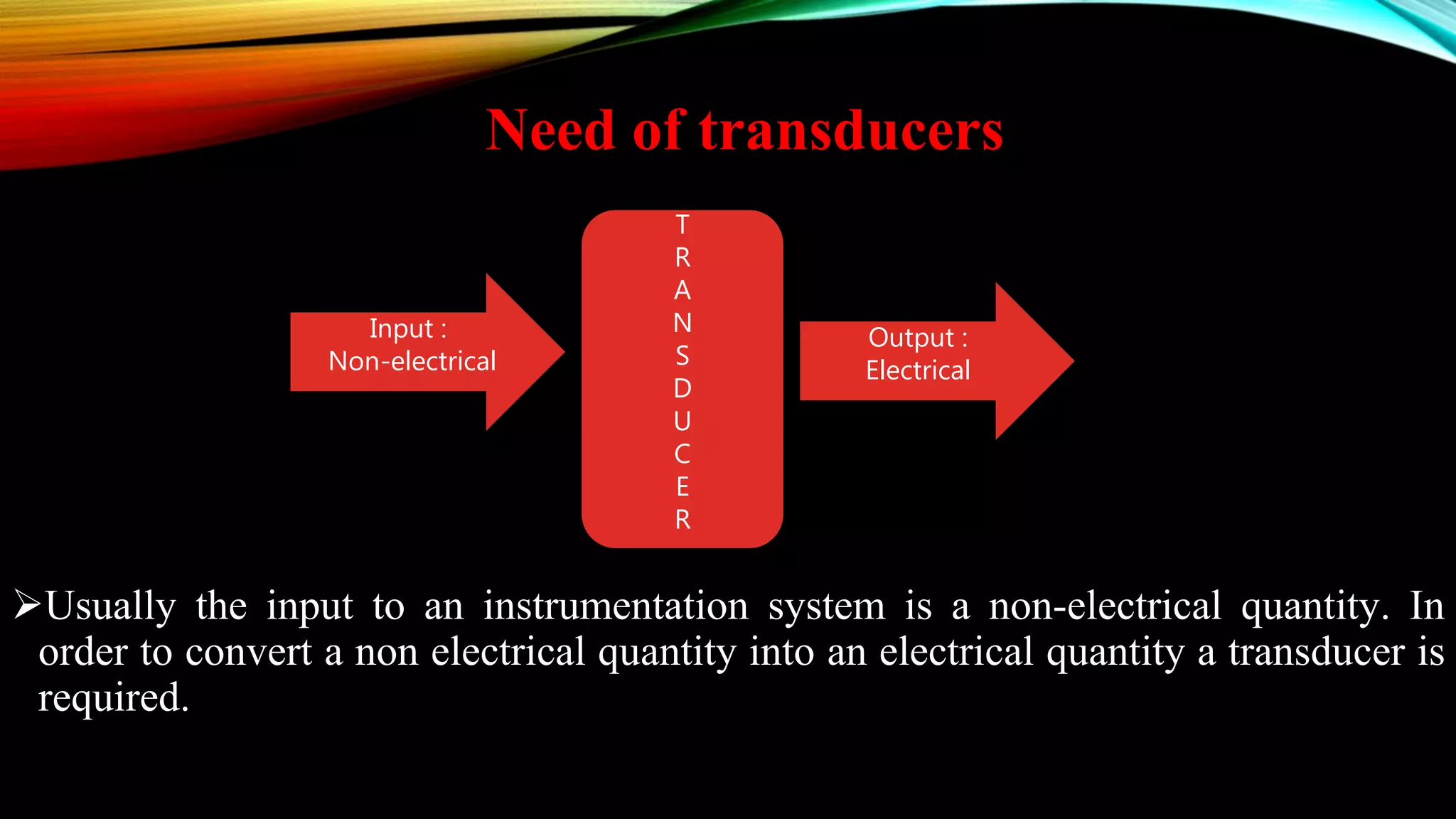
Usually the input to an instrumentation system is a non-electrical quantity. In
order to convert a non electrical quantity into an electrical quantity a transducer is
required.
Input :
Non-electrical
T
R
A
N
S
D
U
C
E
R
Output :
Electrical
CLASSIFICATION OF TRANSDUCERS
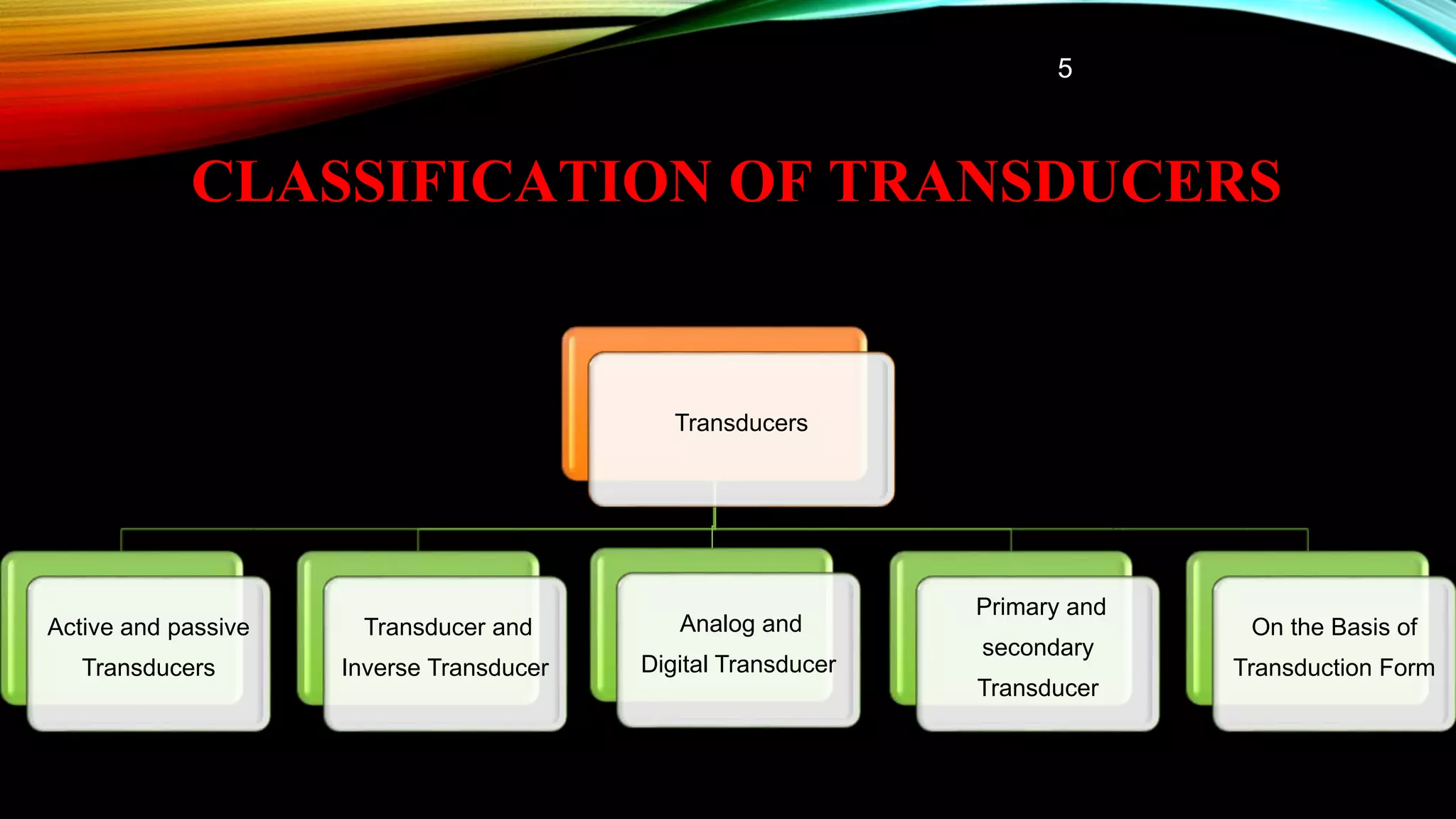
Transducers
Active and passive
Transducers
Transducer and
Inverse Transducer
Analog and
Digital Transducer
Primary and
secondary
Transducer
On the Basis of
Transduction Form
5
ACTIVE AND PASSIVE
TRANSDUCERS
• Active Transducers : The transducers which do not require an external power
supply for their operation are called as active transducers.
Example : Piezoelectric transducers.
• Passive Transducers : The transducers which require an external power supply
for their operation are called as passive transducers.
Example : LVDT
6
TRANSDUCER AND INVERSE
TRANSDUCER
 Transducers as already defined , is a device that converts a non electrical
quantity into an electrical quantity. Normally a transducer and associated circuit
has a non electrical input and an electrical output.
Example : thermocouple , photo conductive cell pressure gauge, Strain
gauge
 It is a device that converts an electrical quantity into a non electrical quantity. it
is a precision actuator having an electrical input and a low power non electrical
output.
Example : piezoelectric crystal
7
ANALOG AND DIGITAL
TRANSDUCERS
Analog transducers : They convert the input physical phenomenon into an
analog output that is a continuous function of time.
Example : LVDT.
Digital Transducers : They convert the input physical phenomenon in
discrete steps of electrical output i.e. in the form of pulses.
Example : Rotary encoders.
8
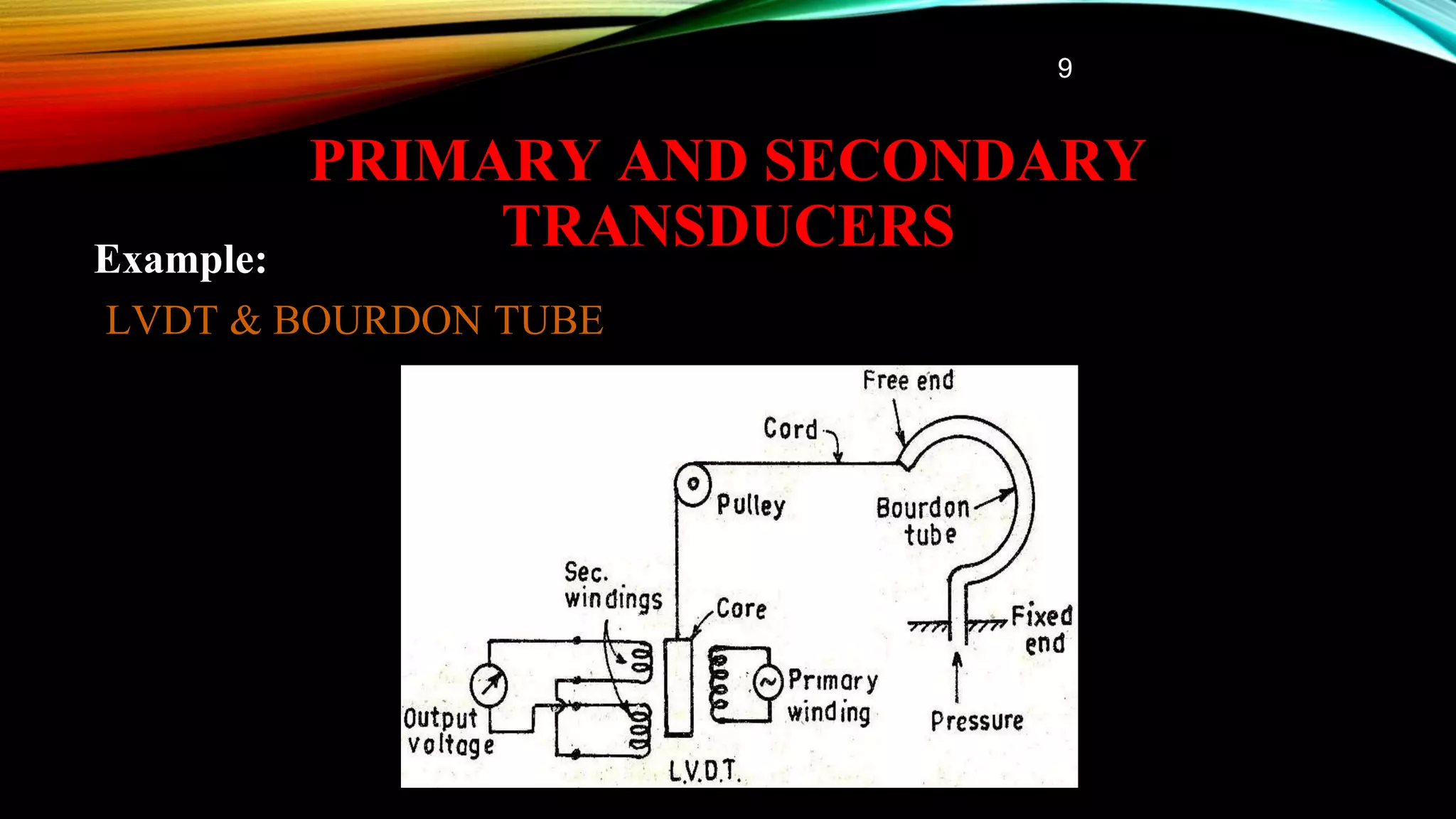
PRIMARY AND SECONDARY
TRANSDUCERSExample:
LVDT & BOURDON TUBE
9
ON THE BASIS OF
TRANSDUCTION FORM USED
• Resistive Transducers.
• Capacitive Transducers.
• Inductive Transducers.
• Voltage and current Generating Transducers.
10
ADVANTAGES
11
 Power requirement is very low for controlling the electrical or electronic system.
 Output can be indicated and recorded remotely from the sensing element.
 Electrical amplification and attenuation can be easily done.
 An amplifier may be used to amplify the electrical signal according to
requirement.
DISADVANTAGES
12
 RTD produce mechanical vibrations
 Their cost is high.
 Thermistors are unsuitable for wide temperature.
 Relative large displacement is required for appreciable output for LVDT.
 Bourdon tube do not provide the precise measurement.
APPLICATIONS
 Loudspeaker, earphone: converts electrical signals into sound.
Antenna: converts propagating electromagnetic waves to and from conducted
electrical signals.
 Hall effect sensor: It converts magnetic field level into an electrical signal.
13
14
CONCLUSION
 Transducers are used to convert one form energy to another.
 All the transducers are very useful in all the application such as microphone,
speakers etc.
THANK
YOU
15

Classification of Transducer

  • 1.
    PRESENTATION ON Classification OfTransducer INDUSTRIAL INSTRUMENT (2170913) Department Of Electrical Engineering B.H.Gardi College Of Engineering & Technology Submitted To:- Asst Prof. Amit A Kulkarni Prepared By:- Jaydeep Chandra (140040109009) 1
  • 2.
    CONTENTS WHAT IS TRANSDUCER NEEDOF TRANSDUCERS CLASSIFICATION OF TRANSDUCERS ADVATAGES  DISADVANTAGES APPLICATION CONCLUSION REFERENCES 2
  • 3.
    WHAT IS TRANSDUCER Thetransducer is defined as the device which convert the one form of energy into another form of the energy Example:  Temperature transducers  Thermocouples  Resistance-Temperature Detectors (RTD)  Thermistors  Resistive position transducers  Displacement transducers  Strain gauge 3
  • 4.
    Need of transducers Usuallythe input to an instrumentation system is a non-electrical quantity. In order to convert a non electrical quantity into an electrical quantity a transducer is required. Input : Non-electrical T R A N S D U C E R Output : Electrical
  • 5.
    CLASSIFICATION OF TRANSDUCERS Transducers Activeand passive Transducers Transducer and Inverse Transducer Analog and Digital Transducer Primary and secondary Transducer On the Basis of Transduction Form 5
  • 6.
    ACTIVE AND PASSIVE TRANSDUCERS •Active Transducers : The transducers which do not require an external power supply for their operation are called as active transducers. Example : Piezoelectric transducers. • Passive Transducers : The transducers which require an external power supply for their operation are called as passive transducers. Example : LVDT 6
  • 7.
    TRANSDUCER AND INVERSE TRANSDUCER Transducers as already defined , is a device that converts a non electrical quantity into an electrical quantity. Normally a transducer and associated circuit has a non electrical input and an electrical output. Example : thermocouple , photo conductive cell pressure gauge, Strain gauge  It is a device that converts an electrical quantity into a non electrical quantity. it is a precision actuator having an electrical input and a low power non electrical output. Example : piezoelectric crystal 7
  • 8.
    ANALOG AND DIGITAL TRANSDUCERS Analogtransducers : They convert the input physical phenomenon into an analog output that is a continuous function of time. Example : LVDT. Digital Transducers : They convert the input physical phenomenon in discrete steps of electrical output i.e. in the form of pulses. Example : Rotary encoders. 8
  • 9.
  • 10.
    ON THE BASISOF TRANSDUCTION FORM USED • Resistive Transducers. • Capacitive Transducers. • Inductive Transducers. • Voltage and current Generating Transducers. 10
  • 11.
    ADVANTAGES 11  Power requirementis very low for controlling the electrical or electronic system.  Output can be indicated and recorded remotely from the sensing element.  Electrical amplification and attenuation can be easily done.  An amplifier may be used to amplify the electrical signal according to requirement.
  • 12.
    DISADVANTAGES 12  RTD producemechanical vibrations  Their cost is high.  Thermistors are unsuitable for wide temperature.  Relative large displacement is required for appreciable output for LVDT.  Bourdon tube do not provide the precise measurement.
  • 13.
    APPLICATIONS  Loudspeaker, earphone:converts electrical signals into sound. Antenna: converts propagating electromagnetic waves to and from conducted electrical signals.  Hall effect sensor: It converts magnetic field level into an electrical signal. 13
  • 14.
    14 CONCLUSION  Transducers areused to convert one form energy to another.  All the transducers are very useful in all the application such as microphone, speakers etc.
  • 15.