Transducers
1
Transducers
• A Transducer is a device which converts one form of
energy into another form.
• Alternatively, a Transducer is defined as a device which
provides usable output response to a specific input
measured which may be a physical quantity.
• A Transducer can also be defined as a device when
actuated by energy in one system supplies energy in the
same form or in another form to a second system.
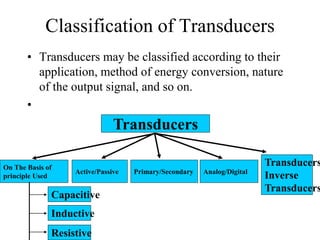
Classification of Transducers
• Transducers may be classified according to their
application, method of energy conversion, nature
of the output signal, and so on.
•
Transducers
On The Basis of
principle Used
Active/Passive Primary/Secondary Analog/Digital
Transducers
Inverse
Transducers
Capacitive
Inductive
Resistive
Active and Passive Transducers
• Active transducers :
• These transducers do not need any external source of power for
their operation. Therefore they are also called as self generating
type transducers.
I. The active transducer are self generating devices which operate
under the energy conversion principle.
II. As the output of active transducers we get an equivalent
electrical output signal e.g. temperature or strain to electric
potential, without any external source of energy being used
Classification of Active Transducers
Example of active transducers
• Piezoelectric Transducer- When an external
force is applied on to a quartz crystal, there will be
a change in the voltage generated across the
surface. This change is measured by its
corresponding value of sound or vibration.
Passive Transducers
• These transducers need external source of power for
their operation. So they are not self generating type
transducers.
• A DC power supply or an audio frequency generator is
used as an external power source.
• These transducers produce the output signal in the
form of variation in electrical parameter like resistance,
capacitance or inductance.
• Examples – Thermistor, Potentiometer type transducer
Primary and Secondary Transducers
• Some transducers contain the mechanical as well as
electrical device. The mechanical device converts the
physical quantity to be measured into a mechanical
signal. Such mechanical device are called as the
primary transducers, because they deal with the
physical quantity to be measured.
• The electrical device then convert this mechanical
signal into a corresponding electrical signal. Such
electrical device are known as secondary transducers.
10
Example of Primary and secondary
transducer
According to Transduction principle
used
Capacitive Transduction:
• Here, the measurand is converted into a change in
capacitance.
• A change in capacitance occurs either by changing
the distance between the two plates or by changing
the dielectric.
d
Area=A
Electromagnetic transduction:
• In electromagnetic transduction, the measurand is
converted to voltage induced in conductor by change
in the magnetic flux, in absence of excitation.
• The electromagnetic transducer are self generating
active transducers
• The motion between a piece of magnet and an
electromagnet is responsible for the change in flux
CLASSIFICATION OF TRANSDUCERS
According to Transduction Principle
PHOTOVOLTAIC TRANSDUCTION :
•In photovoltaic transduction the measurand is
converted to voltage generated when the junction
between dissimilar material is illuminated as shown in
fig.
CLASSIFICATION OF TRANSDUCERS
According to Transduction Principle
PHOTO CONDUCTIVE TRANSDUCTION :
•In photoconductive transduction the measurand is
converted to change in resistance of semiconductor
material by the change in light incident on the material.
Analog and Digital Transducers
Analog transducers:
• These transducers convert the input quantity into an
analog output which is a continuous function of time.
• Thus a strain gauge, an L.V.D.T., a thermocouple or a
thermistor may be called as Analog Transducers as they
give an output which is a continuous function of time.
Digital Transducers:
• These transducers convert the input quantity into an
electrical output which is in the form of pulses and its
output is represented by 0 and 1.
Transducer and Inverse
TransducerTransducer:
• Transducers convert non electrical quantity to
electrical quantity.
Inverse Transducer:
• Inverse transducers convert electrical quantity
to a non electrical quantity. A piezoelectric
crystal acts as an inverse transducer because
when a voltage is applied across its surfaces, it
changes its dimensions causing a mechanical
displacement.
19
TRANSDUCERS SELECTION FACTORS
1. Operating Principle: The transducer are many times selected
on the basis of operating principle used by them. The operating
principle used may be resistive, inductive, capacitive ,
optoelectronic, piezo electric etc.
2. Sensitivity: The transducer must be sensitive enough to
produce detectable output.
3. Operating Range: The transducer should maintain the range
requirement and have a good resolution over the entire range.
4. Accuracy: High accuracy is assured.
5. Cross sensitivity: It has to be taken into account when
measuring mechanical quantities. There are situation where the
actual quantity is being measured is in one plane and the
transducer is subjected to variation in another plan.
6. Errors: The transducer should maintain the expected input-
output relationship as described by the transfer function so as
to avoid errors.
Contd.
7. Transient and frequency response : The transducer should meet
the desired time domain specification like peak overshoot, rise
time, setting time and small dynamic error.
8. Loading Effects: The transducer should have a high input
impedance and low output impedance to avoid loading effects.
9. Environmental Compatibility: It should be assured that the
transducer selected to work under specified environmental
conditions maintains its input- output relationship and does not
break down.
10. Insensitivity to unwanted signals: The transducer should be
minimally sensitive to unwanted signals and highly sensitive to
desired signals.
22
Quantity
being
Measured
Input Device
(Sensor)
Output Device
(Actuator)
Light Level
Light Dependant Resistor (LDR),
Photodiode, Phototransistor, Solar Cell
Lights & Lamps, LED's &
Displays, Fiber Optics
Temperature
Thermocouple, Thermistor, Thermostat,
Resistive temperature detectors (RTD)
Heater, Fan, Peltier
Elements
Force/Pressure
Strain Gauge, Pressure Switch, Load
Cells
Lifts & Jacks,
Electromagnetic, Vibration
Position
Potentiometer, Encoders,
Reflective/Slotted Opto-switch, LVDT
Motor, Solenoid, Panel
Meters
Speed
Tacho-generator, Reflective/Slotted
Opto-coupler, Doppler Effect Sensors
AC and DC Motors,
Stepper Motor, Brake
Sound
Carbon Microphone, Piezo-electric
Crystal
Bell, Buzzer, Loudspeaker
Temperature Transducer:-
1. Resistance temperature detectors (RTD).
2. Thermocouples.
3. Thermistors.
24
27
Circuit symbol thermistor
29
30
31
Thermistors
• High sensitivity to
small temperature
changes
• Temperature
measurements become
more stable with use
• Copper or nickel
extension wires can be
used
• Limited temperature
range
• Fragile
• Some initial accuracy
“drift”
• Decalibration if used
beyond the sensor’s
temperature ratings
• Lack of standards for
replacement
Advantages Disadvantages
Resistance temperature detectors (RTD):-
• Detectors of resistance temperatures
commonly employ platinum, nickel, or
resistance wire elements, whose resistance
variation with temperature has a high
intrinsic accuracy.
• They are available in many configurations
and sizes and as shielded or open units for
both immersion and surface applications.
Resistance temperature detectors (RTD):-
• The relationship between temperature and resistance of
conductors can be calculated from the equation.
Where
R = The resistance of the conductor at temperature t (°C)
Ro = The resistance at the reference temperature, usually 20°C
= The temperature coefficient of resistance
T = The difference between the operating and the reference
Temperature
)1(0 TRR  

Resistance Temperature Detectors
(RTDs)
 Wire wound and thin film
devices.
 Nearly linear over a wide
range of temperatures.
 Can be made small enough to
have response times of a
fraction of a second.
 Require an electrical current
to produce a voltage drop
across the sensor
RTDs
RTD ELEMENT MATERIAL USABLE
TEMPERATURE RANGE
Platinum -260°C to +650°C
Nickel -100°C to +300°C
Copper -75°C to +150°C
Nickel/Iron 0°C to +200°C
37
RTD Applications
 Air conditioning and
refrigeration servicing
 Furnace servicing
 Foodservice
processing
 Medical research
 Textile production
RTDs
• Most stable over time
• Most accurate
• Most repeatable
temperature measurement
• corrosion of the RTD
element
• High cost
• Slowest response time
• Low sensitivity to small
temperature changes
• Sensitive to vibration
(strains the platinum
element wire)
• Decalibration if used
beyond sensor’s
temperature ratings
• Somewhat fragile
Advantages Disadvantages
44
Thermocouples
 Simple, Rugged
 High temperature
operation
 Low cost
 No resistance lead wire
problems
 Point temperature sensing
 Fastest response to
temperature changes
 Least stable, least
repeatable
 Low sensitivity to small
temperature changes
 Extension wire must be of
the same thermocouple
type
 Wire may pick up radiated
electrical noise if not
shielded
 Lowest accuracy
Advantages Disadvantages
Thermocouple Applications
 Plastic injection molding
machinery
 Food processing equipment
 Deicing
 Semiconductor processing
 Heat treating
 Medical equipment
 Industrial heat treating
 Packaging equipment
A little easier to read
Thermocouple
-0.50
0.00
0.50
1.00
1.50
2.00
2.50
3.00
3.50
0 10 20 30 40 50 60 70 80 90
Temperature (∘C)
Voltage(mV)
Thermistor
0.00
20.00
40.00
60.00
80.00
100.00
120.00
0 10 20 30 40 50 60 70 80 90
Temperature (∘C)
Resistance(KΩ)
RTD
100.00
105.00
110.00
115.00
120.00
125.00
130.00
135.00
0 10 20 30 40 50 60 70 80 90
Temperature (∘C)
Resistance(Ω)
Pressure Transducer
48
49
50
51
52
53
54
55
Diaphram / Bellow type
transducer
56
57
58
Bourdon type pressure transducer
59
60
61
Capacitive displacement
transducer
62
63
Capacitive
Pressure Measurement
In a capacitance-type pressure sensor, a high-
frequency, high-voltage oscillator is used to charge the
sensing electrode elements. In a two-plate capacitor
sensor design, the movement of the diaphragm between
the plates is detected as an indication of the changes in
process pressure.
66
67
68
69
70
71
72
Analog Tachometer Digital Tachometer
73
74
75
76
77
78
79
80
81
82
83
84
85
Photo Electric Tachometer
86
87
88

Transducers (1)

  • 1.
  • 3.
    Transducers • A Transduceris a device which converts one form of energy into another form. • Alternatively, a Transducer is defined as a device which provides usable output response to a specific input measured which may be a physical quantity. • A Transducer can also be defined as a device when actuated by energy in one system supplies energy in the same form or in another form to a second system.
  • 4.
    Classification of Transducers •Transducers may be classified according to their application, method of energy conversion, nature of the output signal, and so on. • Transducers On The Basis of principle Used Active/Passive Primary/Secondary Analog/Digital Transducers Inverse Transducers Capacitive Inductive Resistive
  • 5.
    Active and PassiveTransducers • Active transducers : • These transducers do not need any external source of power for their operation. Therefore they are also called as self generating type transducers. I. The active transducer are self generating devices which operate under the energy conversion principle. II. As the output of active transducers we get an equivalent electrical output signal e.g. temperature or strain to electric potential, without any external source of energy being used
  • 6.
  • 7.
    Example of activetransducers • Piezoelectric Transducer- When an external force is applied on to a quartz crystal, there will be a change in the voltage generated across the surface. This change is measured by its corresponding value of sound or vibration.
  • 8.
    Passive Transducers • Thesetransducers need external source of power for their operation. So they are not self generating type transducers. • A DC power supply or an audio frequency generator is used as an external power source. • These transducers produce the output signal in the form of variation in electrical parameter like resistance, capacitance or inductance. • Examples – Thermistor, Potentiometer type transducer
  • 9.
    Primary and SecondaryTransducers • Some transducers contain the mechanical as well as electrical device. The mechanical device converts the physical quantity to be measured into a mechanical signal. Such mechanical device are called as the primary transducers, because they deal with the physical quantity to be measured. • The electrical device then convert this mechanical signal into a corresponding electrical signal. Such electrical device are known as secondary transducers.
  • 10.
    10 Example of Primaryand secondary transducer
  • 11.
  • 12.
    Capacitive Transduction: • Here,the measurand is converted into a change in capacitance. • A change in capacitance occurs either by changing the distance between the two plates or by changing the dielectric. d Area=A
  • 13.
    Electromagnetic transduction: • Inelectromagnetic transduction, the measurand is converted to voltage induced in conductor by change in the magnetic flux, in absence of excitation. • The electromagnetic transducer are self generating active transducers • The motion between a piece of magnet and an electromagnet is responsible for the change in flux
  • 15.
    CLASSIFICATION OF TRANSDUCERS Accordingto Transduction Principle PHOTOVOLTAIC TRANSDUCTION : •In photovoltaic transduction the measurand is converted to voltage generated when the junction between dissimilar material is illuminated as shown in fig.
  • 16.
    CLASSIFICATION OF TRANSDUCERS Accordingto Transduction Principle PHOTO CONDUCTIVE TRANSDUCTION : •In photoconductive transduction the measurand is converted to change in resistance of semiconductor material by the change in light incident on the material.
  • 17.
    Analog and DigitalTransducers Analog transducers: • These transducers convert the input quantity into an analog output which is a continuous function of time. • Thus a strain gauge, an L.V.D.T., a thermocouple or a thermistor may be called as Analog Transducers as they give an output which is a continuous function of time. Digital Transducers: • These transducers convert the input quantity into an electrical output which is in the form of pulses and its output is represented by 0 and 1.
  • 18.
    Transducer and Inverse TransducerTransducer: •Transducers convert non electrical quantity to electrical quantity. Inverse Transducer: • Inverse transducers convert electrical quantity to a non electrical quantity. A piezoelectric crystal acts as an inverse transducer because when a voltage is applied across its surfaces, it changes its dimensions causing a mechanical displacement.
  • 19.
  • 20.
    TRANSDUCERS SELECTION FACTORS 1.Operating Principle: The transducer are many times selected on the basis of operating principle used by them. The operating principle used may be resistive, inductive, capacitive , optoelectronic, piezo electric etc. 2. Sensitivity: The transducer must be sensitive enough to produce detectable output. 3. Operating Range: The transducer should maintain the range requirement and have a good resolution over the entire range. 4. Accuracy: High accuracy is assured. 5. Cross sensitivity: It has to be taken into account when measuring mechanical quantities. There are situation where the actual quantity is being measured is in one plane and the transducer is subjected to variation in another plan. 6. Errors: The transducer should maintain the expected input- output relationship as described by the transfer function so as to avoid errors.
  • 21.
    Contd. 7. Transient andfrequency response : The transducer should meet the desired time domain specification like peak overshoot, rise time, setting time and small dynamic error. 8. Loading Effects: The transducer should have a high input impedance and low output impedance to avoid loading effects. 9. Environmental Compatibility: It should be assured that the transducer selected to work under specified environmental conditions maintains its input- output relationship and does not break down. 10. Insensitivity to unwanted signals: The transducer should be minimally sensitive to unwanted signals and highly sensitive to desired signals.
  • 22.
    22 Quantity being Measured Input Device (Sensor) Output Device (Actuator) LightLevel Light Dependant Resistor (LDR), Photodiode, Phototransistor, Solar Cell Lights & Lamps, LED's & Displays, Fiber Optics Temperature Thermocouple, Thermistor, Thermostat, Resistive temperature detectors (RTD) Heater, Fan, Peltier Elements Force/Pressure Strain Gauge, Pressure Switch, Load Cells Lifts & Jacks, Electromagnetic, Vibration Position Potentiometer, Encoders, Reflective/Slotted Opto-switch, LVDT Motor, Solenoid, Panel Meters Speed Tacho-generator, Reflective/Slotted Opto-coupler, Doppler Effect Sensors AC and DC Motors, Stepper Motor, Brake Sound Carbon Microphone, Piezo-electric Crystal Bell, Buzzer, Loudspeaker
  • 23.
    Temperature Transducer:- 1. Resistancetemperature detectors (RTD). 2. Thermocouples. 3. Thermistors.
  • 24.
  • 27.
  • 29.
  • 30.
  • 31.
  • 32.
    Thermistors • High sensitivityto small temperature changes • Temperature measurements become more stable with use • Copper or nickel extension wires can be used • Limited temperature range • Fragile • Some initial accuracy “drift” • Decalibration if used beyond the sensor’s temperature ratings • Lack of standards for replacement Advantages Disadvantages
  • 33.
    Resistance temperature detectors(RTD):- • Detectors of resistance temperatures commonly employ platinum, nickel, or resistance wire elements, whose resistance variation with temperature has a high intrinsic accuracy. • They are available in many configurations and sizes and as shielded or open units for both immersion and surface applications.
  • 34.
    Resistance temperature detectors(RTD):- • The relationship between temperature and resistance of conductors can be calculated from the equation. Where R = The resistance of the conductor at temperature t (°C) Ro = The resistance at the reference temperature, usually 20°C = The temperature coefficient of resistance T = The difference between the operating and the reference Temperature )1(0 TRR   
  • 35.
    Resistance Temperature Detectors (RTDs) Wire wound and thin film devices.  Nearly linear over a wide range of temperatures.  Can be made small enough to have response times of a fraction of a second.  Require an electrical current to produce a voltage drop across the sensor
  • 36.
    RTDs RTD ELEMENT MATERIALUSABLE TEMPERATURE RANGE Platinum -260°C to +650°C Nickel -100°C to +300°C Copper -75°C to +150°C Nickel/Iron 0°C to +200°C
  • 37.
  • 38.
    RTD Applications  Airconditioning and refrigeration servicing  Furnace servicing  Foodservice processing  Medical research  Textile production
  • 39.
    RTDs • Most stableover time • Most accurate • Most repeatable temperature measurement • corrosion of the RTD element • High cost • Slowest response time • Low sensitivity to small temperature changes • Sensitive to vibration (strains the platinum element wire) • Decalibration if used beyond sensor’s temperature ratings • Somewhat fragile Advantages Disadvantages
  • 44.
  • 45.
    Thermocouples  Simple, Rugged High temperature operation  Low cost  No resistance lead wire problems  Point temperature sensing  Fastest response to temperature changes  Least stable, least repeatable  Low sensitivity to small temperature changes  Extension wire must be of the same thermocouple type  Wire may pick up radiated electrical noise if not shielded  Lowest accuracy Advantages Disadvantages
  • 46.
    Thermocouple Applications  Plasticinjection molding machinery  Food processing equipment  Deicing  Semiconductor processing  Heat treating  Medical equipment  Industrial heat treating  Packaging equipment
  • 47.
    A little easierto read Thermocouple -0.50 0.00 0.50 1.00 1.50 2.00 2.50 3.00 3.50 0 10 20 30 40 50 60 70 80 90 Temperature (∘C) Voltage(mV) Thermistor 0.00 20.00 40.00 60.00 80.00 100.00 120.00 0 10 20 30 40 50 60 70 80 90 Temperature (∘C) Resistance(KΩ) RTD 100.00 105.00 110.00 115.00 120.00 125.00 130.00 135.00 0 10 20 30 40 50 60 70 80 90 Temperature (∘C) Resistance(Ω)
  • 48.
  • 49.
  • 50.
  • 51.
  • 52.
  • 53.
  • 54.
  • 55.
  • 56.
    Diaphram / Bellowtype transducer 56
  • 57.
  • 58.
  • 59.
    Bourdon type pressuretransducer 59
  • 60.
  • 61.
  • 62.
  • 63.
  • 64.
    Capacitive Pressure Measurement In acapacitance-type pressure sensor, a high- frequency, high-voltage oscillator is used to charge the sensing electrode elements. In a two-plate capacitor sensor design, the movement of the diaphragm between the plates is detected as an indication of the changes in process pressure.
  • 66.
  • 67.
  • 68.
  • 69.
  • 70.
  • 71.
  • 72.
  • 73.
  • 74.
  • 75.
  • 76.
  • 77.
  • 78.
  • 79.
  • 80.
  • 81.
  • 82.
  • 83.
  • 84.
  • 85.
  • 86.
  • 87.
  • 88.