By - Prof. Biswajit Karmakar
Lecturer- Electrical Engg
( KPC )
 At the end of this session you would be able to
know :-
 1. What is signal conditioning circuits.
 2. What are the functions of a signal
conditioning circuit
 3. Examples of SCC
 4. Real time usage
 Introduction
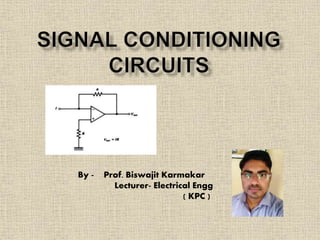
 In electronics, signal conditioning is the manipulation of
an analog signal in such a way that it meets the
requirements of the next stage for further processing.
 In an analog-to-digital converter , signal conditioning
includes voltage or current limiting and anti-aliasing
filtering.
 In control engineering it is common to have a sensing stage
which consists of a sensor, a signal conditioning stage
where usually amplification of the signal is done and a
processing stage (often carried out by an ADC and a micro-
controller). Operational amplifiers (op-amps) are commonly
employed to carry out the amplification of the signal in the
signal conditioning stages.
 Inputs
 Signal inputs accepted by signal conditioners
include DC voltage and current, AC voltage and
current, frequency and electric charge. Sensor inputs
canbe accelerometer, thermocouple, thermistor,
resistance ,thermometer, strain gauge or bridge,
and LVDT or RVDT. Specialized inputs include
encoder, counter or tachometer, timer or clock, relay or
switch, and other specialized inputs.
 Outputs
 Outputs for signal conditioning equipment can be
voltage, current, frequency, timer or counter, relay,
resistance or potentiometer, and other specialized
outputs.
 Processing
 Signal conditioning can include amplification, filtering,
converting, range matching, isolation and any other
processes required to make sensor output suitable for
processing after conditioning.
 Filtering
 Filtering is the most common signal conditioning
function, as usually not all the signal frequency
spectrum contains valid data. The common example is
50/60 Hz AC power lines, present in most
environments, which cause noise if amplified.
 Amplification
 Signal amplification performs two important functions:
increases the resolution of the input signal, and
increases its signal-to-noise ratio.
 For example- the output of an electronic temperature
sensor, which is probably in the milli-volts range is probably
too low for an analog-to-digital converter (ADC) to process
directly. In this case it is necessary to bring the voltage level
up to that required by the ADC.
 Commonly used amplifiers used for signal
conditioning include sample and hold amplifiers, peak
detectors, log amplifiers, antilog amplifiers,
instrumentation amplifiers and programmable gain
amplifiers
 Attenuation
 Attenuation, the opposite of amplification, is necessary
when voltages to be digitized are beyond the ADC range.
This form of signal conditioning decreases the input signal
amplitude so that the conditioned signal is within ADC
range. Attenuation is typically necessary when measuring
voltages that are more than 10 V.
 Excitation
 External power is required for the operation of an active
sensor. (E.g. a temperature sensor like a thermistor & RTD, a
pressure sensor (piezo-resistive and capacitive), etc.). The
stability and precision of the excitation signal directly relates
to the sensor accuracy and stability.
 Linearization
 Linearization is necessary when sensors produce voltage
signals that are not linearly related to the physical
measurement. Linearization is the process of interpreting
the signal from the sensor and can be done either with
signal conditioning or through software.
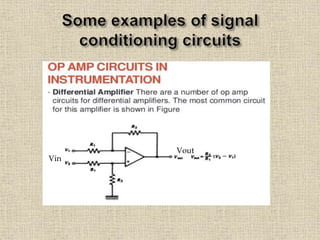
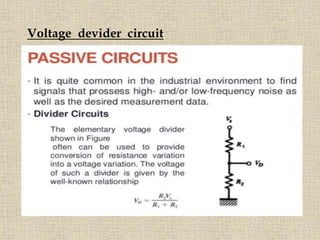
Vout
Vin
Voltage devider circuit
 We have seen that how a signal conditioning
circuit does the manipulation of an analog
signal in such a way that it meets the
requirements of the next stage for further
processing.
 1. List out five different types of signal
conditioning units used in electronics circuits,
Draw the ciruit diagrams and briefly define
them.
 2. What do you mean by OP-AMP ? Draw its
basic circuit diagram and explain its operaion.
1. https://web.itu.edu.tr/yalcinme/files/courses/MMG
/ch3_1%20SignalConditioning.pdf
2. Sensors and Signal Conditioning, 2nd Edition
by Ramón Pallás-Areny, John G. Webster : in this new
edition
3. https://www.analog.com/en/education/education-
library/practical-design-techniques-sensor-signal-
conditioning.html
Signal conditioning
Signal conditioning

Signal conditioning

  • 1.
    By - Prof.Biswajit Karmakar Lecturer- Electrical Engg ( KPC )
  • 2.
     At theend of this session you would be able to know :-  1. What is signal conditioning circuits.  2. What are the functions of a signal conditioning circuit  3. Examples of SCC  4. Real time usage
  • 3.
     Introduction  Inelectronics, signal conditioning is the manipulation of an analog signal in such a way that it meets the requirements of the next stage for further processing.  In an analog-to-digital converter , signal conditioning includes voltage or current limiting and anti-aliasing filtering.  In control engineering it is common to have a sensing stage which consists of a sensor, a signal conditioning stage where usually amplification of the signal is done and a processing stage (often carried out by an ADC and a micro- controller). Operational amplifiers (op-amps) are commonly employed to carry out the amplification of the signal in the signal conditioning stages.
  • 4.
     Inputs  Signalinputs accepted by signal conditioners include DC voltage and current, AC voltage and current, frequency and electric charge. Sensor inputs canbe accelerometer, thermocouple, thermistor, resistance ,thermometer, strain gauge or bridge, and LVDT or RVDT. Specialized inputs include encoder, counter or tachometer, timer or clock, relay or switch, and other specialized inputs.  Outputs  Outputs for signal conditioning equipment can be voltage, current, frequency, timer or counter, relay, resistance or potentiometer, and other specialized outputs.
  • 5.
     Processing  Signalconditioning can include amplification, filtering, converting, range matching, isolation and any other processes required to make sensor output suitable for processing after conditioning.  Filtering  Filtering is the most common signal conditioning function, as usually not all the signal frequency spectrum contains valid data. The common example is 50/60 Hz AC power lines, present in most environments, which cause noise if amplified.
  • 6.
     Amplification  Signalamplification performs two important functions: increases the resolution of the input signal, and increases its signal-to-noise ratio.  For example- the output of an electronic temperature sensor, which is probably in the milli-volts range is probably too low for an analog-to-digital converter (ADC) to process directly. In this case it is necessary to bring the voltage level up to that required by the ADC.  Commonly used amplifiers used for signal conditioning include sample and hold amplifiers, peak detectors, log amplifiers, antilog amplifiers, instrumentation amplifiers and programmable gain amplifiers
  • 7.
     Attenuation  Attenuation,the opposite of amplification, is necessary when voltages to be digitized are beyond the ADC range. This form of signal conditioning decreases the input signal amplitude so that the conditioned signal is within ADC range. Attenuation is typically necessary when measuring voltages that are more than 10 V.  Excitation  External power is required for the operation of an active sensor. (E.g. a temperature sensor like a thermistor & RTD, a pressure sensor (piezo-resistive and capacitive), etc.). The stability and precision of the excitation signal directly relates to the sensor accuracy and stability.  Linearization  Linearization is necessary when sensors produce voltage signals that are not linearly related to the physical measurement. Linearization is the process of interpreting the signal from the sensor and can be done either with signal conditioning or through software.
  • 8.
  • 10.
  • 11.
     We haveseen that how a signal conditioning circuit does the manipulation of an analog signal in such a way that it meets the requirements of the next stage for further processing.
  • 12.
     1. Listout five different types of signal conditioning units used in electronics circuits, Draw the ciruit diagrams and briefly define them.  2. What do you mean by OP-AMP ? Draw its basic circuit diagram and explain its operaion.
  • 13.
    1. https://web.itu.edu.tr/yalcinme/files/courses/MMG /ch3_1%20SignalConditioning.pdf 2. Sensorsand Signal Conditioning, 2nd Edition by Ramón Pallás-Areny, John G. Webster : in this new edition 3. https://www.analog.com/en/education/education- library/practical-design-techniques-sensor-signal- conditioning.html