UNIT 4
Transducers, Instruments & Sensors
• Unit-4 –Transducers and Sensors
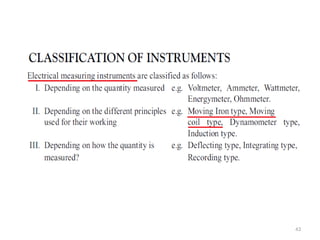
Basic principles and classification of Instruments- Moving Coil
instruments, Moving Iron instruments, Digital Multimeter, Digital
storage Oscilloscope. Transducer- Classification- Capacitive and
Inductive transducers, Linear Variable Differential Transformer
(LVDT), Thermistors, Thermocouple, Piezoelectric transducer,
Photoelectric transducer, Hall effect transducers, Introduction to
Opto-electronics Devices, Light Dependent Resistor (LDR),
Photodiodes, Phototransistors, Photovoltaic cells (solar cells),
Opto-couplers, Liquid crystal display, Proximity sensor, IR
sensor, Pressure sensor, Introduction to Bio sensor, Sensors for
smart building.
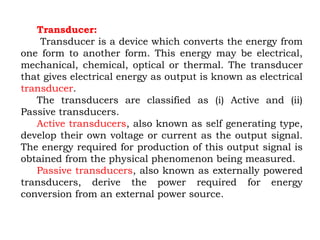
Transducer:
Transducer is a device which converts the energy from
one form to another form. This energy may be electrical,
mechanical, chemical, optical or thermal. The transducer
that gives electrical energy as output is known as electrical
transducer.
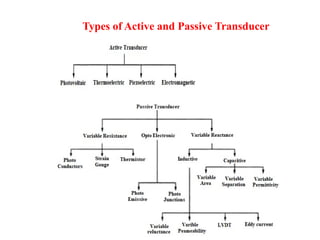
The transducers are classified as (i) Active and (ii)
Passive transducers.
Active transducers, also known as self generating type,
develop their own voltage or current as the output signal.
The energy required for production of this output signal is
obtained from the physical phenomenon being measured.
Passive transducers, also known as externally powered
transducers, derive the power required for energy
conversion from an external power source.
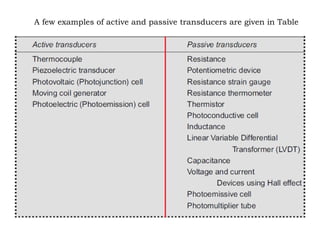
A few examples of active and passive transducers are given in Table
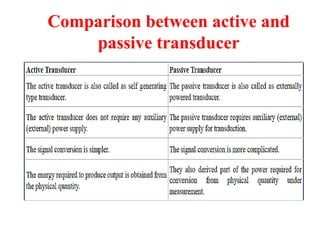
Comparison between active and
passive transducer
Requirements for Transducer
Linearity: Have linear input output characteristics
Repeatability: Produce the same result when the same input signal is applied
repeatedly under same environmental conditions
Ruggedness: Capable of withstanding overload.
High Signal To Noise Ratio: Free from the internal and external noise
Highly Reliable: Possess minimum error in measurement
Good Dynamic Response: Must withstand sudden changes in input
No Hysteresis: Produce similar result while input signal is varied from its low
value to high value and vice versa.
Residual Deformation: No deformation of testing material
Types of Active and Passive Transducer
Displacement Transducer
Define : A Displacement Transducer is an electromechanical
device used to convert mechanical motion or vibrations into a
variable electric signals.
Types:
Capacitive Transducer
Inductive
Variable Inductance
Linear Variable Differential Transformer
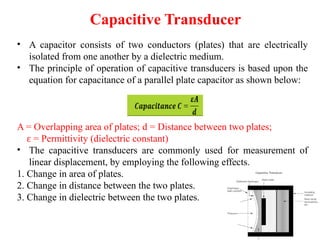
Capacitive Transducer
• A capacitor consists of two conductors (plates) that are electrically
isolated from one another by a dielectric medium.
• The principle of operation of capacitive transducers is based upon the
equation for capacitance of a parallel plate capacitor as shown below:
A = Overlapping area of plates; d = Distance between two plates;
= Permittivity (dielectric constant)
ɛ
• The capacitive transducers are commonly used for measurement of
linear displacement, by employing the following effects.
1. Change in area of plates.
2. Change in distance between the two plates.
3. Change in dielectric between the two plates.
Capacitive Transducer Contd..
Variable capacitance pressure gauge
Principle of operation: Distance between two parallel plates is varied by
an externally applied force.
Applications: Measurement of Displacement, pressure.
Capacitor microphone
Principle of operation: Sound pressure varies the capacitance between a
fixed plate and a movable diaphragm.
Applications: Speech, music, noise.
Dielectric gauge
Principle of operation: Variation in capacitance by changes in the
dielectric.
Applications: Liquid level, thickness.
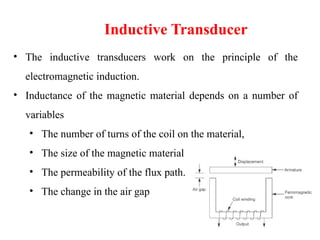
• The inductive transducers work on the principle of the
electromagnetic induction.
• Inductance of the magnetic material depends on a number of
variables
• The number of turns of the coil on the material,
• The size of the magnetic material
• The permeability of the flux path.
• The change in the air gap
Inductive Transducer
Magnetic circuit transducer: Self inductance or mutual inductance of ac-excited coil
is varied by changes in the magnetic circuit. Applications: Pressure, displacement.
Reluctance pickup: Reluctance of the magnetic circuit is varied by changing the
position of the iron core of a coil. Applications: Pressure, displacement, vibration,
position.
Differential transformer: The differential voltage of two secondary windings of a
transformer is varied by positioning the magnetic core through an externally applied
force. Applications: Pressure, force, displacement, position.
Eddy current gauge: Inductance of a coil is varied by the proximity of an eddy
current plate. Applications: Displacement, thickness.
Magnetostriction gauge: Magnetic properties are varied by pressure and stress.
Applications: Force, pressure, sound.
Inductive Transducer Contd..
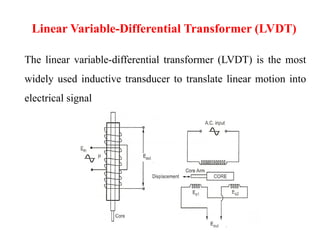
The linear variable-differential transformer (LVDT) is the most
widely used inductive transducer to translate linear motion into
electrical signal
Linear Variable-Differential Transformer (LVDT)
• Consists of a primary winding and two secondary windings.
• A ferro-magnetic core(armature) in the shape of a rod or cylinder is
attached to the transducer sensing which slides freely within the
hollow portion of the bobbin.
• An a.c. excitation is applied across the primary winding and the
movable core varies the coupling between it and the two secondary
windings.
• As the core moves away from the centre position, the coupling to one
secondary becomes more and hence its output voltage increases, while
the coupling and the output voltage of the other secondary decreases.
Construction of LVDT
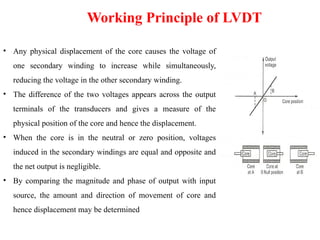
• Any physical displacement of the core causes the voltage of
one secondary winding to increase while simultaneously,
reducing the voltage in the other secondary winding.
• The difference of the two voltages appears across the output
terminals of the transducers and gives a measure of the
physical position of the core and hence the displacement.
• When the core is in the neutral or zero position, voltages
induced in the secondary windings are equal and opposite and
the net output is negligible.
• By comparing the magnitude and phase of output with input
source, the amount and direction of movement of core and
hence displacement may be determined
Working Principle of LVDT
Advt: 1. High Range -1.25mm to 250mm.
2. Low hysteresis
3. Simple, light in weight and easy to maintain.
4. Low Power Consumption
Disadvt: 1. They are sensitive to stray magnetic fields but shielding is
possible.
2. Temperature affects the performance of transducer.
Uses: 1. The LVDT can be used in all applications where displacements
ranging from fraction of a mm to a few cm have to be measured.
2. Acting as a secondary transducer it can be used as a device to
measure force, weight and pressure.
Advt, Disadvt and Uses of LVDT
Define – Converts Temperature to electrical signal and vice versa
Types -
1. RTD (Resistance Temperature Detector) -To predict change in
electrical resistance of some materials with changing temperature.
2. Thermocouple - To convert thermal potential difference into
electric potential difference.
3. Thermistor - Exhibits a large change in resistance proportional
to a small change in temperature.
Thermoelectric Transducers
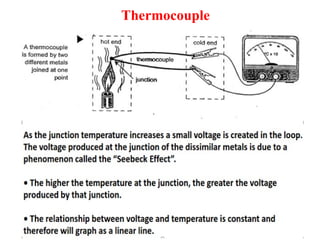
Thermocouple
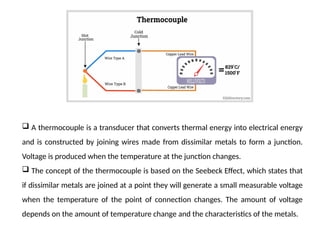
 A thermocouple is a transducer that converts thermal energy into electrical energy
and is constructed by joining wires made from dissimilar metals to form a junction.
Voltage is produced when the temperature at the junction changes.
 The concept of the thermocouple is based on the Seebeck Effect, which states that
if dissimilar metals are joined at a point they will generate a small measurable voltage
when the temperature of the point of connection changes. The amount of voltage
depends on the amount of temperature change and the characteristics of the metals.
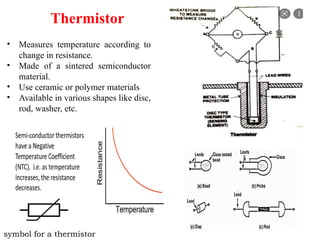
Thermistor
• Measures temperature according to
change in resistance.
• Made of a sintered semiconductor
material.
• Use ceramic or polymer materials
• Available in various shapes like disc,
rod, washer, etc.
symbol for a thermistor
• Working Principle of Thermistors
The thermistor works on the simple principle of change in
resistance due to a change in temperature. When the ambient
temperature changes the thermistor starts self-heating its
elements. its resistance value is changed with respect to this
change in temperature. This change depends on the type of
thermistor used. The resistance temperature characteristics of
different types of thermistors are given in the following section.
• Types of Thermistors
The two basic types of thermistors available are the NTC and
PTC types.
Define : Converts light energy to electrical energy and vice versa.
Types:
• Laser diode, light-emitting diode - convert electrical power into
forms of light.
• Photodiode, photo resistor (LDR), phototransistor,
photomultiplier tube - converts changing light levels into
electrical form.
Photoelectric Transducers
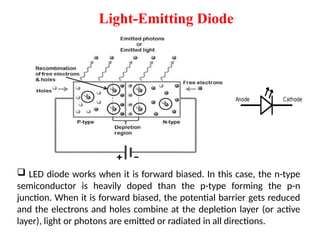
Light-Emitting Diode
 LED diode works when it is forward biased. In this case, the n-type
semiconductor is heavily doped than the p-type forming the p-n
junction. When it is forward biased, the potential barrier gets reduced
and the electrons and holes combine at the depletion layer (or active
layer), light or photons are emitted or radiated in all directions.
Light-Emitting Diode
• When sufficient voltage is applied to the chip across the leads of the LED, electrons
can move easily in only one direction across the junction between the p and n
regions.
• When a voltage is applied and the current starts to flow, electrons in the n region
have sufficient energy to move across the junction into the p region.
• Each time an electron recombines with a positive charge, electric potential energy is
converted into electromagnetic energy. • For each recombination of a negative and a
positive charge, a quantum of electromagnetic energy is emitted in the form of a
photon of light with a frequency characteristic of the semi-conductor material.
• LEDs are made from gallium-based crystals that contain one or more additional
materials such as phosphorous to produce a distinct color. • Different LED chip
technologies emit light in specific regions of the visible light spectrum and produce
different intensity levels.
• LEDs are available in red, orange, amber, yellow, green, blue and white.
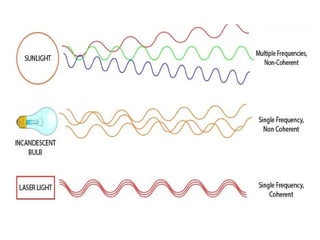
Laser Diode
• LASER stands for Light Amplification by Stimulated Emission
of Radiation.
• A laser diode is an electronic device, which converts electrical
energy into light energy to produce high-intensity coherent light.
• Laser diode is very small in size and appearance.
• It is similar to a transistor and has operation like LED but it emit
coherent light.
• The material which often used in Laser diode is the gallium
Arsenide (GaAs).
• It work on forward biasing.
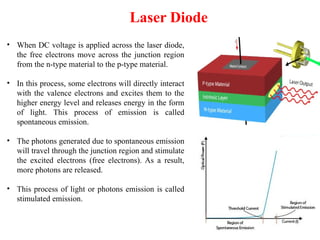
Laser Diode
• When DC voltage is applied across the laser diode,
the free electrons move across the junction region
from the n-type material to the p-type material.
• In this process, some electrons will directly interact
with the valence electrons and excites them to the
higher energy level and releases energy in the form
of light. This process of emission is called
spontaneous emission.
• The photons generated due to spontaneous emission
will travel through the junction region and stimulate
the excited electrons (free electrons). As a result,
more photons are released.
• This process of light or photons emission is called
stimulated emission.
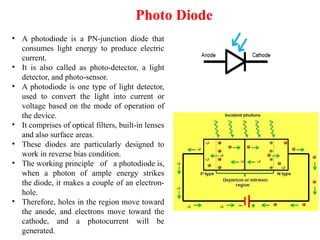
Photo Diode
• A photodiode is a PN-junction diode that
consumes light energy to produce electric
current.
• It is also called as photo-detector, a light
detector, and photo-sensor.
• A photodiode is one type of light detector,
used to convert the light into current or
voltage based on the mode of operation of
the device.
• It comprises of optical filters, built-in lenses
and also surface areas.
• These diodes are particularly designed to
work in reverse bias condition.
• The working principle of a photodiode is,
when a photon of ample energy strikes
the diode, it makes a couple of an electron-
hole.
• Therefore, holes in the region move toward
the anode, and electrons move toward the
cathode, and a photocurrent will be
generated.
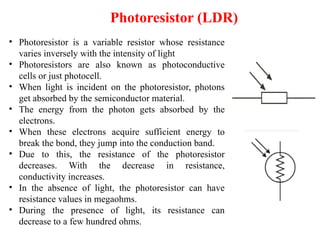
Photoresistor (LDR)
• Photoresistor is a variable resistor whose resistance
varies inversely with the intensity of light
• Photoresistors are also known as photoconductive
cells or just photocell.
• When light is incident on the photoresistor, photons
get absorbed by the semiconductor material.
• The energy from the photon gets absorbed by the
electrons.
• When these electrons acquire sufficient energy to
break the bond, they jump into the conduction band.
• Due to this, the resistance of the photoresistor
decreases. With the decrease in resistance,
conductivity increases.
• In the absence of light, the photoresistor can have
resistance values in megaohms.
• During the presence of light, its resistance can
decrease to a few hundred ohms.
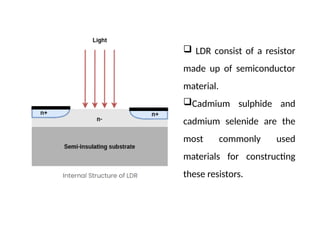
 LDR consist of a resistor
made up of semiconductor
material.
Cadmium sulphide and
cadmium selenide are the
most commonly used
materials for constructing
these resistors.
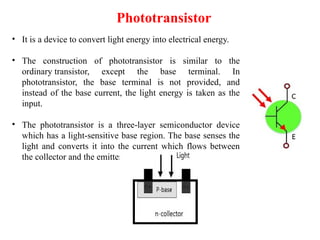
Phototransistor
• It is a device to convert light energy into electrical energy.
• The construction of phototransistor is similar to the
ordinary transistor, except the base terminal. In
phototransistor, the base terminal is not provided, and
instead of the base current, the light energy is taken as the
input.
• The phototransistor is a three-layer semiconductor device
which has a light-sensitive base region. The base senses the
light and converts it into the current which flows between
the collector and the emitter region.
Photovoltaic or Solar Cell
• The Photovoltaic cell is the semiconductor
device that converts the light into electrical
energy.
• The voltage induces by the PV cell depends on
the intensity of light incident on it.
• The semiconductor materials like arsenide,
indium, cadmium, silicon, selenium and
gallium are used for making the PV cells.
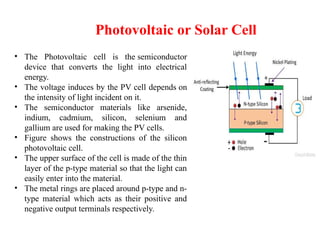
• Figure shows the constructions of the silicon
photovoltaic cell.
• The upper surface of the cell is made of the thin
layer of the p-type material so that the light can
easily enter into the material.
• The metal rings are placed around p-type and n-
type material which acts as their positive and
negative output terminals respectively.
Photovoltaic or Solar Cell
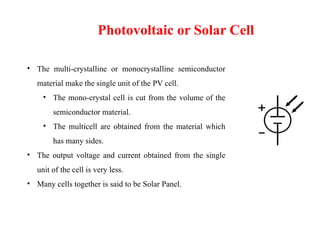
• The multi-crystalline or monocrystalline semiconductor
material make the single unit of the PV cell.
• The mono-crystal cell is cut from the volume of the
semiconductor material.
• The multicell are obtained from the material which
has many sides.
• The output voltage and current obtained from the single
unit of the cell is very less.
• Many cells together is said to be Solar Panel.
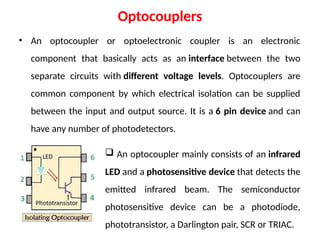
Optocouplers
• An optocoupler or optoelectronic coupler is an electronic
component that basically acts as an interface between the two
separate circuits with different voltage levels. Optocouplers are
common component by which electrical isolation can be supplied
between the input and output source. It is a 6 pin device and can
have any number of photodetectors.
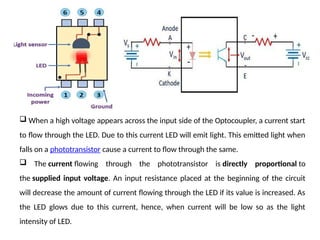
 An optocoupler mainly consists of an infrared
LED and a photosensitive device that detects the
emitted infrared beam. The semiconductor
photosensitive device can be a photodiode,
phototransistor, a Darlington pair, SCR or TRIAC.
 When a high voltage appears across the input side of the Optocoupler, a current start
to flow through the LED. Due to this current LED will emit light. This emitted light when
falls on a phototransistor cause a current to flow through the same.
 The current flowing through the phototransistor is directly proportional to
the supplied input voltage. An input resistance placed at the beginning of the circuit
will decrease the amount of current flowing through the LED if its value is increased. As
the LED glows due to this current, hence, when current will be low so as the light
intensity of LED.
Piezoelectric Transducer
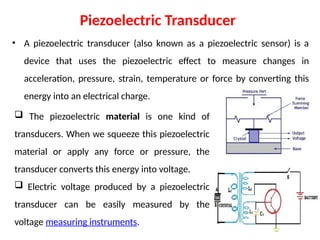
• A piezoelectric transducer (also known as a piezoelectric sensor) is a
device that uses the piezoelectric effect to measure changes in
acceleration, pressure, strain, temperature or force by converting this
energy into an electrical charge.
 The piezoelectric material is one kind of
transducers. When we squeeze this piezoelectric
material or apply any force or pressure, the
transducer converts this energy into voltage.
 Electric voltage produced by a piezoelectric
transducer can be easily measured by the
voltage measuring instruments.
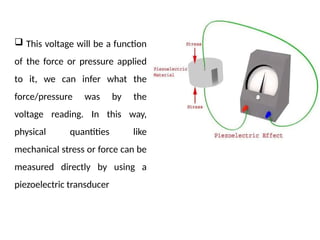
 This voltage will be a function
of the force or pressure applied
to it, we can infer what the
force/pressure was by the
voltage reading. In this way,
physical quantities like
mechanical stress or force can be
measured directly by using a
piezoelectric transducer
Hall Effect Transducer
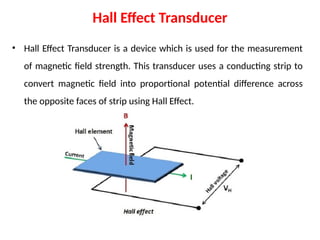
• Hall Effect Transducer is a device which is used for the measurement
of magnetic field strength. This transducer uses a conducting strip to
convert magnetic field into proportional potential difference across
the opposite faces of strip using Hall Effect.
• Hall Effect is basically the process of development of potential
difference across the two faces of a current carrying strip when
the strip is kept in a magnetic field.
• The magnitude of voltage depends upon the current, strength of
magnetic field and the property of conducting material. The Hall
Effect is found in conducting material and semiconductor in
varying amount depending upon the density and mobility of
current carrier.
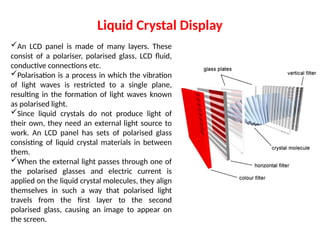
Liquid Crystal Display
An LCD panel is made of many layers. These
consist of a polariser, polarised glass, LCD fluid,
conductive connections etc.
Polarisation is a process in which the vibration
of light waves is restricted to a single plane,
resulting in the formation of light waves known
as polarised light.
Since liquid crystals do not produce light of
their own, they need an external light source to
work. An LCD panel has sets of polarised glass
consisting of liquid crystal materials in between
them.
When the external light passes through one of
the polarised glasses and electric current is
applied on the liquid crystal molecules, they align
themselves in such a way that polarised light
travels from the first layer to the second
polarised glass, causing an image to appear on
the screen.
• Types of LCD
Reflective
• This type of LCD has a mirror layer. When a light ray within an
LCD is reflected by the mirror layer, then visible patterns are
produced on the LCD.
Transmissive
• Here the LCD has a backlight, which passes through the LCD
polarised glass to produce visible pattern. But because it uses
backlight for working, the images displayed in such LCD types
appear very dim when used under bright sunlight.
Transflective
• This LCD type has a reflective mirror layer and a backlight. It
uses both outside light and backlight, making it suitable for
indoor and outdoor conditions.
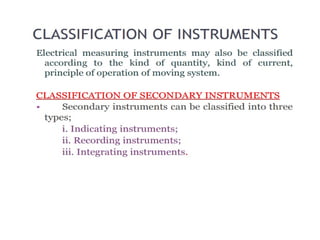
MEASURING INSTRUMENTS
“The device used for comparing the unknown quantity with the
unit of measurement or standard quantity is called a Measuring
Instrument.”
OR
“An instrument may be defined as a machine or system which is
designed to maintain functional relationship between prescribed
properties of physical variables & could include means of
communication to human observer.”
43
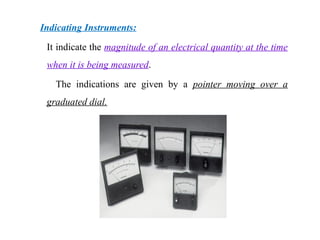
Indicating Instruments:
It indicate the magnitude of an electrical quantity at the time
when it is being measured.
The indications are given by a pointer moving over a
graduated dial.
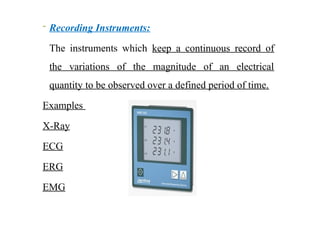
- Recording Instruments:
The instruments which keep a continuous record of
the variations of the magnitude of an electrical
quantity to be observed over a defined period of time.
Examples
X-Ray
ECG
ERG
EMG
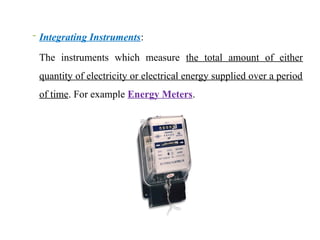
- Integrating Instruments:
The instruments which measure the total amount of either
quantity of electricity or electrical energy supplied over a period
of time. For example Energy Meters.
48
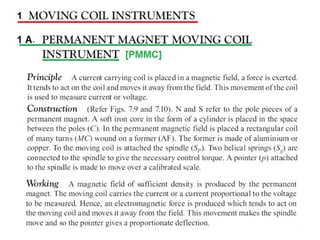
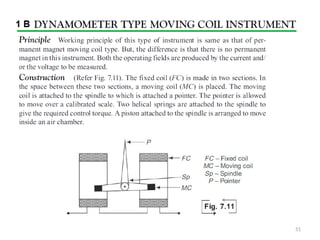
49
50
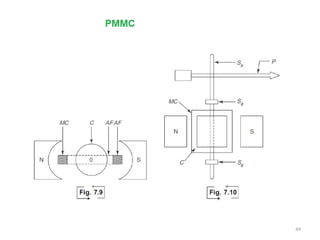
51
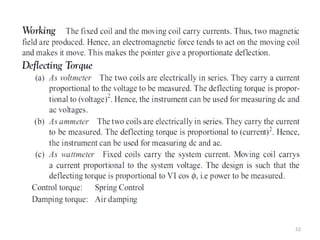
52
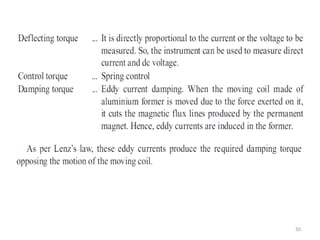
53
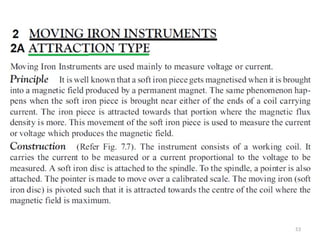
54
55
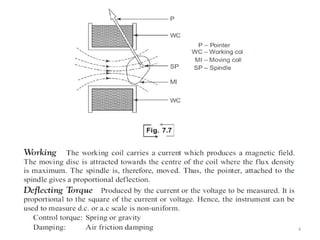
56
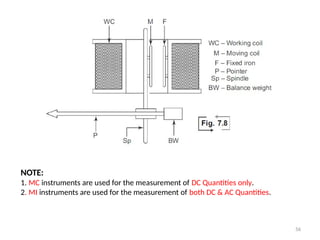
NOTE:
1. MC instruments are used for the measurement of DC Quantities only.
2. MI instruments are used for the measurement of both DC & AC Quantities.
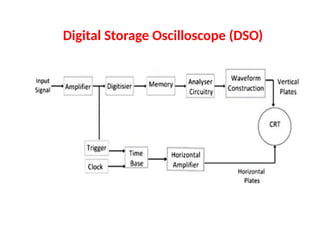
Digital Storage Oscilloscope (DSO)
An electronic instrument that can display the changes in signal
voltages graphically is known as an Oscilloscope. It is utilized to
process, capture, display, analyze, store the waveform and
bandwidth of the signals. The oscilloscopes are of two types based
on the type of signal. These are classified into two types namely
analog oscilloscope and digital oscilloscope.
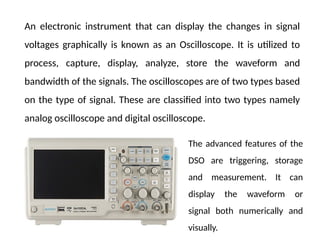
The advanced features of the
DSO are triggering, storage
and measurement. It can
display the waveform or
signal both numerically and
visually.
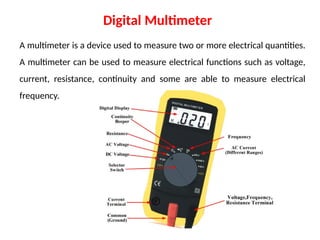
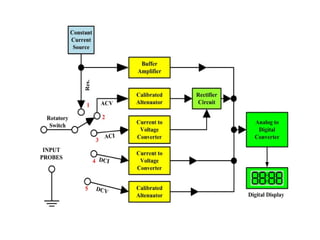
A multimeter is a device used to measure two or more electrical quantities.
A multimeter can be used to measure electrical functions such as voltage,
current, resistance, continuity and some are able to measure electrical
frequency.
Digital Multimeter
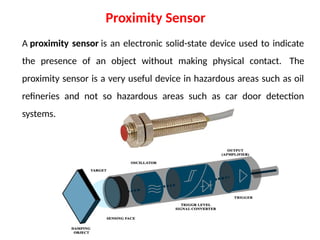
A proximity sensor is an electronic solid-state device used to indicate
the presence of an object without making physical contact. The
proximity sensor is a very useful device in hazardous areas such as oil
refineries and not so hazardous areas such as car door detection
systems.
Proximity Sensor
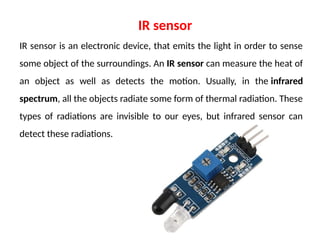
IR sensor is an electronic device, that emits the light in order to sense
some object of the surroundings. An IR sensor can measure the heat of
an object as well as detects the motion. Usually, in the infrared
spectrum, all the objects radiate some form of thermal radiation. These
types of radiations are invisible to our eyes, but infrared sensor can
detect these radiations.
IR sensor
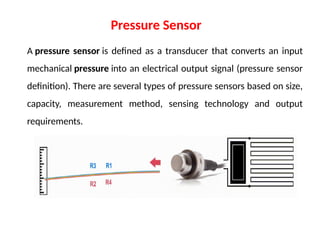
A pressure sensor is defined as a transducer that converts an input
mechanical pressure into an electrical output signal (pressure sensor
definition). There are several types of pressure sensors based on size,
capacity, measurement method, sensing technology and output
requirements.
Pressure Sensor
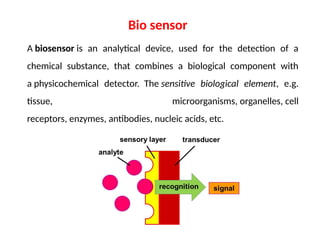
A biosensor is an analytical device, used for the detection of a
chemical substance, that combines a biological component with
a physicochemical detector. The sensitive biological element, e.g.
tissue, microorganisms, organelles, cell
receptors, enzymes, antibodies, nucleic acids, etc.
Bio sensor
The world of smart building sensors can be a confusing one. There
are lots of different options out there and there’s a whole lot of
information too – ranging from the very basic to the impossibly
technical.
Smart building sensors
1. Temperature sensors
2. Humidity sensors
3. Motion / occupancy sensors
4. Contact sensors
5. Gas / air quality sensors
6. Electrical current monitoring sensors
7. Other types of sensor

engineering unit 4 EEE subject full note

  • 1.
  • 2.
    • Unit-4 –Transducersand Sensors Basic principles and classification of Instruments- Moving Coil instruments, Moving Iron instruments, Digital Multimeter, Digital storage Oscilloscope. Transducer- Classification- Capacitive and Inductive transducers, Linear Variable Differential Transformer (LVDT), Thermistors, Thermocouple, Piezoelectric transducer, Photoelectric transducer, Hall effect transducers, Introduction to Opto-electronics Devices, Light Dependent Resistor (LDR), Photodiodes, Phototransistors, Photovoltaic cells (solar cells), Opto-couplers, Liquid crystal display, Proximity sensor, IR sensor, Pressure sensor, Introduction to Bio sensor, Sensors for smart building.
  • 3.
    Transducer: Transducer is adevice which converts the energy from one form to another form. This energy may be electrical, mechanical, chemical, optical or thermal. The transducer that gives electrical energy as output is known as electrical transducer. The transducers are classified as (i) Active and (ii) Passive transducers. Active transducers, also known as self generating type, develop their own voltage or current as the output signal. The energy required for production of this output signal is obtained from the physical phenomenon being measured. Passive transducers, also known as externally powered transducers, derive the power required for energy conversion from an external power source.
  • 4.
    A few examplesof active and passive transducers are given in Table
  • 5.
    Comparison between activeand passive transducer
  • 6.
    Requirements for Transducer Linearity:Have linear input output characteristics Repeatability: Produce the same result when the same input signal is applied repeatedly under same environmental conditions Ruggedness: Capable of withstanding overload. High Signal To Noise Ratio: Free from the internal and external noise Highly Reliable: Possess minimum error in measurement Good Dynamic Response: Must withstand sudden changes in input No Hysteresis: Produce similar result while input signal is varied from its low value to high value and vice versa. Residual Deformation: No deformation of testing material
  • 7.
    Types of Activeand Passive Transducer
  • 8.
    Displacement Transducer Define :A Displacement Transducer is an electromechanical device used to convert mechanical motion or vibrations into a variable electric signals. Types: Capacitive Transducer Inductive Variable Inductance Linear Variable Differential Transformer
  • 9.
    Capacitive Transducer • Acapacitor consists of two conductors (plates) that are electrically isolated from one another by a dielectric medium. • The principle of operation of capacitive transducers is based upon the equation for capacitance of a parallel plate capacitor as shown below: A = Overlapping area of plates; d = Distance between two plates; = Permittivity (dielectric constant) ɛ • The capacitive transducers are commonly used for measurement of linear displacement, by employing the following effects. 1. Change in area of plates. 2. Change in distance between the two plates. 3. Change in dielectric between the two plates.
  • 10.
    Capacitive Transducer Contd.. Variablecapacitance pressure gauge Principle of operation: Distance between two parallel plates is varied by an externally applied force. Applications: Measurement of Displacement, pressure. Capacitor microphone Principle of operation: Sound pressure varies the capacitance between a fixed plate and a movable diaphragm. Applications: Speech, music, noise. Dielectric gauge Principle of operation: Variation in capacitance by changes in the dielectric. Applications: Liquid level, thickness.
  • 11.
    • The inductivetransducers work on the principle of the electromagnetic induction. • Inductance of the magnetic material depends on a number of variables • The number of turns of the coil on the material, • The size of the magnetic material • The permeability of the flux path. • The change in the air gap Inductive Transducer
  • 12.
    Magnetic circuit transducer:Self inductance or mutual inductance of ac-excited coil is varied by changes in the magnetic circuit. Applications: Pressure, displacement. Reluctance pickup: Reluctance of the magnetic circuit is varied by changing the position of the iron core of a coil. Applications: Pressure, displacement, vibration, position. Differential transformer: The differential voltage of two secondary windings of a transformer is varied by positioning the magnetic core through an externally applied force. Applications: Pressure, force, displacement, position. Eddy current gauge: Inductance of a coil is varied by the proximity of an eddy current plate. Applications: Displacement, thickness. Magnetostriction gauge: Magnetic properties are varied by pressure and stress. Applications: Force, pressure, sound. Inductive Transducer Contd..
  • 13.
    The linear variable-differentialtransformer (LVDT) is the most widely used inductive transducer to translate linear motion into electrical signal Linear Variable-Differential Transformer (LVDT)
  • 14.
    • Consists ofa primary winding and two secondary windings. • A ferro-magnetic core(armature) in the shape of a rod or cylinder is attached to the transducer sensing which slides freely within the hollow portion of the bobbin. • An a.c. excitation is applied across the primary winding and the movable core varies the coupling between it and the two secondary windings. • As the core moves away from the centre position, the coupling to one secondary becomes more and hence its output voltage increases, while the coupling and the output voltage of the other secondary decreases. Construction of LVDT
  • 15.
    • Any physicaldisplacement of the core causes the voltage of one secondary winding to increase while simultaneously, reducing the voltage in the other secondary winding. • The difference of the two voltages appears across the output terminals of the transducers and gives a measure of the physical position of the core and hence the displacement. • When the core is in the neutral or zero position, voltages induced in the secondary windings are equal and opposite and the net output is negligible. • By comparing the magnitude and phase of output with input source, the amount and direction of movement of core and hence displacement may be determined Working Principle of LVDT
  • 16.
    Advt: 1. HighRange -1.25mm to 250mm. 2. Low hysteresis 3. Simple, light in weight and easy to maintain. 4. Low Power Consumption Disadvt: 1. They are sensitive to stray magnetic fields but shielding is possible. 2. Temperature affects the performance of transducer. Uses: 1. The LVDT can be used in all applications where displacements ranging from fraction of a mm to a few cm have to be measured. 2. Acting as a secondary transducer it can be used as a device to measure force, weight and pressure. Advt, Disadvt and Uses of LVDT
  • 17.
    Define – ConvertsTemperature to electrical signal and vice versa Types - 1. RTD (Resistance Temperature Detector) -To predict change in electrical resistance of some materials with changing temperature. 2. Thermocouple - To convert thermal potential difference into electric potential difference. 3. Thermistor - Exhibits a large change in resistance proportional to a small change in temperature. Thermoelectric Transducers
  • 18.
  • 19.
     A thermocoupleis a transducer that converts thermal energy into electrical energy and is constructed by joining wires made from dissimilar metals to form a junction. Voltage is produced when the temperature at the junction changes.  The concept of the thermocouple is based on the Seebeck Effect, which states that if dissimilar metals are joined at a point they will generate a small measurable voltage when the temperature of the point of connection changes. The amount of voltage depends on the amount of temperature change and the characteristics of the metals.
  • 20.
    Thermistor • Measures temperatureaccording to change in resistance. • Made of a sintered semiconductor material. • Use ceramic or polymer materials • Available in various shapes like disc, rod, washer, etc. symbol for a thermistor
  • 21.
    • Working Principleof Thermistors The thermistor works on the simple principle of change in resistance due to a change in temperature. When the ambient temperature changes the thermistor starts self-heating its elements. its resistance value is changed with respect to this change in temperature. This change depends on the type of thermistor used. The resistance temperature characteristics of different types of thermistors are given in the following section. • Types of Thermistors The two basic types of thermistors available are the NTC and PTC types.
  • 22.
    Define : Convertslight energy to electrical energy and vice versa. Types: • Laser diode, light-emitting diode - convert electrical power into forms of light. • Photodiode, photo resistor (LDR), phototransistor, photomultiplier tube - converts changing light levels into electrical form. Photoelectric Transducers
  • 23.
    Light-Emitting Diode  LEDdiode works when it is forward biased. In this case, the n-type semiconductor is heavily doped than the p-type forming the p-n junction. When it is forward biased, the potential barrier gets reduced and the electrons and holes combine at the depletion layer (or active layer), light or photons are emitted or radiated in all directions.
  • 24.
    Light-Emitting Diode • Whensufficient voltage is applied to the chip across the leads of the LED, electrons can move easily in only one direction across the junction between the p and n regions. • When a voltage is applied and the current starts to flow, electrons in the n region have sufficient energy to move across the junction into the p region. • Each time an electron recombines with a positive charge, electric potential energy is converted into electromagnetic energy. • For each recombination of a negative and a positive charge, a quantum of electromagnetic energy is emitted in the form of a photon of light with a frequency characteristic of the semi-conductor material. • LEDs are made from gallium-based crystals that contain one or more additional materials such as phosphorous to produce a distinct color. • Different LED chip technologies emit light in specific regions of the visible light spectrum and produce different intensity levels. • LEDs are available in red, orange, amber, yellow, green, blue and white.
  • 25.
    Laser Diode • LASERstands for Light Amplification by Stimulated Emission of Radiation. • A laser diode is an electronic device, which converts electrical energy into light energy to produce high-intensity coherent light. • Laser diode is very small in size and appearance. • It is similar to a transistor and has operation like LED but it emit coherent light. • The material which often used in Laser diode is the gallium Arsenide (GaAs). • It work on forward biasing.
  • 27.
    Laser Diode • WhenDC voltage is applied across the laser diode, the free electrons move across the junction region from the n-type material to the p-type material. • In this process, some electrons will directly interact with the valence electrons and excites them to the higher energy level and releases energy in the form of light. This process of emission is called spontaneous emission. • The photons generated due to spontaneous emission will travel through the junction region and stimulate the excited electrons (free electrons). As a result, more photons are released. • This process of light or photons emission is called stimulated emission.
  • 28.
    Photo Diode • Aphotodiode is a PN-junction diode that consumes light energy to produce electric current. • It is also called as photo-detector, a light detector, and photo-sensor. • A photodiode is one type of light detector, used to convert the light into current or voltage based on the mode of operation of the device. • It comprises of optical filters, built-in lenses and also surface areas. • These diodes are particularly designed to work in reverse bias condition. • The working principle of a photodiode is, when a photon of ample energy strikes the diode, it makes a couple of an electron- hole. • Therefore, holes in the region move toward the anode, and electrons move toward the cathode, and a photocurrent will be generated.
  • 29.
    Photoresistor (LDR) • Photoresistoris a variable resistor whose resistance varies inversely with the intensity of light • Photoresistors are also known as photoconductive cells or just photocell. • When light is incident on the photoresistor, photons get absorbed by the semiconductor material. • The energy from the photon gets absorbed by the electrons. • When these electrons acquire sufficient energy to break the bond, they jump into the conduction band. • Due to this, the resistance of the photoresistor decreases. With the decrease in resistance, conductivity increases. • In the absence of light, the photoresistor can have resistance values in megaohms. • During the presence of light, its resistance can decrease to a few hundred ohms.
  • 30.
     LDR consistof a resistor made up of semiconductor material. Cadmium sulphide and cadmium selenide are the most commonly used materials for constructing these resistors.
  • 31.
    Phototransistor • It isa device to convert light energy into electrical energy. • The construction of phototransistor is similar to the ordinary transistor, except the base terminal. In phototransistor, the base terminal is not provided, and instead of the base current, the light energy is taken as the input. • The phototransistor is a three-layer semiconductor device which has a light-sensitive base region. The base senses the light and converts it into the current which flows between the collector and the emitter region.
  • 32.
    Photovoltaic or SolarCell • The Photovoltaic cell is the semiconductor device that converts the light into electrical energy. • The voltage induces by the PV cell depends on the intensity of light incident on it. • The semiconductor materials like arsenide, indium, cadmium, silicon, selenium and gallium are used for making the PV cells. • Figure shows the constructions of the silicon photovoltaic cell. • The upper surface of the cell is made of the thin layer of the p-type material so that the light can easily enter into the material. • The metal rings are placed around p-type and n- type material which acts as their positive and negative output terminals respectively.
  • 33.
    Photovoltaic or SolarCell • The multi-crystalline or monocrystalline semiconductor material make the single unit of the PV cell. • The mono-crystal cell is cut from the volume of the semiconductor material. • The multicell are obtained from the material which has many sides. • The output voltage and current obtained from the single unit of the cell is very less. • Many cells together is said to be Solar Panel.
  • 34.
    Optocouplers • An optocoupleror optoelectronic coupler is an electronic component that basically acts as an interface between the two separate circuits with different voltage levels. Optocouplers are common component by which electrical isolation can be supplied between the input and output source. It is a 6 pin device and can have any number of photodetectors.  An optocoupler mainly consists of an infrared LED and a photosensitive device that detects the emitted infrared beam. The semiconductor photosensitive device can be a photodiode, phototransistor, a Darlington pair, SCR or TRIAC.
  • 35.
     When ahigh voltage appears across the input side of the Optocoupler, a current start to flow through the LED. Due to this current LED will emit light. This emitted light when falls on a phototransistor cause a current to flow through the same.  The current flowing through the phototransistor is directly proportional to the supplied input voltage. An input resistance placed at the beginning of the circuit will decrease the amount of current flowing through the LED if its value is increased. As the LED glows due to this current, hence, when current will be low so as the light intensity of LED.
  • 36.
    Piezoelectric Transducer • Apiezoelectric transducer (also known as a piezoelectric sensor) is a device that uses the piezoelectric effect to measure changes in acceleration, pressure, strain, temperature or force by converting this energy into an electrical charge.  The piezoelectric material is one kind of transducers. When we squeeze this piezoelectric material or apply any force or pressure, the transducer converts this energy into voltage.  Electric voltage produced by a piezoelectric transducer can be easily measured by the voltage measuring instruments.
  • 37.
     This voltagewill be a function of the force or pressure applied to it, we can infer what the force/pressure was by the voltage reading. In this way, physical quantities like mechanical stress or force can be measured directly by using a piezoelectric transducer
  • 38.
    Hall Effect Transducer •Hall Effect Transducer is a device which is used for the measurement of magnetic field strength. This transducer uses a conducting strip to convert magnetic field into proportional potential difference across the opposite faces of strip using Hall Effect.
  • 39.
    • Hall Effectis basically the process of development of potential difference across the two faces of a current carrying strip when the strip is kept in a magnetic field. • The magnitude of voltage depends upon the current, strength of magnetic field and the property of conducting material. The Hall Effect is found in conducting material and semiconductor in varying amount depending upon the density and mobility of current carrier.
  • 40.
    Liquid Crystal Display AnLCD panel is made of many layers. These consist of a polariser, polarised glass, LCD fluid, conductive connections etc. Polarisation is a process in which the vibration of light waves is restricted to a single plane, resulting in the formation of light waves known as polarised light. Since liquid crystals do not produce light of their own, they need an external light source to work. An LCD panel has sets of polarised glass consisting of liquid crystal materials in between them. When the external light passes through one of the polarised glasses and electric current is applied on the liquid crystal molecules, they align themselves in such a way that polarised light travels from the first layer to the second polarised glass, causing an image to appear on the screen.
  • 41.
    • Types ofLCD Reflective • This type of LCD has a mirror layer. When a light ray within an LCD is reflected by the mirror layer, then visible patterns are produced on the LCD. Transmissive • Here the LCD has a backlight, which passes through the LCD polarised glass to produce visible pattern. But because it uses backlight for working, the images displayed in such LCD types appear very dim when used under bright sunlight. Transflective • This LCD type has a reflective mirror layer and a backlight. It uses both outside light and backlight, making it suitable for indoor and outdoor conditions.
  • 42.
    MEASURING INSTRUMENTS “The deviceused for comparing the unknown quantity with the unit of measurement or standard quantity is called a Measuring Instrument.” OR “An instrument may be defined as a machine or system which is designed to maintain functional relationship between prescribed properties of physical variables & could include means of communication to human observer.”
  • 43.
  • 45.
    Indicating Instruments: It indicatethe magnitude of an electrical quantity at the time when it is being measured. The indications are given by a pointer moving over a graduated dial.
  • 46.
    - Recording Instruments: Theinstruments which keep a continuous record of the variations of the magnitude of an electrical quantity to be observed over a defined period of time. Examples X-Ray ECG ERG EMG
  • 47.
    - Integrating Instruments: Theinstruments which measure the total amount of either quantity of electricity or electrical energy supplied over a period of time. For example Energy Meters.
  • 48.
  • 49.
  • 50.
  • 51.
  • 52.
  • 53.
  • 54.
  • 55.
  • 56.
    56 NOTE: 1. MC instrumentsare used for the measurement of DC Quantities only. 2. MI instruments are used for the measurement of both DC & AC Quantities.
  • 57.
  • 58.
    An electronic instrumentthat can display the changes in signal voltages graphically is known as an Oscilloscope. It is utilized to process, capture, display, analyze, store the waveform and bandwidth of the signals. The oscilloscopes are of two types based on the type of signal. These are classified into two types namely analog oscilloscope and digital oscilloscope. The advanced features of the DSO are triggering, storage and measurement. It can display the waveform or signal both numerically and visually.
  • 59.
    A multimeter isa device used to measure two or more electrical quantities. A multimeter can be used to measure electrical functions such as voltage, current, resistance, continuity and some are able to measure electrical frequency. Digital Multimeter
  • 61.
    A proximity sensoris an electronic solid-state device used to indicate the presence of an object without making physical contact. The proximity sensor is a very useful device in hazardous areas such as oil refineries and not so hazardous areas such as car door detection systems. Proximity Sensor
  • 62.
    IR sensor isan electronic device, that emits the light in order to sense some object of the surroundings. An IR sensor can measure the heat of an object as well as detects the motion. Usually, in the infrared spectrum, all the objects radiate some form of thermal radiation. These types of radiations are invisible to our eyes, but infrared sensor can detect these radiations. IR sensor
  • 63.
    A pressure sensoris defined as a transducer that converts an input mechanical pressure into an electrical output signal (pressure sensor definition). There are several types of pressure sensors based on size, capacity, measurement method, sensing technology and output requirements. Pressure Sensor
  • 64.
    A biosensor isan analytical device, used for the detection of a chemical substance, that combines a biological component with a physicochemical detector. The sensitive biological element, e.g. tissue, microorganisms, organelles, cell receptors, enzymes, antibodies, nucleic acids, etc. Bio sensor
  • 65.
    The world ofsmart building sensors can be a confusing one. There are lots of different options out there and there’s a whole lot of information too – ranging from the very basic to the impossibly technical. Smart building sensors 1. Temperature sensors 2. Humidity sensors 3. Motion / occupancy sensors 4. Contact sensors 5. Gas / air quality sensors 6. Electrical current monitoring sensors 7. Other types of sensor