Faculty Name: Prof. Ajaypalsinh G. Barad
Branch: Mechanical
College : S. P. C. E., Visnagar
Semester: 7th Semester
Name of Subject: Power Plant Engineering
1Ajaypalsinh Barad
Condensers
and
Cooling Towers
Outline
• Introduction
• Types of condensers
• Sources of air in condenser
• Effects of air leakage
• Methods of obtaining maximum vacuum in condenser
• Vacuum & condenser efficiency
• Mass of cooling water required
• Edward air pump
• Necessity of cooling ponds and cooling towers
• Condenser water cooling systems
• Types of cooling towers and cooling ponds
2Ajaypalsinh Barad
Introduction :
3Ajaypalsinh Barad
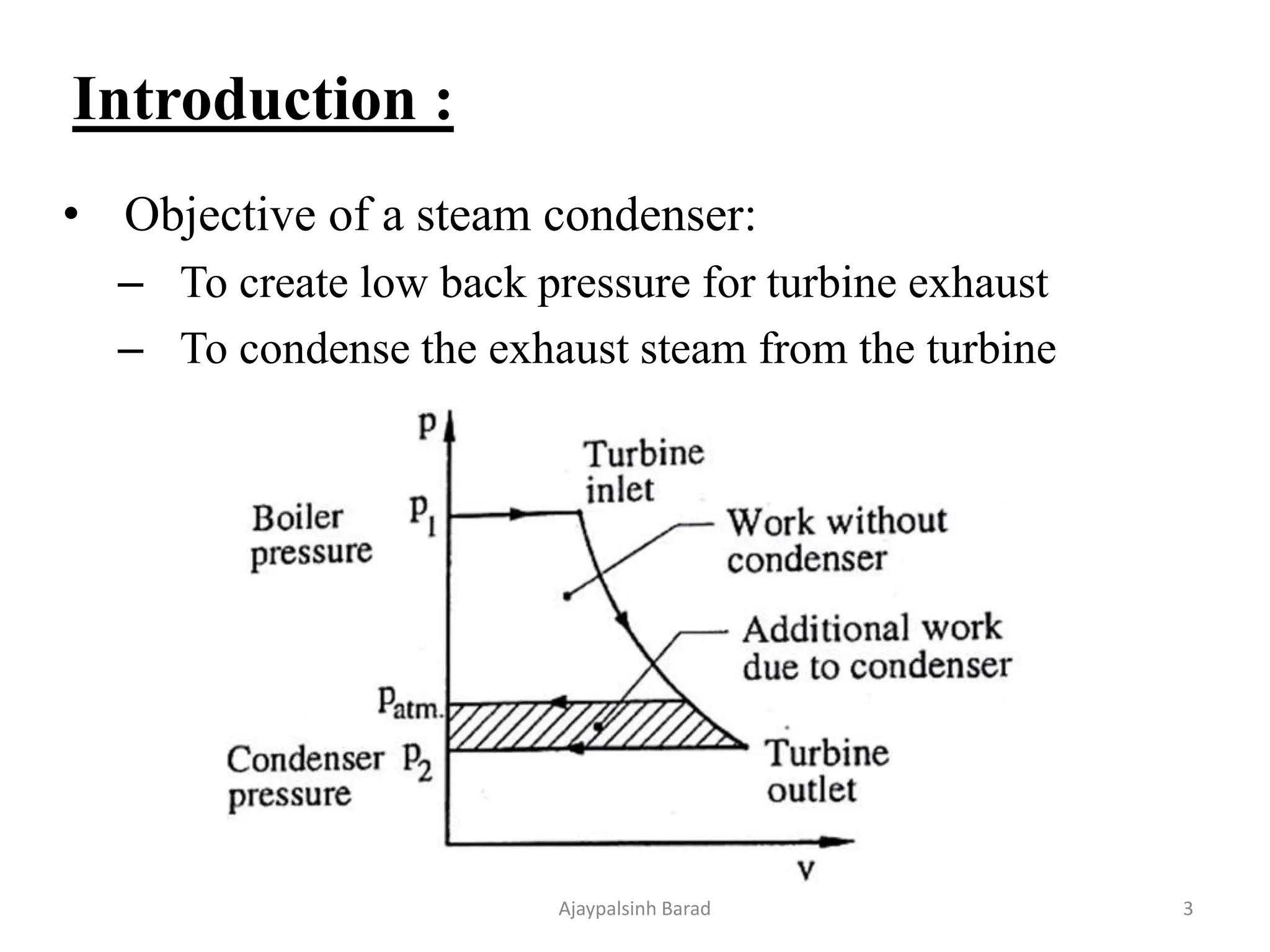
• Objective of a steam condenser:
– To create low back pressure for turbine exhaust
– To condense the exhaust steam from the turbine
Introduction :
4Ajaypalsinh Barad
Advantages :
• Increases work done per kg of steam
• Increases thermal efficiency of plant
• Condensed steam provides a source of good pure feed
water.
• High temperature condensate water reduces amount of
heat supplied per kg of steam
• Reduces corrosion of boiler tube
Introduction :
5Ajaypalsinh Barad
Elements of steam condensing plant :
• Condenser
• Supply of cooling water
• Condenser cooling water pump
• Air extraction pump
• Make up water pump
• Condensate extraction pump
• Boiler feed pump
• Hot well
• Cooling tower
Introduction :
6Ajaypalsinh Barad
Types of Condensers :
Two main types :
• Jet condenser
• Surface condenser
7Ajaypalsinh Barad
Jet Condenser :
• It is further classified on the basis of Direction of
flow of the condensate and Arrangement of the
tubing system.
Types:
• Low level jet condenser
– Parallel flow type
– Counter flow type
• High level jet condenser
• Ejector jet condenser
8Ajaypalsinh Barad
Low Level Parallel Flow Jet Condenser :
9Ajaypalsinh Barad
Low Level Counter Flow Jet Condenser :
10Ajaypalsinh Barad
High Level Jet Condenser :
11Ajaypalsinh Barad
Ejector Condenser :
12Ajaypalsinh Barad
Jet Condenser :
13Ajaypalsinh Barad
Advantages :
• Lower quantity of cooling water required
• Simple in design
• Require less floor space
• Lower capital and maintenance cost
• Due to direct contact heat transfer is more effective
Disadvantages :
• Condensate cannot be directly used as feed water
• Power consumption in pump is more
• Piping cost is high.
Surface Condenser :
14Ajaypalsinh Barad
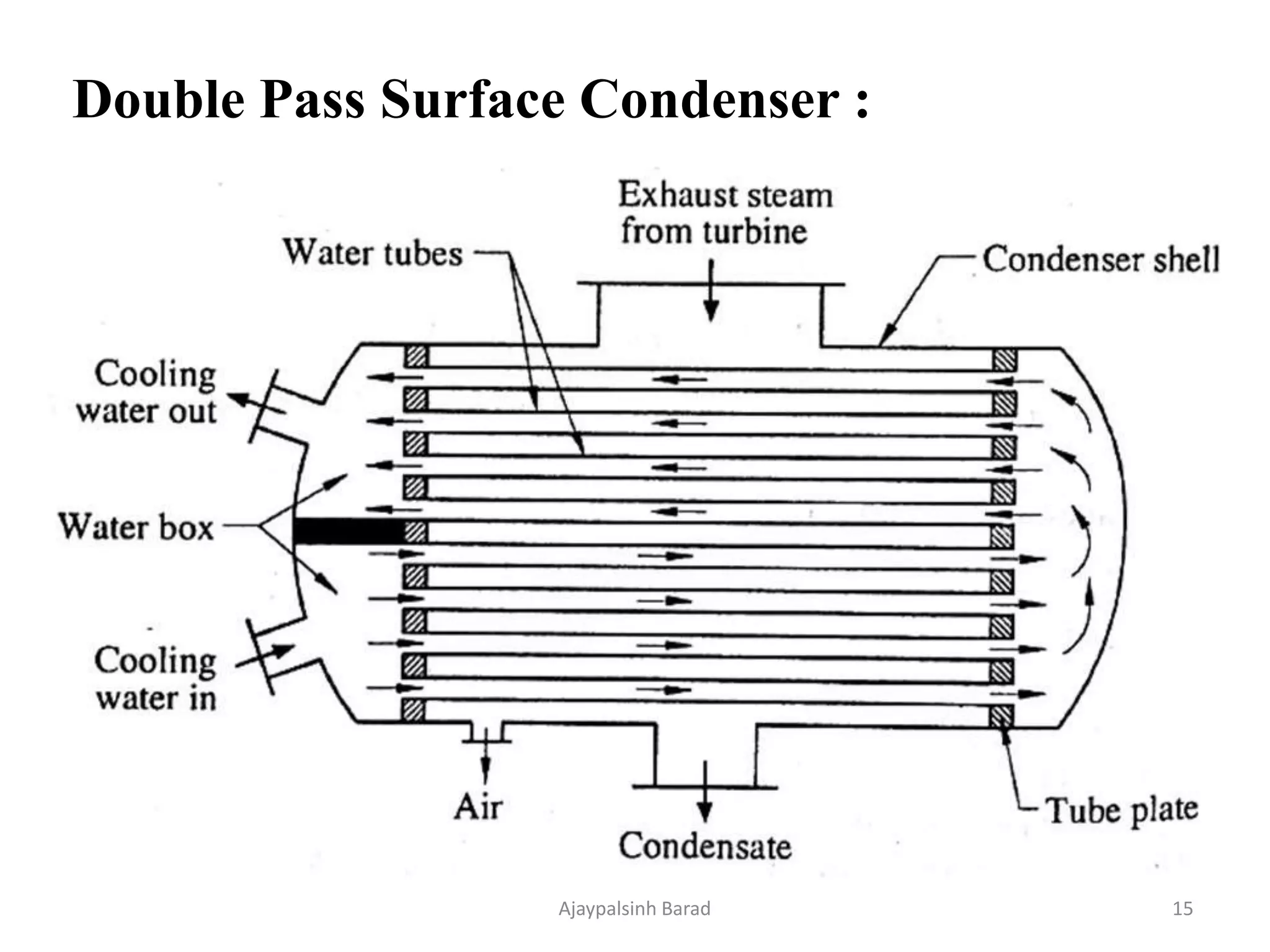
• It is further classified as follows :
• According to number of cooling water passes
– Single pass
– Multi pass
• According to direction of condensate flow
– Down flow condenser
– Central flow condenser
Double Pass Surface Condenser :
15Ajaypalsinh Barad
Down Flow Surface Condenser :
16Ajaypalsinh Barad
Down Flow Surface Condenser :
17Ajaypalsinh Barad
Central Flow Surface Condenser :
18Ajaypalsinh Barad
Evaporative Condenser :
19Ajaypalsinh Barad
Evaporative Condenser :
20Ajaypalsinh Barad
Evaporative Condenser :
21Ajaypalsinh Barad
Advantages:
• Simple in design and low initial cost
• Low quantity cooling water required
• Small capacity cooling water pump
• Low operating cost.
Disadvantages:
• Vacuum maintained is less
• Due to less vacuum work done per kg of steam is less
• Not suitable for medium and large power plant
Surface Condenser :
22Ajaypalsinh Barad
Advantages:
• Due to high vacuum increases thermal efficiency and
output of plant
• Condensate can be reused as boiler feed water
• Auxiliary power requirement is less
• Less amount of air is carried to the boiler
• Any kind of feed water can be used
• Can develop high vacuum, so suitable for medium
and large power plants
Surface Condenser :
23Ajaypalsinh Barad
Disadvantages:
• Very bulky and requires more floor space
• High manufacturing, running and maintenance cost
• Requires large quantity of cooling water
Surface Condenser :
24Ajaypalsinh Barad
Requirement of good surface condenser:
• There should be uniform distribution of exhaust steam
throughout the heat transfer surface of the condenser
• There should not be any leakage of air into the
condenser
• There should not be any tube leakage
• The heat transfer surface in contact with cooling water
must be free from any deposit as scaling reduces the
efficiency of heat exchangers.
Comparison :
25Ajaypalsinh Barad
Jet Condenser Surface Condenser
Cooling water and steam
come in direct contact
Cooling water and steam
do not come in direct
contact
Maintenance cost is low Maintenance cost is high
More suitable for low
capacity plants
More suitable for high
capacity plants
Condensate is not used as
boiler feed water
Condensate is directly used
as boiler feed water
Comparison :
26Ajaypalsinh Barad
Jet Condenser Surface Condenser
Condensation of steam is
due to heat transfer by
mixing of steam with water
Condensation of steam is
due to heat transfer by
steam to water through
tubes
Economic and simple
condensing plant
Costly and complicated
condensing plant
More power consumption
in air pump
Less power consumption in
air pump
Sources of Air in Condenser :
• The boiler feed water contains dissolved air. From the
boiler it is carried off by steam and to the turbine and
finally to the condenser
• The air leaks through the joints, packing and glands
into the condenser where the pressure is below the
atmospheric pressure.
• Air dissolved with cooling water is carried in case of
jet condensers.
27Ajaypalsinh Barad
Effects of Air Leakage :
• Increases the back pressure on the turbine with the
effect that there is low thermal efficiency of the
plant
• Reduces the rate of condensation of steam because air
having poor thermal conductivity, reduces the
overall heat transfer from the steam air mixture.
• The presence of air in the condenser increases the
corrosive action.
28Ajaypalsinh Barad
Method of obtaining max vacuum :
• Air pump : extract the air and other non-condensable
gases from the condenser to maintain a desired
vacuum.
– Wet pump : removes a mixture of condensate and air
with other non-condensable gases.
– Dry pump : removes the air and other non-condensable
gases only.
29Ajaypalsinh Barad
Method of obtaining max vacuum :
• Steam Jet Air Ejector : remove air from condenser
when a wet pump is employed. It consist of
convergent – divergent nozzle and a diffuser.
30Ajaypalsinh Barad
Method of obtaining max vacuum :
• De-aerated feed water : the de-aeration is the
process of removal of non condensable gases from
feed water. It helps both in maintaining better vacuum
in the condenser and controlling corrosion of the steel
and piping of the steam power plant.
• Air tight joints : the air leaks through the joints,
packings and glands into the condenser. This can be
reduced by proper workmanship while making the
joints and these are maintained as such by proper
inspection from time to time.
31Ajaypalsinh Barad
Vacuum & Condenser Efficiency :
• The minimum absolute pressure at the steam inlet of
a condenser is the saturation pressure corresponding
to the temperature of the condensed steam. This
vacuum is called Ideal Vacuum. It is the maximum
vacuum that can be obtained in a condensing plant,
with no air present at that temperature.
• The actual pressure in the condenser is greater than
the ideal pressure by an amount equal to the pressure
of air present in the condenser.
• The ratio of the actual vacuum to the ideal vacuum is
known as Vacuum Efficiency.
32Ajaypalsinh Barad
Vacuum & Condenser Efficiency :
• If,
Ps = Saturation pressure of steam corresponding to the steam
temperature entering into condenser
Pc = Total pressure of air and steam in the condenser (Pa + Ps).
Pb = Atmospheric pressure.
• Ideal vacuum possible without air leakage = (Pb - Ps)
• Actual vacuum existing in condenser due to air
leakage
33Ajaypalsinh Barad
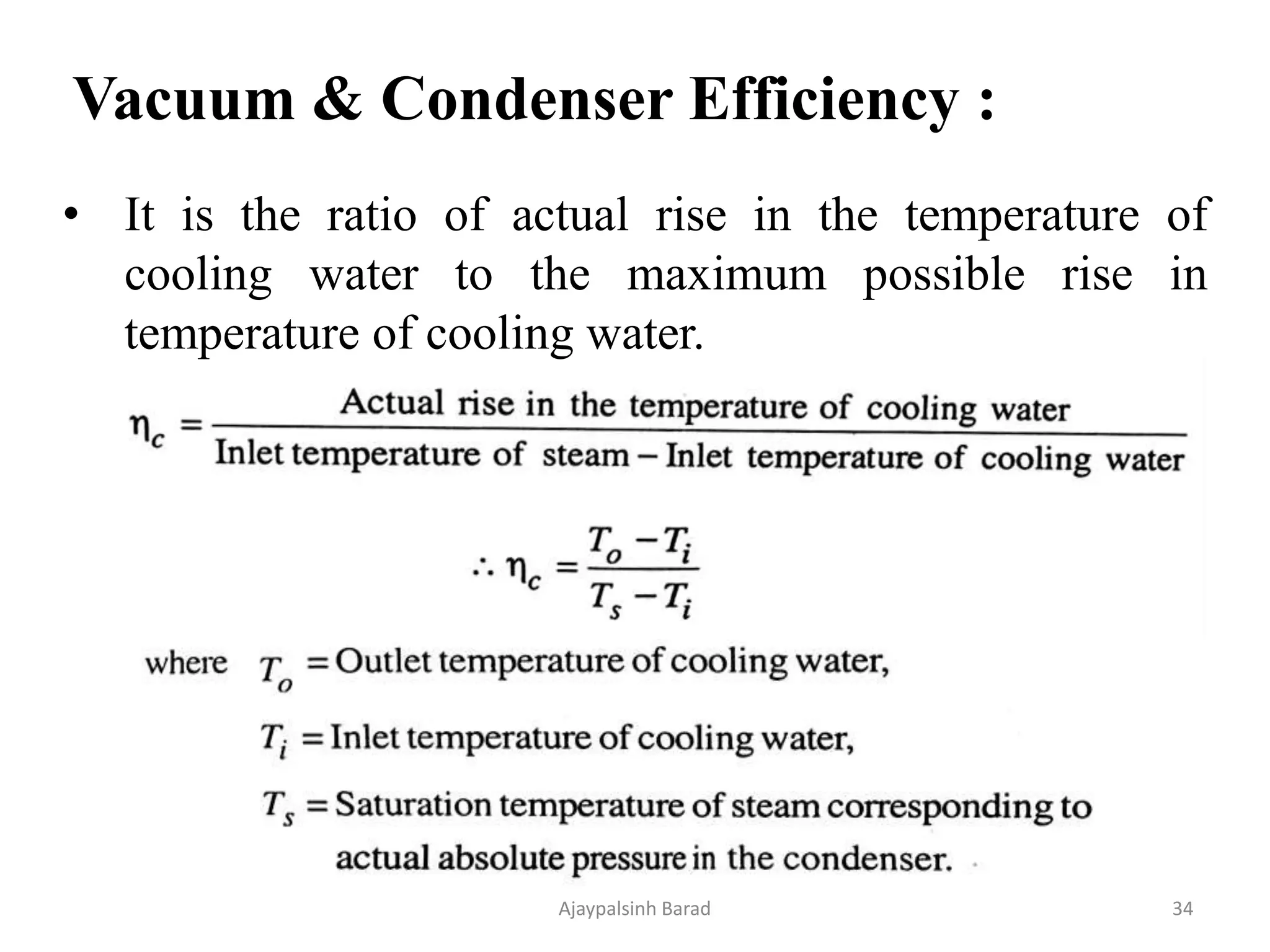
Vacuum & Condenser Efficiency :
• It is the ratio of actual rise in the temperature of
cooling water to the maximum possible rise in
temperature of cooling water.
34Ajaypalsinh Barad
Mass of Cooling Water Required :
35Ajaypalsinh Barad
Mass of Cooling Water Required :
36Ajaypalsinh Barad
Edward Air Pump :
37Ajaypalsinh Barad
Edward Air Pump :
38Ajaypalsinh Barad
Necessity of Cooling Ponds & Towers :
• To absorb the heat from steam.
• It is necessary to pre-cool the water coming out of
condenser before using again in a closed system. As
with increase in temperature pressure also increases.
39Ajaypalsinh Barad
Condenser Water Cooling System :
• Cooling water systems used in practice according to
availability of water are :
– Open Cooling System (Once Through System)
– Closed Cooling System
– Mixed Cooling System
40Ajaypalsinh Barad
Open Cooling System (Once Through System) :
41Ajaypalsinh Barad
Closed Cooling System :
42Ajaypalsinh Barad
Mixed Cooling System :
43Ajaypalsinh Barad
Types of Cooling Towers & Ponds :
• Cooling towers cool the warm water discharged from
the condenser and feed the cooled water back to the
condenser.
• Types of cooling towers :
– Natural draught cooling towers
– Mechanical cooling towers
• Forced draught cooling towers
• Induced draught cooling towers
44Ajaypalsinh Barad
Natural Draught Cooling Towers :
45Ajaypalsinh Barad
Natural Draught Cooling Towers :
46Ajaypalsinh Barad
Natural Draught Cooling Towers :
Advantages :
• Its operating and maintenance costs are less since no
fans are needed.
• It creates its own draft assuring efficient operation
even when there is no wind.
• Longer life.
Disadvantages :
• High capital cost
• Performance varies with the seasonal changes
47Ajaypalsinh Barad
Forced Draught Cooling Tower :
48Ajaypalsinh Barad
Forced Draught Cooling Tower :
49Ajaypalsinh Barad
Forced Draught Cooling Tower :
Advantages:
• More efficient
• Problems of blade erosion are avoided
• Fan is located at ground so more safe
• Vibration and noise are less as mechanical equipments are
set on a solid foundation.
Disadvantages :
• Possibility of recirculation of hot humid exhaust air
coming out from the top of the tower
• Fan size is limited to 4 meters
• Possibility of ice formation on fan blades in cold weather
50Ajaypalsinh Barad
Induced Draught Cooling Tower (Counter) :
51Ajaypalsinh Barad
Induced Draught Cooling Tower (Counter) :
52Ajaypalsinh Barad
Induced Draught Cooling Tower (Cross) :
53Ajaypalsinh Barad
Induced Draught Cooling Tower :
Advantages:
• Coldest water comes in contact with the driest air and
the warmest water comes in contact with the most air.
• The recirculation of hot humid air is not a major
problem.
• Larger fan size can be used.
• Lower first cost due to the reduced pump capacity
• Capable of cooling through a wide range.
54Ajaypalsinh Barad
Induced Draught Cooling Tower :
Disadvantages:
• Not economical up to the capacity of 15000 liters of
water per minute.
• Higher power motor is required to drive the fan
compared to forced draught.
• Maintenance cost is high.
• Fan bearings need to be cooled.
55Ajaypalsinh Barad
Cooling Ponds :
• The cooling pond is one of the simplest method of
cooling the condenser water. This method is less
efficient than cooling tower.
• Types of cooling ponds:
1. Natural and Directed flow cooling pond
2. Single deck and Double deck cooling pond
3. Open and Louvre fence cooling pond.
56Ajaypalsinh Barad
Cooling Ponds :
Natural flow cooling pond
57Ajaypalsinh Barad
Cooling Ponds :
Directed flow cooling pond
58Ajaypalsinh Barad
Cooling Ponds :
Single deck cooling pond
59Ajaypalsinh Barad
Cooling Ponds :
Double deck cooling pond
60Ajaypalsinh Barad
Cooling Ponds :
Single deck cooling pond
61Ajaypalsinh Barad
Cooling Ponds :
• Spray pond with Louvre fence
62Ajaypalsinh Barad
Cooling Ponds :
Advantages:
• Initial cost is less
• Simple in design and arrangement
Disadvantages:
• Requires large area for cooling.
63Ajaypalsinh Barad
Condenser and Cooling Tower Power Plant Engineering

Condenser and Cooling Tower Power Plant Engineering

  • 1.
    Faculty Name: Prof.Ajaypalsinh G. Barad Branch: Mechanical College : S. P. C. E., Visnagar Semester: 7th Semester Name of Subject: Power Plant Engineering 1Ajaypalsinh Barad Condensers and Cooling Towers
  • 2.
    Outline • Introduction • Typesof condensers • Sources of air in condenser • Effects of air leakage • Methods of obtaining maximum vacuum in condenser • Vacuum & condenser efficiency • Mass of cooling water required • Edward air pump • Necessity of cooling ponds and cooling towers • Condenser water cooling systems • Types of cooling towers and cooling ponds 2Ajaypalsinh Barad
  • 3.
    Introduction : 3Ajaypalsinh Barad •Objective of a steam condenser: – To create low back pressure for turbine exhaust – To condense the exhaust steam from the turbine
  • 4.
    Introduction : 4Ajaypalsinh Barad Advantages: • Increases work done per kg of steam • Increases thermal efficiency of plant • Condensed steam provides a source of good pure feed water. • High temperature condensate water reduces amount of heat supplied per kg of steam • Reduces corrosion of boiler tube
  • 5.
    Introduction : 5Ajaypalsinh Barad Elementsof steam condensing plant : • Condenser • Supply of cooling water • Condenser cooling water pump • Air extraction pump • Make up water pump • Condensate extraction pump • Boiler feed pump • Hot well • Cooling tower
  • 6.
  • 7.
    Types of Condensers: Two main types : • Jet condenser • Surface condenser 7Ajaypalsinh Barad
  • 8.
    Jet Condenser : •It is further classified on the basis of Direction of flow of the condensate and Arrangement of the tubing system. Types: • Low level jet condenser – Parallel flow type – Counter flow type • High level jet condenser • Ejector jet condenser 8Ajaypalsinh Barad
  • 9.
    Low Level ParallelFlow Jet Condenser : 9Ajaypalsinh Barad
  • 10.
    Low Level CounterFlow Jet Condenser : 10Ajaypalsinh Barad
  • 11.
    High Level JetCondenser : 11Ajaypalsinh Barad
  • 12.
  • 13.
    Jet Condenser : 13AjaypalsinhBarad Advantages : • Lower quantity of cooling water required • Simple in design • Require less floor space • Lower capital and maintenance cost • Due to direct contact heat transfer is more effective Disadvantages : • Condensate cannot be directly used as feed water • Power consumption in pump is more • Piping cost is high.
  • 14.
    Surface Condenser : 14AjaypalsinhBarad • It is further classified as follows : • According to number of cooling water passes – Single pass – Multi pass • According to direction of condensate flow – Down flow condenser – Central flow condenser
  • 15.
    Double Pass SurfaceCondenser : 15Ajaypalsinh Barad
  • 16.
    Down Flow SurfaceCondenser : 16Ajaypalsinh Barad
  • 17.
    Down Flow SurfaceCondenser : 17Ajaypalsinh Barad
  • 18.
    Central Flow SurfaceCondenser : 18Ajaypalsinh Barad
  • 19.
  • 20.
  • 21.
    Evaporative Condenser : 21AjaypalsinhBarad Advantages: • Simple in design and low initial cost • Low quantity cooling water required • Small capacity cooling water pump • Low operating cost. Disadvantages: • Vacuum maintained is less • Due to less vacuum work done per kg of steam is less • Not suitable for medium and large power plant
  • 22.
    Surface Condenser : 22AjaypalsinhBarad Advantages: • Due to high vacuum increases thermal efficiency and output of plant • Condensate can be reused as boiler feed water • Auxiliary power requirement is less • Less amount of air is carried to the boiler • Any kind of feed water can be used • Can develop high vacuum, so suitable for medium and large power plants
  • 23.
    Surface Condenser : 23AjaypalsinhBarad Disadvantages: • Very bulky and requires more floor space • High manufacturing, running and maintenance cost • Requires large quantity of cooling water
  • 24.
    Surface Condenser : 24AjaypalsinhBarad Requirement of good surface condenser: • There should be uniform distribution of exhaust steam throughout the heat transfer surface of the condenser • There should not be any leakage of air into the condenser • There should not be any tube leakage • The heat transfer surface in contact with cooling water must be free from any deposit as scaling reduces the efficiency of heat exchangers.
  • 25.
    Comparison : 25Ajaypalsinh Barad JetCondenser Surface Condenser Cooling water and steam come in direct contact Cooling water and steam do not come in direct contact Maintenance cost is low Maintenance cost is high More suitable for low capacity plants More suitable for high capacity plants Condensate is not used as boiler feed water Condensate is directly used as boiler feed water
  • 26.
    Comparison : 26Ajaypalsinh Barad JetCondenser Surface Condenser Condensation of steam is due to heat transfer by mixing of steam with water Condensation of steam is due to heat transfer by steam to water through tubes Economic and simple condensing plant Costly and complicated condensing plant More power consumption in air pump Less power consumption in air pump
  • 27.
    Sources of Airin Condenser : • The boiler feed water contains dissolved air. From the boiler it is carried off by steam and to the turbine and finally to the condenser • The air leaks through the joints, packing and glands into the condenser where the pressure is below the atmospheric pressure. • Air dissolved with cooling water is carried in case of jet condensers. 27Ajaypalsinh Barad
  • 28.
    Effects of AirLeakage : • Increases the back pressure on the turbine with the effect that there is low thermal efficiency of the plant • Reduces the rate of condensation of steam because air having poor thermal conductivity, reduces the overall heat transfer from the steam air mixture. • The presence of air in the condenser increases the corrosive action. 28Ajaypalsinh Barad
  • 29.
    Method of obtainingmax vacuum : • Air pump : extract the air and other non-condensable gases from the condenser to maintain a desired vacuum. – Wet pump : removes a mixture of condensate and air with other non-condensable gases. – Dry pump : removes the air and other non-condensable gases only. 29Ajaypalsinh Barad
  • 30.
    Method of obtainingmax vacuum : • Steam Jet Air Ejector : remove air from condenser when a wet pump is employed. It consist of convergent – divergent nozzle and a diffuser. 30Ajaypalsinh Barad
  • 31.
    Method of obtainingmax vacuum : • De-aerated feed water : the de-aeration is the process of removal of non condensable gases from feed water. It helps both in maintaining better vacuum in the condenser and controlling corrosion of the steel and piping of the steam power plant. • Air tight joints : the air leaks through the joints, packings and glands into the condenser. This can be reduced by proper workmanship while making the joints and these are maintained as such by proper inspection from time to time. 31Ajaypalsinh Barad
  • 32.
    Vacuum & CondenserEfficiency : • The minimum absolute pressure at the steam inlet of a condenser is the saturation pressure corresponding to the temperature of the condensed steam. This vacuum is called Ideal Vacuum. It is the maximum vacuum that can be obtained in a condensing plant, with no air present at that temperature. • The actual pressure in the condenser is greater than the ideal pressure by an amount equal to the pressure of air present in the condenser. • The ratio of the actual vacuum to the ideal vacuum is known as Vacuum Efficiency. 32Ajaypalsinh Barad
  • 33.
    Vacuum & CondenserEfficiency : • If, Ps = Saturation pressure of steam corresponding to the steam temperature entering into condenser Pc = Total pressure of air and steam in the condenser (Pa + Ps). Pb = Atmospheric pressure. • Ideal vacuum possible without air leakage = (Pb - Ps) • Actual vacuum existing in condenser due to air leakage 33Ajaypalsinh Barad
  • 34.
    Vacuum & CondenserEfficiency : • It is the ratio of actual rise in the temperature of cooling water to the maximum possible rise in temperature of cooling water. 34Ajaypalsinh Barad
  • 35.
    Mass of CoolingWater Required : 35Ajaypalsinh Barad
  • 36.
    Mass of CoolingWater Required : 36Ajaypalsinh Barad
  • 37.
    Edward Air Pump: 37Ajaypalsinh Barad
  • 38.
    Edward Air Pump: 38Ajaypalsinh Barad
  • 39.
    Necessity of CoolingPonds & Towers : • To absorb the heat from steam. • It is necessary to pre-cool the water coming out of condenser before using again in a closed system. As with increase in temperature pressure also increases. 39Ajaypalsinh Barad
  • 40.
    Condenser Water CoolingSystem : • Cooling water systems used in practice according to availability of water are : – Open Cooling System (Once Through System) – Closed Cooling System – Mixed Cooling System 40Ajaypalsinh Barad
  • 41.
    Open Cooling System(Once Through System) : 41Ajaypalsinh Barad
  • 42.
    Closed Cooling System: 42Ajaypalsinh Barad
  • 43.
    Mixed Cooling System: 43Ajaypalsinh Barad
  • 44.
    Types of CoolingTowers & Ponds : • Cooling towers cool the warm water discharged from the condenser and feed the cooled water back to the condenser. • Types of cooling towers : – Natural draught cooling towers – Mechanical cooling towers • Forced draught cooling towers • Induced draught cooling towers 44Ajaypalsinh Barad
  • 45.
    Natural Draught CoolingTowers : 45Ajaypalsinh Barad
  • 46.
    Natural Draught CoolingTowers : 46Ajaypalsinh Barad
  • 47.
    Natural Draught CoolingTowers : Advantages : • Its operating and maintenance costs are less since no fans are needed. • It creates its own draft assuring efficient operation even when there is no wind. • Longer life. Disadvantages : • High capital cost • Performance varies with the seasonal changes 47Ajaypalsinh Barad
  • 48.
    Forced Draught CoolingTower : 48Ajaypalsinh Barad
  • 49.
    Forced Draught CoolingTower : 49Ajaypalsinh Barad
  • 50.
    Forced Draught CoolingTower : Advantages: • More efficient • Problems of blade erosion are avoided • Fan is located at ground so more safe • Vibration and noise are less as mechanical equipments are set on a solid foundation. Disadvantages : • Possibility of recirculation of hot humid exhaust air coming out from the top of the tower • Fan size is limited to 4 meters • Possibility of ice formation on fan blades in cold weather 50Ajaypalsinh Barad
  • 51.
    Induced Draught CoolingTower (Counter) : 51Ajaypalsinh Barad
  • 52.
    Induced Draught CoolingTower (Counter) : 52Ajaypalsinh Barad
  • 53.
    Induced Draught CoolingTower (Cross) : 53Ajaypalsinh Barad
  • 54.
    Induced Draught CoolingTower : Advantages: • Coldest water comes in contact with the driest air and the warmest water comes in contact with the most air. • The recirculation of hot humid air is not a major problem. • Larger fan size can be used. • Lower first cost due to the reduced pump capacity • Capable of cooling through a wide range. 54Ajaypalsinh Barad
  • 55.
    Induced Draught CoolingTower : Disadvantages: • Not economical up to the capacity of 15000 liters of water per minute. • Higher power motor is required to drive the fan compared to forced draught. • Maintenance cost is high. • Fan bearings need to be cooled. 55Ajaypalsinh Barad
  • 56.
    Cooling Ponds : •The cooling pond is one of the simplest method of cooling the condenser water. This method is less efficient than cooling tower. • Types of cooling ponds: 1. Natural and Directed flow cooling pond 2. Single deck and Double deck cooling pond 3. Open and Louvre fence cooling pond. 56Ajaypalsinh Barad
  • 57.
    Cooling Ponds : Naturalflow cooling pond 57Ajaypalsinh Barad
  • 58.
    Cooling Ponds : Directedflow cooling pond 58Ajaypalsinh Barad
  • 59.
    Cooling Ponds : Singledeck cooling pond 59Ajaypalsinh Barad
  • 60.
    Cooling Ponds : Doubledeck cooling pond 60Ajaypalsinh Barad
  • 61.
    Cooling Ponds : Singledeck cooling pond 61Ajaypalsinh Barad
  • 62.
    Cooling Ponds : •Spray pond with Louvre fence 62Ajaypalsinh Barad
  • 63.
    Cooling Ponds : Advantages: •Initial cost is less • Simple in design and arrangement Disadvantages: • Requires large area for cooling. 63Ajaypalsinh Barad