PC-
TEAM
AMIT NAYAK
PRAVEEN PRAJAPATI
RAVI PAL SINGH
SHAHNAWAZ AKHTAR KHAN
CO ORDINATOR
SHRI D. N. TIWARI
AGM MAINTENANCE
NTPC TANDA
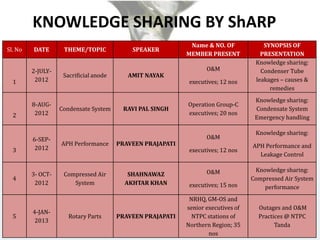
Sl. No DATE THEME/TOPIC SPEAKER
Name & NO. OF
MEMBER PRESENT
SYNOPSIS OF
PRESENTATION
1
2-JULY-
2012
Sacrificial anode AMIT NAYAK
O&M
executives; 12 nos
Knowledge sharing:
Condenser Tube
leakages – causes &
remedies
2
8-AUG-
2012
Condensate System RAVI PAL SINGH
Operation Group-C
executives; 20 nos
Knowledge sharing:
Condensate System
Emergency handling
3
6-SEP-
2012
APH Performance PRAVEEN PRAJAPATI
O&M
executives; 12 nos
Knowledge sharing:
APH Performance and
Leakage Control
4
3- OCT-
2012
Compressed Air
System
SHAHNAWAZ
AKHTAR KHAN
O&M
executives; 15 nos
Knowledge sharing:
Compressed Air System
performance
5
4-JAN-
2013
Rotary Parts PRAVEEN PRAJAPATI
NRHQ, GM-OS and
senior executives of
NTPC stations of
Northern Region; 35
nos
Outages and O&M
Practices @ NTPC
Tanda
KNOWLEDGE SHARING BY ShARP
NEED OF HOUR
“AIR COOLED CONDENSER TO
CURTAIL POWER PLANT THIRST’’
LAYOUT
• WHY AIR COOLED CONDENSER
• WATER USED IN THERMAL POWER PLANTS
• FUTURE WATER DEMAND
• WATER CONSERVATION IN POWER PLANTS
• AIR COOLED CONDENSER
• STATIONS RUNNING ON AIR COOLED CONDENSER
• RESEARCH AND FINDINGS
• VENDORS
• FUTURE SCOPE
• MAJOR IMPACT USING AIR COOLED CONDENSER
• CONCLUSION
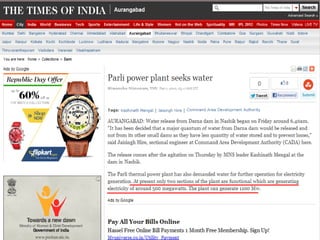
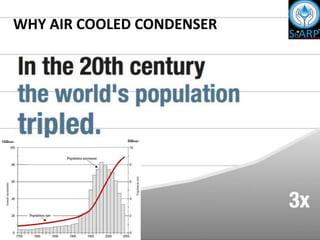
WHY AIR COOLED CONDENSER
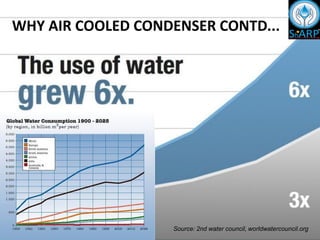
WHY AIR COOLED CONDENSER CONTD...
Source: 2nd water council, worldwatercouncil.org
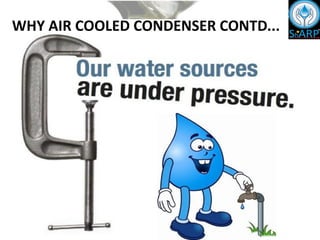
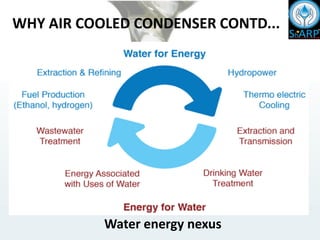
WHY AIR COOLED CONDENSER CONTD...
Water energy nexus
It’s been said,
we’re going to
run out of fresh water,
before we run out of OIL.
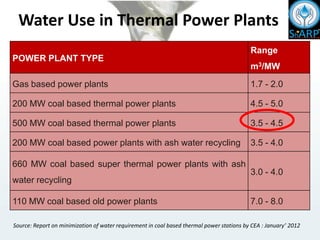
Water Use in Thermal Power Plants
POWER PLANT TYPE
Range
m3/MW
Gas based power plants 1.7 - 2.0
200 MW coal based thermal power plants 4.5 - 5.0
500 MW coal based thermal power plants 3.5 - 4.5
200 MW coal based power plants with ash water recycling 3.5 - 4.0
660 MW coal based super thermal power plants with ash
water recycling
3.0 - 4.0
110 MW coal based old power plants 7.0 - 8.0
Source: Report on minimization of water requirement in coal based thermal power stations by CEA : January’ 2012
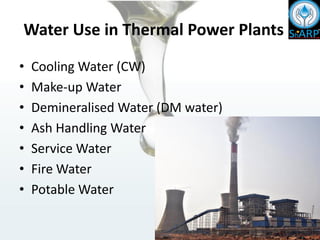
Water Use in Thermal Power Plants
• Cooling Water (CW)
• Make-up Water
• Demineralised Water (DM water)
• Ash Handling Water
• Service Water
• Fire Water
• Potable Water
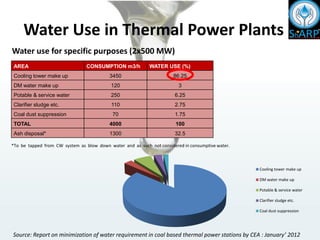
Water use for specific purposes (2x500 MW)
Cooling tower make up
DM water make up
Potable & service water
Clarifier sludge etc.
Coal dust suppression
AREA CONSUMPTION m3/h WATER USE (%)
Cooling tower make up 3450 86.25
DM water make up 120 3
Potable & service water 250 6.25
Clarifier sludge etc. 110 2.75
Coal dust suppression 70 1.75
TOTAL 4000 100
Ash disposal* 1300 32.5
*To be tapped from CW system as blow down water and as such not considered in consumptive water.
Water Use in Thermal Power Plants
Source: Report on minimization of water requirement in coal based thermal power stations by CEA : January’ 2012
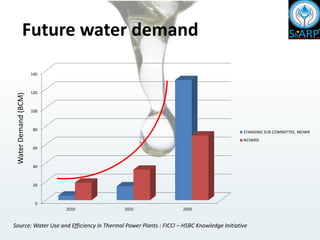
Future water demand
0
20
40
60
80
100
120
140
2010 2025 2050
STANDING SUB COMMITTEE, MOWR
NCIWRD
WaterDemand(BCM)
Source: Water Use and Efficiency in Thermal Power Plants : FICCI – HSBC Knowledge Initiative
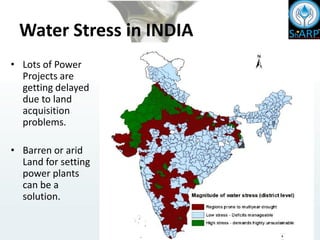
Water Stress in INDIA
• Lots of Power
Projects are
getting delayed
due to land
acquisition
problems.
• Barren or arid
Land for setting
power plants
can be a
solution.
Water conservation in thermal
power plants
• Increasing cycles of concentration
• Optimising ash-water ratio
• Recycling ash water from the ash dyke
• Using air cooled condensers
• Reducing leaks and over flows
• Wastewater recycling
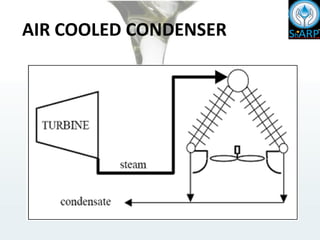
AIR COOLED CONDENSER
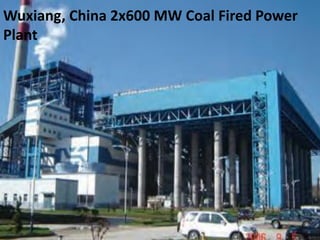
Wuxiang, China 2x600 MW Coal Fired Power
Plant
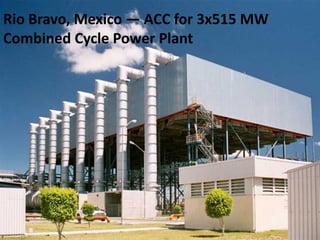
Rio Bravo, Mexico — ACC for 3x515 MW
Combined Cycle Power Plant
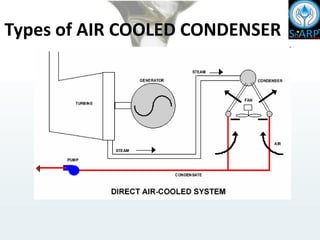
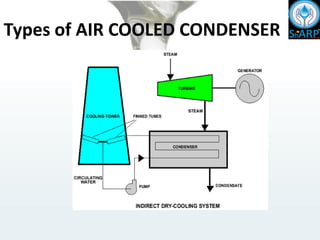
Types of AIR COOLED CONDENSER
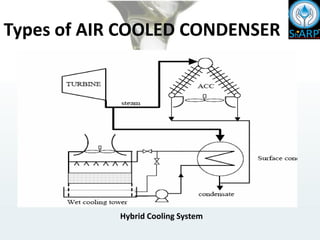
Hybrid Cooling System
Types of AIR COOLED CONDENSER
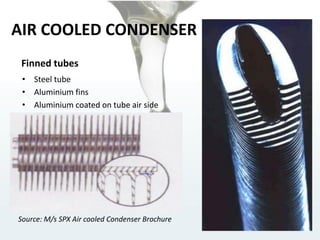
AIR COOLED CONDENSER
Finned tubes
• Steel tube
• Aluminium fins
• Aluminium coated on tube air side
Source: M/s SPX Air cooled Condenser Brochure
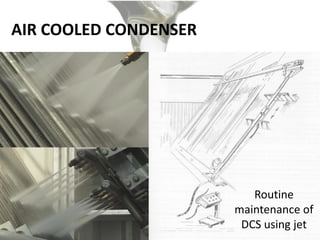
Routine
maintenance of
DCS using jet
AIR COOLED CONDENSER
STATIONS RUNNING ON AIR COOLED
CONDENSER
Power Plants
• 2X350MW Ind Barath Power India Ltd. Orissa.
• 135 MW KSK Energy, Rajasthan.
• 81.5 MW Sarda Energy, Siltara plant.
Captive Power Plants
• Birla White
• Jaypee Group
• J.K. Laxmi
• Shree Cements
• Ultratech Cements.
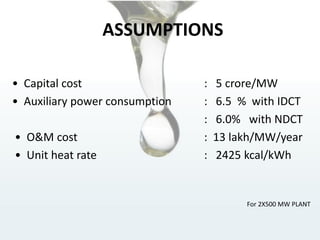
GLOBAL STATIONS RUNNING ON AIR
COOLED CONDENSER
RESEARCH
AND
FINDINGS
ASSUMPTIONS
• Capital cost : 5 crore/MW
• Auxiliary power consumption : 6.5 % with IDCT
: 6.0% with NDCT
• O&M cost : 13 lakh/MW/year
• Unit heat rate : 2425 kcal/kWh
For 2X500 MW PLANT
Findings
Sl no
Description Wet Cooling System
(NDCT)
Direct Dry Cooling
System (ACC)
Indirect Dry Cooling
System (ACC)
1 Condenser Pressure 0.1019 Ksc .1835 Ksc .2243 Ksc
2 Gross unit output, MW 500 466.72 465.11
3 Capital cost Crore 2500 2601.5 2675.5
4 Crore/MW 5 5.57 5.75
5
Auxiliary power
consumption, % of gross
output 6 6.64 6.12
6 Gross heat rate, kcal/kWh 2425 2597.9 2606.9
7 O&M cost lakh/MW 13 12.08 12.13
8
First year tariff
Fixed charges Rs/kWh 1.59 1.75 1.79
Variable charges
Rs/kWh 0.71 0.77 0.77
Total Rs/kWh 2.31 2.52 2.56
9 Difference in tariff Rs/kWh Base 0.21 0.25
10
Levelised tariff
Fixed charges Rs/kWh 1.42 1.53 1.56
Variable charges
Rs/kWh 1.21 1.3 1.3
Total Rs/kWh 2.63 2.83 2.86
11 Difference in tariff Rs/kWh Base 0.21 0.23
Source: Report on minimization of water requirement in coal based thermal power stations by CEA : January’ 2012
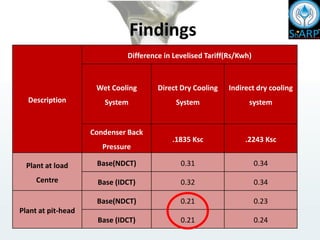
Findings
Description
Difference in Levelised Tariff(Rs/Kwh)
Wet Cooling
System
Direct Dry Cooling
System
Indirect dry cooling
system
Condenser Back
Pressure
.1835 Ksc .2243 Ksc
Plant at load
Centre
Base(NDCT) 0.31 0.34
Base (IDCT) 0.32 0.34
Plant at pit-head
Base(NDCT) 0.21 0.23
Base (IDCT) 0.21 0.24
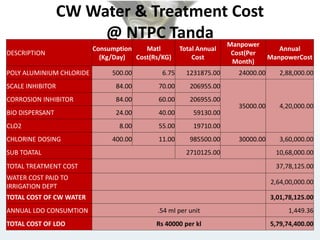
CW Water & Treatment Cost
@ NTPC Tanda
DESCRIPTION
Consumption
(Kg/Day)
Matl
Cost(Rs/KG)
Total Annual
Cost
Manpower
Cost(Per
Month)
Annual
ManpowerCost
POLY ALUMINIUM CHLORIDE 500.00 6.75 1231875.00 24000.00 2,88,000.00
SCALE INHIBITOR 84.00 70.00 206955.00
35000.00 4,20,000.00
CORROSION INHIBITOR 84.00 60.00 206955.00
BIO DISPERSANT 24.00 40.00 59130.00
CLO2 8.00 55.00 19710.00
CHLORINE DOSING 400.00 11.00 985500.00 30000.00 3,60,000.00
SUB TOATAL 2710125.00 10,68,000.00
TOTAL TREATMENT COST 37,78,125.00
WATER COST PAID TO
IRRIGATION DEPT
2,64,00,000.00
TOTAL COST OF CW WATER 3,01,78,125.00
ANNUAL LDO CONSUMTION .54 ml per unit 1,449.36
TOTAL COST OF LDO Rs 40000 per kl 5,79,74,400.00
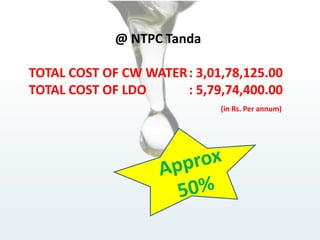
@ NTPC Tanda
TOTAL COST OF CW WATER: 3,01,78,125.00
TOTAL COST OF LDO : 5,79,74,400.00
(in Rs. Per annum)
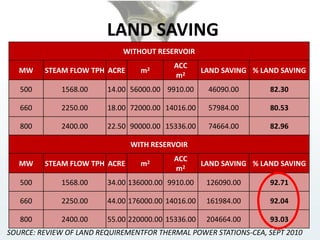
LAND SAVING
WITHOUT RESERVOIR
MW STEAM FLOW TPH ACRE m2
ACC
m2
LAND SAVING % LAND SAVING
500 1568.00 14.00 56000.00 9910.00 46090.00 82.30
660 2250.00 18.00 72000.00 14016.00 57984.00 80.53
800 2400.00 22.50 90000.00 15336.00 74664.00 82.96
WITH RESERVOIR
MW STEAM FLOW TPH ACRE m2
ACC
m2
LAND SAVING % LAND SAVING
500 1568.00 34.00 136000.00 9910.00 126090.00 92.71
660 2250.00 44.00 176000.00 14016.00 161984.00 92.04
800 2400.00 55.00 220000.00 15336.00 204664.00 93.03
SOURCE: REVIEW OF LAND REQUIREMENTFOR THERMAL POWER STATIONS-CEA, SEPT 2010
VENDORS
• M/S SPX, NORTH CAROLINA,USA
• M/S THERMAX, PUNE.
• M/S GEA ENERGY TECHNOLOGY, BHOPAL
DIVISION
• M/S ENERGO
• M/S CLASSIK COOLING TOWERS, COIMBATORE
• M/S PRECESION COOLING SYSTEM, CHENNAI
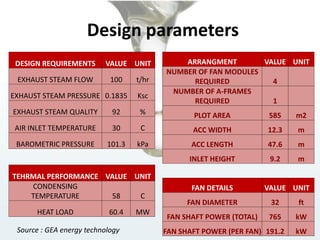
Design parameters
DESIGN REQUIREMENTS VALUE UNIT
EXHAUST STEAM FLOW 100 t/hr
EXHAUST STEAM PRESSURE 0.1835 Ksc
EXHAUST STEAM QUALITY 92 %
AIR INLET TEMPERATURE 30 C
BAROMETRIC PRESSURE 101.3 kPa
TEHRMAL PERFORMANCE VALUE UNIT
CONDENSING
TEMPERATURE 58 C
HEAT LOAD 60.4 MW
ARRANGMENT VALUE UNIT
NUMBER OF FAN MODULES
REQUIRED 4
NUMBER OF A-FRAMES
REQUIRED 1
PLOT AREA 585 m2
ACC WIDTH 12.3 m
ACC LENGTH 47.6 m
INLET HEIGHT 9.2 m
FAN DETAILS VALUE UNIT
FAN DIAMETER 32 ft
FAN SHAFT POWER (TOTAL) 765 kW
FAN SHAFT POWER (PER FAN) 191.2 kWSource : GEA energy technology
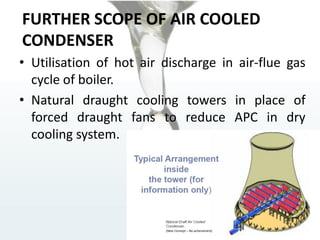
FURTHER SCOPE OF AIR COOLED
CONDENSER
• Utilisation of hot air discharge in air-flue gas
cycle of boiler.
• Natural draught cooling towers in place of
forced draught fans to reduce APC in dry
cooling system.
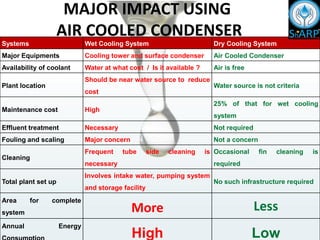
MAJOR IMPACT USING
AIR COOLED CONDENSER
Systems Wet Cooling System Dry Cooling System
Major Equipments Cooling tower and surface condenser Air Cooled Condenser
Availability of coolant Water at what cost / Is it available ? Air is free
Plant location
Should be near water source to reduce
cost
Water source is not criteria
Maintenance cost High
25% of that for wet cooling
system
Effluent treatment Necessary Not required
Fouling and scaling Major concern Not a concern
Cleaning
Frequent tube side cleaning is
necessary
Occasional fin cleaning is
required
Total plant set up
Involves intake water, pumping system
and storage facility
No such infrastructure required
Area for complete
system More Less
Annual Energy
High Low
CONCLUSION
• Exponentially rising demand of power
• In future there may be a situation in which water sources may not
cope up with this requirement.
• Norms of the regulatory authorities regarding usage of natural
resources will be further tightened, which will curtail the freedom
of usage of water in power plant.
• By employing air cooled system, which eliminate dependencies on
water for CW, locating stations in water scarce regions will be more
possible.
• Although dry cooling systems are costly technologies on techno-
economic considerations, but foreseeing the future, it is the need of
hour to employ dry cooling system, which offers possible solution
for power plant installation eliminating the above mentioned
challenges.
It’s a thirsty world...
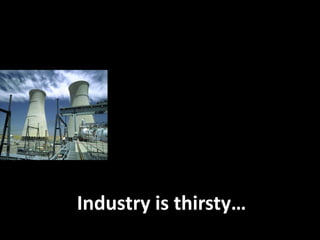
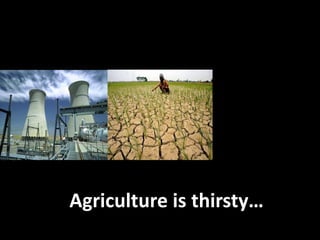
Industry is thirsty…
Agriculture is thirsty…
We are thirsty…
REFRENCES
• Mr. Romit Sen, Senior Assistant Director, FICCI Water Mission: FICCI – HSBC, Knowledge
Initiative on Water Use and Efficiency in Thermal Power Plants.
• The Integrated Energy Policy, Govt. of India
• www.indiapower.org - accessed on June 30, 2011
• The Bulletin on Energy Efficiency, 2006, Volume 7, Issue 3
• Report of the Steering Committee on Water Resources for XI Five Year Plan
• Phansalkar Sanjiv and Verma Shilp; India's Water Future 2050: Potential Deviations from
Business
• International Journal of Rural Management (2007) 3: 14
• Technical EIA Guidance Manual for Thermal Power Plants, MoEF, 2009
• Report on minimization of water requirement in coal based thermal power stations:
central electricity authority, New Delhi, January’ 2012
• C. P. Kumar Scientist ’F’, National Institute of Hydrology, Roorkee: Water Status and
Problems in India
• Audrey Maheu, McGill University: Energy choices and their impacts on demand for water
resources: An assessment of current and projected water consumption In global energy
production
• Anna Delgado Martin, Massachusetts of Technology: Water Footprint of Electric Power
Generation: Modelling its uses and Analyzing options for a water-scarce future
Thank you

Air cooled condensers

  • 1.
    PC- TEAM AMIT NAYAK PRAVEEN PRAJAPATI RAVIPAL SINGH SHAHNAWAZ AKHTAR KHAN CO ORDINATOR SHRI D. N. TIWARI AGM MAINTENANCE NTPC TANDA
  • 2.
    Sl. No DATETHEME/TOPIC SPEAKER Name & NO. OF MEMBER PRESENT SYNOPSIS OF PRESENTATION 1 2-JULY- 2012 Sacrificial anode AMIT NAYAK O&M executives; 12 nos Knowledge sharing: Condenser Tube leakages – causes & remedies 2 8-AUG- 2012 Condensate System RAVI PAL SINGH Operation Group-C executives; 20 nos Knowledge sharing: Condensate System Emergency handling 3 6-SEP- 2012 APH Performance PRAVEEN PRAJAPATI O&M executives; 12 nos Knowledge sharing: APH Performance and Leakage Control 4 3- OCT- 2012 Compressed Air System SHAHNAWAZ AKHTAR KHAN O&M executives; 15 nos Knowledge sharing: Compressed Air System performance 5 4-JAN- 2013 Rotary Parts PRAVEEN PRAJAPATI NRHQ, GM-OS and senior executives of NTPC stations of Northern Region; 35 nos Outages and O&M Practices @ NTPC Tanda KNOWLEDGE SHARING BY ShARP
  • 5.
    NEED OF HOUR “AIRCOOLED CONDENSER TO CURTAIL POWER PLANT THIRST’’
  • 6.
    LAYOUT • WHY AIRCOOLED CONDENSER • WATER USED IN THERMAL POWER PLANTS • FUTURE WATER DEMAND • WATER CONSERVATION IN POWER PLANTS • AIR COOLED CONDENSER • STATIONS RUNNING ON AIR COOLED CONDENSER • RESEARCH AND FINDINGS • VENDORS • FUTURE SCOPE • MAJOR IMPACT USING AIR COOLED CONDENSER • CONCLUSION
  • 7.
    WHY AIR COOLEDCONDENSER
  • 8.
    WHY AIR COOLEDCONDENSER CONTD... Source: 2nd water council, worldwatercouncil.org
  • 9.
    WHY AIR COOLEDCONDENSER CONTD...
  • 10.
    WHY AIR COOLEDCONDENSER CONTD... Water energy nexus
  • 11.
    It’s been said, we’regoing to run out of fresh water, before we run out of OIL.
  • 12.
    Water Use inThermal Power Plants POWER PLANT TYPE Range m3/MW Gas based power plants 1.7 - 2.0 200 MW coal based thermal power plants 4.5 - 5.0 500 MW coal based thermal power plants 3.5 - 4.5 200 MW coal based power plants with ash water recycling 3.5 - 4.0 660 MW coal based super thermal power plants with ash water recycling 3.0 - 4.0 110 MW coal based old power plants 7.0 - 8.0 Source: Report on minimization of water requirement in coal based thermal power stations by CEA : January’ 2012
  • 13.
    Water Use inThermal Power Plants • Cooling Water (CW) • Make-up Water • Demineralised Water (DM water) • Ash Handling Water • Service Water • Fire Water • Potable Water
  • 14.
    Water use forspecific purposes (2x500 MW) Cooling tower make up DM water make up Potable & service water Clarifier sludge etc. Coal dust suppression AREA CONSUMPTION m3/h WATER USE (%) Cooling tower make up 3450 86.25 DM water make up 120 3 Potable & service water 250 6.25 Clarifier sludge etc. 110 2.75 Coal dust suppression 70 1.75 TOTAL 4000 100 Ash disposal* 1300 32.5 *To be tapped from CW system as blow down water and as such not considered in consumptive water. Water Use in Thermal Power Plants Source: Report on minimization of water requirement in coal based thermal power stations by CEA : January’ 2012
  • 15.
    Future water demand 0 20 40 60 80 100 120 140 20102025 2050 STANDING SUB COMMITTEE, MOWR NCIWRD WaterDemand(BCM) Source: Water Use and Efficiency in Thermal Power Plants : FICCI – HSBC Knowledge Initiative
  • 16.
    Water Stress inINDIA • Lots of Power Projects are getting delayed due to land acquisition problems. • Barren or arid Land for setting power plants can be a solution.
  • 17.
    Water conservation inthermal power plants • Increasing cycles of concentration • Optimising ash-water ratio • Recycling ash water from the ash dyke • Using air cooled condensers • Reducing leaks and over flows • Wastewater recycling
  • 18.
  • 19.
    Wuxiang, China 2x600MW Coal Fired Power Plant
  • 20.
    Rio Bravo, Mexico— ACC for 3x515 MW Combined Cycle Power Plant
  • 21.
    Types of AIRCOOLED CONDENSER
  • 22.
    Types of AIRCOOLED CONDENSER
  • 23.
    Hybrid Cooling System Typesof AIR COOLED CONDENSER
  • 24.
    AIR COOLED CONDENSER Finnedtubes • Steel tube • Aluminium fins • Aluminium coated on tube air side Source: M/s SPX Air cooled Condenser Brochure
  • 25.
    Routine maintenance of DCS usingjet AIR COOLED CONDENSER
  • 26.
    STATIONS RUNNING ONAIR COOLED CONDENSER Power Plants • 2X350MW Ind Barath Power India Ltd. Orissa. • 135 MW KSK Energy, Rajasthan. • 81.5 MW Sarda Energy, Siltara plant. Captive Power Plants • Birla White • Jaypee Group • J.K. Laxmi • Shree Cements • Ultratech Cements.
  • 27.
    GLOBAL STATIONS RUNNINGON AIR COOLED CONDENSER
  • 28.
  • 29.
    ASSUMPTIONS • Capital cost: 5 crore/MW • Auxiliary power consumption : 6.5 % with IDCT : 6.0% with NDCT • O&M cost : 13 lakh/MW/year • Unit heat rate : 2425 kcal/kWh For 2X500 MW PLANT
  • 30.
    Findings Sl no Description WetCooling System (NDCT) Direct Dry Cooling System (ACC) Indirect Dry Cooling System (ACC) 1 Condenser Pressure 0.1019 Ksc .1835 Ksc .2243 Ksc 2 Gross unit output, MW 500 466.72 465.11 3 Capital cost Crore 2500 2601.5 2675.5 4 Crore/MW 5 5.57 5.75 5 Auxiliary power consumption, % of gross output 6 6.64 6.12 6 Gross heat rate, kcal/kWh 2425 2597.9 2606.9 7 O&M cost lakh/MW 13 12.08 12.13 8 First year tariff Fixed charges Rs/kWh 1.59 1.75 1.79 Variable charges Rs/kWh 0.71 0.77 0.77 Total Rs/kWh 2.31 2.52 2.56 9 Difference in tariff Rs/kWh Base 0.21 0.25 10 Levelised tariff Fixed charges Rs/kWh 1.42 1.53 1.56 Variable charges Rs/kWh 1.21 1.3 1.3 Total Rs/kWh 2.63 2.83 2.86 11 Difference in tariff Rs/kWh Base 0.21 0.23 Source: Report on minimization of water requirement in coal based thermal power stations by CEA : January’ 2012
  • 31.
    Findings Description Difference in LevelisedTariff(Rs/Kwh) Wet Cooling System Direct Dry Cooling System Indirect dry cooling system Condenser Back Pressure .1835 Ksc .2243 Ksc Plant at load Centre Base(NDCT) 0.31 0.34 Base (IDCT) 0.32 0.34 Plant at pit-head Base(NDCT) 0.21 0.23 Base (IDCT) 0.21 0.24
  • 32.
    CW Water &Treatment Cost @ NTPC Tanda DESCRIPTION Consumption (Kg/Day) Matl Cost(Rs/KG) Total Annual Cost Manpower Cost(Per Month) Annual ManpowerCost POLY ALUMINIUM CHLORIDE 500.00 6.75 1231875.00 24000.00 2,88,000.00 SCALE INHIBITOR 84.00 70.00 206955.00 35000.00 4,20,000.00 CORROSION INHIBITOR 84.00 60.00 206955.00 BIO DISPERSANT 24.00 40.00 59130.00 CLO2 8.00 55.00 19710.00 CHLORINE DOSING 400.00 11.00 985500.00 30000.00 3,60,000.00 SUB TOATAL 2710125.00 10,68,000.00 TOTAL TREATMENT COST 37,78,125.00 WATER COST PAID TO IRRIGATION DEPT 2,64,00,000.00 TOTAL COST OF CW WATER 3,01,78,125.00 ANNUAL LDO CONSUMTION .54 ml per unit 1,449.36 TOTAL COST OF LDO Rs 40000 per kl 5,79,74,400.00
  • 33.
    @ NTPC Tanda TOTALCOST OF CW WATER: 3,01,78,125.00 TOTAL COST OF LDO : 5,79,74,400.00 (in Rs. Per annum)
  • 34.
    LAND SAVING WITHOUT RESERVOIR MWSTEAM FLOW TPH ACRE m2 ACC m2 LAND SAVING % LAND SAVING 500 1568.00 14.00 56000.00 9910.00 46090.00 82.30 660 2250.00 18.00 72000.00 14016.00 57984.00 80.53 800 2400.00 22.50 90000.00 15336.00 74664.00 82.96 WITH RESERVOIR MW STEAM FLOW TPH ACRE m2 ACC m2 LAND SAVING % LAND SAVING 500 1568.00 34.00 136000.00 9910.00 126090.00 92.71 660 2250.00 44.00 176000.00 14016.00 161984.00 92.04 800 2400.00 55.00 220000.00 15336.00 204664.00 93.03 SOURCE: REVIEW OF LAND REQUIREMENTFOR THERMAL POWER STATIONS-CEA, SEPT 2010
  • 35.
    VENDORS • M/S SPX,NORTH CAROLINA,USA • M/S THERMAX, PUNE. • M/S GEA ENERGY TECHNOLOGY, BHOPAL DIVISION • M/S ENERGO • M/S CLASSIK COOLING TOWERS, COIMBATORE • M/S PRECESION COOLING SYSTEM, CHENNAI
  • 36.
    Design parameters DESIGN REQUIREMENTSVALUE UNIT EXHAUST STEAM FLOW 100 t/hr EXHAUST STEAM PRESSURE 0.1835 Ksc EXHAUST STEAM QUALITY 92 % AIR INLET TEMPERATURE 30 C BAROMETRIC PRESSURE 101.3 kPa TEHRMAL PERFORMANCE VALUE UNIT CONDENSING TEMPERATURE 58 C HEAT LOAD 60.4 MW ARRANGMENT VALUE UNIT NUMBER OF FAN MODULES REQUIRED 4 NUMBER OF A-FRAMES REQUIRED 1 PLOT AREA 585 m2 ACC WIDTH 12.3 m ACC LENGTH 47.6 m INLET HEIGHT 9.2 m FAN DETAILS VALUE UNIT FAN DIAMETER 32 ft FAN SHAFT POWER (TOTAL) 765 kW FAN SHAFT POWER (PER FAN) 191.2 kWSource : GEA energy technology
  • 37.
    FURTHER SCOPE OFAIR COOLED CONDENSER • Utilisation of hot air discharge in air-flue gas cycle of boiler. • Natural draught cooling towers in place of forced draught fans to reduce APC in dry cooling system.
  • 38.
    MAJOR IMPACT USING AIRCOOLED CONDENSER Systems Wet Cooling System Dry Cooling System Major Equipments Cooling tower and surface condenser Air Cooled Condenser Availability of coolant Water at what cost / Is it available ? Air is free Plant location Should be near water source to reduce cost Water source is not criteria Maintenance cost High 25% of that for wet cooling system Effluent treatment Necessary Not required Fouling and scaling Major concern Not a concern Cleaning Frequent tube side cleaning is necessary Occasional fin cleaning is required Total plant set up Involves intake water, pumping system and storage facility No such infrastructure required Area for complete system More Less Annual Energy High Low
  • 39.
    CONCLUSION • Exponentially risingdemand of power • In future there may be a situation in which water sources may not cope up with this requirement. • Norms of the regulatory authorities regarding usage of natural resources will be further tightened, which will curtail the freedom of usage of water in power plant. • By employing air cooled system, which eliminate dependencies on water for CW, locating stations in water scarce regions will be more possible. • Although dry cooling systems are costly technologies on techno- economic considerations, but foreseeing the future, it is the need of hour to employ dry cooling system, which offers possible solution for power plant installation eliminating the above mentioned challenges.
  • 40.
  • 41.
  • 42.
  • 43.
  • 45.
    REFRENCES • Mr. RomitSen, Senior Assistant Director, FICCI Water Mission: FICCI – HSBC, Knowledge Initiative on Water Use and Efficiency in Thermal Power Plants. • The Integrated Energy Policy, Govt. of India • www.indiapower.org - accessed on June 30, 2011 • The Bulletin on Energy Efficiency, 2006, Volume 7, Issue 3 • Report of the Steering Committee on Water Resources for XI Five Year Plan • Phansalkar Sanjiv and Verma Shilp; India's Water Future 2050: Potential Deviations from Business • International Journal of Rural Management (2007) 3: 14 • Technical EIA Guidance Manual for Thermal Power Plants, MoEF, 2009 • Report on minimization of water requirement in coal based thermal power stations: central electricity authority, New Delhi, January’ 2012 • C. P. Kumar Scientist ’F’, National Institute of Hydrology, Roorkee: Water Status and Problems in India • Audrey Maheu, McGill University: Energy choices and their impacts on demand for water resources: An assessment of current and projected water consumption In global energy production • Anna Delgado Martin, Massachusetts of Technology: Water Footprint of Electric Power Generation: Modelling its uses and Analyzing options for a water-scarce future
  • 46.