Samrat Prithviraj Chauhan Government College
Ajmer
2020-2021
FRANCK CONDON
PRINCIPLE
Submitted By
Bhuvneshwari
Saini
M.Sc. Chemistry
Semester 2nd
Department of chemistry
Table of Content
 Introduction
 Energy Levels
 Vibrational Transition
 Frank Condon Principle
 Explanation of FCP
 Reference
Introduction
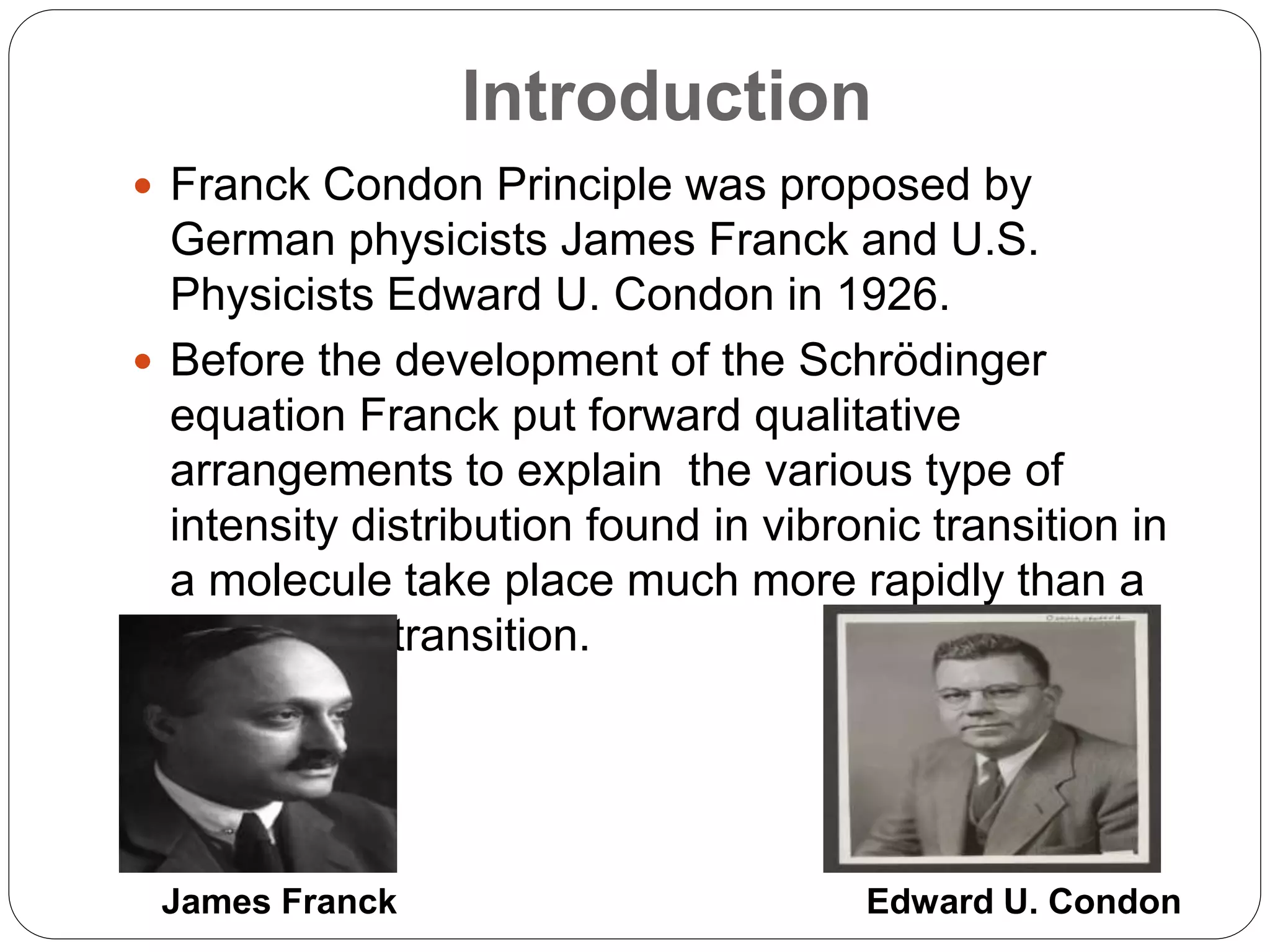
 Franck Condon Principle was proposed by
German physicists James Franck and U.S.
Physicists Edward U. Condon in 1926.
 Before the development of the Schrödinger
equation Franck put forward qualitative
arrangements to explain the various type of
intensity distribution found in vibronic transition in
a molecule take place much more rapidly than a
vibrational transition.
James Franck Edward U. Condon
Energy levels
 A quantum mechanical system or particle that is bond- that
is confined spatially can only take on certain discrete
values of energy called energy levels.
 Types of Energy levels :
1. Translation Energy: It is generated by the translation
motion of the molecule.
2. Rotational Energy: It is generated by the rotational
motion of the molecules. It means it is generated due to
the rotational form of centre of gravity of the molecule.
Minimum rotational energy-0.005eV. Selection Rule
∆J=+1,-1. Example – Rigid Rotor
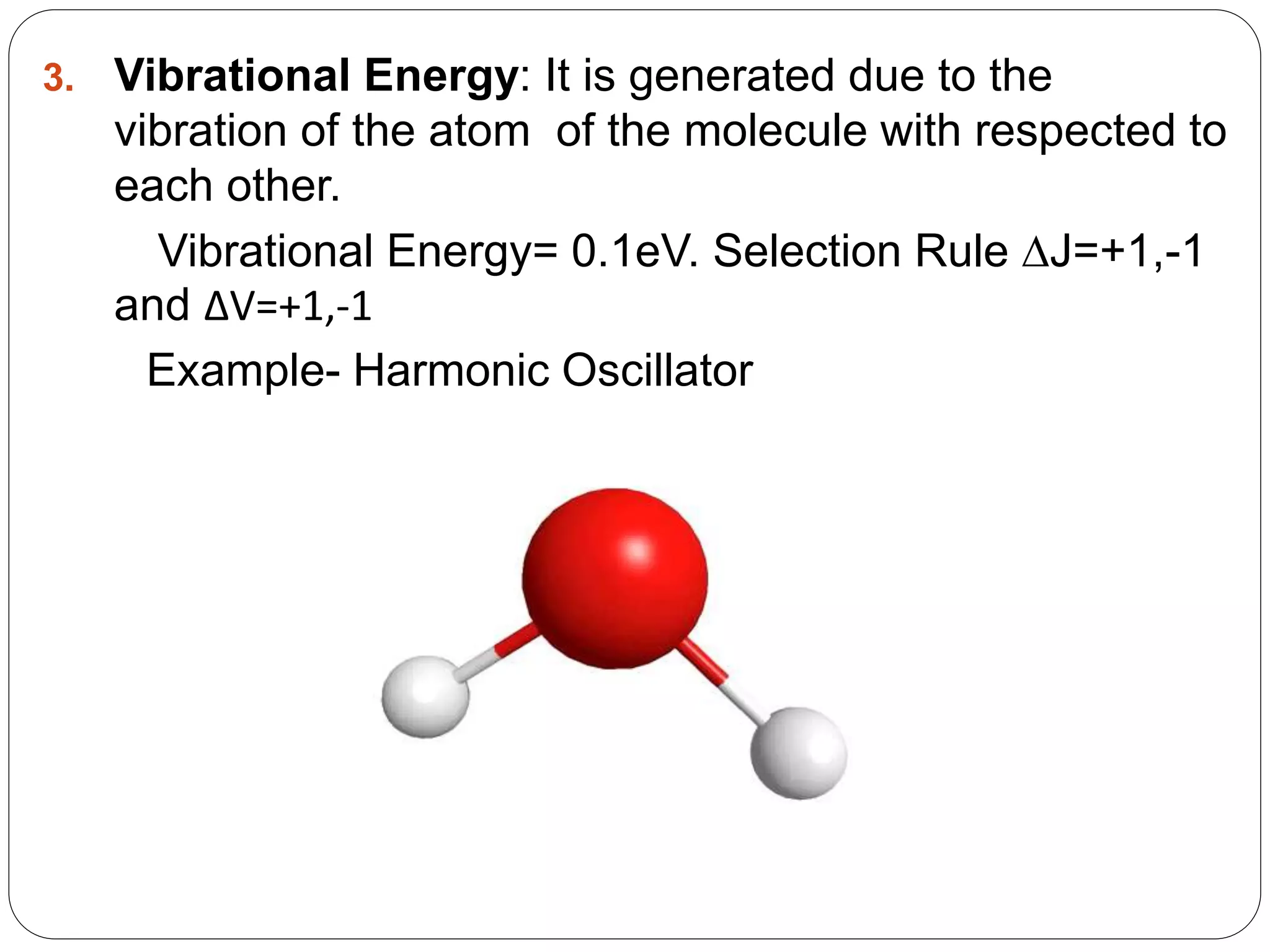
3. Vibrational Energy: It is generated due to the
vibration of the atom of the molecule with respected to
each other.
Vibrational Energy= 0.1eV. Selection Rule ∆J=+1,-1
and ∆V=+1,-1
Example- Harmonic Oscillator
4. Electronic Energy :The electronic energy levels are
quantized and discrete and the energy gap between
the highest occupied and lowest unoccupied orbital
determines the large degree of their stability,
reactivity, and electronic properties.
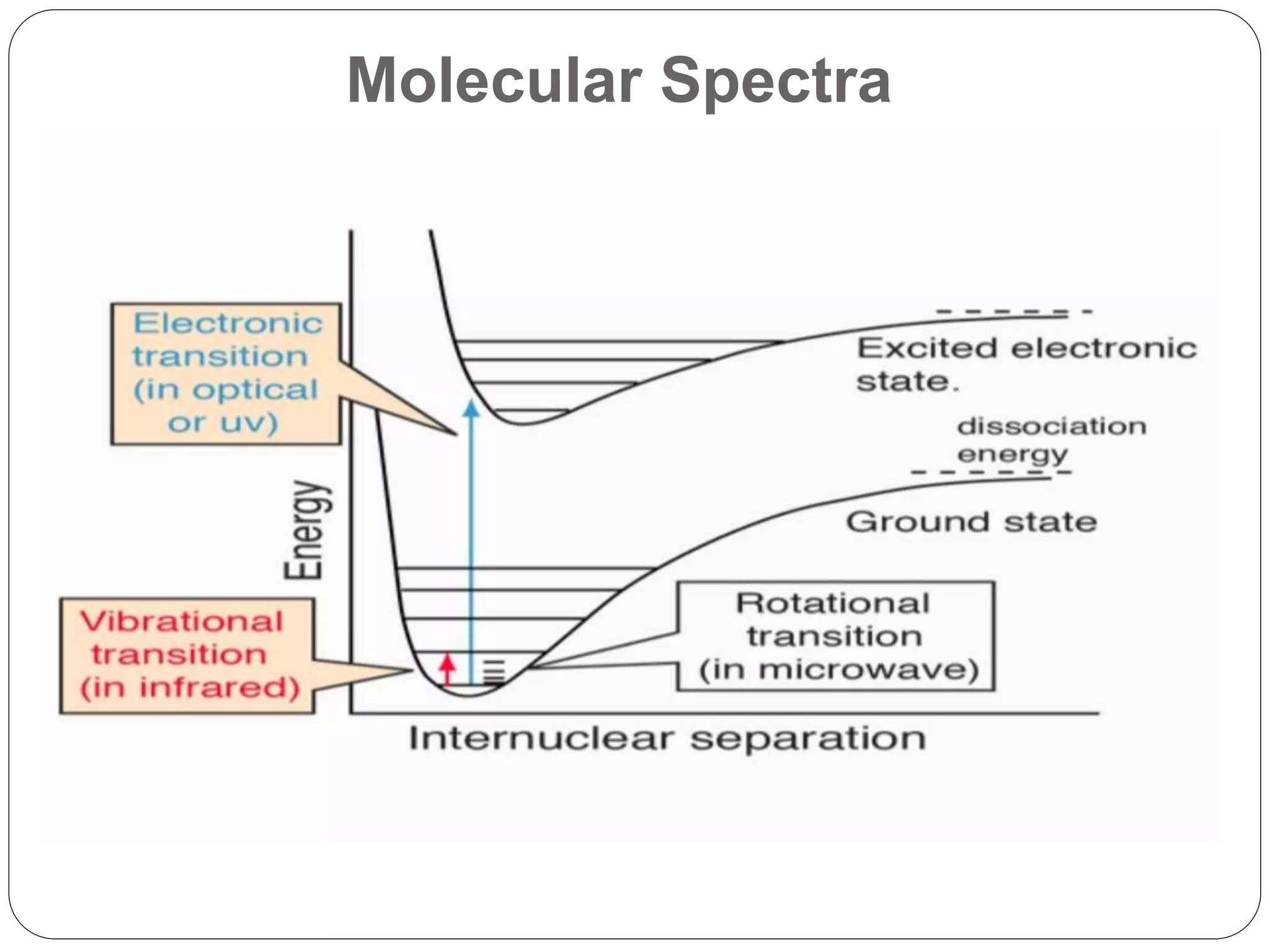
Molecular Spectra
Vibrational Transition
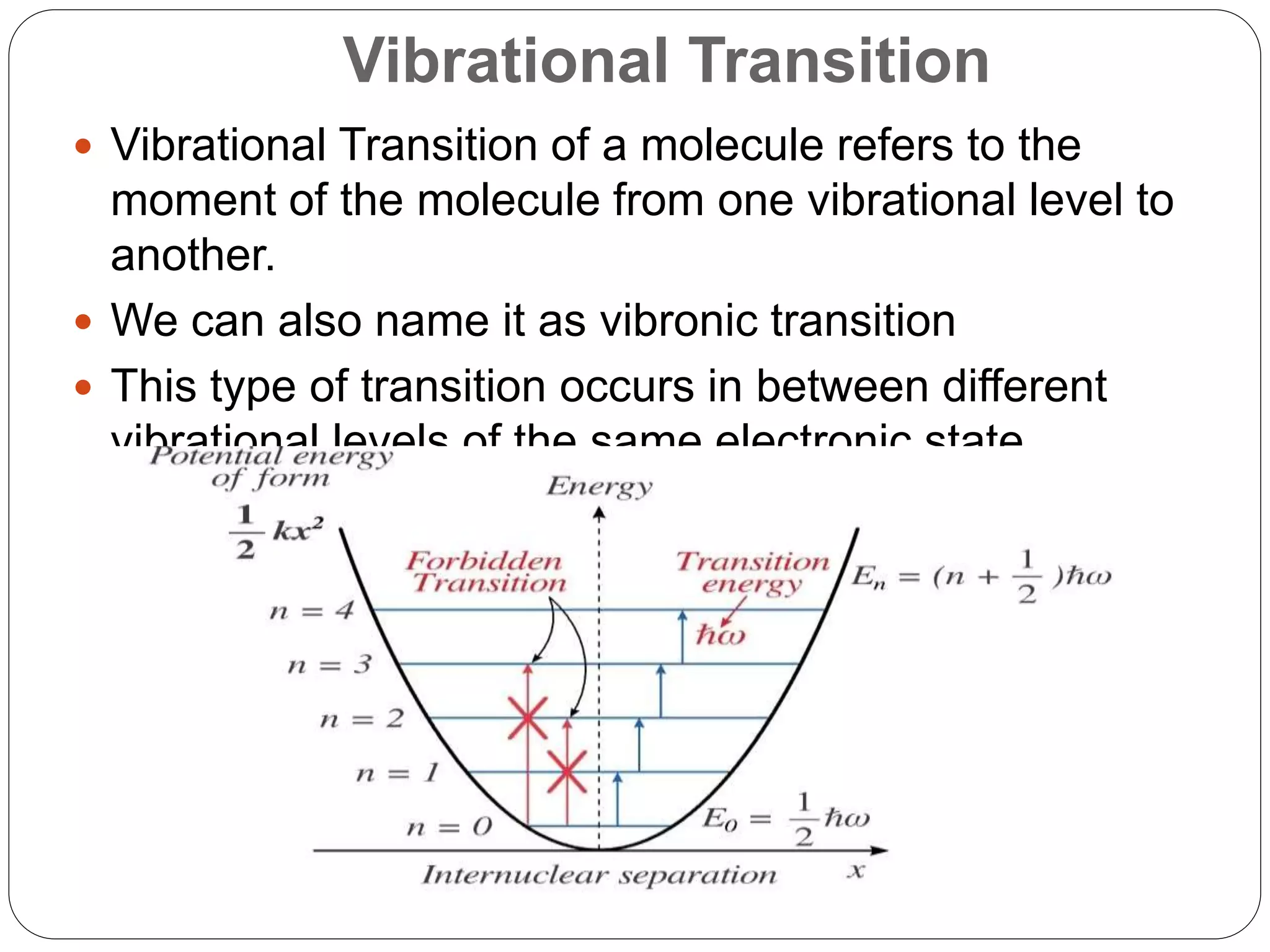
 Vibrational Transition of a molecule refers to the
moment of the molecule from one vibrational level to
another.
 We can also name it as vibronic transition
 This type of transition occurs in between different
vibrational levels of the same electronic state.
Franck Condon Principle
 It states that an electronic
transition take place so
rapidly that a vibrating
molecule does not change
its internuclear distance
appreciably during the
transition.
 This principle is, to a first
approximation, true since
the electrons move so
much fast than the nuclei
that during the electronic
transition than nuclei do
not change their position. Internuclear Distance
Energy
The most likely place
to find and
oscillating object is
at its turning point.
The nuclei do not
have a chance to
move. The transition
represented by
“VERTICAL ARROW”
on the diagram.
In the ground state
the molecule is most
likely in v=0
Explanation of FCP
 CASE 1: Here the excited
electronic state has a slightly
smaller internuclear separation than
the ground state. A vertical
transition form the v"=0 level will be
more likely to occur into the upper
vibrational state v'=2, transition to
lower and higher state being less
likely; in general the upper state
most probably reached will depend
on the difference between the
equilibrium separations in the lower
and upper states. In case of CO
molecule this type of band system
is observed.
Internuclear distance
Energy
Intensity
 CASE 2:When upper
electronic state having the
same equilibrium
internuclear distance as the
lower. Now the FCP
suggests that a transition
occurs vertically on this
diagram since the
internuclear distance does
not change. Thus the
strongest spectral line of the
v" =0 progression will be the
(0,0) . This observed in O₂
molecule.
Internuclear distance
Energy
Intensity
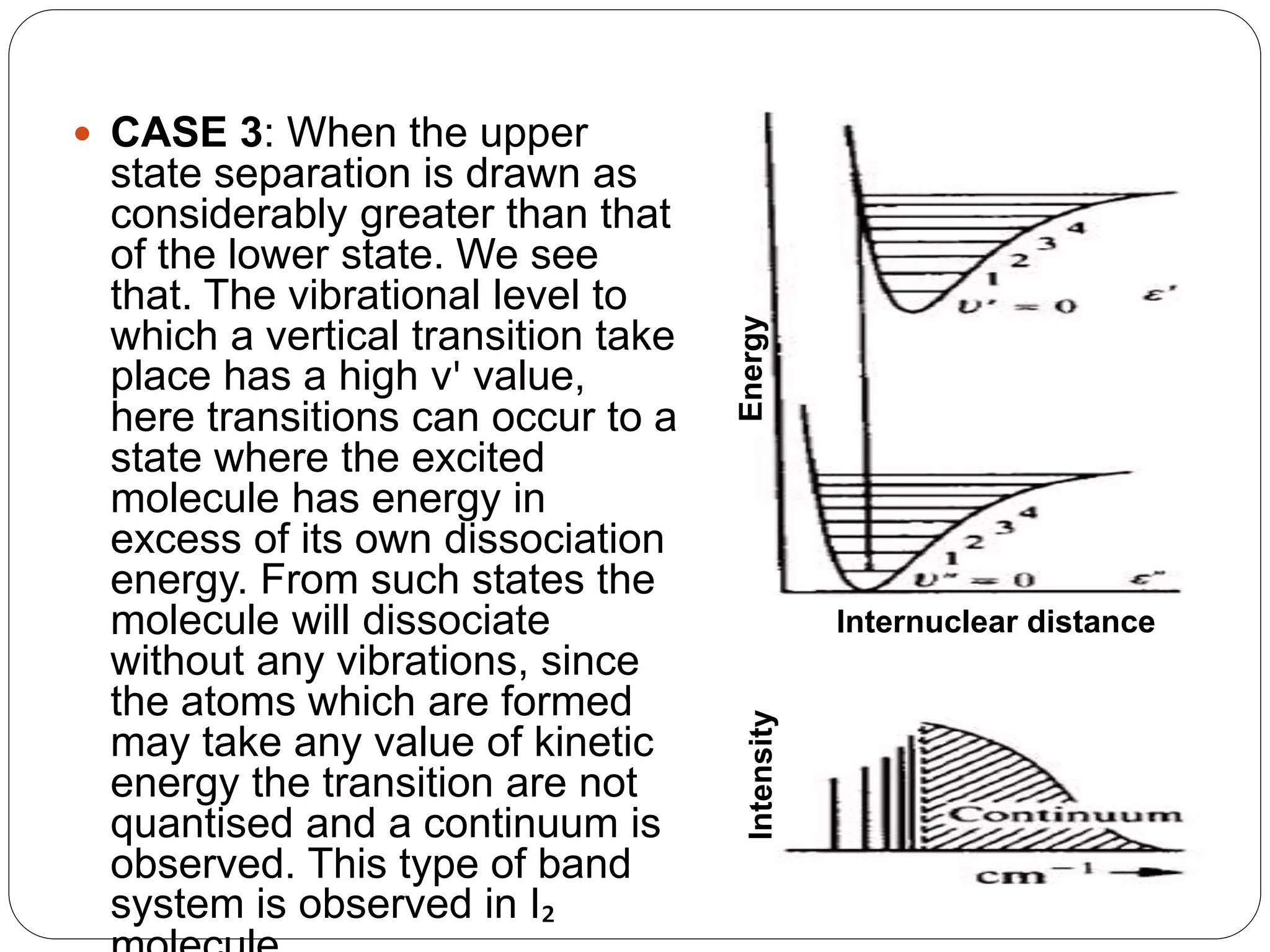
 CASE 3: When the upper
state separation is drawn as
considerably greater than that
of the lower state. We see
that. The vibrational level to
which a vertical transition take
place has a high v' value,
here transitions can occur to a
state where the excited
molecule has energy in
excess of its own dissociation
energy. From such states the
molecule will dissociate
without any vibrations, since
the atoms which are formed
may take any value of kinetic
energy the transition are not
quantised and a continuum is
observed. This type of band
system is observed in I₂
Internuclear distance
Energy
Intensity
Reference
 Atomic and Molecular Spectra: Laser
by Raj Kumar
 Fundamentals of Molecular Spectroscopy
by C.N. Banwell
 Modern spectroscopy
by J.M. Hollas (Wiley)
Thank you

Franck Condon Principle

  • 1.
    Samrat Prithviraj ChauhanGovernment College Ajmer 2020-2021 FRANCK CONDON PRINCIPLE Submitted By Bhuvneshwari Saini M.Sc. Chemistry Semester 2nd Department of chemistry
  • 2.
    Table of Content Introduction  Energy Levels  Vibrational Transition  Frank Condon Principle  Explanation of FCP  Reference
  • 3.
    Introduction  Franck CondonPrinciple was proposed by German physicists James Franck and U.S. Physicists Edward U. Condon in 1926.  Before the development of the Schrödinger equation Franck put forward qualitative arrangements to explain the various type of intensity distribution found in vibronic transition in a molecule take place much more rapidly than a vibrational transition. James Franck Edward U. Condon
  • 4.
    Energy levels  Aquantum mechanical system or particle that is bond- that is confined spatially can only take on certain discrete values of energy called energy levels.  Types of Energy levels : 1. Translation Energy: It is generated by the translation motion of the molecule. 2. Rotational Energy: It is generated by the rotational motion of the molecules. It means it is generated due to the rotational form of centre of gravity of the molecule. Minimum rotational energy-0.005eV. Selection Rule ∆J=+1,-1. Example – Rigid Rotor
  • 5.
    3. Vibrational Energy:It is generated due to the vibration of the atom of the molecule with respected to each other. Vibrational Energy= 0.1eV. Selection Rule ∆J=+1,-1 and ∆V=+1,-1 Example- Harmonic Oscillator
  • 6.
    4. Electronic Energy:The electronic energy levels are quantized and discrete and the energy gap between the highest occupied and lowest unoccupied orbital determines the large degree of their stability, reactivity, and electronic properties.
  • 7.
  • 8.
    Vibrational Transition  VibrationalTransition of a molecule refers to the moment of the molecule from one vibrational level to another.  We can also name it as vibronic transition  This type of transition occurs in between different vibrational levels of the same electronic state.
  • 9.
    Franck Condon Principle It states that an electronic transition take place so rapidly that a vibrating molecule does not change its internuclear distance appreciably during the transition.  This principle is, to a first approximation, true since the electrons move so much fast than the nuclei that during the electronic transition than nuclei do not change their position. Internuclear Distance Energy
  • 10.
    The most likelyplace to find and oscillating object is at its turning point. The nuclei do not have a chance to move. The transition represented by “VERTICAL ARROW” on the diagram. In the ground state the molecule is most likely in v=0
  • 11.
    Explanation of FCP CASE 1: Here the excited electronic state has a slightly smaller internuclear separation than the ground state. A vertical transition form the v"=0 level will be more likely to occur into the upper vibrational state v'=2, transition to lower and higher state being less likely; in general the upper state most probably reached will depend on the difference between the equilibrium separations in the lower and upper states. In case of CO molecule this type of band system is observed. Internuclear distance Energy Intensity
  • 12.
     CASE 2:Whenupper electronic state having the same equilibrium internuclear distance as the lower. Now the FCP suggests that a transition occurs vertically on this diagram since the internuclear distance does not change. Thus the strongest spectral line of the v" =0 progression will be the (0,0) . This observed in O₂ molecule. Internuclear distance Energy Intensity
  • 13.
     CASE 3:When the upper state separation is drawn as considerably greater than that of the lower state. We see that. The vibrational level to which a vertical transition take place has a high v' value, here transitions can occur to a state where the excited molecule has energy in excess of its own dissociation energy. From such states the molecule will dissociate without any vibrations, since the atoms which are formed may take any value of kinetic energy the transition are not quantised and a continuum is observed. This type of band system is observed in I₂ Internuclear distance Energy Intensity
  • 14.
    Reference  Atomic andMolecular Spectra: Laser by Raj Kumar  Fundamentals of Molecular Spectroscopy by C.N. Banwell  Modern spectroscopy by J.M. Hollas (Wiley)
  • 15.