Part 2.10: Vibrational Spectroscopy
1
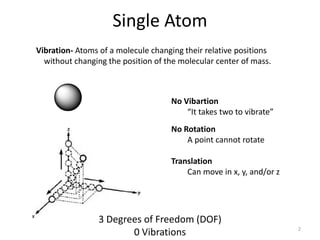
Single Atom
No Rotation
A point cannot rotate
3 Degrees of Freedom (DOF)
0 Vibrations
Vibration- Atoms of a molecule changing their relative positions
without changing the position of the molecular center of mass.
No Vibartion
“It takes two to vibrate”
Translation
Can move in x, y, and/or z
2
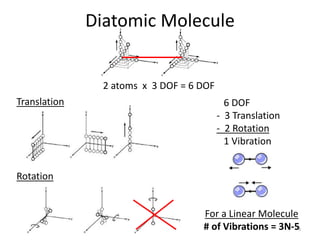
Diatomic Molecule
6 DOF
- 3 Translation
- 2 Rotation
1 Vibration
2 atoms x 3 DOF = 6 DOF
Translation
Rotation
For a Linear Molecule
# of Vibrations = 3N-53
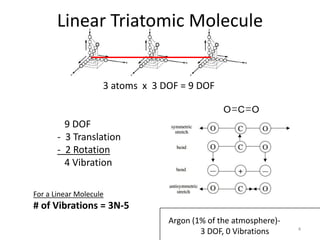
Linear Triatomic Molecule
3 atoms x 3 DOF = 9 DOF
For a Linear Molecule
# of Vibrations = 3N-5
9 DOF
- 3 Translation
- 2 Rotation
4 Vibration
Argon (1% of the atmosphere)-
3 DOF, 0 Vibrations 4
Nonlinear Triatomic Molecule
3 atoms x 3 DOF = 9 DOF
3 Translation
3 Rotation
Linear non-linear
5
Nonlinear Triatomic Molecule
3 atoms x 3 DOF = 9 DOF
9 DOF
- 3 Translation
- 3 Rotation
3 Vibration
For a nonlinear Molecule
# of Vibrations = 3N-6
Rz
Rx
Ry
Transz
Transy
Transx
6
Nonlinear Triatomic Molecule
3 atoms x 3 DOF = 9 DOF
9 DOF
- 3 Translation
- 3 Rotation
3 Vibration
For a nonlinear Molecule
# of Vibrations = 3N-6 7
Molecular Vibrations
Atoms of a molecule changing their relative positions without
changing the position of the molecular center of mass.
Even at Absolute Zero!
In terms of the molecular geometry
these vibrations amount to
continuously changing bond lengths
and bond angles.
Center of Mass
Reduced Mass
8
Molecular Vibrations
Hooke’s Law
Assumes-
It takes the same energy to stretch
the bond as to compress it.
The bond length can be infinite.
k = force constant
x = distance
9
Molecular Vibrations
Vibration Frequency (n)
Related to:
Stiffness of the bond (k).
Atomic masses (reduced mass, m).
10
Molecular Vibrations
Classical Spring
Quantum Behavior
Sometimes a classical description is good enough.
Especially at low energies. 11
6 Types of Vibrational Modes
Symmetric Stretch
Twisting
Assymmetric Stretch Wagging
Scissoring Rocking
12
What kind of information can be deduced about the internal
motion of the molecule from its point-group symmetry?
Each normal mode of vibration forms a basis for
an irreducible representation of the point group
of the molecule.
1) Find number/symmetry of vibrational modes.
2) Assign the symmetry of known vibrations.
3) What does the vibration look like?
4) Find if a vibrational mode is IR or Raman Active.
Vibrations and Group Theory
13
1) Finding Vibrational Modes
1. Assign a point group
2. Choose basis function (three Cartesian
coordinates or a specific bond)
3. Apply operations
-if the basis stays the same = +1
-if the basis is reversed = -1
-if it is a more complicated change = 0
4. Generate a reducible representation
5. Reduce to Irreducible Representation
6. Subtract Translational and Rotational Motion
14
Example: H2O
C2v point group
Basis: x1-3, y1-3 and z1-3
E: 3 + 3 + 3 = 9
1. Assign a point group
2. Choose basis function
3. Apply operations
-if the basis stays the same = +1
-if the basis is reversed = -1
-if it is a more complicated change = 0
E
Atom 1: x1 = 1
y1 = 1
z1 = 1
Atom 2: x2 = 1
y2 = 1
z2 = 1
Atom 3: x3 = 1
y3 = 1
z3 = 1
Atom: 1 2 3
15
Example: H2O
C2v point group
Basis: x1-3, y1-3 and z1-3
E: 3 + 3 + 3 = 9
C2: 0 + -1 + 0 = -1
1. Assign a point group
2. Choose basis function
3. Apply operations
-if the basis stays the same = +1
-if the basis is reversed = -1
-if it is a more complicated change = 0
C2
Atom 1: x1 = 0
y1 = 0
z1 = 0
Atom 2: x2 = -1
y2 = -1
z2 = 1
Atom 3: x3 = 0
y3 = 0
z3 = 0
Atom: 1 2 3
16
Example: H2O
C2v point group
Basis: x1-3, y1-3 and z1-3
E: 3 + 3 + 3 = 9
C2: 0 + -1 + 0 = -1
sxz: 0 + 1 + 0 = 1
1. Assign a point group
2. Choose basis function
3. Apply operations
-if the basis stays the same = +1
-if the basis is reversed = -1
-if it is a more complicated change = 0
sxz
Atom 1: x1 = 0
y1 = 0
z1 = 0
Atom 2: x2 = 1
y2 = -1
z2 = 1
Atom 3: x3 = 0
y3 = 0
z3 = 0
Atom: 1 2 3
17
Example: H2O
C2v point group
Basis: x1-3, y1-3 and z1-3
E: 3 + 3 + 3 = 9
C2: 0 + -1 + 0 = -1
sxz: 0 + 1 + 0 = 1
1. Assign a point group
2. Choose basis function
3. Apply operations
-if the basis stays the same = +1
-if the basis is reversed = -1
-if it is a more complicated change = 0
syz: 1 + 1 + 1 = 3
syz
Atom 1: x1 = -1
y1 = 1
z1 = 1
Atom 2: x2 = -1
y2 = 1
z2 = 1
Atom 3: x3 = -1
y3 = 1
z3 = 1
Atom: 1 2 3
18
Example: H2O
1. Assign a point group
2. Choose basis function
3. Apply operations
-if the basis stays the same = +1
-if the basis is reversed = -1
-if it is a more complicated change = 0
4. Generate a reducible representation
G 9 3
-1 1
C2v point group
Basis: x1-3, y1-3 and z1-3
E: 3 + 3 + 3 = 9
C2: 0 + -1 + 0 = -1
sxz: 0 + 1 + 0 = 1
syz: 1 + 1 + 1 = 3
Atom: 1 2 3
19
1. Assign a point group
2. Choose basis function
3. Apply operations
-if the basis stays the same = +1
-if the basis is reversed = -1
-if it is a more complicated change = 0
4. Generate a reducible representation
5. Reduce to Irreducible Representation
Reducible Rep. Irreducible Rep.
C2v point group
Basis: x1-3, y1-3 and z1-3
G 9 3
-1 1
Example: H2O
20
Decomposition/Reduction Formula
h = 1 + 1 + 1 + 1 = 4
order (h)
aA1 = + (1)(-1)(1) + (1)(1)(1) + (1)(3)(1)
1
4
[ ]
(1)(9)(1) = 3
=
12
4
Example: H2O
G 9 3
-1 1
G = 3A1 + A2 + 2B1 + 3B2
21
1. Assign a point group
2. Choose basis function
3. Apply operations
-if the basis stays the same = +1
-if the basis is reversed = -1
-if it is a more complicated change = 0
4. Generate a reducible representation
5. Reduce to Irreducible Representation
6. Subtract Rot. and Trans.
C2v point group
Basis: x1-3, y1-3 and z1-3
Example: H2O
G = 3A1 + A2 + 2B1 + 3B2
3 atoms x 3 DOF = 9 DOF
3N-6 = 3 Vibrations
Trans= A1 + B1 + B2
Rot = A2 + B1 + B2
Vib = 2A1 + B2 22
1. Assign a point group
2. Choose basis function
3. Apply operations
-if the basis stays the same = +1
-if the basis is reversed = -1
-if it is a more complicated change = 0
4. Generate a reducible representation
5. Reduce to Irreducible Representation
6. Subtract Rot. and Trans.
C2v point group
Basis: x1-3, y1-3 and z1-3
Example: H2O
Vibration = 2A1 + B2
23
B2
A1
A1
1. Start with a drawing of a molecule
2. Draw arrows
3. Use the Character Table
4. Predict a physically observable phenomenon
Example: H2O
C2v point group
Basis: x1-3, y1-3 and z1-3
Vibrations = 2A1 + B2
All three are IR active
but that is not always
the case.
24
1) Find number/symmetry of vibrational modes.
2) Assign the symmetry of known vibrations.
3) What does the vibration look like?
4) Find if a vibrational mode is IR or Raman Active.
Vibrations and Group Theory
25
2) Assign the Symmetry of a Known Vibrations
1. Assign a point group
2. Choose basis function (stretch or bend)
3. Apply operations
-if the basis stays the same = +1
-if the basis is reversed = -1
-if it is a more complicated change = 0
4. Generate a reducible representation
5. Reduce to Irreducible Representation
Vibrations = 2A1 + B2
Stretch Stretch Bend
Bend
Stretch
26
1. Assign a point group
2. Choose basis function
3. Apply operations
-if the basis stays the same = +1
-if the basis is reversed = -1
-if it is a more complicated change = 0
C2v point group
Basis: Bend angle
Example: H2O
sxz
E: 1
C2: 1
sxz: 1
syz: 1
E
C2
syz
27
1. Assign a point group
2. Choose basis function
3. Apply operations
-if the basis stays the same = +1
-if the basis is reversed = -1
-if it is a more complicated change = 0
4. Generate a reducible representation
5. Reduce to Irreducible Representation
Reducible Rep. Irreducible Rep.
C2v point group
Basis: Bend angle
G 1 1
1 1
Example: H2O
28
2) Assign the Symmetry of a Known Vibrations
Vibrations = A1 + B2
Stretch Stretch Bend
A1
1. Assign a point group
2. Choose basis function (stretch)
3. Apply operations
-if the basis stays the same = +1
-if the basis is reversed = -1
-if it is a more complicated change = 0
4. Generate a reducible representation
5. Reduce to Irreducible Representation
Stretch
29
1. Assign a point group
2. Choose basis function
3. Apply operations
-if the basis stays the same = +1
-if the basis is reversed = -1
-if it is a more complicated change = 0
C2v point group
Basis: OH stretch
Example: H2O
sxz
E: 2
C2: 0
sxz: 0
syz: 2
E
C2
syz
30
1. Assign a point group
2. Choose basis function
3. Apply operations
-if the basis stays the same = +1
-if the basis is reversed = -1
-if it is a more complicated change = 0
4. Generate a reducible representation
5. Reduce to Irreducible Representation
Reducible Rep. Irreducible Rep.
G 2 2
0 0
Example: H2O
C2v point group
Basis: OH stretch
31
Decomposition/Reduction Formula
h = 1 + 1 + 1 + 1 = 4
order (h)
aA1 = + (1)(0)(1) + (1)(0)(1) + (1)(2)(1)
1
4
[ ]
(1)(2)(1) = 1
=
4
4
Example: H2O
G 2 2
0 0
G = A1 + B2
aB2 = + (1)(0)(-1) + (1)(0)(-1) + (1)(2)(1)
4
(1)(2)(1) = 1
=
4
1
[ ] 4
32
2) Assign the Symmetry of a Known Vibrations
Vibrations = A1 + B2
Stretch Stretch Bend
A1
3) What does the vibration look like?
By Inspection By Projection Operator
33
1) Find number/symmetry of vibrational modes.
2) Assign the symmetry of known vibrations.
3) What does the vibration look like?
4) Find if a vibrational mode is IR or Raman Active.
Vibrations and Group Theory
34
3) What does the vibration look like?
G = A1 + B2
By Inspection
G 1 1
1 1 G 1 1
-1 -1
A1 B2
35
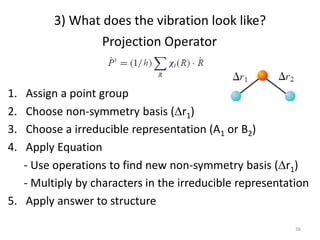
3) What does the vibration look like?
Projection Operator
1. Assign a point group
2. Choose non-symmetry basis (Dr1)
3. Choose a irreducible representation (A1 or B2)
4. Apply Equation
- Use operations to find new non-symmetry basis (Dr1)
- Multiply by characters in the irreducible representation
5. Apply answer to structure
36
3) What does the vibration look like?
Projection Operator
1. Assign a point group
2. Choose non-symmetry basis (Dr1)
3. Choose a irreducible representation (A1)
4. Apply Equation
- Use operations to find new non-symmetry basis (Dr1)
- Multiply by characters in the irreducible representation
C2v point group
Basis: Dr1
sxz
E
C2
syz
For A1
37
3) What does the vibration look like?
1. Assign a point group
2. Choose non-symmetry basis (Dr1)
3. Choose a irreducible representation (A1)
4. Apply Equation
- Use operations to find new non-symmetry basis (Dr1)
- Multiply by characters in the irreducible representation
sxz
E
C2
syz
Projection Operator
C2v point group
Basis: Dr1
For A1
38
3) What does the vibration look like?
1. Assign a point group
2. Choose non-symmetry basis (Dr1)
3. Choose a irreducible representation (B2)
4. Apply Equation
- Use operations to find new non-symmetry basis (Dr1)
- Multiply by characters in the irreducible representation
sxz
E
C2
syz
Projection Operator
C2v point group
Basis: Dr1
For B2
39
3) What does the vibration look like?
1. Assign a point group
2. Choose non-symmetry basis (Dr1)
3. Choose a irreducible representation (B2)
4. Apply Equation
- Use operations to find new non-symmetry basis (Dr1)
- Multiply by characters in the irreducible representation
5. Apply answer to structure
Projection Operator
C2v point group
Basis: Dr1
B2
A1
40
3) What does the vibration look like?
Bend Symmetric Stretch Asymmetric Stretch
A1
B2
A1
A1
A1 B2
Molecular Structure
+
Point Group
=
Find/draw the
vibrational modes of
the molecule
Does not tell us the energy!
Does not tell us IR or Raman active!
41
1) Find number/symmetry of vibrational modes.
2) Assign the symmetry of known vibrations.
3) What does the vibration look like?
4) Find if a vibrational mode is IR or Raman Active.
Vibrations of C60
42
Vibrations of C60
43
Vibrations of C60
44
Vibrations of C60
45
1) Find number/symmetry of vibrational modes.
2) Assign the symmetry of known vibrations.
3) What does the vibration look like?
4) Find if a vibrational mode is IR or Raman Active.
Vibrations and Group Theory
Next ppt!
46
Kincaid et al. J . Phys. Chem. 1988, 92, 5628.
C2v: 20A1 + 19B2 + 9B1
Side note: A Heroic Feat in IR Spectroscopy
47

Vibrational spectroscopy.pptx

  • 1.
    Part 2.10: VibrationalSpectroscopy 1
  • 2.
    Single Atom No Rotation Apoint cannot rotate 3 Degrees of Freedom (DOF) 0 Vibrations Vibration- Atoms of a molecule changing their relative positions without changing the position of the molecular center of mass. No Vibartion “It takes two to vibrate” Translation Can move in x, y, and/or z 2
  • 3.
    Diatomic Molecule 6 DOF -3 Translation - 2 Rotation 1 Vibration 2 atoms x 3 DOF = 6 DOF Translation Rotation For a Linear Molecule # of Vibrations = 3N-53
  • 4.
    Linear Triatomic Molecule 3atoms x 3 DOF = 9 DOF For a Linear Molecule # of Vibrations = 3N-5 9 DOF - 3 Translation - 2 Rotation 4 Vibration Argon (1% of the atmosphere)- 3 DOF, 0 Vibrations 4
  • 5.
    Nonlinear Triatomic Molecule 3atoms x 3 DOF = 9 DOF 3 Translation 3 Rotation Linear non-linear 5
  • 6.
    Nonlinear Triatomic Molecule 3atoms x 3 DOF = 9 DOF 9 DOF - 3 Translation - 3 Rotation 3 Vibration For a nonlinear Molecule # of Vibrations = 3N-6 Rz Rx Ry Transz Transy Transx 6
  • 7.
    Nonlinear Triatomic Molecule 3atoms x 3 DOF = 9 DOF 9 DOF - 3 Translation - 3 Rotation 3 Vibration For a nonlinear Molecule # of Vibrations = 3N-6 7
  • 8.
    Molecular Vibrations Atoms ofa molecule changing their relative positions without changing the position of the molecular center of mass. Even at Absolute Zero! In terms of the molecular geometry these vibrations amount to continuously changing bond lengths and bond angles. Center of Mass Reduced Mass 8
  • 9.
    Molecular Vibrations Hooke’s Law Assumes- Ittakes the same energy to stretch the bond as to compress it. The bond length can be infinite. k = force constant x = distance 9
  • 10.
    Molecular Vibrations Vibration Frequency(n) Related to: Stiffness of the bond (k). Atomic masses (reduced mass, m). 10
  • 11.
    Molecular Vibrations Classical Spring QuantumBehavior Sometimes a classical description is good enough. Especially at low energies. 11
  • 12.
    6 Types ofVibrational Modes Symmetric Stretch Twisting Assymmetric Stretch Wagging Scissoring Rocking 12
  • 13.
    What kind ofinformation can be deduced about the internal motion of the molecule from its point-group symmetry? Each normal mode of vibration forms a basis for an irreducible representation of the point group of the molecule. 1) Find number/symmetry of vibrational modes. 2) Assign the symmetry of known vibrations. 3) What does the vibration look like? 4) Find if a vibrational mode is IR or Raman Active. Vibrations and Group Theory 13
  • 14.
    1) Finding VibrationalModes 1. Assign a point group 2. Choose basis function (three Cartesian coordinates or a specific bond) 3. Apply operations -if the basis stays the same = +1 -if the basis is reversed = -1 -if it is a more complicated change = 0 4. Generate a reducible representation 5. Reduce to Irreducible Representation 6. Subtract Translational and Rotational Motion 14
  • 15.
    Example: H2O C2v pointgroup Basis: x1-3, y1-3 and z1-3 E: 3 + 3 + 3 = 9 1. Assign a point group 2. Choose basis function 3. Apply operations -if the basis stays the same = +1 -if the basis is reversed = -1 -if it is a more complicated change = 0 E Atom 1: x1 = 1 y1 = 1 z1 = 1 Atom 2: x2 = 1 y2 = 1 z2 = 1 Atom 3: x3 = 1 y3 = 1 z3 = 1 Atom: 1 2 3 15
  • 16.
    Example: H2O C2v pointgroup Basis: x1-3, y1-3 and z1-3 E: 3 + 3 + 3 = 9 C2: 0 + -1 + 0 = -1 1. Assign a point group 2. Choose basis function 3. Apply operations -if the basis stays the same = +1 -if the basis is reversed = -1 -if it is a more complicated change = 0 C2 Atom 1: x1 = 0 y1 = 0 z1 = 0 Atom 2: x2 = -1 y2 = -1 z2 = 1 Atom 3: x3 = 0 y3 = 0 z3 = 0 Atom: 1 2 3 16
  • 17.
    Example: H2O C2v pointgroup Basis: x1-3, y1-3 and z1-3 E: 3 + 3 + 3 = 9 C2: 0 + -1 + 0 = -1 sxz: 0 + 1 + 0 = 1 1. Assign a point group 2. Choose basis function 3. Apply operations -if the basis stays the same = +1 -if the basis is reversed = -1 -if it is a more complicated change = 0 sxz Atom 1: x1 = 0 y1 = 0 z1 = 0 Atom 2: x2 = 1 y2 = -1 z2 = 1 Atom 3: x3 = 0 y3 = 0 z3 = 0 Atom: 1 2 3 17
  • 18.
    Example: H2O C2v pointgroup Basis: x1-3, y1-3 and z1-3 E: 3 + 3 + 3 = 9 C2: 0 + -1 + 0 = -1 sxz: 0 + 1 + 0 = 1 1. Assign a point group 2. Choose basis function 3. Apply operations -if the basis stays the same = +1 -if the basis is reversed = -1 -if it is a more complicated change = 0 syz: 1 + 1 + 1 = 3 syz Atom 1: x1 = -1 y1 = 1 z1 = 1 Atom 2: x2 = -1 y2 = 1 z2 = 1 Atom 3: x3 = -1 y3 = 1 z3 = 1 Atom: 1 2 3 18
  • 19.
    Example: H2O 1. Assigna point group 2. Choose basis function 3. Apply operations -if the basis stays the same = +1 -if the basis is reversed = -1 -if it is a more complicated change = 0 4. Generate a reducible representation G 9 3 -1 1 C2v point group Basis: x1-3, y1-3 and z1-3 E: 3 + 3 + 3 = 9 C2: 0 + -1 + 0 = -1 sxz: 0 + 1 + 0 = 1 syz: 1 + 1 + 1 = 3 Atom: 1 2 3 19
  • 20.
    1. Assign apoint group 2. Choose basis function 3. Apply operations -if the basis stays the same = +1 -if the basis is reversed = -1 -if it is a more complicated change = 0 4. Generate a reducible representation 5. Reduce to Irreducible Representation Reducible Rep. Irreducible Rep. C2v point group Basis: x1-3, y1-3 and z1-3 G 9 3 -1 1 Example: H2O 20
  • 21.
    Decomposition/Reduction Formula h =1 + 1 + 1 + 1 = 4 order (h) aA1 = + (1)(-1)(1) + (1)(1)(1) + (1)(3)(1) 1 4 [ ] (1)(9)(1) = 3 = 12 4 Example: H2O G 9 3 -1 1 G = 3A1 + A2 + 2B1 + 3B2 21
  • 22.
    1. Assign apoint group 2. Choose basis function 3. Apply operations -if the basis stays the same = +1 -if the basis is reversed = -1 -if it is a more complicated change = 0 4. Generate a reducible representation 5. Reduce to Irreducible Representation 6. Subtract Rot. and Trans. C2v point group Basis: x1-3, y1-3 and z1-3 Example: H2O G = 3A1 + A2 + 2B1 + 3B2 3 atoms x 3 DOF = 9 DOF 3N-6 = 3 Vibrations Trans= A1 + B1 + B2 Rot = A2 + B1 + B2 Vib = 2A1 + B2 22
  • 23.
    1. Assign apoint group 2. Choose basis function 3. Apply operations -if the basis stays the same = +1 -if the basis is reversed = -1 -if it is a more complicated change = 0 4. Generate a reducible representation 5. Reduce to Irreducible Representation 6. Subtract Rot. and Trans. C2v point group Basis: x1-3, y1-3 and z1-3 Example: H2O Vibration = 2A1 + B2 23
  • 24.
    B2 A1 A1 1. Start witha drawing of a molecule 2. Draw arrows 3. Use the Character Table 4. Predict a physically observable phenomenon Example: H2O C2v point group Basis: x1-3, y1-3 and z1-3 Vibrations = 2A1 + B2 All three are IR active but that is not always the case. 24
  • 25.
    1) Find number/symmetryof vibrational modes. 2) Assign the symmetry of known vibrations. 3) What does the vibration look like? 4) Find if a vibrational mode is IR or Raman Active. Vibrations and Group Theory 25
  • 26.
    2) Assign theSymmetry of a Known Vibrations 1. Assign a point group 2. Choose basis function (stretch or bend) 3. Apply operations -if the basis stays the same = +1 -if the basis is reversed = -1 -if it is a more complicated change = 0 4. Generate a reducible representation 5. Reduce to Irreducible Representation Vibrations = 2A1 + B2 Stretch Stretch Bend Bend Stretch 26
  • 27.
    1. Assign apoint group 2. Choose basis function 3. Apply operations -if the basis stays the same = +1 -if the basis is reversed = -1 -if it is a more complicated change = 0 C2v point group Basis: Bend angle Example: H2O sxz E: 1 C2: 1 sxz: 1 syz: 1 E C2 syz 27
  • 28.
    1. Assign apoint group 2. Choose basis function 3. Apply operations -if the basis stays the same = +1 -if the basis is reversed = -1 -if it is a more complicated change = 0 4. Generate a reducible representation 5. Reduce to Irreducible Representation Reducible Rep. Irreducible Rep. C2v point group Basis: Bend angle G 1 1 1 1 Example: H2O 28
  • 29.
    2) Assign theSymmetry of a Known Vibrations Vibrations = A1 + B2 Stretch Stretch Bend A1 1. Assign a point group 2. Choose basis function (stretch) 3. Apply operations -if the basis stays the same = +1 -if the basis is reversed = -1 -if it is a more complicated change = 0 4. Generate a reducible representation 5. Reduce to Irreducible Representation Stretch 29
  • 30.
    1. Assign apoint group 2. Choose basis function 3. Apply operations -if the basis stays the same = +1 -if the basis is reversed = -1 -if it is a more complicated change = 0 C2v point group Basis: OH stretch Example: H2O sxz E: 2 C2: 0 sxz: 0 syz: 2 E C2 syz 30
  • 31.
    1. Assign apoint group 2. Choose basis function 3. Apply operations -if the basis stays the same = +1 -if the basis is reversed = -1 -if it is a more complicated change = 0 4. Generate a reducible representation 5. Reduce to Irreducible Representation Reducible Rep. Irreducible Rep. G 2 2 0 0 Example: H2O C2v point group Basis: OH stretch 31
  • 32.
    Decomposition/Reduction Formula h =1 + 1 + 1 + 1 = 4 order (h) aA1 = + (1)(0)(1) + (1)(0)(1) + (1)(2)(1) 1 4 [ ] (1)(2)(1) = 1 = 4 4 Example: H2O G 2 2 0 0 G = A1 + B2 aB2 = + (1)(0)(-1) + (1)(0)(-1) + (1)(2)(1) 4 (1)(2)(1) = 1 = 4 1 [ ] 4 32
  • 33.
    2) Assign theSymmetry of a Known Vibrations Vibrations = A1 + B2 Stretch Stretch Bend A1 3) What does the vibration look like? By Inspection By Projection Operator 33
  • 34.
    1) Find number/symmetryof vibrational modes. 2) Assign the symmetry of known vibrations. 3) What does the vibration look like? 4) Find if a vibrational mode is IR or Raman Active. Vibrations and Group Theory 34
  • 35.
    3) What doesthe vibration look like? G = A1 + B2 By Inspection G 1 1 1 1 G 1 1 -1 -1 A1 B2 35
  • 36.
    3) What doesthe vibration look like? Projection Operator 1. Assign a point group 2. Choose non-symmetry basis (Dr1) 3. Choose a irreducible representation (A1 or B2) 4. Apply Equation - Use operations to find new non-symmetry basis (Dr1) - Multiply by characters in the irreducible representation 5. Apply answer to structure 36
  • 37.
    3) What doesthe vibration look like? Projection Operator 1. Assign a point group 2. Choose non-symmetry basis (Dr1) 3. Choose a irreducible representation (A1) 4. Apply Equation - Use operations to find new non-symmetry basis (Dr1) - Multiply by characters in the irreducible representation C2v point group Basis: Dr1 sxz E C2 syz For A1 37
  • 38.
    3) What doesthe vibration look like? 1. Assign a point group 2. Choose non-symmetry basis (Dr1) 3. Choose a irreducible representation (A1) 4. Apply Equation - Use operations to find new non-symmetry basis (Dr1) - Multiply by characters in the irreducible representation sxz E C2 syz Projection Operator C2v point group Basis: Dr1 For A1 38
  • 39.
    3) What doesthe vibration look like? 1. Assign a point group 2. Choose non-symmetry basis (Dr1) 3. Choose a irreducible representation (B2) 4. Apply Equation - Use operations to find new non-symmetry basis (Dr1) - Multiply by characters in the irreducible representation sxz E C2 syz Projection Operator C2v point group Basis: Dr1 For B2 39
  • 40.
    3) What doesthe vibration look like? 1. Assign a point group 2. Choose non-symmetry basis (Dr1) 3. Choose a irreducible representation (B2) 4. Apply Equation - Use operations to find new non-symmetry basis (Dr1) - Multiply by characters in the irreducible representation 5. Apply answer to structure Projection Operator C2v point group Basis: Dr1 B2 A1 40
  • 41.
    3) What doesthe vibration look like? Bend Symmetric Stretch Asymmetric Stretch A1 B2 A1 A1 A1 B2 Molecular Structure + Point Group = Find/draw the vibrational modes of the molecule Does not tell us the energy! Does not tell us IR or Raman active! 41
  • 42.
    1) Find number/symmetryof vibrational modes. 2) Assign the symmetry of known vibrations. 3) What does the vibration look like? 4) Find if a vibrational mode is IR or Raman Active. Vibrations of C60 42
  • 43.
  • 44.
  • 45.
  • 46.
    1) Find number/symmetryof vibrational modes. 2) Assign the symmetry of known vibrations. 3) What does the vibration look like? 4) Find if a vibrational mode is IR or Raman Active. Vibrations and Group Theory Next ppt! 46
  • 47.
    Kincaid et al.J . Phys. Chem. 1988, 92, 5628. C2v: 20A1 + 19B2 + 9B1 Side note: A Heroic Feat in IR Spectroscopy 47