

Achievement Test
Suresh Babu G
Assistant Professor
CTE CPAS Paippad, Kottayam
Achievement Test
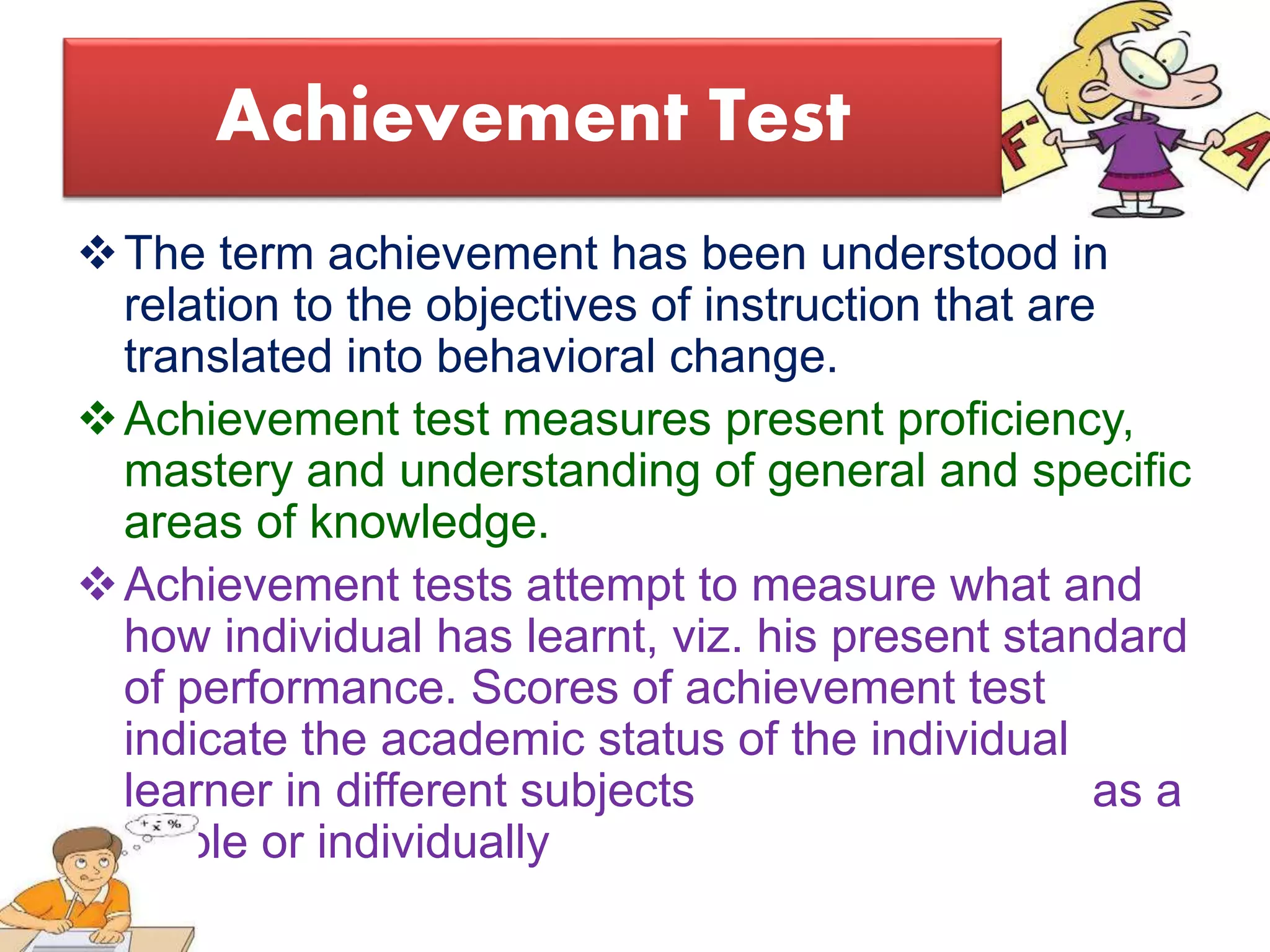
The term achievement has been understood in
relation to the objectives of instruction that are
translated into behavioral change.
Achievement test measures present proficiency,
mastery and understanding of general and specific
areas of knowledge.
Achievement tests attempt to measure what and
how individual has learnt, viz. his present standard
of performance. Scores of achievement test
indicate the academic status of the individual
learner in different subjects as a
whole or individually
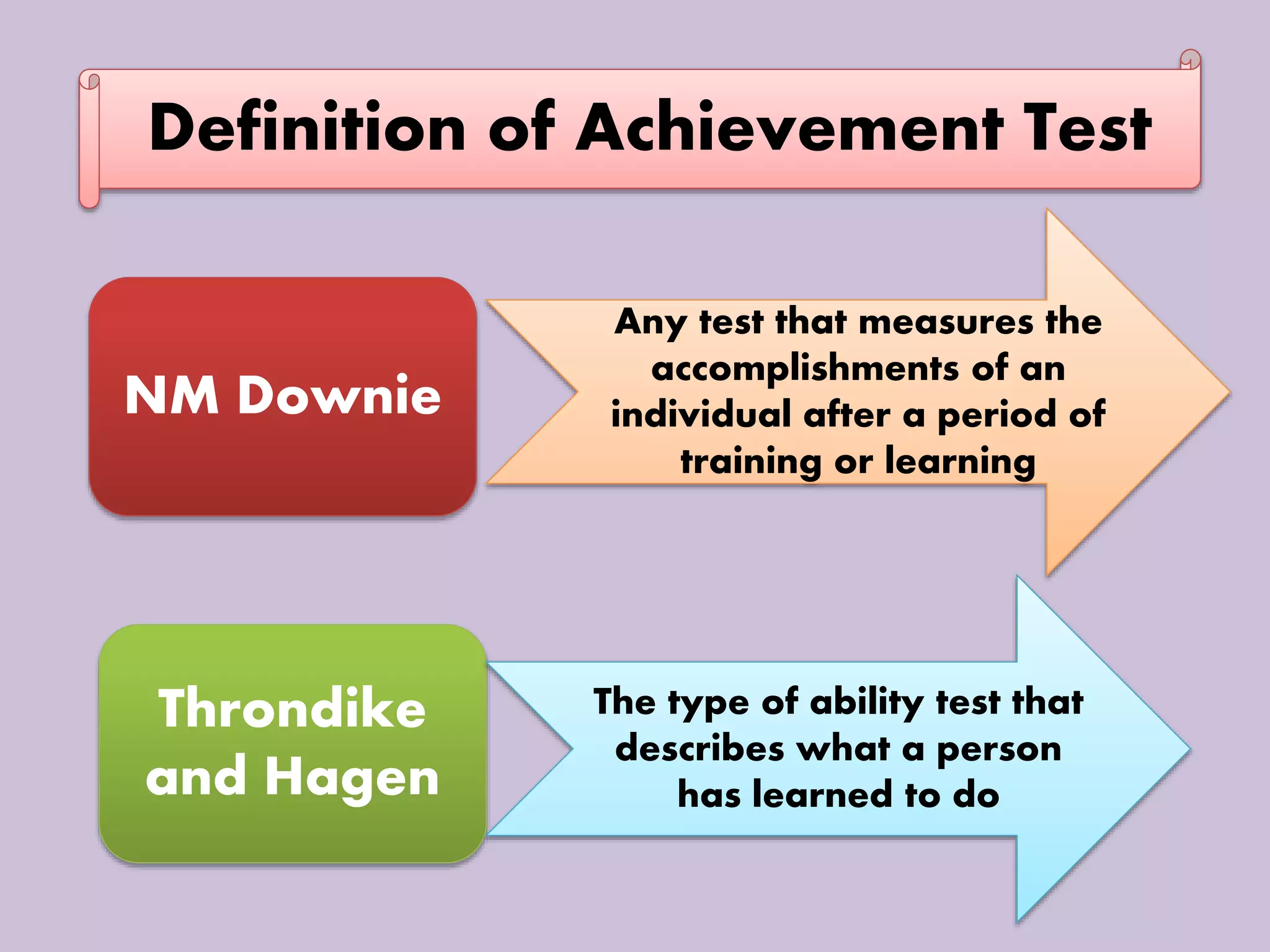
Definition of Achievement Test
NM Downie
Any test that measures the
accomplishments of an
individual after a period of
training or learning
Throndike
and Hagen
The type of ability test that
describes what a person
has learned to do
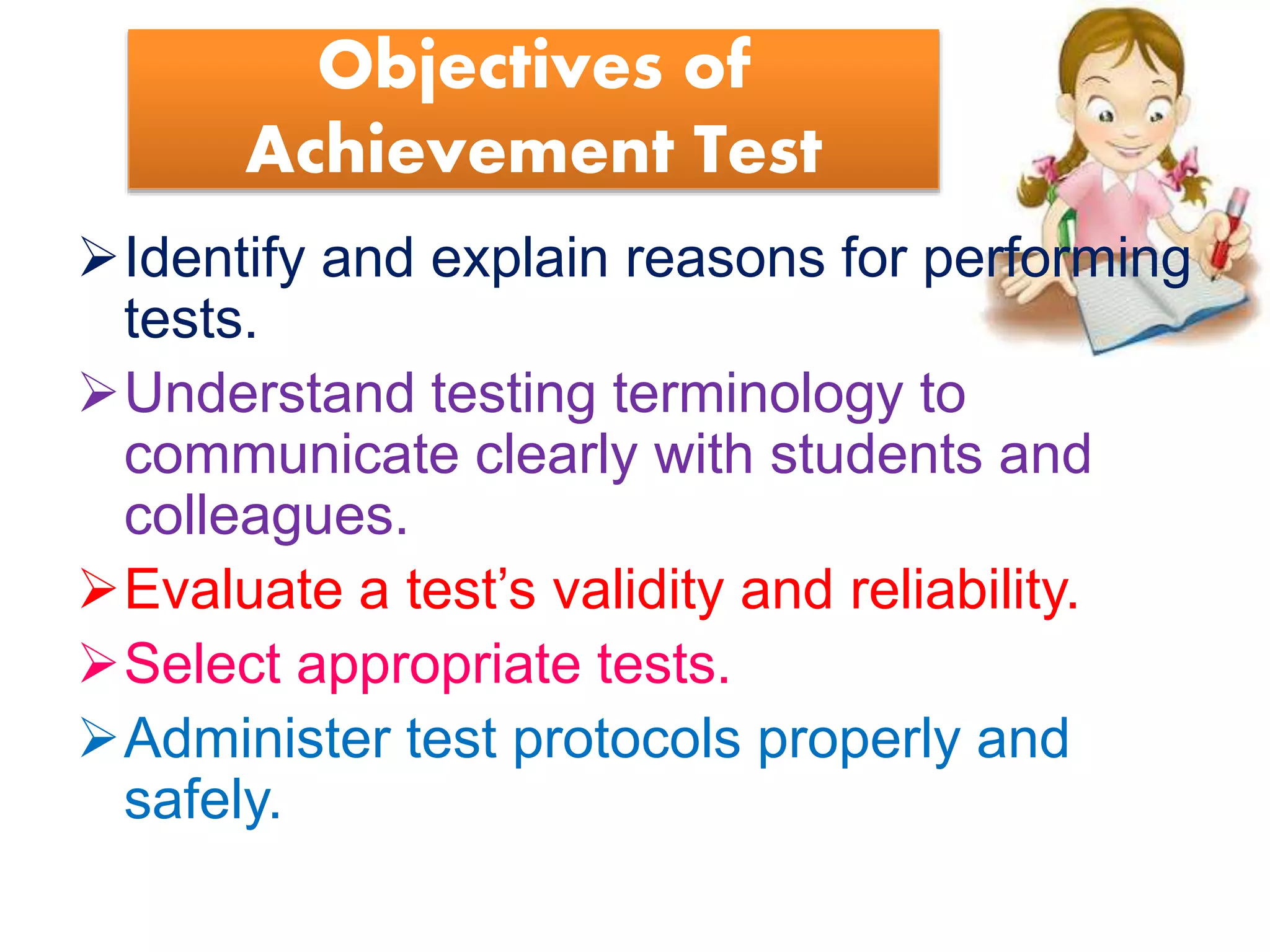
Objectives of
Achievement Test
Identify and explain reasons for performing
tests.
Understand testing terminology to
communicate clearly with students and
colleagues.
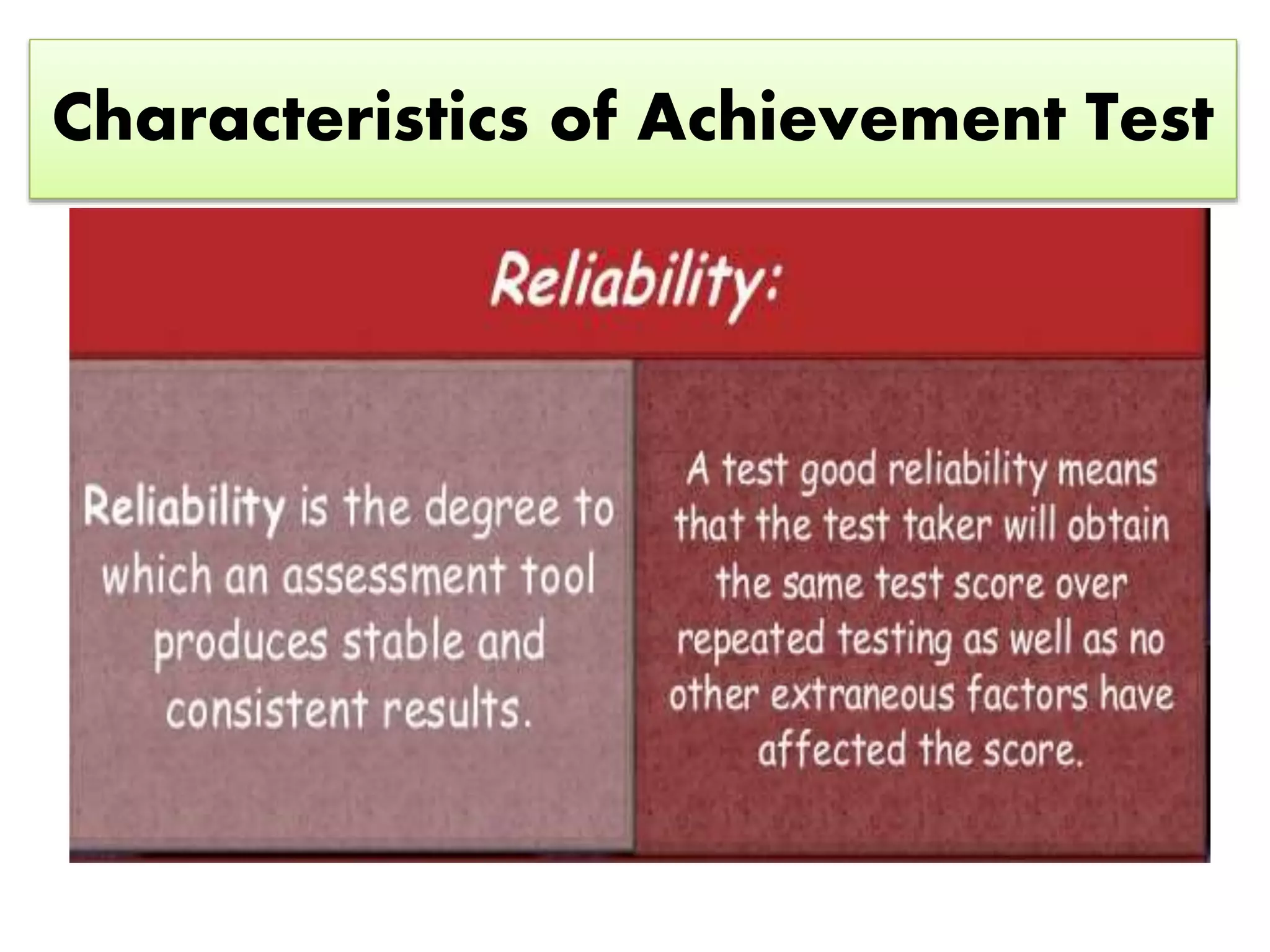
Evaluate a test’s validity and reliability.
Select appropriate tests.
Administer test protocols properly and
safely.
Functions of Achievement Test
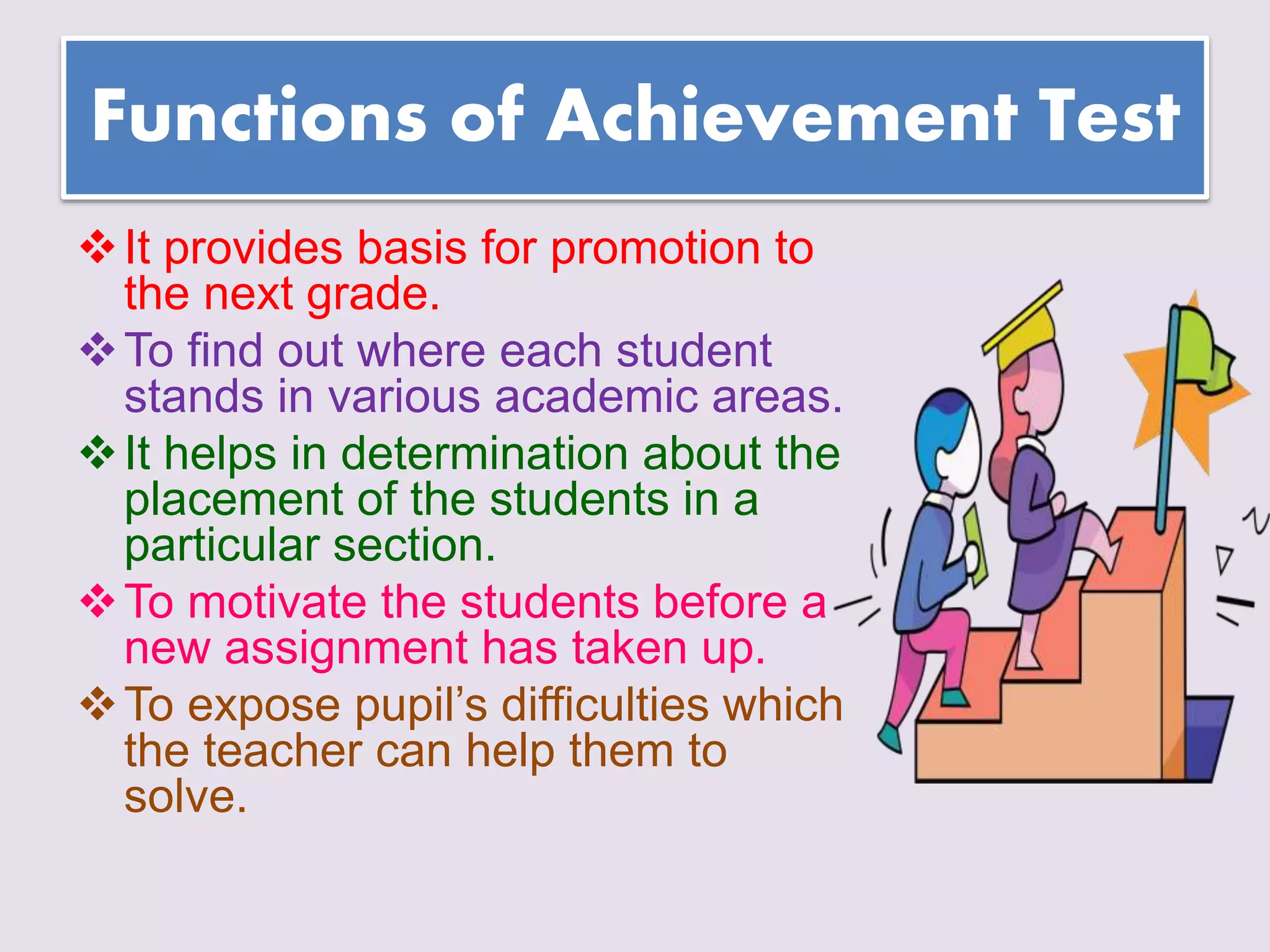
It provides basis for promotion to
the next grade.
To find out where each student
stands in various academic areas.
It helps in determination about the
placement of the students in a
particular section.
To motivate the students before a
new assignment has taken up.
To expose pupil’s difficulties which
the teacher can help them to
solve.
Classification of Achievement Test
• The teacher is interested in knowing the level of
achievement of each student in each of the
learning points and evaluate on the basis of his
pre-determined instructional objectives is called
Achievement Test.
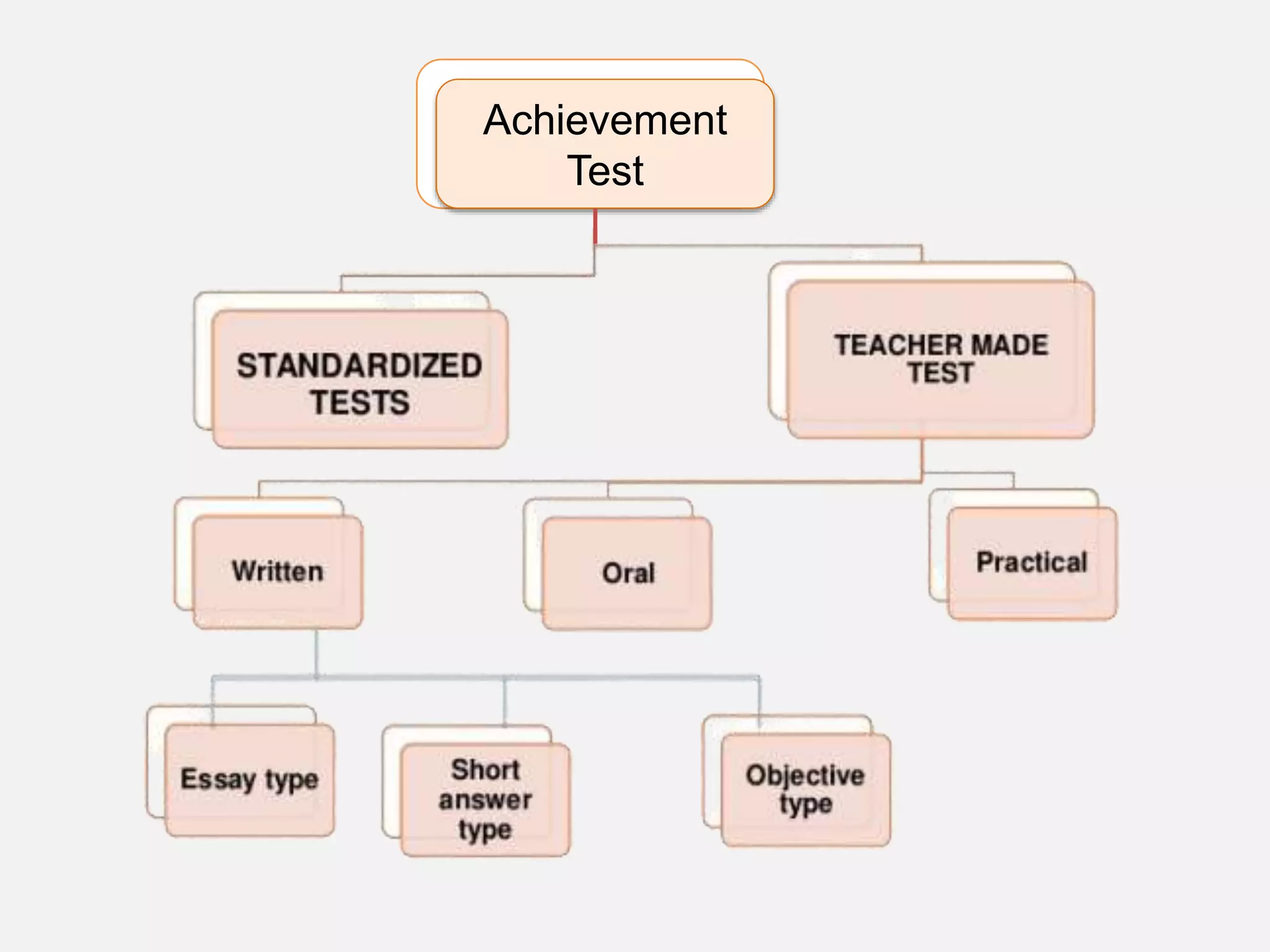
• Achievement Test are generally classified into
Teacher-made tests and Standardized test. We
normally use Teacher-made test in schools. Their
results indicate student achievement in relation to
the instructions provided in a school.
Achievement
Test
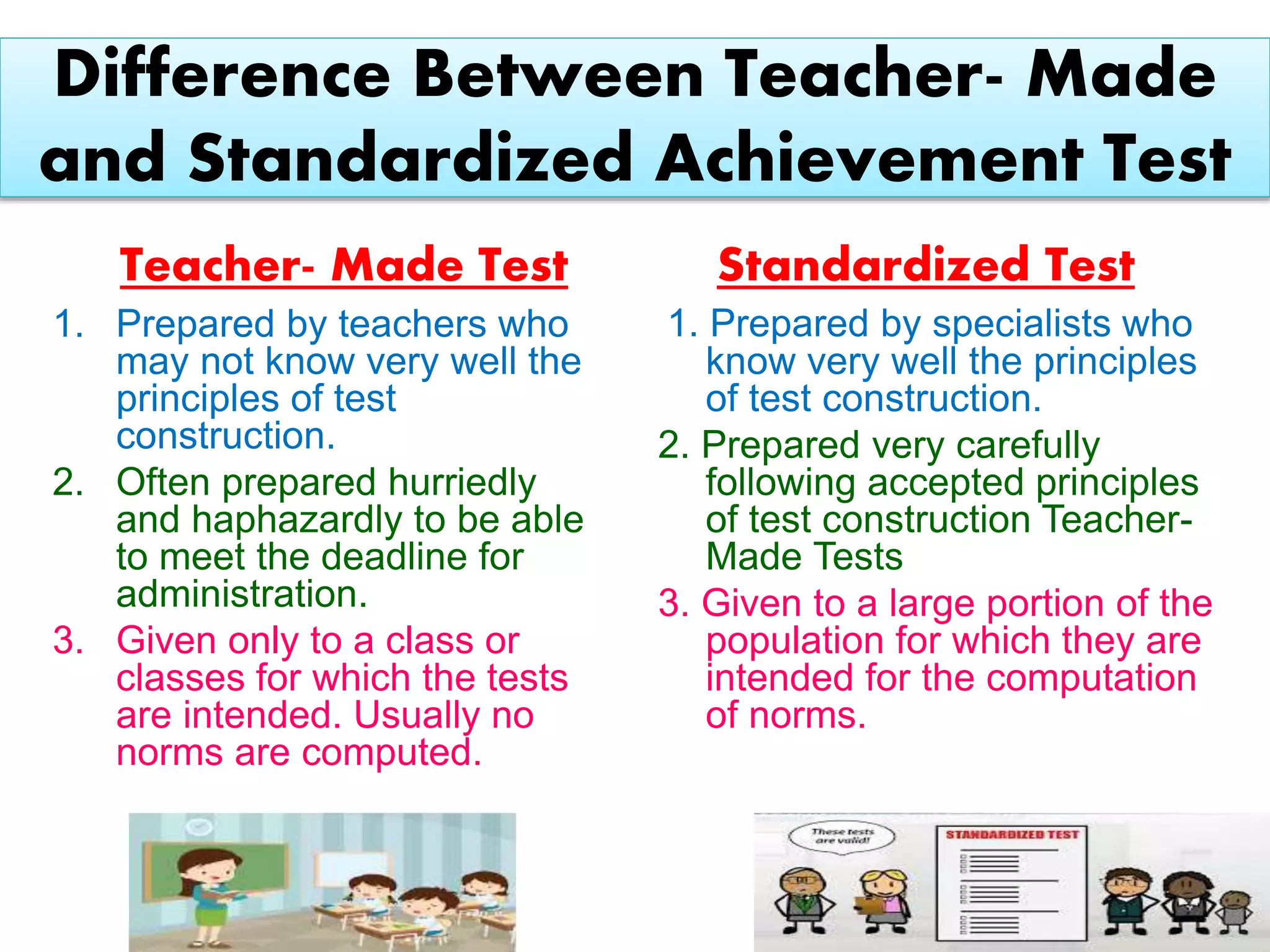
Difference Between Teacher- Made
and Standardized Achievement Test
Teacher- Made Test
1. Prepared by teachers who
may not know very well the
principles of test
construction.
2. Often prepared hurriedly
and haphazardly to be able
to meet the deadline for
administration.
3. Given only to a class or
classes for which the tests
are intended. Usually no
norms are computed.
Standardized Test
1. Prepared by specialists who
know very well the principles
of test construction.
2. Prepared very carefully
following accepted principles
of test construction Teacher-
Made Tests
3. Given to a large portion of the
population for which they are
intended for the computation
of norms.
Difference Between Teacher- Made
and Standardized Achievement Test
Teacher- Made Test
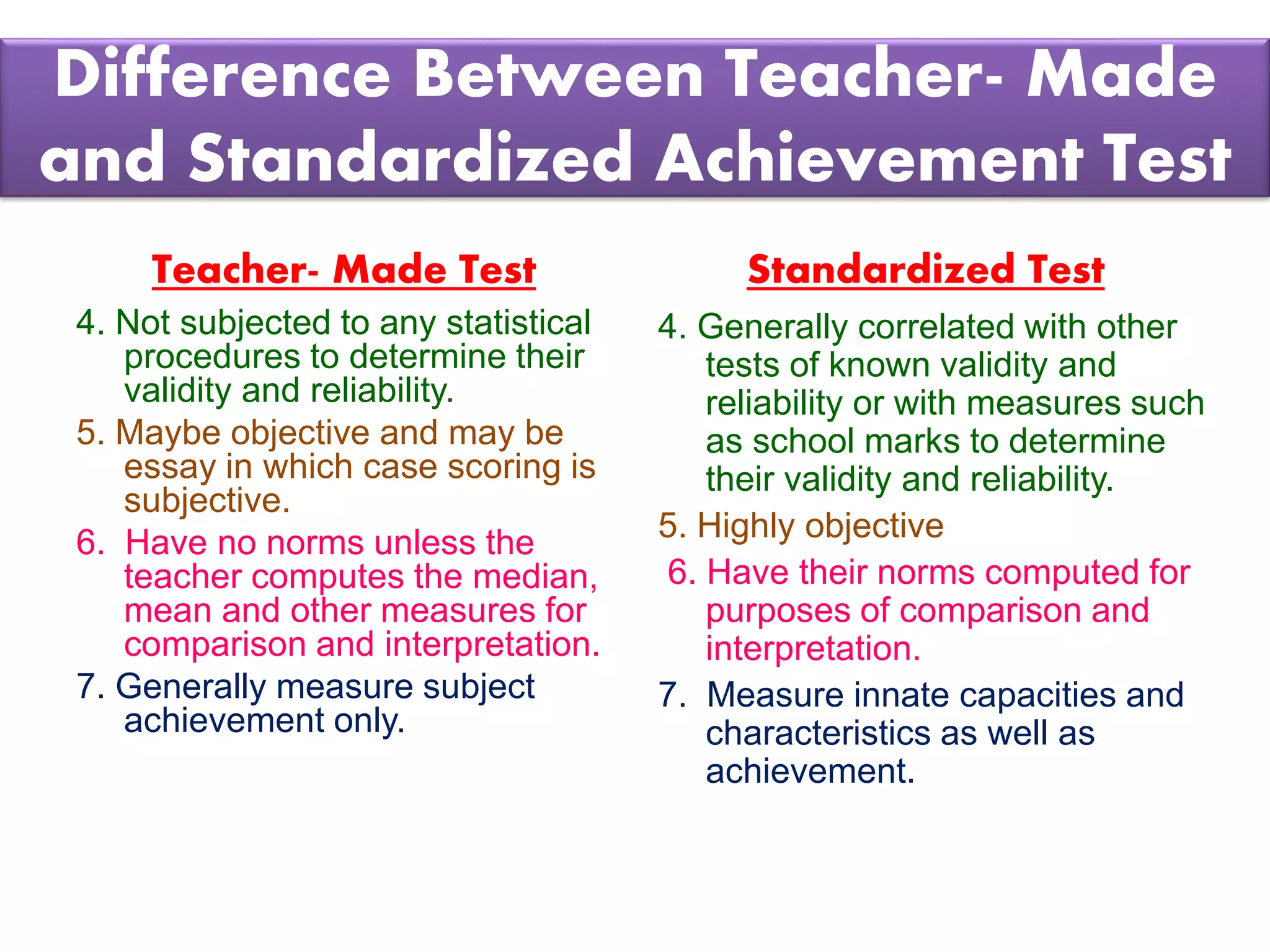
4. Not subjected to any statistical
procedures to determine their
validity and reliability.
5. Maybe objective and may be
essay in which case scoring is
subjective.
6. Have no norms unless the
teacher computes the median,
mean and other measures for
comparison and interpretation.
7. Generally measure subject
achievement only.
Standardized Test
4. Generally correlated with other
tests of known validity and
reliability or with measures such
as school marks to determine
their validity and reliability.
5. Highly objective
6. Have their norms computed for
purposes of comparison and
interpretation.
7. Measure innate capacities and
characteristics as well as
achievement.
Difference Between Teacher- Made
and Standardized Achievement Test
Teacher- Made Test
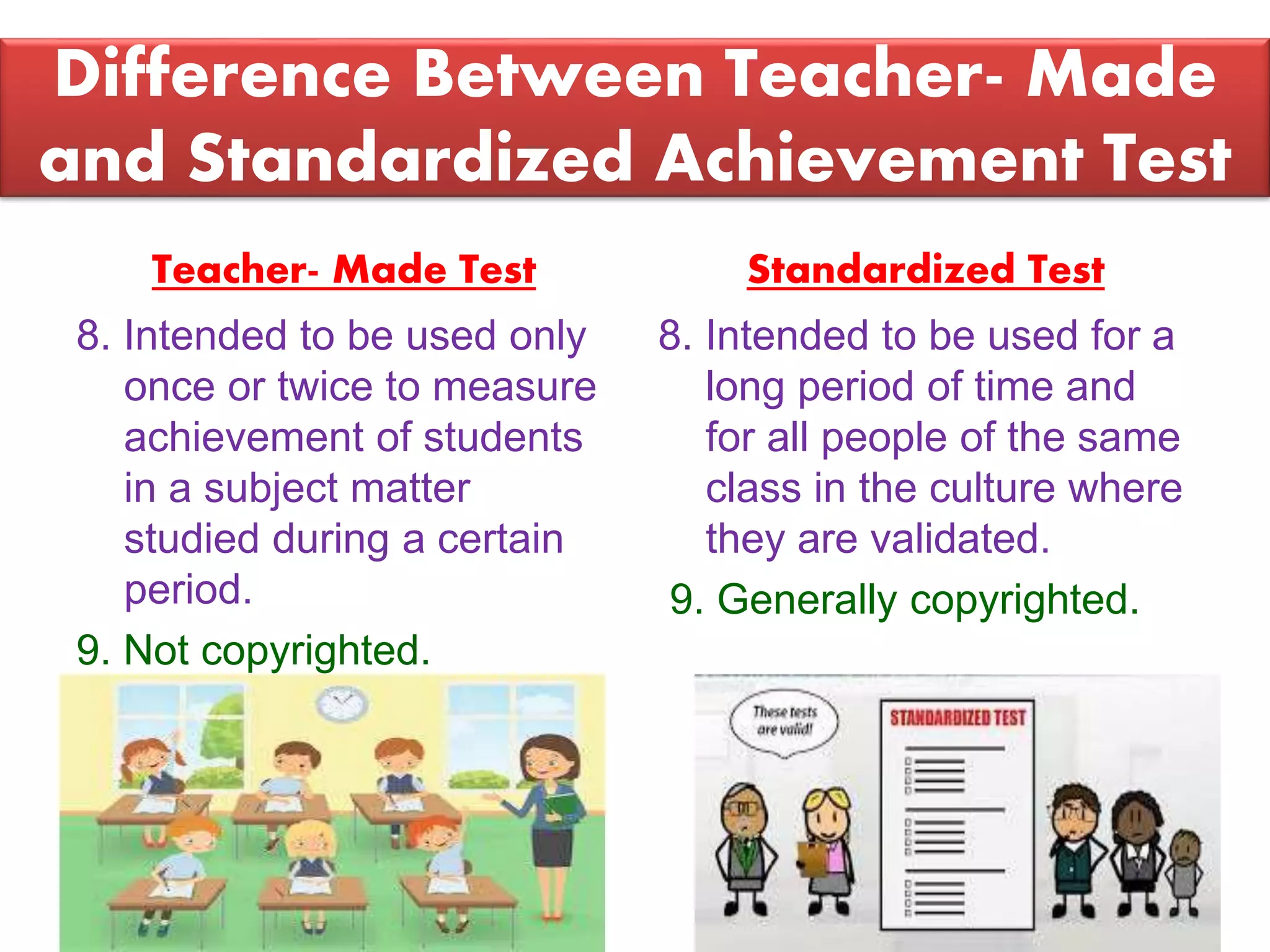
8. Intended to be used only
once or twice to measure
achievement of students
in a subject matter
studied during a certain
period.
9. Not copyrighted.
Standardized Test
8. Intended to be used for a
long period of time and
for all people of the same
class in the culture where
they are validated.
9. Generally copyrighted.
Characteristics of Achievement Test
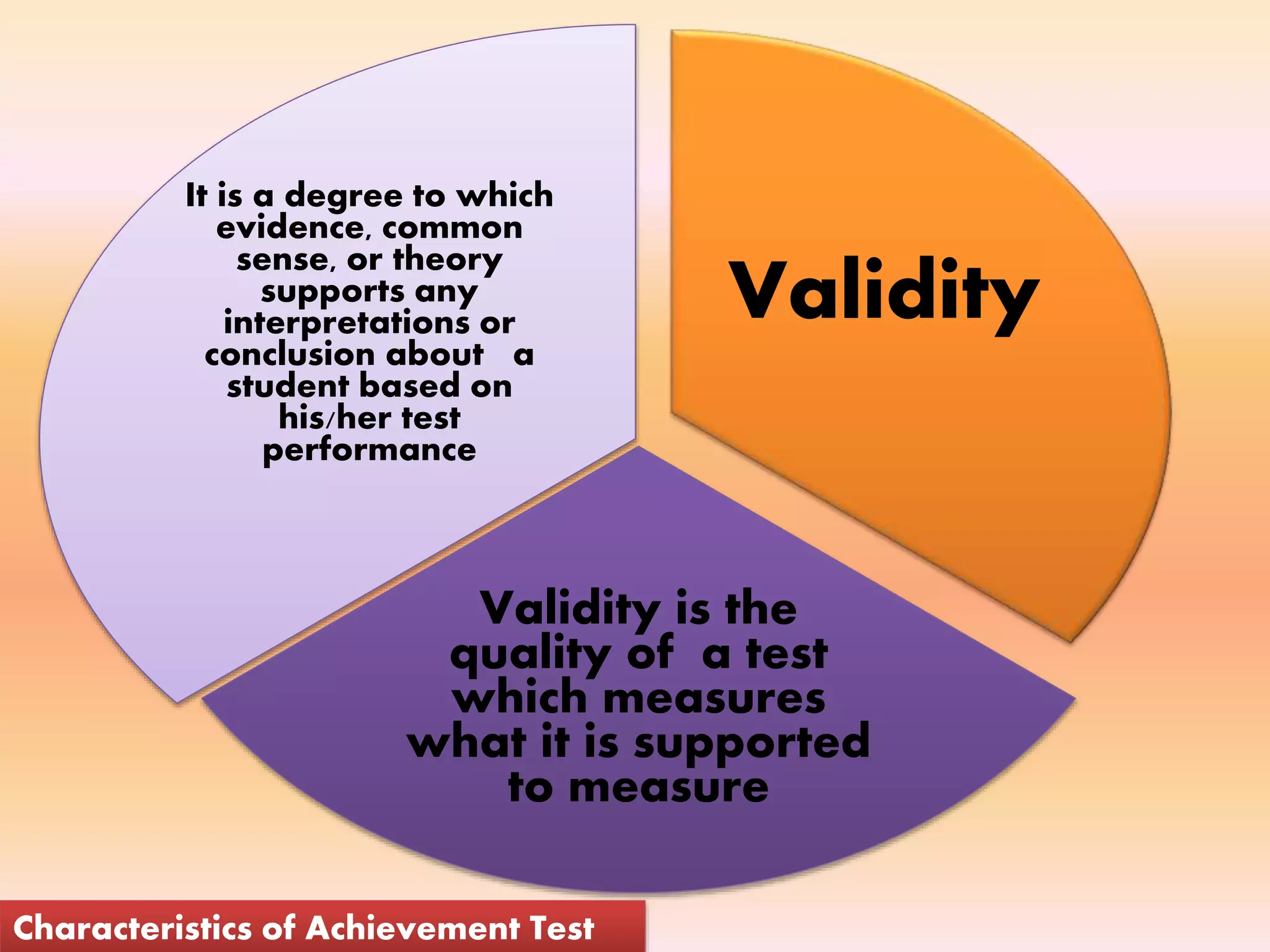
Validity
Validity is the
quality of a test
which measures
what it is supported
to measure
It is a degree to which
evidence, common
sense, or theory
supports any
interpretations or
conclusion about a
student based on
his/her test
performance
Characteristics of Achievement Test
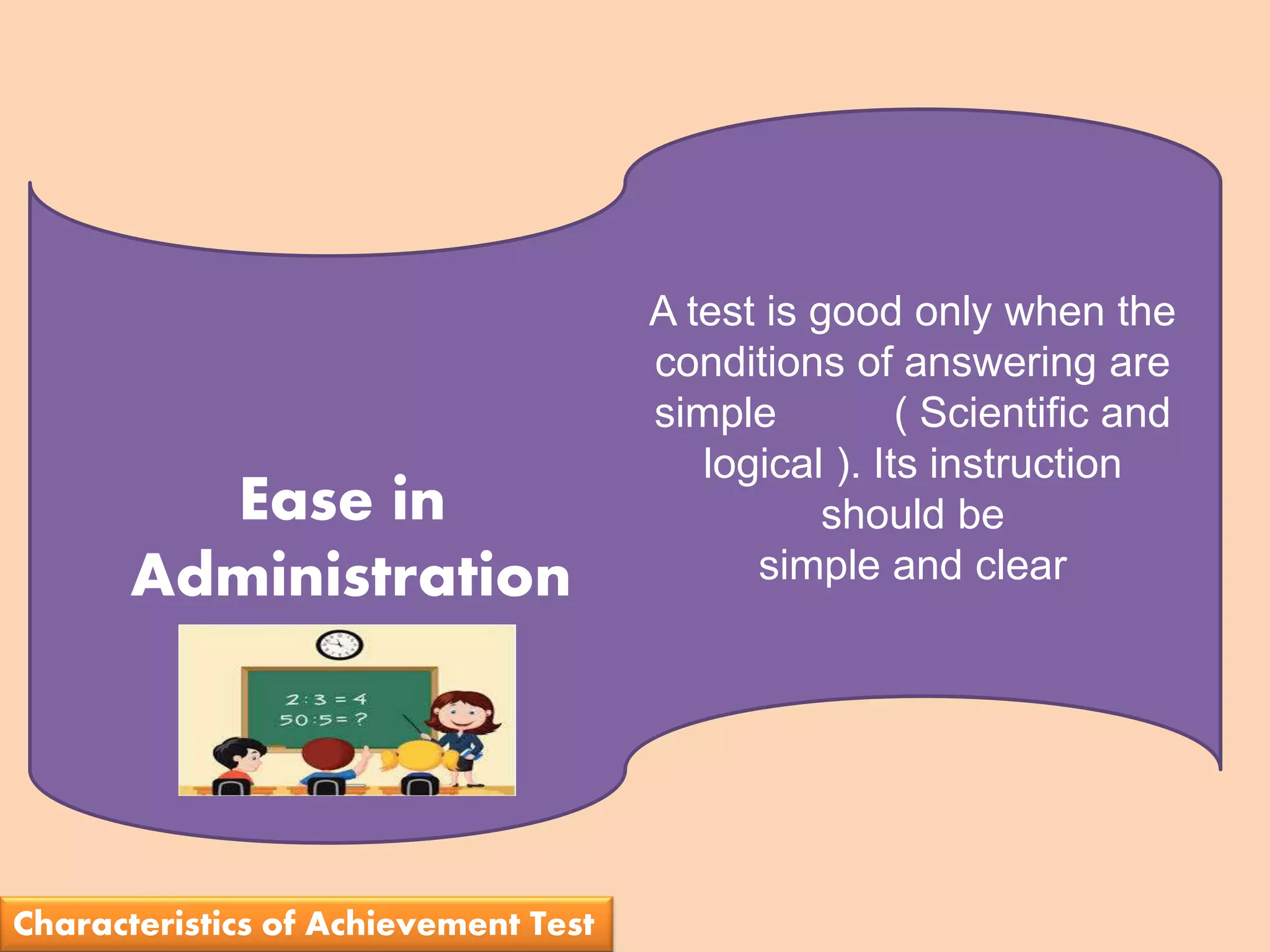
A test is good only when the
conditions of answering are
simple ( Scientific and
logical ). Its instruction
should be
simple and clear
Ease in
Administration
Characteristics of Achievement Test
Cost
A good test should be in expensive,
not only from the view point of
money but also from the view point
of time and effort taken in the
construction of the test
Characteristics of Achievement Test
Specificity
The items in the test should
be specific to the
objectives
Precise and Clear
Items should be precise, clear so that the
students can answer well and score
marks.
Characteristics of Achievement Test
Construction of Achievement Test
Steps
1. Planning of the test
2. Preparation of Design
3. Preparation of Blue Print
4. Writing of Questions.
5. Preparation of a Question Paper
6. Preparing Scoring Key / Marking Scheme
7. Question Wise Analysis
8. Moderation of Question Paper
1. Planning of the test
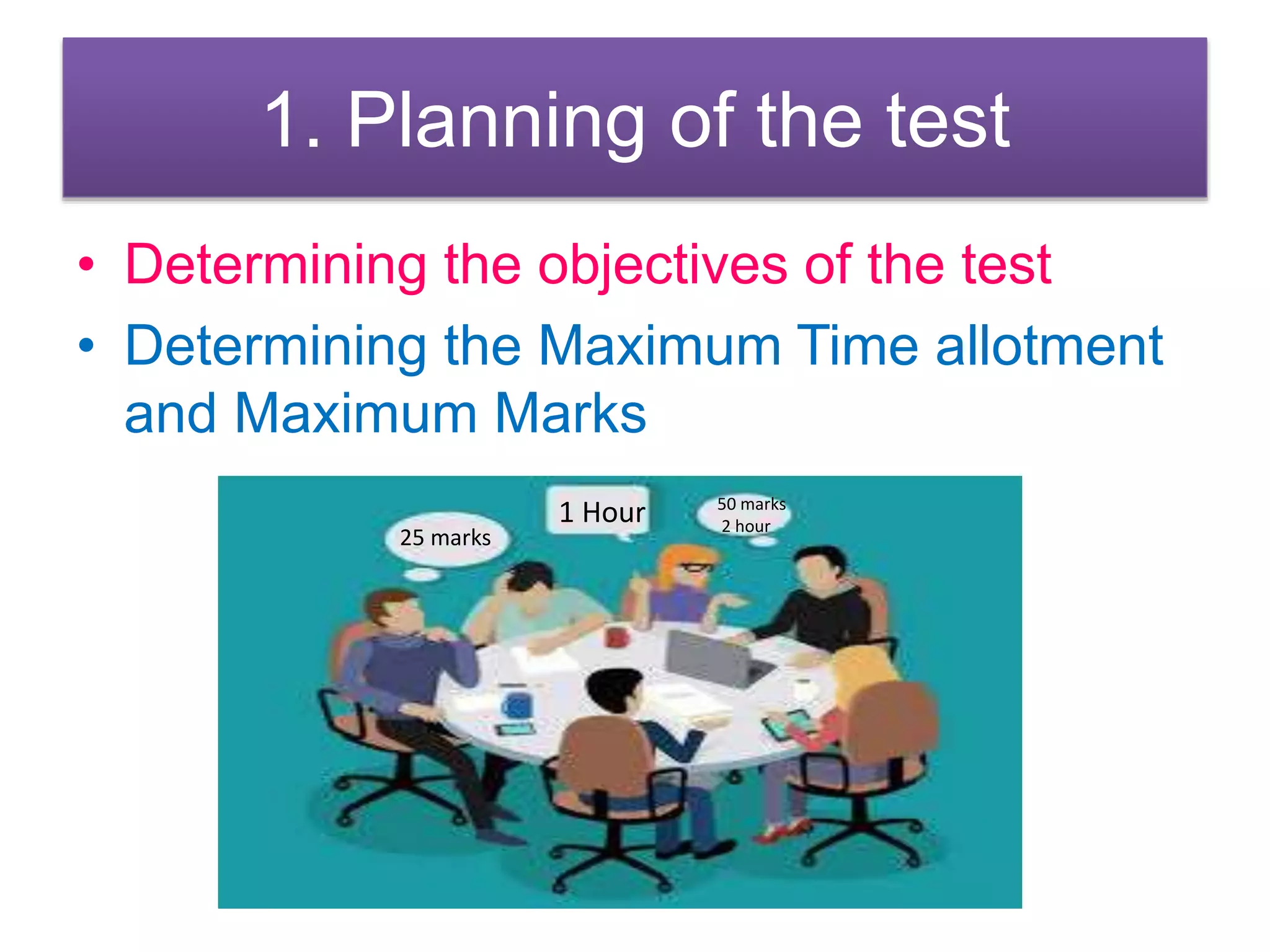
• Determining the objectives of the test
• Determining the Maximum Time allotment
and Maximum Marks
25 marks
1 Hour 50 marks
2 hour
2. Preparation of Design
Important factors to be consider in design
are
Weightage to Objective
Weightage to Content
Weightage to Form of Question
Weightage to difficulty level
2.1 Weightage to Objective
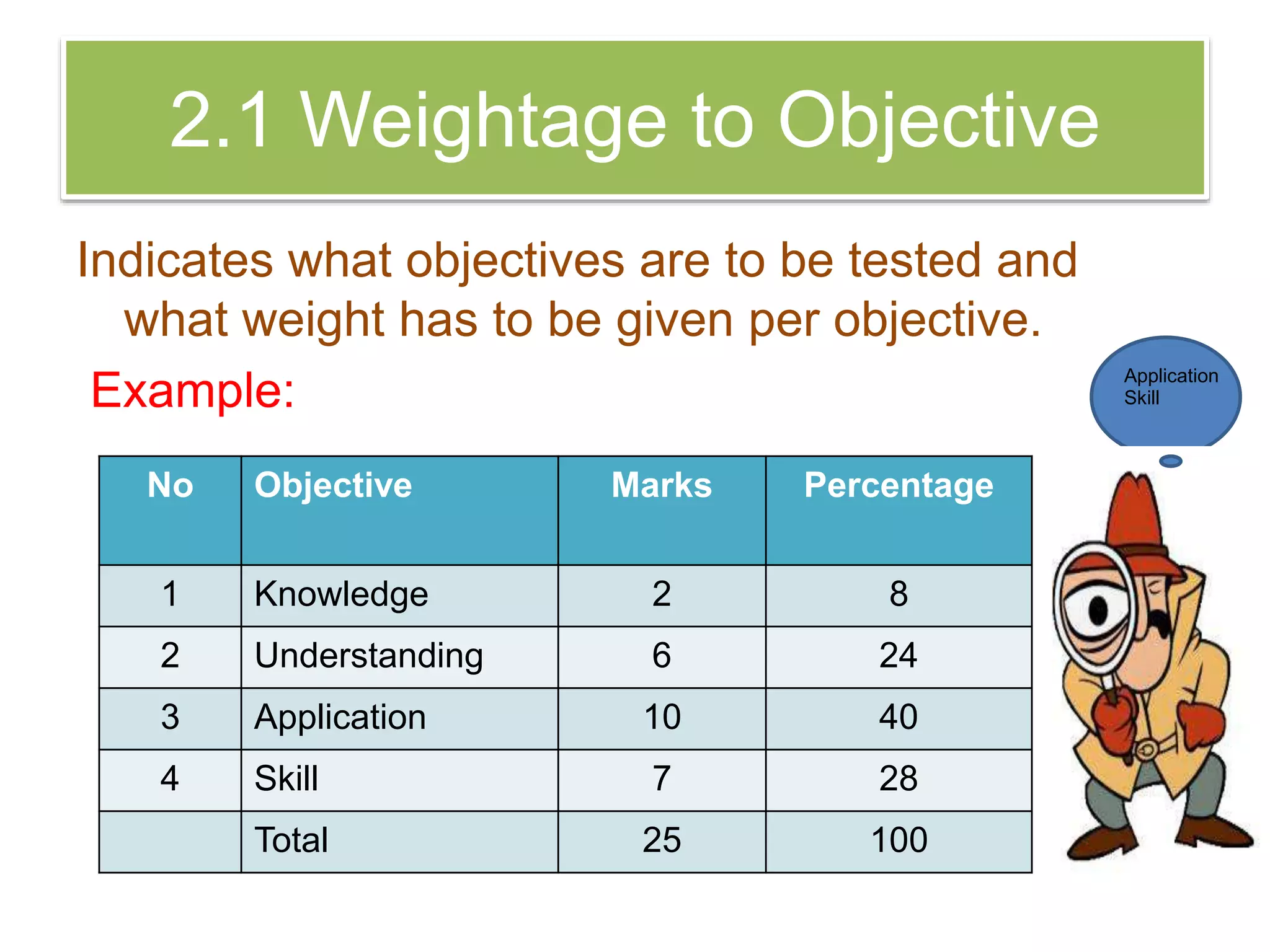
Indicates what objectives are to be tested and
what weight has to be given per objective.
Example:
No Objective Marks Percentage
1 Knowledge 2 8
2 Understanding 6 24
3 Application 10 40
4 Skill 7 28
Total 25 100
Application
Skill
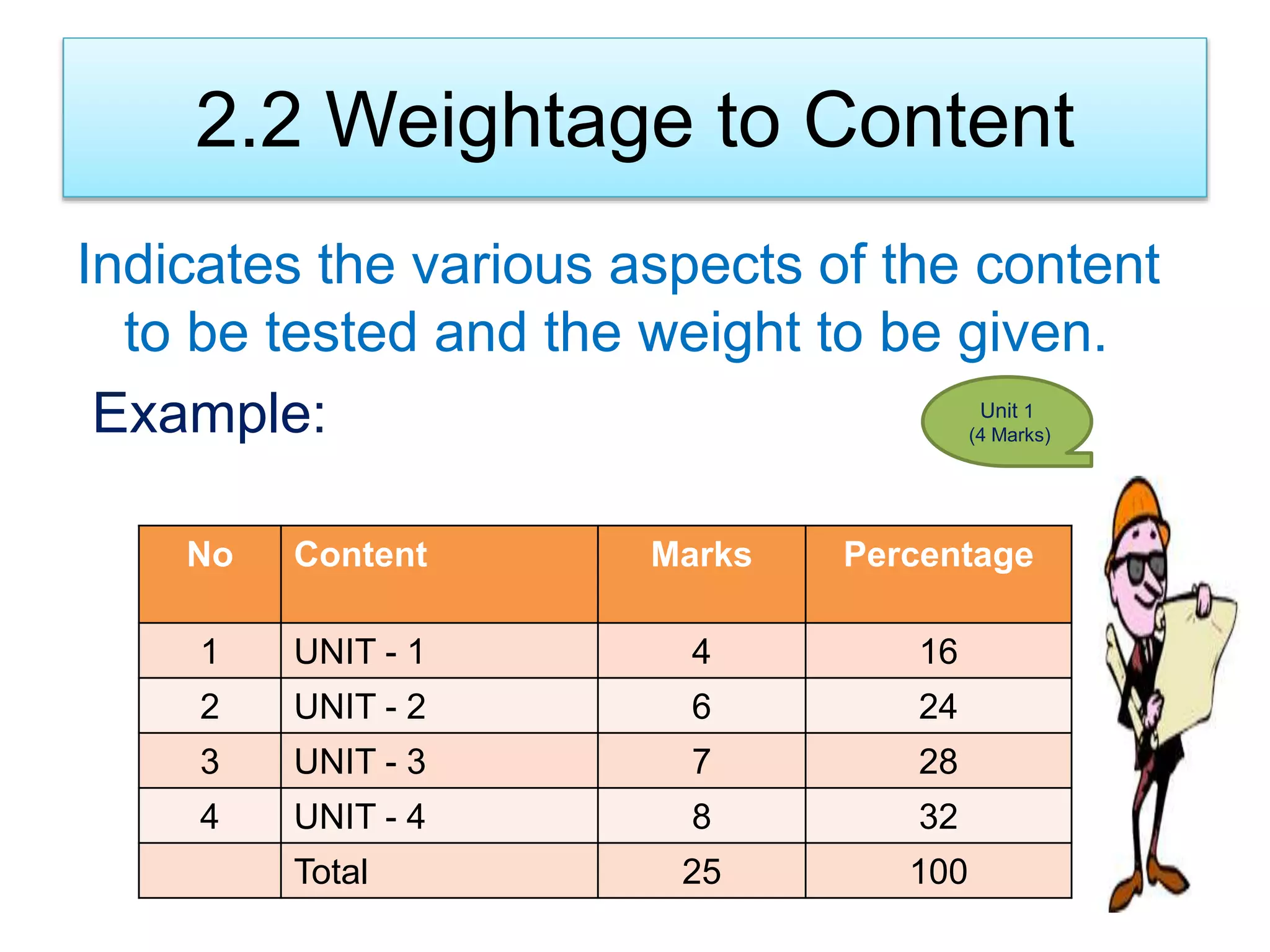
2.2 Weightage to Content
Indicates the various aspects of the content
to be tested and the weight to be given.
Example:
No Content Marks Percentage
1 UNIT - 1 4 16
2 UNIT - 2 6 24
3 UNIT - 3 7 28
4 UNIT - 4 8 32
Total 25 100
Unit 1
(4 Marks)
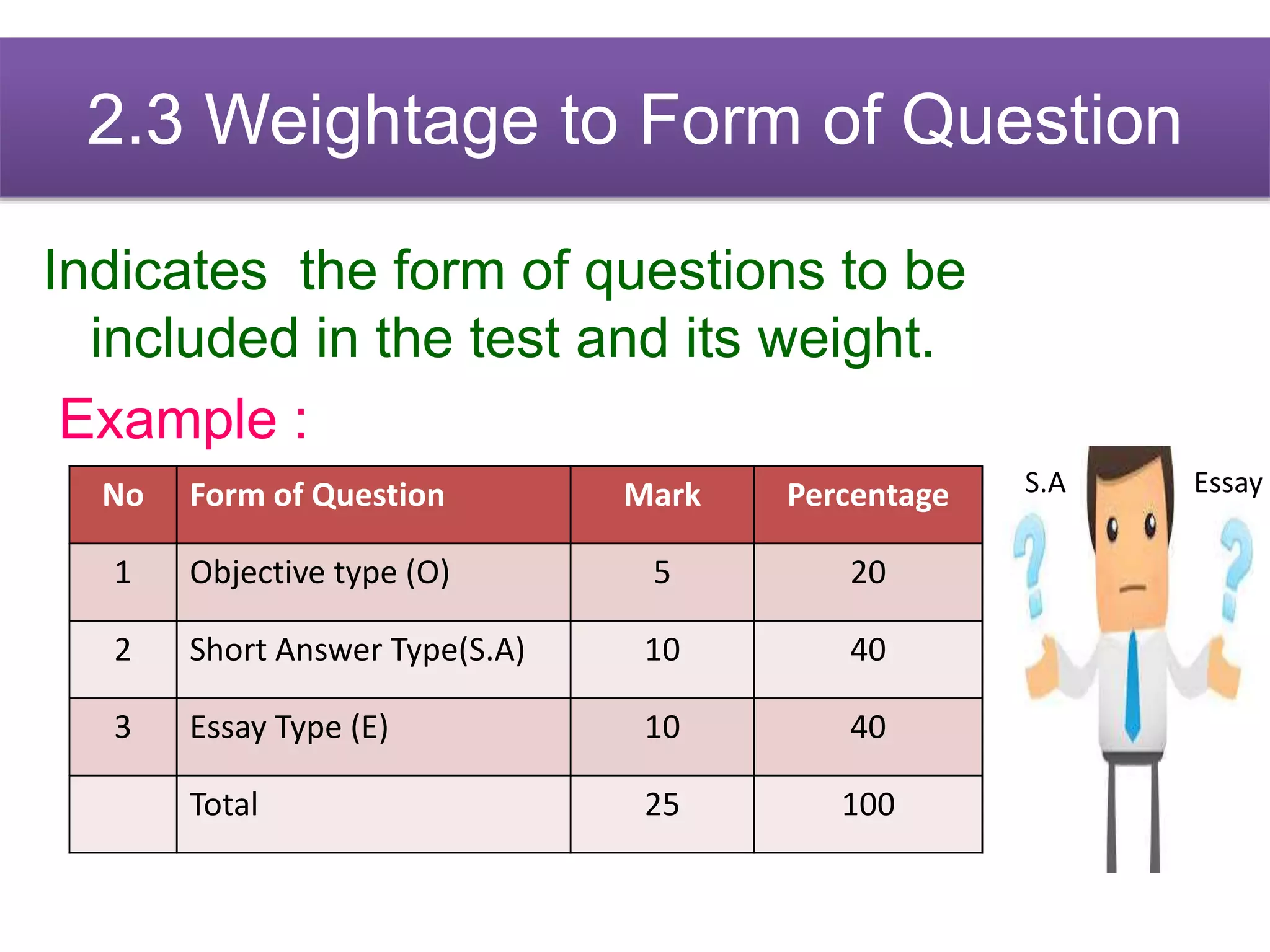
2.3 Weightage to Form of Question
Indicates the form of questions to be
included in the test and its weight.
Example :
No Form of Question Mark Percentage
1 Objective type (O) 5 20
2 Short Answer Type(S.A) 10 40
3 Essay Type (E) 10 40
Total 25 100
S.A Essay
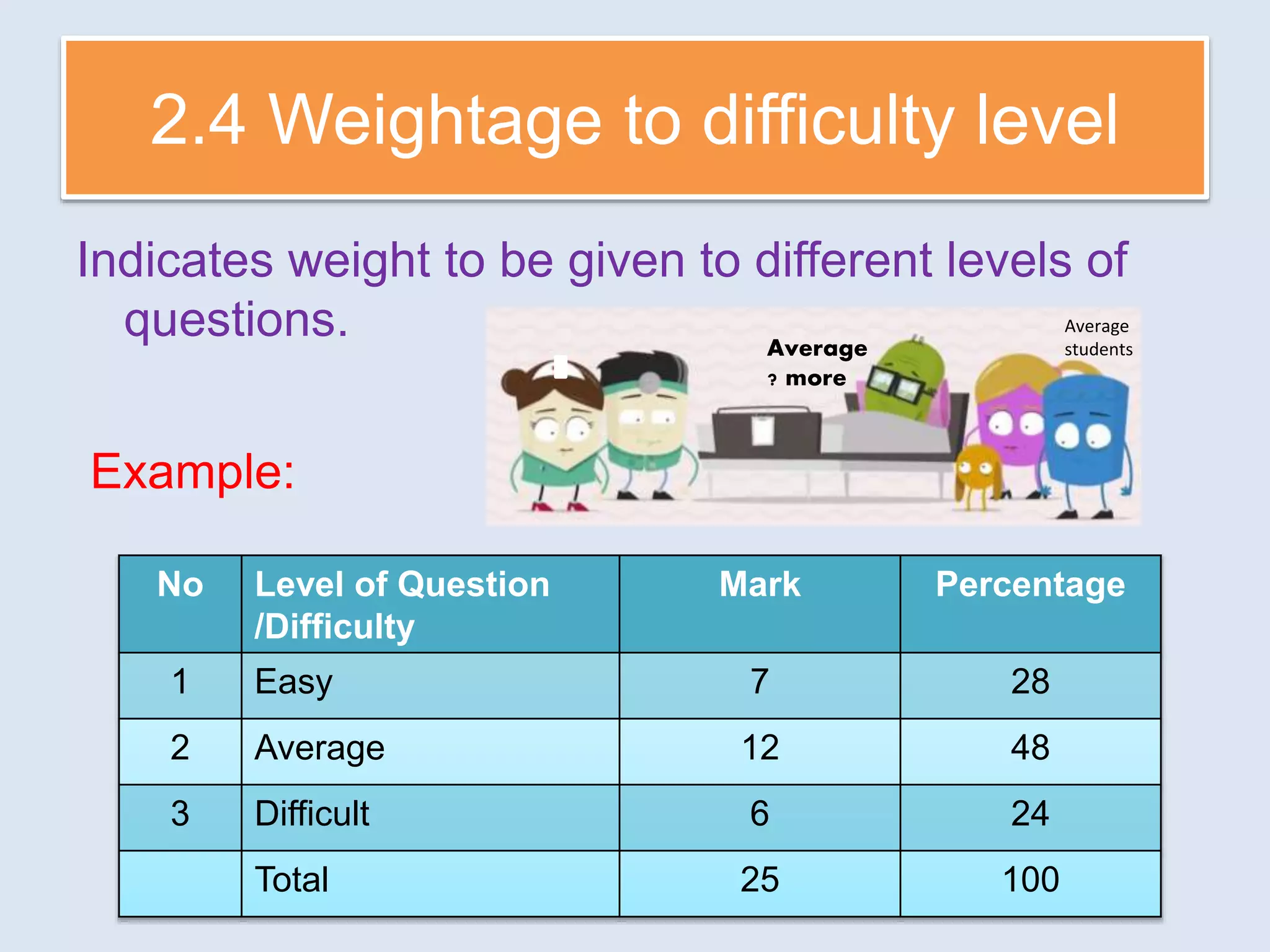
2.4 Weightage to difficulty level
Indicates weight to be given to different levels of
questions.
Example:
No Level of Question
/Difficulty
Mark Percentage
1 Easy 7 28
2 Average 12 48
3 Difficult 6 24
Total 25 100
Average
? more
Average
students
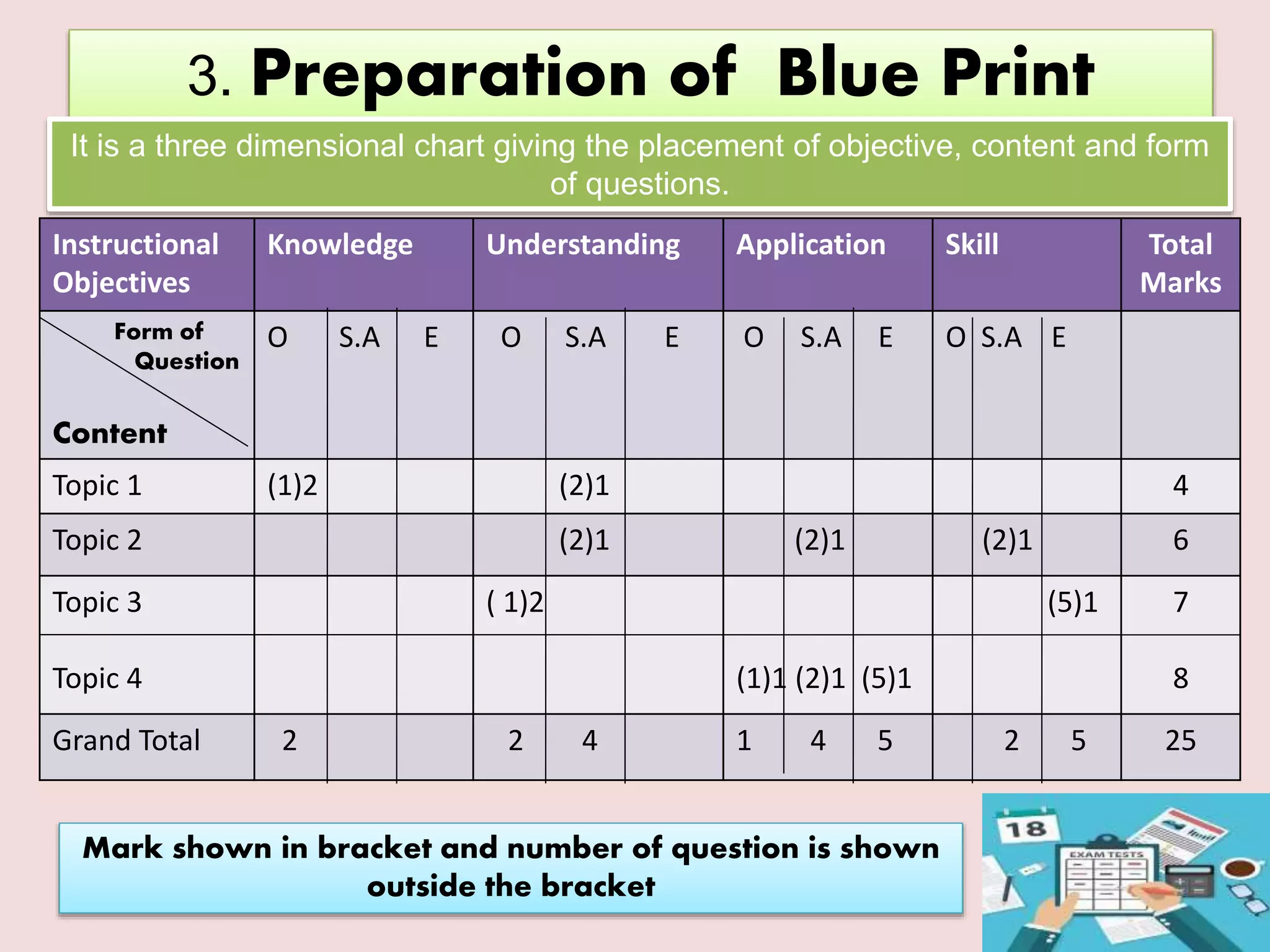
3. Preparation of Blue Print
Instructional
Objectives
Knowledge Understanding Application Skill Total
Marks
Form of
Question
Content
O S.A E O S.A E O S.A E O S.A E
Topic 1 (1)2 (2)1 4
Topic 2 (2)1 (2)1 (2)1 6
Topic 3
Topic 4
( 1)2
(1)1 (2)1 (5)1
(5)1 7
8
Grand Total 2 2 4 1 4 5 2 5 25
Mark shown in bracket and number of question is shown
outside the bracket
It is a three dimensional chart giving the placement of objective, content and form
of questions.
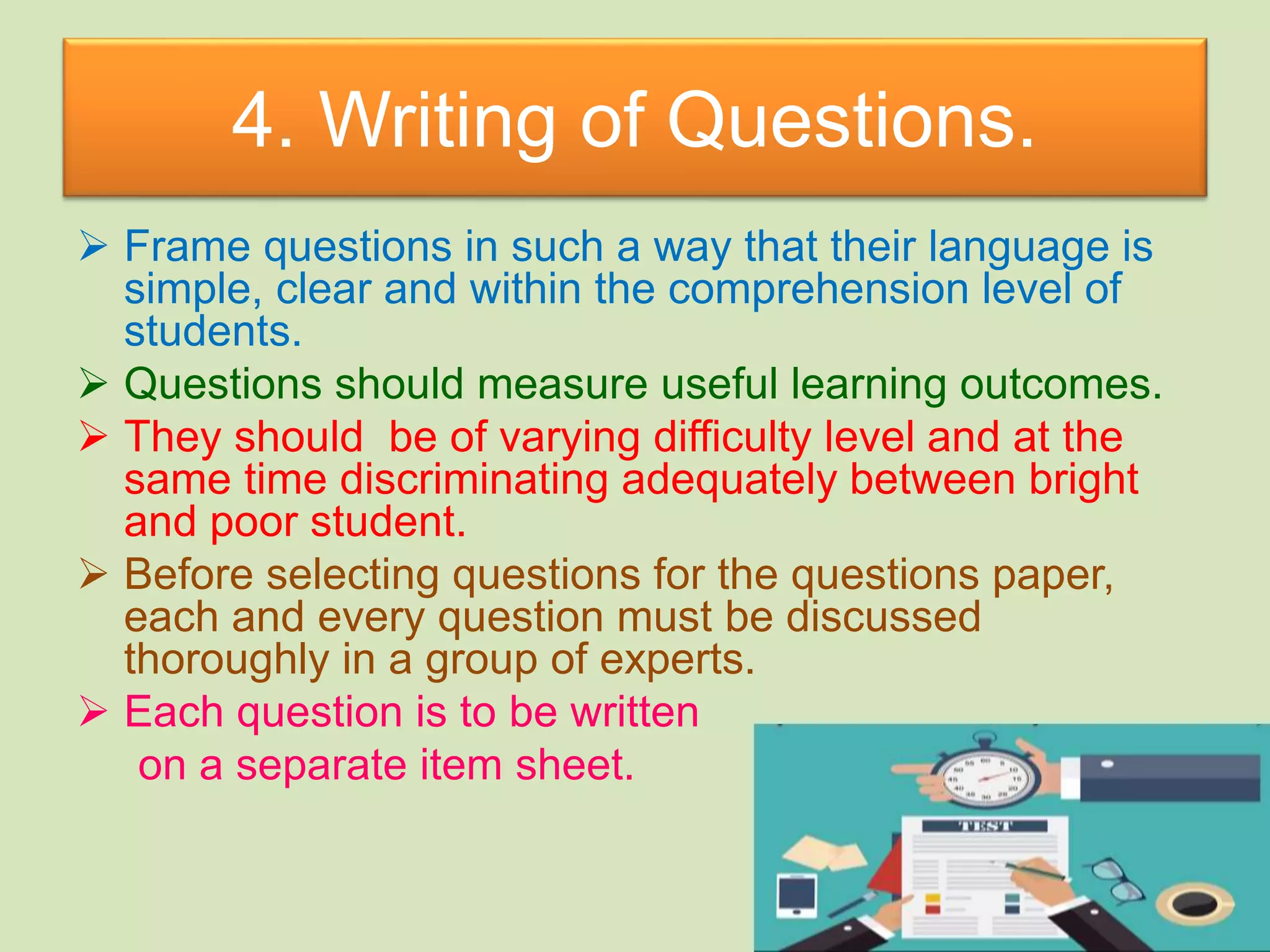
4. Writing of Questions.
 Frame questions in such a way that their language is
simple, clear and within the comprehension level of
students.
 Questions should measure useful learning outcomes.
 They should be of varying difficulty level and at the
same time discriminating adequately between bright
and poor student.
 Before selecting questions for the questions paper,
each and every question must be discussed
thoroughly in a group of experts.
 Each question is to be written
on a separate item sheet.
5. Preparation of a
Question Paper
After writing the questions, they need to be relooked,
modified and finalized in to a question paper. The
following should be done:
 Write general instructions clearly
 The instruction should be specific depends on subjects
 Any specific or related to particular question should be
written before the question
 Questions can be arranged according to form of
questions, instructional objectives, content units,
difficulty level or according to the convenience of
administration in the examination.
 Arrangement of question should be such that it
facilitates the examinees as well as the evaluation
process.
2020
6. Preparing Scoring Key / Marking
Scheme
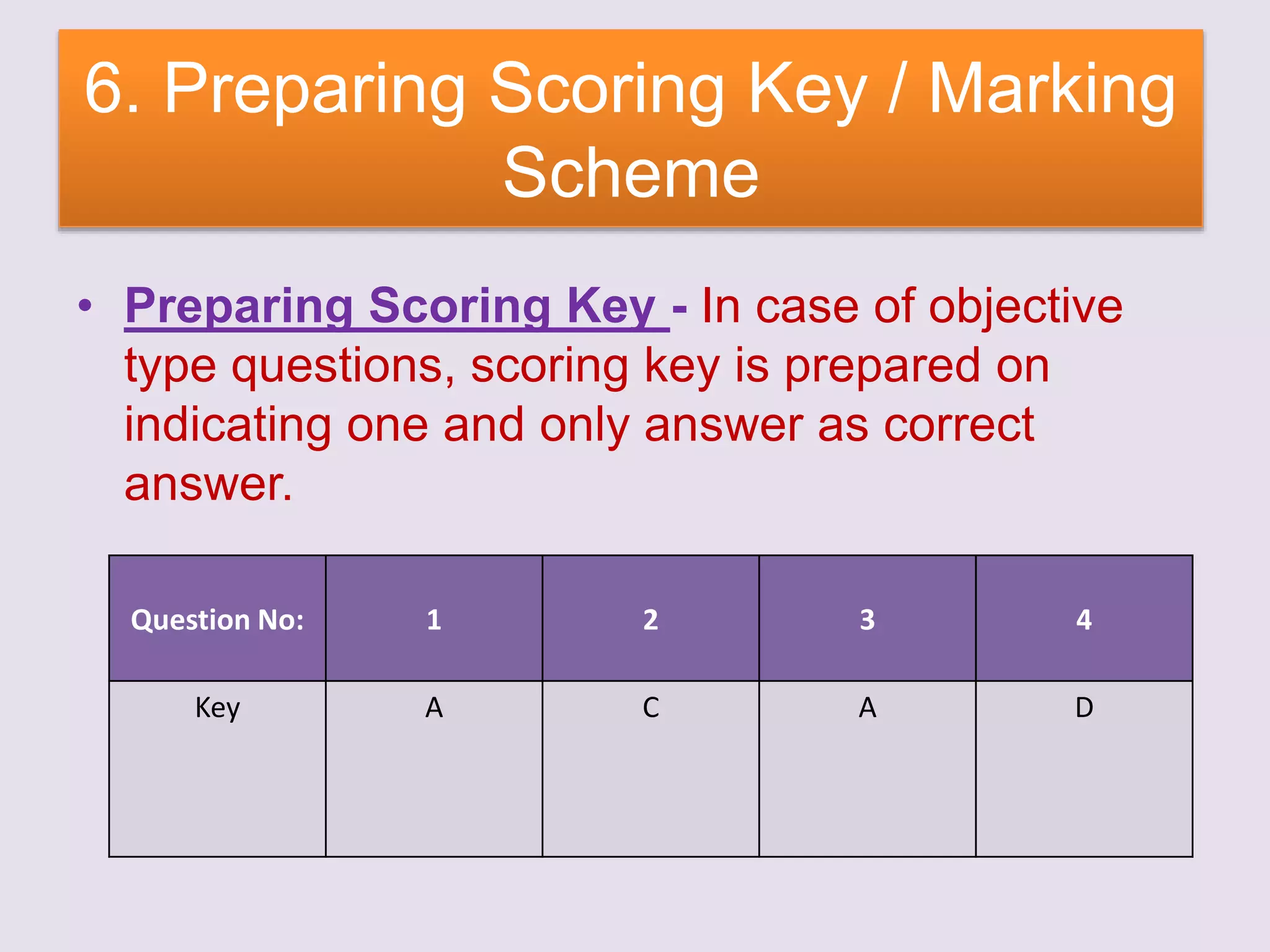
• Preparing Scoring Key - In case of objective
type questions, scoring key is prepared on
indicating one and only answer as correct
answer.
Question No: 1 2 3 4
Key A C A D
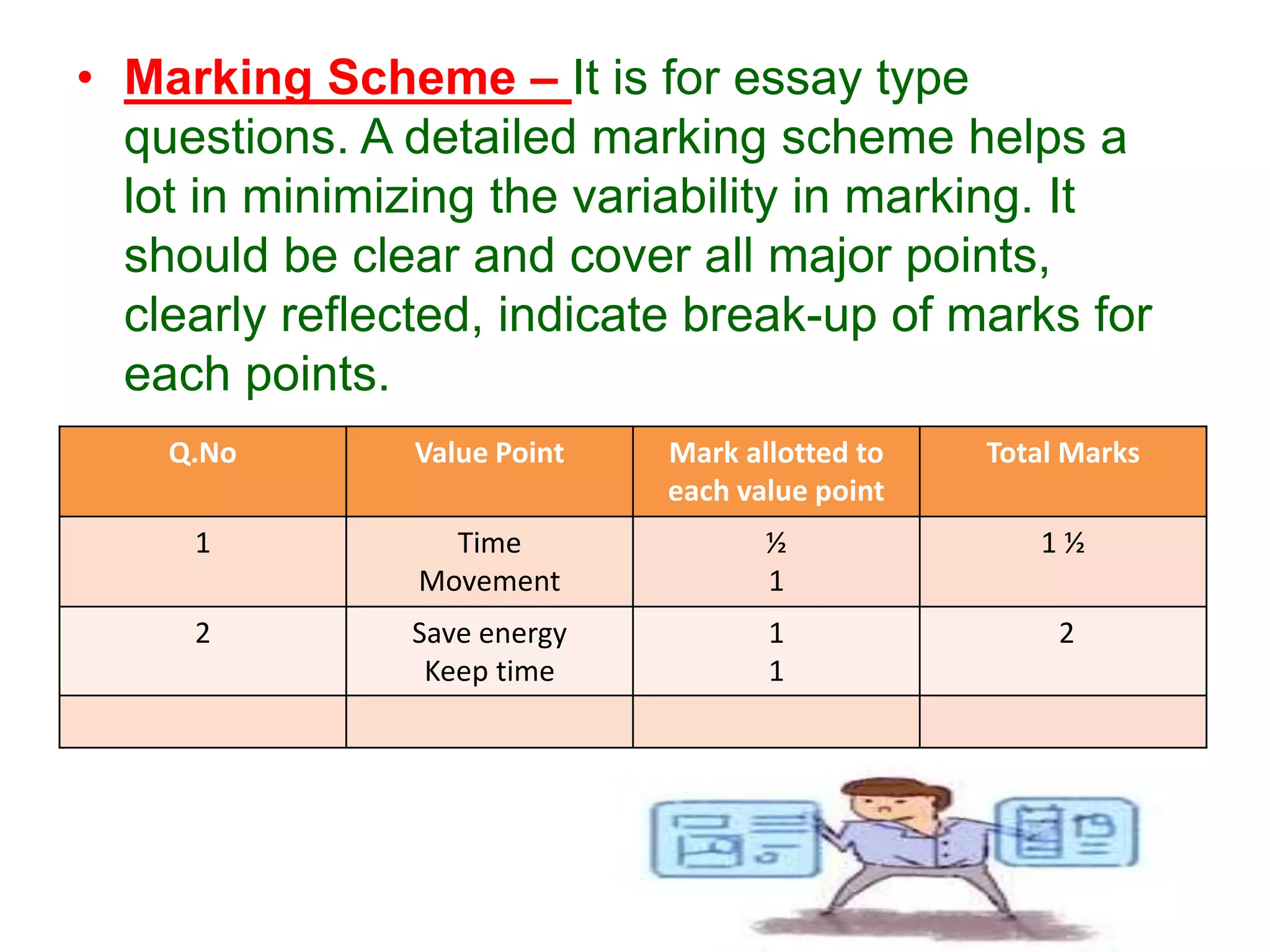
• Marking Scheme – It is for essay type
questions. A detailed marking scheme helps a
lot in minimizing the variability in marking. It
should be clear and cover all major points,
clearly reflected, indicate break-up of marks for
each points.
Q.No Value Point Mark allotted to
each value point
Total Marks
1 Time
Movement
½
1
1 ½
2 Save energy
Keep time
1
1
2
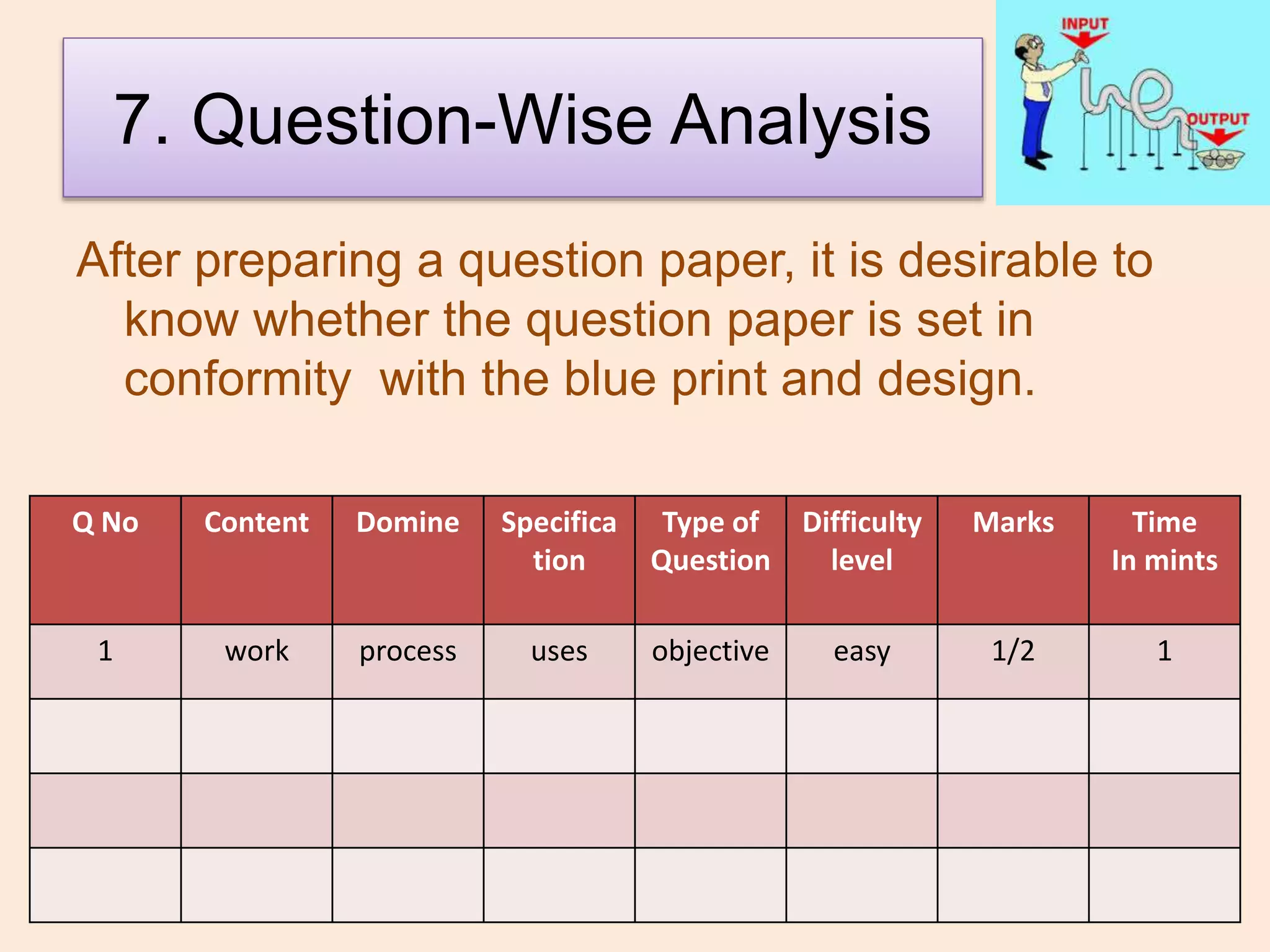
7. Question-Wise Analysis
After preparing a question paper, it is desirable to
know whether the question paper is set in
conformity with the blue print and design.
Q No Content Domine Specifica
tion
Type of
Question
Difficulty
level
Marks Time
In mints
1 work process uses objective easy 1/2 1
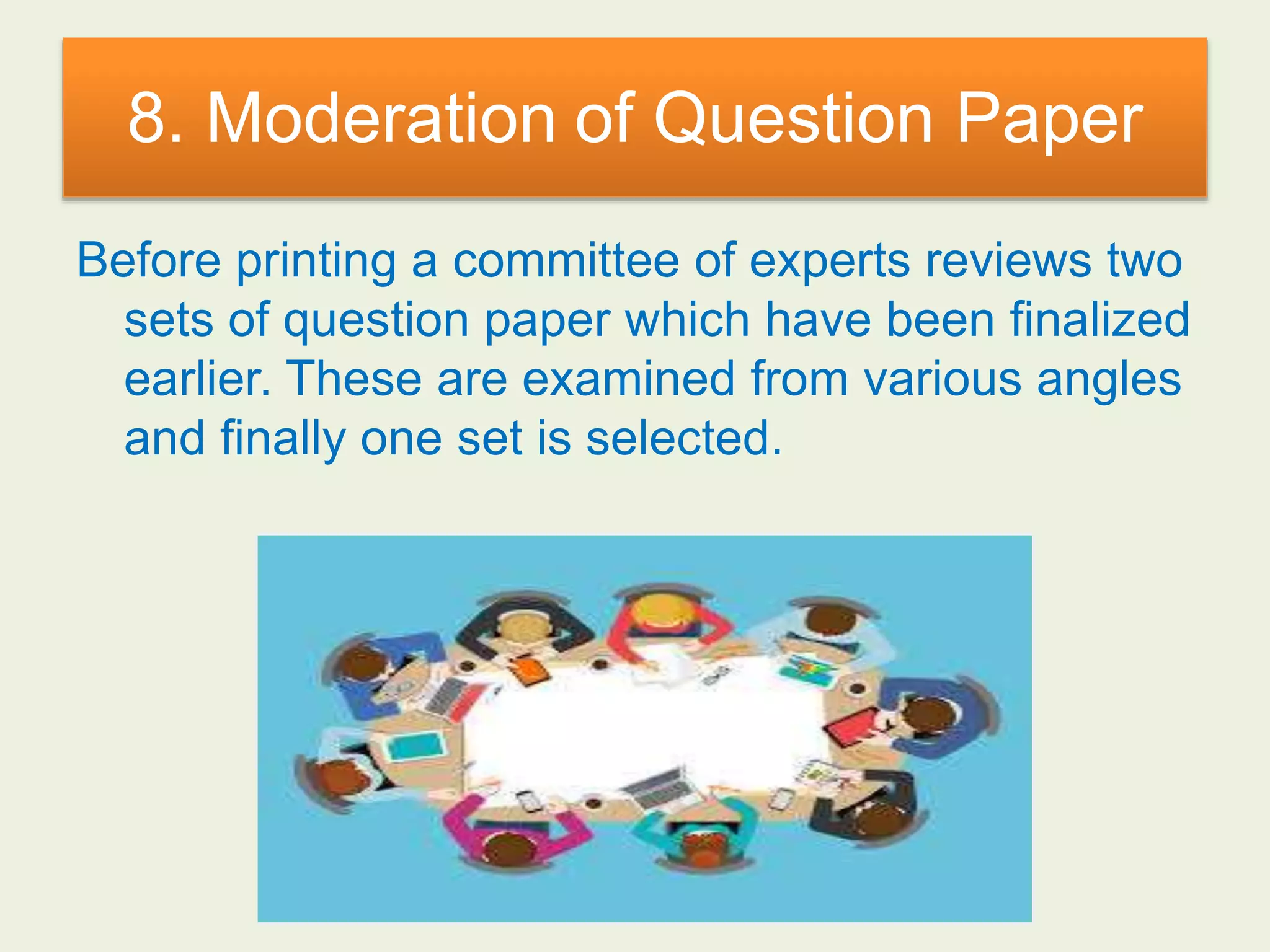
8. Moderation of Question Paper
Before printing a committee of experts reviews two
sets of question paper which have been finalized
earlier. These are examined from various angles
and finally one set is selected.
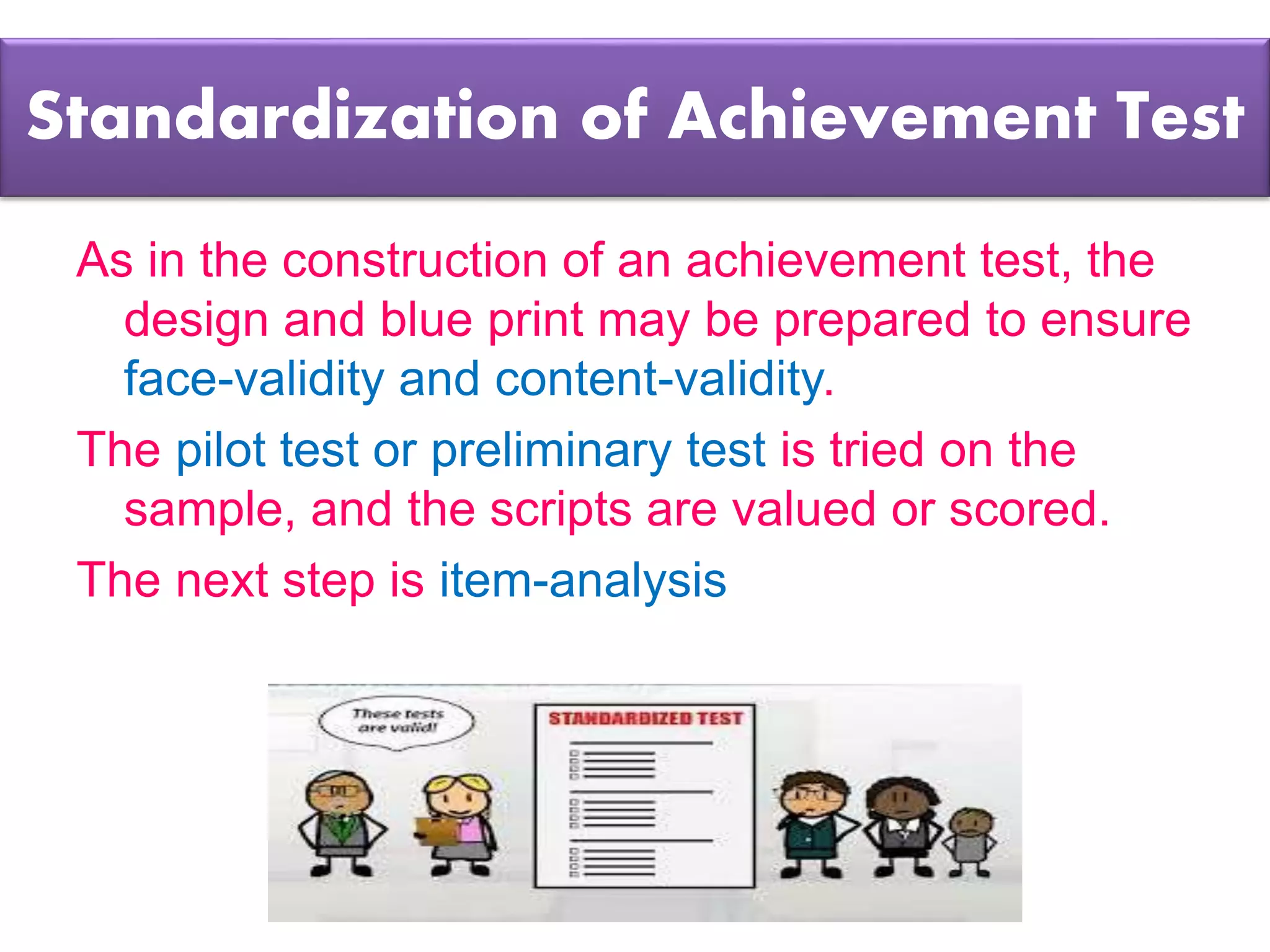
Standardization of Achievement Test
As in the construction of an achievement test, the
design and blue print may be prepared to ensure
face-validity and content-validity.
The pilot test or preliminary test is tried on the
sample, and the scripts are valued or scored.
The next step is item-analysis
Item-analysis
• Here Bad items are eliminated and good items
are retained.
• A good item is one which is attempted
successfully by 50% children.
• A good item must discriminate between superior
children and backward children.
• Suppose an item is successfully answered by all
children, that item is a bad item with no
discrimination power
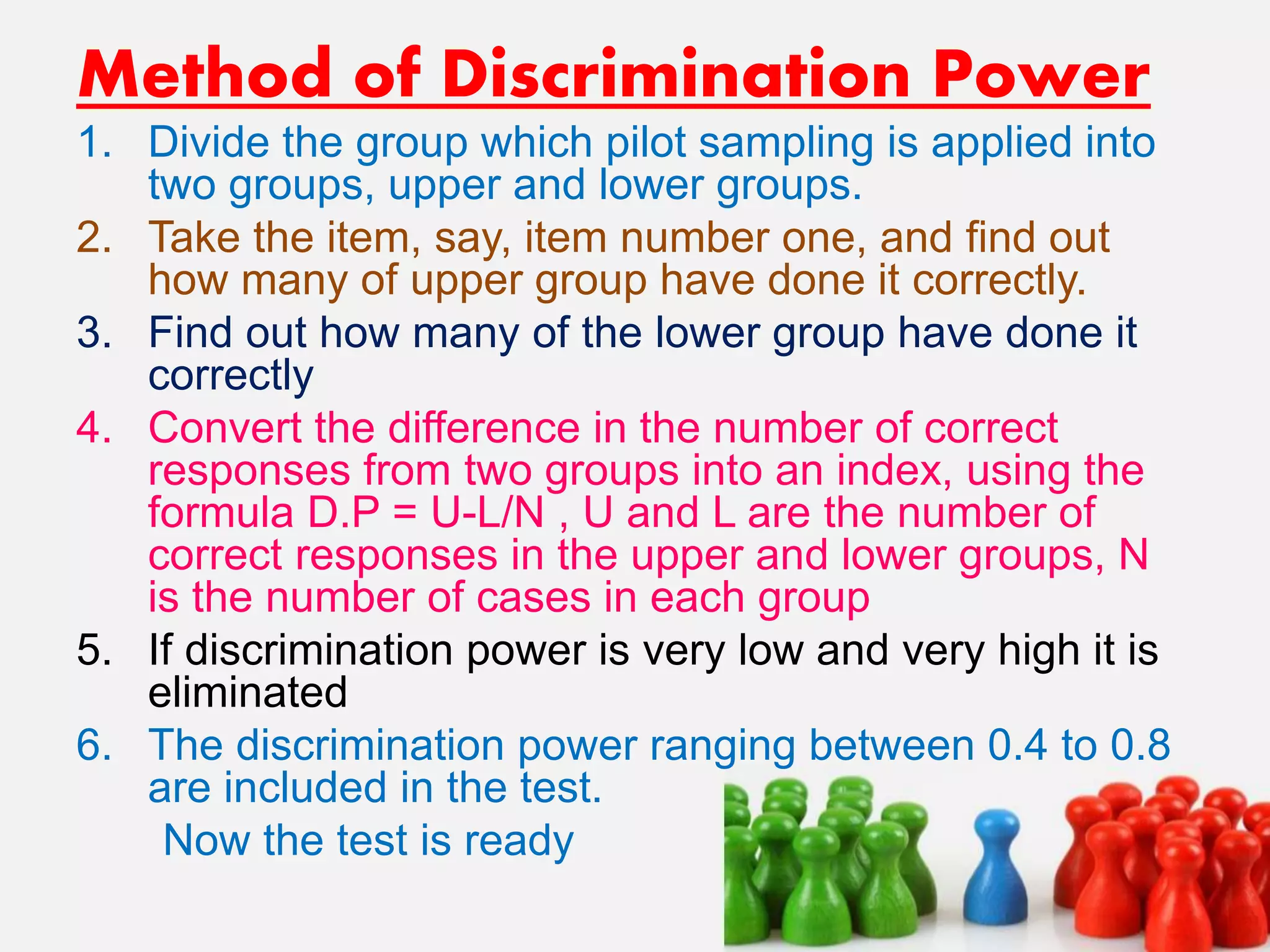
Method of Discrimination Power
1. Divide the group which pilot sampling is applied into
two groups, upper and lower groups.
2. Take the item, say, item number one, and find out
how many of upper group have done it correctly.
3. Find out how many of the lower group have done it
correctly
4. Convert the difference in the number of correct
responses from two groups into an index, using the
formula D.P = U-L/N , U and L are the number of
correct responses in the upper and lower groups, N
is the number of cases in each group
5. If discrimination power is very low and very high it is
eliminated
6. The discrimination power ranging between 0.4 to 0.8
are included in the test.
Now the test is ready
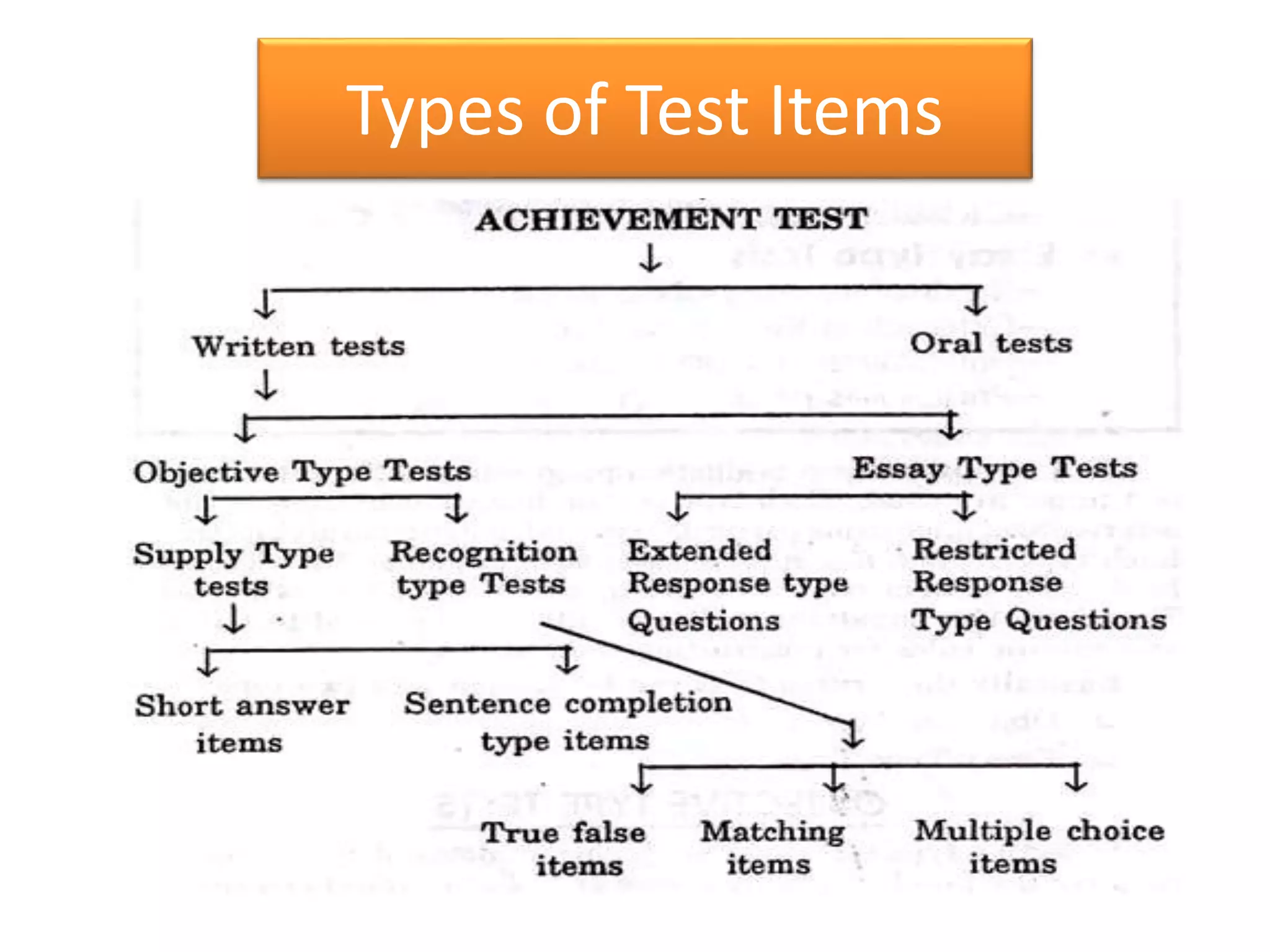
Types of Test Items
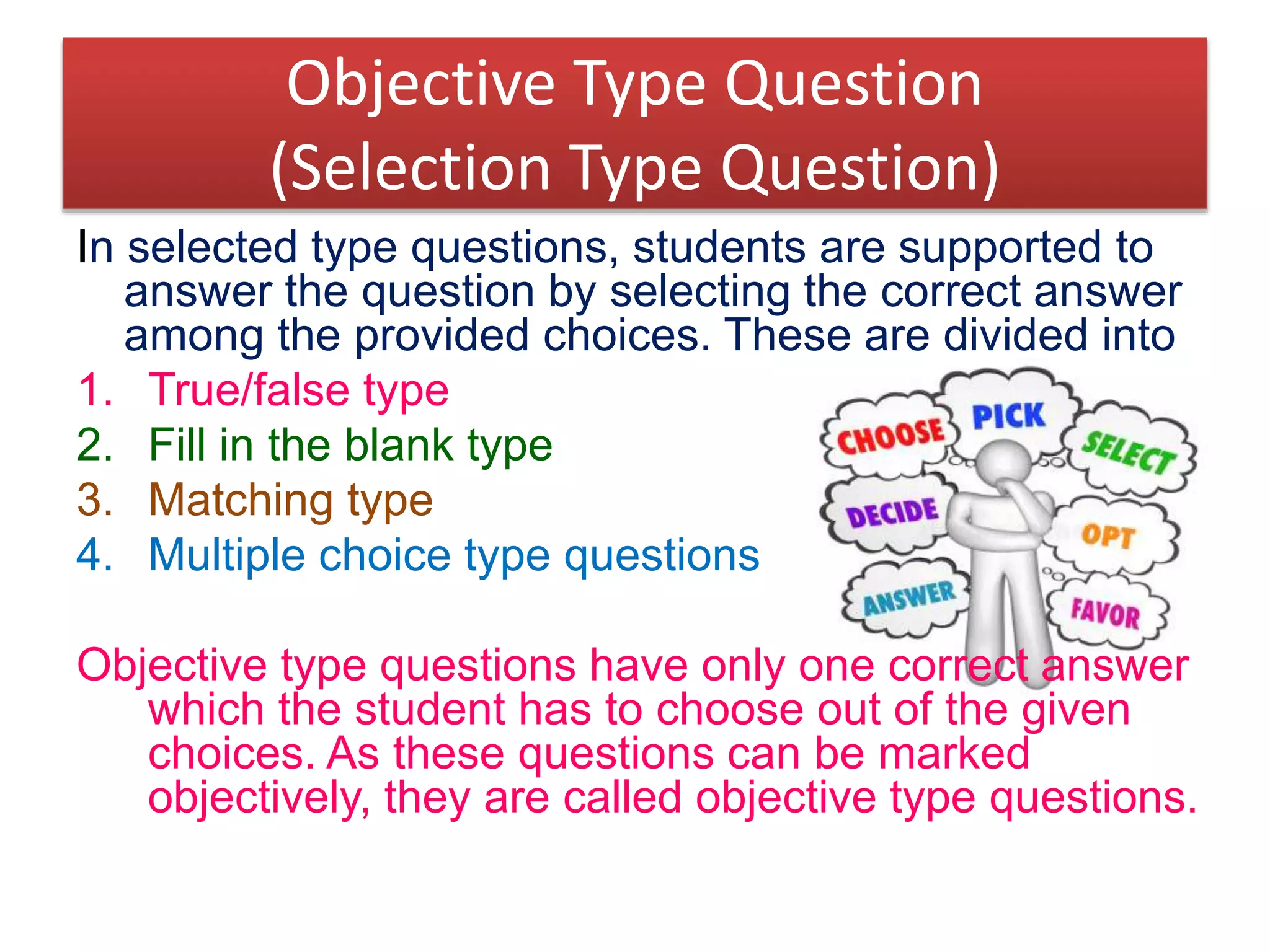
Objective Type Question
(Selection Type Question)
In selected type questions, students are supported to
answer the question by selecting the correct answer
among the provided choices. These are divided into
1. True/false type
2. Fill in the blank type
3. Matching type
4. Multiple choice type questions
Objective type questions have only one correct answer
which the student has to choose out of the given
choices. As these questions can be marked
objectively, they are called objective type questions.
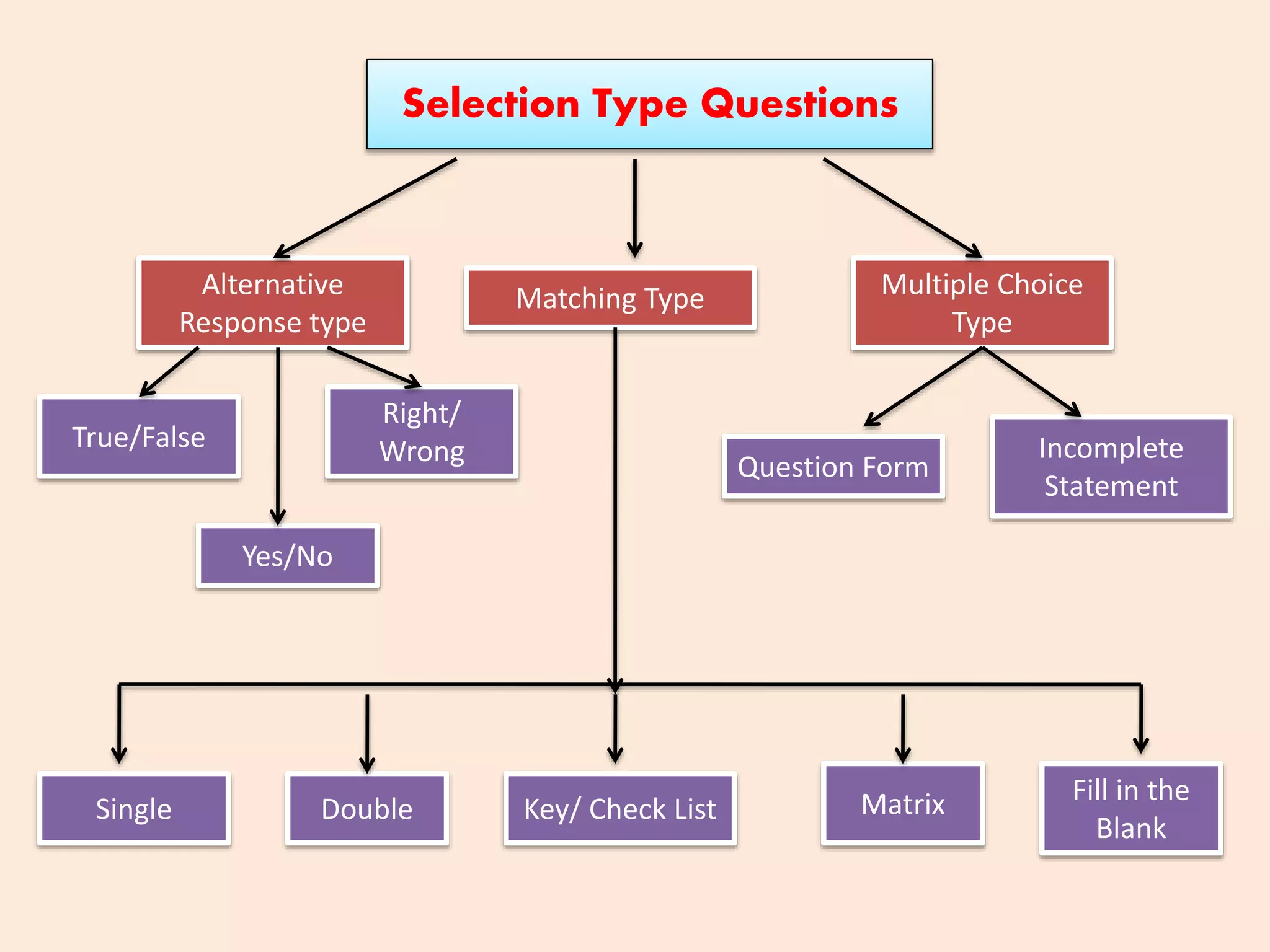
Selection Type Questions
Alternative
Response type
Matching Type Multiple Choice
Type
True/False
Right/
Wrong
Yes/No
Single Double Key/ Check List Matrix Fill in the
Blank
Question Form
Incomplete
Statement
• Alternative Response Type Items or True of
False : It consist of declarative statement that the
student is asked to mark true or false, right or
wrong. Here there is only two choices.
• Fill in the Blanks Type : In this type of questions,
students have to fill in the blank by selecting one
option out of all responses provided.
• Matching Type Items : Here there are least two
columns, the word or statements given in column
one are to be matched with the answers given in
column two. Column two should contains more
distractors than in column one. They are single
matching, double matching, key or check list item,
metrix item.
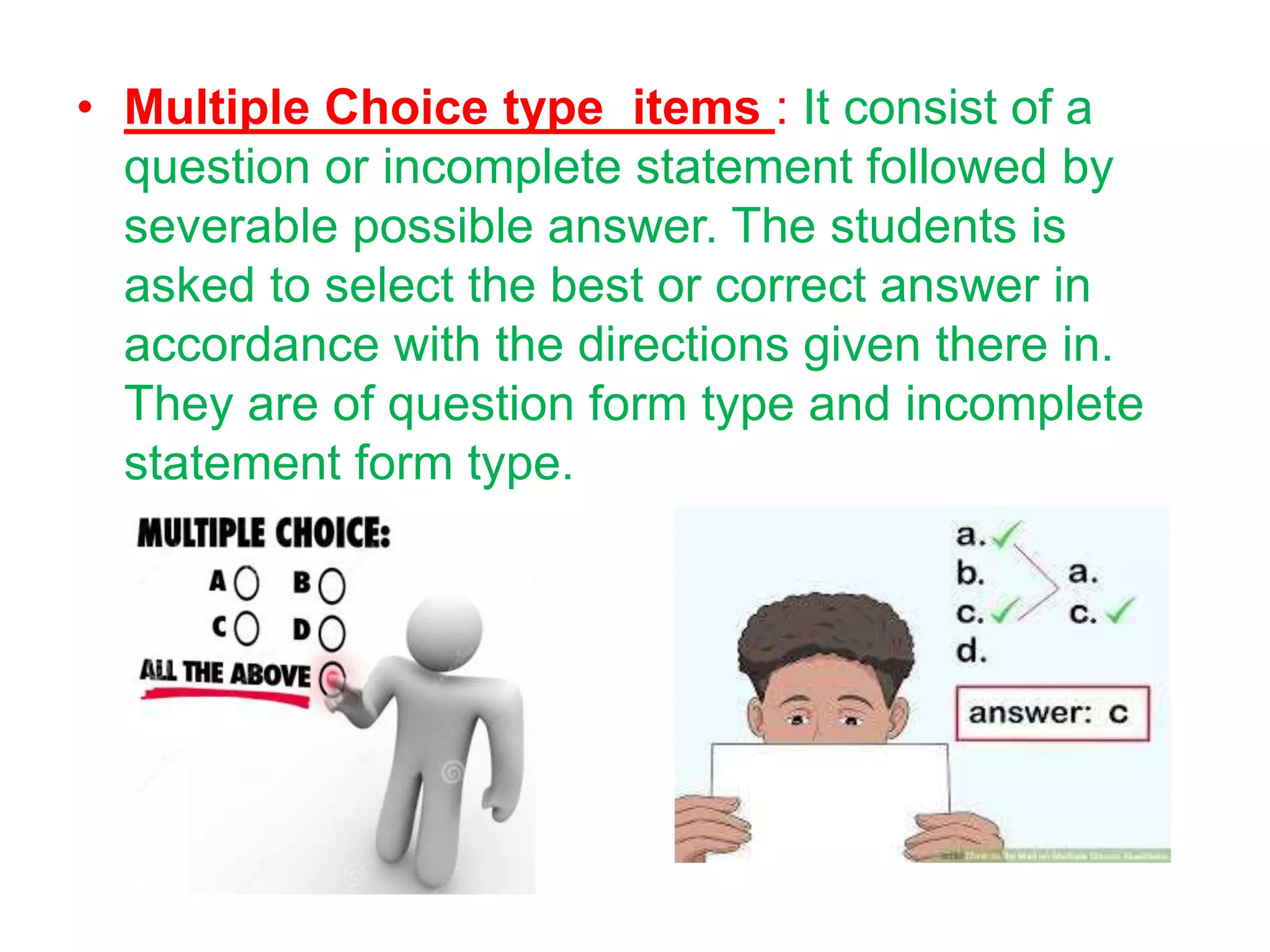
• Multiple Choice type items : It consist of a
question or incomplete statement followed by
severable possible answer. The students is
asked to select the best or correct answer in
accordance with the directions given there in.
They are of question form type and incomplete
statement form type.
Merits of Objective Type Question
 It is easy to conduct .
 It can be used to simple a wide range of subject
matters.
 It can be easily scored.
 Less time consuming.
 Objective and reliable
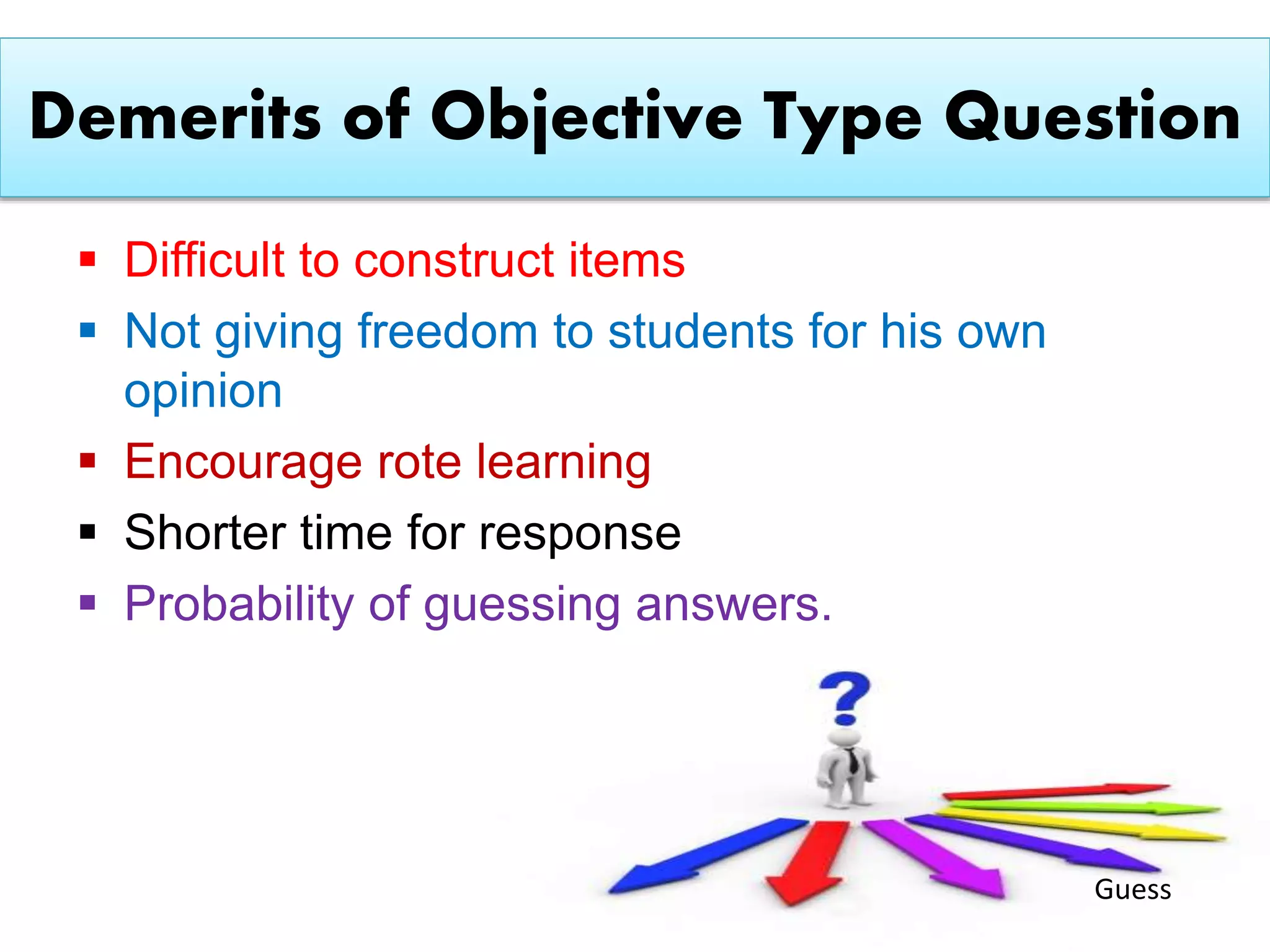
Demerits of Objective Type Question
 Difficult to construct items
 Not giving freedom to students for his own
opinion
 Encourage rote learning
 Shorter time for response
 Probability of guessing answers.
Guess
Short Answer Question
 Short answer questions are good via
media between essay type questions
which suffer from lack of objectivity
and reliability and objective type
 Criteria : May be within 50-60 words,
may be two to six-seven lines, may
be 2 to 4 credit points, can be
answered in 3 to 5 minutes.
Merit of Short Answer Question
• Useful in both internal and external exam.
• Useful to test all the objectives of learning.
• Develop the ability of organizing and selecting
relevant facts.
• Scored more objectively
• No probability of guessing answers
Demerits of Short Answer Question
 Unsuitability of measuring complex learning
outcomes
 Difficult of scoring
Essay Type Questions
It is a type of examination in which the subject or
examinee is asked to discuss, enumerate,
compare, state, evaluate, analyze, summaries or
criticize and involves writing at specific length on
a given topic involving the processed listed
above.
It is examinee responds one.
Its answers consist of many sentences to
several pages.
Students have full freedom to answer.
Merits of Essay Type Questions
Easy to prepare and administer
Can be used in measuring complex learning
outcomes
Largely eliminates guessing
Objectives like an ability to organize idea, justify a
statement, ability to interpret .
All degree of comprehensiveness and accuracy
are possible.
Demerits of Essay Type Questions
 Subjective in scoring
 Scoring is time consuming
 Inefficient for measuring knowledge of factual
information
Achievement test - Teacher Made Test and Standardized Test - Characteristics, Steps in Construction (blueprint) and Standardization, Types of Test Items

Achievement test - Teacher Made Test and Standardized Test - Characteristics, Steps in Construction (blueprint) and Standardization, Types of Test Items

  • 1.
    Achievement Test Suresh BabuG Assistant Professor CTE CPAS Paippad, Kottayam
  • 2.
    Achievement Test The termachievement has been understood in relation to the objectives of instruction that are translated into behavioral change. Achievement test measures present proficiency, mastery and understanding of general and specific areas of knowledge. Achievement tests attempt to measure what and how individual has learnt, viz. his present standard of performance. Scores of achievement test indicate the academic status of the individual learner in different subjects as a whole or individually
  • 3.
    Definition of AchievementTest NM Downie Any test that measures the accomplishments of an individual after a period of training or learning Throndike and Hagen The type of ability test that describes what a person has learned to do
  • 4.
    Objectives of Achievement Test Identifyand explain reasons for performing tests. Understand testing terminology to communicate clearly with students and colleagues. Evaluate a test’s validity and reliability. Select appropriate tests. Administer test protocols properly and safely.
  • 5.
    Functions of AchievementTest It provides basis for promotion to the next grade. To find out where each student stands in various academic areas. It helps in determination about the placement of the students in a particular section. To motivate the students before a new assignment has taken up. To expose pupil’s difficulties which the teacher can help them to solve.
  • 6.
    Classification of AchievementTest • The teacher is interested in knowing the level of achievement of each student in each of the learning points and evaluate on the basis of his pre-determined instructional objectives is called Achievement Test. • Achievement Test are generally classified into Teacher-made tests and Standardized test. We normally use Teacher-made test in schools. Their results indicate student achievement in relation to the instructions provided in a school.
  • 7.
  • 8.
    Difference Between Teacher-Made and Standardized Achievement Test Teacher- Made Test 1. Prepared by teachers who may not know very well the principles of test construction. 2. Often prepared hurriedly and haphazardly to be able to meet the deadline for administration. 3. Given only to a class or classes for which the tests are intended. Usually no norms are computed. Standardized Test 1. Prepared by specialists who know very well the principles of test construction. 2. Prepared very carefully following accepted principles of test construction Teacher- Made Tests 3. Given to a large portion of the population for which they are intended for the computation of norms.
  • 9.
    Difference Between Teacher-Made and Standardized Achievement Test Teacher- Made Test 4. Not subjected to any statistical procedures to determine their validity and reliability. 5. Maybe objective and may be essay in which case scoring is subjective. 6. Have no norms unless the teacher computes the median, mean and other measures for comparison and interpretation. 7. Generally measure subject achievement only. Standardized Test 4. Generally correlated with other tests of known validity and reliability or with measures such as school marks to determine their validity and reliability. 5. Highly objective 6. Have their norms computed for purposes of comparison and interpretation. 7. Measure innate capacities and characteristics as well as achievement.
  • 10.
    Difference Between Teacher-Made and Standardized Achievement Test Teacher- Made Test 8. Intended to be used only once or twice to measure achievement of students in a subject matter studied during a certain period. 9. Not copyrighted. Standardized Test 8. Intended to be used for a long period of time and for all people of the same class in the culture where they are validated. 9. Generally copyrighted.
  • 11.
  • 12.
    Validity Validity is the qualityof a test which measures what it is supported to measure It is a degree to which evidence, common sense, or theory supports any interpretations or conclusion about a student based on his/her test performance Characteristics of Achievement Test
  • 13.
    A test isgood only when the conditions of answering are simple ( Scientific and logical ). Its instruction should be simple and clear Ease in Administration Characteristics of Achievement Test
  • 14.
    Cost A good testshould be in expensive, not only from the view point of money but also from the view point of time and effort taken in the construction of the test Characteristics of Achievement Test
  • 15.
  • 16.
  • 17.
    Specificity The items inthe test should be specific to the objectives Precise and Clear Items should be precise, clear so that the students can answer well and score marks. Characteristics of Achievement Test
  • 18.
    Construction of AchievementTest Steps 1. Planning of the test 2. Preparation of Design 3. Preparation of Blue Print 4. Writing of Questions. 5. Preparation of a Question Paper 6. Preparing Scoring Key / Marking Scheme 7. Question Wise Analysis 8. Moderation of Question Paper
  • 19.
    1. Planning ofthe test • Determining the objectives of the test • Determining the Maximum Time allotment and Maximum Marks 25 marks 1 Hour 50 marks 2 hour
  • 20.
    2. Preparation ofDesign Important factors to be consider in design are Weightage to Objective Weightage to Content Weightage to Form of Question Weightage to difficulty level
  • 21.
    2.1 Weightage toObjective Indicates what objectives are to be tested and what weight has to be given per objective. Example: No Objective Marks Percentage 1 Knowledge 2 8 2 Understanding 6 24 3 Application 10 40 4 Skill 7 28 Total 25 100 Application Skill
  • 22.
    2.2 Weightage toContent Indicates the various aspects of the content to be tested and the weight to be given. Example: No Content Marks Percentage 1 UNIT - 1 4 16 2 UNIT - 2 6 24 3 UNIT - 3 7 28 4 UNIT - 4 8 32 Total 25 100 Unit 1 (4 Marks)
  • 23.
    2.3 Weightage toForm of Question Indicates the form of questions to be included in the test and its weight. Example : No Form of Question Mark Percentage 1 Objective type (O) 5 20 2 Short Answer Type(S.A) 10 40 3 Essay Type (E) 10 40 Total 25 100 S.A Essay
  • 24.
    2.4 Weightage todifficulty level Indicates weight to be given to different levels of questions. Example: No Level of Question /Difficulty Mark Percentage 1 Easy 7 28 2 Average 12 48 3 Difficult 6 24 Total 25 100 Average ? more Average students
  • 25.
    3. Preparation ofBlue Print Instructional Objectives Knowledge Understanding Application Skill Total Marks Form of Question Content O S.A E O S.A E O S.A E O S.A E Topic 1 (1)2 (2)1 4 Topic 2 (2)1 (2)1 (2)1 6 Topic 3 Topic 4 ( 1)2 (1)1 (2)1 (5)1 (5)1 7 8 Grand Total 2 2 4 1 4 5 2 5 25 Mark shown in bracket and number of question is shown outside the bracket It is a three dimensional chart giving the placement of objective, content and form of questions.
  • 26.
    4. Writing ofQuestions.  Frame questions in such a way that their language is simple, clear and within the comprehension level of students.  Questions should measure useful learning outcomes.  They should be of varying difficulty level and at the same time discriminating adequately between bright and poor student.  Before selecting questions for the questions paper, each and every question must be discussed thoroughly in a group of experts.  Each question is to be written on a separate item sheet.
  • 27.
    5. Preparation ofa Question Paper After writing the questions, they need to be relooked, modified and finalized in to a question paper. The following should be done:  Write general instructions clearly  The instruction should be specific depends on subjects  Any specific or related to particular question should be written before the question  Questions can be arranged according to form of questions, instructional objectives, content units, difficulty level or according to the convenience of administration in the examination.  Arrangement of question should be such that it facilitates the examinees as well as the evaluation process. 2020
  • 28.
    6. Preparing ScoringKey / Marking Scheme • Preparing Scoring Key - In case of objective type questions, scoring key is prepared on indicating one and only answer as correct answer. Question No: 1 2 3 4 Key A C A D
  • 29.
    • Marking Scheme– It is for essay type questions. A detailed marking scheme helps a lot in minimizing the variability in marking. It should be clear and cover all major points, clearly reflected, indicate break-up of marks for each points. Q.No Value Point Mark allotted to each value point Total Marks 1 Time Movement ½ 1 1 ½ 2 Save energy Keep time 1 1 2
  • 30.
    7. Question-Wise Analysis Afterpreparing a question paper, it is desirable to know whether the question paper is set in conformity with the blue print and design. Q No Content Domine Specifica tion Type of Question Difficulty level Marks Time In mints 1 work process uses objective easy 1/2 1
  • 31.
    8. Moderation ofQuestion Paper Before printing a committee of experts reviews two sets of question paper which have been finalized earlier. These are examined from various angles and finally one set is selected.
  • 32.
    Standardization of AchievementTest As in the construction of an achievement test, the design and blue print may be prepared to ensure face-validity and content-validity. The pilot test or preliminary test is tried on the sample, and the scripts are valued or scored. The next step is item-analysis
  • 33.
    Item-analysis • Here Baditems are eliminated and good items are retained. • A good item is one which is attempted successfully by 50% children. • A good item must discriminate between superior children and backward children. • Suppose an item is successfully answered by all children, that item is a bad item with no discrimination power
  • 34.
    Method of DiscriminationPower 1. Divide the group which pilot sampling is applied into two groups, upper and lower groups. 2. Take the item, say, item number one, and find out how many of upper group have done it correctly. 3. Find out how many of the lower group have done it correctly 4. Convert the difference in the number of correct responses from two groups into an index, using the formula D.P = U-L/N , U and L are the number of correct responses in the upper and lower groups, N is the number of cases in each group 5. If discrimination power is very low and very high it is eliminated 6. The discrimination power ranging between 0.4 to 0.8 are included in the test. Now the test is ready
  • 35.
  • 36.
    Objective Type Question (SelectionType Question) In selected type questions, students are supported to answer the question by selecting the correct answer among the provided choices. These are divided into 1. True/false type 2. Fill in the blank type 3. Matching type 4. Multiple choice type questions Objective type questions have only one correct answer which the student has to choose out of the given choices. As these questions can be marked objectively, they are called objective type questions.
  • 37.
    Selection Type Questions Alternative Responsetype Matching Type Multiple Choice Type True/False Right/ Wrong Yes/No Single Double Key/ Check List Matrix Fill in the Blank Question Form Incomplete Statement
  • 38.
    • Alternative ResponseType Items or True of False : It consist of declarative statement that the student is asked to mark true or false, right or wrong. Here there is only two choices. • Fill in the Blanks Type : In this type of questions, students have to fill in the blank by selecting one option out of all responses provided. • Matching Type Items : Here there are least two columns, the word or statements given in column one are to be matched with the answers given in column two. Column two should contains more distractors than in column one. They are single matching, double matching, key or check list item, metrix item.
  • 39.
    • Multiple Choicetype items : It consist of a question or incomplete statement followed by severable possible answer. The students is asked to select the best or correct answer in accordance with the directions given there in. They are of question form type and incomplete statement form type.
  • 40.
    Merits of ObjectiveType Question  It is easy to conduct .  It can be used to simple a wide range of subject matters.  It can be easily scored.  Less time consuming.  Objective and reliable
  • 41.
    Demerits of ObjectiveType Question  Difficult to construct items  Not giving freedom to students for his own opinion  Encourage rote learning  Shorter time for response  Probability of guessing answers. Guess
  • 42.
    Short Answer Question Short answer questions are good via media between essay type questions which suffer from lack of objectivity and reliability and objective type  Criteria : May be within 50-60 words, may be two to six-seven lines, may be 2 to 4 credit points, can be answered in 3 to 5 minutes.
  • 43.
    Merit of ShortAnswer Question • Useful in both internal and external exam. • Useful to test all the objectives of learning. • Develop the ability of organizing and selecting relevant facts. • Scored more objectively • No probability of guessing answers Demerits of Short Answer Question  Unsuitability of measuring complex learning outcomes  Difficult of scoring
  • 44.
    Essay Type Questions Itis a type of examination in which the subject or examinee is asked to discuss, enumerate, compare, state, evaluate, analyze, summaries or criticize and involves writing at specific length on a given topic involving the processed listed above. It is examinee responds one. Its answers consist of many sentences to several pages. Students have full freedom to answer.
  • 45.
    Merits of EssayType Questions Easy to prepare and administer Can be used in measuring complex learning outcomes Largely eliminates guessing Objectives like an ability to organize idea, justify a statement, ability to interpret . All degree of comprehensiveness and accuracy are possible. Demerits of Essay Type Questions  Subjective in scoring  Scoring is time consuming  Inefficient for measuring knowledge of factual information