PLASMA COMPONENTS
Presenter – Dr Sowmya.S.M
1
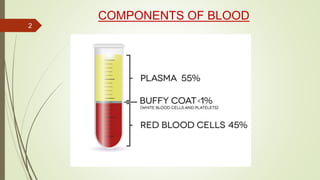
COMPONENTS OF BLOOD
2
3 BLOOD COMPONENTS
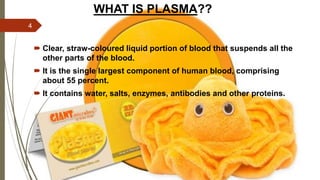
WHAT IS PLASMA??
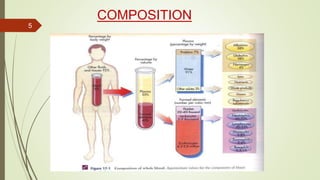
 Clear, straw-coloured liquid portion of blood that suspends all the
other parts of the blood.
 It is the single largest component of human blood, comprising
about 55 percent.
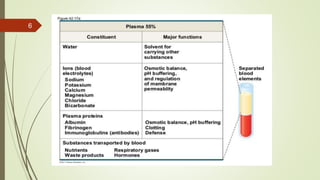
 It contains water, salts, enzymes, antibodies and other proteins.
4
COMPOSITION
5
6
ACTIONS
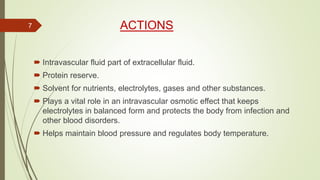
 Intravascular fluid part of extracellular fluid.
 Protein reserve.
 Solvent for nutrients, electrolytes, gases and other substances.
 Plays a vital role in an intravascular osmotic effect that keeps
electrolytes in balanced form and protects the body from infection and
other blood disorders.
 Helps maintain blood pressure and regulates body temperature.
7
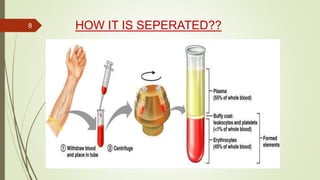
HOW IT IS SEPERATED??8
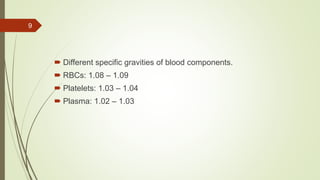
 Different specific gravities of blood components.
 RBCs: 1.08 – 1.09
 Platelets: 1.03 – 1.04
 Plasma: 1.02 – 1.03
9
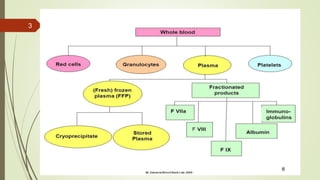
DIFFERENT PLASMA COMPONENTS
 Fresh frozen plasma
 Frozen plasma
 Thawed plasma
 Cryoprecipitate-reduced
 Cryoprecipitate
 Coagulation factors – Factor VIII, IX, XIII and VIIa
 Albumin
10
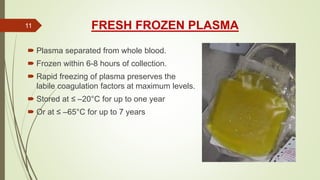
FRESH FROZEN PLASMA
 Plasma separated from whole blood.
 Frozen within 6-8 hours of collection.
 Rapid freezing of plasma preserves the
labile coagulation factors at maximum levels.
 Stored at ≤ –20°C for up to one year
 Or at ≤ –65°C for up to 7 years
11
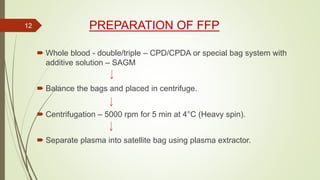
PREPARATION OF FFP
 Whole blood - double/triple – CPD/CPDA or special bag system with
additive solution – SAGM
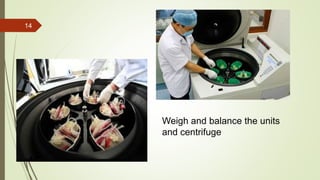
 Balance the bags and placed in centrifuge.
 Centrifugation – 5000 rpm for 5 min at 4°C (Heavy spin).
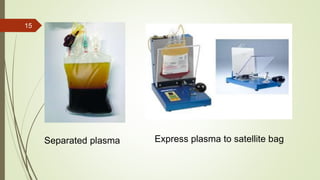
 Separate plasma into satellite bag using plasma extractor.
12
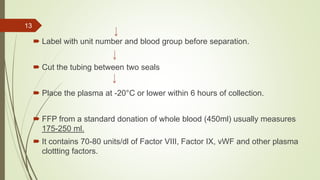
 Label with unit number and blood group before separation.
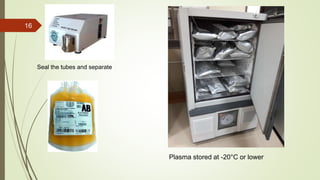
 Cut the tubing between two seals
 Place the plasma at -20°C or lower within 6 hours of collection.
 FFP from a standard donation of whole blood (450ml) usually measures
175-250 ml.
 It contains 70-80 units/dl of Factor VIII, Factor IX, vWF and other plasma
clottting factors.
13
14
Weigh and balance the units
and centrifuge
15
Separated plasma Express plasma to satellite bag
16
Seal the tubes and separate
Plasma stored at -20°C or lower
BEFORE ISSUE…
 Before transfusion, it is thawed over 20 to 30 mins at 30 to 37°C.
 A water bath is used for thawing.
 The entry ports need to be protected from contamination during this
process.
 Transfused immediately or stored at 4°C (1–6°C) for 24 hours – “FFP
thawed”
 After 24 hours, the words “fresh frozen” should be removed and
labelled as “Thawed plasma”.
17
INDICATIONS
 Multiple coagulation factor deficiencies – liver disease, DIC,
coagulopathies.
 Reversal of coumarin drug effect.
 Use in antithrombin deficiency.
 Immunodeficiency syndromes.
 Raised PT and INR
18
DOSE AND ADMINISTRATION
 Accepted dose of FFP transfusion is 12-15ml/kg.
 However dose depends on the underlying clinical disease.
 Post transfusion assessment of patient’s coagulation parameters like
PT, aPTT or specific factor asssay is important for monitoring.
19
FROZEN PLASMA
 Separated from whole blood within 8 - 24 hours of collection.
 The level of the labile clotting factors, factors VIII and V is lower in FP,
than in FFP.
 Adequate – treatment of mild to moderate coagulation factor
deficiencies.
20
SOLVENT/DETERGENT-TREATED
PLASMA The thawed plasma is treated with solvent tri-n-butyl phosphate (1%)
and detergent Triton X-100 (1%)
 Removed after treatment and the sterile-filtered plasma is refrozen.
 ADVANTAGES: Significantly inactivates the lipid enveloped viruses
(e.g. HCV, HBV, HIV).
 But not the non lipid enveloped viruses - hepatitis A and parvovirus.
21
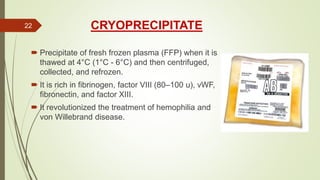
CRYOPRECIPITATE
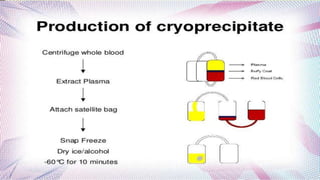
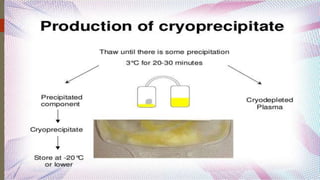
 Precipitate of fresh frozen plasma (FFP) when it is
thawed at 4°C (1°C - 6°C) and then centrifuged,
collected, and refrozen.
 It is rich in fibrinogen, factor VIII (80–100 u), vWF,
fibronectin, and factor XIII.
 It revolutionized the treatment of hemophilia and
von Willebrand disease.
22
02/11/2016olusola.ajayi@aaua.edu.ng ajayicomputer@gmail.com ajsoftengr@gmail.com
23
02/11/2016olusola.ajayi@aaua.edu.ng ajayicomputer@gmail.com ajsoftengr@gmail.com
24
 It contains 80-100 units of F VIII, 100-250 mg of fibrinogen, 50-60mg
of fibronectin and 40-70% of vWF and 20 – 30% F XIII.
 Although this product contains small amounts of isohaemagglutinins,
it is not necessary to perform compatibility testing prior to
administration.
 Neonates should receive only ABO-compatible cryoprecipitate.
25
 Each unit – 10 to 15ml.
 SHELF LIFE: Frozen:1 yr
Thawed: 6 hr
 STORAGE: 18°C or lesser
 BEFORE ISSUE:
Thawed over 20 to 30 mins at 30 to 37°C in water bath.
26
INDICATIONS
 Hemophilia A
 von – Willebrands disease
 Congenital fibrinogen deficiency
 Factor XIII deficiency
 Acquired Factor VIII deficiency – eg: DIC, massive transfusion
 Used as local/topical hemostatic agent.
27
USAGE
 Dosage - relatively subjective
 Monitored by serial measurements of plasma fibrinogen.
 One unit will increase the fibrinogen by 5 to 10 mg/dl in an average
sized adult.
 Cryoprecipitate has been used with a source of thrombin as a
topical haemostatic agent as well
28
CRYOPRECIPITATE-DEPLETED FRESH-FROZEN
PLASMA
(CRYOSUPERNATANT)
 The remaining thawed plasma of FFP that is left after Cryoprecipitate is
separated is called cryoprecipitate reduced (cryo-poor) plasma or
cryosupernatant.
 All the factors like fibrinogen, factor VIII, von Willebrand’s factor (vWF),
factor XIII and fibronectin, are reduced in the cryo-poor plasma.
 It is deficient in the pathogenic ultra-large multimers of vWF but contains
vWF-cleaving metalloprotease.
29
 STORAGE: –18°C or colder.
 SHELF LIFE: one year from the whole blood collection date.
 INDICATIONS: treatment of refractory thrombotic thrombocytopenic
purpura
30
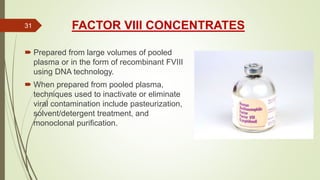
FACTOR VIII CONCENTRATES
 Prepared from large volumes of pooled
plasma or in the form of recombinant FVIII
using DNA technology.
 When prepared from pooled plasma,
techniques used to inactivate or eliminate
viral contamination include pasteurization,
solvent/detergent treatment, and
monoclonal purification.
31
 Factor content per unit volume is 10 – 40 times greater than plasma.
 Stored at 4°C in a home refrigerator.
 INDICATIONS:
 Hemophilia A
 Hemophilia B
 Persons deficient in factor VIII.
02/11/2016
32
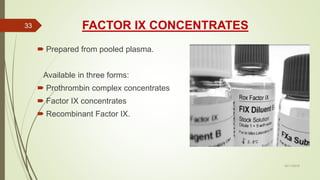
FACTOR IX CONCENTRATES
 Prepared from pooled plasma.
Available in three forms:
 Prothrombin complex concentrates
 Factor IX concentrates
 Recombinant Factor IX.
02/11/2016
33
 INDICATIONS:
Treatment of Factor IX deficiency or Hemophilia B
Treatment of Factor XI Deficiency (Hemophilia C)
 Also contains Factor II, VII and X in concentrated form.
 Vials contains 500 units of Factor X.
34
FACTOR XIII CONCENTRATES
 There are currently two plasma-derived virus inactivated factor XIII
concentrates.
 Fibrogammin P
 Factor XIII concentrate
 Single-use vial contains 1000 – 1600 IU of lyophilised concentrate
 STORAGE: AT 2 - 8°C
 SHELF LIFE: 36 months
35
ALBUMIN
 Albumin is the quantitatively dominant plasma protein.
 MW - 66kDa, water-soluble protein.
 Synthesized in the liver at a rate of about 15 g/day.
 Half-life of around 25 days.
36
PREPARATION
 Commercially available albumin preparations are obtained from
plasma fractionation, according to Cohn and Oncley or Kistler and
Nitschmann.
 Albumin is obtained as fractionV in Cohn process.
 These are subsequently pasteurized for virus inactivation.
 These solutions contain either 3.5–5% or 20–25% albumin at a purity
of 95–98%.
37
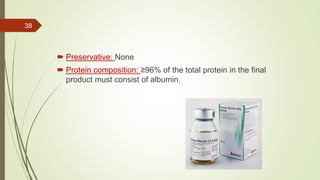
 Preservative: None
 Protein composition: ≥96% of the total protein in the final
product must consist of albumin.
38
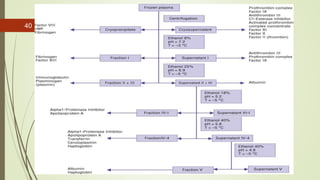
PLASMA FRACTIONATION PROCESS
The Cohn process: Based on the differential precipitation
of plasma proteins by manipulation of ethanol concentration
and ph of a low-ionic-strength solution maintained at a
subzero temperature.
02/11/2016
39
40
DOSE
 According to the American Hospital Formulary Service(AHFS) Drug
Information guide, a typical initial adult dose of albumin is 25 g.
 Can be repeated in 15 to 30 minutes depending on the patient’s
response.
 Up to 250 g of albumin may be infused in a 48-hour period.
 The infusion rate should be based on the patient’s condition.
41
ADMINISTRATION
 Albumin should be inspected for turbidity prior to administration.
 Administration must begin within 4 hours of entry into the container.
 Because blood group isohemagglutinins are removed from albumin
products, albumin is given without regard to ABO type
42
INDICATIONS
 Hypoalbuminemia - liver dysfunction, malnutrition, and
malabsorption.
 Thyrotoxicosis
 Pancreatitis
 Protein-losing gastroenteropathy
 Nephrotic syndrome.
43
FIBRIN GLUE AND SEALANTS
 This results from a mixture of fibrinogen source (FFP, PRP,
heterologous or autologous cryoprecipitate) with bovine thrombin.
 The hemostasis is achieved with action of thrombin on fibrinogen.
This is widely used during surgery to stop bleeding immediately.
44
-THANK YOU45

Plasma components

  • 1.
  • 2.
  • 3.
  • 4.
    WHAT IS PLASMA?? Clear, straw-coloured liquid portion of blood that suspends all the other parts of the blood.  It is the single largest component of human blood, comprising about 55 percent.  It contains water, salts, enzymes, antibodies and other proteins. 4
  • 5.
  • 6.
  • 7.
    ACTIONS  Intravascular fluidpart of extracellular fluid.  Protein reserve.  Solvent for nutrients, electrolytes, gases and other substances.  Plays a vital role in an intravascular osmotic effect that keeps electrolytes in balanced form and protects the body from infection and other blood disorders.  Helps maintain blood pressure and regulates body temperature. 7
  • 8.
    HOW IT ISSEPERATED??8
  • 9.
     Different specificgravities of blood components.  RBCs: 1.08 – 1.09  Platelets: 1.03 – 1.04  Plasma: 1.02 – 1.03 9
  • 10.
    DIFFERENT PLASMA COMPONENTS Fresh frozen plasma  Frozen plasma  Thawed plasma  Cryoprecipitate-reduced  Cryoprecipitate  Coagulation factors – Factor VIII, IX, XIII and VIIa  Albumin 10
  • 11.
    FRESH FROZEN PLASMA Plasma separated from whole blood.  Frozen within 6-8 hours of collection.  Rapid freezing of plasma preserves the labile coagulation factors at maximum levels.  Stored at ≤ –20°C for up to one year  Or at ≤ –65°C for up to 7 years 11
  • 12.
    PREPARATION OF FFP Whole blood - double/triple – CPD/CPDA or special bag system with additive solution – SAGM  Balance the bags and placed in centrifuge.  Centrifugation – 5000 rpm for 5 min at 4°C (Heavy spin).  Separate plasma into satellite bag using plasma extractor. 12
  • 13.
     Label withunit number and blood group before separation.  Cut the tubing between two seals  Place the plasma at -20°C or lower within 6 hours of collection.  FFP from a standard donation of whole blood (450ml) usually measures 175-250 ml.  It contains 70-80 units/dl of Factor VIII, Factor IX, vWF and other plasma clottting factors. 13
  • 14.
    14 Weigh and balancethe units and centrifuge
  • 15.
    15 Separated plasma Expressplasma to satellite bag
  • 16.
    16 Seal the tubesand separate Plasma stored at -20°C or lower
  • 17.
    BEFORE ISSUE…  Beforetransfusion, it is thawed over 20 to 30 mins at 30 to 37°C.  A water bath is used for thawing.  The entry ports need to be protected from contamination during this process.  Transfused immediately or stored at 4°C (1–6°C) for 24 hours – “FFP thawed”  After 24 hours, the words “fresh frozen” should be removed and labelled as “Thawed plasma”. 17
  • 18.
    INDICATIONS  Multiple coagulationfactor deficiencies – liver disease, DIC, coagulopathies.  Reversal of coumarin drug effect.  Use in antithrombin deficiency.  Immunodeficiency syndromes.  Raised PT and INR 18
  • 19.
    DOSE AND ADMINISTRATION Accepted dose of FFP transfusion is 12-15ml/kg.  However dose depends on the underlying clinical disease.  Post transfusion assessment of patient’s coagulation parameters like PT, aPTT or specific factor asssay is important for monitoring. 19
  • 20.
    FROZEN PLASMA  Separatedfrom whole blood within 8 - 24 hours of collection.  The level of the labile clotting factors, factors VIII and V is lower in FP, than in FFP.  Adequate – treatment of mild to moderate coagulation factor deficiencies. 20
  • 21.
    SOLVENT/DETERGENT-TREATED PLASMA The thawedplasma is treated with solvent tri-n-butyl phosphate (1%) and detergent Triton X-100 (1%)  Removed after treatment and the sterile-filtered plasma is refrozen.  ADVANTAGES: Significantly inactivates the lipid enveloped viruses (e.g. HCV, HBV, HIV).  But not the non lipid enveloped viruses - hepatitis A and parvovirus. 21
  • 22.
    CRYOPRECIPITATE  Precipitate offresh frozen plasma (FFP) when it is thawed at 4°C (1°C - 6°C) and then centrifuged, collected, and refrozen.  It is rich in fibrinogen, factor VIII (80–100 u), vWF, fibronectin, and factor XIII.  It revolutionized the treatment of hemophilia and von Willebrand disease. 22
  • 23.
  • 24.
  • 25.
     It contains80-100 units of F VIII, 100-250 mg of fibrinogen, 50-60mg of fibronectin and 40-70% of vWF and 20 – 30% F XIII.  Although this product contains small amounts of isohaemagglutinins, it is not necessary to perform compatibility testing prior to administration.  Neonates should receive only ABO-compatible cryoprecipitate. 25
  • 26.
     Each unit– 10 to 15ml.  SHELF LIFE: Frozen:1 yr Thawed: 6 hr  STORAGE: 18°C or lesser  BEFORE ISSUE: Thawed over 20 to 30 mins at 30 to 37°C in water bath. 26
  • 27.
    INDICATIONS  Hemophilia A von – Willebrands disease  Congenital fibrinogen deficiency  Factor XIII deficiency  Acquired Factor VIII deficiency – eg: DIC, massive transfusion  Used as local/topical hemostatic agent. 27
  • 28.
    USAGE  Dosage -relatively subjective  Monitored by serial measurements of plasma fibrinogen.  One unit will increase the fibrinogen by 5 to 10 mg/dl in an average sized adult.  Cryoprecipitate has been used with a source of thrombin as a topical haemostatic agent as well 28
  • 29.
    CRYOPRECIPITATE-DEPLETED FRESH-FROZEN PLASMA (CRYOSUPERNATANT)  Theremaining thawed plasma of FFP that is left after Cryoprecipitate is separated is called cryoprecipitate reduced (cryo-poor) plasma or cryosupernatant.  All the factors like fibrinogen, factor VIII, von Willebrand’s factor (vWF), factor XIII and fibronectin, are reduced in the cryo-poor plasma.  It is deficient in the pathogenic ultra-large multimers of vWF but contains vWF-cleaving metalloprotease. 29
  • 30.
     STORAGE: –18°Cor colder.  SHELF LIFE: one year from the whole blood collection date.  INDICATIONS: treatment of refractory thrombotic thrombocytopenic purpura 30
  • 31.
    FACTOR VIII CONCENTRATES Prepared from large volumes of pooled plasma or in the form of recombinant FVIII using DNA technology.  When prepared from pooled plasma, techniques used to inactivate or eliminate viral contamination include pasteurization, solvent/detergent treatment, and monoclonal purification. 31
  • 32.
     Factor contentper unit volume is 10 – 40 times greater than plasma.  Stored at 4°C in a home refrigerator.  INDICATIONS:  Hemophilia A  Hemophilia B  Persons deficient in factor VIII. 02/11/2016 32
  • 33.
    FACTOR IX CONCENTRATES Prepared from pooled plasma. Available in three forms:  Prothrombin complex concentrates  Factor IX concentrates  Recombinant Factor IX. 02/11/2016 33
  • 34.
     INDICATIONS: Treatment ofFactor IX deficiency or Hemophilia B Treatment of Factor XI Deficiency (Hemophilia C)  Also contains Factor II, VII and X in concentrated form.  Vials contains 500 units of Factor X. 34
  • 35.
    FACTOR XIII CONCENTRATES There are currently two plasma-derived virus inactivated factor XIII concentrates.  Fibrogammin P  Factor XIII concentrate  Single-use vial contains 1000 – 1600 IU of lyophilised concentrate  STORAGE: AT 2 - 8°C  SHELF LIFE: 36 months 35
  • 36.
    ALBUMIN  Albumin isthe quantitatively dominant plasma protein.  MW - 66kDa, water-soluble protein.  Synthesized in the liver at a rate of about 15 g/day.  Half-life of around 25 days. 36
  • 37.
    PREPARATION  Commercially availablealbumin preparations are obtained from plasma fractionation, according to Cohn and Oncley or Kistler and Nitschmann.  Albumin is obtained as fractionV in Cohn process.  These are subsequently pasteurized for virus inactivation.  These solutions contain either 3.5–5% or 20–25% albumin at a purity of 95–98%. 37
  • 38.
     Preservative: None Protein composition: ≥96% of the total protein in the final product must consist of albumin. 38
  • 39.
    PLASMA FRACTIONATION PROCESS TheCohn process: Based on the differential precipitation of plasma proteins by manipulation of ethanol concentration and ph of a low-ionic-strength solution maintained at a subzero temperature. 02/11/2016 39
  • 40.
  • 41.
    DOSE  According tothe American Hospital Formulary Service(AHFS) Drug Information guide, a typical initial adult dose of albumin is 25 g.  Can be repeated in 15 to 30 minutes depending on the patient’s response.  Up to 250 g of albumin may be infused in a 48-hour period.  The infusion rate should be based on the patient’s condition. 41
  • 42.
    ADMINISTRATION  Albumin shouldbe inspected for turbidity prior to administration.  Administration must begin within 4 hours of entry into the container.  Because blood group isohemagglutinins are removed from albumin products, albumin is given without regard to ABO type 42
  • 43.
    INDICATIONS  Hypoalbuminemia -liver dysfunction, malnutrition, and malabsorption.  Thyrotoxicosis  Pancreatitis  Protein-losing gastroenteropathy  Nephrotic syndrome. 43
  • 44.
    FIBRIN GLUE ANDSEALANTS  This results from a mixture of fibrinogen source (FFP, PRP, heterologous or autologous cryoprecipitate) with bovine thrombin.  The hemostasis is achieved with action of thrombin on fibrinogen. This is widely used during surgery to stop bleeding immediately. 44
  • 45.