Dr. SANJAY SINGH NEGI
ASSOCIATE PROFESSOR
DEPARTMENT OF MICROBIOLOGY
AIIMS, RAIPUR
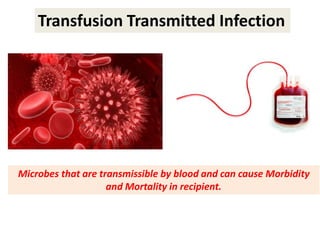
Transfusion Transmitted Infection
Microbes that are transmissible by blood and can cause Morbidity
and Mortality in recipient.
Characteristic of TTI microbes
 Presence in the blood for long periods, sometimes in high titers.
 Stability in blood stored at 40C or lower.
 Long incubation period before the appearance of clinical signs.
 Asymptomatic phase or only mild symptoms in the blood donor.
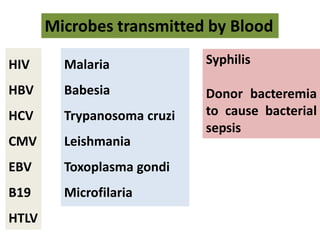
Microbes transmitted by Blood
HIV
HBV
HCV
CMV
EBV
B19
HTLV
Malaria
Babesia
Trypanosoma cruzi
Leishmania
Toxoplasma gondi
Microfilaria
Syphilis
Donor bacteremia
to cause bacterial
sepsis
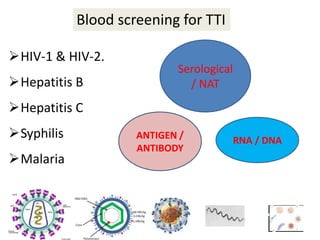
Blood screening for TTI
HIV-1 & HIV-2.
Hepatitis B
Hepatitis C
Syphilis
Malaria
Serological
/ NAT
RNA / DNAANTIGEN /
ANTIBODY
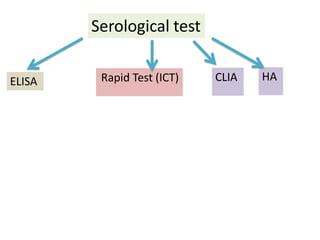
Serological test
ELISA Rapid Test (ICT) CLIA HA
Evaluation of Assays
Testing of all assays against panel samples.
 True positive samples and true negative samples in which sensitivity and
specificity respectively are determined.
 Low level positive samples (Very early or late infection).
 Samples covering a range of different genotypes and / or serotypes with
emphasis on local samples.
 Known nonspecifically reacting samples or potentially cross-reactive
samples: i.e. samples from patients not infected with the target infection
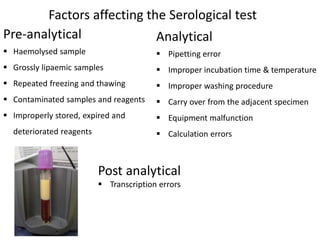
Pre-analytical
 Haemolysed sample
 Grossly lipaemic samples
 Repeated freezing and thawing
 Contaminated samples and reagents
 Improperly stored, expired and
deteriorated reagents
Factors affecting the Serological test
Analytical
 Pipetting error
 Improper incubation time & temperature
 Improper washing procedure
 Carry over from the adjacent specimen
 Equipment malfunction
 Calculation errors
Post analytical
 Transcription errors
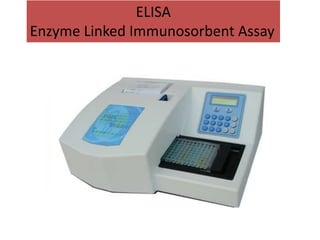
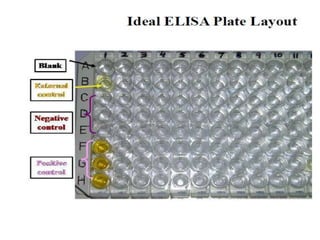
ELISA
Enzyme Linked Immunosorbent Assay
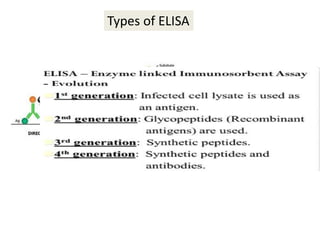
Types of ELISA
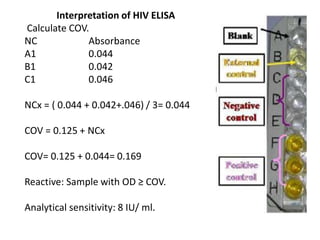
Interpretation of HIV ELISA
Calculate COV.
NC Absorbance
A1 0.044
B1 0.042
C1 0.046
NCx = ( 0.044 + 0.042+.046) / 3= 0.044
COV = 0.125 + NCx
COV= 0.125 + 0.044= 0.169
Reactive: Sample with OD ≥ COV.
Analytical sensitivity: 8 IU/ ml.
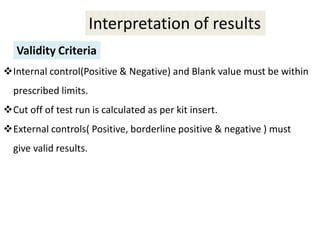
Interpretation of results
Validity Criteria
Internal control(Positive & Negative) and Blank value must be within
prescribed limits.
Cut off of test run is calculated as per kit insert.
External controls( Positive, borderline positive & negative ) must
give valid results.
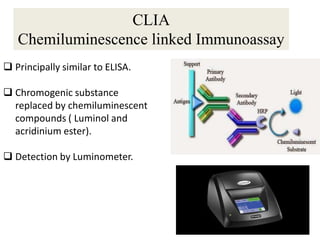
CLIA
Chemiluminescence linked Immunoassay
 Principally similar to ELISA.
 Chromogenic substance
replaced by chemiluminescent
compounds ( Luminol and
acridinium ester).
 Detection by Luminometer.
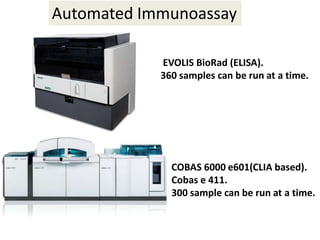
EVOLIS BioRad (ELISA).
360 samples can be run at a time.
COBAS 6000 e601(CLIA based).
Cobas e 411.
300 sample can be run at a time.
Automated Immunoassay
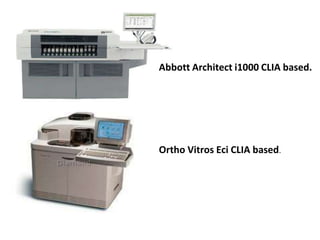
Abbott Architect i1000 CLIA based.
Ortho Vitros Eci CLIA based.
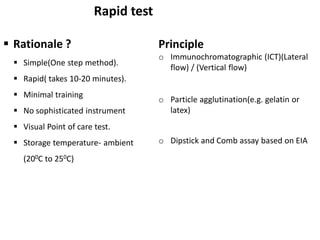
Rapid test
 Rationale ?
 Simple(One step method).
 Rapid( takes 10-20 minutes).
 Minimal training
 No sophisticated instrument
 Visual Point of care test.
 Storage temperature- ambient
(200C to 250C)
Principle
o Immunochromatographic (ICT)(Lateral
flow) / (Vertical flow)
o Particle agglutination(e.g. gelatin or
latex)
o Dipstick and Comb assay based on EIA
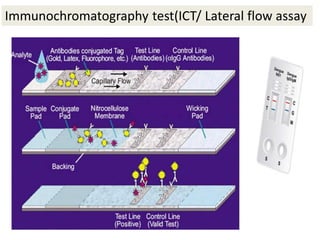
Immunochromatography test(ICT/ Lateral flow assay
Screening tests
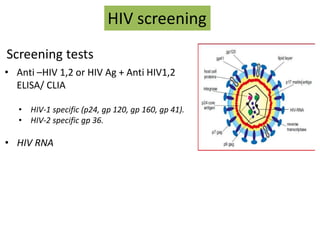
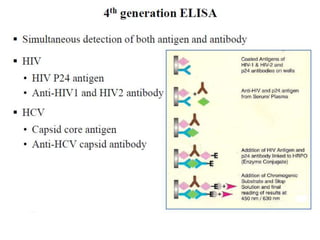
• Anti –HIV 1,2 or HIV Ag + Anti HIV1,2
ELISA/ CLIA
• HIV-1 specific (p24, gp 120, gp 160, gp 41).
• HIV-2 specific gp 36.
• HIV RNA
HIV screening
o Informed consent prior to testing is essential.
o Ensure Confidentiality to protect donor from
Discrimination, Victimization, Psychological harm
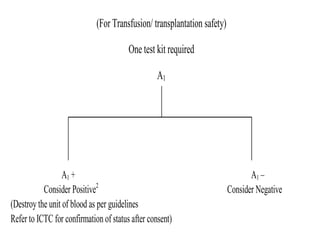
(For Transfusion/ transplantation safety)
One test kit required
A1
A1 + A1 –
Consider Positive2
Consider Negative
(Destroy the unit of blood as per guidelines
Refer to ICTC for confirmation of status after consent)
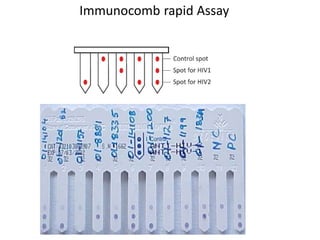
Immunocomb rapid Assay
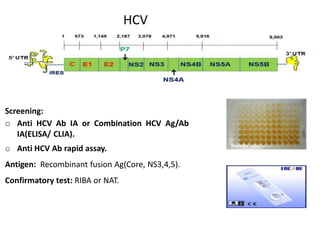
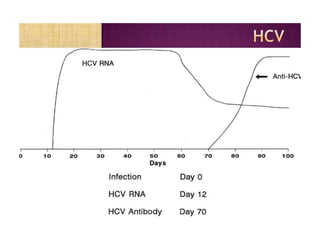
HCV
Screening:
o Anti HCV Ab IA or Combination HCV Ag/Ab
IA(ELISA/ CLIA).
o Anti HCV Ab rapid assay.
Antigen: Recombinant fusion Ag(Core, NS3,4,5).
Confirmatory test: RIBA or NAT.
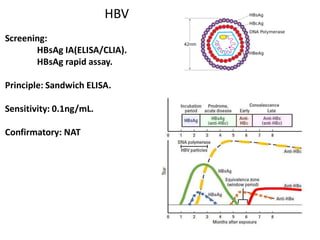
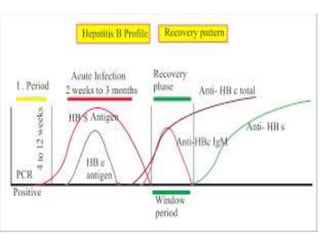
HBV
Screening:
HBsAg IA(ELISA/CLIA).
HBsAg rapid assay.
Principle: Sandwich ELISA.
Sensitivity: 0.1ng/mL.
Confirmatory: NAT
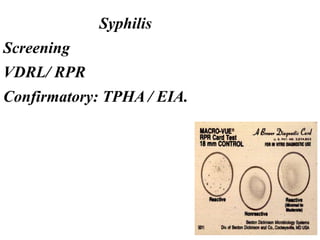
Syphilis
Screening
VDRL/ RPR
Confirmatory: TPHA / EIA.
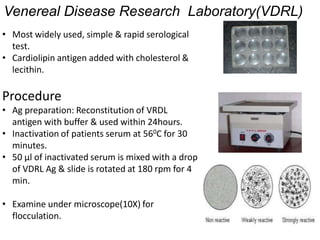
Venereal Disease Research Laboratory(VDRL)
• Most widely used, simple & rapid serological
test.
• Cardiolipin antigen added with cholesterol &
lecithin.
Procedure
• Ag preparation: Reconstitution of VRDL
antigen with buffer & used within 24hours.
• Inactivation of patients serum at 560C for 30
minutes.
• 50 µl of inactivated serum is mixed with a drop
of VDRL Ag & slide is rotated at 180 rpm for 4
min.
• Examine under microscope(10X) for
flocculation.
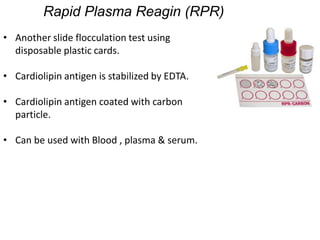
Rapid Plasma Reagin (RPR)
• Another slide flocculation test using
disposable plastic cards.
• Cardiolipin antigen is stabilized by EDTA.
• Cardiolipin antigen coated with carbon
particle.
• Can be used with Blood , plasma & serum.
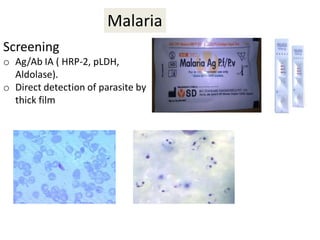
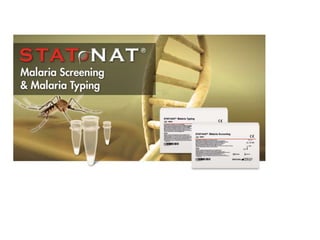
Malaria
Screening
o Ag/Ab IA ( HRP-2, pLDH,
Aldolase).
o Direct detection of parasite by
thick film
NAAT
Nucleic Acid Amplification Test
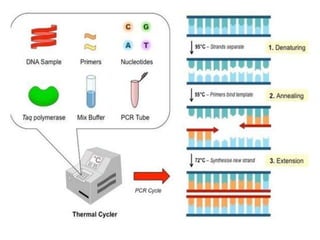
 A nucleic acid test, often called a “NAT”, ( or Nucleic acid
amplification test- NAAT) is a molecular technique to amplifiy
specific portion of DNA or RNA to detect microbes.
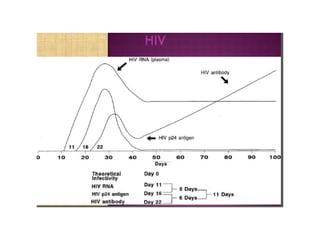
 Reduces the window period by detecting low levels of viral
genomic materials that are present soon after infection but
before the body start producing antibodies in response to a virus.
 Complete automated system to screen HIV, HBV and HCV
simultaneously.
Mini-pool- NAT / Individual donor NAT / Multiplex NAT
 Types
• Individual Donor NAT: ID-NAT.
• Minipool NAT: Pooling of 6 or 8 donor samples before testing.
• Multiplex NAT.
 Disadvantage with mini-pool NAT:
• Whole size of pooled blood donations is blocked until the NAT
report is available.
• Due to dilution, sensitivity of NAT might decrease.
• If pool tested positive, whole pool requires retesting to identify
single positive unit.
Kabita Chhatterjee et al, 2014 Asian J Transfus Sci;8:26-28.
 Individual Donor NAT is ideal methodology for NAT as dilution due to
pooling may miss samples with low viral load.
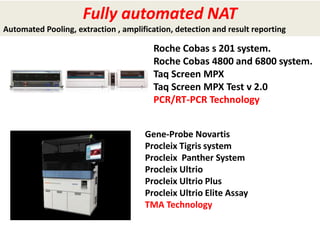
Roche Cobas s 201 system.
Roche Cobas 4800 and 6800 system.
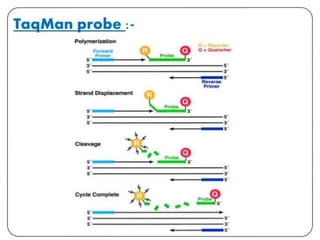
Taq Screen MPX
Taq Screen MPX Test v 2.0
PCR/RT-PCR Technology
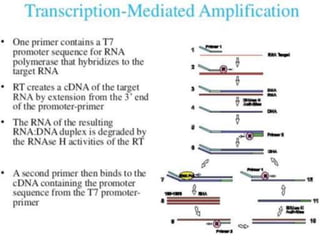
Gene-Probe Novartis
Procleix Tigris system
Procleix Panther System
Procleix Ultrio
Procleix Ultrio Plus
Procleix Ultrio Elite Assay
TMA Technology
Fully automated NAT
Automated Pooling, extraction , amplification, detection and result reporting
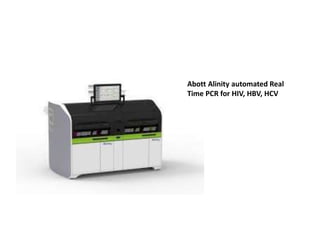
Abott Alinity automated Real
Time PCR for HIV, HBV, HCV
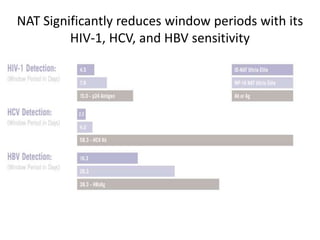
NAT Significantly reduces window periods with its
HIV-1, HCV, and HBV sensitivity
NAT implementation in India
 In India, Indraprastha Apollo Hospital, Delhi has taken the initiative
for NAT implementation for the first time in the country. In the first
nine months of implementing NAT, they were able to pick five (3HBV
and 2HCV) NAT yield samples among 13,331 sample test( Chaurasia
et al, 2014).
 AIIMS, Delhi NAT study, 2009: More than 40,000 sample tested.
 68 samples found positive by NAT but nonreactive by serology.
 NAT yield rate is 1 in 598 for all the three viruses.
Conclusion
 Blood safety is a greater challenge in India because of the high
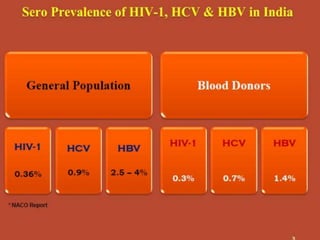
seroprevalence of HIV(0.3%), HCV (0.7%), and HBV (1.4%) in blood
donor population.
 Serological screening is a useful sensitive technique to screen blood
donor for TTI to save the lives of recipients. However to reduce the
window period use of NAT may be considered as an additional layer
of safety to the supply of blood and blood product.
Transfusion tranmitted Infection- Testing platform& recommendations

Transfusion tranmitted Infection- Testing platform& recommendations

  • 1.
    Dr. SANJAY SINGHNEGI ASSOCIATE PROFESSOR DEPARTMENT OF MICROBIOLOGY AIIMS, RAIPUR
  • 2.
    Transfusion Transmitted Infection Microbesthat are transmissible by blood and can cause Morbidity and Mortality in recipient.
  • 3.
    Characteristic of TTImicrobes  Presence in the blood for long periods, sometimes in high titers.  Stability in blood stored at 40C or lower.  Long incubation period before the appearance of clinical signs.  Asymptomatic phase or only mild symptoms in the blood donor.
  • 4.
    Microbes transmitted byBlood HIV HBV HCV CMV EBV B19 HTLV Malaria Babesia Trypanosoma cruzi Leishmania Toxoplasma gondi Microfilaria Syphilis Donor bacteremia to cause bacterial sepsis
  • 5.
    Blood screening forTTI HIV-1 & HIV-2. Hepatitis B Hepatitis C Syphilis Malaria Serological / NAT RNA / DNAANTIGEN / ANTIBODY
  • 7.
    Serological test ELISA RapidTest (ICT) CLIA HA
  • 8.
    Evaluation of Assays Testingof all assays against panel samples.  True positive samples and true negative samples in which sensitivity and specificity respectively are determined.  Low level positive samples (Very early or late infection).  Samples covering a range of different genotypes and / or serotypes with emphasis on local samples.  Known nonspecifically reacting samples or potentially cross-reactive samples: i.e. samples from patients not infected with the target infection
  • 9.
    Pre-analytical  Haemolysed sample Grossly lipaemic samples  Repeated freezing and thawing  Contaminated samples and reagents  Improperly stored, expired and deteriorated reagents Factors affecting the Serological test Analytical  Pipetting error  Improper incubation time & temperature  Improper washing procedure  Carry over from the adjacent specimen  Equipment malfunction  Calculation errors Post analytical  Transcription errors
  • 10.
  • 11.
  • 13.
    Interpretation of HIVELISA Calculate COV. NC Absorbance A1 0.044 B1 0.042 C1 0.046 NCx = ( 0.044 + 0.042+.046) / 3= 0.044 COV = 0.125 + NCx COV= 0.125 + 0.044= 0.169 Reactive: Sample with OD ≥ COV. Analytical sensitivity: 8 IU/ ml.
  • 14.
    Interpretation of results ValidityCriteria Internal control(Positive & Negative) and Blank value must be within prescribed limits. Cut off of test run is calculated as per kit insert. External controls( Positive, borderline positive & negative ) must give valid results.
  • 15.
    CLIA Chemiluminescence linked Immunoassay Principally similar to ELISA.  Chromogenic substance replaced by chemiluminescent compounds ( Luminol and acridinium ester).  Detection by Luminometer.
  • 16.
    EVOLIS BioRad (ELISA). 360samples can be run at a time. COBAS 6000 e601(CLIA based). Cobas e 411. 300 sample can be run at a time. Automated Immunoassay
  • 17.
    Abbott Architect i1000CLIA based. Ortho Vitros Eci CLIA based.
  • 18.
    Rapid test  Rationale?  Simple(One step method).  Rapid( takes 10-20 minutes).  Minimal training  No sophisticated instrument  Visual Point of care test.  Storage temperature- ambient (200C to 250C) Principle o Immunochromatographic (ICT)(Lateral flow) / (Vertical flow) o Particle agglutination(e.g. gelatin or latex) o Dipstick and Comb assay based on EIA
  • 19.
  • 20.
    Screening tests • Anti–HIV 1,2 or HIV Ag + Anti HIV1,2 ELISA/ CLIA • HIV-1 specific (p24, gp 120, gp 160, gp 41). • HIV-2 specific gp 36. • HIV RNA HIV screening
  • 21.
    o Informed consentprior to testing is essential. o Ensure Confidentiality to protect donor from Discrimination, Victimization, Psychological harm
  • 23.
    (For Transfusion/ transplantationsafety) One test kit required A1 A1 + A1 – Consider Positive2 Consider Negative (Destroy the unit of blood as per guidelines Refer to ICTC for confirmation of status after consent)
  • 24.
  • 25.
    HCV Screening: o Anti HCVAb IA or Combination HCV Ag/Ab IA(ELISA/ CLIA). o Anti HCV Ab rapid assay. Antigen: Recombinant fusion Ag(Core, NS3,4,5). Confirmatory test: RIBA or NAT.
  • 27.
    HBV Screening: HBsAg IA(ELISA/CLIA). HBsAg rapidassay. Principle: Sandwich ELISA. Sensitivity: 0.1ng/mL. Confirmatory: NAT
  • 28.
  • 29.
    Venereal Disease ResearchLaboratory(VDRL) • Most widely used, simple & rapid serological test. • Cardiolipin antigen added with cholesterol & lecithin. Procedure • Ag preparation: Reconstitution of VRDL antigen with buffer & used within 24hours. • Inactivation of patients serum at 560C for 30 minutes. • 50 µl of inactivated serum is mixed with a drop of VDRL Ag & slide is rotated at 180 rpm for 4 min. • Examine under microscope(10X) for flocculation.
  • 30.
    Rapid Plasma Reagin(RPR) • Another slide flocculation test using disposable plastic cards. • Cardiolipin antigen is stabilized by EDTA. • Cardiolipin antigen coated with carbon particle. • Can be used with Blood , plasma & serum.
  • 31.
    Malaria Screening o Ag/Ab IA( HRP-2, pLDH, Aldolase). o Direct detection of parasite by thick film
  • 32.
  • 34.
     A nucleicacid test, often called a “NAT”, ( or Nucleic acid amplification test- NAAT) is a molecular technique to amplifiy specific portion of DNA or RNA to detect microbes.  Reduces the window period by detecting low levels of viral genomic materials that are present soon after infection but before the body start producing antibodies in response to a virus.  Complete automated system to screen HIV, HBV and HCV simultaneously.
  • 38.
    Mini-pool- NAT /Individual donor NAT / Multiplex NAT  Types • Individual Donor NAT: ID-NAT. • Minipool NAT: Pooling of 6 or 8 donor samples before testing. • Multiplex NAT.  Disadvantage with mini-pool NAT: • Whole size of pooled blood donations is blocked until the NAT report is available. • Due to dilution, sensitivity of NAT might decrease. • If pool tested positive, whole pool requires retesting to identify single positive unit. Kabita Chhatterjee et al, 2014 Asian J Transfus Sci;8:26-28.  Individual Donor NAT is ideal methodology for NAT as dilution due to pooling may miss samples with low viral load.
  • 39.
    Roche Cobas s201 system. Roche Cobas 4800 and 6800 system. Taq Screen MPX Taq Screen MPX Test v 2.0 PCR/RT-PCR Technology Gene-Probe Novartis Procleix Tigris system Procleix Panther System Procleix Ultrio Procleix Ultrio Plus Procleix Ultrio Elite Assay TMA Technology Fully automated NAT Automated Pooling, extraction , amplification, detection and result reporting
  • 40.
    Abott Alinity automatedReal Time PCR for HIV, HBV, HCV
  • 43.
    NAT Significantly reduceswindow periods with its HIV-1, HCV, and HBV sensitivity
  • 45.
    NAT implementation inIndia  In India, Indraprastha Apollo Hospital, Delhi has taken the initiative for NAT implementation for the first time in the country. In the first nine months of implementing NAT, they were able to pick five (3HBV and 2HCV) NAT yield samples among 13,331 sample test( Chaurasia et al, 2014).  AIIMS, Delhi NAT study, 2009: More than 40,000 sample tested.  68 samples found positive by NAT but nonreactive by serology.  NAT yield rate is 1 in 598 for all the three viruses.
  • 46.
    Conclusion  Blood safetyis a greater challenge in India because of the high seroprevalence of HIV(0.3%), HCV (0.7%), and HBV (1.4%) in blood donor population.  Serological screening is a useful sensitive technique to screen blood donor for TTI to save the lives of recipients. However to reduce the window period use of NAT may be considered as an additional layer of safety to the supply of blood and blood product.