BLOOD COMPONENTS
STORAGE AND USES
Akor Emmanuel
Dept. of Haematology and Blood Transfusion
Jos University Teaching Hospital
1
Outline
 Introduction
 General Principles
 Blood Collection
 Anticoagulant/Preservative Solutions
 Blood Components
Storage conditions
Blood Replacement products: Recommended uses and effects in
adults
2
3
4
5
6
7
8
Definition
 BLOOD PRODUCTS
Any therapeutic substance prepared from human blood
through physical and or chemical means.
9
10
BLOOD COMPONENTS
 Red cell concentrates
 Platelet concentrates
 Granulocyte concentrates
 Fresh frozen plasma
 cryoprecipitate
11
Terms to know:
 Whole blood: blood collected before separation into
components
 Components: parts of whole blood that are separated
 Closed system: a sterile system of blood collection
 Open system: when the collection is exposed to air,
decreasing expiration date
12
13
Collection basics
 Blood is collected in a primary bag that contains
anticoagulant-preservatives
 Satellite bags may also be attached, depending on what
components are needed
 Anticoagulant-preservatives minimize biochemical changes
and increase shelf life
14
Blood Component Preparation
 Components of whole blood are centrifuged:
“light spin” – short time, low RPM (1500 for 10mins)
“heavy spin” – longer spin, high RPM (5000rpm for
20mins)
 Centrifuge must be at 40C
15
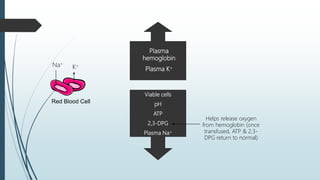
Plasma
hemoglobin
Plasma K+
Viable cells
pH
ATP
2,3-DPG
Plasma Na+
Helps release oxygen
from hemoglobin (once
transfused, ATP & 2,3-
DPG return to normal)
K+Na+
Whole Blood17
Whole Blood
 Consists of RBCs, WBCs, platelets and plasma (with
anticoagulant)
 Indications
Patients who are actively bleeding and lost >25% of blood
volume
Exchange transfusion
18
Whole Blood
 Component Requirements
 Stored: 1-6° C
 Shipping: 1-10° C
 21 or 35 days depending on preservative (CPD, CP2D, or
CPDA-1)
19
Red Blood Cells
 RBCs
 1-6° C (stored); 1-10° C (shipped)
 21, 35, or 42 days depending on preservative or additive
 Hematocrit should be ≤80%
 One unit increases hematocrit 3%
 Once the unit is “opened” it has a 24 hour expiration date!
 24 hours
20
Red Blood Cells
 RBCs (frozen)
≤ -65°C for 10 years
 RBCs (deglycerolized or washed)
Good at 1-6°C for 24 hours
 RBCs (irradiated)
1-6°C for 28 days
21
Red Blood Cells
 RBCs are usually given because of their hemoglobin content
 They increase the mass of circulating red blood cells in
situations where blood loss occurs
22
INDICATIONS FOR RBC
 Conditions include:
 Oncology patients (chemo/radiation)
 Trauma victims
 Cardiac, orthopedic, and other surgery
 End-stage renal disease
 Premature infants
 Sickle cell disease ( Hgb A)
23
RBC Types
 Leukocyte-Reduced RBCs are for:
patients who receive a lot of transfusions to prevent antibody
production toward WBC antigens
Patients transfused outside of a hospital
Patients who have reacted to leukocytes in the past
 Final unit must have less than 5 x 10⁶ WBCs
24
Leukocyte Reduction Filters (maintains closed
system)
25
 Frozen RBCs
 Glycerol is added to cryoprotect the unit
 Glycerol prevents cell lysis
 Why?
 •Freezing RBCs preserves rare units or
extends to life of autologous units
26
Deglycerolized RBCs
 RBCs that have had the glycerin removed
 Thawed at 37°C
 A blood cell processor washes the cells with varying
concentrations of saline
 Considered “open”, expires in 24 hrs.
27
Washed RBCs
 Not effective in reducing WBCs
 For patients (with anti-IgA) that may react with plasma
proteins containing IgA
 Reactions may be allergic, febrile, or anaphylactic
28
Irradiated RBCs
 Prevents T-cell proliferation that may cause transfusion-
associated graft versus host disease (GVHD)
 GVHD is fatal in 90% of those affected
 Produced by subjecting RBC to high dose radiation
29
INDICATIONS
 Donor units from a blood relative
 HLA-matched donor unit
 Intrauterine transfusion
 Immunodeficiency
 Premature newborns
 Chemotherapy and irradiation
 Patients who received marrow or stem cells
30
PLATELETS
 Important in maintaining hemostasis
 Help stop bleeding and form a platelet plug (primary hemostasis)
31
 Requires 2 spins:
 Soft – separates RBCs and WBCs from plasma and platelets
 Heavy
 platelets in platelet rich plasma (PRP) will be forced to the
bottom of a satellite bag
 40-60 mL of plasma is expelled into another satellite bag,
while the remaining bag contains platelet concentrate
32
 Storage Temperature
20-24°C for 5 days (constant agitation)
 Each unit should contain at least 5.5 x 10¹⁰ platelets (platelet
concentrate)
 Each unit should elevate the platelet count by 5-10,000 μL in a
165 lb person
 Single donor platelet from apheresis is equivalent to 6-8
random platelet units which makes up the therapeutic dose
33
INDICATIONS
 Cancer patients
 Bone marrow recipients
 Postoperative bleeding
 ITP
34
Types of platelets
 Pooled platelets
 Used to reach therapeutic dose
 An “open system” occurs when pooling platelets, resulting in an expiration of 4 hours
 Platelet, pheresis – therapeutic dose (from one donor) without having to pool
platelets
 3x10¹¹ minumum
 HLA matched – for those with HLA antibodies
 Leukocyte reduced - used to prevent febrile non-hemolytic reactions and HLA
alloimmunization
35
Fresh Frozen Plasma (FFP)
Plasma that is frozen within 8 hours of donation
-18°C or colder for 1 year
36
Fresh Frozen Plasma (FFP)
FFP is thawed before transfusion
30-37°C water bath for 30-45 minutes
Stored 1-6°C and transfused within 24 hours
Needs to be ABO compatible
37
INDICATIONS
 Provides coagulation factors for Bleeding disorders
 Abnormal clotting due to massive transfusion
 Patients on warfarin who are bleeding
 Treatment of TTP and HUS
 Factor deficiencies
 ATIII deficiency
 DIC when fibrinogen is <100 mg/dL
38
Cryoprecipitate
 Cryoprecipitated antihemophilic factor (AHF) or “Cryo” is the
precipitated protein portion that results after thawing FFP
 Contains:
 von Willebrand’s factor (plt. adhesion)
 Fibrinogen
150 mg in each unit
 Factor VIII
About 80 IU in each unit
 Fibrinonectin
39
Cryoprecipitate
 Same storage as FFP (cannot be re-frozen as FFP once it is
separated); -18 for 1 year
 If thawed, store at room temp 4 hrs
 The leftover plasma is called cryoprecipitate reduced or
plasma cryo or cryo supernatant
 Good for thrombocytopenic purpura (TTP)
40
INDICATIONS FOR CRYO
 treatment for Factor VIII deficiency (Hemophilia A)
 treatment for von Willebrand’s Disease
 Congenital or acquired fibrinogen deficiency
 FXIII deficiency
 “Fibrin Glue” applied to surgical sites
41
42
43
GRANULOCYTE CONCENTRATE44
INDICATIONS/CRITERIA45
PLASMA DERIVATIVES
 Plasma proteins prepared from large pools of human plasma under pharmaceutical
manufacturing conditions.
 Albumin
 Coagulation factors
 immunoglobulins
46
CONCLUSIONS
A good knowledge of component therapy is
vital to minimize wastage of a scarce life
saving tissue and also limit the complications
arising from its use as only required
component is administered.
47
Thank you
48
references
 John P.G wintrobes clinical hematology,twelfth edition;Vol 1;ch 23,pg 672-712
 http://emedicine.medscape.com/article/202030-clinical#a0217.
 Hannah olawunmi a lecture on blood component preparation and uses for WACP
update curse 2015
49

Blood component and uses

  • 1.
    BLOOD COMPONENTS STORAGE ANDUSES Akor Emmanuel Dept. of Haematology and Blood Transfusion Jos University Teaching Hospital 1
  • 2.
    Outline  Introduction  GeneralPrinciples  Blood Collection  Anticoagulant/Preservative Solutions  Blood Components Storage conditions Blood Replacement products: Recommended uses and effects in adults 2
  • 3.
  • 4.
  • 5.
  • 6.
  • 7.
  • 8.
  • 9.
    Definition  BLOOD PRODUCTS Anytherapeutic substance prepared from human blood through physical and or chemical means. 9
  • 10.
  • 11.
    BLOOD COMPONENTS  Redcell concentrates  Platelet concentrates  Granulocyte concentrates  Fresh frozen plasma  cryoprecipitate 11
  • 12.
    Terms to know: Whole blood: blood collected before separation into components  Components: parts of whole blood that are separated  Closed system: a sterile system of blood collection  Open system: when the collection is exposed to air, decreasing expiration date 12
  • 13.
  • 14.
    Collection basics  Bloodis collected in a primary bag that contains anticoagulant-preservatives  Satellite bags may also be attached, depending on what components are needed  Anticoagulant-preservatives minimize biochemical changes and increase shelf life 14
  • 15.
    Blood Component Preparation Components of whole blood are centrifuged: “light spin” – short time, low RPM (1500 for 10mins) “heavy spin” – longer spin, high RPM (5000rpm for 20mins)  Centrifuge must be at 40C 15
  • 16.
    Plasma hemoglobin Plasma K+ Viable cells pH ATP 2,3-DPG PlasmaNa+ Helps release oxygen from hemoglobin (once transfused, ATP & 2,3- DPG return to normal) K+Na+
  • 17.
  • 18.
    Whole Blood  Consistsof RBCs, WBCs, platelets and plasma (with anticoagulant)  Indications Patients who are actively bleeding and lost >25% of blood volume Exchange transfusion 18
  • 19.
    Whole Blood  ComponentRequirements  Stored: 1-6° C  Shipping: 1-10° C  21 or 35 days depending on preservative (CPD, CP2D, or CPDA-1) 19
  • 20.
    Red Blood Cells RBCs  1-6° C (stored); 1-10° C (shipped)  21, 35, or 42 days depending on preservative or additive  Hematocrit should be ≤80%  One unit increases hematocrit 3%  Once the unit is “opened” it has a 24 hour expiration date!  24 hours 20
  • 21.
    Red Blood Cells RBCs (frozen) ≤ -65°C for 10 years  RBCs (deglycerolized or washed) Good at 1-6°C for 24 hours  RBCs (irradiated) 1-6°C for 28 days 21
  • 22.
    Red Blood Cells RBCs are usually given because of their hemoglobin content  They increase the mass of circulating red blood cells in situations where blood loss occurs 22
  • 23.
    INDICATIONS FOR RBC Conditions include:  Oncology patients (chemo/radiation)  Trauma victims  Cardiac, orthopedic, and other surgery  End-stage renal disease  Premature infants  Sickle cell disease ( Hgb A) 23
  • 24.
    RBC Types  Leukocyte-ReducedRBCs are for: patients who receive a lot of transfusions to prevent antibody production toward WBC antigens Patients transfused outside of a hospital Patients who have reacted to leukocytes in the past  Final unit must have less than 5 x 10⁶ WBCs 24
  • 25.
    Leukocyte Reduction Filters(maintains closed system) 25
  • 26.
     Frozen RBCs Glycerol is added to cryoprotect the unit  Glycerol prevents cell lysis  Why?  •Freezing RBCs preserves rare units or extends to life of autologous units 26
  • 27.
    Deglycerolized RBCs  RBCsthat have had the glycerin removed  Thawed at 37°C  A blood cell processor washes the cells with varying concentrations of saline  Considered “open”, expires in 24 hrs. 27
  • 28.
    Washed RBCs  Noteffective in reducing WBCs  For patients (with anti-IgA) that may react with plasma proteins containing IgA  Reactions may be allergic, febrile, or anaphylactic 28
  • 29.
    Irradiated RBCs  PreventsT-cell proliferation that may cause transfusion- associated graft versus host disease (GVHD)  GVHD is fatal in 90% of those affected  Produced by subjecting RBC to high dose radiation 29
  • 30.
    INDICATIONS  Donor unitsfrom a blood relative  HLA-matched donor unit  Intrauterine transfusion  Immunodeficiency  Premature newborns  Chemotherapy and irradiation  Patients who received marrow or stem cells 30
  • 31.
    PLATELETS  Important inmaintaining hemostasis  Help stop bleeding and form a platelet plug (primary hemostasis) 31
  • 32.
     Requires 2spins:  Soft – separates RBCs and WBCs from plasma and platelets  Heavy  platelets in platelet rich plasma (PRP) will be forced to the bottom of a satellite bag  40-60 mL of plasma is expelled into another satellite bag, while the remaining bag contains platelet concentrate 32
  • 33.
     Storage Temperature 20-24°Cfor 5 days (constant agitation)  Each unit should contain at least 5.5 x 10¹⁰ platelets (platelet concentrate)  Each unit should elevate the platelet count by 5-10,000 μL in a 165 lb person  Single donor platelet from apheresis is equivalent to 6-8 random platelet units which makes up the therapeutic dose 33
  • 34.
    INDICATIONS  Cancer patients Bone marrow recipients  Postoperative bleeding  ITP 34
  • 35.
    Types of platelets Pooled platelets  Used to reach therapeutic dose  An “open system” occurs when pooling platelets, resulting in an expiration of 4 hours  Platelet, pheresis – therapeutic dose (from one donor) without having to pool platelets  3x10¹¹ minumum  HLA matched – for those with HLA antibodies  Leukocyte reduced - used to prevent febrile non-hemolytic reactions and HLA alloimmunization 35
  • 36.
    Fresh Frozen Plasma(FFP) Plasma that is frozen within 8 hours of donation -18°C or colder for 1 year 36
  • 37.
    Fresh Frozen Plasma(FFP) FFP is thawed before transfusion 30-37°C water bath for 30-45 minutes Stored 1-6°C and transfused within 24 hours Needs to be ABO compatible 37
  • 38.
    INDICATIONS  Provides coagulationfactors for Bleeding disorders  Abnormal clotting due to massive transfusion  Patients on warfarin who are bleeding  Treatment of TTP and HUS  Factor deficiencies  ATIII deficiency  DIC when fibrinogen is <100 mg/dL 38
  • 39.
    Cryoprecipitate  Cryoprecipitated antihemophilicfactor (AHF) or “Cryo” is the precipitated protein portion that results after thawing FFP  Contains:  von Willebrand’s factor (plt. adhesion)  Fibrinogen 150 mg in each unit  Factor VIII About 80 IU in each unit  Fibrinonectin 39
  • 40.
    Cryoprecipitate  Same storageas FFP (cannot be re-frozen as FFP once it is separated); -18 for 1 year  If thawed, store at room temp 4 hrs  The leftover plasma is called cryoprecipitate reduced or plasma cryo or cryo supernatant  Good for thrombocytopenic purpura (TTP) 40
  • 41.
    INDICATIONS FOR CRYO treatment for Factor VIII deficiency (Hemophilia A)  treatment for von Willebrand’s Disease  Congenital or acquired fibrinogen deficiency  FXIII deficiency  “Fibrin Glue” applied to surgical sites 41
  • 42.
  • 43.
  • 44.
  • 45.
  • 46.
    PLASMA DERIVATIVES  Plasmaproteins prepared from large pools of human plasma under pharmaceutical manufacturing conditions.  Albumin  Coagulation factors  immunoglobulins 46
  • 47.
    CONCLUSIONS A good knowledgeof component therapy is vital to minimize wastage of a scarce life saving tissue and also limit the complications arising from its use as only required component is administered. 47
  • 48.
  • 49.
    references  John P.Gwintrobes clinical hematology,twelfth edition;Vol 1;ch 23,pg 672-712  http://emedicine.medscape.com/article/202030-clinical#a0217.  Hannah olawunmi a lecture on blood component preparation and uses for WACP update curse 2015 49