




Blood	
  and	
  Blood	
  Components	
  
DR	
  .	
  KAWITA	
  BAPAT	
  
	
  KAWITA BAPAT
Goals	
  Of	
  Blood	
  Collec;on	
  	
  
•  Maintain	
  viability	
  and	
  func;on	
  
•  Prevent	
  physical	
  changes	
  
•  Minimize	
  bacterial	
  contamina;on	
  
KAWITA BAPAT
An;coagulants	
  Preserva;ve	
  Solu;ons	
  
•  An;coagulants	
  prevent	
  blood	
  cloGng	
  
•  Preserva;ves	
  provide	
  nutrients	
  for	
  cells	
  
•  Heparin	
  
– Rarely	
  if	
  ever	
  used	
  anymore	
  
– An;coagulant	
  ONLY	
  
– Transfuse	
  within	
  48	
  hours,	
  preferably	
  8	
  
KAWITA BAPAT
An;coagulants	
  
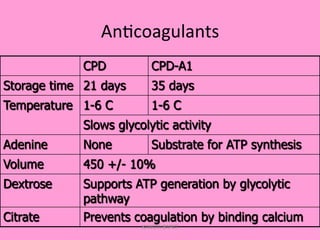
CPD CPD-A1
Storage time 21 days 35 days
Temperature 1-6 C 1-6 C
Slows glycolytic activity
Adenine None Substrate for ATP synthesis
Volume 450 +/- 10%
Dextrose Supports ATP generation by glycolytic
pathway
Citrate Prevents coagulation by binding calcium
KAWITA BAPAT
Addi;ve	
  Solu;on	
  
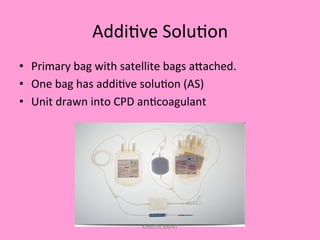
•  Primary	
  bag	
  with	
  satellite	
  bags	
  aPached.	
  
•  One	
  bag	
  has	
  addi;ve	
  solu;on	
  (AS)	
  
•  Unit	
  drawn	
  into	
  CPD	
  an;coagulant	
  
KAWITA BAPAT
Addi;ve	
  Solu;on	
  
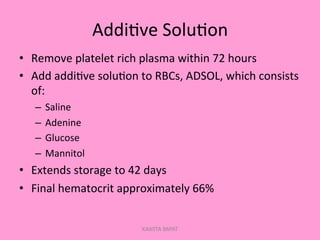
•  Remove	
  platelet	
  rich	
  plasma	
  within	
  72	
  hours	
  
•  Add	
  addi;ve	
  solu;on	
  to	
  RBCs,	
  ADSOL,	
  which	
  consists	
  
of:	
  
–  Saline	
  
–  Adenine	
  
–  Glucose	
  
–  Mannitol	
  
•  Extends	
  storage	
  to	
  42	
  days	
  
•  Final	
  hematocrit	
  approximately	
  66%	
  
KAWITA BAPAT
Changes	
  Occur	
  During	
  Storage	
  
•  Shelf	
  life	
  =	
  expira;on	
  date	
  
– At	
  end	
  of	
  expira;on	
  must	
  have	
  75%	
  recovery	
  
– At	
  least	
  75%	
  of	
  transfused	
  cells	
  remain	
  in	
  
circula;on	
  24	
  hours	
  AFTER	
  transfusion	
  
KAWITA BAPAT
Storage	
  Lesion	
  
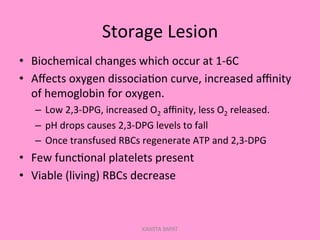
•  Biochemical	
  changes	
  which	
  occur	
  at	
  1-­‐6C	
  
•  Affects	
  oxygen	
  dissocia;on	
  curve,	
  increased	
  affinity	
  
of	
  hemoglobin	
  for	
  oxygen.	
  
–  Low	
  2,3-­‐DPG,	
  increased	
  O2	
  affinity,	
  less	
  O2	
  released.	
  
–  pH	
  drops	
  causes	
  2,3-­‐DPG	
  levels	
  to	
  fall	
  
–  Once	
  transfused	
  RBCs	
  regenerate	
  ATP	
  and	
  2,3-­‐DPG	
  
•  Few	
  func;onal	
  platelets	
  present	
  
•  Viable	
  (living)	
  RBCs	
  decrease	
  
KAWITA BAPAT
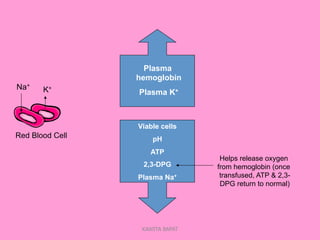
Plasma
hemoglobin
Plasma K+
Viable cells
pH
ATP
2,3-DPG
Plasma Na+
Helps release oxygen
from hemoglobin (once
transfused, ATP & 2,3-
DPG return to normal)
K+Na+
KAWITA BAPAT
Storage	
  Lesion	
  
•  Significant	
  for	
  infants	
  and	
  massive	
  transfusion.	
  
•  Other	
  biochemical	
  changes	
  
– ATP	
  decreases	
  
– Potassium	
  increases	
  
– Sodium	
  decreases	
  
– Plasma	
  hemoglobin	
  increases	
  
KAWITA BAPAT
Prepara;on	
  of	
  Components	
  
•  Collect	
  unit	
  within	
  15	
  minutes	
  to	
  prevent	
  ac;va;on	
  
of	
  coagula;on	
  system	
  
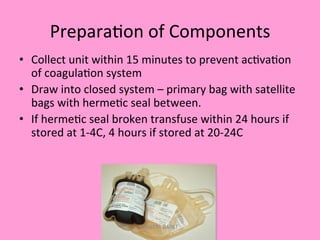
•  Draw	
  into	
  closed	
  system	
  –	
  primary	
  bag	
  with	
  satellite	
  
bags	
  with	
  herme;c	
  seal	
  between.	
  
•  If	
  herme;c	
  seal	
  broken	
  transfuse	
  within	
  24	
  hours	
  if	
  
stored	
  at	
  1-­‐4C,	
  4	
  hours	
  if	
  stored	
  at	
  20-­‐24C	
  
KAWITA BAPAT
Prepara;on	
  of	
  Components	
  
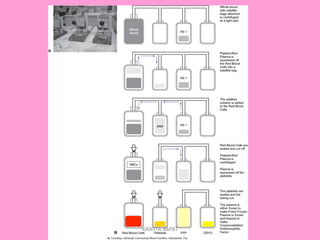
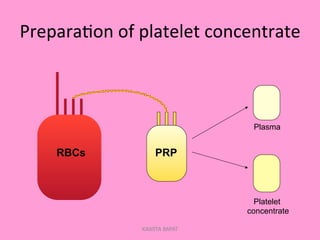
•  Centrifuge	
  –	
  light	
  spin,	
  platelets	
  suspended	
  
•  Remove	
  platelet	
  rich	
  plasma	
  (PRP)	
  
•  Centrifuge	
  PRP	
  heavy	
  spin	
  
•  Remove	
  platelet	
  poor	
  plasma	
  
•  Freeze	
  plasma	
  solid	
  within	
  8	
  hours	
  
•  Thaw	
  plasma	
  at	
  1-­‐4C	
  –	
  precipitate	
  forms	
  
•  Centrifuge,	
  express	
  plasma	
  leaving	
  cryoprecipitate.	
  
Store	
  both	
  at	
  -­‐18C	
  
•  RBCs	
  –	
  CPD	
  –	
  21	
  days,	
  ADSOL	
  –	
  42	
  days	
  –	
  1-­‐6C	
  
KAWITA BAPAT
KAWITA BAPAT
Prepara;on	
  of	
  Components	
  
•  Summary	
  –	
  One	
  unit	
  of	
  whole	
  blood	
  can	
  
produce:	
  
– Packed	
  RBCs	
  
– Fresh	
  frozen	
  plasma	
  (FFP)	
  
– Cryoprecipitate	
  (CRYO)	
  
– Single	
  donor	
  plasma	
  (SDP)	
  –	
  cyro	
  removed	
  
– Platelets	
  –	
  terms	
  PC	
  (platelet	
  concentrate)	
  OR	
  RD	
  
PC	
  (random	
  donor	
  platelet	
  concentrate)	
  
KAWITA BAPAT
Prepara;on	
  of	
  Components	
  
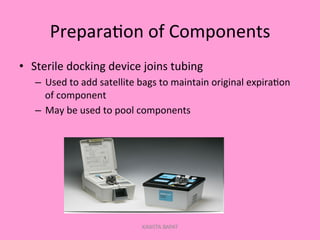
•  Sterile	
  docking	
  device	
  joins	
  tubing	
  
–  Used	
  to	
  add	
  satellite	
  bags	
  to	
  maintain	
  original	
  expira;on	
  
of	
  component	
  
–  May	
  be	
  used	
  to	
  pool	
  components	
  
KAWITA BAPAT
Blood	
  Component	
  General	
  Informa;on	
  
•  Blood	
  separated	
  into	
  components	
  to	
  
specifically	
  treat	
  pa;ents	
  with	
  product	
  needed	
  
•  Advantages	
  of	
  component	
  separa;on	
  
– Allow	
  op;mum	
  survival	
  of	
  each	
  component	
  
– Transfuse	
  only	
  component	
  needed	


KAWITA BAPAT
Blood	
  Component	
  General	
  Informa;on	
  
•  Transfusion	
  prac;ce	
  
– Transfusion	
  requires	
  doctor’s	
  prescrip;on	
  
– All	
  components	
  MUST	
  be	
  administered	
  through	
  a	
  
filter	
  
– Infuse	
  quickly,	
  within	
  4	
  hours	
  
– D	
  (Rh)	
  neg	
  require	
  D	
  neg	
  cellular	
  products	
  
– ABO	
  iden;cal	
  preferred,	
  ABO	
  compa;ble	
  OK	
  
– “Universal	
  donor”	
  –	
  RBCs	
  group	
  O,	
  plasma	
  AB	
  
KAWITA BAPAT
Blood	
  Component	
  General	
  Informa;on	
  
•  Fresh	
  Whole	
  Blood	
  
– Blood	
  not	
  usually	
  available	
  un;l	
  12-­‐24	
  hours	
  
– Candidates	
  
•  Newborns	
  needing	
  exchange	
  transfusion	
  
•  Pa;ents	
  requiring	
  leukoreduced	
  products	
  
KAWITA BAPAT
Blood	
  Component	
  General	
  Informa;on	
  
•  Summary	
  of	
  storage	
  temperatures:	
  
– Liquid	
  RBCs	
  1-­‐6C	
  
– Platelets,	
  Cryo	
  (thawed)	
  and	
  granulocytes	
  20-­‐24C	
  
(room	
  temperature)	
  
– ANY	
  frozen	
  plasma	
  product	
  ≤	
  -­‐18C	
  
– ANY	
  liquid	
  plasma	
  product	
  EXCEPT	
  Cryo	
  1-­‐6C	
  
KAWITA BAPAT
Blood	
  Components	
  
•  Cellular	
  
– Red	
  blood	
  cell	
  products	
  
– Platelets	
  
– Granulocytes	
  
•  Plasma	
  
– FFP	
  
– Cryoprecipitate	
  
KAWITA BAPAT
Products	
  With	
  Red	
  Cells	
  
KAWITA BAPAT
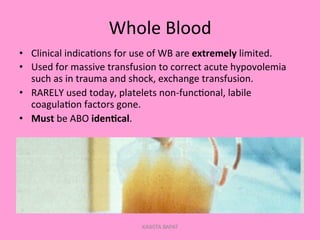
Whole	
  Blood	
  
•  Clinical	
  indica;ons	
  for	
  use	
  of	
  WB	
  are	
  extremely	
  limited.	
  
•  Used	
  for	
  massive	
  transfusion	
  to	
  correct	
  acute	
  hypovolemia	
  
such	
  as	
  in	
  trauma	
  and	
  shock,	
  exchange	
  transfusion.	
  
•  RARELY	
  used	
  today,	
  platelets	
  non-­‐func;onal,	
  labile	
  
coagula;on	
  factors	
  gone.	
  
•  Must	
  be	
  ABO	
  iden.cal.	
  
KAWITA BAPAT
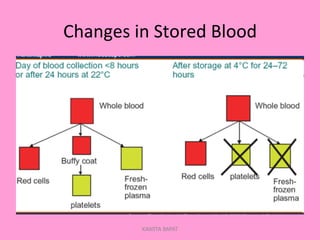
Changes	
  in	
  Stored	
  Blood	
  
KAWITA BAPAT
Red	
  Blood	
  Cells,	
  Packed	
  (PRBC)	
  
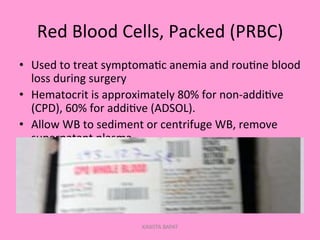
•  Used	
  to	
  treat	
  symptoma;c	
  anemia	
  and	
  rou;ne	
  blood	
  
loss	
  during	
  surgery	
  
•  Hematocrit	
  is	
  approximately	
  80%	
  for	
  non-­‐addi;ve	
  
(CPD),	
  60%	
  for	
  addi;ve	
  (ADSOL).	
  
•  Allow	
  WB	
  to	
  sediment	
  or	
  centrifuge	
  WB,	
  remove	
  
supernatant	
  plasma.	
  
KAWITA BAPAT
Leukocyte	
  Reduced	
  Red	
  Cells	
  (LR-­‐RBC)	
  
•  Leukocytes	
  can	
  induce	
  adverse	
  affects	
  during	
  transfusion,	
  primarily	
  
febrile,	
  non-­‐hemoly;c	
  reac;ons.	
  
•  Reac;ons	
  to	
  cytokines	
  produced	
  by	
  leukocytes	
  in	
  transfused	
  units.	
  
•  Other	
  explana;ons	
  to	
  reac;ons	
  include:	
  immuniza;on	
  of	
  recipient	
  to	
  
transfused	
  HLA	
  or	
  granulocyte	
  an;gens,	
  micro	
  aggregates	
  and	
  
fragmenta;on	
  of	
  granulocytes.	
  
•  Historically,	
  indicated	
  only	
  for	
  pa;ents	
  who	
  had	
  2	
  or	
  more	
  febrile	
  
transfusion	
  reac;ons,	
  now	
  a	
  commonly	
  ordered,	
  popular	
  component.	
  
•  “CMV”	
  safe	
  blood,	
  since	
  CMV	
  lives	
  in	
  WBCs.	
  
•  Most	
  blood	
  centers	
  now	
  leukoreduce	
  blood	
  immediately	
  aler	
  collec;on.	
  
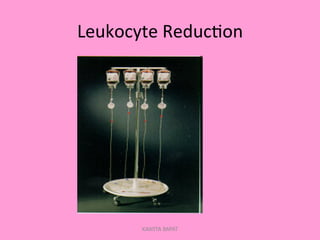
•  Bed	
  side	
  filters	
  are	
  available	
  to	
  leukoreduce	
  products	
  during	
  transfusion.	
  
KAWITA BAPAT
Leukocyte	
  Reduc;on	
  
KAWITA BAPAT
Washed	
  Red	
  Blood	
  Cells	
  (W-­‐RBCs)	
  
•  Washing	
  removes	
  plasma	
  proteins,	
  platelets,	
  WBCs	
  and	
  micro	
  
aggregates	
  which	
  may	
  cause	
  febrile	
  or	
  ur;carial	
  reac;ons.	
  
•  Pa;ent	
  requiring	
  this	
  product	
  is	
  the	
  IgA	
  deficient	
  pa;ent	
  with	
  
an;-­‐IgA	
  an;bodies.	
  
•  Prepared	
  by	
  using	
  a	
  machine	
  which	
  washes	
  the	
  cells	
  3	
  ;mes	
  
with	
  saline	
  to	
  remove	
  and	
  WBCs.	
  
•  Two	
  types	
  of	
  labels:	
  
–  Washed	
  RBCs	
  -­‐	
  do	
  not	
  need	
  to	
  QC	
  for	
  WBCs.	
  
–  Leukocyte	
  Poor	
  WRBCs,	
  QC	
  must	
  be	
  done	
  to	
  guarantee	
  removal	
  of	
  
85%	
  of	
  WBCs.	
  	
  No	
  longer	
  considered	
  effec;ve	
  method	
  for	
  
leukoreduc;on.	
  	
  
•  e. 	
  Expires	
  24	
  hours	
  aler	
  unit	
  is	
  entered.	
  
KAWITA BAPAT
Cell	
  Washer	
  to	
  Prepare	
  Washed	
  Cells	
  
KAWITA BAPAT
Frozen	
  Blood	
  
KAWITA BAPAT
Red	
  Blood	
  Cells	
  Frozen;	
  Red	
  Blood	
  Cells	
  Deglycerolized	
  (D-­‐RBC)	
  
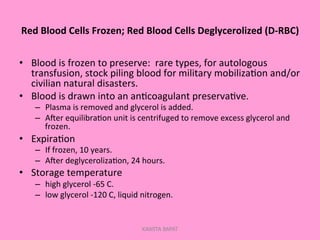
•  Blood	
  is	
  frozen	
  to	
  preserve:	
  	
  rare	
  types,	
  for	
  autologous	
  
transfusion,	
  stock	
  piling	
  blood	
  for	
  military	
  mobiliza;on	
  and/or	
  
civilian	
  natural	
  disasters.	
  
•  Blood	
  is	
  drawn	
  into	
  an	
  an;coagulant	
  preserva;ve.	
  
–  Plasma	
  is	
  removed	
  and	
  glycerol	
  is	
  added.	
  
–  Aler	
  equilibra;on	
  unit	
  is	
  centrifuged	
  to	
  remove	
  excess	
  glycerol	
  and	
  
frozen.	
  
•  Expira;on	
  
–  If	
  frozen,	
  10	
  years.	
  
–  Aler	
  deglyceroliza;on,	
  24	
  hours.	
  
•  Storage	
  temperature	
  
–  high	
  glycerol	
  -­‐65	
  C.	
  
–  low	
  glycerol	
  -­‐120	
  C,	
  liquid	
  nitrogen.	
  
KAWITA BAPAT
Red	
  Blood	
  Cells	
  Frozen;	
  Red	
  Blood	
  Cells	
  Deglycerolized	
  
(D-­‐RBC)	
  
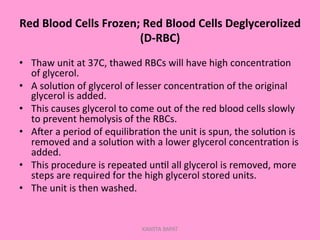
•  Thaw	
  unit	
  at	
  37C,	
  thawed	
  RBCs	
  will	
  have	
  high	
  concentra;on	
  
of	
  glycerol.	
  
•  A	
  solu;on	
  of	
  glycerol	
  of	
  lesser	
  concentra;on	
  of	
  the	
  original	
  
glycerol	
  is	
  added.	
  
•  This	
  causes	
  glycerol	
  to	
  come	
  out	
  of	
  the	
  red	
  blood	
  cells	
  slowly	
  
to	
  prevent	
  hemolysis	
  of	
  the	
  RBCs.	
  
•  Aler	
  a	
  period	
  of	
  equilibra;on	
  the	
  unit	
  is	
  spun,	
  the	
  solu;on	
  is	
  
removed	
  and	
  a	
  solu;on	
  with	
  a	
  lower	
  glycerol	
  concentra;on	
  is	
  
added.	
  
•  This	
  procedure	
  is	
  repeated	
  un;l	
  all	
  glycerol	
  is	
  removed,	
  more	
  
steps	
  are	
  required	
  for	
  the	
  high	
  glycerol	
  stored	
  units.	
  
•  The	
  unit	
  is	
  then	
  washed.	
  
KAWITA BAPAT
Rejuvenated	
  Red	
  Blood	
  Cells	
  
•  A	
  special	
  solu;on	
  is	
  added	
  to	
  expired	
  RBCs	
  up	
  to	
  3	
  
days	
  aler	
  expira;on	
  to	
  restore	
  2,3-­‐DPG	
  and	
  ATP	
  
levels	
  to	
  prestorage	
  values.	
  
•  Rejuvenated	
  RBCs	
  regain	
  normal	
  characteris;cs	
  of	
  
oxygen	
  transport	
  and	
  delivery	
  and	
  improved	
  post	
  
transfusion	
  survival.	
  
•  Expira;on	
  is	
  24	
  hours	
  or,	
  if	
  frozen,	
  10	
  years	
  
KAWITA BAPAT
Platelet	
  Products	
  
KAWITA BAPAT
Platelets	
  (PLTS),	
  Platelet	
  Concentrate	
  (PC)	
  or	
  Random	
  Donor	
  
Platelet	
  Concentrate	
  (RD-­‐PC)	
  
•  Used	
  to	
  prevent	
  spontaneous	
  bleeding	
  or	
  stop	
  established	
  
bleeding	
  in	
  thrombocytopenic	
  pa;ents.	
  
•  Prepared	
  from	
  a	
  single	
  unit	
  of	
  whole	
  blood.	
  
•  Due	
  to	
  storage	
  at	
  RT	
  it	
  is	
  the	
  most	
  likely	
  component	
  to	
  be	
  
contaminated	
  with	
  bacteria.	
  
•  Therapeu;c	
  dose	
  for	
  adults	
  is	
  6	
  to	
  10	
  units.	
  
•  Some	
  pa;ents	
  become	
  "refractory"	
  to	
  platelet	
  therapy.	
  
•  Expira'on	
  is	
  5	
  days	
  as	
  a	
  single	
  unit,	
  4	
  hours	
  if	
  pooled.	
  
•  Store	
  at	
  20-­‐24	
  C	
  (RT)	
  with	
  constant	
  agita;on.	
  
•  D	
  nega;ve	
  pa;ents	
  should	
  be	
  transfused	
  with	
  D	
  nega;ve	
  
platelets	
  due	
  to	
  the	
  presence	
  of	
  a	
  small	
  number	
  of	
  RBCs.	
  
KAWITA BAPAT
Prepara;on	
  of	
  platelet	
  concentrate	
  
RBCs PRP
Plasma
Platelet
concentrate
KAWITA BAPAT
Platelets	
  (PLTS),	
  Platelet	
  Concentrate	
  (PC)	
  or	
  Random	
  Donor	
  
Platelet	
  Concentrate	
  (RD-­‐PC)	
  
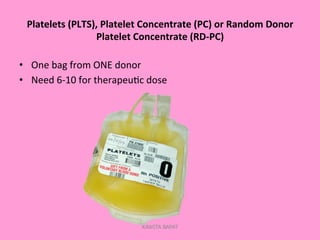
•  One	
  bag	
  from	
  ONE	
  donor	
  
•  Need	
  6-­‐10	
  for	
  therapeu;c	
  dose	
  
KAWITA BAPAT
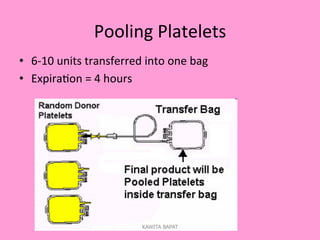
Pooling	
  Platelets	
  
•  6-­‐10	
  units	
  transferred	
  into	
  one	
  bag	
  
•  Expira;on	
  =	
  4	
  hours	
  
KAWITA BAPAT
Platelets	
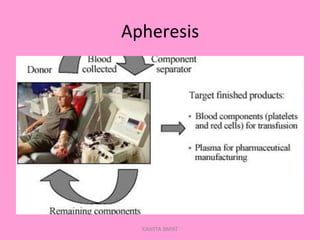
  Pheresis,	
  Apheresis	
  Platelet	
  Concentrate,	
  Single	
  Donor	
  Platelet	
  
Concentrate	
  (SD-­‐PC)	
  
•  Used	
  to	
  decrease	
  donor	
  exposure,	
  obtain	
  HLA	
  matched	
  
platelets	
  for	
  pa;ents	
  who	
  are	
  refractory	
  to	
  RD-­‐PC	
  or	
  prevent	
  
platelet	
  refractoriness	
  from	
  occurring.	
  
•  Prepared	
  by	
  hemapheresis,	
  stored	
  in	
  two	
  connected	
  bags	
  to	
  
maintain	
  viability.	
  
•  One	
  pheresed	
  unit	
  is	
  equivalent	
  to	
  6-­‐8	
  RD-­‐PC.	
  
•  Store	
  at	
  20-­‐24	
  C	
  (RT)	
  with	
  agita;on	
  for	
  5	
  days,	
  a9er	
  
combining,	
  24	
  hours	
  
•  D	
  nega;ve	
  pa;ents	
  should	
  be	
  transfused	
  with	
  D	
  nega;ve	
  
platelets	
  due	
  to	
  the	
  presence	
  of	
  a	
  small	
  number	
  of	
  RBCs	
  
KAWITA BAPAT
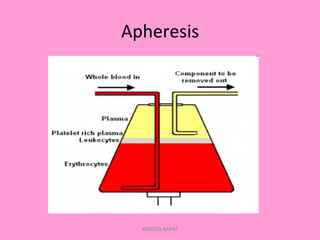
Apheresis	
  
KAWITA BAPAT
Apheresis	
  
KAWITA BAPAT
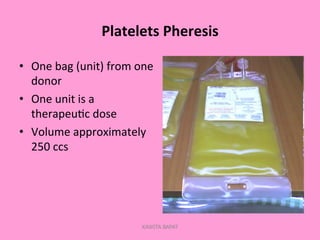
Platelets	
  Pheresis	
  
•  One	
  bag	
  (unit)	
  from	
  one	
  
donor	
  
•  One	
  unit	
  is	
  a	
  
therapeu;c	
  dose	
  
•  Volume	
  approximately	
  
250	
  ccs	
  
KAWITA BAPAT
 	
  	
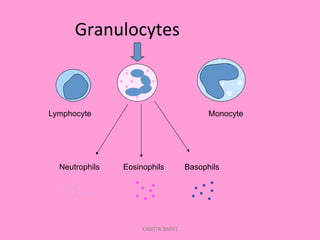
  Granulocytes	
  
Lymphocyte Monocyte
Neutrophils Eosinophils Basophils
KAWITA BAPAT
Granulocytes	
  
•  Primary	
  use	
  is	
  for	
  pa;ents	
  with	
  neutropenia	
  who	
  have	
  gram	
  
nega;ve	
  infec;ons	
  documented	
  by	
  culture,	
  but	
  are	
  
unresponsive	
  to	
  an;bio;cs.	
  
•  Therapeu;c	
  efficacy	
  and	
  indica;ons	
  for	
  granulocyte	
  
transfusions	
  are	
  not	
  well	
  defined.	
  
•  BePer	
  an;microbial	
  agents	
  and	
  use	
  of	
  granulocyte	
  and	
  
macrophage	
  colony	
  s;mula;ng	
  factors	
  best	
  for	
  adults,	
  best	
  
success	
  with	
  this	
  component	
  has	
  been	
  with	
  babies	
  
•  Daily	
  transfusions	
  are	
  necessary.	
  
•  Prepared	
  by	
  hemapheresis.	
  
•  Expira;on	
  ;me	
  is	
  24	
  hours	
  but	
  best	
  to	
  infuse	
  ASAP.	
  
•  Store	
  at	
  20-­‐24	
  C.	
  
KAWITA BAPAT
Plasma	
  Components	
  
KAWITA BAPAT
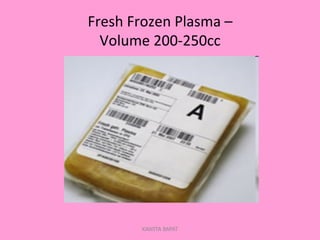
Fresh	
  Frozen	
  Plasma	
  –	
  	
  
Volume	
  200-­‐250cc	
  
KAWITA BAPAT
Fresh	
  Frozen	
  Plasma	
  (FFP)	
  
•  Used	
  to	
  replace	
  labile	
  and	
  non-­‐labile	
  coagula;on	
  
factors	
  in	
  massively	
  bleeding	
  pa;ents	
  OR	
  treat	
  
bleeding	
  associated	
  with	
  cloGng	
  factor	
  deficiencies	
  
when	
  factor	
  concentrate	
  is	
  not	
  available.	
  
•  Must	
  be	
  frozen	
  within	
  8	
  hours	
  of	
  collec'on.	
  
•  Expira;on	
  
–  frozen	
  -­‐	
  1	
  year	
  stored	
  at	
  <-­‐18	
  C.	
  
–  frozen	
  -­‐	
  7	
  years	
  stored	
  at	
  <-­‐65	
  C.thawed	
  -­‐	
  24	
  hours	
  
KAWITA BAPAT
Fresh	
  Frozen	
  Plasma	
  (FFP)	
  
•  Storage	
  temperature	
  
– frozen	
  	
  -­‐18	
  C,	
  preferably	
  -­‐30	
  C	
  or	
  lower	
  
– thawed	
  -­‐	
  1-­‐6	
  C	
  
•  Thawed	
  in	
  30-­‐37C	
  water	
  bath	
  or	
  FDA	
  
approved	
  microwave	
  
•  Must	
  have	
  mechanism	
  to	
  detect	
  units	
  which	
  
have	
  thawed	
  and	
  refrozen	
  due	
  to	
  improper	
  
storage.	
  
•  Must	
  be	
  ABO	
  compa;ble	
  
KAWITA BAPAT
Plasma,	
  Liquid	
  Plasma,	
  Recovered	
  Plasma	
  and	
  
Source	
  Plasma	
  
•  Used	
  to	
  treat	
  pa;ents	
  with	
  stable	
  cloGng	
  factor	
  deficiencies	
  
for	
  which	
  no	
  concentrate	
  is	
  available	
  or	
  for	
  pa;ents	
  
undergoing	
  therapeu;c	
  plasmapheresis.	
  
•  Prepared	
  by	
  separa;ng	
  the	
  plasma	
  from	
  the	
  RBCs	
  on	
  or	
  
before	
  the	
  5th	
  day	
  aNer	
  expira.on	
  of	
  the	
  whole	
  blood.	
  
•  Once	
  separated	
  can:	
  
–  Freeze,	
  store	
  at	
  -­‐18	
  C	
  for	
  5	
  years	
  
–  If	
  not	
  frozen,	
  called	
  liquid	
  plasma,	
  store	
  at	
  1-­‐6	
  C	
  for	
  up	
  to	
  5	
  days	
  aler	
  
expira;on	
  of	
  WB.	
  
•  Once	
  FFP	
  is	
  one	
  year	
  old	
  can	
  redesignate	
  as	
  Plasma,	
  
expira;on	
  is	
  5	
  years.	
  
KAWITA BAPAT
Pooled	
  Plasma/Solvent	
  Detergent	
  Treated	
  
•  Most	
  recently	
  licensed	
  product.	
  
•  Prepared	
  from	
  pools	
  of	
  no	
  more	
  than	
  2500	
  units	
  of	
  ABO	
  
specific	
  plasma	
  frozen	
  to	
  preserve	
  labile	
  coagula;on	
  factors.	
  
•  Treated	
  with	
  chemicals	
  to	
  inac;vate	
  lipid-­‐enveloped	
  viruses.	
  
•  Contains	
  labile	
  and	
  non-­‐labile	
  coagula;on	
  factors	
  but	
  lacks	
  
largest	
  Von	
  Willebrand’s	
  factor	
  mul;mers.	
  
•  Used	
  same	
  as	
  FFP.Safety	
  concerns	
  
–  Decreases	
  disease	
  transmission	
  for	
  diseases	
  tested	
  for.	
  
–  Doesn’t	
  inac;vate	
  viruses	
  with	
  non-­‐lipid	
  envelopes:	
  parvo	
  virus	
  B19,	
  
hepa;;s	
  A,	
  and	
  unrecognized	
  pathogens	
  
KAWITA BAPAT
Cryoprecipitate	
  (CRYO),	
  Factor	
  VIII	
  or	
  An.-­‐
Hemophilic	
  Factor	
  (AHF)	
  
•  Cold	
  insoluble	
  por;on	
  of	
  plasma	
  that	
  precipitates	
  when	
  FFP	
  is	
  
thawed	
  at	
  1-­‐6C.	
  
•  Cryoprecipitate	
  contains	
  high	
  levels	
  of	
  Factor	
  VIII	
  and	
  
Fibrinogen,	
  used	
  for	
  treatment	
  of	
  hemophiliacs	
  and	
  Von	
  
Willebrands	
  when	
  concentrates	
  are	
  not	
  available.	
  
•  Used	
  most	
  commonly	
  for	
  pa;ents	
  with	
  DIC	
  or	
  low	
  fibrinogen	
  
levels.	
  
•  A	
  therapeu'c	
  dose	
  for	
  an	
  adult	
  is	
  6	
  to	
  10	
  units.	
  
•  Can	
  be	
  prepared	
  from	
  WB	
  which	
  is	
  then	
  designated	
  as	
  
"Whole	
  Blood	
  Cryoprecipitate	
  Removed"	
  or	
  from	
  FFP	
  
–  Plasma	
  is	
  frozen.	
  
–  Plasma	
  is	
  then	
  thawed	
  at	
  1-­‐6	
  C,	
  a	
  precipitate	
  forms.	
  
–  Plasma	
  is	
  centrifuged,	
  cryoprecipitate	
  will	
  go	
  to	
  boPom.	
  
–  Remove	
  plasma,	
  freeze	
  within	
  1	
  hour	
  of	
  prepara;on	
  
KAWITA BAPAT
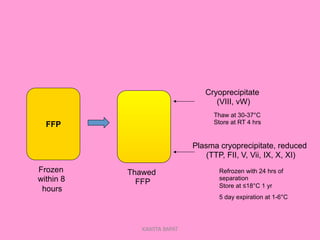
FFP
Frozen
within 8
hours
Thawed
FFP
Cryoprecipitate
(VIII, vW)
Plasma cryoprecipitate, reduced
(TTP, FII, V, Vii, IX, X, XI)
Thaw at 30-37°C
Store at RT 4 hrs
Refrozen with 24 hrs of
separation
Store at ≤18°C 1 yr
5 day expiration at 1-6°C
KAWITA BAPAT
Cryoprecipitate	
  (CRYO),	
  Factor	
  VIII	
  or	
  An.-­‐
Hemophilic	
  Factor	
  (AHF)	
  
•  Storage	
  Temperature	
  
– Frozen	
  -­‐18	
  C	
  or	
  lower	
  
– Thawed	
  -­‐	
  room	
  temperature	
  
•  Expira;on:	
  
– Frozen	
  1	
  year	
  
– Thawed	
  6	
  hours	
  
– Pooled	
  4	
  hours	
  
•  Best	
  to	
  be	
  ABO	
  compa;ble	
  but	
  not	
  important	
  
due	
  to	
  small	
  volume	
  
KAWITA BAPAT
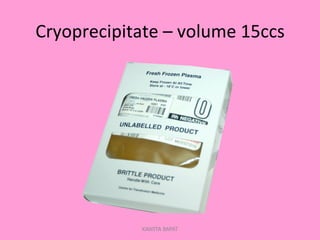
Cryoprecipitate	
  –	
  volume	
  15ccs	
  
KAWITA BAPAT
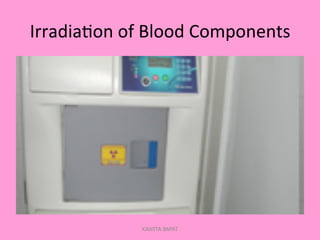
Irradia;on	
  of	
  Blood	
  Components	
  
KAWITA BAPAT
Irradia;on	
  of	
  Blood	
  Components	
  
•  Cellular	
  blood	
  components	
  are	
  irradiated	
  to	
  destroy	
  
viable	
  T-­‐	
  lymphocytes	
  which	
  may	
  cause	
  Gra9	
  Versus	
  
Host	
  Disease	
  (GVHD).	
  
•  GVHD	
  is	
  a	
  disease	
  that	
  results	
  when	
  
immunocompetent,	
  viable	
  lymphocytes	
  in	
  donor	
  
blood	
  engral	
  in	
  an	
  immunocompromised	
  host,	
  
recognize	
  the	
  pa;ent	
  ;ssues	
  as	
  foreign	
  and	
  produce	
  
an;bodies	
  against	
  pa;ent	
  ;ssues,	
  primarily	
  skin,	
  
liver	
  and	
  GI	
  tract.	
  	
  The	
  resul;ng	
  disease	
  has	
  serious	
  
consequences	
  including	
  death.	
  
•  GVHD	
  may	
  be	
  chronic	
  or	
  acute	
  
KAWITA BAPAT
Irradia;on	
  of	
  Blood	
  Components	
  
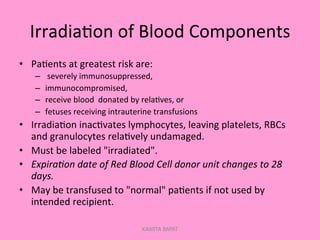
•  Pa;ents	
  at	
  greatest	
  risk	
  are:	
  
–  	
  severely	
  immunosuppressed,	
  
–  immunocompromised,	
  	
  
–  receive	
  blood	
  	
  donated	
  by	
  rela;ves,	
  or	
  	
  
–  fetuses	
  receiving	
  intrauterine	
  transfusions	
  
•  Irradia;on	
  inac;vates	
  lymphocytes,	
  leaving	
  platelets,	
  RBCs	
  
and	
  granulocytes	
  rela;vely	
  undamaged.	
  
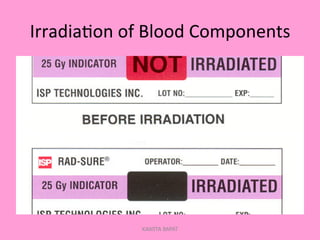
•  Must	
  be	
  labeled	
  "irradiated".	
  
•  Expira'on	
  date	
  of	
  Red	
  Blood	
  Cell	
  donor	
  unit	
  changes	
  to	
  28	
  
days.	
  
•  May	
  be	
  transfused	
  to	
  "normal"	
  pa;ents	
  if	
  not	
  used	
  by	
  
intended	
  recipient.	
  
KAWITA BAPAT
Irradia;on	
  of	
  Blood	
  Components	
  
KAWITA BAPAT
Donor	
  Blood	
  Inspec;on	
  and	
  Disposi;on	
  
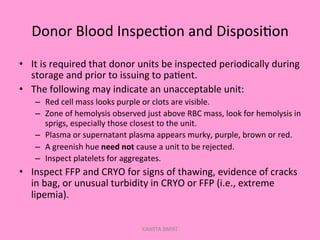
•  It	
  is	
  required	
  that	
  donor	
  units	
  be	
  inspected	
  periodically	
  during	
  
storage	
  and	
  prior	
  to	
  issuing	
  to	
  pa;ent.	
  
•  The	
  following	
  may	
  indicate	
  an	
  unacceptable	
  unit:	
  
–  Red	
  cell	
  mass	
  looks	
  purple	
  or	
  clots	
  are	
  visible.	
  
–  Zone	
  of	
  hemolysis	
  observed	
  just	
  above	
  RBC	
  mass,	
  look	
  for	
  hemolysis	
  in	
  
sprigs,	
  especially	
  those	
  closest	
  to	
  the	
  unit.	
  
–  Plasma	
  or	
  supernatant	
  plasma	
  appears	
  murky,	
  purple,	
  brown	
  or	
  red.	
  
–  A	
  greenish	
  hue	
  need	
  not	
  cause	
  a	
  unit	
  to	
  be	
  rejected.	
  
–  Inspect	
  platelets	
  for	
  aggregates.	
  
•  Inspect	
  FFP	
  and	
  CRYO	
  for	
  signs	
  of	
  thawing,	
  evidence	
  of	
  cracks	
  
in	
  bag,	
  or	
  unusual	
  turbidity	
  in	
  CRYO	
  or	
  FFP	
  (i.e.,	
  extreme	
  
lipemia).	
  
KAWITA BAPAT
Inspec;on	
  of	
  Donor	
  Blood	
  
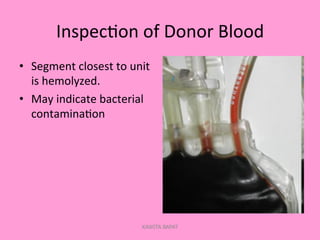
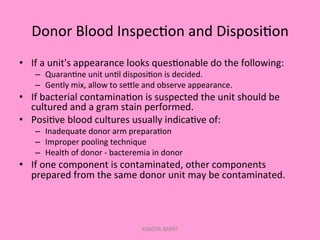
•  Segment	
  closest	
  to	
  unit	
  
is	
  hemolyzed.	
  
•  May	
  indicate	
  bacterial	
  
contamina;on	
  
KAWITA BAPAT
Donor	
  Blood	
  Inspec;on	
  and	
  Disposi;on	
  
•  If	
  a	
  unit's	
  appearance	
  looks	
  ques;onable	
  do	
  the	
  following:	
  
–  Quaran;ne	
  unit	
  un;l	
  disposi;on	
  is	
  decided.	
  
–  Gently	
  mix,	
  allow	
  to	
  sePle	
  and	
  observe	
  appearance.	
  
•  If	
  bacterial	
  contamina;on	
  is	
  suspected	
  the	
  unit	
  should	
  be	
  
cultured	
  and	
  a	
  gram	
  stain	
  performed.	
  
•  Posi;ve	
  blood	
  cultures	
  usually	
  indica;ve	
  of:	
  
–  Inadequate	
  donor	
  arm	
  prepara;on	
  
–  Improper	
  pooling	
  technique	
  
–  Health	
  of	
  donor	
  -­‐	
  bacteremia	
  in	
  donor	
  
•  If	
  one	
  component	
  is	
  contaminated,	
  other	
  components	
  
prepared	
  from	
  the	
  same	
  donor	
  unit	
  may	
  be	
  contaminated.	
  
KAWITA BAPAT
Inspec;on	
  of	
  Donor	
  Blood	
  
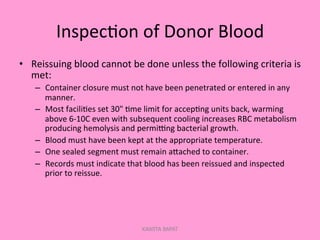
•  Reissuing	
  blood	
  cannot	
  be	
  done	
  unless	
  the	
  following	
  criteria	
  is	
  
met:	
  
–  Container	
  closure	
  must	
  not	
  have	
  been	
  penetrated	
  or	
  entered	
  in	
  any	
  
manner.	
  
–  Most	
  facili;es	
  set	
  30"	
  ;me	
  limit	
  for	
  accep;ng	
  units	
  back,	
  warming	
  
above	
  6-­‐10C	
  even	
  with	
  subsequent	
  cooling	
  increases	
  RBC	
  metabolism	
  
producing	
  hemolysis	
  and	
  permiGng	
  bacterial	
  growth.	
  
–  Blood	
  must	
  have	
  been	
  kept	
  at	
  the	
  appropriate	
  temperature.	
  
–  One	
  sealed	
  segment	
  must	
  remain	
  aPached	
  to	
  container.	
  
–  Records	
  must	
  indicate	
  that	
  blood	
  has	
  been	
  reissued	
  and	
  inspected	
  
prior	
  to	
  reissue.	
  
KAWITA BAPAT
Transporta;on	
  of	
  Blood	
  and	
  Blood	
  Components	
  
•  WB	
  and	
  RBC	
  
– Sturdy	
  well	
  insulated	
  cardboard	
  and/or	
  styrofoam	
  
container,	
  wet	
  ice	
  in	
  ziplock	
  bag	
  to	
  cool,	
  
temperature	
  must	
  be	
  monitored.	
  
– Mobile	
  collec;on	
  units	
  should	
  transport	
  blood	
  
ASAP	
  and	
  leave	
  at	
  RT	
  if	
  platelets	
  are	
  to	
  be	
  made.	
  
– In-­‐house	
  transport	
  	
  place	
  in	
  cooler	
  with	
  wet	
  ice	
  
and	
  thermometer,	
  monitor	
  temperature	
  every	
  30	
  
minutes.	
  
KAWITA BAPAT
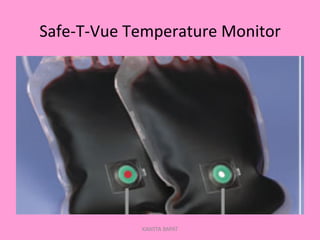
Safe-­‐T-­‐Vue	
  Temperature	
  Monitor	
  
KAWITA BAPAT
Transporta;on	
  of	
  Blood	
  and	
  Blood	
  Components	
  
•  Frozen	
  components	
  
–  Temperature	
  must	
  be	
  maintained	
  at	
  or	
  below	
  required	
  
storage	
  temperature.	
  
–  Use	
  dry	
  ice	
  in	
  well	
  insulated	
  container.	
  
•  Platelets	
  and	
  granulocytes	
  
–  Maintain	
  at	
  20-­‐24	
  C.	
  
–  Transport	
  in	
  well	
  insulated	
  containers	
  without	
  ice.	
  
•  Commercial	
  coolers	
  available	
  to	
  maintain	
  at	
  20-­‐24C.	
  
KAWITA BAPAT
Transporta;on	
  of	
  Blood	
  and	
  Blood	
  Components	
  
•  Handling	
  donor	
  units	
  
– Should	
  not	
  remain	
  at	
  RT	
  unnecessarily,	
  when	
  
blood	
  is	
  issued	
  it	
  should	
  be	
  transfused	
  as	
  soon	
  as	
  
possible.	
  
– When	
  numerous	
  units	
  are	
  removed	
  from	
  fridge,	
  
remove	
  fluid	
  filled	
  container	
  with	
  a	
  thermometer	
  
at	
  same	
  ;me	
  as	
  blood,	
  when	
  temperature	
  reaches	
  
6	
  C	
  return	
  to	
  fridge.	
  
KAWITA BAPAT
Records	
  
•  Must	
  be	
  made	
  concurrently	
  with	
  each	
  step	
  of	
  
component	
  prepara;on,	
  being	
  as	
  detailed	
  as	
  
possible	
  for	
  clear	
  understanding.	
  
•  Must	
  be	
  legible	
  and	
  indelible.	
  
•  Must	
  include	
  dates	
  of	
  various	
  steps	
  and	
  
person	
  responsible.	
  
KAWITA BAPAT
KAWITA BAPAT
KAWITA BAPAT

Blood components

  • 1.
              Blood  and  Blood  Components   DR  .  KAWITA  BAPAT    KAWITA BAPAT
  • 2.
    Goals  Of  Blood  Collec;on     •  Maintain  viability  and  func;on   •  Prevent  physical  changes   •  Minimize  bacterial  contamina;on   KAWITA BAPAT
  • 3.
    An;coagulants  Preserva;ve  Solu;ons   •  An;coagulants  prevent  blood  cloGng   •  Preserva;ves  provide  nutrients  for  cells   •  Heparin   – Rarely  if  ever  used  anymore   – An;coagulant  ONLY   – Transfuse  within  48  hours,  preferably  8   KAWITA BAPAT
  • 4.
    An;coagulants   CPD CPD-A1 Storagetime 21 days 35 days Temperature 1-6 C 1-6 C Slows glycolytic activity Adenine None Substrate for ATP synthesis Volume 450 +/- 10% Dextrose Supports ATP generation by glycolytic pathway Citrate Prevents coagulation by binding calcium KAWITA BAPAT
  • 5.
    Addi;ve  Solu;on   • Primary  bag  with  satellite  bags  aPached.   •  One  bag  has  addi;ve  solu;on  (AS)   •  Unit  drawn  into  CPD  an;coagulant   KAWITA BAPAT
  • 6.
    Addi;ve  Solu;on   • Remove  platelet  rich  plasma  within  72  hours   •  Add  addi;ve  solu;on  to  RBCs,  ADSOL,  which  consists   of:   –  Saline   –  Adenine   –  Glucose   –  Mannitol   •  Extends  storage  to  42  days   •  Final  hematocrit  approximately  66%   KAWITA BAPAT
  • 7.
    Changes  Occur  During  Storage   •  Shelf  life  =  expira;on  date   – At  end  of  expira;on  must  have  75%  recovery   – At  least  75%  of  transfused  cells  remain  in   circula;on  24  hours  AFTER  transfusion   KAWITA BAPAT
  • 8.
    Storage  Lesion   • Biochemical  changes  which  occur  at  1-­‐6C   •  Affects  oxygen  dissocia;on  curve,  increased  affinity   of  hemoglobin  for  oxygen.   –  Low  2,3-­‐DPG,  increased  O2  affinity,  less  O2  released.   –  pH  drops  causes  2,3-­‐DPG  levels  to  fall   –  Once  transfused  RBCs  regenerate  ATP  and  2,3-­‐DPG   •  Few  func;onal  platelets  present   •  Viable  (living)  RBCs  decrease   KAWITA BAPAT
  • 9.
    Plasma hemoglobin Plasma K+ Viable cells pH ATP 2,3-DPG PlasmaNa+ Helps release oxygen from hemoglobin (once transfused, ATP & 2,3- DPG return to normal) K+Na+ KAWITA BAPAT
  • 10.
    Storage  Lesion   • Significant  for  infants  and  massive  transfusion.   •  Other  biochemical  changes   – ATP  decreases   – Potassium  increases   – Sodium  decreases   – Plasma  hemoglobin  increases   KAWITA BAPAT
  • 11.
    Prepara;on  of  Components   •  Collect  unit  within  15  minutes  to  prevent  ac;va;on   of  coagula;on  system   •  Draw  into  closed  system  –  primary  bag  with  satellite   bags  with  herme;c  seal  between.   •  If  herme;c  seal  broken  transfuse  within  24  hours  if   stored  at  1-­‐4C,  4  hours  if  stored  at  20-­‐24C   KAWITA BAPAT
  • 12.
    Prepara;on  of  Components   •  Centrifuge  –  light  spin,  platelets  suspended   •  Remove  platelet  rich  plasma  (PRP)   •  Centrifuge  PRP  heavy  spin   •  Remove  platelet  poor  plasma   •  Freeze  plasma  solid  within  8  hours   •  Thaw  plasma  at  1-­‐4C  –  precipitate  forms   •  Centrifuge,  express  plasma  leaving  cryoprecipitate.   Store  both  at  -­‐18C   •  RBCs  –  CPD  –  21  days,  ADSOL  –  42  days  –  1-­‐6C   KAWITA BAPAT
  • 13.
  • 14.
    Prepara;on  of  Components   •  Summary  –  One  unit  of  whole  blood  can   produce:   – Packed  RBCs   – Fresh  frozen  plasma  (FFP)   – Cryoprecipitate  (CRYO)   – Single  donor  plasma  (SDP)  –  cyro  removed   – Platelets  –  terms  PC  (platelet  concentrate)  OR  RD   PC  (random  donor  platelet  concentrate)   KAWITA BAPAT
  • 15.
    Prepara;on  of  Components   •  Sterile  docking  device  joins  tubing   –  Used  to  add  satellite  bags  to  maintain  original  expira;on   of  component   –  May  be  used  to  pool  components   KAWITA BAPAT
  • 16.
    Blood  Component  General  Informa;on   •  Blood  separated  into  components  to   specifically  treat  pa;ents  with  product  needed   •  Advantages  of  component  separa;on   – Allow  op;mum  survival  of  each  component   – Transfuse  only  component  needed     KAWITA BAPAT
  • 17.
    Blood  Component  General  Informa;on   •  Transfusion  prac;ce   – Transfusion  requires  doctor’s  prescrip;on   – All  components  MUST  be  administered  through  a   filter   – Infuse  quickly,  within  4  hours   – D  (Rh)  neg  require  D  neg  cellular  products   – ABO  iden;cal  preferred,  ABO  compa;ble  OK   – “Universal  donor”  –  RBCs  group  O,  plasma  AB   KAWITA BAPAT
  • 18.
    Blood  Component  General  Informa;on   •  Fresh  Whole  Blood   – Blood  not  usually  available  un;l  12-­‐24  hours   – Candidates   •  Newborns  needing  exchange  transfusion   •  Pa;ents  requiring  leukoreduced  products   KAWITA BAPAT
  • 19.
    Blood  Component  General  Informa;on   •  Summary  of  storage  temperatures:   – Liquid  RBCs  1-­‐6C   – Platelets,  Cryo  (thawed)  and  granulocytes  20-­‐24C   (room  temperature)   – ANY  frozen  plasma  product  ≤  -­‐18C   – ANY  liquid  plasma  product  EXCEPT  Cryo  1-­‐6C   KAWITA BAPAT
  • 20.
    Blood  Components   • Cellular   – Red  blood  cell  products   – Platelets   – Granulocytes   •  Plasma   – FFP   – Cryoprecipitate   KAWITA BAPAT
  • 21.
    Products  With  Red  Cells   KAWITA BAPAT
  • 22.
    Whole  Blood   • Clinical  indica;ons  for  use  of  WB  are  extremely  limited.   •  Used  for  massive  transfusion  to  correct  acute  hypovolemia   such  as  in  trauma  and  shock,  exchange  transfusion.   •  RARELY  used  today,  platelets  non-­‐func;onal,  labile   coagula;on  factors  gone.   •  Must  be  ABO  iden.cal.   KAWITA BAPAT
  • 23.
    Changes  in  Stored  Blood   KAWITA BAPAT
  • 24.
    Red  Blood  Cells,  Packed  (PRBC)   •  Used  to  treat  symptoma;c  anemia  and  rou;ne  blood   loss  during  surgery   •  Hematocrit  is  approximately  80%  for  non-­‐addi;ve   (CPD),  60%  for  addi;ve  (ADSOL).   •  Allow  WB  to  sediment  or  centrifuge  WB,  remove   supernatant  plasma.   KAWITA BAPAT
  • 25.
    Leukocyte  Reduced  Red  Cells  (LR-­‐RBC)   •  Leukocytes  can  induce  adverse  affects  during  transfusion,  primarily   febrile,  non-­‐hemoly;c  reac;ons.   •  Reac;ons  to  cytokines  produced  by  leukocytes  in  transfused  units.   •  Other  explana;ons  to  reac;ons  include:  immuniza;on  of  recipient  to   transfused  HLA  or  granulocyte  an;gens,  micro  aggregates  and   fragmenta;on  of  granulocytes.   •  Historically,  indicated  only  for  pa;ents  who  had  2  or  more  febrile   transfusion  reac;ons,  now  a  commonly  ordered,  popular  component.   •  “CMV”  safe  blood,  since  CMV  lives  in  WBCs.   •  Most  blood  centers  now  leukoreduce  blood  immediately  aler  collec;on.   •  Bed  side  filters  are  available  to  leukoreduce  products  during  transfusion.   KAWITA BAPAT
  • 26.
  • 27.
    Washed  Red  Blood  Cells  (W-­‐RBCs)   •  Washing  removes  plasma  proteins,  platelets,  WBCs  and  micro   aggregates  which  may  cause  febrile  or  ur;carial  reac;ons.   •  Pa;ent  requiring  this  product  is  the  IgA  deficient  pa;ent  with   an;-­‐IgA  an;bodies.   •  Prepared  by  using  a  machine  which  washes  the  cells  3  ;mes   with  saline  to  remove  and  WBCs.   •  Two  types  of  labels:   –  Washed  RBCs  -­‐  do  not  need  to  QC  for  WBCs.   –  Leukocyte  Poor  WRBCs,  QC  must  be  done  to  guarantee  removal  of   85%  of  WBCs.    No  longer  considered  effec;ve  method  for   leukoreduc;on.     •  e.  Expires  24  hours  aler  unit  is  entered.   KAWITA BAPAT
  • 28.
    Cell  Washer  to  Prepare  Washed  Cells   KAWITA BAPAT
  • 29.
  • 30.
    Red  Blood  Cells  Frozen;  Red  Blood  Cells  Deglycerolized  (D-­‐RBC)   •  Blood  is  frozen  to  preserve:    rare  types,  for  autologous   transfusion,  stock  piling  blood  for  military  mobiliza;on  and/or   civilian  natural  disasters.   •  Blood  is  drawn  into  an  an;coagulant  preserva;ve.   –  Plasma  is  removed  and  glycerol  is  added.   –  Aler  equilibra;on  unit  is  centrifuged  to  remove  excess  glycerol  and   frozen.   •  Expira;on   –  If  frozen,  10  years.   –  Aler  deglyceroliza;on,  24  hours.   •  Storage  temperature   –  high  glycerol  -­‐65  C.   –  low  glycerol  -­‐120  C,  liquid  nitrogen.   KAWITA BAPAT
  • 31.
    Red  Blood  Cells  Frozen;  Red  Blood  Cells  Deglycerolized   (D-­‐RBC)   •  Thaw  unit  at  37C,  thawed  RBCs  will  have  high  concentra;on   of  glycerol.   •  A  solu;on  of  glycerol  of  lesser  concentra;on  of  the  original   glycerol  is  added.   •  This  causes  glycerol  to  come  out  of  the  red  blood  cells  slowly   to  prevent  hemolysis  of  the  RBCs.   •  Aler  a  period  of  equilibra;on  the  unit  is  spun,  the  solu;on  is   removed  and  a  solu;on  with  a  lower  glycerol  concentra;on  is   added.   •  This  procedure  is  repeated  un;l  all  glycerol  is  removed,  more   steps  are  required  for  the  high  glycerol  stored  units.   •  The  unit  is  then  washed.   KAWITA BAPAT
  • 32.
    Rejuvenated  Red  Blood  Cells   •  A  special  solu;on  is  added  to  expired  RBCs  up  to  3   days  aler  expira;on  to  restore  2,3-­‐DPG  and  ATP   levels  to  prestorage  values.   •  Rejuvenated  RBCs  regain  normal  characteris;cs  of   oxygen  transport  and  delivery  and  improved  post   transfusion  survival.   •  Expira;on  is  24  hours  or,  if  frozen,  10  years   KAWITA BAPAT
  • 33.
  • 34.
    Platelets  (PLTS),  Platelet  Concentrate  (PC)  or  Random  Donor   Platelet  Concentrate  (RD-­‐PC)   •  Used  to  prevent  spontaneous  bleeding  or  stop  established   bleeding  in  thrombocytopenic  pa;ents.   •  Prepared  from  a  single  unit  of  whole  blood.   •  Due  to  storage  at  RT  it  is  the  most  likely  component  to  be   contaminated  with  bacteria.   •  Therapeu;c  dose  for  adults  is  6  to  10  units.   •  Some  pa;ents  become  "refractory"  to  platelet  therapy.   •  Expira'on  is  5  days  as  a  single  unit,  4  hours  if  pooled.   •  Store  at  20-­‐24  C  (RT)  with  constant  agita;on.   •  D  nega;ve  pa;ents  should  be  transfused  with  D  nega;ve   platelets  due  to  the  presence  of  a  small  number  of  RBCs.   KAWITA BAPAT
  • 35.
    Prepara;on  of  platelet  concentrate   RBCs PRP Plasma Platelet concentrate KAWITA BAPAT
  • 36.
    Platelets  (PLTS),  Platelet  Concentrate  (PC)  or  Random  Donor   Platelet  Concentrate  (RD-­‐PC)   •  One  bag  from  ONE  donor   •  Need  6-­‐10  for  therapeu;c  dose   KAWITA BAPAT
  • 37.
    Pooling  Platelets   • 6-­‐10  units  transferred  into  one  bag   •  Expira;on  =  4  hours   KAWITA BAPAT
  • 38.
    Platelets  Pheresis,  Apheresis  Platelet  Concentrate,  Single  Donor  Platelet   Concentrate  (SD-­‐PC)   •  Used  to  decrease  donor  exposure,  obtain  HLA  matched   platelets  for  pa;ents  who  are  refractory  to  RD-­‐PC  or  prevent   platelet  refractoriness  from  occurring.   •  Prepared  by  hemapheresis,  stored  in  two  connected  bags  to   maintain  viability.   •  One  pheresed  unit  is  equivalent  to  6-­‐8  RD-­‐PC.   •  Store  at  20-­‐24  C  (RT)  with  agita;on  for  5  days,  a9er   combining,  24  hours   •  D  nega;ve  pa;ents  should  be  transfused  with  D  nega;ve   platelets  due  to  the  presence  of  a  small  number  of  RBCs   KAWITA BAPAT
  • 39.
  • 40.
  • 41.
    Platelets  Pheresis   • One  bag  (unit)  from  one   donor   •  One  unit  is  a   therapeu;c  dose   •  Volume  approximately   250  ccs   KAWITA BAPAT
  • 42.
         Granulocytes   Lymphocyte Monocyte Neutrophils Eosinophils Basophils KAWITA BAPAT
  • 43.
    Granulocytes   •  Primary  use  is  for  pa;ents  with  neutropenia  who  have  gram   nega;ve  infec;ons  documented  by  culture,  but  are   unresponsive  to  an;bio;cs.   •  Therapeu;c  efficacy  and  indica;ons  for  granulocyte   transfusions  are  not  well  defined.   •  BePer  an;microbial  agents  and  use  of  granulocyte  and   macrophage  colony  s;mula;ng  factors  best  for  adults,  best   success  with  this  component  has  been  with  babies   •  Daily  transfusions  are  necessary.   •  Prepared  by  hemapheresis.   •  Expira;on  ;me  is  24  hours  but  best  to  infuse  ASAP.   •  Store  at  20-­‐24  C.   KAWITA BAPAT
  • 44.
  • 45.
    Fresh  Frozen  Plasma  –     Volume  200-­‐250cc   KAWITA BAPAT
  • 46.
    Fresh  Frozen  Plasma  (FFP)   •  Used  to  replace  labile  and  non-­‐labile  coagula;on   factors  in  massively  bleeding  pa;ents  OR  treat   bleeding  associated  with  cloGng  factor  deficiencies   when  factor  concentrate  is  not  available.   •  Must  be  frozen  within  8  hours  of  collec'on.   •  Expira;on   –  frozen  -­‐  1  year  stored  at  <-­‐18  C.   –  frozen  -­‐  7  years  stored  at  <-­‐65  C.thawed  -­‐  24  hours   KAWITA BAPAT
  • 47.
    Fresh  Frozen  Plasma  (FFP)   •  Storage  temperature   – frozen    -­‐18  C,  preferably  -­‐30  C  or  lower   – thawed  -­‐  1-­‐6  C   •  Thawed  in  30-­‐37C  water  bath  or  FDA   approved  microwave   •  Must  have  mechanism  to  detect  units  which   have  thawed  and  refrozen  due  to  improper   storage.   •  Must  be  ABO  compa;ble   KAWITA BAPAT
  • 48.
    Plasma,  Liquid  Plasma,  Recovered  Plasma  and   Source  Plasma   •  Used  to  treat  pa;ents  with  stable  cloGng  factor  deficiencies   for  which  no  concentrate  is  available  or  for  pa;ents   undergoing  therapeu;c  plasmapheresis.   •  Prepared  by  separa;ng  the  plasma  from  the  RBCs  on  or   before  the  5th  day  aNer  expira.on  of  the  whole  blood.   •  Once  separated  can:   –  Freeze,  store  at  -­‐18  C  for  5  years   –  If  not  frozen,  called  liquid  plasma,  store  at  1-­‐6  C  for  up  to  5  days  aler   expira;on  of  WB.   •  Once  FFP  is  one  year  old  can  redesignate  as  Plasma,   expira;on  is  5  years.   KAWITA BAPAT
  • 49.
    Pooled  Plasma/Solvent  Detergent  Treated   •  Most  recently  licensed  product.   •  Prepared  from  pools  of  no  more  than  2500  units  of  ABO   specific  plasma  frozen  to  preserve  labile  coagula;on  factors.   •  Treated  with  chemicals  to  inac;vate  lipid-­‐enveloped  viruses.   •  Contains  labile  and  non-­‐labile  coagula;on  factors  but  lacks   largest  Von  Willebrand’s  factor  mul;mers.   •  Used  same  as  FFP.Safety  concerns   –  Decreases  disease  transmission  for  diseases  tested  for.   –  Doesn’t  inac;vate  viruses  with  non-­‐lipid  envelopes:  parvo  virus  B19,   hepa;;s  A,  and  unrecognized  pathogens   KAWITA BAPAT
  • 50.
    Cryoprecipitate  (CRYO),  Factor  VIII  or  An.-­‐ Hemophilic  Factor  (AHF)   •  Cold  insoluble  por;on  of  plasma  that  precipitates  when  FFP  is   thawed  at  1-­‐6C.   •  Cryoprecipitate  contains  high  levels  of  Factor  VIII  and   Fibrinogen,  used  for  treatment  of  hemophiliacs  and  Von   Willebrands  when  concentrates  are  not  available.   •  Used  most  commonly  for  pa;ents  with  DIC  or  low  fibrinogen   levels.   •  A  therapeu'c  dose  for  an  adult  is  6  to  10  units.   •  Can  be  prepared  from  WB  which  is  then  designated  as   "Whole  Blood  Cryoprecipitate  Removed"  or  from  FFP   –  Plasma  is  frozen.   –  Plasma  is  then  thawed  at  1-­‐6  C,  a  precipitate  forms.   –  Plasma  is  centrifuged,  cryoprecipitate  will  go  to  boPom.   –  Remove  plasma,  freeze  within  1  hour  of  prepara;on   KAWITA BAPAT
  • 51.
    FFP Frozen within 8 hours Thawed FFP Cryoprecipitate (VIII, vW) Plasmacryoprecipitate, reduced (TTP, FII, V, Vii, IX, X, XI) Thaw at 30-37°C Store at RT 4 hrs Refrozen with 24 hrs of separation Store at ≤18°C 1 yr 5 day expiration at 1-6°C KAWITA BAPAT
  • 52.
    Cryoprecipitate  (CRYO),  Factor  VIII  or  An.-­‐ Hemophilic  Factor  (AHF)   •  Storage  Temperature   – Frozen  -­‐18  C  or  lower   – Thawed  -­‐  room  temperature   •  Expira;on:   – Frozen  1  year   – Thawed  6  hours   – Pooled  4  hours   •  Best  to  be  ABO  compa;ble  but  not  important   due  to  small  volume   KAWITA BAPAT
  • 53.
    Cryoprecipitate  –  volume  15ccs   KAWITA BAPAT
  • 54.
    Irradia;on  of  Blood  Components   KAWITA BAPAT
  • 55.
    Irradia;on  of  Blood  Components   •  Cellular  blood  components  are  irradiated  to  destroy   viable  T-­‐  lymphocytes  which  may  cause  Gra9  Versus   Host  Disease  (GVHD).   •  GVHD  is  a  disease  that  results  when   immunocompetent,  viable  lymphocytes  in  donor   blood  engral  in  an  immunocompromised  host,   recognize  the  pa;ent  ;ssues  as  foreign  and  produce   an;bodies  against  pa;ent  ;ssues,  primarily  skin,   liver  and  GI  tract.    The  resul;ng  disease  has  serious   consequences  including  death.   •  GVHD  may  be  chronic  or  acute   KAWITA BAPAT
  • 56.
    Irradia;on  of  Blood  Components   •  Pa;ents  at  greatest  risk  are:   –   severely  immunosuppressed,   –  immunocompromised,     –  receive  blood    donated  by  rela;ves,  or     –  fetuses  receiving  intrauterine  transfusions   •  Irradia;on  inac;vates  lymphocytes,  leaving  platelets,  RBCs   and  granulocytes  rela;vely  undamaged.   •  Must  be  labeled  "irradiated".   •  Expira'on  date  of  Red  Blood  Cell  donor  unit  changes  to  28   days.   •  May  be  transfused  to  "normal"  pa;ents  if  not  used  by   intended  recipient.   KAWITA BAPAT
  • 57.
    Irradia;on  of  Blood  Components   KAWITA BAPAT
  • 58.
    Donor  Blood  Inspec;on  and  Disposi;on   •  It  is  required  that  donor  units  be  inspected  periodically  during   storage  and  prior  to  issuing  to  pa;ent.   •  The  following  may  indicate  an  unacceptable  unit:   –  Red  cell  mass  looks  purple  or  clots  are  visible.   –  Zone  of  hemolysis  observed  just  above  RBC  mass,  look  for  hemolysis  in   sprigs,  especially  those  closest  to  the  unit.   –  Plasma  or  supernatant  plasma  appears  murky,  purple,  brown  or  red.   –  A  greenish  hue  need  not  cause  a  unit  to  be  rejected.   –  Inspect  platelets  for  aggregates.   •  Inspect  FFP  and  CRYO  for  signs  of  thawing,  evidence  of  cracks   in  bag,  or  unusual  turbidity  in  CRYO  or  FFP  (i.e.,  extreme   lipemia).   KAWITA BAPAT
  • 59.
    Inspec;on  of  Donor  Blood   •  Segment  closest  to  unit   is  hemolyzed.   •  May  indicate  bacterial   contamina;on   KAWITA BAPAT
  • 60.
    Donor  Blood  Inspec;on  and  Disposi;on   •  If  a  unit's  appearance  looks  ques;onable  do  the  following:   –  Quaran;ne  unit  un;l  disposi;on  is  decided.   –  Gently  mix,  allow  to  sePle  and  observe  appearance.   •  If  bacterial  contamina;on  is  suspected  the  unit  should  be   cultured  and  a  gram  stain  performed.   •  Posi;ve  blood  cultures  usually  indica;ve  of:   –  Inadequate  donor  arm  prepara;on   –  Improper  pooling  technique   –  Health  of  donor  -­‐  bacteremia  in  donor   •  If  one  component  is  contaminated,  other  components   prepared  from  the  same  donor  unit  may  be  contaminated.   KAWITA BAPAT
  • 61.
    Inspec;on  of  Donor  Blood   •  Reissuing  blood  cannot  be  done  unless  the  following  criteria  is   met:   –  Container  closure  must  not  have  been  penetrated  or  entered  in  any   manner.   –  Most  facili;es  set  30"  ;me  limit  for  accep;ng  units  back,  warming   above  6-­‐10C  even  with  subsequent  cooling  increases  RBC  metabolism   producing  hemolysis  and  permiGng  bacterial  growth.   –  Blood  must  have  been  kept  at  the  appropriate  temperature.   –  One  sealed  segment  must  remain  aPached  to  container.   –  Records  must  indicate  that  blood  has  been  reissued  and  inspected   prior  to  reissue.   KAWITA BAPAT
  • 62.
    Transporta;on  of  Blood  and  Blood  Components   •  WB  and  RBC   – Sturdy  well  insulated  cardboard  and/or  styrofoam   container,  wet  ice  in  ziplock  bag  to  cool,   temperature  must  be  monitored.   – Mobile  collec;on  units  should  transport  blood   ASAP  and  leave  at  RT  if  platelets  are  to  be  made.   – In-­‐house  transport    place  in  cooler  with  wet  ice   and  thermometer,  monitor  temperature  every  30   minutes.   KAWITA BAPAT
  • 63.
  • 64.
    Transporta;on  of  Blood  and  Blood  Components   •  Frozen  components   –  Temperature  must  be  maintained  at  or  below  required   storage  temperature.   –  Use  dry  ice  in  well  insulated  container.   •  Platelets  and  granulocytes   –  Maintain  at  20-­‐24  C.   –  Transport  in  well  insulated  containers  without  ice.   •  Commercial  coolers  available  to  maintain  at  20-­‐24C.   KAWITA BAPAT
  • 65.
    Transporta;on  of  Blood  and  Blood  Components   •  Handling  donor  units   – Should  not  remain  at  RT  unnecessarily,  when   blood  is  issued  it  should  be  transfused  as  soon  as   possible.   – When  numerous  units  are  removed  from  fridge,   remove  fluid  filled  container  with  a  thermometer   at  same  ;me  as  blood,  when  temperature  reaches   6  C  return  to  fridge.   KAWITA BAPAT
  • 66.
    Records   •  Must  be  made  concurrently  with  each  step  of   component  prepara;on,  being  as  detailed  as   possible  for  clear  understanding.   •  Must  be  legible  and  indelible.   •  Must  include  dates  of  various  steps  and   person  responsible.   KAWITA BAPAT
  • 67.
  • 68.