Presented by:- 
Soumya Ranjan Parida 
Basic Bsc. Nursing(7th sem) 
Regd. No-1141535034
VITAL EVENTS 
BIRTH DEATH MARRIAGE 
DIVORCE 
2
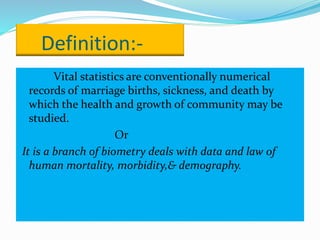
Definition:- 
Vital statistics are conventionally numerical 
records of marriage births, sickness, and death by 
which the health and growth of community may be 
studied. 
Or 
It is a branch of biometry deals with data and law of 
human mortality, morbidity,& demography.
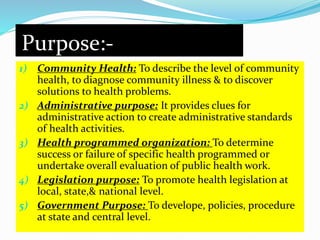
Purpose:- 
1) Community Health: To describe the level of community 
health, to diagnose community illness & to discover 
solutions to health problems. 
2) Administrative purpose: It provides clues for 
administrative action to create administrative standards 
of health activities. 
3) Health programmed organization: To determine 
success or failure of specific health programmed or 
undertake overall evaluation of public health work. 
4) Legislation purpose: To promote health legislation at 
local, state,& national level. 
5) Government Purpose: To develope, policies, procedure 
at state and central level.
Uses:- 
 To evaluate the impact of various National Health 
Programmes. 
 To plan for better future measures of disease control. 
 To explain the heridetary nature of the disease. 
 To plan and evaluate economic and social development. 
 It is a primary tool in research activities. 
 To determine the health status of individual. 
 To compare the health status of individual one nation 
with others.
Sources of Vital Statistics:- 
 1. Civil Registration System: 
It is defined as the continous permanent 
and compulsory recording of the occurrence of vital 
events like live births, deaths, fetal deaths, 
marriages, divorces, as well as annulments, judicial 
separation, adoption. Civil registration is 
performed under a law and regulation so as to 
provide legal basis to the records and certificate 
made from system.
2. National Sample Survey: 
The data collected from the census are not 
very reliable and available only once in 10 years. In 
absence of reliable data from the civil registration 
system(SRS), the need for reliable statistics at 
national and state levels is being met through 
sample surveys launched from time to time.
3. Sample Registration System: 
In this system, there is continous 
enumeration of births and deaths in a sample of 
villages/urban blocks by a resident parttime 
enumerator and then an independent six monthly 
retrospective survey by a full time supervisor.
4. Health Surveys: 
A few important sources for demographic data 
have emerged. These are National Family Health 
Surveys(NFHS) and the District Levels Household 
Surveys(DLHS) conducted for evaluation of reproductive 
and child health programmes. 
NFHS provide estimates of fertility, child mortality 
and a no. of fertility, child mortality and a no. of health 
parameters relating to infants and children at state level. 
The DLHS provide information at the district level 
on a no. of indicators relating to child health, 
reproductive health problems and quality of services 
availability to them.
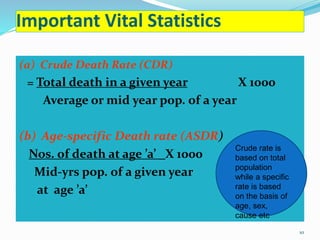
Important Vital Statistics 
(a) Crude Death Rate (CDR) 
= Total death in a given year X 1000 
Average or mid year pop. of a year 
(b) Age-specific Death rate (ASDR) 
Nos. of death at age ’a’ _X 1000 
Mid-yrs pop. of a given year 
at age ’a’ 
Crude rate is 
based on total 
population 
while a specific 
rate is based 
on the basis of 
age, sex, 
cause etc 
10
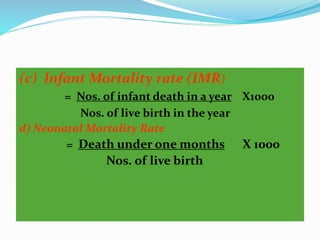
(c) Infant Mortality rate (IMR) 
= Nos. of infant death in a year X1000 
Nos. of live birth in the year 
d) Neonatal Mortality Rate 
= Death under one months X 1000 
Nos. of live birth
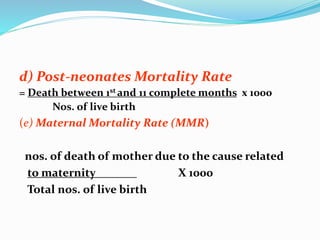
d) Post-neonates Mortality Rate 
= Death between 1st and 11 complete months x 1000 
Nos. of live birth 
(e) Maternal Mortality Rate (MMR) 
nos. of death of mother due to the cause related 
to maternity X 1000 
Total nos. of live birth

Vital statistics

  • 1.
    Presented by:- SoumyaRanjan Parida Basic Bsc. Nursing(7th sem) Regd. No-1141535034
  • 2.
    VITAL EVENTS BIRTHDEATH MARRIAGE DIVORCE 2
  • 3.
    Definition:- Vital statisticsare conventionally numerical records of marriage births, sickness, and death by which the health and growth of community may be studied. Or It is a branch of biometry deals with data and law of human mortality, morbidity,& demography.
  • 4.
    Purpose:- 1) CommunityHealth: To describe the level of community health, to diagnose community illness & to discover solutions to health problems. 2) Administrative purpose: It provides clues for administrative action to create administrative standards of health activities. 3) Health programmed organization: To determine success or failure of specific health programmed or undertake overall evaluation of public health work. 4) Legislation purpose: To promote health legislation at local, state,& national level. 5) Government Purpose: To develope, policies, procedure at state and central level.
  • 5.
    Uses:-  Toevaluate the impact of various National Health Programmes.  To plan for better future measures of disease control.  To explain the heridetary nature of the disease.  To plan and evaluate economic and social development.  It is a primary tool in research activities.  To determine the health status of individual.  To compare the health status of individual one nation with others.
  • 6.
    Sources of VitalStatistics:-  1. Civil Registration System: It is defined as the continous permanent and compulsory recording of the occurrence of vital events like live births, deaths, fetal deaths, marriages, divorces, as well as annulments, judicial separation, adoption. Civil registration is performed under a law and regulation so as to provide legal basis to the records and certificate made from system.
  • 7.
    2. National SampleSurvey: The data collected from the census are not very reliable and available only once in 10 years. In absence of reliable data from the civil registration system(SRS), the need for reliable statistics at national and state levels is being met through sample surveys launched from time to time.
  • 8.
    3. Sample RegistrationSystem: In this system, there is continous enumeration of births and deaths in a sample of villages/urban blocks by a resident parttime enumerator and then an independent six monthly retrospective survey by a full time supervisor.
  • 9.
    4. Health Surveys: A few important sources for demographic data have emerged. These are National Family Health Surveys(NFHS) and the District Levels Household Surveys(DLHS) conducted for evaluation of reproductive and child health programmes. NFHS provide estimates of fertility, child mortality and a no. of fertility, child mortality and a no. of health parameters relating to infants and children at state level. The DLHS provide information at the district level on a no. of indicators relating to child health, reproductive health problems and quality of services availability to them.
  • 10.
    Important Vital Statistics (a) Crude Death Rate (CDR) = Total death in a given year X 1000 Average or mid year pop. of a year (b) Age-specific Death rate (ASDR) Nos. of death at age ’a’ _X 1000 Mid-yrs pop. of a given year at age ’a’ Crude rate is based on total population while a specific rate is based on the basis of age, sex, cause etc 10
  • 11.
    (c) Infant Mortalityrate (IMR) = Nos. of infant death in a year X1000 Nos. of live birth in the year d) Neonatal Mortality Rate = Death under one months X 1000 Nos. of live birth
  • 12.
    d) Post-neonates MortalityRate = Death between 1st and 11 complete months x 1000 Nos. of live birth (e) Maternal Mortality Rate (MMR) nos. of death of mother due to the cause related to maternity X 1000 Total nos. of live birth