Vital statistics
By Kunal soni
MSc.Nursing
Community health nursing
Terminology of statistics
1. Rate:
• A rate is measures the occurrence of some particular event in a population
during a given period of time. The event can be Births, death, diseases.
• It is defined as the numerical statement of the frequency of an event
obtained by dividing the number of individuals experiencing the event
during a specified time period (The numerator) by the total mid year
population who are capable of experiencing the event (the denominator or
the population at risk) and multiply by a constant number which is usually
1,000 but it can be some other round figure such as 10,000,100,000
2. Crude rates :
• Crude rate are actual observed rates based on the entire population and are
not reflective of such as any specific age group or only female
• for example. Crude birth rates, crude death rate
Conti.
3. Specific rates:
• These are actual observed rates based on specific population group such as
sex and age wise group, disease wise groups or during specific time periods
• For example: Annual rates, monthly rates, weekly rates
4. Ratio:
• It is measure of events which expresses a relation in size between two
different factors occurring in the population and it is obtained by dividing
quantity of one factor with other Exp. The number of children with
malnutrition with the ratio of normal children. It is expressed in the ratio of
X:Y or X/Y
• Exp. Male :female = Number of females
Number of males
Conti.
5. Mid-Year Population
Also referred to as the mean population, is regarded as the population at
July 1 and is assumed to be the point at which half of the changes in the
population during the year have occurred. This is the population estimate
that is generally used as the base for the calculation of rates. Birth Rate (or
crude birth rate) The number of live births per 1,000 population in a given
year. Calculated by dividing the number of live births occurring in the
year by the total mean (or midyear population) for that year
Introduction
• Vital statistics are known by different names such as life tables, statistics
regarding birth and death, essential data of life statistics.
• In fact, vital statistics is a major portion of population studies or
demography.
• Vital statistics means numerical data regarding important incidents
occurring in a community and method of analysis of this data.
• Important incidents means Birth, death, marriage, diseases. Which are main
indicators of health and development of community or a nation.
• The most common way of collecting information on these events is through
civil registration, an administrative system used by govt. to record vital
events which occur in their population.
Definition of Vital statistics
“Vital statistics is data/record regarding marriage, birth, diseases and, on the
basis of which community’s health and development are studied”
- Benjamin
“Vital statistics is the numerical description of birth, death, abortion, marriage,
divorce, adoption, and judicial separation’’
- U.N.O
Uses and Importance of vital statistics
General:
• Legal necessity
• Administrative Utility
• Useful in planning
• International utility
• Bases of social reform
Health:
• Determination of health status of Individual/ community, health problems
and health needs.
• Making programmes for health
• Improvement in administration.
• Comparing the health status of one nation with others.
Conti.
• Evaluation of Health programmes
• For Research related to health
• For analysis of the trends of health statistics.
• Life Expectancy
Sources of vital Statistics In India
1. Population census:
• Ancient Literature reveals that the Population count was practiced between
600& 800BC in India .
• India initiated its First census in 1881,& continued it once every 10 years
• The last census of India was undertaken in 2011 and it was 15th census of
India.
2. Civil registration system(SRS):
• The task of “civil registration system” is recording of vital events Exp. Live
birth, stillbirth, and deaths
• Present registration of birth and death is being done under act,1969.
• “Registration records” are useful legal documents
• It’s a source of statistics.
Conti.
3. Sample Registration system(SRS):
• It is one of the largest demographic household sample survey in the world
• This was initiated in 1969-70 with the purpose of complete registration
from CSR(Civil registration system)
• Provide reliable annual estimates of birth, death, and infant mortality rates
at the state and separately for rural and urban areas.
• Some of other rates which could be elicited from this are: Child
mortality(CMR),total fertility rate (TFR),Sex ratio at birth and 0-4 age ,rate
of institutional deliveries, medical attention before death
• From the year 2008,it also provide under 5 mortality rate.
Conti.
4. Demographic sample surveys (NSSO):
• National sample survey organisation (NSSO) established in 1950 in India
conducts regular Socio-economic and unemployment, health and medical
services.
• National sample survey organisation currently known As “National sample
survey office” function under the statistics, Govt. India
5. Health surveys
a. National family Health survey (NFHS):
It is a large-level , multiple surveys conducted in a representative sample of
household throughout India “International institute for population Sciences.
"Mumbai, provide coordination and technical guidance for the survey. The
multiple survey round were found by USAID, DFID, the Bill and Melinda
Gates Foundation, UNICEF, UNFPA, and MOHFW,GOI
Conti.
Specific Goals of NFHS:
• To provide essential data on health and family welfare needed by the Ministry
of Health and family Welfare and other agencies for policy and program
purposes.
• To provide information on important emerging health and family welfare
issues.
• Four rounds of the survey have been conducted so far:
o NFHS-1(1992-93)
o NFHS-2(1998-99)
o NFHS-3(2005-2015)
b. Reproductive and child health survey (DLHS-RCH): the largest ever
demographic and health survey carried out in India, with a sample size of
about seven lakh households covering all districts level estimates on health
indicators that would assist in policy making decentralized planning and
evaluation.
Conti.
Survey provide information on-maternal and child, reproductive health,
practice of family planning, performance of national rural Health and
Accessibility and utilization of health facilities.
6. Annual Health survey:
• The annual survey (AHS) is a comprehensive, representatives dataset on
core vital indicators like IMR,MMR and TFR along with their co-variates
of the districts to provide special attention on needy districts.
7. Concurrent Evaluation of NRHM:
• Concurrent Evaluation assesses the extent of reach of NRHM activities to
the rural communities and provide information for policy making and
program planning.
Conti.
8. Multiple indicator Cluster survey:
• The Multiple Indicator cluster survey (MICS) enable all the countries to
elicit statistically sound and internationally comparable data on certain
indicators in the area of health, education etc. MICS is extensively used in
policy making and program intervention.
9. Longitudinal Aging Study In India:
• The longitudinal aging study in India (LASI) mainly focuses on the issues
related to elderly populations of India on Health, Economic, and social
well-being.
Types of Important vital statistics
Crude Birth rate
Crude Death rate
Infant mortality rate
Neonatal Mortality rate
General Fertility Rate
Maternal Mortality Rate
Conti.
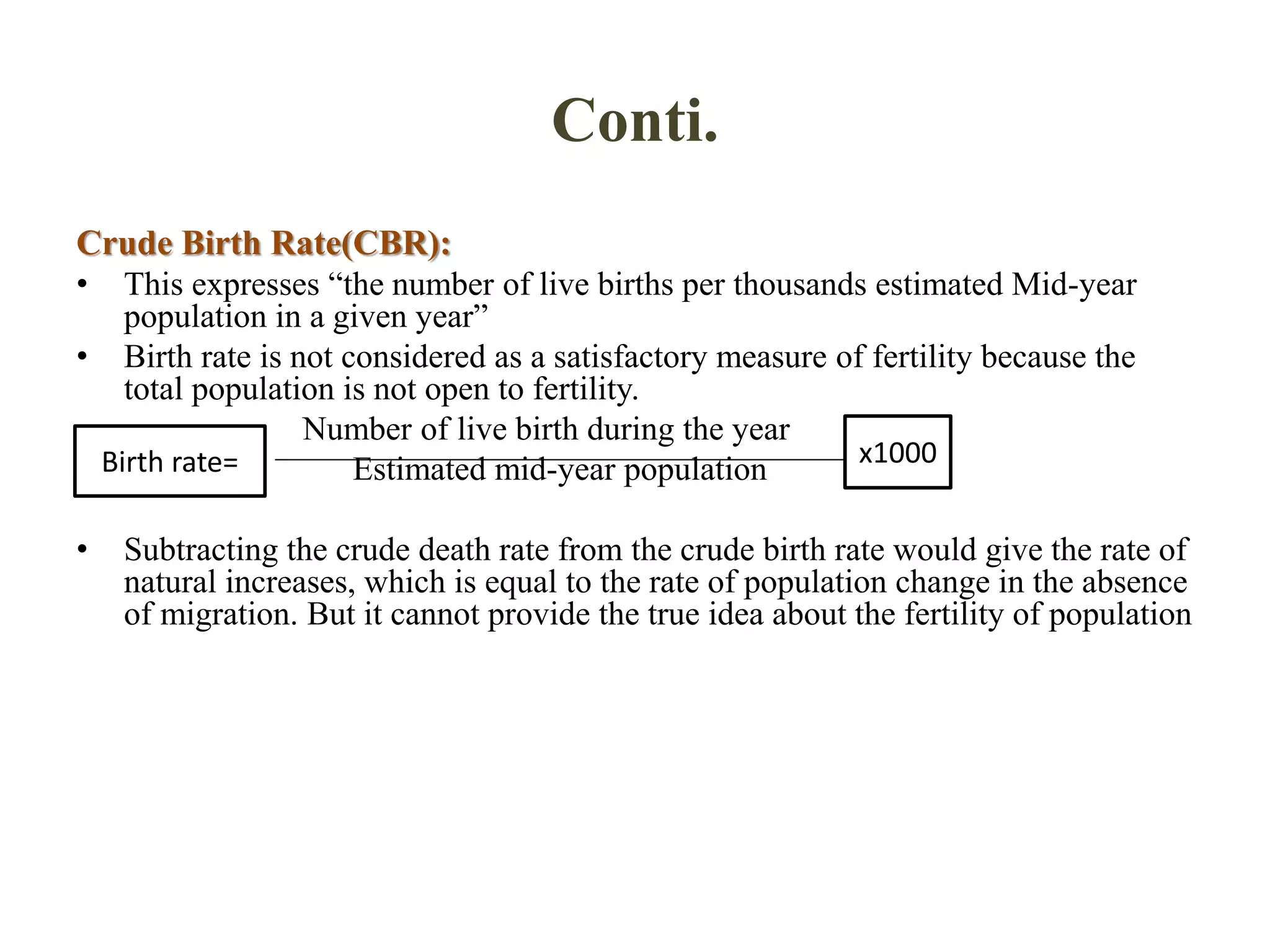
Crude Birth Rate(CBR):
• This expresses “the number of live births per thousands estimated Mid-year
population in a given year”
• Birth rate is not considered as a satisfactory measure of fertility because the
total population is not open to fertility.
Number of live birth during the year
Estimated mid-year population
• Subtracting the crude death rate from the crude birth rate would give the rate of
natural increases, which is equal to the rate of population change in the absence
of migration. But it cannot provide the true idea about the fertility of population
x1000Birth rate=
Conti.
Crude Death rate
This expresses “the number of live births per thousands estimated mid year
population in a given year”
Crude Birth rate= 1000Number of live birth during the year
Estimated mid year population
Conti.
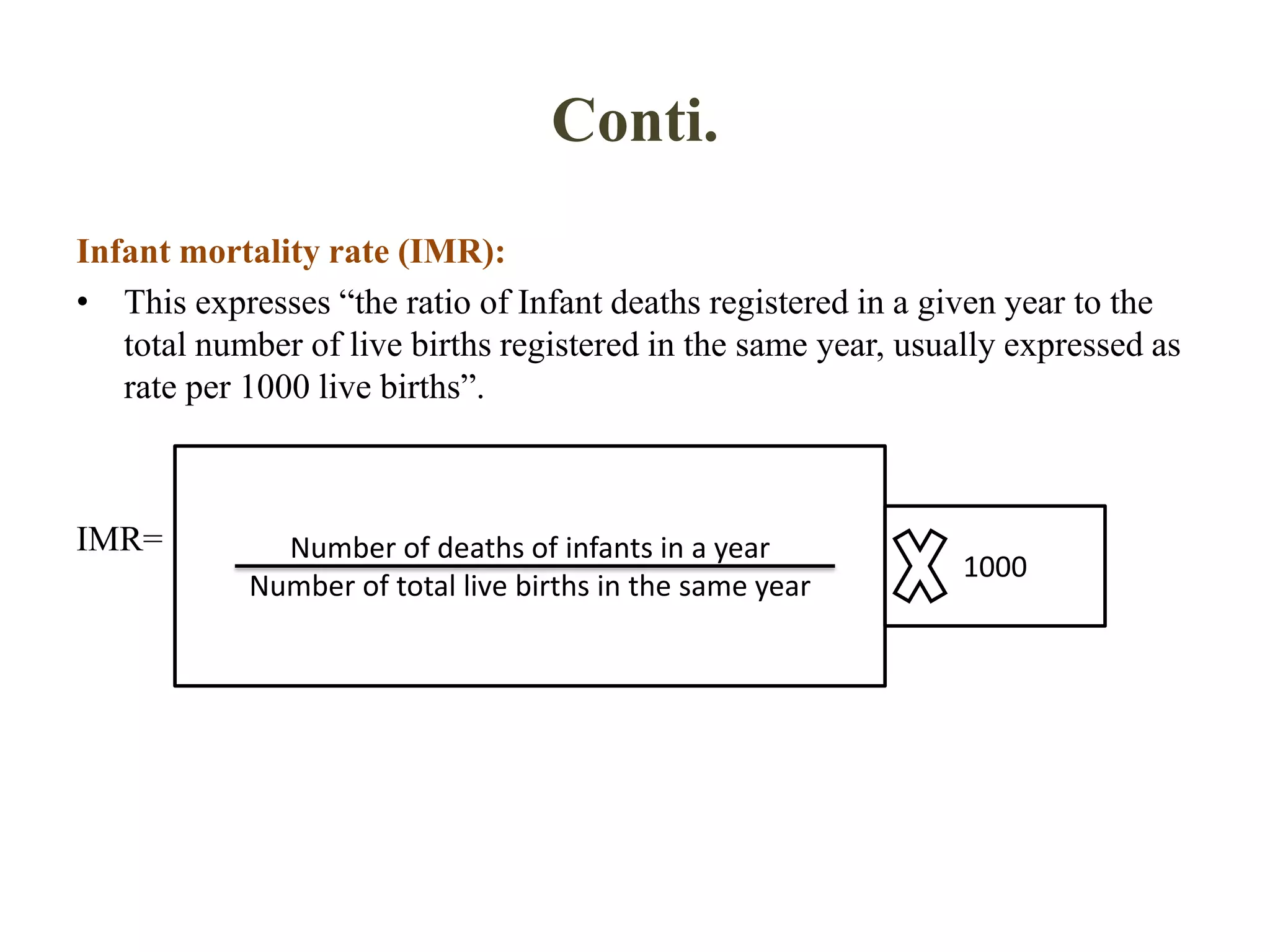
Infant mortality rate (IMR):
• This expresses “the ratio of Infant deaths registered in a given year to the
total number of live births registered in the same year, usually expressed as
rate per 1000 live births”.
IMR= Number of deaths of infants in a year
Number of total live births in the same year
1000
Conti.
Neonatal mortality Rate(NMR):
• According to WHO MMR expresses “the death of women while pregnant
or within 42 days of termination of pregnancy, from any cause related to or
aggravated by the pregnancy or its management, but not from accidental or
incidental causes”
MMR=
Total number of female deaths due to complication of
pregnancy, child birth or within 42 days of delivery from
puerperal causes during from given year
Total number of live births in the same area and year 1000
Conti.
General fertility Rate:
The general fertility (GFR) is defined as the total number of live births per 1,000
women of reproductive age (15 to 49 years) in a population per year.
GFR= Number of live births in a year
Mid-year married female population in the age group 15-49 years 1000
Conti.
Maternal mortality Rate:
• According to WHO MMR expresses “the death of women while pregnant
or within 42 days of termination of pregnancy, irrespective of the duration
and site of pregnancy, from any cause related to or aggravated by the
pregnancy or is management, but not from accidental or incidental causes”
MMR=
Total number of female deaths due to complication of
pregnancy, child birth or within 42 days of delivery from
puerperal causes during the given year
Total number of live births in same area and year
1000
Conti.
• MMR may be expressed per 10,000 or per 1 lakh population also .in
puerperal causes, deaths in pregnancy, at the time of pregnancy or within
42 days of delivery included.
Other Types
Age-specific Fertility Rate:
The age specific fertility rate (ASFR) is defined as the annual number of births
to women of a specified age per 1,000 women in that age group. ASFR is the
sensitive indicator of family planning.
ASFR=
Number of live births in particular age group
Mid year population of the same age group
1000
Conti.
Total Fertility Rate:
• Total fertility rate(TFR) is defined as the number of children that would be
born to a women if she were to live to the end of her childbearing years and
bears children in accordance with current age-specific fertility rates.
• Total fertility rate is the sum of the age specific birth rates(5- year age
group between 15 and 49 years) for females of a specified geographic area
during a specified time period multiplied by 5.
• The TFR is calculated as : TFR=∑ASFRa,(For single year age group)
OR
• TFR= 5∑ASFRa (for 5-year age group)
• Where ASFRa= age specific fertility rate for women in age group a
(Expressed as a rate per women)
Conti.
Net reproduction rate:
• Net reproduction rate (NRR) is defined as the number of daughters a new-
born girl bear will bear during her life time assuming fixed age specific
fertility and mortality Rates.
• NRR of India is 1.171 (2015)
Crude marriage rate:
• The crude marriage rate is defined as the annual number of marriages per
1,000 population.
• The Act, ceremony or process by which the legal relationship of husband
and wife is constitute. The legality of the union may be established by civil,
religious or other means as recognized by laws of each country
Conti.
Crude marriage rate=
According to demographers this is very unsatisfactory rate since the
denominator comprised primarily of population that is not eligible to marry
Number of marriages in the year
Mid-year population
1000
Conti.
Pregnancy Rate and Ratio:
• Pregnancy rate is defined as the total number of pregnancies including live
births, induced abortion and foetal deaths per 1,000 women aged 15-44
years for a specified geographical area during a specified time period
Pregnancy rate=
Number of resident pregnancies
(live births+ induced abortion + foetal deaths)
Number of women in reproductive age (15-44years) 1000
Conti.
Pregnancy Ratio:
= (live births + induced abortion+ foetal deaths)
Number of women in reproductive age (15-44 years)
Conti.
Abortion ratio:
It is defined as the number of abortion of all types in a year to number of live
births over the same period.
Abortion ratio=
World abortion ratio is =32:100 live births. This means foe every 100 live
births in the world there are 32 abortions.
Abortion is refers to the termination of pregnancy from whatever cause before
the foetus is capable of extra uterine life. (WHO)
Number of all types of abortion
Number of live births
Shortcoming of Indian vital statistics
• Lack of uniformity
• Voluntary registration (like registration of marriage)
• Incomplete information
• Under registration
• Lack of accuracy
• Errors made by registration worker
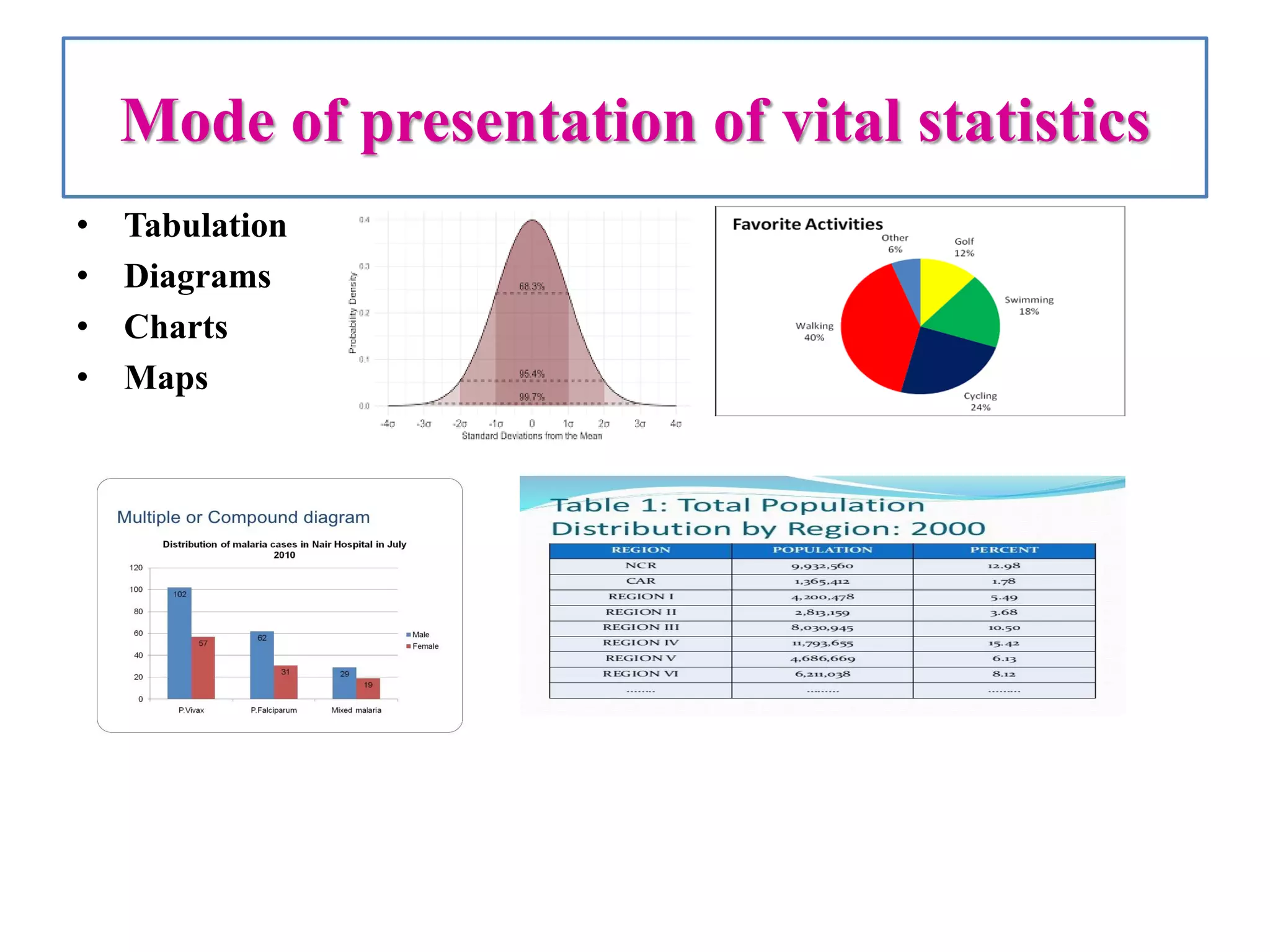
Mode of presentation of vital statistics
• Tabulation
• Diagrams
• Charts
• Maps
Responsibilities of Community health Nurse
in Vital statistics
• Collection of information regarding vital statistics in her area
• Observing the information collected by nursing and health worker under
her guiding them.
• Editing classification of data's collected by nursing and health workers
under her guide them
• Attractive presentation of the data through tables, diagram, maps according
to need
• Sending data of vital statistics to concerned official/institutions
• Analysing the data, making community diagnosis and providing treatment
• Spreading the importance of vital statistics in the community, creating
awareness regarding registration
• Having latest knowledge regarding data collection/communication
• Participation in health survey.

Vital statistics

  • 1.
    Vital statistics By Kunalsoni MSc.Nursing Community health nursing
  • 2.
    Terminology of statistics 1.Rate: • A rate is measures the occurrence of some particular event in a population during a given period of time. The event can be Births, death, diseases. • It is defined as the numerical statement of the frequency of an event obtained by dividing the number of individuals experiencing the event during a specified time period (The numerator) by the total mid year population who are capable of experiencing the event (the denominator or the population at risk) and multiply by a constant number which is usually 1,000 but it can be some other round figure such as 10,000,100,000 2. Crude rates : • Crude rate are actual observed rates based on the entire population and are not reflective of such as any specific age group or only female • for example. Crude birth rates, crude death rate
  • 3.
    Conti. 3. Specific rates: •These are actual observed rates based on specific population group such as sex and age wise group, disease wise groups or during specific time periods • For example: Annual rates, monthly rates, weekly rates 4. Ratio: • It is measure of events which expresses a relation in size between two different factors occurring in the population and it is obtained by dividing quantity of one factor with other Exp. The number of children with malnutrition with the ratio of normal children. It is expressed in the ratio of X:Y or X/Y • Exp. Male :female = Number of females Number of males
  • 4.
    Conti. 5. Mid-Year Population Alsoreferred to as the mean population, is regarded as the population at July 1 and is assumed to be the point at which half of the changes in the population during the year have occurred. This is the population estimate that is generally used as the base for the calculation of rates. Birth Rate (or crude birth rate) The number of live births per 1,000 population in a given year. Calculated by dividing the number of live births occurring in the year by the total mean (or midyear population) for that year
  • 5.
    Introduction • Vital statisticsare known by different names such as life tables, statistics regarding birth and death, essential data of life statistics. • In fact, vital statistics is a major portion of population studies or demography. • Vital statistics means numerical data regarding important incidents occurring in a community and method of analysis of this data. • Important incidents means Birth, death, marriage, diseases. Which are main indicators of health and development of community or a nation. • The most common way of collecting information on these events is through civil registration, an administrative system used by govt. to record vital events which occur in their population.
  • 6.
    Definition of Vitalstatistics “Vital statistics is data/record regarding marriage, birth, diseases and, on the basis of which community’s health and development are studied” - Benjamin “Vital statistics is the numerical description of birth, death, abortion, marriage, divorce, adoption, and judicial separation’’ - U.N.O
  • 7.
    Uses and Importanceof vital statistics General: • Legal necessity • Administrative Utility • Useful in planning • International utility • Bases of social reform Health: • Determination of health status of Individual/ community, health problems and health needs. • Making programmes for health • Improvement in administration. • Comparing the health status of one nation with others.
  • 8.
    Conti. • Evaluation ofHealth programmes • For Research related to health • For analysis of the trends of health statistics. • Life Expectancy
  • 9.
    Sources of vitalStatistics In India 1. Population census: • Ancient Literature reveals that the Population count was practiced between 600& 800BC in India . • India initiated its First census in 1881,& continued it once every 10 years • The last census of India was undertaken in 2011 and it was 15th census of India. 2. Civil registration system(SRS): • The task of “civil registration system” is recording of vital events Exp. Live birth, stillbirth, and deaths • Present registration of birth and death is being done under act,1969. • “Registration records” are useful legal documents • It’s a source of statistics.
  • 10.
    Conti. 3. Sample Registrationsystem(SRS): • It is one of the largest demographic household sample survey in the world • This was initiated in 1969-70 with the purpose of complete registration from CSR(Civil registration system) • Provide reliable annual estimates of birth, death, and infant mortality rates at the state and separately for rural and urban areas. • Some of other rates which could be elicited from this are: Child mortality(CMR),total fertility rate (TFR),Sex ratio at birth and 0-4 age ,rate of institutional deliveries, medical attention before death • From the year 2008,it also provide under 5 mortality rate.
  • 11.
    Conti. 4. Demographic samplesurveys (NSSO): • National sample survey organisation (NSSO) established in 1950 in India conducts regular Socio-economic and unemployment, health and medical services. • National sample survey organisation currently known As “National sample survey office” function under the statistics, Govt. India 5. Health surveys a. National family Health survey (NFHS): It is a large-level , multiple surveys conducted in a representative sample of household throughout India “International institute for population Sciences. "Mumbai, provide coordination and technical guidance for the survey. The multiple survey round were found by USAID, DFID, the Bill and Melinda Gates Foundation, UNICEF, UNFPA, and MOHFW,GOI
  • 12.
    Conti. Specific Goals ofNFHS: • To provide essential data on health and family welfare needed by the Ministry of Health and family Welfare and other agencies for policy and program purposes. • To provide information on important emerging health and family welfare issues. • Four rounds of the survey have been conducted so far: o NFHS-1(1992-93) o NFHS-2(1998-99) o NFHS-3(2005-2015) b. Reproductive and child health survey (DLHS-RCH): the largest ever demographic and health survey carried out in India, with a sample size of about seven lakh households covering all districts level estimates on health indicators that would assist in policy making decentralized planning and evaluation.
  • 13.
    Conti. Survey provide informationon-maternal and child, reproductive health, practice of family planning, performance of national rural Health and Accessibility and utilization of health facilities. 6. Annual Health survey: • The annual survey (AHS) is a comprehensive, representatives dataset on core vital indicators like IMR,MMR and TFR along with their co-variates of the districts to provide special attention on needy districts. 7. Concurrent Evaluation of NRHM: • Concurrent Evaluation assesses the extent of reach of NRHM activities to the rural communities and provide information for policy making and program planning.
  • 14.
    Conti. 8. Multiple indicatorCluster survey: • The Multiple Indicator cluster survey (MICS) enable all the countries to elicit statistically sound and internationally comparable data on certain indicators in the area of health, education etc. MICS is extensively used in policy making and program intervention. 9. Longitudinal Aging Study In India: • The longitudinal aging study in India (LASI) mainly focuses on the issues related to elderly populations of India on Health, Economic, and social well-being.
  • 15.
    Types of Importantvital statistics Crude Birth rate Crude Death rate Infant mortality rate Neonatal Mortality rate General Fertility Rate Maternal Mortality Rate
  • 16.
    Conti. Crude Birth Rate(CBR): •This expresses “the number of live births per thousands estimated Mid-year population in a given year” • Birth rate is not considered as a satisfactory measure of fertility because the total population is not open to fertility. Number of live birth during the year Estimated mid-year population • Subtracting the crude death rate from the crude birth rate would give the rate of natural increases, which is equal to the rate of population change in the absence of migration. But it cannot provide the true idea about the fertility of population x1000Birth rate=
  • 17.
    Conti. Crude Death rate Thisexpresses “the number of live births per thousands estimated mid year population in a given year” Crude Birth rate= 1000Number of live birth during the year Estimated mid year population
  • 18.
    Conti. Infant mortality rate(IMR): • This expresses “the ratio of Infant deaths registered in a given year to the total number of live births registered in the same year, usually expressed as rate per 1000 live births”. IMR= Number of deaths of infants in a year Number of total live births in the same year 1000
  • 19.
    Conti. Neonatal mortality Rate(NMR): •According to WHO MMR expresses “the death of women while pregnant or within 42 days of termination of pregnancy, from any cause related to or aggravated by the pregnancy or its management, but not from accidental or incidental causes” MMR= Total number of female deaths due to complication of pregnancy, child birth or within 42 days of delivery from puerperal causes during from given year Total number of live births in the same area and year 1000
  • 20.
    Conti. General fertility Rate: Thegeneral fertility (GFR) is defined as the total number of live births per 1,000 women of reproductive age (15 to 49 years) in a population per year. GFR= Number of live births in a year Mid-year married female population in the age group 15-49 years 1000
  • 21.
    Conti. Maternal mortality Rate: •According to WHO MMR expresses “the death of women while pregnant or within 42 days of termination of pregnancy, irrespective of the duration and site of pregnancy, from any cause related to or aggravated by the pregnancy or is management, but not from accidental or incidental causes” MMR= Total number of female deaths due to complication of pregnancy, child birth or within 42 days of delivery from puerperal causes during the given year Total number of live births in same area and year 1000
  • 22.
    Conti. • MMR maybe expressed per 10,000 or per 1 lakh population also .in puerperal causes, deaths in pregnancy, at the time of pregnancy or within 42 days of delivery included.
  • 23.
    Other Types Age-specific FertilityRate: The age specific fertility rate (ASFR) is defined as the annual number of births to women of a specified age per 1,000 women in that age group. ASFR is the sensitive indicator of family planning. ASFR= Number of live births in particular age group Mid year population of the same age group 1000
  • 24.
    Conti. Total Fertility Rate: •Total fertility rate(TFR) is defined as the number of children that would be born to a women if she were to live to the end of her childbearing years and bears children in accordance with current age-specific fertility rates. • Total fertility rate is the sum of the age specific birth rates(5- year age group between 15 and 49 years) for females of a specified geographic area during a specified time period multiplied by 5. • The TFR is calculated as : TFR=∑ASFRa,(For single year age group) OR • TFR= 5∑ASFRa (for 5-year age group) • Where ASFRa= age specific fertility rate for women in age group a (Expressed as a rate per women)
  • 25.
    Conti. Net reproduction rate: •Net reproduction rate (NRR) is defined as the number of daughters a new- born girl bear will bear during her life time assuming fixed age specific fertility and mortality Rates. • NRR of India is 1.171 (2015) Crude marriage rate: • The crude marriage rate is defined as the annual number of marriages per 1,000 population. • The Act, ceremony or process by which the legal relationship of husband and wife is constitute. The legality of the union may be established by civil, religious or other means as recognized by laws of each country
  • 26.
    Conti. Crude marriage rate= Accordingto demographers this is very unsatisfactory rate since the denominator comprised primarily of population that is not eligible to marry Number of marriages in the year Mid-year population 1000
  • 27.
    Conti. Pregnancy Rate andRatio: • Pregnancy rate is defined as the total number of pregnancies including live births, induced abortion and foetal deaths per 1,000 women aged 15-44 years for a specified geographical area during a specified time period Pregnancy rate= Number of resident pregnancies (live births+ induced abortion + foetal deaths) Number of women in reproductive age (15-44years) 1000
  • 28.
    Conti. Pregnancy Ratio: = (livebirths + induced abortion+ foetal deaths) Number of women in reproductive age (15-44 years)
  • 29.
    Conti. Abortion ratio: It isdefined as the number of abortion of all types in a year to number of live births over the same period. Abortion ratio= World abortion ratio is =32:100 live births. This means foe every 100 live births in the world there are 32 abortions. Abortion is refers to the termination of pregnancy from whatever cause before the foetus is capable of extra uterine life. (WHO) Number of all types of abortion Number of live births
  • 30.
    Shortcoming of Indianvital statistics • Lack of uniformity • Voluntary registration (like registration of marriage) • Incomplete information • Under registration • Lack of accuracy • Errors made by registration worker
  • 31.
    Mode of presentationof vital statistics • Tabulation • Diagrams • Charts • Maps
  • 32.
    Responsibilities of Communityhealth Nurse in Vital statistics • Collection of information regarding vital statistics in her area • Observing the information collected by nursing and health worker under her guiding them. • Editing classification of data's collected by nursing and health workers under her guide them • Attractive presentation of the data through tables, diagram, maps according to need • Sending data of vital statistics to concerned official/institutions • Analysing the data, making community diagnosis and providing treatment • Spreading the importance of vital statistics in the community, creating awareness regarding registration • Having latest knowledge regarding data collection/communication • Participation in health survey.