PRESENTED BY
MR.TUSHAR KEDAR
MSC FIRST YEAR
FAMILY WELFARE SERVICE
 DEFINITION:
 FAMILY
“Family” refers to two or more individuals who
depend on one another for emotional, physical
and economical support.”
FAMILY WELFARE SERVICE
 Introduction:
 The ministry of health and family at the centre
and states plays an important role in the
governmental effort in the delivery of health and
family welfare service to people in the country.
Cont..
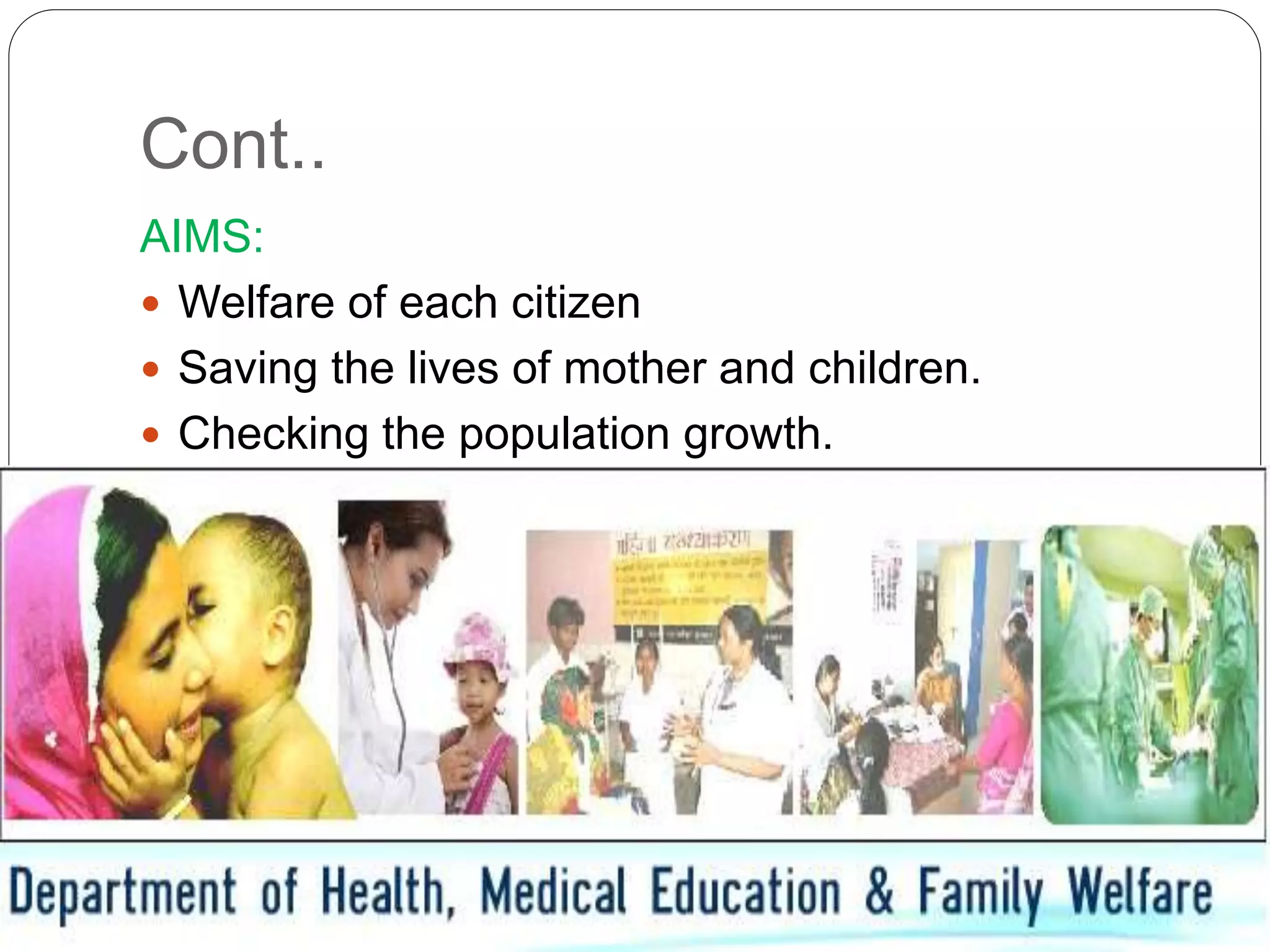
AIMS:
 Welfare of each citizen
 Saving the lives of mother and children.
 Checking the population growth.
Services render under the family welfare
are:
 Antenatal registration
 Immunization
 Screening of high risk pregnancy and follow up
 Anemia correction
 Intra natal care, emergency obstetric services,
postnatal care.
 Newborn care
 Family welfare services
Cont..
 Family planning services
 MTP services.
 Micro-surgery: recanalisation and infertility
 Cancer screening: PAP smear test facility.
The services rendered under family planning activities
may be described as below:
CLINIC SERVICES:
 MCH services
 Those who have completed their family size (2
children) are motivated to opt for a terminal
method of contraception.
 Those who wish to postpone the arrival of their
next child are advised spacing methods with due
to emphasis on oral pills or copper –T insertion.
 Tubectomies are performed at the clinics
attached to primary health center and district
hospitals.
Cont.
DOMICILIARY SERVICES:
 Education and motivation of eligible couple
individually.
 Follow up of IUD and pills users and post operative
follow up of vasectomy, Tubectomy and MTP cases.
 Domiciliary care of antenatal, natal, post-natal infant
and toddler care.
 Referral services-for those having special problem of
post-operative complications
Cont.
COMMUNITY SERVICES:
Family planning survey:
 This will comprise collective on of information (
demographic, cultural and socio-economic) about
the place and people ,preparation of village map
and household list; identification of eligible
couples ,expectant mothers ,infants and pre-
school children and collecting information about
other agencies engaged in the delivery of family
planning services.
Cont..
Identification of community leaders:
 Identification of local male and female leaders
and other influential persons in the community
and mobilizing their support and participation in
the programme implementation is an essential
factor for the success of the programme.
Cont..
 Educational activities:
 Nurses have to vital role to play in terms of
providing education and motivation for
popularizing small family norms.
 They have to explain the people that population
increase should not be viewed from the narrow
view point of economic benefits to the family.
Cont..
 Educational activities to create awareness and to
dissemination of specific information about family
planning methods and the desirability of a small
family norms among general masses are an are
import aspect of the family planning programme.
 Activities like film shows exhibitions, mass
meetings, group discussion have to be organized
in the community
CONT..
Motivational effort:
 Educational activities must be supplemented by
motivational efforts. Utilizing information from
eligible couple register ,the eligible couples
should be motivated individually and collectively.
Cont..
Maintaining adequate supplies:
 Contraceptive distribution depots should be
established in each village to ensure continuous
supply of contraceptives.
Cont..
Organizing special campaigns:
 This will include organizing intensive drives, IUD
camps, and vasectomy and Tubectomy camps
periodically to boost the target achievement.
cont.
BEYOND FAMILY PLANNING SERVICES:
 Female literacy
 Enhancing child survival and development
 Anti-poverty programs
 Old age security.
Cont..
IMPROVED PROGRAMME PLANNING
DELIVERY AND MANAGEMENT
 Upgrading technical service and follow up care
 Integrating field workers into the health care
system.
 Improve programme management
 Manpower development and training
 Monitoring ,evaluation and research
ROLE OF COMMUNITY HEALTH NURSE IN FAMILY
WELFARE:
 leadership
 He will be responsible for the proper and
successful implementation of the family welfare
services in PHC area including information,
education, communication activities motivation,
and delivery of services and after care.
Cont.
 He will be responsible for giving immediate and
sustained attention to the any complications the
acceptors develop due to acceptance of family
welfare method in his area.
 he should carefully watch the morbidity and
mortality of acceptors for immediate action.
 He will extend motivational advice and
contraceptives services ( temporary and
permanent) to all eligible couples he sees in the
clinics conducted by him at the PHC .
Cont.
 He will trained in service, operation MTP and IUD.
 He will maintain the record of training status of
PHC staff on health and family welfare.
 He will ensure adequate supplies or equipment,
drugs, contraceptive and educational materials
required for the services.
Cont.
 He will organize monthly staff meetings to review the
progress made and to discuss the problem and
future plans.
 He will development and maintain a cooperatives
work relationship with other agencies and opinion
leader in PHC area in order to generate and sustain
the family welfare movement.
 He will ensure proper and up-to-date maintenance of
eligible couple registers through spot checking.
HEALTH COMMITTEE
 BHORE COMMITTEE
 MUDALIAR COMMITTEE
 CHADAH COMMITTEE
 KARTAR SINGH COMMITTEE
 SHRIVASTAV COMMITTEE
summary
 Today we discussed regarding introduction, aims,
services under family welfare and role of nurse in
family welfare services.
conclusion
 I hope you understood my presentation and use
this knowledge at community settings.
 Assignment.
 FAMILY PLANNING METHODS.
Family welfare services

Family welfare services

  • 1.
    PRESENTED BY MR.TUSHAR KEDAR MSCFIRST YEAR FAMILY WELFARE SERVICE
  • 2.
    FAMILY WELFARE SERVICE DEFINITION:  FAMILY “Family” refers to two or more individuals who depend on one another for emotional, physical and economical support.”
  • 3.
    FAMILY WELFARE SERVICE Introduction:  The ministry of health and family at the centre and states plays an important role in the governmental effort in the delivery of health and family welfare service to people in the country.
  • 4.
    Cont.. AIMS:  Welfare ofeach citizen  Saving the lives of mother and children.  Checking the population growth.
  • 5.
    Services render underthe family welfare are:  Antenatal registration  Immunization  Screening of high risk pregnancy and follow up  Anemia correction  Intra natal care, emergency obstetric services, postnatal care.  Newborn care  Family welfare services
  • 6.
    Cont..  Family planningservices  MTP services.  Micro-surgery: recanalisation and infertility  Cancer screening: PAP smear test facility.
  • 7.
    The services renderedunder family planning activities may be described as below: CLINIC SERVICES:  MCH services  Those who have completed their family size (2 children) are motivated to opt for a terminal method of contraception.  Those who wish to postpone the arrival of their next child are advised spacing methods with due to emphasis on oral pills or copper –T insertion.  Tubectomies are performed at the clinics attached to primary health center and district hospitals.
  • 8.
    Cont. DOMICILIARY SERVICES:  Educationand motivation of eligible couple individually.  Follow up of IUD and pills users and post operative follow up of vasectomy, Tubectomy and MTP cases.  Domiciliary care of antenatal, natal, post-natal infant and toddler care.  Referral services-for those having special problem of post-operative complications
  • 9.
    Cont. COMMUNITY SERVICES: Family planningsurvey:  This will comprise collective on of information ( demographic, cultural and socio-economic) about the place and people ,preparation of village map and household list; identification of eligible couples ,expectant mothers ,infants and pre- school children and collecting information about other agencies engaged in the delivery of family planning services.
  • 10.
    Cont.. Identification of communityleaders:  Identification of local male and female leaders and other influential persons in the community and mobilizing their support and participation in the programme implementation is an essential factor for the success of the programme.
  • 11.
    Cont..  Educational activities: Nurses have to vital role to play in terms of providing education and motivation for popularizing small family norms.  They have to explain the people that population increase should not be viewed from the narrow view point of economic benefits to the family.
  • 12.
    Cont..  Educational activitiesto create awareness and to dissemination of specific information about family planning methods and the desirability of a small family norms among general masses are an are import aspect of the family planning programme.  Activities like film shows exhibitions, mass meetings, group discussion have to be organized in the community
  • 13.
    CONT.. Motivational effort:  Educationalactivities must be supplemented by motivational efforts. Utilizing information from eligible couple register ,the eligible couples should be motivated individually and collectively.
  • 14.
    Cont.. Maintaining adequate supplies: Contraceptive distribution depots should be established in each village to ensure continuous supply of contraceptives.
  • 15.
    Cont.. Organizing special campaigns: This will include organizing intensive drives, IUD camps, and vasectomy and Tubectomy camps periodically to boost the target achievement.
  • 16.
    cont. BEYOND FAMILY PLANNINGSERVICES:  Female literacy  Enhancing child survival and development  Anti-poverty programs  Old age security.
  • 17.
    Cont.. IMPROVED PROGRAMME PLANNING DELIVERYAND MANAGEMENT  Upgrading technical service and follow up care  Integrating field workers into the health care system.  Improve programme management  Manpower development and training  Monitoring ,evaluation and research
  • 18.
    ROLE OF COMMUNITYHEALTH NURSE IN FAMILY WELFARE:  leadership  He will be responsible for the proper and successful implementation of the family welfare services in PHC area including information, education, communication activities motivation, and delivery of services and after care.
  • 19.
    Cont.  He willbe responsible for giving immediate and sustained attention to the any complications the acceptors develop due to acceptance of family welfare method in his area.  he should carefully watch the morbidity and mortality of acceptors for immediate action.  He will extend motivational advice and contraceptives services ( temporary and permanent) to all eligible couples he sees in the clinics conducted by him at the PHC .
  • 20.
    Cont.  He willtrained in service, operation MTP and IUD.  He will maintain the record of training status of PHC staff on health and family welfare.  He will ensure adequate supplies or equipment, drugs, contraceptive and educational materials required for the services.
  • 21.
    Cont.  He willorganize monthly staff meetings to review the progress made and to discuss the problem and future plans.  He will development and maintain a cooperatives work relationship with other agencies and opinion leader in PHC area in order to generate and sustain the family welfare movement.  He will ensure proper and up-to-date maintenance of eligible couple registers through spot checking.
  • 22.
    HEALTH COMMITTEE  BHORECOMMITTEE  MUDALIAR COMMITTEE  CHADAH COMMITTEE  KARTAR SINGH COMMITTEE  SHRIVASTAV COMMITTEE
  • 23.
    summary  Today wediscussed regarding introduction, aims, services under family welfare and role of nurse in family welfare services.
  • 24.
    conclusion  I hopeyou understood my presentation and use this knowledge at community settings.
  • 25.
     Assignment.  FAMILYPLANNING METHODS.