


“VITAL STATISTICS”
Dr. K. RameshKumar
Assistant Professor
PG & Research Dept. of Zoology
Vivekananda College
Tiruvedakam- West
Introduction:
•Vital statistics, the most important branch of statistics, deals
with the mankind in aggregate.
•It provides a description of the vital events occurring in
given communities.
•By vital events, we mean birth, death, sickness, marriage,
divorce, fertility, etc.
•It deals with people rather than with things.
Meaning of Vital Statistics:
•Vital statistics, also known as vital events or vital records,
are an important source of demographic data.
• They explain statistically such events as births, deaths,
marriages, divorces, etc.
• According to N.B. Ryder, they “provide cumulative
summaries for successive time periods of population
movements like birth, death, migration, marriage and
marital dissolution as well as demographic and other
relevant characteristics of the individuals involved in these
events.”
•But in underdeveloped countries due to mass illiteracy and
ignorance, the registration of births, deaths, marriages,
migration, etc. is not done, especially by people living in
rural areas.
•However, in the majority of developing countries and in all
developed countries registration of vital events like births,
deaths, marriages, divorces, migrations, etc. is a
compulsory process.
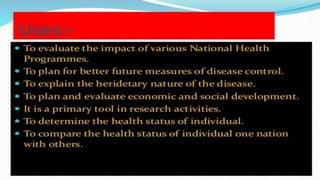
Uses of Vital Statistics:
• Vital statistics are of much importance for the people and nation.
(1) For the Individual:
• Vital statistics are of much use for an individual. A birth certificate
issued by the registering authority is an important document
which records the date, time, place and parentage of the person.
• It establishes his identity as the citizen of the country.
• It is a legal document which is used for admission to a school, for
getting a passport to travel abroad and even to migrate to another
country, etc.
• Similarly, a marriage certificate records the marital status of a
couple and legalises the birth of children from that marriage.
(2) Legal Use:
•Vital statistics are legally very useful. Certificates relating
to birth, death, marriage, divorce, etc. have legal
importance.
•For instance, a death certificate is an important legal
document for the settlement of property of the deceased
person, the claim of his/her insurance policy, etc.
(3) Health and Family Planning Programmes:
•Vital statistics relating to births and deaths can be used in
health and family planning programmes of the government.
•The causes of deaths, and the mortality rates of different
categories help in assessing the health condition of the
people.
•Accordingly, the state can formulate such health
programmes as malaria eradication, polio and small pox
immunisation, tuberculosis, etc.
• In keeping with the requirements of the population, the
government can open hospitals, maternity and child welfare
centres, etc.
(4) Study of Social Conditions:
•Vital statistics like birth and death rates, divorce rate,
widow remarriage, widowhood, etc. throw light on the
social conditions of a society, as also its customs and
traditions.
(5) For Administrators and Planners:
•Data provided by vital statistics relating to trend and growth
of population in the various age groups and on the whole,
help planners and administrators to plan and formulate
policies for public health, education, housing, transport and
communications, food supplies, etc.
(6) For the Nation:
• Vital statistics are of much importance for the nation. They help in
analysing the population trends at any given point of time.
• They try to fill the gap between two censuses. They relate to the
composition, size, distribution and growth of population.
• It is on their basis that population projections can be made.
• Vital statistics help in formulating policies for providing social
security to the people.
• Even the rules for immigration and emigration can be framed on
the basis of population growth data.
• Vital statistics are also used for updating electoral rolls and
demarcation of constituencies.
Fertility rate:
• A birth rate based on the population more closely
corresponding to the group “exposed to risk” is more
meaningful for certain purposes especially for international
inter-area comparisons.
• Since it takes cognizance of the broad age structure of the
population, this type of rate is more comparable between
geographic areas as well as over time.
• It should be noted that the age-limited birth rate and its
modifications may also be formulated in terms of the male
populations, in which case it is usual to limit the
denominator to ages 15 to 64 years.
Mortality rate:
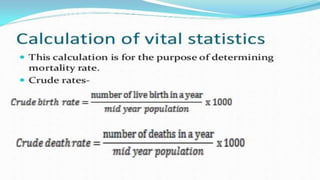
• The crude death rate which measures the decrease in a
population due to death, is the most widely used of any vital
statistics rates. This is so for two reasons.
• First, it is relatively easy to compute, requiring only total
deaths and total population.
• Second, it has a value as an index in numerous
demographic and public health problems. Within broad
limits, the crude death rate represents the chance of dying
for persons in the population.
•Crude death rates cannot be used indiscriminately for
inter-area comparisons. This is so because mortality
varies with age, among other things.
•The crude death rate, which marks all age groups, may be
misleading if the age- sex structure of the population
being compared are not similar.
THANK YOU

Vital Statistics - Uses and Importance's

  • 1.
    “VITAL STATISTICS” Dr. K.RameshKumar Assistant Professor PG & Research Dept. of Zoology Vivekananda College Tiruvedakam- West
  • 2.
    Introduction: •Vital statistics, themost important branch of statistics, deals with the mankind in aggregate. •It provides a description of the vital events occurring in given communities. •By vital events, we mean birth, death, sickness, marriage, divorce, fertility, etc. •It deals with people rather than with things.
  • 3.
    Meaning of VitalStatistics: •Vital statistics, also known as vital events or vital records, are an important source of demographic data. • They explain statistically such events as births, deaths, marriages, divorces, etc. • According to N.B. Ryder, they “provide cumulative summaries for successive time periods of population movements like birth, death, migration, marriage and marital dissolution as well as demographic and other relevant characteristics of the individuals involved in these events.”
  • 4.
    •But in underdevelopedcountries due to mass illiteracy and ignorance, the registration of births, deaths, marriages, migration, etc. is not done, especially by people living in rural areas. •However, in the majority of developing countries and in all developed countries registration of vital events like births, deaths, marriages, divorces, migrations, etc. is a compulsory process.
  • 5.
    Uses of VitalStatistics: • Vital statistics are of much importance for the people and nation. (1) For the Individual: • Vital statistics are of much use for an individual. A birth certificate issued by the registering authority is an important document which records the date, time, place and parentage of the person. • It establishes his identity as the citizen of the country. • It is a legal document which is used for admission to a school, for getting a passport to travel abroad and even to migrate to another country, etc. • Similarly, a marriage certificate records the marital status of a couple and legalises the birth of children from that marriage.
  • 6.
    (2) Legal Use: •Vitalstatistics are legally very useful. Certificates relating to birth, death, marriage, divorce, etc. have legal importance. •For instance, a death certificate is an important legal document for the settlement of property of the deceased person, the claim of his/her insurance policy, etc.
  • 7.
    (3) Health andFamily Planning Programmes: •Vital statistics relating to births and deaths can be used in health and family planning programmes of the government. •The causes of deaths, and the mortality rates of different categories help in assessing the health condition of the people. •Accordingly, the state can formulate such health programmes as malaria eradication, polio and small pox immunisation, tuberculosis, etc. • In keeping with the requirements of the population, the government can open hospitals, maternity and child welfare centres, etc.
  • 8.
    (4) Study ofSocial Conditions: •Vital statistics like birth and death rates, divorce rate, widow remarriage, widowhood, etc. throw light on the social conditions of a society, as also its customs and traditions. (5) For Administrators and Planners: •Data provided by vital statistics relating to trend and growth of population in the various age groups and on the whole, help planners and administrators to plan and formulate policies for public health, education, housing, transport and communications, food supplies, etc.
  • 9.
    (6) For theNation: • Vital statistics are of much importance for the nation. They help in analysing the population trends at any given point of time. • They try to fill the gap between two censuses. They relate to the composition, size, distribution and growth of population. • It is on their basis that population projections can be made. • Vital statistics help in formulating policies for providing social security to the people. • Even the rules for immigration and emigration can be framed on the basis of population growth data. • Vital statistics are also used for updating electoral rolls and demarcation of constituencies.
  • 12.
    Fertility rate: • Abirth rate based on the population more closely corresponding to the group “exposed to risk” is more meaningful for certain purposes especially for international inter-area comparisons. • Since it takes cognizance of the broad age structure of the population, this type of rate is more comparable between geographic areas as well as over time. • It should be noted that the age-limited birth rate and its modifications may also be formulated in terms of the male populations, in which case it is usual to limit the denominator to ages 15 to 64 years.
  • 13.
    Mortality rate: • Thecrude death rate which measures the decrease in a population due to death, is the most widely used of any vital statistics rates. This is so for two reasons. • First, it is relatively easy to compute, requiring only total deaths and total population. • Second, it has a value as an index in numerous demographic and public health problems. Within broad limits, the crude death rate represents the chance of dying for persons in the population.
  • 14.
    •Crude death ratescannot be used indiscriminately for inter-area comparisons. This is so because mortality varies with age, among other things. •The crude death rate, which marks all age groups, may be misleading if the age- sex structure of the population being compared are not similar.
  • 21.