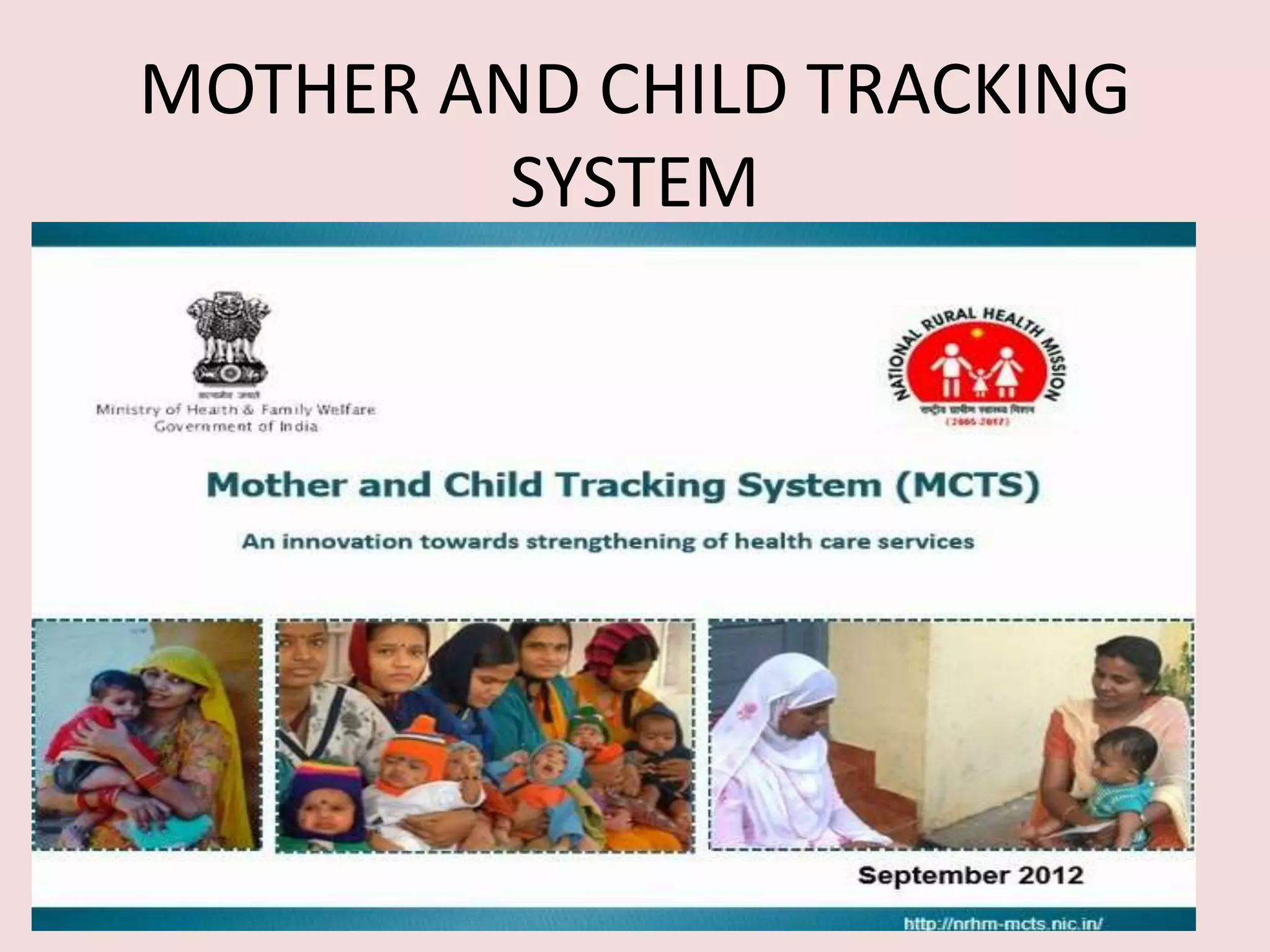
MOTHER AND CHILD TRACKING
SYSTEM
INTRODUCTION
Mother and Child Tracking System (MCTS) is
an initiative of Ministry of Health & Family Welfare
to leverage information technology for ensuring
delivery of full spectrum of healthcare and
immunization services to pregnant women and
children up to 5 years of age.
• India’s Mother and Child Tracking System (MCTS) is
an information system for tracking maternal and child
health beneficiaries in India’s public health system,
and improving service delivery planning and
outcomes.
• Among the most vulnerable populations, pregnant
women and children in resource-poor settings need
health systems that are capable of delivering timely
and quality care.
Cont.,
• At the forefront of service delivery in many Low
and Middle Income Countries (LMICs) are
Frontline Health Workers (FHWs), who are
responsible for identifying all eligible
beneficiaries within their catchment areas and
ensuring that each beneficiary receives the full
schedule of services.
Cont.,
• Generation of work plans of ANMs, sending regular
alerts to the service providers as well as beneficiaries
about the services due and a user-friendly dash board
for health managers at various levels to monitor
delivery of services will go a long way in ensuring
quality service delivery, micro birth planning, ensuring
universal immunization
Cont.,
• It will have positive impact on important health
indicators like Infant Mortality Rate and Maternal
Mortality Ratio.
• It will also help in evidence based planning and
continuous assessment of service delivery to pregnant
women and children.
OBJECTIVES:
• Registration of Pregnant Women
• Ante-Natal Care (ANC), Delivery & Post-Natal Care
(PNC) Services During the pregnancy period, MCTS
records 4 ANC services given to pregnant women and
then captures delivery details like date of delivery,
place of delivery and its outcome and then PNC
Service
• Work plan for the ANM/ASHA is generated so that
no women are left without services. • Registration of
Children for Immunization In order to give 30
immunizations to every child, she/he is registered in
MCTS application.
• Immunization Services to Children Immunization is
given to every child as per the schedule and Work
plan is generated to be consumed by ANM/ASHA
from the MCTS application so that no child is left.
Integration with other applications like PFMS, MDR,
MCTFC, Mobile Academy, Kilkari etc. Integrated with:
1.PFMS to make the DBT based JSY payments to the
beneficiary.
2.MCTs Facilitation Centre (MCTFC) to access the
quality of service being delivered in the field.
3. Kilkari Services, a dedicated IVRS platform to
educate beneficiary about the pregnancy & child care
• USSD technology to update the service live on the
MCTS portal.
• 41 Data is updated through USSD by the ANMs on
real time basis on the MCTS portal from the remotest
part of the country
National Conference Proceedings(NCP) 2019
MCTS benefit – States:
• At a Glance real time State progress report of the
entire state
• Facilitate in identification of poor performing
Districts, health facilities, SubCenters
• Graphical dashboard for pictorial representation
of the reports
• Special reports of high risk cases
• Dedicated helpdesk for feedback and suggestion
• Focused deployment of health workers & any
supplementary immunization activity planning
• Better data analysis for preparation of District
/Block health action plans
• Improved supply chain management of vaccines
and Drugs
• Effective IEC and communication with field
workers and beneficiaries
MCTS - Current Status (India):
• An Online Software for MCTS has been
developed which is available at the URL
http://nrhm-mcts.nic.in/
• Total records entered in the MCT System:
• 2.80 Crore mother records already entered since inception.
In 2012-13 total 65.2 lakh mother has already been registered in
MCT System.
Cont.,
• 2.06 Crore Child records already entered since
inception. In 2012-13 total 42.3 lakh children have
already been registered in MCT System.
Facilities reporting data related to Mother & Child:
• Correctness of Data
• Calls made to the Beneficiaries
Expectations of MOHFW
➢ 100% Registration of Pregnant Women & Children
➢ 100% timely Update of Services Delivered to Pregnant
Women & Children on MCTS Portal
➢ Use of MCTS application by all levels Health workers
➢ Service Delivery to Pregnant Women and Children ensured
➢ Work-plan generation and utilization
➢ Near Real time update of Data on MCTS
➢ Use of MCTS data for review and action-for follow up on
various schemes and programs related to RCH services.
➢ Use of MCTS data for policy formulation, micro planning at
different levels .
➢ Advice DMHO and BMHO for continuous monitoring, field
visit and taking of corrective action based on MCTS information
➢ Improve civil registration
Cont.,
• For validating the data entered in MCTS, SMS based approach has been
evolved in addition to establishing call centers at the national and State
levels.
• Messages are sent to both beneficiaries and service providers to verify
their identity as entered in MCTS.
• Registration of pregnant women Registration of children
• Since July 2016 to broaden the scope of MCH services the name of the
system has been changed to “Reproductive and Child health Portal.”
Live RCH Roll out Plan - example
➢ Beneficiaries, Health provider etc. data shifted MCTS to RCH
Portal for Pune District including PMC & PCMC Corporation
➢ Currently Block wise training held at Pune.
➢ Block data operator with One PHC ANM called with filled
information of village profile, eligible couple, pregnant women &
children information in RCH Register.
Conclusion
• Mother and Child Tracking System (MCTS) is an initiative of
Ministry of Health & Family Welfare to leverage information
technology for ensuring delivery of full spectrum of healthcare and
immunization services to pregnant women and children up to 5
years of age.
• It facilitates and monitors service delivery and also establishes a
two way communication between the service providers and
beneficiaries.

Mother and child tracking system

  • 1.
    MOTHER AND CHILDTRACKING SYSTEM
  • 2.
    INTRODUCTION Mother and ChildTracking System (MCTS) is an initiative of Ministry of Health & Family Welfare to leverage information technology for ensuring delivery of full spectrum of healthcare and immunization services to pregnant women and children up to 5 years of age.
  • 3.
    • India’s Motherand Child Tracking System (MCTS) is an information system for tracking maternal and child health beneficiaries in India’s public health system, and improving service delivery planning and outcomes. • Among the most vulnerable populations, pregnant women and children in resource-poor settings need health systems that are capable of delivering timely and quality care.
  • 4.
    Cont., • At theforefront of service delivery in many Low and Middle Income Countries (LMICs) are Frontline Health Workers (FHWs), who are responsible for identifying all eligible beneficiaries within their catchment areas and ensuring that each beneficiary receives the full schedule of services.
  • 5.
    Cont., • Generation ofwork plans of ANMs, sending regular alerts to the service providers as well as beneficiaries about the services due and a user-friendly dash board for health managers at various levels to monitor delivery of services will go a long way in ensuring quality service delivery, micro birth planning, ensuring universal immunization
  • 6.
    Cont., • It willhave positive impact on important health indicators like Infant Mortality Rate and Maternal Mortality Ratio. • It will also help in evidence based planning and continuous assessment of service delivery to pregnant women and children.
  • 7.
    OBJECTIVES: • Registration ofPregnant Women • Ante-Natal Care (ANC), Delivery & Post-Natal Care (PNC) Services During the pregnancy period, MCTS records 4 ANC services given to pregnant women and then captures delivery details like date of delivery, place of delivery and its outcome and then PNC Service
  • 8.
    • Work planfor the ANM/ASHA is generated so that no women are left without services. • Registration of Children for Immunization In order to give 30 immunizations to every child, she/he is registered in MCTS application. • Immunization Services to Children Immunization is given to every child as per the schedule and Work plan is generated to be consumed by ANM/ASHA from the MCTS application so that no child is left.
  • 9.
    Integration with otherapplications like PFMS, MDR, MCTFC, Mobile Academy, Kilkari etc. Integrated with: 1.PFMS to make the DBT based JSY payments to the beneficiary. 2.MCTs Facilitation Centre (MCTFC) to access the quality of service being delivered in the field.
  • 10.
    3. Kilkari Services,a dedicated IVRS platform to educate beneficiary about the pregnancy & child care • USSD technology to update the service live on the MCTS portal. • 41 Data is updated through USSD by the ANMs on real time basis on the MCTS portal from the remotest part of the country
  • 11.
    National Conference Proceedings(NCP)2019 MCTS benefit – States: • At a Glance real time State progress report of the entire state • Facilitate in identification of poor performing Districts, health facilities, SubCenters • Graphical dashboard for pictorial representation of the reports • Special reports of high risk cases • Dedicated helpdesk for feedback and suggestion
  • 12.
    • Focused deploymentof health workers & any supplementary immunization activity planning • Better data analysis for preparation of District /Block health action plans • Improved supply chain management of vaccines and Drugs • Effective IEC and communication with field workers and beneficiaries
  • 13.
    MCTS - CurrentStatus (India): • An Online Software for MCTS has been developed which is available at the URL http://nrhm-mcts.nic.in/ • Total records entered in the MCT System: • 2.80 Crore mother records already entered since inception. In 2012-13 total 65.2 lakh mother has already been registered in MCT System.
  • 14.
    Cont., • 2.06 CroreChild records already entered since inception. In 2012-13 total 42.3 lakh children have already been registered in MCT System. Facilities reporting data related to Mother & Child: • Correctness of Data • Calls made to the Beneficiaries
  • 16.
    Expectations of MOHFW ➢100% Registration of Pregnant Women & Children ➢ 100% timely Update of Services Delivered to Pregnant Women & Children on MCTS Portal ➢ Use of MCTS application by all levels Health workers ➢ Service Delivery to Pregnant Women and Children ensured ➢ Work-plan generation and utilization
  • 17.
    ➢ Near Realtime update of Data on MCTS ➢ Use of MCTS data for review and action-for follow up on various schemes and programs related to RCH services. ➢ Use of MCTS data for policy formulation, micro planning at different levels . ➢ Advice DMHO and BMHO for continuous monitoring, field visit and taking of corrective action based on MCTS information ➢ Improve civil registration
  • 18.
    Cont., • For validatingthe data entered in MCTS, SMS based approach has been evolved in addition to establishing call centers at the national and State levels. • Messages are sent to both beneficiaries and service providers to verify their identity as entered in MCTS. • Registration of pregnant women Registration of children • Since July 2016 to broaden the scope of MCH services the name of the system has been changed to “Reproductive and Child health Portal.”
  • 19.
    Live RCH Rollout Plan - example ➢ Beneficiaries, Health provider etc. data shifted MCTS to RCH Portal for Pune District including PMC & PCMC Corporation ➢ Currently Block wise training held at Pune. ➢ Block data operator with One PHC ANM called with filled information of village profile, eligible couple, pregnant women & children information in RCH Register.
  • 20.
    Conclusion • Mother andChild Tracking System (MCTS) is an initiative of Ministry of Health & Family Welfare to leverage information technology for ensuring delivery of full spectrum of healthcare and immunization services to pregnant women and children up to 5 years of age. • It facilitates and monitors service delivery and also establishes a two way communication between the service providers and beneficiaries.