Coordination Chemistry
1
Md. Saiful Islam
Dept. of Pharmaceutical Sciences
North South University
Facebook Group: Pharmacy Universe
2
Why We Study Descriptive Chemistry of Transition Metals?
 Transition metals are found in nature
Rocks and minerals contain transition metals
The color of many gemstones is due to the presence of
transition metal ions
 Rubies are red due to Cr
 Sapphires are blue due to presence of Fe and Ti
Many biomolecules contain transition metals that are
involved in the functions of these biomolecules
 Vitamin B12contains Co
 Hemoglobin, myoglobin, and cytochrome C contain Fe
3
 Transition metals and their compounds have many
useful applications
Fe is used to make steel and stainless steel
Ti is used to make lightweight alloys
Transition metal compounds are used as pigments
 TiO2 = white
 PbCrO4 = yellow
 Fe4[Fe(CN)6]3 (prussian blue)= blue
Transition metal compounds are used in many industrial
processes
 To understand the uses and applications of
transition metals and their compounds, we need to
understand their chemistry.
 Our focus will be on the 4th
period transition
elements.
4
Transition Metals
 General Properties
Have typical metallic properties
Not as reactive as Grp. IA, IIA metals
Have high MP’s, high BP’s, high density, and
are hard and strong
Have 1 or 2 s electrons in valence shell
Differ in # d electrons in n-1 energy level
Exhibit multiple oxidation states
5
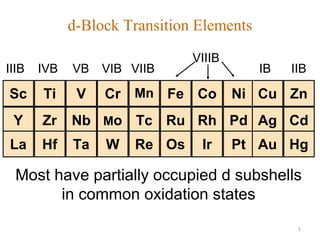
Sc Ti V Cr Mn Fe Co Ni Cu Zn
Y Zr Nb Mo Tc Ru Rh Pd Ag Cd
La Hf Ta W Re Os Ir Pt Au Hg
IIIB IVB VB VIB VIIB IB IIB
VIIIB
d-Block Transition Elements
Most have partially occupied d subshells
in common oxidation states
6
Electronic Configurations
Sc [Ar]3d1
4s2
Ti [Ar]3d2
4s2
V [Ar]3d3
4s2
Cr [Ar]3d5
4s1
Mn [Ar]3d5
4s2
Element Configuration
[Ar] = 1s2
2s2
2p6
3s2
3p6
7
Electronic Configurations
Fe [Ar] 3d6
4s2
Co [Ar] 3d7
4s2
Ni [Ar] 3d8
4s2
Cu [Ar]3d10
4s1
Zn [Ar]3d10
4s2
Element Configuration
[Ar] = 1s2
2s2
2p6
3s2
3p6
8
Transition Metals
 Characteristics due to d electrons:
Exhibit multiple oxidation states
Compounds typically have color
Exhibit interesting magnetic properties
 paramagnetism
 ferromagnetism
9
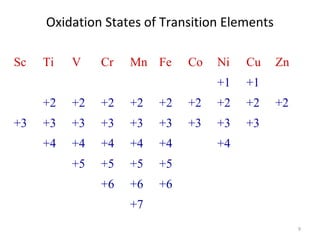
Oxidation States of Transition Elements
Sc Ti V Cr Mn Fe Co Ni Cu Zn
+1 +1
+2 +2 +2 +2 +2 +2 +2 +2 +2
+3 +3 +3 +3 +3 +3 +3 +3 +3
+4 +4 +4 +4 +4 +4
+5 +5 +5 +5
+6 +6 +6
+7
10
 Electronic configuration of Fe2+
Fe – 2e-
→ Fe2+
[Ar]3d6
4s2
[Ar]3d6
valence ns e-
’s removed
first
Electronic Configurations of Transition Metal Ions
11
 Electronic configuration of Fe3+
Fe – 3e-
→ Fe3+
[Ar]3d6
4s2
[Ar]3d5
valence ns e-
’s removed
first, then n-1 d e-
’s
Electronic Configurations of Transition Metal Ions
12
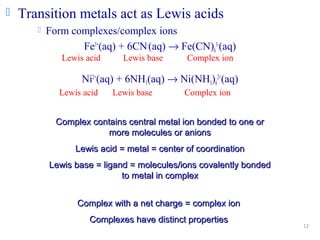
 Transition metals act as Lewis acids
 Form complexes/complex ions
Fe3+
(aq) + 6CN-
(aq) → Fe(CN)6
3-
(aq)
Ni2+
(aq) + 6NH3(aq) → Ni(NH3)6
2+
(aq)
Complex contains central metal ion bonded to one orComplex contains central metal ion bonded to one or
more molecules or anionsmore molecules or anions
Lewis acid = metal = center of coordinationLewis acid = metal = center of coordination
Lewis base = ligand = molecules/ions covalently bondedLewis base = ligand = molecules/ions covalently bonded
to metal in complexto metal in complex
Lewis acid Lewis base Complex ion
Complex with a net charge = complex ionComplex with a net charge = complex ion
Complexes have distinct propertiesComplexes have distinct properties
13
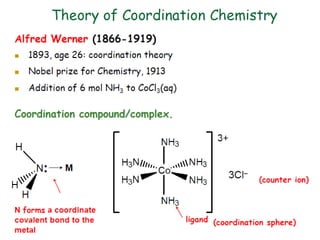
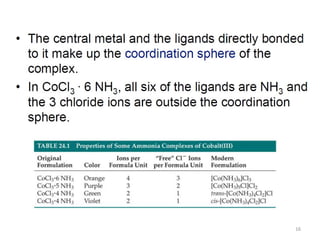
 Coordination compound
Compound that contains 1 or more complexes
Example
 [Co(NH3)6]Cl3
 [Cu(NH3)4][PtCl4]
 [Pt(NH3)2Cl2]
 Coordination sphere
Metal and ligands bound to it
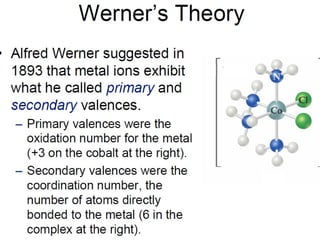
 Coordination number
number of donor atoms bonded to the central metal
atom or ion in the complex
 Most common = 4, 6
 Determined by ligands
 Larger ligands and those that transfer substantial negative charge
to metal favor lower coordination numbers
14
15
16
17
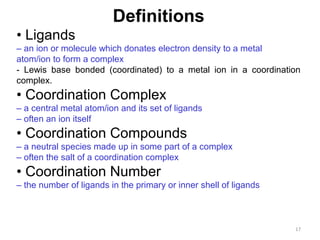
Definitions
• Ligands
– an ion or molecule which donates electron density to a metal
atom/ion to form a complex
- Lewis base bonded (coordinated) to a metal ion in a coordination
complex.
• Coordination Complex
– a central metal atom/ion and its set of ligands
– often an ion itself
• Coordination Compounds
– a neutral species made up in some part of a complex
– often the salt of a coordination complex
• Coordination Number
– the number of ligands in the primary or inner shell of ligands
18
[Fe(CN)6]3-
Complex charge = sum of charges
on the metal and the ligands
+3 6(-1)
[Co(NH3)6]Cl2
+2 6(0) 2(-1)
Neutral charge of coordination compound = sum of
charges on metal, ligands, and counterbalancing ions
19
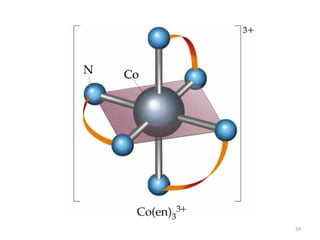
Chelation describes a particular way that ions and molecules bind
metal ions. According to the International Union of Pure and Applied
Chemistry (IUPAC), chelation involves the formation or presence of
two or more separate coordinate bonds between a polydentate
(multiple bonded) ligand and a single central atom. Usually these
ligands are organic compounds, and are called chelants, chelators,
chelating agents, or sequestering agents.
In other words, a chelating agent is a multidentate ligand.
20
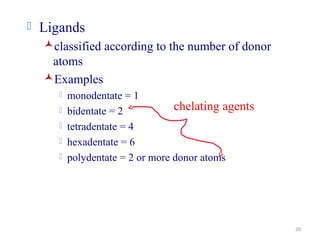
 Ligands
classified according to the number of donor
atoms
Examples
 monodentate = 1
 bidentate = 2
 tetradentate = 4
 hexadentate = 6
 polydentate = 2 or more donor atoms
chelating agents
21
 Monodentate
 Examples:
 H2O, CN-
, NH3, NO2
-
, SCN-
, OH-
, X-
(halides), CO, O2-
Example Complexes
 [Co(NH3)6]3+
 [Fe(SCN)6]3-
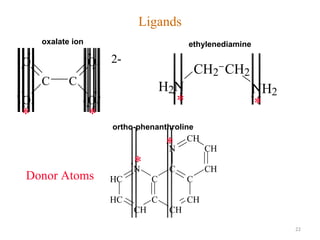
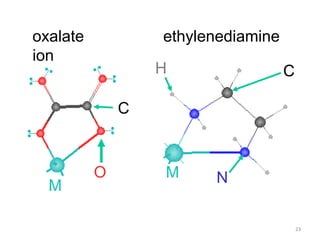
 Bidentate
Examples
 oxalate ion = C2O4
2-
 ethylenediamine (en) = NH2CH2CH2NH2
 ortho-phenanthroline (o-phen)
Example Complexes
 [Co(en)3]3+
 [Cr(C2O4)3]3-
 [Fe(NH3)4(o-phen)]3+
22
Ligands
oxalate ion ethylenediamine
CC
O
O O
O 2-
CH2
H2N
CH2
NH2
N
CH
CH
CH
CH
CHCH
HC
HC
N
C
C
C
C
ortho-phenanthroline
Donor Atoms
* *
* *
*
*
23
oxalate
ion
ethylenediamine
O
C
M
M N
CH
24
25
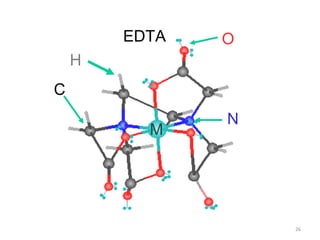
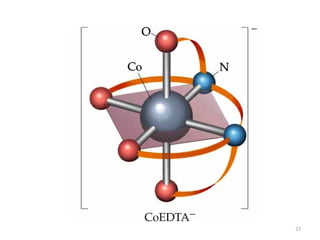
 Hexadentate
 ethylenediaminetetraacetate (EDTA) =
(O2CCH2)2N(CH2)2N(CH2CO2)2
4-
Example Complexes
 [Fe(EDTA)]-1
 [Co(EDTA)]-1
CH2N
CH2
CH2
C
C
CH2 N
CH2
CH2 C
C
O
O
O
O
O O
OO
EDTA
Donor Atoms
*
* *
*
**
26
EDTA
C
O
N
H
M
27
EDTA
28
Common Geometries of
Complexes
Linear
Coordination Number Geometry
2
Example: [Ag(NH3)2]+
29
Coordination Number Geometry
4 tetrahedral
square
planarExample: [Ni(CN)4]2-
Examples: [Zn(NH3)4]2+
, [FeCl4]-
30
Coordination Number Geometry
6
octahedral
Examples: [Co(CN)6]3-
, [Fe(en)3]3+
31
N
NH NH
N
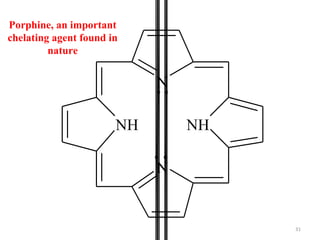
Porphine, an important
chelating agent found in
nature
32
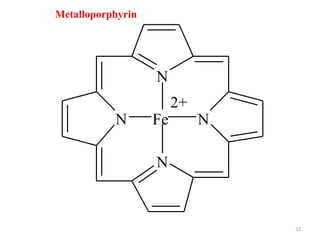
N
N N
N
Fe
2+
Metalloporphyrin
33
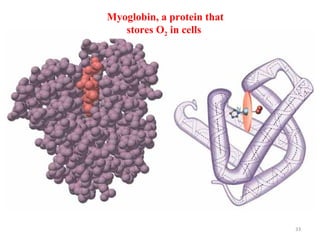
Myoglobin, a protein that
stores O2 in cells
34
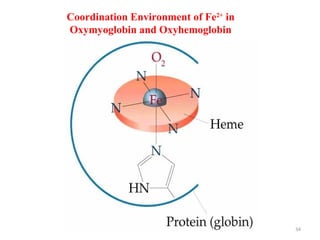
Coordination Environment of Fe2+
in
Oxymyoglobin and Oxyhemoglobin
35
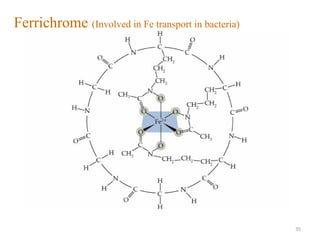
Ferrichrome (Involved in Fe transport in bacteria)

Coordination chemistry/Descriptive Chemistry /Transition Metals

  • 1.
    Coordination Chemistry 1 Md. SaifulIslam Dept. of Pharmaceutical Sciences North South University Facebook Group: Pharmacy Universe
  • 2.
    2 Why We StudyDescriptive Chemistry of Transition Metals?  Transition metals are found in nature Rocks and minerals contain transition metals The color of many gemstones is due to the presence of transition metal ions  Rubies are red due to Cr  Sapphires are blue due to presence of Fe and Ti Many biomolecules contain transition metals that are involved in the functions of these biomolecules  Vitamin B12contains Co  Hemoglobin, myoglobin, and cytochrome C contain Fe
  • 3.
    3  Transition metalsand their compounds have many useful applications Fe is used to make steel and stainless steel Ti is used to make lightweight alloys Transition metal compounds are used as pigments  TiO2 = white  PbCrO4 = yellow  Fe4[Fe(CN)6]3 (prussian blue)= blue Transition metal compounds are used in many industrial processes  To understand the uses and applications of transition metals and their compounds, we need to understand their chemistry.  Our focus will be on the 4th period transition elements.
  • 4.
    4 Transition Metals  GeneralProperties Have typical metallic properties Not as reactive as Grp. IA, IIA metals Have high MP’s, high BP’s, high density, and are hard and strong Have 1 or 2 s electrons in valence shell Differ in # d electrons in n-1 energy level Exhibit multiple oxidation states
  • 5.
    5 Sc Ti VCr Mn Fe Co Ni Cu Zn Y Zr Nb Mo Tc Ru Rh Pd Ag Cd La Hf Ta W Re Os Ir Pt Au Hg IIIB IVB VB VIB VIIB IB IIB VIIIB d-Block Transition Elements Most have partially occupied d subshells in common oxidation states
  • 6.
    6 Electronic Configurations Sc [Ar]3d1 4s2 Ti[Ar]3d2 4s2 V [Ar]3d3 4s2 Cr [Ar]3d5 4s1 Mn [Ar]3d5 4s2 Element Configuration [Ar] = 1s2 2s2 2p6 3s2 3p6
  • 7.
    7 Electronic Configurations Fe [Ar]3d6 4s2 Co [Ar] 3d7 4s2 Ni [Ar] 3d8 4s2 Cu [Ar]3d10 4s1 Zn [Ar]3d10 4s2 Element Configuration [Ar] = 1s2 2s2 2p6 3s2 3p6
  • 8.
    8 Transition Metals  Characteristicsdue to d electrons: Exhibit multiple oxidation states Compounds typically have color Exhibit interesting magnetic properties  paramagnetism  ferromagnetism
  • 9.
    9 Oxidation States ofTransition Elements Sc Ti V Cr Mn Fe Co Ni Cu Zn +1 +1 +2 +2 +2 +2 +2 +2 +2 +2 +2 +3 +3 +3 +3 +3 +3 +3 +3 +3 +4 +4 +4 +4 +4 +4 +5 +5 +5 +5 +6 +6 +6 +7
  • 10.
    10  Electronic configurationof Fe2+ Fe – 2e- → Fe2+ [Ar]3d6 4s2 [Ar]3d6 valence ns e- ’s removed first Electronic Configurations of Transition Metal Ions
  • 11.
    11  Electronic configurationof Fe3+ Fe – 3e- → Fe3+ [Ar]3d6 4s2 [Ar]3d5 valence ns e- ’s removed first, then n-1 d e- ’s Electronic Configurations of Transition Metal Ions
  • 12.
    12  Transition metalsact as Lewis acids  Form complexes/complex ions Fe3+ (aq) + 6CN- (aq) → Fe(CN)6 3- (aq) Ni2+ (aq) + 6NH3(aq) → Ni(NH3)6 2+ (aq) Complex contains central metal ion bonded to one orComplex contains central metal ion bonded to one or more molecules or anionsmore molecules or anions Lewis acid = metal = center of coordinationLewis acid = metal = center of coordination Lewis base = ligand = molecules/ions covalently bondedLewis base = ligand = molecules/ions covalently bonded to metal in complexto metal in complex Lewis acid Lewis base Complex ion Lewis acid Lewis base Complex ion Complex with a net charge = complex ionComplex with a net charge = complex ion Complexes have distinct propertiesComplexes have distinct properties
  • 13.
    13  Coordination compound Compoundthat contains 1 or more complexes Example  [Co(NH3)6]Cl3  [Cu(NH3)4][PtCl4]  [Pt(NH3)2Cl2]  Coordination sphere Metal and ligands bound to it  Coordination number number of donor atoms bonded to the central metal atom or ion in the complex  Most common = 4, 6  Determined by ligands  Larger ligands and those that transfer substantial negative charge to metal favor lower coordination numbers
  • 14.
  • 15.
  • 16.
  • 17.
    17 Definitions • Ligands – anion or molecule which donates electron density to a metal atom/ion to form a complex - Lewis base bonded (coordinated) to a metal ion in a coordination complex. • Coordination Complex – a central metal atom/ion and its set of ligands – often an ion itself • Coordination Compounds – a neutral species made up in some part of a complex – often the salt of a coordination complex • Coordination Number – the number of ligands in the primary or inner shell of ligands
  • 18.
    18 [Fe(CN)6]3- Complex charge =sum of charges on the metal and the ligands +3 6(-1) [Co(NH3)6]Cl2 +2 6(0) 2(-1) Neutral charge of coordination compound = sum of charges on metal, ligands, and counterbalancing ions
  • 19.
    19 Chelation describes aparticular way that ions and molecules bind metal ions. According to the International Union of Pure and Applied Chemistry (IUPAC), chelation involves the formation or presence of two or more separate coordinate bonds between a polydentate (multiple bonded) ligand and a single central atom. Usually these ligands are organic compounds, and are called chelants, chelators, chelating agents, or sequestering agents. In other words, a chelating agent is a multidentate ligand.
  • 20.
    20  Ligands classified accordingto the number of donor atoms Examples  monodentate = 1  bidentate = 2  tetradentate = 4  hexadentate = 6  polydentate = 2 or more donor atoms chelating agents
  • 21.
    21  Monodentate  Examples: H2O, CN- , NH3, NO2 - , SCN- , OH- , X- (halides), CO, O2- Example Complexes  [Co(NH3)6]3+  [Fe(SCN)6]3-  Bidentate Examples  oxalate ion = C2O4 2-  ethylenediamine (en) = NH2CH2CH2NH2  ortho-phenanthroline (o-phen) Example Complexes  [Co(en)3]3+  [Cr(C2O4)3]3-  [Fe(NH3)4(o-phen)]3+
  • 22.
    22 Ligands oxalate ion ethylenediamine CC O OO O 2- CH2 H2N CH2 NH2 N CH CH CH CH CHCH HC HC N C C C C ortho-phenanthroline Donor Atoms * * * * * *
  • 23.
  • 24.
  • 25.
    25  Hexadentate  ethylenediaminetetraacetate(EDTA) = (O2CCH2)2N(CH2)2N(CH2CO2)2 4- Example Complexes  [Fe(EDTA)]-1  [Co(EDTA)]-1 CH2N CH2 CH2 C C CH2 N CH2 CH2 C C O O O O O O OO EDTA Donor Atoms * * * * **
  • 26.
  • 27.
  • 28.
    28 Common Geometries of Complexes Linear CoordinationNumber Geometry 2 Example: [Ag(NH3)2]+
  • 29.
    29 Coordination Number Geometry 4tetrahedral square planarExample: [Ni(CN)4]2- Examples: [Zn(NH3)4]2+ , [FeCl4]-
  • 30.
  • 31.
    31 N NH NH N Porphine, animportant chelating agent found in nature
  • 32.
  • 33.
    33 Myoglobin, a proteinthat stores O2 in cells
  • 34.
    34 Coordination Environment ofFe2+ in Oxymyoglobin and Oxyhemoglobin
  • 35.
    35 Ferrichrome (Involved inFe transport in bacteria)