Copyright McGraw-Hill 2009 1
Chapter 22
Coordination
Chemistry
Insert picture from
First page of chapter
Copyright McGraw-Hill 2009 2
22.1 Coordination Compounds
• Coordination compounds contain
coordinate covalent bonds formed
between metal ions with groups of anions
or polar molecules.
– Metal ion – Lewis acid
– Bonded groups – Lewis base
• Complex ion – ion in which a metal cation
is covalently bound to one or more
molecules or ions
Copyright McGraw-Hill 2009 3
• Components of a coordination compound
– Complex ion (enclosed in square barckets)
– Counter ions
– Some coordination compounds do not contain
a complex ion
– Most of the metals in complexes are transition
metals
Copyright McGraw-Hill 2009 4
• Properties of transition metals
–Have incompletely filled d subshells
–Or react to form ions with incompletely
filled d subshells
• Distinctive colors
• Paramagnetism
• Catalytic activity
• Tendency to form complex ions
–Exhibit variable oxidation state
Copyright McGraw-Hill 2009 5
The Transition Metals
Transition metals shown in green box.
Copyright McGraw-Hill 2009 6
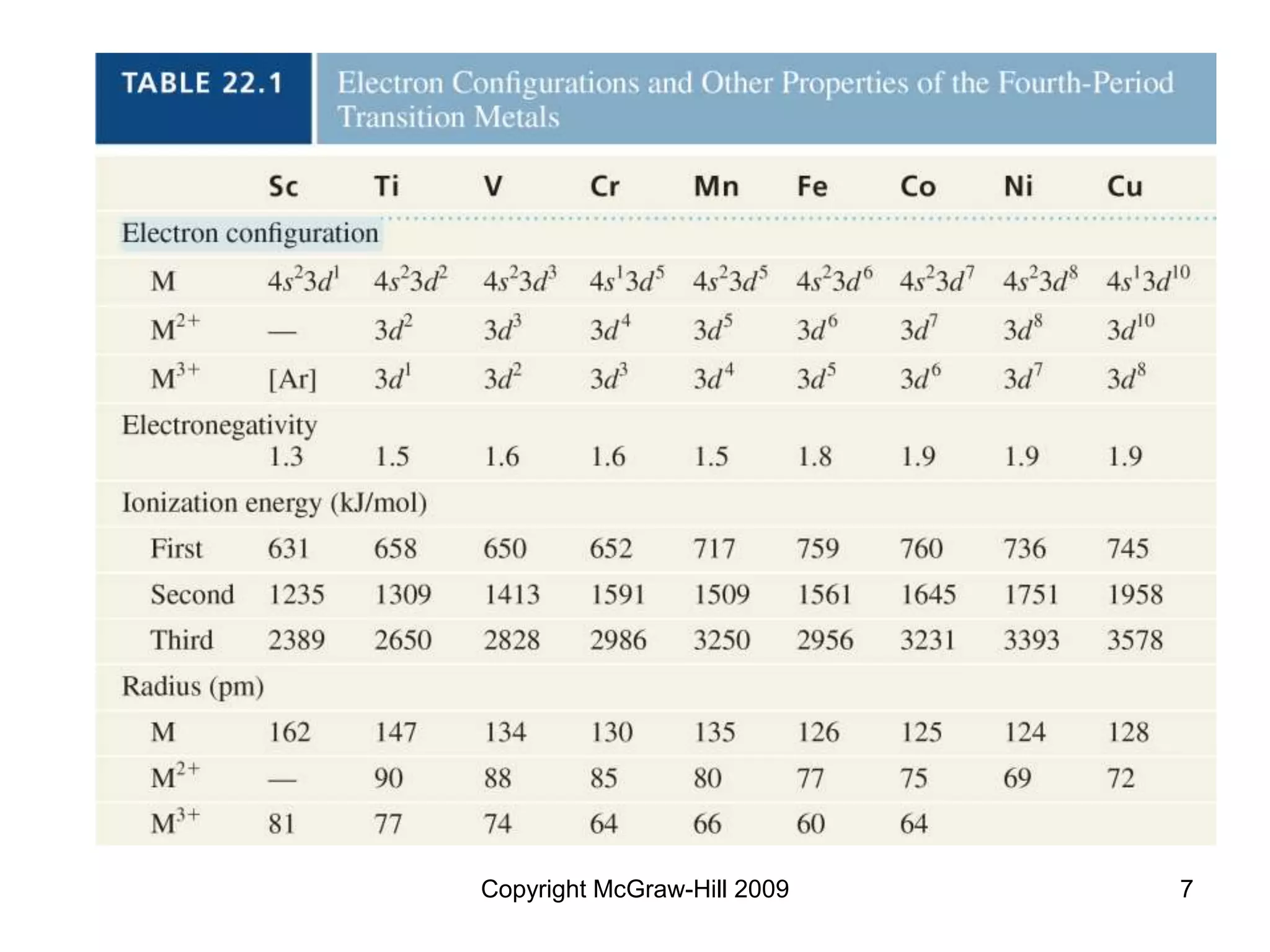
Oxidation States of the Transition Metals
Copyright McGraw-Hill 2009 7
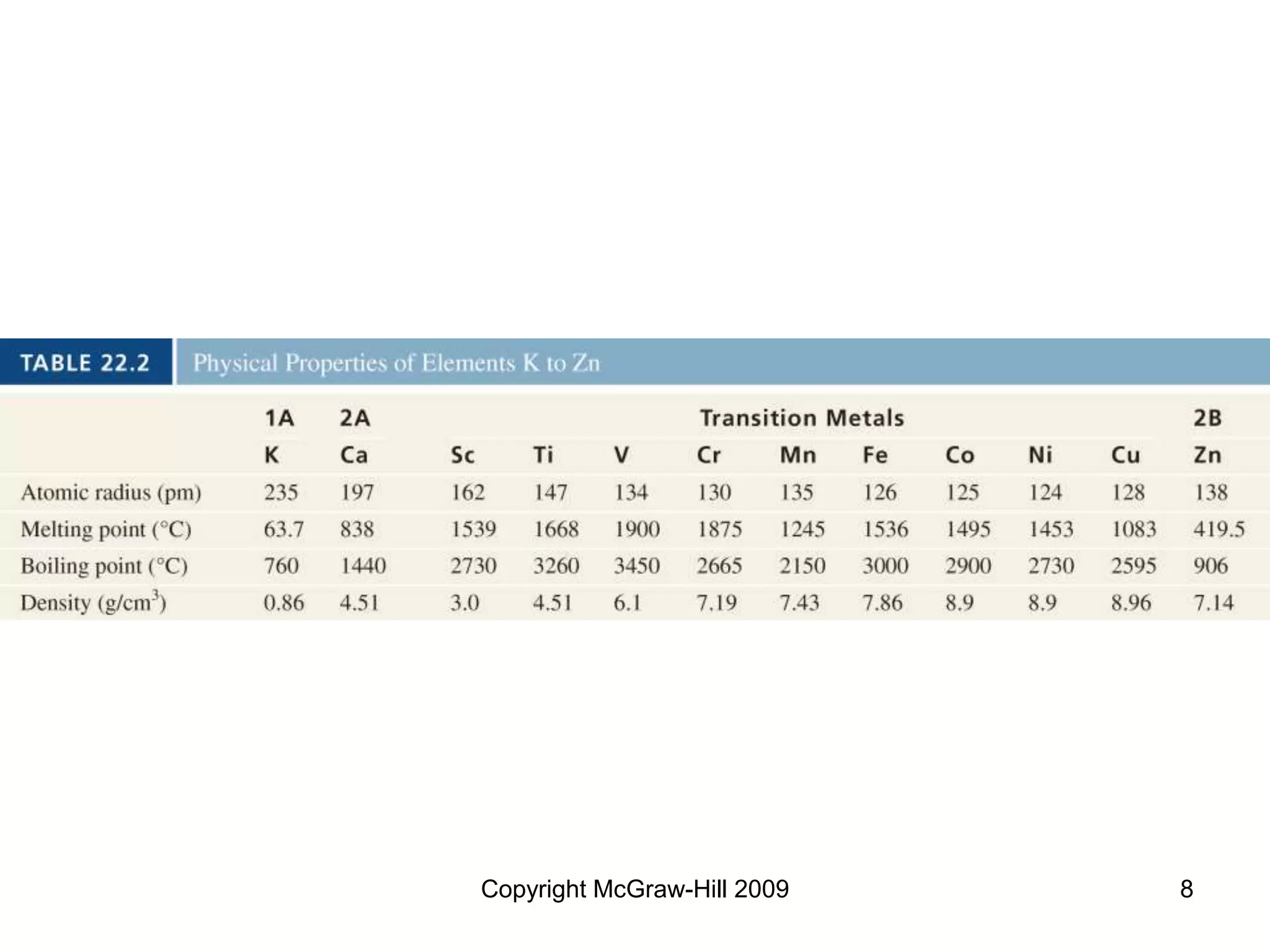
Copyright McGraw-Hill 2009 8
Copyright McGraw-Hill 2009 9
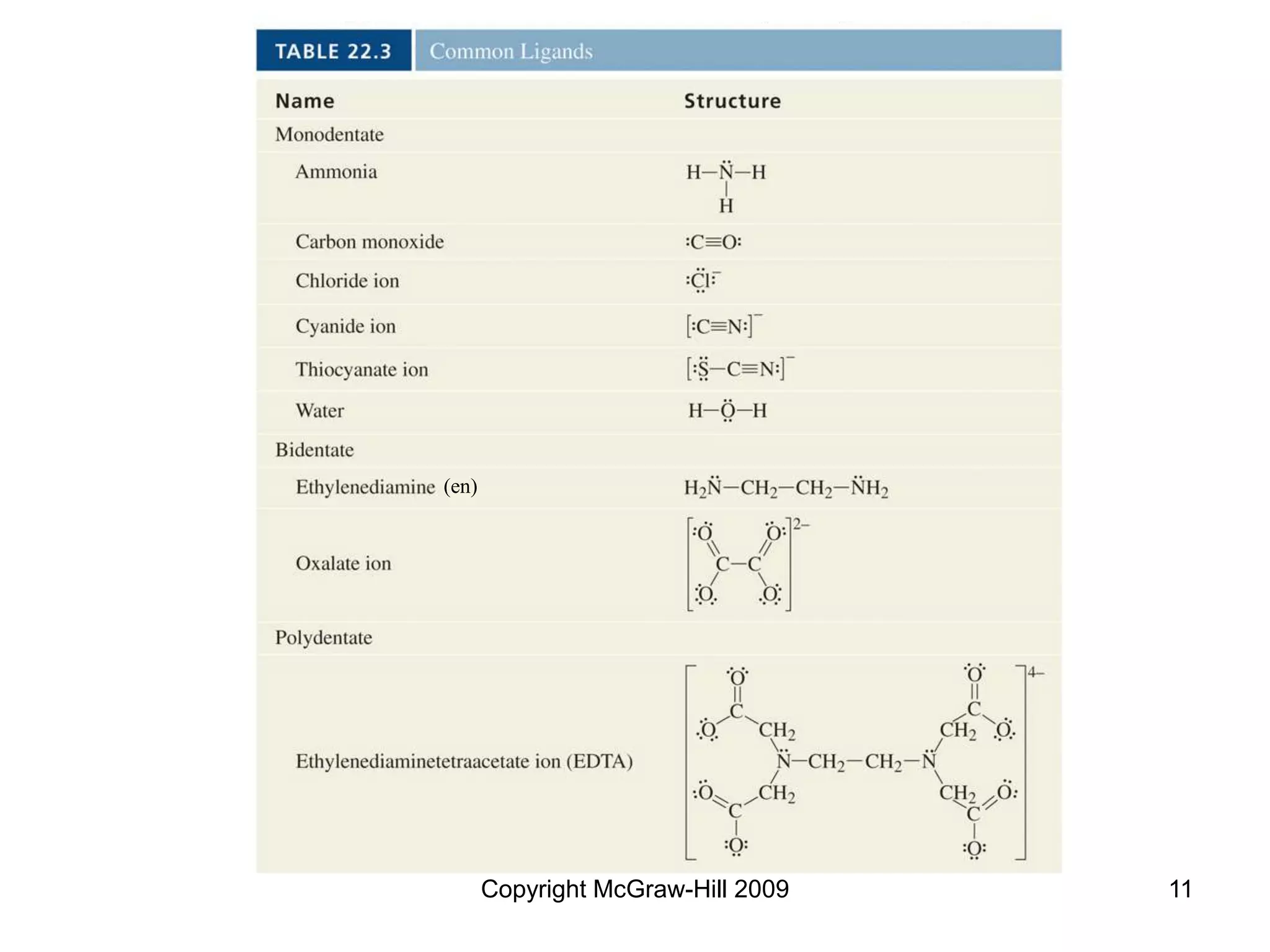
• Ligands - the molecules or ions that
surround the metal in a complex ion
– Must contain at least one unshared pair of
valence electrons
– Donor atom – atom in the ligand directly
bonded to the metal atom
Copyright McGraw-Hill 2009 10
– Coordination number – number of donor
atoms surrounding the central atom
• Common coordination numbers: 4 and 6
– Classifications of ligands
• Monodentate – 1 donor atom
• Bidentate – 2 donor atoms
• Polydentate - > 2 donor atoms
• Chelating agents – another name for bidentate or
polydentate ligands
– Overall charge on the complex ion is
determined by
• Oxidation state of the metal
• Charges on the ligands
Copyright McGraw-Hill 2009 11
(en)
Copyright McGraw-Hill 2009 12
Representations of [Co(en)3]2+
Copyright McGraw-Hill 2009 13
Representations of [Pb(EDTA)]2
Copyright McGraw-Hill 2009 14
(en)
(EDTA)
Copyright McGraw-Hill 2009 15
Determine oxidation number for the transition
metal, Au, in
K[Au(OH)4]
Copyright McGraw-Hill 2009 16
K[Au(OH)4] consists of a complex ion (the
part of the formula enclosed in square
brackets) and one K counter ion. Because
the overall charge on the compound is zero,
the complex ion is [Au(OH)4]. There are
four
ligands each with a 1 charge, making the
total negative charge  4. So the charge on
the gold ion must be +3.
Copyright McGraw-Hill 2009 17
• Nomenclature of Coordination Compounds
– The cation is named before the anion, as in
other ionic compounds.
– Within a complex ion, the ligands are named
first, in alphabetical order, and the metal ion is
named last.
– The names of anionic ligands end with the
letter o, whereas neutral ligands are usually
called by the names of the molecules. The
exceptions are H2O (aquo), CO (carbonyl),
and NH3 (ammine).
Copyright McGraw-Hill 2009 18
– When two or more of the same ligand are
present, use Greek prefixes di-, tri-, tetra-,
penta-, and hexa- to specify their number.
(Prefixes are not included in determining the
alphabetical order.) When the name of the
ligand contains a Greek prefix, a different set
of prefixes are used for the ligand: 2 = bis-, 3
= tris-, 4 = tetrakis-
– The oxidation number of the metal is indicated
in Roman numerals immediately following the
name of the metal.
– If the complex is an anion, its name ends in -
ate. (Roman numeral indicating the oxidation
state of the metal follows the suffix -ate.)
Copyright McGraw-Hill 2009 19
Give the correct name for [Cr(H2O)4Cl2]Cl.
Copyright McGraw-Hill 2009 20
Tetraaquodichlorochromium(III) chloride
[Cr(H2O)4Cl2]Cl
Copyright McGraw-Hill 2009 21
Write the formula for
tris(ethylenediamine)cobalt(III) sulfate
Copyright McGraw-Hill 2009 22
[Co(en)3]2(SO4)3
tris(ethylenediamine)cobalt(III) sulfate
Copyright McGraw-Hill 2009 23
22.2 Structure of Coordination
Compounds
• Molecular geometry – plays a significant
role in determining properties
– Structure is related to coordination number
Copyright McGraw-Hill 2009 24
Common Geometries of Complex Ions
Copyright McGraw-Hill 2009 25
• Stereoisomers
– Ligands arranged differently
– Distinctly different properties
• Type of complex ion stereoisomerism
– Geometric isomers – cannot be
interconverted without breaking chemical
bonds
• Designated as cis and trans
Copyright McGraw-Hill 2009 26
Cis and Trans Isomers of Diamminedichloroplatinum(II)
Copyright McGraw-Hill 2009 27
– Optical isomers – nonsuperimposable mirror
images
• Termed chiral
• Rotate polarized light in different directions
–Rotation to the right – dextrorotatory (d
isomer)
–Rotation to the left – levorotatory (l
isomer)
• Enantiomers – a pair of d and l isomers
• Racemic mixture – equimolar mixture of
two enantiomers
–Net rotation of polarized light is zero
Copyright McGraw-Hill 2009 28
Nonsuperimposable Mirror Images: A Common Example
Copyright McGraw-Hill 2009 29
Nonsuperimposable Mirror Images: A Chemical Example
Copyright McGraw-Hill 2009 30
Optical Isomers of Geometric Isomers
cis trans
nonsuperimposable superimposable
rotate 90o
rotate in any manner
chiral achiral
Copyright McGraw-Hill 2009 31
Operation of a Polarimeter
Copyright McGraw-Hill 2009 32
22.3 Bonding in Coordination
Compounds: Crystal Field Theory
• Crystal field theory explains the bonding in
complex ions purely in terms of
electrostatic forces.
– Attraction between the metal ion (atom) and
the ligands
– Repulsion between the lone pairs on the
ligands and the electrons in the d orbitals of
the metal
– In the absence of ligands, the d orbitals are
degenerate
Copyright McGraw-Hill 2009 33
– In the presence of ligands, electrons in d
orbitals experience different levels of
repulsion for the ligand lone pairs
– As a result (depending on the geometry)
some d orbitals attain higher energy and
others lower energy
Copyright McGraw-Hill 2009 34
– In an octahedral complex
• the electrons in the d orbitals located along
the coordinate axes experience stronger
repulsions and increase in energy
• the electrons in the d orbitals 45o from the
coordinate axes experience weaker
repulsions and decrease in energy
• The energy difference between the two
sets of orbitals is the crystal field splitting
(D)
–Depends on the nature of metal and
ligands
–Determines color and magnetic
properties
Copyright McGraw-Hill 2009 35
Crystal Field Splitting in an Octahedral Complex
Copyright McGraw-Hill 2009 36
• Color
– As with reflected light, transmitted light (i.e.,
the light that passes through the medium,
such as a solution) of selected wavelengths is
responsible for color.
• The color of observed light is the
complementary color the light absorbed.
• For example, a solution of CuSO4 absorbs
light in the orange region of the spectrum
and therefore appears blue.
Copyright McGraw-Hill 2009 37
Color Wheel: Diagonal Complementary Colors
Copyright McGraw-Hill 2009 38
– Relation to D
– The amount of energy, D, to promote an
electron from lower energy d orbitals to higher
energy d orbitals


hc
h
E 



hc
h 

D
Copyright McGraw-Hill 2009 39
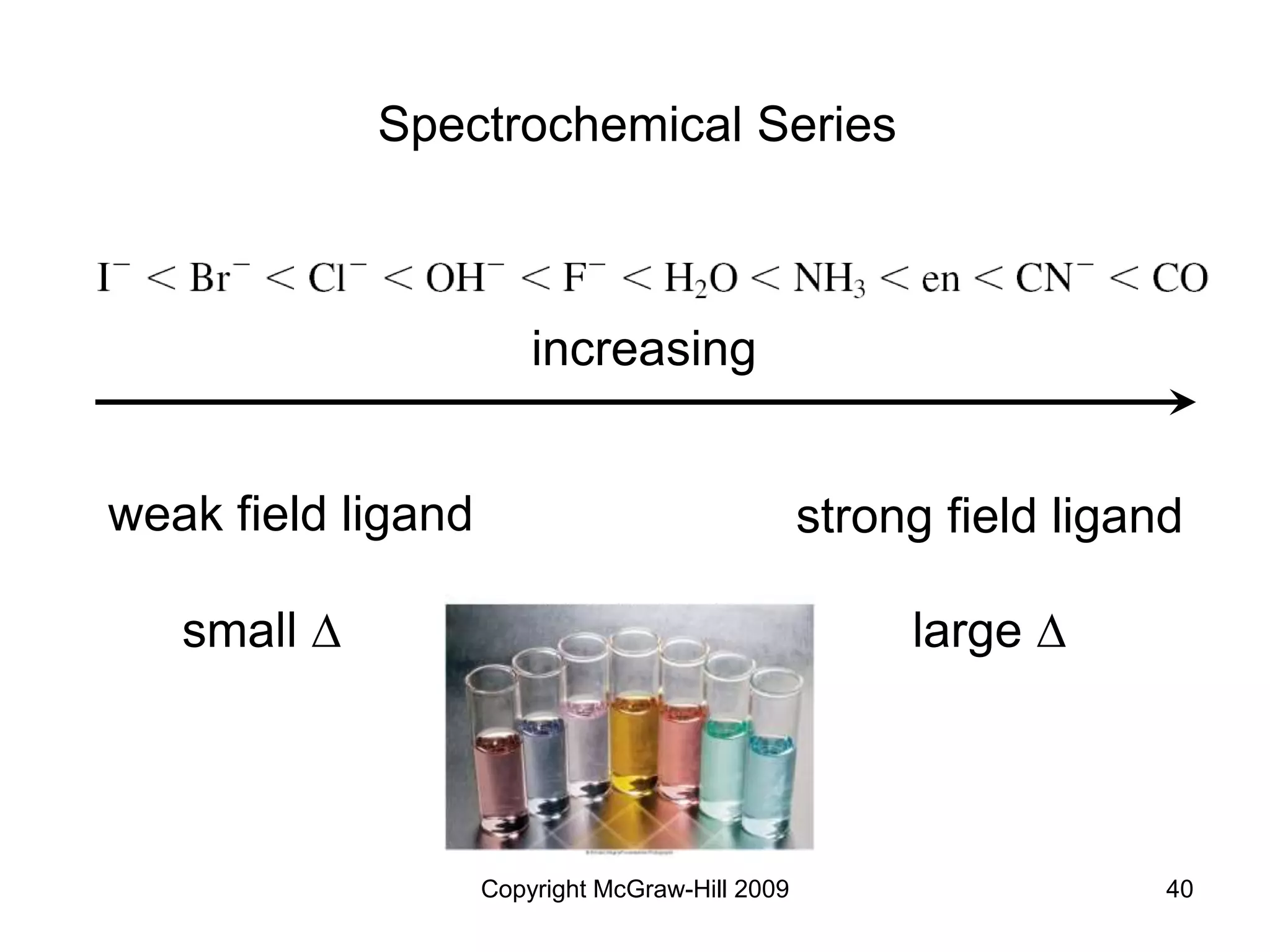
– Spectroscopic measurements of D allow an
ordering of ligands ability to split the d orbitals
called a spectrochemical series.
Copyright McGraw-Hill 2009 40
Spectrochemical Series
strong field ligand
weak field ligand
increasing
small D large D
Copyright McGraw-Hill 2009 41
• Magnetic Properties
– The magnitude of the crystal field splitting
also determines the magnetic properties of a
complex ion
– The electron configuration of the ion is a
balance between
• Energy to promote an electron to a higher
energy d orbital – related to the magnitude
of D
• Stability gained by maximum number of
unpaired spins
Copyright McGraw-Hill 2009 42
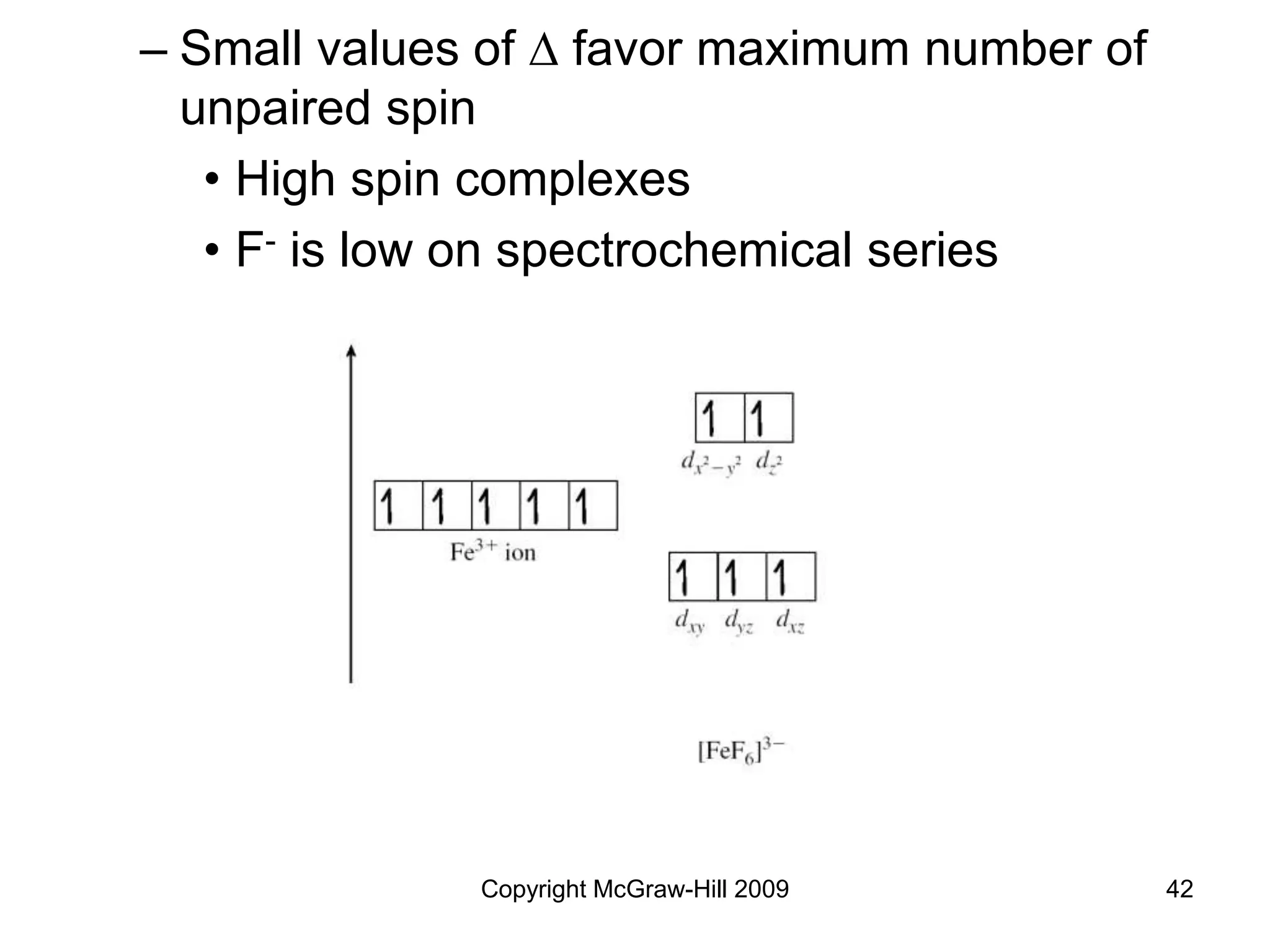
– Small values of D favor maximum number of
unpaired spin
• High spin complexes
• F- is low on spectrochemical series
Copyright McGraw-Hill 2009 43
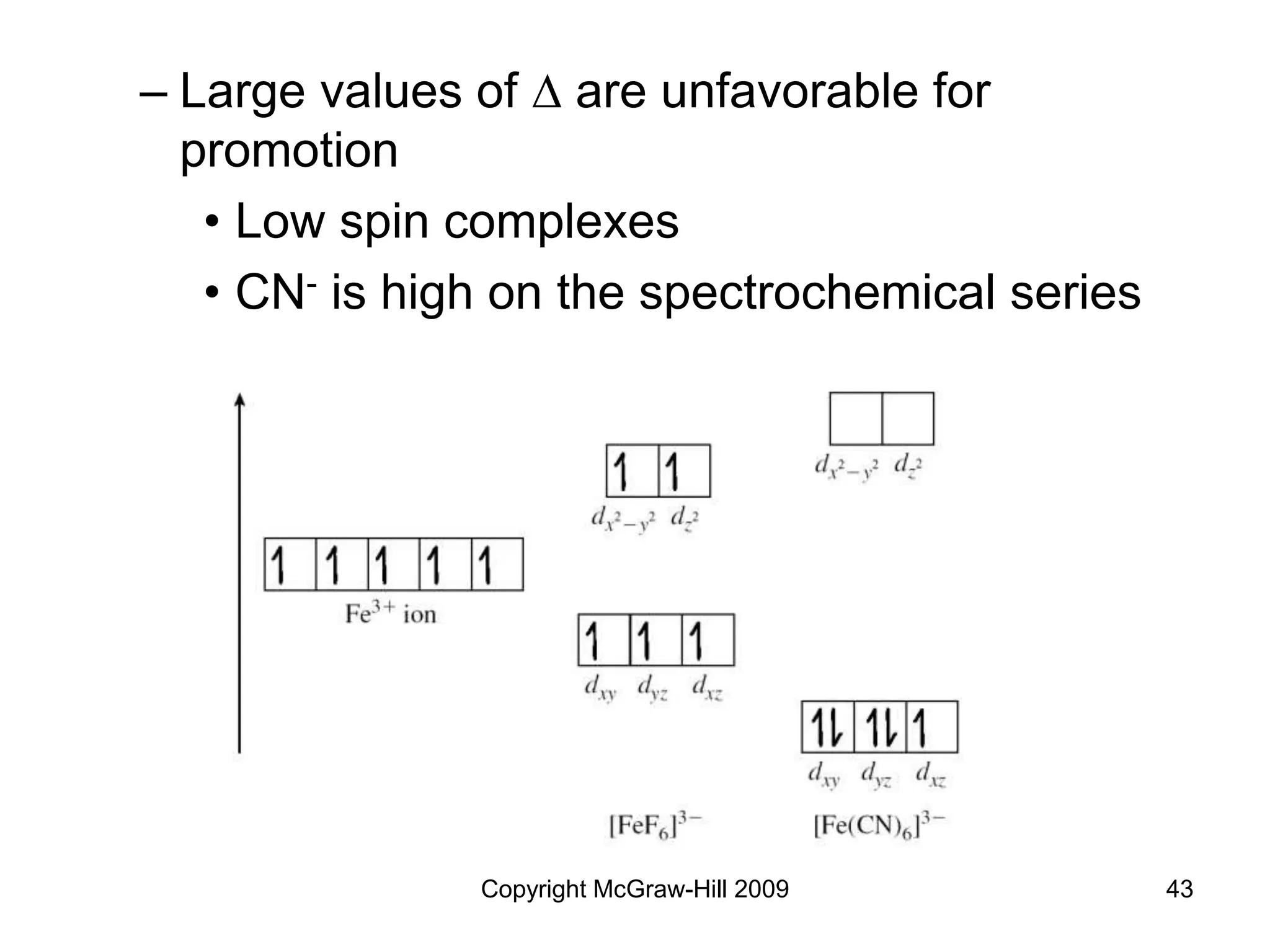
– Large values of D are unfavorable for
promotion
• Low spin complexes
• CN- is high on the spectrochemical series
Copyright McGraw-Hill 2009 44
Orbital Diagrams for Specific d Orbital Configurations
Copyright McGraw-Hill 2009 45
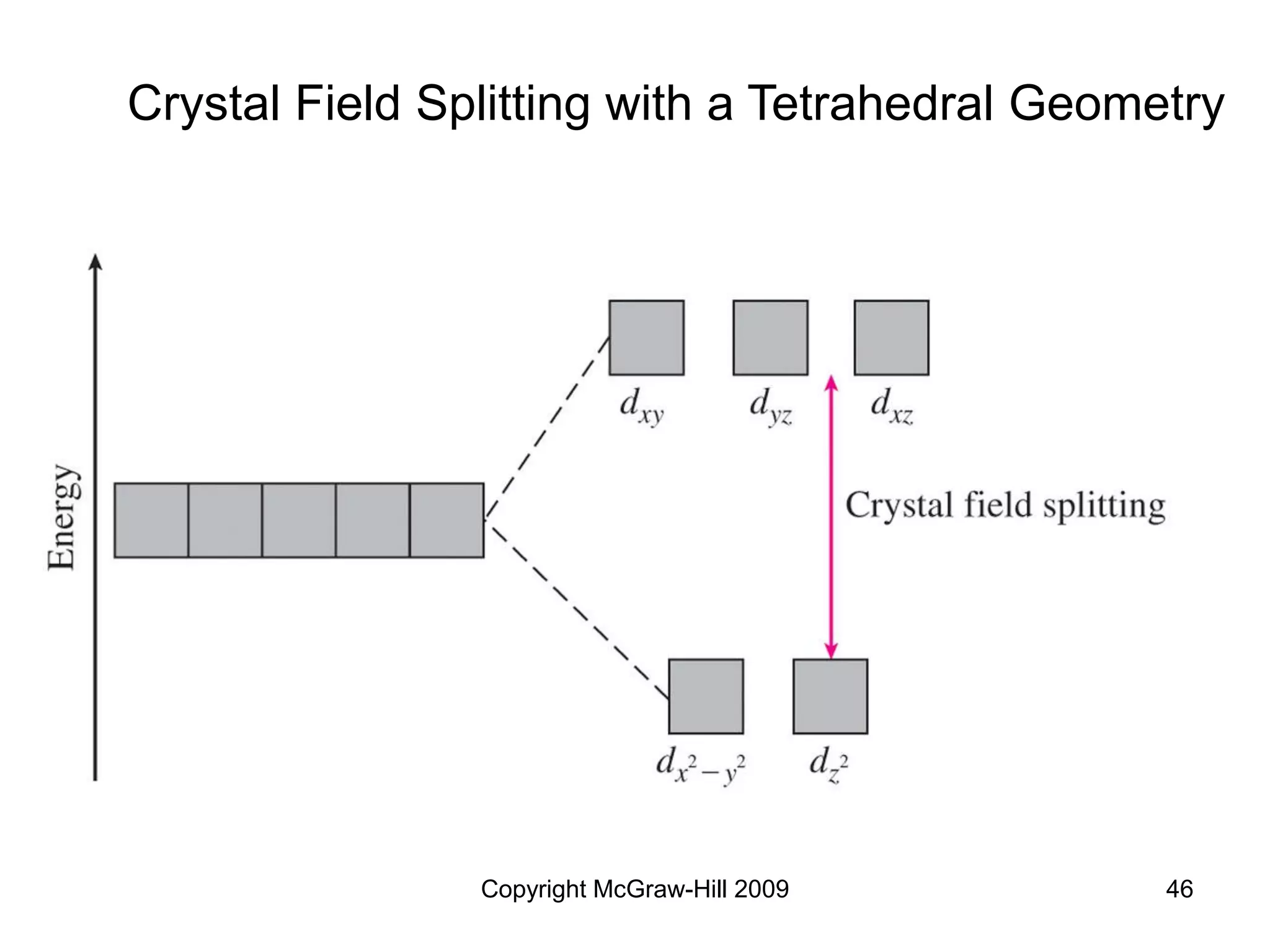
• Tetrahedral and square planar complexes
– Proximity of the ligands to d orbitals changes
with the geometry of the complex
– d electrons in orbitals more closely associated
with the lone pairs of ligand electrons attain
higher energies
– Splitting patterns reflect this repulsion
Copyright McGraw-Hill 2009 46
Crystal Field Splitting with a Tetrahedral Geometry
Copyright McGraw-Hill 2009 47
Crystal Field Splitting with a Square Planar Geometry
Copyright McGraw-Hill 2009 48
How many unpaired electrons are in [Mn(H2O)6]2+?
Hint: H2O is a weak field ligand.
Copyright McGraw-Hill 2009 49
Mn2+ has an electron configuration of
d5. Because H2O is a weak-field ligand, we
expect [Mn(H2O)6]2+ to be a high-spin
complex. All five electrons will be placed in
In separate orbitals before any pairing
occurs.There will be a total of five unpaired
spins.
Copyright McGraw-Hill 2009 50
22.4 Reactions of Coordination
Compounds
• Complex ions undergo ligand exchange
(or substitution) reactions in solution.
– Example: Exchange of NH3 with H2O
– Rates of exchange reactions vary widely
Copyright McGraw-Hill 2009 51
– Exchange reactions are characterized by
• Thermodynamic stability – measured by Kf
–Large Kf values indicate stability
–Small Kf values indicate instability
• Kinetic lability – tendency to react
–Labile complexes undergo rapid
exchange
–Inert complexes undergo slow exchange
• Thermodynmically stable complexes can
be labile or inert
Copyright McGraw-Hill 2009 52
22.5 Applications of Coordination
Compounds
• Metallurgy – extraction by complex
formation
• Chelation therapy – removal of toxins by
chelation
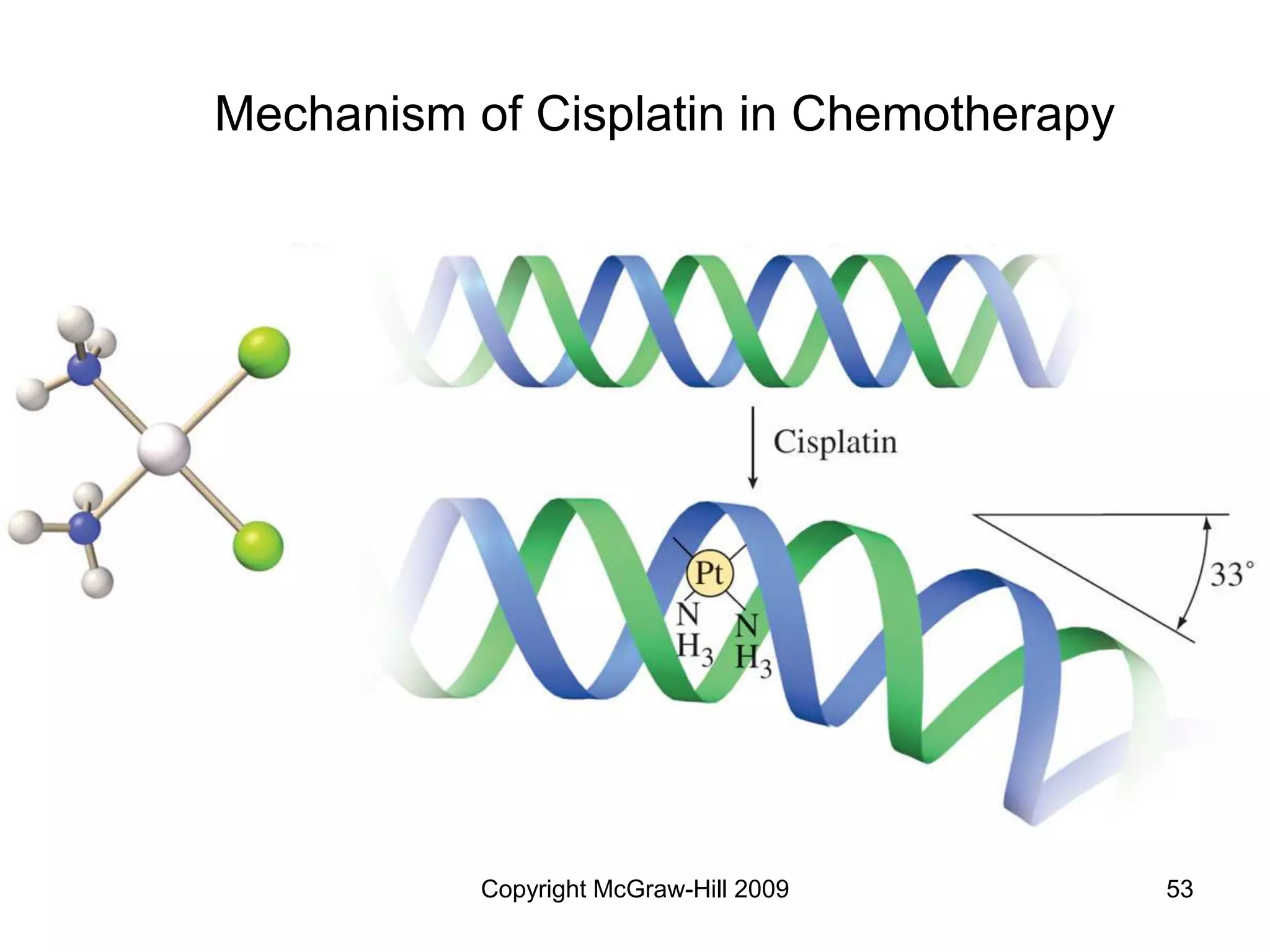
• Chemotherapy – use of complexes to
inhibit the growth of cancer cells
Copyright McGraw-Hill 2009 53
Mechanism of Cisplatin in Chemotherapy
Copyright McGraw-Hill 2009 54
• Chemical analysis – used in both
qualitative and quantitative analysis
– Example: dimethylgloxime (DMG) in nickel
analysis
Copyright McGraw-Hill 2009 55
• Detergents
– Chelating agents (tripolyphosphates) to
complex divalent ions associated with water
hardness
– Environmental impact – eutrophication from
phosphates
• Sequestrants (Example: EDTA)
– Agents to complex metal ions that catalyze
oxidation reactions in foods
Copyright McGraw-Hill 2009 56
Key Points
• Coordination Compounds
– Properties of transition metals
• d subshell configuration
• Color
• Varaible oxidation state
• Formation of complex ions
– Ligands
• Types
• Coodination number
• Chelating agents
Copyright McGraw-Hill 2009 57
– Nomenclature of coordination compounds
• Structure of coodination compounds
– Geometric isomers
– Optical isomers
• Polarimetry
• Enantiomers
• Racemic mixtures
• Bonding in coordination compounds
– Crystal field splitting
• Octahedral complexes
• Tetrahedral and Square planar complexes
Copyright McGraw-Hill 2009 58
– Color
– Magnetic properties
• Reactions of coordination compounds
– Exchange reactions
– Thermodynamic stability and kinetic lability
• Applications of coordination compounds

4910457.ppt

  • 1.
    Copyright McGraw-Hill 20091 Chapter 22 Coordination Chemistry Insert picture from First page of chapter
  • 2.
    Copyright McGraw-Hill 20092 22.1 Coordination Compounds • Coordination compounds contain coordinate covalent bonds formed between metal ions with groups of anions or polar molecules. – Metal ion – Lewis acid – Bonded groups – Lewis base • Complex ion – ion in which a metal cation is covalently bound to one or more molecules or ions
  • 3.
    Copyright McGraw-Hill 20093 • Components of a coordination compound – Complex ion (enclosed in square barckets) – Counter ions – Some coordination compounds do not contain a complex ion – Most of the metals in complexes are transition metals
  • 4.
    Copyright McGraw-Hill 20094 • Properties of transition metals –Have incompletely filled d subshells –Or react to form ions with incompletely filled d subshells • Distinctive colors • Paramagnetism • Catalytic activity • Tendency to form complex ions –Exhibit variable oxidation state
  • 5.
    Copyright McGraw-Hill 20095 The Transition Metals Transition metals shown in green box.
  • 6.
    Copyright McGraw-Hill 20096 Oxidation States of the Transition Metals
  • 7.
  • 8.
  • 9.
    Copyright McGraw-Hill 20099 • Ligands - the molecules or ions that surround the metal in a complex ion – Must contain at least one unshared pair of valence electrons – Donor atom – atom in the ligand directly bonded to the metal atom
  • 10.
    Copyright McGraw-Hill 200910 – Coordination number – number of donor atoms surrounding the central atom • Common coordination numbers: 4 and 6 – Classifications of ligands • Monodentate – 1 donor atom • Bidentate – 2 donor atoms • Polydentate - > 2 donor atoms • Chelating agents – another name for bidentate or polydentate ligands – Overall charge on the complex ion is determined by • Oxidation state of the metal • Charges on the ligands
  • 11.
  • 12.
    Copyright McGraw-Hill 200912 Representations of [Co(en)3]2+
  • 13.
    Copyright McGraw-Hill 200913 Representations of [Pb(EDTA)]2
  • 14.
  • 15.
    Copyright McGraw-Hill 200915 Determine oxidation number for the transition metal, Au, in K[Au(OH)4]
  • 16.
    Copyright McGraw-Hill 200916 K[Au(OH)4] consists of a complex ion (the part of the formula enclosed in square brackets) and one K counter ion. Because the overall charge on the compound is zero, the complex ion is [Au(OH)4]. There are four ligands each with a 1 charge, making the total negative charge  4. So the charge on the gold ion must be +3.
  • 17.
    Copyright McGraw-Hill 200917 • Nomenclature of Coordination Compounds – The cation is named before the anion, as in other ionic compounds. – Within a complex ion, the ligands are named first, in alphabetical order, and the metal ion is named last. – The names of anionic ligands end with the letter o, whereas neutral ligands are usually called by the names of the molecules. The exceptions are H2O (aquo), CO (carbonyl), and NH3 (ammine).
  • 18.
    Copyright McGraw-Hill 200918 – When two or more of the same ligand are present, use Greek prefixes di-, tri-, tetra-, penta-, and hexa- to specify their number. (Prefixes are not included in determining the alphabetical order.) When the name of the ligand contains a Greek prefix, a different set of prefixes are used for the ligand: 2 = bis-, 3 = tris-, 4 = tetrakis- – The oxidation number of the metal is indicated in Roman numerals immediately following the name of the metal. – If the complex is an anion, its name ends in - ate. (Roman numeral indicating the oxidation state of the metal follows the suffix -ate.)
  • 19.
    Copyright McGraw-Hill 200919 Give the correct name for [Cr(H2O)4Cl2]Cl.
  • 20.
    Copyright McGraw-Hill 200920 Tetraaquodichlorochromium(III) chloride [Cr(H2O)4Cl2]Cl
  • 21.
    Copyright McGraw-Hill 200921 Write the formula for tris(ethylenediamine)cobalt(III) sulfate
  • 22.
    Copyright McGraw-Hill 200922 [Co(en)3]2(SO4)3 tris(ethylenediamine)cobalt(III) sulfate
  • 23.
    Copyright McGraw-Hill 200923 22.2 Structure of Coordination Compounds • Molecular geometry – plays a significant role in determining properties – Structure is related to coordination number
  • 24.
    Copyright McGraw-Hill 200924 Common Geometries of Complex Ions
  • 25.
    Copyright McGraw-Hill 200925 • Stereoisomers – Ligands arranged differently – Distinctly different properties • Type of complex ion stereoisomerism – Geometric isomers – cannot be interconverted without breaking chemical bonds • Designated as cis and trans
  • 26.
    Copyright McGraw-Hill 200926 Cis and Trans Isomers of Diamminedichloroplatinum(II)
  • 27.
    Copyright McGraw-Hill 200927 – Optical isomers – nonsuperimposable mirror images • Termed chiral • Rotate polarized light in different directions –Rotation to the right – dextrorotatory (d isomer) –Rotation to the left – levorotatory (l isomer) • Enantiomers – a pair of d and l isomers • Racemic mixture – equimolar mixture of two enantiomers –Net rotation of polarized light is zero
  • 28.
    Copyright McGraw-Hill 200928 Nonsuperimposable Mirror Images: A Common Example
  • 29.
    Copyright McGraw-Hill 200929 Nonsuperimposable Mirror Images: A Chemical Example
  • 30.
    Copyright McGraw-Hill 200930 Optical Isomers of Geometric Isomers cis trans nonsuperimposable superimposable rotate 90o rotate in any manner chiral achiral
  • 31.
    Copyright McGraw-Hill 200931 Operation of a Polarimeter
  • 32.
    Copyright McGraw-Hill 200932 22.3 Bonding in Coordination Compounds: Crystal Field Theory • Crystal field theory explains the bonding in complex ions purely in terms of electrostatic forces. – Attraction between the metal ion (atom) and the ligands – Repulsion between the lone pairs on the ligands and the electrons in the d orbitals of the metal – In the absence of ligands, the d orbitals are degenerate
  • 33.
    Copyright McGraw-Hill 200933 – In the presence of ligands, electrons in d orbitals experience different levels of repulsion for the ligand lone pairs – As a result (depending on the geometry) some d orbitals attain higher energy and others lower energy
  • 34.
    Copyright McGraw-Hill 200934 – In an octahedral complex • the electrons in the d orbitals located along the coordinate axes experience stronger repulsions and increase in energy • the electrons in the d orbitals 45o from the coordinate axes experience weaker repulsions and decrease in energy • The energy difference between the two sets of orbitals is the crystal field splitting (D) –Depends on the nature of metal and ligands –Determines color and magnetic properties
  • 35.
    Copyright McGraw-Hill 200935 Crystal Field Splitting in an Octahedral Complex
  • 36.
    Copyright McGraw-Hill 200936 • Color – As with reflected light, transmitted light (i.e., the light that passes through the medium, such as a solution) of selected wavelengths is responsible for color. • The color of observed light is the complementary color the light absorbed. • For example, a solution of CuSO4 absorbs light in the orange region of the spectrum and therefore appears blue.
  • 37.
    Copyright McGraw-Hill 200937 Color Wheel: Diagonal Complementary Colors
  • 38.
    Copyright McGraw-Hill 200938 – Relation to D – The amount of energy, D, to promote an electron from lower energy d orbitals to higher energy d orbitals   hc h E     hc h   D
  • 39.
    Copyright McGraw-Hill 200939 – Spectroscopic measurements of D allow an ordering of ligands ability to split the d orbitals called a spectrochemical series.
  • 40.
    Copyright McGraw-Hill 200940 Spectrochemical Series strong field ligand weak field ligand increasing small D large D
  • 41.
    Copyright McGraw-Hill 200941 • Magnetic Properties – The magnitude of the crystal field splitting also determines the magnetic properties of a complex ion – The electron configuration of the ion is a balance between • Energy to promote an electron to a higher energy d orbital – related to the magnitude of D • Stability gained by maximum number of unpaired spins
  • 42.
    Copyright McGraw-Hill 200942 – Small values of D favor maximum number of unpaired spin • High spin complexes • F- is low on spectrochemical series
  • 43.
    Copyright McGraw-Hill 200943 – Large values of D are unfavorable for promotion • Low spin complexes • CN- is high on the spectrochemical series
  • 44.
    Copyright McGraw-Hill 200944 Orbital Diagrams for Specific d Orbital Configurations
  • 45.
    Copyright McGraw-Hill 200945 • Tetrahedral and square planar complexes – Proximity of the ligands to d orbitals changes with the geometry of the complex – d electrons in orbitals more closely associated with the lone pairs of ligand electrons attain higher energies – Splitting patterns reflect this repulsion
  • 46.
    Copyright McGraw-Hill 200946 Crystal Field Splitting with a Tetrahedral Geometry
  • 47.
    Copyright McGraw-Hill 200947 Crystal Field Splitting with a Square Planar Geometry
  • 48.
    Copyright McGraw-Hill 200948 How many unpaired electrons are in [Mn(H2O)6]2+? Hint: H2O is a weak field ligand.
  • 49.
    Copyright McGraw-Hill 200949 Mn2+ has an electron configuration of d5. Because H2O is a weak-field ligand, we expect [Mn(H2O)6]2+ to be a high-spin complex. All five electrons will be placed in In separate orbitals before any pairing occurs.There will be a total of five unpaired spins.
  • 50.
    Copyright McGraw-Hill 200950 22.4 Reactions of Coordination Compounds • Complex ions undergo ligand exchange (or substitution) reactions in solution. – Example: Exchange of NH3 with H2O – Rates of exchange reactions vary widely
  • 51.
    Copyright McGraw-Hill 200951 – Exchange reactions are characterized by • Thermodynamic stability – measured by Kf –Large Kf values indicate stability –Small Kf values indicate instability • Kinetic lability – tendency to react –Labile complexes undergo rapid exchange –Inert complexes undergo slow exchange • Thermodynmically stable complexes can be labile or inert
  • 52.
    Copyright McGraw-Hill 200952 22.5 Applications of Coordination Compounds • Metallurgy – extraction by complex formation • Chelation therapy – removal of toxins by chelation • Chemotherapy – use of complexes to inhibit the growth of cancer cells
  • 53.
    Copyright McGraw-Hill 200953 Mechanism of Cisplatin in Chemotherapy
  • 54.
    Copyright McGraw-Hill 200954 • Chemical analysis – used in both qualitative and quantitative analysis – Example: dimethylgloxime (DMG) in nickel analysis
  • 55.
    Copyright McGraw-Hill 200955 • Detergents – Chelating agents (tripolyphosphates) to complex divalent ions associated with water hardness – Environmental impact – eutrophication from phosphates • Sequestrants (Example: EDTA) – Agents to complex metal ions that catalyze oxidation reactions in foods
  • 56.
    Copyright McGraw-Hill 200956 Key Points • Coordination Compounds – Properties of transition metals • d subshell configuration • Color • Varaible oxidation state • Formation of complex ions – Ligands • Types • Coodination number • Chelating agents
  • 57.
    Copyright McGraw-Hill 200957 – Nomenclature of coordination compounds • Structure of coodination compounds – Geometric isomers – Optical isomers • Polarimetry • Enantiomers • Racemic mixtures • Bonding in coordination compounds – Crystal field splitting • Octahedral complexes • Tetrahedral and Square planar complexes
  • 58.
    Copyright McGraw-Hill 200958 – Color – Magnetic properties • Reactions of coordination compounds – Exchange reactions – Thermodynamic stability and kinetic lability • Applications of coordination compounds