P R E S E N T E D B Y
K . M U T H U K A N N A N
BORAZINE
Introduction:
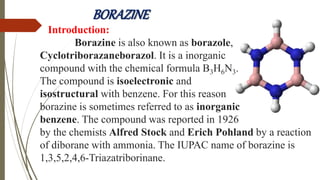
Borazine is also known as borazole,
Cyclotriborazaneborazol. It is a inorganic
compound with the chemical formula B3H6N3.
The compound is isoelectronic and
isostructural with benzene. For this reason
borazine is sometimes referred to as inorganic
benzene. The compound was reported in 1926
by the chemists Alfred Stock and Erich Pohland by a reaction
of diborane with ammonia. The IUPAC name of borazine is
1,3,5,2,4,6-Triazatriborinane.
Preparation:
Stock and Pohlands method:
By the action of NH3 on diborane in 1:2 ratio. The
adduct B2H6.NH3 is first formed, which then gets decomposed by
heating in a closed tube at 200°C.
3 B2H6 + 6 NH3 → 3[B2H6.NH3] → 2 B3H6N3 + 12 H2
Heating BCl3 with NH4Cl:
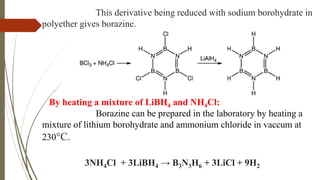
Heating boron trichloride with ammonium chloride in
chlorobenzene in the presence of Fe, Ni, or Co catalyst at 140°C
trichloroborazine is formed.
This derivative being reduced with sodium borohydrate in
polyether gives borazine.
By heating a mixture of LiBH4 and NH4Cl:
Borazine can be prepared in the laboratory by heating a
mixture of lithium borohydrate and ammonium chloride in vaccum at
230°C.
3NH4Cl + 3LiBH4 → B3N3H6 + 3LiCl + 9H2
Physical Properties:
⸙ It is a colourless volatile liquid.
⸙ Melting point is -58°C
⸙ Boiling point is 53°C
⸙ Density is 0.81g/cm3.
⸙ Molecular weight is 77.5 g/mol.
⸙ It decomposes at -80°C.
Structure:
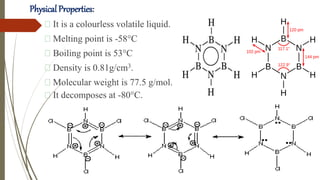
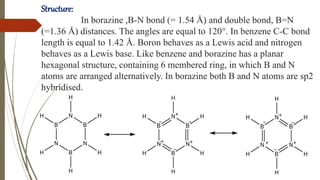
In borazine ,B-N bond (= 1.54 Å) and double bond, B=N
(=1.36 Å) distances. The angles are equal to 120°. In benzene C-C bond
length is equal to 1.42 Å. Boron behaves as a Lewis acid and nitrogen
behaves as a Lewis base. Like benzene and borazine has a planar
hexagonal structure, containing 6 membered ring, in which B and N
atoms are arranged alternatively. In borazine both B and N atoms are sp2
hybridised.
Chemical reactions :
Addition reaction:
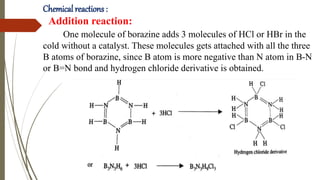
One molecule of borazine adds 3 molecules of HCl or HBr in the
cold without a catalyst. These molecules gets attached with all the three
B atoms of borazine, since B atom is more negative than N atom in B-N
or B=N bond and hydrogen chloride derivative is obtained.
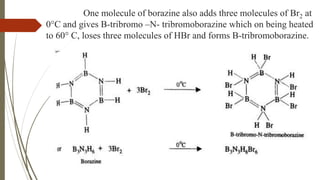
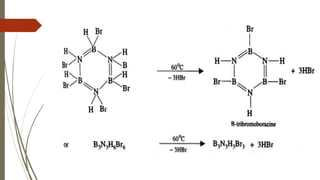
One molecule of borazine also adds three molecules of Br2 at
0°C and gives B-tribromo –N- tribromoborazine which on being heated
to 60° C, loses three molecules of HBr and forms B-tribromoborazine.
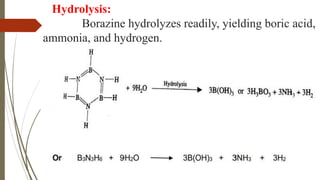
Hydrolysis:
Borazine hydrolyzes readily, yielding boric acid,
ammonia, and hydrogen.
Pyrolysis:
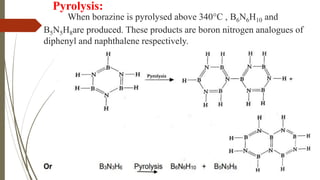
When borazine is pyrolysed above 340°C , B6N6H10 and
B5N5H8are produced. These products are boron nitrogen analogues of
diphenyl and naphthalene respectively.
Formation of adduct:
Borazine forms an adduct with methanol. This adduct undergoes pyrolysis
with the elimination of hydrogen and gives B-trimethoxy-borazine.
Polymerization:
Borazine heated at 70 °C expels hydrogen gas
with formation of polyborazylene.
n B3N3H6 → [B3N3H4]n
Applications:
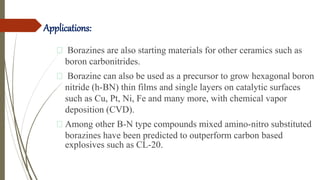
⸙ Borazines are also starting materials for other ceramics such as
boron carbonitrides.
⸙ Borazine can also be used as a precursor to grow hexagonal boron
nitride (h-BN) thin films and single layers on catalytic surfaces
such as Cu, Pt, Ni, Fe and many more, with chemical vapor
deposition (CVD).
⸙ Among other B-N type compounds mixed amino-nitro substituted
borazines have been predicted to outperform carbon based
explosives such as CL-20.
NET and GATE exam Questions:
1) BCl3 with NH4Cl gives product A which upon reduction by NaBH4 gives product
B. Product B upon reacting with HCl affords compound C, which is
a) Cl3B3N3H9
b) (ClBNH)3
c) (HBNH)3
d) (ClH)3B3N3CClH3
2) Heating mixture of NH4Cl gives one liquid product (X), along with other
products. Compound (X) is
a) NH4[BH4]
b) [(NH3)2BH2][BH4]
c) N3B3H6
d) N3B3H12
3) BCl3 and NH4Cl were reacted at 140oC to give compound X, which then
treated NaBH4 gave compound Y, X and Y ?
a) X= B3N3H6Cl3 , Y= B3N3H6
b) X= B3N3H9Cl3 , Y= B3N3H6
c) X= B3N3H9Cl3 , Y= B3N3H12
d) X= B3N3Cl6 , Y= B6N3H6
4) 3NH4Cl + BCl3 X Y ; X,Y ?
a) [HB(NH)]3, [H(OH)B(NH2)]3
b) [HB(NH)]3, [HB(NH2OH)]3
c) (NH4)(H)2(BH2)3,[H(OH)(NH2OH)]3
d) (NH4)(H)2(BH2)3, [HB(NH2OH)]3
C6H5Cl
LiBH4
3H2O
Borazine

Borazine

  • 1.
    P R ES E N T E D B Y K . M U T H U K A N N A N
  • 2.
    BORAZINE Introduction: Borazine is alsoknown as borazole, Cyclotriborazaneborazol. It is a inorganic compound with the chemical formula B3H6N3. The compound is isoelectronic and isostructural with benzene. For this reason borazine is sometimes referred to as inorganic benzene. The compound was reported in 1926 by the chemists Alfred Stock and Erich Pohland by a reaction of diborane with ammonia. The IUPAC name of borazine is 1,3,5,2,4,6-Triazatriborinane.
  • 3.
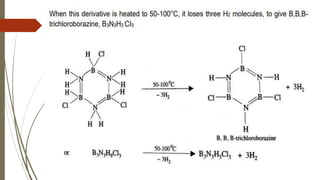
    Preparation: Stock and Pohlandsmethod: By the action of NH3 on diborane in 1:2 ratio. The adduct B2H6.NH3 is first formed, which then gets decomposed by heating in a closed tube at 200°C. 3 B2H6 + 6 NH3 → 3[B2H6.NH3] → 2 B3H6N3 + 12 H2 Heating BCl3 with NH4Cl: Heating boron trichloride with ammonium chloride in chlorobenzene in the presence of Fe, Ni, or Co catalyst at 140°C trichloroborazine is formed.
  • 4.
    This derivative beingreduced with sodium borohydrate in polyether gives borazine. By heating a mixture of LiBH4 and NH4Cl: Borazine can be prepared in the laboratory by heating a mixture of lithium borohydrate and ammonium chloride in vaccum at 230°C. 3NH4Cl + 3LiBH4 → B3N3H6 + 3LiCl + 9H2
  • 5.
    Physical Properties: ⸙ Itis a colourless volatile liquid. ⸙ Melting point is -58°C ⸙ Boiling point is 53°C ⸙ Density is 0.81g/cm3. ⸙ Molecular weight is 77.5 g/mol. ⸙ It decomposes at -80°C.
  • 6.
    Structure: In borazine ,B-Nbond (= 1.54 Å) and double bond, B=N (=1.36 Å) distances. The angles are equal to 120°. In benzene C-C bond length is equal to 1.42 Å. Boron behaves as a Lewis acid and nitrogen behaves as a Lewis base. Like benzene and borazine has a planar hexagonal structure, containing 6 membered ring, in which B and N atoms are arranged alternatively. In borazine both B and N atoms are sp2 hybridised.
  • 7.
    Chemical reactions : Additionreaction: One molecule of borazine adds 3 molecules of HCl or HBr in the cold without a catalyst. These molecules gets attached with all the three B atoms of borazine, since B atom is more negative than N atom in B-N or B=N bond and hydrogen chloride derivative is obtained.
  • 9.
    One molecule ofborazine also adds three molecules of Br2 at 0°C and gives B-tribromo –N- tribromoborazine which on being heated to 60° C, loses three molecules of HBr and forms B-tribromoborazine.
  • 11.
    Hydrolysis: Borazine hydrolyzes readily,yielding boric acid, ammonia, and hydrogen.
  • 12.
    Pyrolysis: When borazine ispyrolysed above 340°C , B6N6H10 and B5N5H8are produced. These products are boron nitrogen analogues of diphenyl and naphthalene respectively.
  • 13.
    Formation of adduct: Borazineforms an adduct with methanol. This adduct undergoes pyrolysis with the elimination of hydrogen and gives B-trimethoxy-borazine. Polymerization: Borazine heated at 70 °C expels hydrogen gas with formation of polyborazylene. n B3N3H6 → [B3N3H4]n
  • 14.
    Applications: ⸙ Borazines arealso starting materials for other ceramics such as boron carbonitrides. ⸙ Borazine can also be used as a precursor to grow hexagonal boron nitride (h-BN) thin films and single layers on catalytic surfaces such as Cu, Pt, Ni, Fe and many more, with chemical vapor deposition (CVD). ⸙ Among other B-N type compounds mixed amino-nitro substituted borazines have been predicted to outperform carbon based explosives such as CL-20.
  • 15.
    NET and GATEexam Questions: 1) BCl3 with NH4Cl gives product A which upon reduction by NaBH4 gives product B. Product B upon reacting with HCl affords compound C, which is a) Cl3B3N3H9 b) (ClBNH)3 c) (HBNH)3 d) (ClH)3B3N3CClH3 2) Heating mixture of NH4Cl gives one liquid product (X), along with other products. Compound (X) is a) NH4[BH4] b) [(NH3)2BH2][BH4] c) N3B3H6 d) N3B3H12
  • 16.
    3) BCl3 andNH4Cl were reacted at 140oC to give compound X, which then treated NaBH4 gave compound Y, X and Y ? a) X= B3N3H6Cl3 , Y= B3N3H6 b) X= B3N3H9Cl3 , Y= B3N3H6 c) X= B3N3H9Cl3 , Y= B3N3H12 d) X= B3N3Cl6 , Y= B6N3H6 4) 3NH4Cl + BCl3 X Y ; X,Y ? a) [HB(NH)]3, [H(OH)B(NH2)]3 b) [HB(NH)]3, [HB(NH2OH)]3 c) (NH4)(H)2(BH2)3,[H(OH)(NH2OH)]3 d) (NH4)(H)2(BH2)3, [HB(NH2OH)]3 C6H5Cl LiBH4 3H2O