Metal allyl complex
Done by
K. Revathi ,
20-my-14 ,
NGM College, Pollachi.
The Metal Allyl Complexes
• The allyl ligand is often referred to as an “actor” ligand rather than a
“spectator” ligand.
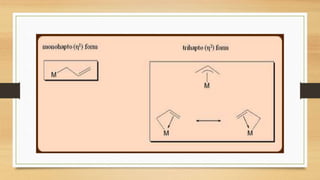
• It binds to metals in two ways i.e. in a η1 (monohapto) form and a η3
(trihapto) form .
• In its monohapto (η1) form, it behaves as an anionic 1e−donor X type of a
ligand analogous to that of a methyl moiety while
• In a trihapto (η3) form, it acts as an anionic 3e−donor LX type of a ligand.
Transition-metal allyl complexes …
• Transition-metal allyl complexes are coordination
complexes with allyl and its derivatives as ligands.
• Allyl is the radical with the connectivity CH2CHCH2, although as a
ligand it is usually viewed as an allyl anion CH2=CH−CH2
−, which
is usually described as two equivalent resonance structures.
Metal−allyl interaction
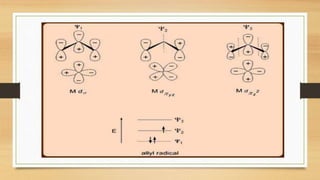
• Of particular interest are the molecular orbitals namely Ψ1, Ψ2 and Ψ3
of the allyl ligand that interact with the metal in a metal allyl complex.
• The energy of these molecular orbitals increase with the increase in the
number of nodes.
• Of the three, the Ψ1 and Ψ2 orbitals usually engage in ligand to metal
σ−donation,
• with Ψ1 involving in a dative L−type bonding and Ψ2 participating in a
covalent X−type bonding with the metal d orbitals (Figure 2).
Structure and Bonding
• In the trihapto form, the C-C distances and bond angles are
about what we'd expect, 1.35 to 1.40 Angstroms (comparable to
that in ferrocene, for example) with a C-C-C angle of 120
degrees.
• The two C-C bonds are usually the same length, but there are
some exceptions, particularly when strongly pi-bonding ligands
are trans to the allyl ligand.
Structure and Bonding…
• The plane of the allyl ligand is typically tilted away from perpendicular
to maximize orbital overlap. Krüger et. al. (Organometallics 1985, 4,
285) report on the neutron diffraction structure of an allyl complex.
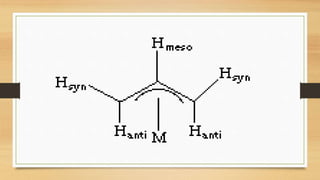
• They found that Hmeso and Hsyn are bent towards the metal (7 and 13
degrees from planar) while Hanti is bent 31 degrees away.
• In this particular example, the Ni-C1 and Ni-C3 distances are
approximately 2.03 Angstroms and Ni-C2 is 1.98 Angstroms
Spectroscopic Features of Allyl Ligands
• The static 1 NMR structure of a typical trihapto allyl has
Hanti at 1 - 3 ppm, Hsyn at 2 - 5 ppm and Hmeso around 4 - 6.5
ppm.
• There is no syn-anti proton-proton coupling. In the 13C
NMR, the terminal carbons appear between 80 - 90 ppm and
the central carbon from 110-130 ppm.
Synthesisof the metal allyl complexes
• The metal allyl complexes are synthesized by the
following methods.
i.From an alkene complex as shown below.
II. By a nucleophilic attack of an allyl
compound as shown below.
iii. By an electrophilic attack of an allyl
compound as shown below
iv. From a diene complex as shown
below.
Reactions of metal allyl
complexes
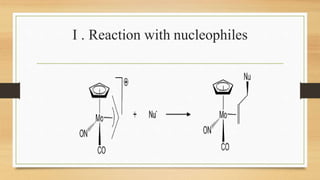
I . Reaction with nucleophiles
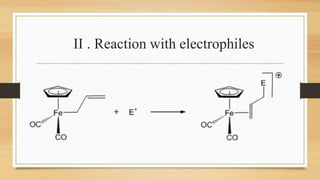
II . Reaction with electrophiles
III . Insertion reaction
IV. Reductive elimination
Application
• In terms of applications, a popular allyl complex is allyl
palladium chloride.
• Allyl ligands are susceptible to nucleophilic addition,
which can be useful in organic synthesis.
Conclusion…
• Allyl metal is an important class of σ−donor/π−acceptor
ligands that occupy a special place in organometallic chemistry.
• The complexes of these ligands with metals are important
intermediates in many catalytic cycles and hence an
understanding of their interaction with metal is of significant
importance
  Metal allyl   comples

Metal allyl comples

  • 1.
    Metal allyl complex Doneby K. Revathi , 20-my-14 , NGM College, Pollachi.
  • 2.
    The Metal AllylComplexes • The allyl ligand is often referred to as an “actor” ligand rather than a “spectator” ligand. • It binds to metals in two ways i.e. in a η1 (monohapto) form and a η3 (trihapto) form . • In its monohapto (η1) form, it behaves as an anionic 1e−donor X type of a ligand analogous to that of a methyl moiety while • In a trihapto (η3) form, it acts as an anionic 3e−donor LX type of a ligand.
  • 4.
    Transition-metal allyl complexes… • Transition-metal allyl complexes are coordination complexes with allyl and its derivatives as ligands. • Allyl is the radical with the connectivity CH2CHCH2, although as a ligand it is usually viewed as an allyl anion CH2=CH−CH2 −, which is usually described as two equivalent resonance structures.
  • 6.
    Metal−allyl interaction • Ofparticular interest are the molecular orbitals namely Ψ1, Ψ2 and Ψ3 of the allyl ligand that interact with the metal in a metal allyl complex. • The energy of these molecular orbitals increase with the increase in the number of nodes. • Of the three, the Ψ1 and Ψ2 orbitals usually engage in ligand to metal σ−donation, • with Ψ1 involving in a dative L−type bonding and Ψ2 participating in a covalent X−type bonding with the metal d orbitals (Figure 2).
  • 8.
    Structure and Bonding •In the trihapto form, the C-C distances and bond angles are about what we'd expect, 1.35 to 1.40 Angstroms (comparable to that in ferrocene, for example) with a C-C-C angle of 120 degrees. • The two C-C bonds are usually the same length, but there are some exceptions, particularly when strongly pi-bonding ligands are trans to the allyl ligand.
  • 9.
    Structure and Bonding… •The plane of the allyl ligand is typically tilted away from perpendicular to maximize orbital overlap. Krüger et. al. (Organometallics 1985, 4, 285) report on the neutron diffraction structure of an allyl complex. • They found that Hmeso and Hsyn are bent towards the metal (7 and 13 degrees from planar) while Hanti is bent 31 degrees away. • In this particular example, the Ni-C1 and Ni-C3 distances are approximately 2.03 Angstroms and Ni-C2 is 1.98 Angstroms
  • 11.
    Spectroscopic Features ofAllyl Ligands • The static 1 NMR structure of a typical trihapto allyl has Hanti at 1 - 3 ppm, Hsyn at 2 - 5 ppm and Hmeso around 4 - 6.5 ppm. • There is no syn-anti proton-proton coupling. In the 13C NMR, the terminal carbons appear between 80 - 90 ppm and the central carbon from 110-130 ppm.
  • 12.
    Synthesisof the metalallyl complexes • The metal allyl complexes are synthesized by the following methods. i.From an alkene complex as shown below.
  • 13.
    II. By anucleophilic attack of an allyl compound as shown below.
  • 14.
    iii. By anelectrophilic attack of an allyl compound as shown below
  • 15.
    iv. From adiene complex as shown below.
  • 16.
    Reactions of metalallyl complexes
  • 17.
    I . Reactionwith nucleophiles
  • 18.
    II . Reactionwith electrophiles
  • 19.
  • 20.
  • 21.
    Application • In termsof applications, a popular allyl complex is allyl palladium chloride. • Allyl ligands are susceptible to nucleophilic addition, which can be useful in organic synthesis.
  • 22.
    Conclusion… • Allyl metalis an important class of σ−donor/π−acceptor ligands that occupy a special place in organometallic chemistry. • The complexes of these ligands with metals are important intermediates in many catalytic cycles and hence an understanding of their interaction with metal is of significant importance