Faculty of Engineering
Mechanical Engineering Department
Lecture No. (6)
‫معدات‬ ‫و‬ ‫أساليب‬‫تشغيل‬(1)
Machining Techniques & Equipments (1)
Dr. Rania Mostafa
Shaping & Planing processes
Outline
 Introduction
Operations on shaping machine
 Advantages of shaper
Shaper limitations
 Principal parts of shaper
 Principal of working
 Quick return mechanism
 Specifications of shaping machine
 Feed drive mechanism
 Shaper tool materials, shape and size
 Shaper cutting tool terminologies
 Cutting motions
 Cutting speed, feed and depth of cut
 Machining time calculations
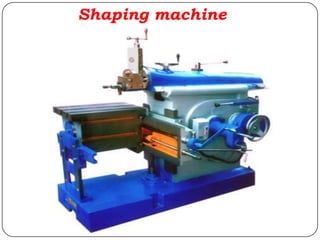
Shaping machine
INTRODUCTION
Shaper is defined as a process for removing metal
surfaces in horizontal, vertical and angular planes by
the use of a single point cutting tool held on the ram
that reciprocates the tool.
Machine Features:
Single point cutting tool is used for machining. Tool is
clamped in the tool post mounted on the ram of the
machine.
The ram reciprocates to and for, tool cuts the material in
the forward stroke, No cutting during return (back) stroke.
Job is held rigidly in a vise.
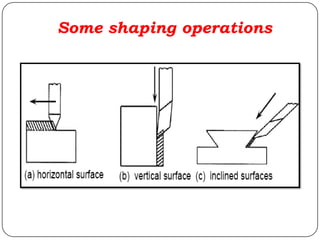
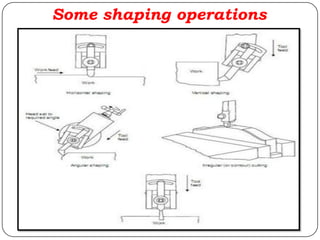
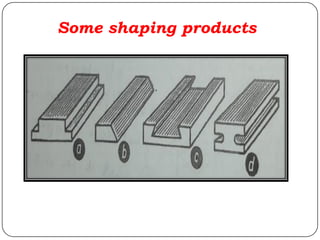
The Shaper is a machine tool used
primarily for:
Producing a flat or plane surface which
may be in a horizontal, a vertical or an
angular plane.
 Making slots, grooves and keyways.
 Producing contour of concave/convex or
a combination of these.
Operations on Shaper
Some shaping operations
Some shaping products
Shaping machine
Advantages Of Shapers
The single point cutting tools used in shapers
are inexpensive, these tools can be easily
grounded to any desirable shape.
The simplicity and ease of holding work, its
easy adjustment, and the simple tool give the
shaper its great flexibility.
Shaper set up is very quick and easy and can
be readily changed from one job to another.
Thin or fragile jobs can be conveniently
machined on shapers because of lower cutting
forces.
 The shaper is unsuitable for generating flat
surfaces on very large parts because of the
limitations on the stroke and overhang the ram
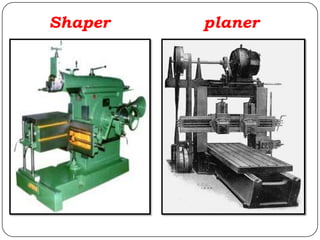
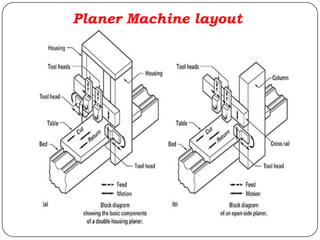
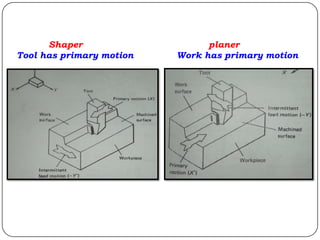
 Planer solved this problem by applying the
linear primary motion to the work-piece and
feeding the tool at right angles to this motion.
 The primary motion is accomplished by a rack
and pinion drive using a variable speed motor.
Shaper limitations
Shaper planer
Planer Machine layout
Shaper planer
Tool has primary motion Work has primary motion
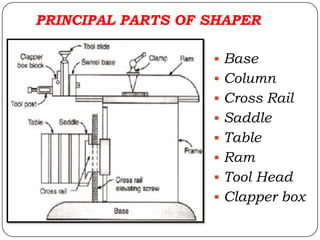
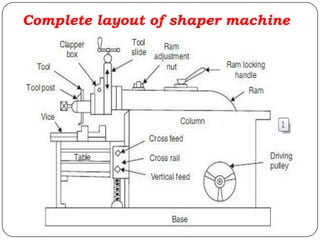
PRINCIPAL PARTS OF SHAPER
 Base
 Column
 Cross Rail
 Saddle
 Table
 Ram
 Tool Head
 Clapper box
Complete layout of shaper machine
PRINCIPAL PARTS OF SHAPER
PARTS OF SHAPER
BASE
 It made of cast iron to resist vibration and take up
high compressive load.
 It Provides support for other parts of machine.
COLUMN
 The column is a box like casting mounted vertically on
top of base.
 It has Two guide ways. One vertical guide-way in the
front over which a cross slide moves up and down.
 Second horizontal guide ways on top over which ram
reciprocate.
 The reciprocating mechanism is housed inside the
column
CROSS RAIL
 It is on the front vertical guide ways of the column.
 The table may be raised or lowered to accommodate
different sizes of jobs by rotating an elevating screw
which causes the cross rail to slide up and down
on the vertical face of the column.
 Saddle
 The saddle is mounted on the cross rail which holds
the table firmly on its top.
 Crosswise movement of the saddle by rotating the
cross feed screw by hand or power causes the table to
move sideways.
PARTS OF SHAPER
TABLE
 It mounted on a saddle which is located above
the cross rail. Top and sides are accurately
machined and have T slots.
RAM
 It supports tool head on its front. It reciprocates
on accurately horizontal machined guide ways
on top of column
TOOL HEAD
 It fitted on the face of ram. Holds the tool rigidly.
 Provide vertical and angular depth for the tool
 Tool head can be positioned at any angle
PARTS OF SHAPER
Clapper Box
The clapper box houses the clapper block which is
connected to it by means of hinge pin.
The tool post is mounted upon the clapper block to
prevent interference between the tools and work-piece
on the return stroke
On the forward cutting stroke the clapper block fits
securely to the clapper box to make a rigid tool on the
work.
It prevents the tool cutting edge form dragging and
wear.
The work surface is also prevented from any damage
due to dragging.
PARTS OF SHAPER
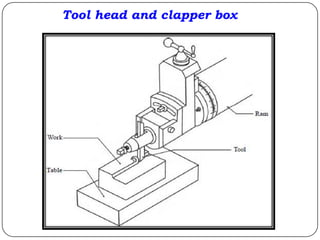
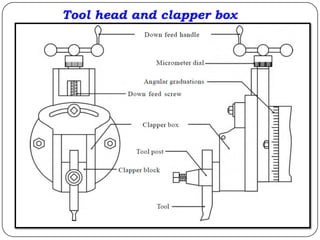
Tool head and clapper box
Principal of working
 The job is rigidly fixed on the machine table.
 The single point cutting tool held properly in the tool post is
mounted on a reciprocating ram.
 The reciprocating motion of the ram is obtained by a quick
return motion mechanism.
 As the ram reciprocates, the tool cuts the material during
its forward stroke. During return, there is no cutting action
and this stroke is called the idle stroke.
 The forward and return strokes constitute one operating
cycle of the shaper.
 In order to reduce the time wasted during the return non-
cutting stroke, shaping machines are fitted with a quick-
return mechanism, usually of the crank and slotted-link
design.
Traversing head shaper
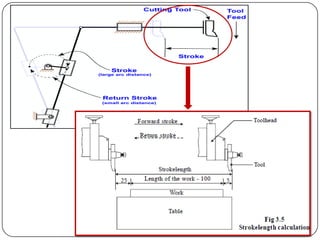
Double stroke= cutting stroke + return stroke
Stroke starts slightly before the work piece (A) and ends after the work piece (B)
Total stroke length = A + L+ B
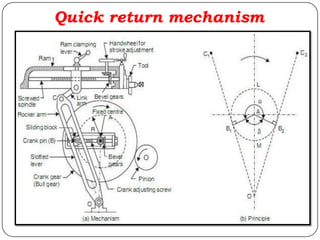
Quick return mechanism
Working Of Quick Return Mechanism
The crank AB (of adjustable length R) rotates with a
uniform angular speed. The crank pin B is in the
shape of a die block which is free to slide inside the
slot in the slotted lever OBC. This slotted lever is
pivoted at O and the other end C is connected to the
ram by a short link arm as shown in Fig. a. When the
crank AB rotates clockwise from position AB1to AB2,
the ram moves forward from left to right and when it
rotates from position AB2 to AB1the ram returns back
to its original position. Clearly the time taken to
complete forward stroke is proportional to angle α(refer
to Fig. b) and the return stroke is completed in less
time which is proportional to angle β.
Feed drive mechanism
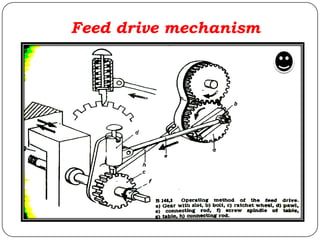
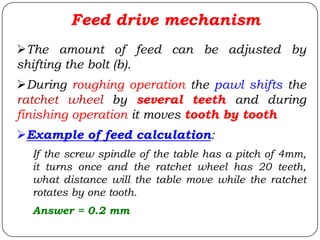
The amount of feed can be adjusted by
shifting the bolt (b).
During roughing operation the pawl shifts the
ratchet wheel by several teeth and during
finishing operation it moves tooth by tooth
Example of feed calculation:
If the screw spindle of the table has a pitch of 4mm,
it turns once and the ratchet wheel has 20 teeth,
what distance will the table move while the ratchet
rotates by one tooth.
Answer = 0.2 mm
Specifications of Shaping Machine
Maximum length of Stroke of Ram
Power input
Floor Space required
Weight of the Machine
 Cutting to Return Stroke ratio range
Feed range
Adjustment range (depth)
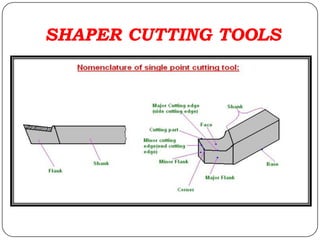
Cutting Tool Materials, Shapes & Sizes
 Most shaper cutting tools are made from high
speed steel (HSS).
 For cutting very hard materials, tungsten carbide
tools are used.
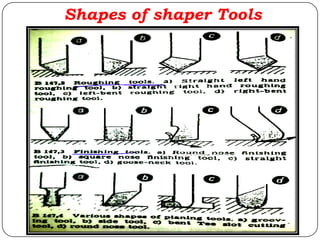
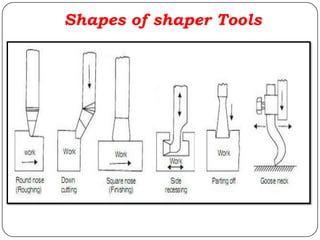
 Shaper cutting tools are ground for cutting
horizontally right or left, vertically right or left, and
for grooving.
 Cutting tool shape varies with the material to be
machined and the type of cut required.
SHAPER CUTTING TOOLS
Shapes of shaper Tools
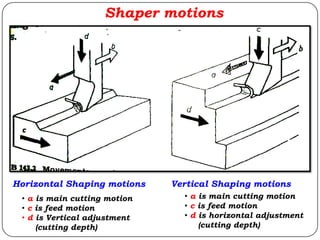
Shaper motions
• a is main cutting motion
• c is feed motion
• d is Vertical adjustment
(cutting depth)
Horizontal Shaping motions Vertical Shaping motions
• a is main cutting motion
• c is feed motion
• d is horizontal adjustment
(cutting depth)
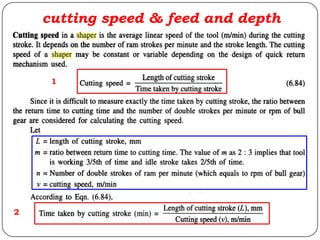
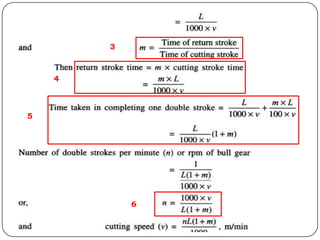
cutting speed & feed and depth
1
2
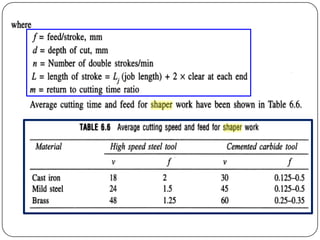
3
4
5
6
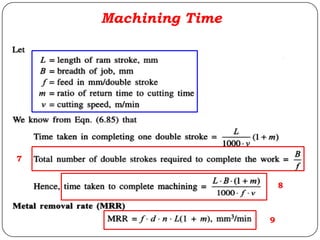
Machining Time
7
8
9
THANK YOU

Lecture 6 shaping and planing

  • 1.
    Faculty of Engineering MechanicalEngineering Department Lecture No. (6) ‫معدات‬ ‫و‬ ‫أساليب‬‫تشغيل‬(1) Machining Techniques & Equipments (1) Dr. Rania Mostafa Shaping & Planing processes
  • 2.
    Outline  Introduction Operations onshaping machine  Advantages of shaper Shaper limitations  Principal parts of shaper  Principal of working  Quick return mechanism  Specifications of shaping machine  Feed drive mechanism  Shaper tool materials, shape and size  Shaper cutting tool terminologies  Cutting motions  Cutting speed, feed and depth of cut  Machining time calculations
  • 3.
  • 4.
    INTRODUCTION Shaper is definedas a process for removing metal surfaces in horizontal, vertical and angular planes by the use of a single point cutting tool held on the ram that reciprocates the tool. Machine Features: Single point cutting tool is used for machining. Tool is clamped in the tool post mounted on the ram of the machine. The ram reciprocates to and for, tool cuts the material in the forward stroke, No cutting during return (back) stroke. Job is held rigidly in a vise.
  • 5.
    The Shaper isa machine tool used primarily for: Producing a flat or plane surface which may be in a horizontal, a vertical or an angular plane.  Making slots, grooves and keyways.  Producing contour of concave/convex or a combination of these. Operations on Shaper
  • 6.
  • 7.
  • 8.
  • 9.
  • 10.
    Advantages Of Shapers Thesingle point cutting tools used in shapers are inexpensive, these tools can be easily grounded to any desirable shape. The simplicity and ease of holding work, its easy adjustment, and the simple tool give the shaper its great flexibility. Shaper set up is very quick and easy and can be readily changed from one job to another. Thin or fragile jobs can be conveniently machined on shapers because of lower cutting forces.
  • 11.
     The shaperis unsuitable for generating flat surfaces on very large parts because of the limitations on the stroke and overhang the ram  Planer solved this problem by applying the linear primary motion to the work-piece and feeding the tool at right angles to this motion.  The primary motion is accomplished by a rack and pinion drive using a variable speed motor. Shaper limitations
  • 12.
  • 13.
  • 14.
    Shaper planer Tool hasprimary motion Work has primary motion
  • 15.
    PRINCIPAL PARTS OFSHAPER  Base  Column  Cross Rail  Saddle  Table  Ram  Tool Head  Clapper box
  • 16.
    Complete layout ofshaper machine
  • 17.
  • 18.
    PARTS OF SHAPER BASE It made of cast iron to resist vibration and take up high compressive load.  It Provides support for other parts of machine. COLUMN  The column is a box like casting mounted vertically on top of base.  It has Two guide ways. One vertical guide-way in the front over which a cross slide moves up and down.  Second horizontal guide ways on top over which ram reciprocate.  The reciprocating mechanism is housed inside the column
  • 19.
    CROSS RAIL  Itis on the front vertical guide ways of the column.  The table may be raised or lowered to accommodate different sizes of jobs by rotating an elevating screw which causes the cross rail to slide up and down on the vertical face of the column.  Saddle  The saddle is mounted on the cross rail which holds the table firmly on its top.  Crosswise movement of the saddle by rotating the cross feed screw by hand or power causes the table to move sideways. PARTS OF SHAPER
  • 20.
    TABLE  It mountedon a saddle which is located above the cross rail. Top and sides are accurately machined and have T slots. RAM  It supports tool head on its front. It reciprocates on accurately horizontal machined guide ways on top of column TOOL HEAD  It fitted on the face of ram. Holds the tool rigidly.  Provide vertical and angular depth for the tool  Tool head can be positioned at any angle PARTS OF SHAPER
  • 21.
    Clapper Box The clapperbox houses the clapper block which is connected to it by means of hinge pin. The tool post is mounted upon the clapper block to prevent interference between the tools and work-piece on the return stroke On the forward cutting stroke the clapper block fits securely to the clapper box to make a rigid tool on the work. It prevents the tool cutting edge form dragging and wear. The work surface is also prevented from any damage due to dragging. PARTS OF SHAPER
  • 22.
    Tool head andclapper box
  • 23.
    Tool head andclapper box
  • 24.
    Principal of working The job is rigidly fixed on the machine table.  The single point cutting tool held properly in the tool post is mounted on a reciprocating ram.  The reciprocating motion of the ram is obtained by a quick return motion mechanism.  As the ram reciprocates, the tool cuts the material during its forward stroke. During return, there is no cutting action and this stroke is called the idle stroke.  The forward and return strokes constitute one operating cycle of the shaper.  In order to reduce the time wasted during the return non- cutting stroke, shaping machines are fitted with a quick- return mechanism, usually of the crank and slotted-link design.
  • 25.
    Traversing head shaper Doublestroke= cutting stroke + return stroke Stroke starts slightly before the work piece (A) and ends after the work piece (B) Total stroke length = A + L+ B
  • 26.
  • 27.
    Working Of QuickReturn Mechanism The crank AB (of adjustable length R) rotates with a uniform angular speed. The crank pin B is in the shape of a die block which is free to slide inside the slot in the slotted lever OBC. This slotted lever is pivoted at O and the other end C is connected to the ram by a short link arm as shown in Fig. a. When the crank AB rotates clockwise from position AB1to AB2, the ram moves forward from left to right and when it rotates from position AB2 to AB1the ram returns back to its original position. Clearly the time taken to complete forward stroke is proportional to angle α(refer to Fig. b) and the return stroke is completed in less time which is proportional to angle β.
  • 29.
  • 30.
    Feed drive mechanism Theamount of feed can be adjusted by shifting the bolt (b). During roughing operation the pawl shifts the ratchet wheel by several teeth and during finishing operation it moves tooth by tooth Example of feed calculation: If the screw spindle of the table has a pitch of 4mm, it turns once and the ratchet wheel has 20 teeth, what distance will the table move while the ratchet rotates by one tooth. Answer = 0.2 mm
  • 31.
    Specifications of ShapingMachine Maximum length of Stroke of Ram Power input Floor Space required Weight of the Machine  Cutting to Return Stroke ratio range Feed range Adjustment range (depth)
  • 32.
    Cutting Tool Materials,Shapes & Sizes  Most shaper cutting tools are made from high speed steel (HSS).  For cutting very hard materials, tungsten carbide tools are used.  Shaper cutting tools are ground for cutting horizontally right or left, vertically right or left, and for grooving.  Cutting tool shape varies with the material to be machined and the type of cut required.
  • 33.
  • 34.
  • 35.
  • 36.
    Shaper motions • ais main cutting motion • c is feed motion • d is Vertical adjustment (cutting depth) Horizontal Shaping motions Vertical Shaping motions • a is main cutting motion • c is feed motion • d is horizontal adjustment (cutting depth)
  • 37.
    cutting speed &feed and depth 1 2
  • 38.
  • 39.
  • 41.