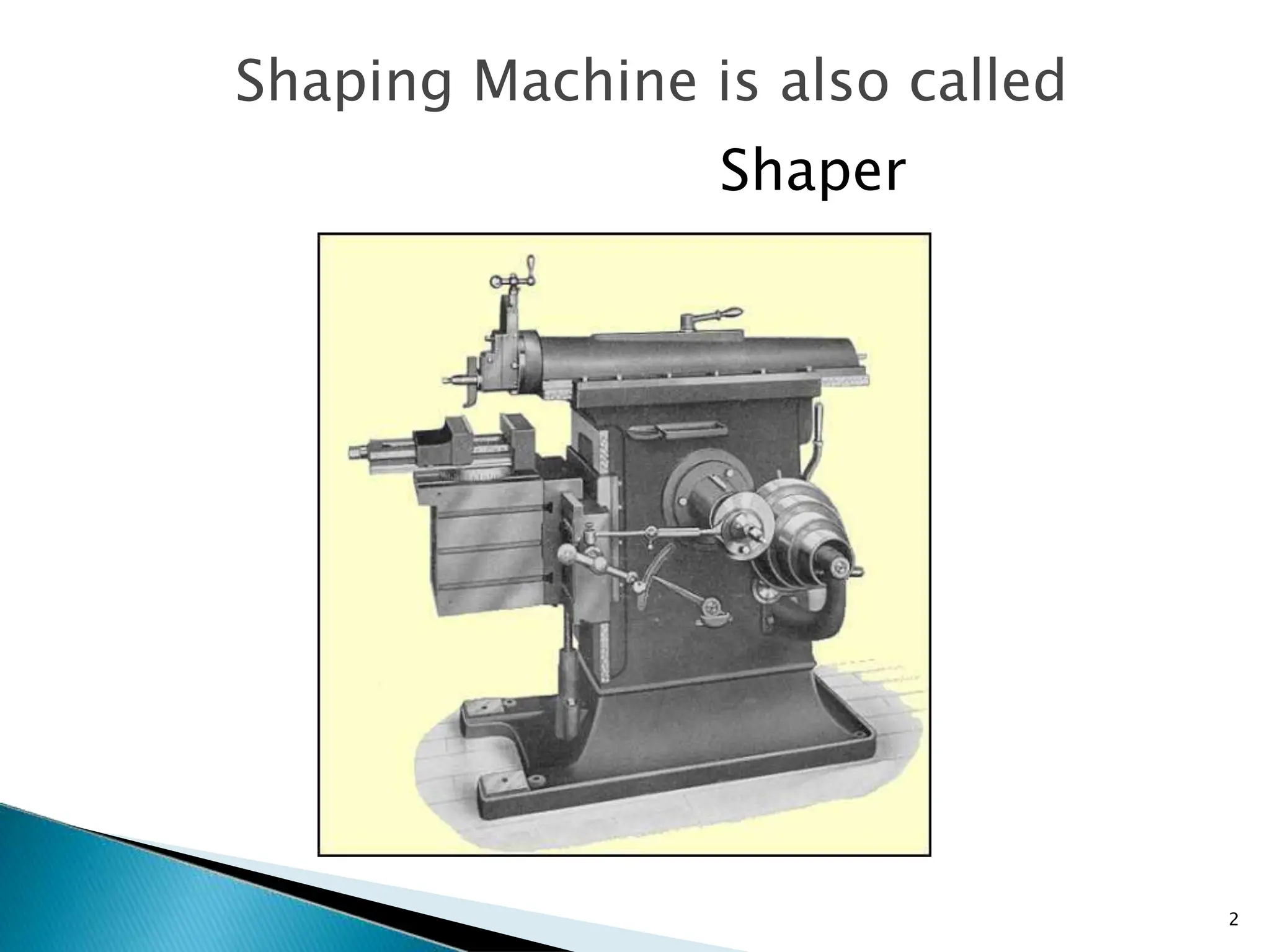
Shaping Machine is also called
Shaper
2
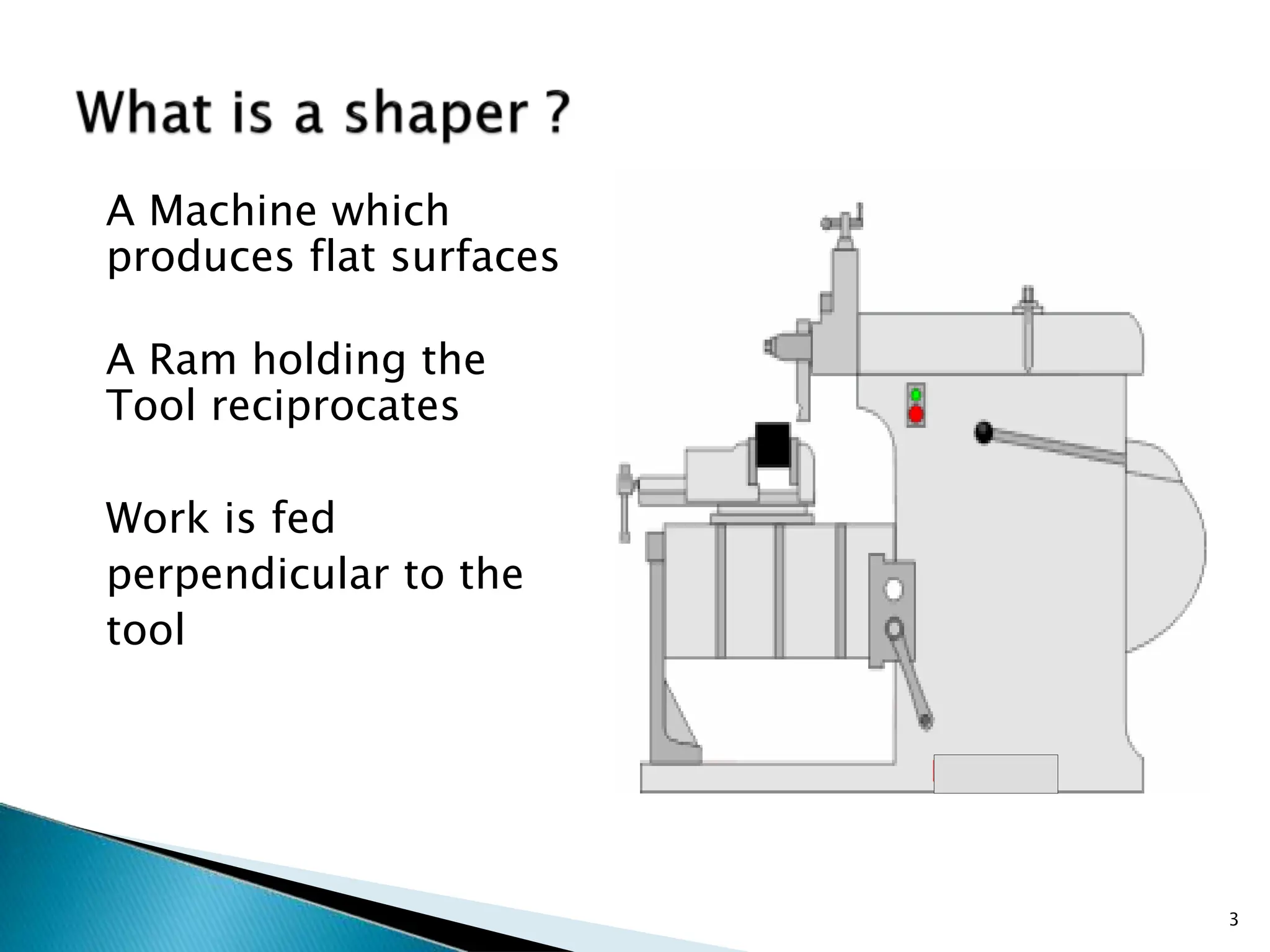
A Machine which
produces flat surfaces
A Ram holding the
Tool reciprocates
Work is fed
perpendicular to the
tool
3
B
A
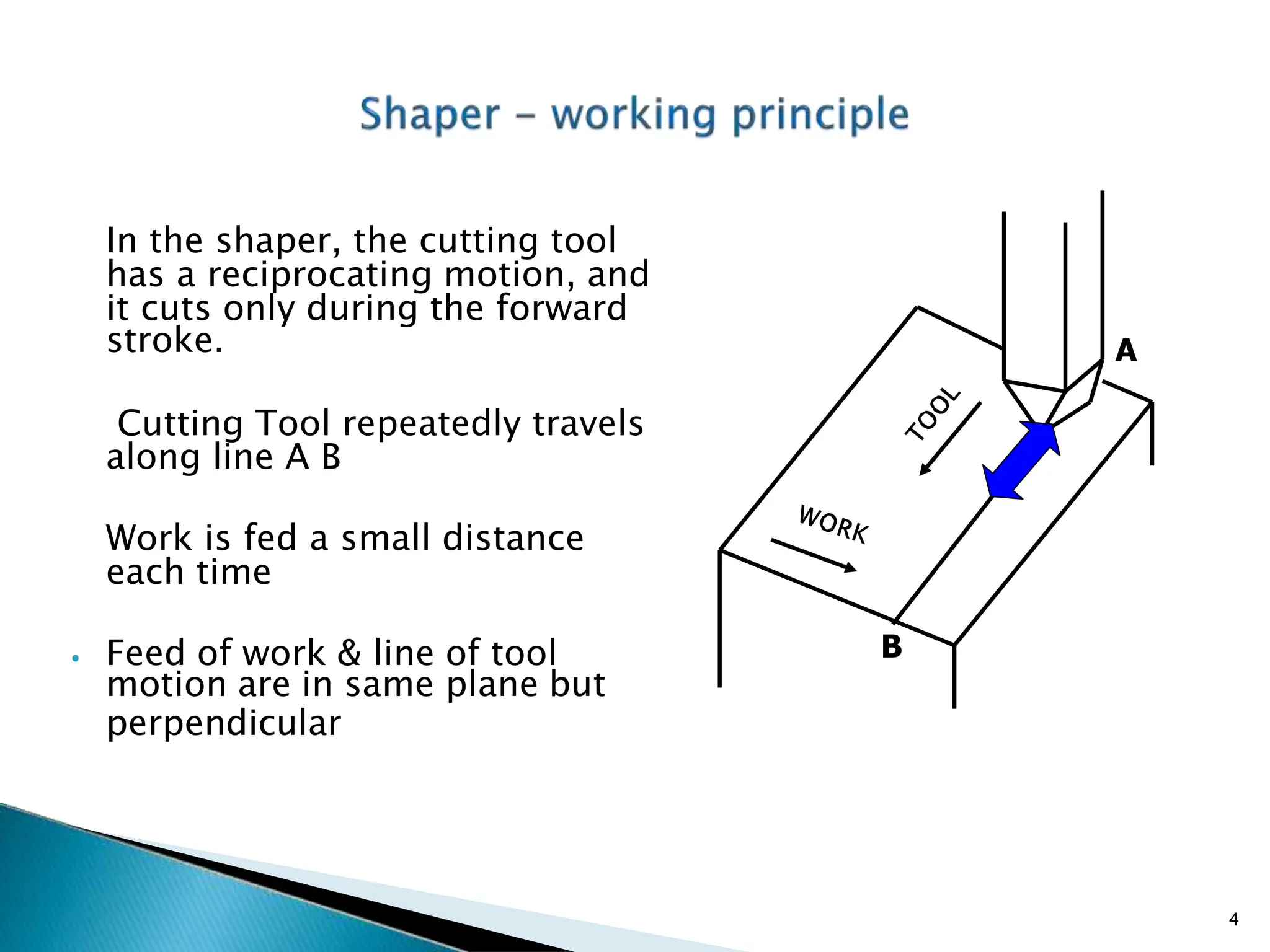
In the shaper, the cutting tool
has a reciprocating motion, and
it cuts only during the forward
stroke.
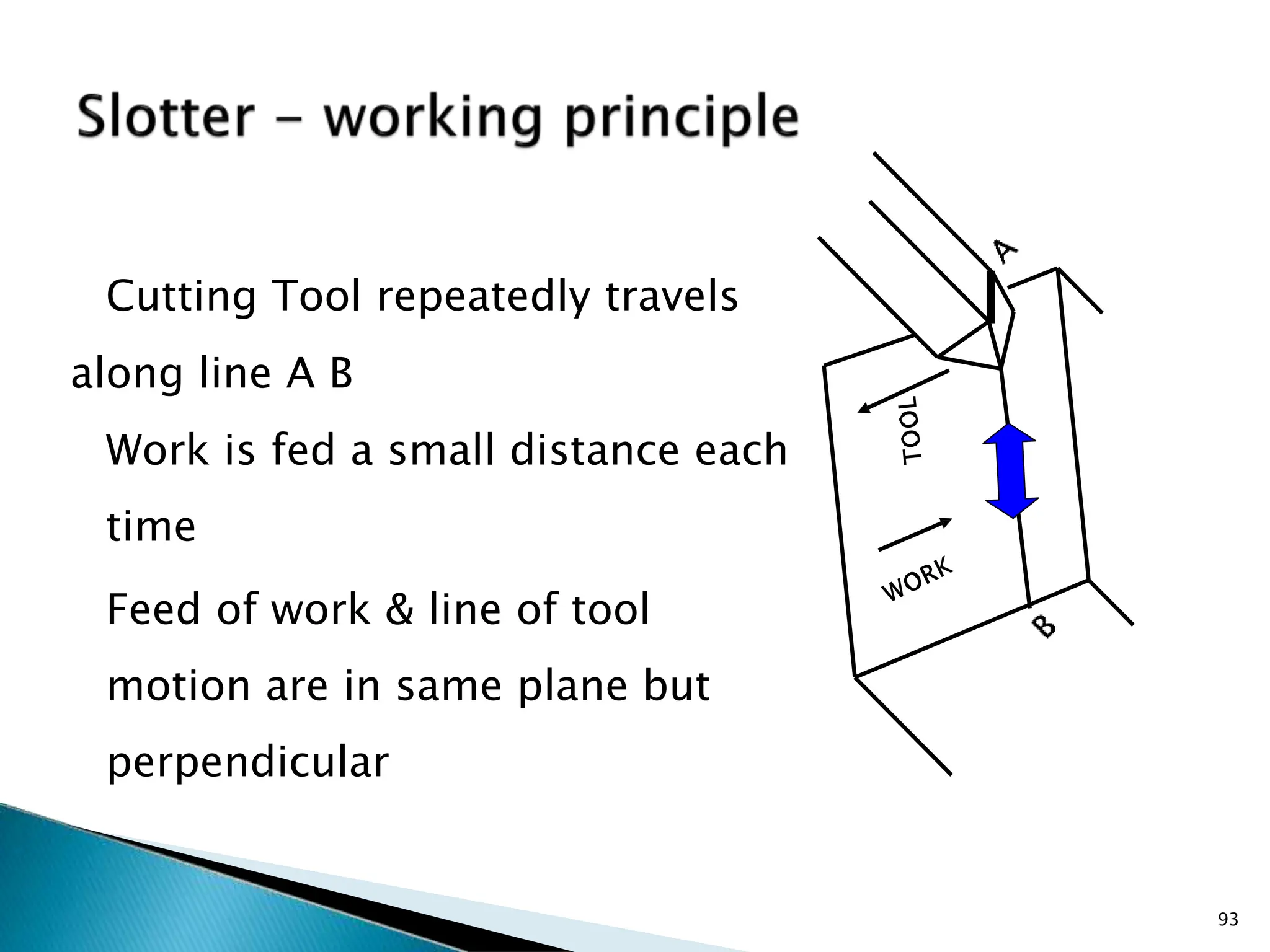
Cutting Tool repeatedly travels
along line A B
Work is fed a small distance
each time
⦁ Feed of work & line of tool
motion are in same plane but
perpendicular
4
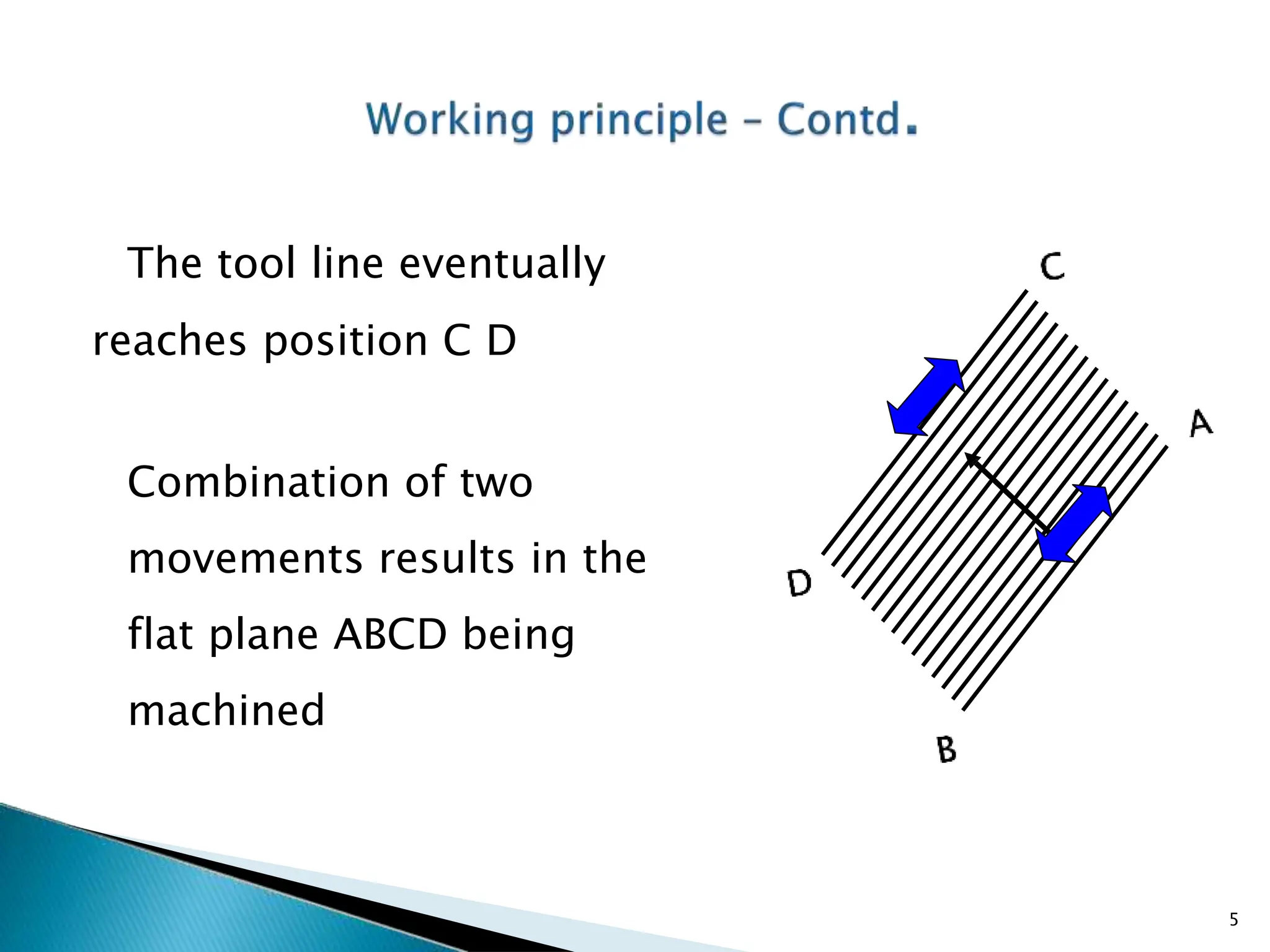
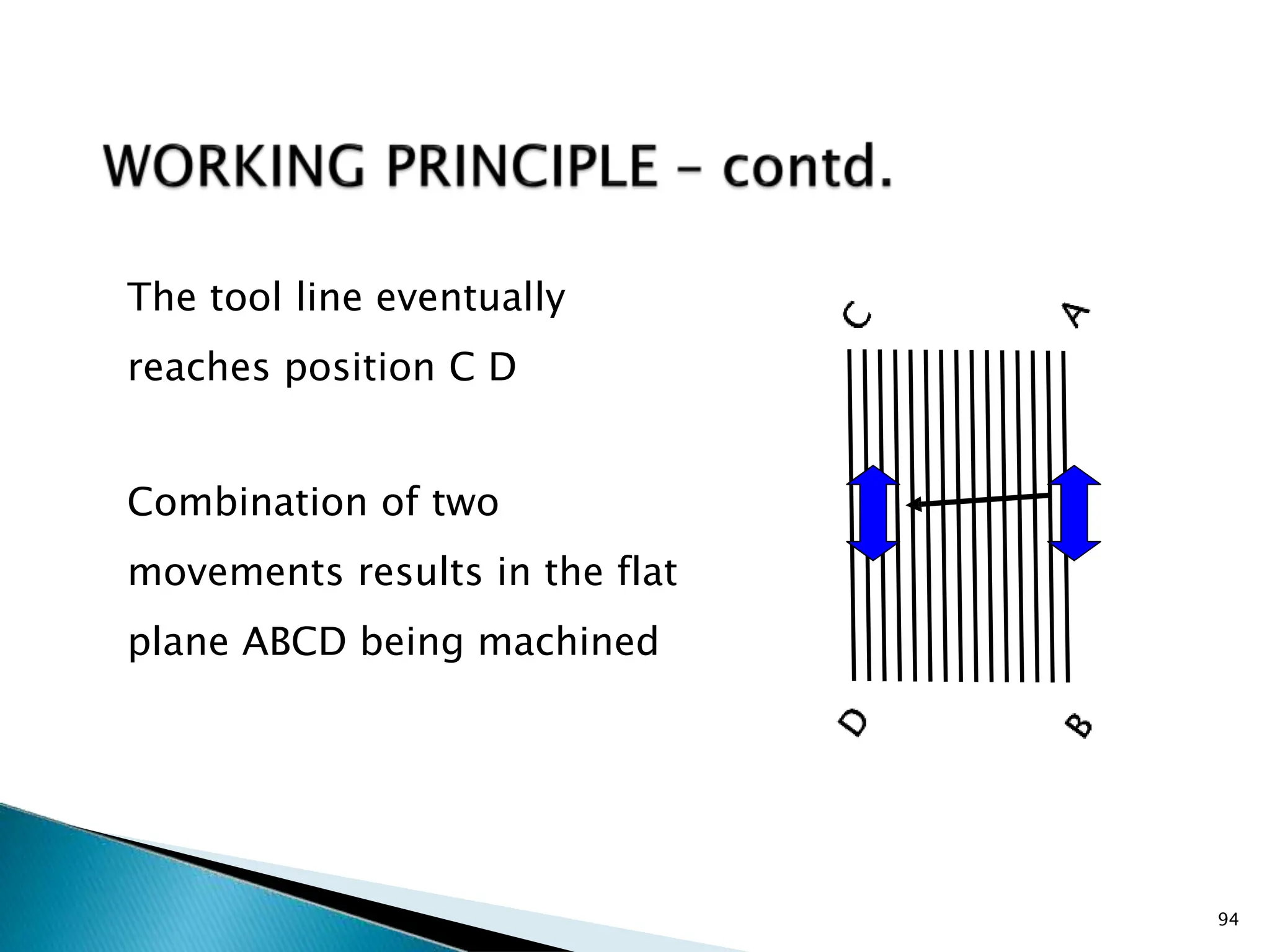
The tool line eventually
reaches position C D
Combination of two
movements results in the
flat plane ABCD being
machined
5
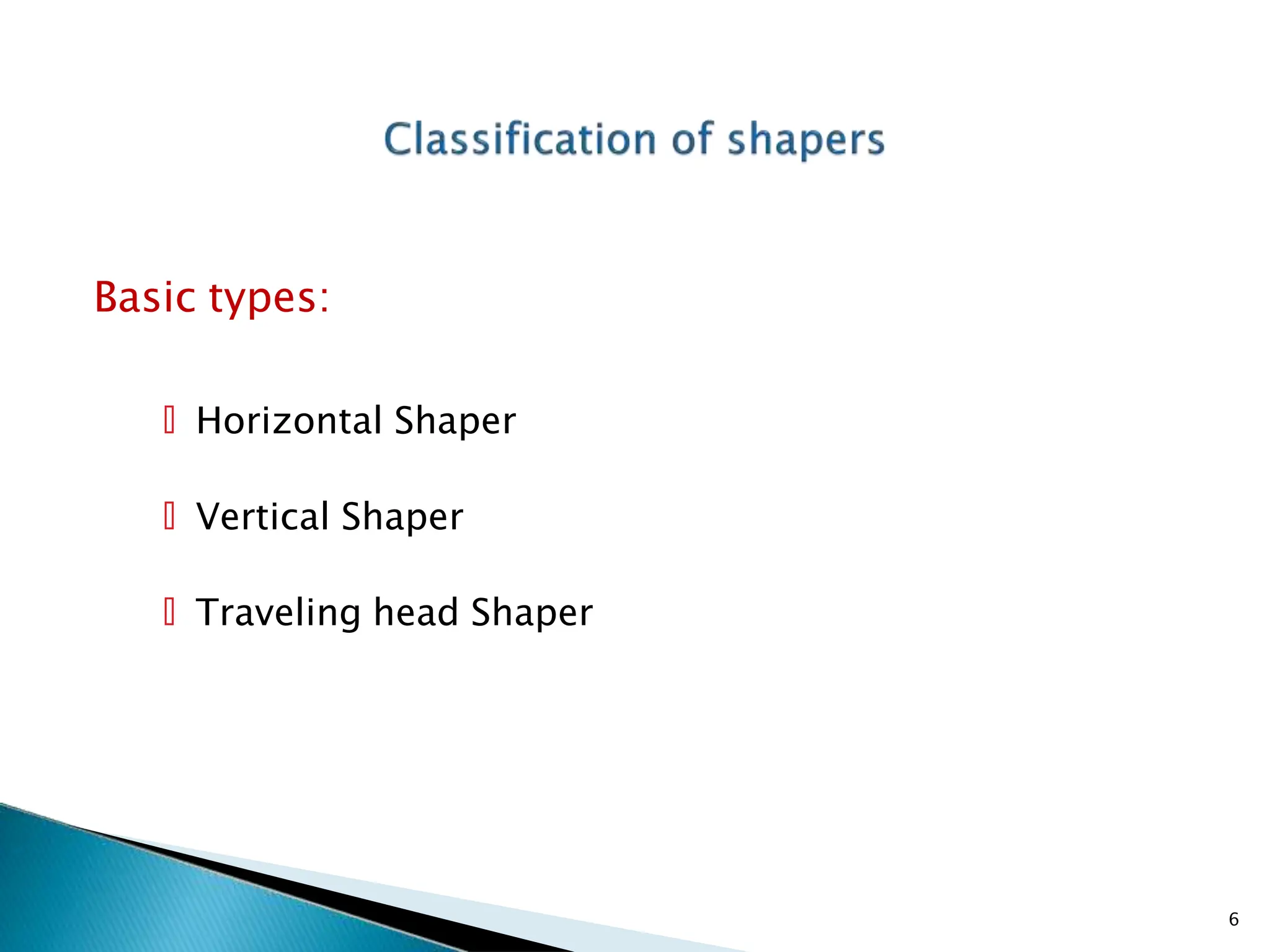
Basic types:
6
🞄 Horizontal Shaper
🞄 Vertical Shaper
🞄 Traveling head Shaper
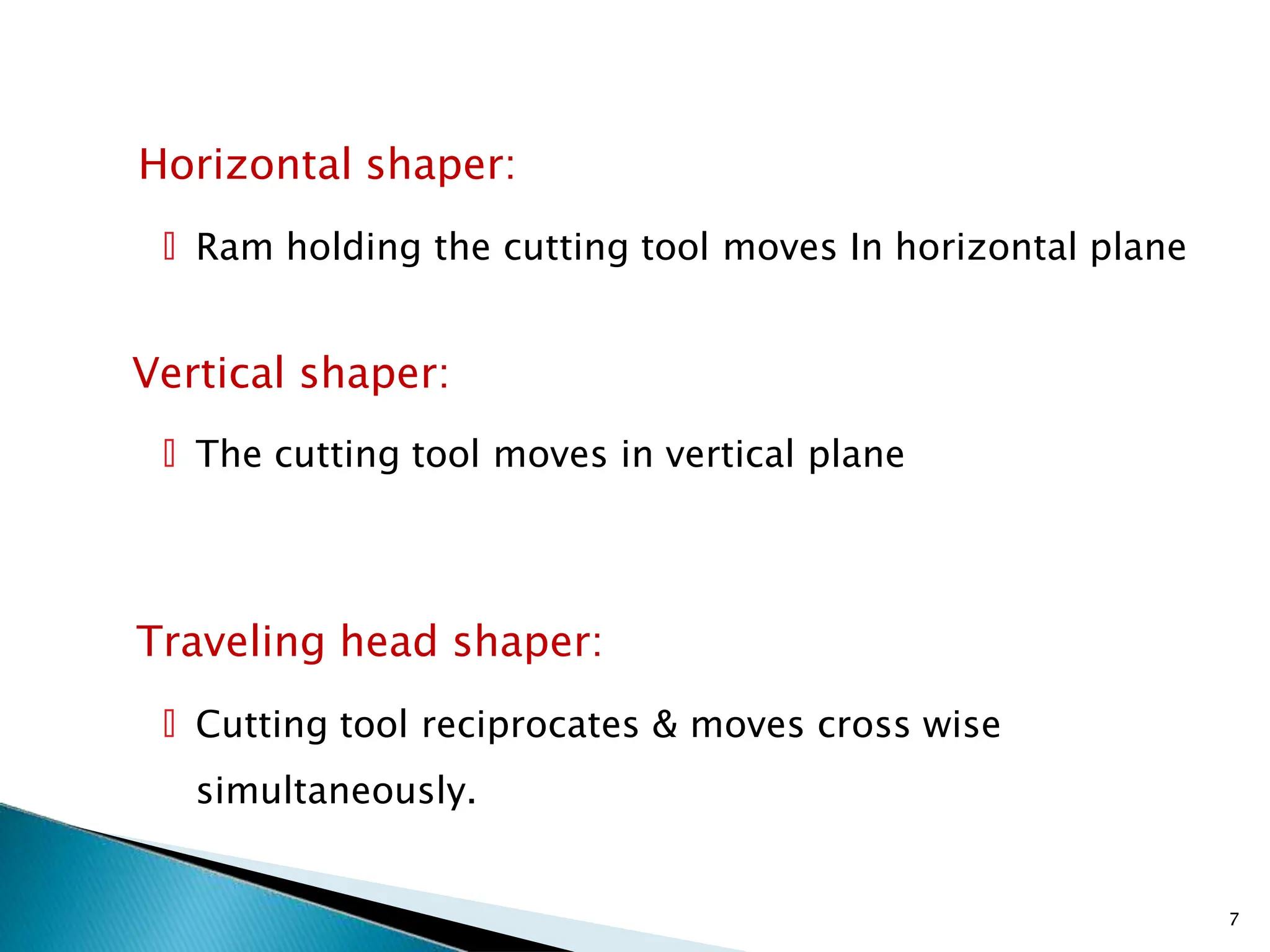
Horizontal shaper:
7
🞄 Ram holding the cutting tool moves In horizontal plane
Vertical shaper:
🞄 The cutting tool moves in vertical plane
Traveling head shaper:
🞄 Cutting tool reciprocates & moves cross wise
simultaneously.
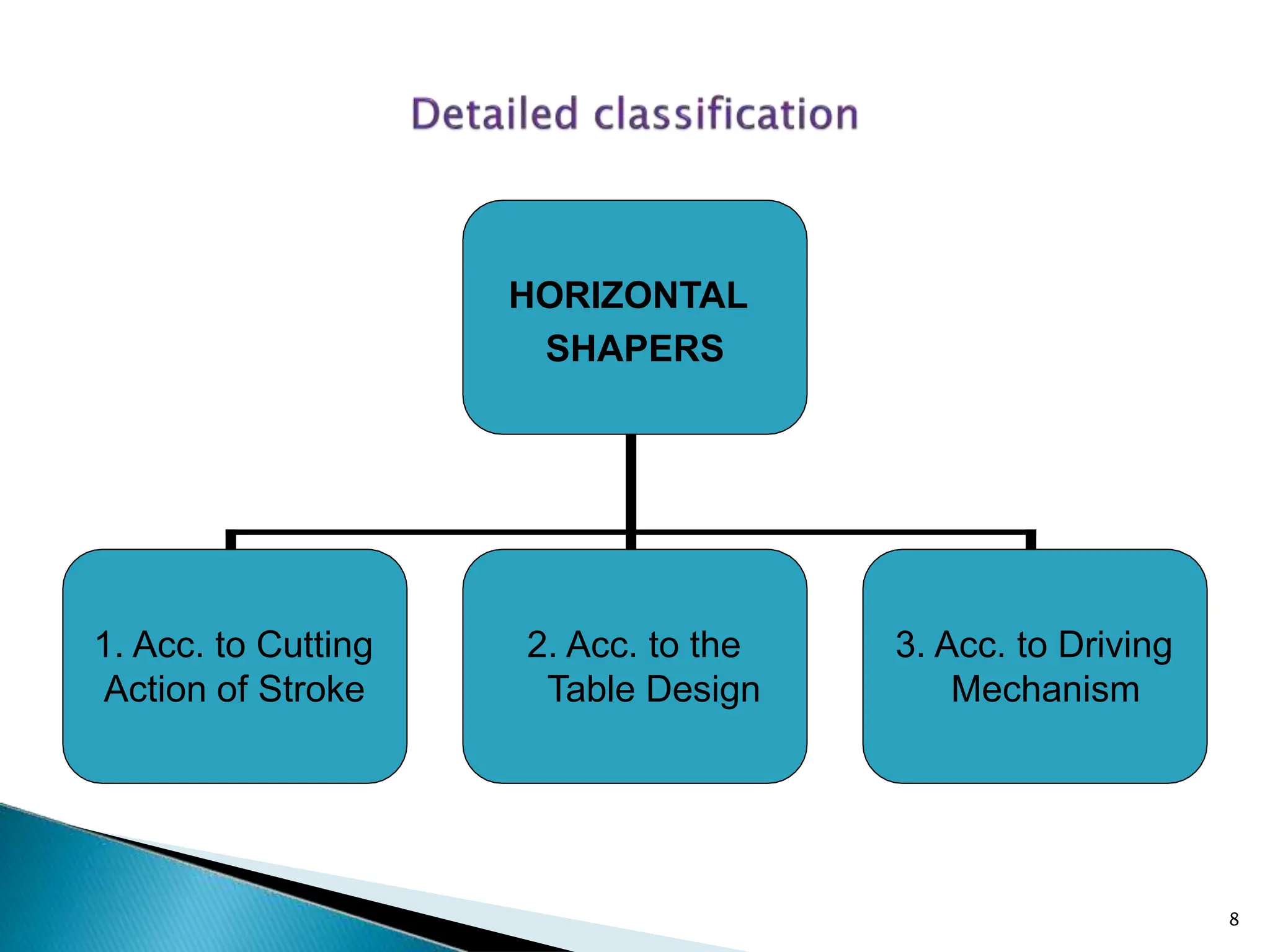
HORIZONTAL
SHAPERS
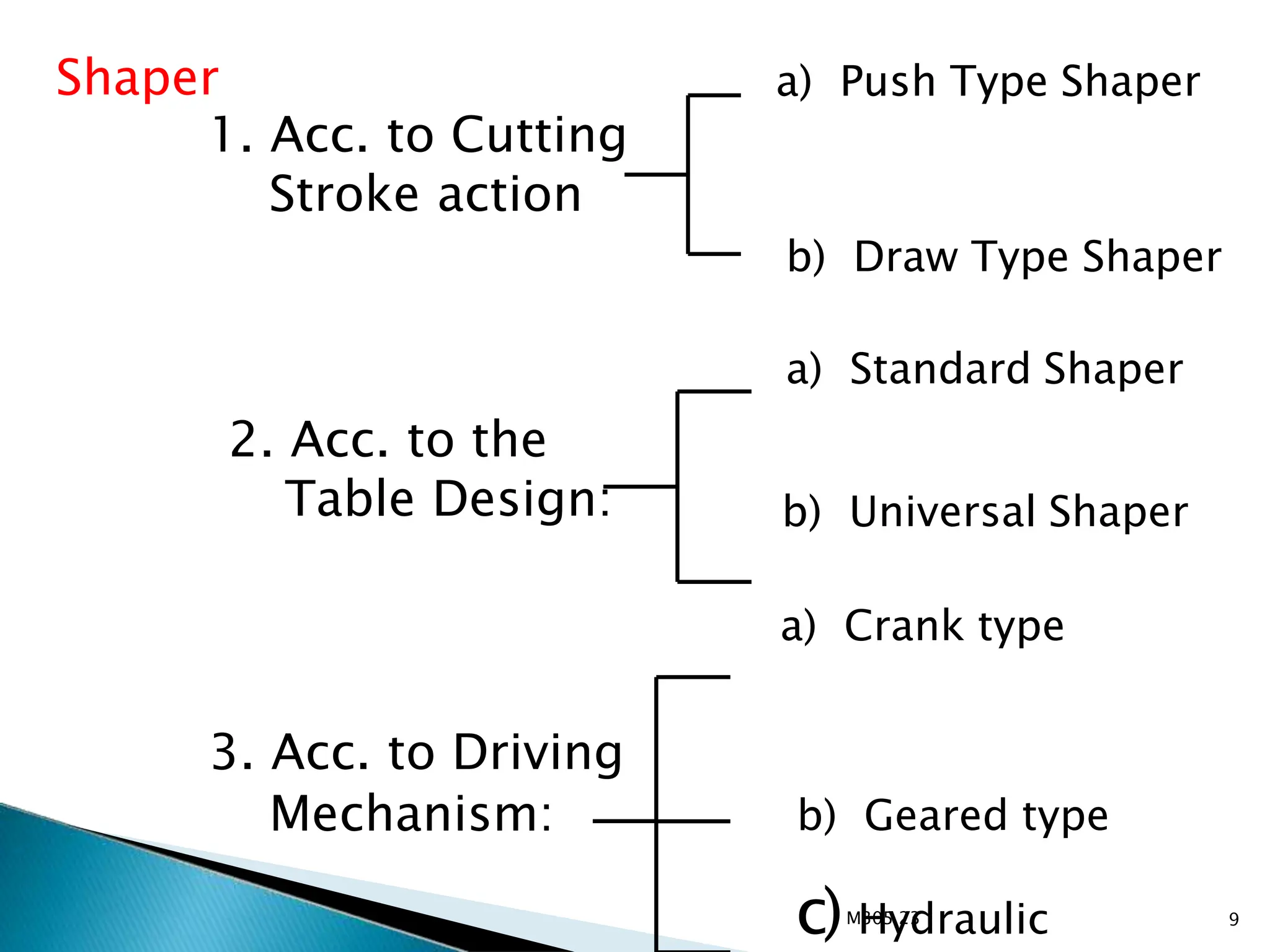
1. Acc. to Cutting
Action of Stroke
2. Acc. to the
Table Design
3. Acc. to Driving
Mechanism
8
b) Geared type
c)M
H
305
y
.23
draulic 9
a) Push Type Shaper
1. Acc. to Cutting
Stroke action
b) Draw Type Shaper
a) Standard Shaper
b) Universal Shaper
a) Crank type
2. Acc. to the
Table Design:
3. Acc. to Driving
Mechanism:
Shaper
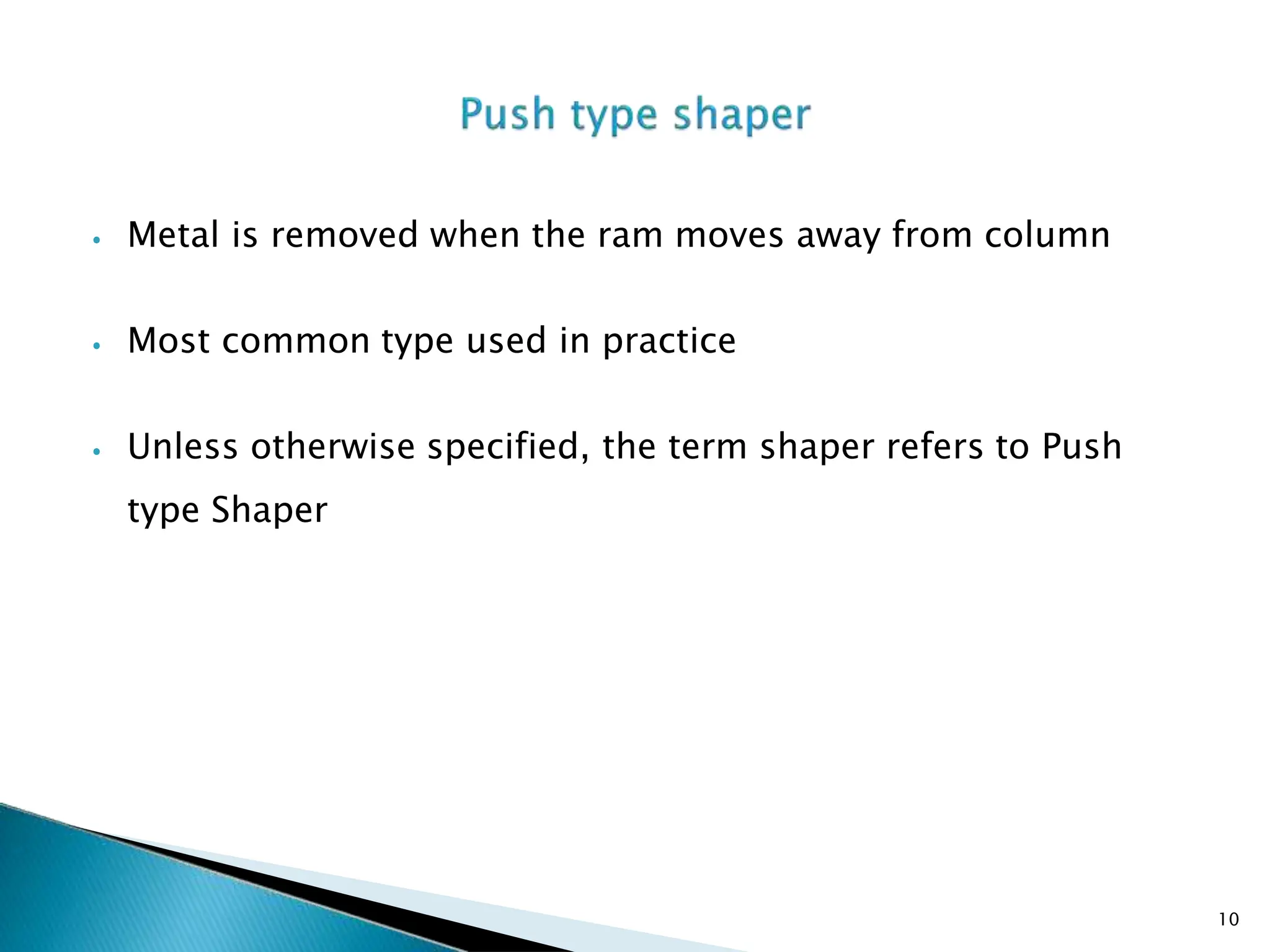
⦁ Metal is removed when the ram moves away from column
⦁ Most common type used in practice
⦁ Unless otherwise specified, the term shaper refers to Push
type Shaper
10
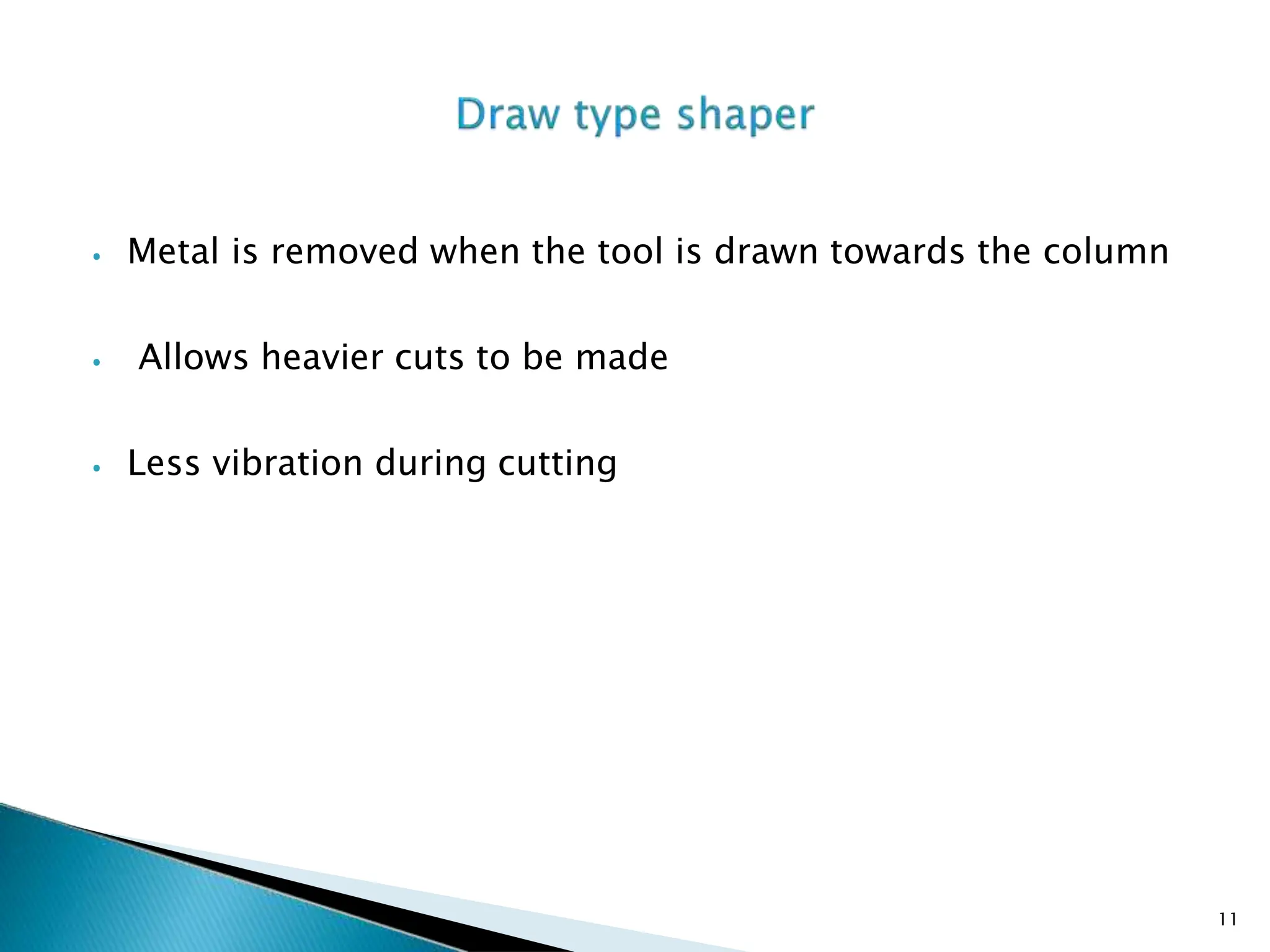
⦁ Metal is removed when the tool is drawn towards the column
⦁ Allows heavier cuts to be made
⦁ Less vibration during cutting
11
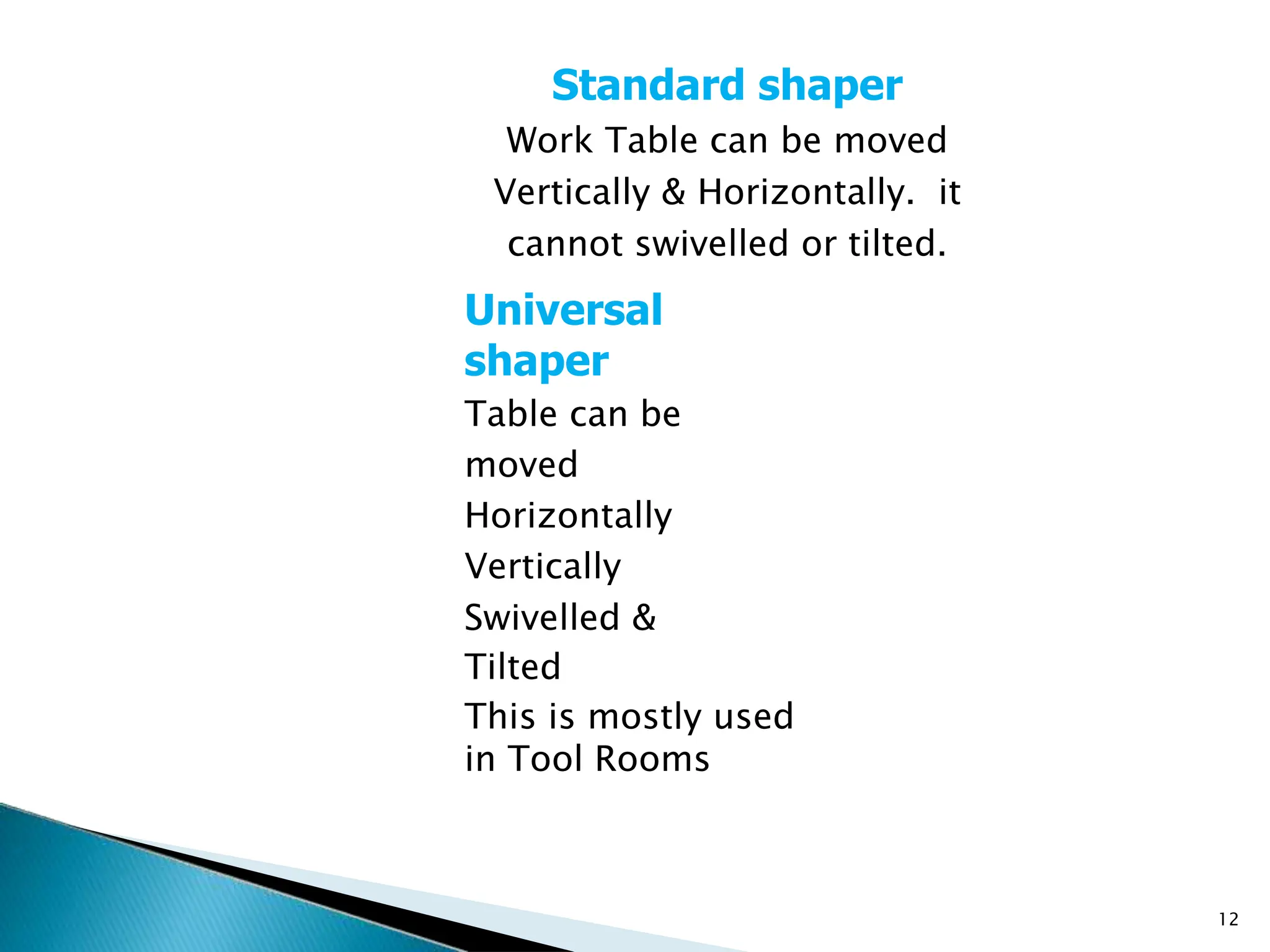
Standard shaper
Work Table can be moved
Vertically & Horizontally. it
cannot swivelled or tilted.
12
Universal
shaper
Table can be
moved
Horizontally
Vertically
Swivelled &
Tilted
This is mostly used
in Tool Rooms
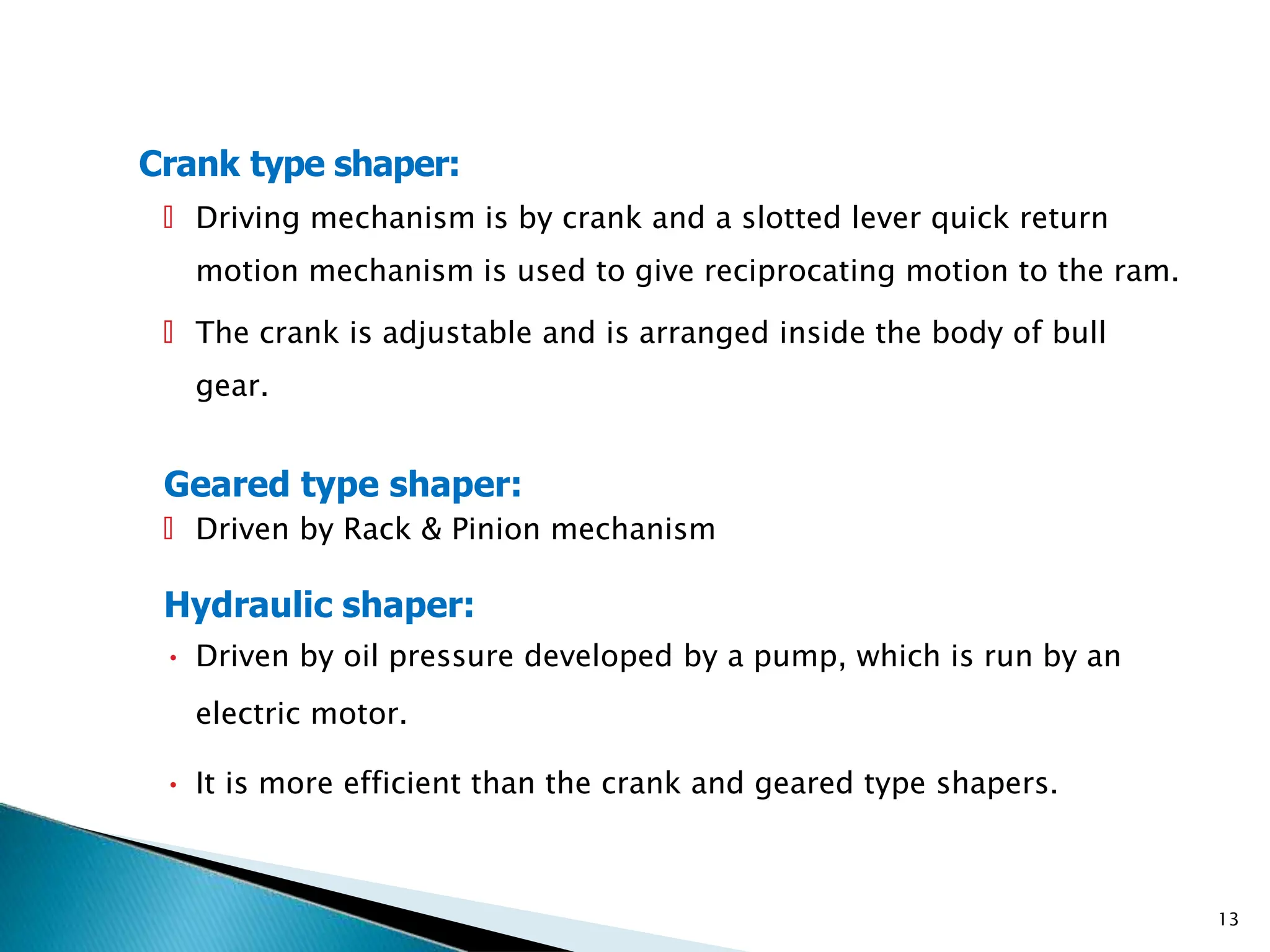
Crank type shaper:
13
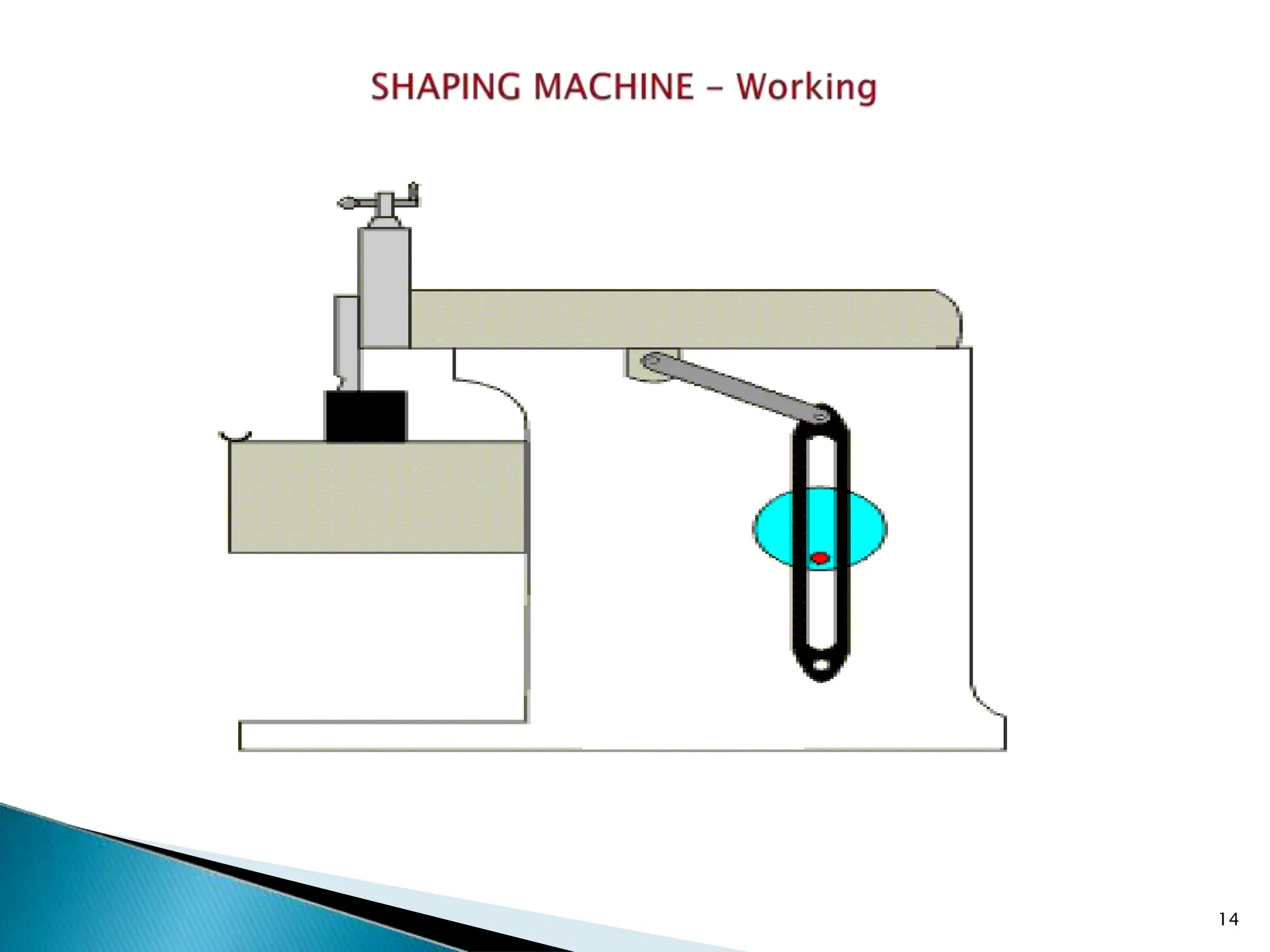
🞄 Driving mechanism is by crank and a slotted lever quick return
motion mechanism is used to give reciprocating motion to the ram.
🞄 The crank is adjustable and is arranged inside the body of bull
gear.
Geared type shaper:
🞄 Driven by Rack & Pinion mechanism
Hydraulic shaper:
• Driven by oil pressure developed by a pump, which is run by an
electric motor.
• It is more efficient than the crank and geared type shapers.
14
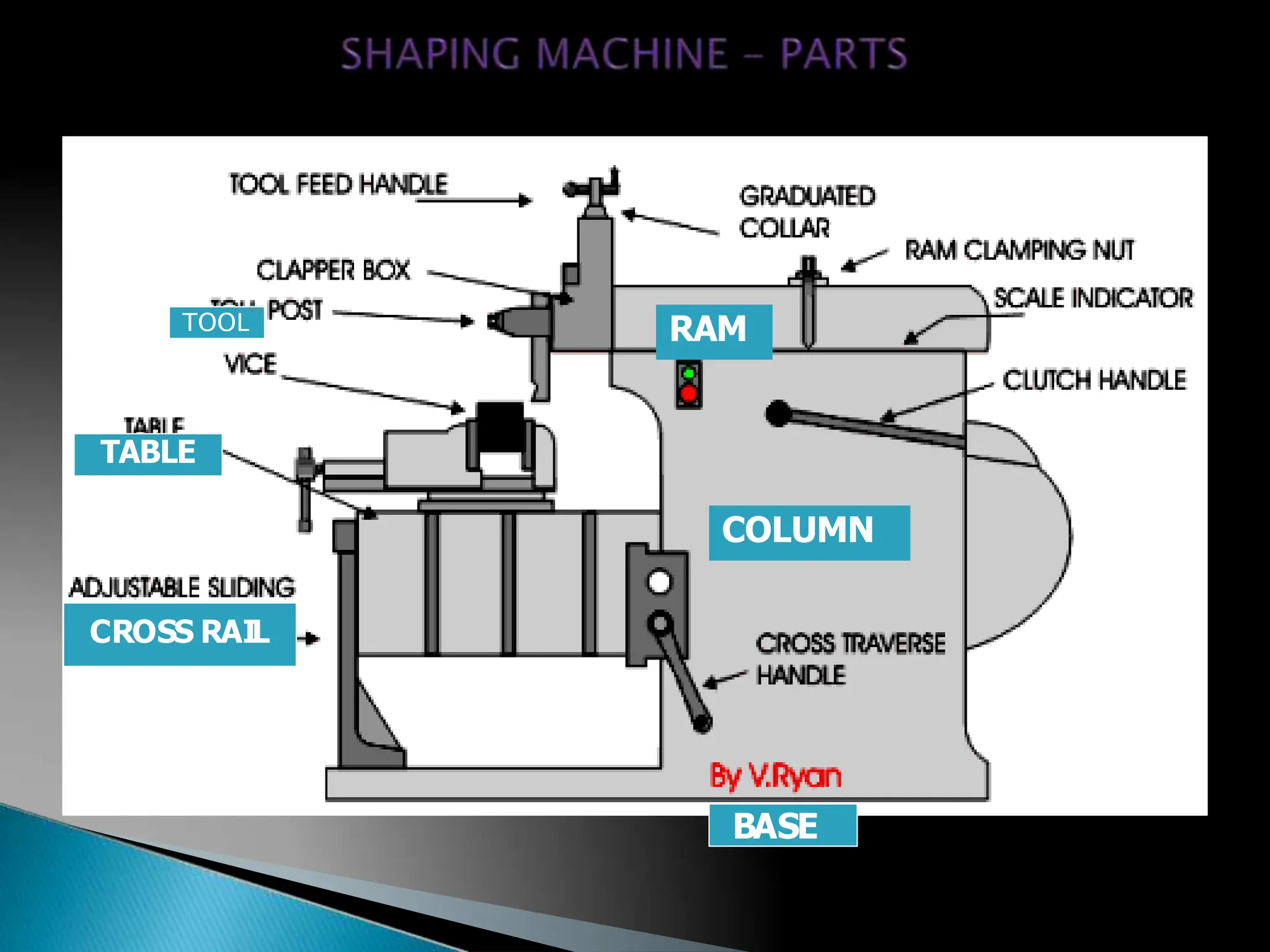
BASE
COLUMN
RAM
CROSS RAIL
TABLE
TOOL
15
1. BASE
2. COLUMN
3. RAM
4. TABLE
16
5. CROSS RAIL
6. SADDLE
7. TOOL HEAD
8. CLAPPER BOX
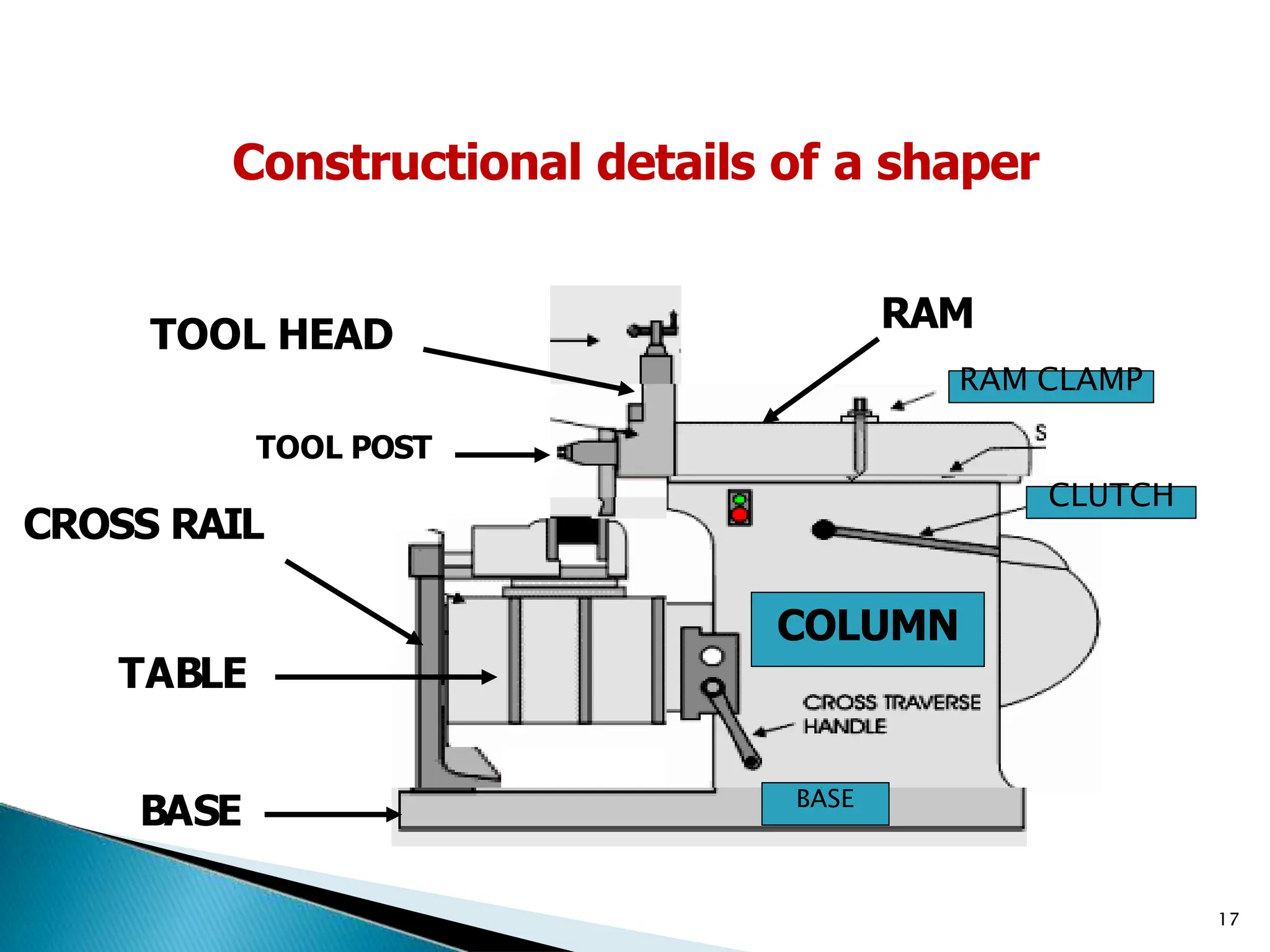
Constructional details of a shaper
BASE
TABLE
TOOL HEAD
RAM
RAM CLAMP
CLUTCH
COLUMN
17
TOOL POST
CROSS RAIL
BASE
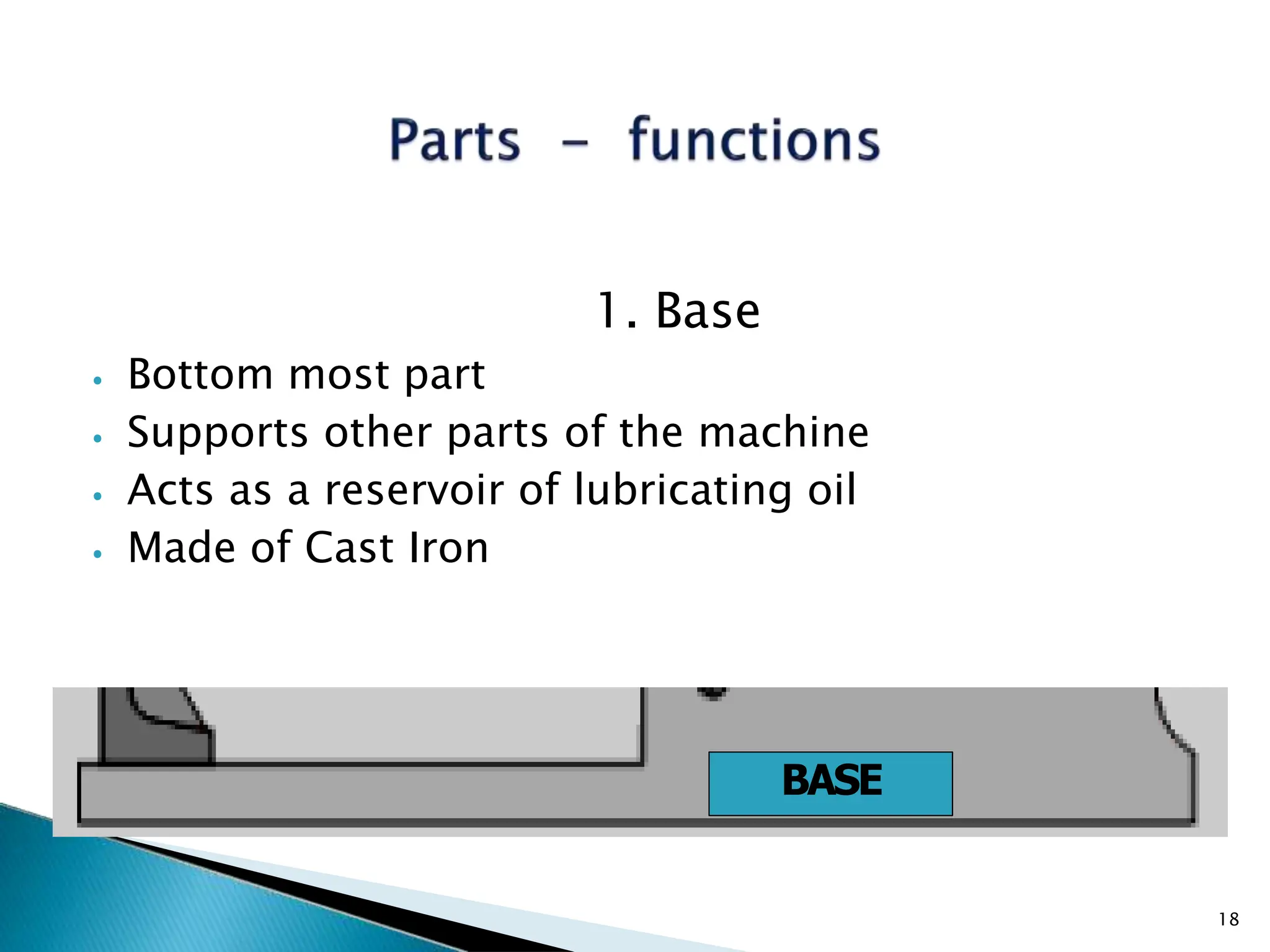
1. Base
⦁ Bottom most part
⦁ Supports other parts of the machine
⦁ Acts as a reservoir of lubricating oil
⦁ Made of Cast Iron
BASE
18
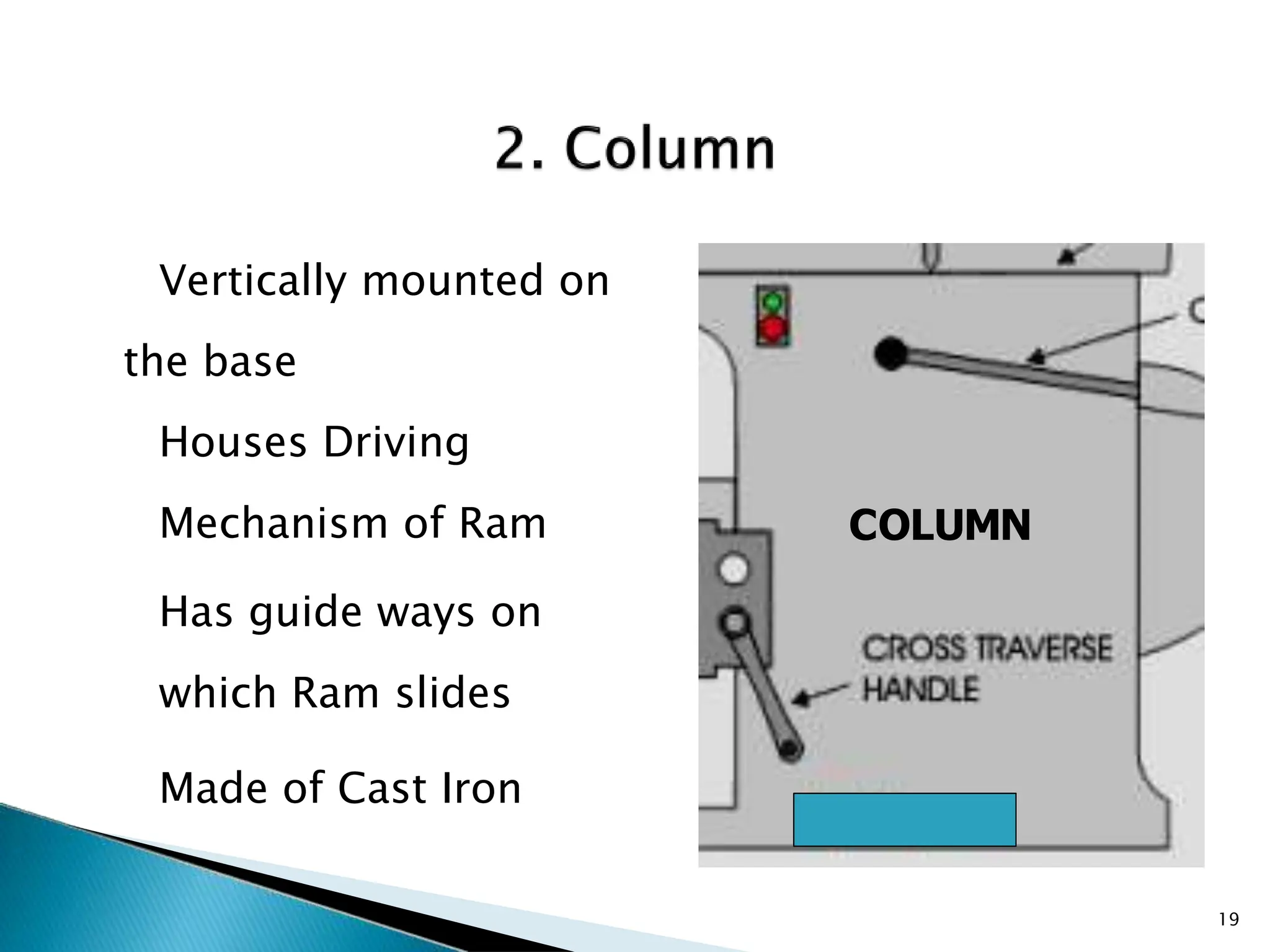
Vertically mounted on
the base
Houses Driving
Mechanism of Ram
Has guide ways on
which Ram slides
Made of Cast Iron
COLUMN
19
g
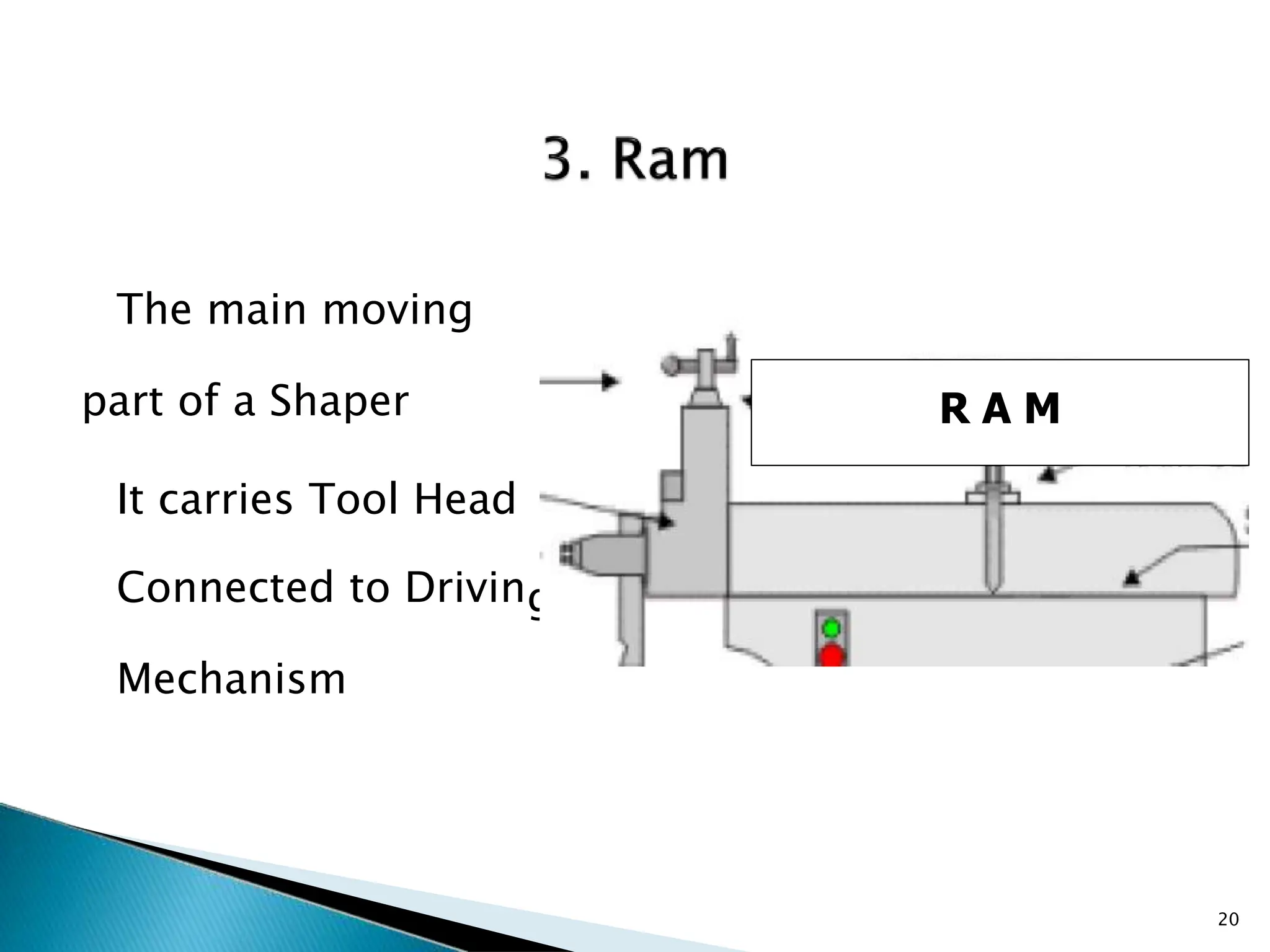
The main moving
part of a Shaper
It carries Tool Head
Connected to Drivin
Mechanism
R A M
20
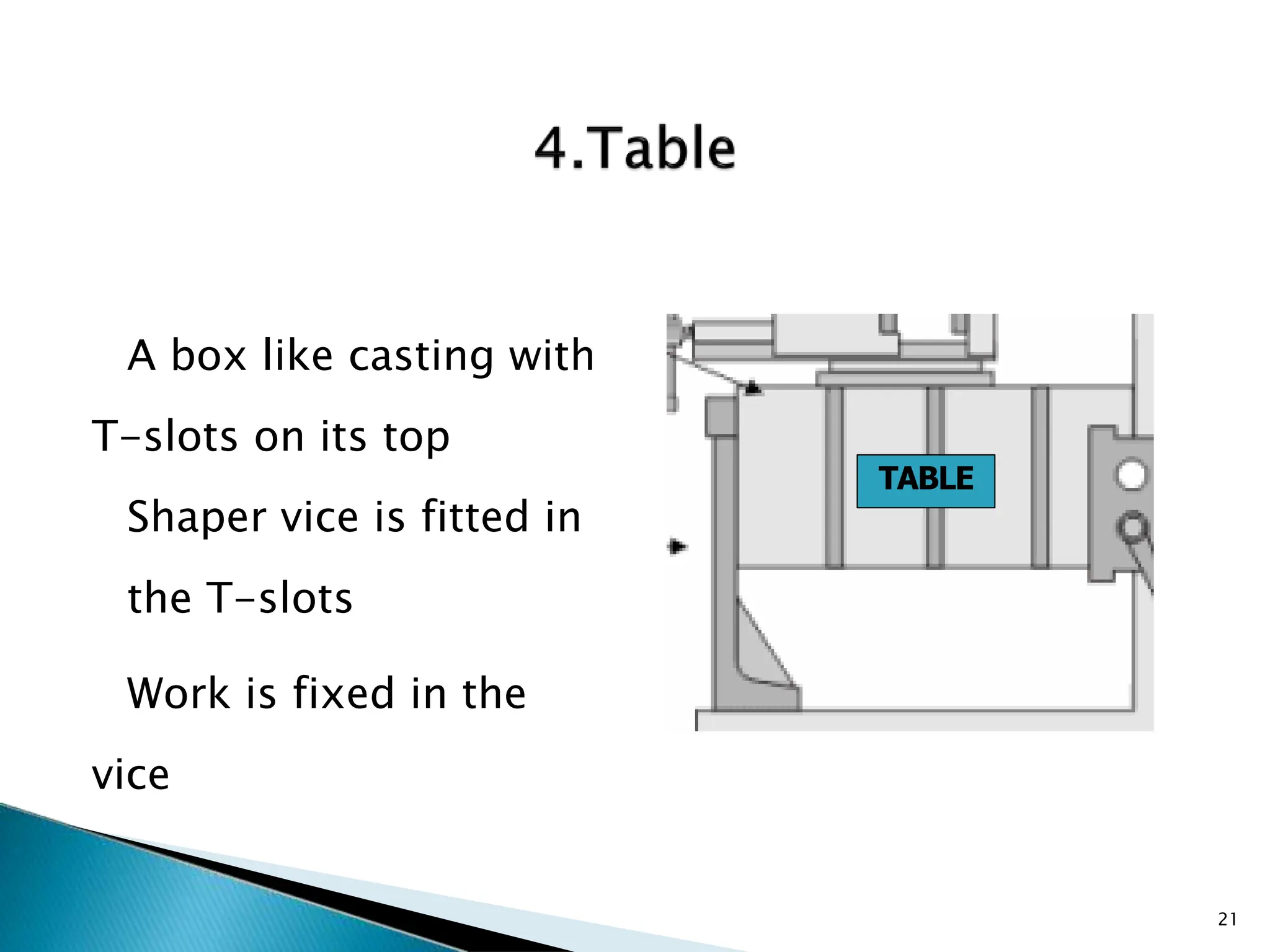
A box like casting with
T-slots on its top
Shaper vice is fitted in
the T-slots
Work is fixed in the
vice
TABLE
21
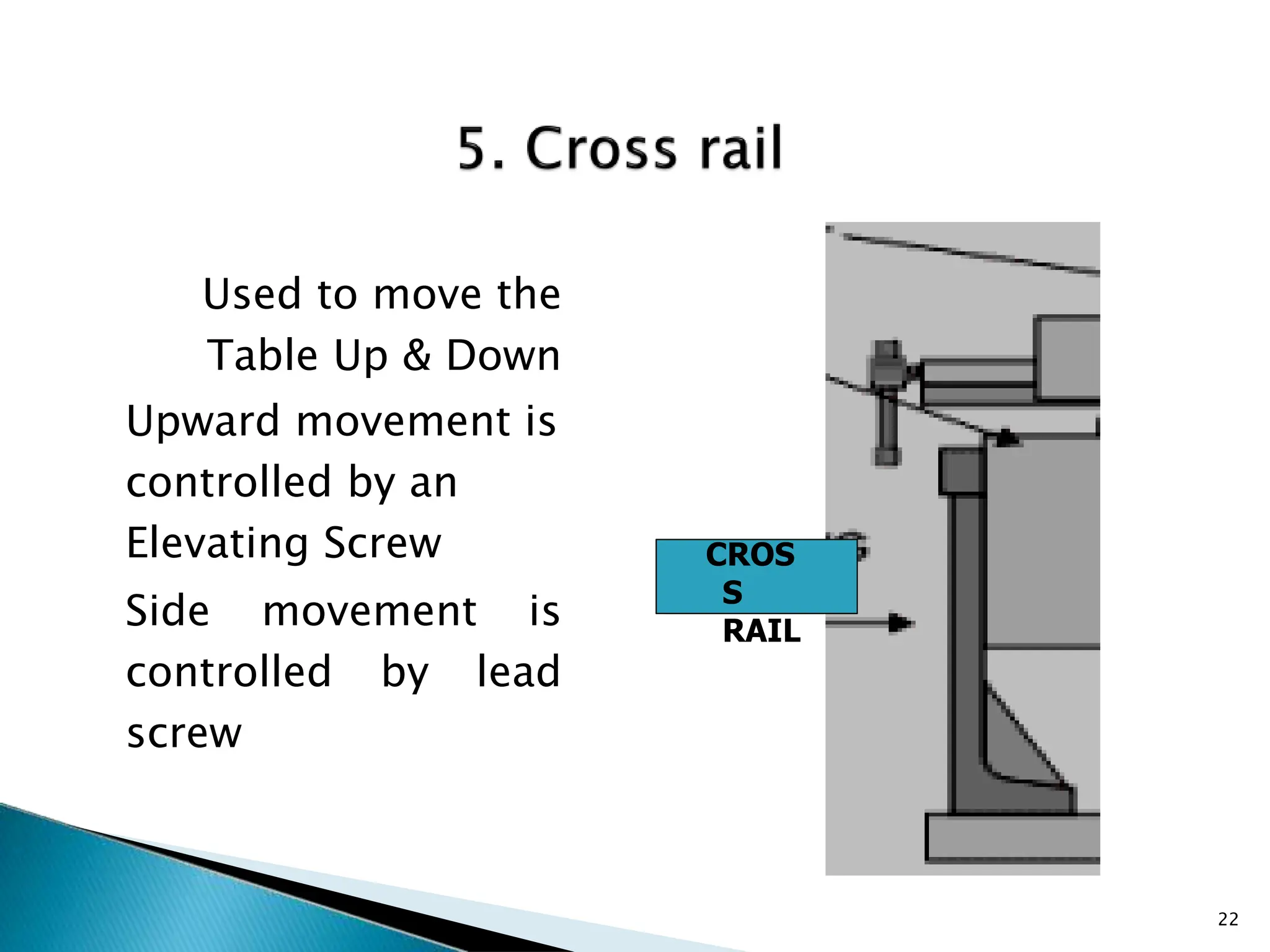
Used to move the
Table Up & Down
Upward movement is
controlled by an
Elevating Screw
Side movement is
controlled by lead
screw
CROS
S
RAIL
22
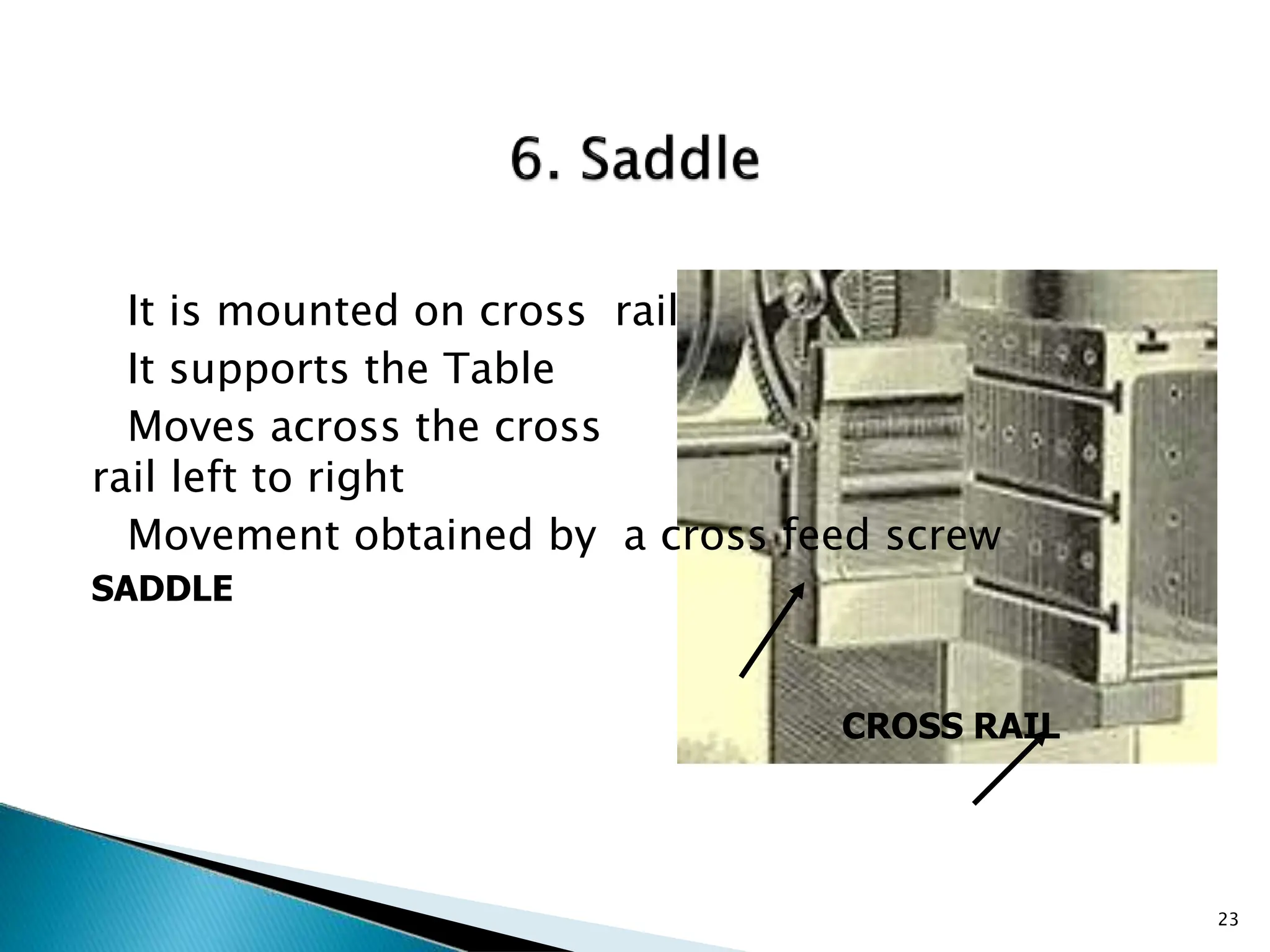
It is mounted on cross rail
It supports the Table
Moves across the cross
rail left to right
Movement obtained by a cross feed screw
SADDLE
CROSS RAIL
23
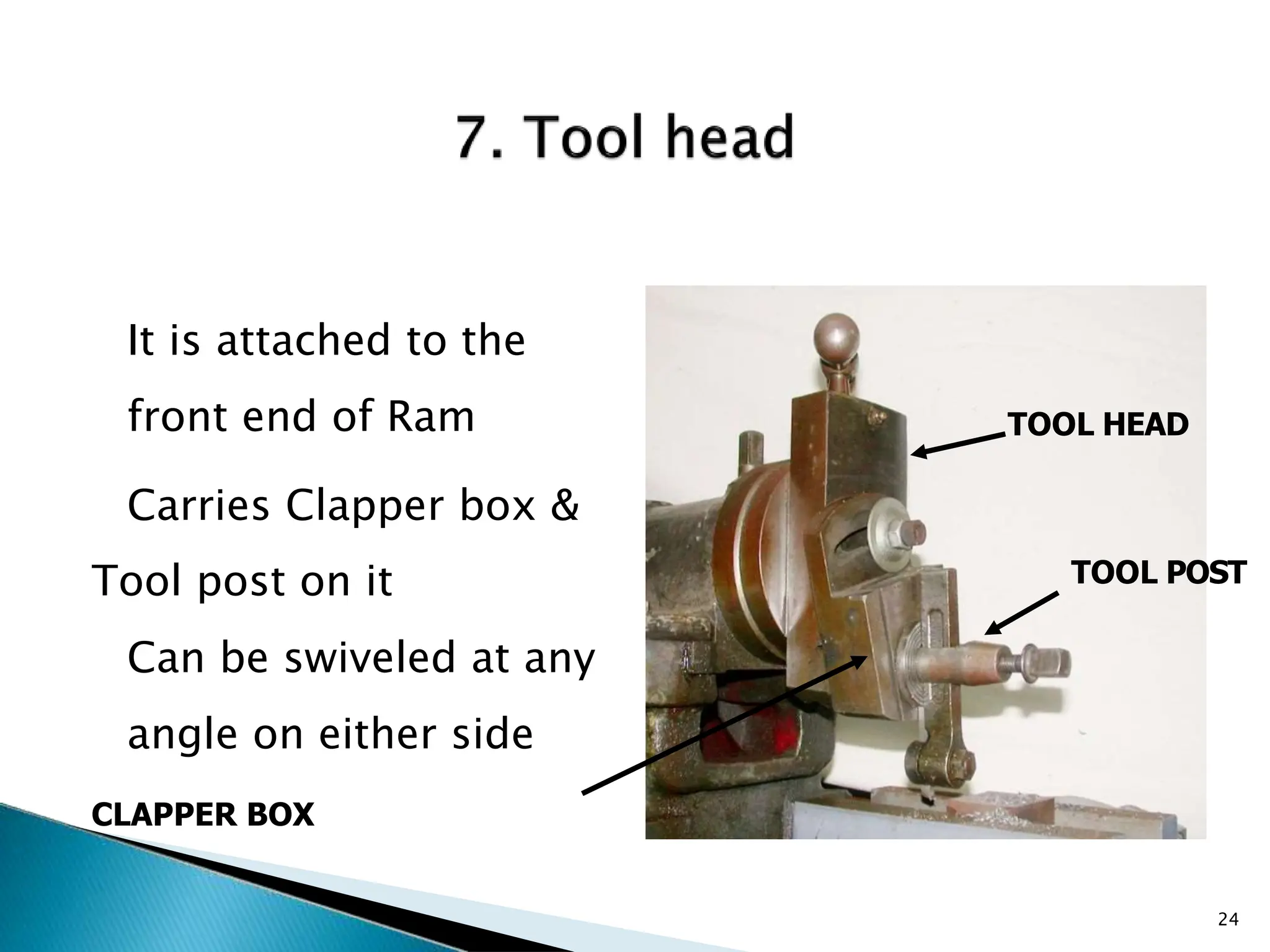
TOOL HEAD
TOOL POST
24
It is attached to the
front end of Ram
Carries Clapper box &
Tool post on it
Can be swiveled at any
angle on either side
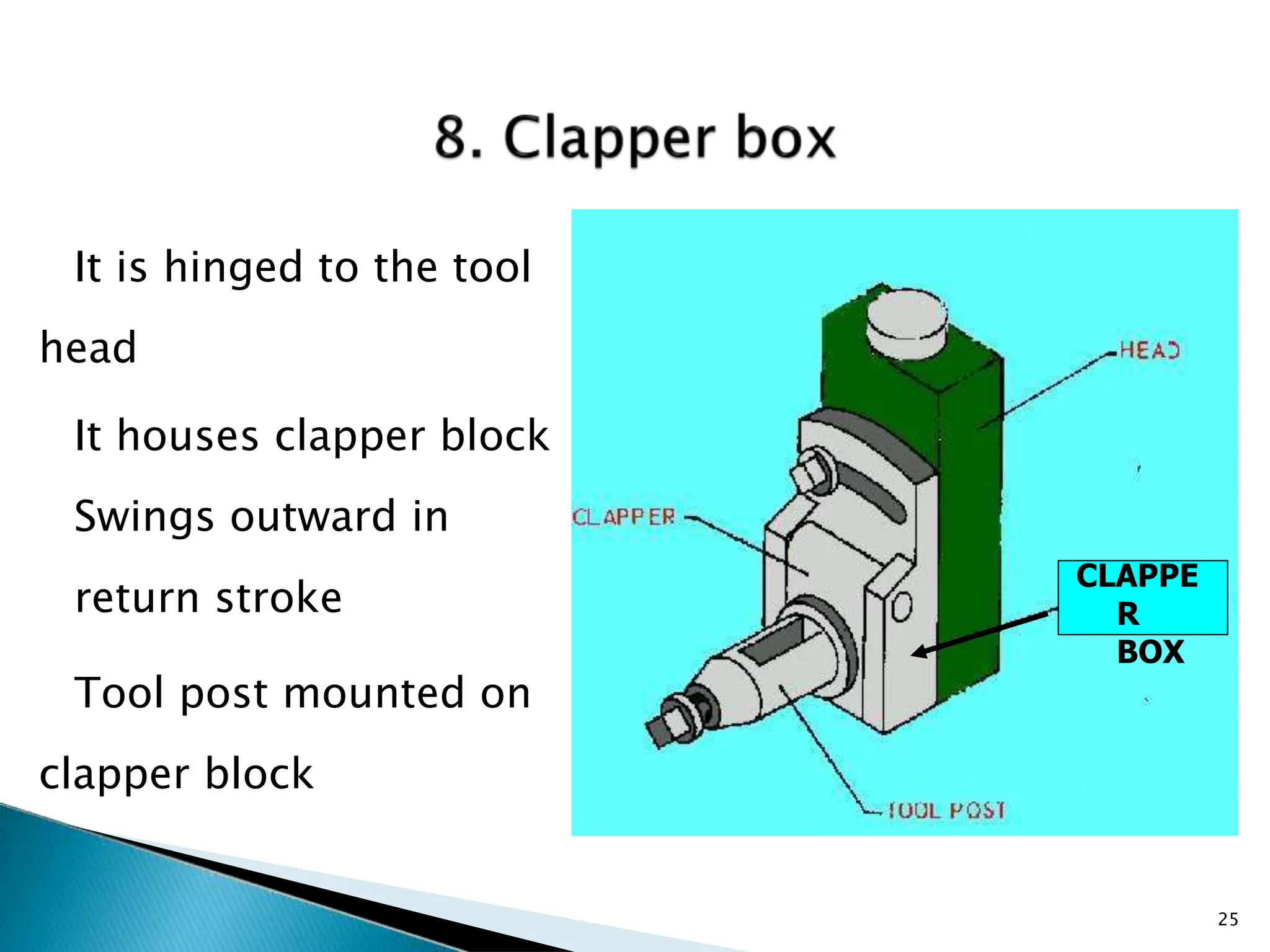
CLAPPER BOX
It is hinged to the tool
head
It houses clapper block
Swings outward in
return stroke
Tool post mounted on
clapper block
CLAPPE
R
BOX
25
• Max. length of Stroke of Ram
• Type of Drive
• Power input
• Floor Space required
• Weight of the Machine
• Cutting to Return Stroke ratio
• Feed
• Size of table
• Maximum horizontal and vertical travel of the table
26
Shaper drive Mechanism changes rotary motion of
power source (Electric motor) to reciprocating
motion of Ram.
Material removal (cutting) of work piece takes place
in the forward stroke of ram.
The return stroke of the ram does no cutting,
hence is called Idle stroke.
The Ram with cutting tool has to move slowly in
cutting stroke.
27
•Since return stroke does no cutting the ram
should move faster during return stroke.
•The shaper drive system incorporates quick
return mechanism. So that the ram moves faster
during return stroke
•Thus minimizing the (idle time) Quick Return
time.
28
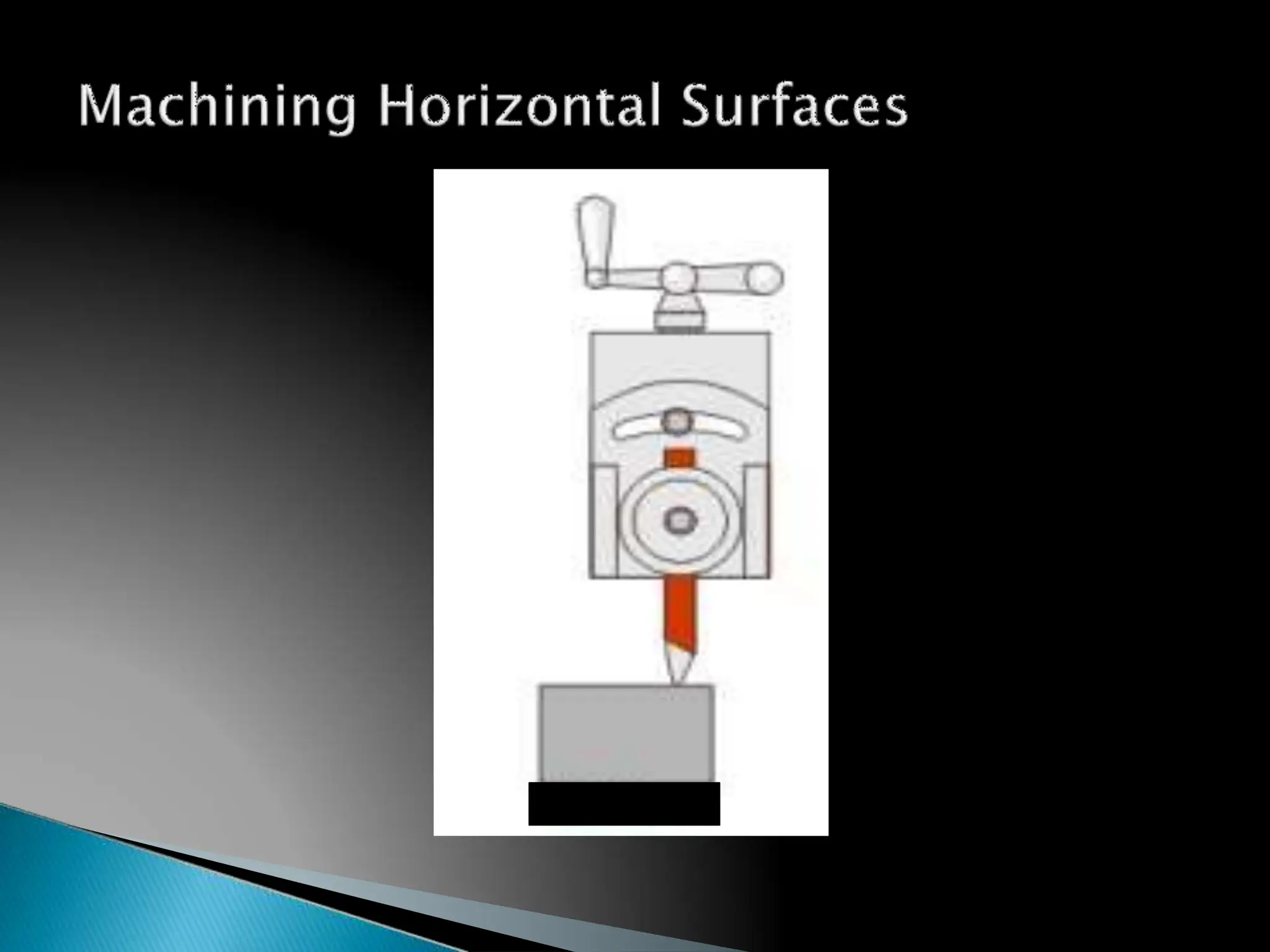
⦁ Machining Horizontal Surfaces
⦁ Machining Vertical Surfaces
⦁ Machining Angular Surfaces
⦁ Cutting Slots, Grooves & Key ways
⦁ Machining irregular surfaces
⦁ Machining Splines / Cutting Gears
29
Work is properly held in a vice
Table is raised to a gap of 25 to 30 mm between
tool & work
The length & position of stroke are adjusted
The length of stroke should be nearly 20 mm
longer than the work
30
The approach & over run should be 10 & 5 mm
respectively.
Depth of cut is adjusted by rotating down the feed
screw of tool head
Feed is adjusted about half the width of cutting
edge of tool
31
⦁ Fix the work properly on the table
⦁ Adjust the length of stroke
⦁ Set the required cutting speed
⦁ Give required feed of the table
⦁ Fix an appropriate tool in the tool head
⦁ Give suitable depth of cut for rough cuts
⦁ Finishing the job by giving less depth of cut
32
33
Fix up the job on the table firmly
Align the surface to be machined properly
Fix up a side cutting tool in the tool head
Set the vertical slide exactly at zero
Swivel the apron away from the job
Switch on the machine
Rotate down feed screw by hand to give down
feed
Feed in about 0.25 mm
34
35
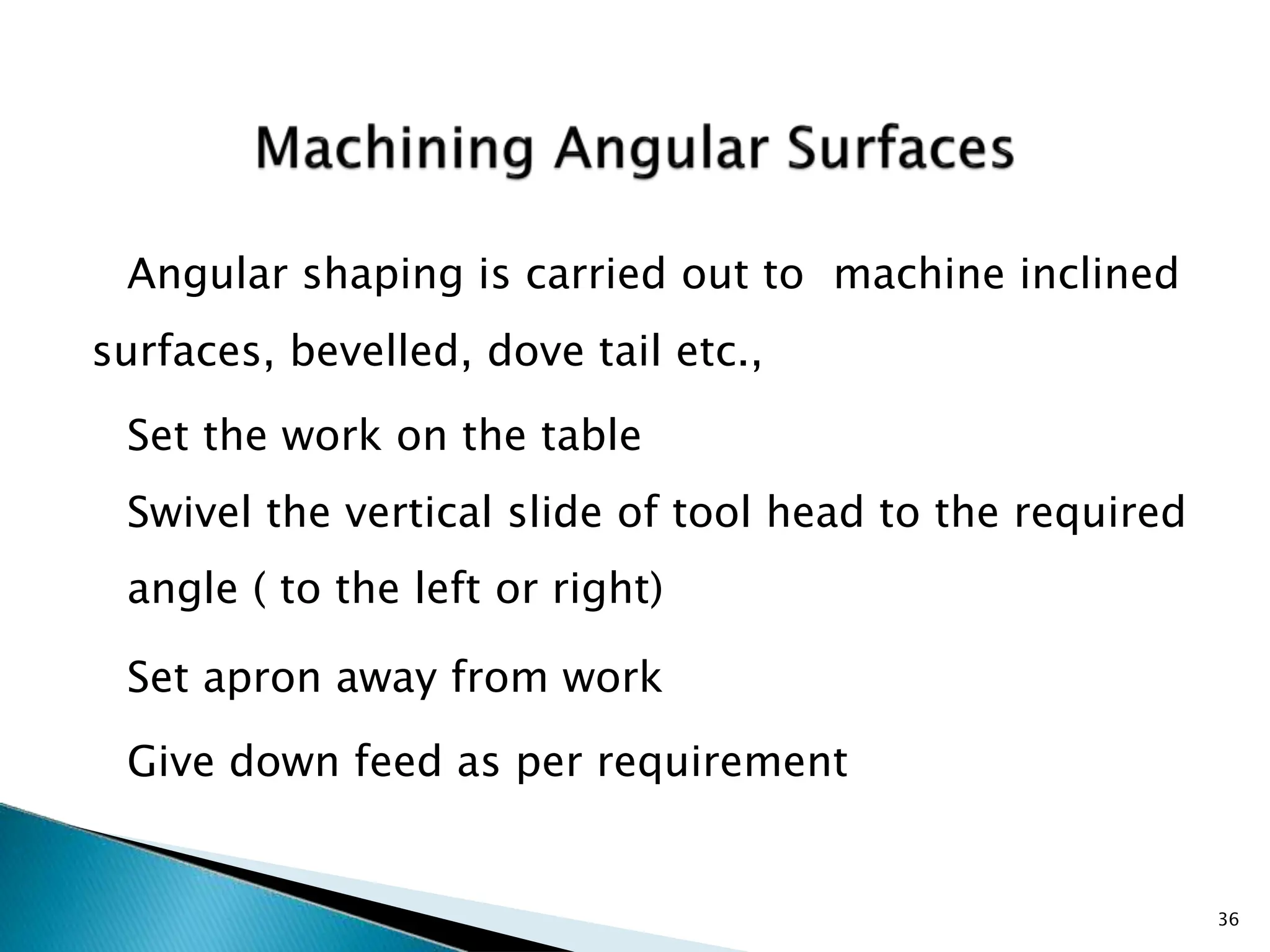
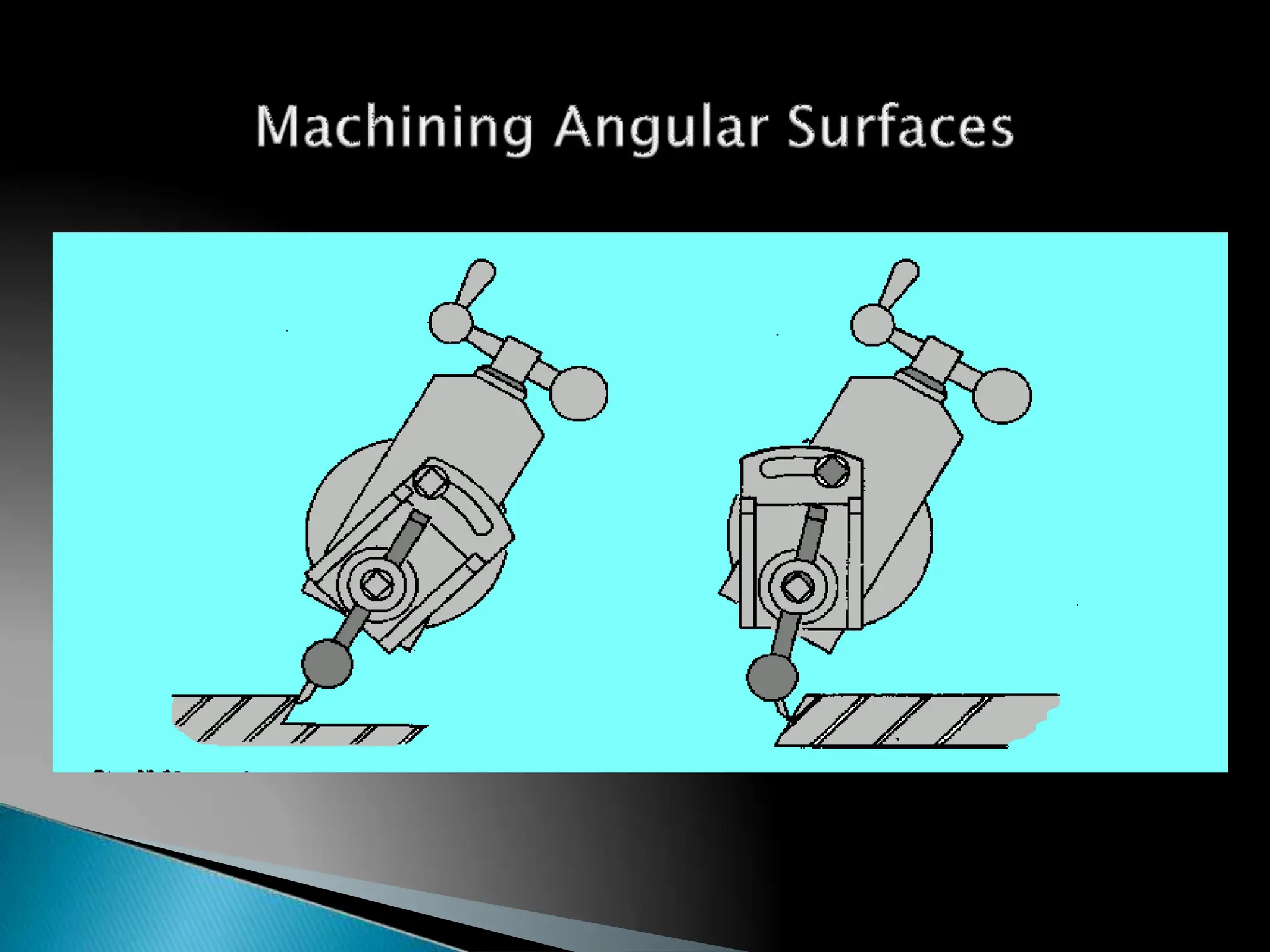
Angular shaping is carried out to machine inclined
surfaces, bevelled, dove tail etc.,
Set the work on the table
Swivel the vertical slide of tool head to the required
angle ( to the left or right)
Set apron away from work
Give down feed as per requirement
36
37
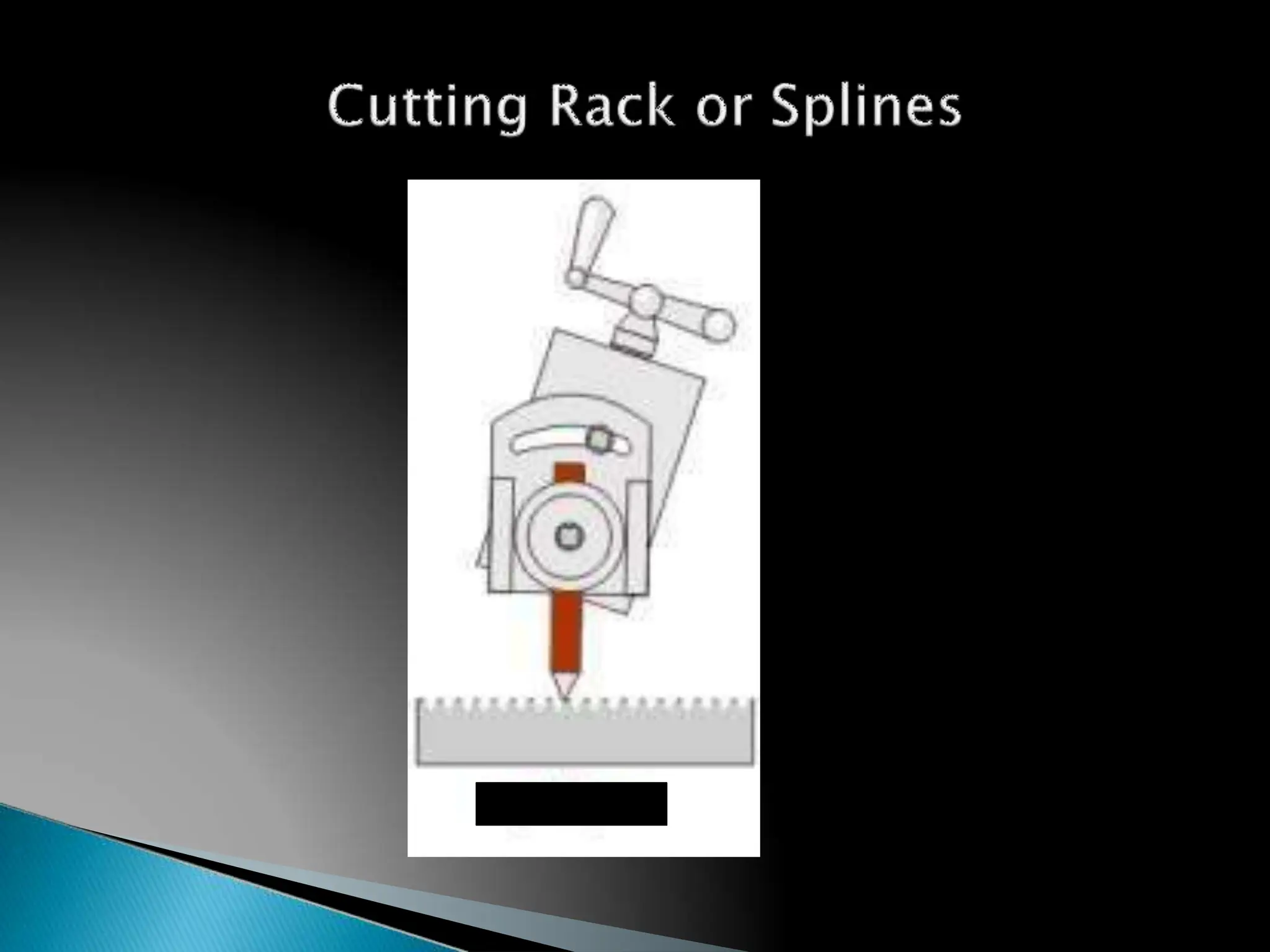
⦁ Fix up a square nose tool in tool head
⦁ Adjust the length & position of stroke
⦁ Reduce the cutting speed
⦁ Give suitable depth of cut
⦁ Feed the work properly to get equal splines
38
39
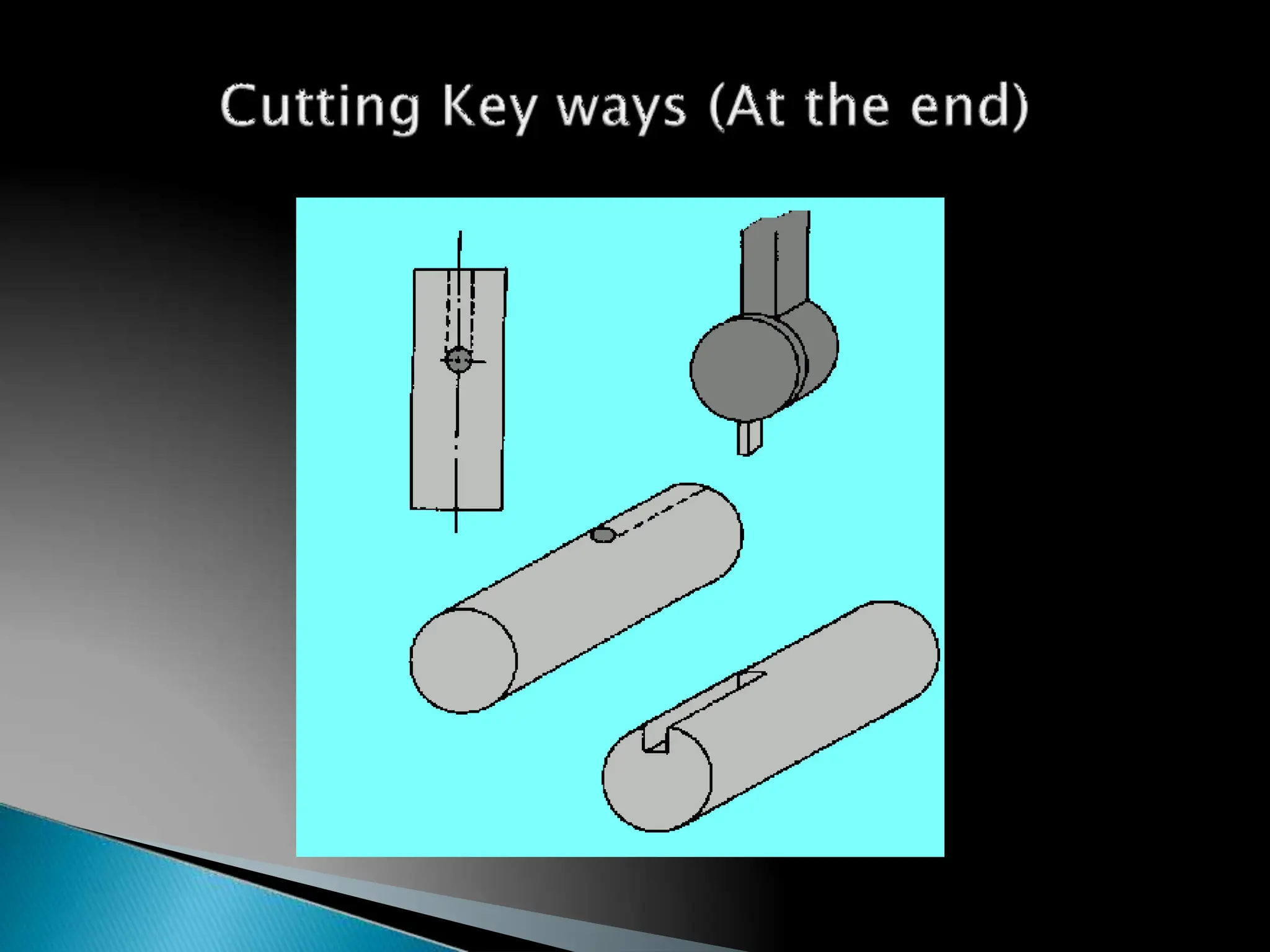
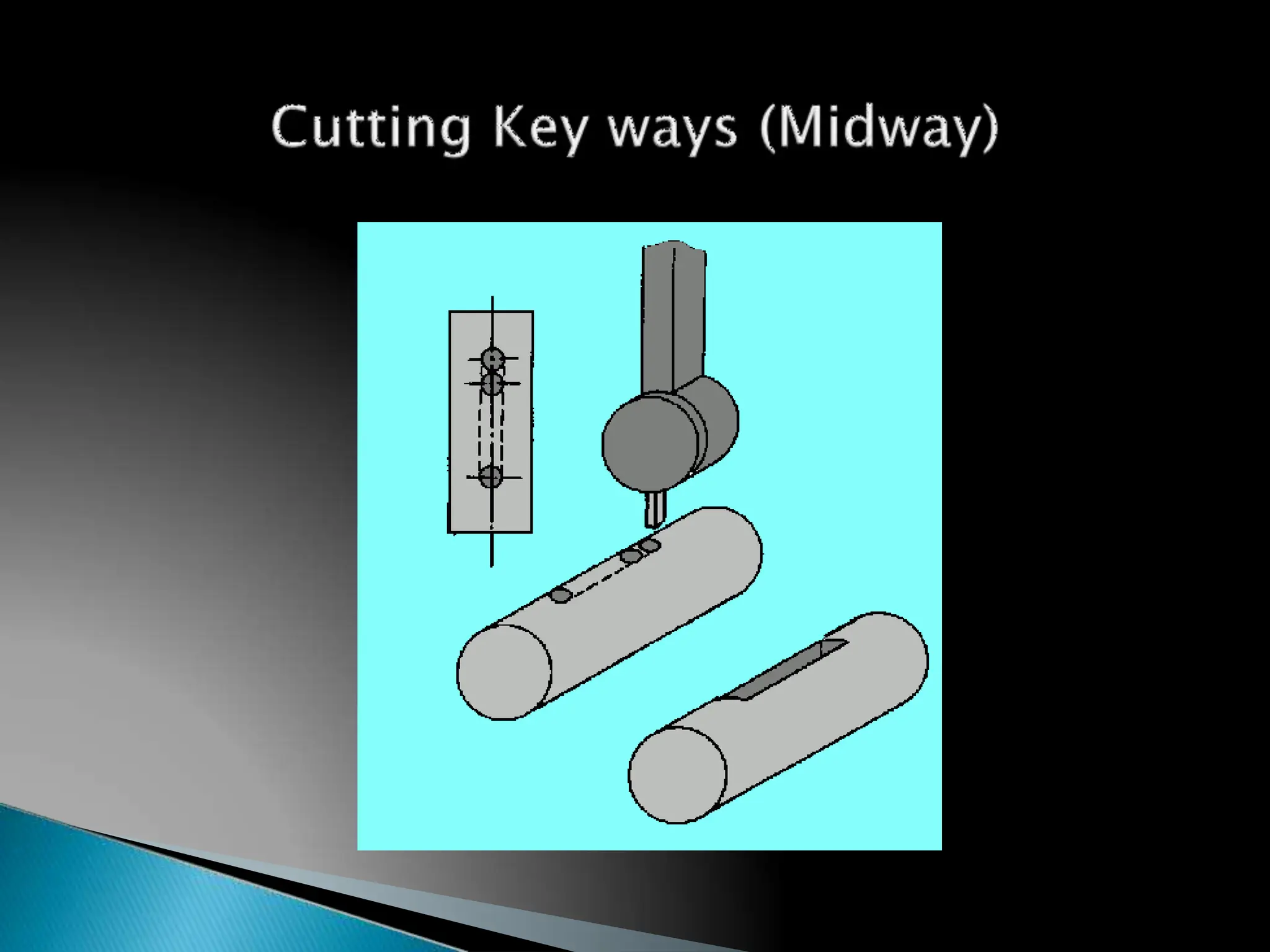
⦁ Fix up the job between two centres
⦁ Cut first spline similar to a key way
⦁ Move / Rotate work by the required amount
⦁ Use index plate for this purpose
40
41
42
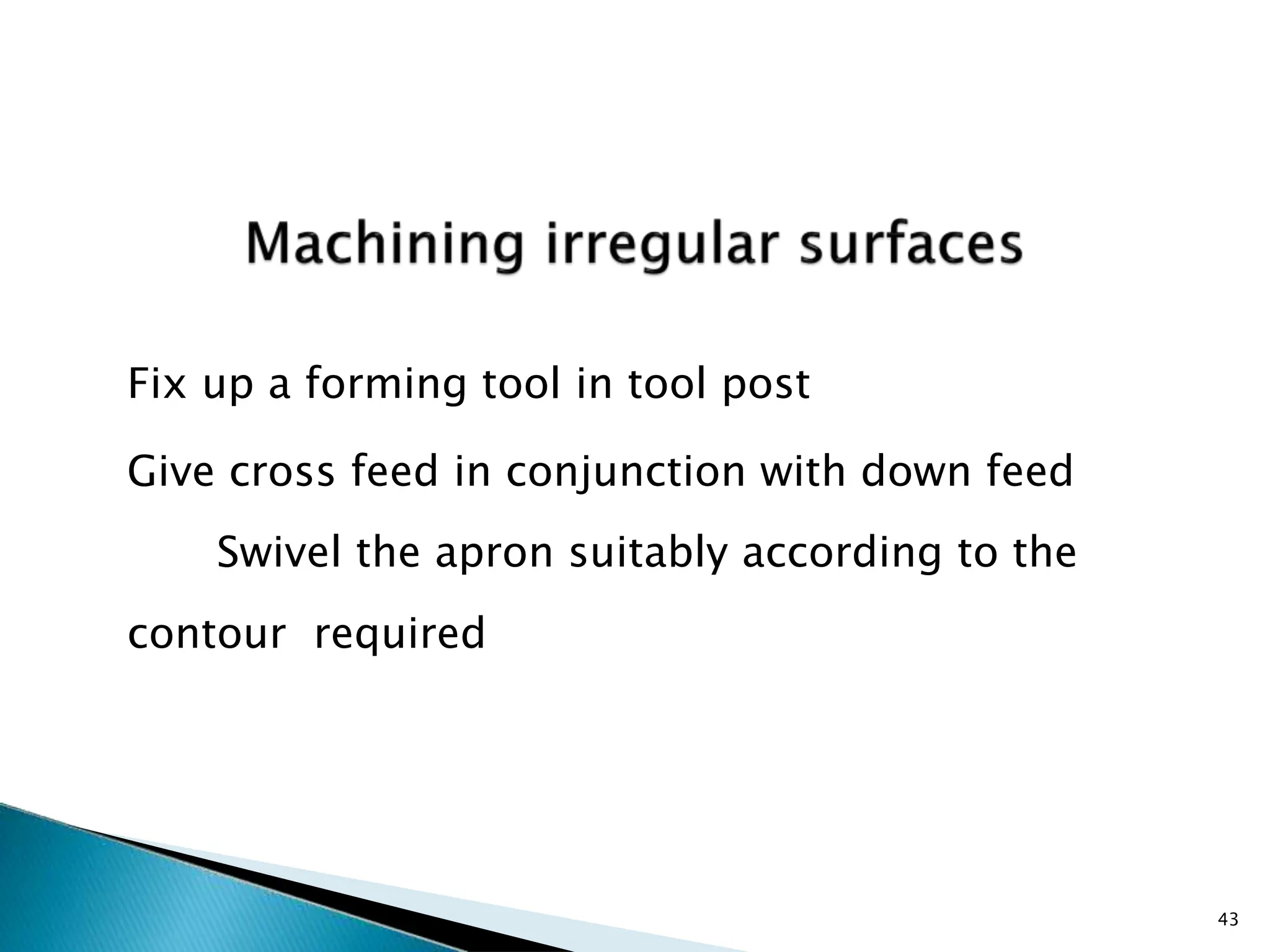
Fix up a forming tool in tool post
Give cross feed in conjunction with down feed
Swivel the apron suitably according to the
contour required
43
WORK
T
O
O
L
44
and can be readily changed from
one job to another.
The work can held easily.
The single point tools used are
in inexpensive;
🞄 Advantages 🞄 Limitations
🞄 The set up is very quick and easy 🞄 By nature is a slow machine
⦁ These tools can be easily
grounded to any desired shape.
Lower first cost.
The cutting stroke has a definite
stopping point.
⦁ Because lower cutting forces,
thin and fragile jobs can be
conventionally machined on
shapers.
because of its straight line,
forward and return stroke. The
single point tool requires several
strokes to complete a work.
The cutting speeds are not
usually very high speeds of
reciprocating motion due to high
inertia forces developed in the
motion of the units and
components of the machine.
Owing to these reasons the
shaper does not find ready
adaptability for assembly and
production line.
Shaper Driving Mechanisms
46
•Whitworth quick return mechanism
•Slotted link quick return mechanism
•Hydraulic quick return mechanism
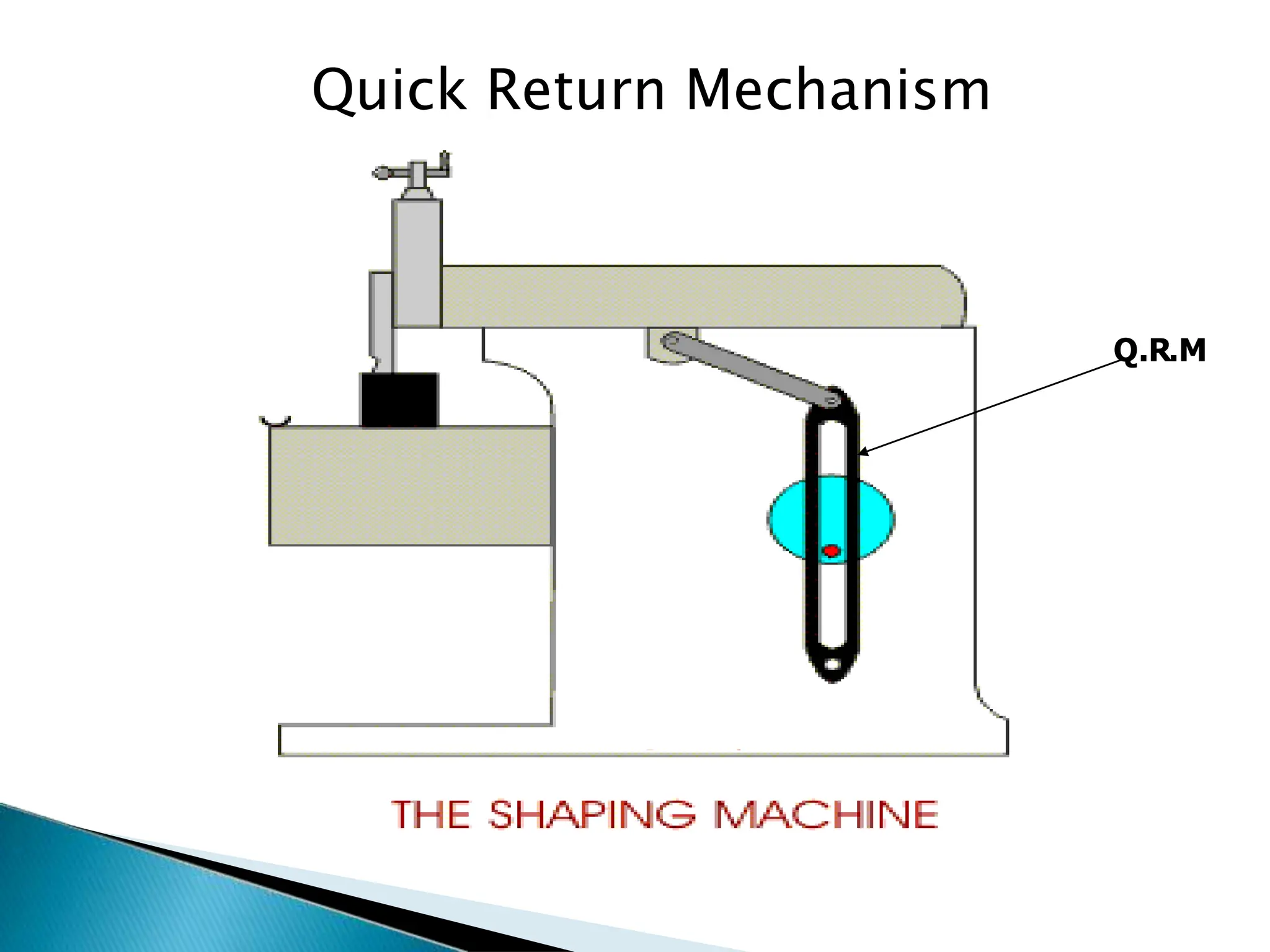
Quick Return Mechanism
Q.R.M
47
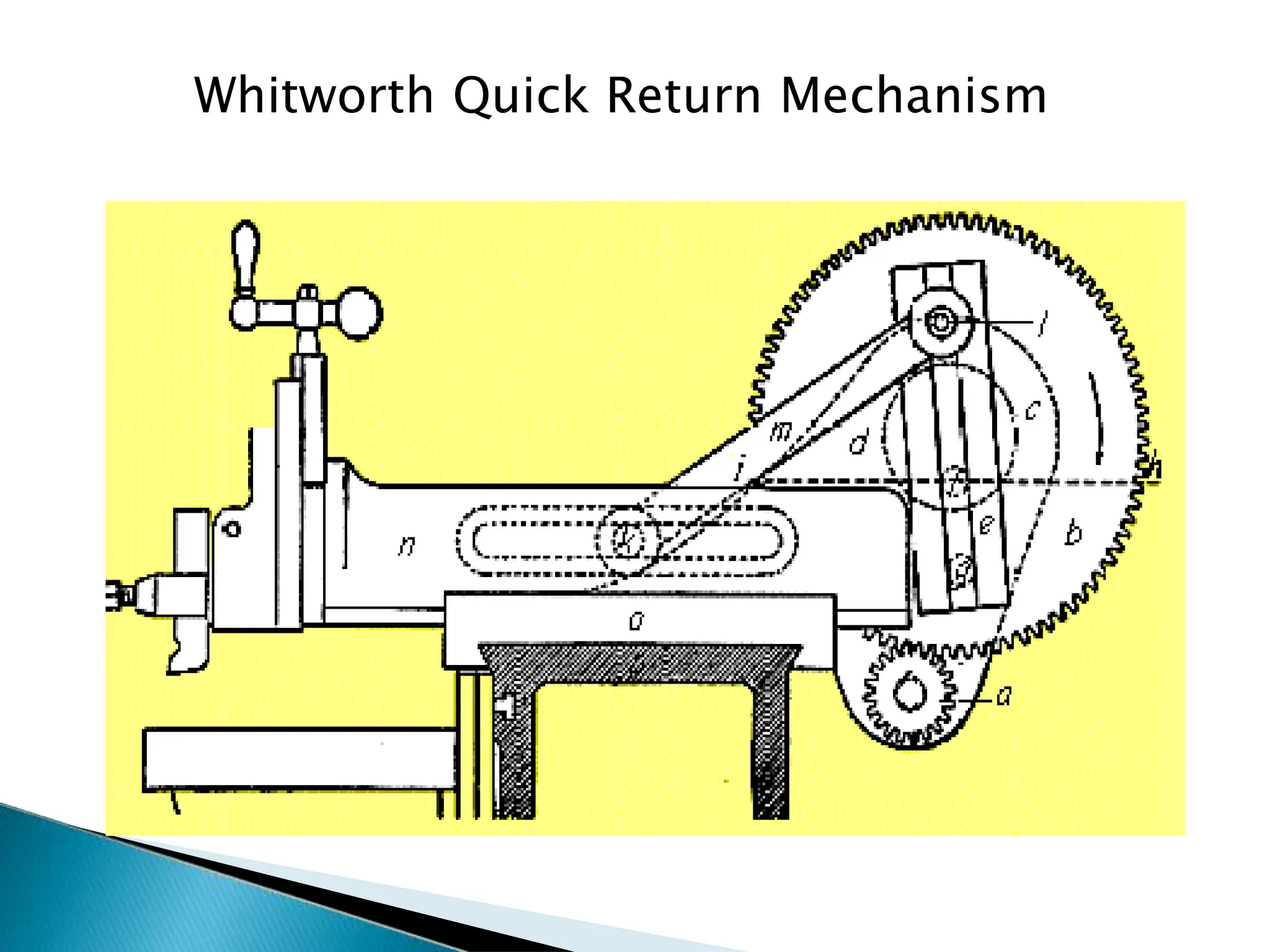
Whitworth Quick Return Mechanism
48
Whitworth Quick Return Mechanism
49
Whitworth Quick Return Mechanism
50
Whitworth Quick Return Mechanism
51
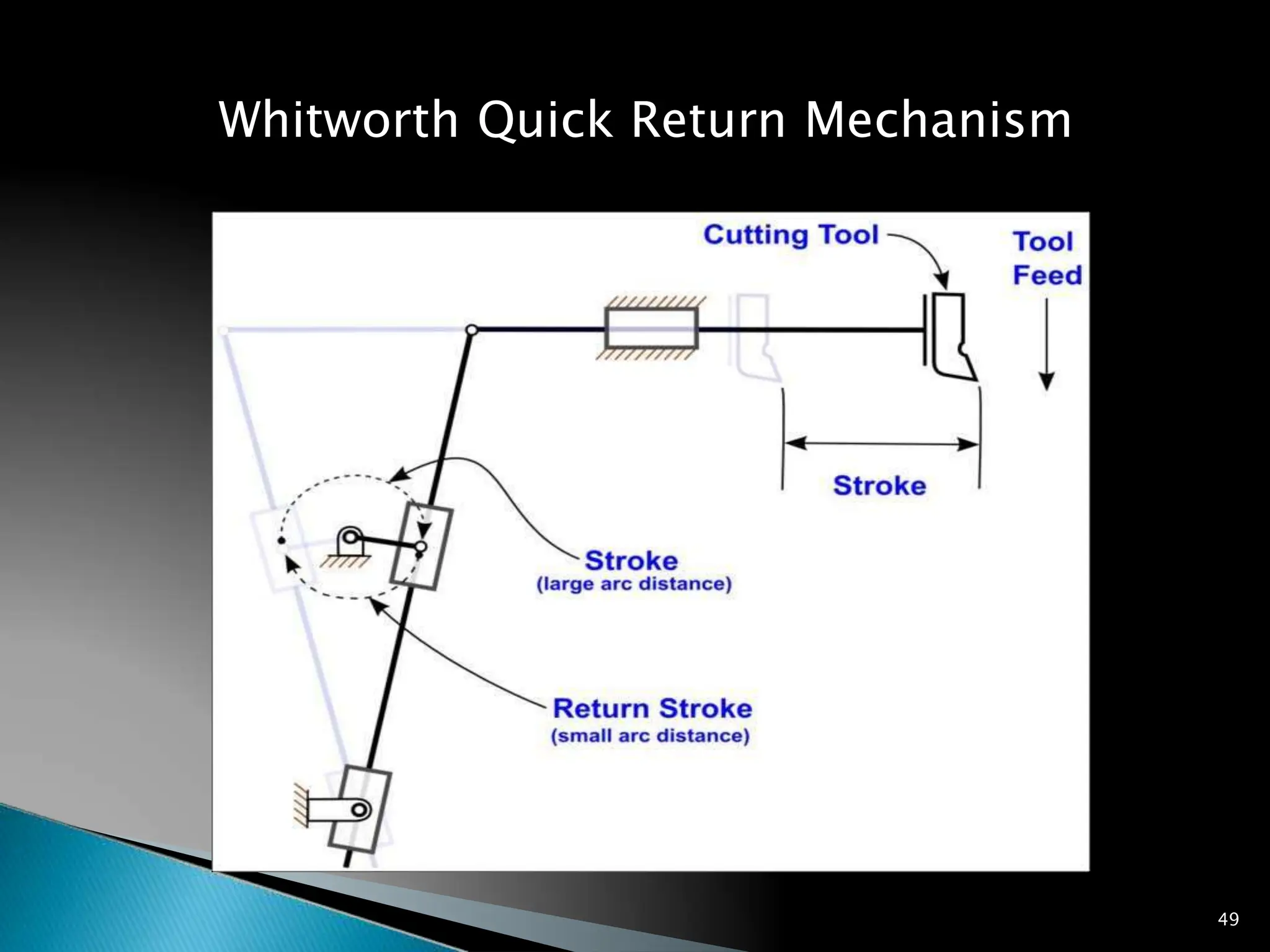
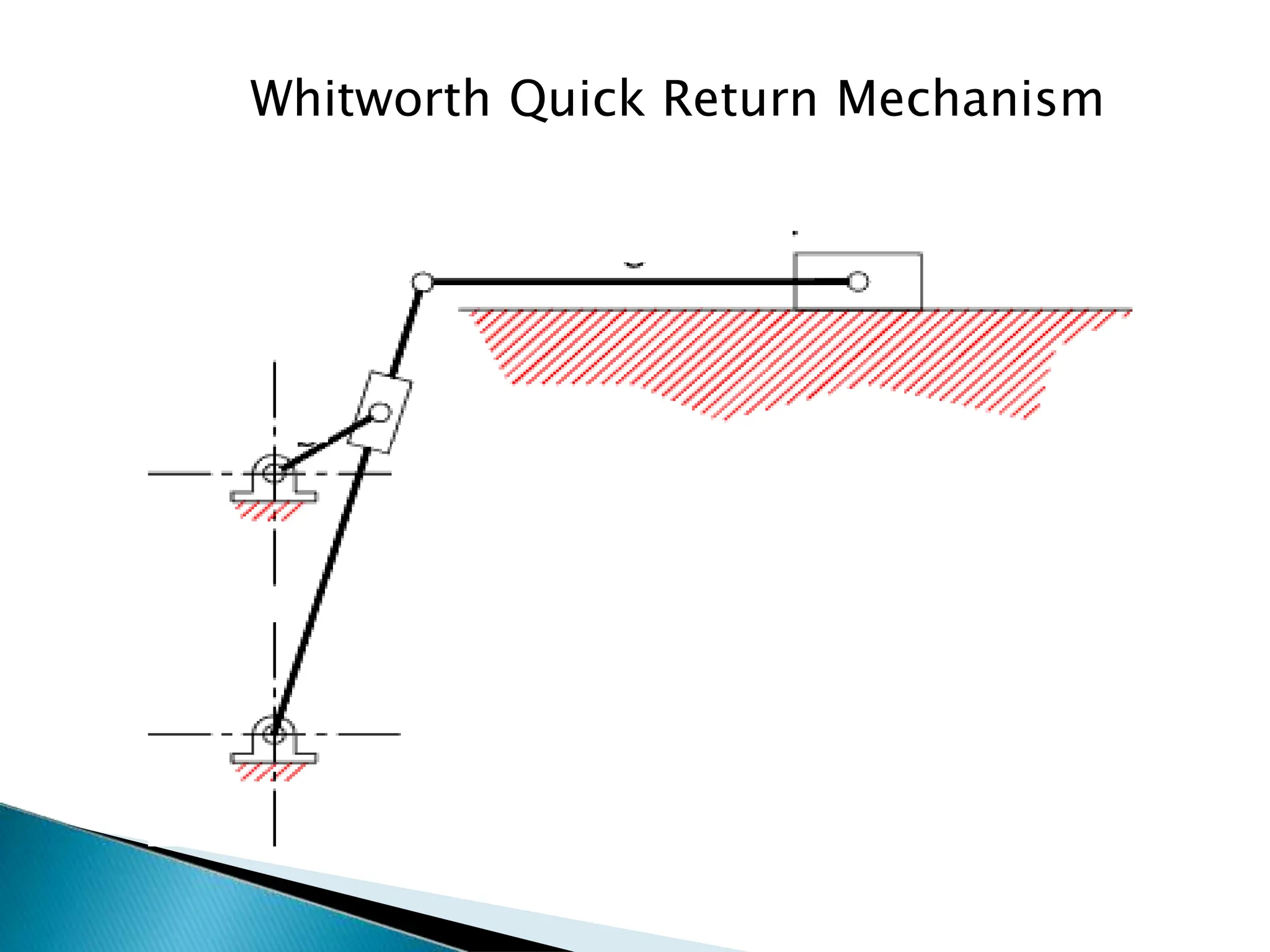
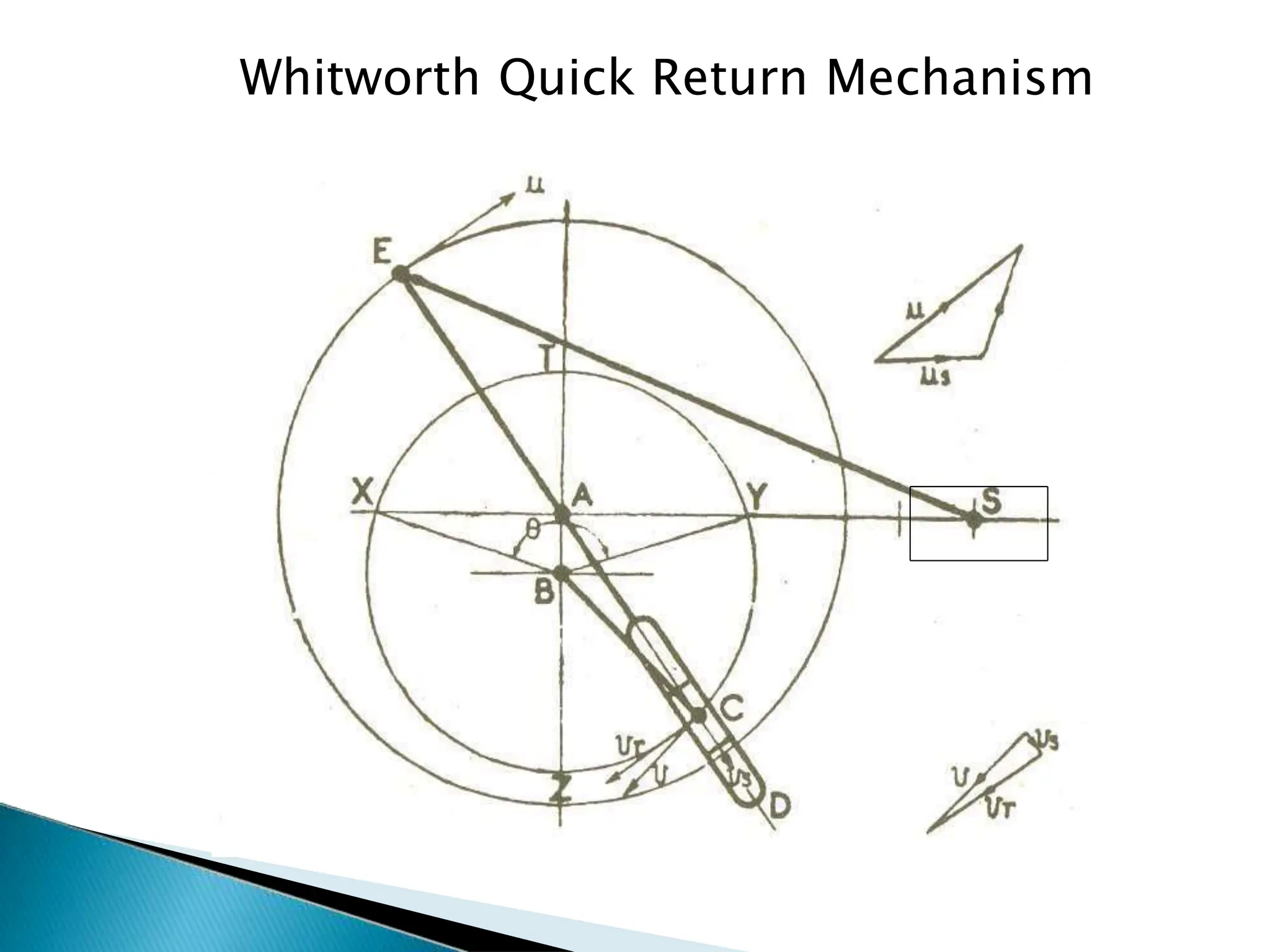
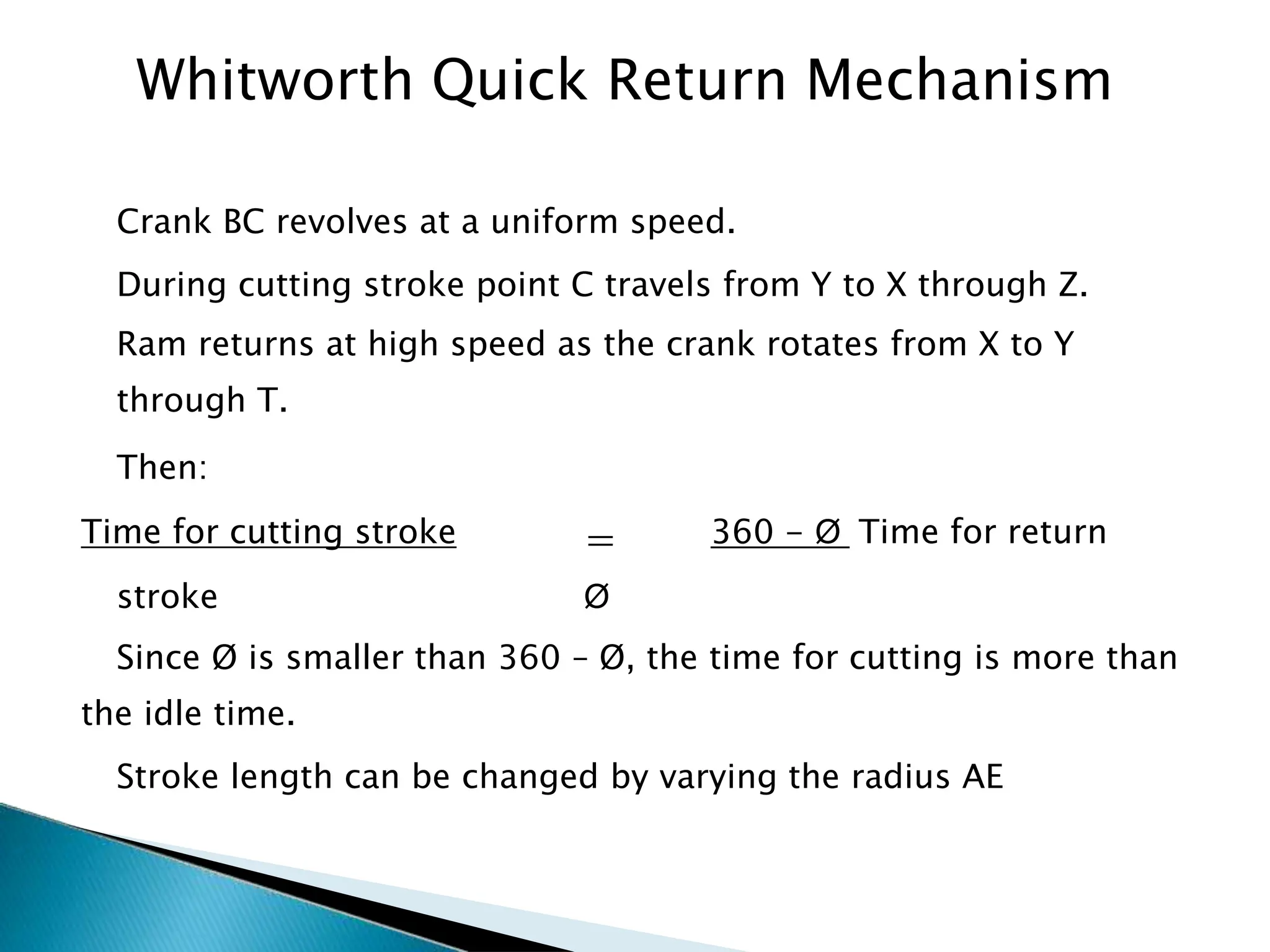
Crank BC revolves at a uniform speed.
During cutting stroke point C travels from Y to X through Z.
Ram returns at high speed as the crank rotates from X to Y
through T.
Then:
Time for cutting stroke = 360 - Ø Time for return
stroke Ø
Since Ø is smaller than 360 – Ø, the time for cutting is more than
the idle time.
Stroke length can be changed by varying the radius AE
52
Whitworth Quick Return Mechanism
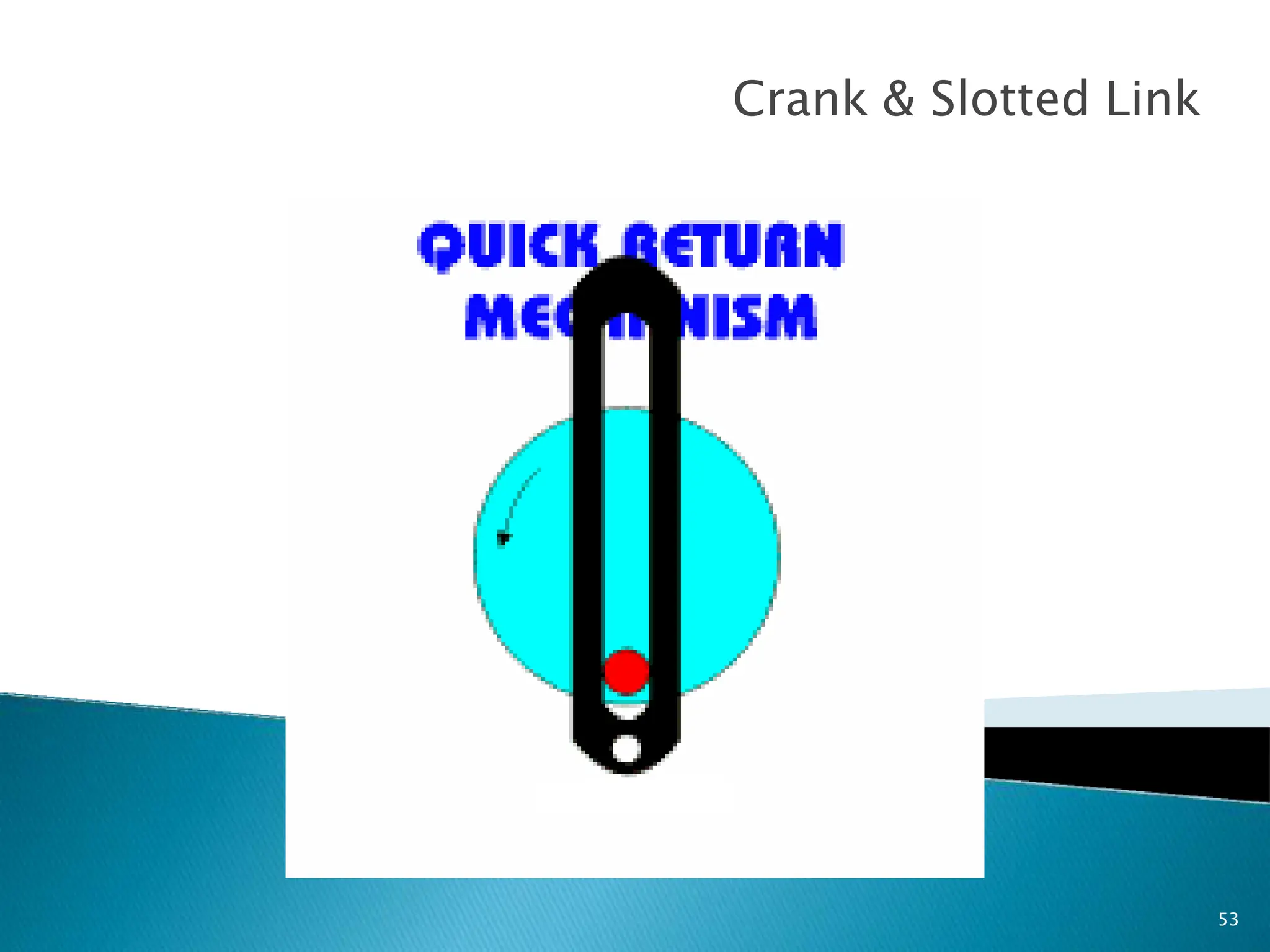
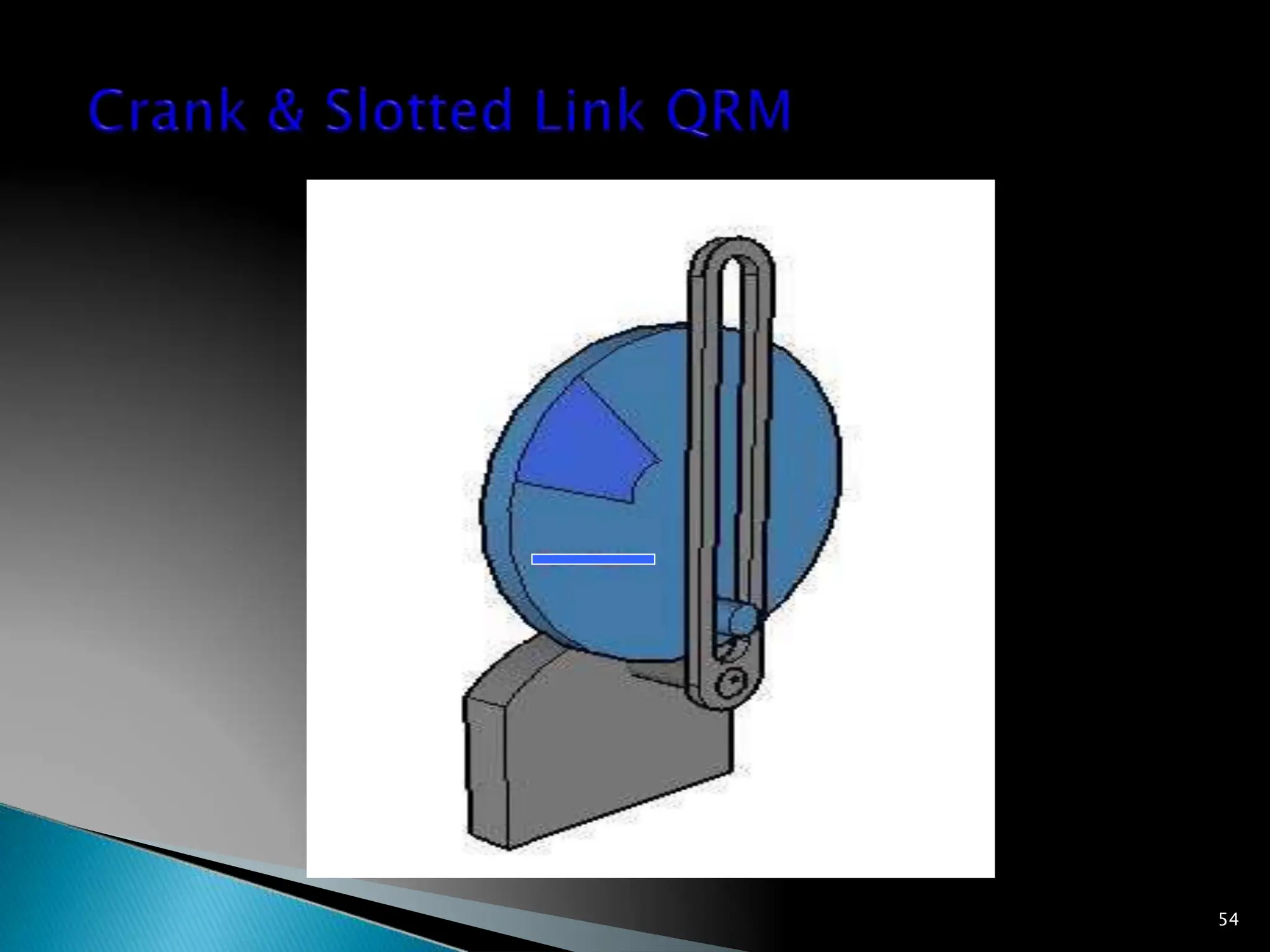
Crank & Slotted Link
53
54
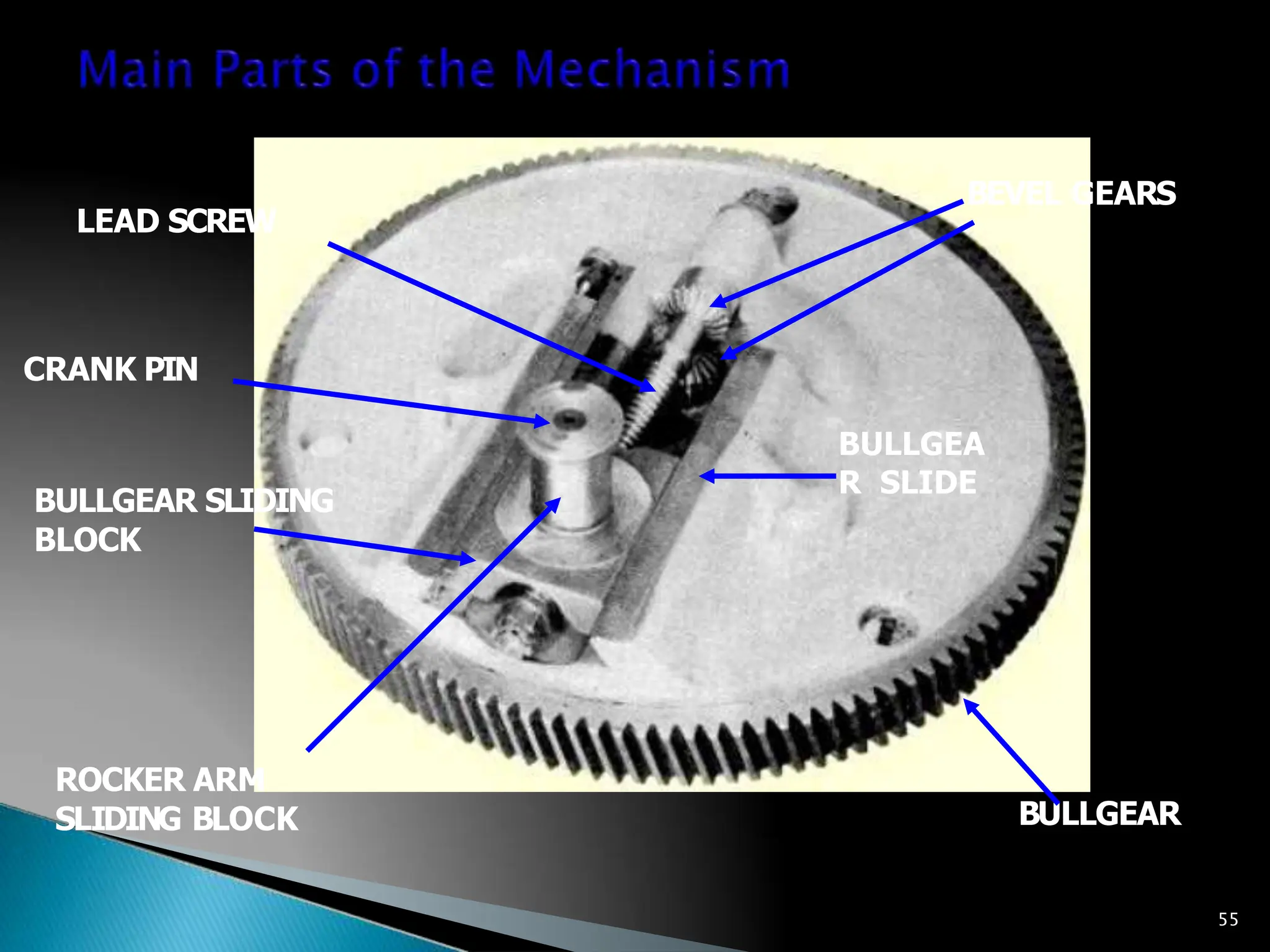
BULLGEAR
BULLGEAR SLIDING
BLOCK
CRANK PIN
BULLGEA
R SLIDE
LEAD SCREW
BEVEL GEARS
ROCKER ARM
SLIDING BLOCK
55
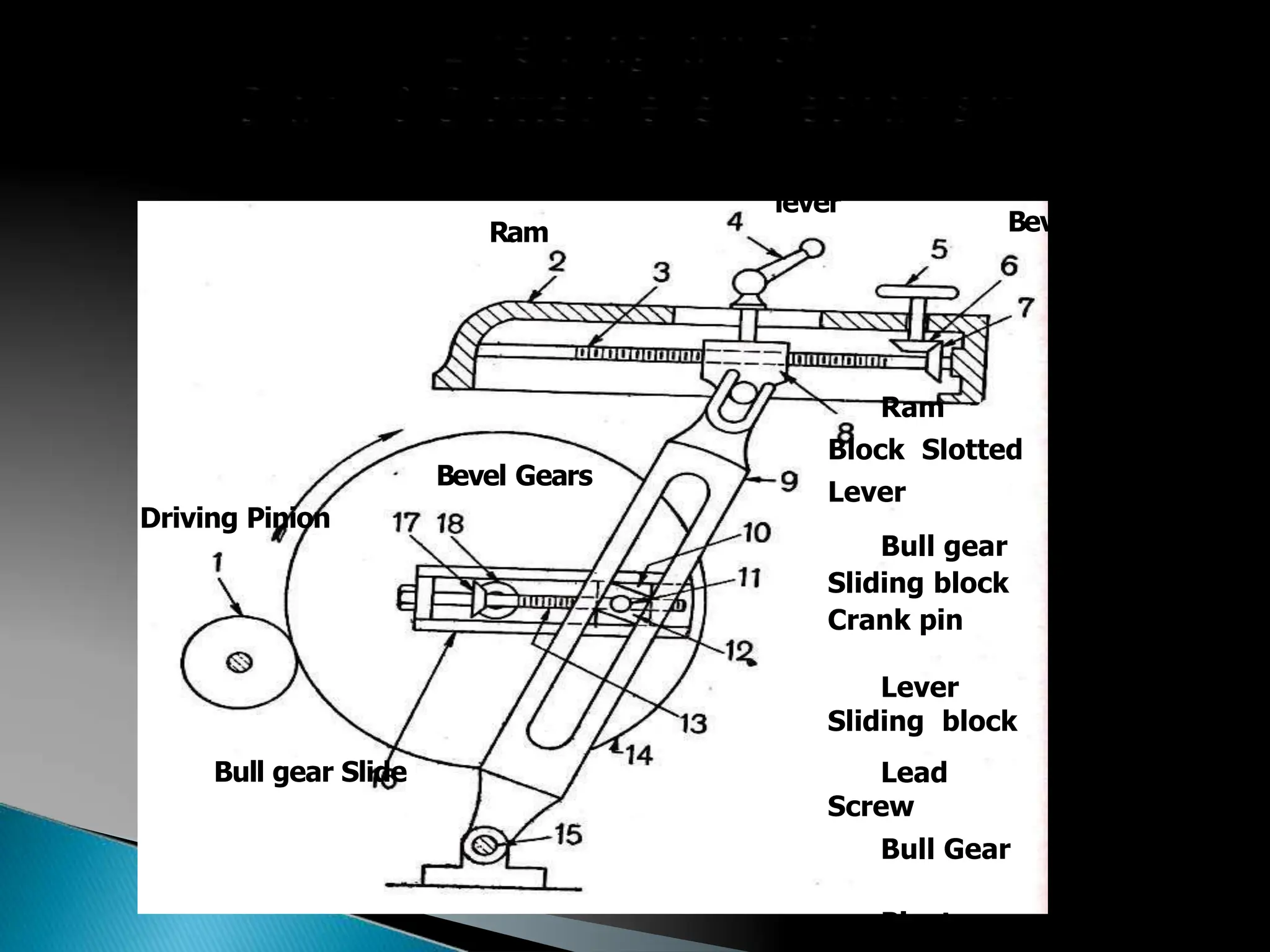
Driving Pinion
lever
Ram Bev
Bull gear Slide
Ram
Block Slotted
Lever
Bull gear
Sliding block
Crank pin
Lever
Sliding block
Lead
Screw
Bull Gear
Pivot
Bevel Gears
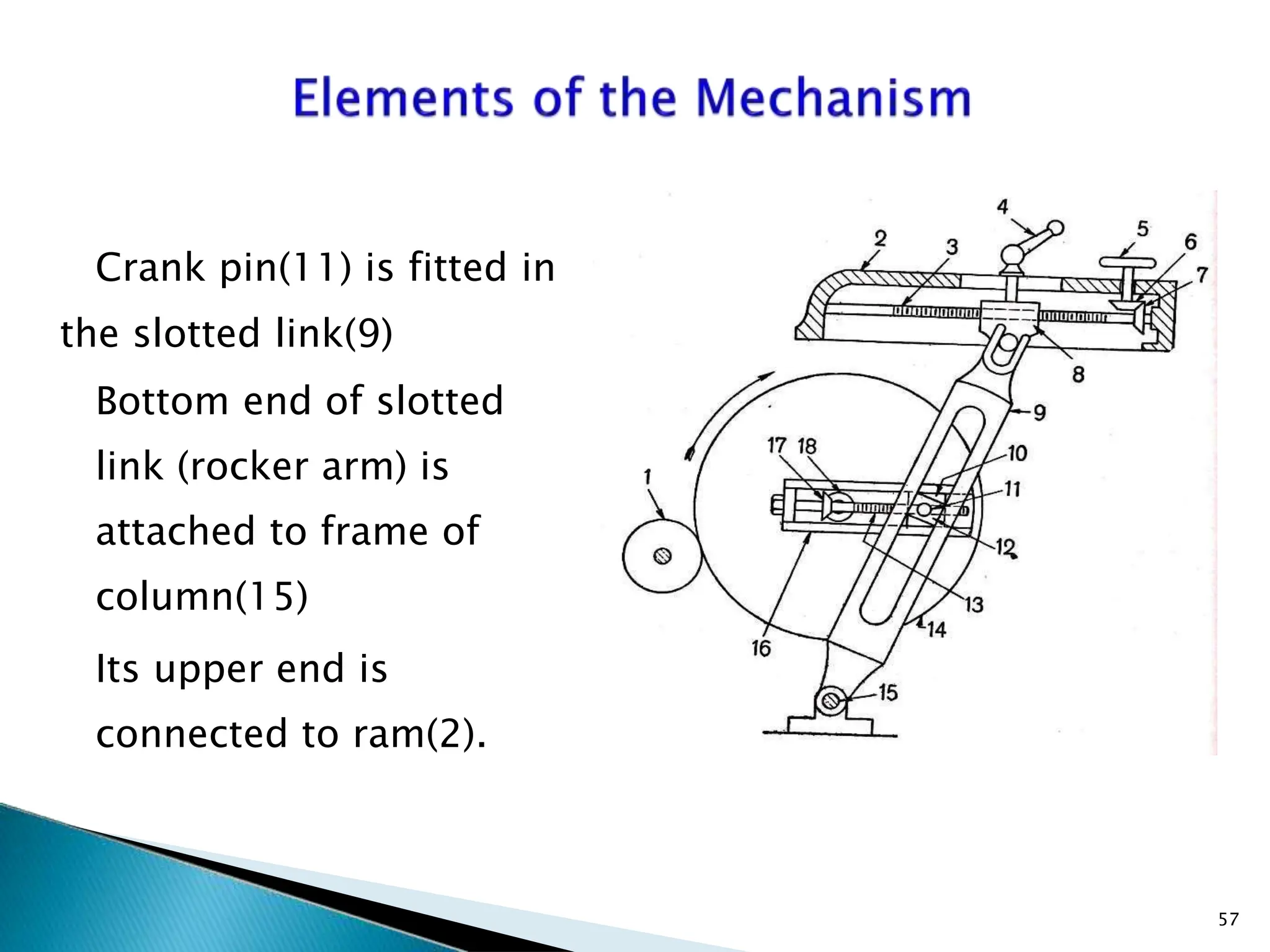
Crank pin(11) is fitted in
the slotted link(9)
Bottom end of slotted
link (rocker arm) is
attached to frame of
column(15)
Its upper end is
connected to ram(2).
57
Electric motor drives pinion (1)
Pinion (1) drives the bull gear(14)
A Radial slide (16) is bolted at the centre of bull gear.
Radial slide carries a sliding block(12) & a crank pin (11)
As the bull gear 14 rotates, crank pin 11 rotates.
So sliding block 12 also rotates on the crank pin circle.
Simultaneously crankpin will move up & down in the slot of the
slotted link 9.
58
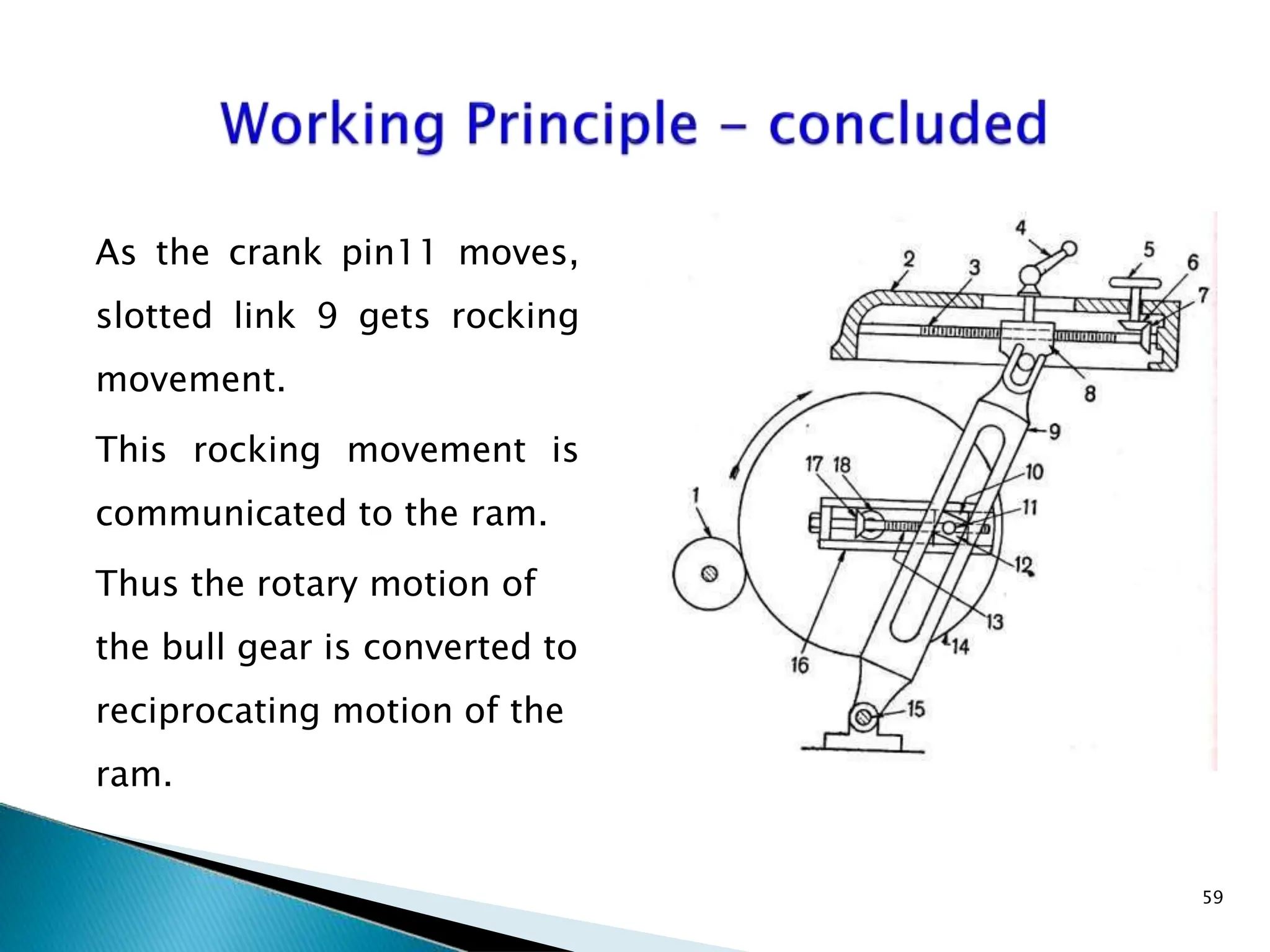
As the crank pin11 moves,
slotted link 9 gets rocking
movement.
This rocking movement is
communicated to the ram.
Thus the rotary motion of
the bull gear is converted to
reciprocating motion of the
ram.
59
P
M N
K
O
L
C2
C1
60
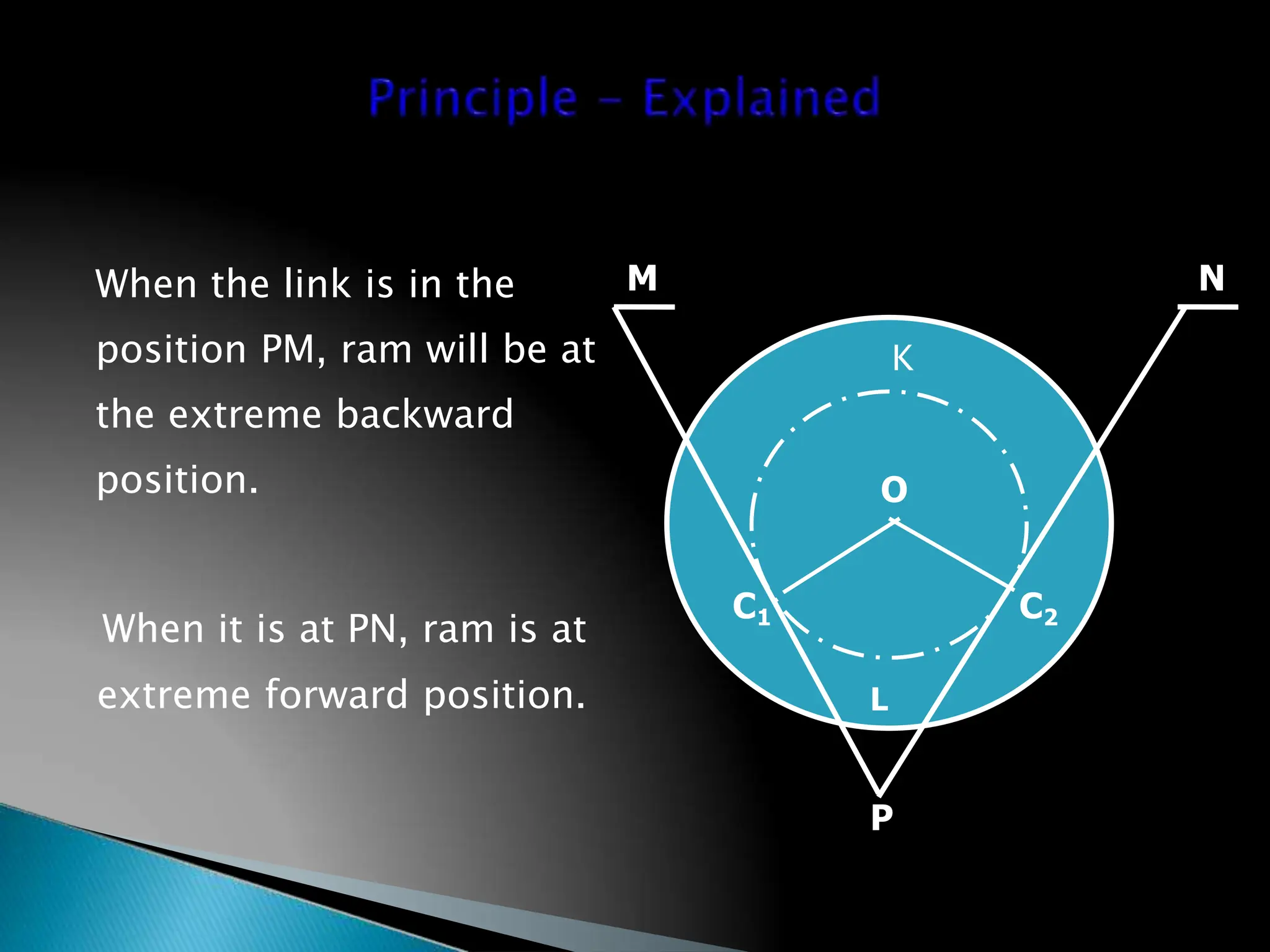
When the link is in the
position PM, ram will be at
the extreme backward
position.
When it is at PN, ram is at
extreme forward position.
P
M N
K
O
L
C2
C1
61
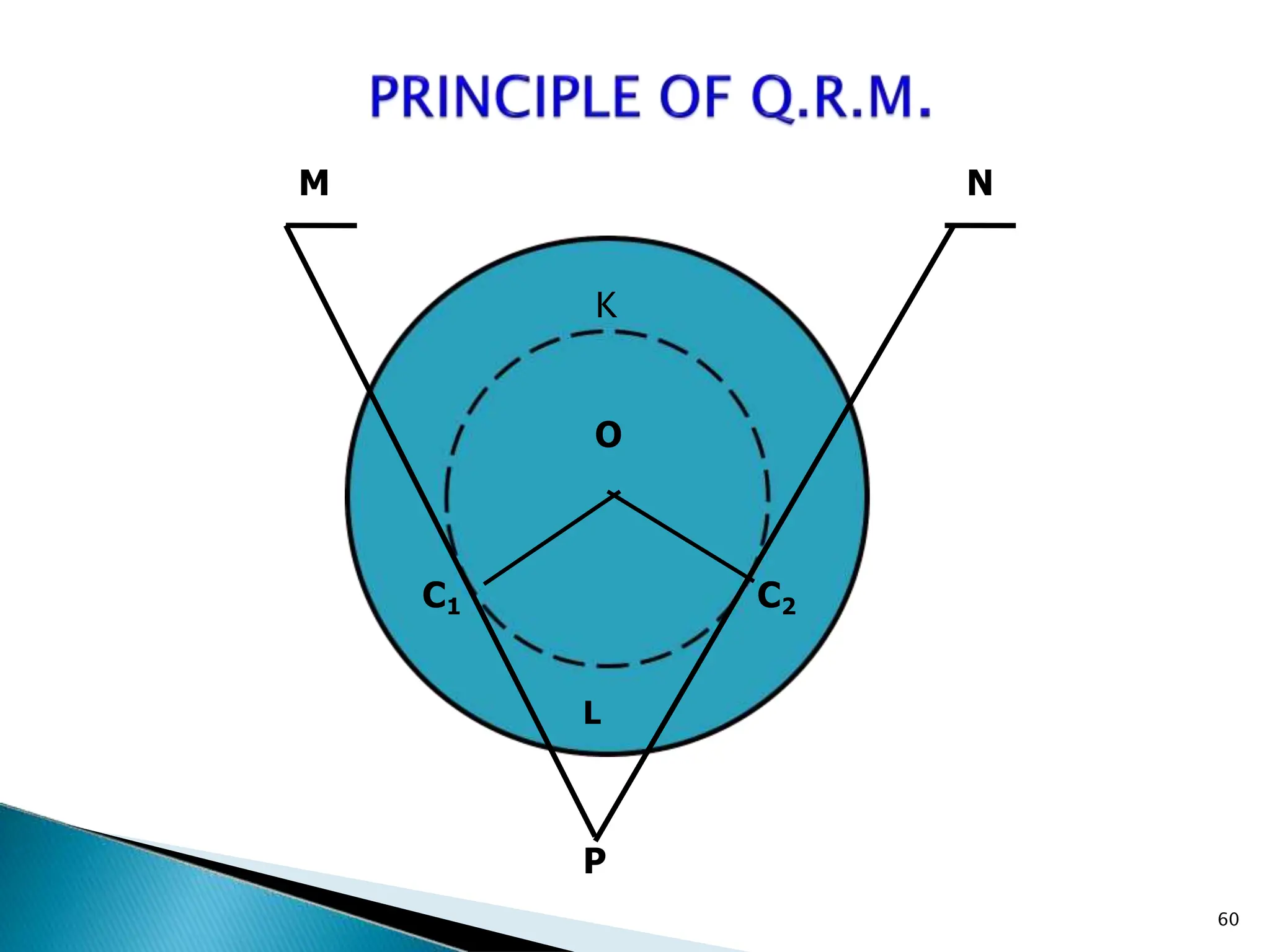
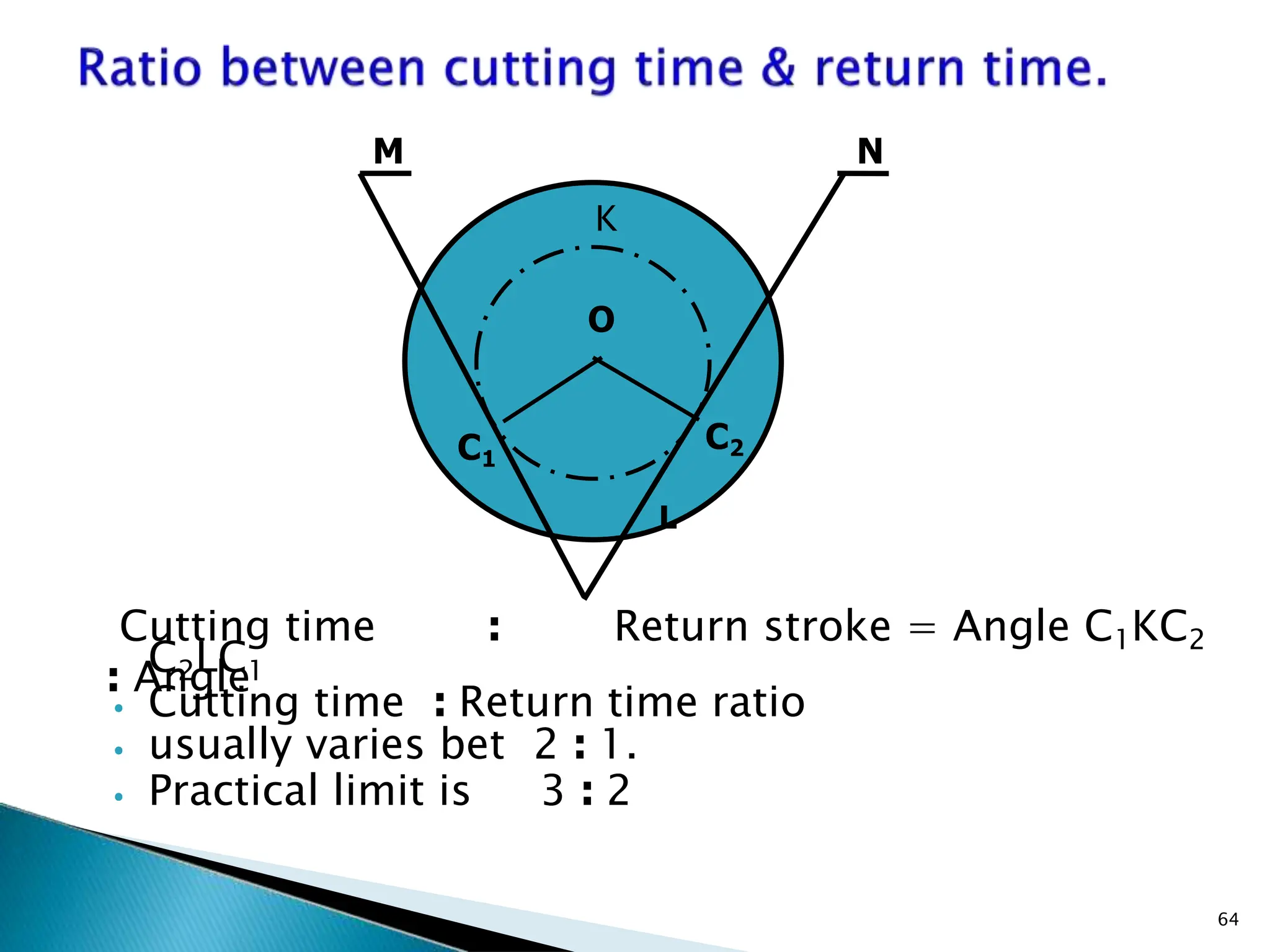
PM&PN are tangents drawn to
the crank pin circle.
Forward cutting stroke takes
place through the angle C1K C2
Return stroke takes place
through the angle C2 L C1
of the crank.
It is evident that angle C2K C1
is greater than C2 L C1 P
M N
K
O
L
C
2
C
1
62
M N
K
O
C2
C1
L
P
•Angular velocity of crank pin is constant.
•So Return stroke is completed in a shorter time.
•Therefore it is known as quick return motion.
63
C2LC1
⦁ Cutting time : Return time ratio
⦁ usually varies bet 2 : 1.
⦁ Practical limit is 3 : 2
M N
K
O
L
Cutting time : Return stroke = Angle C1KC2
: Angle
C2
C1
64
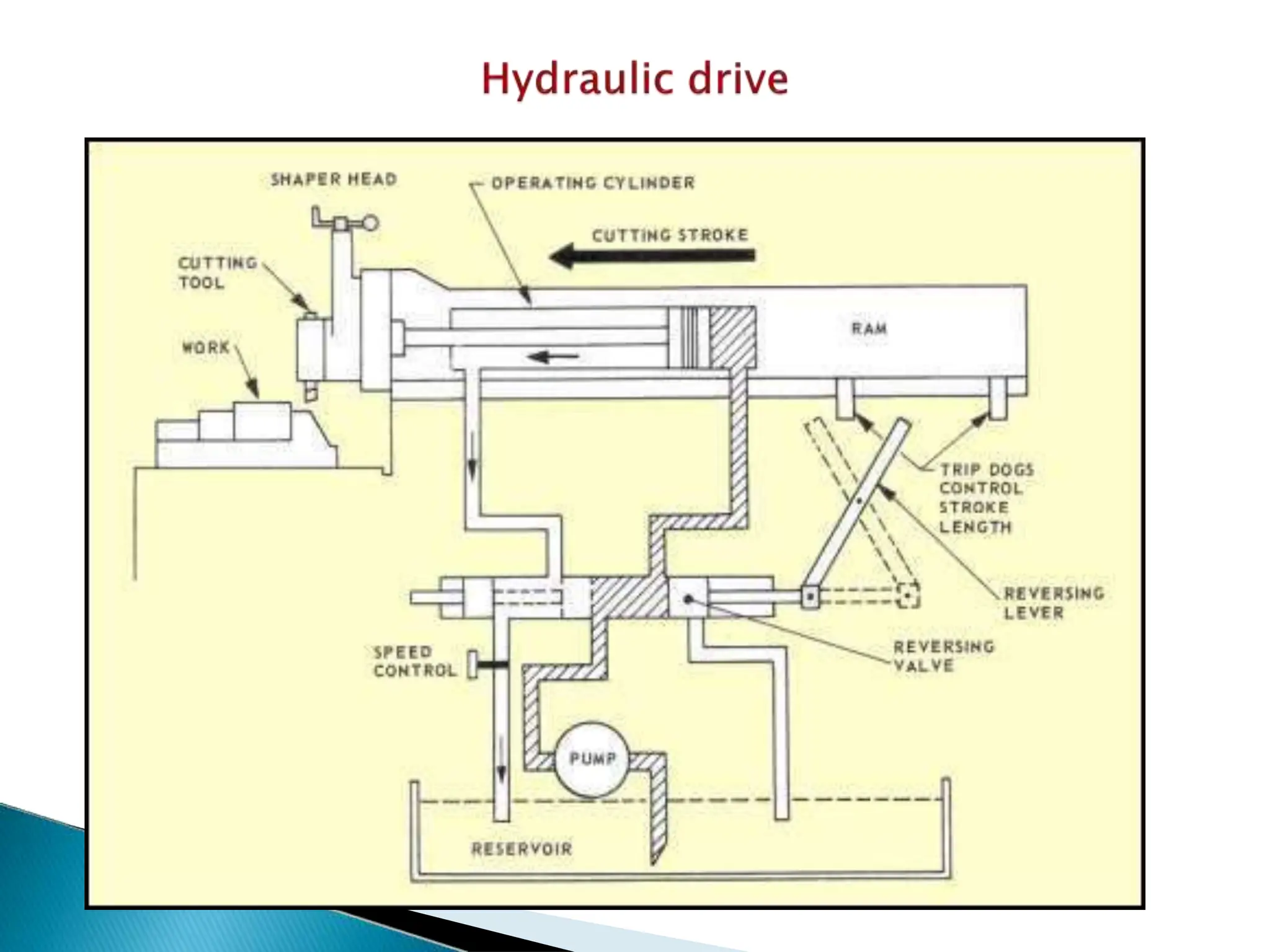
Quick return in the hydraulic shaper is accomplished by increasing the flow
of hydraulic oil during the return stroke.
In the hydraulic shaper the ram is connected to the hydraulic cylinder which
is controlled by means of a 4 way valve.
The hydraulic fluid is pumped to the hydraulic cylinder through 4 way valve;
this valve is connected to the sump.
The 4 way valve controls the direction of high pressure fluid into the cylinder
and controls the direction of motion, either the cutting stroke or return
stroke.
The flow control valve controls the flow rate of the hydraulic fluid
thereby controlling the speed at which ram moves.
Since the power available remains constant throughout, it is possible
to utilize the full capacity of the cutting tool during the cutting stroke
The starting and stopping of the machine is achieved by through a
finger operator lever.
An adjustable trip dog operated lever controls the operation of 4 way
valve to control the ram reversible.
The return or idle stroke is faster than the cutting stroke because of
the smaller area in the return side of the cylinder if constant volume
pump is used.
The cutting stroke has a more constant velocity and less
vibration is induced in the hydraulic shaper.
The cutting speed is generally shown on an indicator and
does not require calculation.
Both the cutting stroke length and its position relative to
the work may be changed quickly without stopping the
machine.
The hydraulic feed operates while the tool is clear of work.
More strokes per minute can be achieved by consuming
less time for reversal and return strokes.
The stopping point of the cutting stroke in a hydraulic shaper
can vary depending upon the resistance offered to cutting by
the work material.
It is more expensive compared to the mechanical shaper.
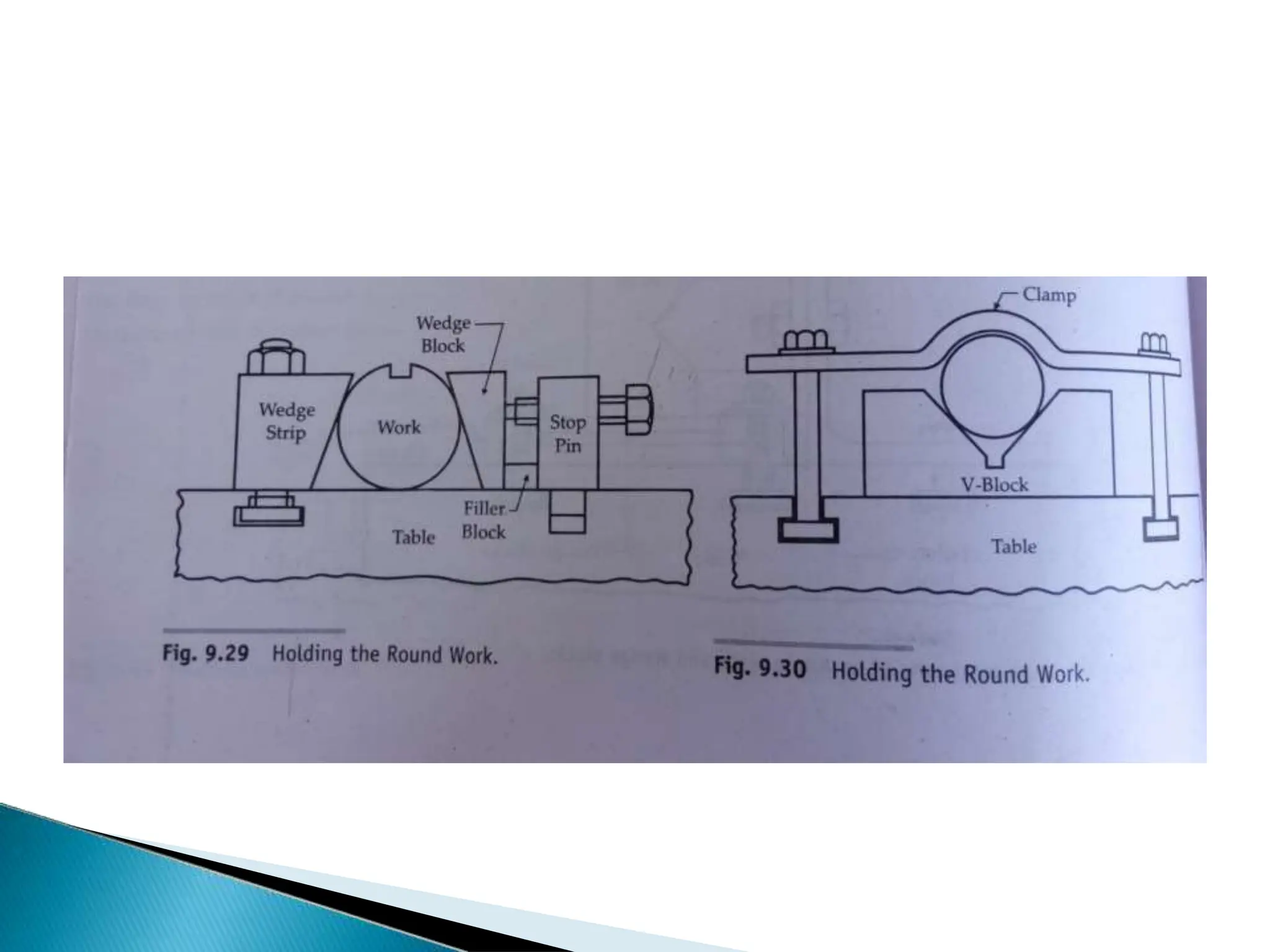
Work should be properly & firmly fixed on the
Shaper table
70
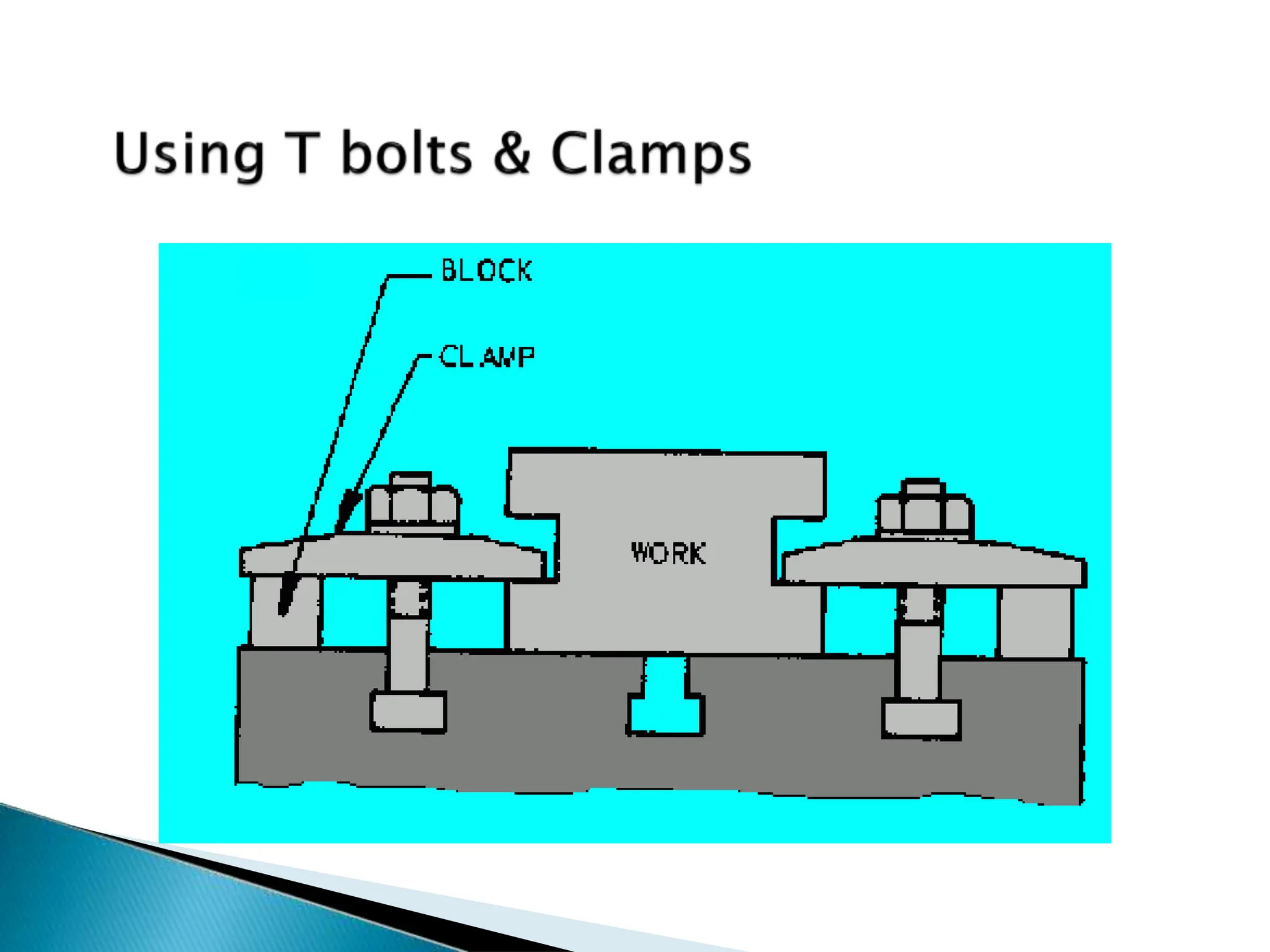
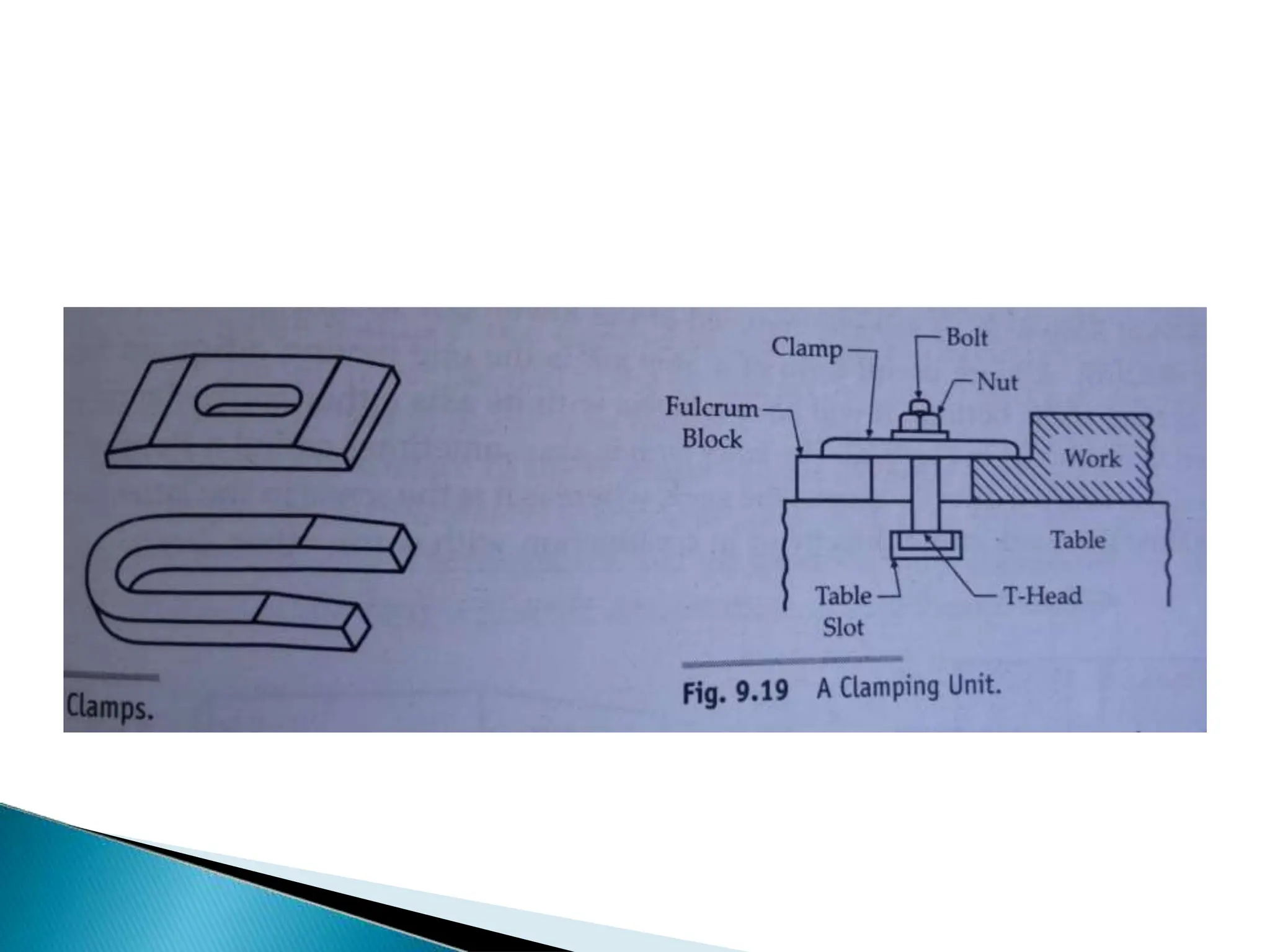
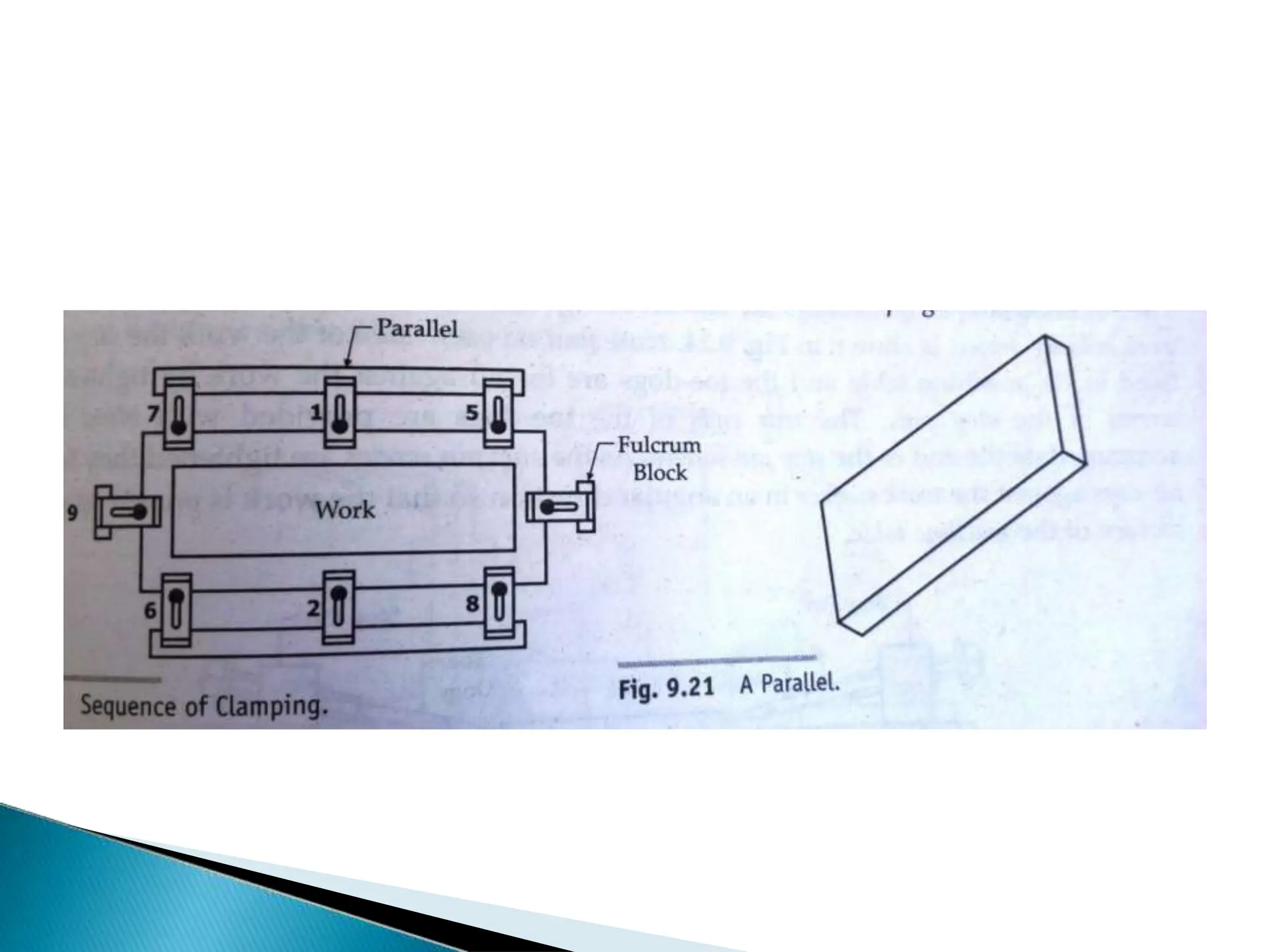
Work is fixed on the table by 3 methods.
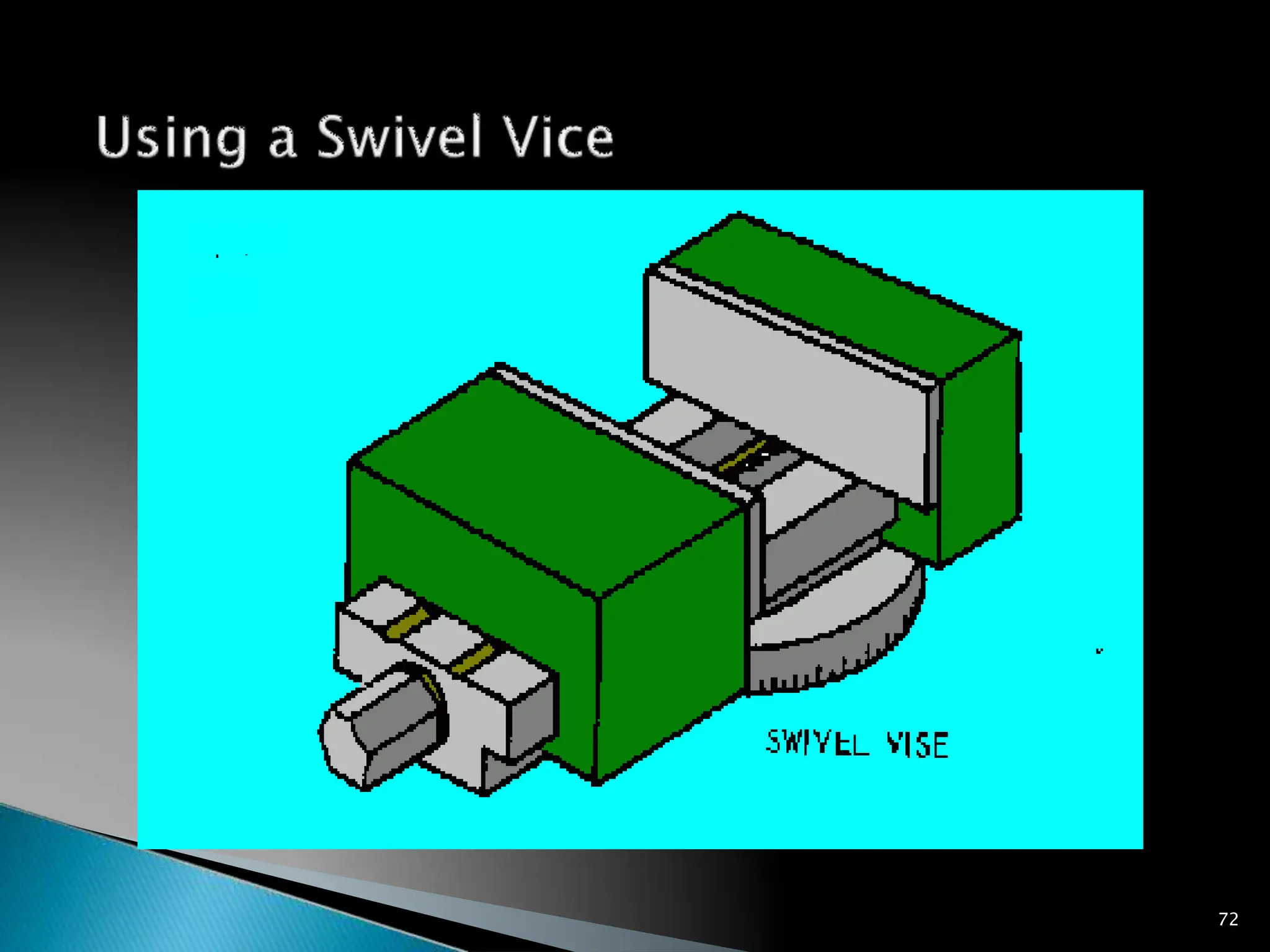
• Using a Swivel Vice
• Using T bolts & Clamps
• Using Angle plate & C Clamps
72
73
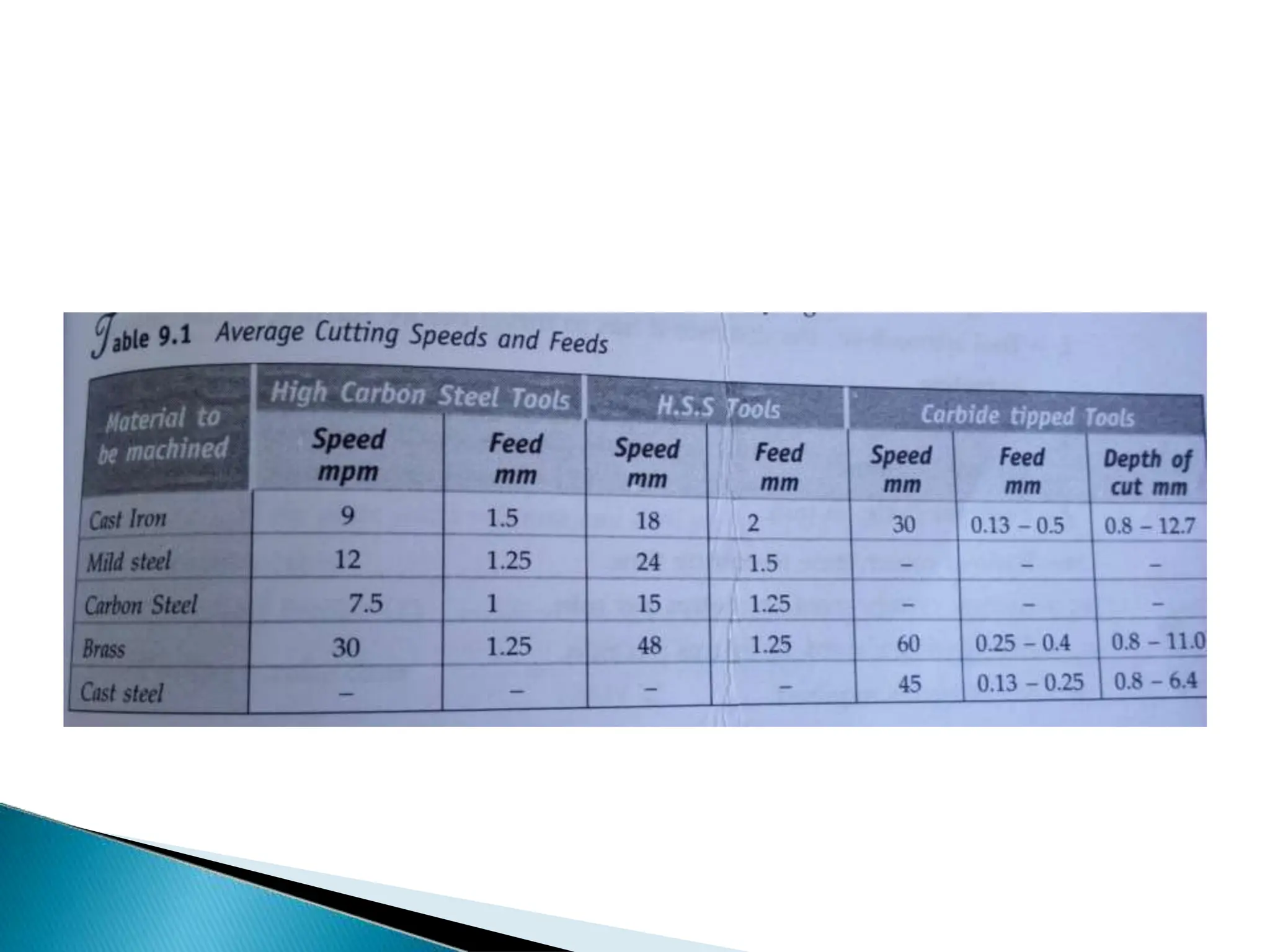
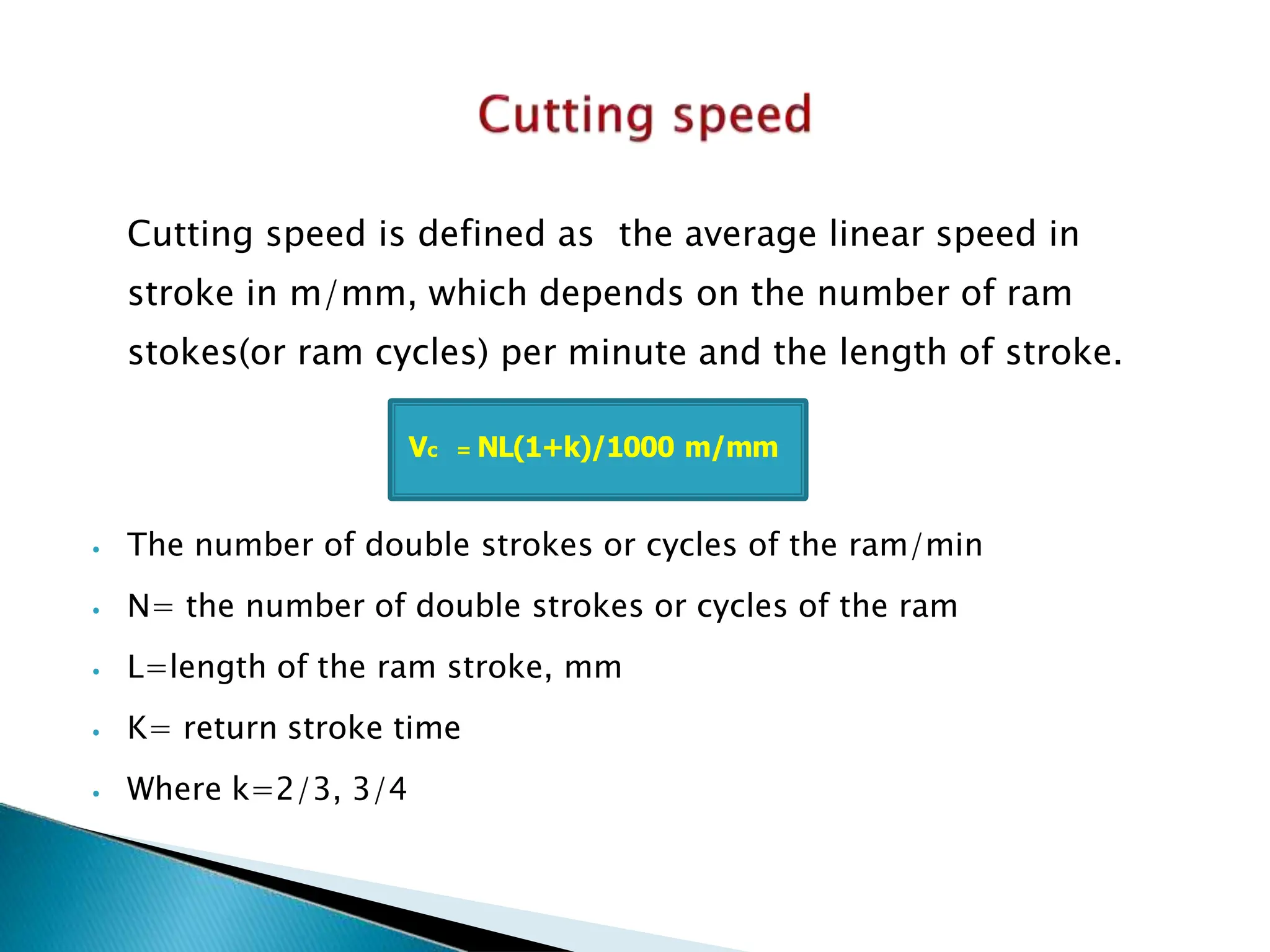
Cutting speed is defined as the average linear speed in
stroke in m/mm, which depends on the number of ram
stokes(or ram cycles) per minute and the length of stroke.
⦁ The number of double strokes or cycles of the ram/min
⦁ N= the number of double strokes or cycles of the ram
⦁ L=length of the ram stroke, mm
⦁ K= return stroke time
⦁ Where k=2/3, 3/4
Vc = NL(1+k)/1000 m/mm
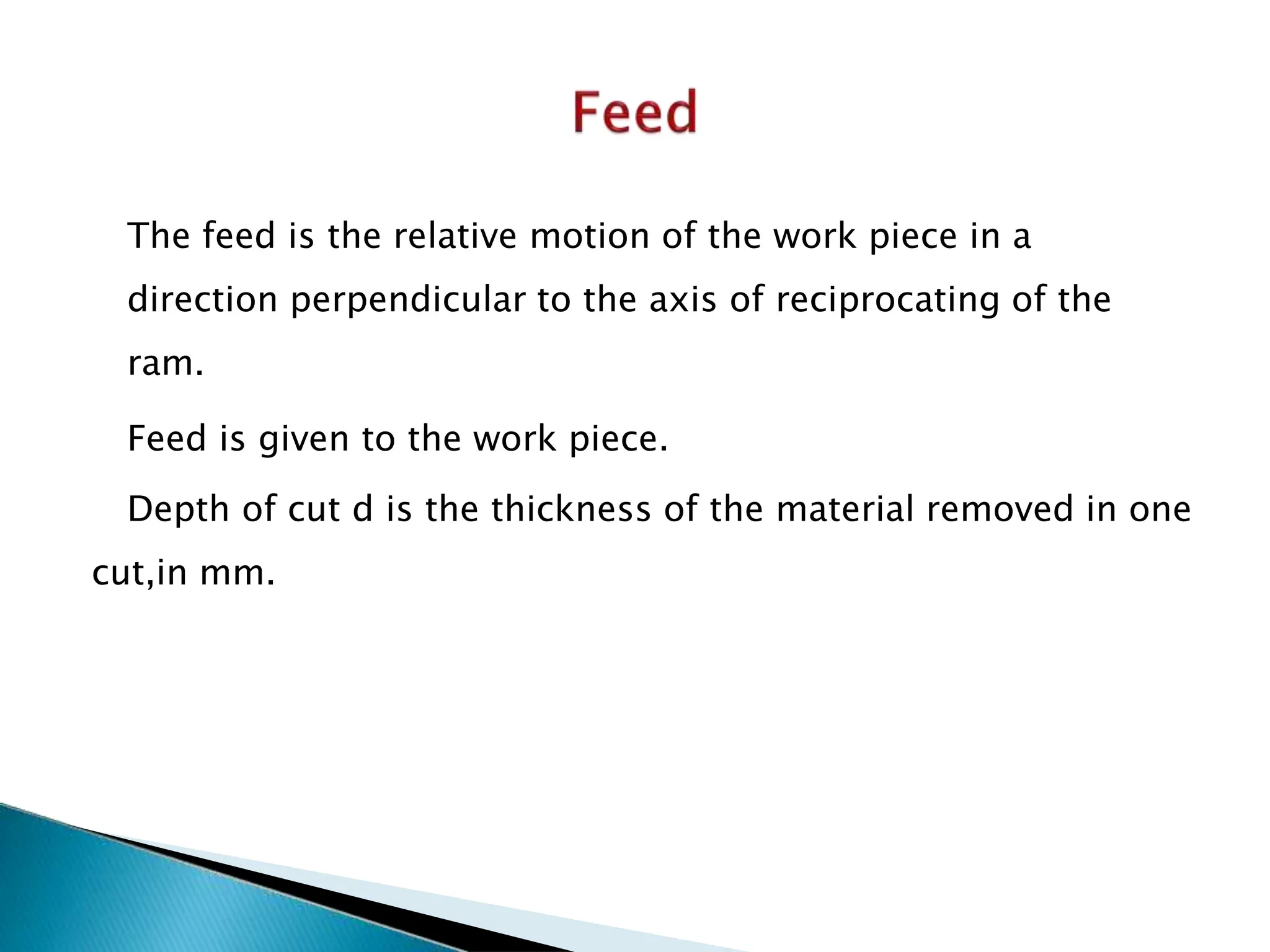
The feed is the relative motion of the work piece in a
direction perpendicular to the axis of reciprocating of the
ram.
Feed is given to the work piece.
Depth of cut d is the thickness of the material removed in one
cut,in mm.
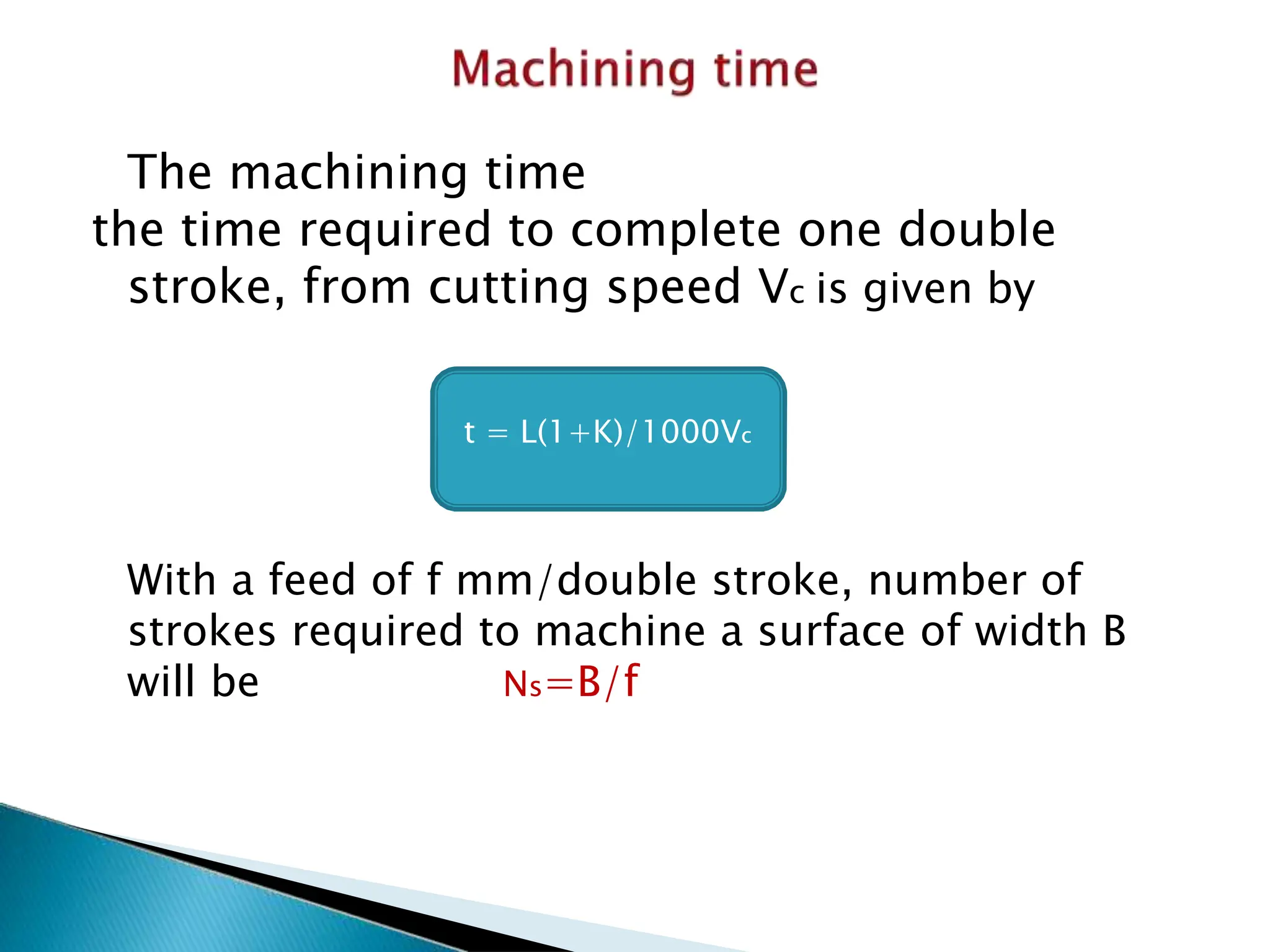
The machining time
the time required to complete one double
stroke, from cutting speed Vc is given by
With a feed of f mm/double stroke, number of
strokes required to machine a surface of width B
will be Ns=B/f
t = L(1+K)/1000Vc
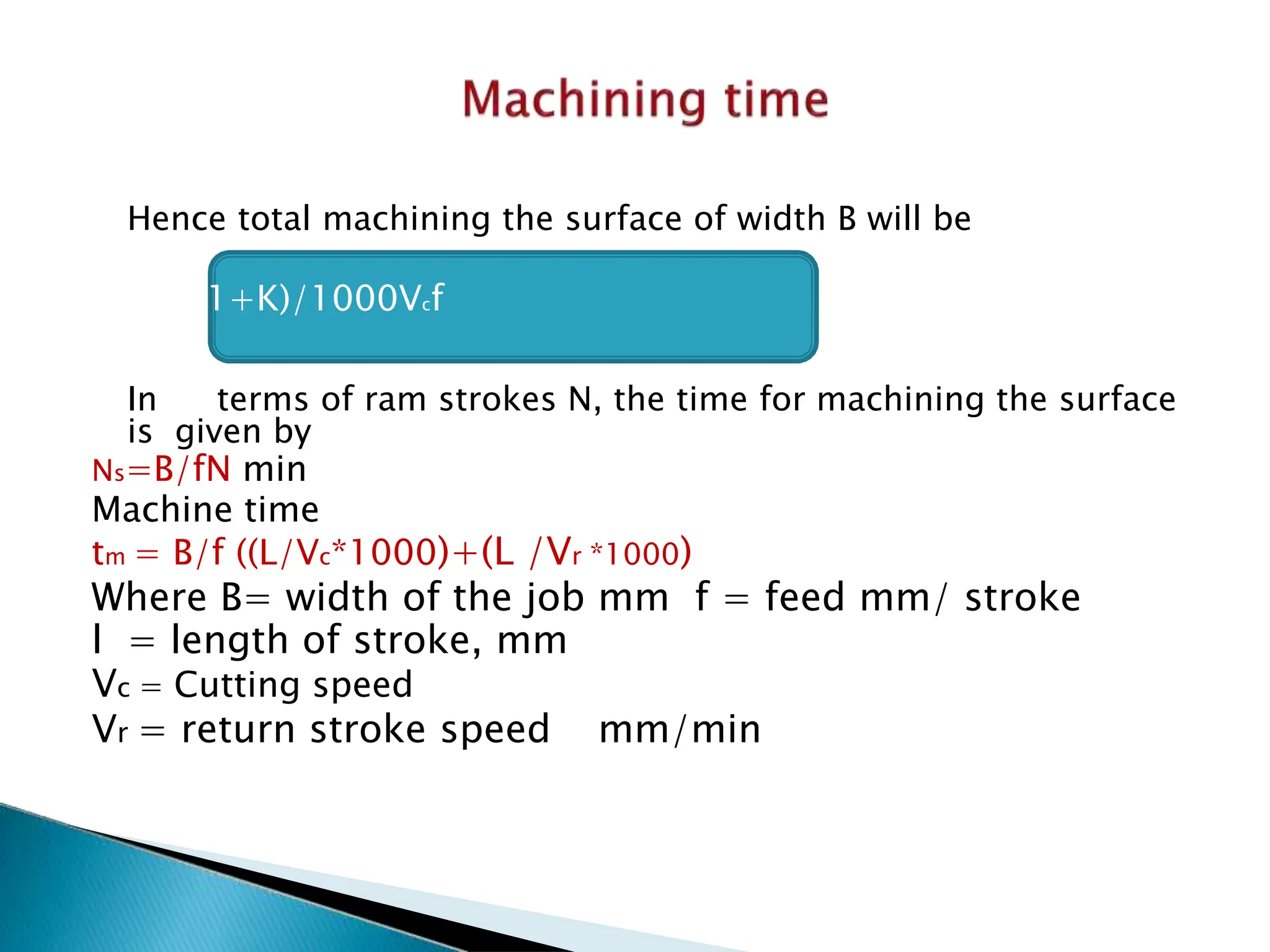
Hence total machining the surface of width B will be
t = LB(1+K)/1000Vcf
In terms of ram strokes N, the time for machining the surface
is given by
Ns=B/fN min
Machine time
tm = B/f ((L/Vc*1000)+(L /Vr *1000)
Where B= width of the job mm f = feed mm/ stroke
l = length of stroke, mm
Vc = Cutting speed
Vr = return stroke speed mm/min
⦁Slotting machine
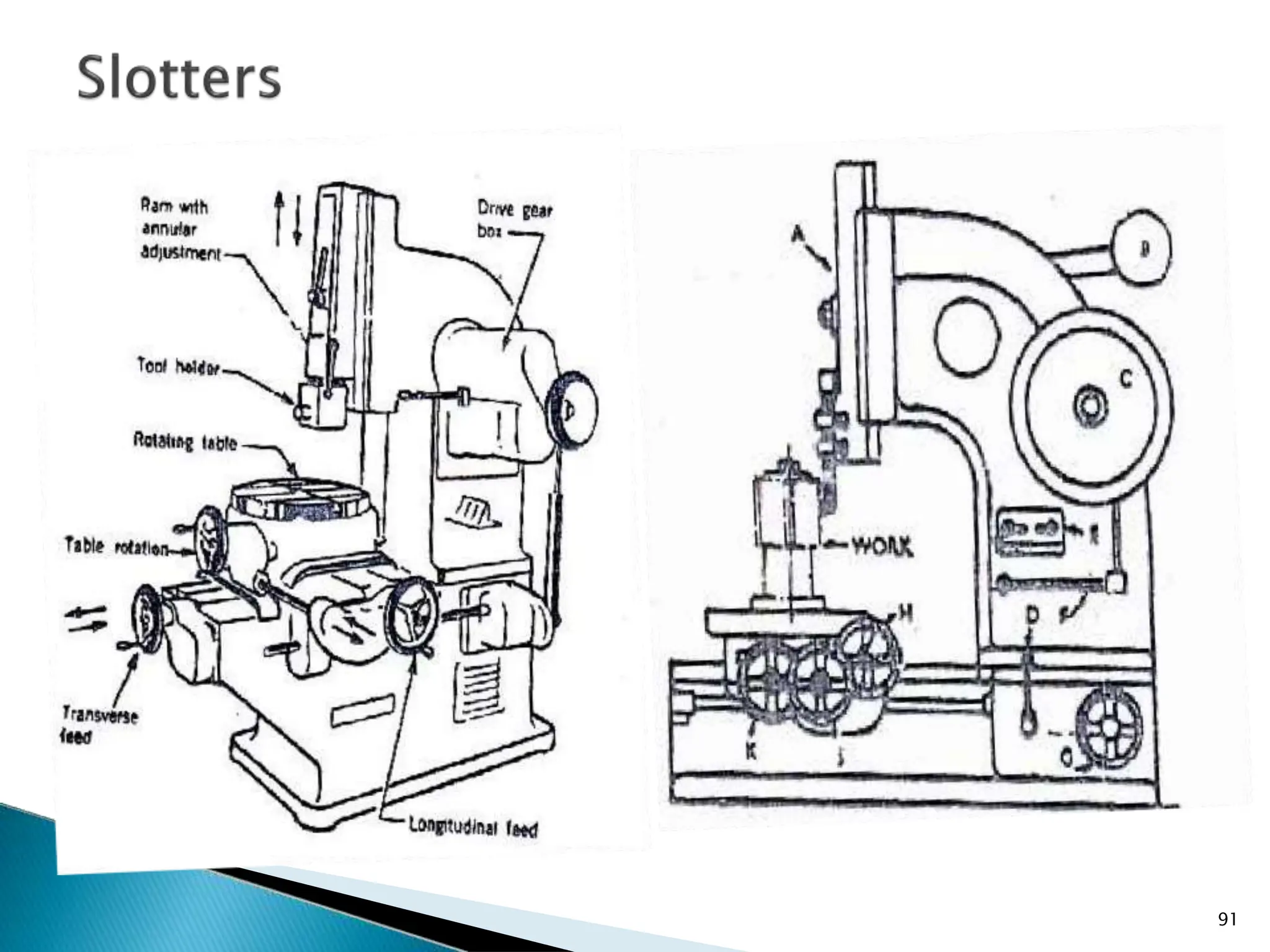
Slotting machine is also called as Slotter
89
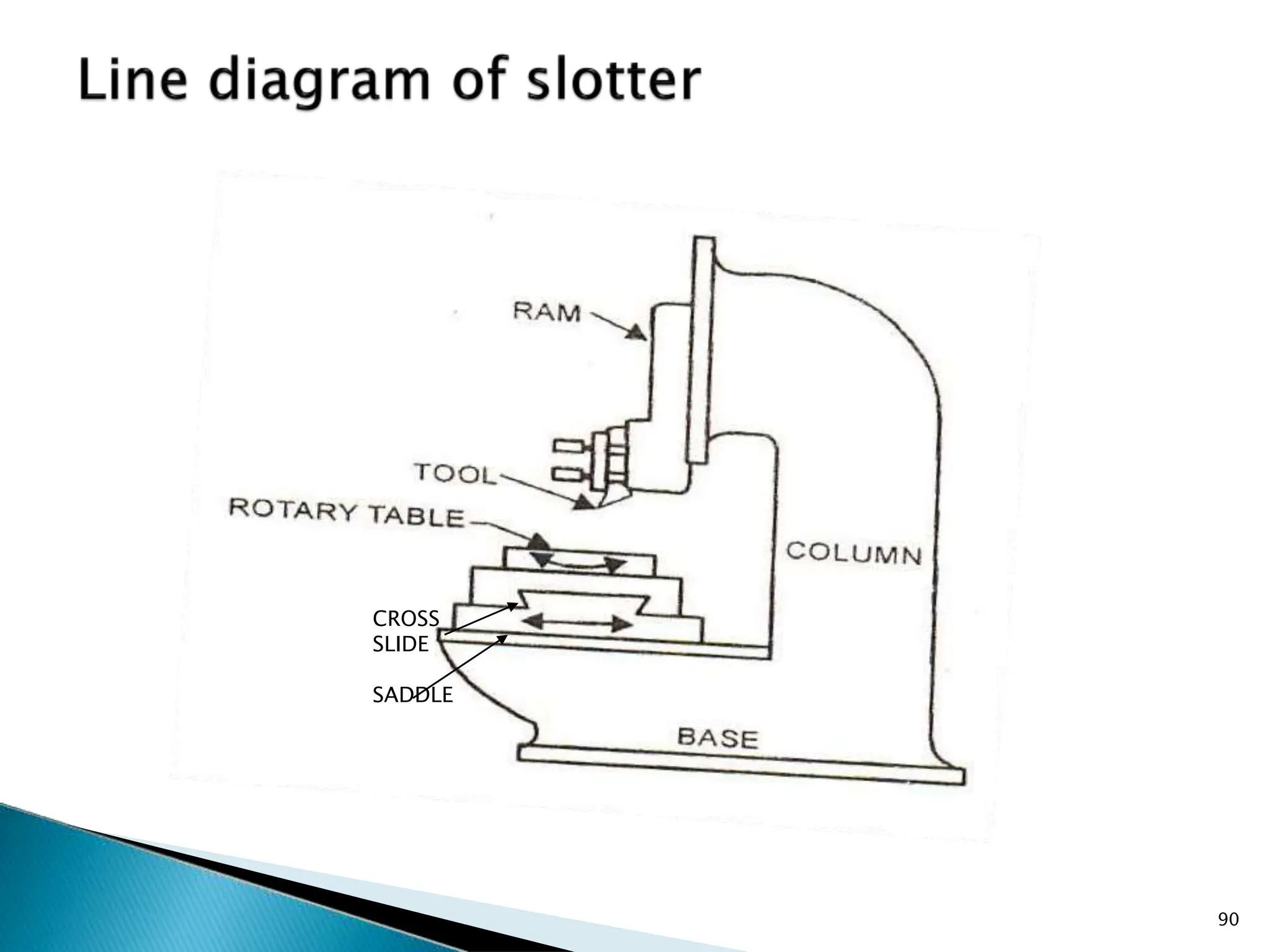
CROSS
SLIDE
SADDLE
90
91
• A Machine which produces flat surfaces
• A Ram holding the Tool reciprocates
• Ram reciprocates in vertical direction
• Work is fed perpendicular to the tool
92
Cutting Tool repeatedly travels
along line A B
Work is fed a small distance each
time
Feed of work & line of tool
motion are in same plane but
perpendicular
93
The tool line eventually
reaches position C D
Combination of two
movements results in the flat
plane ABCD being machined
94
⦁ Work is supported on a rotary table.
⦁ Table can have longitudinal and rotary movements
⦁ Straight and rotary cuts can be produced.
95
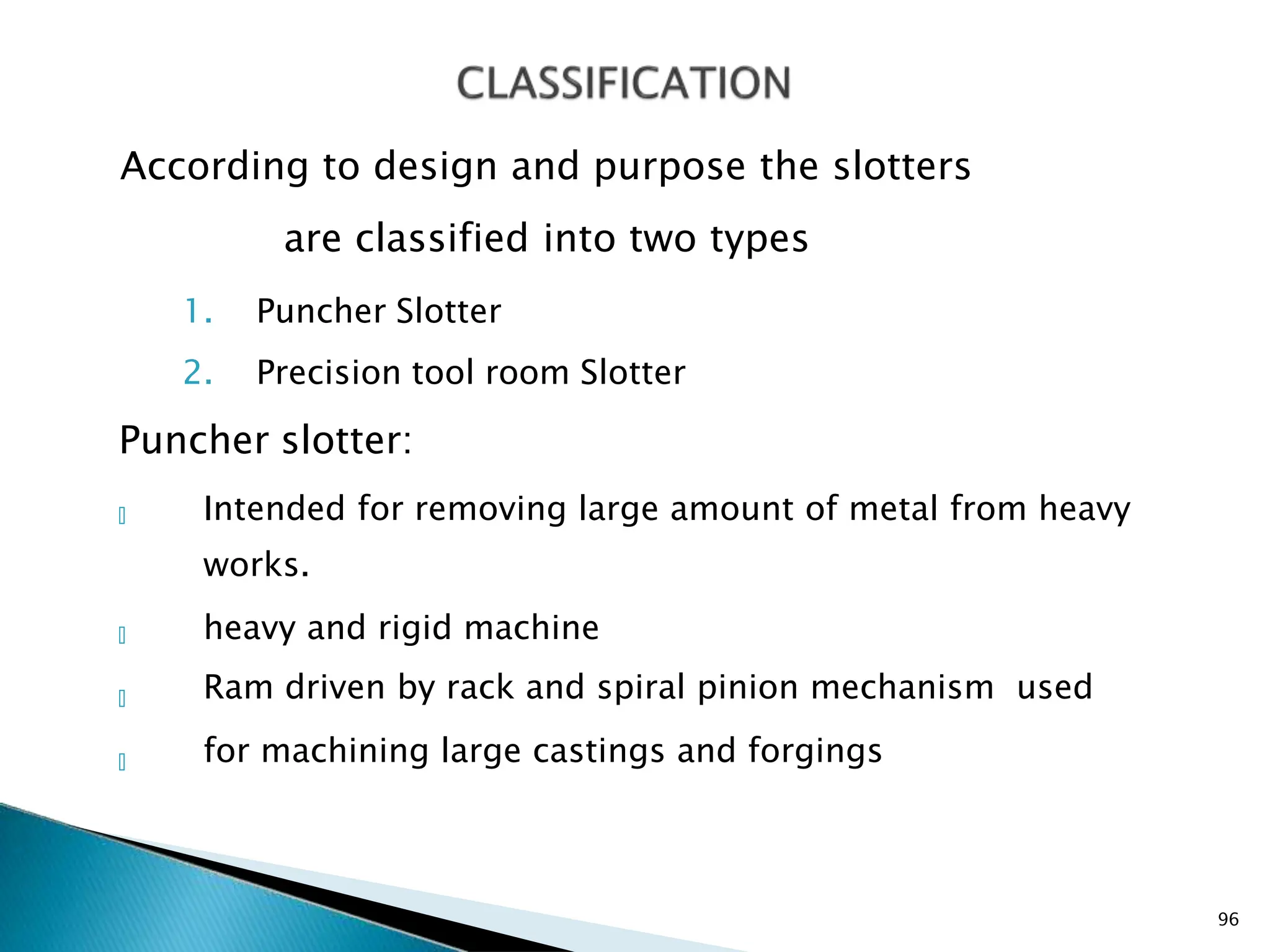
According to design and purpose the slotters
are classified into two types
96
1. Puncher Slotter
2. Precision tool room Slotter
Puncher slotter:
🞄 Intended for removing large amount of metal from heavy
works.
heavy and rigid machine
Ram driven by rack and spiral pinion mechanism used
for machining large castings and forgings
🞄
🞄
🞄
Precision tool room slotter:
98
• Used for tool room work, where accuracy important
• Lighter in construction
• Fitted with quick return mechanism
• Operates at high speeds and designed for light cuts
• Gives accurate finish
• Suitable for small to medium size work pieces
Difference between vertical shaper and Slotter
99
•in vertical shaper the tool holding ram can tilt by
about 100 with respect to vertical axis
•In slotter ram cannot tilt at all.
•In all other aspects vertical shaper and slotter are
similar
Having known the Working Principle we
will now look at :
10
0
M305.30
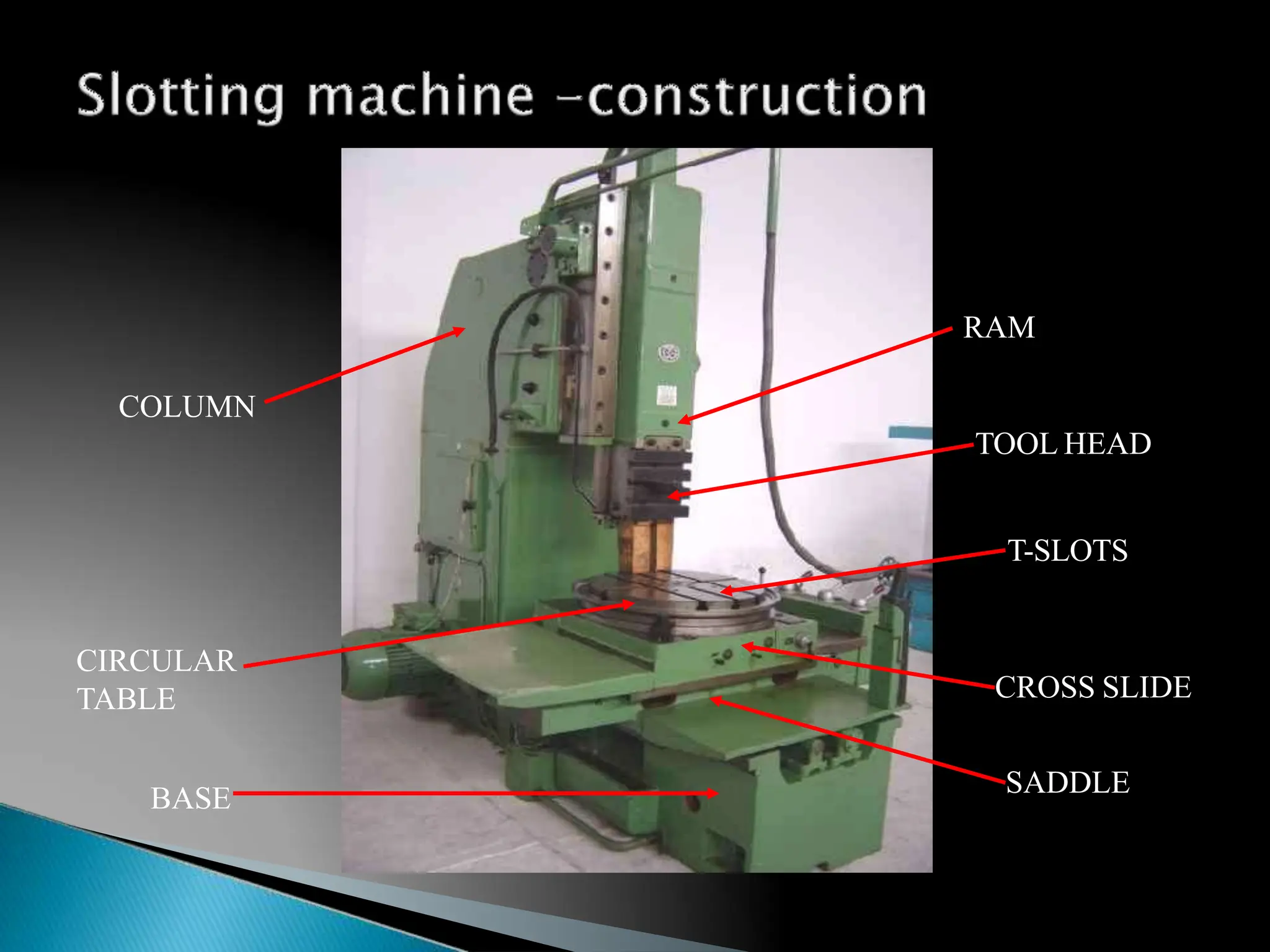
⦁ The Constructional Details of a slotting Machine
⦁ Function of each part
⦁ Specifications of a slotter
BASE
CIRCULAR
TABLE
COLUMN
RAM
CROSS SLIDE
SADDLE
TOOL HEAD
T-SLOTS
10
1
M305.30
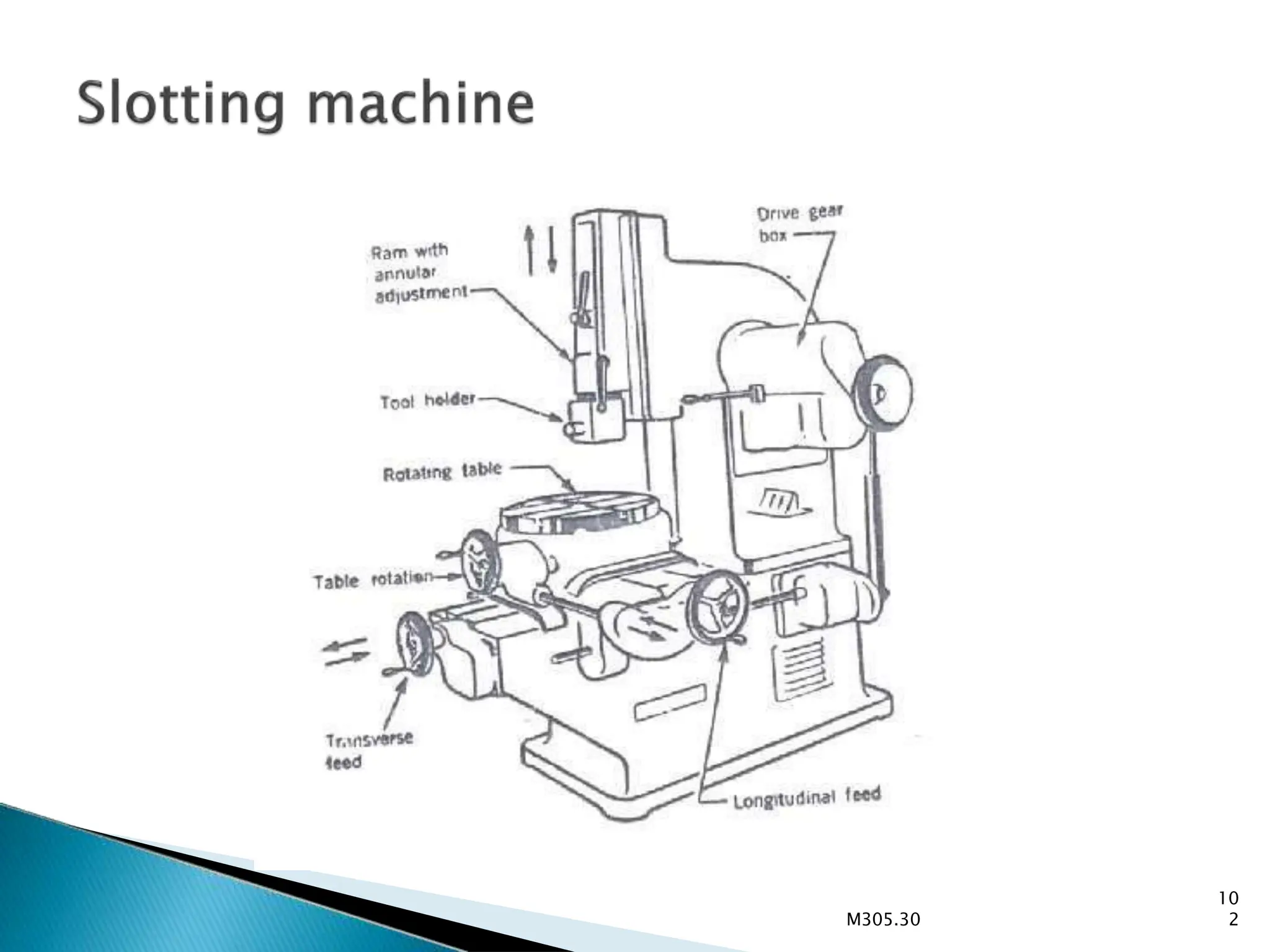
10
2
M305.30
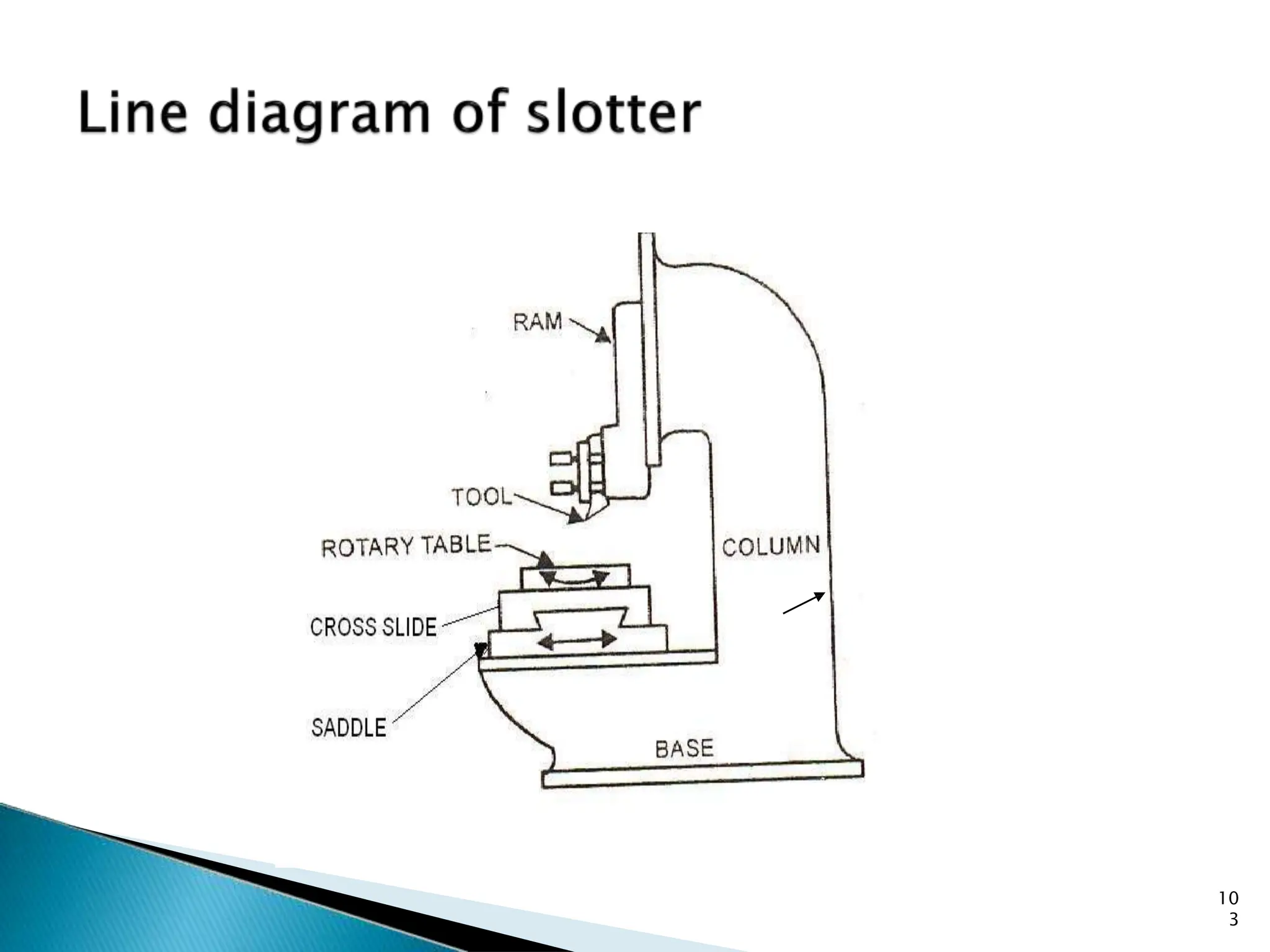
10
3
1. Base
2. Column
3. Ram
4. Table
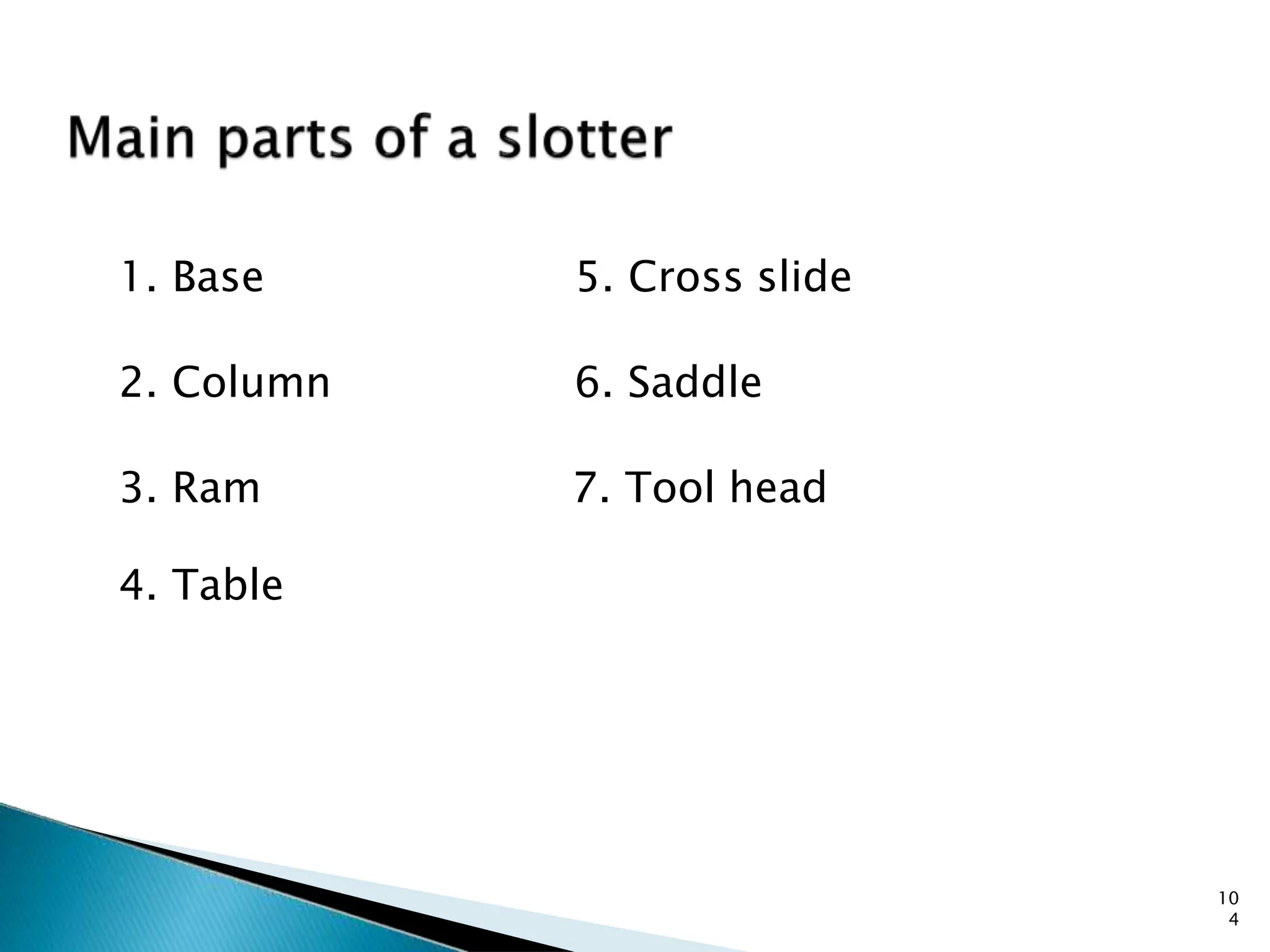
10
4
5. Cross slide
6. Saddle
7. Tool head
1. Base
10
5
Bottom most part
Supports other parts of the machine
Acts as a reservoir of lubricating oil
Made of Cast Iron
Contd..
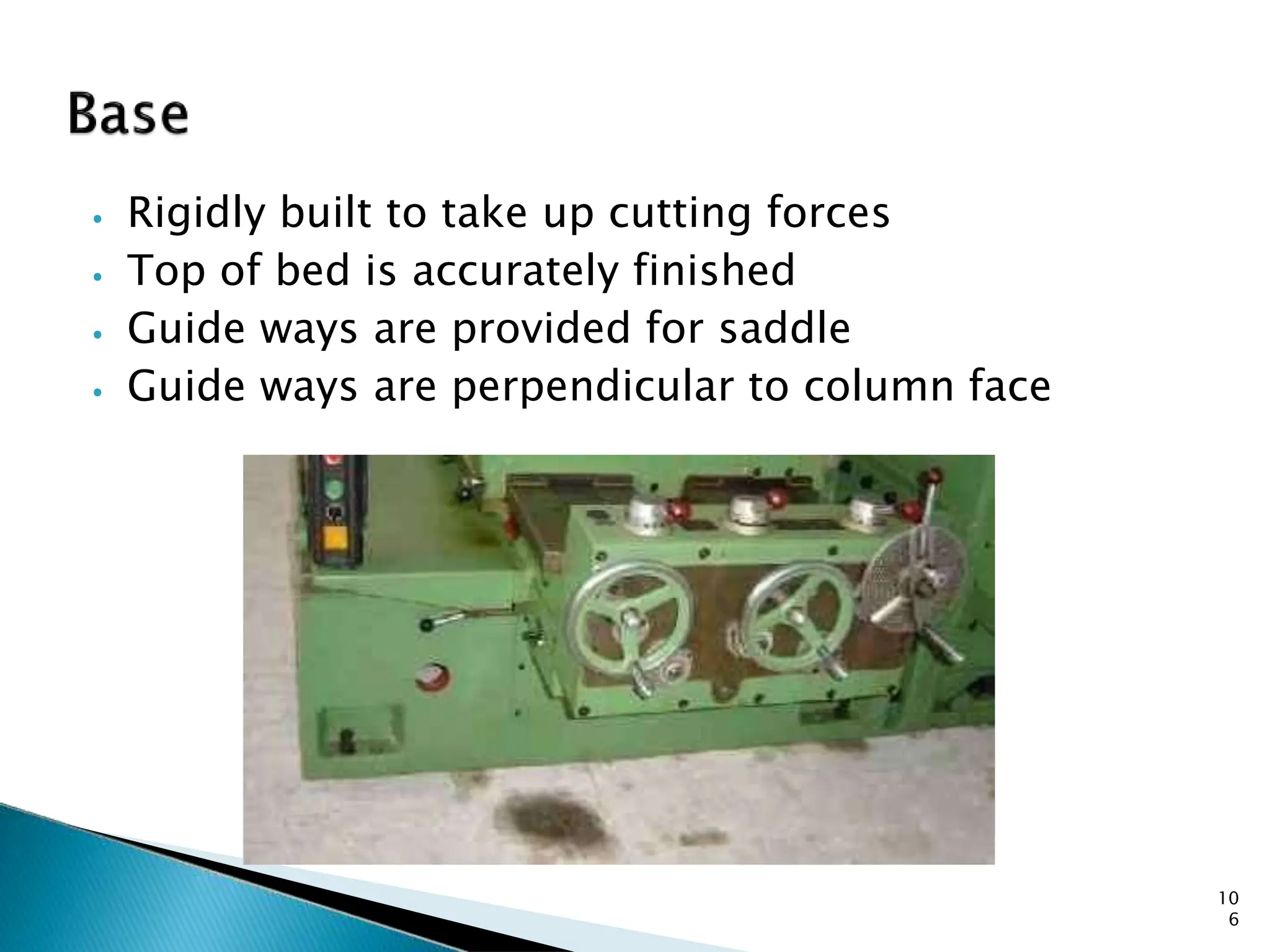
⦁ Rigidly built to take up cutting forces
⦁ Top of bed is accurately finished
⦁ Guide ways are provided for saddle
⦁ Guide ways are perpendicular to column face
10
6
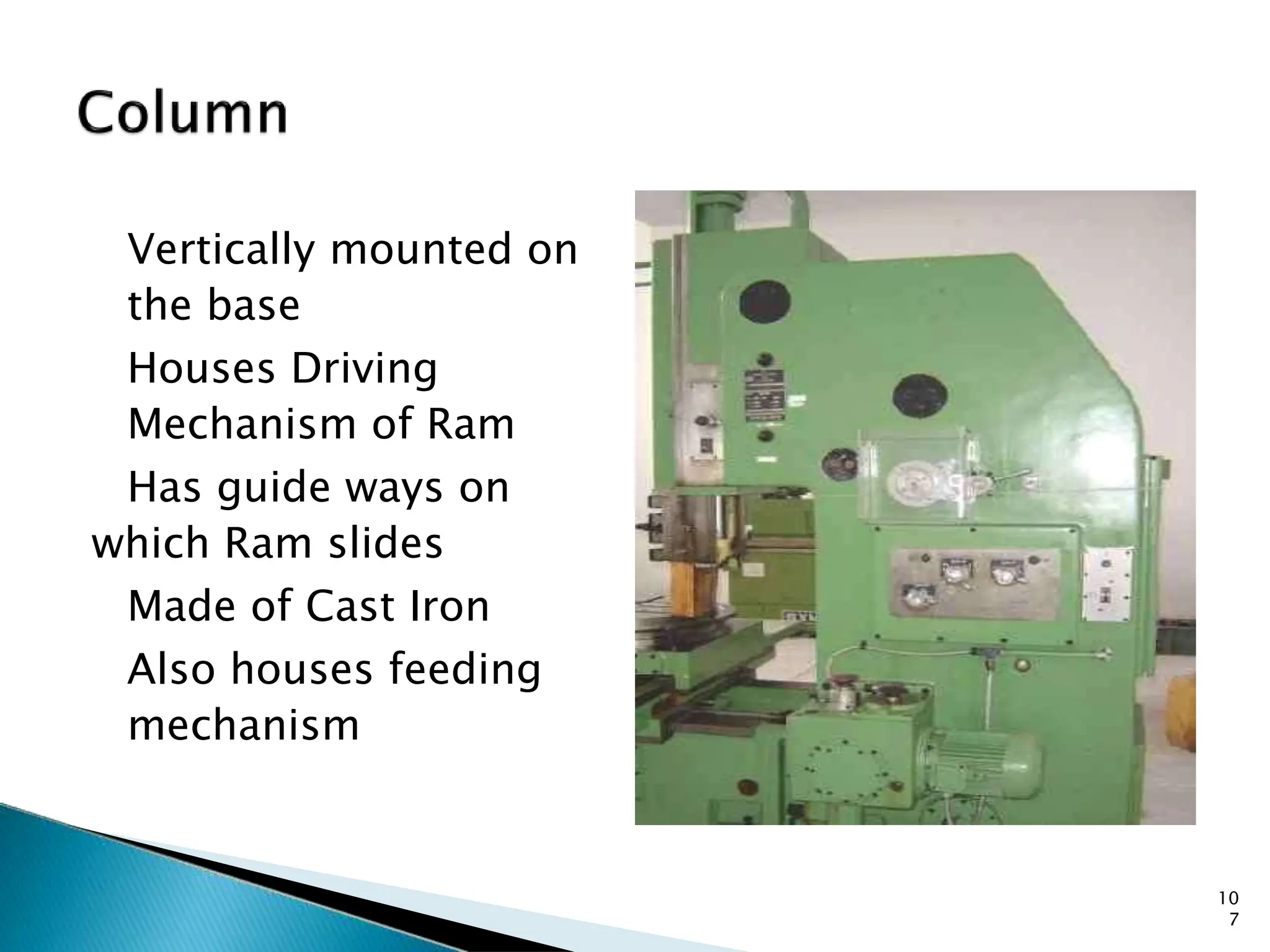
Vertically mounted on
the base
Houses Driving
Mechanism of Ram
Has guide ways on
which Ram slides
Made of Cast Iron
Also houses feeding
mechanism
COLUMN
10
7
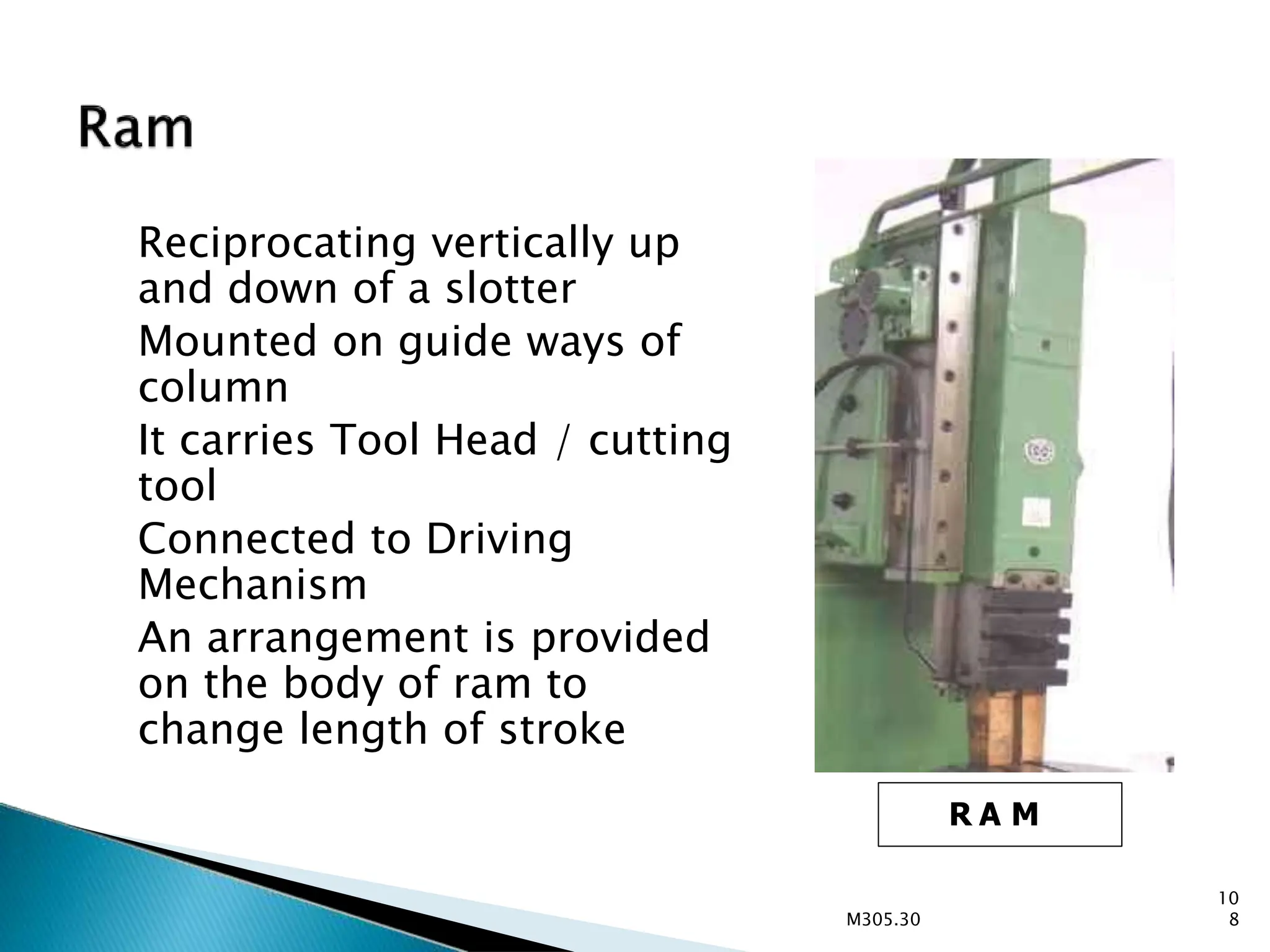
Reciprocating vertically up
and down of a slotter
Mounted on guide ways of
column
It carries Tool Head / cutting
tool
Connected to Driving
Mechanism
An arrangement is provided
on the body of ram to
change length of stroke
R A M
10
8
M305.30
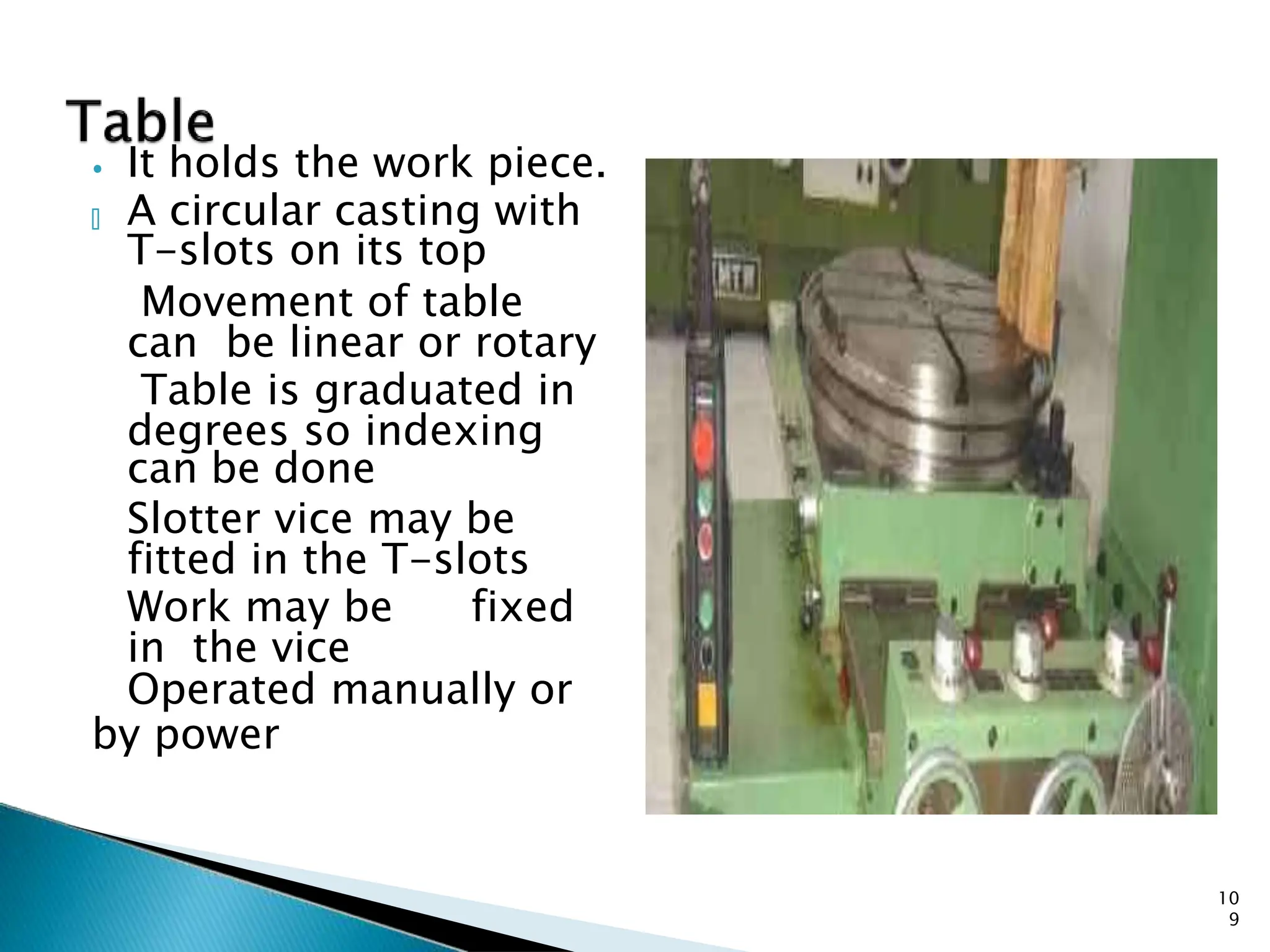
⦁ It holds the work piece.
🞄 A circular casting with
T-slots on its top
Movement of table
can be linear or rotary
Table is graduated in
degrees so indexing
can be done
Slotter vice may be
fitted in the T-slots
Work may be fixed
in the vice
Operated manually or
by power
TABLE
10
9
It is mounted on guide ways of bed
It can be moved towards or away from bed
Using saddle longitudinal feed is given
Top is accurately finished to provide guide ways
for cross slide
These guide ways are perpendicular to the guide
on the base
Operated either manually or by power
11
9
⦁ Circular work-table is mounted on the top.
⦁ Mounted on guide ways of saddle
⦁ Moves parallel to the face of the column
⦁ Using cross slide cross feed is given
⦁ Operated either manually or by power
11
1
It is attached to the bottom end of Ram
Carries Tool post on it
Tool is fixed in position
No swiveling along verticle axis or horizontal
axis
11
2
⦁ Max. length of Ram Stroke
⦁ Diameter of work table in mm.
⦁ Type of Drive
⦁ Maximum table travel.
⦁ Power input
⦁ Floor Space required
11
3
115
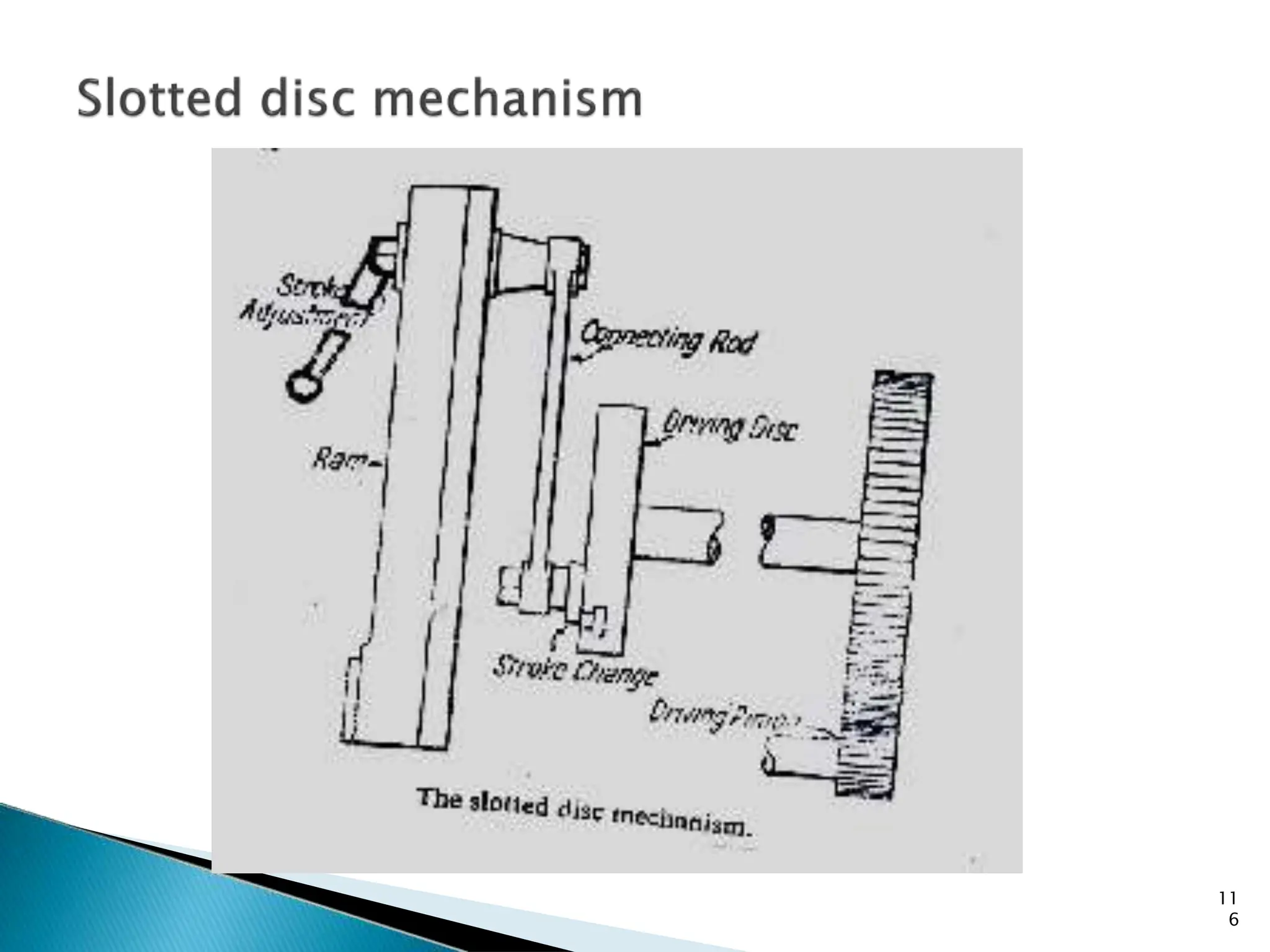
A Slotting machine produces flat surfaces
The Ram holding the Tool reciprocates vertically up
and down
Cuts the material only in down stroke
There should be some mechanism to move the ram in
reciprocating motion
It is called as slotter driving mechanism
The mechanism commonly used is slotted disc
mechanism
11
6
117
⦁ A Mechanism makes the ram to move slowly during
cutting stroke.
⦁ During return stroke ram moves at a faster rate.
⦁ To reduce the idle time,It Should return quickly .
⦁ The mechanism adopted is known as QRM
1. Whitworth Q.R.M. Mechanism
2. Variable speed reversible motor drive mechanism
3. Hydraulic drive Mechanism
The mechanisms for QRM in slotter are similar to
QRM in shaper
118
In Slotter feed is given by table
Feed movement is intermittent
Feed is given at the beginning of the cutting stroke
Feed may be given either manually or by power
Table will have three types of feed movements
a. longitudinal
b. cross and
c. circular feeds.
Contd…
11
9
Longitudinal feed:
•Table is fed perpendicular to the column
•Table moves towards or away from the column
Cross feed:
•Table is fed parallel to the face of the column
Circular feed:
• table is rotated with respect to
verticle axis
12
9
Feed shaft
12
1
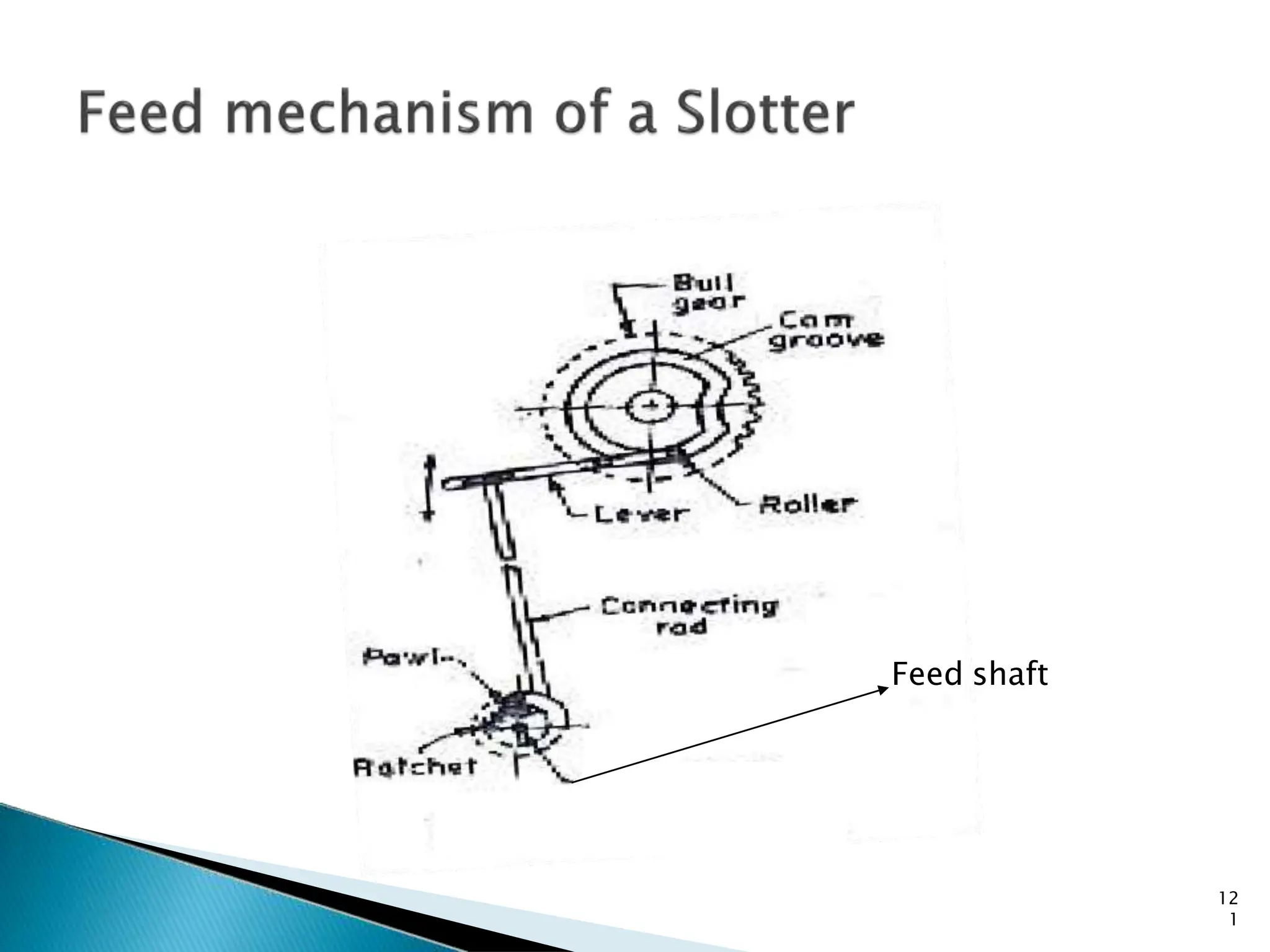
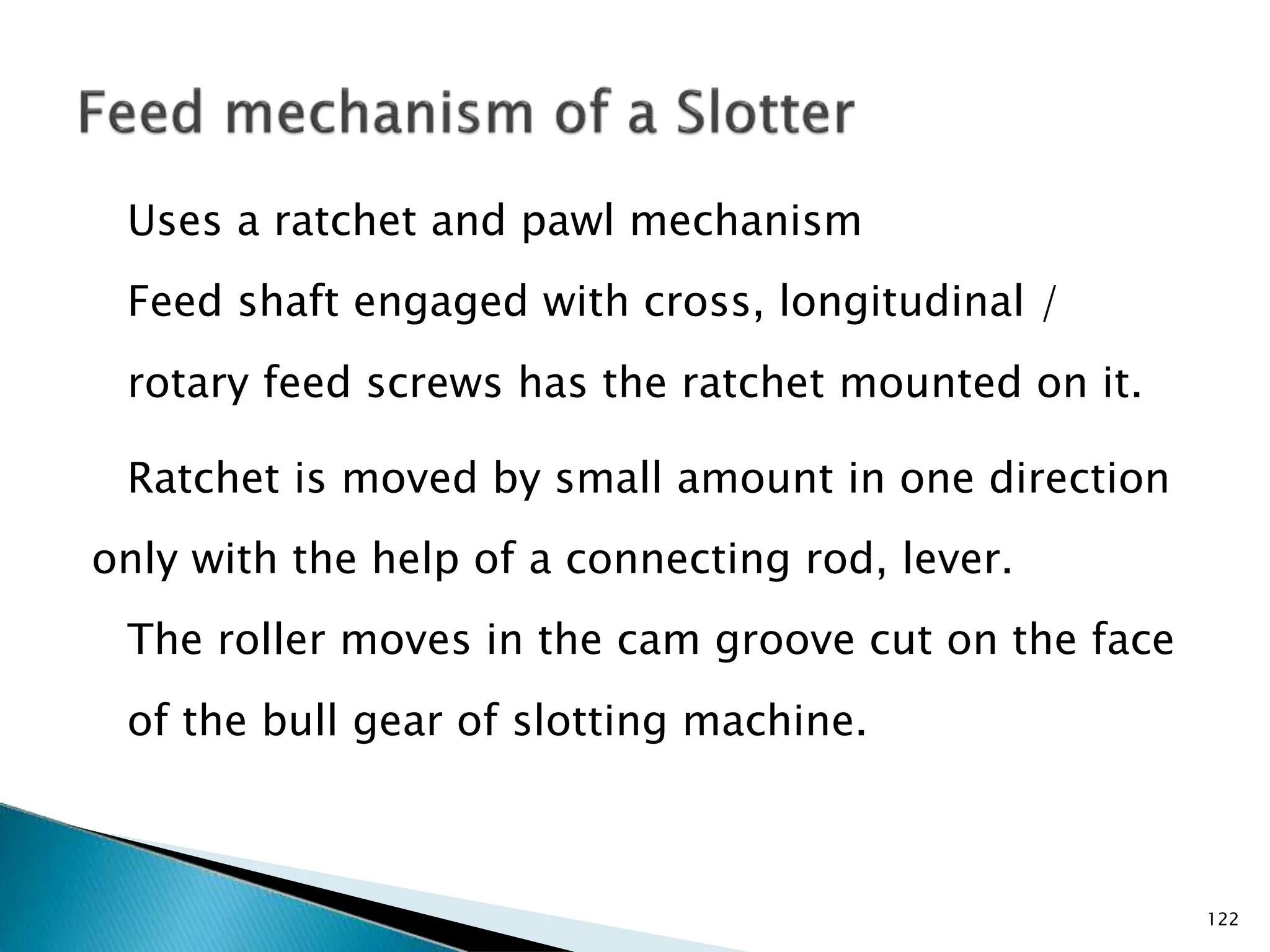
Uses a ratchet and pawl mechanism
Feed shaft engaged with cross, longitudinal /
rotary feed screws has the ratchet mounted on it.
Ratchet is moved by small amount in one direction
only with the help of a connecting rod, lever.
The roller moves in the cam groove cut on the face
of the bull gear of slotting machine.
122
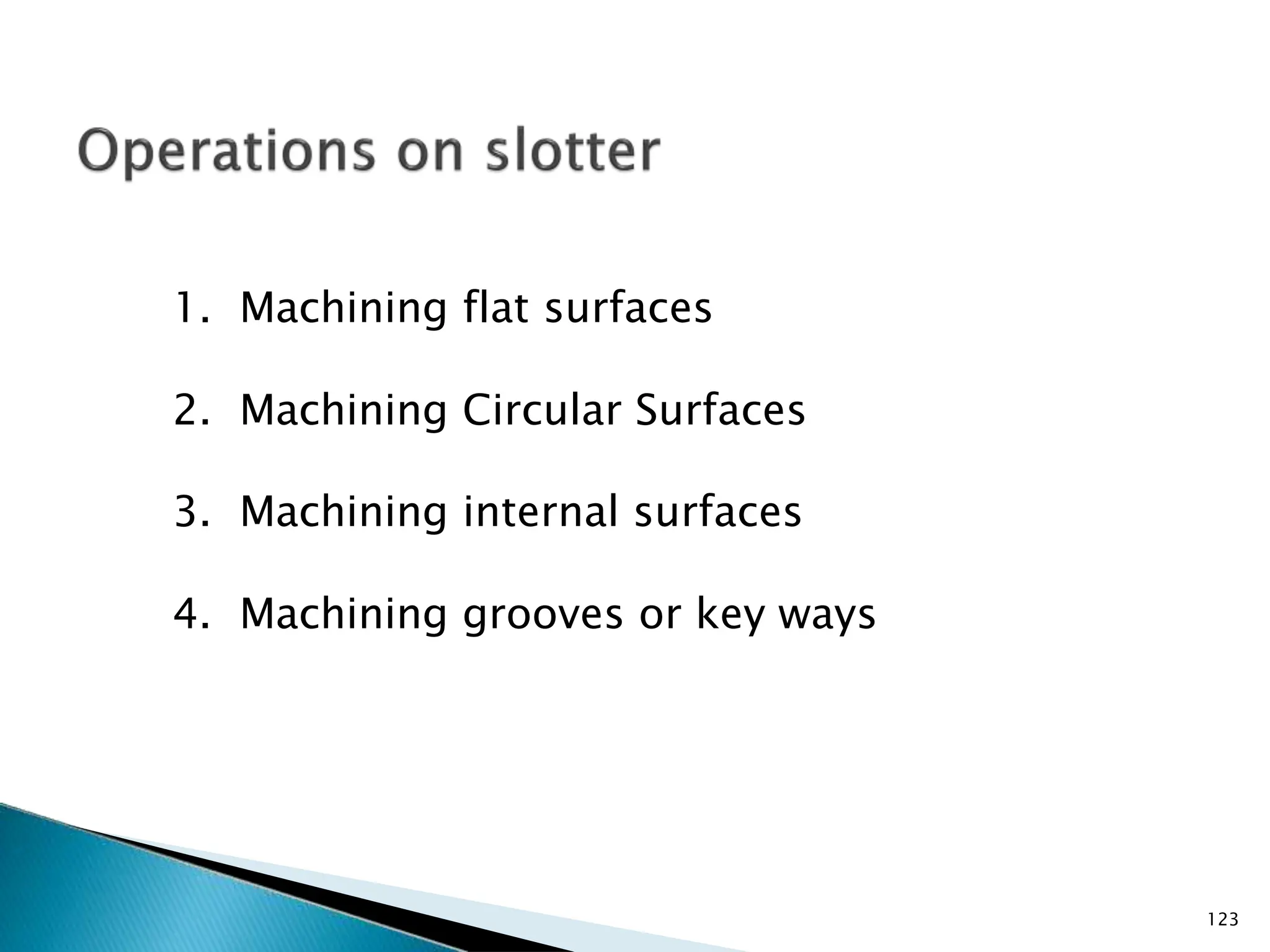
1. Machining flat surfaces
2. Machining Circular Surfaces
3. Machining internal surfaces
4. Machining grooves or key ways
123
Work is properly held in a vice
Table is raised to a gap of 25 to 30 mm between
tool & work
The length & position of stroke are adjusted
The length of stroke should be nearly 20 mm
longer than the work
Contd…
124
The approach & over run should be 10 & 5 mm
respectively.
Depth of cut is adjusted by rotating down the feed
screw of tool head
Feed is adjusted about half the width of cutting
edge of tool
125
⦁ Fix the work properly on the table
⦁ Adjust the length of stroke
⦁ Set the required cutting speed
⦁ Give required feed of the table
⦁ Tool is held in the tool head of ram
⦁ Ram reciprocates up and down
126
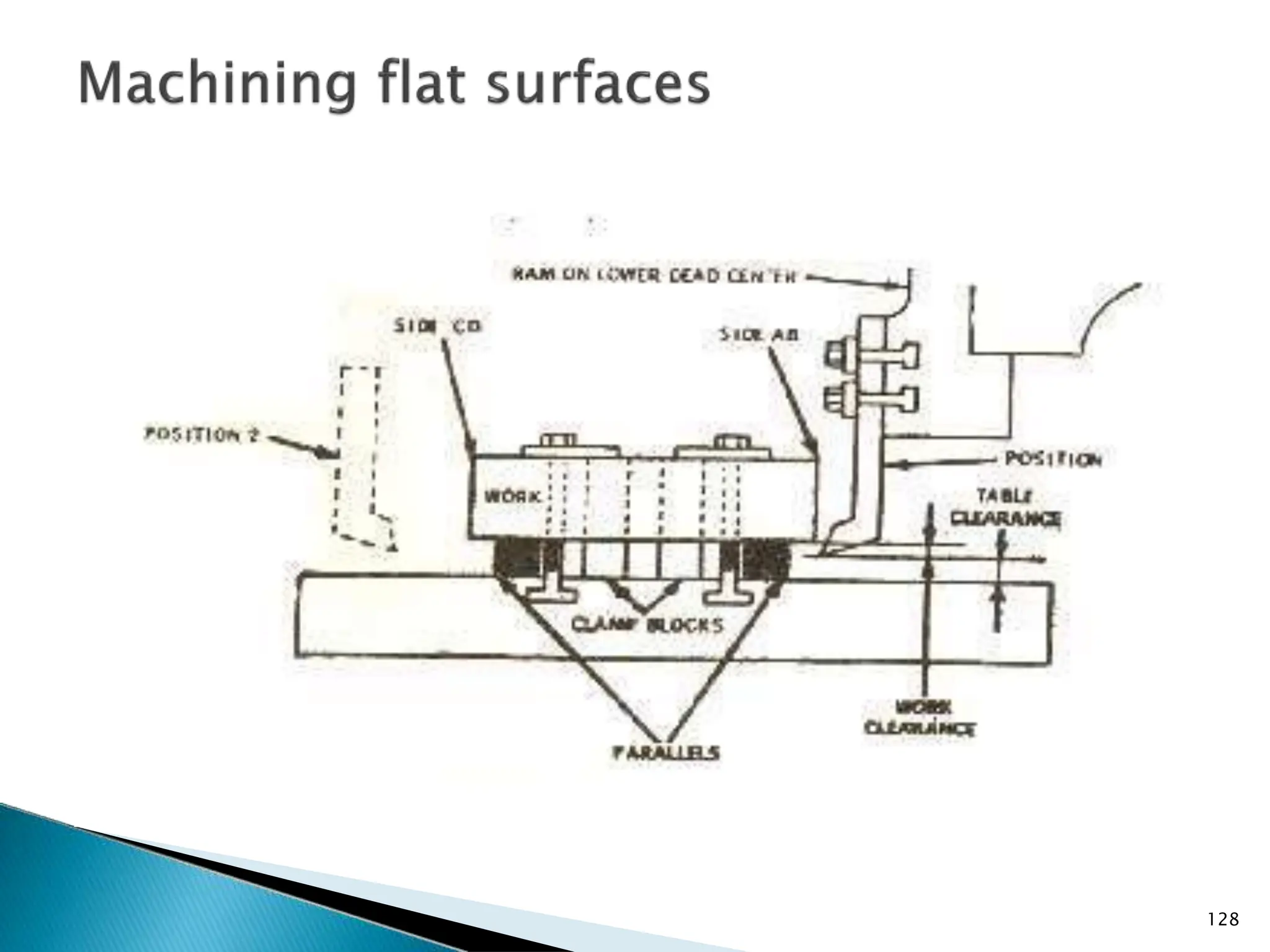
⦁ Feed has to be given at the beginning of cutting stroke
⦁ Both internal and external surfaces can be machined
⦁ Give suitable depth of cut for rough cuts
⦁ Finishing the job by giving less depth of cut
127
128
⦁ Tool is set radially on the work
⦁ Work piece is placed centrally on the rotary table
⦁ Feed is given by the rotary table feed screw
⦁ Feed screw rotates the table through an arc
⦁ Adjust the length of stroke
⦁ Set the required cutting speed
⦁ Finishing the job by giving less depth of cut
129
⦁ Fix up a tool in tool post
⦁ Cross, longitudinal and rotary feed are combined
⦁ Any contoured surface can be machined
⦁ Mostly done manually
⦁ Good skill is required from operator
130
Slotter is specially intended for cutting internal
grooves
External or internal gear teeth can be machined
Fix up the job between two centers
Cut first a key way
Move / Rotate work by the required amount
Indexing can be done by using graduations on
rotary table
131
⦁ Fix up the job between two centres
⦁ Cut first spline similar to a key way
⦁ Move / Rotate work by the required amount
⦁ Use index plate for this purpose
132
133
Work should be properly & firmly fixed
on the Slotter table
134
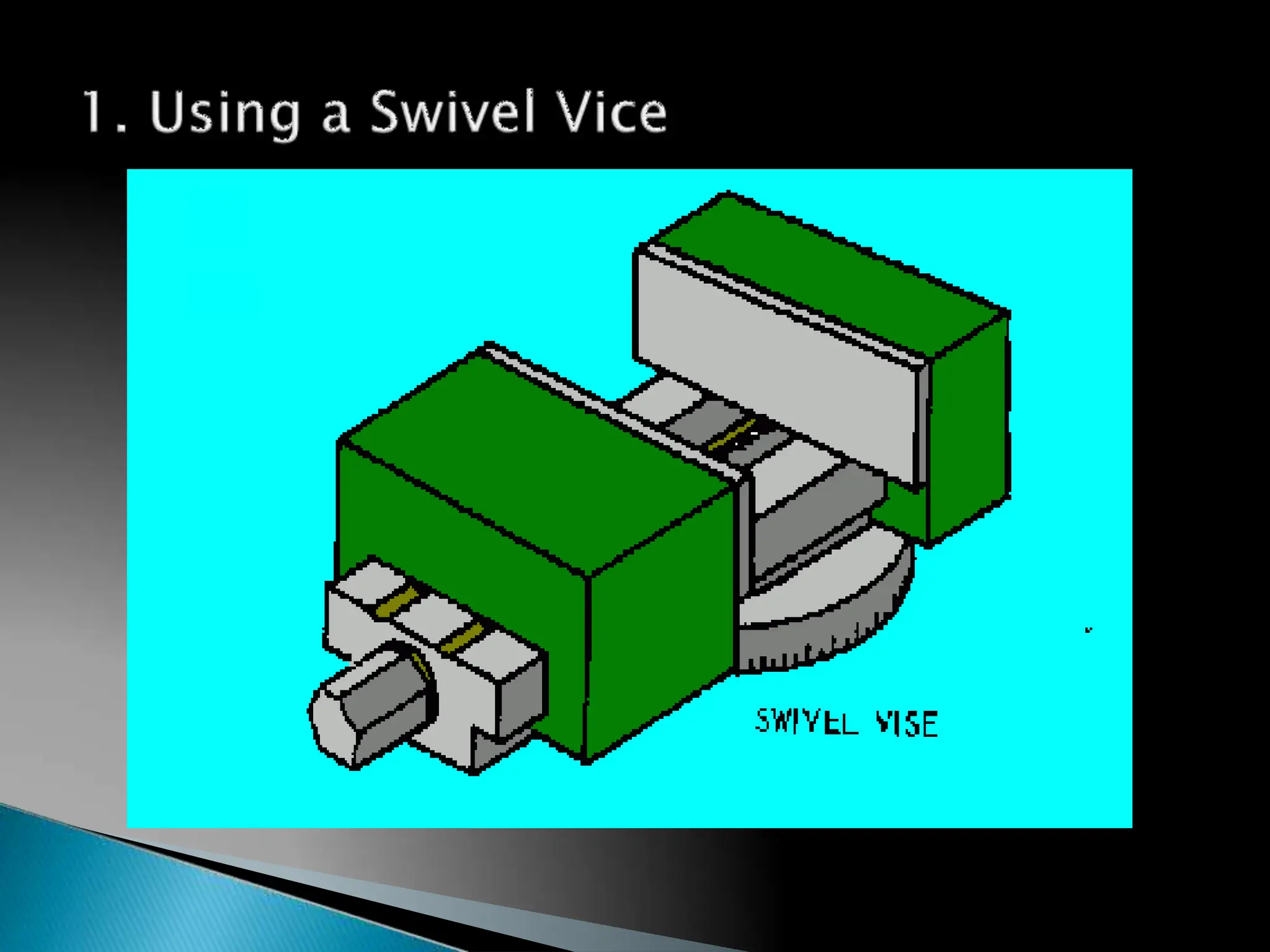
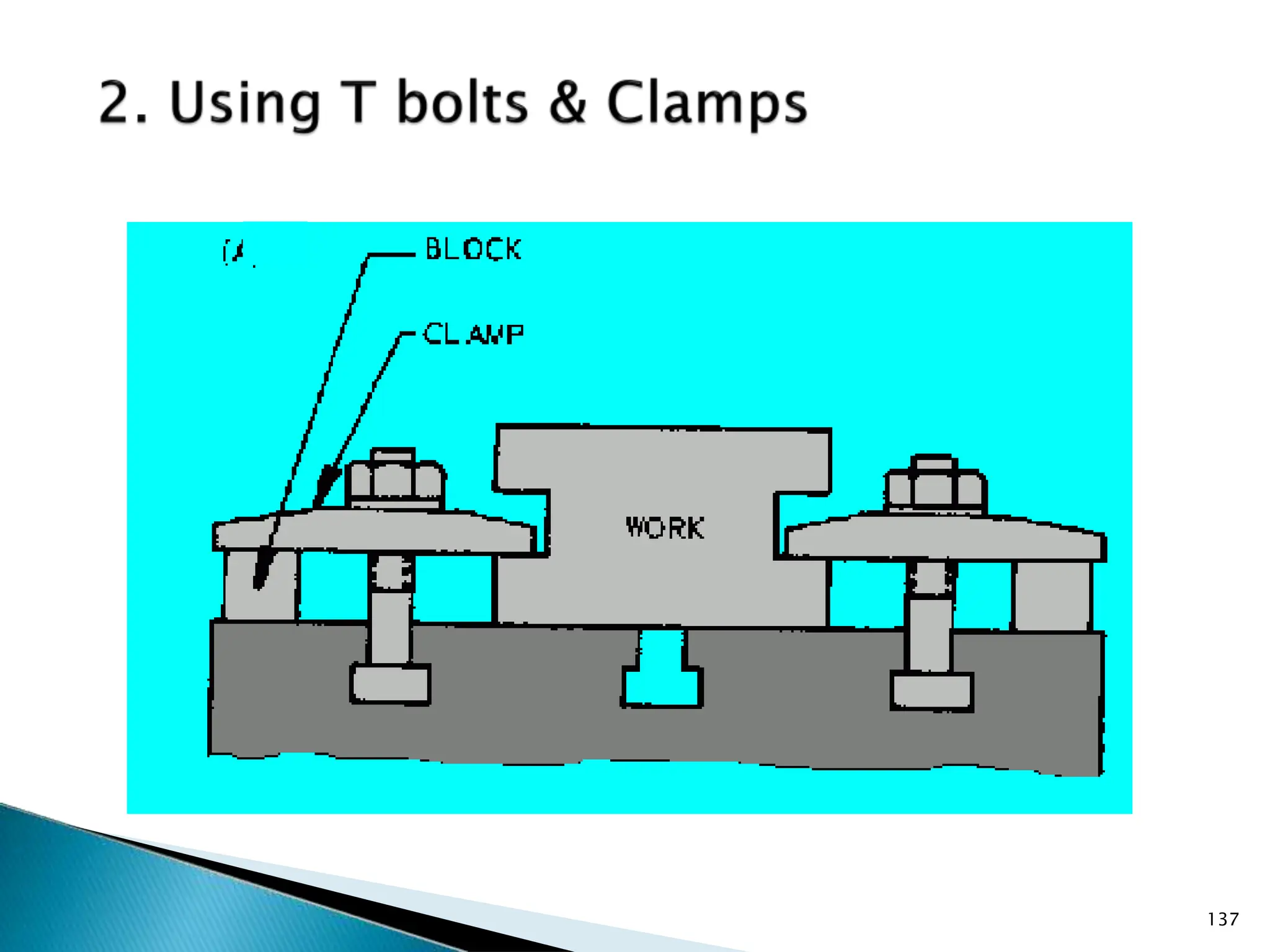
Work is fixed on the table by 3 methods.
1. Using a Swivel Vice
2. Using T bolts & Clamps
3. Using Angle plate & C Clamps
Clamping the work on a Slotter is depicted in
the following Slides, one by one
135
136
137
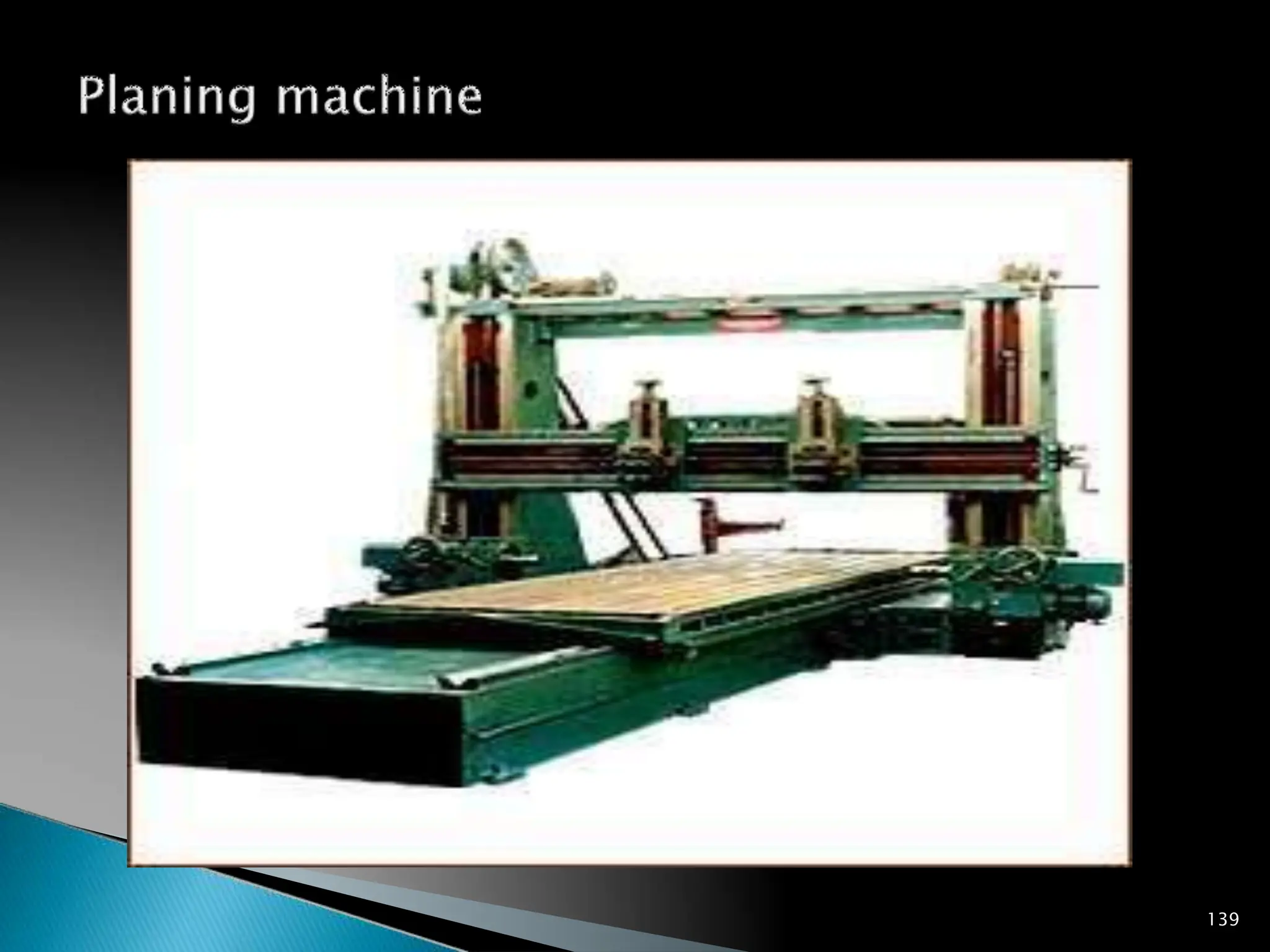
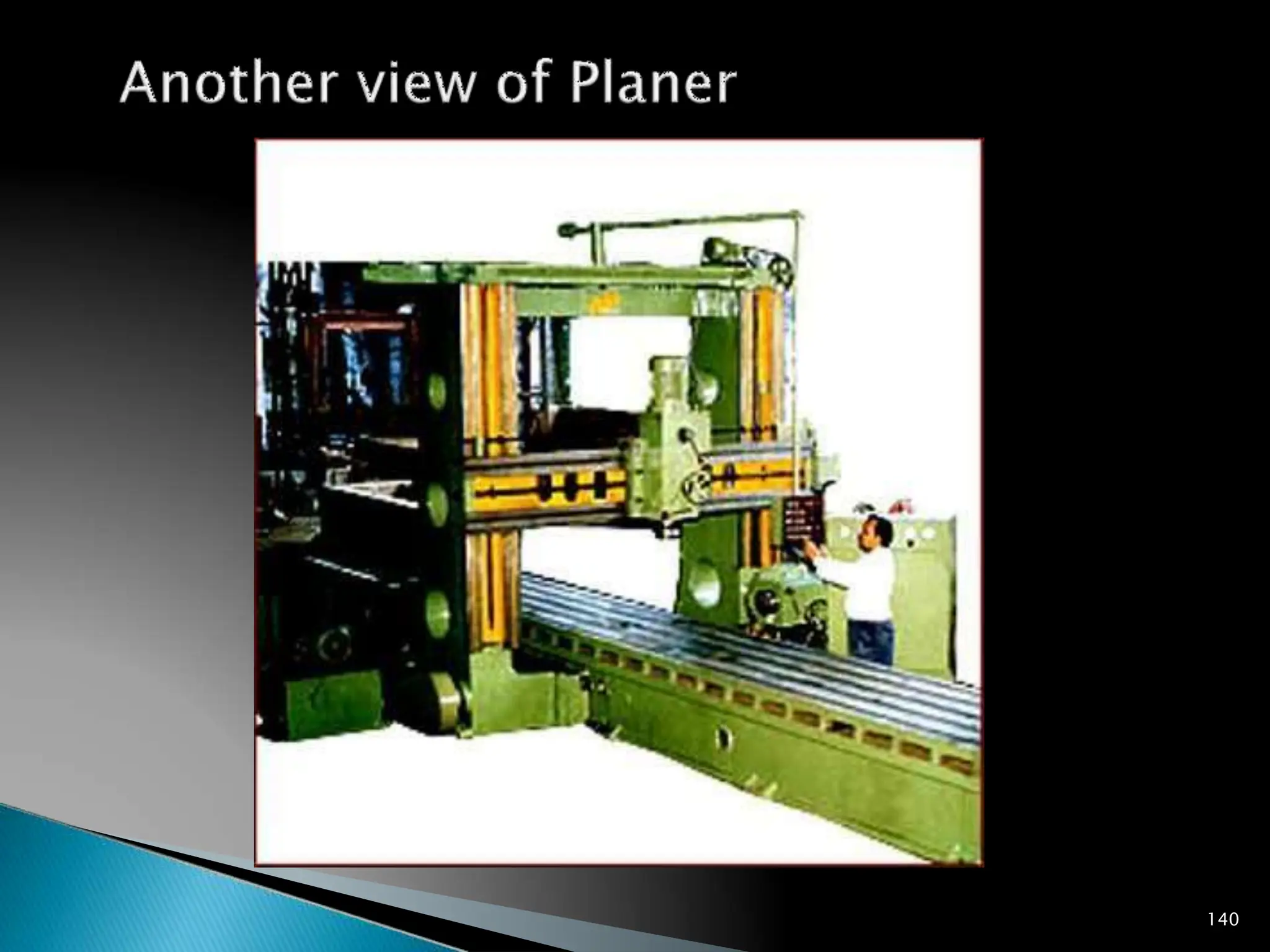
⦁ Planing machine
139
140
141
142
A Machine which produces flat surfaces
Consists a stationary housing for holding the tools
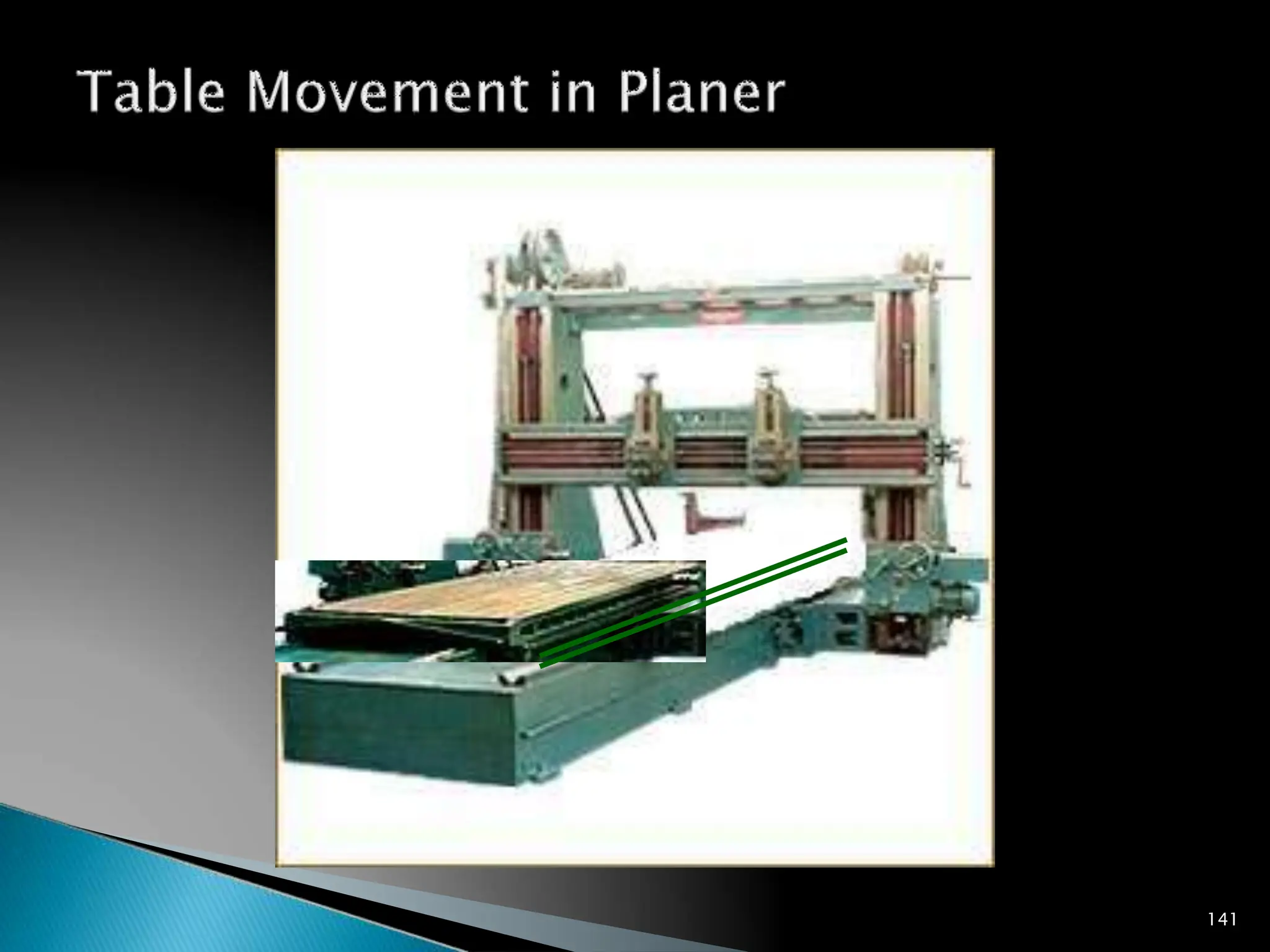
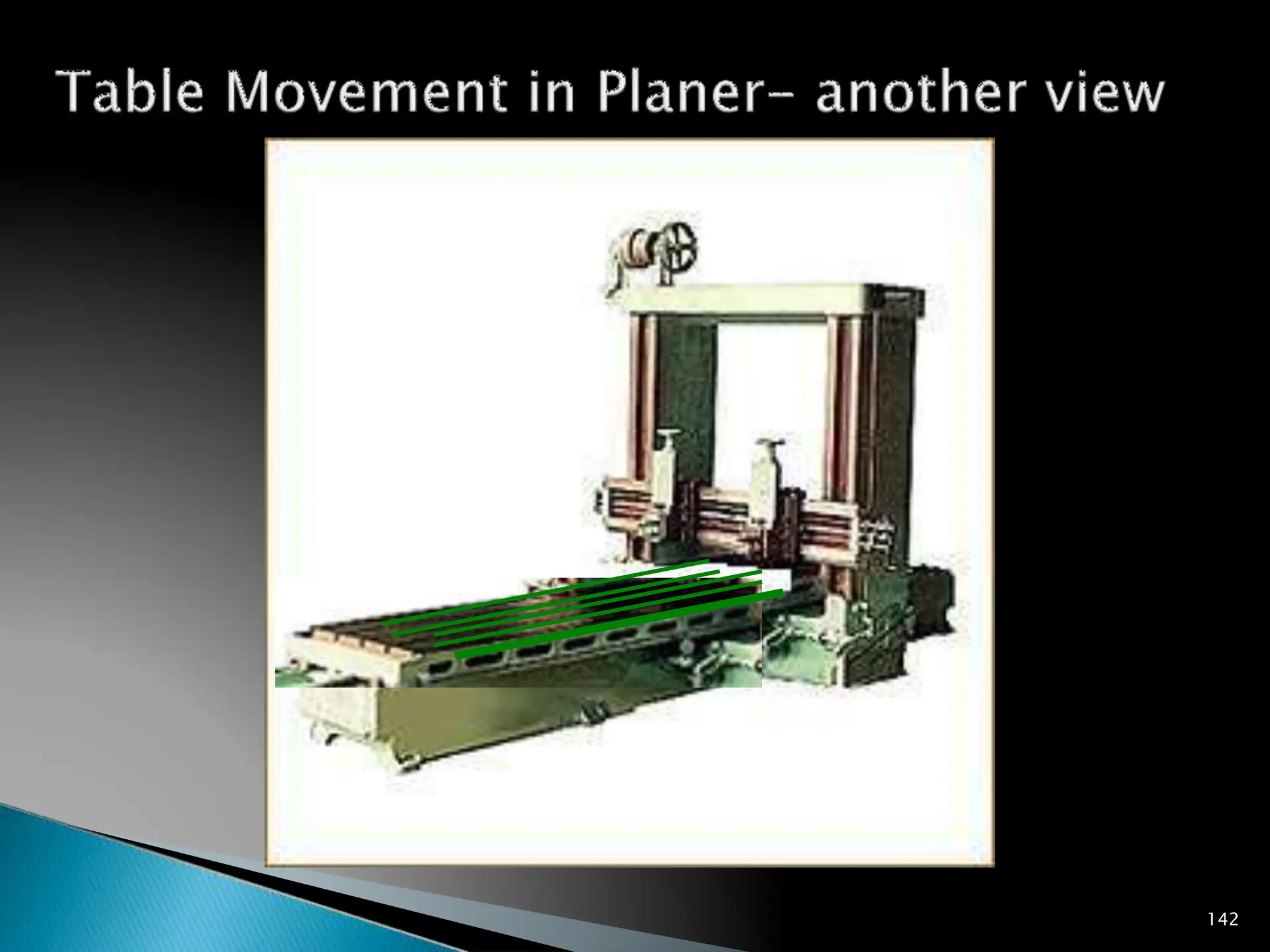
A table holding the work reciprocates
Large works, that con not be accommodate on
shapers
The tool is stationary but the work moves
143
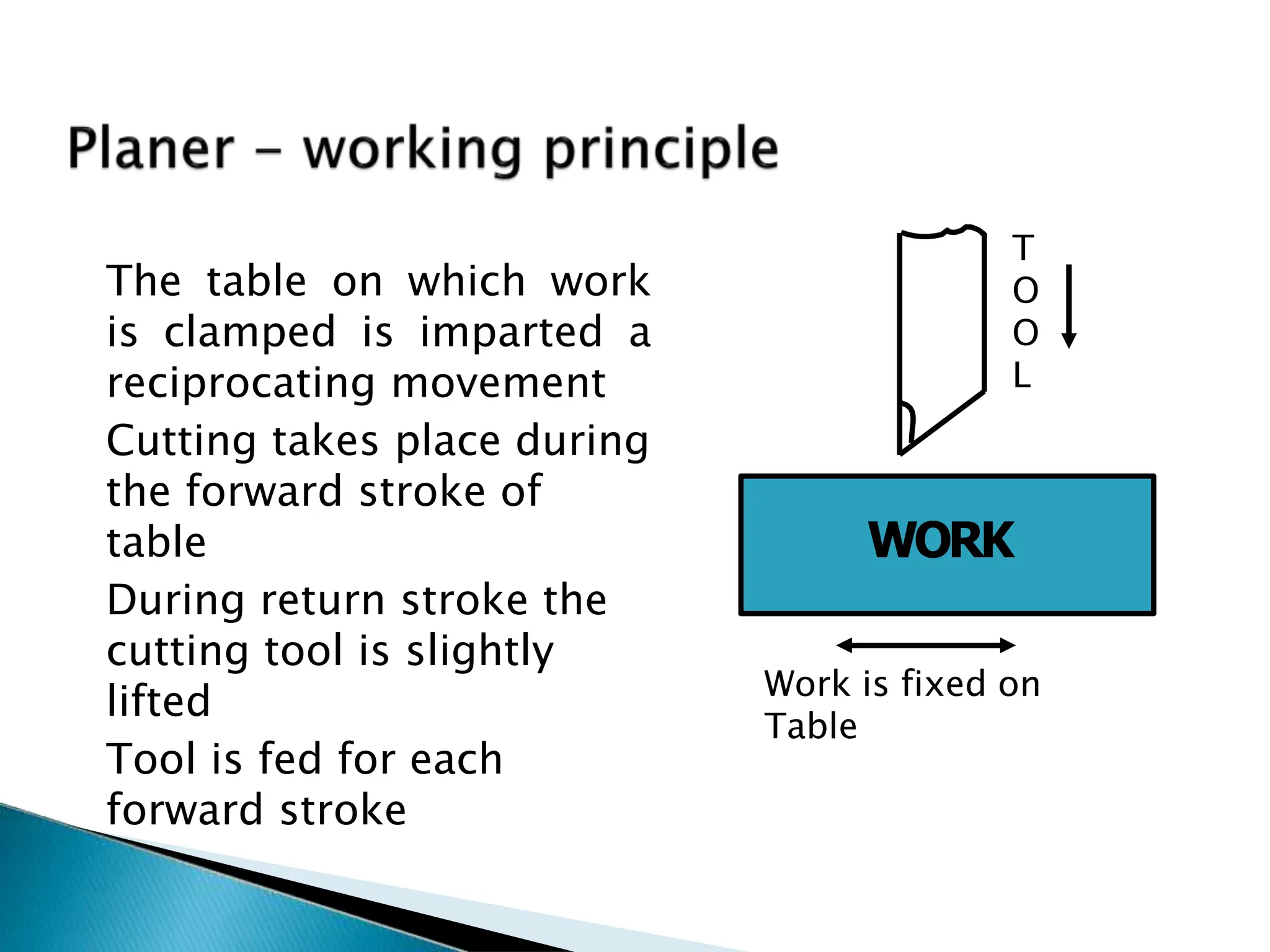
The table on which work
is clamped is imparted a
reciprocating movement
Cutting takes place during
the forward stroke of
table
During return stroke the
cutting tool is slightly
lifted
Tool is fed for each
forward stroke
WORK
T
O
O
L
Work is fixed on
Table
144
⦁ Table is driven by an electric motor
⦁ Length of table stroke can be adjusted
⦁ Speed of return stroke is also regulated
145
146
1. Double housing Planer
2. Open side Planer
3. Pit type Planer
4. Edge Planer or Plate Planer
5. Divided Table Planer
147
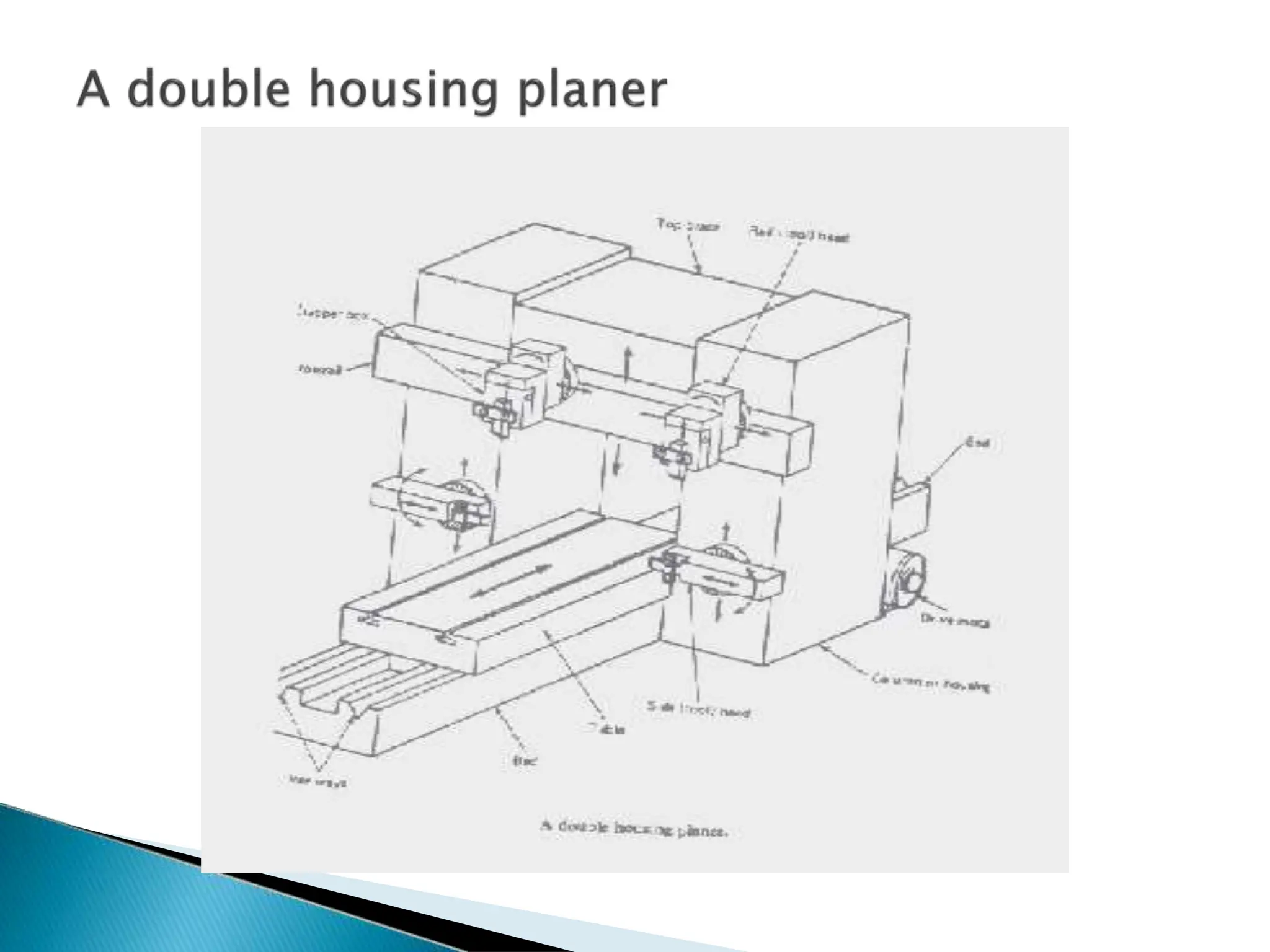
⦁ It is the Standard model & most widely used
⦁ Very heavy and robust
⦁ Has a bed and two vertical housings are fixed
⦁ Table moves along the guide ways of the bed
⦁ Housing supports cross rail & tool heads.
⦁ Cross rail carries two tool heads
⦁ Tool head carries tools
148
149
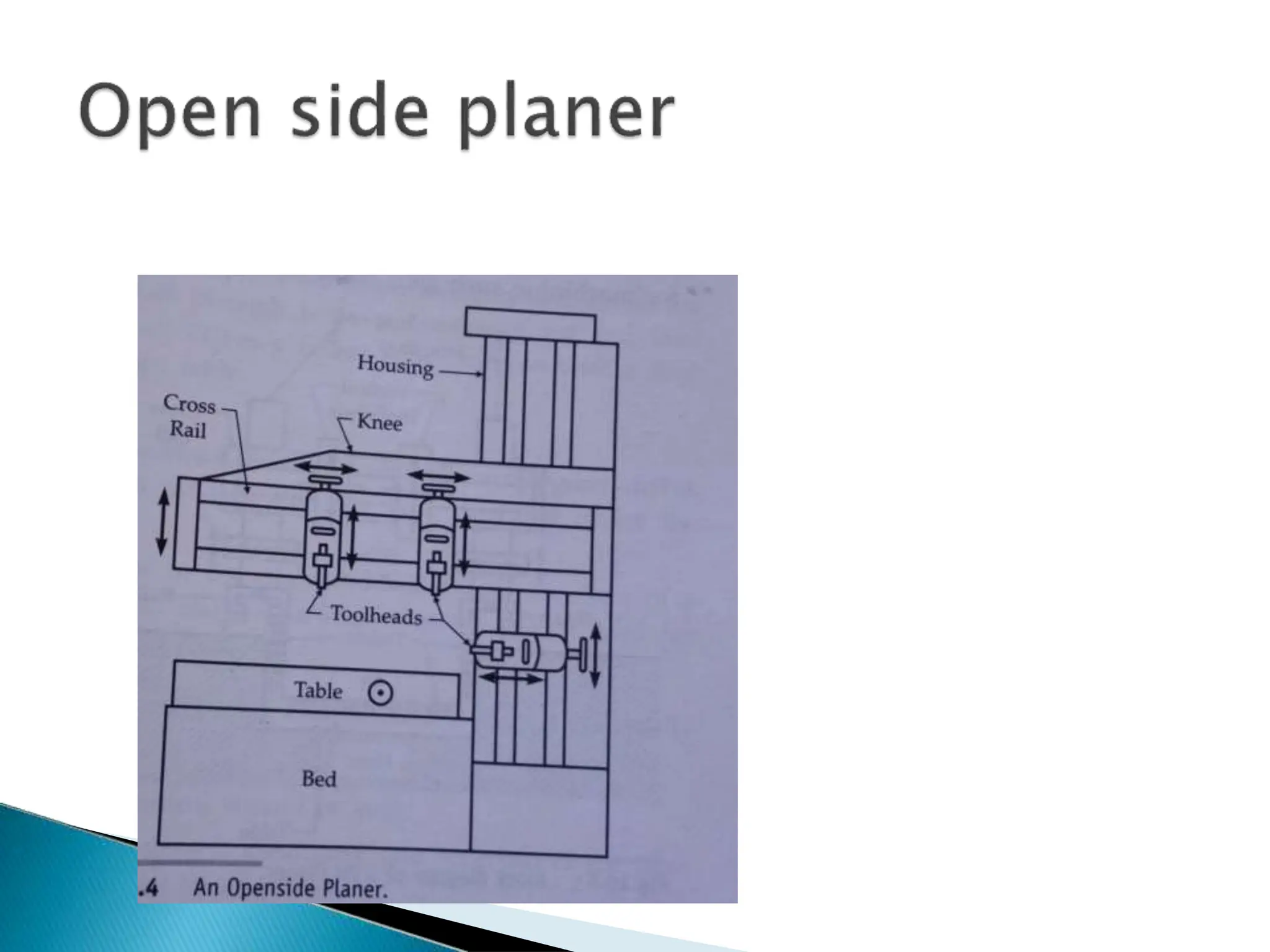
⦁ It has only one supporting column (housing)
⦁ Area larger than the table can be planed
⦁ Cross rail is mounted as a Cantilever
⦁ Tool holders are mounted on Cross rail
⦁ Stroke length of bed is controlled by adjustable dogs
150
Columns and cross rail carrying tool head move
longitudinally on massive rail above the work table
Bed is recessed in the floor
Loading and unloading of jobs is easy
Used for Planing heavy & large jobs
Table and work piece resting on it are stationary and
the tool reciprocates
152
Specially designed for squaring or beveling the edges of
heavy steel plates for pressure vessels
Carriage supporting the tool is movedback
and front
direction
Cutting can take place during both directions of carriage
travel
Operator stands on the platform & operates
153
Also known as Tandem planer
Planer has two tables on the bed
Table may be reciprocated together or separately
Each table reciprocates under different tool head
For continuous production, small work pieces
clamped on one table are being machined, another
is stationary and can be used for setting up fresh
works
Used for quick & continuous production
154
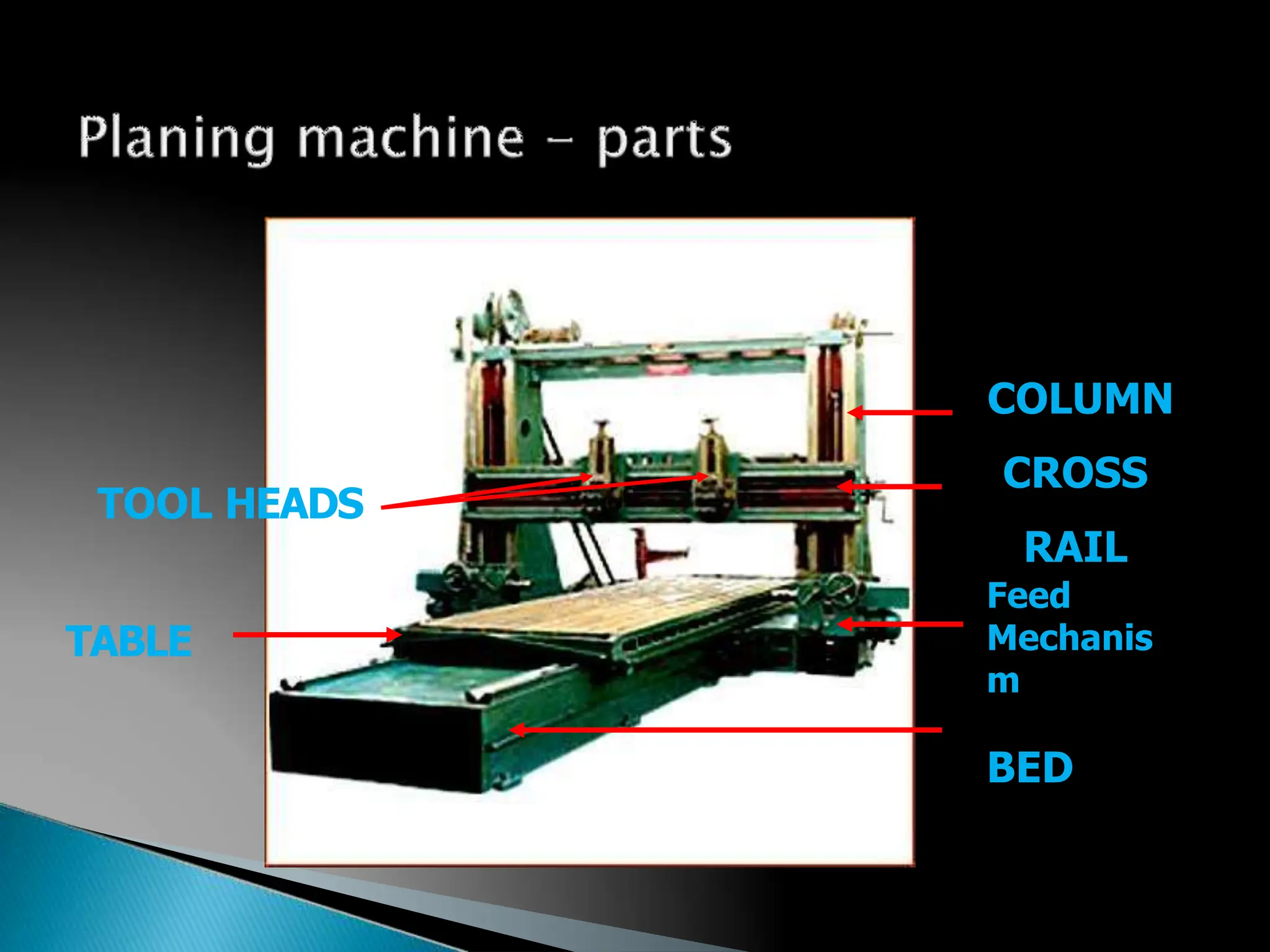
TABLE
COLUMN
CROSS
RAIL
TOOL HEADS
155
Feed
Mechanis
m
BED
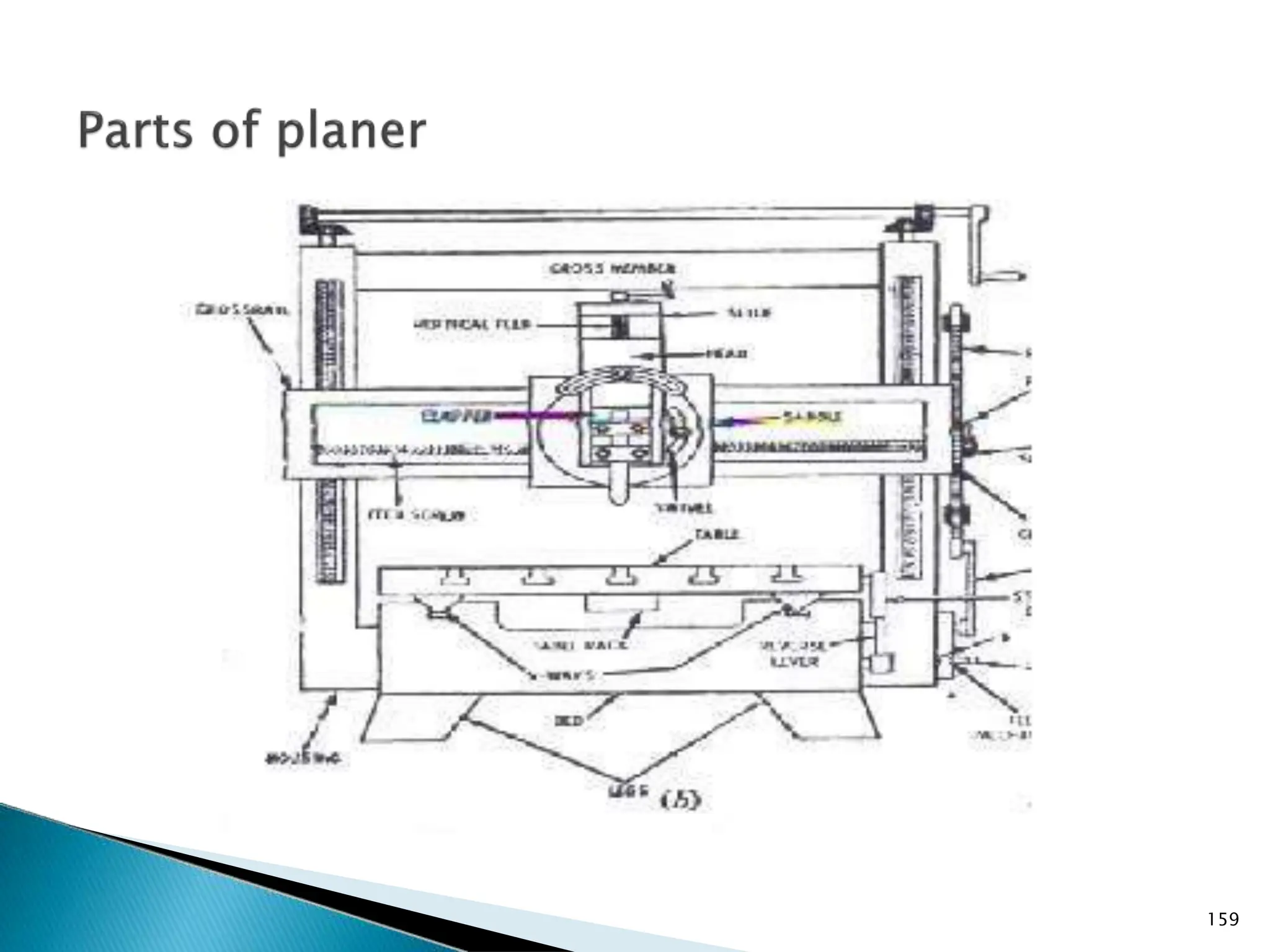
1. Bed
2. Table
3. Housing or Column
4. Cross rail
5. Tool heads
6. Driving Mechanism
7. Feed Mechanism
156
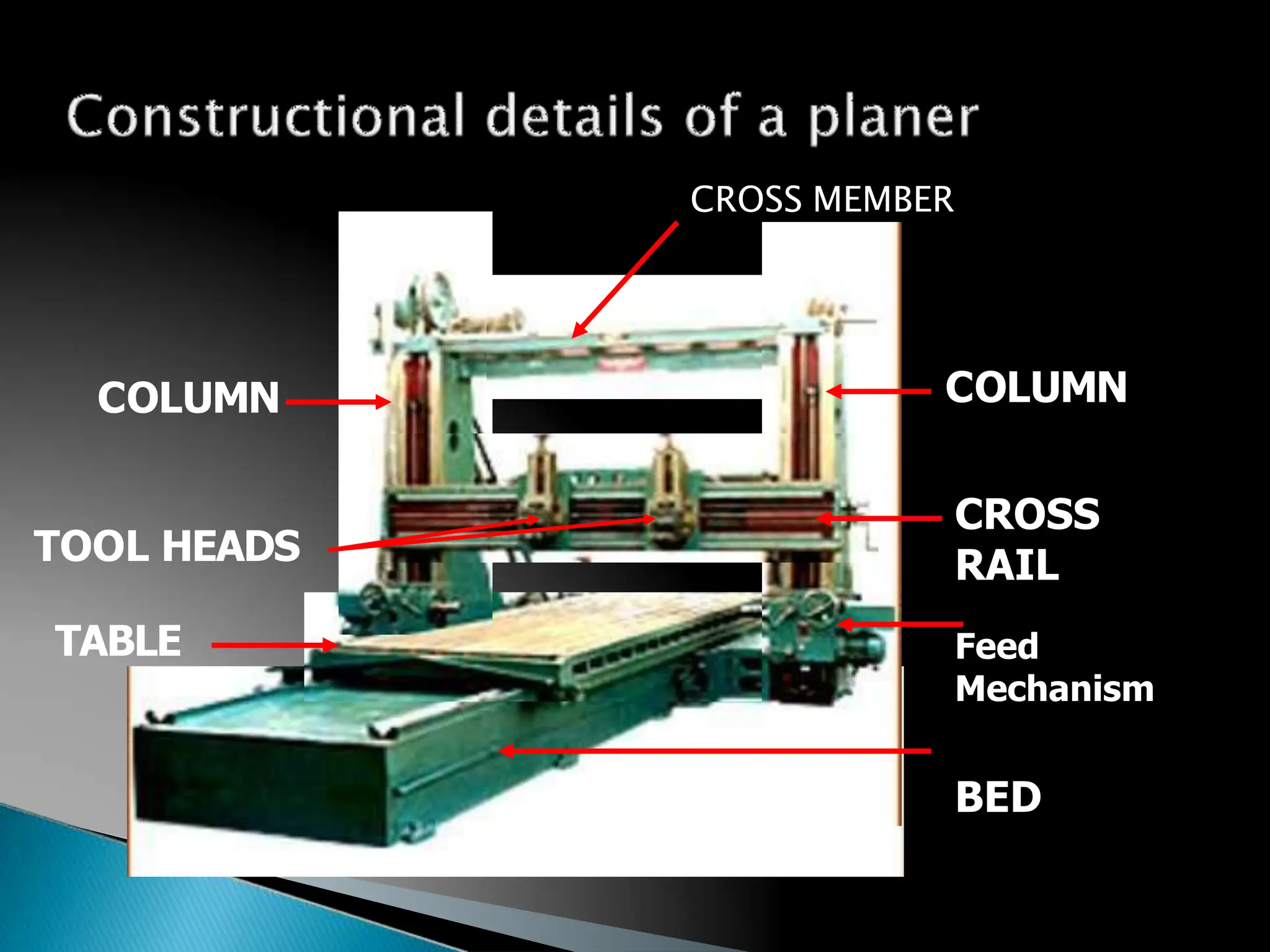
TOOL HEADS
TABLE
COLUMN
CROSS MEMBER
COLUMN
CROSS
RAIL
Feed
Mechanism
BED
157
158
159
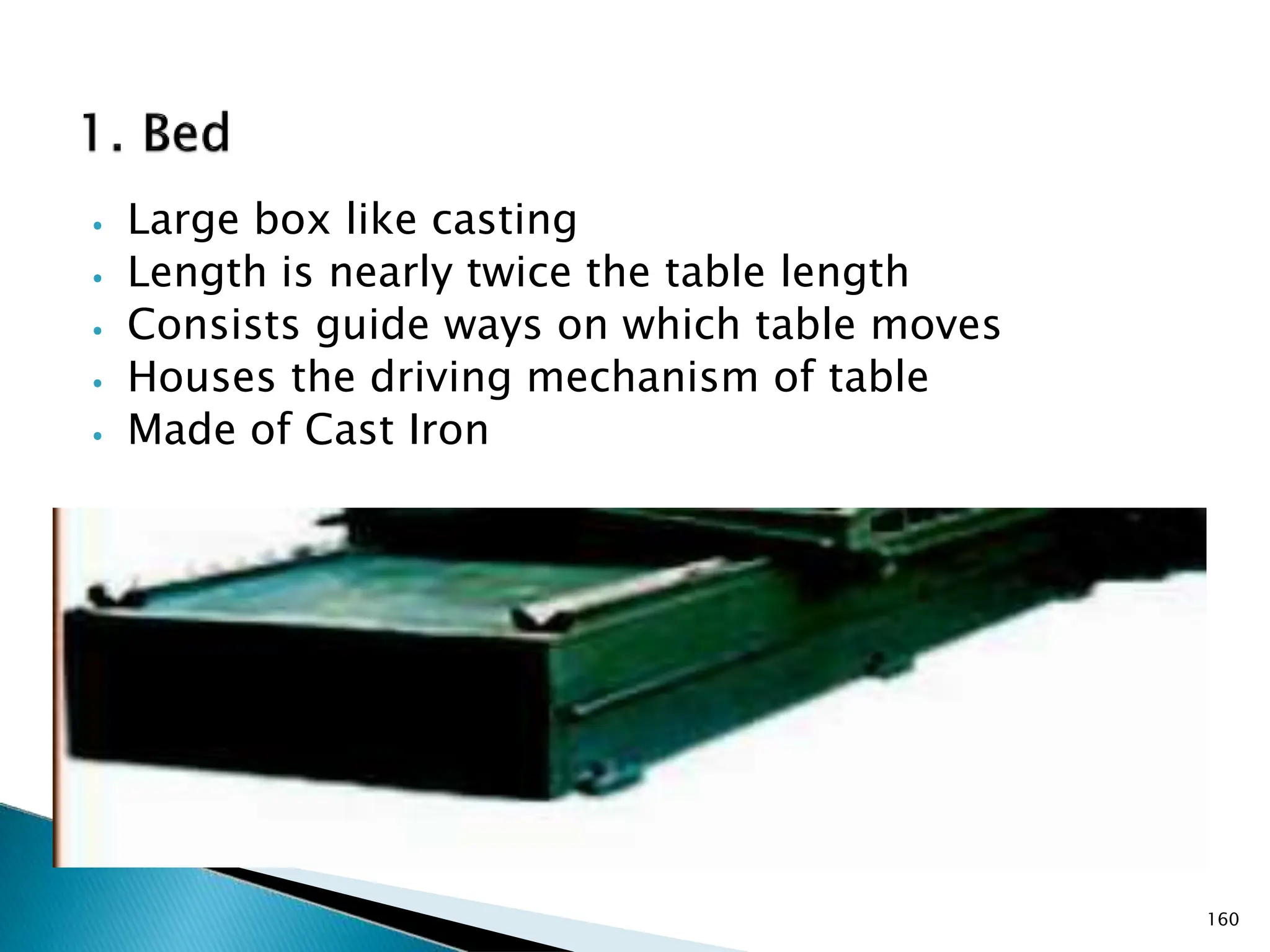
⦁ Large box like casting
⦁ Length is nearly twice the table length
⦁ Consists guide ways on which table moves
⦁ Houses the driving mechanism of table
⦁ Made of Cast Iron
160
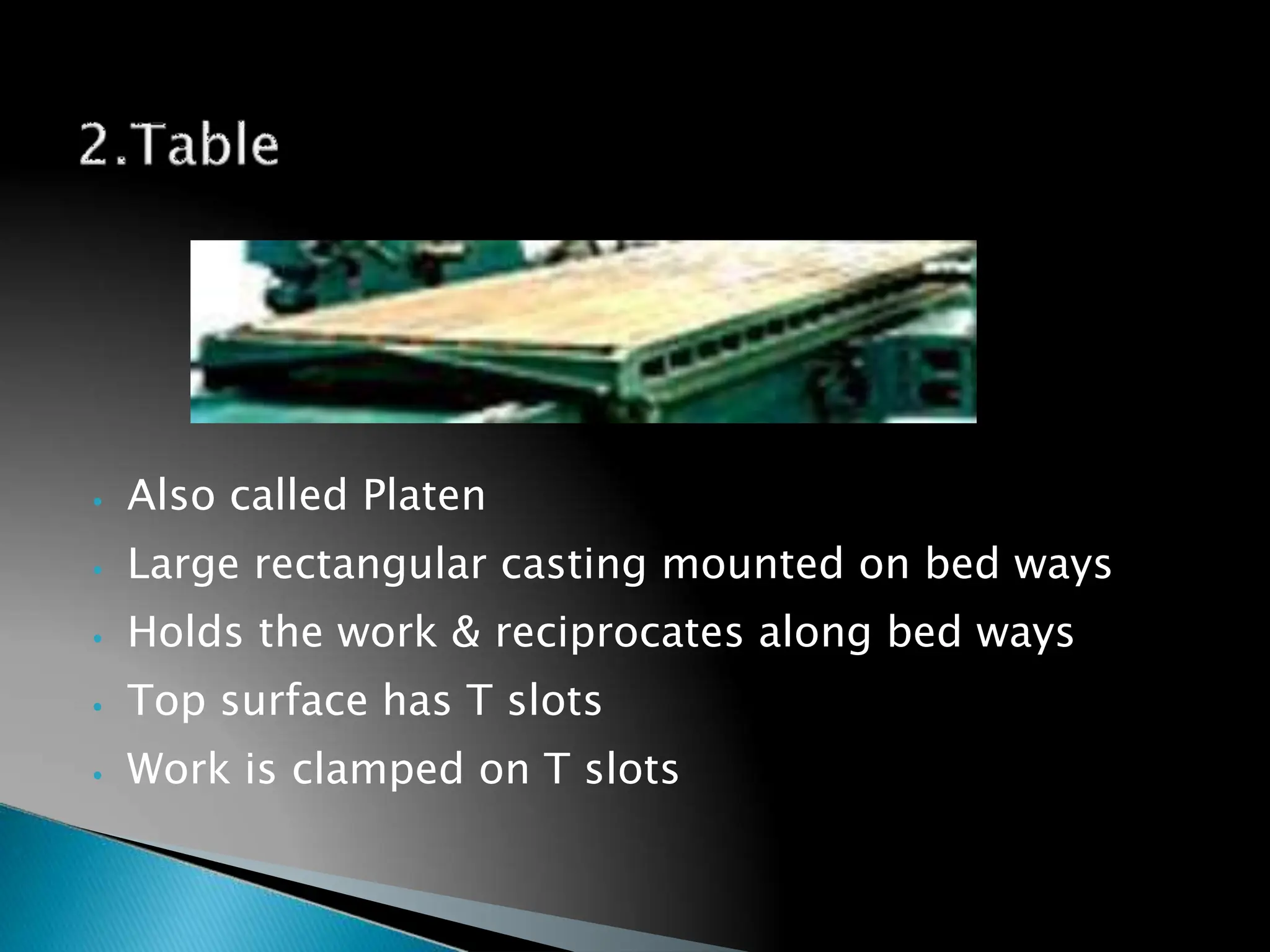
⦁ Also called Platen
⦁ Large rectangular casting mounted on bed ways
⦁ Holds the work & reciprocates along bed ways
⦁ Top surface has T slots
⦁ Work is clamped on T slots
161
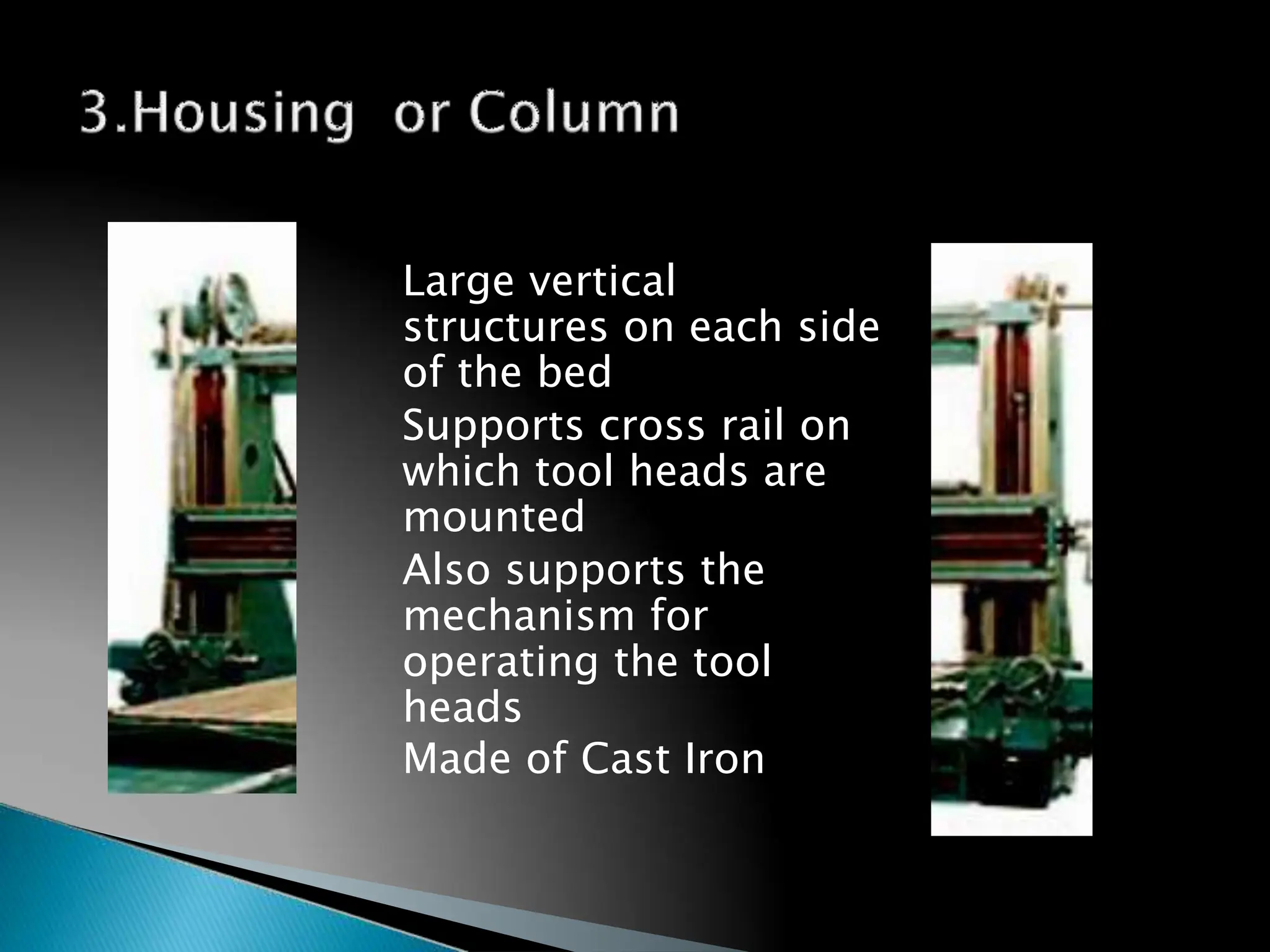
Large vertical
structures on each side
of the bed
Supports cross rail on
which tool heads are
mounted
Also supports the
mechanism for
operating the tool
heads
Made of Cast Iron
162
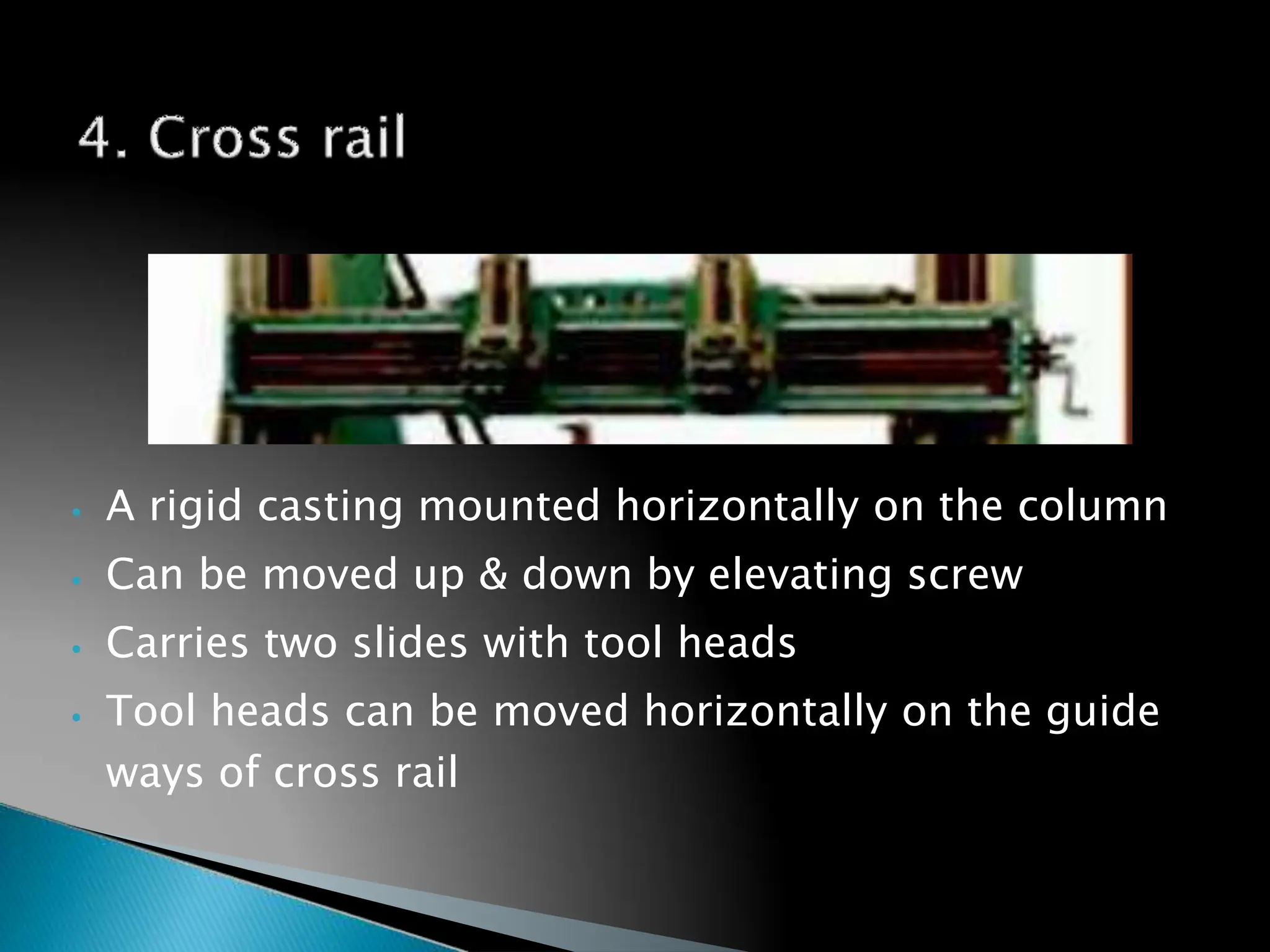
⦁ A rigid casting mounted horizontally on the column
⦁ Can be moved up & down by elevating screw
⦁ Carries two slides with tool heads
⦁ Tool heads can be moved horizontally on the guide
ways of cross rail
163
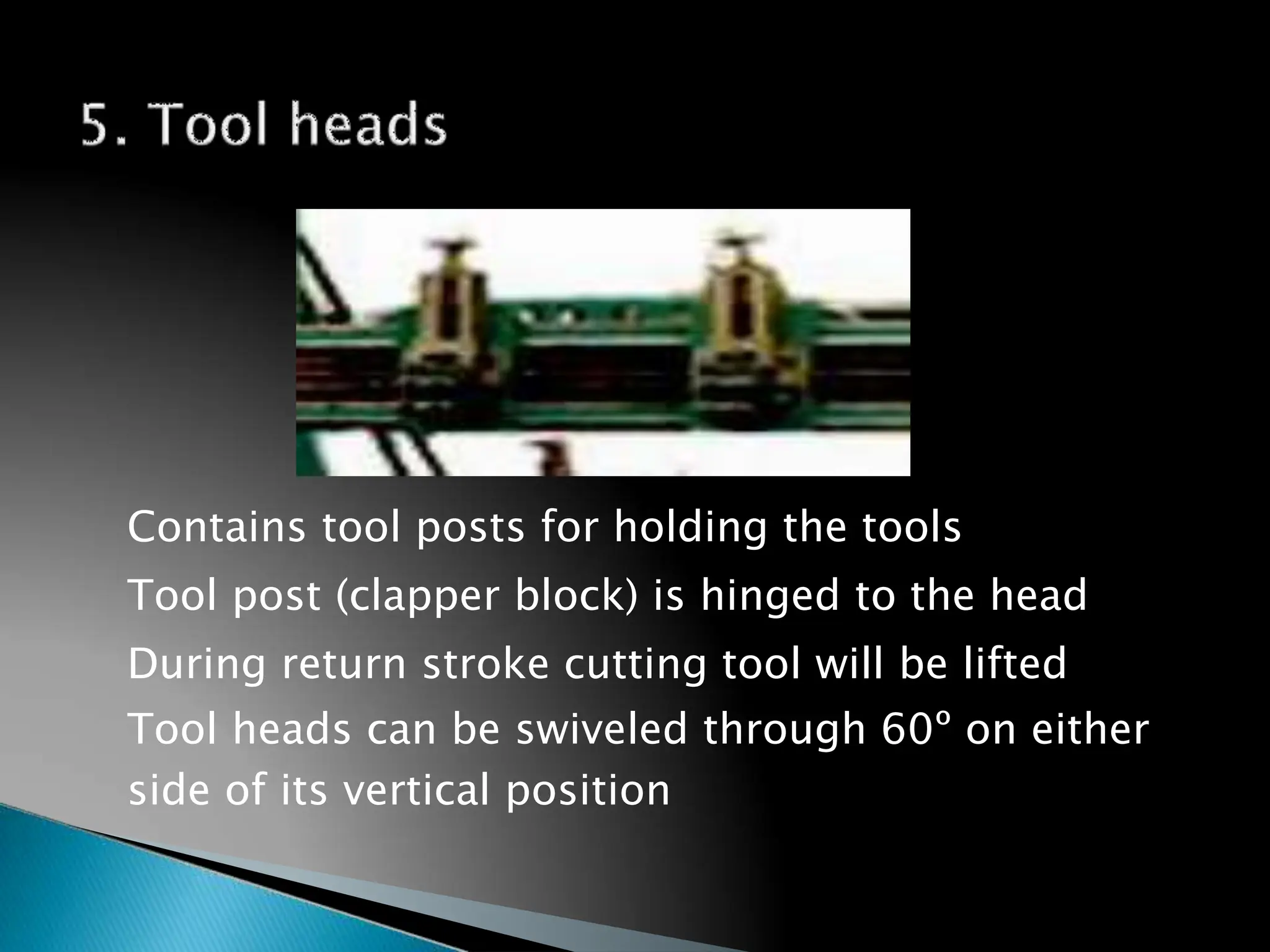
Contains tool posts for holding the tools
Tool post (clapper block) is hinged to the head
During return stroke cutting tool will be lifted
Tool heads can be swiveled through 60º on either
side of its vertical position
164
1. Distance between the two housings
2. Height between Table & cross rail at its
uppermost position
3. Maximum length of table travel
4. Number of Speeds & feeds available
165
5. Power input
6. Floor space required
7. Type of Drive
8. Net weight of the Machine
166
A Planing Machine produces flat surfaces
The Table holding the Work reciprocates
There should be some mechanism to move the
Table in reciprocating motion, and
Table to move quick during idle stroke
167
1. Open & Cross belt drive
2. Reversible motor drive
3. Hydraulic drive
168
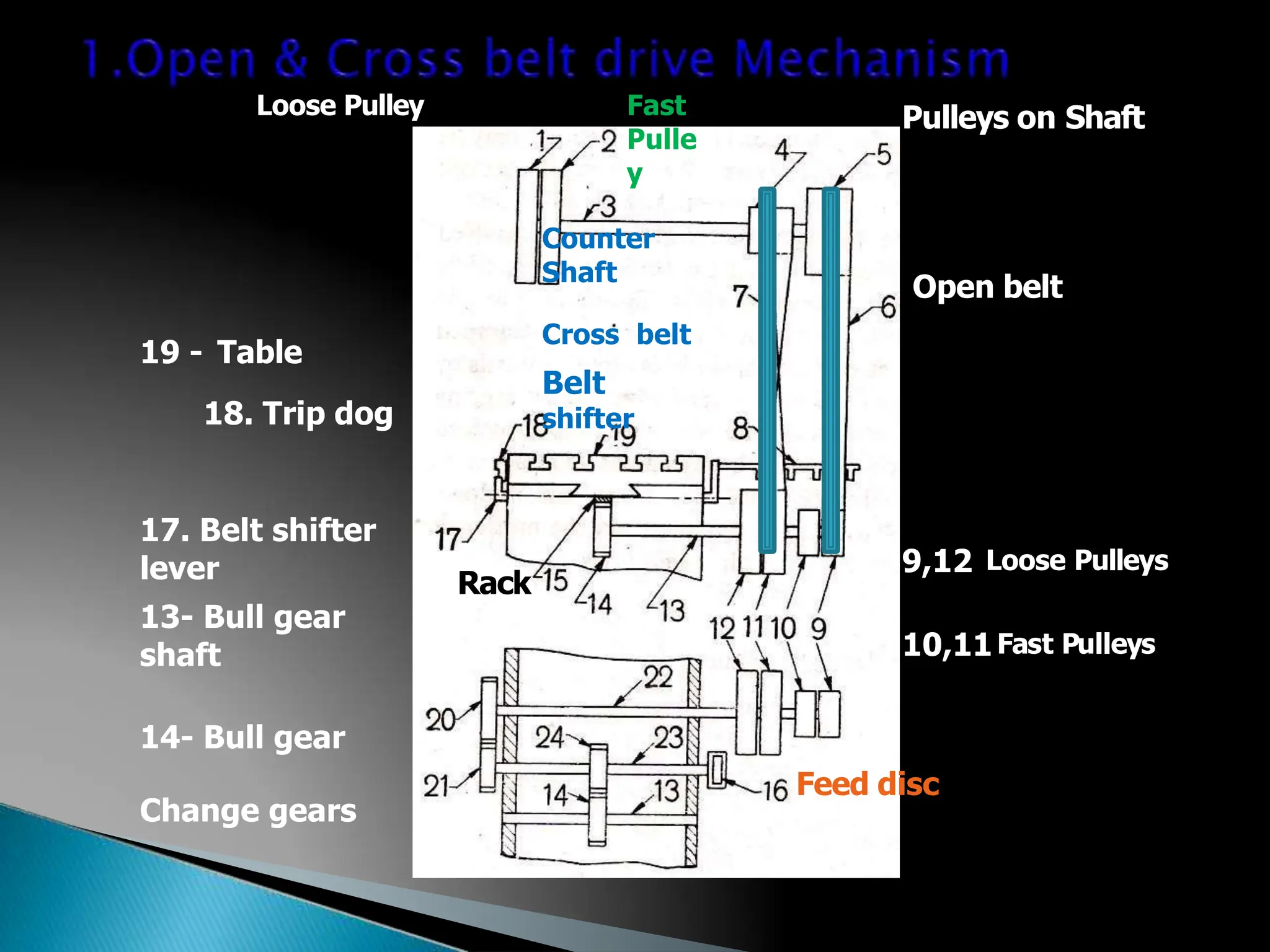
Loose Pulley Fast
Pulle
y
Pulleys on Shaft
Open belt
Counter
Shaft
Cross belt
Belt
shifter
9,12 Loose Pulleys
10,11Fast Pulleys
Rack
19 - Table
18. Trip dog
17. Belt shifter
lever
13- Bull gear
shaft
14- Bull gear
Change gears
Feed disc
169
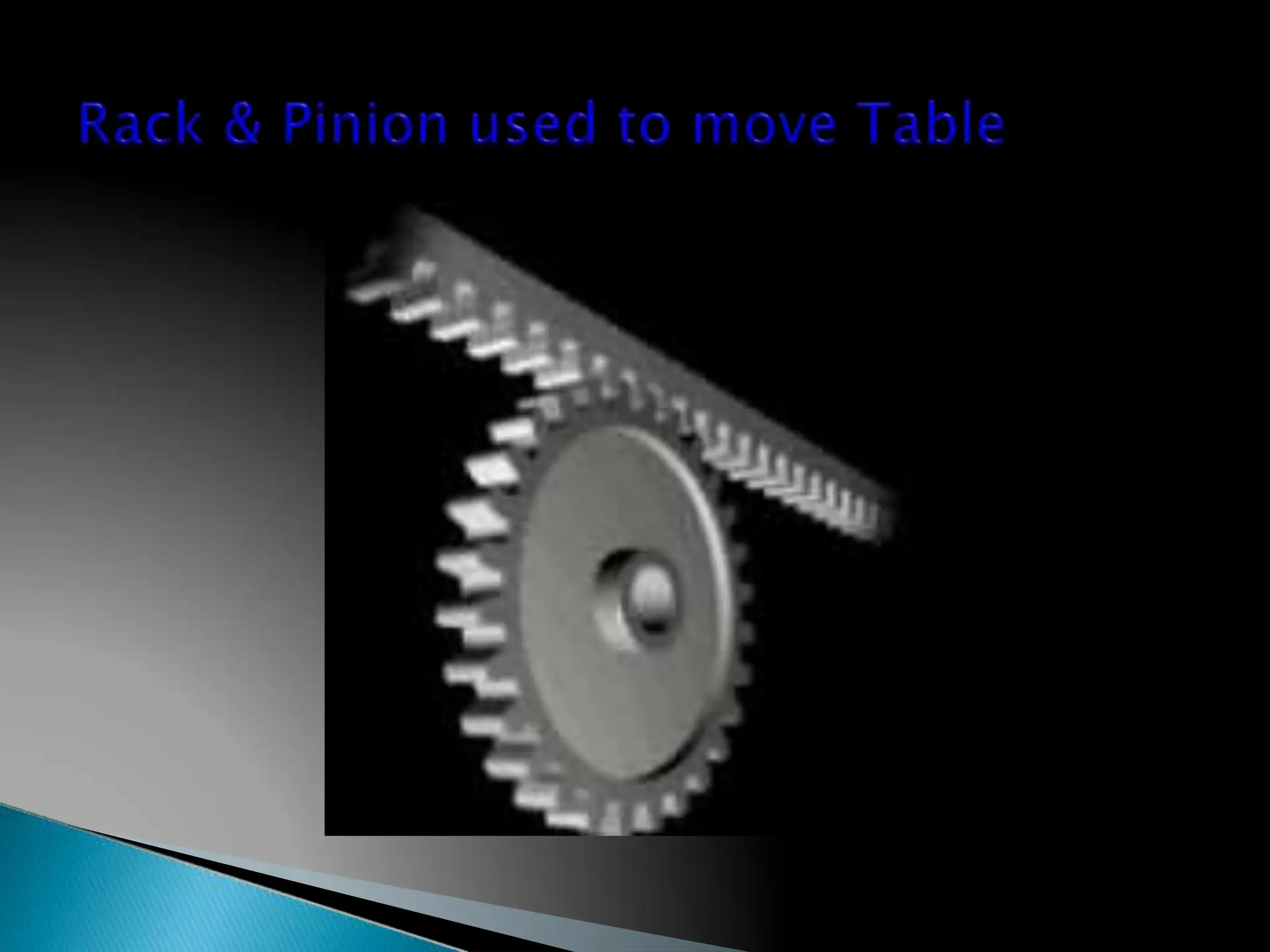
Used for smaller capacity machines
Table is moved by gears & rack attached under
the table
Counter shaft at the top of housing has 2 pulleys
These Pulleys transfer power to main shaft(Driving)
Main shaft drives the table by rack & pinion
170
2 Sets of fast & loose pulleys are mounted on driving
shaft at one end and pinion is on another end
RETURN STROKE:
Smaller fast pulley is used for backward motion of table
(Quick motion)
It is connected by open belt drive
The open belt passes over small fast pulley to get
Quick
return
The Cross belt is on loose pulley so it will not drive
171
FORWARD STROKE:
Bigger fast pulley is driven by cross belt drive
It is used to drive the table during cutting stroke
Open belt is on loose pulley
At the end of cutting stroke, cross belt is shifted from fast
pulley to loose pulley
Simultaneously open belt is shifted from loose pulley to fast
pulley
This is achieved by trip dog which operates belt shifting lever
Thus the direction of movement is automatically reversed
172
173
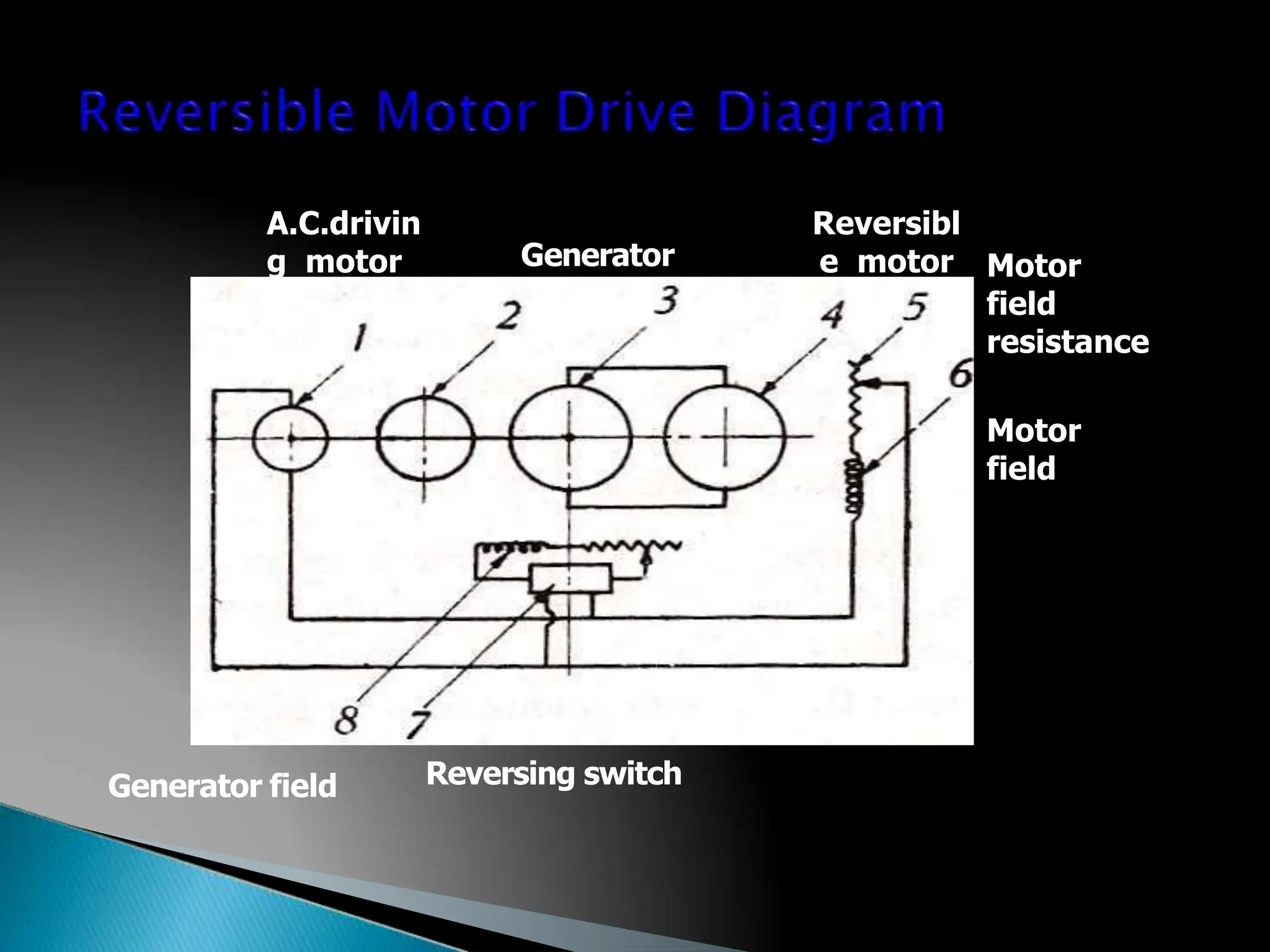
Electric motor drives the bull gear through gear
trains
Motor is coupled to D.C. generator
When motor is started, generator supplies power
to reversible motor
174
Reversible motor causes the planer table to move
At the end of stroke, trip dog operates the switch
which reverses the direction of table
Speed of cutting stroke is reduced by regulating
the field current of the generator
175
A.C.drivin
g motor
ter
176
Generator
Reversibl
e motor Motor
field
resistance
Motor
field
Generator field Reversing switch
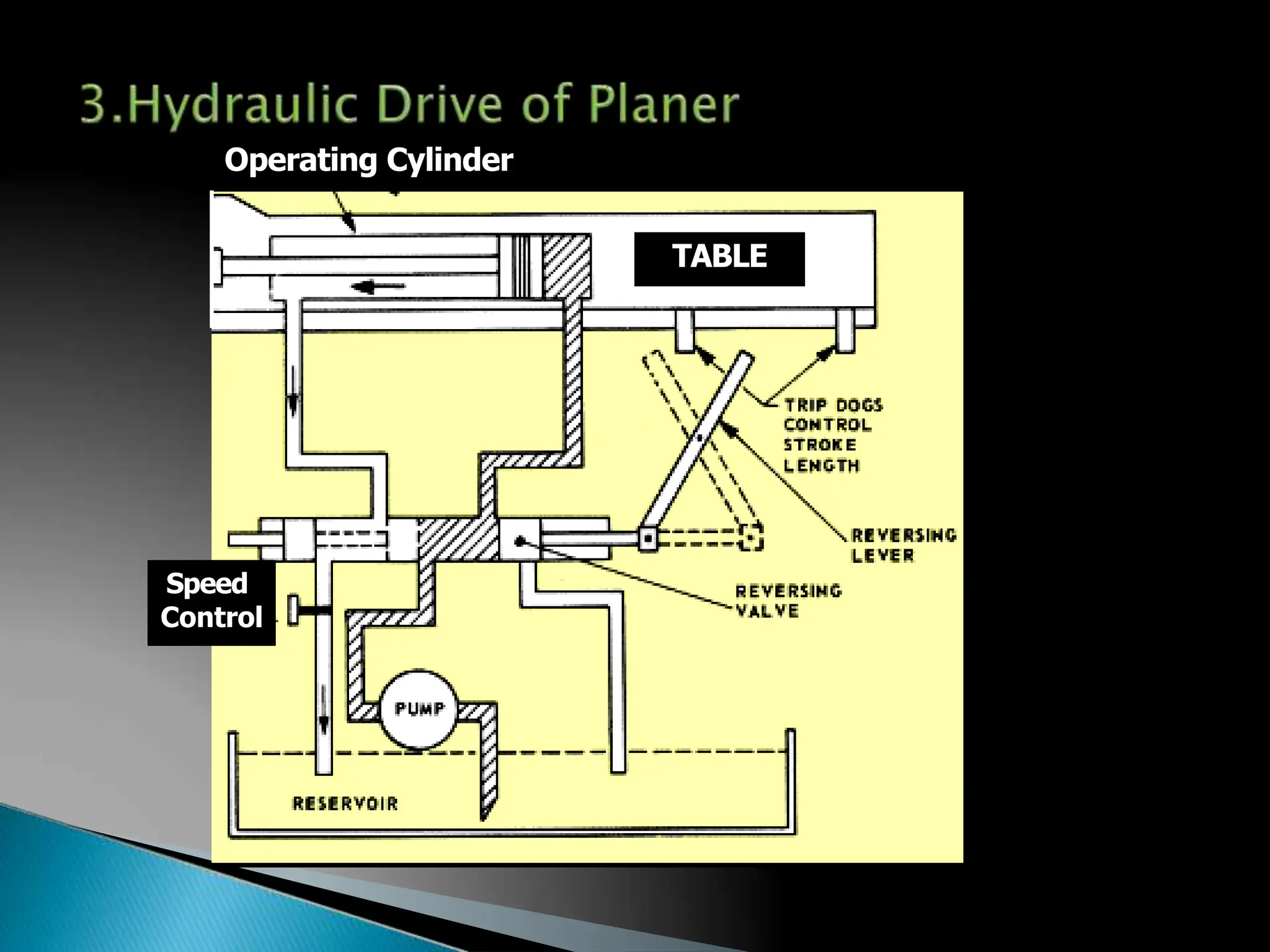
TABLE
Operating Cylinder
Speed
177
Control
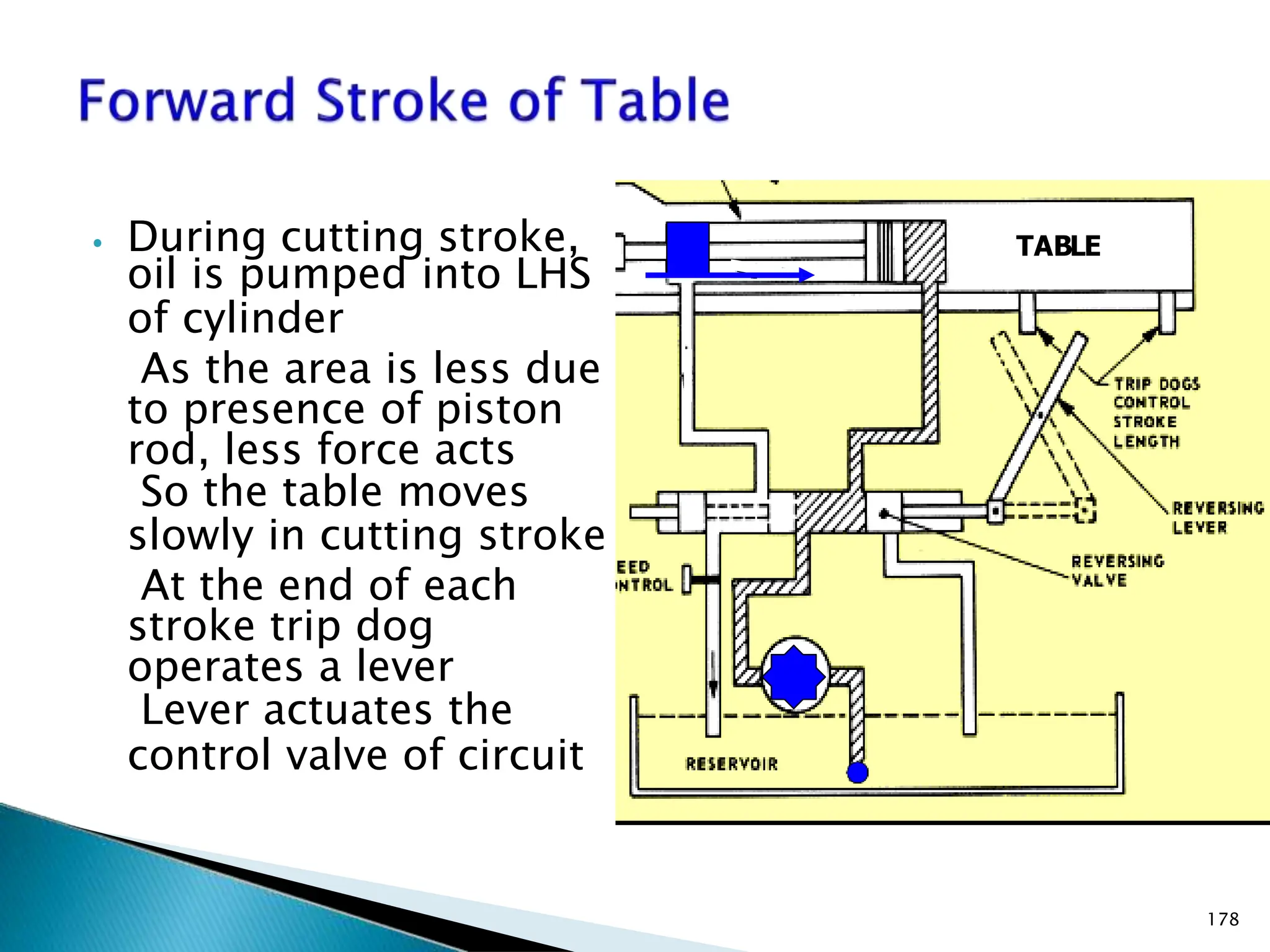
⦁ During cutting stroke,
oil is pumped into LHS
of cylinder
As the area is less due
to presence of piston
rod, less force acts
So the table moves
slowly in cutting stroke
At the end of each
stroke trip dog
operates a lever
Lever actuates the
control valve of circuit
TABLE
178
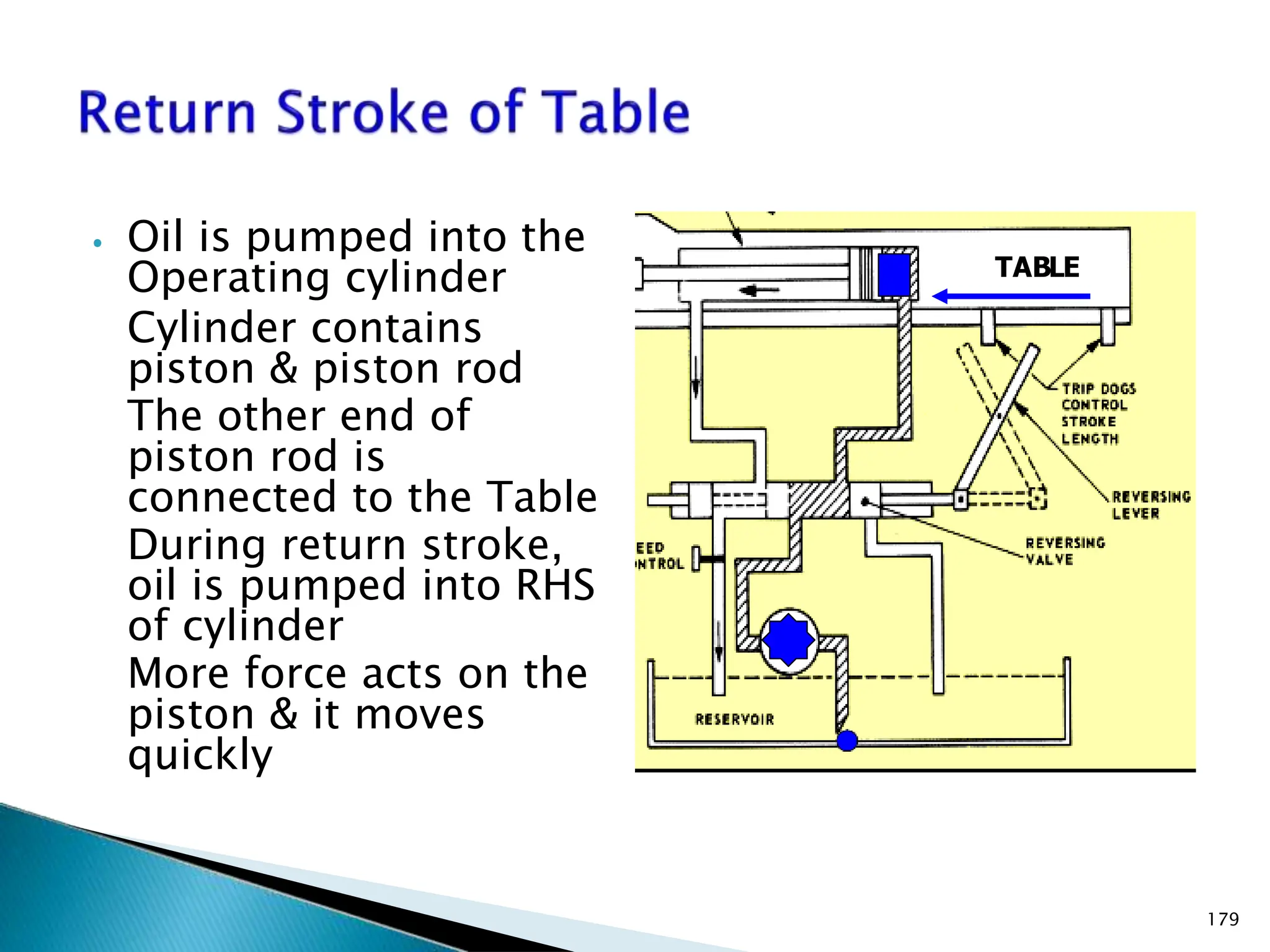
⦁ Oil is pumped into the
Operating cylinder
Cylinder contains
piston & piston rod
The other end of
piston rod is
connected to the Table
During return stroke,
oil is pumped into RHS
of cylinder
More force acts on the
piston & it moves
quickly
TABLE
179
Flow of oil is changed from one side to the other
side of cylinder
The length of stroke can be varied by adjusting the
distance between trip dogs
180
1.Planing Horizontal Surfaces
2. Planing Vertical Surfaces
3. Planing Angular Surfaces / Dovetails
4. Planing Curved surfaces
5. Planing Slots, key ways & Grooves
181
🞄 Fix the work properly on the table
🞄 Set the required cutting speed
🞄 Give required feed of the tool
🞄 Give suitable depth of cut for rough cuts
🞄 Finishing the job by giving less depth of cut
182
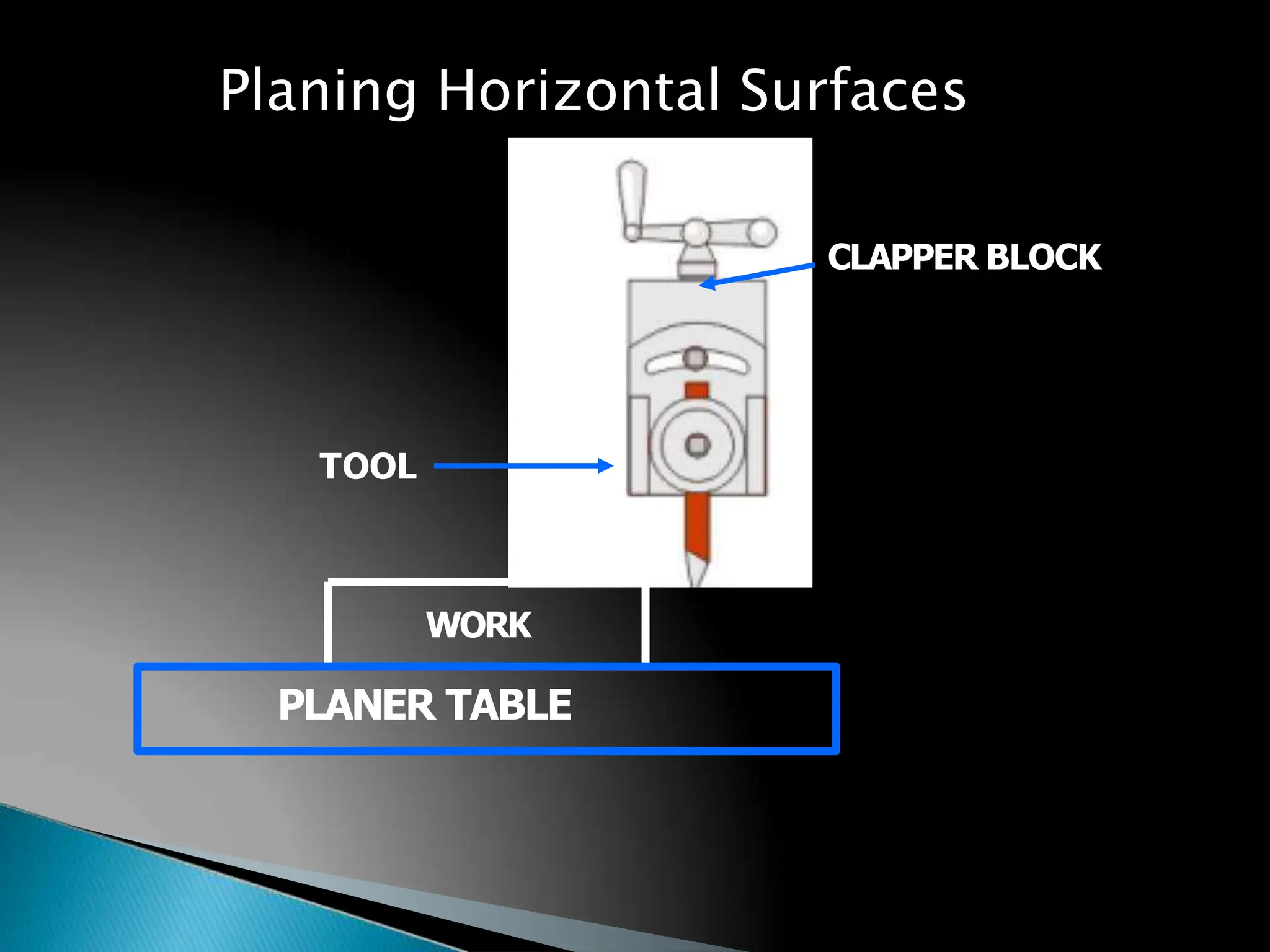
WORK
PLANER TABLE
Planing Horizontal Surfaces
TOOL
183
CLAPPER BLOCK
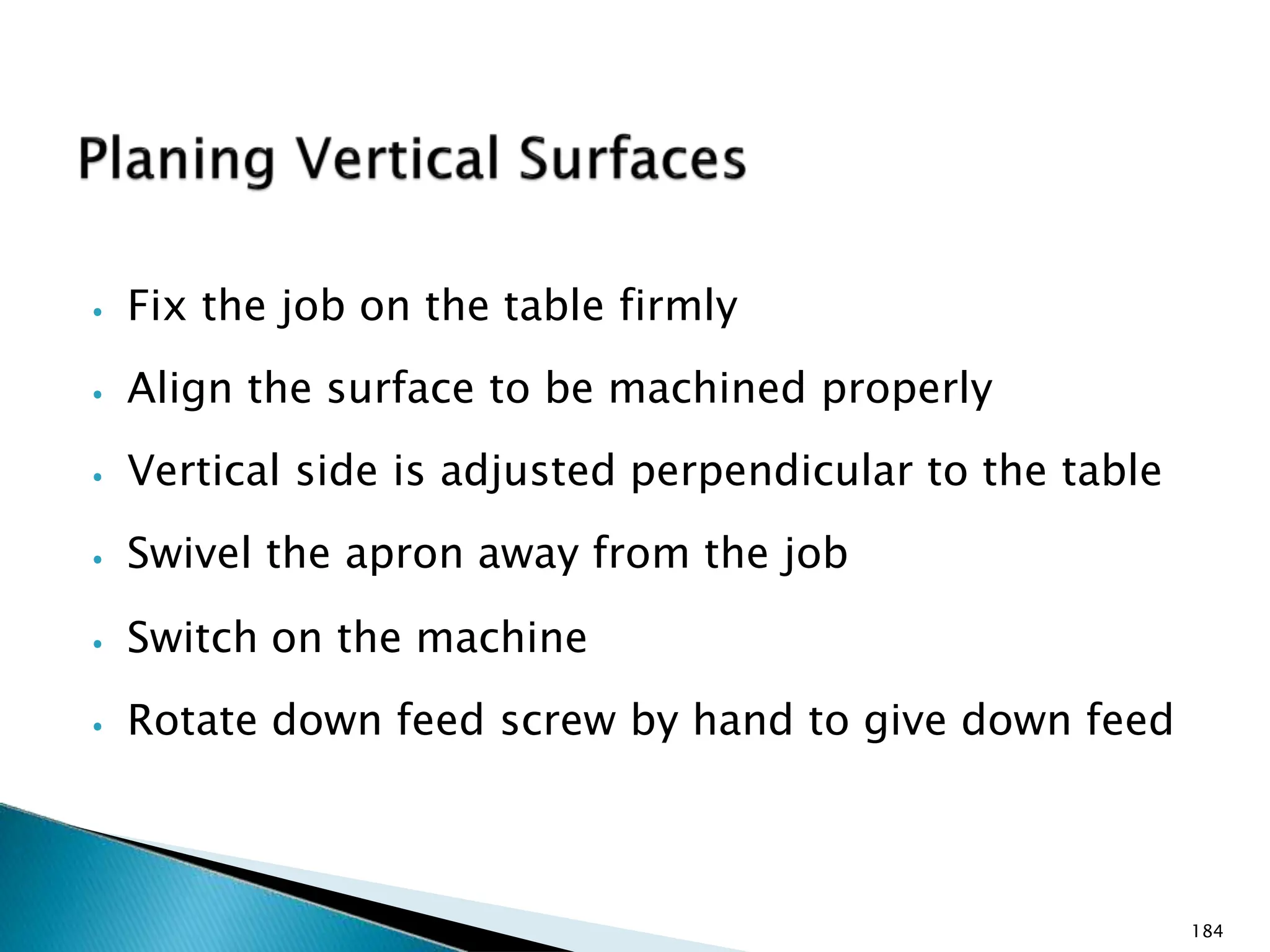
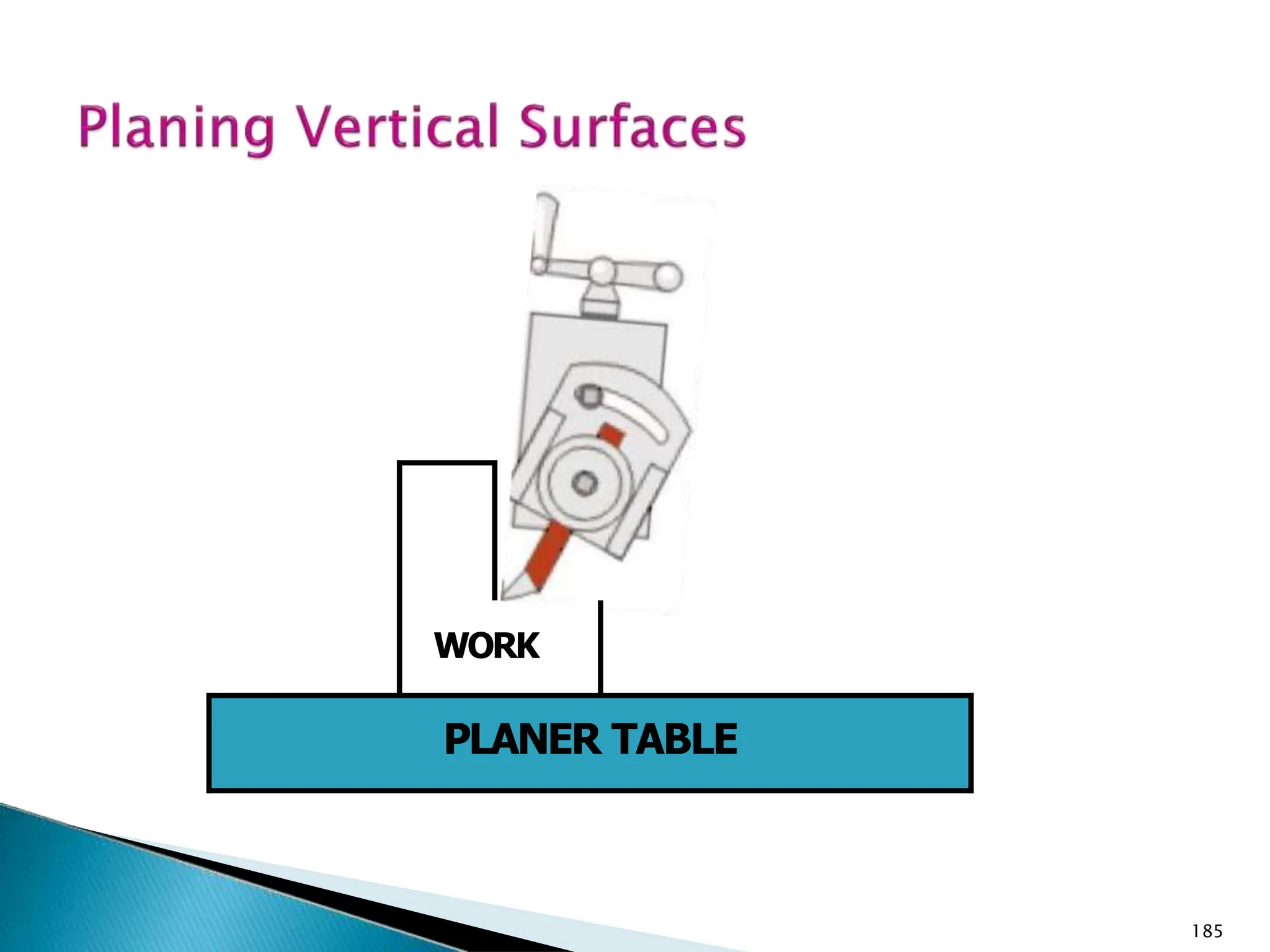
⦁ Fix the job on the table firmly
⦁ Align the surface to be machined properly
⦁ Vertical side is adjusted perpendicular to the table
⦁ Swivel the apron away from the job
⦁ Switch on the machine
⦁ Rotate down feed screw by hand to give down feed
184
WORK
PLANER TABLE
185
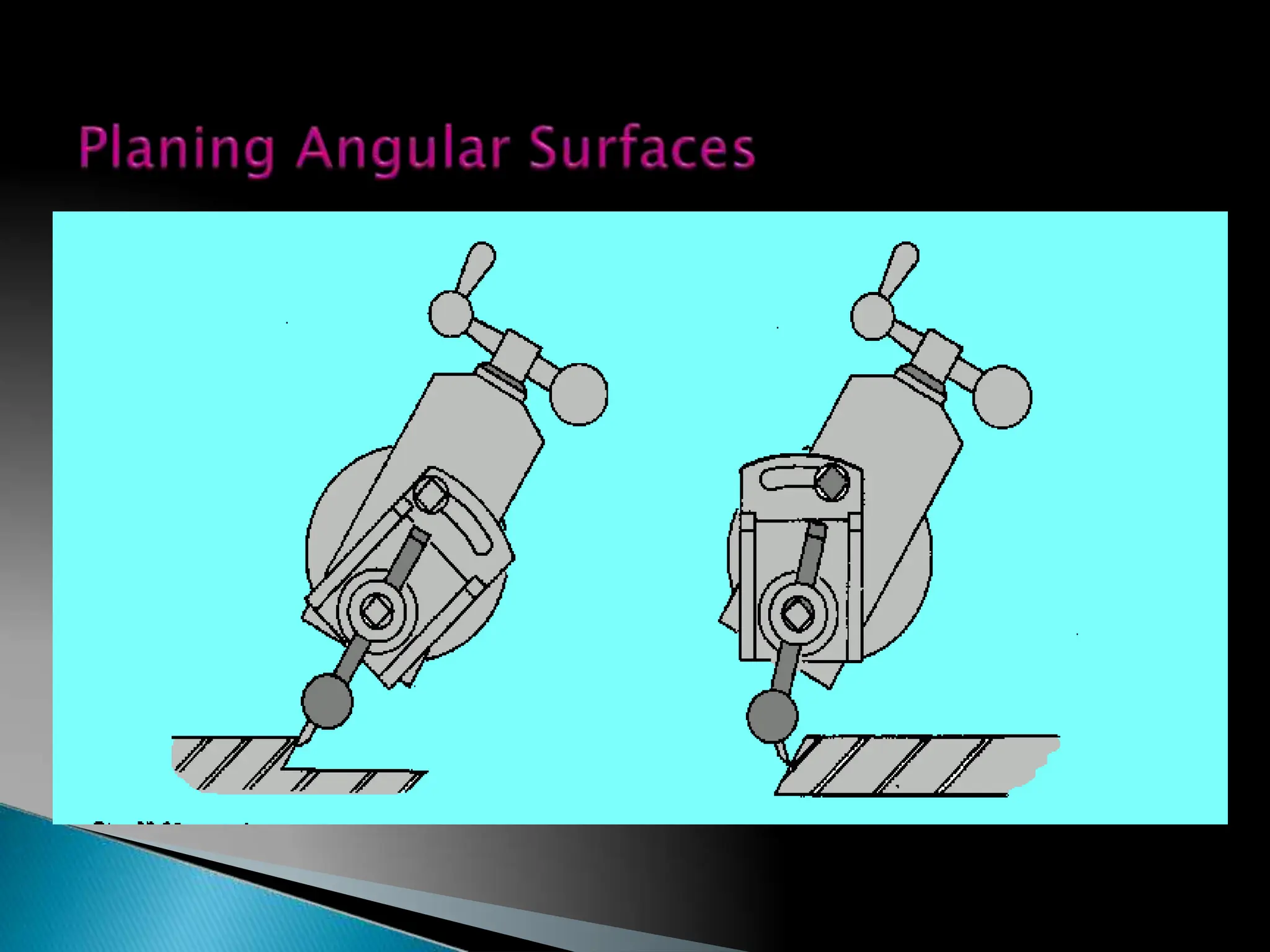
Main angular planing is to make dove tails & V
grooves
Set the work on the table
Swivel the tool head to the required angle
Set apron away from work
Give down feed as per requirement
186
187
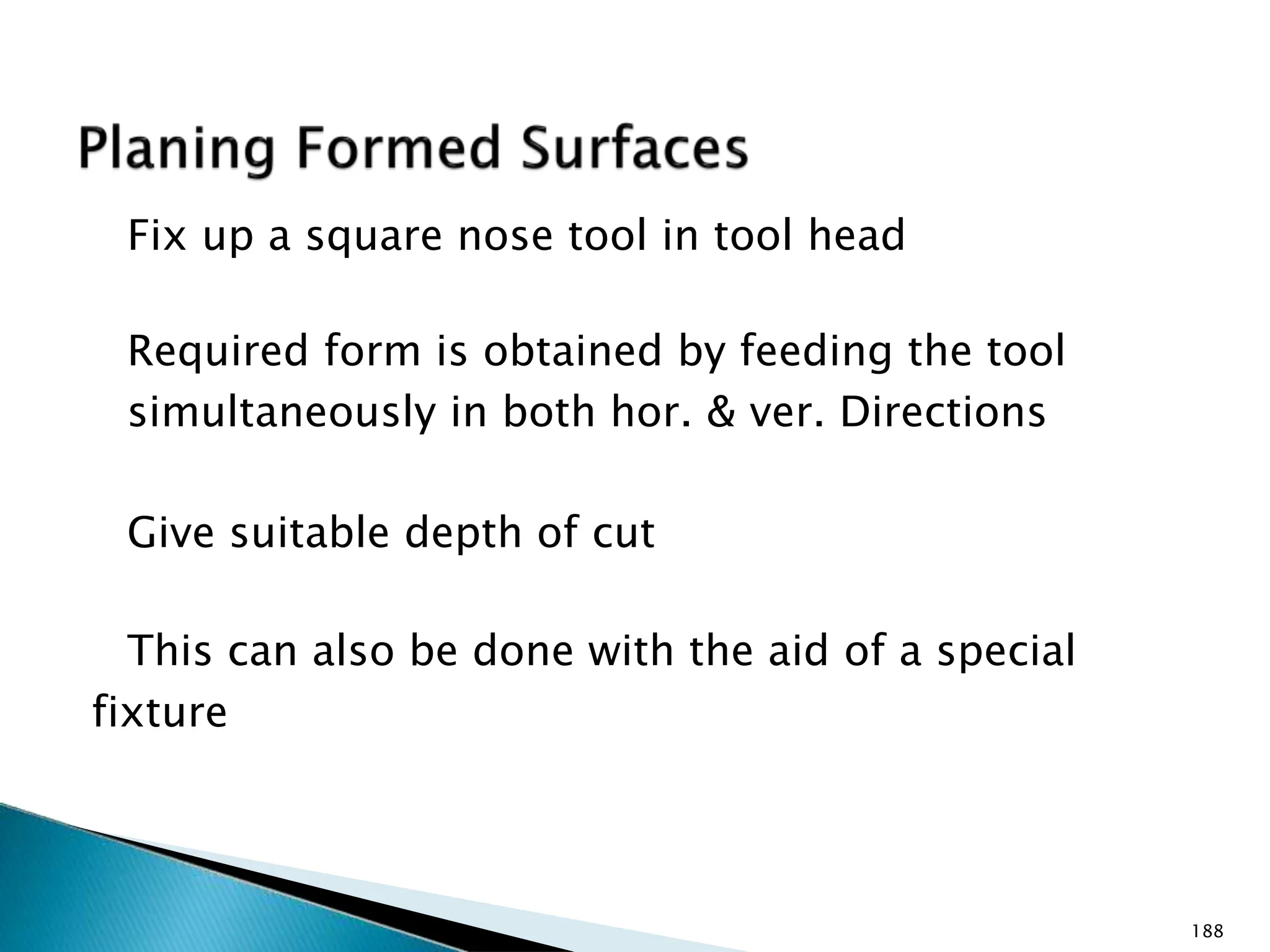
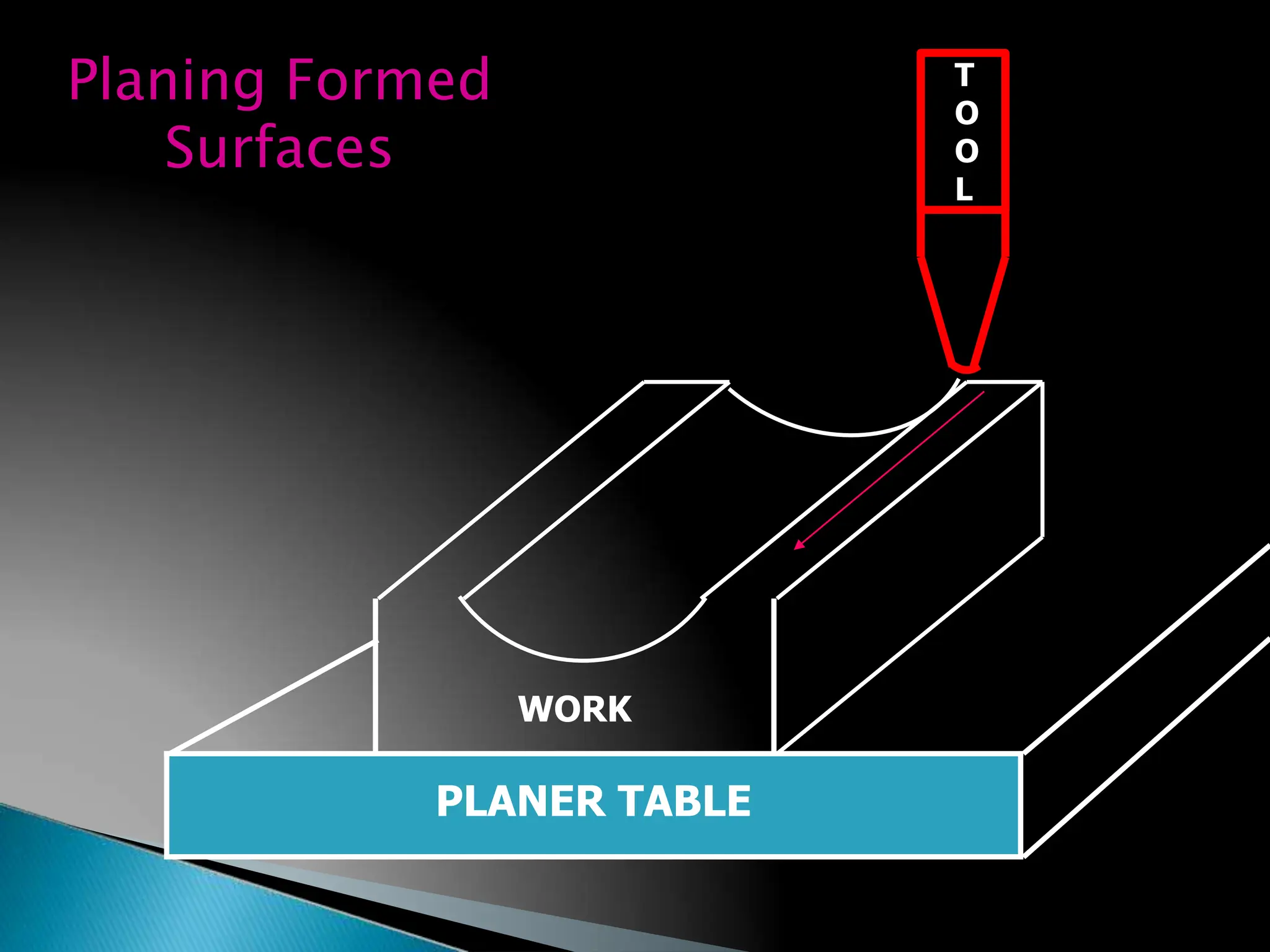
Fix up a square nose tool in tool head
Required form is obtained by feeding the tool
simultaneously in both hor. & ver. Directions
Give suitable depth of cut
This can also be done with the aid of a special
fixture
188
T
O
O
L
WORK
PLANER TABLE
Planing Formed
Surfaces
189
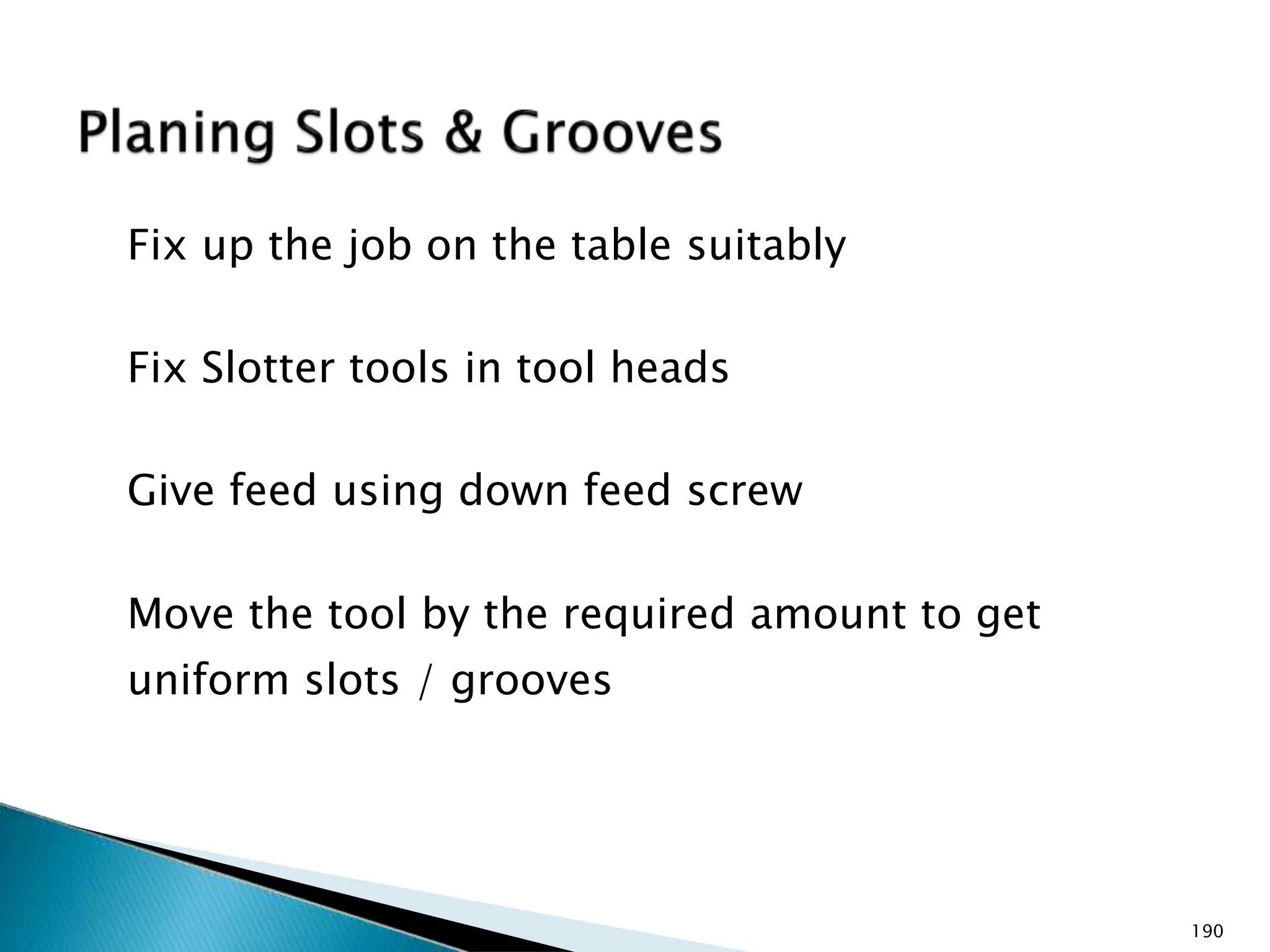
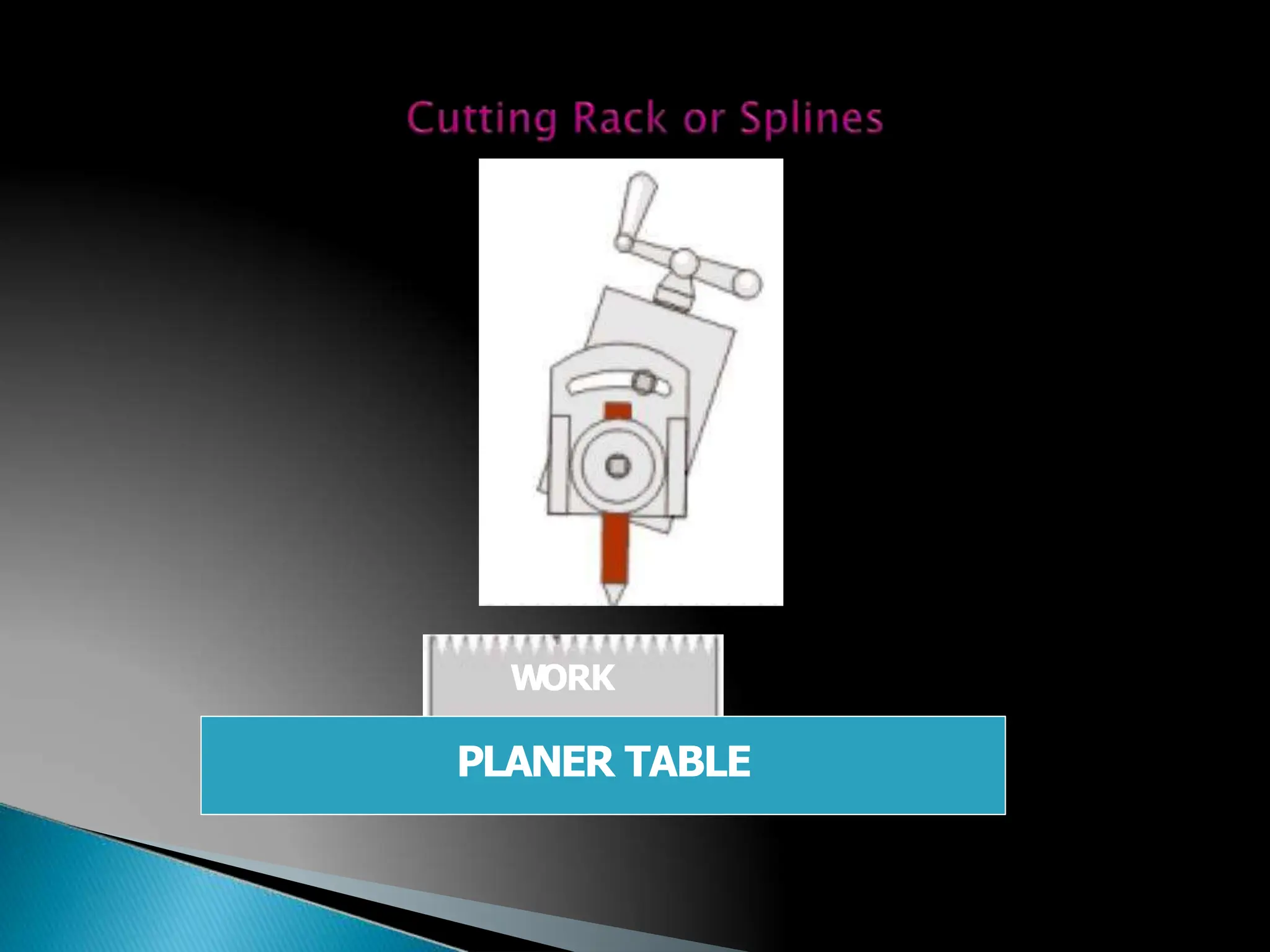
Fix up the job on the table suitably
Fix Slotter tools in tool heads
Give feed using down feed screw
Move the tool by the required amount to get
uniform slots / grooves
190
PLANER TABLE
191
WORK
1.
2.
3.
4.
5.
6.
7.
8.
1.
2.
3.
4.
5.
6.
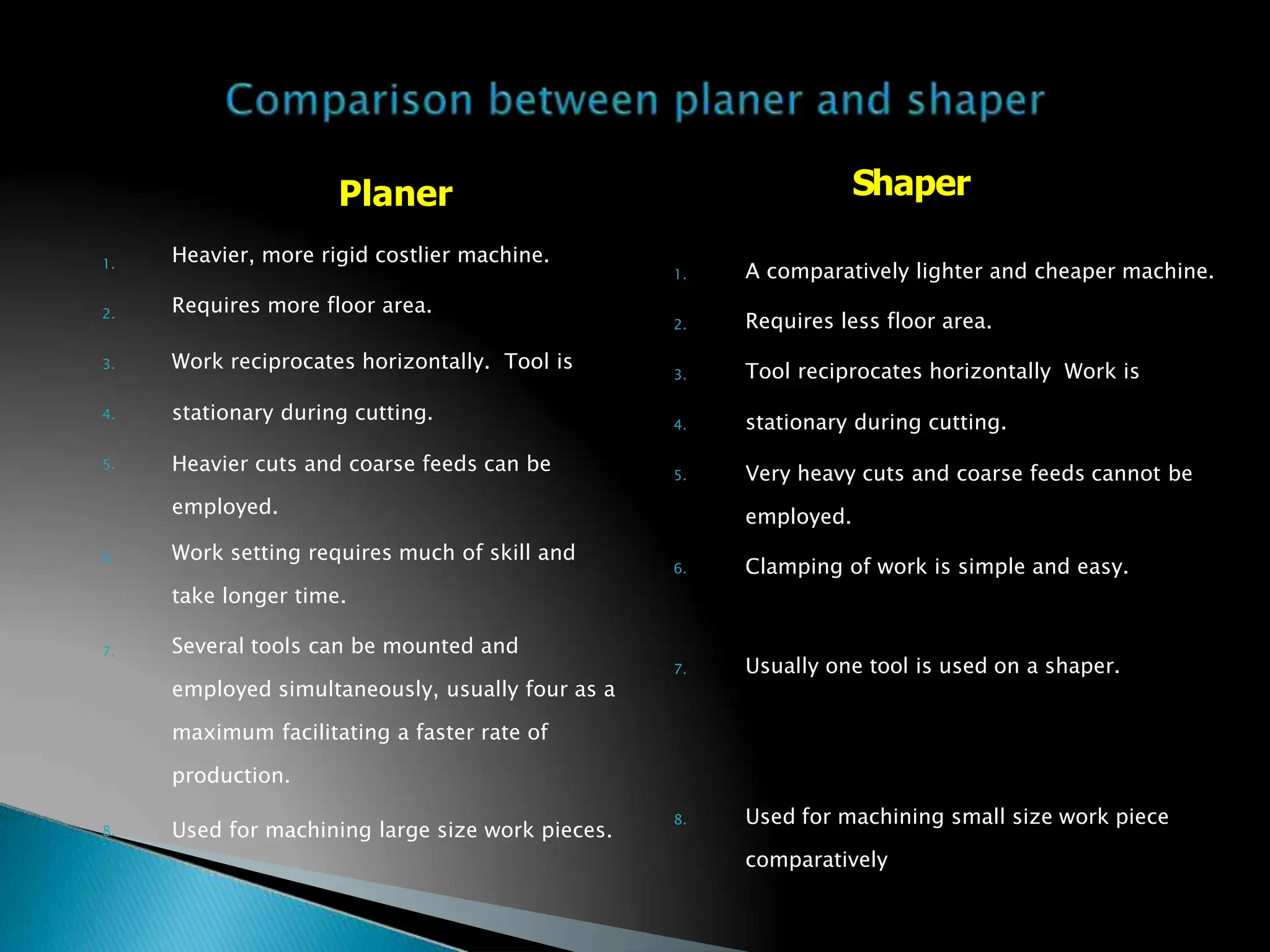
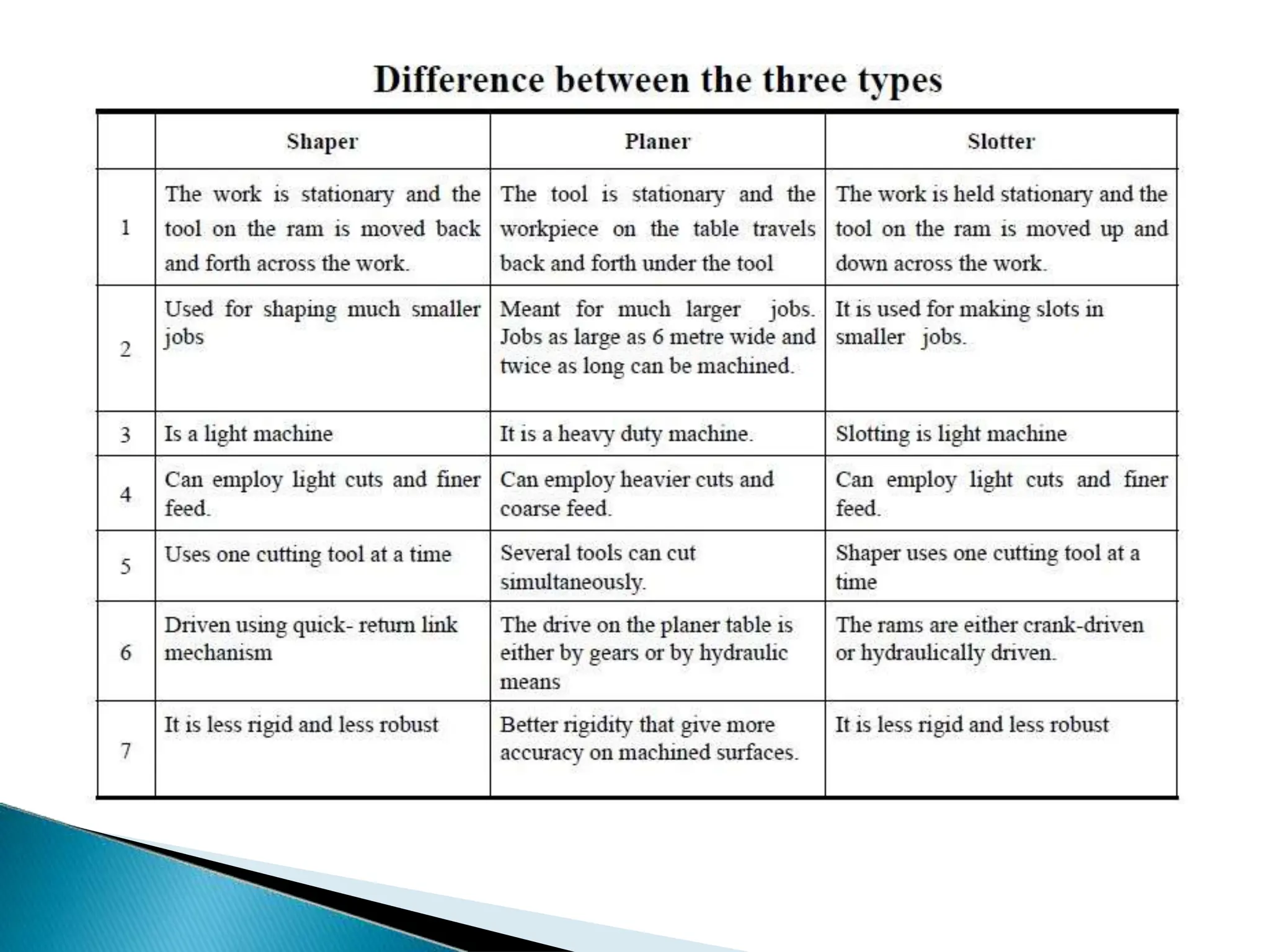
A comparatively lighter and cheaper machine.
Requires less floor area.
Tool reciprocates horizontally Work is
stationary during cutting.
Very heavy cuts and coarse feeds cannot be
employed.
Clamping of work is simple and easy.
7. Usually one tool is used on a shaper.
8. Used for machining small size work piece
comparatively
Shaper
Planer
Heavier, more rigid costlier machine.
Requires more floor area.
Work reciprocates horizontally. Tool is
stationary during cutting.
Heavier cuts and coarse feeds can be
employed.
Work setting requires much of skill and
take longer time.
Several tools can be mounted and
employed simultaneously, usually four as a
maximum facilitating a faster rate of
production.
Used for machining large size work pieces.
Shaper, Slotter, Planer working principle.ppt

Shaper, Slotter, Planer working principle.ppt

  • 2.
    Shaping Machine isalso called Shaper 2
  • 3.
    A Machine which producesflat surfaces A Ram holding the Tool reciprocates Work is fed perpendicular to the tool 3
  • 4.
    B A In the shaper,the cutting tool has a reciprocating motion, and it cuts only during the forward stroke. Cutting Tool repeatedly travels along line A B Work is fed a small distance each time ⦁ Feed of work & line of tool motion are in same plane but perpendicular 4
  • 5.
    The tool lineeventually reaches position C D Combination of two movements results in the flat plane ABCD being machined 5
  • 6.
    Basic types: 6 🞄 HorizontalShaper 🞄 Vertical Shaper 🞄 Traveling head Shaper
  • 7.
    Horizontal shaper: 7 🞄 Ramholding the cutting tool moves In horizontal plane Vertical shaper: 🞄 The cutting tool moves in vertical plane Traveling head shaper: 🞄 Cutting tool reciprocates & moves cross wise simultaneously.
  • 8.
    HORIZONTAL SHAPERS 1. Acc. toCutting Action of Stroke 2. Acc. to the Table Design 3. Acc. to Driving Mechanism 8
  • 9.
    b) Geared type c)M H 305 y .23 draulic9 a) Push Type Shaper 1. Acc. to Cutting Stroke action b) Draw Type Shaper a) Standard Shaper b) Universal Shaper a) Crank type 2. Acc. to the Table Design: 3. Acc. to Driving Mechanism: Shaper
  • 10.
    ⦁ Metal isremoved when the ram moves away from column ⦁ Most common type used in practice ⦁ Unless otherwise specified, the term shaper refers to Push type Shaper 10
  • 11.
    ⦁ Metal isremoved when the tool is drawn towards the column ⦁ Allows heavier cuts to be made ⦁ Less vibration during cutting 11
  • 12.
    Standard shaper Work Tablecan be moved Vertically & Horizontally. it cannot swivelled or tilted. 12 Universal shaper Table can be moved Horizontally Vertically Swivelled & Tilted This is mostly used in Tool Rooms
  • 13.
    Crank type shaper: 13 🞄Driving mechanism is by crank and a slotted lever quick return motion mechanism is used to give reciprocating motion to the ram. 🞄 The crank is adjustable and is arranged inside the body of bull gear. Geared type shaper: 🞄 Driven by Rack & Pinion mechanism Hydraulic shaper: • Driven by oil pressure developed by a pump, which is run by an electric motor. • It is more efficient than the crank and geared type shapers.
  • 14.
  • 15.
  • 16.
    1. BASE 2. COLUMN 3.RAM 4. TABLE 16 5. CROSS RAIL 6. SADDLE 7. TOOL HEAD 8. CLAPPER BOX
  • 17.
    Constructional details ofa shaper BASE TABLE TOOL HEAD RAM RAM CLAMP CLUTCH COLUMN 17 TOOL POST CROSS RAIL BASE
  • 18.
    1. Base ⦁ Bottommost part ⦁ Supports other parts of the machine ⦁ Acts as a reservoir of lubricating oil ⦁ Made of Cast Iron BASE 18
  • 19.
    Vertically mounted on thebase Houses Driving Mechanism of Ram Has guide ways on which Ram slides Made of Cast Iron COLUMN 19
  • 20.
    g The main moving partof a Shaper It carries Tool Head Connected to Drivin Mechanism R A M 20
  • 21.
    A box likecasting with T-slots on its top Shaper vice is fitted in the T-slots Work is fixed in the vice TABLE 21
  • 22.
    Used to movethe Table Up & Down Upward movement is controlled by an Elevating Screw Side movement is controlled by lead screw CROS S RAIL 22
  • 23.
    It is mountedon cross rail It supports the Table Moves across the cross rail left to right Movement obtained by a cross feed screw SADDLE CROSS RAIL 23
  • 24.
    TOOL HEAD TOOL POST 24 Itis attached to the front end of Ram Carries Clapper box & Tool post on it Can be swiveled at any angle on either side CLAPPER BOX
  • 25.
    It is hingedto the tool head It houses clapper block Swings outward in return stroke Tool post mounted on clapper block CLAPPE R BOX 25
  • 26.
    • Max. lengthof Stroke of Ram • Type of Drive • Power input • Floor Space required • Weight of the Machine • Cutting to Return Stroke ratio • Feed • Size of table • Maximum horizontal and vertical travel of the table 26
  • 27.
    Shaper drive Mechanismchanges rotary motion of power source (Electric motor) to reciprocating motion of Ram. Material removal (cutting) of work piece takes place in the forward stroke of ram. The return stroke of the ram does no cutting, hence is called Idle stroke. The Ram with cutting tool has to move slowly in cutting stroke. 27
  • 28.
    •Since return strokedoes no cutting the ram should move faster during return stroke. •The shaper drive system incorporates quick return mechanism. So that the ram moves faster during return stroke •Thus minimizing the (idle time) Quick Return time. 28
  • 29.
    ⦁ Machining HorizontalSurfaces ⦁ Machining Vertical Surfaces ⦁ Machining Angular Surfaces ⦁ Cutting Slots, Grooves & Key ways ⦁ Machining irregular surfaces ⦁ Machining Splines / Cutting Gears 29
  • 30.
    Work is properlyheld in a vice Table is raised to a gap of 25 to 30 mm between tool & work The length & position of stroke are adjusted The length of stroke should be nearly 20 mm longer than the work 30
  • 31.
    The approach &over run should be 10 & 5 mm respectively. Depth of cut is adjusted by rotating down the feed screw of tool head Feed is adjusted about half the width of cutting edge of tool 31
  • 32.
    ⦁ Fix thework properly on the table ⦁ Adjust the length of stroke ⦁ Set the required cutting speed ⦁ Give required feed of the table ⦁ Fix an appropriate tool in the tool head ⦁ Give suitable depth of cut for rough cuts ⦁ Finishing the job by giving less depth of cut 32
  • 33.
  • 34.
    Fix up thejob on the table firmly Align the surface to be machined properly Fix up a side cutting tool in the tool head Set the vertical slide exactly at zero Swivel the apron away from the job Switch on the machine Rotate down feed screw by hand to give down feed Feed in about 0.25 mm 34
  • 35.
  • 36.
    Angular shaping iscarried out to machine inclined surfaces, bevelled, dove tail etc., Set the work on the table Swivel the vertical slide of tool head to the required angle ( to the left or right) Set apron away from work Give down feed as per requirement 36
  • 37.
  • 38.
    ⦁ Fix upa square nose tool in tool head ⦁ Adjust the length & position of stroke ⦁ Reduce the cutting speed ⦁ Give suitable depth of cut ⦁ Feed the work properly to get equal splines 38
  • 39.
  • 40.
    ⦁ Fix upthe job between two centres ⦁ Cut first spline similar to a key way ⦁ Move / Rotate work by the required amount ⦁ Use index plate for this purpose 40
  • 41.
  • 42.
  • 43.
    Fix up aforming tool in tool post Give cross feed in conjunction with down feed Swivel the apron suitably according to the contour required 43
  • 44.
  • 45.
    and can bereadily changed from one job to another. The work can held easily. The single point tools used are in inexpensive; 🞄 Advantages 🞄 Limitations 🞄 The set up is very quick and easy 🞄 By nature is a slow machine ⦁ These tools can be easily grounded to any desired shape. Lower first cost. The cutting stroke has a definite stopping point. ⦁ Because lower cutting forces, thin and fragile jobs can be conventionally machined on shapers. because of its straight line, forward and return stroke. The single point tool requires several strokes to complete a work. The cutting speeds are not usually very high speeds of reciprocating motion due to high inertia forces developed in the motion of the units and components of the machine. Owing to these reasons the shaper does not find ready adaptability for assembly and production line.
  • 46.
    Shaper Driving Mechanisms 46 •Whitworthquick return mechanism •Slotted link quick return mechanism •Hydraulic quick return mechanism
  • 47.
  • 48.
  • 49.
  • 50.
  • 51.
  • 52.
    Crank BC revolvesat a uniform speed. During cutting stroke point C travels from Y to X through Z. Ram returns at high speed as the crank rotates from X to Y through T. Then: Time for cutting stroke = 360 - Ø Time for return stroke Ø Since Ø is smaller than 360 – Ø, the time for cutting is more than the idle time. Stroke length can be changed by varying the radius AE 52 Whitworth Quick Return Mechanism
  • 53.
  • 54.
  • 55.
    BULLGEAR BULLGEAR SLIDING BLOCK CRANK PIN BULLGEA RSLIDE LEAD SCREW BEVEL GEARS ROCKER ARM SLIDING BLOCK 55
  • 56.
    Driving Pinion lever Ram Bev Bullgear Slide Ram Block Slotted Lever Bull gear Sliding block Crank pin Lever Sliding block Lead Screw Bull Gear Pivot Bevel Gears
  • 57.
    Crank pin(11) isfitted in the slotted link(9) Bottom end of slotted link (rocker arm) is attached to frame of column(15) Its upper end is connected to ram(2). 57
  • 58.
    Electric motor drivespinion (1) Pinion (1) drives the bull gear(14) A Radial slide (16) is bolted at the centre of bull gear. Radial slide carries a sliding block(12) & a crank pin (11) As the bull gear 14 rotates, crank pin 11 rotates. So sliding block 12 also rotates on the crank pin circle. Simultaneously crankpin will move up & down in the slot of the slotted link 9. 58
  • 59.
    As the crankpin11 moves, slotted link 9 gets rocking movement. This rocking movement is communicated to the ram. Thus the rotary motion of the bull gear is converted to reciprocating motion of the ram. 59
  • 60.
  • 61.
    When the linkis in the position PM, ram will be at the extreme backward position. When it is at PN, ram is at extreme forward position. P M N K O L C2 C1 61
  • 62.
    PM&PN are tangentsdrawn to the crank pin circle. Forward cutting stroke takes place through the angle C1K C2 Return stroke takes place through the angle C2 L C1 of the crank. It is evident that angle C2K C1 is greater than C2 L C1 P M N K O L C 2 C 1 62
  • 63.
    M N K O C2 C1 L P •Angular velocityof crank pin is constant. •So Return stroke is completed in a shorter time. •Therefore it is known as quick return motion. 63
  • 64.
    C2LC1 ⦁ Cutting time: Return time ratio ⦁ usually varies bet 2 : 1. ⦁ Practical limit is 3 : 2 M N K O L Cutting time : Return stroke = Angle C1KC2 : Angle C2 C1 64
  • 66.
    Quick return inthe hydraulic shaper is accomplished by increasing the flow of hydraulic oil during the return stroke. In the hydraulic shaper the ram is connected to the hydraulic cylinder which is controlled by means of a 4 way valve. The hydraulic fluid is pumped to the hydraulic cylinder through 4 way valve; this valve is connected to the sump. The 4 way valve controls the direction of high pressure fluid into the cylinder and controls the direction of motion, either the cutting stroke or return stroke.
  • 67.
    The flow controlvalve controls the flow rate of the hydraulic fluid thereby controlling the speed at which ram moves. Since the power available remains constant throughout, it is possible to utilize the full capacity of the cutting tool during the cutting stroke The starting and stopping of the machine is achieved by through a finger operator lever. An adjustable trip dog operated lever controls the operation of 4 way valve to control the ram reversible. The return or idle stroke is faster than the cutting stroke because of the smaller area in the return side of the cylinder if constant volume pump is used.
  • 68.
    The cutting strokehas a more constant velocity and less vibration is induced in the hydraulic shaper. The cutting speed is generally shown on an indicator and does not require calculation. Both the cutting stroke length and its position relative to the work may be changed quickly without stopping the machine. The hydraulic feed operates while the tool is clear of work. More strokes per minute can be achieved by consuming less time for reversal and return strokes.
  • 69.
    The stopping pointof the cutting stroke in a hydraulic shaper can vary depending upon the resistance offered to cutting by the work material. It is more expensive compared to the mechanical shaper.
  • 70.
    Work should beproperly & firmly fixed on the Shaper table 70 Work is fixed on the table by 3 methods. • Using a Swivel Vice • Using T bolts & Clamps • Using Angle plate & C Clamps
  • 72.
  • 73.
  • 84.
    Cutting speed isdefined as the average linear speed in stroke in m/mm, which depends on the number of ram stokes(or ram cycles) per minute and the length of stroke. ⦁ The number of double strokes or cycles of the ram/min ⦁ N= the number of double strokes or cycles of the ram ⦁ L=length of the ram stroke, mm ⦁ K= return stroke time ⦁ Where k=2/3, 3/4 Vc = NL(1+k)/1000 m/mm
  • 85.
    The feed isthe relative motion of the work piece in a direction perpendicular to the axis of reciprocating of the ram. Feed is given to the work piece. Depth of cut d is the thickness of the material removed in one cut,in mm.
  • 86.
    The machining time thetime required to complete one double stroke, from cutting speed Vc is given by With a feed of f mm/double stroke, number of strokes required to machine a surface of width B will be Ns=B/f t = L(1+K)/1000Vc
  • 87.
    Hence total machiningthe surface of width B will be t = LB(1+K)/1000Vcf In terms of ram strokes N, the time for machining the surface is given by Ns=B/fN min Machine time tm = B/f ((L/Vc*1000)+(L /Vr *1000) Where B= width of the job mm f = feed mm/ stroke l = length of stroke, mm Vc = Cutting speed Vr = return stroke speed mm/min
  • 88.
  • 89.
    Slotting machine isalso called as Slotter 89
  • 90.
  • 91.
  • 92.
    • A Machinewhich produces flat surfaces • A Ram holding the Tool reciprocates • Ram reciprocates in vertical direction • Work is fed perpendicular to the tool 92
  • 93.
    Cutting Tool repeatedlytravels along line A B Work is fed a small distance each time Feed of work & line of tool motion are in same plane but perpendicular 93
  • 94.
    The tool lineeventually reaches position C D Combination of two movements results in the flat plane ABCD being machined 94
  • 95.
    ⦁ Work issupported on a rotary table. ⦁ Table can have longitudinal and rotary movements ⦁ Straight and rotary cuts can be produced. 95
  • 96.
    According to designand purpose the slotters are classified into two types 96 1. Puncher Slotter 2. Precision tool room Slotter Puncher slotter: 🞄 Intended for removing large amount of metal from heavy works. heavy and rigid machine Ram driven by rack and spiral pinion mechanism used for machining large castings and forgings 🞄 🞄 🞄
  • 98.
    Precision tool roomslotter: 98 • Used for tool room work, where accuracy important • Lighter in construction • Fitted with quick return mechanism • Operates at high speeds and designed for light cuts • Gives accurate finish • Suitable for small to medium size work pieces
  • 99.
    Difference between verticalshaper and Slotter 99 •in vertical shaper the tool holding ram can tilt by about 100 with respect to vertical axis •In slotter ram cannot tilt at all. •In all other aspects vertical shaper and slotter are similar
  • 100.
    Having known theWorking Principle we will now look at : 10 0 M305.30 ⦁ The Constructional Details of a slotting Machine ⦁ Function of each part ⦁ Specifications of a slotter
  • 101.
  • 102.
  • 103.
  • 104.
    1. Base 2. Column 3.Ram 4. Table 10 4 5. Cross slide 6. Saddle 7. Tool head
  • 105.
    1. Base 10 5 Bottom mostpart Supports other parts of the machine Acts as a reservoir of lubricating oil Made of Cast Iron Contd..
  • 106.
    ⦁ Rigidly builtto take up cutting forces ⦁ Top of bed is accurately finished ⦁ Guide ways are provided for saddle ⦁ Guide ways are perpendicular to column face 10 6
  • 107.
    Vertically mounted on thebase Houses Driving Mechanism of Ram Has guide ways on which Ram slides Made of Cast Iron Also houses feeding mechanism COLUMN 10 7
  • 108.
    Reciprocating vertically up anddown of a slotter Mounted on guide ways of column It carries Tool Head / cutting tool Connected to Driving Mechanism An arrangement is provided on the body of ram to change length of stroke R A M 10 8 M305.30
  • 109.
    ⦁ It holdsthe work piece. 🞄 A circular casting with T-slots on its top Movement of table can be linear or rotary Table is graduated in degrees so indexing can be done Slotter vice may be fitted in the T-slots Work may be fixed in the vice Operated manually or by power TABLE 10 9
  • 110.
    It is mountedon guide ways of bed It can be moved towards or away from bed Using saddle longitudinal feed is given Top is accurately finished to provide guide ways for cross slide These guide ways are perpendicular to the guide on the base Operated either manually or by power 11 9
  • 111.
    ⦁ Circular work-tableis mounted on the top. ⦁ Mounted on guide ways of saddle ⦁ Moves parallel to the face of the column ⦁ Using cross slide cross feed is given ⦁ Operated either manually or by power 11 1
  • 112.
    It is attachedto the bottom end of Ram Carries Tool post on it Tool is fixed in position No swiveling along verticle axis or horizontal axis 11 2
  • 113.
    ⦁ Max. lengthof Ram Stroke ⦁ Diameter of work table in mm. ⦁ Type of Drive ⦁ Maximum table travel. ⦁ Power input ⦁ Floor Space required 11 3
  • 115.
    115 A Slotting machineproduces flat surfaces The Ram holding the Tool reciprocates vertically up and down Cuts the material only in down stroke There should be some mechanism to move the ram in reciprocating motion It is called as slotter driving mechanism The mechanism commonly used is slotted disc mechanism
  • 116.
  • 117.
    117 ⦁ A Mechanismmakes the ram to move slowly during cutting stroke. ⦁ During return stroke ram moves at a faster rate. ⦁ To reduce the idle time,It Should return quickly . ⦁ The mechanism adopted is known as QRM
  • 118.
    1. Whitworth Q.R.M.Mechanism 2. Variable speed reversible motor drive mechanism 3. Hydraulic drive Mechanism The mechanisms for QRM in slotter are similar to QRM in shaper 118
  • 119.
    In Slotter feedis given by table Feed movement is intermittent Feed is given at the beginning of the cutting stroke Feed may be given either manually or by power Table will have three types of feed movements a. longitudinal b. cross and c. circular feeds. Contd… 11 9
  • 120.
    Longitudinal feed: •Table isfed perpendicular to the column •Table moves towards or away from the column Cross feed: •Table is fed parallel to the face of the column Circular feed: • table is rotated with respect to verticle axis 12 9
  • 121.
  • 122.
    Uses a ratchetand pawl mechanism Feed shaft engaged with cross, longitudinal / rotary feed screws has the ratchet mounted on it. Ratchet is moved by small amount in one direction only with the help of a connecting rod, lever. The roller moves in the cam groove cut on the face of the bull gear of slotting machine. 122
  • 123.
    1. Machining flatsurfaces 2. Machining Circular Surfaces 3. Machining internal surfaces 4. Machining grooves or key ways 123
  • 124.
    Work is properlyheld in a vice Table is raised to a gap of 25 to 30 mm between tool & work The length & position of stroke are adjusted The length of stroke should be nearly 20 mm longer than the work Contd… 124
  • 125.
    The approach &over run should be 10 & 5 mm respectively. Depth of cut is adjusted by rotating down the feed screw of tool head Feed is adjusted about half the width of cutting edge of tool 125
  • 126.
    ⦁ Fix thework properly on the table ⦁ Adjust the length of stroke ⦁ Set the required cutting speed ⦁ Give required feed of the table ⦁ Tool is held in the tool head of ram ⦁ Ram reciprocates up and down 126
  • 127.
    ⦁ Feed hasto be given at the beginning of cutting stroke ⦁ Both internal and external surfaces can be machined ⦁ Give suitable depth of cut for rough cuts ⦁ Finishing the job by giving less depth of cut 127
  • 128.
  • 129.
    ⦁ Tool isset radially on the work ⦁ Work piece is placed centrally on the rotary table ⦁ Feed is given by the rotary table feed screw ⦁ Feed screw rotates the table through an arc ⦁ Adjust the length of stroke ⦁ Set the required cutting speed ⦁ Finishing the job by giving less depth of cut 129
  • 130.
    ⦁ Fix upa tool in tool post ⦁ Cross, longitudinal and rotary feed are combined ⦁ Any contoured surface can be machined ⦁ Mostly done manually ⦁ Good skill is required from operator 130
  • 131.
    Slotter is speciallyintended for cutting internal grooves External or internal gear teeth can be machined Fix up the job between two centers Cut first a key way Move / Rotate work by the required amount Indexing can be done by using graduations on rotary table 131
  • 132.
    ⦁ Fix upthe job between two centres ⦁ Cut first spline similar to a key way ⦁ Move / Rotate work by the required amount ⦁ Use index plate for this purpose 132
  • 133.
  • 134.
    Work should beproperly & firmly fixed on the Slotter table 134 Work is fixed on the table by 3 methods. 1. Using a Swivel Vice 2. Using T bolts & Clamps 3. Using Angle plate & C Clamps
  • 135.
    Clamping the workon a Slotter is depicted in the following Slides, one by one 135
  • 136.
  • 137.
  • 138.
  • 139.
  • 140.
  • 141.
  • 142.
  • 143.
    A Machine whichproduces flat surfaces Consists a stationary housing for holding the tools A table holding the work reciprocates Large works, that con not be accommodate on shapers The tool is stationary but the work moves 143
  • 144.
    The table onwhich work is clamped is imparted a reciprocating movement Cutting takes place during the forward stroke of table During return stroke the cutting tool is slightly lifted Tool is fed for each forward stroke WORK T O O L Work is fixed on Table 144
  • 145.
    ⦁ Table isdriven by an electric motor ⦁ Length of table stroke can be adjusted ⦁ Speed of return stroke is also regulated 145
  • 146.
  • 147.
    1. Double housingPlaner 2. Open side Planer 3. Pit type Planer 4. Edge Planer or Plate Planer 5. Divided Table Planer 147
  • 148.
    ⦁ It isthe Standard model & most widely used ⦁ Very heavy and robust ⦁ Has a bed and two vertical housings are fixed ⦁ Table moves along the guide ways of the bed ⦁ Housing supports cross rail & tool heads. ⦁ Cross rail carries two tool heads ⦁ Tool head carries tools 148
  • 149.
  • 150.
    ⦁ It hasonly one supporting column (housing) ⦁ Area larger than the table can be planed ⦁ Cross rail is mounted as a Cantilever ⦁ Tool holders are mounted on Cross rail ⦁ Stroke length of bed is controlled by adjustable dogs 150
  • 152.
    Columns and crossrail carrying tool head move longitudinally on massive rail above the work table Bed is recessed in the floor Loading and unloading of jobs is easy Used for Planing heavy & large jobs Table and work piece resting on it are stationary and the tool reciprocates 152
  • 153.
    Specially designed forsquaring or beveling the edges of heavy steel plates for pressure vessels Carriage supporting the tool is movedback and front direction Cutting can take place during both directions of carriage travel Operator stands on the platform & operates 153
  • 154.
    Also known asTandem planer Planer has two tables on the bed Table may be reciprocated together or separately Each table reciprocates under different tool head For continuous production, small work pieces clamped on one table are being machined, another is stationary and can be used for setting up fresh works Used for quick & continuous production 154
  • 155.
  • 156.
    1. Bed 2. Table 3.Housing or Column 4. Cross rail 5. Tool heads 6. Driving Mechanism 7. Feed Mechanism 156
  • 157.
  • 158.
  • 159.
  • 160.
    ⦁ Large boxlike casting ⦁ Length is nearly twice the table length ⦁ Consists guide ways on which table moves ⦁ Houses the driving mechanism of table ⦁ Made of Cast Iron 160
  • 161.
    ⦁ Also calledPlaten ⦁ Large rectangular casting mounted on bed ways ⦁ Holds the work & reciprocates along bed ways ⦁ Top surface has T slots ⦁ Work is clamped on T slots 161
  • 162.
    Large vertical structures oneach side of the bed Supports cross rail on which tool heads are mounted Also supports the mechanism for operating the tool heads Made of Cast Iron 162
  • 163.
    ⦁ A rigidcasting mounted horizontally on the column ⦁ Can be moved up & down by elevating screw ⦁ Carries two slides with tool heads ⦁ Tool heads can be moved horizontally on the guide ways of cross rail 163
  • 164.
    Contains tool postsfor holding the tools Tool post (clapper block) is hinged to the head During return stroke cutting tool will be lifted Tool heads can be swiveled through 60º on either side of its vertical position 164
  • 165.
    1. Distance betweenthe two housings 2. Height between Table & cross rail at its uppermost position 3. Maximum length of table travel 4. Number of Speeds & feeds available 165
  • 166.
    5. Power input 6.Floor space required 7. Type of Drive 8. Net weight of the Machine 166
  • 167.
    A Planing Machineproduces flat surfaces The Table holding the Work reciprocates There should be some mechanism to move the Table in reciprocating motion, and Table to move quick during idle stroke 167
  • 168.
    1. Open &Cross belt drive 2. Reversible motor drive 3. Hydraulic drive 168
  • 169.
    Loose Pulley Fast Pulle y Pulleyson Shaft Open belt Counter Shaft Cross belt Belt shifter 9,12 Loose Pulleys 10,11Fast Pulleys Rack 19 - Table 18. Trip dog 17. Belt shifter lever 13- Bull gear shaft 14- Bull gear Change gears Feed disc 169
  • 170.
    Used for smallercapacity machines Table is moved by gears & rack attached under the table Counter shaft at the top of housing has 2 pulleys These Pulleys transfer power to main shaft(Driving) Main shaft drives the table by rack & pinion 170
  • 171.
    2 Sets offast & loose pulleys are mounted on driving shaft at one end and pinion is on another end RETURN STROKE: Smaller fast pulley is used for backward motion of table (Quick motion) It is connected by open belt drive The open belt passes over small fast pulley to get Quick return The Cross belt is on loose pulley so it will not drive 171
  • 172.
    FORWARD STROKE: Bigger fastpulley is driven by cross belt drive It is used to drive the table during cutting stroke Open belt is on loose pulley At the end of cutting stroke, cross belt is shifted from fast pulley to loose pulley Simultaneously open belt is shifted from loose pulley to fast pulley This is achieved by trip dog which operates belt shifting lever Thus the direction of movement is automatically reversed 172
  • 173.
  • 174.
    Electric motor drivesthe bull gear through gear trains Motor is coupled to D.C. generator When motor is started, generator supplies power to reversible motor 174
  • 175.
    Reversible motor causesthe planer table to move At the end of stroke, trip dog operates the switch which reverses the direction of table Speed of cutting stroke is reduced by regulating the field current of the generator 175
  • 176.
    A.C.drivin g motor ter 176 Generator Reversibl e motorMotor field resistance Motor field Generator field Reversing switch
  • 177.
  • 178.
    ⦁ During cuttingstroke, oil is pumped into LHS of cylinder As the area is less due to presence of piston rod, less force acts So the table moves slowly in cutting stroke At the end of each stroke trip dog operates a lever Lever actuates the control valve of circuit TABLE 178
  • 179.
    ⦁ Oil ispumped into the Operating cylinder Cylinder contains piston & piston rod The other end of piston rod is connected to the Table During return stroke, oil is pumped into RHS of cylinder More force acts on the piston & it moves quickly TABLE 179
  • 180.
    Flow of oilis changed from one side to the other side of cylinder The length of stroke can be varied by adjusting the distance between trip dogs 180
  • 181.
    1.Planing Horizontal Surfaces 2.Planing Vertical Surfaces 3. Planing Angular Surfaces / Dovetails 4. Planing Curved surfaces 5. Planing Slots, key ways & Grooves 181
  • 182.
    🞄 Fix thework properly on the table 🞄 Set the required cutting speed 🞄 Give required feed of the tool 🞄 Give suitable depth of cut for rough cuts 🞄 Finishing the job by giving less depth of cut 182
  • 183.
    WORK PLANER TABLE Planing HorizontalSurfaces TOOL 183 CLAPPER BLOCK
  • 184.
    ⦁ Fix thejob on the table firmly ⦁ Align the surface to be machined properly ⦁ Vertical side is adjusted perpendicular to the table ⦁ Swivel the apron away from the job ⦁ Switch on the machine ⦁ Rotate down feed screw by hand to give down feed 184
  • 185.
  • 186.
    Main angular planingis to make dove tails & V grooves Set the work on the table Swivel the tool head to the required angle Set apron away from work Give down feed as per requirement 186
  • 187.
  • 188.
    Fix up asquare nose tool in tool head Required form is obtained by feeding the tool simultaneously in both hor. & ver. Directions Give suitable depth of cut This can also be done with the aid of a special fixture 188
  • 189.
  • 190.
    Fix up thejob on the table suitably Fix Slotter tools in tool heads Give feed using down feed screw Move the tool by the required amount to get uniform slots / grooves 190
  • 191.
  • 192.
    1. 2. 3. 4. 5. 6. 7. 8. 1. 2. 3. 4. 5. 6. A comparatively lighterand cheaper machine. Requires less floor area. Tool reciprocates horizontally Work is stationary during cutting. Very heavy cuts and coarse feeds cannot be employed. Clamping of work is simple and easy. 7. Usually one tool is used on a shaper. 8. Used for machining small size work piece comparatively Shaper Planer Heavier, more rigid costlier machine. Requires more floor area. Work reciprocates horizontally. Tool is stationary during cutting. Heavier cuts and coarse feeds can be employed. Work setting requires much of skill and take longer time. Several tools can be mounted and employed simultaneously, usually four as a maximum facilitating a faster rate of production. Used for machining large size work pieces.