MansouraUniversity - Faculty of Engineering
Production EngineeringAnd MechanicalDesign
Department
Lecture 3
Research
Methods(2)
By
Assoc.Prof.Dr. RaniaMostafa
Chapter 2
Research Methods and Methodologies
Mansoura University- Faculty of Engineering
Production EngineeringAnd MechanicalDesign Department
Introduction
Research skills,
Difference between Research
Methods and Methodologies
Choice of methods and
methodology
Types of Research
Lecture Outline
Research Methods and Methodologies
Introduction
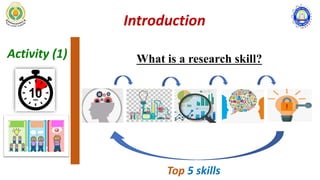
Activity (1) What is a research skill?
Top 5 skills
Activity
(1)
What is research skill?
Research skill is the ability to find an answer to a question
or a solution to a problem. It includes the ability to gather
information about a topic, review that information and
analyze and interpret the details in a way to support a
solution
Check your Understanding
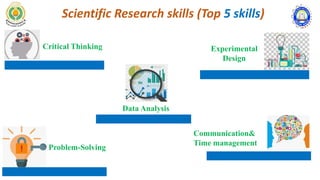
Scientific Research skills (Top 5 skills)
Critical Thinking
Data Analysis
Communication&
Time management
Experimental
Design
Problem-Solving
Scientific Research skills
1. Critical Thinking:
o The ability to objectively analyze and evaluate information, data, and theories. Critical thinking involves questioning
assumptions, identifying biases, and considering alternative explanations or perspectives.
2. Data Analysis:
o Proficiency in collecting, processing, and interpreting data. This includes statistical analysis, understanding data patterns,
and using tools or software to manage and analyze large datasets.
3. Experimental Design:
o The skill of designing experiments or studies that effectively test hypotheses. This involves selecting appropriate
methodologies, controls, variables, and ensuring that the study is robust, reproducible, and minimizes sources of error.
4. Communication:
o The ability to clearly and effectively communicate research findings, both in writing and verbally. This includes writing
research papers, reports, and presenting findings at conferences or to a broader audience.
5. Problem-Solving:
o The capacity to identify research challenges, develop innovative solutions, and adapt methods as needed. Problem-solving is
crucial for overcoming obstacles that arise during research, whether they are technical, theoretical, or practical.
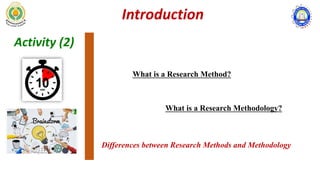
Introduction
Activity (2)
What is a Research Method?
What is a Research Methodology?
Differences between Research Methods and Methodology
Activity
(2)
What is a Research Method?
 A method is simply the tool used to answer your research questions.
 It is the specific approach to collecting data.
 Examples of research methods include:
 Interview,
 websites search and Survey
 Focus groups
 Experiments
 Case studies
 Observational studies
 Online data collection
 Every method varies in style, so it is important to choose a suitable of these before
applying them. For example, an interview could be structured or semi-structured. A
survey could be multiple choice or long answer questions.
Activity
(2)
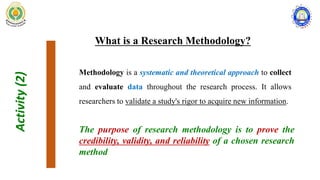
What is a Research Methodology?
Methodology is a systematic and theoretical approach to collect
and evaluate data throughout the research process. It allows
researchers to validate a study's rigor to acquire new information.
The purpose of research methodology is to prove the
credibility, validity, and reliability of a chosen research
method
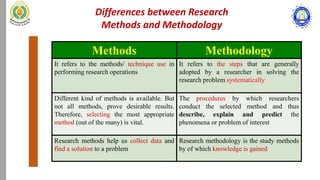
Differences between Research
Methods and Methodology
Methods Methodology
It refers to the methods/ technique use in
performing research operations
It refers to the steps that are generally
adopted by a researcher in solving the
research problem systematically
Different kind of methods is available. But
not all methods, prove desirable results.
Therefore, selecting the most appropriate
method (out of the many) is vital.
The procedures by which researchers
conduct the selected method and thus
describe, explain and predict the
phenomena or problem of interest
Research methods help us collect data and
find a solution to a problem
Research methodology is the study methods
by of which knowledge is gained
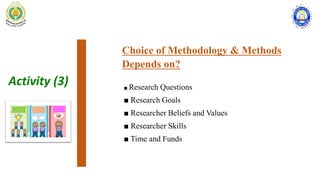
Choice of Methodology & Methods
Depends on?
Activity (3) ■ Research Questions
■ Research Goals
■ Researcher Beliefs and Values
■ Researcher Skills
■ Time and Funds
“Discover what your believe to be true”
‫ﺑﮫ‬ ‫ﺗؤﻣن‬ ‫ﻣﺎ‬ ‫اﻛﺗﺷف‬
Types of Research
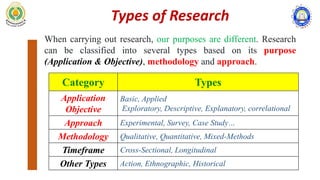
Types of Research
When carrying out research, our purposes are different. Research
can be classified into several types based on its purpose
(Application & Objective), methodology and approach.
Category Types
Application
Objective
Basic, Applied
Exploratory, Descriptive, Explanatory, correlational
Approach Experimental, Survey, Case Study…
Methodology Qualitative, Quantitative, Mixed-Methods
Timeframe Cross-Sectional, Longitudinal
Other Types Action, Ethnographic, Historical
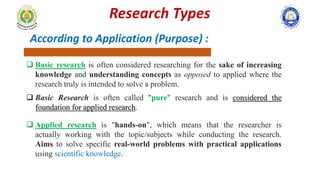
According to Application (Purpose) :
 Basic research is often considered researching for the sake of increasing
knowledge and understanding concepts as opposed to applied where the
research truly is intended to solve a problem.
 Basic Research is often called "pure" research and is considered the
foundation for applied research.
 Applied research is "hands-on", which means that the researcher is
actually working with the topic/subjects while conducting the research.
Aims to solve specific real-world problems with practical applications
using scientific knowledge.
Research Types
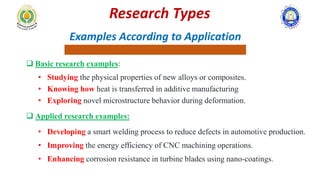
Examples According to Application
 Basic research examples:
• Studying the physical properties of new alloys or composites.
• Knowing how heat is transferred in additive manufacturing
• Exploring novel microstructure behavior during deformation.
 Applied research examples:
• Developing a smart welding process to reduce defects in automotive production.
• Improving the energy efficiency of CNC machining operations.
• Enhancing corrosion resistance in turbine blades using nano-coatings.
Research Types
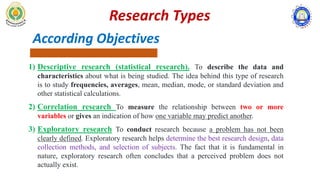
According Objectives
1) Descriptive research (statistical research). To describe the data and
characteristics about what is being studied. The idea behind this type of research
is to study frequencies, averages, mean, median, mode, or standard deviation and
other statistical calculations.
2) Correlation research To measure the relationship between two or more
variables or gives an indication of how one variable may predict another.
3) Exploratory research To conduct research because a problem has not been
clearly defined. Exploratory research helps determine the best research design, data
collection methods, and selection of subjects. The fact that it is fundamental in
nature, exploratory research often concludes that a perceived problem does not
actually exist.
Research Types
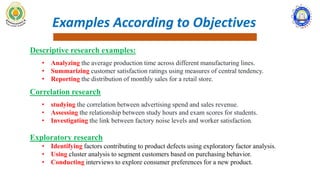
Examples According to Objectives
Descriptive research examples:
• Analyzing the average production time across different manufacturing lines.
• Summarizing customer satisfaction ratings using measures of central tendency.
• Reporting the distribution of monthly sales for a retail store.
Correlation research
• studying the correlation between advertising spend and sales revenue.
• Assessing the relationship between study hours and exam scores for students.
• Investigating the link between factory noise levels and worker satisfaction.
Exploratory research
• Identifying factors contributing to product defects using exploratory factor analysis.
• Using cluster analysis to segment customers based on purchasing behavior.
• Conducting interviews to explore consumer preferences for a new product.
Types of Data
All data are categorized as either ‘primary data’ or ‘secondary data,’ based on
how you source them.
 Primary data are those that you and your team collect directly from the main
sources.
 Secondary data are those that were collected by other organizations, government
agencies, or independent research institutions and individuals and are available
for use.
 Secondary data could be censuses, surveys, organizational records or other
previous research, extracted from books, journals, reports, newspapers,
magazines, data archives, databases etc.
Methodology (Inquiry mode )
 The inquiry mode of research can be categorized as Qualitative and Quantitative.
1- Qualitative Research
 It is research undertaken to gain insights concerning attitudes, beliefs, motivations
and behaviors of individuals, to explore a social or human problem. It Involves
non-numerical data to understand underlying meanings, patterns, and
motivations.
 Qualitative research methods and data collection strategies include focus groups,
in-depth interviews, observation research, case studies and people’s stories,
experiences and feelings to measure change
 It can be use to study past events or current events.
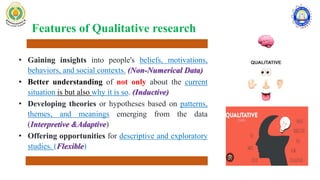
Features of Qualitative research
• Gaining insights into people's beliefs, motivations,
behaviors, and social contexts. (Non-Numerical Data)
• Better understanding of not only about the current
situation is but also why it is so. (Inductive)
• Developing theories or hypotheses based on patterns,
themes, and meanings emerging from the data
(Interpretive &Adaptive)
• Offering opportunities for descriptive and exploratory
studies. (Flexible)
2- Quantitative research
 It is research concerned with the measurement of attitudes, behaviors and
perceptions. It involves numerical data to quantify variables and analyze
relationships.
 Its methods and data collection include interviewing (telephone, intercept, and
door-to-door interviews), Questionnaires , Experiments, Observational Studies,
Secondary Data Analysis as well as self-completion methods such as mail outs
and online surveys.
Methodology (Inquiry mode )
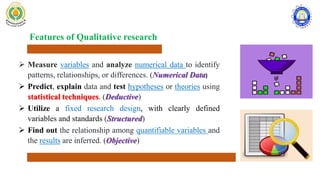
 Measure variables and analyze numerical data to identify
patterns, relationships, or differences. (Numerical Data)
 Predict, explain data and test hypotheses or theories using
statistical techniques. (Deductive)
 Utilize a fixed research design, with clearly defined
variables and standards (Structured)
 Find out the relationship among quantifiable variables and
the results are inferred. (Objective)
Features of Qualitative research
Examples According to Methodology
 Quantitative research examples:
• Analyzing trends in machine vibration levels over time to predict maintenance
needs.
• Modeling the effect of machine speed on the quality of machined components
• Quantifying machine performance by analyzing availability, and quality rates..
 Qualitative research examples:
• Investigating employees feeling about the adoption of new technology
• Exploring the energy efficiency of CNC machining operations.
• Examining the relationships between a manufacturing company and its suppliers.
Research Types
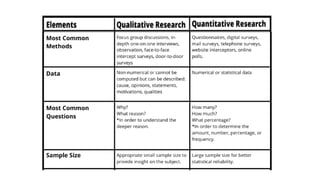
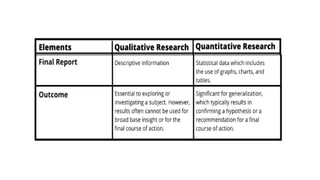
compare
between
Qualitative and
Quantitative
Research
Activity
(3)
https://www.toladata.com/blog/qualitative-and-
quantitative-data-collection-methods-in-monitoring-
and-evaluation/
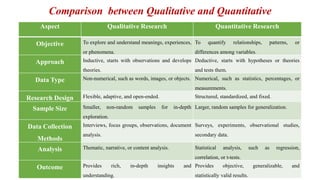
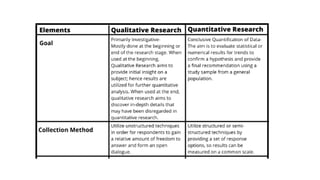
Aspect Qualitative Research Quantitative Research
Objective To explore and understand meanings, experiences,
or phenomena.
To quantify relationships, patterns, or
differences among variables.
Approach Inductive, starts with observations and develops
theories.
Deductive, starts with hypotheses or theories
and tests them.
Data Type Non-numerical, such as words, images, or objects. Numerical, such as statistics, percentages, or
measurements.
Research Design Flexible, adaptive, and open-ended. Structured, standardized, and fixed.
Sample Size Smaller, non-random samples for in-depth
exploration.
Larger, random samples for generalization.
Data Collection
Methods
Interviews, focus groups, observations, document
analysis.
Surveys, experiments, observational studies,
secondary data.
Analysis Thematic, narrative, or content analysis. Statistical analysis, such as regression,
correlation, or t-tests.
Outcome Provides rich, in-depth insights and
understanding.
Provides objective, generalizable, and
statistically valid results.
Comparison between Qualitative and Quantitative
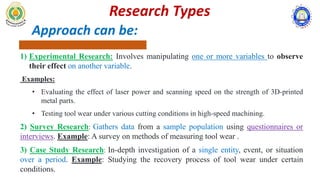
Approach can be:
1) Experimental Research: Involves manipulating one or more variables to observe
their effect on another variable.
Examples:
• Evaluating the effect of laser power and scanning speed on the strength of 3D-printed
metal parts.
• Testing tool wear under various cutting conditions in high-speed machining.
2) Survey Research: Gathers data from a sample population using questionnaires or
interviews. Example: A survey on methods of measuring tool wear .
3) Case Study Research: In-depth investigation of a single entity, event, or situation
over a period. Example: Studying the recovery process of tool wear under certain
conditions.
Research Types
‫اﻟﺘﺪرﯾﺒﻲ‬
‫اﻟﯿﻮم‬
‫أھﺪاف‬
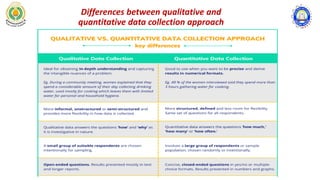
Differences between qualitative and
quantitative data collection approach
‫اﻟﺘﺪرﯾﺒﻲ‬
‫اﻟﯿﻮم‬
‫أھﺪاف‬
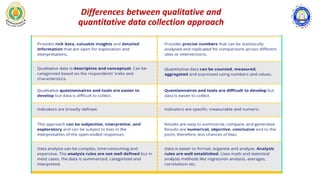
Differences between qualitative and
quantitative data collection approach
Research Methods and methodology _ research types

Research Methods and methodology _ research types

  • 1.
    MansouraUniversity - Facultyof Engineering Production EngineeringAnd MechanicalDesign Department Lecture 3 Research Methods(2) By Assoc.Prof.Dr. RaniaMostafa
  • 2.
    Chapter 2 Research Methodsand Methodologies Mansoura University- Faculty of Engineering Production EngineeringAnd MechanicalDesign Department
  • 3.
    Introduction Research skills, Difference betweenResearch Methods and Methodologies Choice of methods and methodology Types of Research Lecture Outline Research Methods and Methodologies
  • 4.
    Introduction Activity (1) Whatis a research skill? Top 5 skills
  • 5.
    Activity (1) What is researchskill? Research skill is the ability to find an answer to a question or a solution to a problem. It includes the ability to gather information about a topic, review that information and analyze and interpret the details in a way to support a solution Check your Understanding
  • 6.
    Scientific Research skills(Top 5 skills) Critical Thinking Data Analysis Communication& Time management Experimental Design Problem-Solving
  • 7.
    Scientific Research skills 1.Critical Thinking: o The ability to objectively analyze and evaluate information, data, and theories. Critical thinking involves questioning assumptions, identifying biases, and considering alternative explanations or perspectives. 2. Data Analysis: o Proficiency in collecting, processing, and interpreting data. This includes statistical analysis, understanding data patterns, and using tools or software to manage and analyze large datasets. 3. Experimental Design: o The skill of designing experiments or studies that effectively test hypotheses. This involves selecting appropriate methodologies, controls, variables, and ensuring that the study is robust, reproducible, and minimizes sources of error. 4. Communication: o The ability to clearly and effectively communicate research findings, both in writing and verbally. This includes writing research papers, reports, and presenting findings at conferences or to a broader audience. 5. Problem-Solving: o The capacity to identify research challenges, develop innovative solutions, and adapt methods as needed. Problem-solving is crucial for overcoming obstacles that arise during research, whether they are technical, theoretical, or practical.
  • 8.
    Introduction Activity (2) What isa Research Method? What is a Research Methodology? Differences between Research Methods and Methodology
  • 9.
    Activity (2) What is aResearch Method?  A method is simply the tool used to answer your research questions.  It is the specific approach to collecting data.  Examples of research methods include:  Interview,  websites search and Survey  Focus groups  Experiments  Case studies  Observational studies  Online data collection  Every method varies in style, so it is important to choose a suitable of these before applying them. For example, an interview could be structured or semi-structured. A survey could be multiple choice or long answer questions.
  • 10.
    Activity (2) What is aResearch Methodology? Methodology is a systematic and theoretical approach to collect and evaluate data throughout the research process. It allows researchers to validate a study's rigor to acquire new information. The purpose of research methodology is to prove the credibility, validity, and reliability of a chosen research method
  • 11.
    Differences between Research Methodsand Methodology Methods Methodology It refers to the methods/ technique use in performing research operations It refers to the steps that are generally adopted by a researcher in solving the research problem systematically Different kind of methods is available. But not all methods, prove desirable results. Therefore, selecting the most appropriate method (out of the many) is vital. The procedures by which researchers conduct the selected method and thus describe, explain and predict the phenomena or problem of interest Research methods help us collect data and find a solution to a problem Research methodology is the study methods by of which knowledge is gained
  • 12.
    Choice of Methodology& Methods Depends on? Activity (3) ■ Research Questions ■ Research Goals ■ Researcher Beliefs and Values ■ Researcher Skills ■ Time and Funds
  • 13.
    “Discover what yourbelieve to be true” ‫ﺑﮫ‬ ‫ﺗؤﻣن‬ ‫ﻣﺎ‬ ‫اﻛﺗﺷف‬ Types of Research
  • 14.
    Types of Research Whencarrying out research, our purposes are different. Research can be classified into several types based on its purpose (Application & Objective), methodology and approach. Category Types Application Objective Basic, Applied Exploratory, Descriptive, Explanatory, correlational Approach Experimental, Survey, Case Study… Methodology Qualitative, Quantitative, Mixed-Methods Timeframe Cross-Sectional, Longitudinal Other Types Action, Ethnographic, Historical
  • 15.
    According to Application(Purpose) :  Basic research is often considered researching for the sake of increasing knowledge and understanding concepts as opposed to applied where the research truly is intended to solve a problem.  Basic Research is often called "pure" research and is considered the foundation for applied research.  Applied research is "hands-on", which means that the researcher is actually working with the topic/subjects while conducting the research. Aims to solve specific real-world problems with practical applications using scientific knowledge. Research Types
  • 16.
    Examples According toApplication  Basic research examples: • Studying the physical properties of new alloys or composites. • Knowing how heat is transferred in additive manufacturing • Exploring novel microstructure behavior during deformation.  Applied research examples: • Developing a smart welding process to reduce defects in automotive production. • Improving the energy efficiency of CNC machining operations. • Enhancing corrosion resistance in turbine blades using nano-coatings. Research Types
  • 17.
    According Objectives 1) Descriptiveresearch (statistical research). To describe the data and characteristics about what is being studied. The idea behind this type of research is to study frequencies, averages, mean, median, mode, or standard deviation and other statistical calculations. 2) Correlation research To measure the relationship between two or more variables or gives an indication of how one variable may predict another. 3) Exploratory research To conduct research because a problem has not been clearly defined. Exploratory research helps determine the best research design, data collection methods, and selection of subjects. The fact that it is fundamental in nature, exploratory research often concludes that a perceived problem does not actually exist. Research Types
  • 18.
    Examples According toObjectives Descriptive research examples: • Analyzing the average production time across different manufacturing lines. • Summarizing customer satisfaction ratings using measures of central tendency. • Reporting the distribution of monthly sales for a retail store. Correlation research • studying the correlation between advertising spend and sales revenue. • Assessing the relationship between study hours and exam scores for students. • Investigating the link between factory noise levels and worker satisfaction. Exploratory research • Identifying factors contributing to product defects using exploratory factor analysis. • Using cluster analysis to segment customers based on purchasing behavior. • Conducting interviews to explore consumer preferences for a new product.
  • 19.
    Types of Data Alldata are categorized as either ‘primary data’ or ‘secondary data,’ based on how you source them.  Primary data are those that you and your team collect directly from the main sources.  Secondary data are those that were collected by other organizations, government agencies, or independent research institutions and individuals and are available for use.  Secondary data could be censuses, surveys, organizational records or other previous research, extracted from books, journals, reports, newspapers, magazines, data archives, databases etc.
  • 20.
    Methodology (Inquiry mode)  The inquiry mode of research can be categorized as Qualitative and Quantitative. 1- Qualitative Research  It is research undertaken to gain insights concerning attitudes, beliefs, motivations and behaviors of individuals, to explore a social or human problem. It Involves non-numerical data to understand underlying meanings, patterns, and motivations.  Qualitative research methods and data collection strategies include focus groups, in-depth interviews, observation research, case studies and people’s stories, experiences and feelings to measure change  It can be use to study past events or current events.
  • 21.
    Features of Qualitativeresearch • Gaining insights into people's beliefs, motivations, behaviors, and social contexts. (Non-Numerical Data) • Better understanding of not only about the current situation is but also why it is so. (Inductive) • Developing theories or hypotheses based on patterns, themes, and meanings emerging from the data (Interpretive &Adaptive) • Offering opportunities for descriptive and exploratory studies. (Flexible)
  • 22.
    2- Quantitative research It is research concerned with the measurement of attitudes, behaviors and perceptions. It involves numerical data to quantify variables and analyze relationships.  Its methods and data collection include interviewing (telephone, intercept, and door-to-door interviews), Questionnaires , Experiments, Observational Studies, Secondary Data Analysis as well as self-completion methods such as mail outs and online surveys. Methodology (Inquiry mode )
  • 23.
     Measure variablesand analyze numerical data to identify patterns, relationships, or differences. (Numerical Data)  Predict, explain data and test hypotheses or theories using statistical techniques. (Deductive)  Utilize a fixed research design, with clearly defined variables and standards (Structured)  Find out the relationship among quantifiable variables and the results are inferred. (Objective) Features of Qualitative research
  • 24.
    Examples According toMethodology  Quantitative research examples: • Analyzing trends in machine vibration levels over time to predict maintenance needs. • Modeling the effect of machine speed on the quality of machined components • Quantifying machine performance by analyzing availability, and quality rates..  Qualitative research examples: • Investigating employees feeling about the adoption of new technology • Exploring the energy efficiency of CNC machining operations. • Examining the relationships between a manufacturing company and its suppliers. Research Types
  • 25.
  • 26.
    Aspect Qualitative ResearchQuantitative Research Objective To explore and understand meanings, experiences, or phenomena. To quantify relationships, patterns, or differences among variables. Approach Inductive, starts with observations and develops theories. Deductive, starts with hypotheses or theories and tests them. Data Type Non-numerical, such as words, images, or objects. Numerical, such as statistics, percentages, or measurements. Research Design Flexible, adaptive, and open-ended. Structured, standardized, and fixed. Sample Size Smaller, non-random samples for in-depth exploration. Larger, random samples for generalization. Data Collection Methods Interviews, focus groups, observations, document analysis. Surveys, experiments, observational studies, secondary data. Analysis Thematic, narrative, or content analysis. Statistical analysis, such as regression, correlation, or t-tests. Outcome Provides rich, in-depth insights and understanding. Provides objective, generalizable, and statistically valid results. Comparison between Qualitative and Quantitative
  • 27.
    Approach can be: 1)Experimental Research: Involves manipulating one or more variables to observe their effect on another variable. Examples: • Evaluating the effect of laser power and scanning speed on the strength of 3D-printed metal parts. • Testing tool wear under various cutting conditions in high-speed machining. 2) Survey Research: Gathers data from a sample population using questionnaires or interviews. Example: A survey on methods of measuring tool wear . 3) Case Study Research: In-depth investigation of a single entity, event, or situation over a period. Example: Studying the recovery process of tool wear under certain conditions. Research Types
  • 28.
  • 29.