
“Multivariate Analysis With SPSS”
1Qasimraza555@gmail.com
2Qasimraza555@gmail.com
“Multivariate Analysis With SPSS”
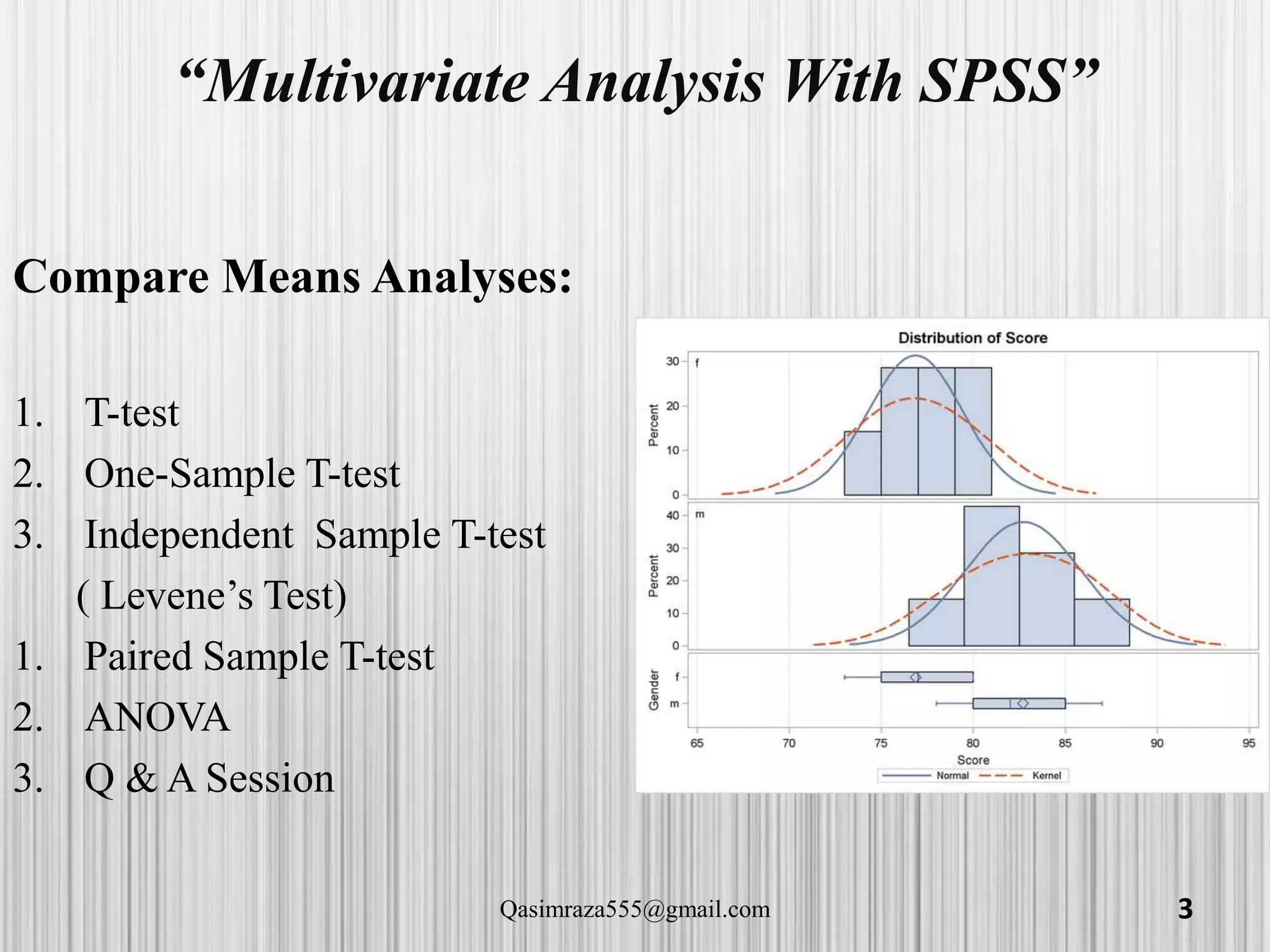
Compare Means Analyses:
1. T-test
2. One-Sample T-test
3. Independent Sample T-test
( Levene’s Test)
1. Paired Sample T-test
2. ANOVA
3. Q & A Session
3Qasimraza555@gmail.com
1. What is meant by T-test?
The t-test compares the actual difference between two means
in relation to the variation in the data (expressed as the
standard deviation of the difference between the means).
4Qasimraza555@gmail.com
2. One-Sample T-test
 The one-sample t-test allows us to test whether a sample mean is
significantly different from a population mean. When only the sample
standard deviation is known. Simply, when to use the one-sample t-test,
you should consider using this test when you have continuous data
collected from group that you want to compare that group’s average
scores to some known criterion value (probably a population mean).
 Often performed for testing the mean value of distribution.
 It can be used under the assumption that sample distribution is normal.
 For large samples, the procedure performs often well even for non-
normal population.
5Qasimraza555@gmail.com
One-Sample T-test (Cont…)
Example:
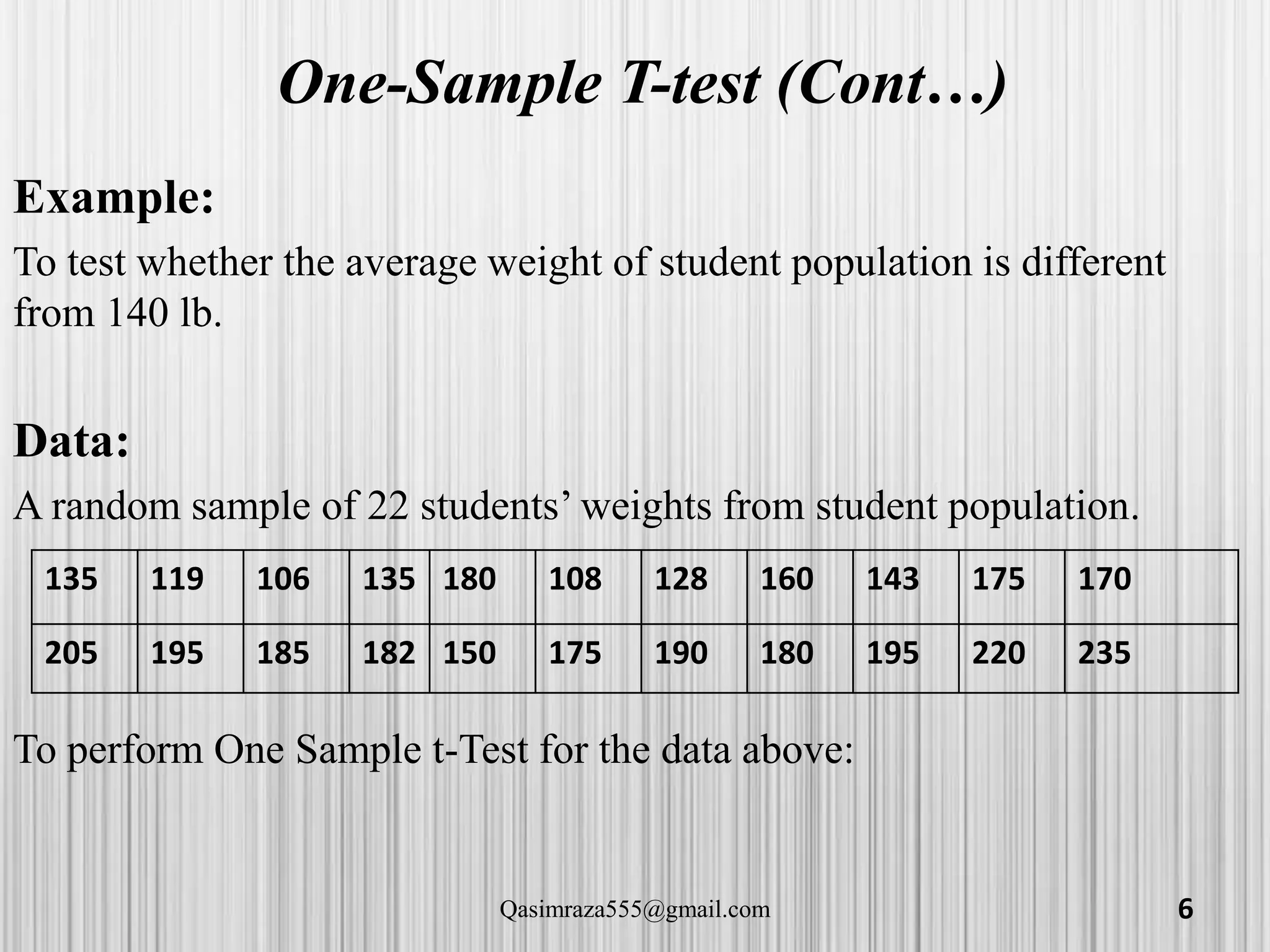
To test whether the average weight of student population is different
from 140 lb.
Data:
A random sample of 22 students’ weights from student population.
To perform One Sample t-Test for the data above:
135 119 106 135 180 108 128 160 143 175 170
205 195 185 182 150 175 190 180 195 220 235
6Qasimraza555@gmail.com
One-Sample T-test (Cont…)
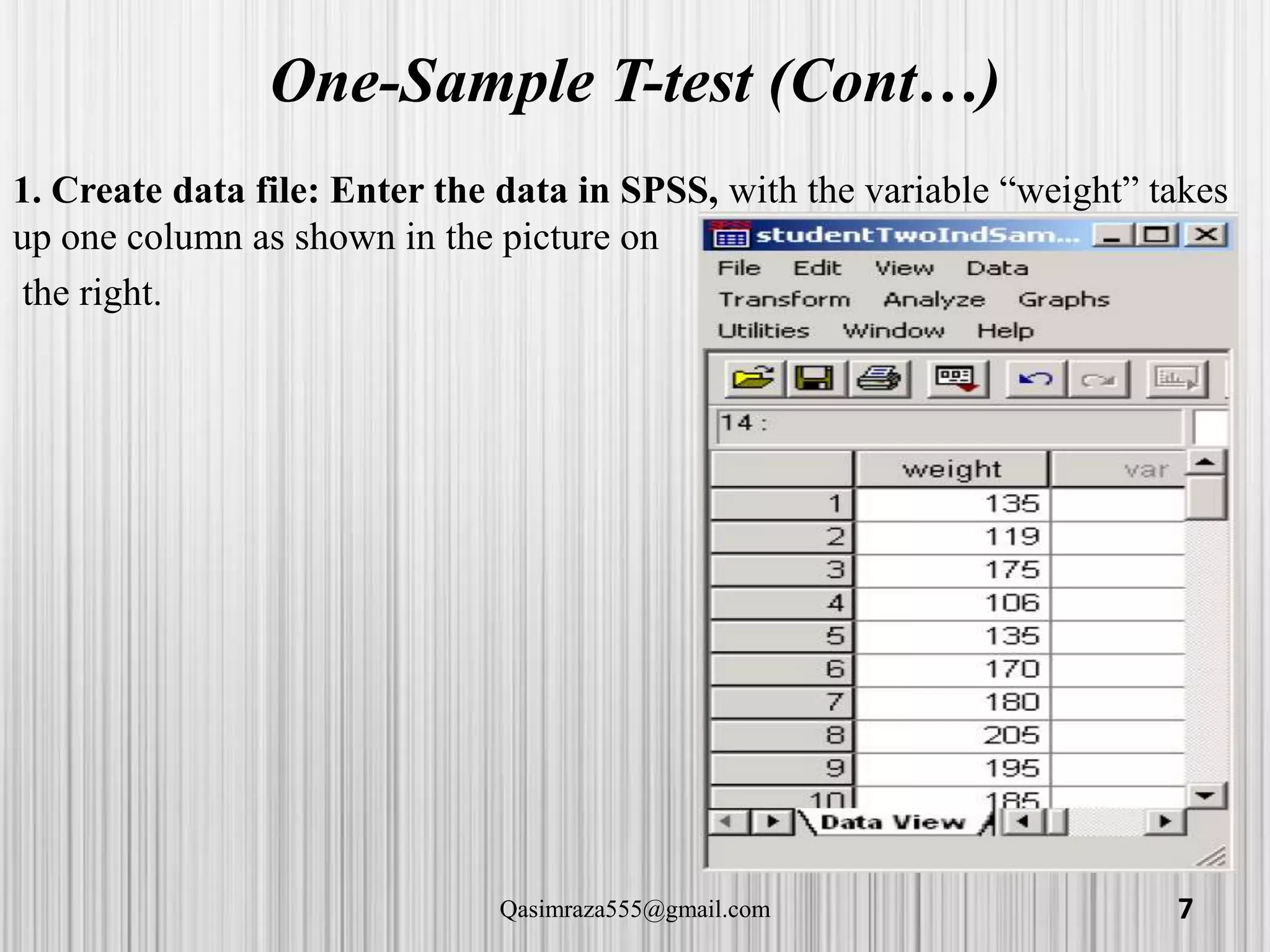
1. Create data file: Enter the data in SPSS, with the variable “weight” takes
up one column as shown in the picture on
the right.
7Qasimraza555@gmail.com
One-Sample T-test (Cont…)
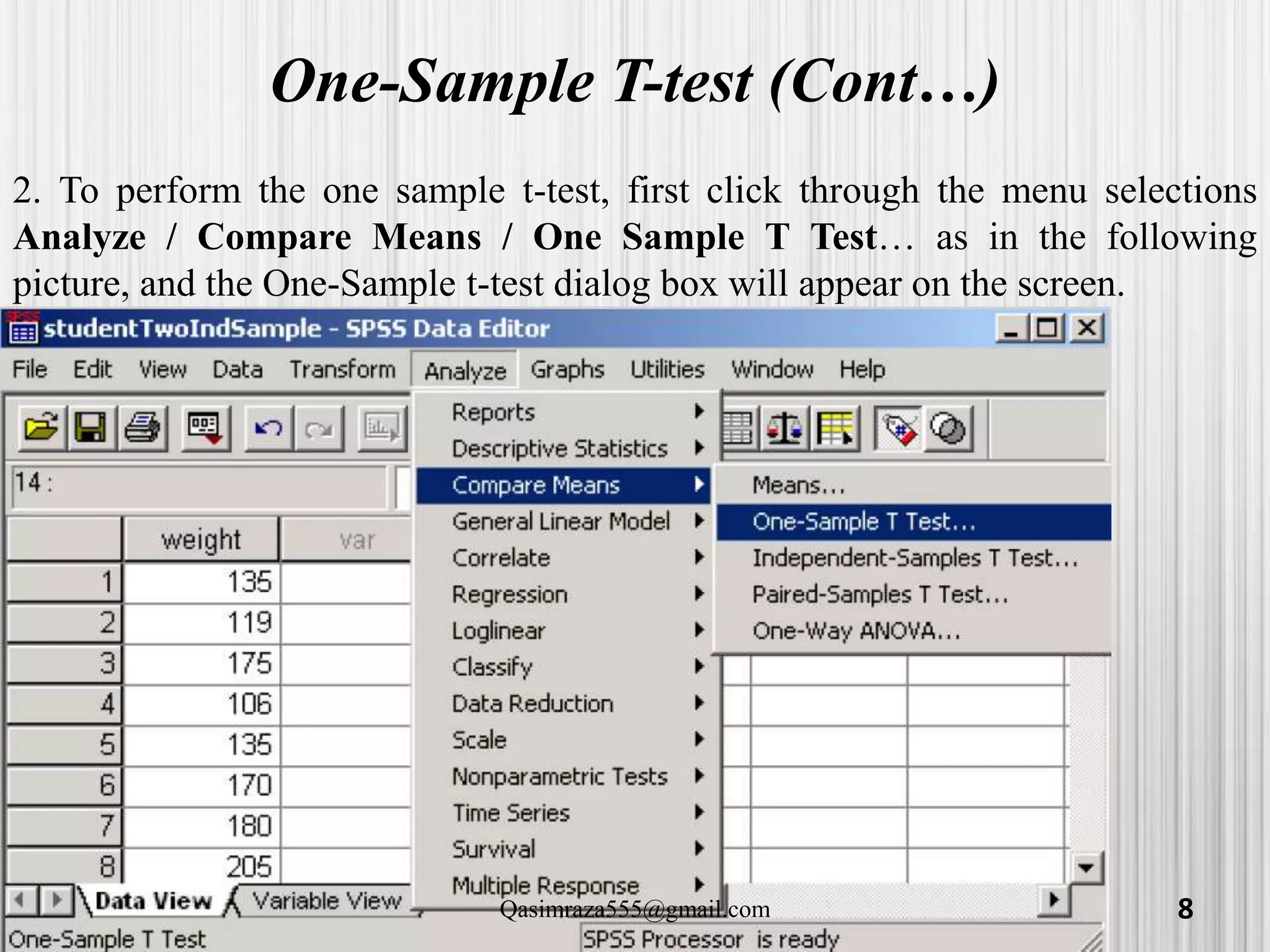
2. To perform the one sample t-test, first click through the menu selections
Analyze / Compare Means / One Sample T Test… as in the following
picture, and the One-Sample t-test dialog box will appear on the screen.
8Qasimraza555@gmail.com
One-Sample T-test (Cont…)
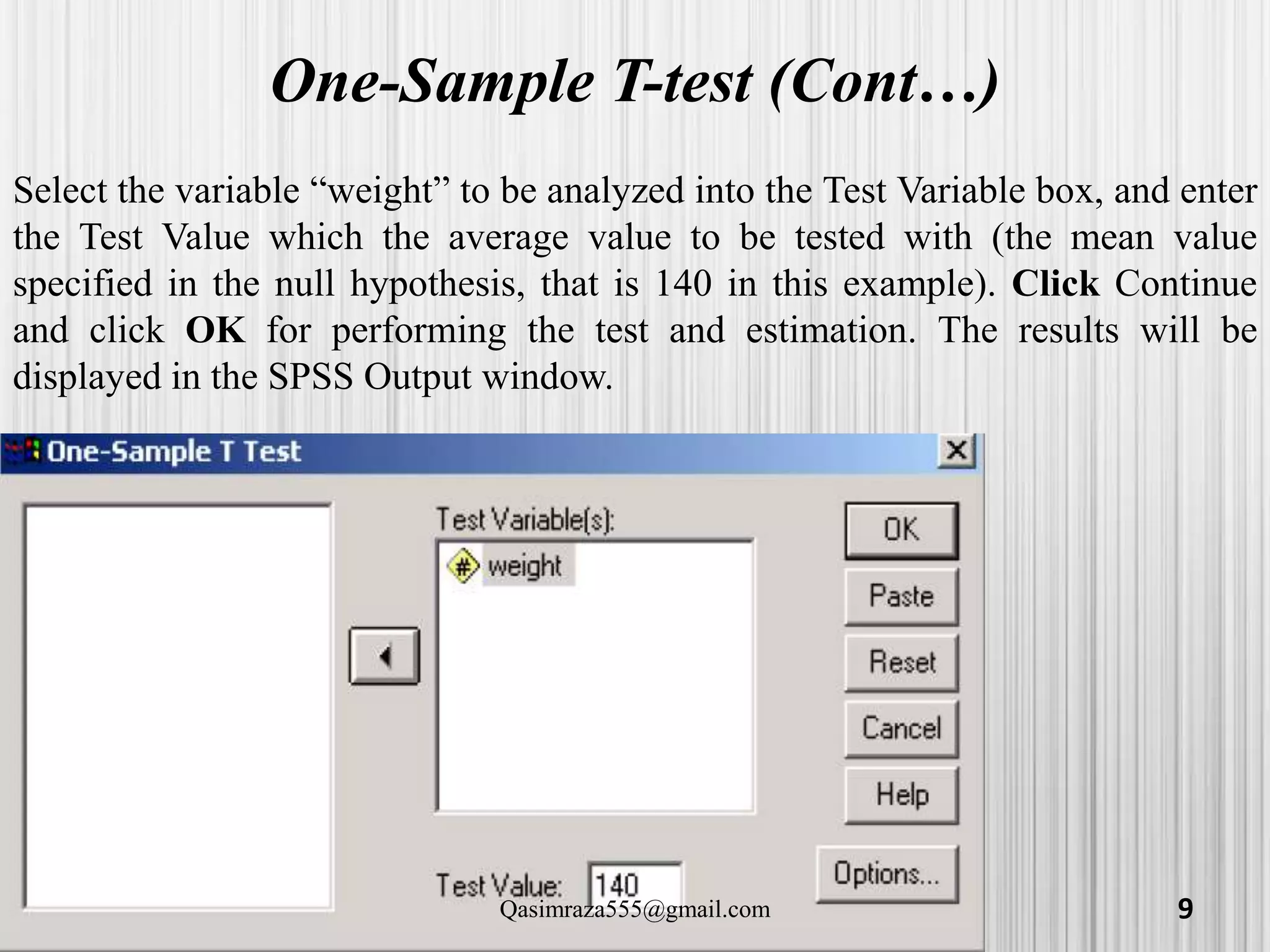
Select the variable “weight” to be analyzed into the Test Variable box, and enter
the Test Value which the average value to be tested with (the mean value
specified in the null hypothesis, that is 140 in this example). Click Continue
and click OK for performing the test and estimation. The results will be
displayed in the SPSS Output window.
9Qasimraza555@gmail.com
One-Sample T-test (Cont…)
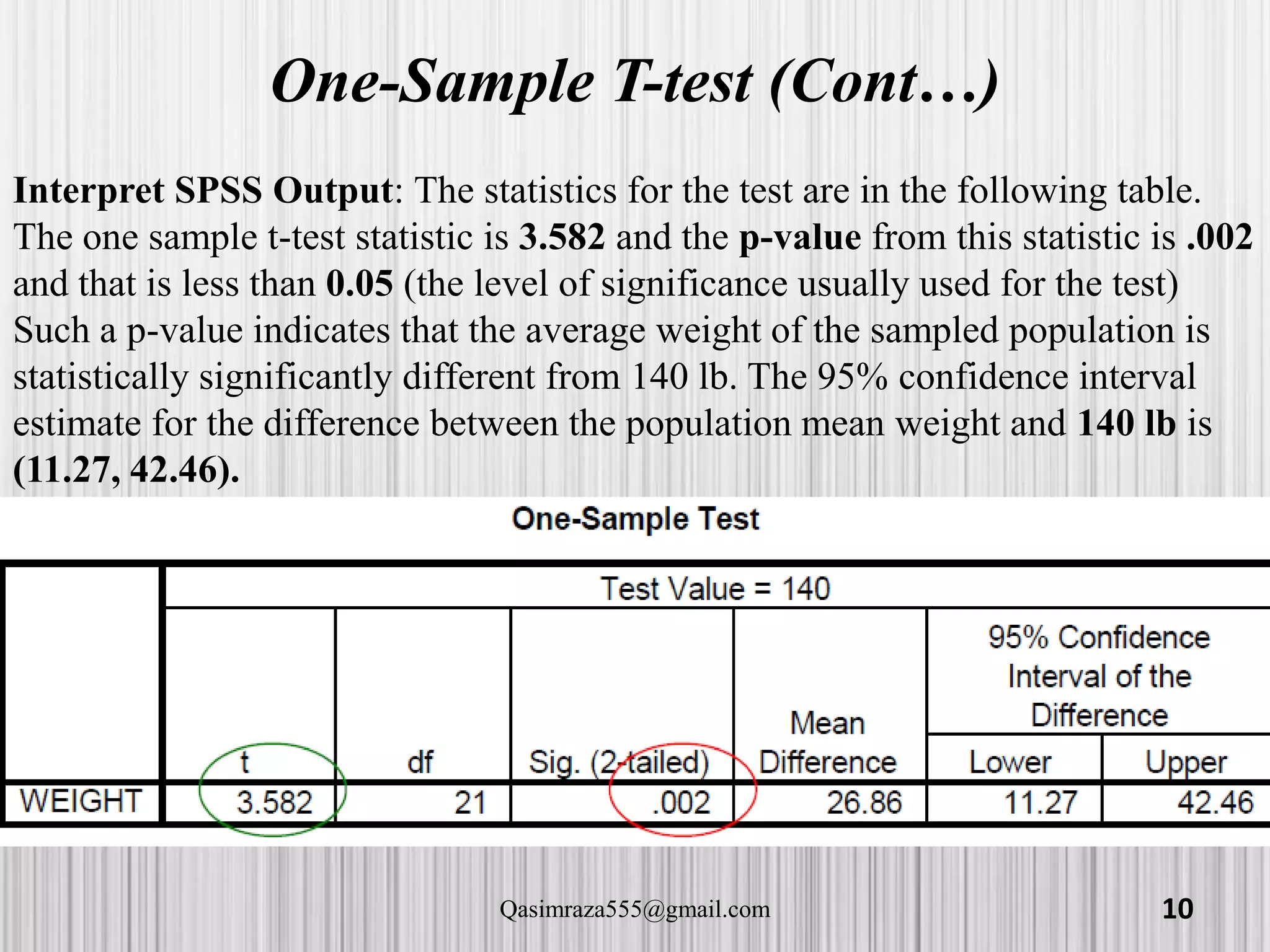
Interpret SPSS Output: The statistics for the test are in the following table.
The one sample t-test statistic is 3.582 and the p-value from this statistic is .002
and that is less than 0.05 (the level of significance usually used for the test)
Such a p-value indicates that the average weight of the sampled population is
statistically significantly different from 140 lb. The 95% confidence interval
estimate for the difference between the population mean weight and 140 lb is
(11.27, 42.46).
10Qasimraza555@gmail.com
3. Independent Sample t-test
 Purpose: test whether or not the populations represented by the two samples
have a different mean.
 Independent Sample t-test measures the significance difference in the means
of the Two categories /variables/Groups.
 Examples:
o Whether there is a significant difference in the satisfaction level of
consumers using Prepaid and Post Paid Packaging…Here we have Package
in two subcategories as a variable and Test Variable is Satisfaction Level.
o Social work students have higher GPA’s than nursing students
o Social work students volunteer for more hours per week than education
majors
11Qasimraza555@gmail.com
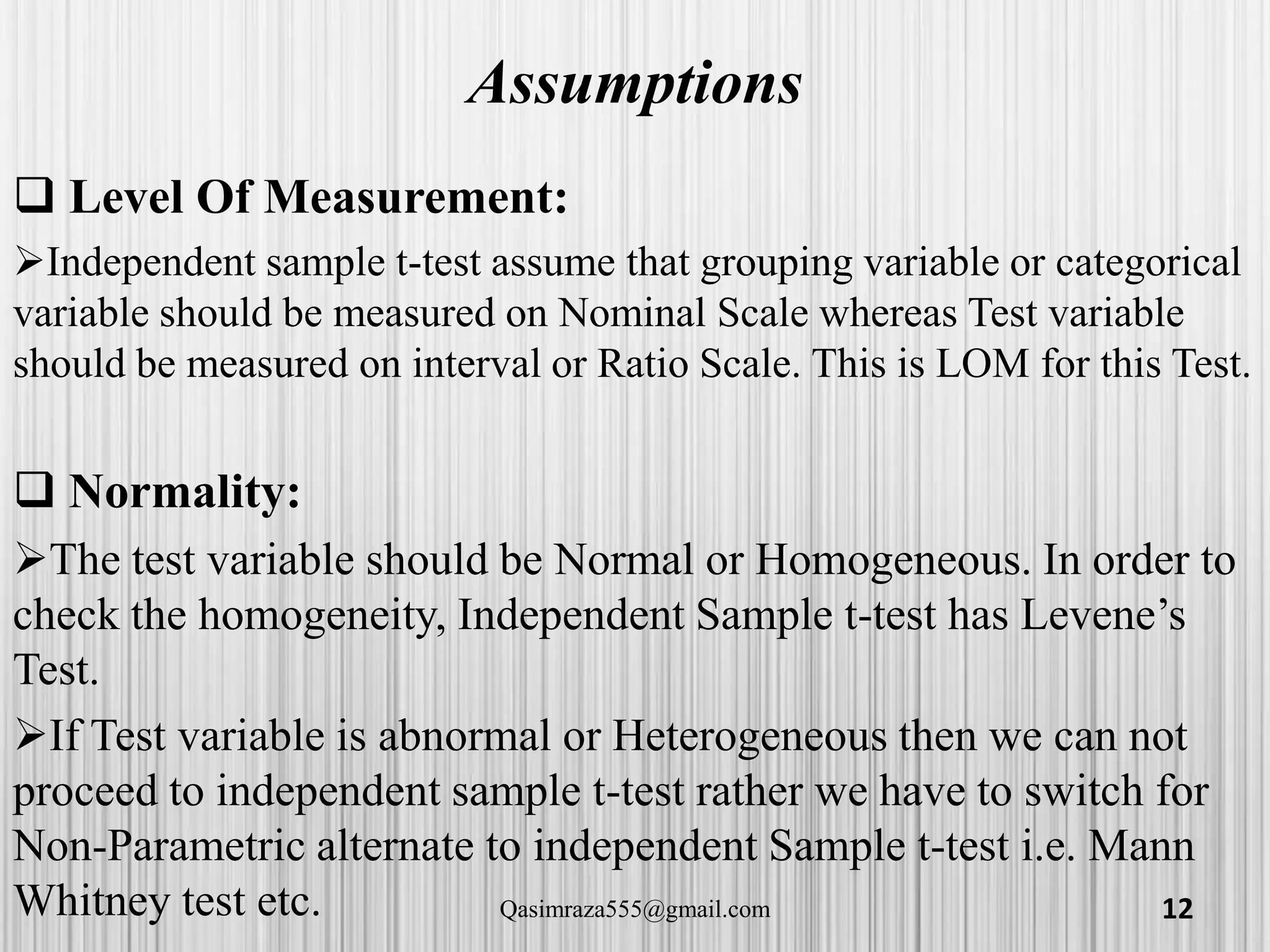
Assumptions
 Level Of Measurement:
Independent sample t-test assume that grouping variable or categorical
variable should be measured on Nominal Scale whereas Test variable
should be measured on interval or Ratio Scale. This is LOM for this Test.
 Normality:
The test variable should be Normal or Homogeneous. In order to
check the homogeneity, Independent Sample t-test has Levene’s
Test.
If Test variable is abnormal or Heterogeneous then we can not
proceed to independent sample t-test rather we have to switch for
Non-Parametric alternate to independent Sample t-test i.e. Mann
Whitney test etc. 12Qasimraza555@gmail.com
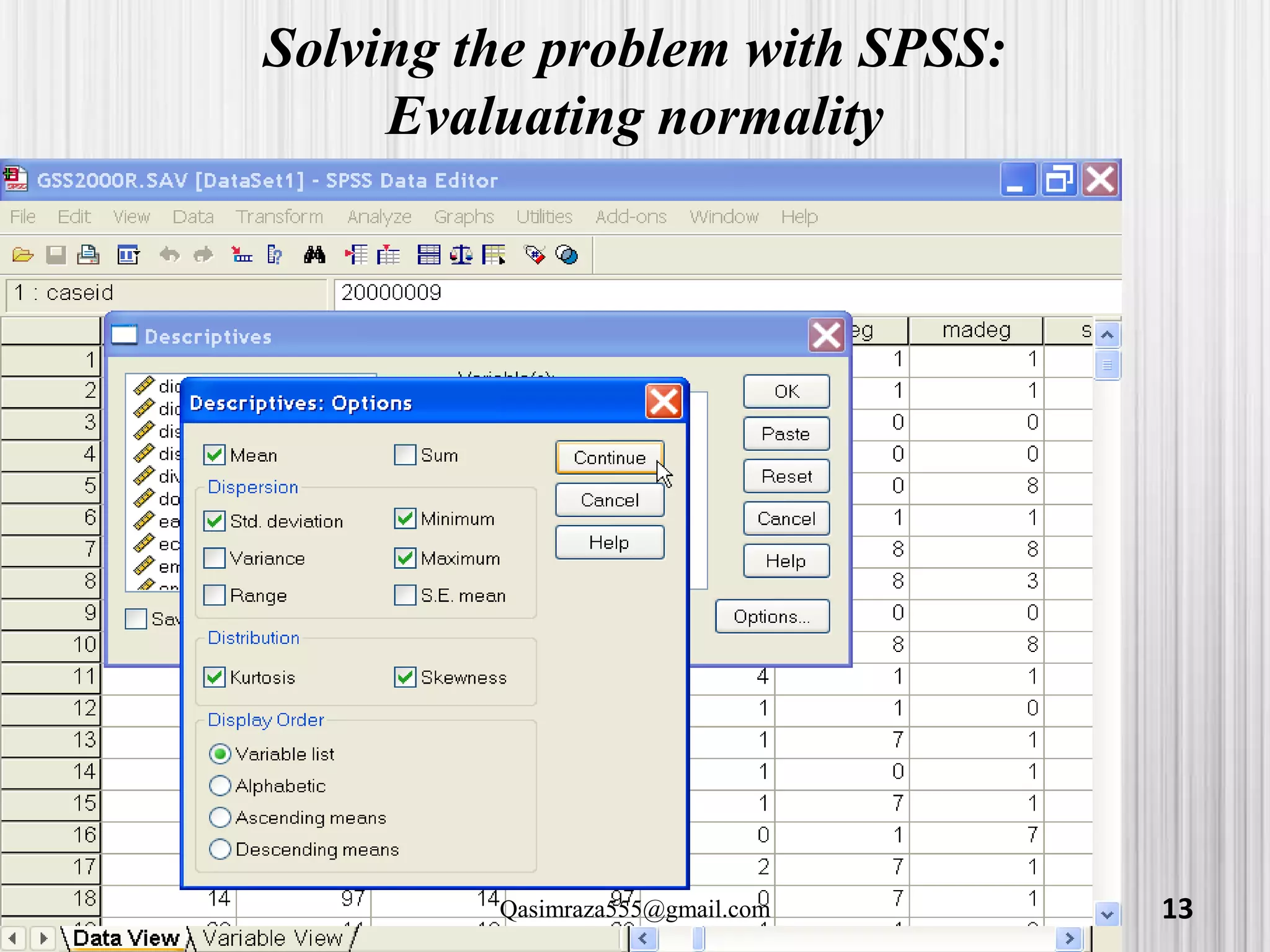
Solving the problem with SPSS:
Evaluating normality
13Qasimraza555@gmail.com
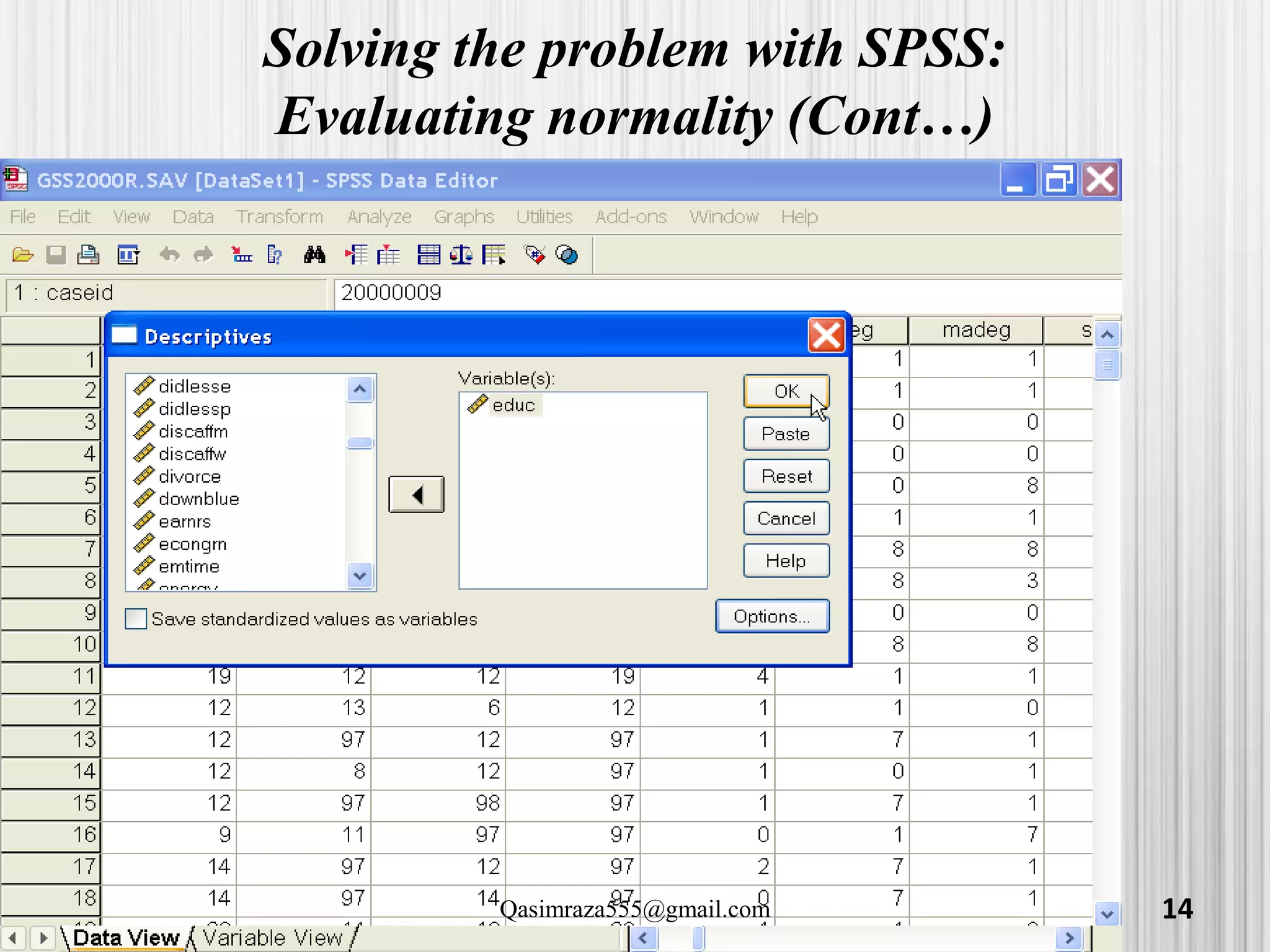
Solving the problem with SPSS:
Evaluating normality (Cont…)
14Qasimraza555@gmail.com
Solving the problem with SPSS:
Evaluating normality (Cont…)
"Highest year of school completed" [educ] did
not satisfy the criteria for a normal
distribution. The skewness of the distribution
(-.137) was between -1.0 and +1.0, but the
kurtosis of the distribution (1.246) fell outside
the range from -1.0 to +1.0.
Having failed the normality requirement using
this criteria, we will see if we can apply the
central limit theorem.
15Qasimraza555@gmail.com
Solving the problem with SPSS:
The independent-samples t-test
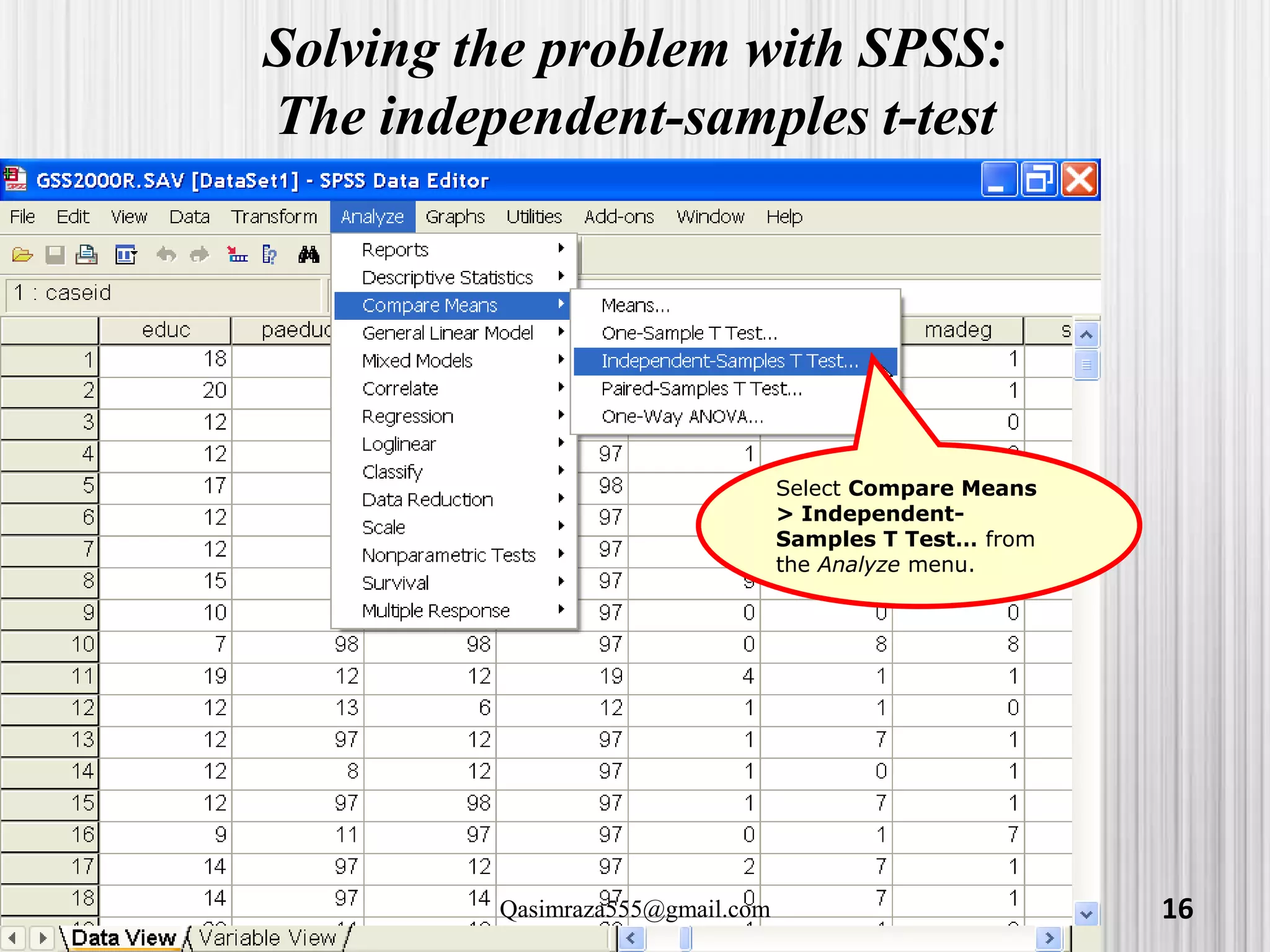
Select Compare Means
> Independent-
Samples T Test… from
the Analyze menu.
16Qasimraza555@gmail.com
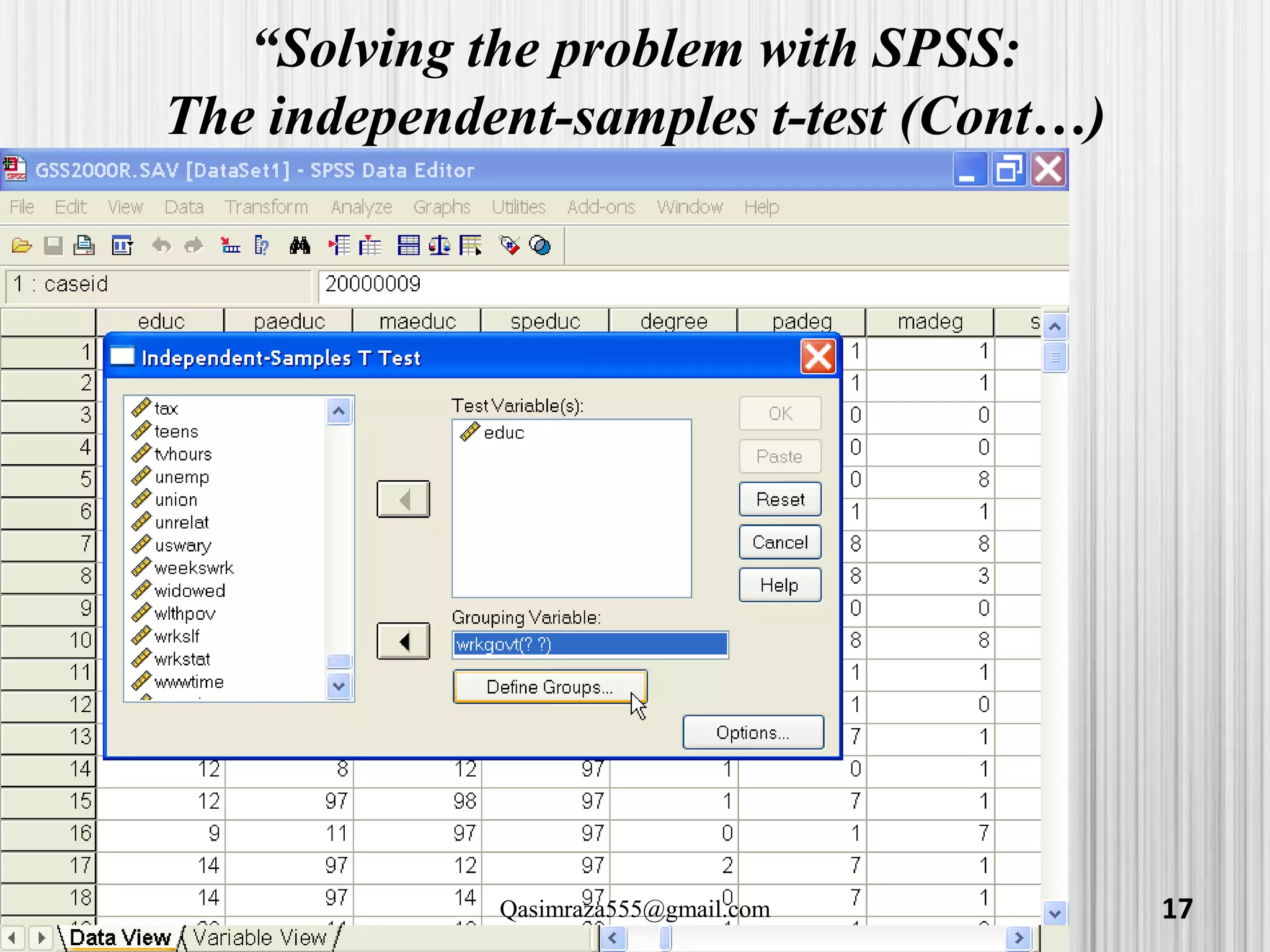
“Solving the problem with SPSS:
The independent-samples t-test (Cont…)
17Qasimraza555@gmail.com
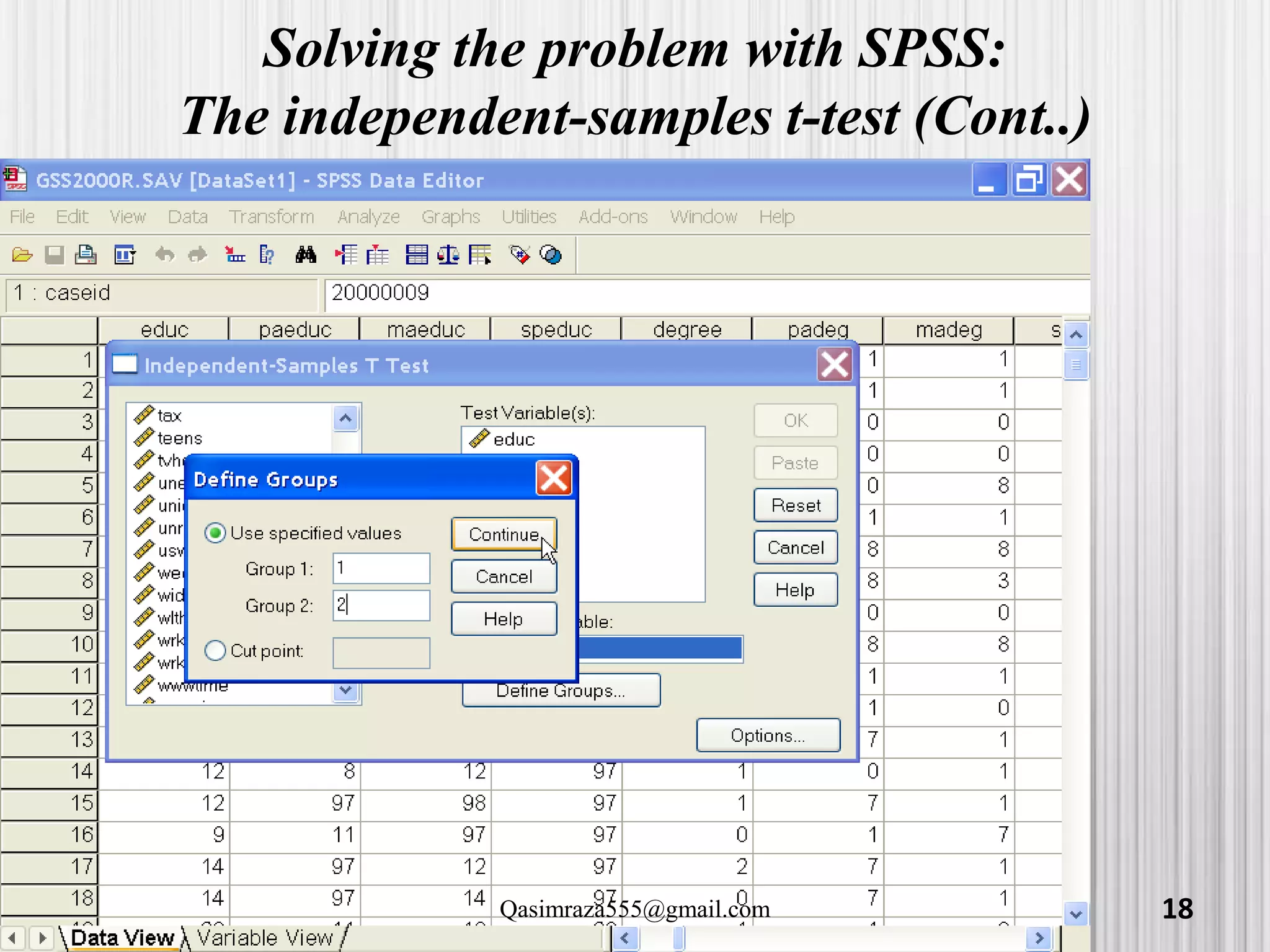
Solving the problem with SPSS:
The independent-samples t-test (Cont..)
18Qasimraza555@gmail.com
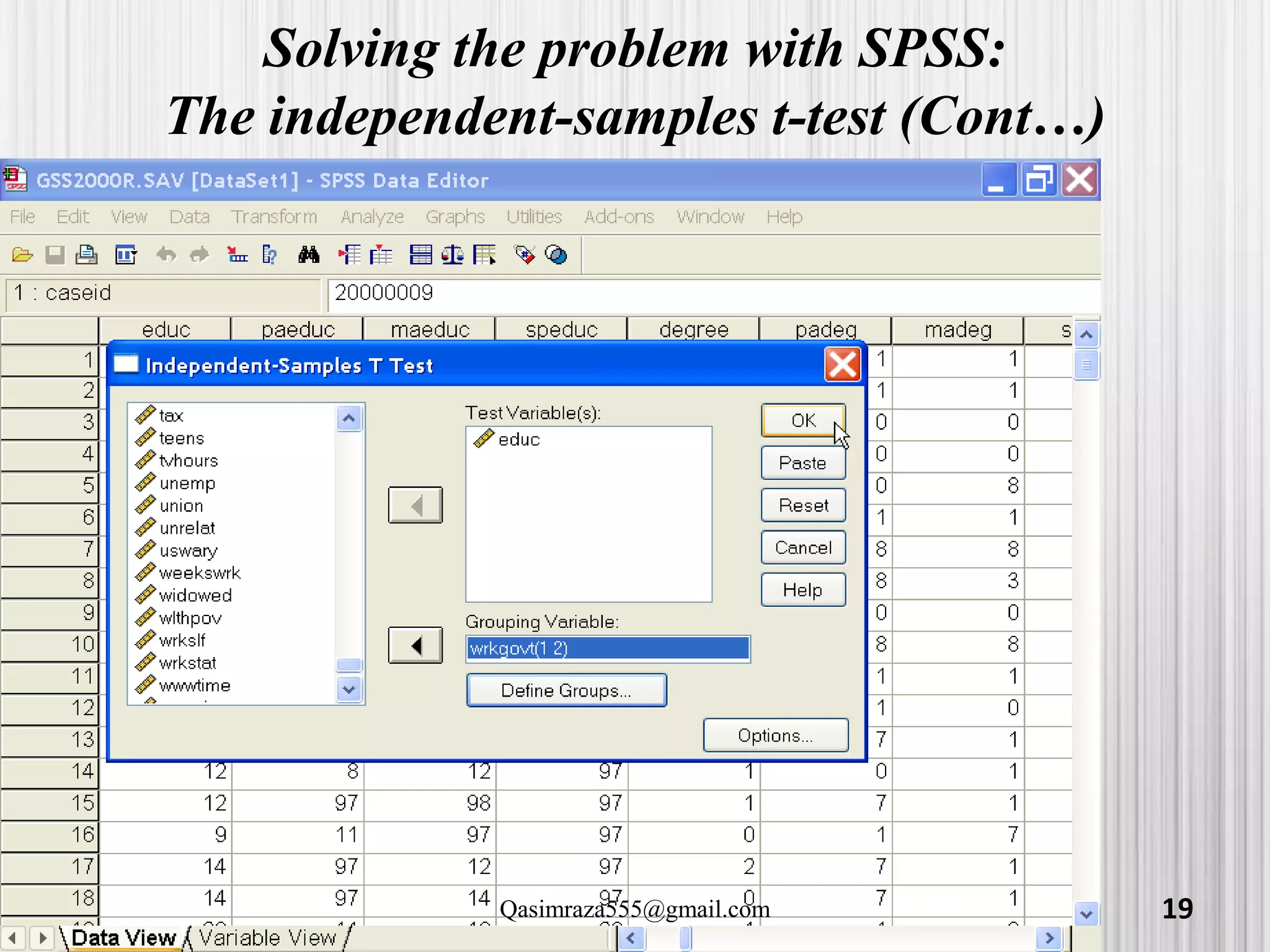
Solving the problem with SPSS:
The independent-samples t-test (Cont…)
19Qasimraza555@gmail.com
Solving the problem with SPSS:
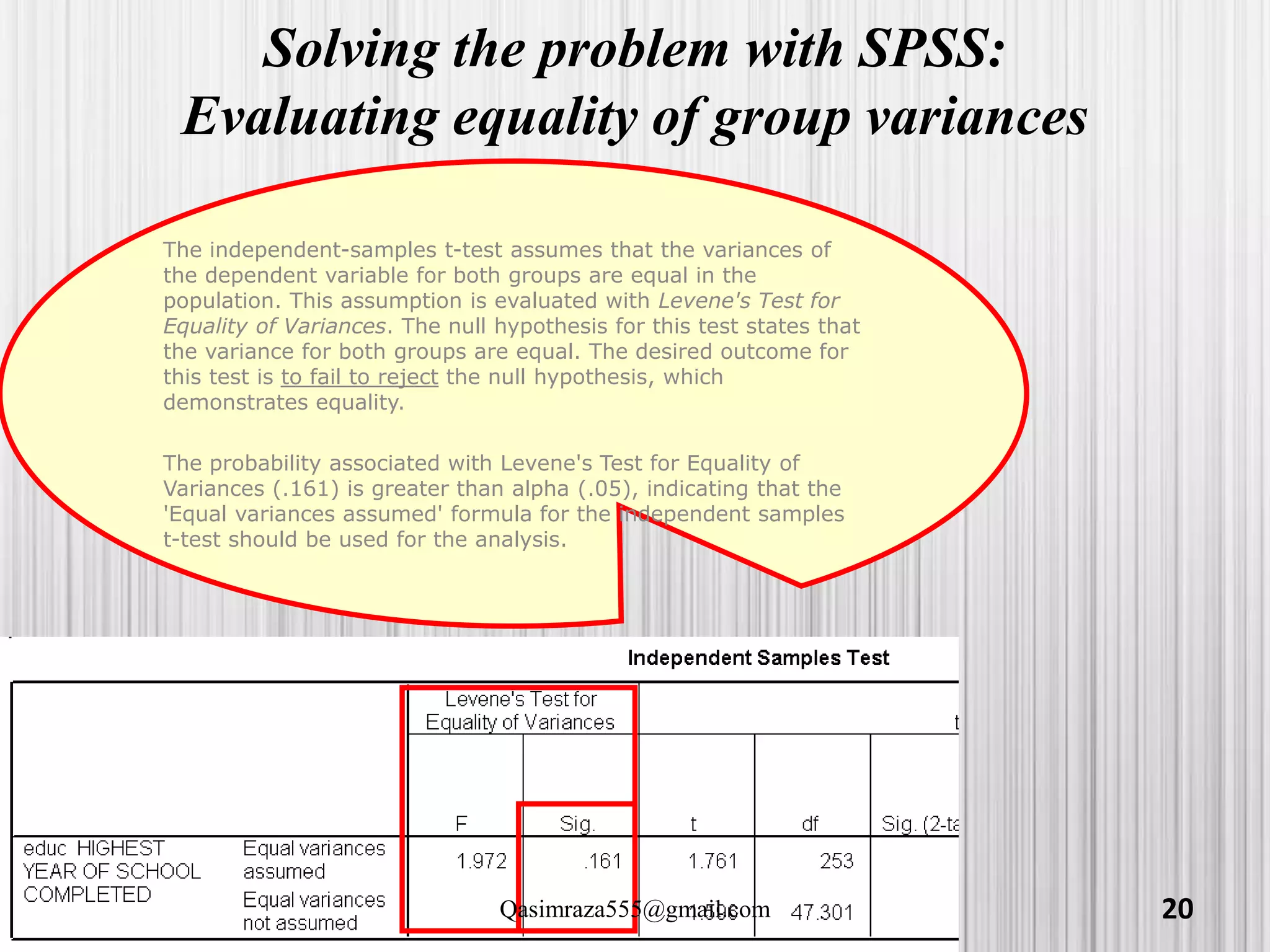
Evaluating equality of group variances
The independent-samples t-test assumes that the variances of
the dependent variable for both groups are equal in the
population. This assumption is evaluated with Levene's Test for
Equality of Variances. The null hypothesis for this test states that
the variance for both groups are equal. The desired outcome for
this test is to fail to reject the null hypothesis, which
demonstrates equality.
The probability associated with Levene's Test for Equality of
Variances (.161) is greater than alpha (.05), indicating that the
'Equal variances assumed' formula for the independent samples
t-test should be used for the analysis.
20Qasimraza555@gmail.com
4. Paired Sample T-test
A paired sample t test is used to test if an observed difference between
two means is statistically significant i.e. whether there is a significant
difference between the average values of the same measurement made
under two different conditions.
Assumptions for paired sample T-test:
To run the paired sample T-test data
 Should have normal distribution
 Is a large data set
 Has no outliers
21Qasimraza555@gmail.com
Paired Sample T-test (Cont…)
Research Questions for Paired Sample T-test
Is there an instructional effect taking place in the computer class?
Hypothesis for Paired Sample T-test:
NULL HYPOTHESIS (H0): H0 specifies that the value for the population
parameters are the same. H0 always includes an equality.
H0: there is no influence of using internet on academic achievement for
this class.
ALTERNATE HYPOTHESIS (H1): H1 always includes a non-equality
H1: there is an influence of using the internet on academic achievement
for this class. 22Qasimraza555@gmail.com
Paired Sample T-test (Cont…)
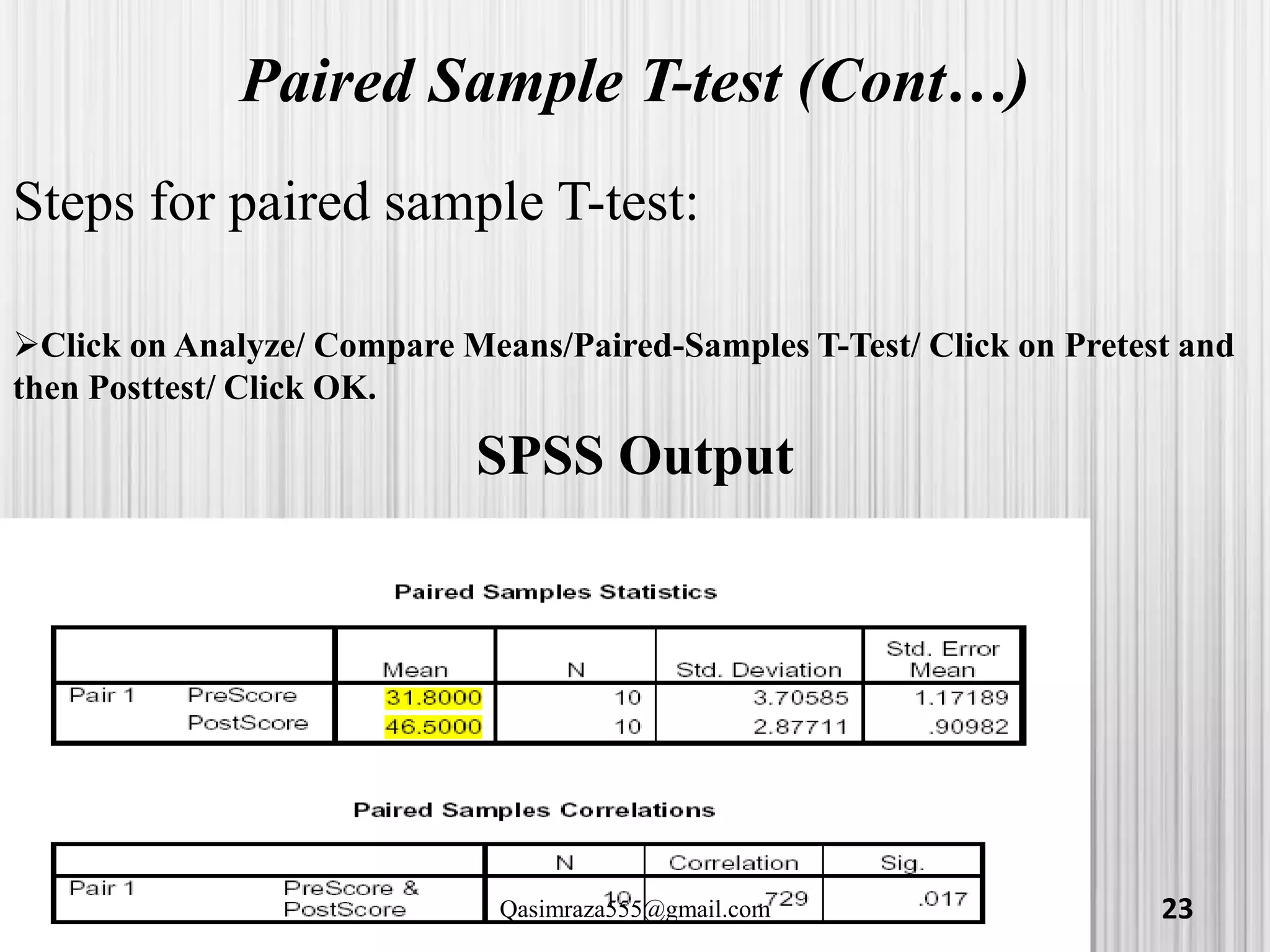
Steps for paired sample T-test:
Click on Analyze/ Compare Means/Paired-Samples T-Test/ Click on Pretest and
then Posttest/ Click OK.
SPSS Output
23Qasimraza555@gmail.com
Paired Sample T-test (Cont…)
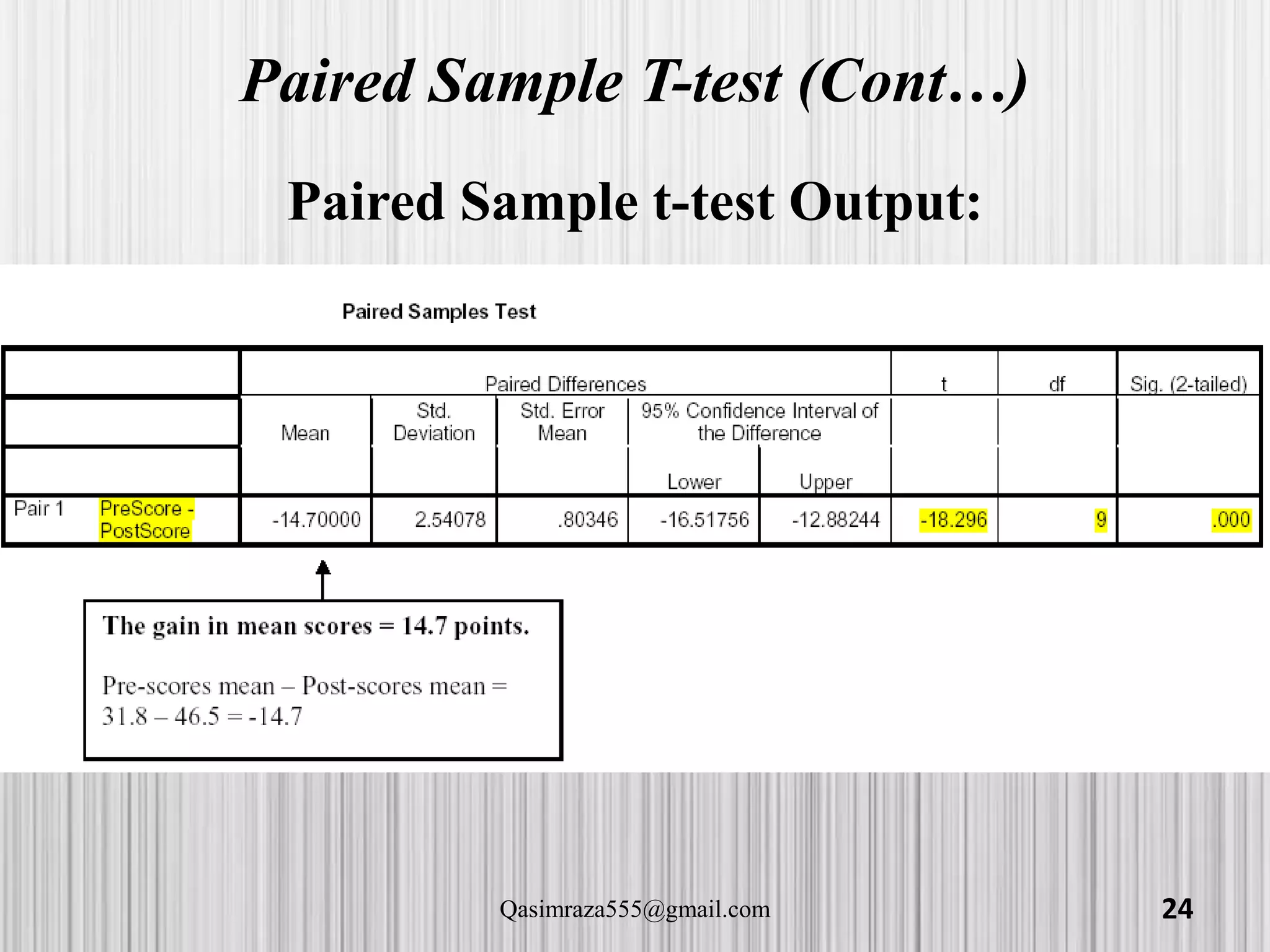
Paired Sample t-test Output:
24Qasimraza555@gmail.com
Paired Sample T-test (Cont…)
Results:
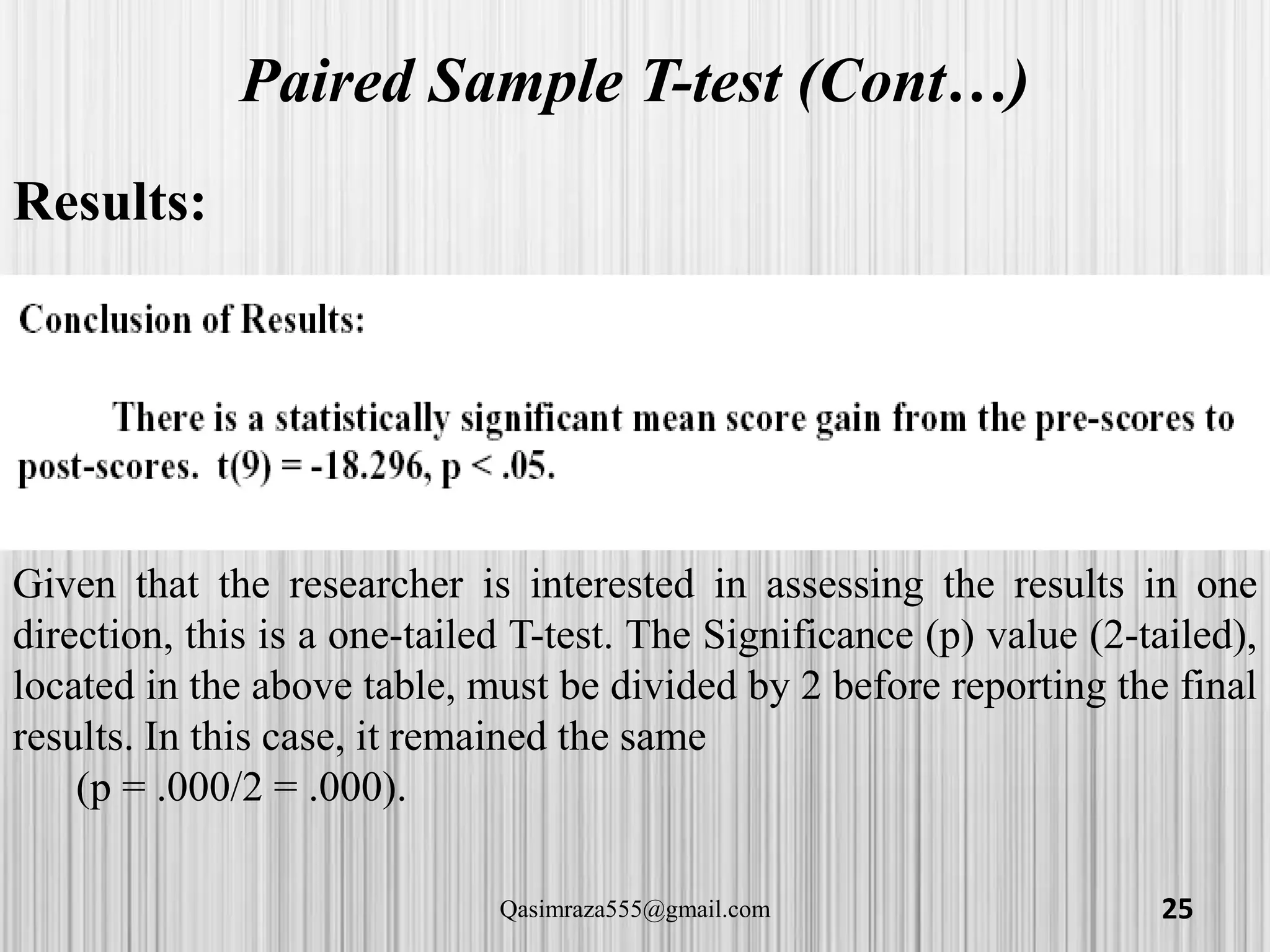
Given that the researcher is interested in assessing the results in one
direction, this is a one-tailed T-test. The Significance (p) value (2-tailed),
located in the above table, must be divided by 2 before reporting the final
results. In this case, it remained the same
(p = .000/2 = .000).
25Qasimraza555@gmail.com
5. Analysis of Variance (ANOVA)
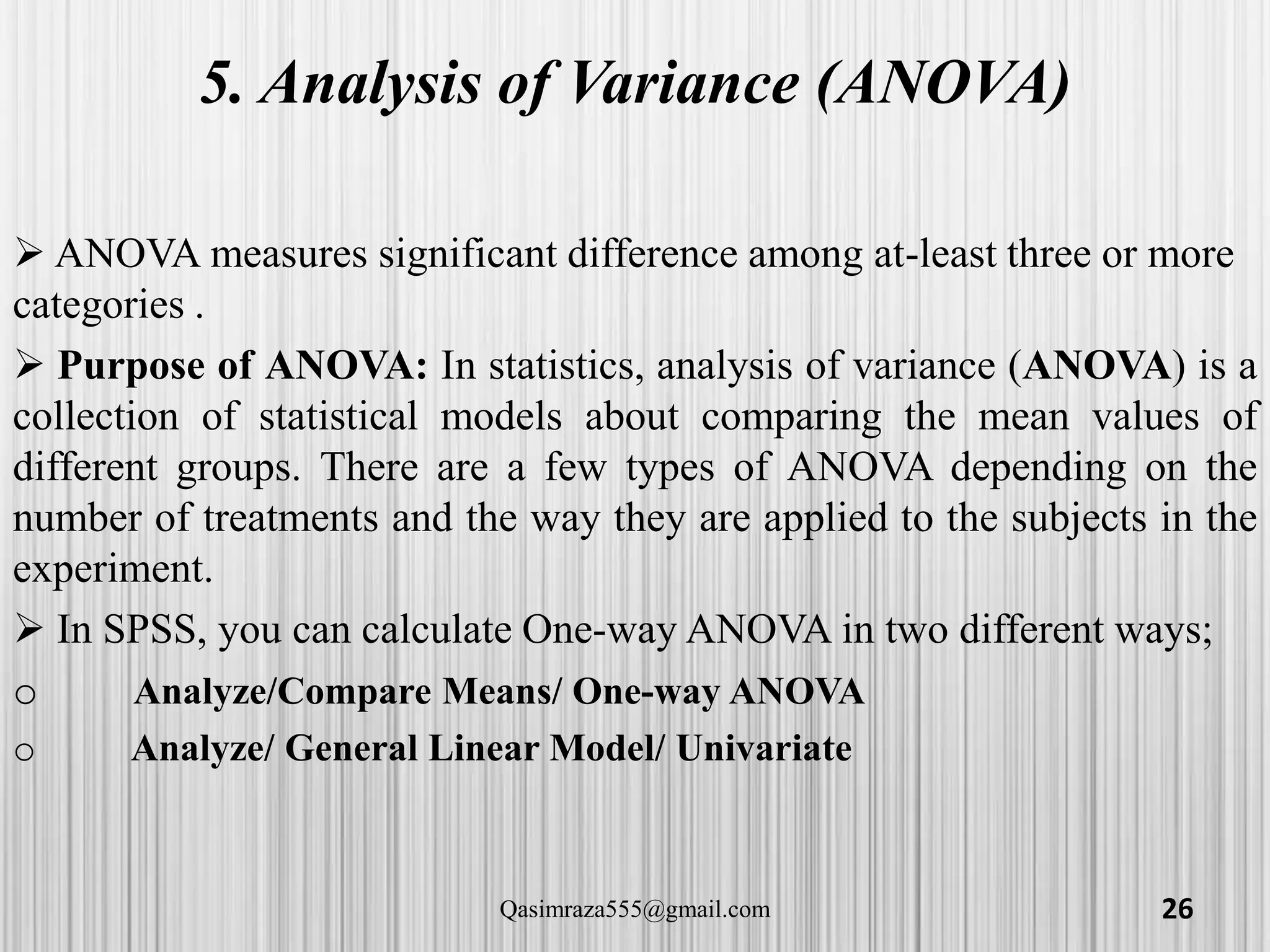
 ANOVA measures significant difference among at-least three or more
categories .
 Purpose of ANOVA: In statistics, analysis of variance (ANOVA) is a
collection of statistical models about comparing the mean values of
different groups. There are a few types of ANOVA depending on the
number of treatments and the way they are applied to the subjects in the
experiment.
 In SPSS, you can calculate One-way ANOVA in two different ways;
o Analyze/Compare Means/ One-way ANOVA
o Analyze/ General Linear Model/ Univariate
26Qasimraza555@gmail.com
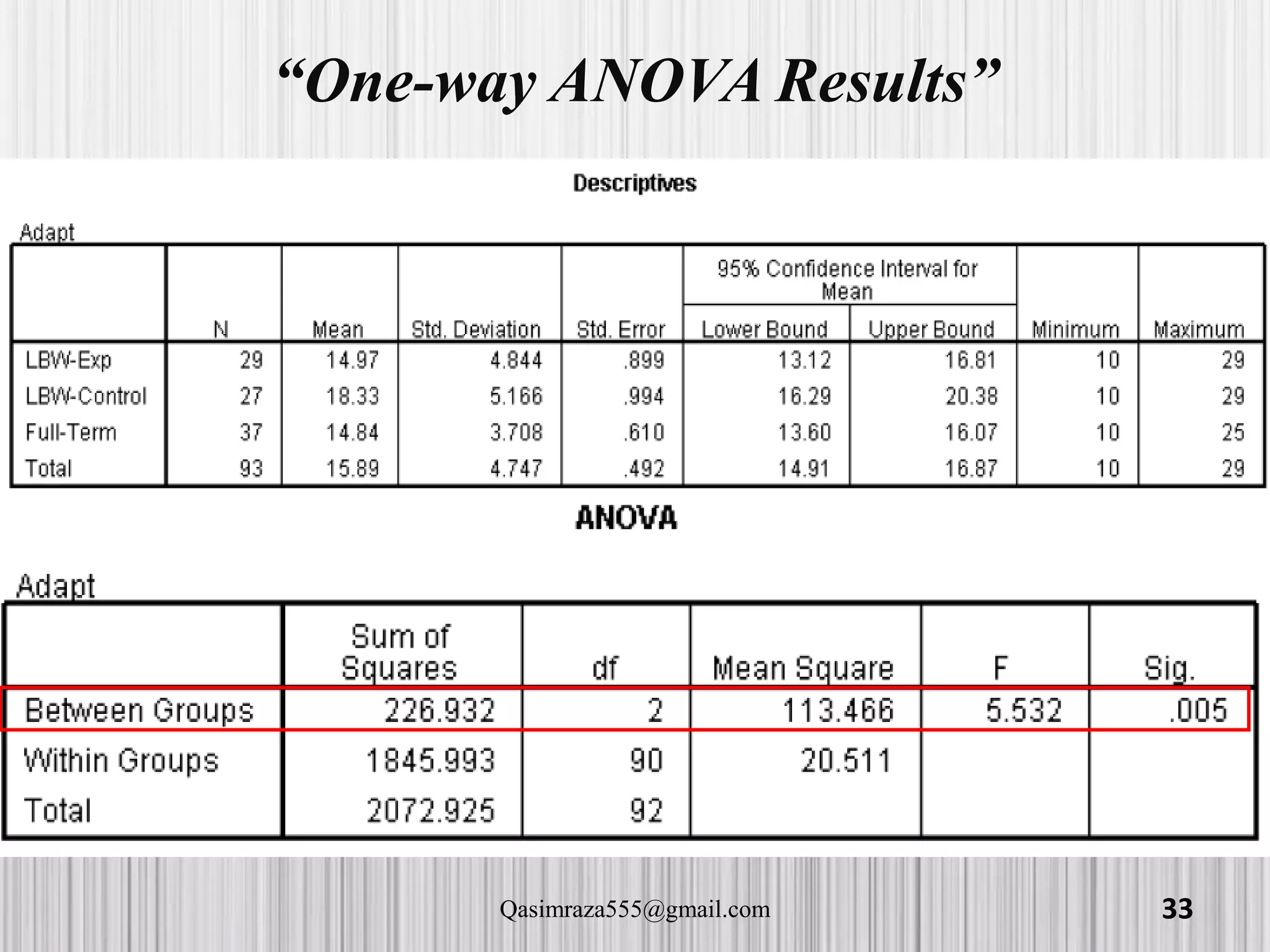
“ Analysis of Variance (ANOVA)”
Null and Alternate Hypothesis:
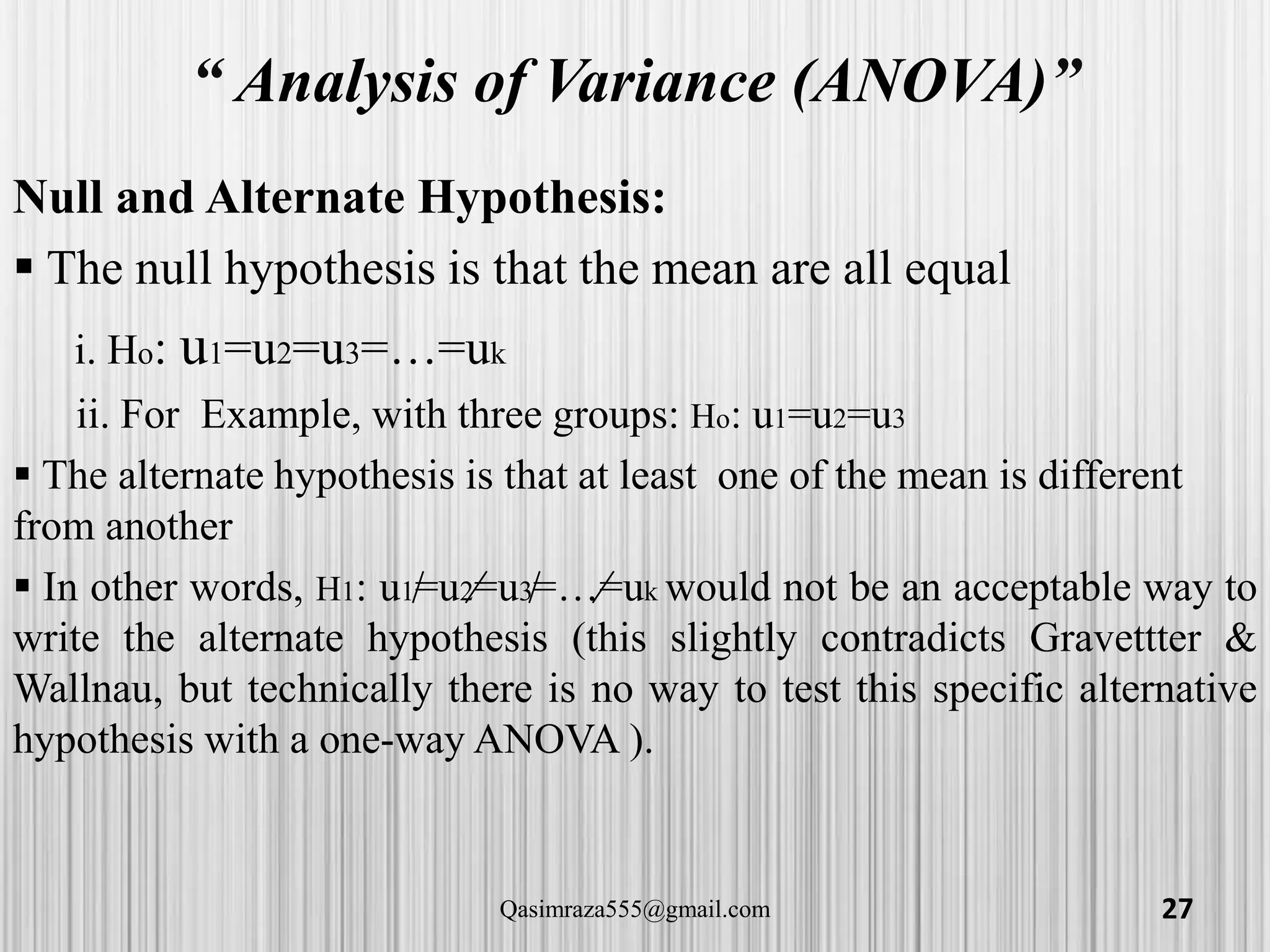
 The null hypothesis is that the mean are all equal
i. Ho: u1=u2=u3=…=uk
ii. For Example, with three groups: Ho: u1=u2=u3
 The alternate hypothesis is that at least one of the mean is different
from another
 In other words, H1: u1=u2=u3=…=uk would not be an acceptable way to
write the alternate hypothesis (this slightly contradicts Gravettter &
Wallnau, but technically there is no way to test this specific alternative
hypothesis with a one-way ANOVA ).
27Qasimraza555@gmail.com
Assumptions
 Level of Measurement assumption:
 According to this assumption one variable should be categorical
having at least 3-subcategories or nominal scale and Test variable
(dependent ) should be measured on interval or Ratio Scale.
 Normality:
 2nd assumption is Normality or Homogeneity of the Test
variable. This means that the test variable should be normal and we
test this by means of Levene’s Test.
The Hypothesis of ANOVA are
Null : means across the categories are equal
Alternate: means across the categories are not equal
28Qasimraza555@gmail.com
Normality
 Homogeneity is whether the variances in the populations are equal.
When conducting an ANOVA, one of the options is to produce a test of
homogeneity in the output, called Levene’s Test.
If Levene’s test is significant (p < .05) then equal variances are NOT assumed,
called heterogeneity.
If Levene’s is not significant (p > .05) then equal variances are assumed, called
homogeneity.
29Qasimraza555@gmail.com
What if
If Test variable is not Normal ,then we switch to the NON-Parametric
alternate to ANOVA i.e.
 Kruskal Wallis Test….
30Qasimraza555@gmail.com
Difference
 ANOVA is different than “t-test” in that the t-test is testing the mean
difference between two groups; whereas ANOVA is testing the mean
difference between three or more groups.
 Examples:
T-test compares two means to each other
(Who is happier: Republicans, Democrats?)
ANOVA compares three or more means to each other
(Happier: Republicans, Democrats, Independents, etc)
31Qasimraza555@gmail.com
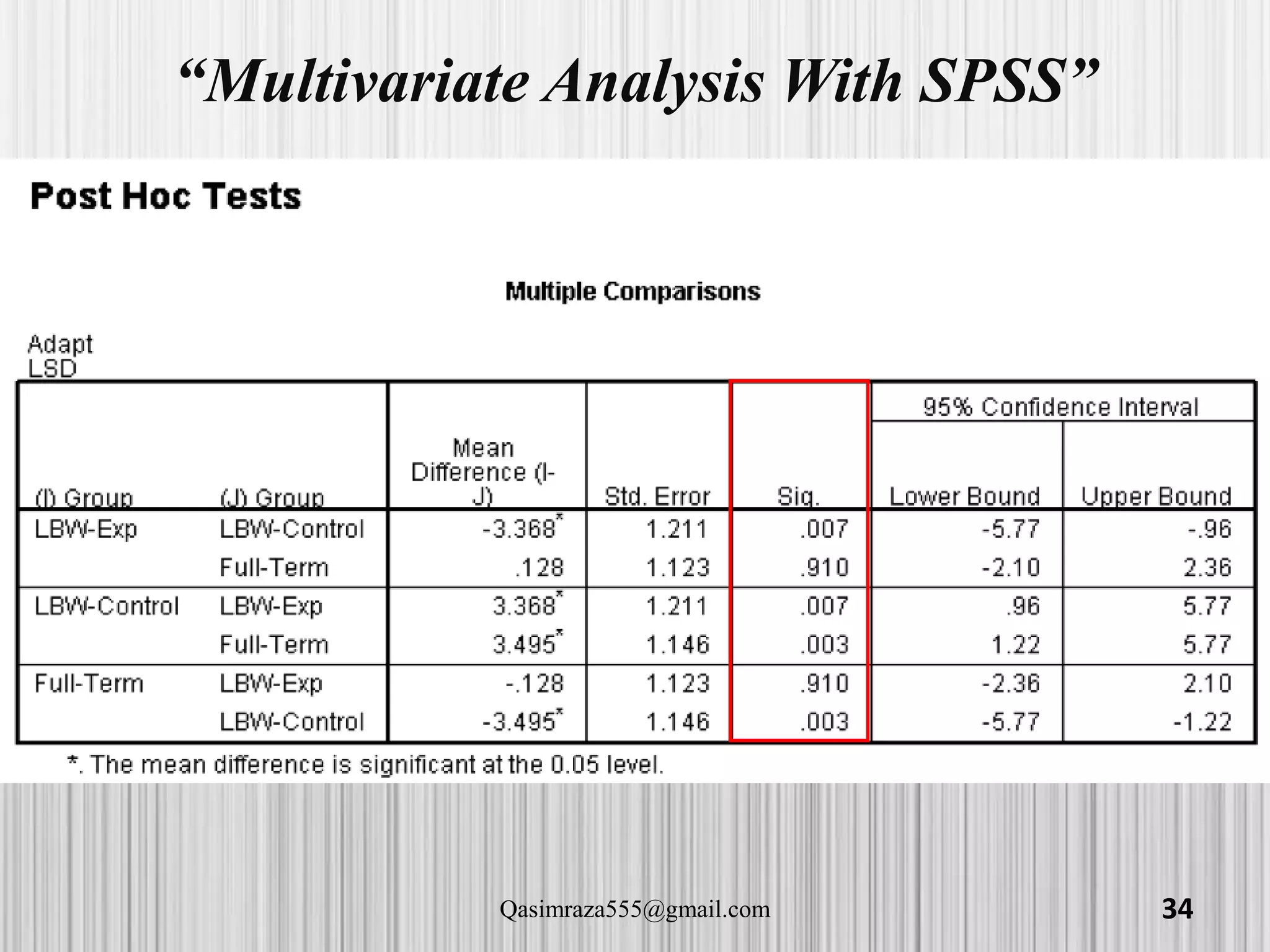
Extension of ANOVA……Post Hoc
 ANOVA Sees only significant difference (Yes/No).
 In order to extend this analysis of measure of difference from one
subsection to another subsection, we proceed to Post Hoc test. With in
Post Hoc test we have further sub-categories in terms of Homogeneity or
Heterogeneity.
 If Normal we proceed as
ANOVA to Post Hoc to Tukey
If Not Normal
ANOVA to Post Hoc to Duuntt’s-3
32Qasimraza555@gmail.com
“One-way ANOVA Results”
33Qasimraza555@gmail.com
“Multivariate Analysis With SPSS”
hhhhyy
34Qasimraza555@gmail.com
“Question & Answer Session”
35Qasimraza555@gmail.com
36Qasimraza555@gmail.com

T test, independant sample, paired sample and anova

  • 1.
    “Multivariate Analysis WithSPSS” 1Qasimraza555@gmail.com
  • 2.
  • 3.
    “Multivariate Analysis WithSPSS” Compare Means Analyses: 1. T-test 2. One-Sample T-test 3. Independent Sample T-test ( Levene’s Test) 1. Paired Sample T-test 2. ANOVA 3. Q & A Session 3Qasimraza555@gmail.com
  • 4.
    1. What ismeant by T-test? The t-test compares the actual difference between two means in relation to the variation in the data (expressed as the standard deviation of the difference between the means). 4Qasimraza555@gmail.com
  • 5.
    2. One-Sample T-test The one-sample t-test allows us to test whether a sample mean is significantly different from a population mean. When only the sample standard deviation is known. Simply, when to use the one-sample t-test, you should consider using this test when you have continuous data collected from group that you want to compare that group’s average scores to some known criterion value (probably a population mean).  Often performed for testing the mean value of distribution.  It can be used under the assumption that sample distribution is normal.  For large samples, the procedure performs often well even for non- normal population. 5Qasimraza555@gmail.com
  • 6.
    One-Sample T-test (Cont…) Example: Totest whether the average weight of student population is different from 140 lb. Data: A random sample of 22 students’ weights from student population. To perform One Sample t-Test for the data above: 135 119 106 135 180 108 128 160 143 175 170 205 195 185 182 150 175 190 180 195 220 235 6Qasimraza555@gmail.com
  • 7.
    One-Sample T-test (Cont…) 1.Create data file: Enter the data in SPSS, with the variable “weight” takes up one column as shown in the picture on the right. 7Qasimraza555@gmail.com
  • 8.
    One-Sample T-test (Cont…) 2.To perform the one sample t-test, first click through the menu selections Analyze / Compare Means / One Sample T Test… as in the following picture, and the One-Sample t-test dialog box will appear on the screen. 8Qasimraza555@gmail.com
  • 9.
    One-Sample T-test (Cont…) Selectthe variable “weight” to be analyzed into the Test Variable box, and enter the Test Value which the average value to be tested with (the mean value specified in the null hypothesis, that is 140 in this example). Click Continue and click OK for performing the test and estimation. The results will be displayed in the SPSS Output window. 9Qasimraza555@gmail.com
  • 10.
    One-Sample T-test (Cont…) InterpretSPSS Output: The statistics for the test are in the following table. The one sample t-test statistic is 3.582 and the p-value from this statistic is .002 and that is less than 0.05 (the level of significance usually used for the test) Such a p-value indicates that the average weight of the sampled population is statistically significantly different from 140 lb. The 95% confidence interval estimate for the difference between the population mean weight and 140 lb is (11.27, 42.46). 10Qasimraza555@gmail.com
  • 11.
    3. Independent Samplet-test  Purpose: test whether or not the populations represented by the two samples have a different mean.  Independent Sample t-test measures the significance difference in the means of the Two categories /variables/Groups.  Examples: o Whether there is a significant difference in the satisfaction level of consumers using Prepaid and Post Paid Packaging…Here we have Package in two subcategories as a variable and Test Variable is Satisfaction Level. o Social work students have higher GPA’s than nursing students o Social work students volunteer for more hours per week than education majors 11Qasimraza555@gmail.com
  • 12.
    Assumptions  Level OfMeasurement: Independent sample t-test assume that grouping variable or categorical variable should be measured on Nominal Scale whereas Test variable should be measured on interval or Ratio Scale. This is LOM for this Test.  Normality: The test variable should be Normal or Homogeneous. In order to check the homogeneity, Independent Sample t-test has Levene’s Test. If Test variable is abnormal or Heterogeneous then we can not proceed to independent sample t-test rather we have to switch for Non-Parametric alternate to independent Sample t-test i.e. Mann Whitney test etc. 12Qasimraza555@gmail.com
  • 13.
    Solving the problemwith SPSS: Evaluating normality 13Qasimraza555@gmail.com
  • 14.
    Solving the problemwith SPSS: Evaluating normality (Cont…) 14Qasimraza555@gmail.com
  • 15.
    Solving the problemwith SPSS: Evaluating normality (Cont…) "Highest year of school completed" [educ] did not satisfy the criteria for a normal distribution. The skewness of the distribution (-.137) was between -1.0 and +1.0, but the kurtosis of the distribution (1.246) fell outside the range from -1.0 to +1.0. Having failed the normality requirement using this criteria, we will see if we can apply the central limit theorem. 15Qasimraza555@gmail.com
  • 16.
    Solving the problemwith SPSS: The independent-samples t-test Select Compare Means > Independent- Samples T Test… from the Analyze menu. 16Qasimraza555@gmail.com
  • 17.
    “Solving the problemwith SPSS: The independent-samples t-test (Cont…) 17Qasimraza555@gmail.com
  • 18.
    Solving the problemwith SPSS: The independent-samples t-test (Cont..) 18Qasimraza555@gmail.com
  • 19.
    Solving the problemwith SPSS: The independent-samples t-test (Cont…) 19Qasimraza555@gmail.com
  • 20.
    Solving the problemwith SPSS: Evaluating equality of group variances The independent-samples t-test assumes that the variances of the dependent variable for both groups are equal in the population. This assumption is evaluated with Levene's Test for Equality of Variances. The null hypothesis for this test states that the variance for both groups are equal. The desired outcome for this test is to fail to reject the null hypothesis, which demonstrates equality. The probability associated with Levene's Test for Equality of Variances (.161) is greater than alpha (.05), indicating that the 'Equal variances assumed' formula for the independent samples t-test should be used for the analysis. 20Qasimraza555@gmail.com
  • 21.
    4. Paired SampleT-test A paired sample t test is used to test if an observed difference between two means is statistically significant i.e. whether there is a significant difference between the average values of the same measurement made under two different conditions. Assumptions for paired sample T-test: To run the paired sample T-test data  Should have normal distribution  Is a large data set  Has no outliers 21Qasimraza555@gmail.com
  • 22.
    Paired Sample T-test(Cont…) Research Questions for Paired Sample T-test Is there an instructional effect taking place in the computer class? Hypothesis for Paired Sample T-test: NULL HYPOTHESIS (H0): H0 specifies that the value for the population parameters are the same. H0 always includes an equality. H0: there is no influence of using internet on academic achievement for this class. ALTERNATE HYPOTHESIS (H1): H1 always includes a non-equality H1: there is an influence of using the internet on academic achievement for this class. 22Qasimraza555@gmail.com
  • 23.
    Paired Sample T-test(Cont…) Steps for paired sample T-test: Click on Analyze/ Compare Means/Paired-Samples T-Test/ Click on Pretest and then Posttest/ Click OK. SPSS Output 23Qasimraza555@gmail.com
  • 24.
    Paired Sample T-test(Cont…) Paired Sample t-test Output: 24Qasimraza555@gmail.com
  • 25.
    Paired Sample T-test(Cont…) Results: Given that the researcher is interested in assessing the results in one direction, this is a one-tailed T-test. The Significance (p) value (2-tailed), located in the above table, must be divided by 2 before reporting the final results. In this case, it remained the same (p = .000/2 = .000). 25Qasimraza555@gmail.com
  • 26.
    5. Analysis ofVariance (ANOVA)  ANOVA measures significant difference among at-least three or more categories .  Purpose of ANOVA: In statistics, analysis of variance (ANOVA) is a collection of statistical models about comparing the mean values of different groups. There are a few types of ANOVA depending on the number of treatments and the way they are applied to the subjects in the experiment.  In SPSS, you can calculate One-way ANOVA in two different ways; o Analyze/Compare Means/ One-way ANOVA o Analyze/ General Linear Model/ Univariate 26Qasimraza555@gmail.com
  • 27.
    “ Analysis ofVariance (ANOVA)” Null and Alternate Hypothesis:  The null hypothesis is that the mean are all equal i. Ho: u1=u2=u3=…=uk ii. For Example, with three groups: Ho: u1=u2=u3  The alternate hypothesis is that at least one of the mean is different from another  In other words, H1: u1=u2=u3=…=uk would not be an acceptable way to write the alternate hypothesis (this slightly contradicts Gravettter & Wallnau, but technically there is no way to test this specific alternative hypothesis with a one-way ANOVA ). 27Qasimraza555@gmail.com
  • 28.
    Assumptions  Level ofMeasurement assumption:  According to this assumption one variable should be categorical having at least 3-subcategories or nominal scale and Test variable (dependent ) should be measured on interval or Ratio Scale.  Normality:  2nd assumption is Normality or Homogeneity of the Test variable. This means that the test variable should be normal and we test this by means of Levene’s Test. The Hypothesis of ANOVA are Null : means across the categories are equal Alternate: means across the categories are not equal 28Qasimraza555@gmail.com
  • 29.
    Normality  Homogeneity iswhether the variances in the populations are equal. When conducting an ANOVA, one of the options is to produce a test of homogeneity in the output, called Levene’s Test. If Levene’s test is significant (p < .05) then equal variances are NOT assumed, called heterogeneity. If Levene’s is not significant (p > .05) then equal variances are assumed, called homogeneity. 29Qasimraza555@gmail.com
  • 30.
    What if If Testvariable is not Normal ,then we switch to the NON-Parametric alternate to ANOVA i.e.  Kruskal Wallis Test…. 30Qasimraza555@gmail.com
  • 31.
    Difference  ANOVA isdifferent than “t-test” in that the t-test is testing the mean difference between two groups; whereas ANOVA is testing the mean difference between three or more groups.  Examples: T-test compares two means to each other (Who is happier: Republicans, Democrats?) ANOVA compares three or more means to each other (Happier: Republicans, Democrats, Independents, etc) 31Qasimraza555@gmail.com
  • 32.
    Extension of ANOVA……PostHoc  ANOVA Sees only significant difference (Yes/No).  In order to extend this analysis of measure of difference from one subsection to another subsection, we proceed to Post Hoc test. With in Post Hoc test we have further sub-categories in terms of Homogeneity or Heterogeneity.  If Normal we proceed as ANOVA to Post Hoc to Tukey If Not Normal ANOVA to Post Hoc to Duuntt’s-3 32Qasimraza555@gmail.com
  • 33.
  • 34.
    “Multivariate Analysis WithSPSS” hhhhyy 34Qasimraza555@gmail.com
  • 35.
    “Question & AnswerSession” 35Qasimraza555@gmail.com
  • 36.