






Five Successful Online
Business Stories
Presented By:
Asim Muhammad
Aslam Ali
Irfan Ali
1
 Introduction
 History
 Product And Services
 Success Factors
 Questions
2
About E-Commerce
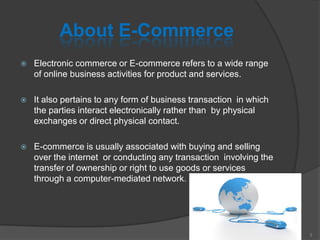
 Electronic commerce or E-commerce refers to a wide range
of online business activities for product and services.
 It also pertains to any form of business transaction in which
the parties interact electronically rather than by physical
exchanges or direct physical contact.
 E-commerce is usually associated with buying and selling
over the internet or conducting any transaction involving the
transfer of ownership or right to use goods or services
through a computer-mediated network.
3
Major types of E-commerce
 Business-to-business (B2B)
 Business-to-consumer (B2C)
 Business-to-government (B2G)
 Consumer-to-consumer (C2C)
4
5
Introduction
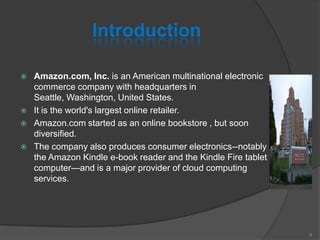
 Amazon.com, Inc. is an American multinational electronic
commerce company with headquarters in
Seattle, Washington, United States.
 It is the world's largest online retailer.
 Amazon.com started as an online bookstore , but soon
diversified.
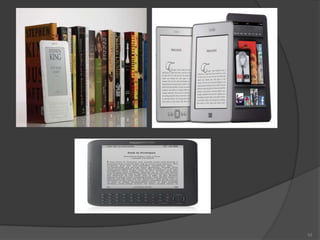
 The company also produces consumer electronics--notably
the Amazon Kindle e-book reader and the Kindle Fire tablet
computer—and is a major provider of cloud computing
services.
6
History
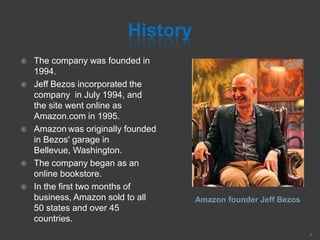
Amazon founder Jeff Bezos
 The company was founded in
1994.
 Jeff Bezos incorporated the
company in July 1994, and
the site went online as
Amazon.com in 1995.
 Amazon was originally founded
in Bezos' garage in
Bellevue, Washington.
 The company began as an
online bookstore.
 In the first two months of
business, Amazon sold to all
50 states and over 45
countries.
7
History (continue)
 Within two months, Amazon's sales were up to
$20,000/week.
 In October 1995, the company announced itself to the public.
 Amazon issued its initial public offering of stock on May
15, 1997, trading under the NASDAQ stock exchange
symbol AMZN, at a price of US$ 18.00 per share.
 In 1999, Time magazine named Bezos the Person of the
Year, recognizing the company's success in popularizing
online shopping.
8
Products and services
 Amazon product lines include books, music CDs, videotapes
and DVDs, software, consumer electronics, kitchen
items, tools, lawn and garden items, toys & games, baby
products, apparel, sporting goods, gourmet
food, jewelry, watches, health and personal-care
items, beauty products, musical
instruments, clothing, industrial & scientific supplies, and
groceries.
 In November 2007, Amazon launched Amazon Kindle, an e-
book reader.
 In September 2011, Amazon announced its entry into the
tablet computer market by introducing the Kindle Fire, which
runs a customized version of the operating system Android.
9
10
Success Factors
 early well developed strategy which was to provide
customer-focused innovation.
 Selling of their shares.
 Establishment of the executive team.
 Lowering prices of their products
 Creating new and unique features
 Expanded their offers.
11
12
Introduction
 eBay Inc. is an American multinational internet consumer-to-
consumer corporation, headquartered in San
Jose, California.
 It was founded in 1995, and became a notable success story
of the dot-com bubble.
 It is now a multi-billion dollar business with operations
localized in over thirty countries.
 The company manages eBay.com, an online auction and
shopping website in which people and businesses buy and
sell a broad variety of goods and services worldwide.
 In addition to its auction-style selling's, the website has since
expanded to include "Buy It Now" standard shopping.
13
History
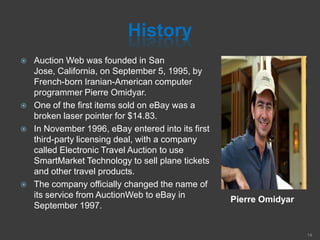
Pierre Omidyar
 Auction Web was founded in San
Jose, California, on September 5, 1995, by
French-born Iranian-American computer
programmer Pierre Omidyar.
 One of the first items sold on eBay was a
broken laser pointer for $14.83.
 In November 1996, eBay entered into its first
third-party licensing deal, with a company
called Electronic Travel Auction to use
SmartMarket Technology to sell plane tickets
and other travel products.
 The company officially changed the name of
its service from AuctionWeb to eBay in
September 1997.
14
History (continue)
 In 1997, the company received $6.7 million in funding from
the venture capital firm Benchmark Capital.
 eBay went public on September 21, 1998.
 As the company expanded product categories beyond
collectibles into almost any saleable item, business grew
quickly.
 In February 2002, the company purchased IBazar, a similar
European auction web site founded in 1993 and then bought
PayPal on October 14, 2002.
 By early 2008, the company had expanded
worldwide, counted hundreds of millions of registered
users, 15,000+ employees and revenues of almost $7.7
billion.
15
History (continue)
 In late 2009, eBay completed the sale of Skype for $2.75
billion, but will still own 30% equity in the company.
 On December 20, 2010, eBay announced its acquisition of a
German online shopping club, brands4friends.de, for €150
million ($197 million) to strengthen the company's interests
in the fashion industry in Europe.
16
Product And Services
 Millions of
collectibles, decor, appliances, computers, furnishings, equip
ment, domain names, vehicles, and other miscellaneous
items are listed, bought, or sold daily on eBay.
 In 2006, eBay launched its Business & Industrial
category, breaking into the industrial surplus business.
 Large international companies, such as IBM, sell their
newest products and offer services on eBay using
competitive auctions and fixed-priced storefronts.
 Separate eBay sites such as eBay US and eBay UK allow
the users to trade using the local currency.
17
Success Factors
 Feedback
 Buyer protection
 Bigger Market
 Range of items
 Competitive Prices
18
19
Introduction
 It is a privately owned Hangzhou-based family of Internet-
based E-Commerce businesses.
 It cover business-to-business online marketplaces, retail and
payment platforms, shopping search engine and data-centric
cloud computing services.
 In 2012, two of Alibaba’s portals together handled 1.1 trillion
yuan ($170 billion) in sales, more than competitors eBay and
Amazon combined.
 The company primarily operates in the People’s Republic of
China.
 The company is estimated to have a valuation between $55
billion to more than $120 billion.
20
History
 In December 1998, Jack Ma and other 17 founders released
their first online marketplace named "Alibaba Online".
 The company began in 1999 with the web domain
Alibaba.com a business-to-business portal to connect
Chinese manufacturers with overseas buyers.
 From 1999 to 2000, Alibaba Group raised a total of US$25
million from Softbank, Goldman Sachs, Fidelity and some
other institutions.
 In December 2001, Alibaba.com achieved profitability.
 In May 2003, Taobao was founded as a consumer e-
commerce platform.
 In December 2004, Alipay, which started as a service on the
Taobao platform, became an independent business.
21
History (continue)
 In October 2005, Alibaba Group took over the operation of
China Yahoo! as part of its strategic partnership with Yahoo!
Inc.
 In November, 2007, Alibaba.com successfully listed on the
Hong Kong Stock Exchange.
 In April 2008, Taobao established Taobao Mall
(Tmall.com), a dedicated B2C platform, to complement its
C2C marketplace.
 In September 2008, Alibaba Group R&D Institute was
established.
 In September 2009, Alibaba Group established Alibaba
Cloud Computing.
 In May 2010, Alibaba Group announced a plan to earmark
0.3% of its annual revenues to fund environmental protection
initiatives.
22
History (continue)
 In October 2010, Taobao beta-launched eTao as an
independent shopping search engine.
 In June 2011, Alibaba Group reorganized Taobao into three
separate companies: Taobao Marketplace, Taobao Mall
(Tmall.com) and eTao.
 In January 2012, Tmall.com changed its Chinese name as
part of a rebranding exercise .
23
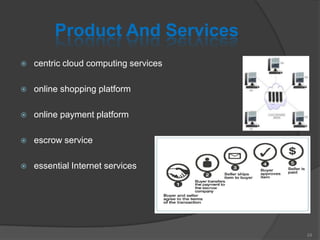
Product And Services
 centric cloud computing services
 online shopping platform
 online payment platform
 escrow service
 essential Internet services
24
Success Factors
 Company Name
 Online Payment System
 Believed that Alibaba is a Small Company
25
26
Introduction
 OLX is an internet company based in New York City and
Buenos Aires, Argentina.
 The company offers its services in the United States and
internationally.
 OLX website hosts free user-generated classified
advertisements for urban communities around the world and
provides discussion forums sorted by various topics.
 OLX, Inc. operates an online classifieds site.
 OLX gained prominence upon announcing a partnership with
Friendster, the social networking website.
27
History
 The company was co-founded in March 2006 by internet
entrepreneurs Fabrica Grinda and Alec Oxenford.
 OLX is used in over 105 countries in 40 languages.
 As of January 2011, OLX is available in 96 countries and 45
languages.
 In August 2009, OLX was named a good competitor to
Craigslist in the United States.
 In December 2009, OLX Inc. was named a rival to Craigslist
by Business Week.
 In January 2010, OLX was named one of New York City's 10
hottest tech startups.
28
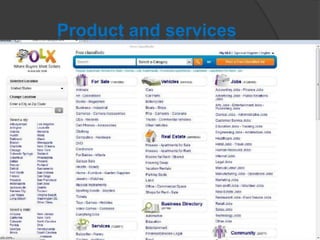
Product and services
29
Success Factors
 Easily available products that the customer needs at good
cost.
 Colorful listings with pictures and videos.
 Available in 96 countries and 45 languages.
30
31
Introduction
 Facebook is an online social networking service.
 It was founded in February 2004 by Mark Zuckerberg with
his college roommates and fellow Harvard University
students Eduardo Saverin, Andrew McCollum, Dustin
Moskovitz and Chris Hughes.
 The website's membership was initially limited by the
founders to Harvard students.
 Facebook now allows any users who declare themselves to
be at least 13 years old to become registered users of the
site.
 Facebook has over one billion active users.
 According to a May 2011 Consumer Reports survey, there
are 7.5 million children under 13 with accounts and 5 million
under 10, violating the site's terms of service.
32
History
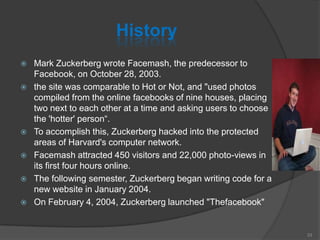
 Mark Zuckerberg wrote Facemash, the predecessor to
Facebook, on October 28, 2003.
 the site was comparable to Hot or Not, and "used photos
compiled from the online facebooks of nine houses, placing
two next to each other at a time and asking users to choose
the 'hotter' person“.
 To accomplish this, Zuckerberg hacked into the protected
areas of Harvard's computer network.
 Facemash attracted 450 visitors and 22,000 photo-views in
its first four hours online.
 The following semester, Zuckerberg began writing code for a
new website in January 2004.
 On February 4, 2004, Zuckerberg launched "Thefacebook"
33
History (continue)
 Six days after the site launched, three Harvard
seniors, Cameron Winklevoss, Tyler Winklevoss, and Divya
Narendra, accused Zuckerberg of intentionally misleading
them into believing he would help them build a social
network called HarvardConnection.com
 The three later filed a lawsuit against Zuckerberg.
 In mid-2004, entrepreneur Sean Parker, who had been
informally advising Zuckerberg, became the company's
president.
 In June 2004, Facebook moved its base of operations to
Palo Alto, California.
 It received its first investment later that month from PayPal
co-founder Peter Thiel.
34
History (continue)
 The company dropped The from its name after purchasing
the domain name facebook.com in 2005 for $200,000.
 Late in 2007, Facebook had 100,000 business
pages, allowing companies to attract potential customers
and tell about themselves.
 These started as group pages.
 On October 24, 2007, Microsoft announced that it had
purchased a 1.6% share of Facebook for $240 million, giving
Facebook a total implied value of around $15 billion.
 In October 2008, Facebook announced that it would set up
its international headquarters in Dublin, Ireland.
 Facebook's value was $41 billion and it became the third
largest U.S. Web company after Google and Amazon.
35
Success Factors
 There was a huge market
 Privacy
 Features and the Experience
 socioeconomic motives
36
37

5 Successful Business Stories

  • 1.
    Five Successful Online BusinessStories Presented By: Asim Muhammad Aslam Ali Irfan Ali 1
  • 2.
     Introduction  History Product And Services  Success Factors  Questions 2
  • 3.
    About E-Commerce  Electroniccommerce or E-commerce refers to a wide range of online business activities for product and services.  It also pertains to any form of business transaction in which the parties interact electronically rather than by physical exchanges or direct physical contact.  E-commerce is usually associated with buying and selling over the internet or conducting any transaction involving the transfer of ownership or right to use goods or services through a computer-mediated network. 3
  • 4.
    Major types ofE-commerce  Business-to-business (B2B)  Business-to-consumer (B2C)  Business-to-government (B2G)  Consumer-to-consumer (C2C) 4
  • 5.
  • 6.
    Introduction  Amazon.com, Inc.is an American multinational electronic commerce company with headquarters in Seattle, Washington, United States.  It is the world's largest online retailer.  Amazon.com started as an online bookstore , but soon diversified.  The company also produces consumer electronics--notably the Amazon Kindle e-book reader and the Kindle Fire tablet computer—and is a major provider of cloud computing services. 6
  • 7.
    History Amazon founder JeffBezos  The company was founded in 1994.  Jeff Bezos incorporated the company in July 1994, and the site went online as Amazon.com in 1995.  Amazon was originally founded in Bezos' garage in Bellevue, Washington.  The company began as an online bookstore.  In the first two months of business, Amazon sold to all 50 states and over 45 countries. 7
  • 8.
    History (continue)  Withintwo months, Amazon's sales were up to $20,000/week.  In October 1995, the company announced itself to the public.  Amazon issued its initial public offering of stock on May 15, 1997, trading under the NASDAQ stock exchange symbol AMZN, at a price of US$ 18.00 per share.  In 1999, Time magazine named Bezos the Person of the Year, recognizing the company's success in popularizing online shopping. 8
  • 9.
    Products and services Amazon product lines include books, music CDs, videotapes and DVDs, software, consumer electronics, kitchen items, tools, lawn and garden items, toys & games, baby products, apparel, sporting goods, gourmet food, jewelry, watches, health and personal-care items, beauty products, musical instruments, clothing, industrial & scientific supplies, and groceries.  In November 2007, Amazon launched Amazon Kindle, an e- book reader.  In September 2011, Amazon announced its entry into the tablet computer market by introducing the Kindle Fire, which runs a customized version of the operating system Android. 9
  • 10.
  • 11.
    Success Factors  earlywell developed strategy which was to provide customer-focused innovation.  Selling of their shares.  Establishment of the executive team.  Lowering prices of their products  Creating new and unique features  Expanded their offers. 11
  • 12.
  • 13.
    Introduction  eBay Inc.is an American multinational internet consumer-to- consumer corporation, headquartered in San Jose, California.  It was founded in 1995, and became a notable success story of the dot-com bubble.  It is now a multi-billion dollar business with operations localized in over thirty countries.  The company manages eBay.com, an online auction and shopping website in which people and businesses buy and sell a broad variety of goods and services worldwide.  In addition to its auction-style selling's, the website has since expanded to include "Buy It Now" standard shopping. 13
  • 14.
    History Pierre Omidyar  AuctionWeb was founded in San Jose, California, on September 5, 1995, by French-born Iranian-American computer programmer Pierre Omidyar.  One of the first items sold on eBay was a broken laser pointer for $14.83.  In November 1996, eBay entered into its first third-party licensing deal, with a company called Electronic Travel Auction to use SmartMarket Technology to sell plane tickets and other travel products.  The company officially changed the name of its service from AuctionWeb to eBay in September 1997. 14
  • 15.
    History (continue)  In1997, the company received $6.7 million in funding from the venture capital firm Benchmark Capital.  eBay went public on September 21, 1998.  As the company expanded product categories beyond collectibles into almost any saleable item, business grew quickly.  In February 2002, the company purchased IBazar, a similar European auction web site founded in 1993 and then bought PayPal on October 14, 2002.  By early 2008, the company had expanded worldwide, counted hundreds of millions of registered users, 15,000+ employees and revenues of almost $7.7 billion. 15
  • 16.
    History (continue)  Inlate 2009, eBay completed the sale of Skype for $2.75 billion, but will still own 30% equity in the company.  On December 20, 2010, eBay announced its acquisition of a German online shopping club, brands4friends.de, for €150 million ($197 million) to strengthen the company's interests in the fashion industry in Europe. 16
  • 17.
    Product And Services Millions of collectibles, decor, appliances, computers, furnishings, equip ment, domain names, vehicles, and other miscellaneous items are listed, bought, or sold daily on eBay.  In 2006, eBay launched its Business & Industrial category, breaking into the industrial surplus business.  Large international companies, such as IBM, sell their newest products and offer services on eBay using competitive auctions and fixed-priced storefronts.  Separate eBay sites such as eBay US and eBay UK allow the users to trade using the local currency. 17
  • 18.
    Success Factors  Feedback Buyer protection  Bigger Market  Range of items  Competitive Prices 18
  • 19.
  • 20.
    Introduction  It isa privately owned Hangzhou-based family of Internet- based E-Commerce businesses.  It cover business-to-business online marketplaces, retail and payment platforms, shopping search engine and data-centric cloud computing services.  In 2012, two of Alibaba’s portals together handled 1.1 trillion yuan ($170 billion) in sales, more than competitors eBay and Amazon combined.  The company primarily operates in the People’s Republic of China.  The company is estimated to have a valuation between $55 billion to more than $120 billion. 20
  • 21.
    History  In December1998, Jack Ma and other 17 founders released their first online marketplace named "Alibaba Online".  The company began in 1999 with the web domain Alibaba.com a business-to-business portal to connect Chinese manufacturers with overseas buyers.  From 1999 to 2000, Alibaba Group raised a total of US$25 million from Softbank, Goldman Sachs, Fidelity and some other institutions.  In December 2001, Alibaba.com achieved profitability.  In May 2003, Taobao was founded as a consumer e- commerce platform.  In December 2004, Alipay, which started as a service on the Taobao platform, became an independent business. 21
  • 22.
    History (continue)  InOctober 2005, Alibaba Group took over the operation of China Yahoo! as part of its strategic partnership with Yahoo! Inc.  In November, 2007, Alibaba.com successfully listed on the Hong Kong Stock Exchange.  In April 2008, Taobao established Taobao Mall (Tmall.com), a dedicated B2C platform, to complement its C2C marketplace.  In September 2008, Alibaba Group R&D Institute was established.  In September 2009, Alibaba Group established Alibaba Cloud Computing.  In May 2010, Alibaba Group announced a plan to earmark 0.3% of its annual revenues to fund environmental protection initiatives. 22
  • 23.
    History (continue)  InOctober 2010, Taobao beta-launched eTao as an independent shopping search engine.  In June 2011, Alibaba Group reorganized Taobao into three separate companies: Taobao Marketplace, Taobao Mall (Tmall.com) and eTao.  In January 2012, Tmall.com changed its Chinese name as part of a rebranding exercise . 23
  • 24.
    Product And Services centric cloud computing services  online shopping platform  online payment platform  escrow service  essential Internet services 24
  • 25.
    Success Factors  CompanyName  Online Payment System  Believed that Alibaba is a Small Company 25
  • 26.
  • 27.
    Introduction  OLX isan internet company based in New York City and Buenos Aires, Argentina.  The company offers its services in the United States and internationally.  OLX website hosts free user-generated classified advertisements for urban communities around the world and provides discussion forums sorted by various topics.  OLX, Inc. operates an online classifieds site.  OLX gained prominence upon announcing a partnership with Friendster, the social networking website. 27
  • 28.
    History  The companywas co-founded in March 2006 by internet entrepreneurs Fabrica Grinda and Alec Oxenford.  OLX is used in over 105 countries in 40 languages.  As of January 2011, OLX is available in 96 countries and 45 languages.  In August 2009, OLX was named a good competitor to Craigslist in the United States.  In December 2009, OLX Inc. was named a rival to Craigslist by Business Week.  In January 2010, OLX was named one of New York City's 10 hottest tech startups. 28
  • 29.
  • 30.
    Success Factors  Easilyavailable products that the customer needs at good cost.  Colorful listings with pictures and videos.  Available in 96 countries and 45 languages. 30
  • 31.
  • 32.
    Introduction  Facebook isan online social networking service.  It was founded in February 2004 by Mark Zuckerberg with his college roommates and fellow Harvard University students Eduardo Saverin, Andrew McCollum, Dustin Moskovitz and Chris Hughes.  The website's membership was initially limited by the founders to Harvard students.  Facebook now allows any users who declare themselves to be at least 13 years old to become registered users of the site.  Facebook has over one billion active users.  According to a May 2011 Consumer Reports survey, there are 7.5 million children under 13 with accounts and 5 million under 10, violating the site's terms of service. 32
  • 33.
    History  Mark Zuckerbergwrote Facemash, the predecessor to Facebook, on October 28, 2003.  the site was comparable to Hot or Not, and "used photos compiled from the online facebooks of nine houses, placing two next to each other at a time and asking users to choose the 'hotter' person“.  To accomplish this, Zuckerberg hacked into the protected areas of Harvard's computer network.  Facemash attracted 450 visitors and 22,000 photo-views in its first four hours online.  The following semester, Zuckerberg began writing code for a new website in January 2004.  On February 4, 2004, Zuckerberg launched "Thefacebook" 33
  • 34.
    History (continue)  Sixdays after the site launched, three Harvard seniors, Cameron Winklevoss, Tyler Winklevoss, and Divya Narendra, accused Zuckerberg of intentionally misleading them into believing he would help them build a social network called HarvardConnection.com  The three later filed a lawsuit against Zuckerberg.  In mid-2004, entrepreneur Sean Parker, who had been informally advising Zuckerberg, became the company's president.  In June 2004, Facebook moved its base of operations to Palo Alto, California.  It received its first investment later that month from PayPal co-founder Peter Thiel. 34
  • 35.
    History (continue)  Thecompany dropped The from its name after purchasing the domain name facebook.com in 2005 for $200,000.  Late in 2007, Facebook had 100,000 business pages, allowing companies to attract potential customers and tell about themselves.  These started as group pages.  On October 24, 2007, Microsoft announced that it had purchased a 1.6% share of Facebook for $240 million, giving Facebook a total implied value of around $15 billion.  In October 2008, Facebook announced that it would set up its international headquarters in Dublin, Ireland.  Facebook's value was $41 billion and it became the third largest U.S. Web company after Google and Amazon. 35
  • 36.
    Success Factors  Therewas a huge market  Privacy  Features and the Experience  socioeconomic motives 36
  • 37.