


Presented By:
Irfan Ali
Tauqeer Abbasi
1
1. Techniques of sampling or Sample
Methods
2. Sample size criteria,
3. Generalizability
4. Reliability analysis
Presentation Agenda
2
Sampling:
The process of selecting a number of
individuals for a study such a way that the
individuals represent the larger group from
which they were selected
Sample:
The representatives selected for a study whose
characteristics exemplify the larger group from
which they were selected
Sampling a Population
3
The larger group from which individuals are
selected to participate in a study.
The purpose for sampling:
To gather data about the population in order to
make an inference that can be generalized to the
population.
Population
4
Sampling error
 The chance and random variation in variables that occurs
when any sample is selected from the population.
 Sampling error is to be expected
 To avoid sampling error, a census of the entire
population must be taken
5
• Nonsampling errors are more serious and are due
to mistakes made in the acquisition of data or due to
the sample observations being selected improperly.
• Most likely caused be poor planning, sloppy work,
act of the Goddess of Statistics, etc
Non-Sampling Errors…
6
Steps in sampling...
 Define population (N) to be sampled.
 Determine sample size (n).
 Control for bias and error.
 Select sample.
7
1. Define population to be sampled...
 Identify the group of interest and its characteristics to
which the findings of the study will be generalized.
 It also called the “target” population (the ideal
selection).
 smaller samples are more likely not to be
representative.
8
2. Determine the sample size...
 The size of the sample influences both the
representativeness of the sample and the statistical
analysis of the data.
 larger samples are more likely to detect a
difference between different groups
9
2-Rules of thumb for determining the
sample size.
 The larger the population size, the smaller the
percentage of the population required to get a
representative sample.
 For smaller samples (N ‹ 100), there is little point in
sampling. Survey the entire population.
 If the population size is around 500 (give or take
100), 50% should be sampled.
10
Rules of thumb for determining
the sample size...
 If the population size is around 1500, 20% should
be sampled.
 Beyond a certain point (N = 5000), the population
size is almost irrelevant and a sample size of 400
may be adequate.
11
3. Control for sampling bias and error...
 Be aware of the sources of sampling bias and
identify how to avoid it
 Decide whether the bias is so severe that the results of
the study will be seriously affected
 In the final report, document awareness of bias,
rationale for proceeding, and potential effects
12
4. Select the sample...
• A process by which the researcher attempts to
ensure that the sample is representative of the
population from which it is to be selected
• Requires identifying the sampling method that will
be used.
13
Approaches to quantitative sampling...
 Random: allows a procedure governed by chance to
select the sample; controls for sampling bias
 Non Random (“non probability”): does not have
random sampling at any state of the sample
selection; increases probability of sampling bias.
14
Random sampling methods...
• 1. Simple random sampling
2. Stratified sampling
3. Cluster sampling
4. Systematic sampling
15
1. Simple random sampling
The process of selecting a sample that allows individual in
the defined population to have an equal and independent
chance of being selected for the sample.
Example:
Drawing three names from a hat containing all the names of the
students in the class is an example of a simple random sample:
any group of three names is as equally likely as picking any other
group of three names.
16
Steps in random sampling...
1. Identify and define the population.
2. Determine the desired sample size.
3. List all members of the population.
4. Assign all individuals on the list a consecutive number
from zero to the required number. Each individual must
have the same number of digits as each other
individual.
17
Steps in random sampling...
5. Select an arbitrary number in the table of random
numbers.
6. For the selected number, look only at the number of
digits assigned to each population member.
7. If the number corresponds to the number assigned to
any of the individuals in the population, then that
individual is included in the sample.
8. Go to the next number in the column and repeat step
#7 until the desired number of individuals has been
selected for the sample.
18
Advantages
• Easy to conduct.
• Strategy requires minimum knowledge of the
population to be sampled.
19
Disadvantages
 Need names of all population members
 May over- represent or under- estimate sample
members
 There is difficulty in reaching all selected in the sample
20
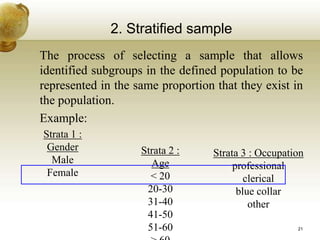
2. Stratified sample
The process of selecting a sample that allows
identified subgroups in the defined population to be
represented in the same proportion that they exist in
the population.
Example:
Strata 1 :
Gender
Male
Female
Strata 2 :
Age
< 20
20-30
31-40
41-50
51-60
Strata 3 : Occupation
professional
clerical
blue collar
other
21
Steps in stratified sampling...
1. Identify and define the population.
2. Determine the desired sample size.
3. Identify the variable and subgroups (strata) for which
you want to guarantee appropriate, equal
representation.
4. Classify all members of the population as members of
one identified subgroup.
5. Randomly select, using a table of random numbers) an
“appropriate” number of individuals from each of the
subgroups, appropriate meaning an equal number of
individuals
22
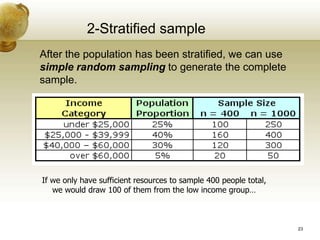
2-Stratified sample
After the population has been stratified, we can use
simple random sampling to generate the complete
sample.
If we only have sufficient resources to sample 400 people total,
we would draw 100 of them from the low income group…
23
3. Cluster sampling
The process of randomly selecting intact groups, not
individuals, within the defined population sharing
similar characteristics.
24
Steps in cluster sampling...
3. Identify and define a logical cluster.
4. List all clusters (or obtain a list) that make up the
population of clusters.
1. Identify and define the population.
2. Determine the desired sample size.
5. Estimate the average number of population members
per cluster.
6. Determine the number of clusters needed by dividing
the sample size by the estimated size of a cluster.
8. Include in your study all population members in each
selected cluster. 25
4. Systematic sampling
• the process of selecting individuals within the
defined population from a list by taking every Kth
name.
26
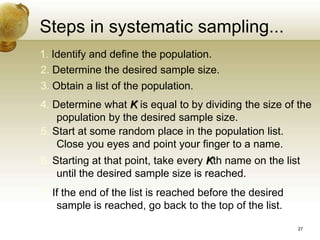
Steps in systematic sampling...
1. Identify and define the population.
2. Determine the desired sample size.
3. Obtain a list of the population.
4. Determine what K is equal to by dividing the size of the
population by the desired sample size.
5. Start at some random place in the population list.
Close you eyes and point your finger to a name.
6. Starting at that point, take every Kth name on the list
until the desired sample size is reached.
7. If the end of the list is reached before the desired
sample is reached, go back to the top of the list.
27
Nonrandom sampling methods.
1. Convenience sampling
2. Purposive sampling
3. Quota sampling
28
• The process of including whoever happens to be
available at the time.
…called “accidental” or “haphazard” sampling.
1. Convenience sampling
1. A type of no probability sampling which involves the
sample being drawn from that part of the population
which is close to hand. That is, readily available and
convenient.
2. The researcher using such a sample cannot
scientifically make generalizations about the total
population from this sample because it would not be
representative enough.
29
2. Purposive sampling
2. The process whereby the researcher selects
a sample based on experience or
knowledge of the group to be sampled
…called “judgment” sampling
30
3. Quota sampling
The process whereby a researcher gathers data from
individuals possessing identified characteristics and
quotas.
• The population is first segmented into mutually
exclusive sub-groups, just as in stratified sampling.
• Then judgment used to select subjects or units
from each segment based on a specified
proportion.
• For example, an interviewer may be told to sample
200 females and 300 males between the age of 45
and 60.
• It is this second step which makes the technique
one of non-probability sampling.
• In quota sampling the selection of the sample is
non-random. 31
Reliability of data
• The reliability of sampling data depends on the
following factors.
1. Size of Sample:
For this law to hold good, size of the sample should
be large. If the size of the sample is small,
conclusions drawn on its bias will lack reliability.
2. Methods of Sampling:
• If the method of sampling is not simple it will not
adequately represent population. Therefore, the
results based on the sample will not be dependable.
32
3. Bias of Correspondents:
Personal bias of the correspondents should be less
as far as possible. Otherwise, reliability of the
sampling data is bound to suffer
4. Training of Enumerators:
Reliability of sample depends on the training of the
investigator. If they are not trained, the sample will
lack reliability.
Reliability of data
33
34
35

Sampling For Multivariate Data Analysis

  • 1.
  • 2.
    1. Techniques ofsampling or Sample Methods 2. Sample size criteria, 3. Generalizability 4. Reliability analysis Presentation Agenda 2
  • 3.
    Sampling: The process ofselecting a number of individuals for a study such a way that the individuals represent the larger group from which they were selected Sample: The representatives selected for a study whose characteristics exemplify the larger group from which they were selected Sampling a Population 3
  • 4.
    The larger groupfrom which individuals are selected to participate in a study. The purpose for sampling: To gather data about the population in order to make an inference that can be generalized to the population. Population 4
  • 5.
    Sampling error  Thechance and random variation in variables that occurs when any sample is selected from the population.  Sampling error is to be expected  To avoid sampling error, a census of the entire population must be taken 5
  • 6.
    • Nonsampling errorsare more serious and are due to mistakes made in the acquisition of data or due to the sample observations being selected improperly. • Most likely caused be poor planning, sloppy work, act of the Goddess of Statistics, etc Non-Sampling Errors… 6
  • 7.
    Steps in sampling... Define population (N) to be sampled.  Determine sample size (n).  Control for bias and error.  Select sample. 7
  • 8.
    1. Define populationto be sampled...  Identify the group of interest and its characteristics to which the findings of the study will be generalized.  It also called the “target” population (the ideal selection).  smaller samples are more likely not to be representative. 8
  • 9.
    2. Determine thesample size...  The size of the sample influences both the representativeness of the sample and the statistical analysis of the data.  larger samples are more likely to detect a difference between different groups 9
  • 10.
    2-Rules of thumbfor determining the sample size.  The larger the population size, the smaller the percentage of the population required to get a representative sample.  For smaller samples (N ‹ 100), there is little point in sampling. Survey the entire population.  If the population size is around 500 (give or take 100), 50% should be sampled. 10
  • 11.
    Rules of thumbfor determining the sample size...  If the population size is around 1500, 20% should be sampled.  Beyond a certain point (N = 5000), the population size is almost irrelevant and a sample size of 400 may be adequate. 11
  • 12.
    3. Control forsampling bias and error...  Be aware of the sources of sampling bias and identify how to avoid it  Decide whether the bias is so severe that the results of the study will be seriously affected  In the final report, document awareness of bias, rationale for proceeding, and potential effects 12
  • 13.
    4. Select thesample... • A process by which the researcher attempts to ensure that the sample is representative of the population from which it is to be selected • Requires identifying the sampling method that will be used. 13
  • 14.
    Approaches to quantitativesampling...  Random: allows a procedure governed by chance to select the sample; controls for sampling bias  Non Random (“non probability”): does not have random sampling at any state of the sample selection; increases probability of sampling bias. 14
  • 15.
    Random sampling methods... •1. Simple random sampling 2. Stratified sampling 3. Cluster sampling 4. Systematic sampling 15
  • 16.
    1. Simple randomsampling The process of selecting a sample that allows individual in the defined population to have an equal and independent chance of being selected for the sample. Example: Drawing three names from a hat containing all the names of the students in the class is an example of a simple random sample: any group of three names is as equally likely as picking any other group of three names. 16
  • 17.
    Steps in randomsampling... 1. Identify and define the population. 2. Determine the desired sample size. 3. List all members of the population. 4. Assign all individuals on the list a consecutive number from zero to the required number. Each individual must have the same number of digits as each other individual. 17
  • 18.
    Steps in randomsampling... 5. Select an arbitrary number in the table of random numbers. 6. For the selected number, look only at the number of digits assigned to each population member. 7. If the number corresponds to the number assigned to any of the individuals in the population, then that individual is included in the sample. 8. Go to the next number in the column and repeat step #7 until the desired number of individuals has been selected for the sample. 18
  • 19.
    Advantages • Easy toconduct. • Strategy requires minimum knowledge of the population to be sampled. 19
  • 20.
    Disadvantages  Need namesof all population members  May over- represent or under- estimate sample members  There is difficulty in reaching all selected in the sample 20
  • 21.
    2. Stratified sample Theprocess of selecting a sample that allows identified subgroups in the defined population to be represented in the same proportion that they exist in the population. Example: Strata 1 : Gender Male Female Strata 2 : Age < 20 20-30 31-40 41-50 51-60 Strata 3 : Occupation professional clerical blue collar other 21
  • 22.
    Steps in stratifiedsampling... 1. Identify and define the population. 2. Determine the desired sample size. 3. Identify the variable and subgroups (strata) for which you want to guarantee appropriate, equal representation. 4. Classify all members of the population as members of one identified subgroup. 5. Randomly select, using a table of random numbers) an “appropriate” number of individuals from each of the subgroups, appropriate meaning an equal number of individuals 22
  • 23.
    2-Stratified sample After thepopulation has been stratified, we can use simple random sampling to generate the complete sample. If we only have sufficient resources to sample 400 people total, we would draw 100 of them from the low income group… 23
  • 24.
    3. Cluster sampling Theprocess of randomly selecting intact groups, not individuals, within the defined population sharing similar characteristics. 24
  • 25.
    Steps in clustersampling... 3. Identify and define a logical cluster. 4. List all clusters (or obtain a list) that make up the population of clusters. 1. Identify and define the population. 2. Determine the desired sample size. 5. Estimate the average number of population members per cluster. 6. Determine the number of clusters needed by dividing the sample size by the estimated size of a cluster. 8. Include in your study all population members in each selected cluster. 25
  • 26.
    4. Systematic sampling •the process of selecting individuals within the defined population from a list by taking every Kth name. 26
  • 27.
    Steps in systematicsampling... 1. Identify and define the population. 2. Determine the desired sample size. 3. Obtain a list of the population. 4. Determine what K is equal to by dividing the size of the population by the desired sample size. 5. Start at some random place in the population list. Close you eyes and point your finger to a name. 6. Starting at that point, take every Kth name on the list until the desired sample size is reached. 7. If the end of the list is reached before the desired sample is reached, go back to the top of the list. 27
  • 28.
    Nonrandom sampling methods. 1.Convenience sampling 2. Purposive sampling 3. Quota sampling 28
  • 29.
    • The processof including whoever happens to be available at the time. …called “accidental” or “haphazard” sampling. 1. Convenience sampling 1. A type of no probability sampling which involves the sample being drawn from that part of the population which is close to hand. That is, readily available and convenient. 2. The researcher using such a sample cannot scientifically make generalizations about the total population from this sample because it would not be representative enough. 29
  • 30.
    2. Purposive sampling 2.The process whereby the researcher selects a sample based on experience or knowledge of the group to be sampled …called “judgment” sampling 30
  • 31.
    3. Quota sampling Theprocess whereby a researcher gathers data from individuals possessing identified characteristics and quotas. • The population is first segmented into mutually exclusive sub-groups, just as in stratified sampling. • Then judgment used to select subjects or units from each segment based on a specified proportion. • For example, an interviewer may be told to sample 200 females and 300 males between the age of 45 and 60. • It is this second step which makes the technique one of non-probability sampling. • In quota sampling the selection of the sample is non-random. 31
  • 32.
    Reliability of data •The reliability of sampling data depends on the following factors. 1. Size of Sample: For this law to hold good, size of the sample should be large. If the size of the sample is small, conclusions drawn on its bias will lack reliability. 2. Methods of Sampling: • If the method of sampling is not simple it will not adequately represent population. Therefore, the results based on the sample will not be dependable. 32
  • 33.
    3. Bias ofCorrespondents: Personal bias of the correspondents should be less as far as possible. Otherwise, reliability of the sampling data is bound to suffer 4. Training of Enumerators: Reliability of sample depends on the training of the investigator. If they are not trained, the sample will lack reliability. Reliability of data 33
  • 34.
  • 35.