TUTORIAL 1
PN SITI NUR DIYANA
MAHMUD
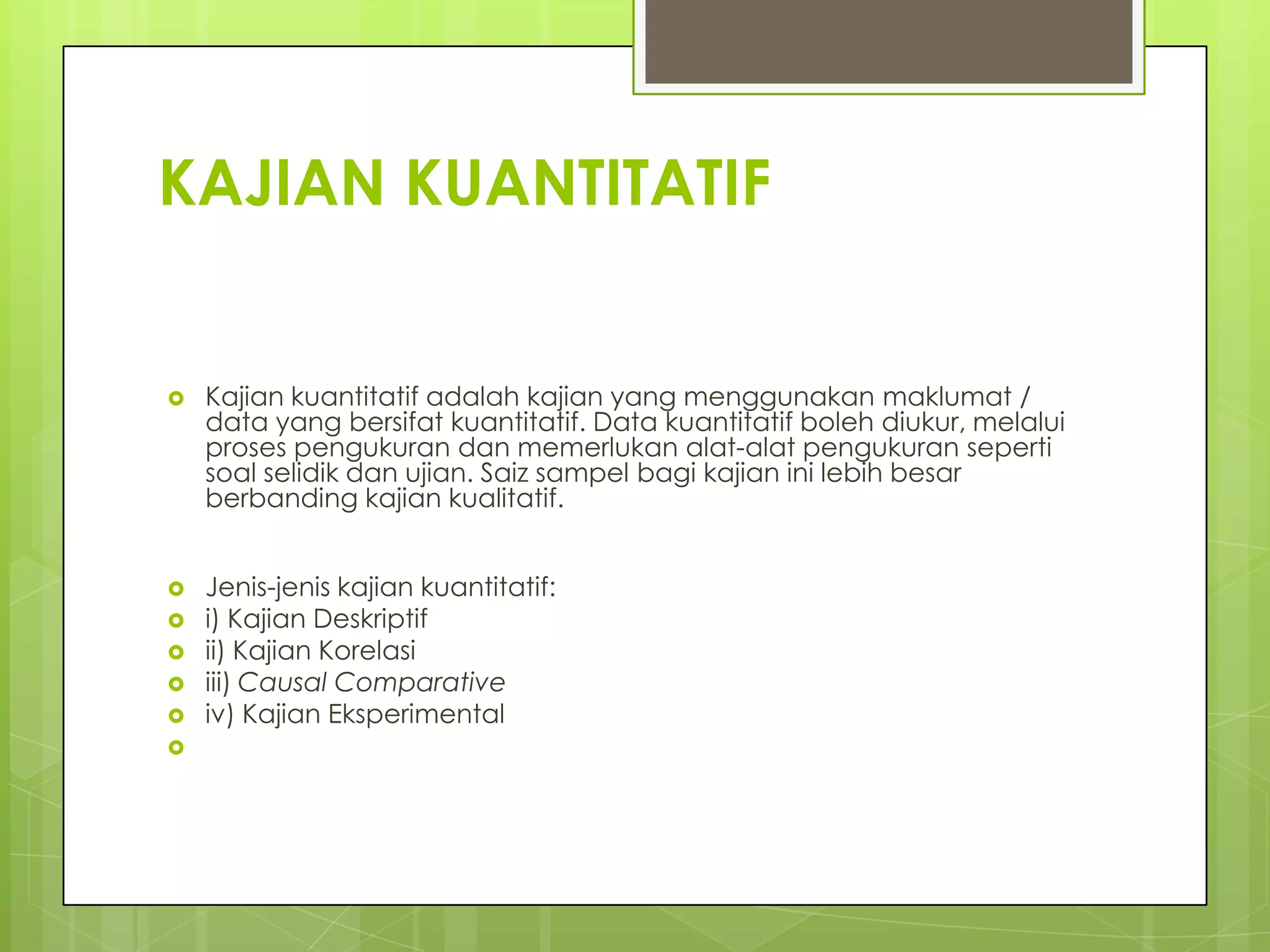
KAJIAN KUANTITATIF


   Kajian kuantitatif adalah kajian yang menggunakan maklumat /
    data yang bersifat kuantitatif. Data kuantitatif boleh diukur, melalui
    proses pengukuran dan memerlukan alat-alat pengukuran seperti
    soal selidik dan ujian. Saiz sampel bagi kajian ini lebih besar
    berbanding kajian kualitatif.


   Jenis-jenis kajian kuantitatif:
   i) Kajian Deskriptif
   ii) Kajian Korelasi
   iii) Causal Comparative
   iv) Kajian Eksperimental

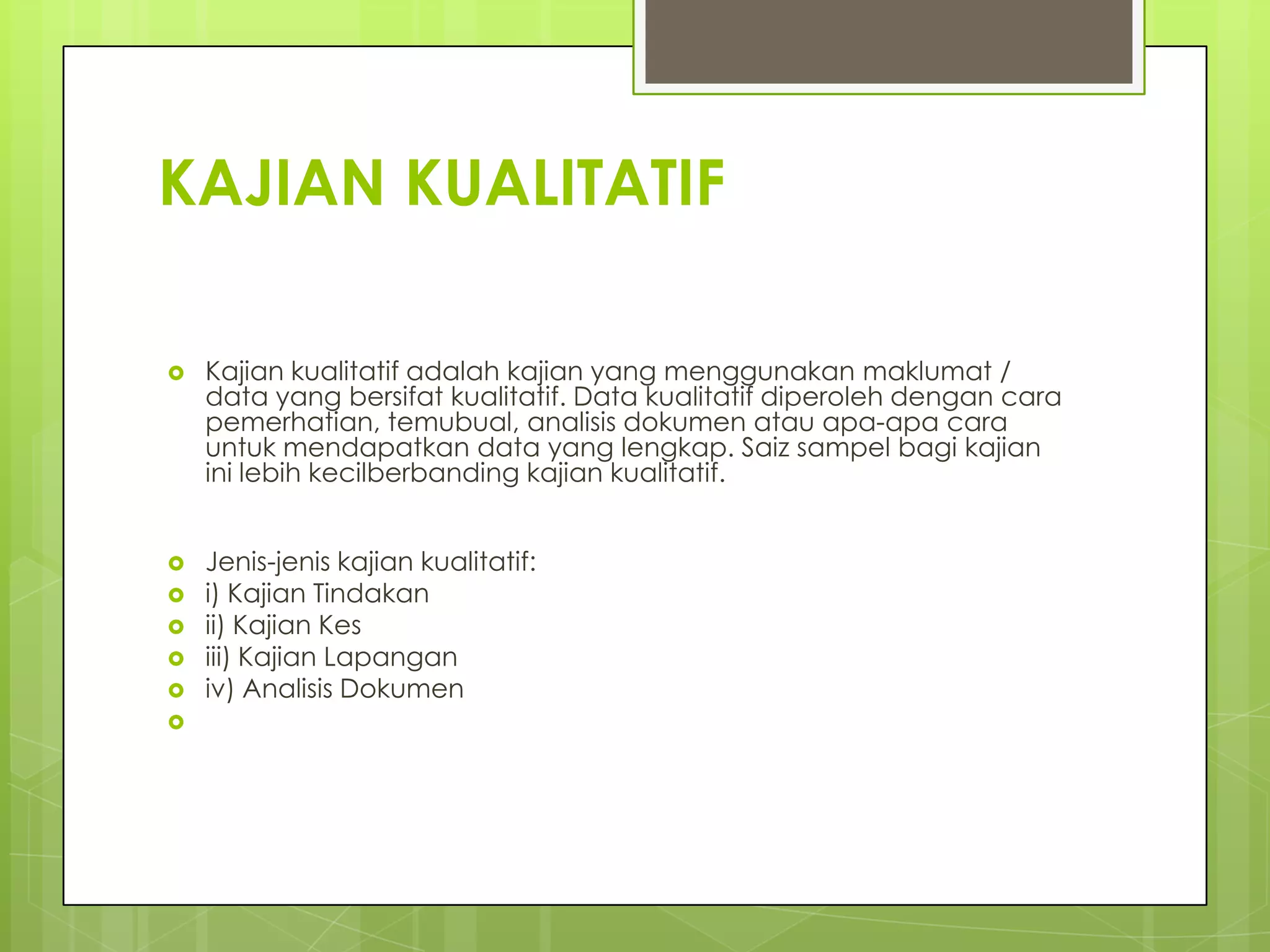
KAJIAN KUALITATIF

   Kajian kualitatif adalah kajian yang menggunakan maklumat /
    data yang bersifat kualitatif. Data kualitatif diperoleh dengan cara
    pemerhatian, temubual, analisis dokumen atau apa-apa cara
    untuk mendapatkan data yang lengkap. Saiz sampel bagi kajian
    ini lebih kecilberbanding kajian kualitatif.


   Jenis-jenis kajian kualitatif:
   i) Kajian Tindakan
   ii) Kajian Kes
   iii) Kajian Lapangan
   iv) Analisis Dokumen

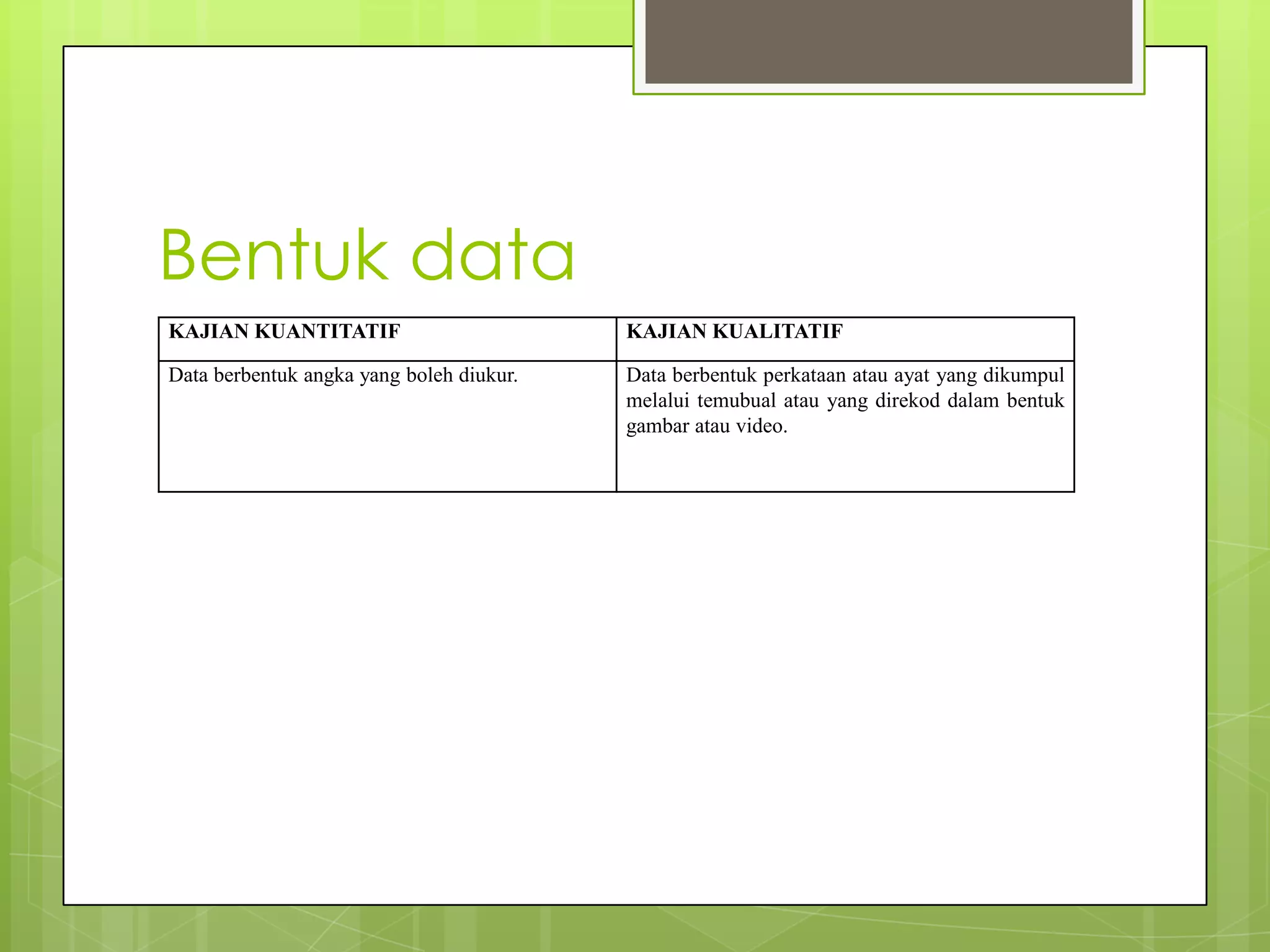
Bentuk data
KAJIAN KUANTITATIF                        KAJIAN KUALITATIF

Data berbentuk angka yang boleh diukur.   Data berbentuk perkataan atau ayat yang dikumpul
                                          melalui temubual atau yang direkod dalam bentuk
                                          gambar atau video.
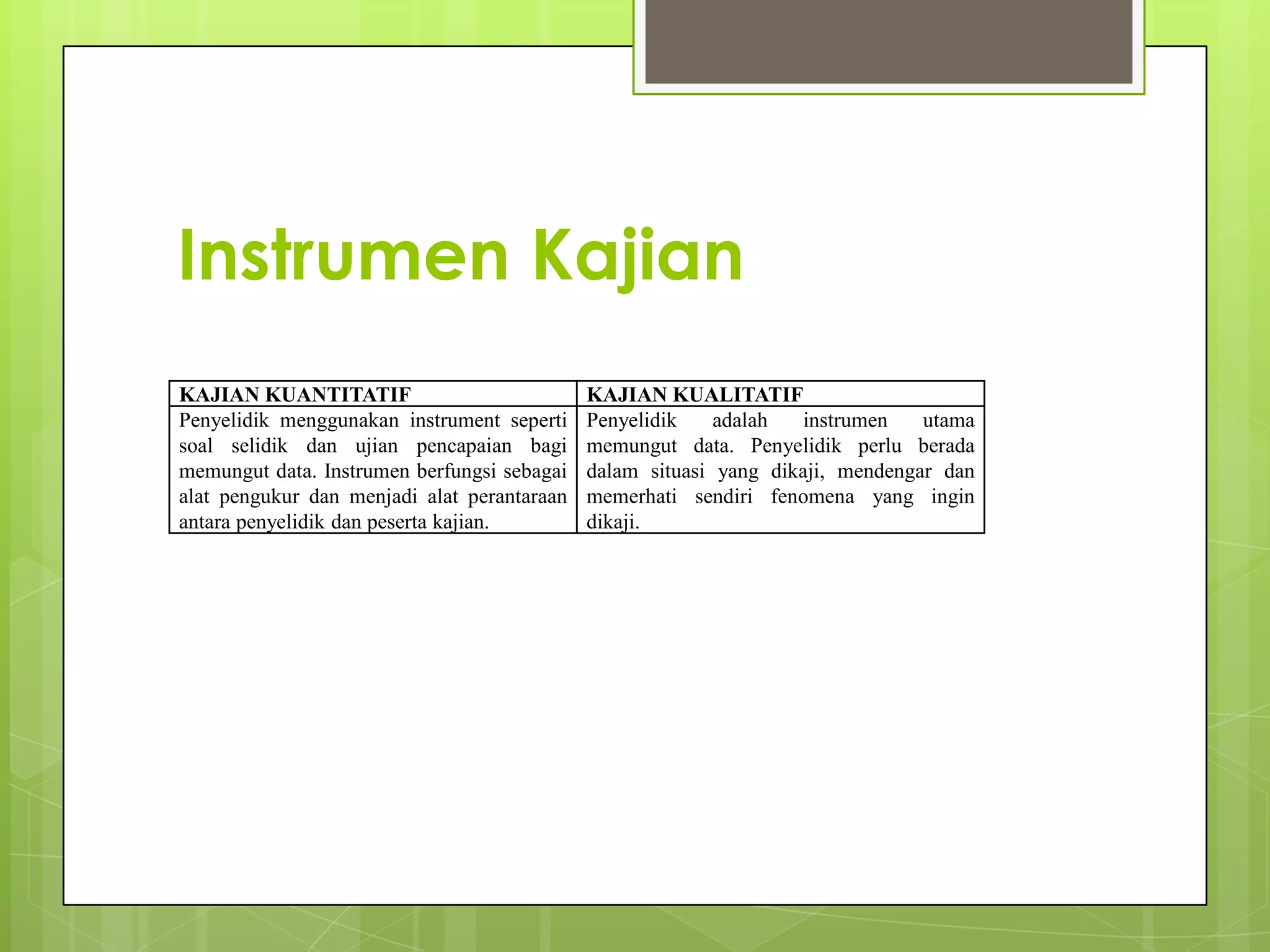
Instrumen Kajian
KAJIAN KUANTITATIF                           KAJIAN KUALITATIF
Penyelidik menggunakan instrument seperti    Penyelidik    adalah   instrumen   utama
soal selidik dan ujian pencapaian bagi       memungut data. Penyelidik perlu berada
memungut data. Instrumen berfungsi sebagai   dalam situasi yang dikaji, mendengar dan
alat pengukur dan menjadi alat perantaraan   memerhati sendiri fenomena yang ingin
antara penyelidik dan peserta kajian.        dikaji.
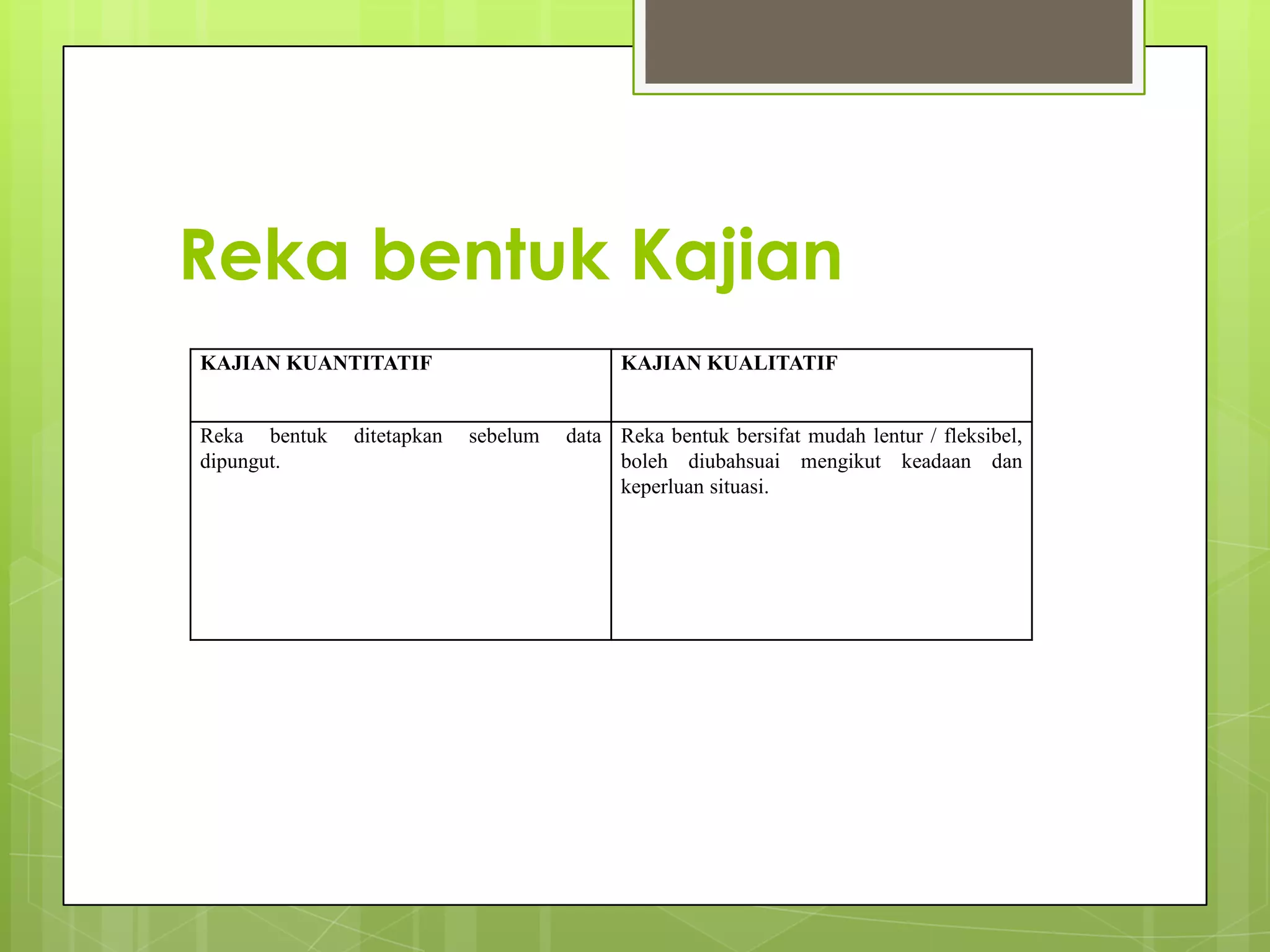
Reka bentuk Kajian
KAJIAN KUANTITATIF                         KAJIAN KUALITATIF


Reka bentuk   ditetapkan   sebelum   data Reka bentuk bersifat mudah lentur / fleksibel,
dipungut.                                 boleh diubahsuai mengikut keadaan dan
                                          keperluan situasi.
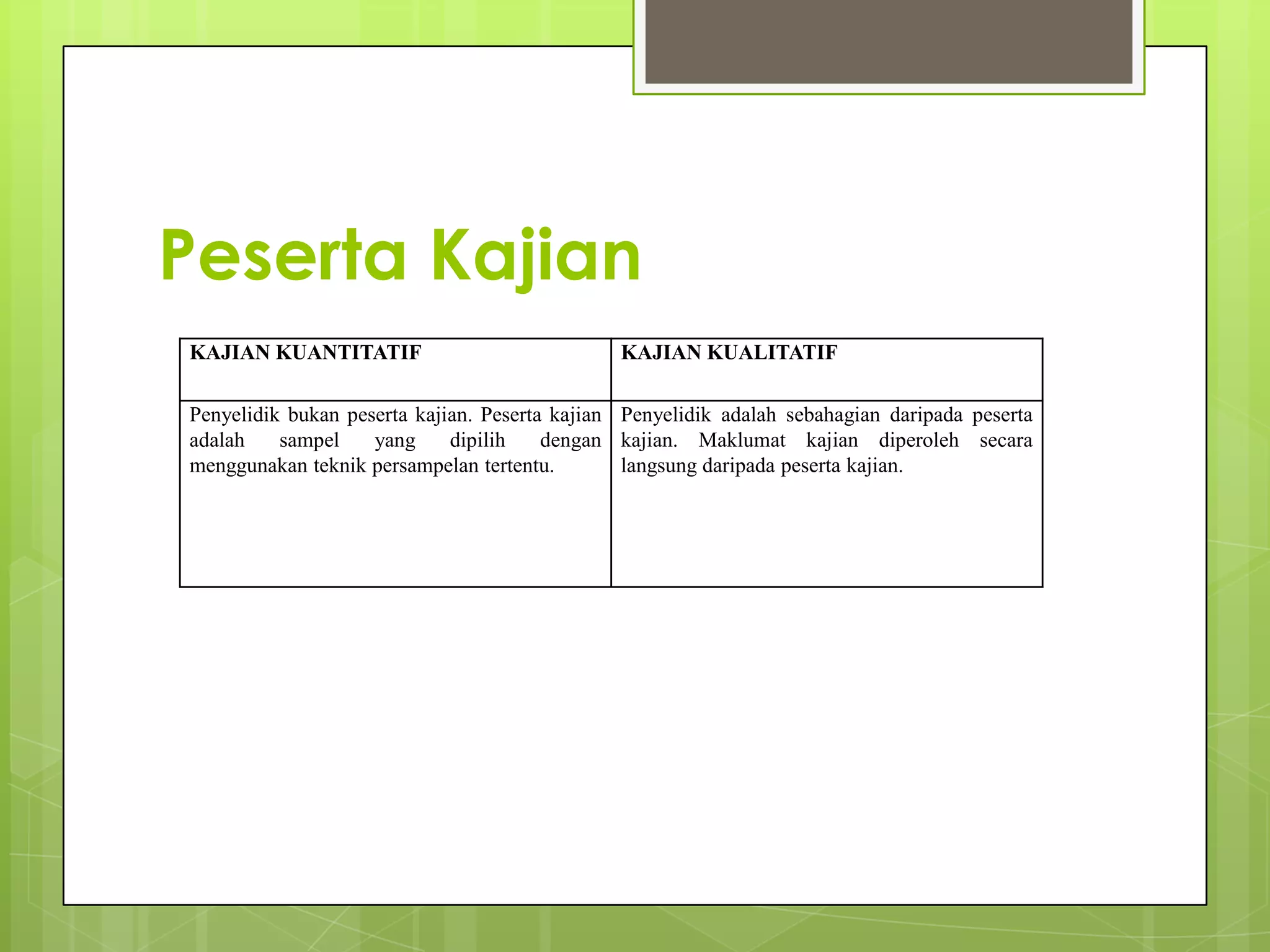
Peserta Kajian
KAJIAN KUANTITATIF                             KAJIAN KUALITATIF

Penyelidik bukan peserta kajian. Peserta kajian Penyelidik adalah sebahagian daripada peserta
adalah    sampel    yang     dipilih    dengan kajian. Maklumat kajian diperoleh secara
menggunakan teknik persampelan tertentu.        langsung daripada peserta kajian.
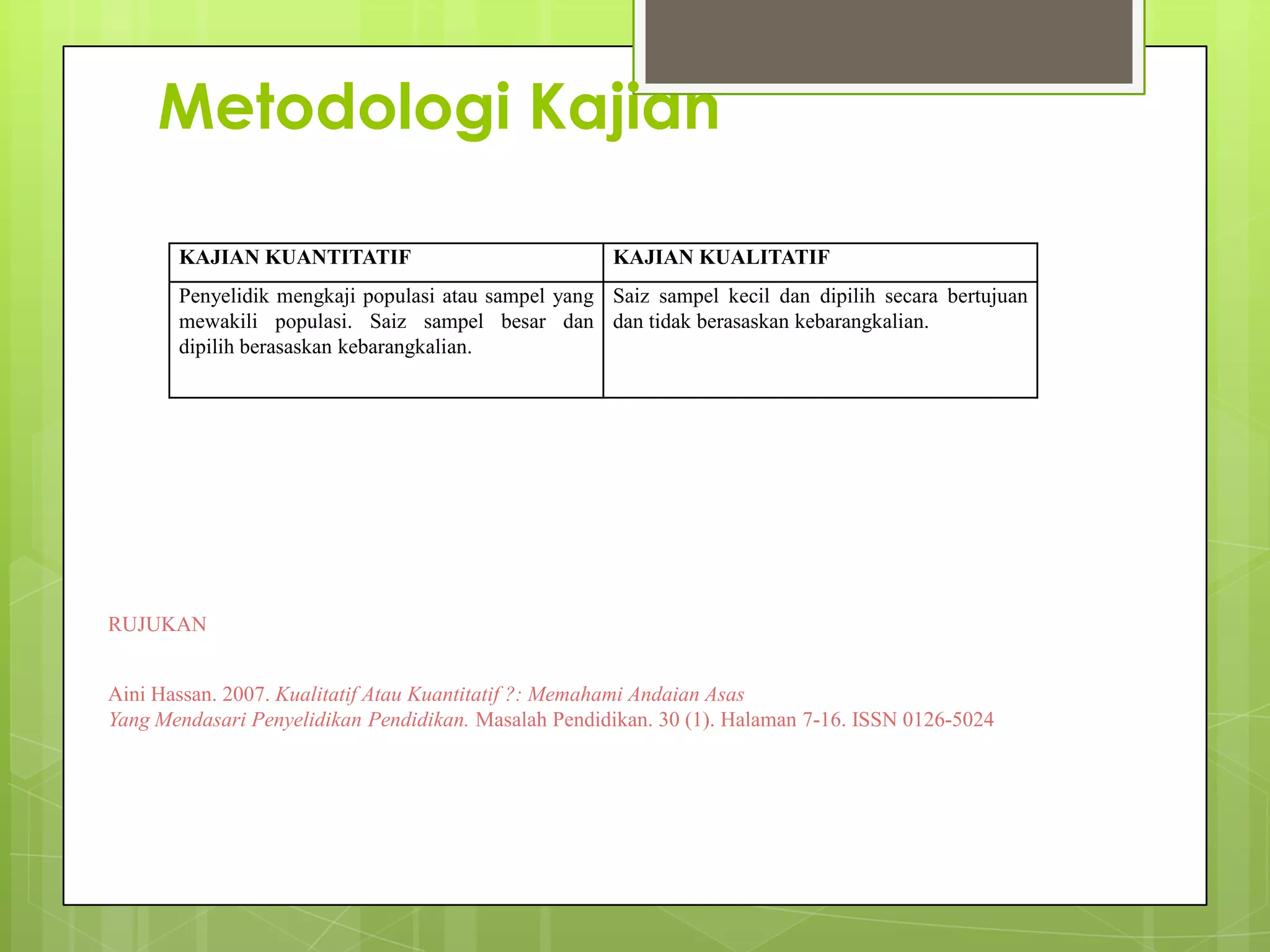
Metodologi Kajian

       KAJIAN KUANTITATIF                             KAJIAN KUALITATIF
       Penyelidik mengkaji populasi atau sampel yang Saiz sampel kecil dan dipilih secara bertujuan
       mewakili populasi. Saiz sampel besar dan dan tidak berasaskan kebarangkalian.
       dipilih berasaskan kebarangkalian.


RUJUKAN


Aini Hassan. 2007. Kualitatif Atau Kuantitatif ?: Memahami Andaian Asas
Yang Mendasari Penyelidikan Pendidikan. Masalah Pendidikan. 30 (1). Halaman 7-16. ISSN 0126-5024
SOALAN 3: Huraikan kitaran proses yang terlibat
dalam sesuatu penyelidikan
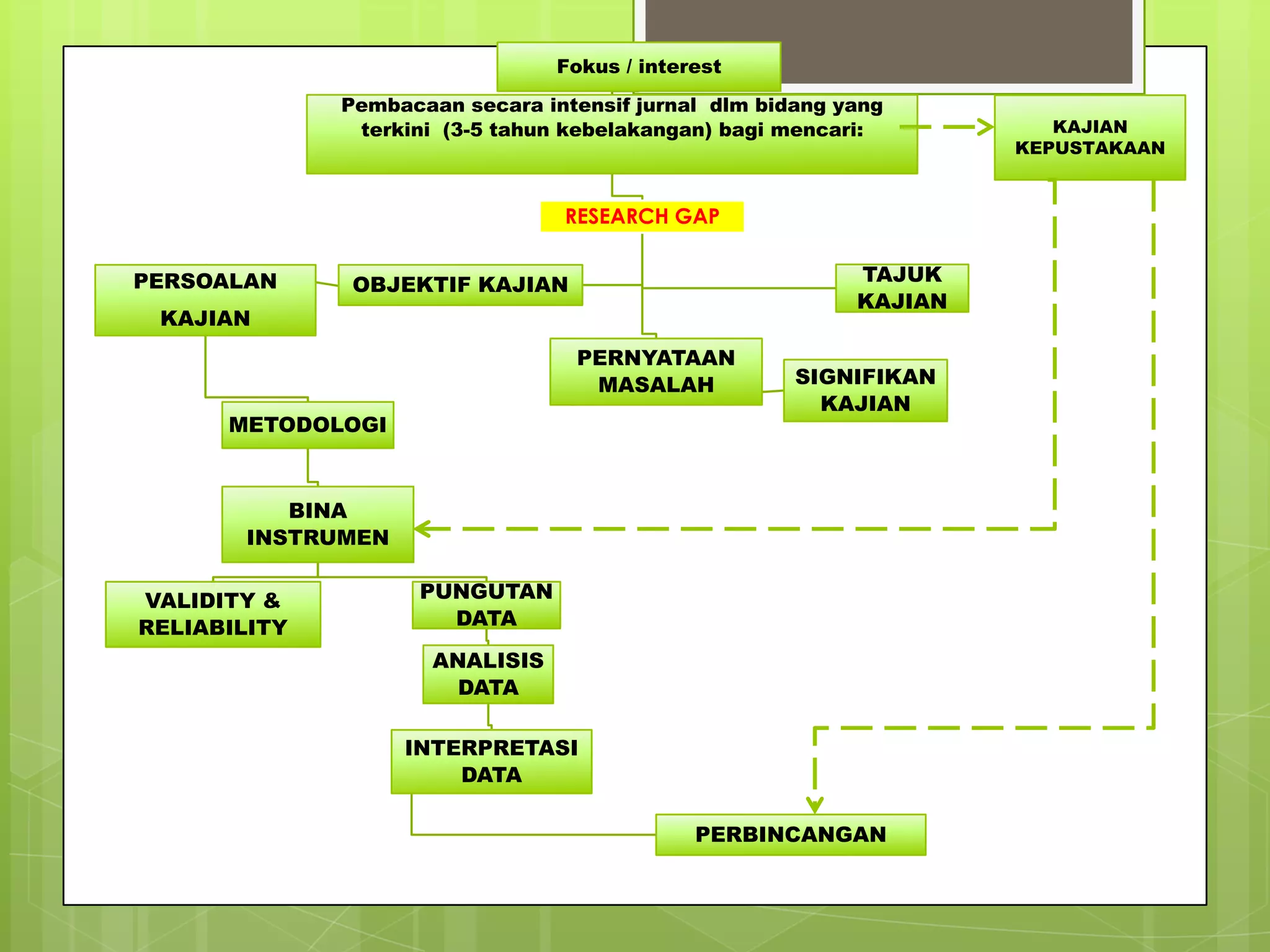
Fokus / interest
              Pembacaan secara intensif jurnal dlm bidang yang
               terkini (3-5 tahun kebelakangan) bagi mencari:          KAJIAN
                                                                    KEPUSTAKAAN


                                 RESEARCH GAP


PERSOALAN     OBJEKTIF KAJIAN                              TAJUK
                                                           KAJIAN
 KAJIAN
                                  PERNYATAAN
                                   MASALAH            SIGNIFIKAN
                                                        KAJIAN
      METODOLOGI


          BINA
       INSTRUMEN

VALIDITY &          PUNGUTAN
RELIABILITY           DATA

                      ANALISIS
                        DATA

                   INTERPRETASI
                       DATA

                                              PERBINCANGAN
Soalan 5: Reflek prosedur kognitif


COGNITIVE PROCESS
 The essential idea behind the cognitive
 processes is quite simple. Whenever our
 minds are engaged, we are doing one of
 two things. We are either taking in
 information or else organizing information
 and drawing conclusions. Jung called the
 "taking-in" process Perceiving and the
 "organizing-and-drawing-conclusions"
 process Judging.
   Here's an example of how it works:
    We observe we are thirsty (Perceiving), we
    decide to get something to drink (Judging),
    we come up with possibilities of what to drink
    (Perceiving), we decide on a beverage that's
    available several blocks away (Judging), we
    notice it is sunny (Perceiving), we decide to
    have water outside instead (Judging). And so
    it goes, back and forth, all through the waking
    hours of our life.
Cognitive process : in
generating idea

 Step  1: Divergent Thinking
  Here are some examples of divergent
  thinking triggers:
 List all the uses you can think of for a shoe.
     Generate meanings for a nutshell.
     List all the resources available for your next
      project.
     Make as many sentences as you can using
      all of the following words: candle, hope,
      tissue, egg.
  open-ended exercise.
 No evaluation is required or asked for.
 None of the questions asked you to meet
  any criteria whatsoever.
 The responses are free from any
  restriction, even if they are outside the
  parameters you perceive in the question.
  That’s an important point.
 Step
     2: Convergent Thinking
 Here are some examples to demonstrate
 convergent thinking.
    Which shoe idea is the most novel?
    Rank your meanings of the nutshell from the
     most personally meaningful to the least.
    Select the resources that are most
     challenging to maintain.
    Of all the sentences you made, which is the
     most intriguing?
   During the convergent stage, we apply
    critical thinking; that is, we use some criteria to
    evaluate, select, and analyze the output from
    the divergent phase.
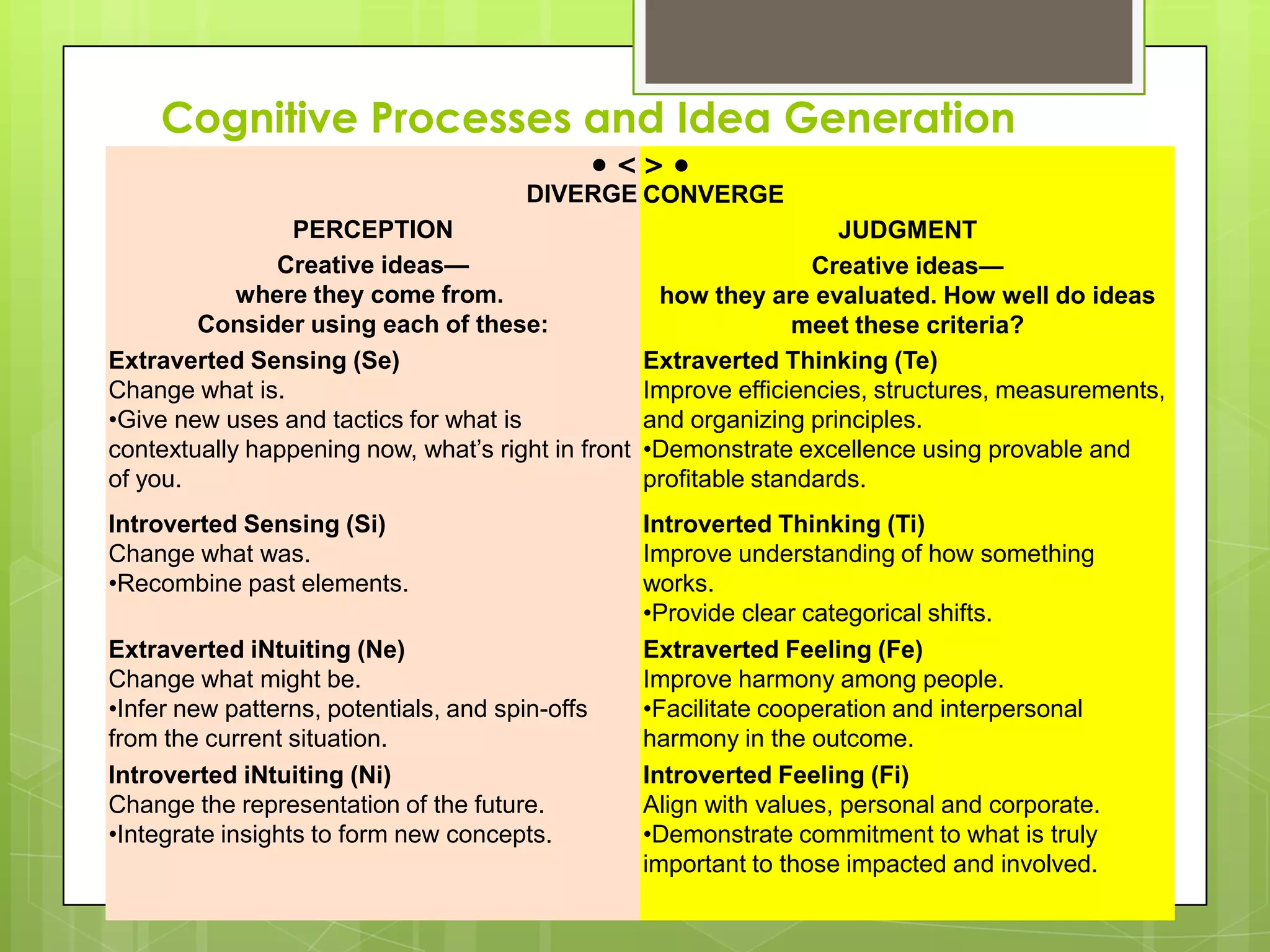
Cognitive Processes and Idea Generation
                                            • <> •
                                        DIVERGE CONVERGE
                PERCEPTION                                            JUDGMENT
               Creative ideas—                                      Creative ideas—
            where they come from.                    how they are evaluated. How well do ideas
        Consider using each of these:                              meet these criteria?
Extraverted Sensing (Se)                            Extraverted Thinking (Te)
Change what is.                                     Improve efficiencies, structures, measurements,
•Give new uses and tactics for what is              and organizing principles.
contextually happening now, what’s right in front   •Demonstrate excellence using provable and
of you.                                             profitable standards.
Introverted Sensing (Si)                            Introverted Thinking (Ti)
Change what was.                                    Improve understanding of how something
•Recombine past elements.                           works.
                                                    •Provide clear categorical shifts.
Extraverted iNtuiting (Ne)                          Extraverted Feeling (Fe)
Change what might be.                               Improve harmony among people.
•Infer new patterns, potentials, and spin-offs      •Facilitate cooperation and interpersonal
from the current situation.                         harmony in the outcome.
Introverted iNtuiting (Ni)                          Introverted Feeling (Fi)
Change the representation of the future.            Align with values, personal and corporate.
•Integrate insights to form new concepts.           •Demonstrate commitment to what is truly
                                                    important to those impacted and involved.
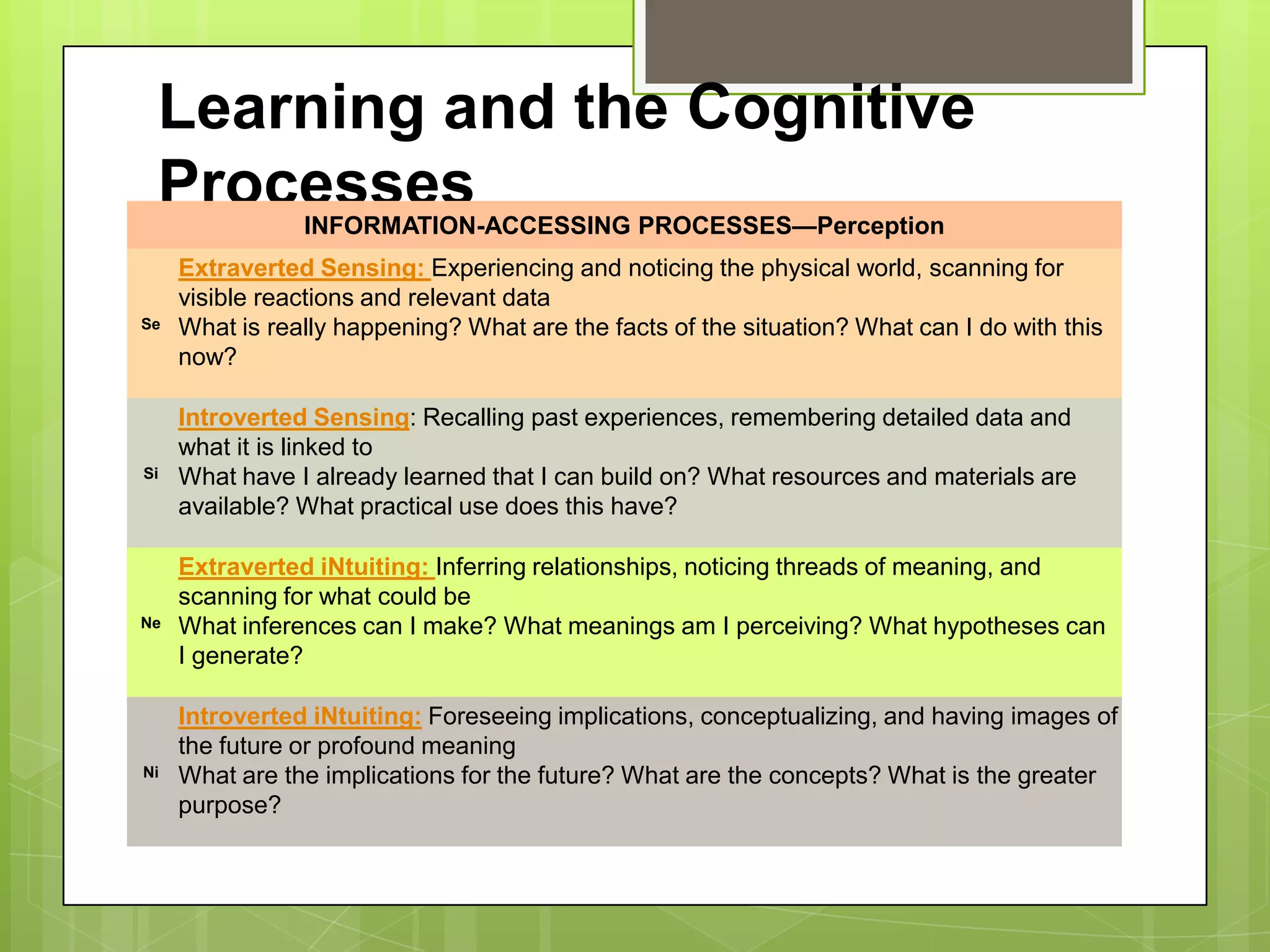
Learning and the Cognitive
 Processes      INFORMATION-ACCESSING PROCESSES—Perception
     Extraverted Sensing: Experiencing and noticing the physical world, scanning for
     visible reactions and relevant data
Se   What is really happening? What are the facts of the situation? What can I do with this
     now?

     Introverted Sensing: Recalling past experiences, remembering detailed data and
     what it is linked to
Si   What have I already learned that I can build on? What resources and materials are
     available? What practical use does this have?

     Extraverted iNtuiting: Inferring relationships, noticing threads of meaning, and
     scanning for what could be
Ne   What inferences can I make? What meanings am I perceiving? What hypotheses can
     I generate?

     Introverted iNtuiting: Foreseeing implications, conceptualizing, and having images of
     the future or profound meaning
Ni   What are the implications for the future? What are the concepts? What is the greater
     purpose?
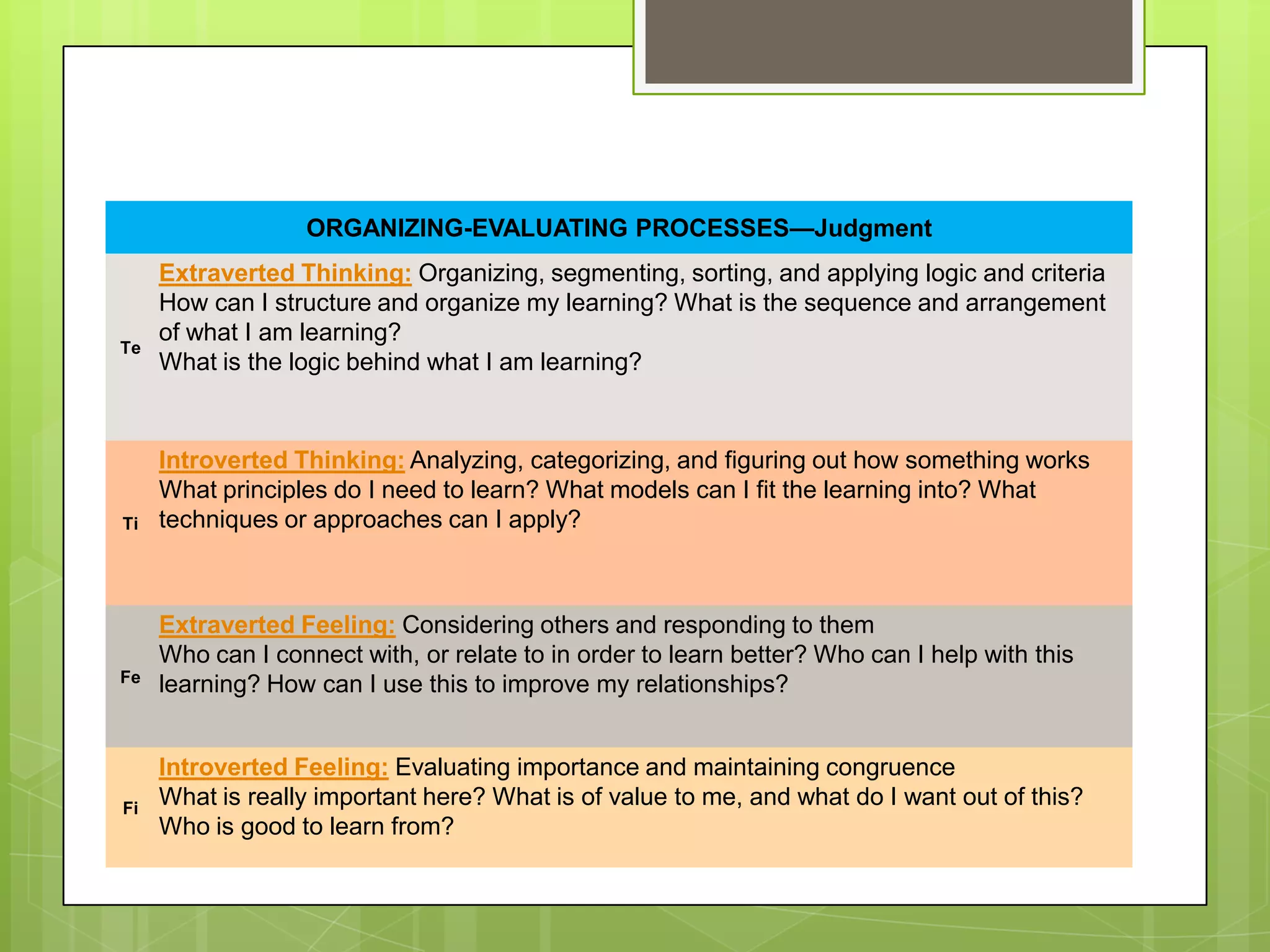
ORGANIZING-EVALUATING PROCESSES—Judgment
     Extraverted Thinking: Organizing, segmenting, sorting, and applying logic and criteria
     How can I structure and organize my learning? What is the sequence and arrangement
     of what I am learning?
Te
     What is the logic behind what I am learning?


     Introverted Thinking: Analyzing, categorizing, and figuring out how something works
     What principles do I need to learn? What models can I fit the learning into? What
Ti   techniques or approaches can I apply?


     Extraverted Feeling: Considering others and responding to them
     Who can I connect with, or relate to in order to learn better? Who can I help with this
Fe
     learning? How can I use this to improve my relationships?


     Introverted Feeling: Evaluating importance and maintaining congruence
Fi
     What is really important here? What is of value to me, and what do I want out of this?
     Who is good to learn from?

Tutorial 1 kaedah penyelidikan

  • 1.
    TUTORIAL 1 PN SITINUR DIYANA MAHMUD
  • 2.
    KAJIAN KUANTITATIF  Kajian kuantitatif adalah kajian yang menggunakan maklumat / data yang bersifat kuantitatif. Data kuantitatif boleh diukur, melalui proses pengukuran dan memerlukan alat-alat pengukuran seperti soal selidik dan ujian. Saiz sampel bagi kajian ini lebih besar berbanding kajian kualitatif.  Jenis-jenis kajian kuantitatif:  i) Kajian Deskriptif  ii) Kajian Korelasi  iii) Causal Comparative  iv) Kajian Eksperimental 
  • 3.
    KAJIAN KUALITATIF  Kajian kualitatif adalah kajian yang menggunakan maklumat / data yang bersifat kualitatif. Data kualitatif diperoleh dengan cara pemerhatian, temubual, analisis dokumen atau apa-apa cara untuk mendapatkan data yang lengkap. Saiz sampel bagi kajian ini lebih kecilberbanding kajian kualitatif.  Jenis-jenis kajian kualitatif:  i) Kajian Tindakan  ii) Kajian Kes  iii) Kajian Lapangan  iv) Analisis Dokumen 
  • 4.
    Bentuk data KAJIAN KUANTITATIF KAJIAN KUALITATIF Data berbentuk angka yang boleh diukur. Data berbentuk perkataan atau ayat yang dikumpul melalui temubual atau yang direkod dalam bentuk gambar atau video.
  • 5.
    Instrumen Kajian KAJIAN KUANTITATIF KAJIAN KUALITATIF Penyelidik menggunakan instrument seperti Penyelidik adalah instrumen utama soal selidik dan ujian pencapaian bagi memungut data. Penyelidik perlu berada memungut data. Instrumen berfungsi sebagai dalam situasi yang dikaji, mendengar dan alat pengukur dan menjadi alat perantaraan memerhati sendiri fenomena yang ingin antara penyelidik dan peserta kajian. dikaji.
  • 6.
    Reka bentuk Kajian KAJIANKUANTITATIF KAJIAN KUALITATIF Reka bentuk ditetapkan sebelum data Reka bentuk bersifat mudah lentur / fleksibel, dipungut. boleh diubahsuai mengikut keadaan dan keperluan situasi.
  • 7.
    Peserta Kajian KAJIAN KUANTITATIF KAJIAN KUALITATIF Penyelidik bukan peserta kajian. Peserta kajian Penyelidik adalah sebahagian daripada peserta adalah sampel yang dipilih dengan kajian. Maklumat kajian diperoleh secara menggunakan teknik persampelan tertentu. langsung daripada peserta kajian.
  • 8.
    Metodologi Kajian KAJIAN KUANTITATIF KAJIAN KUALITATIF Penyelidik mengkaji populasi atau sampel yang Saiz sampel kecil dan dipilih secara bertujuan mewakili populasi. Saiz sampel besar dan dan tidak berasaskan kebarangkalian. dipilih berasaskan kebarangkalian. RUJUKAN Aini Hassan. 2007. Kualitatif Atau Kuantitatif ?: Memahami Andaian Asas Yang Mendasari Penyelidikan Pendidikan. Masalah Pendidikan. 30 (1). Halaman 7-16. ISSN 0126-5024
  • 9.
    SOALAN 3: Huraikankitaran proses yang terlibat dalam sesuatu penyelidikan
  • 10.
    Fokus / interest Pembacaan secara intensif jurnal dlm bidang yang terkini (3-5 tahun kebelakangan) bagi mencari: KAJIAN KEPUSTAKAAN RESEARCH GAP PERSOALAN OBJEKTIF KAJIAN TAJUK KAJIAN KAJIAN PERNYATAAN MASALAH SIGNIFIKAN KAJIAN METODOLOGI BINA INSTRUMEN VALIDITY & PUNGUTAN RELIABILITY DATA ANALISIS DATA INTERPRETASI DATA PERBINCANGAN
  • 11.
    Soalan 5: Reflekprosedur kognitif COGNITIVE PROCESS  The essential idea behind the cognitive processes is quite simple. Whenever our minds are engaged, we are doing one of two things. We are either taking in information or else organizing information and drawing conclusions. Jung called the "taking-in" process Perceiving and the "organizing-and-drawing-conclusions" process Judging.
  • 12.
    Here's an example of how it works:  We observe we are thirsty (Perceiving), we decide to get something to drink (Judging), we come up with possibilities of what to drink (Perceiving), we decide on a beverage that's available several blocks away (Judging), we notice it is sunny (Perceiving), we decide to have water outside instead (Judging). And so it goes, back and forth, all through the waking hours of our life.
  • 13.
    Cognitive process :in generating idea  Step 1: Divergent Thinking Here are some examples of divergent thinking triggers:  List all the uses you can think of for a shoe.  Generate meanings for a nutshell.  List all the resources available for your next project.  Make as many sentences as you can using all of the following words: candle, hope, tissue, egg.
  • 14.
     open-endedexercise.  No evaluation is required or asked for.  None of the questions asked you to meet any criteria whatsoever.  The responses are free from any restriction, even if they are outside the parameters you perceive in the question. That’s an important point.
  • 15.
     Step 2: Convergent Thinking Here are some examples to demonstrate convergent thinking.  Which shoe idea is the most novel?  Rank your meanings of the nutshell from the most personally meaningful to the least.  Select the resources that are most challenging to maintain.  Of all the sentences you made, which is the most intriguing?
  • 16.
    During the convergent stage, we apply critical thinking; that is, we use some criteria to evaluate, select, and analyze the output from the divergent phase.
  • 17.
    Cognitive Processes andIdea Generation • <> • DIVERGE CONVERGE PERCEPTION JUDGMENT Creative ideas— Creative ideas— where they come from. how they are evaluated. How well do ideas Consider using each of these: meet these criteria? Extraverted Sensing (Se) Extraverted Thinking (Te) Change what is. Improve efficiencies, structures, measurements, •Give new uses and tactics for what is and organizing principles. contextually happening now, what’s right in front •Demonstrate excellence using provable and of you. profitable standards. Introverted Sensing (Si) Introverted Thinking (Ti) Change what was. Improve understanding of how something •Recombine past elements. works. •Provide clear categorical shifts. Extraverted iNtuiting (Ne) Extraverted Feeling (Fe) Change what might be. Improve harmony among people. •Infer new patterns, potentials, and spin-offs •Facilitate cooperation and interpersonal from the current situation. harmony in the outcome. Introverted iNtuiting (Ni) Introverted Feeling (Fi) Change the representation of the future. Align with values, personal and corporate. •Integrate insights to form new concepts. •Demonstrate commitment to what is truly important to those impacted and involved.
  • 18.
    Learning and theCognitive Processes INFORMATION-ACCESSING PROCESSES—Perception Extraverted Sensing: Experiencing and noticing the physical world, scanning for visible reactions and relevant data Se What is really happening? What are the facts of the situation? What can I do with this now? Introverted Sensing: Recalling past experiences, remembering detailed data and what it is linked to Si What have I already learned that I can build on? What resources and materials are available? What practical use does this have? Extraverted iNtuiting: Inferring relationships, noticing threads of meaning, and scanning for what could be Ne What inferences can I make? What meanings am I perceiving? What hypotheses can I generate? Introverted iNtuiting: Foreseeing implications, conceptualizing, and having images of the future or profound meaning Ni What are the implications for the future? What are the concepts? What is the greater purpose?
  • 19.
    ORGANIZING-EVALUATING PROCESSES—Judgment Extraverted Thinking: Organizing, segmenting, sorting, and applying logic and criteria How can I structure and organize my learning? What is the sequence and arrangement of what I am learning? Te What is the logic behind what I am learning? Introverted Thinking: Analyzing, categorizing, and figuring out how something works What principles do I need to learn? What models can I fit the learning into? What Ti techniques or approaches can I apply? Extraverted Feeling: Considering others and responding to them Who can I connect with, or relate to in order to learn better? Who can I help with this Fe learning? How can I use this to improve my relationships? Introverted Feeling: Evaluating importance and maintaining congruence Fi What is really important here? What is of value to me, and what do I want out of this? Who is good to learn from?