Chapter 11 Frequency Response
 11.1 Fundamental Concepts
 11.2 High-Frequency Models of Transistors
 11.3 Analysis Procedure
 11.4 Frequency Response of CE and CS Stages
 11.5 Frequency Response of CB and CG Stages
 11.6 Frequency Response of Followers
 11.7 Frequency Response of Cascode Stage
 11.8 Frequency Response of Differential Pairs
 11.9 Additional Examples
1
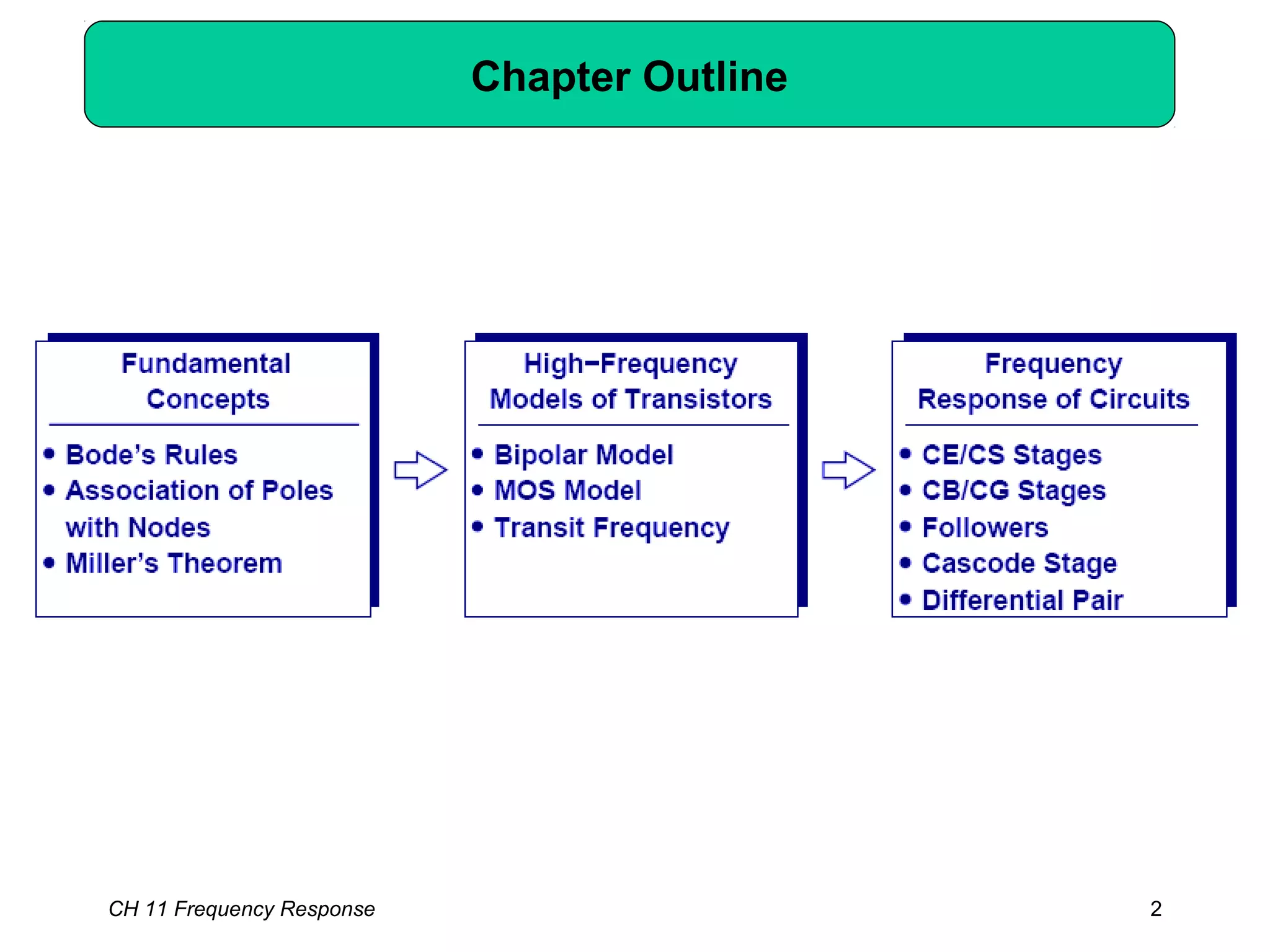
Chapter Outline
CH 11 Frequency Response 2
CH 11 Frequency Response 3
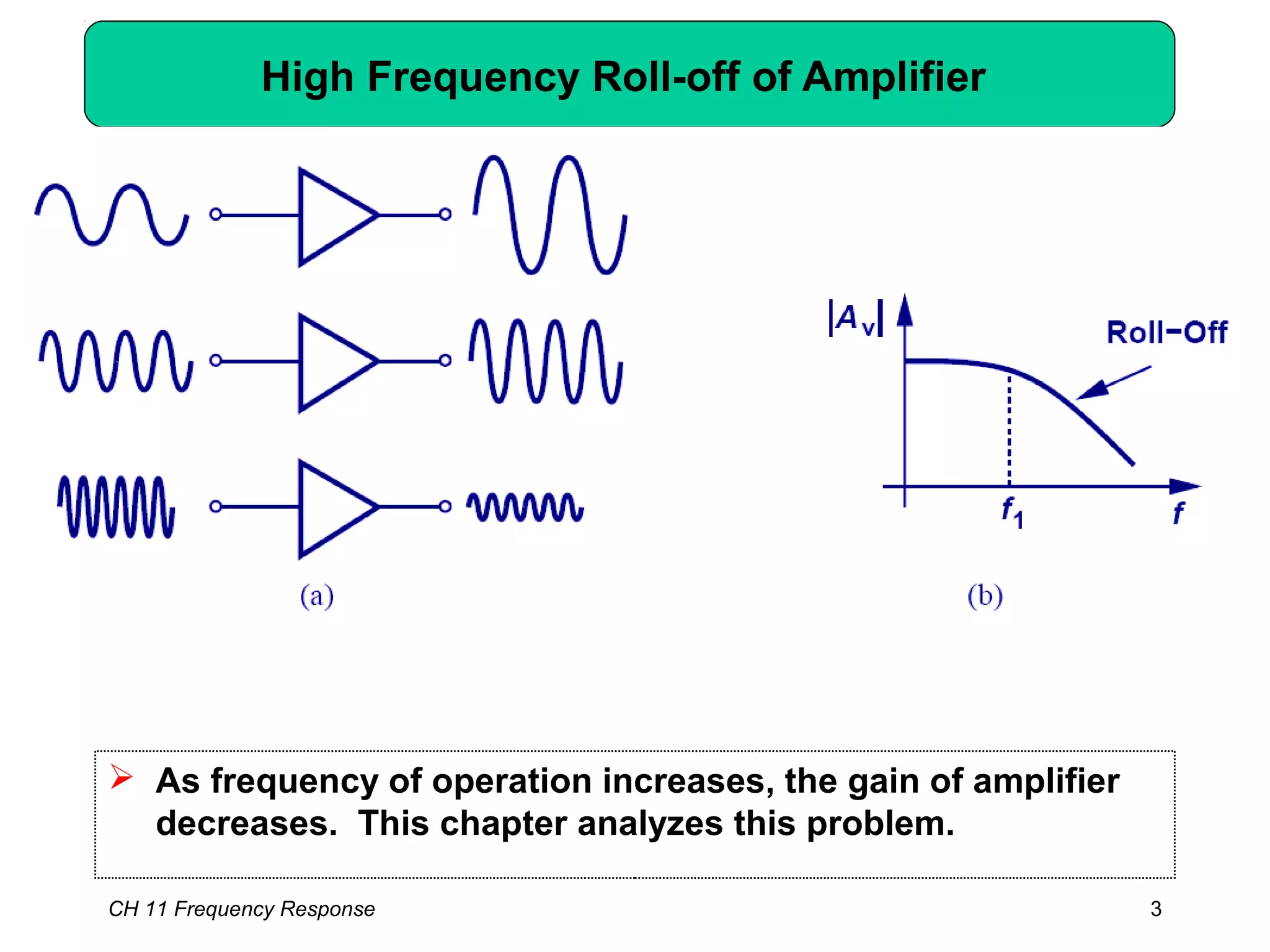
High Frequency Roll-off of Amplifier
 As frequency of operation increases, the gain of amplifier
decreases. This chapter analyzes this problem.
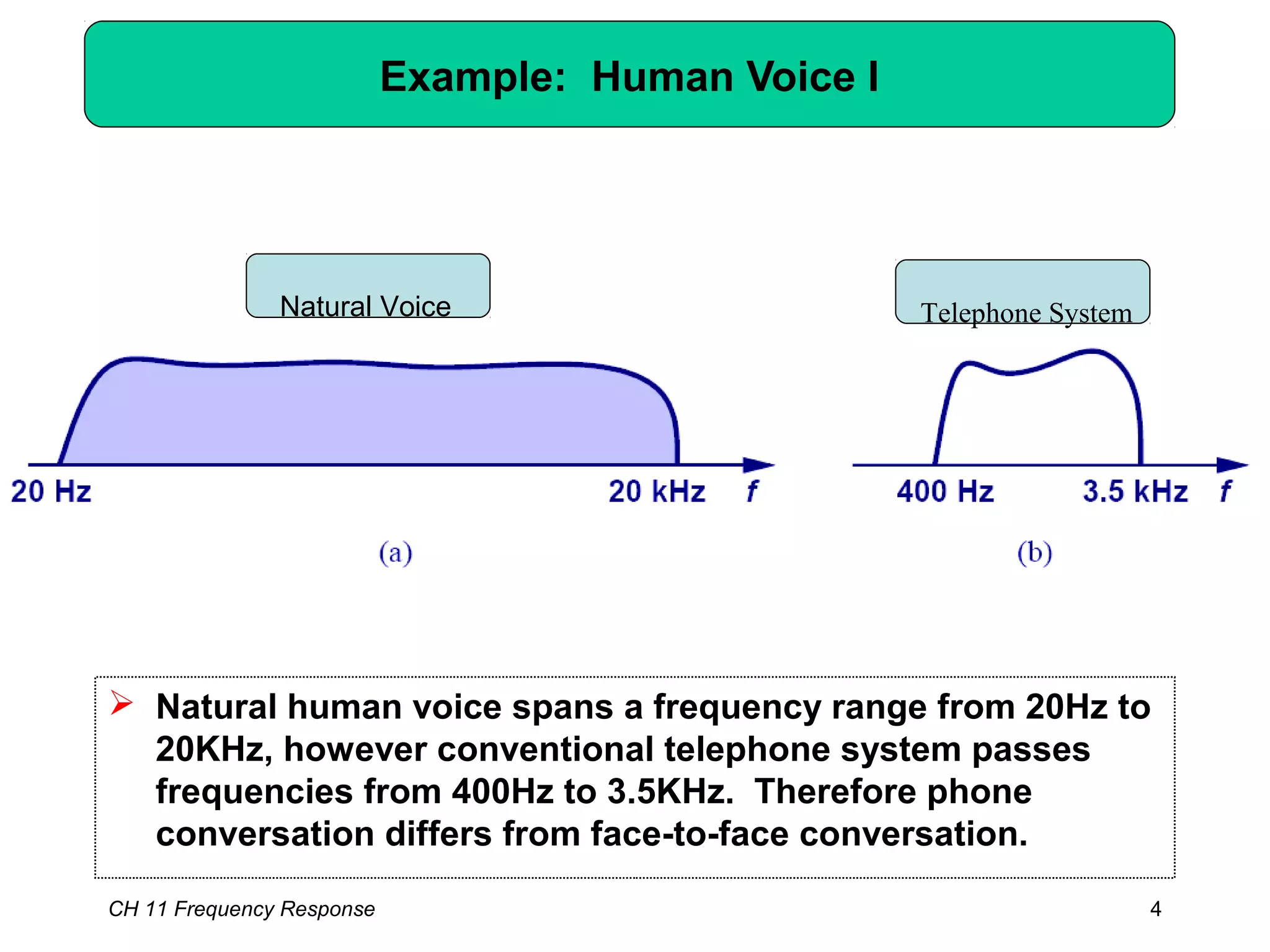
Example: Human Voice I
 Natural human voice spans a frequency range from 20Hz to
20KHz, however conventional telephone system passes
frequencies from 400Hz to 3.5KHz. Therefore phone
conversation differs from face-to-face conversation.
CH 11 Frequency Response 4
Natural Voice Telephone System
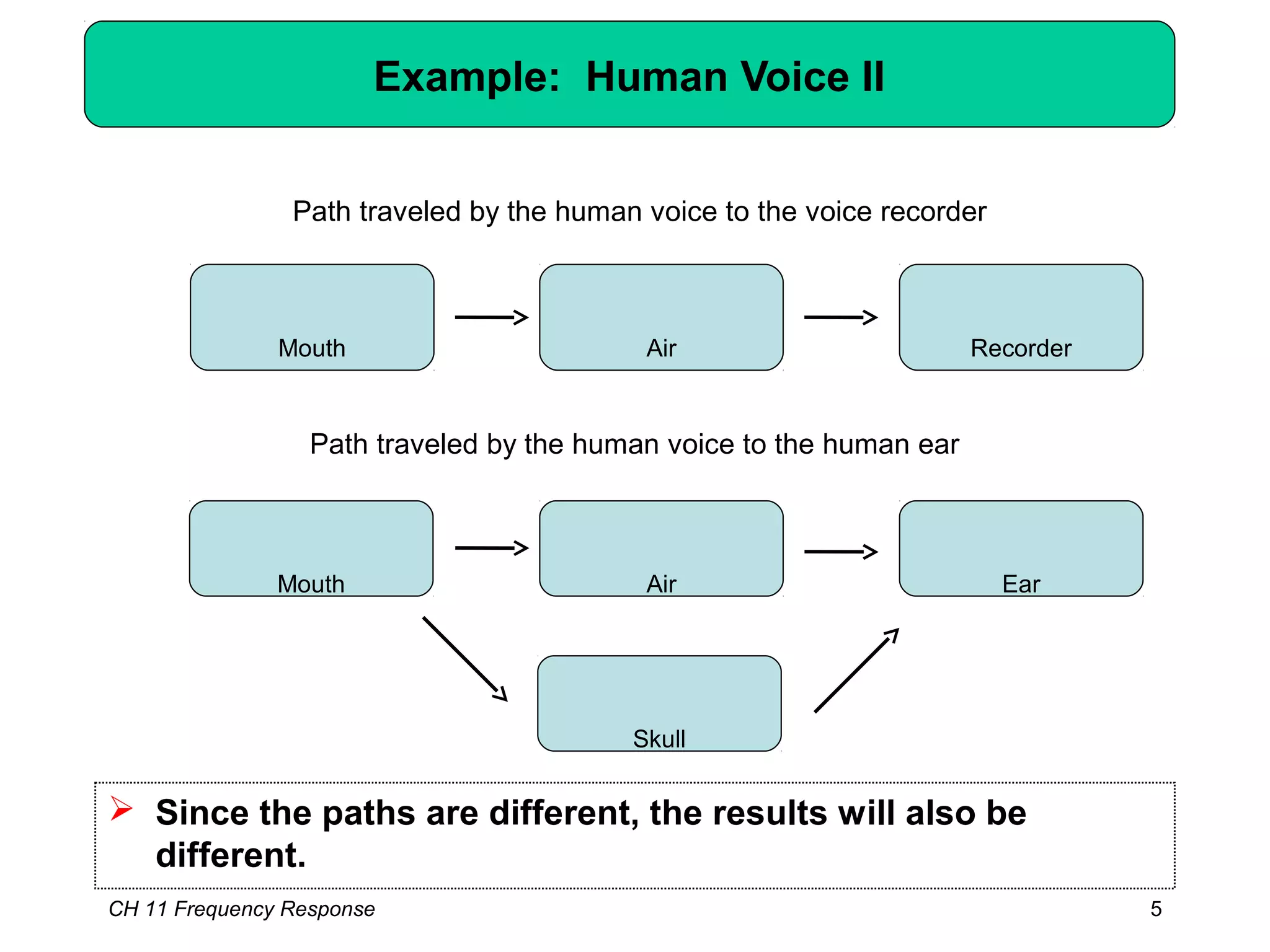
Example: Human Voice II
CH 11 Frequency Response 5
Mouth RecorderAir
Mouth EarAir
Skull
Path traveled by the human voice to the voice recorder
Path traveled by the human voice to the human ear
 Since the paths are different, the results will also be
different.
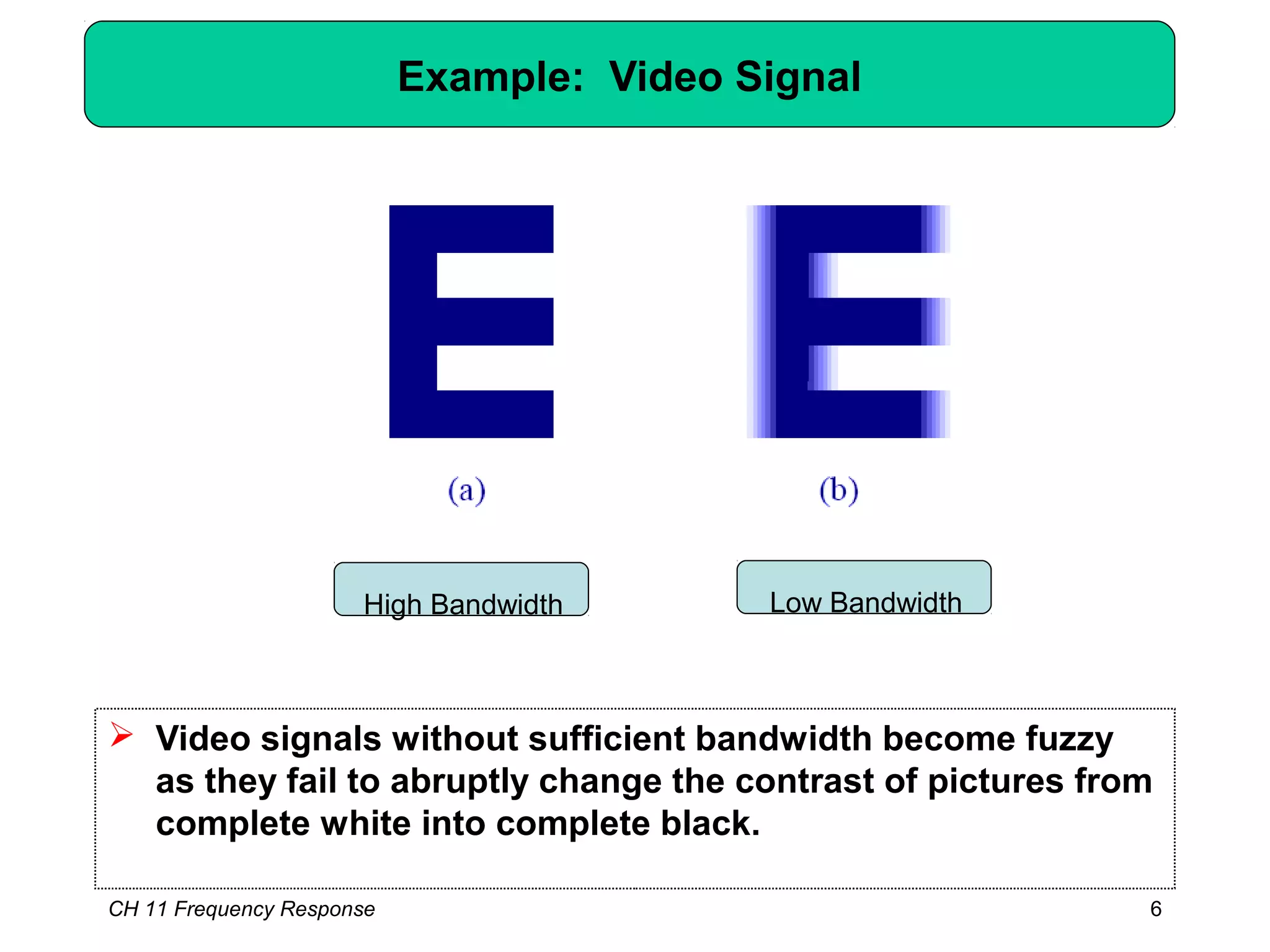
Example: Video Signal
 Video signals without sufficient bandwidth become fuzzy
as they fail to abruptly change the contrast of pictures from
complete white into complete black.
CH 11 Frequency Response 6
High Bandwidth Low Bandwidth
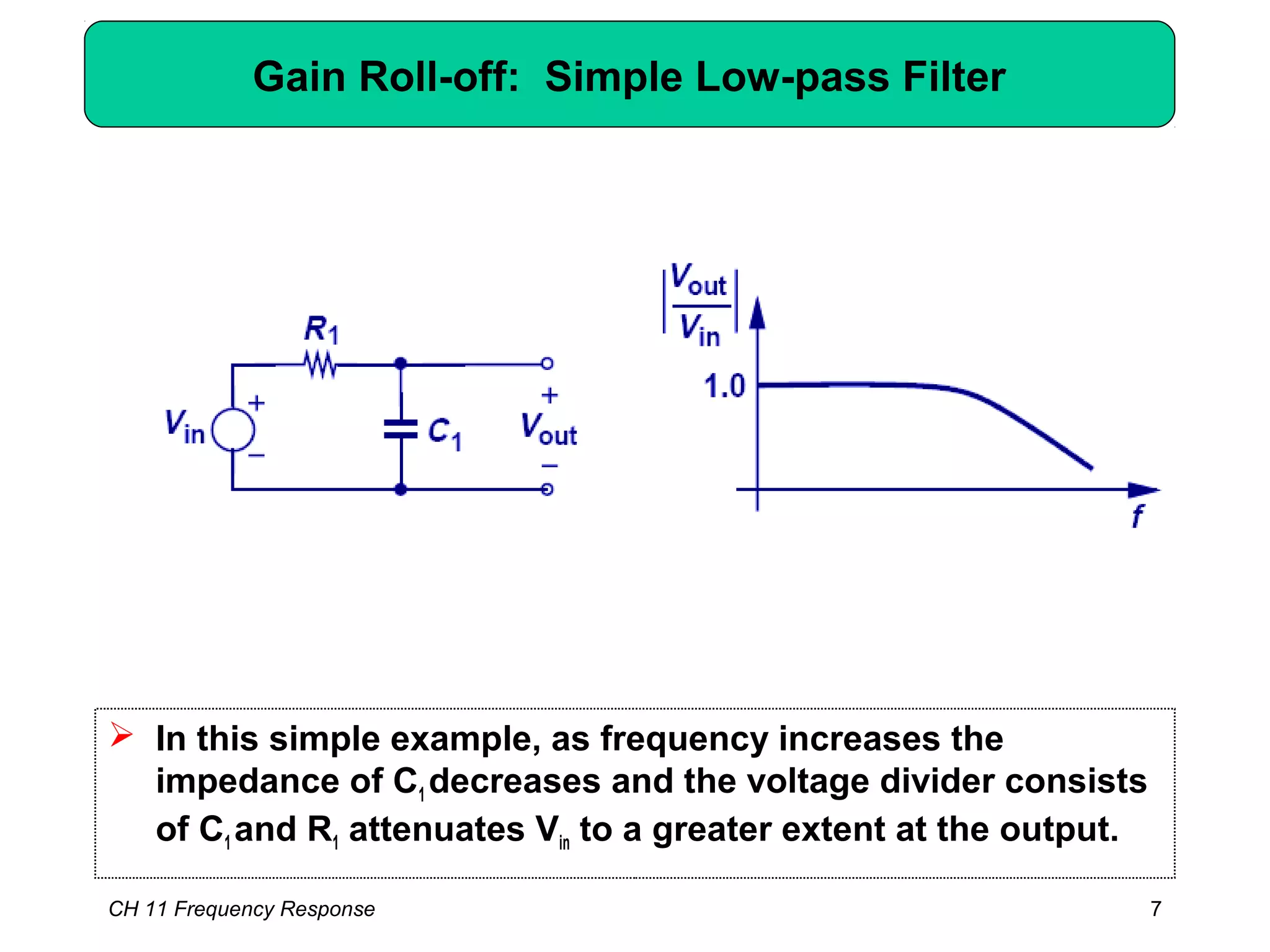
Gain Roll-off: Simple Low-pass Filter
 In this simple example, as frequency increases the
impedance of C1 decreases and the voltage divider consists
of C1 and R1 attenuates Vin to a greater extent at the output.
CH 11 Frequency Response 7
CH 11 Frequency Response 8
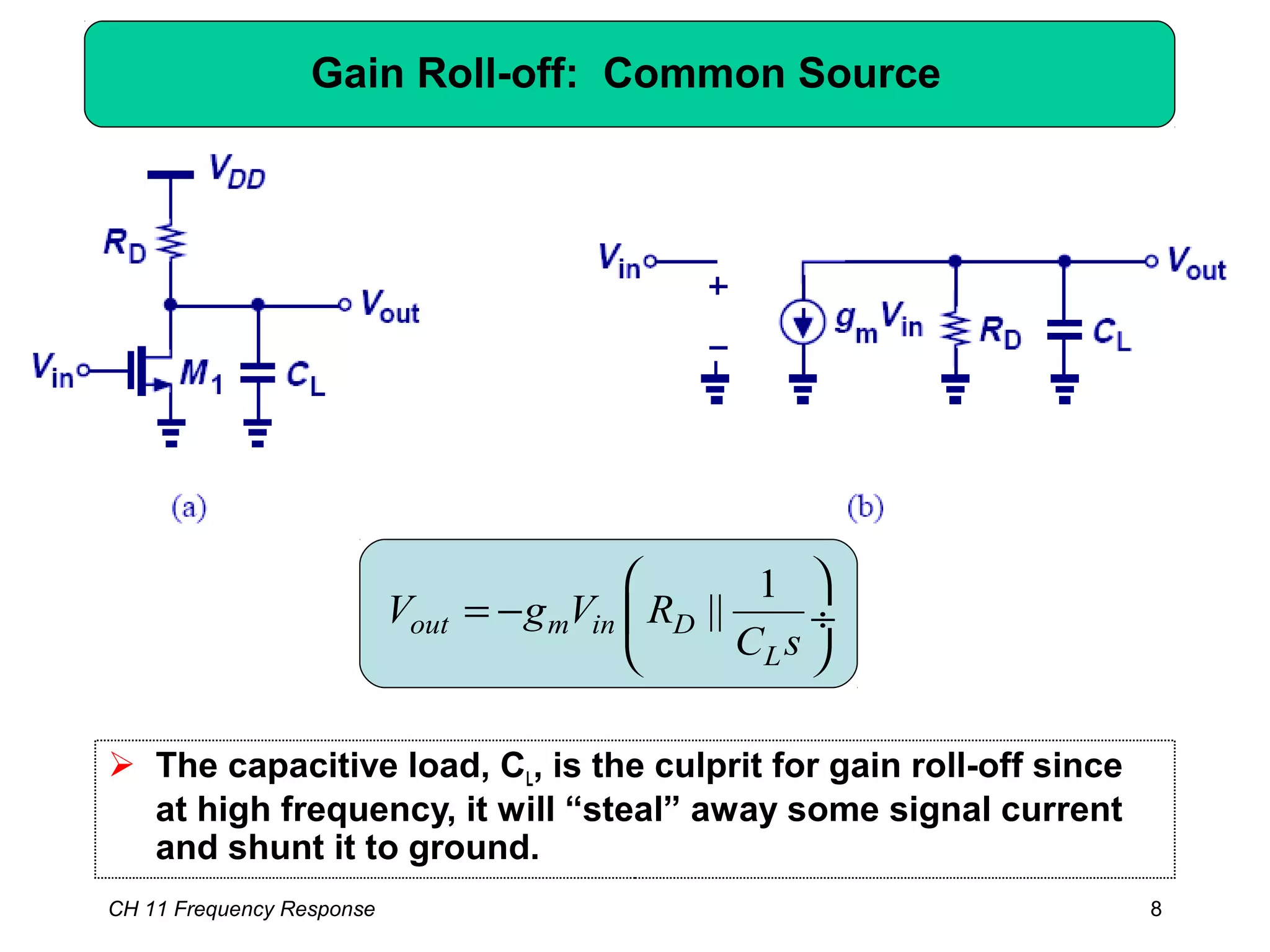
Gain Roll-off: Common Source
 The capacitive load, CL, is the culprit for gain roll-off since
at high frequency, it will “steal” away some signal current
and shunt it to ground.
1
||out m in D
L
V g V R
C s
 
= −  ÷
 
CH 11 Frequency Response 9
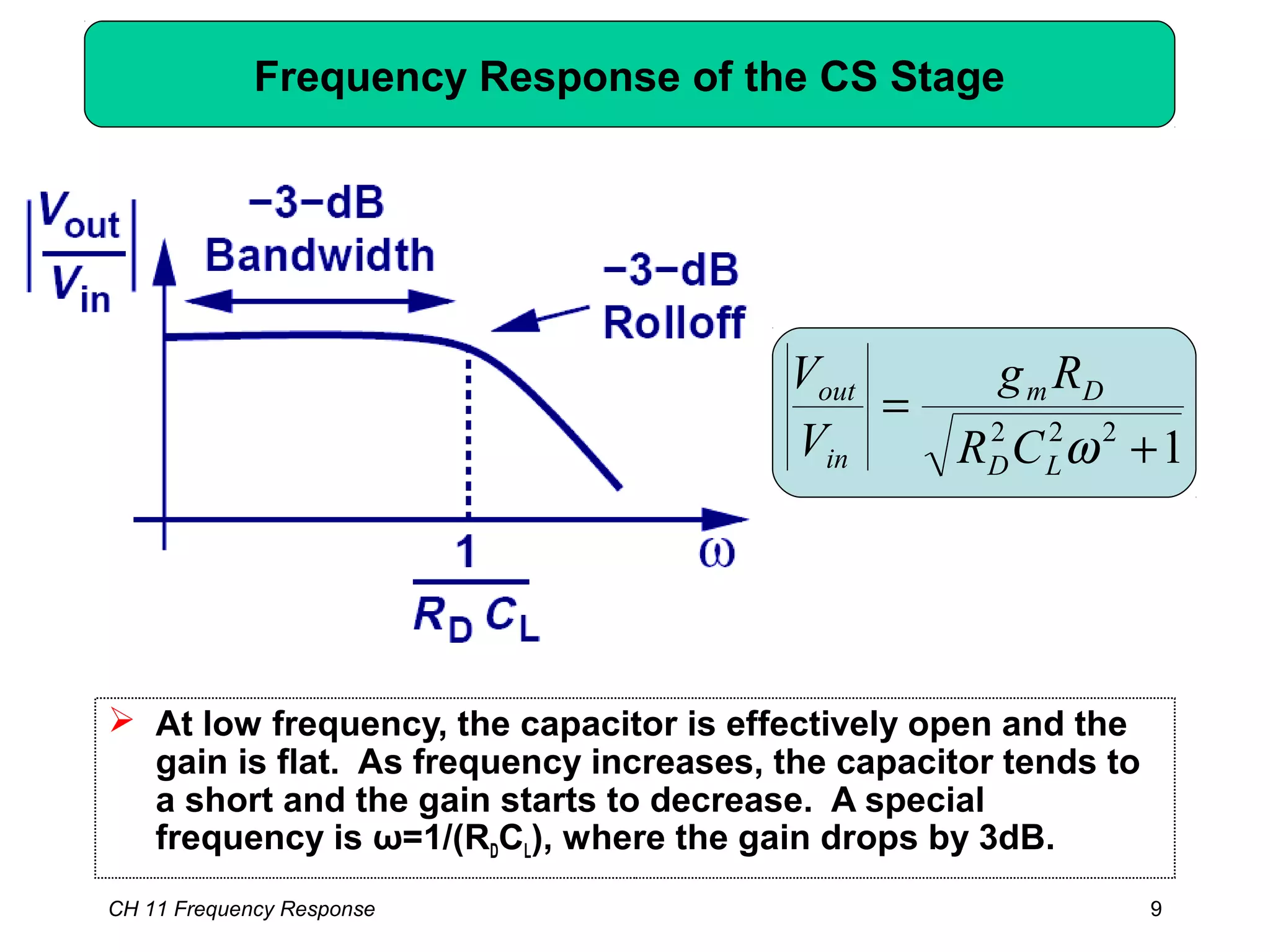
Frequency Response of the CS Stage
 At low frequency, the capacitor is effectively open and the
gain is flat. As frequency increases, the capacitor tends to
a short and the gain starts to decrease. A special
frequency is ω=1/(RDCL), where the gain drops by 3dB.
1222
+
=
ωLD
Dm
in
out
CR
Rg
V
V
CH 11 Frequency Response 10
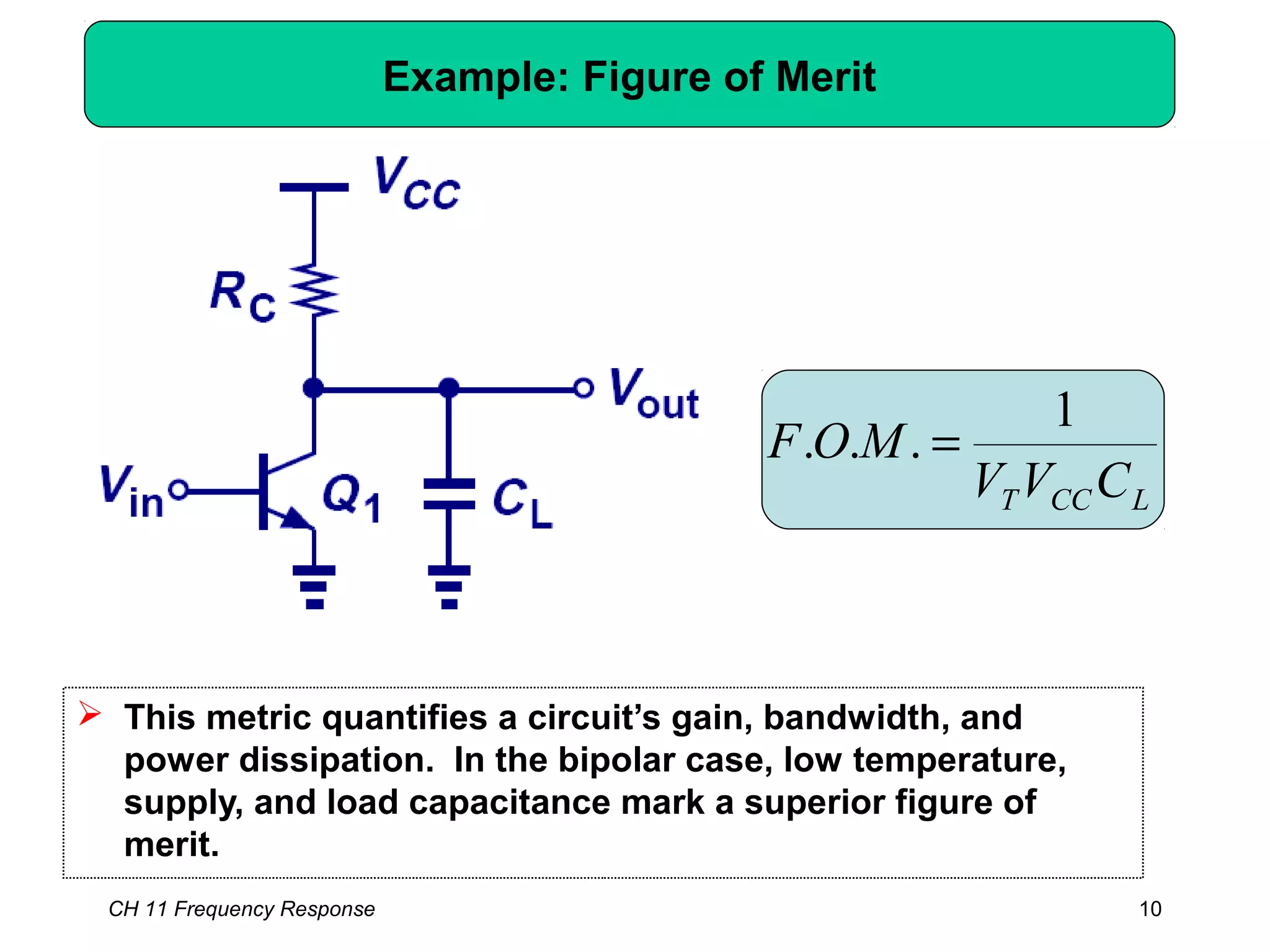
Example: Figure of Merit
 This metric quantifies a circuit’s gain, bandwidth, and
power dissipation. In the bipolar case, low temperature,
supply, and load capacitance mark a superior figure of
merit.
LCCT CVV
MOF
1
... =
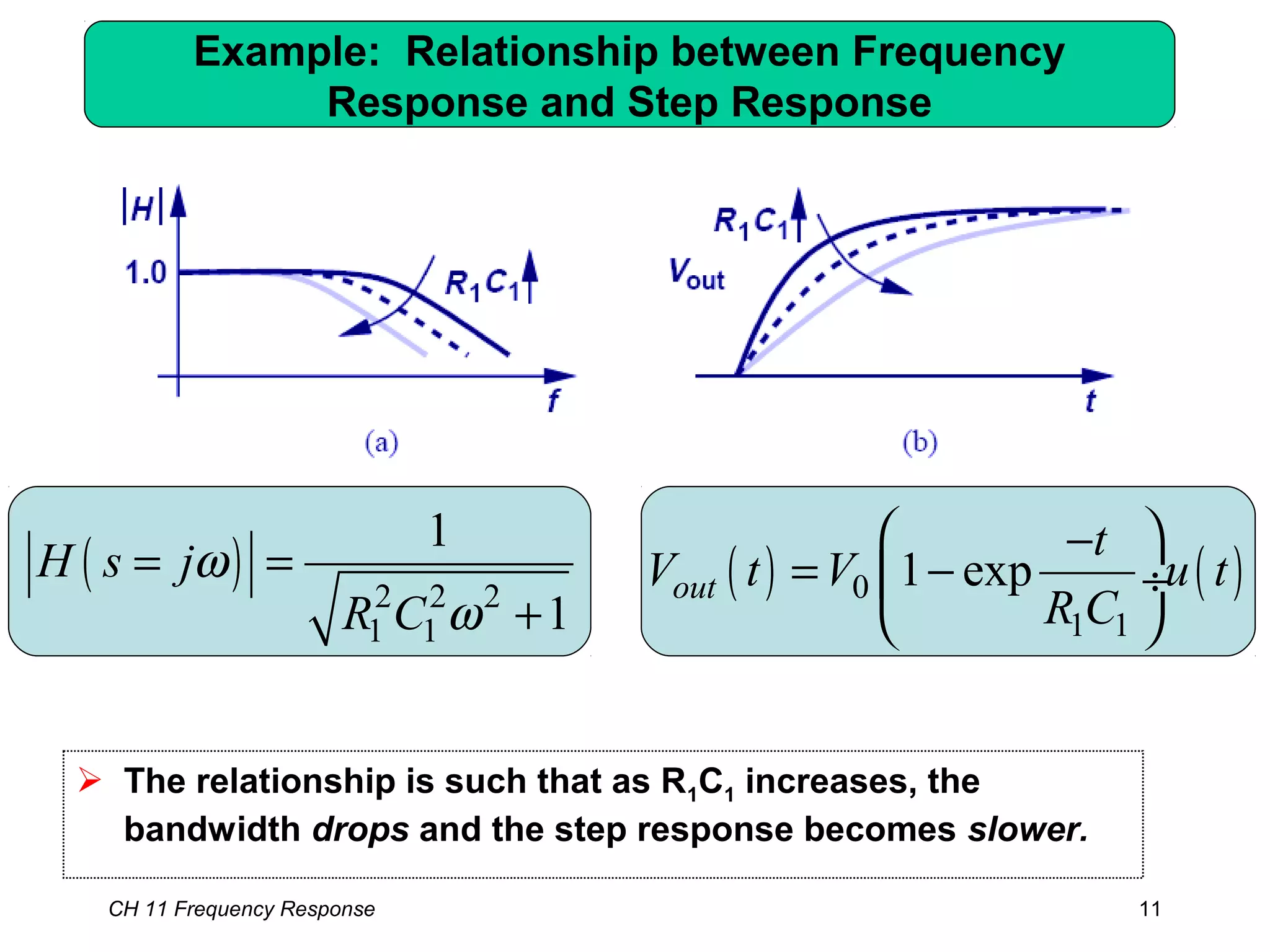
Example: Relationship between Frequency
Response and Step Response
CH 11 Frequency Response 11
( ) 2 2 2
1 1
1
1
H s j
R C
ω
ω
= =
+
( ) ( )0
1 1
1 expout
t
V t V u t
R C
 −
= − ÷
 
 The relationship is such that as R1C1 increases, the
bandwidth drops and the step response becomes slower.
CH 11 Frequency Response 12
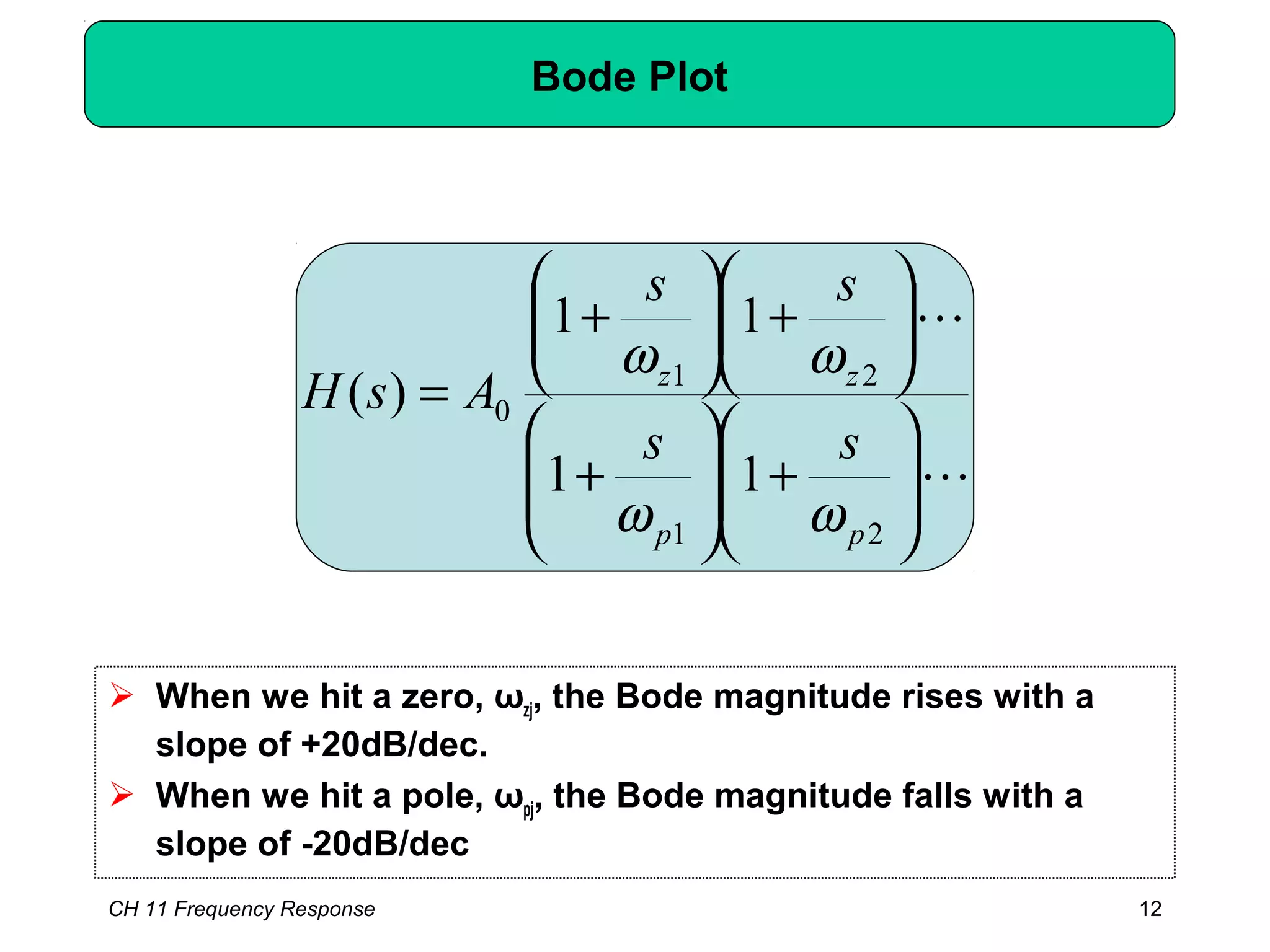
Bode Plot
 When we hit a zero, ωzj, the Bode magnitude rises with a
slope of +20dB/dec.
 When we hit a pole, ωpj, the Bode magnitude falls with a
slope of -20dB/dec










+







+






+





+
=
21
21
0
11
11
)(
pp
zz
ss
ss
AsH
ωω
ωω
CH 11 Frequency Response 13
Example: Bode Plot
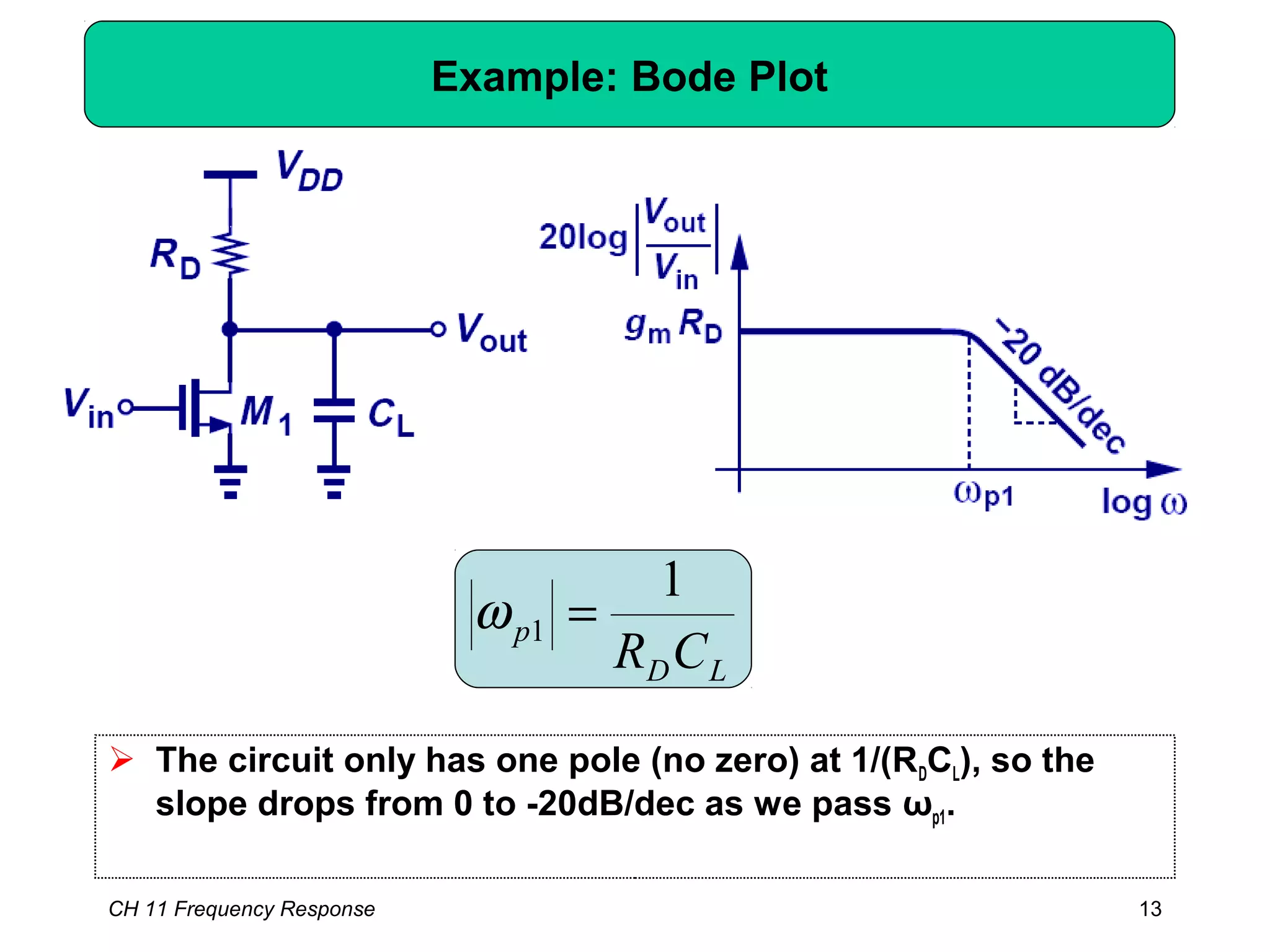
 The circuit only has one pole (no zero) at 1/(RDCL), so the
slope drops from 0 to -20dB/dec as we pass ωp1.
LD
p
CR
1
1 =ω
CH 11 Frequency Response 14
Pole Identification Example I
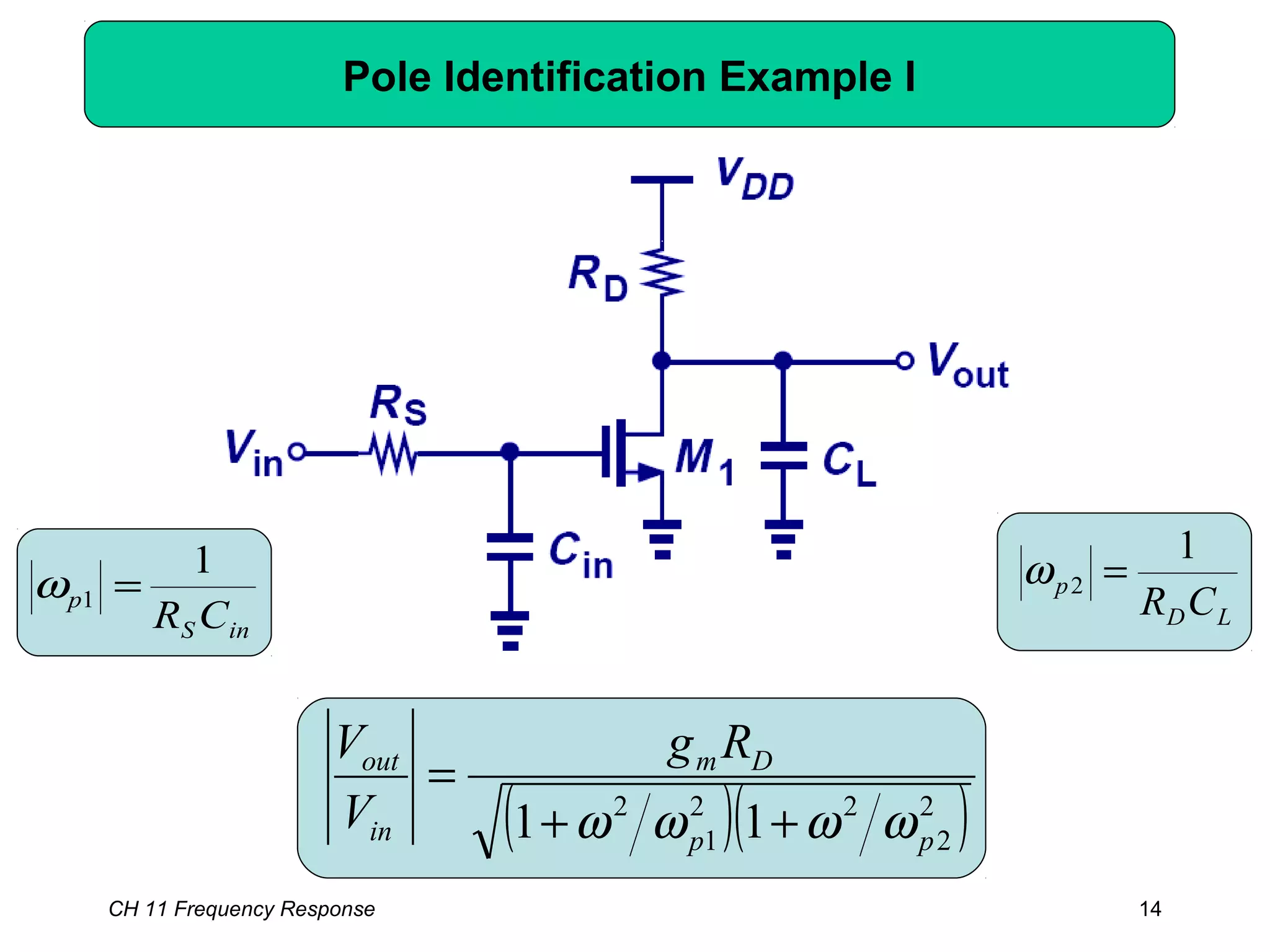
inS
p
CR
1
1 =ω
LD
p
CR
1
2 =ω
( )( )2
2
22
1
2
11 pp
Dm
in
out Rg
V
V
ωωωω ++
=
CH 11 Frequency Response 15
Pole Identification Example II
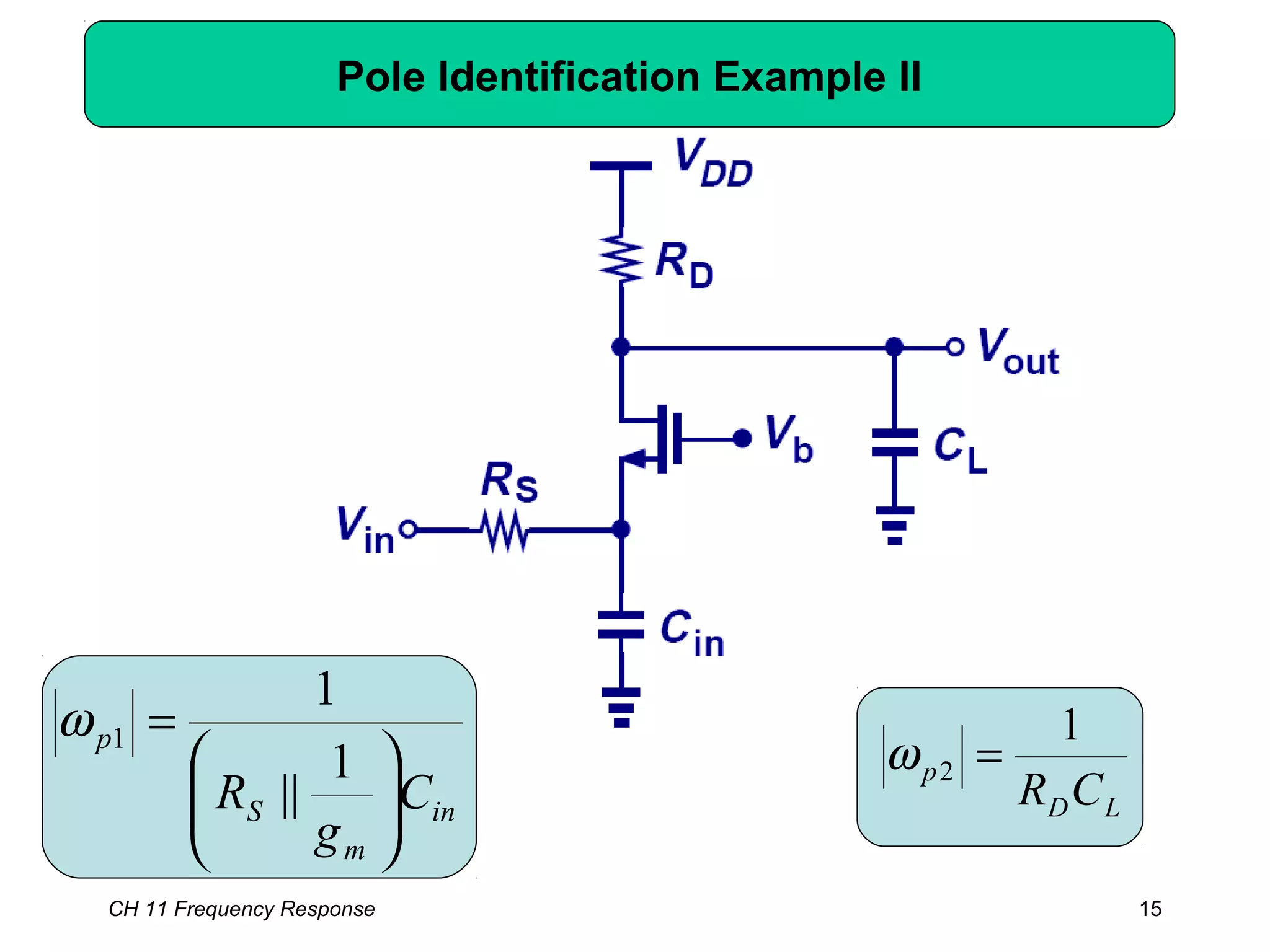
in
m
S
p
C
g
R 





=
1
||
1
1ω
LD
p
CR
1
2 =ω
CH 11 Frequency Response 16
Circuit with Floating Capacitor
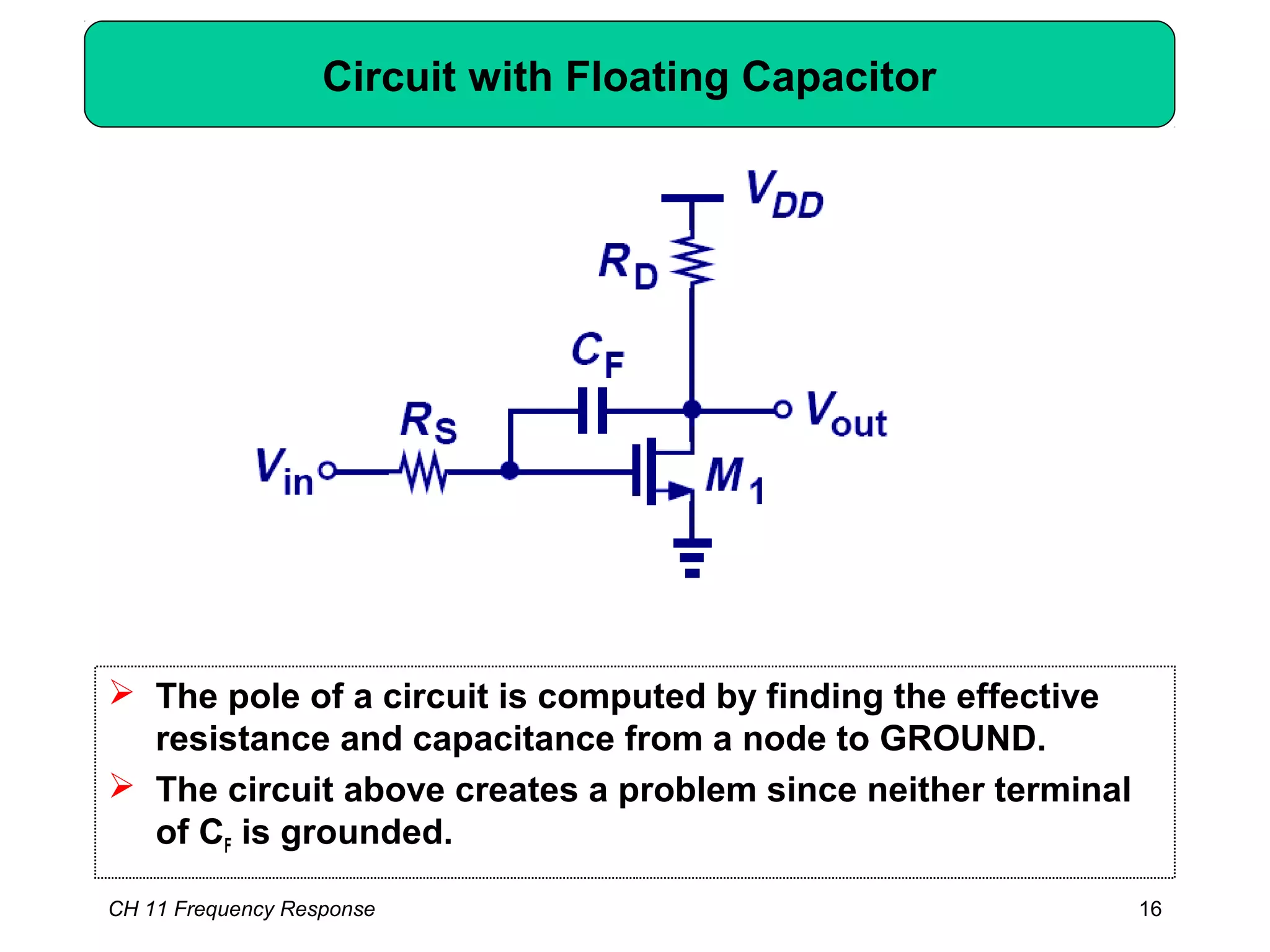
 The pole of a circuit is computed by finding the effective
resistance and capacitance from a node to GROUND.
 The circuit above creates a problem since neither terminal
of CF is grounded.
CH 11 Frequency Response 17
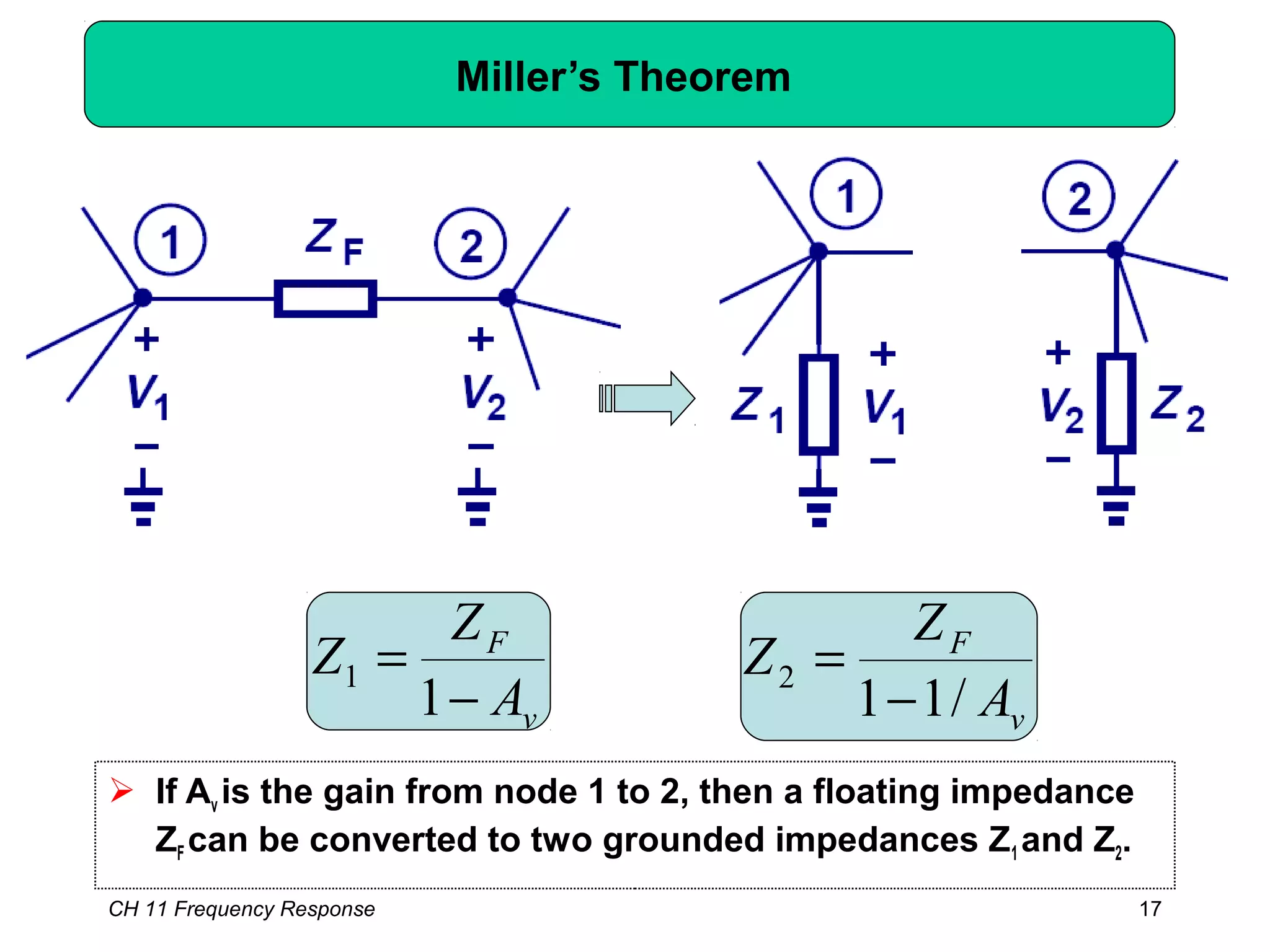
Miller’s Theorem
 If Av is the gain from node 1 to 2, then a floating impedance
ZF can be converted to two grounded impedances Z1 and Z2.
v
F
A
Z
Z
−
=
1
1
v
F
A
Z
Z
/11
2
−
=
CH 11 Frequency Response 18
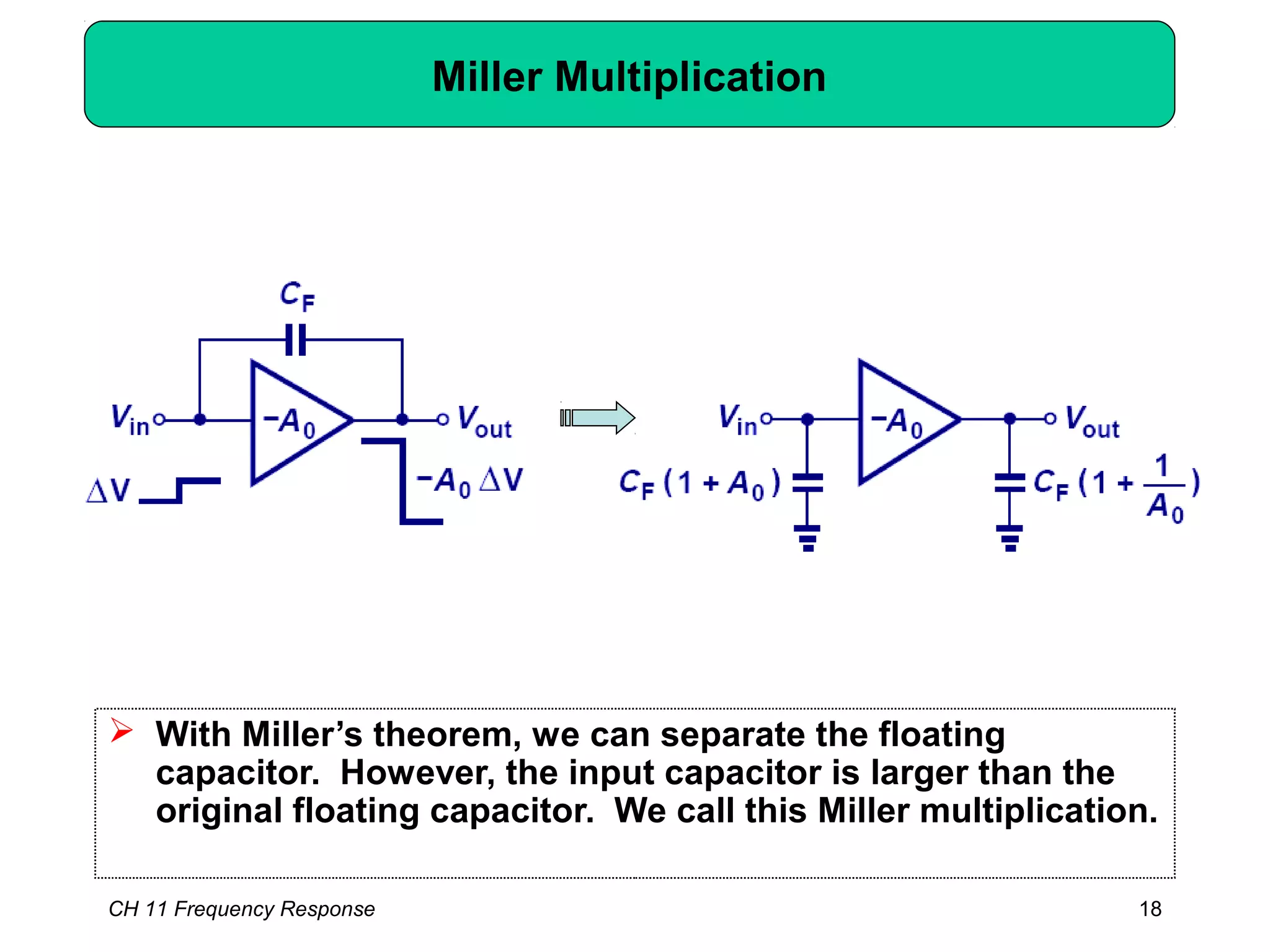
Miller Multiplication
 With Miller’s theorem, we can separate the floating
capacitor. However, the input capacitor is larger than the
original floating capacitor. We call this Miller multiplication.
CH 11 Frequency Response 19
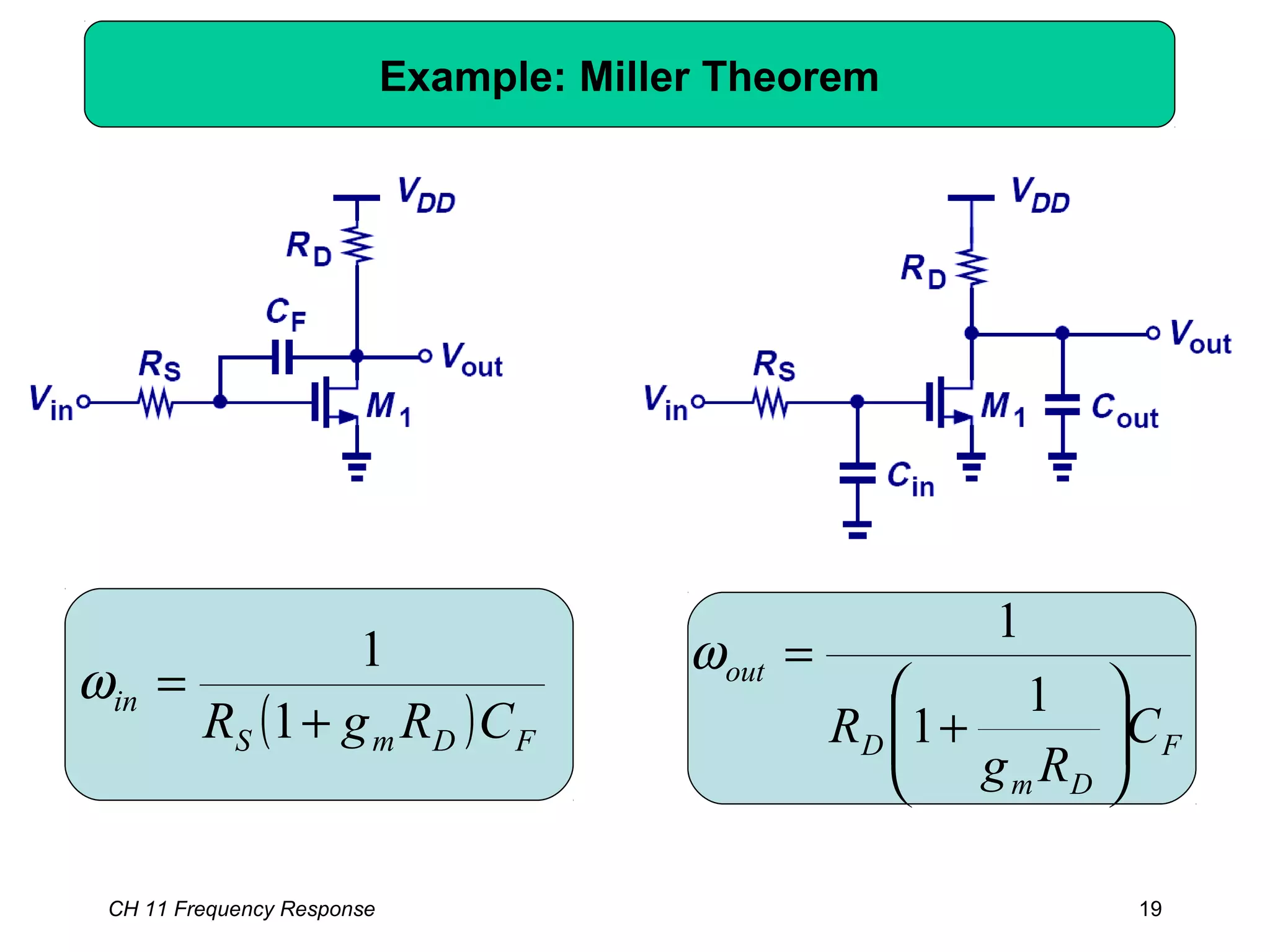
Example: Miller Theorem
( ) FDmS
in
CRgR +
=
1
1
ω
F
Dm
D
out
C
Rg
R 





+
=
1
1
1
ω
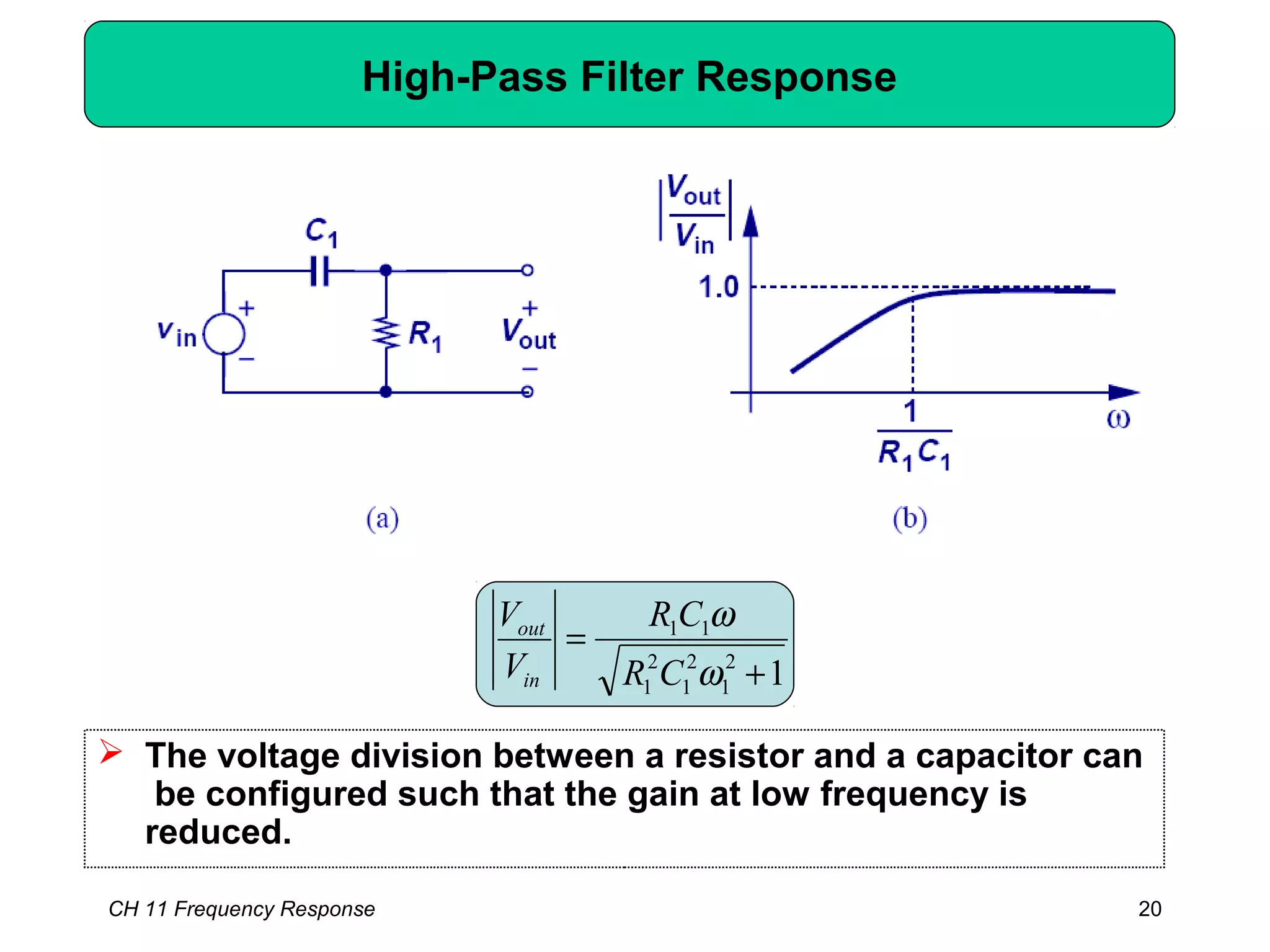
High-Pass Filter Response
12
1
2
1
2
1
11
+
=
ω
ω
CR
CR
V
V
in
out
 The voltage division between a resistor and a capacitor can
be configured such that the gain at low frequency is
reduced.
CH 11 Frequency Response 20
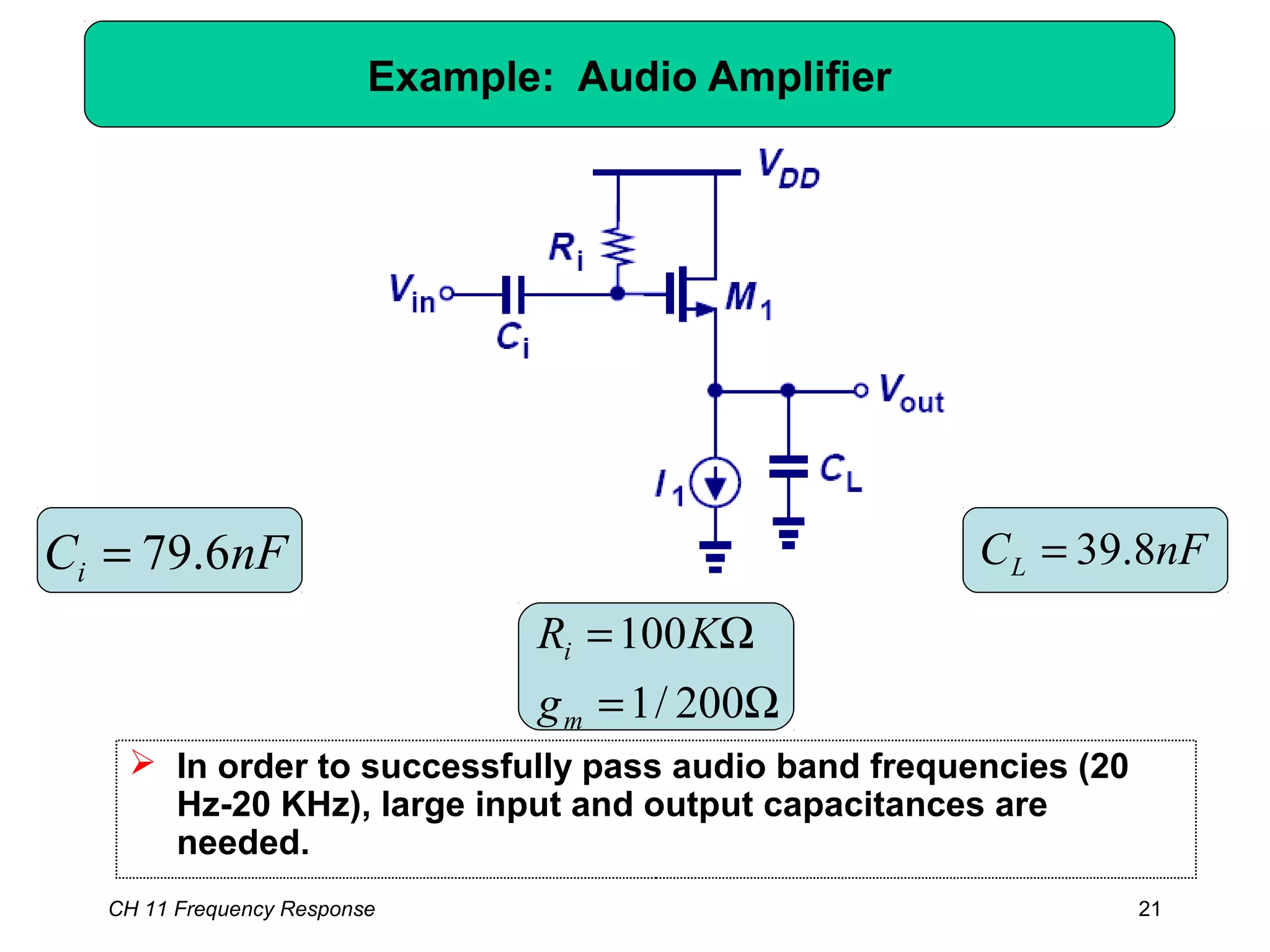
Example: Audio Amplifier
nFCi 6.79= nFCL 8.39=
 In order to successfully pass audio band frequencies (20
Hz-20 KHz), large input and output capacitances are
needed.
Ω=
Ω=
200/1
100
m
i
g
KR
CH 11 Frequency Response 21
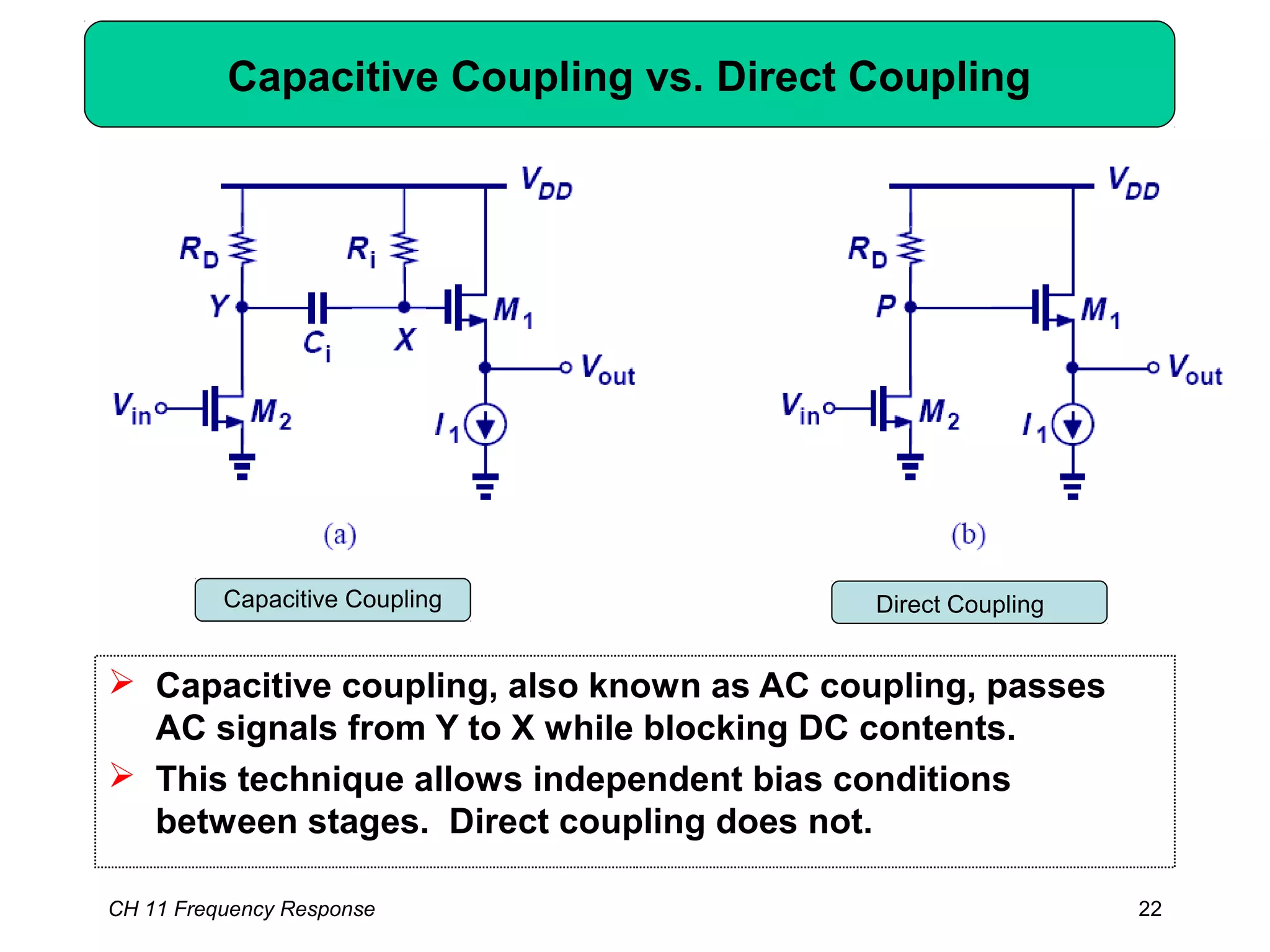
Capacitive Coupling vs. Direct Coupling
 Capacitive coupling, also known as AC coupling, passes
AC signals from Y to X while blocking DC contents.
 This technique allows independent bias conditions
between stages. Direct coupling does not.
Capacitive Coupling Direct Coupling
CH 11 Frequency Response 22
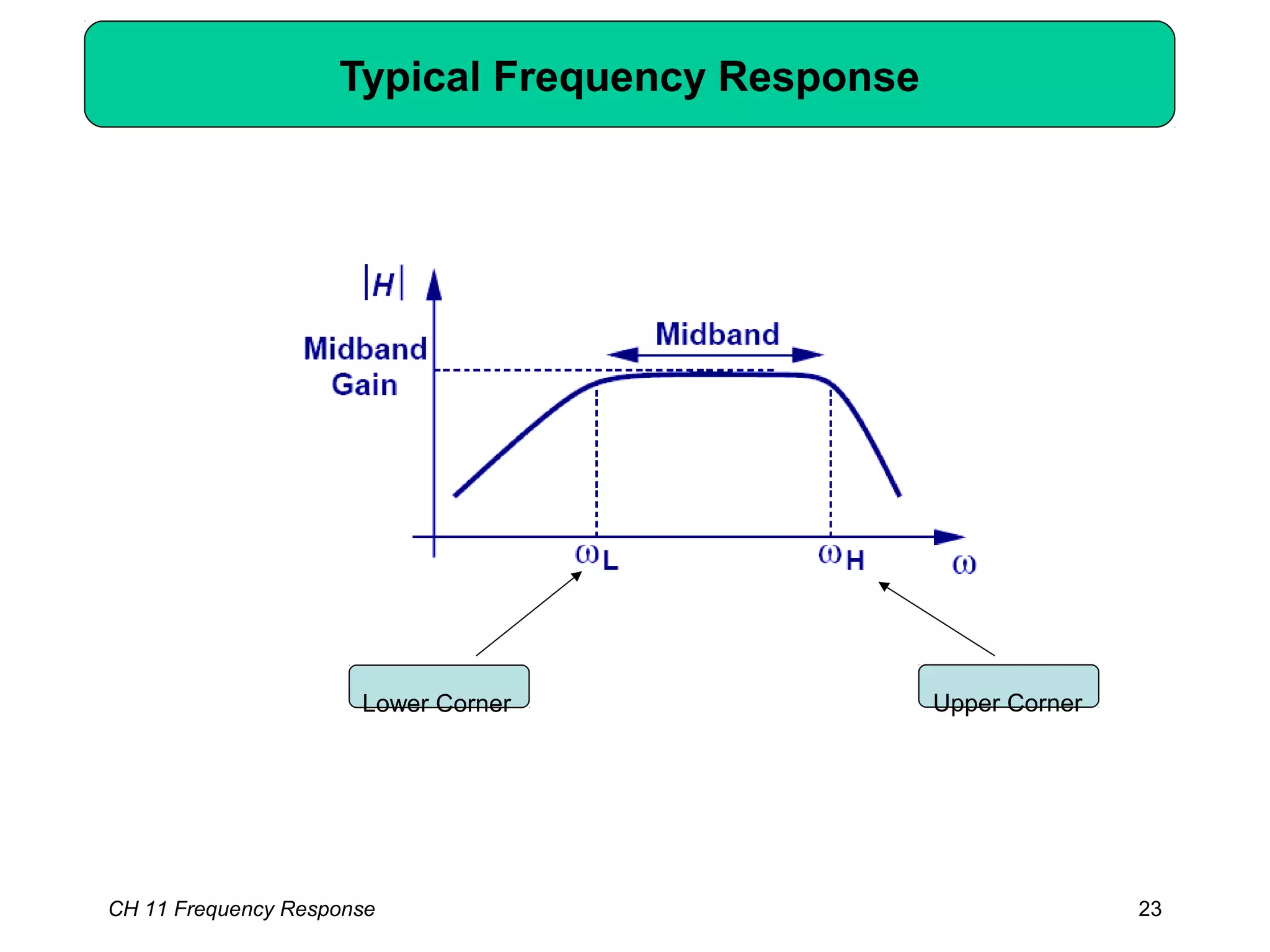
Typical Frequency Response
Lower Corner Upper Corner
CH 11 Frequency Response 23
CH 11 Frequency Response 24
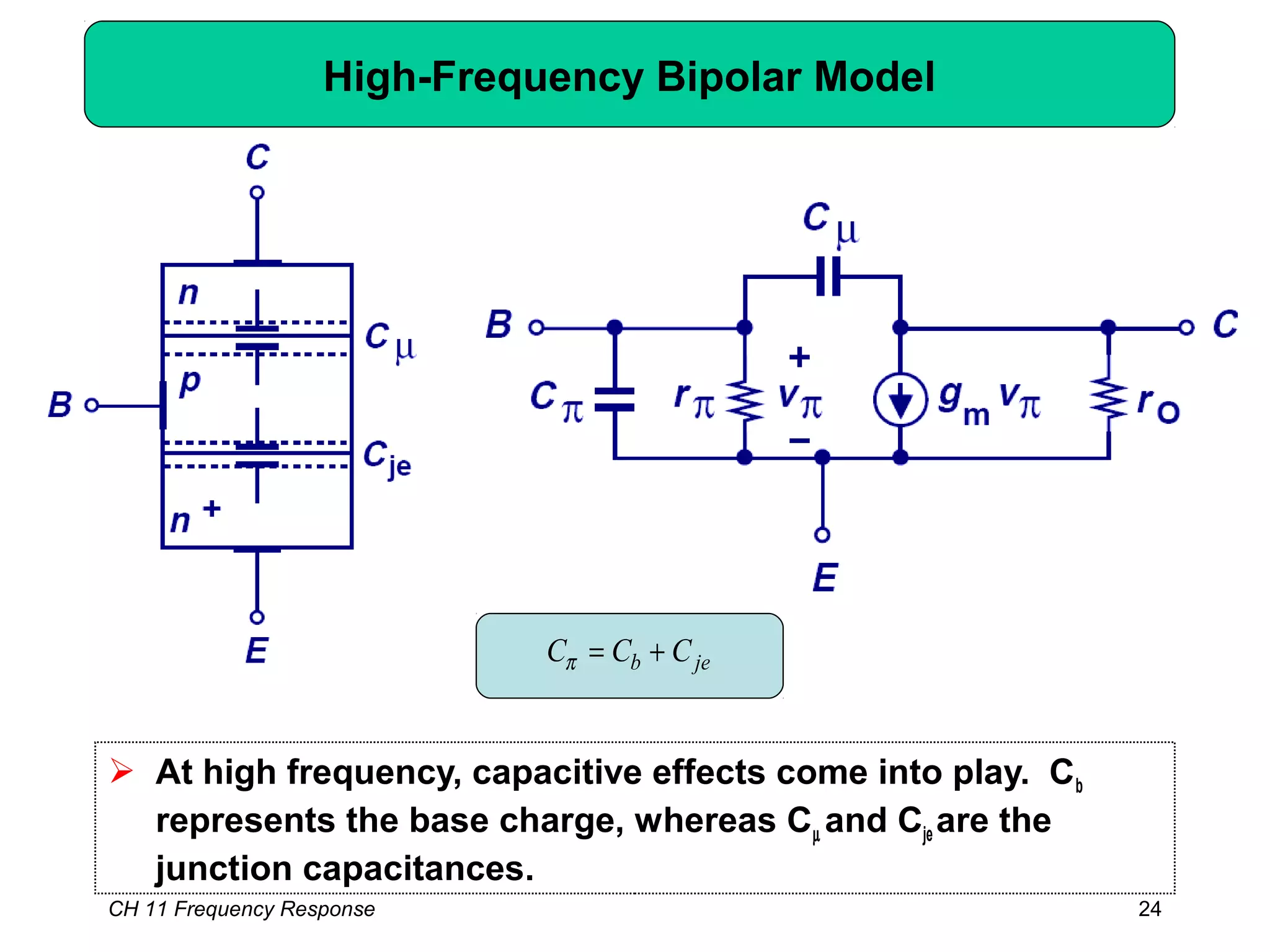
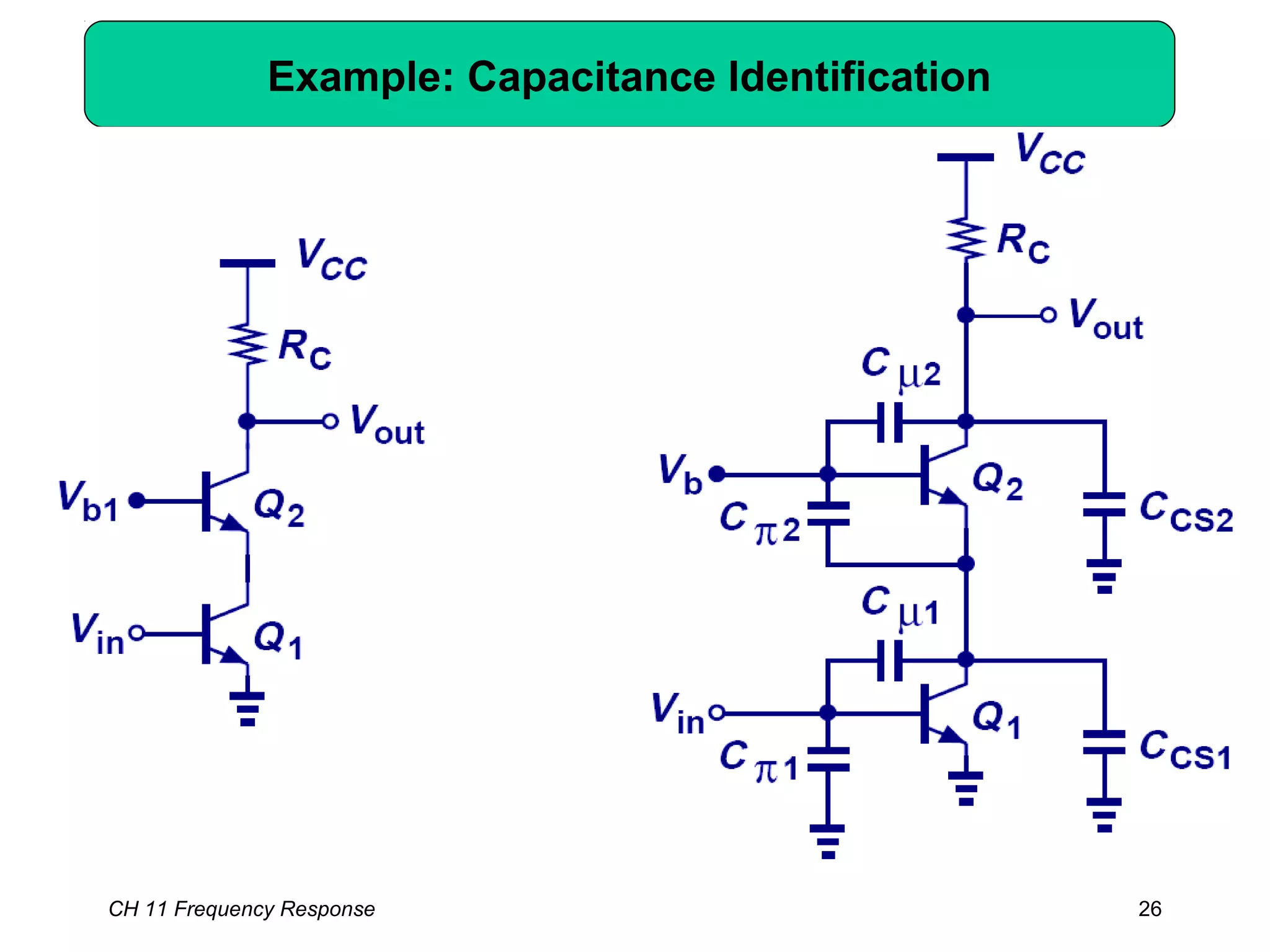
High-Frequency Bipolar Model
 At high frequency, capacitive effects come into play. Cb
represents the base charge, whereas Cµ and Cje are the
junction capacitances.
b jeC C Cπ = +
CH 11 Frequency Response 25
High-Frequency Model of Integrated Bipolar
Transistor
 Since an integrated bipolar circuit is fabricated on top of a
substrate, another junction capacitance exists between the
collector and substrate, namely CCS.
CH 11 Frequency Response 26
Example: Capacitance Identification
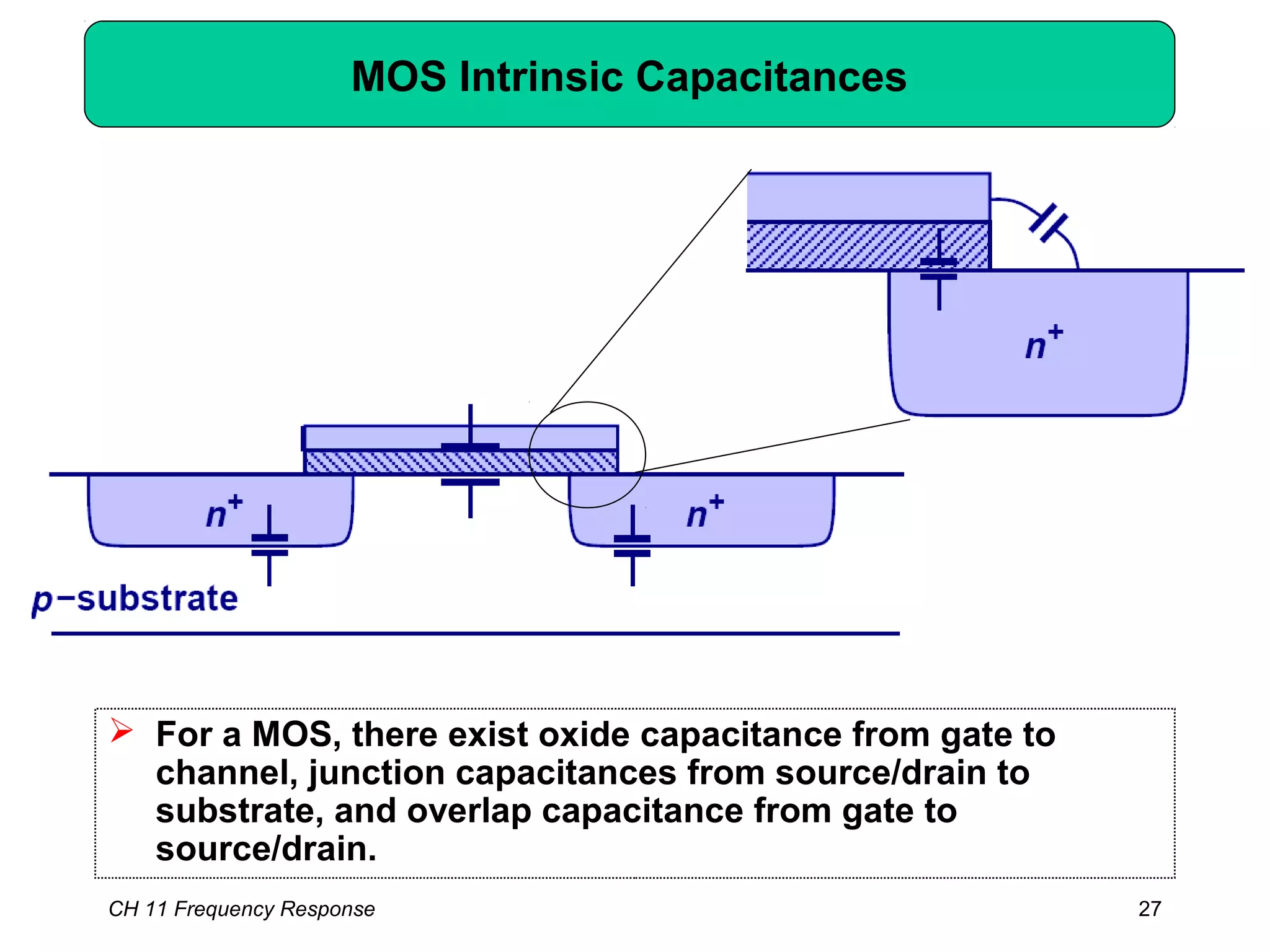
CH 11 Frequency Response 27
MOS Intrinsic Capacitances
 For a MOS, there exist oxide capacitance from gate to
channel, junction capacitances from source/drain to
substrate, and overlap capacitance from gate to
source/drain.
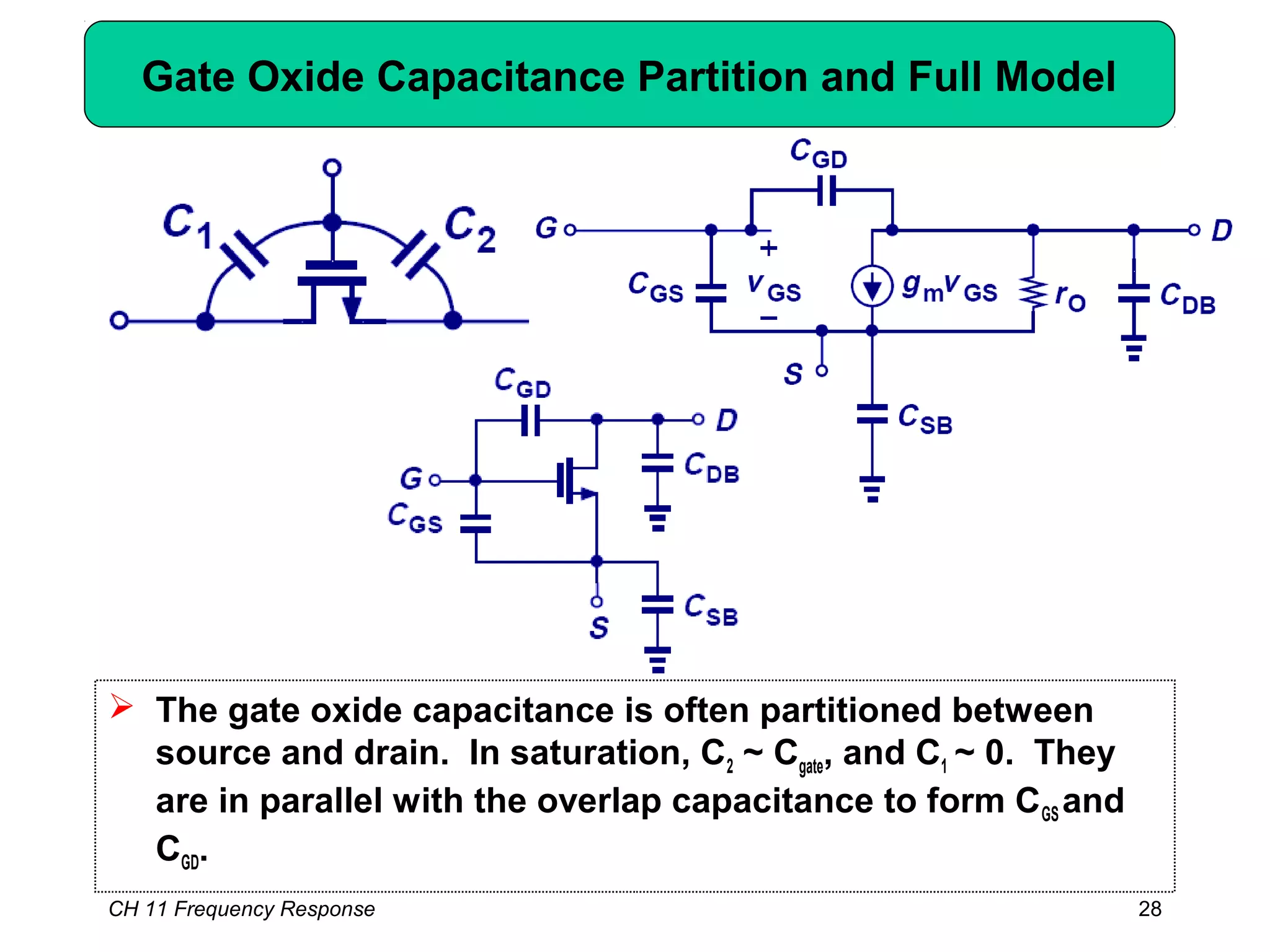
CH 11 Frequency Response 28
Gate Oxide Capacitance Partition and Full Model
 The gate oxide capacitance is often partitioned between
source and drain. In saturation, C2 ~ Cgate, and C1 ~ 0. They
are in parallel with the overlap capacitance to form CGS and
CGD.
CH 11 Frequency Response 29
Example: Capacitance Identification
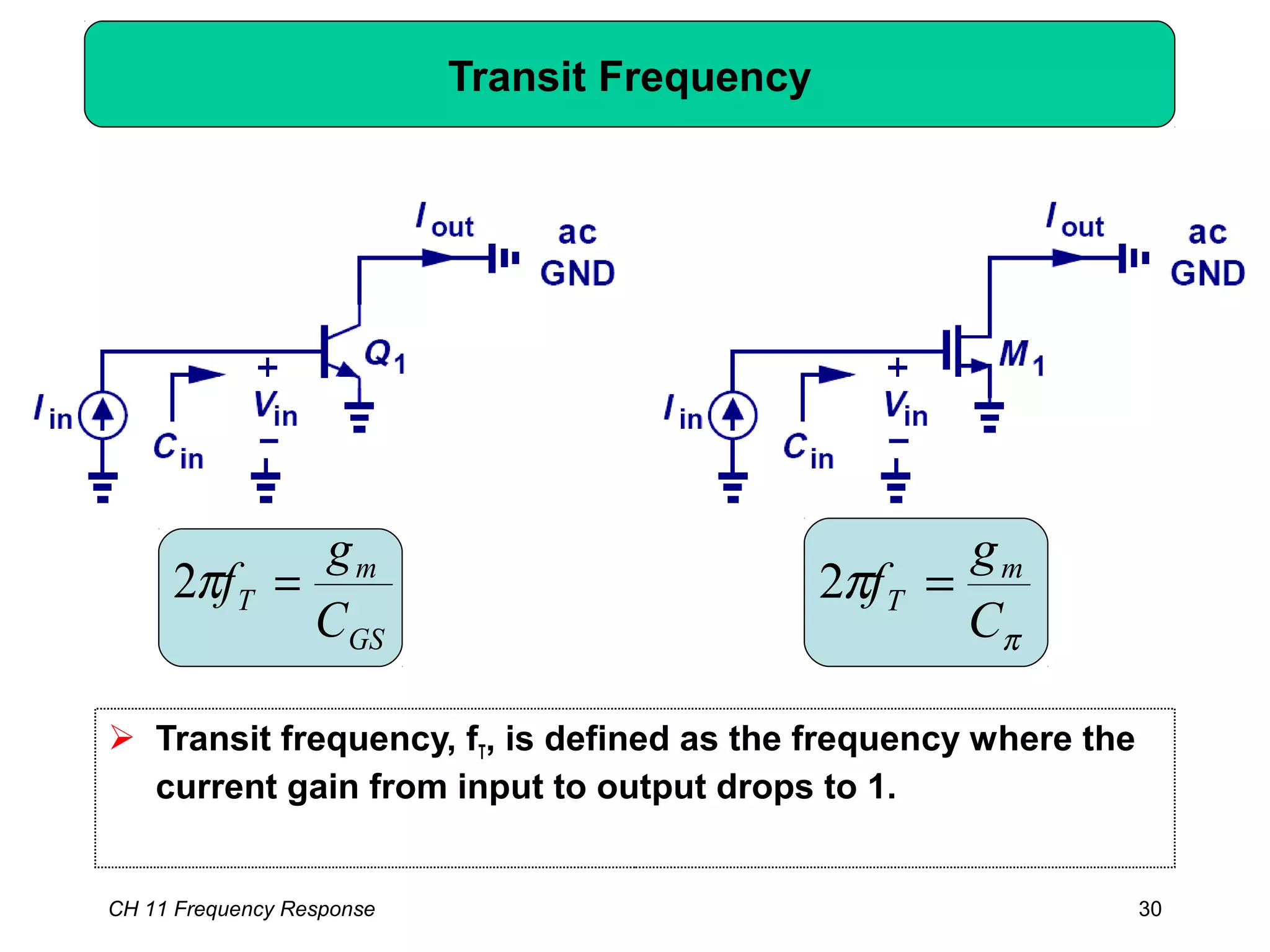
CH 11 Frequency Response 30
Transit Frequency
 Transit frequency, fT, is defined as the frequency where the
current gain from input to output drops to 1.
π
π
C
g
f m
T =2
GS
m
T
C
g
f =π2
Example: Transit Frequency Calculation
( )THGS
n
T VV
L
f −= 2
2
3
2
µ
π
GHzf
sVcm
mVVV
nmL
T
n
THGS
226
)./(400
100
65
2
=
=
=−
=
µ
CH 11 Frequency Response 31
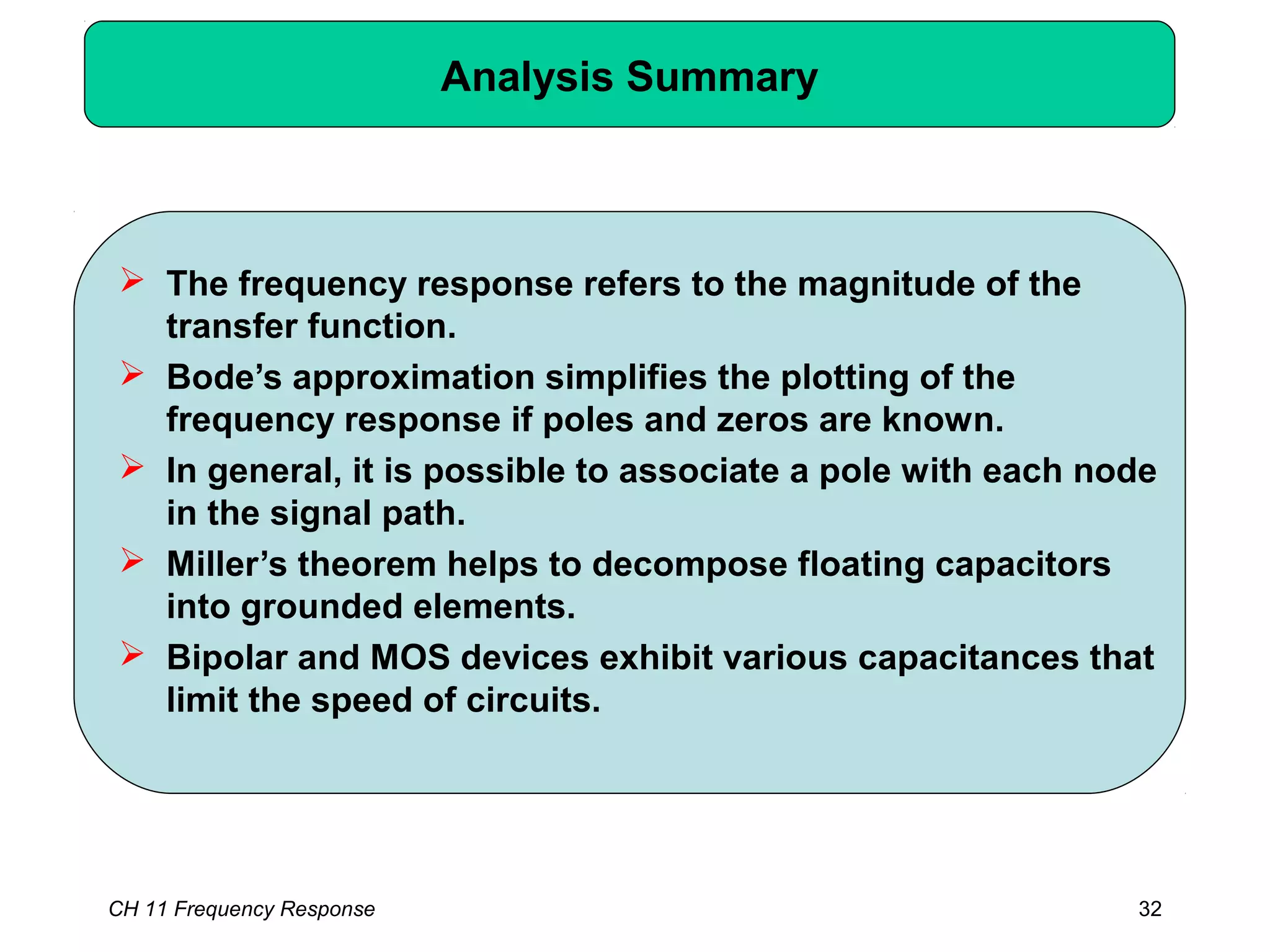
Analysis Summary
 The frequency response refers to the magnitude of the
transfer function.
 Bode’s approximation simplifies the plotting of the
frequency response if poles and zeros are known.
 In general, it is possible to associate a pole with each node
in the signal path.
 Miller’s theorem helps to decompose floating capacitors
into grounded elements.
 Bipolar and MOS devices exhibit various capacitances that
limit the speed of circuits.
CH 11 Frequency Response 32
High Frequency Circuit Analysis Procedure
 Determine which capacitor impact the low-frequency region
of the response and calculate the low-frequency pole
(neglect transistor capacitance).
 Calculate the midband gain by replacing the capacitors
with short circuits (neglect transistor capacitance).
 Include transistor capacitances.
 Merge capacitors connected to AC grounds and omit those
that play no role in the circuit.
 Determine the high-frequency poles and zeros.
 Plot the frequency response using Bode’s rules or exact
analysis.
CH 11 Frequency Response 33
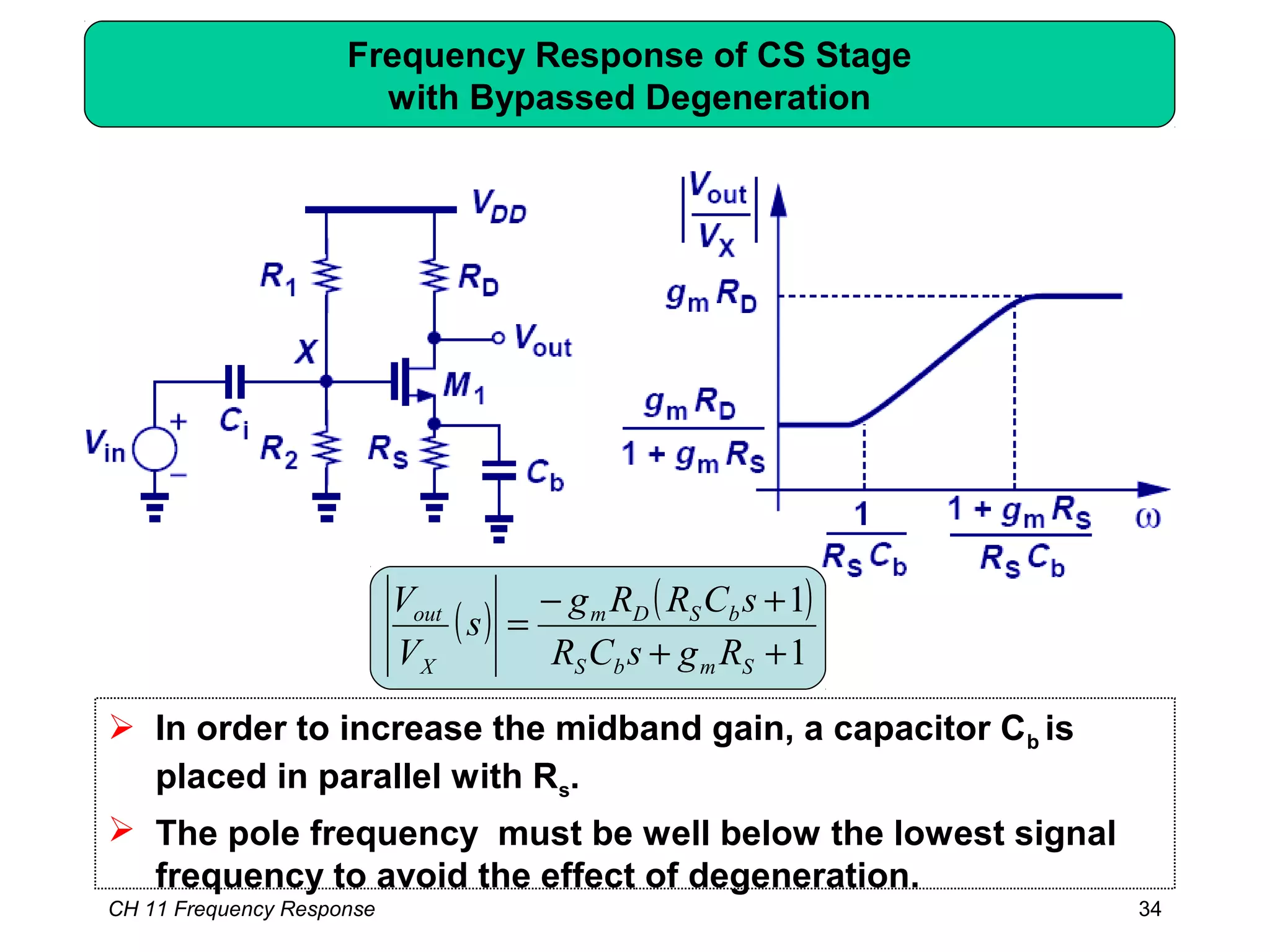
Frequency Response of CS Stage
with Bypassed Degeneration
( ) ( )
1
1
++
+−
=
SmbS
bSDm
X
out
RgsCR
sCRRg
s
V
V
 In order to increase the midband gain, a capacitor Cb is
placed in parallel with Rs.
 The pole frequency must be well below the lowest signal
frequency to avoid the effect of degeneration.
CH 11 Frequency Response 34
CH 11 Frequency Response 35
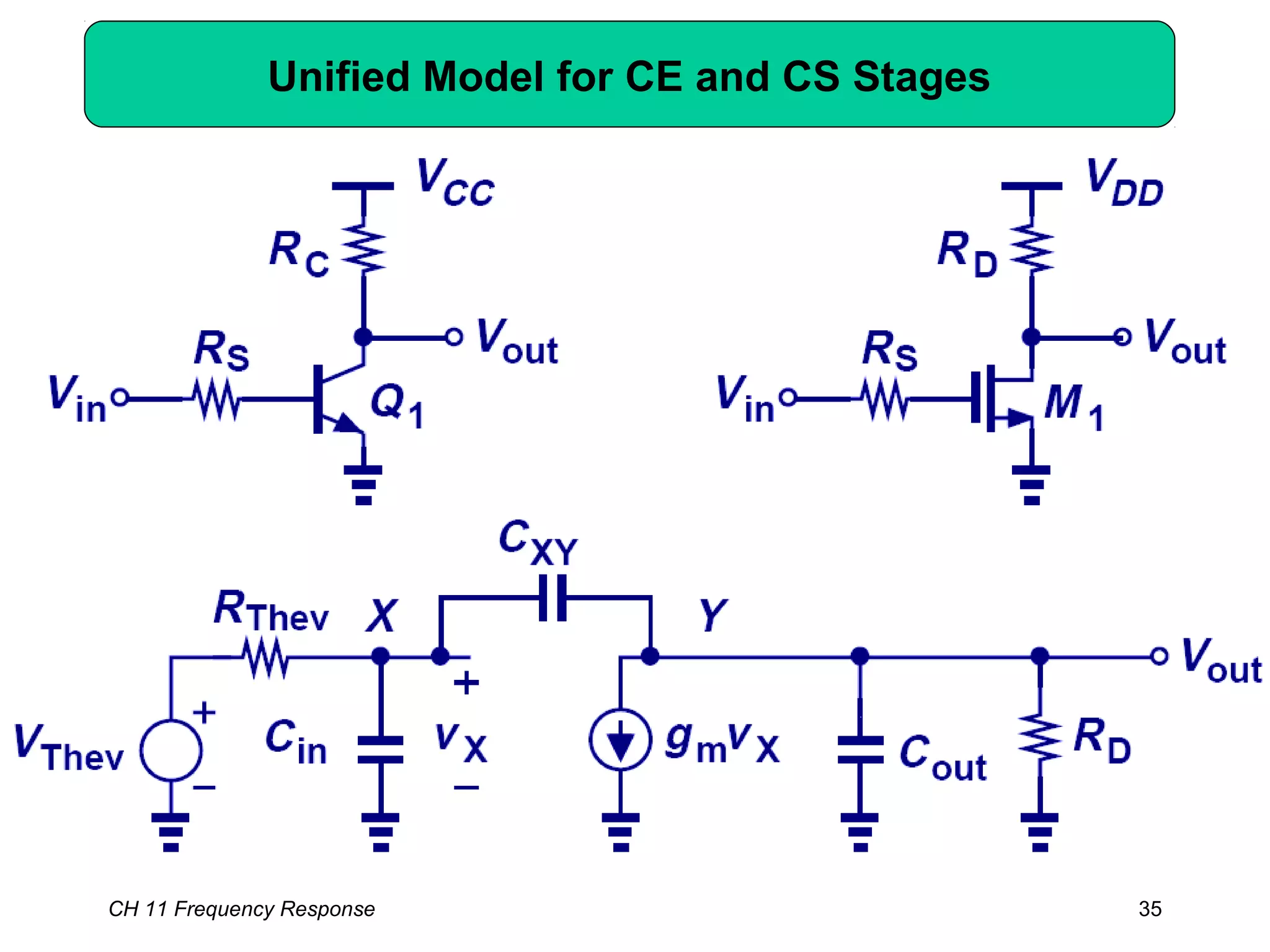
Unified Model for CE and CS Stages
CH 11 Frequency Response 36
Unified Model Using Miller’s Theorem
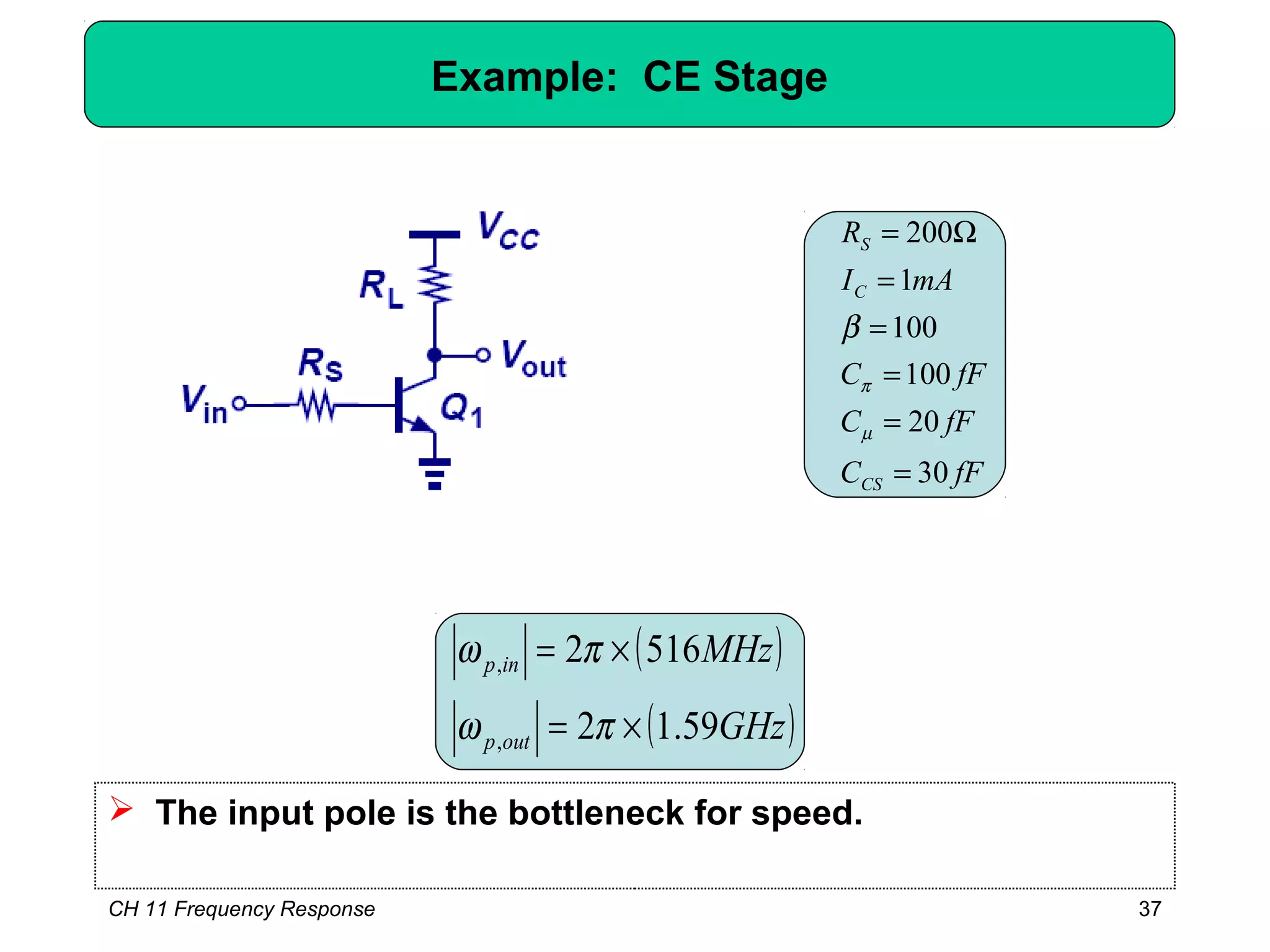
Example: CE Stage
fFC
fFC
fFC
mAI
R
CS
C
S
30
20
100
100
1
200
=
=
=
=
=
Ω=
µ
π
β
( )
( )GHz
MHz
outp
inp
59.12
5162
,
,
×=
×=
πω
πω
 The input pole is the bottleneck for speed.
CH 11 Frequency Response 37
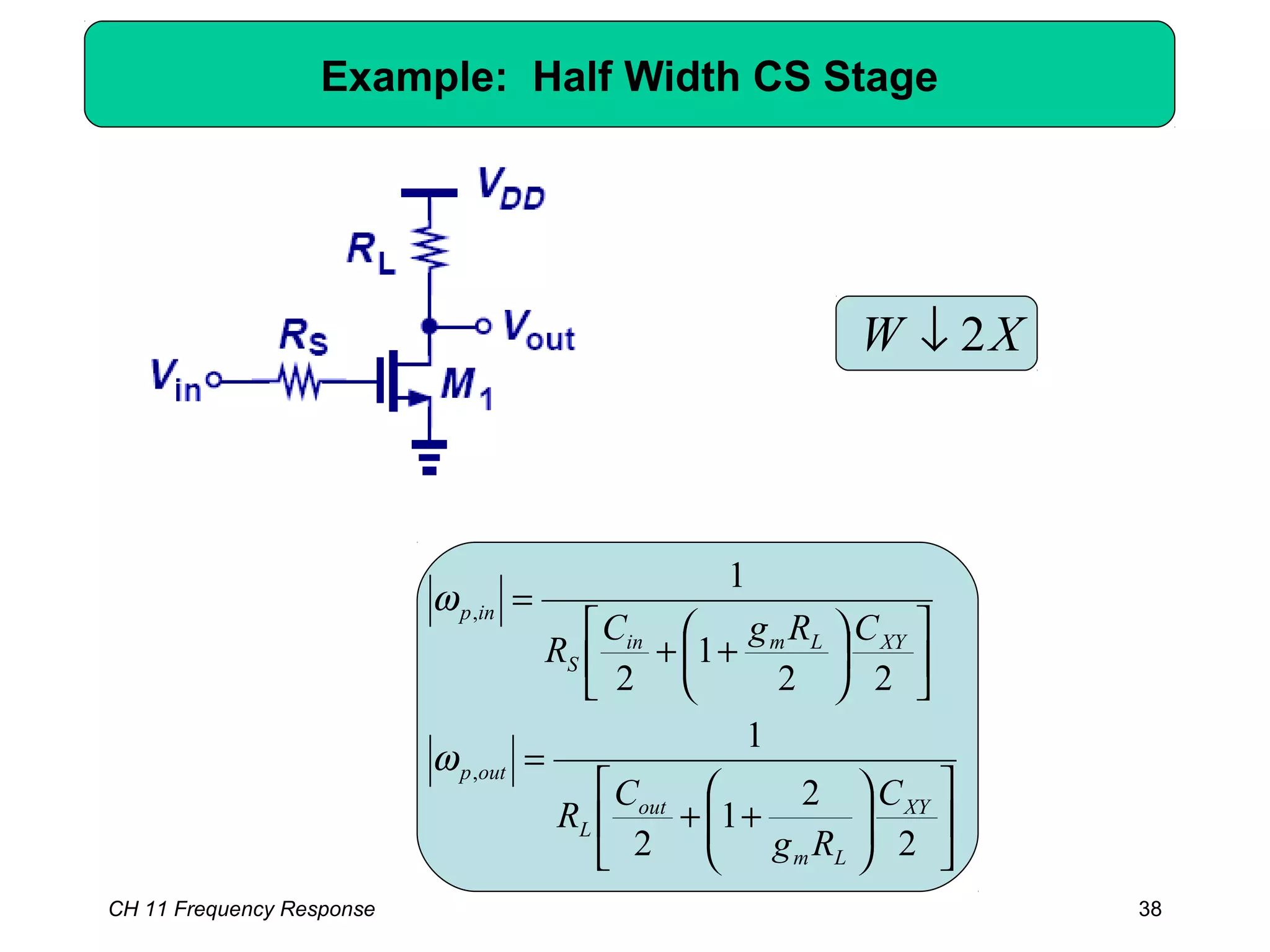
Example: Half Width CS Stage
XW 2↓












++
=












++
=
2
2
1
2
1
22
1
2
1
,
,
XY
Lm
out
L
outp
XYLmin
S
inp
C
Rg
C
R
CRgC
R
ω
ω
CH 11 Frequency Response 38
CH 11 Frequency Response 39
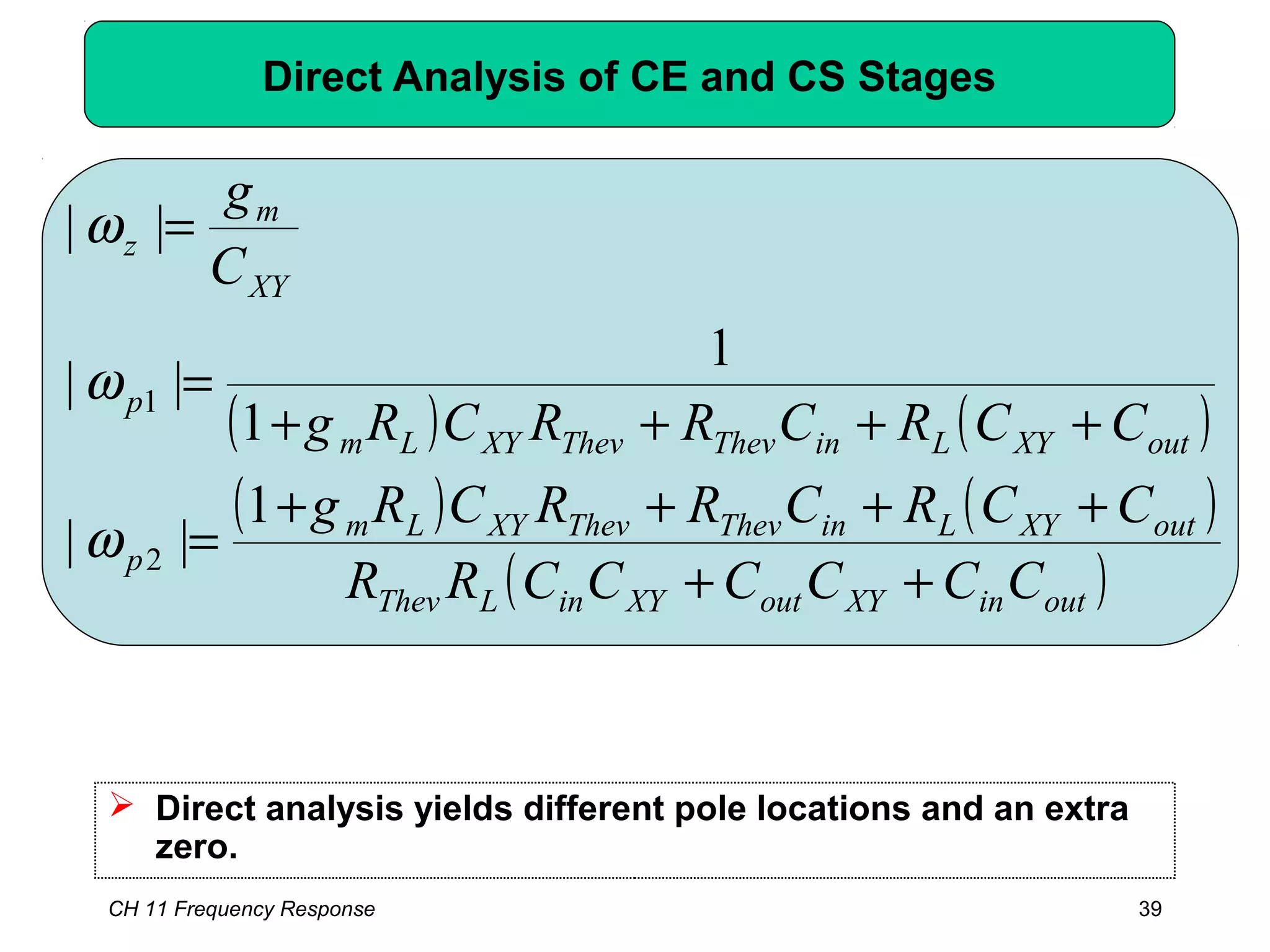
Direct Analysis of CE and CS Stages
 Direct analysis yields different pole locations and an extra
zero.
( ) ( )
( ) ( )
( )outinXYoutXYinLThev
outXYLinThevThevXYLm
p
outXYLinThevThevXYLm
p
XY
m
z
CCCCCCRR
CCRCRRCRg
CCRCRRCRg
C
g
++
++++
=
++++
=
=
1
||
1
1
||
||
2
1
ω
ω
ω
CH 11 Frequency Response 40
Example: CE and CS Direct Analysis
( )[ ] ( )
( )[ ] ( )
( )( )outinXYoutXYinOOS
outXYOOinSSXYOOm
p
outXYOOinSSXYOOm
p
CCCCCCrrR
CCrrCRRCrrg
CCrrCRRCrrg
++
++++
≈
++++
≈
21
21211
2
21211
1
||
)(||||1
)(||||1
1
ω
ω
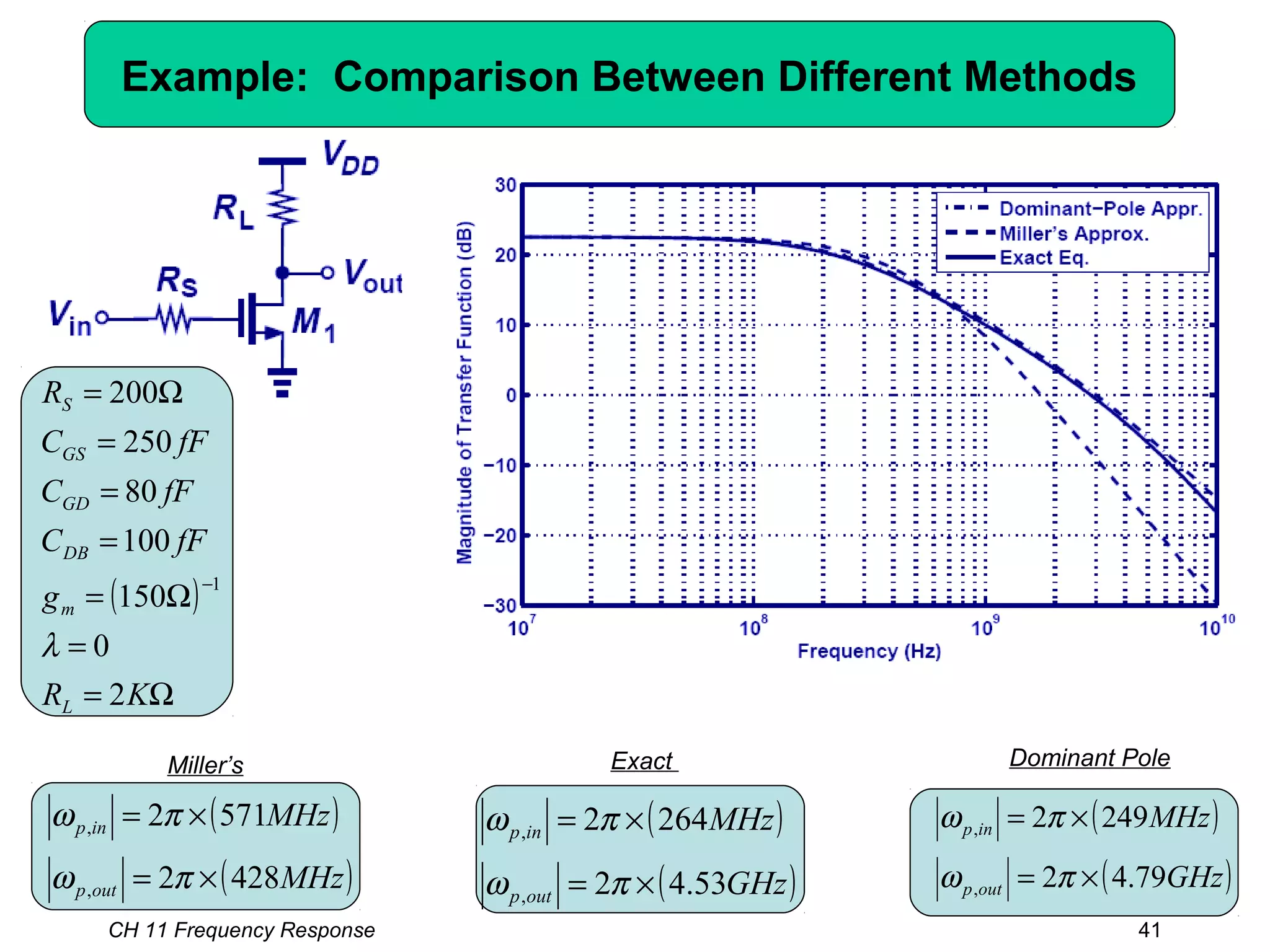
Example: Comparison Between Different Methods
( )
( )MHz
MHz
outp
inp
4282
5712
,
,
×=
×=
πω
πω ( )
( )GHz
MHz
outp
inp
53.42
2642
,
,
×=
×=
πω
πω ( )
( )GHz
MHz
outp
inp
79.42
2492
,
,
×=
×=
πω
πω
( )
Ω=
=
Ω=
=
=
=
Ω=
−
KR
g
fFC
fFC
fFC
R
L
m
DB
GD
GS
S
2
0
150
100
80
250
200
1
λ
Miller’s Exact Dominant Pole
CH 11 Frequency Response 41
CH 11 Frequency Response 42
Input Impedance of CE and CS Stages
( )[ ] π
µπ
r
sCRgC
Z
Cm
in ||
1
1
++
≈
( )[ ]sCRgC
Z
GDDmGS
in
++
≈
1
1
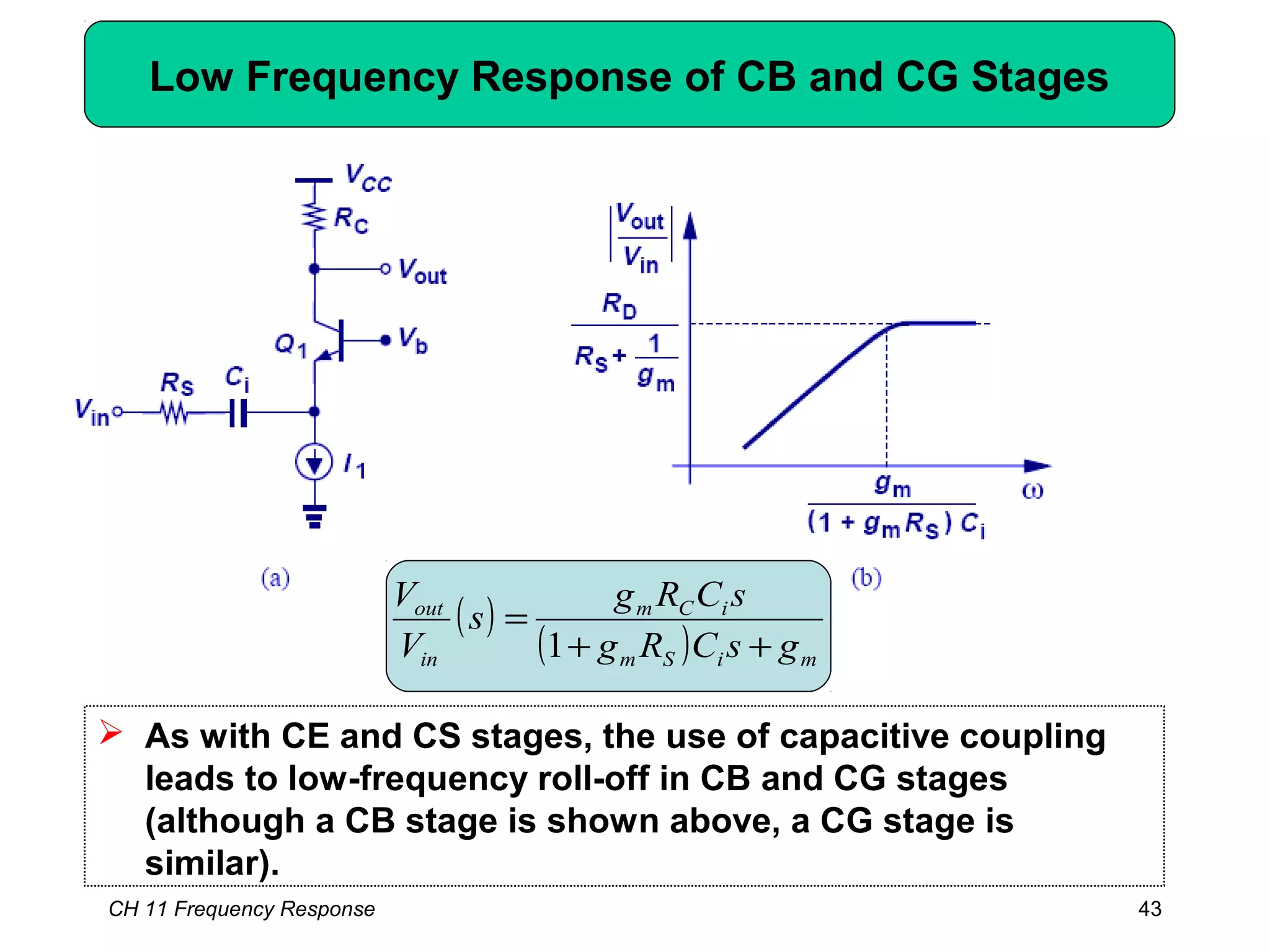
Low Frequency Response of CB and CG Stages
( )
( ) miSm
iCm
in
out
gsCRg
sCRg
s
V
V
++
=
1
 As with CE and CS stages, the use of capacitive coupling
leads to low-frequency roll-off in CB and CG stages
(although a CB stage is shown above, a CG stage is
similar).
CH 11 Frequency Response 43
CH 11 Frequency Response 44
Frequency Response of CB Stage
X
m
S
Xp
C
g
R 





=
1
||
1
,ω
πCCX =
YL
Yp
CR
1
, =ω
CSY CCC += µ
∞=Or
CH 11 Frequency Response 45
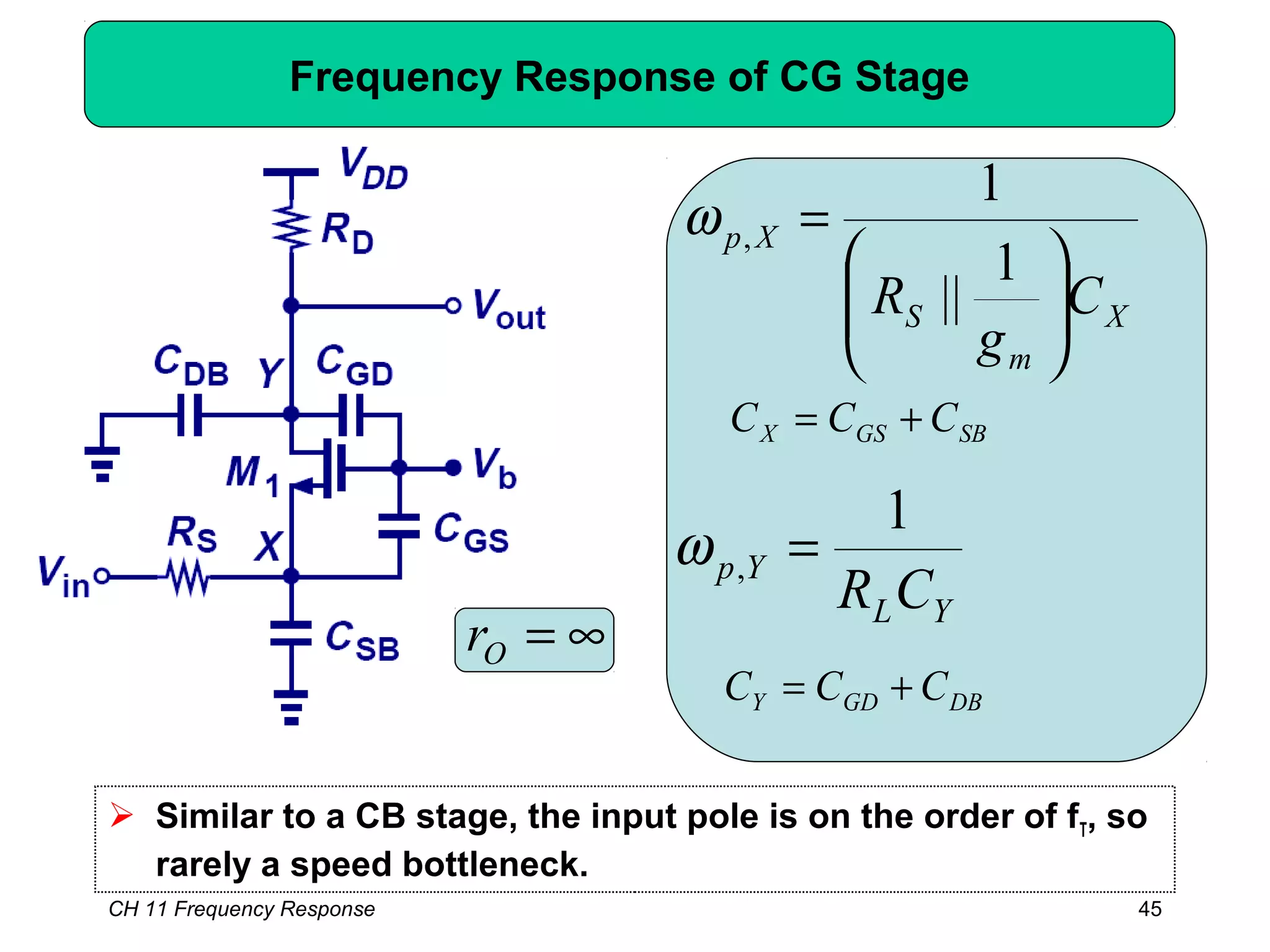
Frequency Response of CG Stage
∞=Or
X
m
S
Xp
C
g
R 





=
1
||
1
,ω
SBGSX CCC +=
YL
Yp
CR
1
, =ω
DBGDY CCC +=
 Similar to a CB stage, the input pole is on the order of fT, so
rarely a speed bottleneck.
∞=Or
CH 11 Frequency Response 46
Example: CG Stage Pole Identification
( )11
1
,
1
||
1
GDSB
m
S
Xp
CC
g
R +





=ω
( )2211
2
,
1
1
DBGSGDDB
m
Yp
CCCC
g
+++
=ω
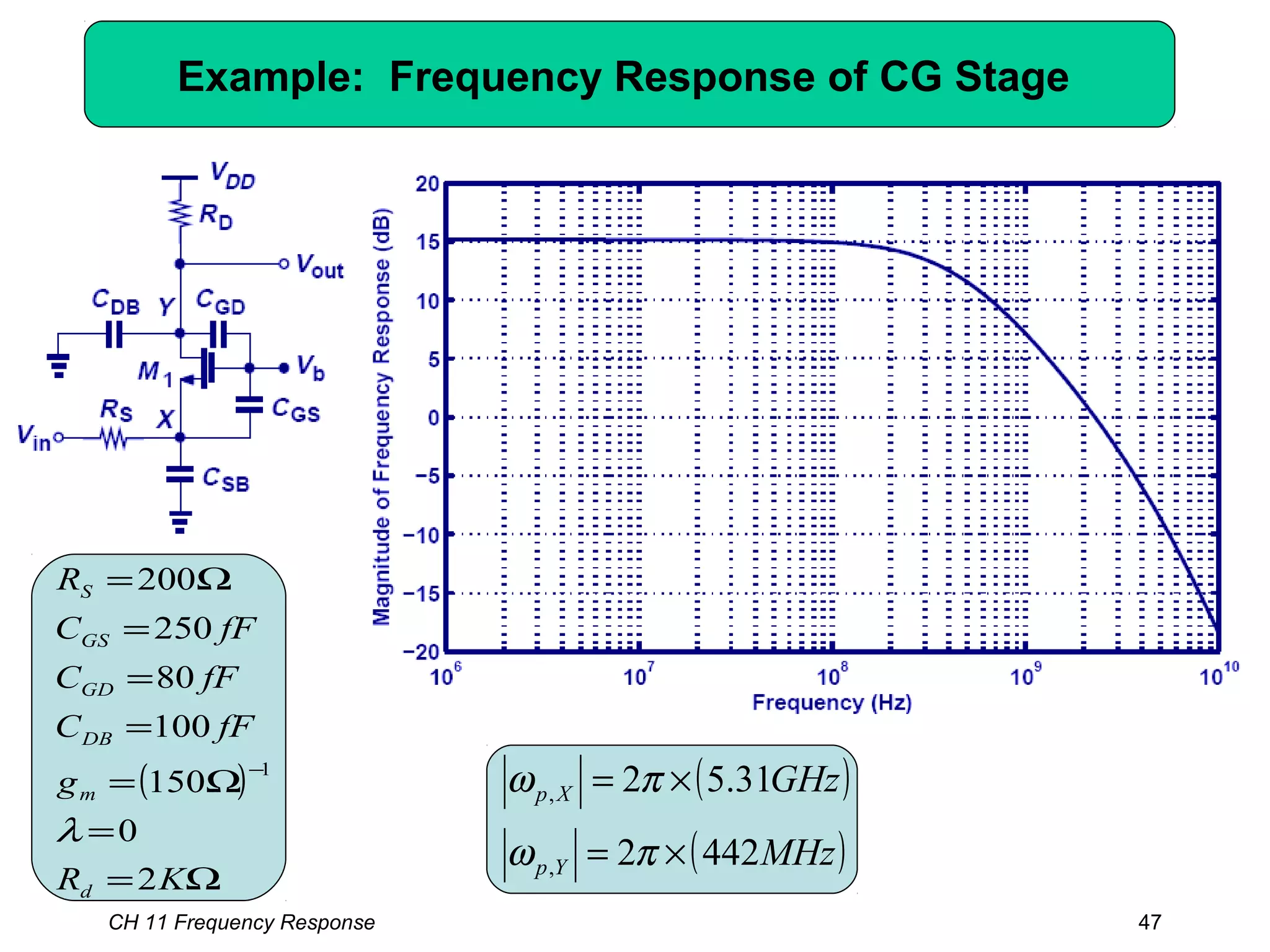
Example: Frequency Response of CG Stage
( )
Ω=
=
Ω=
=
=
=
Ω=
−
KR
g
fFC
fFC
fFC
R
d
m
DB
GD
GS
S
2
0
150
100
80
250
200
1
λ
( )
( )MHz
GHz
Yp
Xp
4422
31.52
,
,
×=
×=
πω
πω
CH 11 Frequency Response 47
CH 11 Frequency Response 48
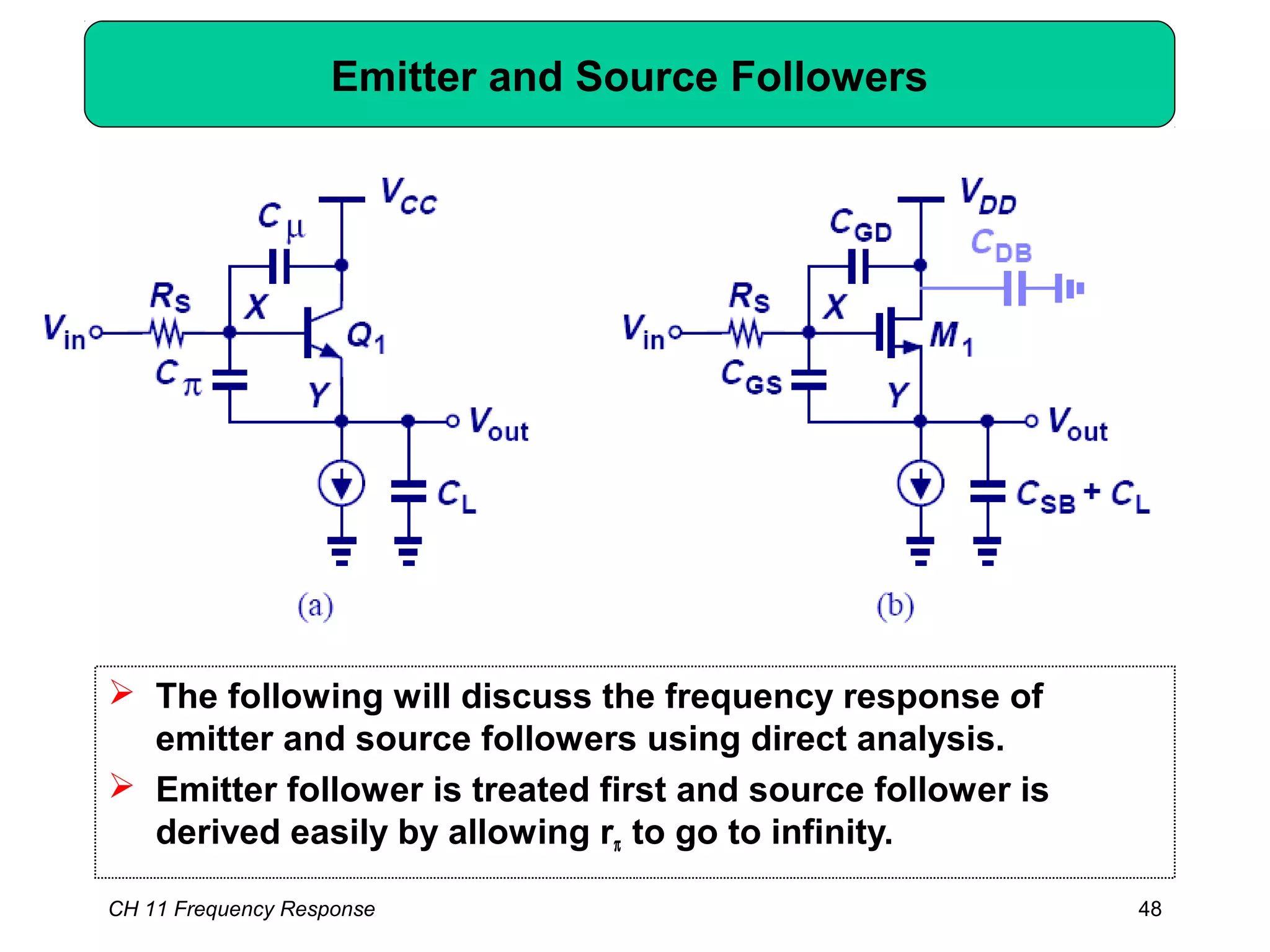
Emitter and Source Followers
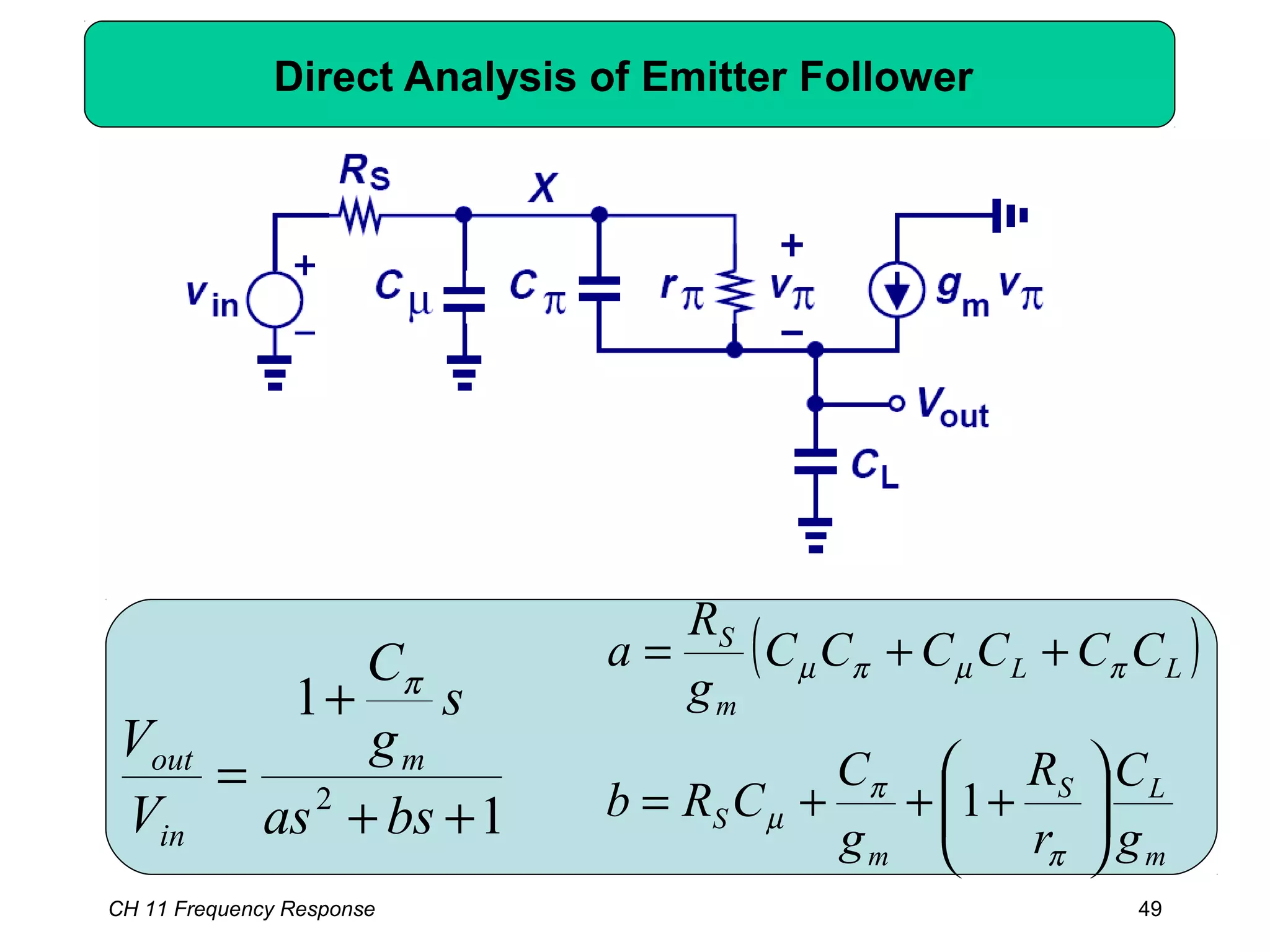
 The following will discuss the frequency response of
emitter and source followers using direct analysis.
 Emitter follower is treated first and source follower is
derived easily by allowing rπ to go to infinity.
CH 11 Frequency Response 49
Direct Analysis of Emitter Follower
1
1
2
++
+
=
bsas
s
g
C
V
V m
in
out
π
( )
m
LS
m
S
LL
m
S
g
C
r
R
g
C
CRb
CCCCCC
g
R
a






+++=
++=
π
π
µ
πµπµ
1
CH 11 Frequency Response 50
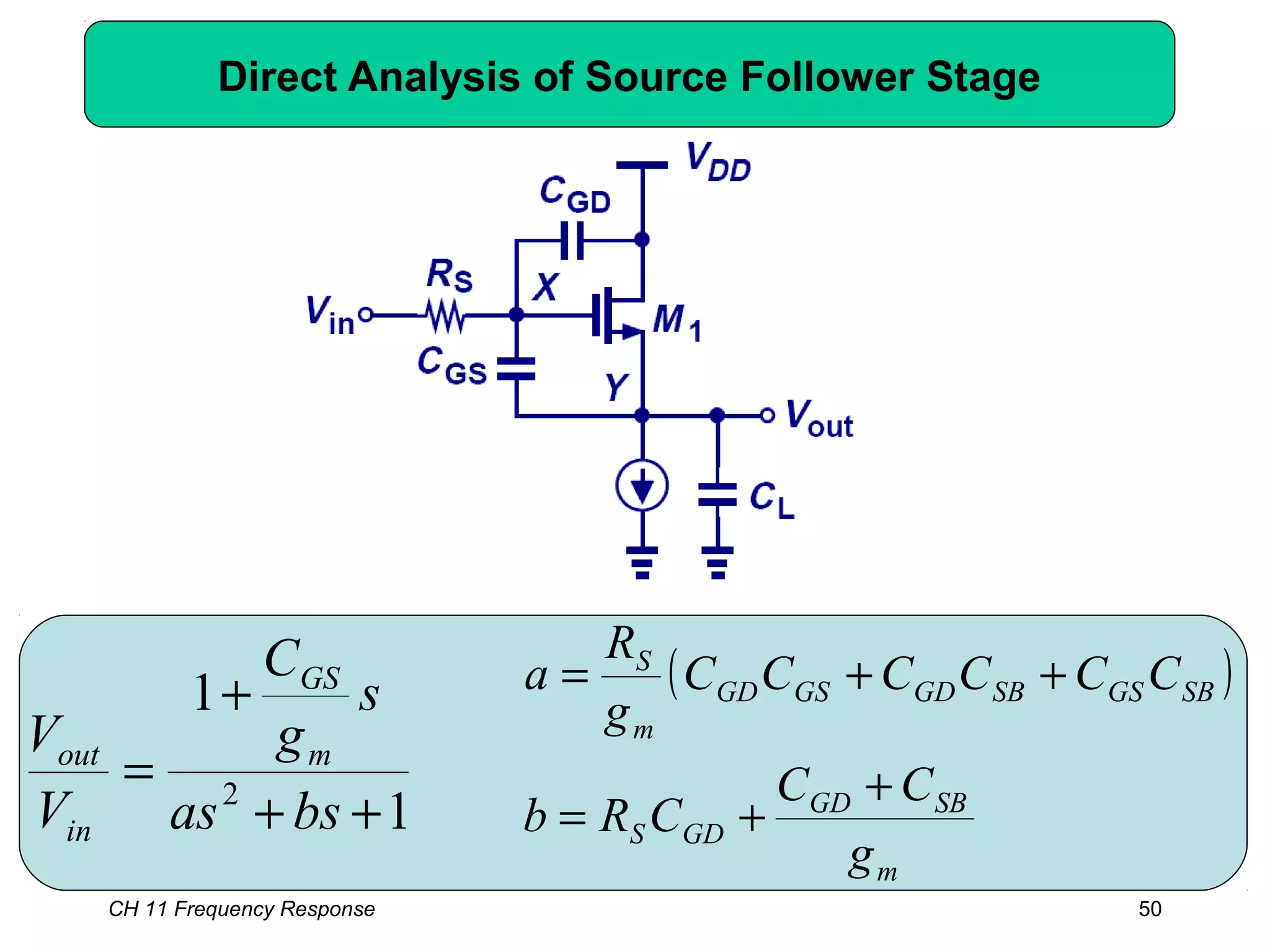
Direct Analysis of Source Follower Stage
1
1
2
++
+
=
bsas
s
g
C
V
V m
GS
in
out
( )
m
SBGD
GDS
SBGSSBGDGSGD
m
S
g
CC
CRb
CCCCCC
g
R
a
+
+=
++=
Example: Frequency Response of Source Follower
( )
0
150
100
80
250
100
200
1
=
Ω=
=
=
=
=
Ω=
−
λ
m
DB
GD
GS
L
S
g
fFC
fFC
fFC
fFC
R
( )[ ]
( )[ ]GHzjGHz
GHzjGHz
p
p
57.279.12
57.279.12
2
1
−−=
+−=
πω
πω
CH 11 Frequency Response 51
CH 11 Frequency Response 52
Example: Source Follower
1
1
2
++
+
=
bsas
s
g
C
V
V m
GS
in
out
[ ]
1
2211
1
2211111
1
))((
m
DBGDSBGD
GDS
DBGDSBGSGDGSGD
m
S
g
CCCC
CRb
CCCCCCC
g
R
a
+++
+=
++++=
CH 11 Frequency Response 53
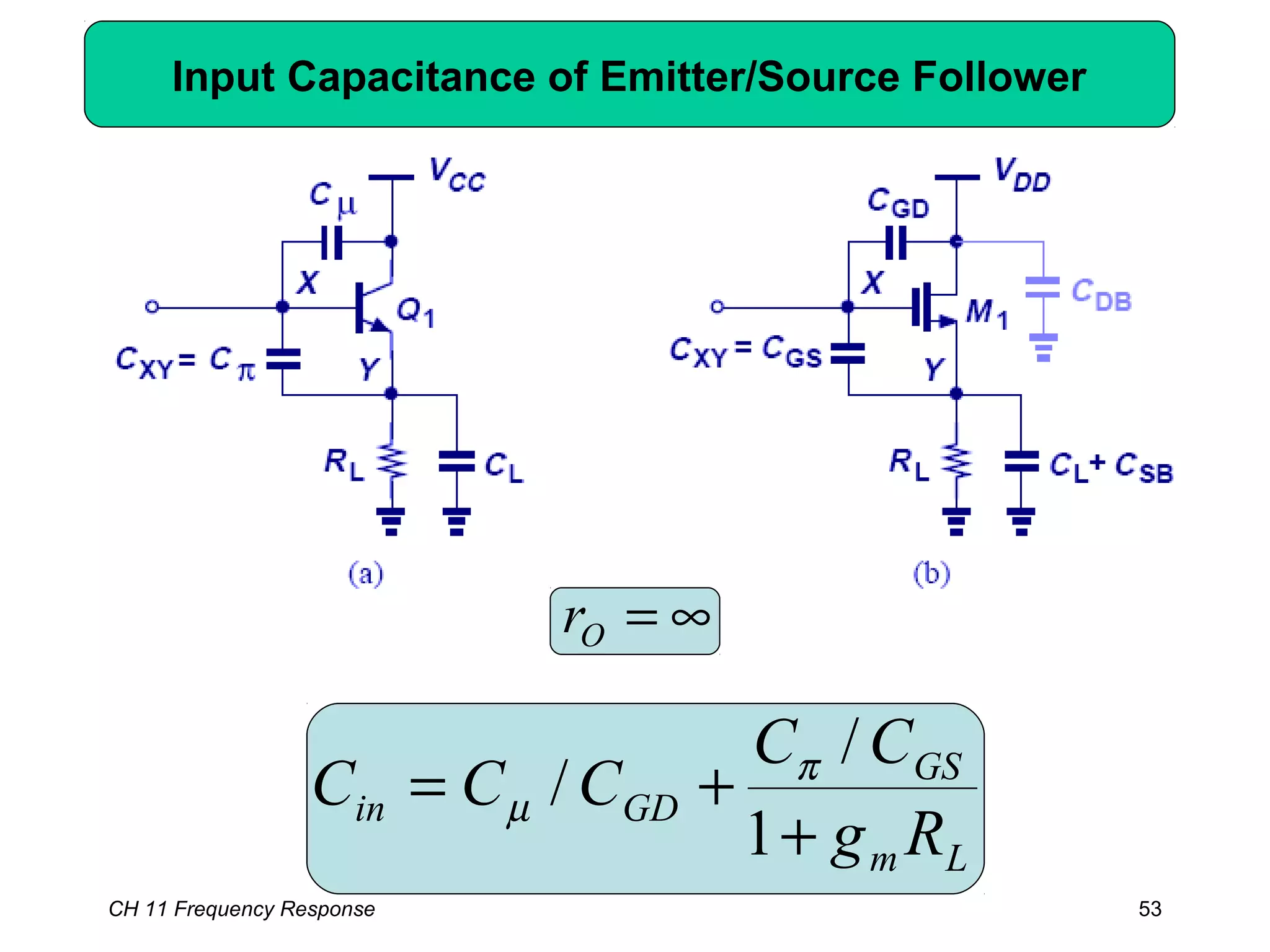
Input Capacitance of Emitter/Source Follower
Lm
GS
GDin
Rg
CC
CCC
+
+=
1
/
/ π
µ
∞=Or
CH 11 Frequency Response 54
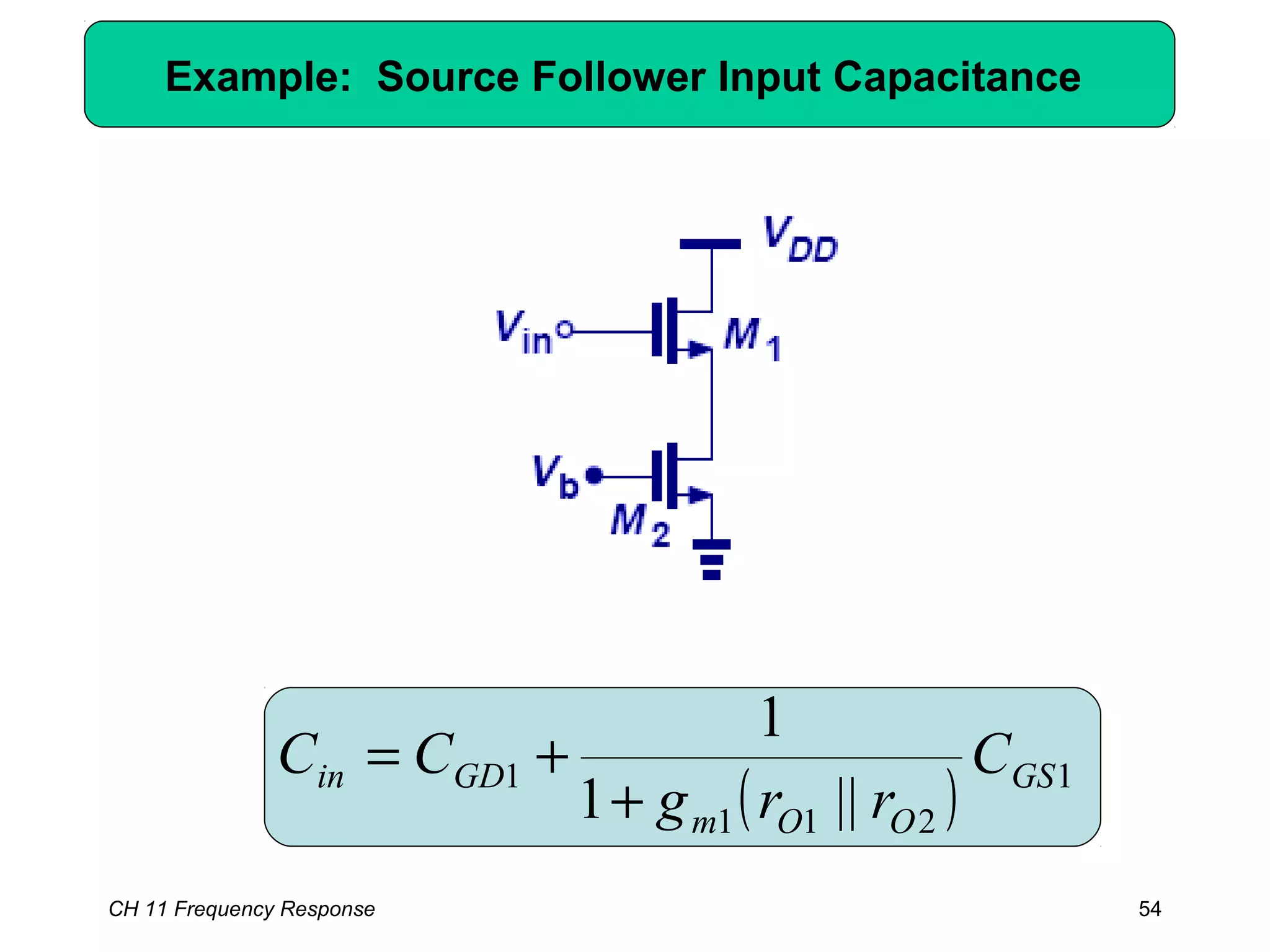
Example: Source Follower Input Capacitance
( ) 1
211
1
||1
1
GS
OOm
GDin C
rrg
CC
+
+=
CH 11 Frequency Response 55
Output Impedance of Emitter Follower
1++
++
=
βππ
πππ
sCr
RrsCrR
I
V SS
X
X
CH 11 Frequency Response 56
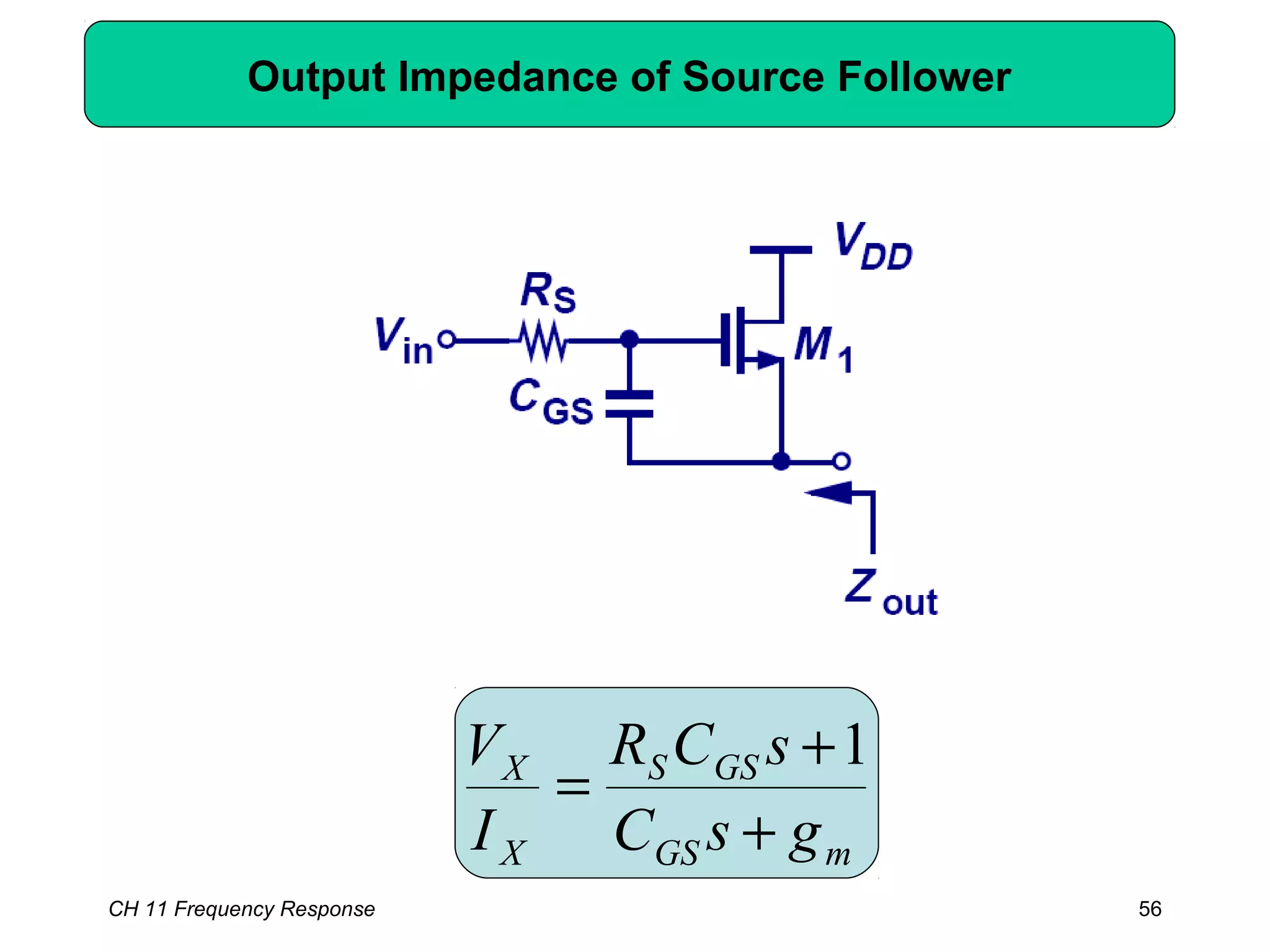
Output Impedance of Source Follower
mGS
GSS
X
X
gsC
sCR
I
V
+
+
=
1
CH 11 Frequency Response 57
Active Inductor
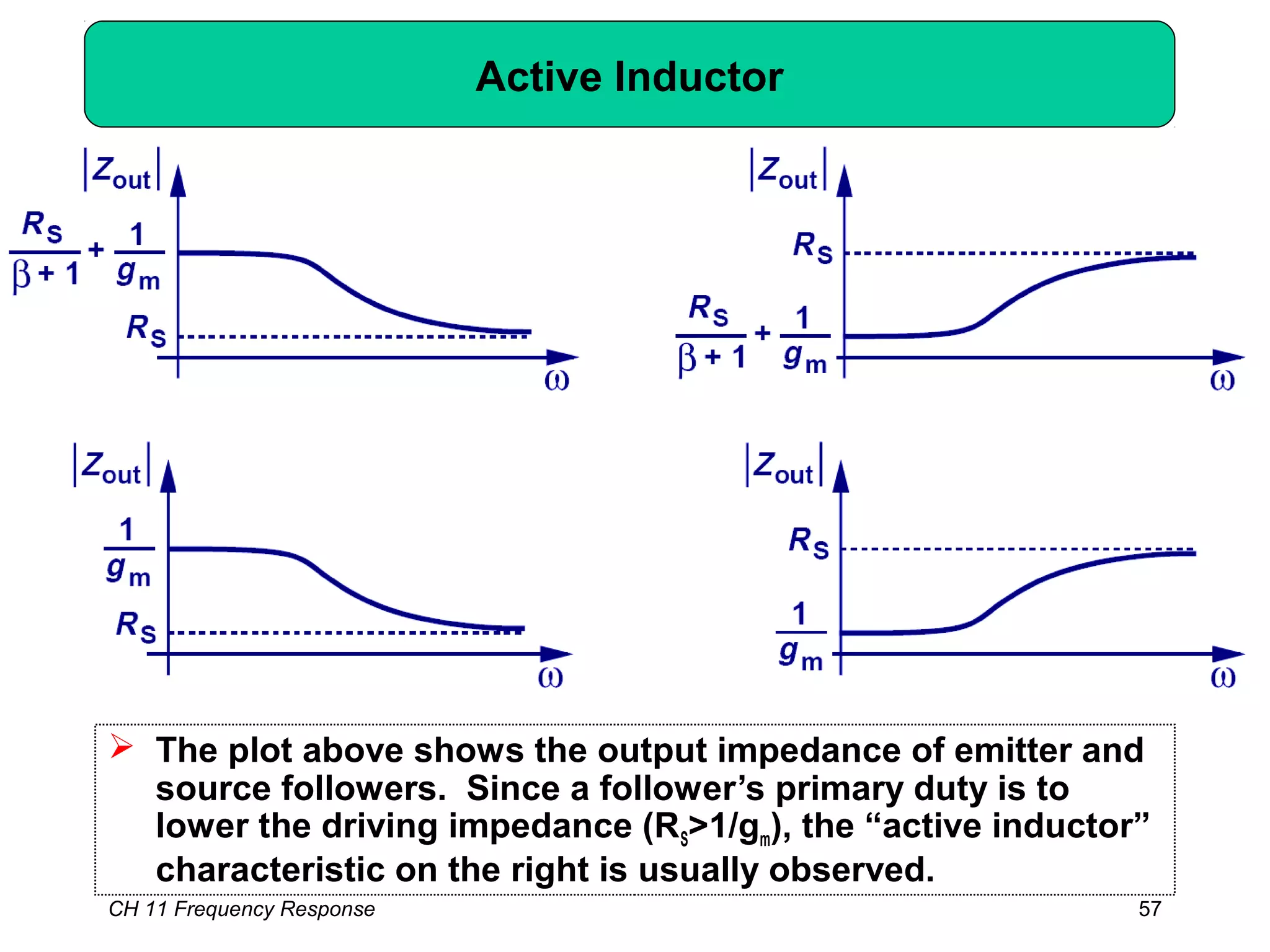
 The plot above shows the output impedance of emitter and
source followers. Since a follower’s primary duty is to
lower the driving impedance (RS>1/gm), the “active inductor”
characteristic on the right is usually observed.
CH 11 Frequency Response 58
Example: Output Impedance
( )
33
321 1||
mGS
GSOO
X
X
gsC
sCrr
I
V
+
+
=
∞=Or
CH 11 Frequency Response 59
Frequency Response of Cascode Stage
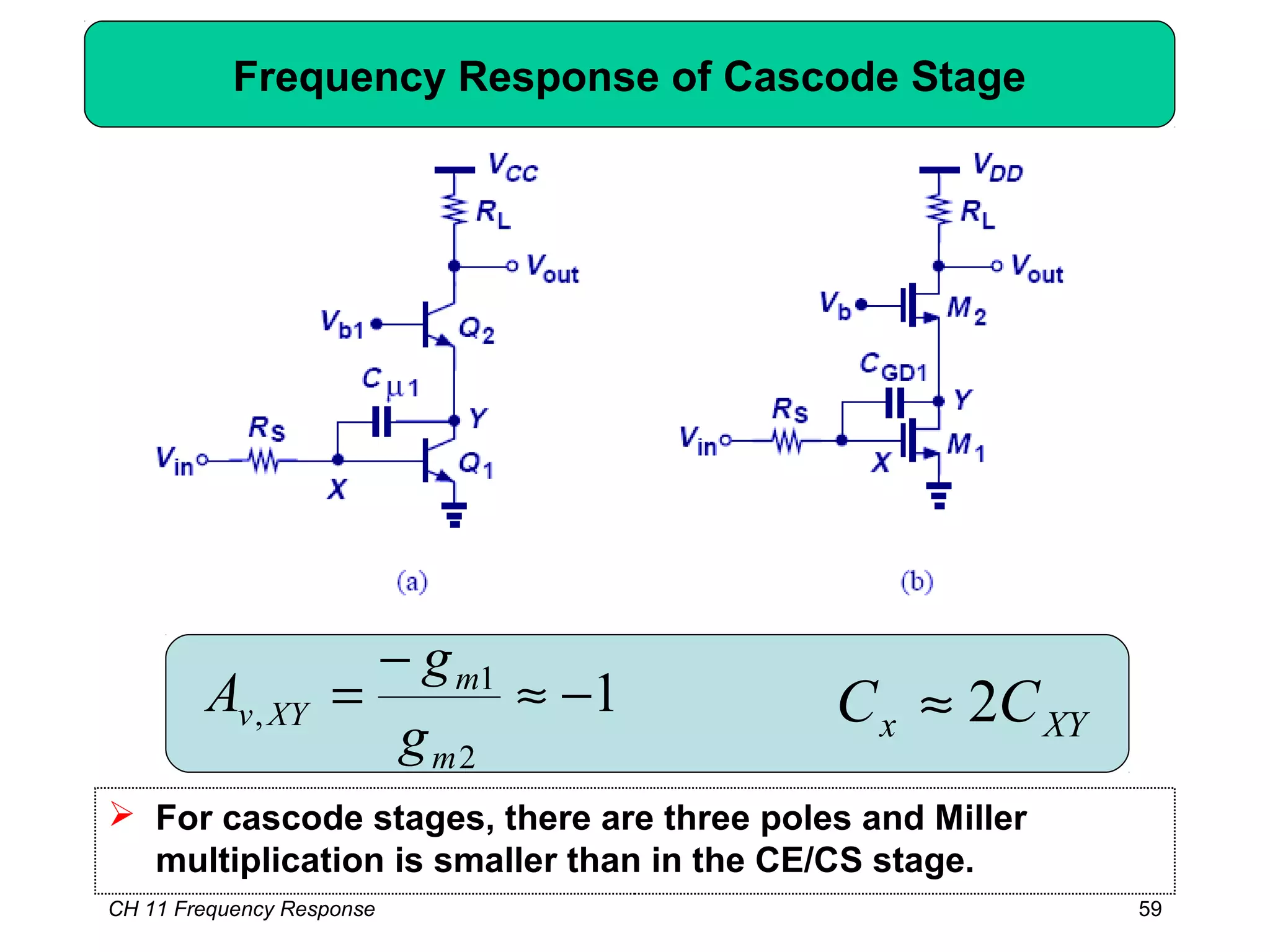
 For cascode stages, there are three poles and Miller
multiplication is smaller than in the CE/CS stage.
1
2
1
, −≈
−
=
m
m
XYv
g
g
A XYx CC 2≈
CH 11 Frequency Response 60
Poles of Bipolar Cascode
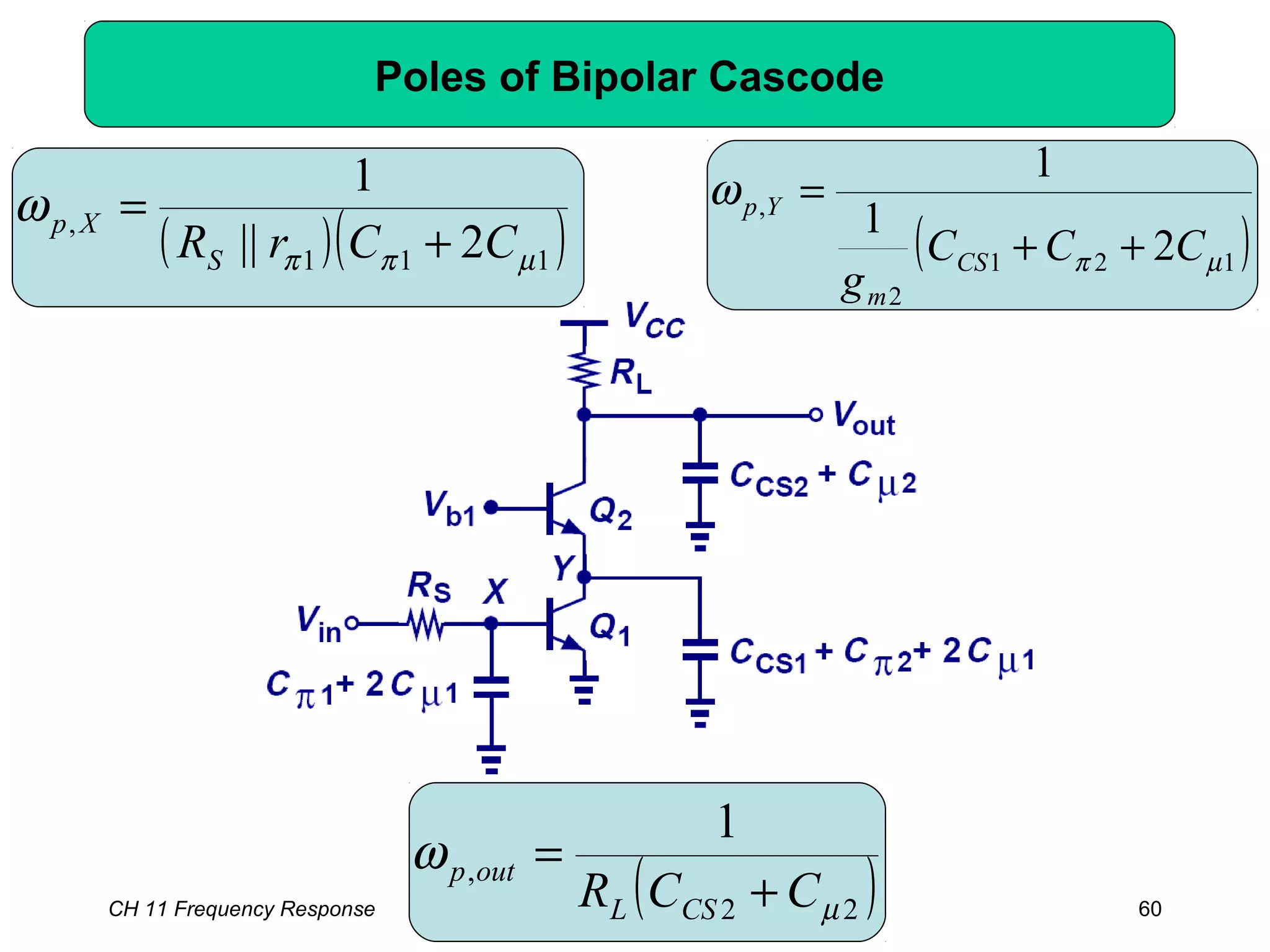
( )( )111
,
2||
1
µππ
ω
CCrRS
Xp
+
=
( )121
2
,
2
1
1
µπ
ω
CCC
g
CS
m
Yp
++
=
( )22
,
1
µ
ω
CCR CSL
outp
+
=
CH 11 Frequency Response 61
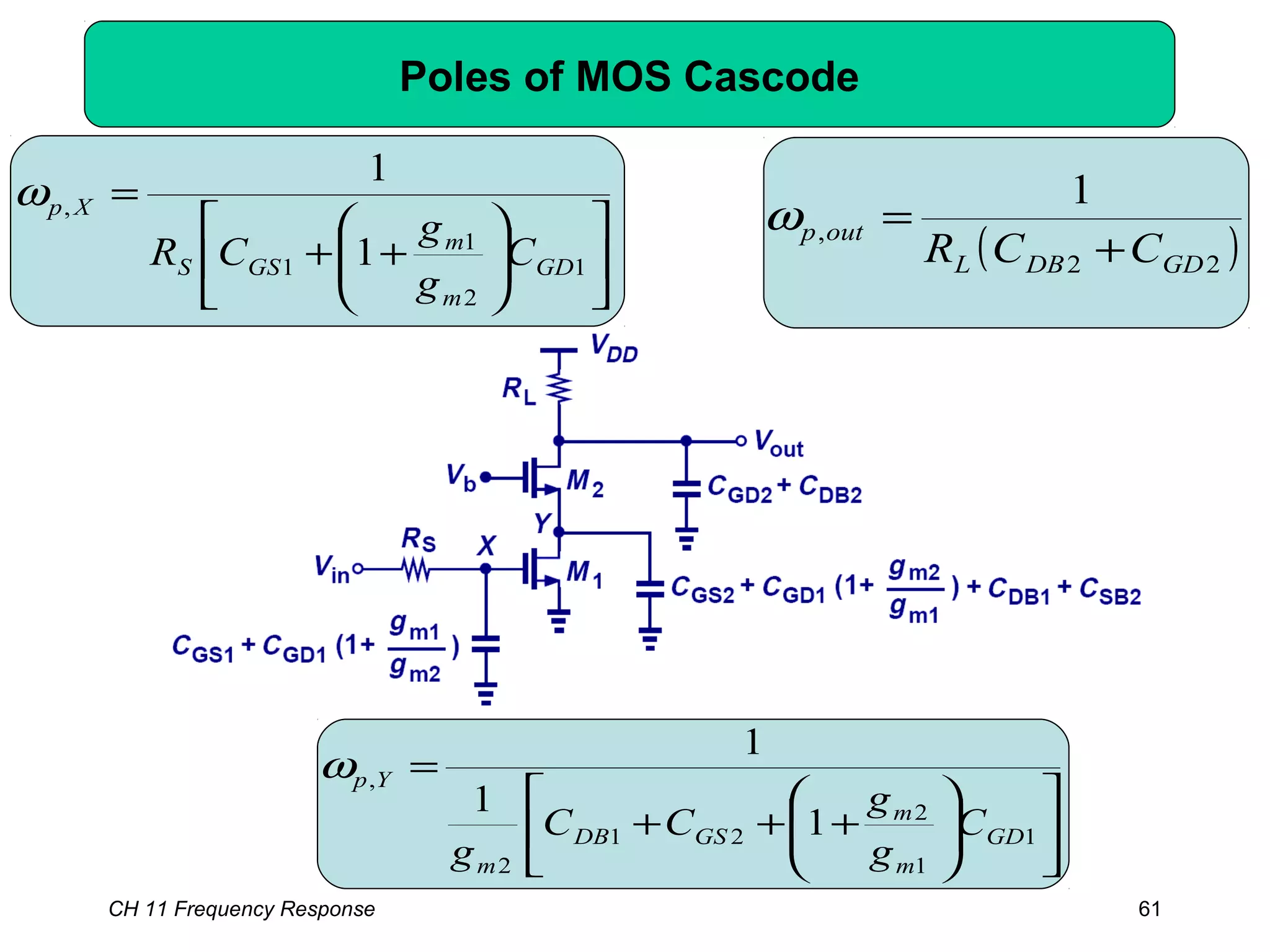
Poles of MOS Cascode












++
=
1
2
1
1
,
1
1
GD
m
m
GSS
Xp
C
g
g
CR
ω












+++
=
1
1
2
21
2
,
1
1
1
GD
m
m
GSDB
m
Yp
C
g
g
CC
g
ω
( )22
,
1
GDDBL
outp
CCR +
=ω
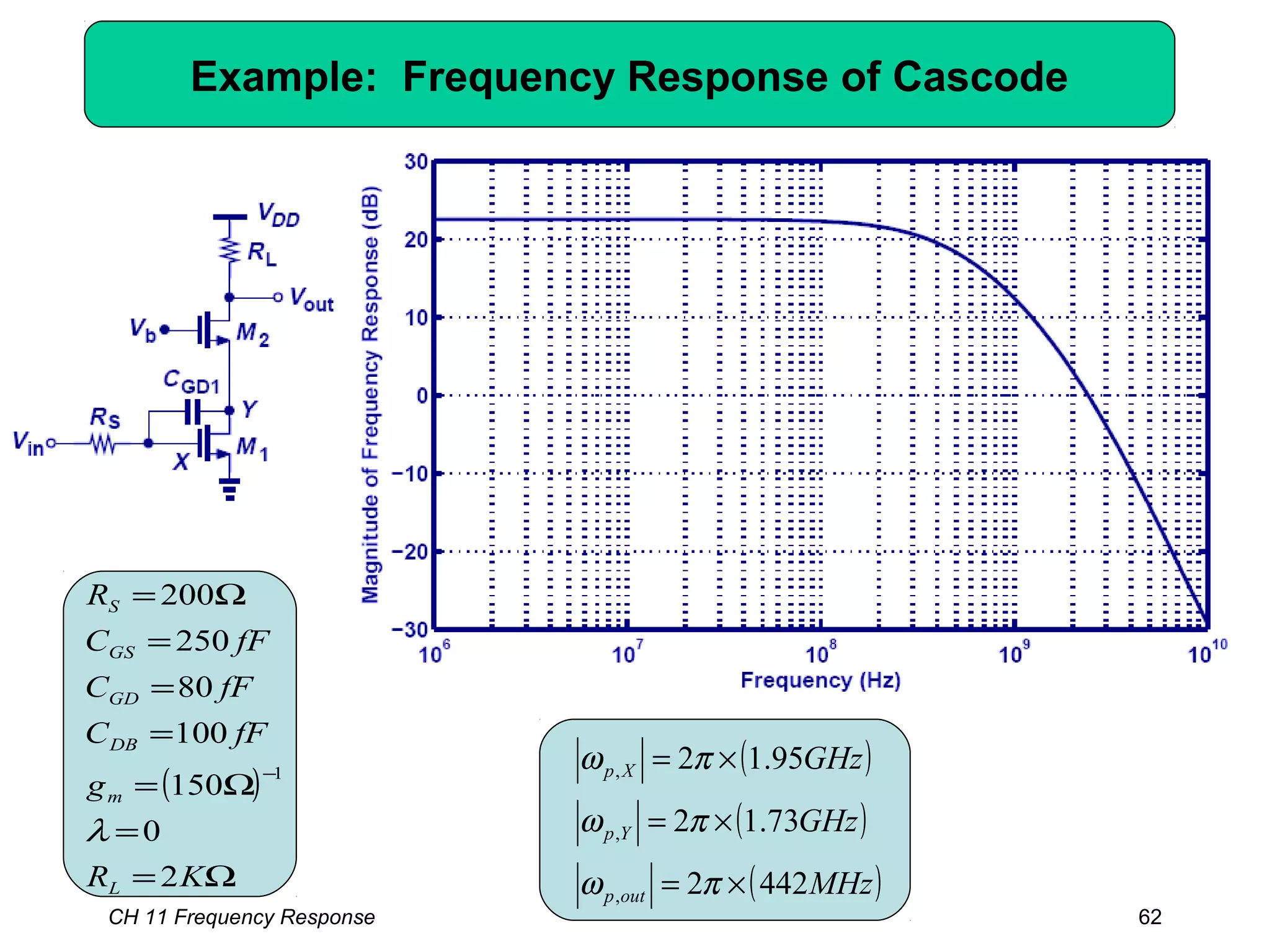
Example: Frequency Response of Cascode
( )
Ω=
=
Ω=
=
=
=
Ω=
−
KR
g
fFC
fFC
fFC
R
L
m
DB
GD
GS
S
2
0
150
100
80
250
200
1
λ
( )
( )
( )MHz
GHz
GHz
outp
Yp
Xp
4422
73.12
95.12
,
,
,
×=
×=
×=
πω
πω
πω
CH 11 Frequency Response 62
CH 11 Frequency Response 63
MOS Cascode Example












++
=
1
2
1
1
,
1
1
GD
m
m
GSS
Xp
C
g
g
CR
ω






++





+++
=
331
1
2
21
2
,
1
1
1
DBGDGD
m
m
GSDB
m
Yp
CCC
g
g
CC
g
ω
( )22
,
1
GDDBL
outp
CCR +
=ω
CH 11 Frequency Response 64
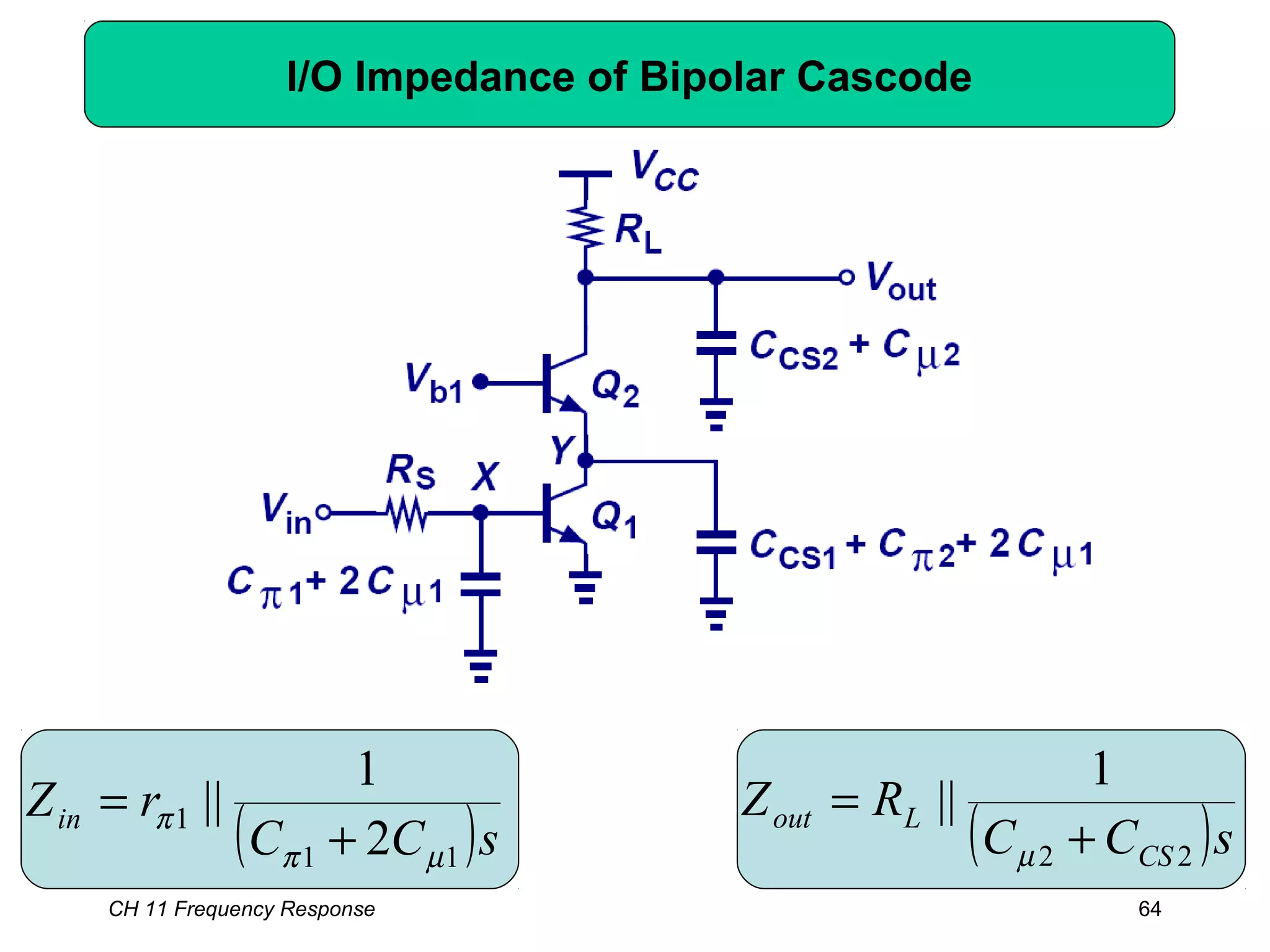
I/O Impedance of Bipolar Cascode
( )sCC
rZin
11
1
2
1
||
µπ
π
+
=
( )sCC
RZ
CS
Lout
22
1
||
+
=
µ
CH 11 Frequency Response 65
I/O Impedance of MOS Cascode
sC
g
g
C
Z
GD
m
m
GS
in












++
=
1
2
1
1 1
1
( )sCC
RZ
DBGD
Lout
22
1
||
+
=
CH 11 Frequency Response 66
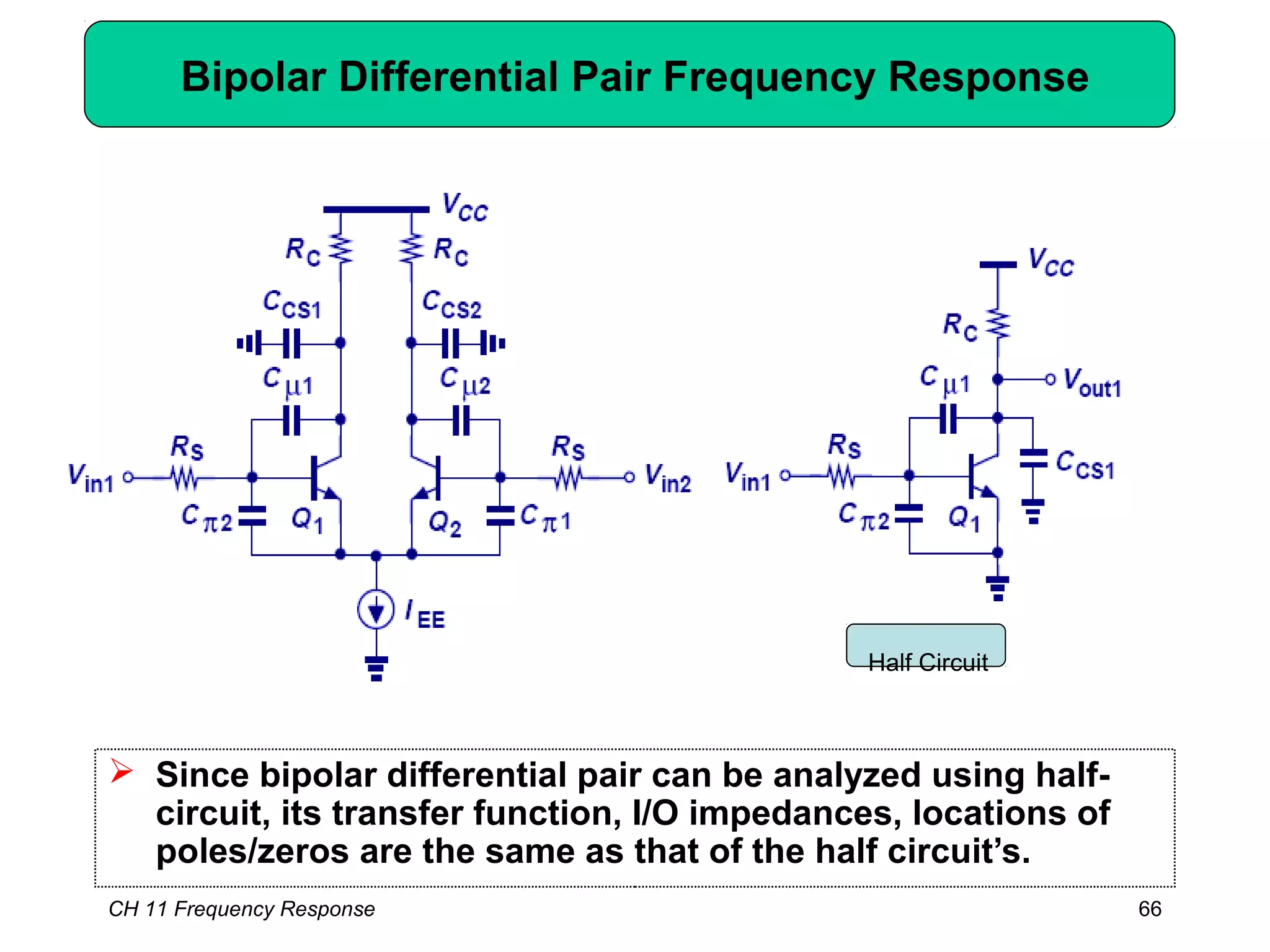
Bipolar Differential Pair Frequency Response
 Since bipolar differential pair can be analyzed using half-
circuit, its transfer function, I/O impedances, locations of
poles/zeros are the same as that of the half circuit’s.
Half Circuit
CH 11 Frequency Response 67
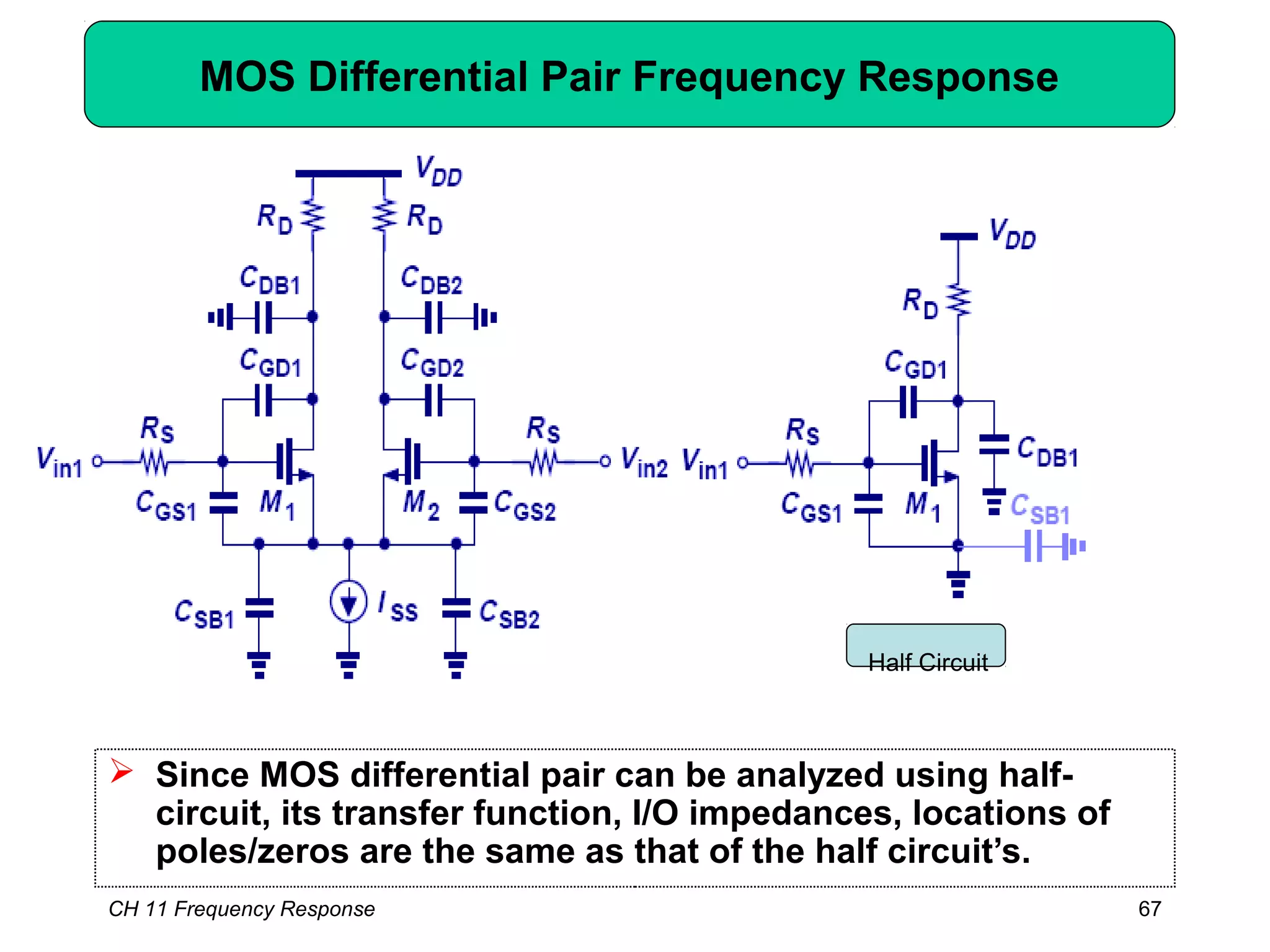
MOS Differential Pair Frequency Response
 Since MOS differential pair can be analyzed using half-
circuit, its transfer function, I/O impedances, locations of
poles/zeros are the same as that of the half circuit’s.
Half Circuit
CH 11 Frequency Response 68
Example: MOS Differential Pair
( )33
,
1
1
3
31
3
,
1311
,
1
1
1
1
])/1([
1
GDDBL
outp
GD
m
m
GSDB
m
Yp
GDmmGSS
Xp
CCR
C
g
g
CC
g
CggCR
+
=












+++
=
++
=
ω
ω
ω
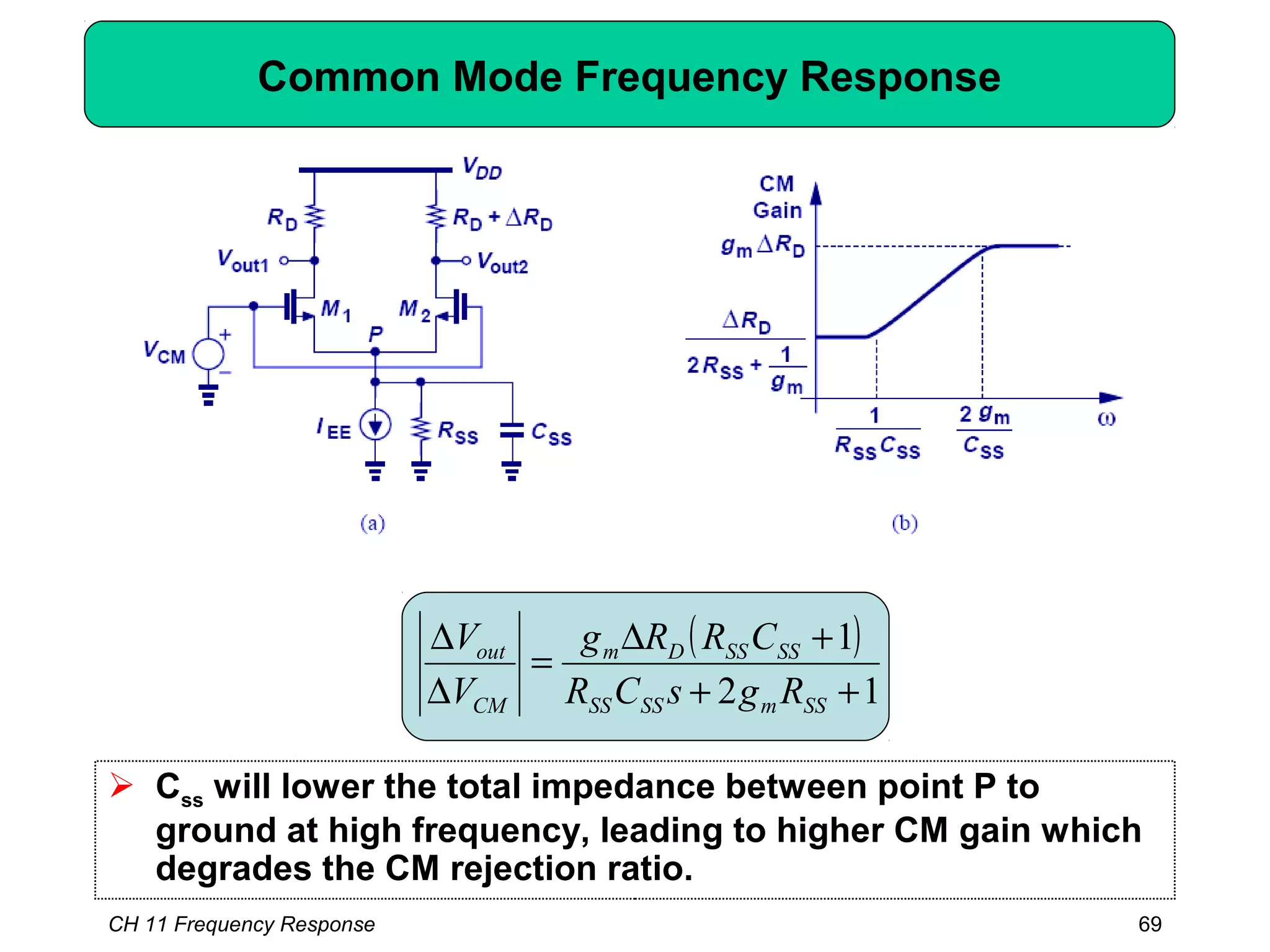
Common Mode Frequency Response
( )
12
1
++
+∆
=
∆
∆
SSmSSSS
SSSSDm
CM
out
RgsCR
CRRg
V
V
 Css will lower the total impedance between point P to
ground at high frequency, leading to higher CM gain which
degrades the CM rejection ratio.
CH 11 Frequency Response 69
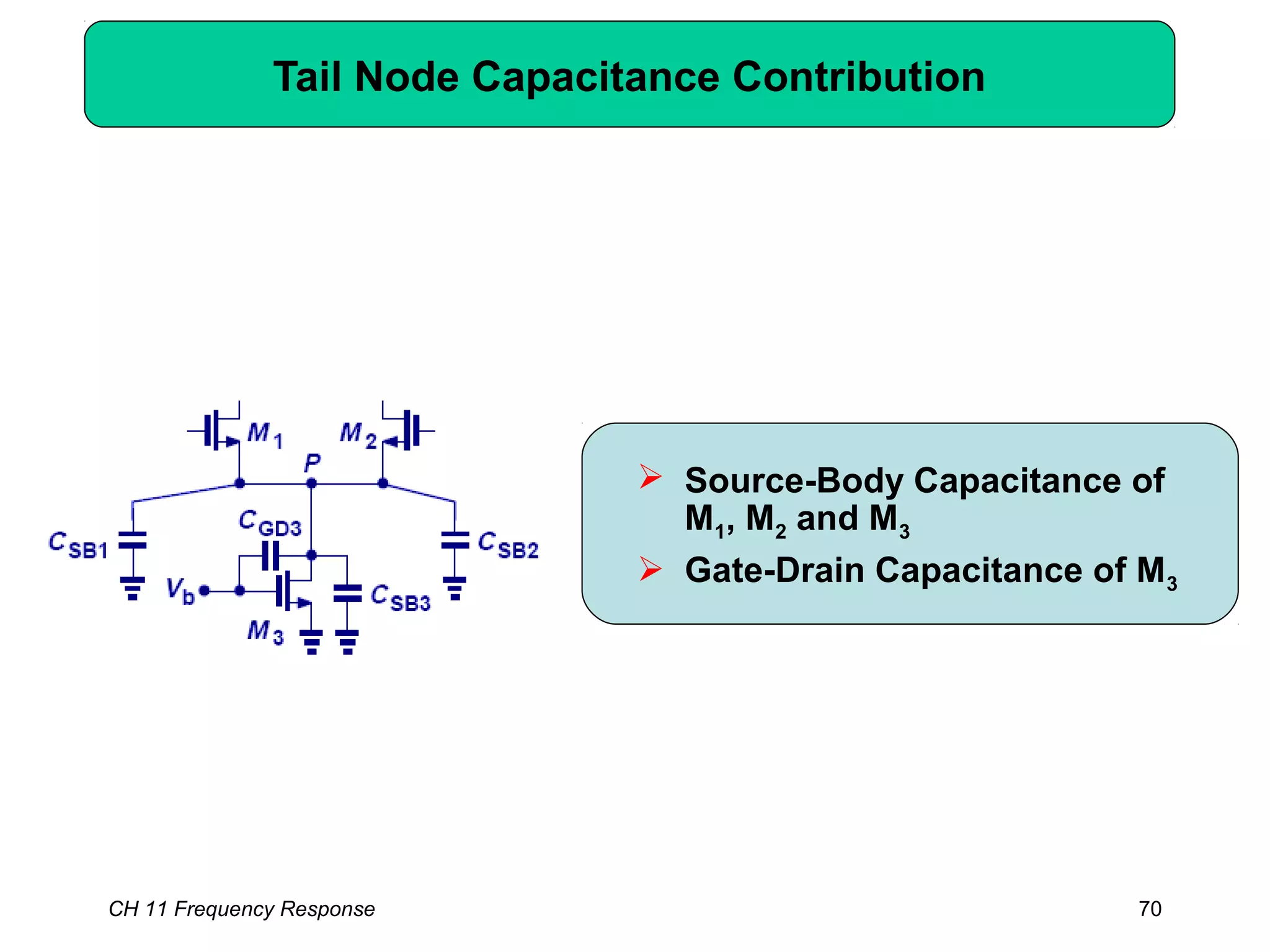
Tail Node Capacitance Contribution
 Source-Body Capacitance of
M1, M2 and M3
 Gate-Drain Capacitance of M3
CH 11 Frequency Response 70
Example: Capacitive Coupling
( )[ ]EBin RrRR 1|| 222 ++= βπ
( )
( )Hz
CRr B
L 5422
||
1
111
1 ×== πω
π ( )
( )Hz
CRR inC
L 9.22
1
22
2 ×=
+
= πω
CH 11 Frequency Response 71
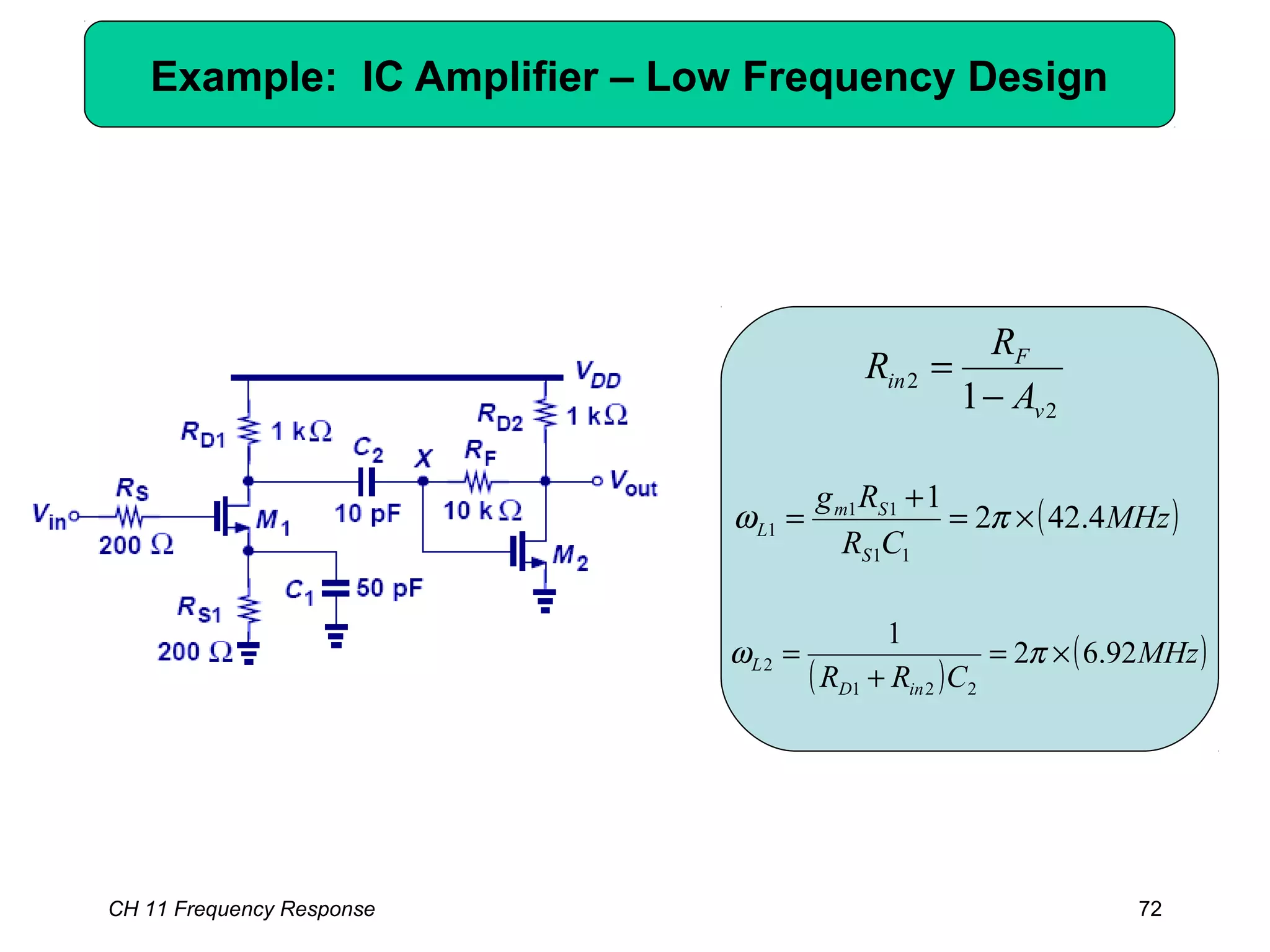
( )
( )MHz
CRR inD
L 92.62
1
221
2 ×=
+
= πω
( )MHz
CR
Rg
S
Sm
L 4.422
1
11
11
1 ×=
+
= πω
2
2
1 v
F
in
A
R
R
−
=
Example: IC Amplifier – Low Frequency Design
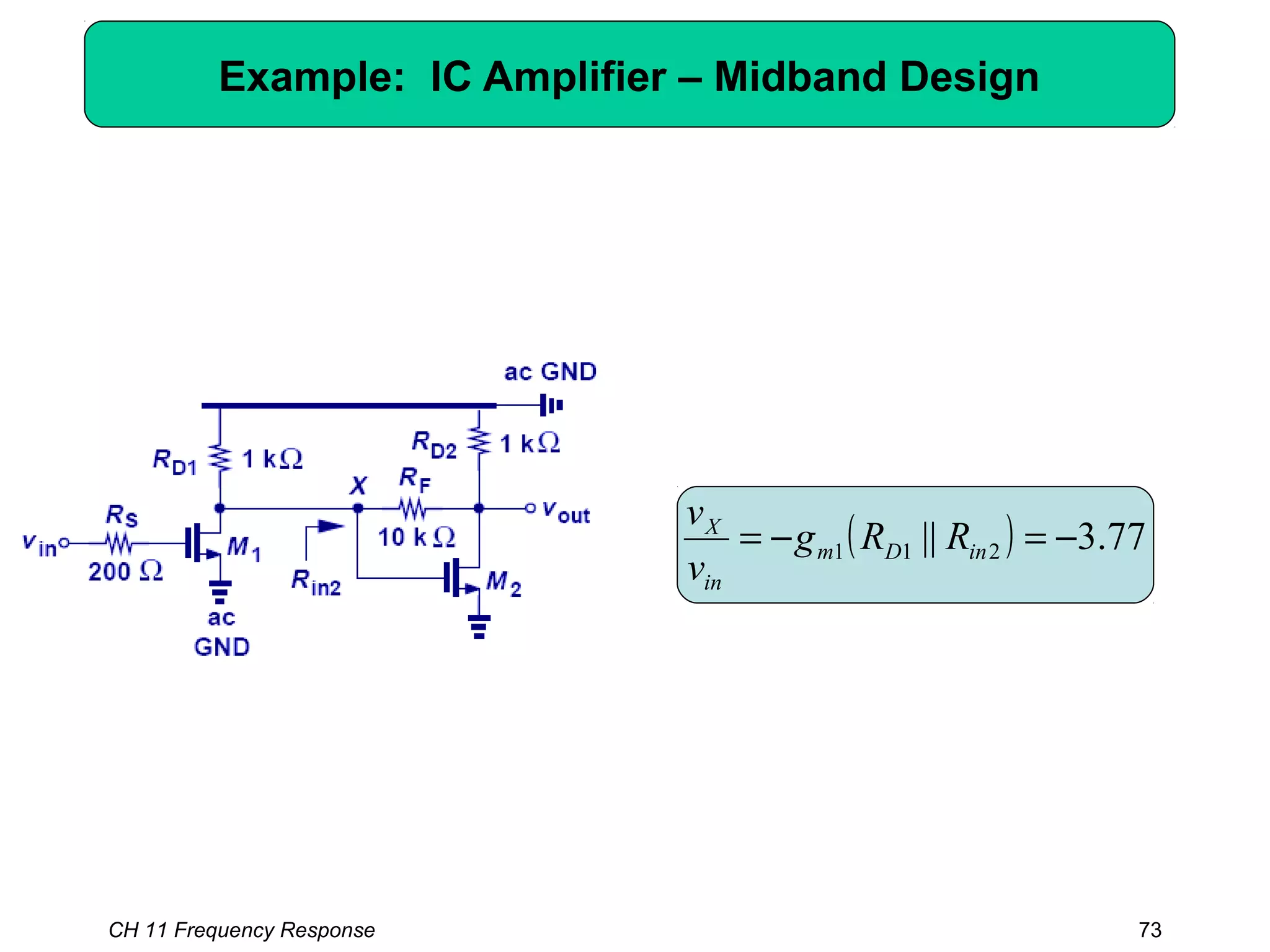
CH 11 Frequency Response 72
( ) 77.3|| 211 −=−= inDm
in
X
RRg
v
v
Example: IC Amplifier – Midband Design
CH 11 Frequency Response 73
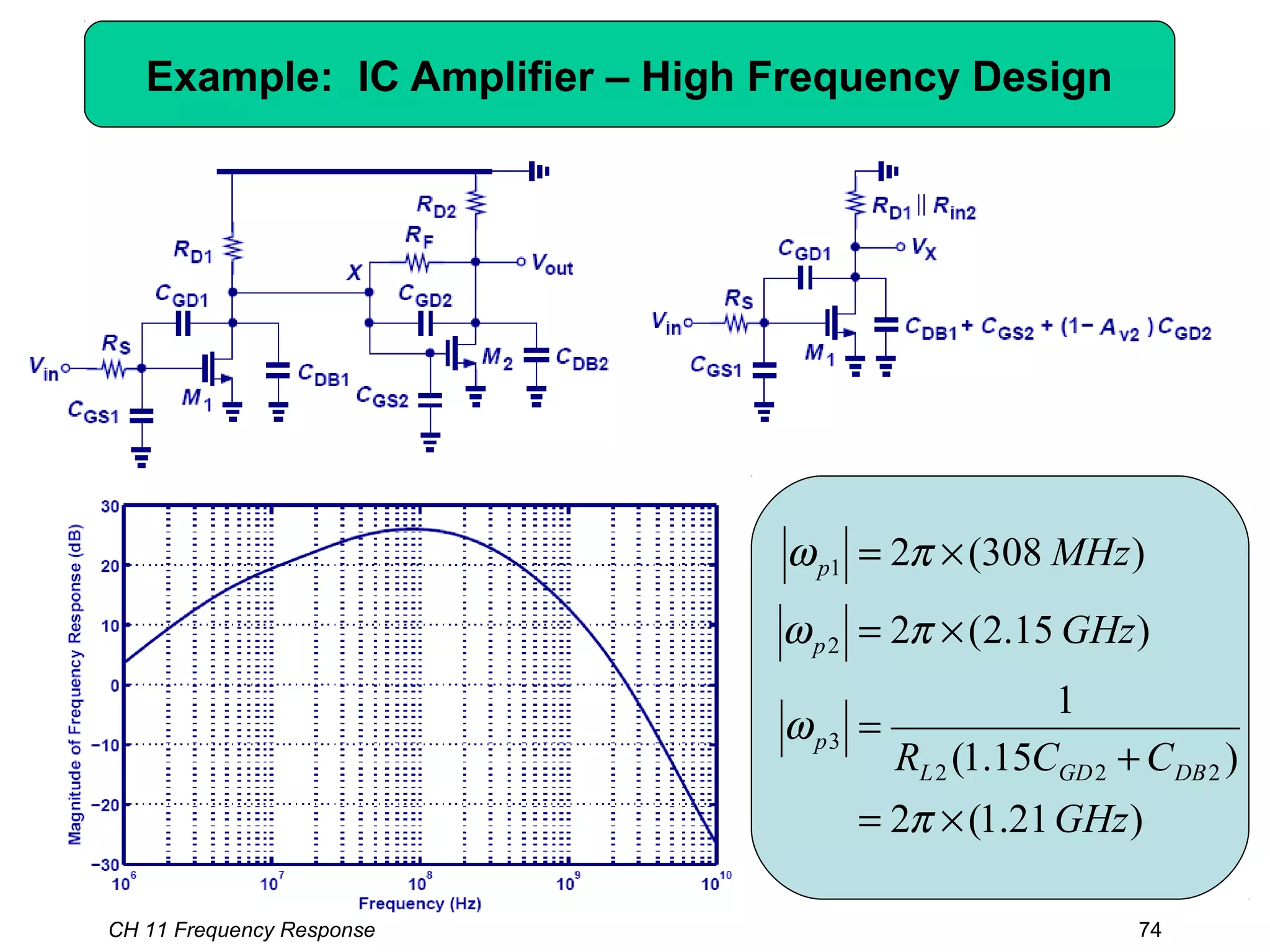
Example: IC Amplifier – High Frequency Design
)21.1(2
)15.1(
1
)15.2(2
)308(2
222
3
2
1
GHz
CCR
GHz
MHz
DBGDL
p
p
p
×=
+
=
×=
×=
π
ω
πω
πω
CH 11 Frequency Response 74

Frequency response

  • 1.
    Chapter 11 FrequencyResponse  11.1 Fundamental Concepts  11.2 High-Frequency Models of Transistors  11.3 Analysis Procedure  11.4 Frequency Response of CE and CS Stages  11.5 Frequency Response of CB and CG Stages  11.6 Frequency Response of Followers  11.7 Frequency Response of Cascode Stage  11.8 Frequency Response of Differential Pairs  11.9 Additional Examples 1
  • 2.
    Chapter Outline CH 11Frequency Response 2
  • 3.
    CH 11 FrequencyResponse 3 High Frequency Roll-off of Amplifier  As frequency of operation increases, the gain of amplifier decreases. This chapter analyzes this problem.
  • 4.
    Example: Human VoiceI  Natural human voice spans a frequency range from 20Hz to 20KHz, however conventional telephone system passes frequencies from 400Hz to 3.5KHz. Therefore phone conversation differs from face-to-face conversation. CH 11 Frequency Response 4 Natural Voice Telephone System
  • 5.
    Example: Human VoiceII CH 11 Frequency Response 5 Mouth RecorderAir Mouth EarAir Skull Path traveled by the human voice to the voice recorder Path traveled by the human voice to the human ear  Since the paths are different, the results will also be different.
  • 6.
    Example: Video Signal Video signals without sufficient bandwidth become fuzzy as they fail to abruptly change the contrast of pictures from complete white into complete black. CH 11 Frequency Response 6 High Bandwidth Low Bandwidth
  • 7.
    Gain Roll-off: SimpleLow-pass Filter  In this simple example, as frequency increases the impedance of C1 decreases and the voltage divider consists of C1 and R1 attenuates Vin to a greater extent at the output. CH 11 Frequency Response 7
  • 8.
    CH 11 FrequencyResponse 8 Gain Roll-off: Common Source  The capacitive load, CL, is the culprit for gain roll-off since at high frequency, it will “steal” away some signal current and shunt it to ground. 1 ||out m in D L V g V R C s   = −  ÷  
  • 9.
    CH 11 FrequencyResponse 9 Frequency Response of the CS Stage  At low frequency, the capacitor is effectively open and the gain is flat. As frequency increases, the capacitor tends to a short and the gain starts to decrease. A special frequency is ω=1/(RDCL), where the gain drops by 3dB. 1222 + = ωLD Dm in out CR Rg V V
  • 10.
    CH 11 FrequencyResponse 10 Example: Figure of Merit  This metric quantifies a circuit’s gain, bandwidth, and power dissipation. In the bipolar case, low temperature, supply, and load capacitance mark a superior figure of merit. LCCT CVV MOF 1 ... =
  • 11.
    Example: Relationship betweenFrequency Response and Step Response CH 11 Frequency Response 11 ( ) 2 2 2 1 1 1 1 H s j R C ω ω = = + ( ) ( )0 1 1 1 expout t V t V u t R C  − = − ÷    The relationship is such that as R1C1 increases, the bandwidth drops and the step response becomes slower.
  • 12.
    CH 11 FrequencyResponse 12 Bode Plot  When we hit a zero, ωzj, the Bode magnitude rises with a slope of +20dB/dec.  When we hit a pole, ωpj, the Bode magnitude falls with a slope of -20dB/dec           +        +       +      + = 21 21 0 11 11 )( pp zz ss ss AsH ωω ωω
  • 13.
    CH 11 FrequencyResponse 13 Example: Bode Plot  The circuit only has one pole (no zero) at 1/(RDCL), so the slope drops from 0 to -20dB/dec as we pass ωp1. LD p CR 1 1 =ω
  • 14.
    CH 11 FrequencyResponse 14 Pole Identification Example I inS p CR 1 1 =ω LD p CR 1 2 =ω ( )( )2 2 22 1 2 11 pp Dm in out Rg V V ωωωω ++ =
  • 15.
    CH 11 FrequencyResponse 15 Pole Identification Example II in m S p C g R       = 1 || 1 1ω LD p CR 1 2 =ω
  • 16.
    CH 11 FrequencyResponse 16 Circuit with Floating Capacitor  The pole of a circuit is computed by finding the effective resistance and capacitance from a node to GROUND.  The circuit above creates a problem since neither terminal of CF is grounded.
  • 17.
    CH 11 FrequencyResponse 17 Miller’s Theorem  If Av is the gain from node 1 to 2, then a floating impedance ZF can be converted to two grounded impedances Z1 and Z2. v F A Z Z − = 1 1 v F A Z Z /11 2 − =
  • 18.
    CH 11 FrequencyResponse 18 Miller Multiplication  With Miller’s theorem, we can separate the floating capacitor. However, the input capacitor is larger than the original floating capacitor. We call this Miller multiplication.
  • 19.
    CH 11 FrequencyResponse 19 Example: Miller Theorem ( ) FDmS in CRgR + = 1 1 ω F Dm D out C Rg R       + = 1 1 1 ω
  • 20.
    High-Pass Filter Response 12 1 2 1 2 1 11 + = ω ω CR CR V V in out The voltage division between a resistor and a capacitor can be configured such that the gain at low frequency is reduced. CH 11 Frequency Response 20
  • 21.
    Example: Audio Amplifier nFCi6.79= nFCL 8.39=  In order to successfully pass audio band frequencies (20 Hz-20 KHz), large input and output capacitances are needed. Ω= Ω= 200/1 100 m i g KR CH 11 Frequency Response 21
  • 22.
    Capacitive Coupling vs.Direct Coupling  Capacitive coupling, also known as AC coupling, passes AC signals from Y to X while blocking DC contents.  This technique allows independent bias conditions between stages. Direct coupling does not. Capacitive Coupling Direct Coupling CH 11 Frequency Response 22
  • 23.
    Typical Frequency Response LowerCorner Upper Corner CH 11 Frequency Response 23
  • 24.
    CH 11 FrequencyResponse 24 High-Frequency Bipolar Model  At high frequency, capacitive effects come into play. Cb represents the base charge, whereas Cµ and Cje are the junction capacitances. b jeC C Cπ = +
  • 25.
    CH 11 FrequencyResponse 25 High-Frequency Model of Integrated Bipolar Transistor  Since an integrated bipolar circuit is fabricated on top of a substrate, another junction capacitance exists between the collector and substrate, namely CCS.
  • 26.
    CH 11 FrequencyResponse 26 Example: Capacitance Identification
  • 27.
    CH 11 FrequencyResponse 27 MOS Intrinsic Capacitances  For a MOS, there exist oxide capacitance from gate to channel, junction capacitances from source/drain to substrate, and overlap capacitance from gate to source/drain.
  • 28.
    CH 11 FrequencyResponse 28 Gate Oxide Capacitance Partition and Full Model  The gate oxide capacitance is often partitioned between source and drain. In saturation, C2 ~ Cgate, and C1 ~ 0. They are in parallel with the overlap capacitance to form CGS and CGD.
  • 29.
    CH 11 FrequencyResponse 29 Example: Capacitance Identification
  • 30.
    CH 11 FrequencyResponse 30 Transit Frequency  Transit frequency, fT, is defined as the frequency where the current gain from input to output drops to 1. π π C g f m T =2 GS m T C g f =π2
  • 31.
    Example: Transit FrequencyCalculation ( )THGS n T VV L f −= 2 2 3 2 µ π GHzf sVcm mVVV nmL T n THGS 226 )./(400 100 65 2 = = =− = µ CH 11 Frequency Response 31
  • 32.
    Analysis Summary  Thefrequency response refers to the magnitude of the transfer function.  Bode’s approximation simplifies the plotting of the frequency response if poles and zeros are known.  In general, it is possible to associate a pole with each node in the signal path.  Miller’s theorem helps to decompose floating capacitors into grounded elements.  Bipolar and MOS devices exhibit various capacitances that limit the speed of circuits. CH 11 Frequency Response 32
  • 33.
    High Frequency CircuitAnalysis Procedure  Determine which capacitor impact the low-frequency region of the response and calculate the low-frequency pole (neglect transistor capacitance).  Calculate the midband gain by replacing the capacitors with short circuits (neglect transistor capacitance).  Include transistor capacitances.  Merge capacitors connected to AC grounds and omit those that play no role in the circuit.  Determine the high-frequency poles and zeros.  Plot the frequency response using Bode’s rules or exact analysis. CH 11 Frequency Response 33
  • 34.
    Frequency Response ofCS Stage with Bypassed Degeneration ( ) ( ) 1 1 ++ +− = SmbS bSDm X out RgsCR sCRRg s V V  In order to increase the midband gain, a capacitor Cb is placed in parallel with Rs.  The pole frequency must be well below the lowest signal frequency to avoid the effect of degeneration. CH 11 Frequency Response 34
  • 35.
    CH 11 FrequencyResponse 35 Unified Model for CE and CS Stages
  • 36.
    CH 11 FrequencyResponse 36 Unified Model Using Miller’s Theorem
  • 37.
    Example: CE Stage fFC fFC fFC mAI R CS C S 30 20 100 100 1 200 = = = = = Ω= µ π β () ( )GHz MHz outp inp 59.12 5162 , , ×= ×= πω πω  The input pole is the bottleneck for speed. CH 11 Frequency Response 37
  • 38.
    Example: Half WidthCS Stage XW 2↓             ++ =             ++ = 2 2 1 2 1 22 1 2 1 , , XY Lm out L outp XYLmin S inp C Rg C R CRgC R ω ω CH 11 Frequency Response 38
  • 39.
    CH 11 FrequencyResponse 39 Direct Analysis of CE and CS Stages  Direct analysis yields different pole locations and an extra zero. ( ) ( ) ( ) ( ) ( )outinXYoutXYinLThev outXYLinThevThevXYLm p outXYLinThevThevXYLm p XY m z CCCCCCRR CCRCRRCRg CCRCRRCRg C g ++ ++++ = ++++ = = 1 || 1 1 || || 2 1 ω ω ω
  • 40.
    CH 11 FrequencyResponse 40 Example: CE and CS Direct Analysis ( )[ ] ( ) ( )[ ] ( ) ( )( )outinXYoutXYinOOS outXYOOinSSXYOOm p outXYOOinSSXYOOm p CCCCCCrrR CCrrCRRCrrg CCrrCRRCrrg ++ ++++ ≈ ++++ ≈ 21 21211 2 21211 1 || )(||||1 )(||||1 1 ω ω
  • 41.
    Example: Comparison BetweenDifferent Methods ( ) ( )MHz MHz outp inp 4282 5712 , , ×= ×= πω πω ( ) ( )GHz MHz outp inp 53.42 2642 , , ×= ×= πω πω ( ) ( )GHz MHz outp inp 79.42 2492 , , ×= ×= πω πω ( ) Ω= = Ω= = = = Ω= − KR g fFC fFC fFC R L m DB GD GS S 2 0 150 100 80 250 200 1 λ Miller’s Exact Dominant Pole CH 11 Frequency Response 41
  • 42.
    CH 11 FrequencyResponse 42 Input Impedance of CE and CS Stages ( )[ ] π µπ r sCRgC Z Cm in || 1 1 ++ ≈ ( )[ ]sCRgC Z GDDmGS in ++ ≈ 1 1
  • 43.
    Low Frequency Responseof CB and CG Stages ( ) ( ) miSm iCm in out gsCRg sCRg s V V ++ = 1  As with CE and CS stages, the use of capacitive coupling leads to low-frequency roll-off in CB and CG stages (although a CB stage is shown above, a CG stage is similar). CH 11 Frequency Response 43
  • 44.
    CH 11 FrequencyResponse 44 Frequency Response of CB Stage X m S Xp C g R       = 1 || 1 ,ω πCCX = YL Yp CR 1 , =ω CSY CCC += µ ∞=Or
  • 45.
    CH 11 FrequencyResponse 45 Frequency Response of CG Stage ∞=Or X m S Xp C g R       = 1 || 1 ,ω SBGSX CCC += YL Yp CR 1 , =ω DBGDY CCC +=  Similar to a CB stage, the input pole is on the order of fT, so rarely a speed bottleneck. ∞=Or
  • 46.
    CH 11 FrequencyResponse 46 Example: CG Stage Pole Identification ( )11 1 , 1 || 1 GDSB m S Xp CC g R +      =ω ( )2211 2 , 1 1 DBGSGDDB m Yp CCCC g +++ =ω
  • 47.
    Example: Frequency Responseof CG Stage ( ) Ω= = Ω= = = = Ω= − KR g fFC fFC fFC R d m DB GD GS S 2 0 150 100 80 250 200 1 λ ( ) ( )MHz GHz Yp Xp 4422 31.52 , , ×= ×= πω πω CH 11 Frequency Response 47
  • 48.
    CH 11 FrequencyResponse 48 Emitter and Source Followers  The following will discuss the frequency response of emitter and source followers using direct analysis.  Emitter follower is treated first and source follower is derived easily by allowing rπ to go to infinity.
  • 49.
    CH 11 FrequencyResponse 49 Direct Analysis of Emitter Follower 1 1 2 ++ + = bsas s g C V V m in out π ( ) m LS m S LL m S g C r R g C CRb CCCCCC g R a       +++= ++= π π µ πµπµ 1
  • 50.
    CH 11 FrequencyResponse 50 Direct Analysis of Source Follower Stage 1 1 2 ++ + = bsas s g C V V m GS in out ( ) m SBGD GDS SBGSSBGDGSGD m S g CC CRb CCCCCC g R a + += ++=
  • 51.
    Example: Frequency Responseof Source Follower ( ) 0 150 100 80 250 100 200 1 = Ω= = = = = Ω= − λ m DB GD GS L S g fFC fFC fFC fFC R ( )[ ] ( )[ ]GHzjGHz GHzjGHz p p 57.279.12 57.279.12 2 1 −−= +−= πω πω CH 11 Frequency Response 51
  • 52.
    CH 11 FrequencyResponse 52 Example: Source Follower 1 1 2 ++ + = bsas s g C V V m GS in out [ ] 1 2211 1 2211111 1 ))(( m DBGDSBGD GDS DBGDSBGSGDGSGD m S g CCCC CRb CCCCCCC g R a +++ += ++++=
  • 53.
    CH 11 FrequencyResponse 53 Input Capacitance of Emitter/Source Follower Lm GS GDin Rg CC CCC + += 1 / / π µ ∞=Or
  • 54.
    CH 11 FrequencyResponse 54 Example: Source Follower Input Capacitance ( ) 1 211 1 ||1 1 GS OOm GDin C rrg CC + +=
  • 55.
    CH 11 FrequencyResponse 55 Output Impedance of Emitter Follower 1++ ++ = βππ πππ sCr RrsCrR I V SS X X
  • 56.
    CH 11 FrequencyResponse 56 Output Impedance of Source Follower mGS GSS X X gsC sCR I V + + = 1
  • 57.
    CH 11 FrequencyResponse 57 Active Inductor  The plot above shows the output impedance of emitter and source followers. Since a follower’s primary duty is to lower the driving impedance (RS>1/gm), the “active inductor” characteristic on the right is usually observed.
  • 58.
    CH 11 FrequencyResponse 58 Example: Output Impedance ( ) 33 321 1|| mGS GSOO X X gsC sCrr I V + + = ∞=Or
  • 59.
    CH 11 FrequencyResponse 59 Frequency Response of Cascode Stage  For cascode stages, there are three poles and Miller multiplication is smaller than in the CE/CS stage. 1 2 1 , −≈ − = m m XYv g g A XYx CC 2≈
  • 60.
    CH 11 FrequencyResponse 60 Poles of Bipolar Cascode ( )( )111 , 2|| 1 µππ ω CCrRS Xp + = ( )121 2 , 2 1 1 µπ ω CCC g CS m Yp ++ = ( )22 , 1 µ ω CCR CSL outp + =
  • 61.
    CH 11 FrequencyResponse 61 Poles of MOS Cascode             ++ = 1 2 1 1 , 1 1 GD m m GSS Xp C g g CR ω             +++ = 1 1 2 21 2 , 1 1 1 GD m m GSDB m Yp C g g CC g ω ( )22 , 1 GDDBL outp CCR + =ω
  • 62.
    Example: Frequency Responseof Cascode ( ) Ω= = Ω= = = = Ω= − KR g fFC fFC fFC R L m DB GD GS S 2 0 150 100 80 250 200 1 λ ( ) ( ) ( )MHz GHz GHz outp Yp Xp 4422 73.12 95.12 , , , ×= ×= ×= πω πω πω CH 11 Frequency Response 62
  • 63.
    CH 11 FrequencyResponse 63 MOS Cascode Example             ++ = 1 2 1 1 , 1 1 GD m m GSS Xp C g g CR ω       ++      +++ = 331 1 2 21 2 , 1 1 1 DBGDGD m m GSDB m Yp CCC g g CC g ω ( )22 , 1 GDDBL outp CCR + =ω
  • 64.
    CH 11 FrequencyResponse 64 I/O Impedance of Bipolar Cascode ( )sCC rZin 11 1 2 1 || µπ π + = ( )sCC RZ CS Lout 22 1 || + = µ
  • 65.
    CH 11 FrequencyResponse 65 I/O Impedance of MOS Cascode sC g g C Z GD m m GS in             ++ = 1 2 1 1 1 1 ( )sCC RZ DBGD Lout 22 1 || + =
  • 66.
    CH 11 FrequencyResponse 66 Bipolar Differential Pair Frequency Response  Since bipolar differential pair can be analyzed using half- circuit, its transfer function, I/O impedances, locations of poles/zeros are the same as that of the half circuit’s. Half Circuit
  • 67.
    CH 11 FrequencyResponse 67 MOS Differential Pair Frequency Response  Since MOS differential pair can be analyzed using half- circuit, its transfer function, I/O impedances, locations of poles/zeros are the same as that of the half circuit’s. Half Circuit
  • 68.
    CH 11 FrequencyResponse 68 Example: MOS Differential Pair ( )33 , 1 1 3 31 3 , 1311 , 1 1 1 1 ])/1([ 1 GDDBL outp GD m m GSDB m Yp GDmmGSS Xp CCR C g g CC g CggCR + =             +++ = ++ = ω ω ω
  • 69.
    Common Mode FrequencyResponse ( ) 12 1 ++ +∆ = ∆ ∆ SSmSSSS SSSSDm CM out RgsCR CRRg V V  Css will lower the total impedance between point P to ground at high frequency, leading to higher CM gain which degrades the CM rejection ratio. CH 11 Frequency Response 69
  • 70.
    Tail Node CapacitanceContribution  Source-Body Capacitance of M1, M2 and M3  Gate-Drain Capacitance of M3 CH 11 Frequency Response 70
  • 71.
    Example: Capacitive Coupling ()[ ]EBin RrRR 1|| 222 ++= βπ ( ) ( )Hz CRr B L 5422 || 1 111 1 ×== πω π ( ) ( )Hz CRR inC L 9.22 1 22 2 ×= + = πω CH 11 Frequency Response 71
  • 72.
    ( ) ( )MHz CRRinD L 92.62 1 221 2 ×= + = πω ( )MHz CR Rg S Sm L 4.422 1 11 11 1 ×= + = πω 2 2 1 v F in A R R − = Example: IC Amplifier – Low Frequency Design CH 11 Frequency Response 72
  • 73.
    ( ) 77.3||211 −=−= inDm in X RRg v v Example: IC Amplifier – Midband Design CH 11 Frequency Response 73
  • 74.
    Example: IC Amplifier– High Frequency Design )21.1(2 )15.1( 1 )15.2(2 )308(2 222 3 2 1 GHz CCR GHz MHz DBGDL p p p ×= + = ×= ×= π ω πω πω CH 11 Frequency Response 74