Oscillators
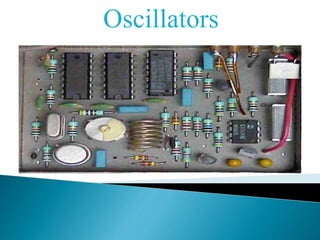
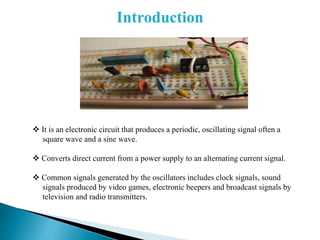
 It is an electronic circuit that produces a periodic, oscillating signal often a
square wave and a sine wave.
 Converts direct current from a power supply to an alternating current signal.
 Common signals generated by the oscillators includes clock signals, sound
signals produced by video games, electronic beepers and broadcast signals by
television and radio transmitters.
Introduction
Conditions For Oscillations
 The loop phase shift must be 0 ͦand 360 ͦ.
 The loop gain must be slightly greater than unity.
 The voltage gain around the closed feedback loop Acl is the product
of the amplifier gain Av and the attenuation B of the feedback
circuit.
Acl = AvB
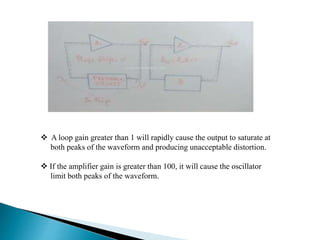
 A loop gain greater than 1 will rapidly cause the output to saturate at
both peaks of the waveform and producing unacceptable distortion.
 If the amplifier gain is greater than 100, it will cause the oscillator
limit both peaks of the waveform.
Oscillator Circuit
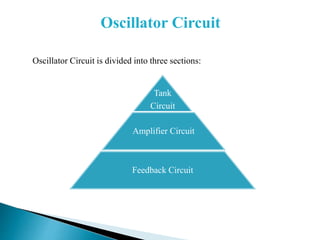
Oscillator Circuit is divided into three sections:
Tank
Circuit
Amplifier Circuit
Feedback Circuit
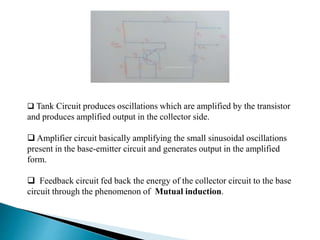
 Tank Circuit produces oscillations which are amplified by the transistor
and produces amplified output in the collector side.
 Amplifier circuit basically amplifying the small sinusoidal oscillations
present in the base-emitter circuit and generates output in the amplified
form.
 Feedback circuit fed back the energy of the collector circuit to the base
circuit through the phenomenon of Mutual induction.
Types Of Oscillator
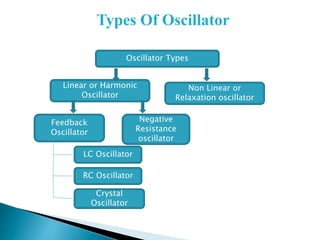
Oscillator Types
Linear or Harmonic
Oscillator
Non Linear or
Relaxation oscillator
Feedback
Oscillator
Negative
Resistance
oscillator
LC Oscillator
RC Oscillator
Crystal
Oscillator
LC Oscillator
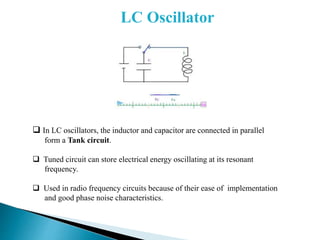
 In LC oscillators, the inductor and capacitor are connected in parallel
form a Tank circuit.
 Tuned circuit can store electrical energy oscillating at its resonant
frequency.
 Used in radio frequency circuits because of their ease of implementation
and good phase noise characteristics.
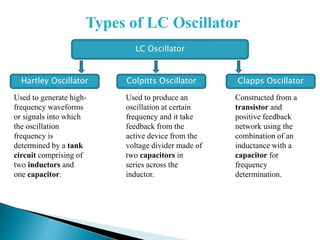
Types of LC Oscillator
LC Oscillator
Hartley Oscillator Colpitts Oscillator Clapps Oscillator
Used to generate high-
frequency waveforms
or signals into which
the oscillation
frequency is
determined by a tank
circuit comprising of
two inductors and
one capacitor.
Used to produce an
oscillation at certain
frequency and it take
feedback from the
active device from the
voltage divider made of
two capacitors in
series across the
inductor.
Constructed from a
transistor and
positive feedback
network using the
combination of an
inductance with a
capacitor for
frequency
determination.
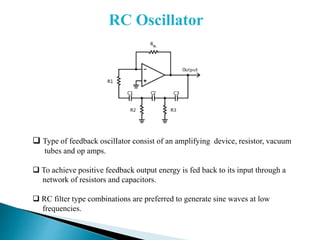
RC Oscillator
 Type of feedback oscilIator consist of an amplifying device, resistor, vacuum
tubes and op amps.
 To achieve positive feedback output energy is fed back to its input through a
network of resistors and capacitors.
 RC filter type combinations are preferred to generate sine waves at low
frequencies.
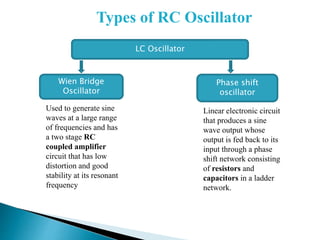
Types of RC Oscillator
LC Oscillator
Wien Bridge
Oscillator
Phase shift
oscillator
Used to generate sine
waves at a large range
of frequencies and has
a two stage RC
coupled amplifier
circuit that has low
distortion and good
stability at its resonant
frequency
Linear electronic circuit
that produces a sine
wave output whose
output is fed back to its
input through a phase
shift network consisting
of resistors and
capacitors in a ladder
network.
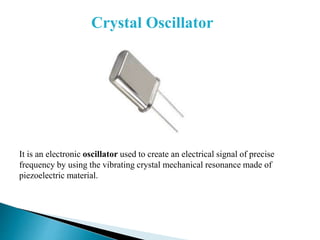
Crystal Oscillator
It is an electronic oscillator used to create an electrical signal of precise
frequency by using the vibrating crystal mechanical resonance made of
piezoelectric material.
For more detail of Oscillators go to http://analyseameter.com

Basics of Oscillator

  • 1.
  • 2.
     It isan electronic circuit that produces a periodic, oscillating signal often a square wave and a sine wave.  Converts direct current from a power supply to an alternating current signal.  Common signals generated by the oscillators includes clock signals, sound signals produced by video games, electronic beepers and broadcast signals by television and radio transmitters. Introduction
  • 3.
    Conditions For Oscillations The loop phase shift must be 0 ͦand 360 ͦ.  The loop gain must be slightly greater than unity.  The voltage gain around the closed feedback loop Acl is the product of the amplifier gain Av and the attenuation B of the feedback circuit. Acl = AvB
  • 4.
     A loopgain greater than 1 will rapidly cause the output to saturate at both peaks of the waveform and producing unacceptable distortion.  If the amplifier gain is greater than 100, it will cause the oscillator limit both peaks of the waveform.
  • 5.
    Oscillator Circuit Oscillator Circuitis divided into three sections: Tank Circuit Amplifier Circuit Feedback Circuit
  • 6.
     Tank Circuitproduces oscillations which are amplified by the transistor and produces amplified output in the collector side.  Amplifier circuit basically amplifying the small sinusoidal oscillations present in the base-emitter circuit and generates output in the amplified form.  Feedback circuit fed back the energy of the collector circuit to the base circuit through the phenomenon of Mutual induction.
  • 7.
    Types Of Oscillator OscillatorTypes Linear or Harmonic Oscillator Non Linear or Relaxation oscillator Feedback Oscillator Negative Resistance oscillator LC Oscillator RC Oscillator Crystal Oscillator
  • 8.
    LC Oscillator  InLC oscillators, the inductor and capacitor are connected in parallel form a Tank circuit.  Tuned circuit can store electrical energy oscillating at its resonant frequency.  Used in radio frequency circuits because of their ease of implementation and good phase noise characteristics.
  • 9.
    Types of LCOscillator LC Oscillator Hartley Oscillator Colpitts Oscillator Clapps Oscillator Used to generate high- frequency waveforms or signals into which the oscillation frequency is determined by a tank circuit comprising of two inductors and one capacitor. Used to produce an oscillation at certain frequency and it take feedback from the active device from the voltage divider made of two capacitors in series across the inductor. Constructed from a transistor and positive feedback network using the combination of an inductance with a capacitor for frequency determination.
  • 10.
    RC Oscillator  Typeof feedback oscilIator consist of an amplifying device, resistor, vacuum tubes and op amps.  To achieve positive feedback output energy is fed back to its input through a network of resistors and capacitors.  RC filter type combinations are preferred to generate sine waves at low frequencies.
  • 11.
    Types of RCOscillator LC Oscillator Wien Bridge Oscillator Phase shift oscillator Used to generate sine waves at a large range of frequencies and has a two stage RC coupled amplifier circuit that has low distortion and good stability at its resonant frequency Linear electronic circuit that produces a sine wave output whose output is fed back to its input through a phase shift network consisting of resistors and capacitors in a ladder network.
  • 12.
    Crystal Oscillator It isan electronic oscillator used to create an electrical signal of precise frequency by using the vibrating crystal mechanical resonance made of piezoelectric material.
  • 13.
    For more detailof Oscillators go to http://analyseameter.com