SPASTICITY -
PATHOPHYSIOLOGYAND
MANAGEMENT
DR. SUMIT S. KAMBLE
SENIOR RESIDENT
DEPT. OF NEUROLOGY
GMC, KOTA
• Spasticity is frequent and often disabling feature of
neurological disease.
• Spasticity is motor disorder that is characterized by velocity
dependent increase in tonic stretch reflexes (muscle tone) with
exaggerated tendon jerks, resulting from hyper excitability of
the stretch reflex, as one component of the upper motor neuron
syndrome. J.W.Lance(1980)
CHARACTERISTIC FEATURES
• Velocity dependence- increased tone of spasticity is velocity
dependent, that is, the faster the stretch, the greater the muscle
resistance
• ‘Clasp-knife’ phenomenon- spastic limb initially resists
movement and then suddenly gives way, like the resistance of a
folding knife blade
• Distribution- differential distribution with antigravity muscles
being more affected
ACCOMPANIMENTS OF SPASTICITY
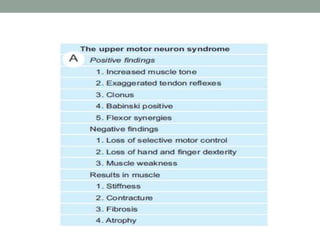
Positive features
• Clonus- involuntary rhythmic contractions, response to sudden
sustained stretch, alternate loading and off-loading of muscle
spindles
• Spasms- sudden involuntary movements involving multiple
muscle groups and joints, repetitive and sustained, represent an
exaggerated reflex withdrawal response to nociceptive stimuli
• Exaggerated tendon reflexes
• Babinski sign
Negative components
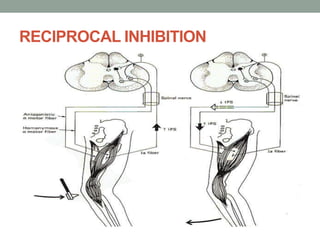
• Spastic co-contraction- inappropriate activation of antagonistic
muscles during voluntary activity. It is due to loss of reciprocal
inhibition during voluntary contraction
• Motor weakness
• Slowed movements
• Loss of dexterity
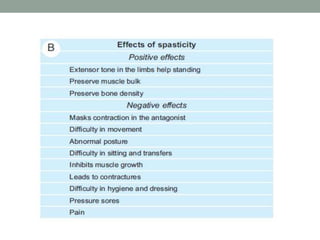
COMPLICATIONS
Spasticity if left untreated or sub-optimally treated, may lead to
consequences, such as:
• Muscle contractures (leading to abnormal body segment loading
and sensory change),
• Limb deformity and altered body mechanics,
• Pressure sores,
• Difficulty in the management of pressure sores,
• Pain from muscle spasms,
• Degenerative joint disease,
• Loss of function, and
• Mood problems and inability to participate in rehabilitation.
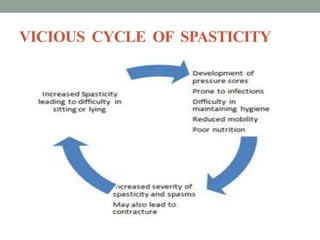
VICIOUS CYCLE OF SPASTICITY
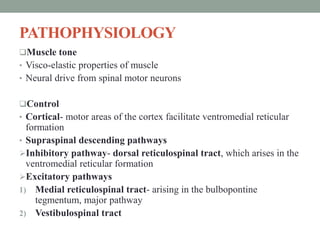
PATHOPHYSIOLOGY
Muscle tone
• Visco-elastic properties of muscle
• Neural drive from spinal motor neurons
Control
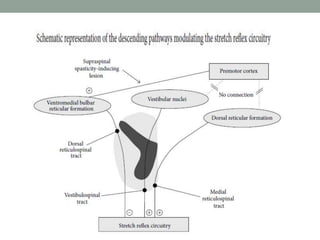
• Cortical- motor areas of the cortex facilitate ventromedial reticular
formation
• Supraspinal descending pathways
Inhibitory pathway- dorsal reticulospinal tract, which arises in the
ventromedial reticular formation
Excitatory pathways
1) Medial reticulospinal tract- arising in the bulbopontine
tegmentum, major pathway
2) Vestibulospinal tract
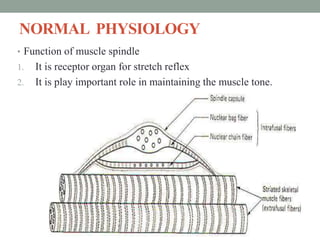
NORMAL PHYSIOLOGY
• Function of muscle spindle
1. It is receptor organ for stretch reflex
2. It is play important role in maintaining the muscle tone.
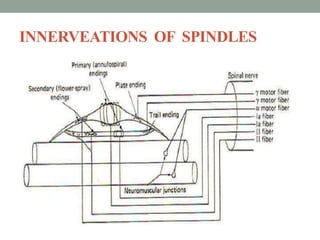
INNERVEATIONS OF SPINDLES
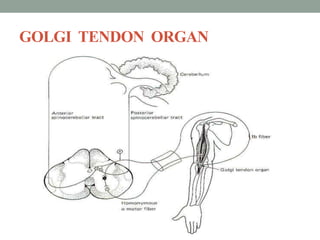
GOLGI TENDON ORGAN
RECIPROCAL INHIBITION
PATHOPHYSIOLOGY
• Immediately after SCI, there are depressed spinal reflexes
during state of spinal shock, followed by development of
hyperreflexia and spasticity over the following weeks to month.
• Pathophysiology of spasticity is not completely understood;
however, it is believed to arise primarily from loss of the effect
of numerous descending inhibitory pathways. These include
reciprocal 1a interneuronal inhibition, presynaptic inhibition,
renshaw-mediated recurrent inhibition, group II afferent
inhibition, and Golgi tendon organs.
• Axonal collateral sprouting and denervation super sensitivity
are change that may also play a role in the development of
spasticity.
MECHANISM AT VARIOUS LEVELS
Cortical & Supraspinal descending pathways
• Loss of cortical facilitation of the inhibitory pathway(dorsal
reticulospinal tract)
• Partial spinal cord lesion, which destroys the inhibitory
pathways but preserves the excitatory fibres
• Complete spinal cord lesion affecting both inhibitory and
excitatory pathways
Spinal Cord
• Loss of recurrent inhibition- mediated by motor axon collaterals
and Renshaw cell
• Loss of reciprocal inhibition- mediated by antagonistic muscle
spindle afferents
• Reduced inverse stretch reflex- mediated by Golgi tendon
organs
• Reduced presynaptic inhibition of muscle spindle afferents
Spinal motor neuron
• Denervation supersensitivity
• Collateral sprouting
Muscles and joints
• Shortening of sarcomeres
• Loss of elastic tissue
• Fibro-fatty deposits in muscles and tendons
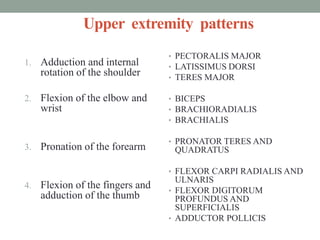
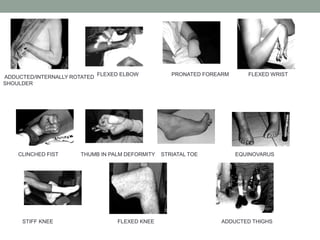
Upper extremity patterns
1. Adduction and internal
rotation of the shoulder
2. Flexion of the elbow and
wrist
3. Pronation of the forearm
4. Flexion of the fingers and
adduction of the thumb
• PECTORALIS MAJOR
• LATISSIMUS DORSI
• TERES MAJOR
• BICEPS
• BRACHIORADIALIS
• BRACHIALIS
• PRONATOR TERES AND
QUADRATUS
• FLEXOR CARPI RADIALIS AND
ULNARIS
• FLEXOR DIGITORUM
PROFUNDUS AND
SUPERFICIALIS
• ADDUCTOR POLLICIS
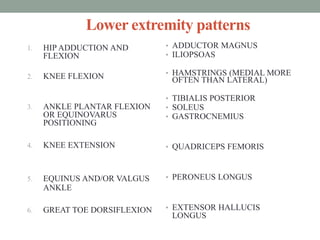
Lower extremity patterns
1. HIP ADDUCTION AND
FLEXION
2. KNEE FLEXION
3. ANKLE PLANTAR FLEXION
OR EQUINOVARUS
POSITIONING
4. KNEE EXTENSION
5. EQUINUS AND/OR VALGUS
ANKLE
6. GREAT TOE DORSIFLEXION
• ADDUCTOR MAGNUS
• ILIOPSOAS
• HAMSTRINGS (MEDIAL MORE
OFTEN THAN LATERAL)
• TIBIALIS POSTERIOR
• SOLEUS
• GASTROCNEMIUS
• QUADRICEPS FEMORIS
• PERONEUS LONGUS
• EXTENSOR HALLUCIS
LONGUS
ADDUCTED/INTERNALLY ROTATED
SHOULDER
FLEXED ELBOW PRONATED FOREARM FLEXED WRIST
CLINCHED FIST THUMB IN PALM DEFORMITY STRIATAL TOE EQUINOVARUS
STIFF KNEE FLEXED KNEE ADDUCTED THIGHS
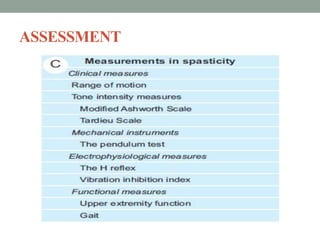
ASSESSMENT
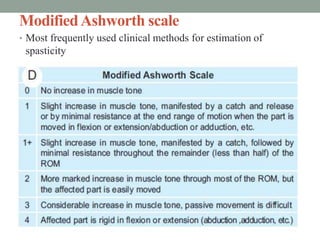
ModifiedAshworth scale
• Most frequently used clinical methods for estimation of
spasticity
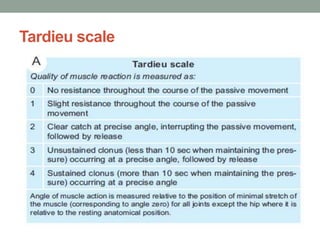
Tardieu scale
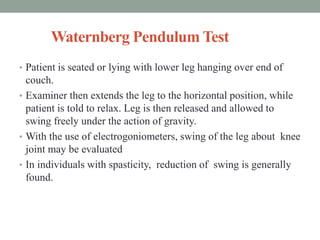
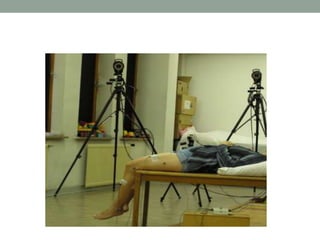
Waternberg Pendulum Test
• Patient is seated or lying with lower leg hanging over end of
couch.
• Examiner then extends the leg to the horizontal position, while
patient is told to relax. Leg is then released and allowed to
swing freely under the action of gravity.
• With the use of electrogoniometers, swing of the leg about knee
joint may be evaluated
• In individuals with spasticity, reduction of swing is generally
found.
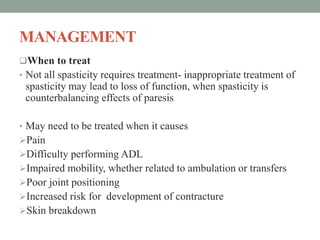
MANAGEMENT
When to treat
• Not all spasticity requires treatment- inappropriate treatment of
spasticity may lead to loss of function, when spasticity is
counterbalancing effects of paresis
• May need to be treated when it causes
Pain
Difficulty performing ADL
Impaired mobility, whether related to ambulation or transfers
Poor joint positioning
Increased risk for development of contracture
Skin breakdown
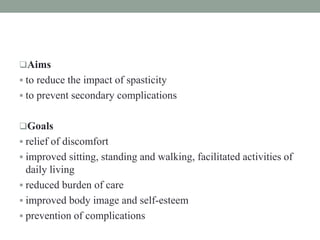
Aims
 to reduce the impact of spasticity
 to prevent secondary complications
Goals
 relief of discomfort
 improved sitting, standing and walking, facilitated activities of
daily living
 reduced burden of care
 improved body image and self-esteem
 prevention of complications
Identification and elimination of triggers
Non pharmacological interventions
• Passive movements
• Exercises
• Posture & Standing
• Physical modalities
 Medications
• Oral
• Injectables
Surgical
Identification and elimination of triggers
Patient and carer education to recognise these triggers is
important part of management
• Pressure ulcers
• Ingrown toenails
• Skin infections
• Injuries
• Constipation
• Urinary tract infection
• Deep vein thrombosis
• Improper seating
• Ill-fitting orthotics
Passive movements
 Passive stretching decreases excitability of motor neurones and
maintains visco-elastic properties of muscles and joints
 Prolonged stretching can help to treat contractures
 Stretching can be facilitated by using casts or splints, sometimes
used together with botulinum toxin injections
 No conclusive evidence whether therapy is effective but no
evidence that it is harmful
Exercises
 Improve motor control and cardiovascular fitness in people with
UMN disorders
Posture and standing
• Stretches spastic muscles and decrease sensitivity of stretch
reflex and brain stem reflexes that trigger spasticity
• Weight bearing and standing also help to improve psychological
wellbeing, to improve bone mineral density, facilitate
pulmonary drainage and helps bowel and bladder functions
• Proper positioning of limbs and trunk is essential to prevent
aggravation spasticity and development of contractures
• Devices such as splints help to position limbs properly
Physical modalities
• These physical modalities work through either modulating the
visco-elastic properties of muscles and tendons
Ultrasound
Cryotherapy
 Vibration
 Shockwave therapy
 Magnetic stimulation
Transcutaneous electrical nerve stimulation (TENS)
• limited evidence base to support the use
Medications
Principles of drug therapy
• Weakness is a side effect of all antispasticity drugs, usually due
to unmasking of underlying UMN weakness
• A ‘start low and go slow’ policy limits these unwanted
functional effects
• Reach maximal tolerated dose for a sufficiently long period
before stopping a drug and labeling it as ineffective
• Patients not responding to one drug may respond to another
• Sudden stopping of even an apparently ‘ineffective’ drug may
cause a rebound increase in spasticity. It is better to taper initial
drug while simultaneously introducing the second drug.
• Combination of two drugs should be tried if the spasticity does
not respond to a single agent
• It is important to time the doses according to the patient’s
activity, care and therapy
Oral agents
Gamma aminobutyric acid (GABA)ergic system
• Baclofen
• Gabapentin
• Benzodiazepines
α-2 adrenergic system
• Tizanidine
 Block calcium release into the muscles
• Dantrolene
Cannabinoids
Baclofen
• Most widely used oral antispasticity drug
• Mechanism
GABA-B receptor agonist
Reduces calcium influx
↓s release of excitatory neurotransmitters(glutamate & aspartate)
Down-regulates activity of 1a sensory afferents, spinal interneurones
& motor neurones
 Dose
starting - 5 mg thrice daily
Maintenance- ↑d by 5–10 mg weekly, until there is an optimal effect
Max- 90–120 mg per day
Adverse effects
• Weakness, drowsiness and dizziness
• Sexual dysfunction & urinary incontinence
• Reduces seizure threshold
• Sudden withdrawal may also cause seizures and hallucinations,
sometimes accompanied by extreme hyperthermia and increased
spasticity (baclofen withdrawal syndrome)
• Caution pregnancy- animal studies show impaired sternal
ossification and omphalocele
Benzodiazepines
• Act on GABA-A receptors, enhances the presynaptic inhibitory
effect of GABA and decreases spasticity
• Absorbed faster than baclofen, acts faster, and has a longer
lasting effect
• Drowsiness and behavioural side effects limit its use during the
daytime
• Particularly useful to treat spasticity that interferes with sleep
• Clonazepam is particularly useful to treat nocturnal spasms
Usual starting dose is 0.5 mg at night
Maximum dose of 1 mg
Tizanidine
• Mechanism
α-2 receptor agonist
Inhibits excitatory spinal interneurones and tracts from locus
coeruleus
• Dose
Starting dosage is 2 mg at bedtime, increased by 2 mg weekly
to a maximum of 36 mg, divided into 3–4 daily doses
• Adverse effects
Dry mouth, gastrointestinal disturbance, hypotension and acute
hepatitis
Sudden stopping of tizanidine can lead to a hyperadrenergic
syndrome, characterised by anxiety, tremor, hypertension and
tachycardia
Dantrolene
• Mechanism
Blocks calcium release from sarcoplasmic reticulum and interferes
with excitation–contraction coupling of the skeletal muscle
Acts directly on the muscle and so is less sedative
• Dose
Starting dose is 25 mg daily for the first week, increased in steps of
25 mg per week to a top dose of 100 mg 3–4 times daily
• Adverse effects
Muscle weakness, sedation, diarrhoea
Most important side effect is hepatotoxicity, and so liver function
must be monitored carefully
Cannabinoids
• Cannabinoid receptors in dorsal spinal cord, basal ganglia,
hippocampus and cerebellum, and these modulate spasticity
• Cannabidiol & Nabiximols limited role in managing treatment-
resistant spasticity
• May be worth trying in patients who are not responding to a
combination of two drugs in adequate doses
• 30–40% of people show a response, treatment effect should be
reviewed at 4–6 weeks and continued only if there is an
objective improvement
• Concerns about its long-term effects on cognition, behaviour
and mental health
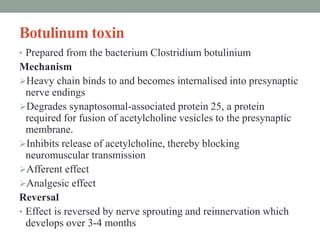
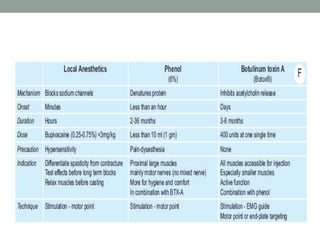
Botulinum toxin
• Prepared from the bacterium Clostridium botulinium
Mechanism
Heavy chain binds to and becomes internalised into presynaptic
nerve endings
Degrades synaptosomal-associated protein 25, a protein
required for fusion of acetylcholine vesicles to the presynaptic
membrane.
Inhibits release of acetylcholine, thereby blocking
neuromuscular transmission
Afferent effect
Analgesic effect
Reversal
• Effect is reversed by nerve sprouting and reinnervation which
develops over 3-4 months
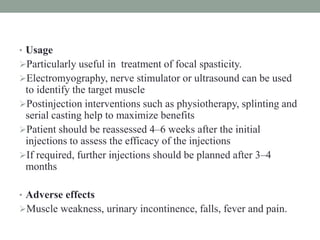
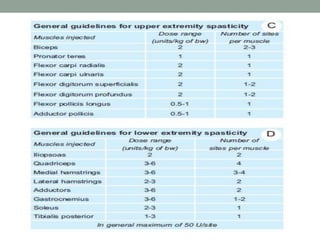
• Usage
Particularly useful in treatment of focal spasticity.
Electromyography, nerve stimulator or ultrasound can be used
to identify the target muscle
Postinjection interventions such as physiotherapy, splinting and
serial casting help to maximize benefits
Patient should be reassessed 4–6 weeks after the initial
injections to assess the efficacy of the injections
If required, further injections should be planned after 3–4
months
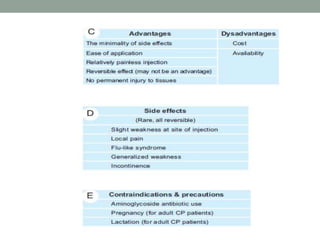
• Adverse effects
Muscle weakness, urinary incontinence, falls, fever and pain.
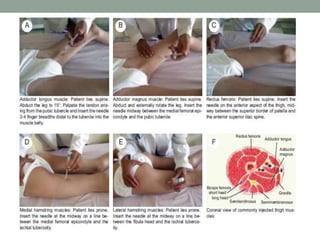
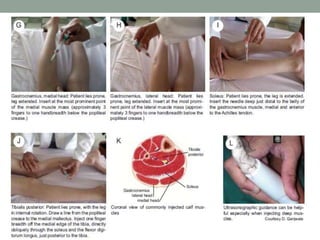
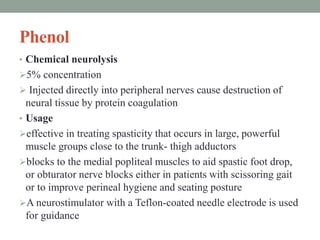
Phenol
• Chemical neurolysis
5% concentration
 Injected directly into peripheral nerves cause destruction of
neural tissue by protein coagulation
• Usage
effective in treating spasticity that occurs in large, powerful
muscle groups close to the trunk- thigh adductors
blocks to the medial popliteal muscles to aid spastic foot drop,
or obturator nerve blocks either in patients with scissoring gait
or to improve perineal hygiene and seating posture
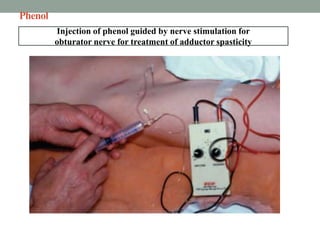
A neurostimulator with a Teflon-coated needle electrode is used
for guidance
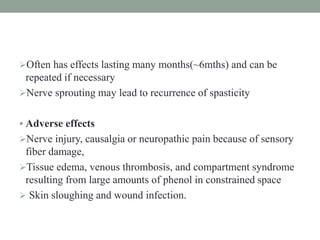
Often has effects lasting many months(~6mths) and can be
repeated if necessary
Nerve sprouting may lead to recurrence of spasticity
 Adverse effects
Nerve injury, causalgia or neuropathic pain because of sensory
fiber damage,
Tissue edema, venous thrombosis, and compartment syndrome
resulting from large amounts of phenol in constrained space
 Skin sloughing and wound infection.
Phenol
Injection of phenol guided by nerve stimulation for
obturator nerve for treatment of adductor spasticity
Alcohol
• Acts as a local anesthetic by decreasing sodium and potassium
conductance at the nerve membrane at low concentrations.
• It causes protein denaturation at higher concentration
Adverse effects
• Causes pain during injection
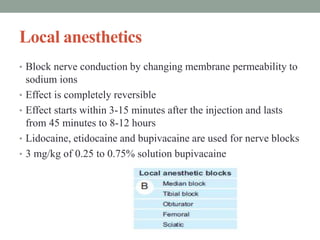
Local anesthetics
• Block nerve conduction by changing membrane permeability to
sodium ions
• Effect is completely reversible
• Effect starts within 3-15 minutes after the injection and lasts
from 45 minutes to 8-12 hours
• Lidocaine, etidocaine and bupivacaine are used for nerve blocks
• 3 mg/kg of 0.25 to 0.75% solution bupivacaine
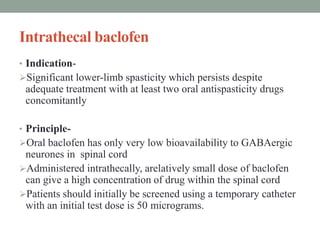
Intrathecal baclofen
• Indication-
Significant lower-limb spasticity which persists despite
adequate treatment with at least two oral antispasticity drugs
concomitantly
• Principle-
Oral baclofen has only very low bioavailability to GABAergic
neurones in spinal cord
Administered intrathecally, arelatively small dose of baclofen
can give a high concentration of drug within the spinal cord
Patients should initially be screened using a temporary catheter
with an initial test dose is 50 micrograms.
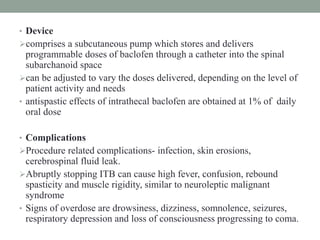
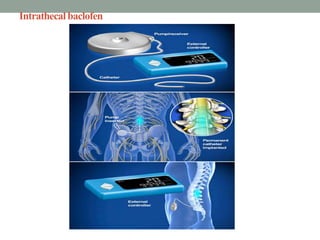
• Device
comprises a subcutaneous pump which stores and delivers
programmable doses of baclofen through a catheter into the spinal
subarchanoid space
can be adjusted to vary the doses delivered, depending on the level of
patient activity and needs
• antispastic effects of intrathecal baclofen are obtained at 1% of daily
oral dose
• Complications
Procedure related complications- infection, skin erosions,
cerebrospinal fluid leak.
Abruptly stopping ITB can cause high fever, confusion, rebound
spasticity and muscle rigidity, similar to neuroleptic malignant
syndrome
• Signs of overdose are drowsiness, dizziness, somnolence, seizures,
respiratory depression and loss of consciousness progressing to coma.
Intrathecalbaclofen
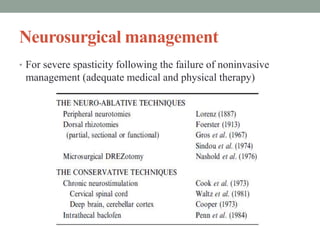
Neurosurgical management
• For severe spasticity following the failure of noninvasive
management (adequate medical and physical therapy)
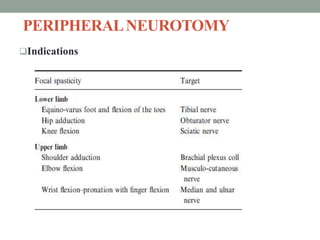
PERIPHERALNEUROTOMY
Indications
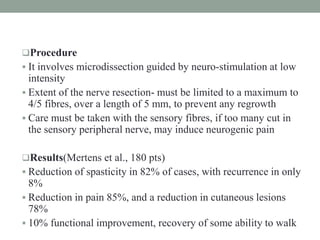
Procedure
 It involves microdissection guided by neuro-stimulation at low
intensity
 Extent of the nerve resection- must be limited to a maximum to
4/5 fibres, over a length of 5 mm, to prevent any regrowth
 Care must be taken with the sensory fibres, if too many cut in
the sensory peripheral nerve, may induce neurogenic pain
Results(Mertens et al., 180 pts)
 Reduction of spasticity in 82% of cases, with recurrence in only
8%
 Reduction in pain 85%, and a reduction in cutaneous lesions
78%
 10% functional improvement, recovery of some ability to walk
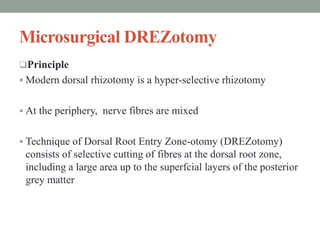
Microsurgical DREZotomy
Principle
 Modern dorsal rhizotomy is a hyper-selective rhizotomy
 At the periphery, nerve fibres are mixed
 Technique of Dorsal Root Entry Zone-otomy (DREZotomy)
consists of selective cutting of fibres at the dorsal root zone,
including a large area up to the superfcial layers of the posterior
grey matter
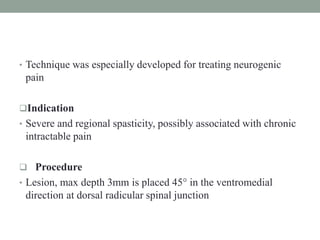
• Technique was especially developed for treating neurogenic
pain
Indication
• Severe and regional spasticity, possibly associated with chronic
intractable pain
 Procedure
• Lesion, max depth 3mm is placed 45° in the ventromedial
direction at dorsal radicular spinal junction
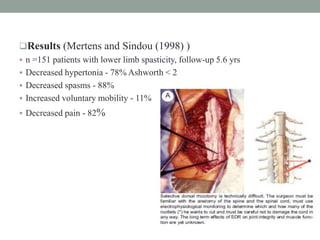
Results (Mertens and Sindou (1998) )
 n =151 patients with lower limb spasticity, follow-up 5.6 yrs
 Decreased hypertonia - 78% Ashworth < 2
 Decreased spasms - 88%
 Increased voluntary mobility - 11%
 Decreased pain - 82%
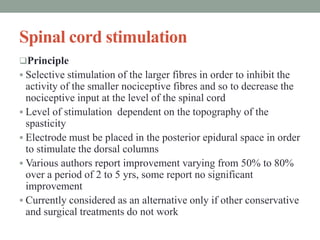
Spinal cord stimulation
Principle
 Selective stimulation of the larger fibres in order to inhibit the
activity of the smaller nociceptive fibres and so to decrease the
nociceptive input at the level of the spinal cord
 Level of stimulation dependent on the topography of the
spasticity
 Electrode must be placed in the posterior epidural space in order
to stimulate the dorsal columns
 Various authors report improvement varying from 50% to 80%
over a period of 2 to 5 yrs, some report no significant
improvement
 Currently considered as an alternative only if other conservative
and surgical treatments do not work
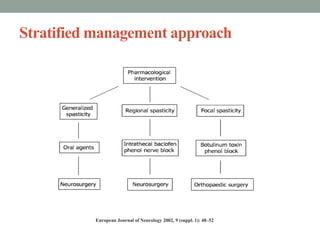
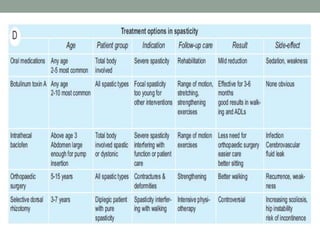
Stratified management approach
European Journal of Neurology 2002, 9 (suppl. 1): 48–52
THANK YOU
REFERECES
• Spasticity: pathophysiology, evaluation and management
Practical Neurology 2012;12:289–298
• Sheean G. 2002. The pathophysiology of spasticity. European
Journal of Neurology 9 (Suppl 1):3-9.
• Pathophysiology of spasticity Journal of Neurology,
Neurosurgery, and Psychiatry 1994;57:773-777
• Pathophysiology of Spasticity: Implications for
Neurorehabilitation BioMed Research International
Volume 2014 (2014), Article ID 354906,
• Dejong Neurology 7th edition
• UPTODATE.COM

Pathophysiology of spasticity

  • 1.
    SPASTICITY - PATHOPHYSIOLOGYAND MANAGEMENT DR. SUMITS. KAMBLE SENIOR RESIDENT DEPT. OF NEUROLOGY GMC, KOTA
  • 2.
    • Spasticity isfrequent and often disabling feature of neurological disease. • Spasticity is motor disorder that is characterized by velocity dependent increase in tonic stretch reflexes (muscle tone) with exaggerated tendon jerks, resulting from hyper excitability of the stretch reflex, as one component of the upper motor neuron syndrome. J.W.Lance(1980)
  • 3.
    CHARACTERISTIC FEATURES • Velocitydependence- increased tone of spasticity is velocity dependent, that is, the faster the stretch, the greater the muscle resistance • ‘Clasp-knife’ phenomenon- spastic limb initially resists movement and then suddenly gives way, like the resistance of a folding knife blade • Distribution- differential distribution with antigravity muscles being more affected
  • 4.
    ACCOMPANIMENTS OF SPASTICITY Positivefeatures • Clonus- involuntary rhythmic contractions, response to sudden sustained stretch, alternate loading and off-loading of muscle spindles • Spasms- sudden involuntary movements involving multiple muscle groups and joints, repetitive and sustained, represent an exaggerated reflex withdrawal response to nociceptive stimuli • Exaggerated tendon reflexes • Babinski sign
  • 5.
    Negative components • Spasticco-contraction- inappropriate activation of antagonistic muscles during voluntary activity. It is due to loss of reciprocal inhibition during voluntary contraction • Motor weakness • Slowed movements • Loss of dexterity
  • 7.
    COMPLICATIONS Spasticity if leftuntreated or sub-optimally treated, may lead to consequences, such as: • Muscle contractures (leading to abnormal body segment loading and sensory change), • Limb deformity and altered body mechanics, • Pressure sores, • Difficulty in the management of pressure sores, • Pain from muscle spasms, • Degenerative joint disease, • Loss of function, and • Mood problems and inability to participate in rehabilitation.
  • 8.
    VICIOUS CYCLE OFSPASTICITY
  • 10.
    PATHOPHYSIOLOGY Muscle tone • Visco-elasticproperties of muscle • Neural drive from spinal motor neurons Control • Cortical- motor areas of the cortex facilitate ventromedial reticular formation • Supraspinal descending pathways Inhibitory pathway- dorsal reticulospinal tract, which arises in the ventromedial reticular formation Excitatory pathways 1) Medial reticulospinal tract- arising in the bulbopontine tegmentum, major pathway 2) Vestibulospinal tract
  • 11.
    NORMAL PHYSIOLOGY • Functionof muscle spindle 1. It is receptor organ for stretch reflex 2. It is play important role in maintaining the muscle tone.
  • 12.
  • 13.
  • 15.
  • 16.
    PATHOPHYSIOLOGY • Immediately afterSCI, there are depressed spinal reflexes during state of spinal shock, followed by development of hyperreflexia and spasticity over the following weeks to month. • Pathophysiology of spasticity is not completely understood; however, it is believed to arise primarily from loss of the effect of numerous descending inhibitory pathways. These include reciprocal 1a interneuronal inhibition, presynaptic inhibition, renshaw-mediated recurrent inhibition, group II afferent inhibition, and Golgi tendon organs. • Axonal collateral sprouting and denervation super sensitivity are change that may also play a role in the development of spasticity.
  • 17.
    MECHANISM AT VARIOUSLEVELS Cortical & Supraspinal descending pathways • Loss of cortical facilitation of the inhibitory pathway(dorsal reticulospinal tract) • Partial spinal cord lesion, which destroys the inhibitory pathways but preserves the excitatory fibres • Complete spinal cord lesion affecting both inhibitory and excitatory pathways Spinal Cord • Loss of recurrent inhibition- mediated by motor axon collaterals and Renshaw cell • Loss of reciprocal inhibition- mediated by antagonistic muscle spindle afferents
  • 18.
    • Reduced inversestretch reflex- mediated by Golgi tendon organs • Reduced presynaptic inhibition of muscle spindle afferents Spinal motor neuron • Denervation supersensitivity • Collateral sprouting Muscles and joints • Shortening of sarcomeres • Loss of elastic tissue • Fibro-fatty deposits in muscles and tendons
  • 19.
    Upper extremity patterns 1.Adduction and internal rotation of the shoulder 2. Flexion of the elbow and wrist 3. Pronation of the forearm 4. Flexion of the fingers and adduction of the thumb • PECTORALIS MAJOR • LATISSIMUS DORSI • TERES MAJOR • BICEPS • BRACHIORADIALIS • BRACHIALIS • PRONATOR TERES AND QUADRATUS • FLEXOR CARPI RADIALIS AND ULNARIS • FLEXOR DIGITORUM PROFUNDUS AND SUPERFICIALIS • ADDUCTOR POLLICIS
  • 20.
    Lower extremity patterns 1.HIP ADDUCTION AND FLEXION 2. KNEE FLEXION 3. ANKLE PLANTAR FLEXION OR EQUINOVARUS POSITIONING 4. KNEE EXTENSION 5. EQUINUS AND/OR VALGUS ANKLE 6. GREAT TOE DORSIFLEXION • ADDUCTOR MAGNUS • ILIOPSOAS • HAMSTRINGS (MEDIAL MORE OFTEN THAN LATERAL) • TIBIALIS POSTERIOR • SOLEUS • GASTROCNEMIUS • QUADRICEPS FEMORIS • PERONEUS LONGUS • EXTENSOR HALLUCIS LONGUS
  • 21.
    ADDUCTED/INTERNALLY ROTATED SHOULDER FLEXED ELBOWPRONATED FOREARM FLEXED WRIST CLINCHED FIST THUMB IN PALM DEFORMITY STRIATAL TOE EQUINOVARUS STIFF KNEE FLEXED KNEE ADDUCTED THIGHS
  • 22.
  • 23.
    ModifiedAshworth scale • Mostfrequently used clinical methods for estimation of spasticity
  • 24.
  • 25.
    Waternberg Pendulum Test •Patient is seated or lying with lower leg hanging over end of couch. • Examiner then extends the leg to the horizontal position, while patient is told to relax. Leg is then released and allowed to swing freely under the action of gravity. • With the use of electrogoniometers, swing of the leg about knee joint may be evaluated • In individuals with spasticity, reduction of swing is generally found.
  • 27.
    MANAGEMENT When to treat •Not all spasticity requires treatment- inappropriate treatment of spasticity may lead to loss of function, when spasticity is counterbalancing effects of paresis • May need to be treated when it causes Pain Difficulty performing ADL Impaired mobility, whether related to ambulation or transfers Poor joint positioning Increased risk for development of contracture Skin breakdown
  • 28.
    Aims  to reducethe impact of spasticity  to prevent secondary complications Goals  relief of discomfort  improved sitting, standing and walking, facilitated activities of daily living  reduced burden of care  improved body image and self-esteem  prevention of complications
  • 29.
    Identification and eliminationof triggers Non pharmacological interventions • Passive movements • Exercises • Posture & Standing • Physical modalities  Medications • Oral • Injectables Surgical
  • 30.
    Identification and eliminationof triggers Patient and carer education to recognise these triggers is important part of management • Pressure ulcers • Ingrown toenails • Skin infections • Injuries • Constipation • Urinary tract infection • Deep vein thrombosis • Improper seating • Ill-fitting orthotics
  • 31.
    Passive movements  Passivestretching decreases excitability of motor neurones and maintains visco-elastic properties of muscles and joints  Prolonged stretching can help to treat contractures  Stretching can be facilitated by using casts or splints, sometimes used together with botulinum toxin injections  No conclusive evidence whether therapy is effective but no evidence that it is harmful
  • 32.
    Exercises  Improve motorcontrol and cardiovascular fitness in people with UMN disorders Posture and standing • Stretches spastic muscles and decrease sensitivity of stretch reflex and brain stem reflexes that trigger spasticity • Weight bearing and standing also help to improve psychological wellbeing, to improve bone mineral density, facilitate pulmonary drainage and helps bowel and bladder functions • Proper positioning of limbs and trunk is essential to prevent aggravation spasticity and development of contractures • Devices such as splints help to position limbs properly
  • 33.
    Physical modalities • Thesephysical modalities work through either modulating the visco-elastic properties of muscles and tendons Ultrasound Cryotherapy  Vibration  Shockwave therapy  Magnetic stimulation Transcutaneous electrical nerve stimulation (TENS) • limited evidence base to support the use
  • 34.
    Medications Principles of drugtherapy • Weakness is a side effect of all antispasticity drugs, usually due to unmasking of underlying UMN weakness • A ‘start low and go slow’ policy limits these unwanted functional effects • Reach maximal tolerated dose for a sufficiently long period before stopping a drug and labeling it as ineffective • Patients not responding to one drug may respond to another
  • 35.
    • Sudden stoppingof even an apparently ‘ineffective’ drug may cause a rebound increase in spasticity. It is better to taper initial drug while simultaneously introducing the second drug. • Combination of two drugs should be tried if the spasticity does not respond to a single agent • It is important to time the doses according to the patient’s activity, care and therapy
  • 36.
    Oral agents Gamma aminobutyricacid (GABA)ergic system • Baclofen • Gabapentin • Benzodiazepines α-2 adrenergic system • Tizanidine  Block calcium release into the muscles • Dantrolene Cannabinoids
  • 37.
    Baclofen • Most widelyused oral antispasticity drug • Mechanism GABA-B receptor agonist Reduces calcium influx ↓s release of excitatory neurotransmitters(glutamate & aspartate) Down-regulates activity of 1a sensory afferents, spinal interneurones & motor neurones  Dose starting - 5 mg thrice daily Maintenance- ↑d by 5–10 mg weekly, until there is an optimal effect Max- 90–120 mg per day
  • 38.
    Adverse effects • Weakness,drowsiness and dizziness • Sexual dysfunction & urinary incontinence • Reduces seizure threshold • Sudden withdrawal may also cause seizures and hallucinations, sometimes accompanied by extreme hyperthermia and increased spasticity (baclofen withdrawal syndrome) • Caution pregnancy- animal studies show impaired sternal ossification and omphalocele
  • 39.
    Benzodiazepines • Act onGABA-A receptors, enhances the presynaptic inhibitory effect of GABA and decreases spasticity • Absorbed faster than baclofen, acts faster, and has a longer lasting effect • Drowsiness and behavioural side effects limit its use during the daytime • Particularly useful to treat spasticity that interferes with sleep • Clonazepam is particularly useful to treat nocturnal spasms Usual starting dose is 0.5 mg at night Maximum dose of 1 mg
  • 40.
    Tizanidine • Mechanism α-2 receptoragonist Inhibits excitatory spinal interneurones and tracts from locus coeruleus • Dose Starting dosage is 2 mg at bedtime, increased by 2 mg weekly to a maximum of 36 mg, divided into 3–4 daily doses • Adverse effects Dry mouth, gastrointestinal disturbance, hypotension and acute hepatitis Sudden stopping of tizanidine can lead to a hyperadrenergic syndrome, characterised by anxiety, tremor, hypertension and tachycardia
  • 41.
    Dantrolene • Mechanism Blocks calciumrelease from sarcoplasmic reticulum and interferes with excitation–contraction coupling of the skeletal muscle Acts directly on the muscle and so is less sedative • Dose Starting dose is 25 mg daily for the first week, increased in steps of 25 mg per week to a top dose of 100 mg 3–4 times daily • Adverse effects Muscle weakness, sedation, diarrhoea Most important side effect is hepatotoxicity, and so liver function must be monitored carefully
  • 42.
    Cannabinoids • Cannabinoid receptorsin dorsal spinal cord, basal ganglia, hippocampus and cerebellum, and these modulate spasticity • Cannabidiol & Nabiximols limited role in managing treatment- resistant spasticity • May be worth trying in patients who are not responding to a combination of two drugs in adequate doses • 30–40% of people show a response, treatment effect should be reviewed at 4–6 weeks and continued only if there is an objective improvement • Concerns about its long-term effects on cognition, behaviour and mental health
  • 43.
    Botulinum toxin • Preparedfrom the bacterium Clostridium botulinium Mechanism Heavy chain binds to and becomes internalised into presynaptic nerve endings Degrades synaptosomal-associated protein 25, a protein required for fusion of acetylcholine vesicles to the presynaptic membrane. Inhibits release of acetylcholine, thereby blocking neuromuscular transmission Afferent effect Analgesic effect Reversal • Effect is reversed by nerve sprouting and reinnervation which develops over 3-4 months
  • 44.
    • Usage Particularly usefulin treatment of focal spasticity. Electromyography, nerve stimulator or ultrasound can be used to identify the target muscle Postinjection interventions such as physiotherapy, splinting and serial casting help to maximize benefits Patient should be reassessed 4–6 weeks after the initial injections to assess the efficacy of the injections If required, further injections should be planned after 3–4 months • Adverse effects Muscle weakness, urinary incontinence, falls, fever and pain.
  • 49.
    Phenol • Chemical neurolysis 5%concentration  Injected directly into peripheral nerves cause destruction of neural tissue by protein coagulation • Usage effective in treating spasticity that occurs in large, powerful muscle groups close to the trunk- thigh adductors blocks to the medial popliteal muscles to aid spastic foot drop, or obturator nerve blocks either in patients with scissoring gait or to improve perineal hygiene and seating posture A neurostimulator with a Teflon-coated needle electrode is used for guidance
  • 50.
    Often has effectslasting many months(~6mths) and can be repeated if necessary Nerve sprouting may lead to recurrence of spasticity  Adverse effects Nerve injury, causalgia or neuropathic pain because of sensory fiber damage, Tissue edema, venous thrombosis, and compartment syndrome resulting from large amounts of phenol in constrained space  Skin sloughing and wound infection.
  • 51.
    Phenol Injection of phenolguided by nerve stimulation for obturator nerve for treatment of adductor spasticity
  • 52.
    Alcohol • Acts asa local anesthetic by decreasing sodium and potassium conductance at the nerve membrane at low concentrations. • It causes protein denaturation at higher concentration Adverse effects • Causes pain during injection
  • 53.
    Local anesthetics • Blocknerve conduction by changing membrane permeability to sodium ions • Effect is completely reversible • Effect starts within 3-15 minutes after the injection and lasts from 45 minutes to 8-12 hours • Lidocaine, etidocaine and bupivacaine are used for nerve blocks • 3 mg/kg of 0.25 to 0.75% solution bupivacaine
  • 55.
    Intrathecal baclofen • Indication- Significantlower-limb spasticity which persists despite adequate treatment with at least two oral antispasticity drugs concomitantly • Principle- Oral baclofen has only very low bioavailability to GABAergic neurones in spinal cord Administered intrathecally, arelatively small dose of baclofen can give a high concentration of drug within the spinal cord Patients should initially be screened using a temporary catheter with an initial test dose is 50 micrograms.
  • 56.
    • Device comprises asubcutaneous pump which stores and delivers programmable doses of baclofen through a catheter into the spinal subarchanoid space can be adjusted to vary the doses delivered, depending on the level of patient activity and needs • antispastic effects of intrathecal baclofen are obtained at 1% of daily oral dose • Complications Procedure related complications- infection, skin erosions, cerebrospinal fluid leak. Abruptly stopping ITB can cause high fever, confusion, rebound spasticity and muscle rigidity, similar to neuroleptic malignant syndrome • Signs of overdose are drowsiness, dizziness, somnolence, seizures, respiratory depression and loss of consciousness progressing to coma.
  • 57.
  • 58.
    Neurosurgical management • Forsevere spasticity following the failure of noninvasive management (adequate medical and physical therapy)
  • 59.
  • 60.
    Procedure  It involvesmicrodissection guided by neuro-stimulation at low intensity  Extent of the nerve resection- must be limited to a maximum to 4/5 fibres, over a length of 5 mm, to prevent any regrowth  Care must be taken with the sensory fibres, if too many cut in the sensory peripheral nerve, may induce neurogenic pain Results(Mertens et al., 180 pts)  Reduction of spasticity in 82% of cases, with recurrence in only 8%  Reduction in pain 85%, and a reduction in cutaneous lesions 78%  10% functional improvement, recovery of some ability to walk
  • 61.
    Microsurgical DREZotomy Principle  Moderndorsal rhizotomy is a hyper-selective rhizotomy  At the periphery, nerve fibres are mixed  Technique of Dorsal Root Entry Zone-otomy (DREZotomy) consists of selective cutting of fibres at the dorsal root zone, including a large area up to the superfcial layers of the posterior grey matter
  • 62.
    • Technique wasespecially developed for treating neurogenic pain Indication • Severe and regional spasticity, possibly associated with chronic intractable pain  Procedure • Lesion, max depth 3mm is placed 45° in the ventromedial direction at dorsal radicular spinal junction
  • 63.
    Results (Mertens andSindou (1998) )  n =151 patients with lower limb spasticity, follow-up 5.6 yrs  Decreased hypertonia - 78% Ashworth < 2  Decreased spasms - 88%  Increased voluntary mobility - 11%  Decreased pain - 82%
  • 64.
    Spinal cord stimulation Principle Selective stimulation of the larger fibres in order to inhibit the activity of the smaller nociceptive fibres and so to decrease the nociceptive input at the level of the spinal cord  Level of stimulation dependent on the topography of the spasticity  Electrode must be placed in the posterior epidural space in order to stimulate the dorsal columns  Various authors report improvement varying from 50% to 80% over a period of 2 to 5 yrs, some report no significant improvement  Currently considered as an alternative only if other conservative and surgical treatments do not work
  • 65.
    Stratified management approach EuropeanJournal of Neurology 2002, 9 (suppl. 1): 48–52
  • 67.
  • 68.
    REFERECES • Spasticity: pathophysiology,evaluation and management Practical Neurology 2012;12:289–298 • Sheean G. 2002. The pathophysiology of spasticity. European Journal of Neurology 9 (Suppl 1):3-9. • Pathophysiology of spasticity Journal of Neurology, Neurosurgery, and Psychiatry 1994;57:773-777 • Pathophysiology of Spasticity: Implications for Neurorehabilitation BioMed Research International Volume 2014 (2014), Article ID 354906, • Dejong Neurology 7th edition • UPTODATE.COM