PHYSIOTHERAPY ASSESSMENT OF TRAUMATIC
BRAIN INJURY (UNCONSCIOUS)
PRESENTED BY
AHMAD MUKHTAR MAGAJI (B.PT-BUK)
TO
THE DEPARTMENT OF MEDICAL REHABILITATION USMANU
DANFODIYO UNIVERSITY TEACHING HOSPITAL SOKOTO
ON
JULY,2020
1
SYNOPSIS
 Introduction
 Definitions
 Brief Anatomy
 Epidemiology
 Etiology
 Pathophysiology
 General Assessment
 Subjective Assessment
 Objective Assessment
 Investigation
 Recommendation
 Conclusion
2
Introduction
• Traumatic Brain injury is any physical damage to the brain caused
by external force.(Barr et. al., 2012)
• Traumatic brain injuries constitute a significant portion of injury
resulting from automotive collisions (john et. al., 2013)
• Brain injuries not only represent a serious trauma for those
involved but also place an enormous burden on society, often
exacting a heavy economical, social, and emotional price. (Wong
et al., 2005) 3
Intro cont.
• Development of intervention strategies to prevent or minimize
these injuries requires a complete understanding of injury
mechanisms, response and tolerance level (Anthony et. al., 1999)
• It is worthy of note that the long-term sequelae of traumatic brain
injury especially moderate to severe cases do not affect the survivor
alone, but also the community they live in, as well as their families
and caregivers, both psychologically and economically. (Dziadzko et.
al., 2016)
4
Definition
• Traumatic brain injury (TBI) is a non degenerative, non
congenital insult to the brain from external mechanical force
possibly leading to permanent or temporary impairment of
cognitive, physical, and psychosocial functions, with an
associated diminished or altered level of consciousness
(Segun, T. D., 2019)
• Unconscious “the state of not being awake and not aware of
things around you especially as the result of a head injury”
5
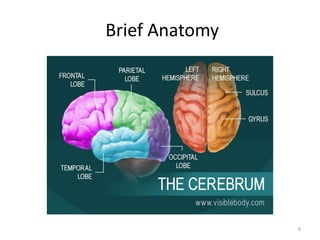
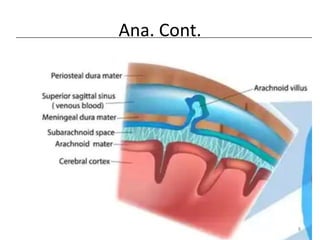
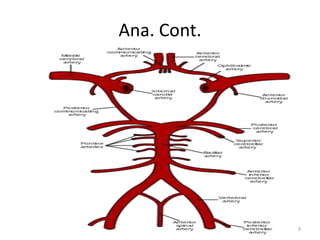
Brief Anatomy
6
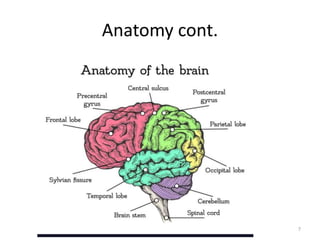
Anatomy cont.
7
Ana. Cont.
8
Ana. Cont.
9
Epidemiology
According to research carried out in university of port harcourt
by Regina, C.O. (2018)
• 30.9% of patients with trauma and 3.6 % of all A&E
admissions present with TBI.
• 76.9% males and 23.1% females 3.3:1
• Fatality rate of 22.6% of presenting TBI cases.
• Highest Rate of TBI occur in older adults
10
Etiology
Road traffic accident
 vehicle-vehicle,
 vehicle-pedestrian,
Domestic accident
 Fall,
 Assault
 Sport
11
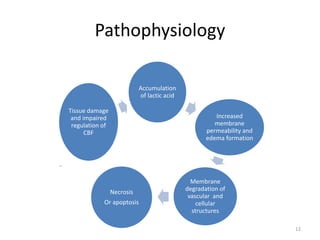
Pathophysiology
Accumulation
of lactic acid
Increased
membrane
permeability and
edema formation
Membrane
degradation of
vascular and
cellular
structures
Necrosis
Or apoptosis
Tissue damage
and impaired
regulation of
CBF
12
Response to injury
• Swelling of brain
• Vasodilatation with increased blood volume
• Increased ICP
• Decreased blood flow to brain
• Perfusion decreases
• Cerebral ischemia (hypoxia)
13
Assessment
 Subjective
o Chief complain
o History
 the exact time and nature of the accident, including the direction of the blow;
 First action taken
 Headache, nausea, vomiting and convulsion
 Loss of consciousness
 Referral
14
Subjective ass
• PMHx- HTN,DM,RTA, previous hx of accidents,
Surgery
• FSHx- marital status, No of children, occupation,
hobbies, social life (smoking, alcohol, kola nut, drug
addiction ).
• DHx- muscle relaxants, anticoagulants e.t.c
15
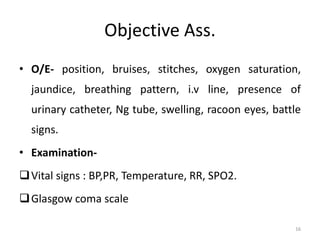
Objective Ass.
• O/E- position, bruises, stitches, oxygen saturation,
jaundice, breathing pattern, i.v line, presence of
urinary catheter, Ng tube, swelling, racoon eyes, battle
signs.
• Examination-
Vital signs : BP,PR, Temperature, RR, SPO2.
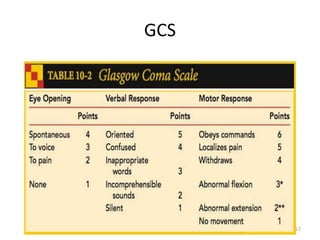
Glasgow coma scale
16
GCS
17
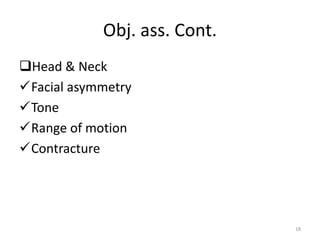
Obj. ass. Cont.
Head & Neck
Facial asymmetry
Tone
Range of motion
Contracture
18
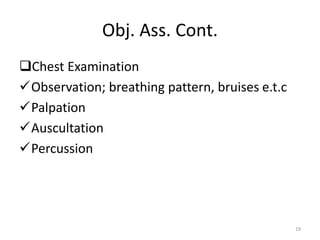
Obj. Ass. Cont.
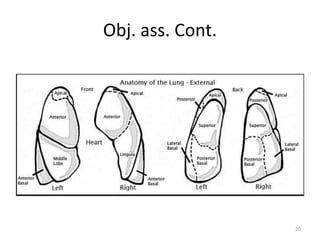
Chest Examination
Observation; breathing pattern, bruises e.t.c
Palpation
Auscultation
Percussion
19
Obj. ass. Cont.
20
Obj. ass. Cont.
Upper limbs
 Edema
 Atrophy
 Range of motion
 Spasticity
 Contracture
 reflexes
21
Obj. ass. Cont.
 Lower limbs
 Edema
 Atrophy
 Tenderness
 Range of motion
 Spasticity
 Contracture
 reflexes
22
Radiological investigation
23
Based on radiological invg.
 FOCAL
 Cerebral Contusion,
 Epidural Hematoma,
 Subdural hematoma
 Intracerebral Hemorrhage
 DIFFUSE
 Concussion
 Moderate-severe Diffuse Axonal injury
24
Focal
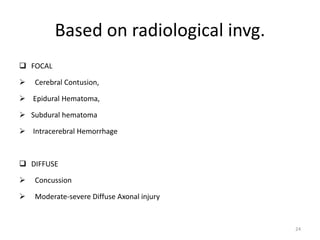
Cerebral contusion
– Blunt trauma to local
brain tissue
– Capillary bleeding into
brain tissue
– Common with blunt
head trauma
• Confusion
• Neurologic deficit
– Personality changes
– Vision changes
– Speech changes
25
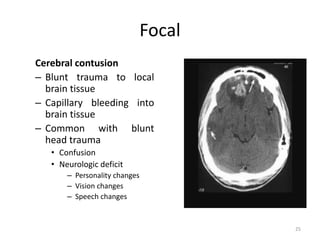
Epidural Hematoma
– Bleeding between dura mater
and skull
– Involves arteries
• Middle meningeal artery most
common
– Rapid bleeding & reduction of
oxygen to tissues
– Herniates brain toward
foramen magnum
• Associated symptoms
• Ipsilateral dilated fixed pupil, signs
of increasing ICP, unconsciousness,
contralateral paralysis, death
26
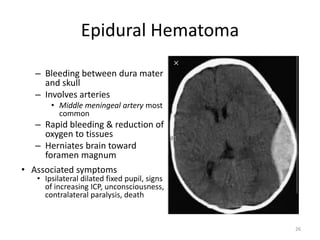
Subdural Hematoma
• Subdural Hematoma
– Bleeding within meninges
• Beneath dura mater & within
subarachnoid space
• Above pia mater
– Slow bleeding
• Superior sagital sinus
– Signs progress over several
days
• Slow deterioration of mentation
• Associated symptoms
• Headache
• Focal neurologic signs
27
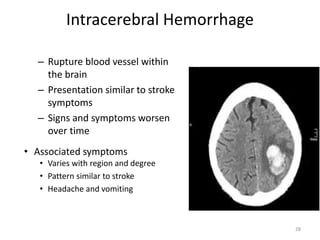
Intracerebral Hemorrhage
– Rupture blood vessel within
the brain
– Presentation similar to stroke
symptoms
– Signs and symptoms worsen
over time
• Associated symptoms
• Varies with region and degree
• Pattern similar to stroke
• Headache and vomiting
28
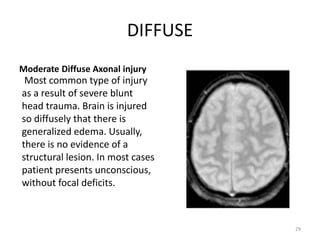
DIFFUSE
Moderate Diffuse Axonal injury
Most common type of injury
as a result of severe blunt
head trauma. Brain is injured
so diffusely that there is
generalized edema. Usually,
there is no evidence of a
structural lesion. In most cases
patient presents unconscious,
without focal deficits.
29
conclusion
 Proper assessment of patient with traumatic brain injury is
key to accurate diagnosis and subsequent management.
 High priority should be given to the prevention of traumatic
brain injury
30
Recommendation
• Subsequent presenter should Present on assessment and
management of non-traumatic brain injury .
• Subsequent presentation on management of traumatic brain
injury should be done
31
THANK YOU
32
Refrences
• Barr, R.M., Gean, A.D., Le, T.H. Craniofacial trauma. In: Brant WE, Helms CA, editors.
Fundamentals of Diagnostic Radiology. 4th ed. Philadelphia: Wolters Kluwer
Health/Lippincott Williams & Wilkins; 2012. p. 49–74.
• Dziadzko, V., Dziadzko, M.A., Gajic, O., Karnatovskaia, L. Approaching psychological
trauma of the critically ill: Patient and family perspectives. Am J Respir Crit Care Med
2016;193:A4744.
• Segun, T. D., 2019. Traumatic brain injury (TBI)- Definition, Epidemiology,
Pathophysiology. Physical Medicine and Rehabilitation.
• Regina, C. O., Richard, C. E., 2018. An epidemiologic study of traumatic head injuries in
the emergency department of a tertiary health institution. Journal of Medicine in the
Tropics.
33

Physiotherapy assessment Traumatic brain injury

  • 1.
    PHYSIOTHERAPY ASSESSMENT OFTRAUMATIC BRAIN INJURY (UNCONSCIOUS) PRESENTED BY AHMAD MUKHTAR MAGAJI (B.PT-BUK) TO THE DEPARTMENT OF MEDICAL REHABILITATION USMANU DANFODIYO UNIVERSITY TEACHING HOSPITAL SOKOTO ON JULY,2020 1
  • 2.
    SYNOPSIS  Introduction  Definitions Brief Anatomy  Epidemiology  Etiology  Pathophysiology  General Assessment  Subjective Assessment  Objective Assessment  Investigation  Recommendation  Conclusion 2
  • 3.
    Introduction • Traumatic Braininjury is any physical damage to the brain caused by external force.(Barr et. al., 2012) • Traumatic brain injuries constitute a significant portion of injury resulting from automotive collisions (john et. al., 2013) • Brain injuries not only represent a serious trauma for those involved but also place an enormous burden on society, often exacting a heavy economical, social, and emotional price. (Wong et al., 2005) 3
  • 4.
    Intro cont. • Developmentof intervention strategies to prevent or minimize these injuries requires a complete understanding of injury mechanisms, response and tolerance level (Anthony et. al., 1999) • It is worthy of note that the long-term sequelae of traumatic brain injury especially moderate to severe cases do not affect the survivor alone, but also the community they live in, as well as their families and caregivers, both psychologically and economically. (Dziadzko et. al., 2016) 4
  • 5.
    Definition • Traumatic braininjury (TBI) is a non degenerative, non congenital insult to the brain from external mechanical force possibly leading to permanent or temporary impairment of cognitive, physical, and psychosocial functions, with an associated diminished or altered level of consciousness (Segun, T. D., 2019) • Unconscious “the state of not being awake and not aware of things around you especially as the result of a head injury” 5
  • 6.
  • 7.
  • 8.
  • 9.
  • 10.
    Epidemiology According to researchcarried out in university of port harcourt by Regina, C.O. (2018) • 30.9% of patients with trauma and 3.6 % of all A&E admissions present with TBI. • 76.9% males and 23.1% females 3.3:1 • Fatality rate of 22.6% of presenting TBI cases. • Highest Rate of TBI occur in older adults 10
  • 11.
    Etiology Road traffic accident vehicle-vehicle,  vehicle-pedestrian, Domestic accident  Fall,  Assault  Sport 11
  • 12.
    Pathophysiology Accumulation of lactic acid Increased membrane permeabilityand edema formation Membrane degradation of vascular and cellular structures Necrosis Or apoptosis Tissue damage and impaired regulation of CBF 12
  • 13.
    Response to injury •Swelling of brain • Vasodilatation with increased blood volume • Increased ICP • Decreased blood flow to brain • Perfusion decreases • Cerebral ischemia (hypoxia) 13
  • 14.
    Assessment  Subjective o Chiefcomplain o History  the exact time and nature of the accident, including the direction of the blow;  First action taken  Headache, nausea, vomiting and convulsion  Loss of consciousness  Referral 14
  • 15.
    Subjective ass • PMHx-HTN,DM,RTA, previous hx of accidents, Surgery • FSHx- marital status, No of children, occupation, hobbies, social life (smoking, alcohol, kola nut, drug addiction ). • DHx- muscle relaxants, anticoagulants e.t.c 15
  • 16.
    Objective Ass. • O/E-position, bruises, stitches, oxygen saturation, jaundice, breathing pattern, i.v line, presence of urinary catheter, Ng tube, swelling, racoon eyes, battle signs. • Examination- Vital signs : BP,PR, Temperature, RR, SPO2. Glasgow coma scale 16
  • 17.
  • 18.
    Obj. ass. Cont. Head& Neck Facial asymmetry Tone Range of motion Contracture 18
  • 19.
    Obj. Ass. Cont. ChestExamination Observation; breathing pattern, bruises e.t.c Palpation Auscultation Percussion 19
  • 20.
  • 21.
    Obj. ass. Cont. Upperlimbs  Edema  Atrophy  Range of motion  Spasticity  Contracture  reflexes 21
  • 22.
    Obj. ass. Cont. Lower limbs  Edema  Atrophy  Tenderness  Range of motion  Spasticity  Contracture  reflexes 22
  • 23.
  • 24.
    Based on radiologicalinvg.  FOCAL  Cerebral Contusion,  Epidural Hematoma,  Subdural hematoma  Intracerebral Hemorrhage  DIFFUSE  Concussion  Moderate-severe Diffuse Axonal injury 24
  • 25.
    Focal Cerebral contusion – Blunttrauma to local brain tissue – Capillary bleeding into brain tissue – Common with blunt head trauma • Confusion • Neurologic deficit – Personality changes – Vision changes – Speech changes 25
  • 26.
    Epidural Hematoma – Bleedingbetween dura mater and skull – Involves arteries • Middle meningeal artery most common – Rapid bleeding & reduction of oxygen to tissues – Herniates brain toward foramen magnum • Associated symptoms • Ipsilateral dilated fixed pupil, signs of increasing ICP, unconsciousness, contralateral paralysis, death 26
  • 27.
    Subdural Hematoma • SubduralHematoma – Bleeding within meninges • Beneath dura mater & within subarachnoid space • Above pia mater – Slow bleeding • Superior sagital sinus – Signs progress over several days • Slow deterioration of mentation • Associated symptoms • Headache • Focal neurologic signs 27
  • 28.
    Intracerebral Hemorrhage – Ruptureblood vessel within the brain – Presentation similar to stroke symptoms – Signs and symptoms worsen over time • Associated symptoms • Varies with region and degree • Pattern similar to stroke • Headache and vomiting 28
  • 29.
    DIFFUSE Moderate Diffuse Axonalinjury Most common type of injury as a result of severe blunt head trauma. Brain is injured so diffusely that there is generalized edema. Usually, there is no evidence of a structural lesion. In most cases patient presents unconscious, without focal deficits. 29
  • 30.
    conclusion  Proper assessmentof patient with traumatic brain injury is key to accurate diagnosis and subsequent management.  High priority should be given to the prevention of traumatic brain injury 30
  • 31.
    Recommendation • Subsequent presentershould Present on assessment and management of non-traumatic brain injury . • Subsequent presentation on management of traumatic brain injury should be done 31
  • 32.
  • 33.
    Refrences • Barr, R.M.,Gean, A.D., Le, T.H. Craniofacial trauma. In: Brant WE, Helms CA, editors. Fundamentals of Diagnostic Radiology. 4th ed. Philadelphia: Wolters Kluwer Health/Lippincott Williams & Wilkins; 2012. p. 49–74. • Dziadzko, V., Dziadzko, M.A., Gajic, O., Karnatovskaia, L. Approaching psychological trauma of the critically ill: Patient and family perspectives. Am J Respir Crit Care Med 2016;193:A4744. • Segun, T. D., 2019. Traumatic brain injury (TBI)- Definition, Epidemiology, Pathophysiology. Physical Medicine and Rehabilitation. • Regina, C. O., Richard, C. E., 2018. An epidemiologic study of traumatic head injuries in the emergency department of a tertiary health institution. Journal of Medicine in the Tropics. 33