CURRENT STATUS OF
STROKE INTERVENTIONS
DR. SUMIT KAMBLE
SENIOR RESIDENT, NEUROLOGY
GMC, KOTA
MODERATOR -
DR. BHARAT BHUSHAN
ASSOCIATE PROFESSOR, NEUROLOGY
OVERVIEW
1. Intervention in Ischemic stroke
• Emergency
a) Intravenous Fibrinolysis
b) Endovascular Interventions
c) Decompressive Craniotomy
• Elective
a) Carotid Stenting
b) Carotid Endarterectomy
2. Intervention in acute Hemorrhagic stroke
Intravenous Fibrinolysis
Recommendations
• Intravenous rtPA (0.9 mg/kg, maximum dose 90 mg) is
recommended for selected patients who may be treated within 3
hours of onset of ischemic stroke (Class I; Level of Evidence A).
• In patients eligible for intravenous rtPA, benefit of therapy is
time dependent, and treatment should be initiated as quickly as
possible. The door-to-needle should be within 60 minutes from
hospital arrival (Class I; Level of Evidence A).
• Intravenous rtPA (0.9 mg/kg, maximum dose 90 mg) is
recommended for administration to eligible patients who can be
treated in the time period of 3 to 4.5 hours after stroke
onset (Class I; Level of Evidence B).
• Eligibility criteria for treatment in this time period are similar to
those for people treated at earlier time periods within 3 hours,
with the following additional exclusion criteria:
a. Patients >80 years old,
b. Taking oral anticoagulants regardless of INR,
c. Baseline NIHSS score >25,
d. Imaging evidence of ischemic injury involving more than one third of the
MCA territory,
e. History of both stroke and diabetes mellitus.
• Intravenous rtPA is reasonable in patients whose blood pressure
can be lowered safely (to below 185/110 mm Hg) with
antihypertensive agents, with the physician assessing the
stability of the blood pressure before starting intravenous
rtPA (Class I; Level of Evidence B).
• In patients undergoing fibrinolytic therapy, physicians should be
aware of and prepared to emergently treat potential side effects,
including bleeding complications and angioedema that may
cause partial airway obstruction (Class I; Level of Evidence B).
• Intravenous rtPA is reasonable in patients with a seizure at the
time of onset of stroke if evidence suggests that residual
impairments are secondary to stroke and not a postictal
phenomenon (Class IIa; Level of Evidence C).
• Effectiveness of sonothrombolysis for treatment of patients with
acute stroke is not well established (Class IIb; Level of
Evidence B).
• Usefulness of intravenous administration of tenecteplase,
reteplase, desmoteplase, urokinase, or other fibrinolytic agents
and the intravenous administration of ancrod or other
defibrinogenating agents is not well established, and they
should only be used in the setting of a clinical trial (Class IIb;
Level of Evidence B).
• Effectiveness of intravenous treatment with rtPA is not well
established (Class IIb; Level of Evidence C) and requires further
study for patients who can be treated in the time period of 3 to
4.5 hours after stroke but have 1 or more of the following
exclusion criteria: (1) patients >80 years old, (2) those taking
oral anticoagulants, even with INR ≤1.7, (3) those with a
baseline NIHSS score >25, or (4) those with a history of both
stroke and diabetes mellitus.
• Use of intravenous fibrinolysis in patients with conditions of
mild stroke deficits, rapidly improving stroke symptoms, major
surgery in the preceding 3 months, and recent myocardial
infarction may be considered, and potential increased risk
should be weighed against the anticipated benefits (Class IIb;
Level of Evidence C).
• Intravenous administration of streptokinase for treatment of
stroke is not recommended (Class III; Level of Evidence A).
• Use of intravenous rtPA in patients taking direct thrombin
inhibitors or direct factor Xa inhibitors may be harmful and is
not recommended unless sensitive laboratory tests such as
aPTT, INR, platelet count, and TT, or appropriate direct factor
Xa activity assays are normal, or the patient has not received a
dose of these agents for >2 days (assuming normal renal
metabolizing function). Similar consideration should be given to
patients being considered for intra-arterial rtPA (Class III; Level
of Evidence C).
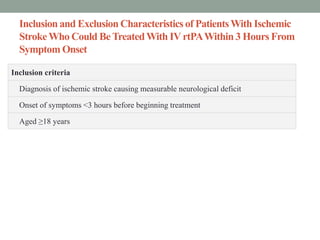
Inclusion and Exclusion Characteristics of PatientsWith Ischemic
StrokeWho Could BeTreatedWith IV rtPAWithin 3 Hours From
Symptom Onset
Inclusion criteria
Diagnosis of ischemic stroke causing measurable neurological deficit
Onset of symptoms <3 hours before beginning treatment
Aged ≥18 years
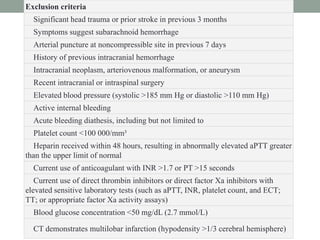
Exclusion criteria
Significant head trauma or prior stroke in previous 3 months
Symptoms suggest subarachnoid hemorrhage
Arterial puncture at noncompressible site in previous 7 days
History of previous intracranial hemorrhage
Intracranial neoplasm, arteriovenous malformation, or aneurysm
Recent intracranial or intraspinal surgery
Elevated blood pressure (systolic >185 mm Hg or diastolic >110 mm Hg)
Active internal bleeding
Acute bleeding diathesis, including but not limited to
Platelet count <100 000/mm³
Heparin received within 48 hours, resulting in abnormally elevated aPTT greater
than the upper limit of normal
Current use of anticoagulant with INR >1.7 or PT >15 seconds
Current use of direct thrombin inhibitors or direct factor Xa inhibitors with
elevated sensitive laboratory tests (such as aPTT, INR, platelet count, and ECT;
TT; or appropriate factor Xa activity assays)
Blood glucose concentration <50 mg/dL (2.7 mmol/L)
CT demonstrates multilobar infarction (hypodensity >1/3 cerebral hemisphere)
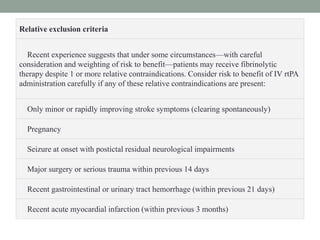
Relative exclusion criteria
Recent experience suggests that under some circumstances—with careful
consideration and weighting of risk to benefit—patients may receive fibrinolytic
therapy despite 1 or more relative contraindications. Consider risk to benefit of IV rtPA
administration carefully if any of these relative contraindications are present:
Only minor or rapidly improving stroke symptoms (clearing spontaneously)
Pregnancy
Seizure at onset with postictal residual neurological impairments
Major surgery or serious trauma within previous 14 days
Recent gastrointestinal or urinary tract hemorrhage (within previous 21 days)
Recent acute myocardial infarction (within previous 3 months)
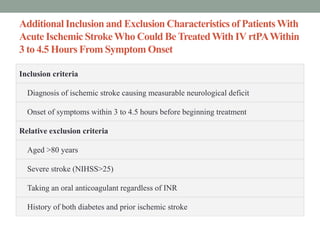
Additional Inclusion and Exclusion Characteristics of PatientsWith
Acute Ischemic StrokeWho Could Be TreatedWith IV rtPAWithin
3 to 4.5 Hours From Symptom Onset
Inclusion criteria
Diagnosis of ischemic stroke causing measurable neurological deficit
Onset of symptoms within 3 to 4.5 hours before beginning treatment
Relative exclusion criteria
Aged >80 years
Severe stroke (NIHSS>25)
Taking an oral anticoagulant regardless of INR
History of both diabetes and prior ischemic stroke
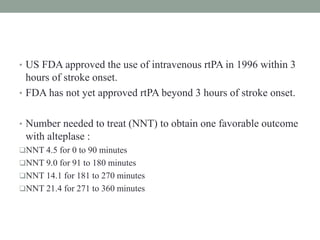
• US FDA approved the use of intravenous rtPA in 1996 within 3
hours of stroke onset.
• FDA has not yet approved rtPA beyond 3 hours of stroke onset.
• Number needed to treat (NNT) to obtain one favorable outcome
with alteplase :
NNT 4.5 for 0 to 90 minutes
NNT 9.0 for 91 to 180 minutes
NNT 14.1 for 181 to 270 minutes
NNT 21.4 for 271 to 360 minutes
•
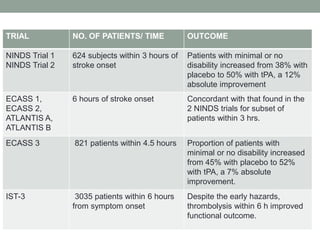
TRIAL NO. OF PATIENTS/ TIME OUTCOME
NINDS Trial 1
NINDS Trial 2
624 subjects within 3 hours of
stroke onset
Patients with minimal or no
disability increased from 38% with
placebo to 50% with tPA, a 12%
absolute improvement
ECASS 1,
ECASS 2,
ATLANTIS A,
ATLANTIS B
6 hours of stroke onset Concordant with that found in the
2 NINDS trials for subset of
patients within 3 hrs.
ECASS 3 821 patients within 4.5 hours Proportion of patients with
minimal or no disability increased
from 45% with placebo to 52%
with tPA, a 7% absolute
improvement.
IST-3 3035 patients within 6 hours
from symptom onset
Despite the early hazards,
thrombolysis within 6 h improved
functional outcome.
Other FibrinolyticAgents
Streptokinase -
• Clinical trials of streptokinase were halted prematurely because
of unacceptably high rates of hemorrhage
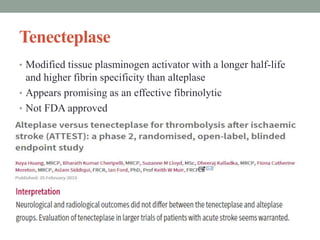
Tenecteplase
• Modified tissue plasminogen activator with a longer half-life
and higher fibrin specificity than alteplase
• Appears promising as an effective fibrinolytic
• Not FDA approved
Desmoteplase
• Fibrinolytic agent isolated from vampire bat saliva. Two phase
II trials of desmoteplase provided encouraging safety and
potential efficacy data in penumbral imaging–selected patients 9
hours after stroke onset.
• Phase III studies are ongoing.
Transcranial Ultrasound FibrinolysisAugmentation
• Ultrasound can be delivered to an acute cerebral arterial
occlusion in several ways, including
(1) by a sonographic operator actively positioning a diagnostic
Doppler or B-mode/color flow duplex imaging probe
(2) by unfocused, low-frequency ultrasound that sonicates both
the vessels and brain without imaging guidance
(3) intra-arterial or intraclot delivery via catheter
CLOTBUST trial -
• 83% of patients achieved any recanalization (46% complete,
27% partial) with intravenous rtPA and TCD versus 50% (17%
complete, 33% partial) with intravenous rtPA alone within 2
hours of treatment (P=0.001). The sICH rate was 3.8% in both
groups.
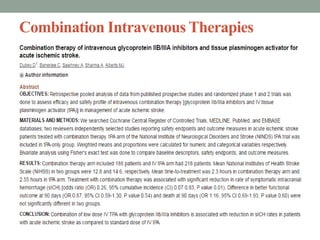
Combination Intravenous Therapies
Acute Endovascular Interventions
Recommendations
• Patients eligible for intravenous rtPA should receive intravenous
rtPA even if intra-arterial treatments are being considered (Class
I; Level of Evidence A).
• Intra-arterial fibrinolysis is beneficial for treatment of carefully
selected patients with major ischemic strokes of <6 hours’
duration caused by occlusions of the MCA who are not
otherwise candidates for intravenous rtPA (Class I; Level of
Evidence B).
• As with intravenous fibrinolytic therapy, reduced time from
symptom onset to reperfusion with intra-arterial therapies is
highly correlated with better clinical outcomes, and all efforts
must be undertaken to minimize delays to definitive
therapy (Class I; Level of Evidence B).
• Intra-arterial treatment requires the patient to be at an
experienced stroke center with rapid access to cerebral
angiography and qualified interventionalists. An emphasis on
expeditious assessment and treatment should be made. Facilities
are encouraged to define criteria that can be used to credential
individuals who can perform intra-arterial revascularization
procedures. Outcomes on all patients should be tracked (Class
I; Level of Evidence C).
• When mechanical thrombectomy is pursued, stent retrievers
such as Solitaire FR and Trevo are generally preferred to coil
retrievers such as Merci (Class I; Level of Evidence A). The
relative effectiveness of the Penumbra System versus stent
retrievers is not yet characterized.
• The Merci, Penumbra System, Solitaire FR, and Trevo
thrombectomy devices can be useful in achieving recanalization
alone or in combination with pharmacological fibrinolysis in
carefully selected patients (Class IIa; Level of Evidence B).
• Intra-arterial fibrinolysis or mechanical thrombectomy is
reasonable in patients who have contraindications to the use of
intravenous fibrinolysis (Class IIa; Level of Evidence C).
• Rescue intra-arterial fibrinolysis or mechanical thrombectomy
may be reasonable approaches to recanalization in patients with
large-artery occlusion who have not responded to intravenous
fibrinolysis. Additional randomized trial data are needed (Class
IIb; Level of Evidence B).
• Usefulness of mechanical thrombectomy devices other than the
Merci retriever, the Penumbra System, Solitaire FR, and Trevo
is not well established (Class IIb; Level of Evidence C).
• Usefulness of emergent intracranial angioplasty and/or stenting
is not well established. These procedures should be used in the
setting of clinical trials (Class IIb; Level of Evidence C).
• Usefulness of emergent angioplasty and/or stenting of the
extracranial carotid or vertebral arteries in unselected patients is
not well established (Class IIb; Level of Evidence C). Use of
these techniques may be considered in certain circumstances,
such as in the treatment of acute ischemic stroke resulting from
cervical atherosclerosis or dissection (Class IIb; Level of
Evidence C).
Intra-arterial Fibrinolysis
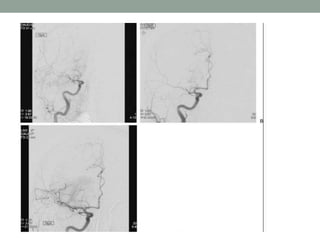
PROACT II –
• To test the effectiveness of intra-arterial fibrinolysis using r-
pro-UK to treat MCA (M1 or M2) occlusions within 6 hours of
stroke symptom onset.
• 40% of the 121 patients treated with r-pro-UK and 25% of the
59 control patients had an mRS score of 0 to 2 at 90 days
(P=0.04). MCA recanalization was achieved in 66% of the r-
pro-UK arm and 18% of the control group (P=0.001). sICH
occurred in 10% of patients treated with r-pro-UK and in 2% of
the control group (P=0.06).
• Use of intra-arterial fibrinolysis for occlusions in additional
locations, such as the basilar artery and intracranial carotid
artery, is based primarily on consensus and case series.
• Meta-analysis of multiple case series comparing intravenous
with intra-arterial fibrinolysis for acute vertebrobasilar stroke in
422 patients showed marginally better recanalization rates with
intra-arterial therapy (65% versus 53%; P=0.5), good
neurological outcomes in 22% to 24% of patients, but no clear
difference in efficacy between the 2 modalities
• Results of PROACT-II were considered insufficient to grant
FDA approval
• Intra-arterial fibrinolysis is a consideration for patients
ineligible for intravenous rtPA
a. Treatment within 4.5 to 6 hours;
b. Recent history of a major surgical procedure
Mechanical Clot Disruption/Extraction
• Primary reperfusion strategy and in conjunction with
pharmacological fibrinolysis for achieving recanalization in
patients with acute ischemic stroke.
• Patients who are ineligible for treatment with IV-rtPA or who
fail IV-rtPA therapy are candidates for treatment.
• Currently 4 devices cleared by the FDA for recanalization of
arterial occlusion in patients with ischemic stroke.
a. Merci Retrieval System
b. Penumbra System
c. Solitaire Flow Restoration Device
d. Trevo Retriever
• Mechanical Embolus Removal in Cerebral Ischemia (MERCI)
trial - designed to test the safety and efficacy of the Merci clot
retrieval device to restore the patency of intracranial arteries
within the first 8 hours of an acute stroke in 141 patients.
• Recanalization was significantly higher (48% vs 18%)
• Multi-MERCI trial
• Pivotal Penumbra trial
• SWIFT study
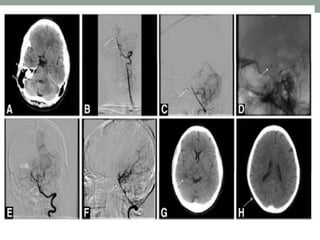
AcuteAngioplasty and Stenting
Intracranial Acute Angioplasty and Stenting
• Urgent angioplasty with adjunctive stent deployment is being
used to restore antegrade flow, with or without fibrinolysis or
clot extraction.
• Current data, which are limited to case series, suggest high
(80%–90%) recanalization rates and reasonable safety
Stent-Assisted Recanalization in Acute Ischemic Stroke
(SARIS) study
• 20 patients ineligible for or not responsive to intravenous rtPA,
partial or complete recanalization was achieved in all patients.
Extracranial Acute Angioplasty and Stenting
• Predominantly performed for stroke prevention rather than
acute stroke treatment.
• Used on an emergency basis in the setting of acute stroke for 2
situations in particular:
• A. Primary cause of the stroke is attenuation or cessation of
flow in the extracranial carotid or vertebral artery
• B. When catheter access to a culprit intracranial thrombus is
impeded by severe stenosis of the extracranial carotid.
• No completed prospective, randomized controlled trials
demonstrating relative efficacy and safety
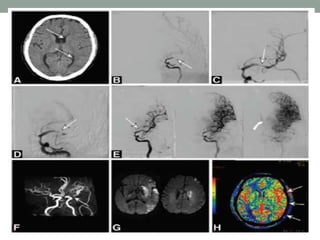
• Nedeltchev et al described angioplasty and stenting of the
internal carotid artery in conjunction with intra-arterial
fibrinolysis in 25 patients who had acute carotid artery
occlusion that caused MCA territory ischemic stroke and
compared them with a group of 31 medically treated patients.
Favorable outcomes were more frequent (56% versus 26%)
Decompressive craniectomy in Ischemic Stroke
• 1. In patients <60 years of age with unilateral MCA infarctions
that deteriorate neurologically within 48 hours despite medical
therapy, decompressive craniectomy with dural expansion is
effective. The effect of later decompression is not known, but it
should be strongly considered (Class I; Level of Evidence B).
• 2. Although the optimal trigger for decompressive craniectomy
is unknown, it is reasonable to use a decrease in level of
consciousness and its attribution to brain swelling as selection
criteria (Class IIa; Level of Evidence A).
• 3. Efficacy of decompressive craniectomy in patients >60 years
of age and the optimal timing of surgery are uncertain (Class
IIb; Level of Evidence C).
• 4. Suboccipital craniectomy with dural expansion should be
performed in patients with cerebellar infarctions who deteriorate
neurologically despite maximal medical therapy (Class I; Level
of Evidence B).
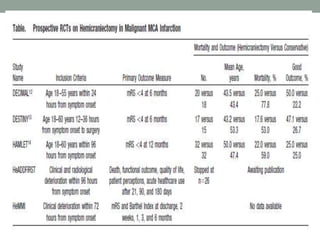
• Three prospective, randomized trials studied patients with
supratentorial infarctions treated with decompressive
craniectomy, usually within 48 hours of stroke onset.
1. Decompressive Surgery for the Treatment of Malignant
Infarction of the Middle Cerebral Artery [DESTINY],
2. Decompressive Craniectomy in Malignant Middle Cerebral
Artery Infarction [DECIMAL], and
3. Hemicraniectomy After Middle Cerebral Artery Infarction
With Life-threatening Edema Trial [HAMLET])
• Showed reduced mortality with hemicraniectomy compared
with medical management (22% versus 71% mortality, pooled
analysis) in patients <60 years of age.
• No individual study showed an improvement in percentage of
survivors with good outcomes (mRS score, 0–3), although this
improvement (43% versus 21%) was noted in a pooled analysis.
Older patients would experience a similar effect ?
• Randomized study of 47 patients included patients 18 to 80
years of age, with 18 patients 61 to 70 years and 11 patients 71
to 80 years of age.
• Significant benefit of surgery was found in this small subset of
patients >60 years of age (1-year mortality reduced from 69.6%
to 16.7%) and on poor outcome (1-year mRS score >4 reduced
from 100% to 37.5%).
• DESTINY 2 - include patients 62 to 82 years of age.
Surgical Treatment of ICH
Recommendations
• 1. Patients with cerebellar hemorrhage who are deteriorating
neurologically or who have brainstem compression and/or
hydrocephalus from ventricular obstruction should undergo
surgical removal of the hemorrhage as soon as possible (Class I;
Level of Evidence B).
• Initial treatment of these patients with ventricular drainage
rather than surgical evacuation is not recommended (Class III;
Level of Evidence C).
• 2. For most patients with supratentorial ICH, usefulness of
surgery is not well established (Class IIb; Level of Evidence A).
Specific exceptions are outlined below.
• 3. Policy of early hematoma evacuation is not clearly beneficial
compared with hematoma evacuation when patients deteriorate
(Class IIb; Level of Evidence A).
• 4. Supratentorial hematoma evacuation in deteriorating patients
might be considered as a life-saving measure (Class IIb; Level
of Evidence C).
• For patients presenting with lobar clots >30 mL and within 1 cm
of the surface, evacuation of supratentorial ICH by standard
craniotomy might be consideration (Class IIb; Level of
Evidence: B).
• 5. DC with or without hematoma evacuation might reduce
mortality for patients with supratentorial ICH who are in a
coma, have large hematomas with significant midline shift, or
have elevated ICP refractory to medical management (Class IIb;
Level of Evidence C).
• 6. Effectiveness of minimally invasive clot evacuation with
stereotactic or endoscopic aspiration with or without
thrombolytic usage is uncertain (Class IIb; Level of Evidence
B).
Intraventricular Hemorrhage
• IVH in association with ICH increased the risk of death from
20% without to 51% with IVH.
• 1. Although intraventricular administration of rtPA in IVH
appears to have a fairly low complication rate, efficacy and
safety of this treatment are uncertain (Class IIb; Level of
Evidence B).
• 2. Efficacy of endoscopic treatment of IVH is uncertain (Class
IIb; Level of Evidence B).
• Largest trial of intraventricular fibrinolysis - CLEAR-IVH trial
• Patients treated with rtPA had significantly lower intracranial
pressures, fewer VC obstructions that required replacement, and
nonsignificantly shorter duration of VC requirement.
• Symptomatic rebleeding in 9 rtPA patients - (12%)
• Median 30-day modified Rankin scale score was 5 in both
groups, and mortality was 19%, with no significant difference
between placebo and rtPA.
• Phase 3 randomized CLEAR III trial.
Craniotomy for Supratentorial Hemorrhage
STICH trial-
• 1033 patients were randomized to early surgery (<24 hours of
randomization) or initial conservative treatment.
• No overall statistically significant difference in mortality or
functional outcome between treatment groups.
• Subgroup analysis suggested that patients with lobar
hemorrhages within 1 cm of the cortical surface might benefit
from surgery.
STICH II trial
• Early surgery would be beneficial for conscious patients with
superficial lobar hemorrhage of 10 to 100 mm3 within 1 cm of
cortical surface and without IVH and who were admitted within
48 hours of ictus.
• Forty-one percent of patients in the early surgery group had a
favorable outcome compared with 38% in the medical arm;
• Difference was not statistically significant.
Craniotomy for Posterior Fossa
Hemorrhage
• Because of the narrow confines of the posterior fossa,
deterioration can occur quickly in cerebellar hemorrhage caused
by obstructive hydrocephalus or local mass effect on the
brainstem.
• Several nonrandomized studies have suggested that patients
with cerebellar hemorrhages >3 cm in diameter or patients in
whom cerebellar hemorrhage is associated with brainstem
compression or hydrocephalus have better outcomes with
surgical decompression.
Minimally Invasive Surgical Evacuation of
ICH
• Randomized study of 465 patients compared needle aspiration
of basal ganglia hemorrhages (25–40 mm3) to medical
management alone.
• Although there was no significant impact on mortality, 3-month
neurological outcome was better in the aspiration group.
• Minimally Invasive Surgery Plus Recombinant Tissue-Type
Plasminogen Activator for ICH Evacuation Trial II (MISTIE II)
aimed to determine the safety of minimally invasive surgery
plus rtPA in the setting of ICH.
• Demonstrated a significant reduction in perihematomal edema
in the hematoma evacuation group with a trend toward
improved outcomes.

• A randomized phase 3 clinical trial of minimally invasive
hematoma evacuation (MISTIE III) is currently in progress.
Preventive Endovascular Stroke Treatment
Asymptomatic Carotid Stenosis
• 1. Patients with asymptomatic carotid stenosis should be
prescribed daily aspirin and a statin. Patients should also be
screened for other treatable risk factors for stroke, and
appropriate medical therapies and lifestyle changes should be
instituted (Class I; Level of Evidence C).
• 2. In patients who are to undergo CEA, aspirin is recommended
perioperatively and postoperatively unless contraindicated
(Class I; Level of Evidence C).
• 3. It is reasonable to consider performing CEA in asymptomatic
patients who have >70% stenosis of internal carotid artery if
risk of perioperative stroke, MI, and death is low (<3%).
However, its effectiveness compared with contemporary best
medical management alone is not well established (Class IIa;
Level of Evidence A).
• 4. It is reasonable to repeat duplex ultrasonography annually by
a qualified technologist in a certified laboratory to assess the
progression or regression of disease and response to therapeutic
interventions in patients with atherosclerotic stenosis >50%
(Class IIa; Level of Evidence C)
• 5. Prophylactic CAS might be considered in highly selected
patients with asymptomatic carotid stenosis (minimum, 60% by
angiography, 70% by validated Doppler ultrasound), but its
effectiveness compared with medical therapy alone in this
situation is not well established (Class IIb; Level of Evidence
B)
• 6. In asymptomatic patients at high risk of complications for
carotid revascularization by either CEA or CAS, the
effectiveness of revascularization versus medical therapy alone
is not well established (Class IIb; Level of Evidence B).
• 7. Screening low-risk populations for asymptomatic carotid
artery stenosis is not recommended (Class III; Level of
Evidence C).
Symptomatic Carotid Stenosis:
Recommendations
• 1. For patients with a TIA or ischemic stroke within the past 6
months and ipsilateral severe (70%–99%) carotid artery stenosis
as documented by noninvasive imaging, CEA is recommended
if the perioperative morbidity and mortality risk is estimated to
be <6% (Class I; Level of Evidence A).
• 2. For patients with recent TIA or ischemic stroke and ipsilateral
moderate (50%–69%) carotid stenosis as documented by
catheter-based imaging or noninvasive imaging with
corroboration (eg, magnetic resonance angiogram or computed
tomography angiogram), CEA is recommended depending on
patient-specific factors, such as age, sex, and comorbidities, if
the perioperative morbidity and mortality risk is estimated to be
<6%(Class I; Level of Evidence B)
• 3. When the degree of stenosis is < 50%, CEA and CAS are not
recommended (Class III; Level of Evidence A).
• 4. When revascularization is indicated for patients with TIA or
minor, nondisabling stroke, it is reasonable to perform the
procedure within 2 weeks of the index event rather than delay
surgery if there are no contraindications to early
revascularization (Class IIa; Level of Evidence B).
• 5. CAS is indicated as an alternative to CEA for symptomatic
patients at average or low risk of complications associated with
endovascular intervention when the diameter of the lumen of
the ICA is reduced by >70% by noninvasive imaging or >50%
by catheter-based imaging or noninvasive imaging with
corroboration and the anticipated rate of periprocedural stroke
or death is < 6% (Class IIa; Level of Evidence B).
• 6. It is reasonable to consider patient age in choosing between
CAS and CEA. For older patients (ie, older than ≈70 years),
CEA may be associated with improved outcome compared with
CAS, particularly when arterial anatomy is unfavorable for
endovascular intervention. For younger patients, CAS is
equivalent to CEA in terms of risk for periprocedural
complications (ie, stroke, MI, or death) and long-term risk for
ipsilateral stroke (Class IIa; Level of Evidence B).
• 7. Among patients with symptomatic severe stenosis (>70%) in
whom anatomic or medical conditions are present that greatly
increase the risk for surgery or when other specific
circumstances exist such as radiation-induced stenosis or
restenosis after CEA, CAS is reasonable (Class IIa; Level of
Evidence B).
• 8. CAS and CEA in the above settings should be performed by
operators with established periprocedural stroke and mortality
rates of < 6% for symptomatic patients, similar to that observed
in trials comparing CEA to medical therapy and more recent
observational studies (Class I; Level of Evidence B).
• 9. Routine, long-term follow-up imaging of the extracranial
carotid circulation with carotid duplex ultrasonography is not
recommended (Class III; Level of Evidence B). (New
recommendation)
• 10. For patients with a recent (within 6 months) TIA or ischemic
stroke ipsilateral to a stenosis or occlusion of the middle
cerebral or carotid artery, EC/ IC bypass surgery is not
recommended (Class III; Level of Evidence A).
• 11. For patients with recurrent or progressive ischemic
symptoms ipsilateral to a stenosis or occlusion of a distal
(surgically inaccessible) carotid artery, or occlusion of a
midcervical carotid artery after institution of optimal medical
therapy, the usefulness of EC/IC bypass is considered
investigational (Class IIb; Level of Evidence C).
• 12. Optimal medical therapy, which should include antiplatelet
therapy, statin therapy, and risk factor modification, is
recommended for all patients with carotid artery stenosis and a
TIA or stroke, as outlined elsewhere in this guideline (Class I;
Level of Evidence A).
THANKYOU
REFERENCES
• Guidelines for the Management of Spontaneous Intracerebral
Hemorrhage 2015
• Recommendations for the Management of Cerebral and
Cerebellar Infarction With Swelling 2014
• AHA/ASA Guidelines for the Early Management of Patients
With Acute Ischemic Stroke 2013
• Thrombolytic Therapy in Stroke Nov 2016 Medscape
• Uptodate.com

Current status of stroke intervention

  • 1.
    CURRENT STATUS OF STROKEINTERVENTIONS DR. SUMIT KAMBLE SENIOR RESIDENT, NEUROLOGY GMC, KOTA MODERATOR - DR. BHARAT BHUSHAN ASSOCIATE PROFESSOR, NEUROLOGY
  • 2.
    OVERVIEW 1. Intervention inIschemic stroke • Emergency a) Intravenous Fibrinolysis b) Endovascular Interventions c) Decompressive Craniotomy • Elective a) Carotid Stenting b) Carotid Endarterectomy 2. Intervention in acute Hemorrhagic stroke
  • 3.
    Intravenous Fibrinolysis Recommendations • IntravenousrtPA (0.9 mg/kg, maximum dose 90 mg) is recommended for selected patients who may be treated within 3 hours of onset of ischemic stroke (Class I; Level of Evidence A). • In patients eligible for intravenous rtPA, benefit of therapy is time dependent, and treatment should be initiated as quickly as possible. The door-to-needle should be within 60 minutes from hospital arrival (Class I; Level of Evidence A).
  • 4.
    • Intravenous rtPA(0.9 mg/kg, maximum dose 90 mg) is recommended for administration to eligible patients who can be treated in the time period of 3 to 4.5 hours after stroke onset (Class I; Level of Evidence B). • Eligibility criteria for treatment in this time period are similar to those for people treated at earlier time periods within 3 hours, with the following additional exclusion criteria: a. Patients >80 years old, b. Taking oral anticoagulants regardless of INR, c. Baseline NIHSS score >25, d. Imaging evidence of ischemic injury involving more than one third of the MCA territory, e. History of both stroke and diabetes mellitus.
  • 5.
    • Intravenous rtPAis reasonable in patients whose blood pressure can be lowered safely (to below 185/110 mm Hg) with antihypertensive agents, with the physician assessing the stability of the blood pressure before starting intravenous rtPA (Class I; Level of Evidence B). • In patients undergoing fibrinolytic therapy, physicians should be aware of and prepared to emergently treat potential side effects, including bleeding complications and angioedema that may cause partial airway obstruction (Class I; Level of Evidence B).
  • 6.
    • Intravenous rtPAis reasonable in patients with a seizure at the time of onset of stroke if evidence suggests that residual impairments are secondary to stroke and not a postictal phenomenon (Class IIa; Level of Evidence C). • Effectiveness of sonothrombolysis for treatment of patients with acute stroke is not well established (Class IIb; Level of Evidence B).
  • 7.
    • Usefulness ofintravenous administration of tenecteplase, reteplase, desmoteplase, urokinase, or other fibrinolytic agents and the intravenous administration of ancrod or other defibrinogenating agents is not well established, and they should only be used in the setting of a clinical trial (Class IIb; Level of Evidence B).
  • 8.
    • Effectiveness ofintravenous treatment with rtPA is not well established (Class IIb; Level of Evidence C) and requires further study for patients who can be treated in the time period of 3 to 4.5 hours after stroke but have 1 or more of the following exclusion criteria: (1) patients >80 years old, (2) those taking oral anticoagulants, even with INR ≤1.7, (3) those with a baseline NIHSS score >25, or (4) those with a history of both stroke and diabetes mellitus.
  • 9.
    • Use ofintravenous fibrinolysis in patients with conditions of mild stroke deficits, rapidly improving stroke symptoms, major surgery in the preceding 3 months, and recent myocardial infarction may be considered, and potential increased risk should be weighed against the anticipated benefits (Class IIb; Level of Evidence C). • Intravenous administration of streptokinase for treatment of stroke is not recommended (Class III; Level of Evidence A).
  • 10.
    • Use ofintravenous rtPA in patients taking direct thrombin inhibitors or direct factor Xa inhibitors may be harmful and is not recommended unless sensitive laboratory tests such as aPTT, INR, platelet count, and TT, or appropriate direct factor Xa activity assays are normal, or the patient has not received a dose of these agents for >2 days (assuming normal renal metabolizing function). Similar consideration should be given to patients being considered for intra-arterial rtPA (Class III; Level of Evidence C).
  • 11.
    Inclusion and ExclusionCharacteristics of PatientsWith Ischemic StrokeWho Could BeTreatedWith IV rtPAWithin 3 Hours From Symptom Onset Inclusion criteria Diagnosis of ischemic stroke causing measurable neurological deficit Onset of symptoms <3 hours before beginning treatment Aged ≥18 years
  • 12.
    Exclusion criteria Significant headtrauma or prior stroke in previous 3 months Symptoms suggest subarachnoid hemorrhage Arterial puncture at noncompressible site in previous 7 days History of previous intracranial hemorrhage Intracranial neoplasm, arteriovenous malformation, or aneurysm Recent intracranial or intraspinal surgery Elevated blood pressure (systolic >185 mm Hg or diastolic >110 mm Hg) Active internal bleeding Acute bleeding diathesis, including but not limited to Platelet count <100 000/mm³ Heparin received within 48 hours, resulting in abnormally elevated aPTT greater than the upper limit of normal Current use of anticoagulant with INR >1.7 or PT >15 seconds Current use of direct thrombin inhibitors or direct factor Xa inhibitors with elevated sensitive laboratory tests (such as aPTT, INR, platelet count, and ECT; TT; or appropriate factor Xa activity assays) Blood glucose concentration <50 mg/dL (2.7 mmol/L) CT demonstrates multilobar infarction (hypodensity >1/3 cerebral hemisphere)
  • 13.
    Relative exclusion criteria Recentexperience suggests that under some circumstances—with careful consideration and weighting of risk to benefit—patients may receive fibrinolytic therapy despite 1 or more relative contraindications. Consider risk to benefit of IV rtPA administration carefully if any of these relative contraindications are present: Only minor or rapidly improving stroke symptoms (clearing spontaneously) Pregnancy Seizure at onset with postictal residual neurological impairments Major surgery or serious trauma within previous 14 days Recent gastrointestinal or urinary tract hemorrhage (within previous 21 days) Recent acute myocardial infarction (within previous 3 months)
  • 14.
    Additional Inclusion andExclusion Characteristics of PatientsWith Acute Ischemic StrokeWho Could Be TreatedWith IV rtPAWithin 3 to 4.5 Hours From Symptom Onset Inclusion criteria Diagnosis of ischemic stroke causing measurable neurological deficit Onset of symptoms within 3 to 4.5 hours before beginning treatment Relative exclusion criteria Aged >80 years Severe stroke (NIHSS>25) Taking an oral anticoagulant regardless of INR History of both diabetes and prior ischemic stroke
  • 15.
    • US FDAapproved the use of intravenous rtPA in 1996 within 3 hours of stroke onset. • FDA has not yet approved rtPA beyond 3 hours of stroke onset. • Number needed to treat (NNT) to obtain one favorable outcome with alteplase : NNT 4.5 for 0 to 90 minutes NNT 9.0 for 91 to 180 minutes NNT 14.1 for 181 to 270 minutes NNT 21.4 for 271 to 360 minutes
  • 16.
    • TRIAL NO. OFPATIENTS/ TIME OUTCOME NINDS Trial 1 NINDS Trial 2 624 subjects within 3 hours of stroke onset Patients with minimal or no disability increased from 38% with placebo to 50% with tPA, a 12% absolute improvement ECASS 1, ECASS 2, ATLANTIS A, ATLANTIS B 6 hours of stroke onset Concordant with that found in the 2 NINDS trials for subset of patients within 3 hrs. ECASS 3 821 patients within 4.5 hours Proportion of patients with minimal or no disability increased from 45% with placebo to 52% with tPA, a 7% absolute improvement. IST-3 3035 patients within 6 hours from symptom onset Despite the early hazards, thrombolysis within 6 h improved functional outcome.
  • 17.
    Other FibrinolyticAgents Streptokinase - •Clinical trials of streptokinase were halted prematurely because of unacceptably high rates of hemorrhage
  • 18.
    Tenecteplase • Modified tissueplasminogen activator with a longer half-life and higher fibrin specificity than alteplase • Appears promising as an effective fibrinolytic • Not FDA approved
  • 20.
    Desmoteplase • Fibrinolytic agentisolated from vampire bat saliva. Two phase II trials of desmoteplase provided encouraging safety and potential efficacy data in penumbral imaging–selected patients 9 hours after stroke onset. • Phase III studies are ongoing.
  • 21.
    Transcranial Ultrasound FibrinolysisAugmentation •Ultrasound can be delivered to an acute cerebral arterial occlusion in several ways, including (1) by a sonographic operator actively positioning a diagnostic Doppler or B-mode/color flow duplex imaging probe (2) by unfocused, low-frequency ultrasound that sonicates both the vessels and brain without imaging guidance (3) intra-arterial or intraclot delivery via catheter
  • 22.
    CLOTBUST trial - •83% of patients achieved any recanalization (46% complete, 27% partial) with intravenous rtPA and TCD versus 50% (17% complete, 33% partial) with intravenous rtPA alone within 2 hours of treatment (P=0.001). The sICH rate was 3.8% in both groups.
  • 23.
  • 24.
    Acute Endovascular Interventions Recommendations •Patients eligible for intravenous rtPA should receive intravenous rtPA even if intra-arterial treatments are being considered (Class I; Level of Evidence A). • Intra-arterial fibrinolysis is beneficial for treatment of carefully selected patients with major ischemic strokes of <6 hours’ duration caused by occlusions of the MCA who are not otherwise candidates for intravenous rtPA (Class I; Level of Evidence B).
  • 25.
    • As withintravenous fibrinolytic therapy, reduced time from symptom onset to reperfusion with intra-arterial therapies is highly correlated with better clinical outcomes, and all efforts must be undertaken to minimize delays to definitive therapy (Class I; Level of Evidence B). • Intra-arterial treatment requires the patient to be at an experienced stroke center with rapid access to cerebral angiography and qualified interventionalists. An emphasis on expeditious assessment and treatment should be made. Facilities are encouraged to define criteria that can be used to credential individuals who can perform intra-arterial revascularization procedures. Outcomes on all patients should be tracked (Class I; Level of Evidence C).
  • 26.
    • When mechanicalthrombectomy is pursued, stent retrievers such as Solitaire FR and Trevo are generally preferred to coil retrievers such as Merci (Class I; Level of Evidence A). The relative effectiveness of the Penumbra System versus stent retrievers is not yet characterized. • The Merci, Penumbra System, Solitaire FR, and Trevo thrombectomy devices can be useful in achieving recanalization alone or in combination with pharmacological fibrinolysis in carefully selected patients (Class IIa; Level of Evidence B).
  • 27.
    • Intra-arterial fibrinolysisor mechanical thrombectomy is reasonable in patients who have contraindications to the use of intravenous fibrinolysis (Class IIa; Level of Evidence C). • Rescue intra-arterial fibrinolysis or mechanical thrombectomy may be reasonable approaches to recanalization in patients with large-artery occlusion who have not responded to intravenous fibrinolysis. Additional randomized trial data are needed (Class IIb; Level of Evidence B).
  • 28.
    • Usefulness ofmechanical thrombectomy devices other than the Merci retriever, the Penumbra System, Solitaire FR, and Trevo is not well established (Class IIb; Level of Evidence C). • Usefulness of emergent intracranial angioplasty and/or stenting is not well established. These procedures should be used in the setting of clinical trials (Class IIb; Level of Evidence C).
  • 29.
    • Usefulness ofemergent angioplasty and/or stenting of the extracranial carotid or vertebral arteries in unselected patients is not well established (Class IIb; Level of Evidence C). Use of these techniques may be considered in certain circumstances, such as in the treatment of acute ischemic stroke resulting from cervical atherosclerosis or dissection (Class IIb; Level of Evidence C).
  • 30.
    Intra-arterial Fibrinolysis PROACT II– • To test the effectiveness of intra-arterial fibrinolysis using r- pro-UK to treat MCA (M1 or M2) occlusions within 6 hours of stroke symptom onset. • 40% of the 121 patients treated with r-pro-UK and 25% of the 59 control patients had an mRS score of 0 to 2 at 90 days (P=0.04). MCA recanalization was achieved in 66% of the r- pro-UK arm and 18% of the control group (P=0.001). sICH occurred in 10% of patients treated with r-pro-UK and in 2% of the control group (P=0.06).
  • 31.
    • Use ofintra-arterial fibrinolysis for occlusions in additional locations, such as the basilar artery and intracranial carotid artery, is based primarily on consensus and case series. • Meta-analysis of multiple case series comparing intravenous with intra-arterial fibrinolysis for acute vertebrobasilar stroke in 422 patients showed marginally better recanalization rates with intra-arterial therapy (65% versus 53%; P=0.5), good neurological outcomes in 22% to 24% of patients, but no clear difference in efficacy between the 2 modalities
  • 32.
    • Results ofPROACT-II were considered insufficient to grant FDA approval • Intra-arterial fibrinolysis is a consideration for patients ineligible for intravenous rtPA a. Treatment within 4.5 to 6 hours; b. Recent history of a major surgical procedure
  • 34.
    Mechanical Clot Disruption/Extraction •Primary reperfusion strategy and in conjunction with pharmacological fibrinolysis for achieving recanalization in patients with acute ischemic stroke. • Patients who are ineligible for treatment with IV-rtPA or who fail IV-rtPA therapy are candidates for treatment. • Currently 4 devices cleared by the FDA for recanalization of arterial occlusion in patients with ischemic stroke. a. Merci Retrieval System b. Penumbra System c. Solitaire Flow Restoration Device d. Trevo Retriever
  • 35.
    • Mechanical EmbolusRemoval in Cerebral Ischemia (MERCI) trial - designed to test the safety and efficacy of the Merci clot retrieval device to restore the patency of intracranial arteries within the first 8 hours of an acute stroke in 141 patients. • Recanalization was significantly higher (48% vs 18%) • Multi-MERCI trial • Pivotal Penumbra trial • SWIFT study
  • 38.
    AcuteAngioplasty and Stenting IntracranialAcute Angioplasty and Stenting • Urgent angioplasty with adjunctive stent deployment is being used to restore antegrade flow, with or without fibrinolysis or clot extraction. • Current data, which are limited to case series, suggest high (80%–90%) recanalization rates and reasonable safety Stent-Assisted Recanalization in Acute Ischemic Stroke (SARIS) study • 20 patients ineligible for or not responsive to intravenous rtPA, partial or complete recanalization was achieved in all patients.
  • 39.
    Extracranial Acute Angioplastyand Stenting • Predominantly performed for stroke prevention rather than acute stroke treatment. • Used on an emergency basis in the setting of acute stroke for 2 situations in particular: • A. Primary cause of the stroke is attenuation or cessation of flow in the extracranial carotid or vertebral artery • B. When catheter access to a culprit intracranial thrombus is impeded by severe stenosis of the extracranial carotid.
  • 40.
    • No completedprospective, randomized controlled trials demonstrating relative efficacy and safety • Nedeltchev et al described angioplasty and stenting of the internal carotid artery in conjunction with intra-arterial fibrinolysis in 25 patients who had acute carotid artery occlusion that caused MCA territory ischemic stroke and compared them with a group of 31 medically treated patients. Favorable outcomes were more frequent (56% versus 26%)
  • 42.
    Decompressive craniectomy inIschemic Stroke • 1. In patients <60 years of age with unilateral MCA infarctions that deteriorate neurologically within 48 hours despite medical therapy, decompressive craniectomy with dural expansion is effective. The effect of later decompression is not known, but it should be strongly considered (Class I; Level of Evidence B). • 2. Although the optimal trigger for decompressive craniectomy is unknown, it is reasonable to use a decrease in level of consciousness and its attribution to brain swelling as selection criteria (Class IIa; Level of Evidence A).
  • 43.
    • 3. Efficacyof decompressive craniectomy in patients >60 years of age and the optimal timing of surgery are uncertain (Class IIb; Level of Evidence C). • 4. Suboccipital craniectomy with dural expansion should be performed in patients with cerebellar infarctions who deteriorate neurologically despite maximal medical therapy (Class I; Level of Evidence B).
  • 44.
    • Three prospective,randomized trials studied patients with supratentorial infarctions treated with decompressive craniectomy, usually within 48 hours of stroke onset. 1. Decompressive Surgery for the Treatment of Malignant Infarction of the Middle Cerebral Artery [DESTINY], 2. Decompressive Craniectomy in Malignant Middle Cerebral Artery Infarction [DECIMAL], and 3. Hemicraniectomy After Middle Cerebral Artery Infarction With Life-threatening Edema Trial [HAMLET])
  • 46.
    • Showed reducedmortality with hemicraniectomy compared with medical management (22% versus 71% mortality, pooled analysis) in patients <60 years of age. • No individual study showed an improvement in percentage of survivors with good outcomes (mRS score, 0–3), although this improvement (43% versus 21%) was noted in a pooled analysis.
  • 47.
    Older patients wouldexperience a similar effect ? • Randomized study of 47 patients included patients 18 to 80 years of age, with 18 patients 61 to 70 years and 11 patients 71 to 80 years of age. • Significant benefit of surgery was found in this small subset of patients >60 years of age (1-year mortality reduced from 69.6% to 16.7%) and on poor outcome (1-year mRS score >4 reduced from 100% to 37.5%). • DESTINY 2 - include patients 62 to 82 years of age.
  • 48.
    Surgical Treatment ofICH Recommendations • 1. Patients with cerebellar hemorrhage who are deteriorating neurologically or who have brainstem compression and/or hydrocephalus from ventricular obstruction should undergo surgical removal of the hemorrhage as soon as possible (Class I; Level of Evidence B). • Initial treatment of these patients with ventricular drainage rather than surgical evacuation is not recommended (Class III; Level of Evidence C).
  • 49.
    • 2. Formost patients with supratentorial ICH, usefulness of surgery is not well established (Class IIb; Level of Evidence A). Specific exceptions are outlined below. • 3. Policy of early hematoma evacuation is not clearly beneficial compared with hematoma evacuation when patients deteriorate (Class IIb; Level of Evidence A).
  • 50.
    • 4. Supratentorialhematoma evacuation in deteriorating patients might be considered as a life-saving measure (Class IIb; Level of Evidence C). • For patients presenting with lobar clots >30 mL and within 1 cm of the surface, evacuation of supratentorial ICH by standard craniotomy might be consideration (Class IIb; Level of Evidence: B).
  • 51.
    • 5. DCwith or without hematoma evacuation might reduce mortality for patients with supratentorial ICH who are in a coma, have large hematomas with significant midline shift, or have elevated ICP refractory to medical management (Class IIb; Level of Evidence C). • 6. Effectiveness of minimally invasive clot evacuation with stereotactic or endoscopic aspiration with or without thrombolytic usage is uncertain (Class IIb; Level of Evidence B).
  • 52.
    Intraventricular Hemorrhage • IVHin association with ICH increased the risk of death from 20% without to 51% with IVH. • 1. Although intraventricular administration of rtPA in IVH appears to have a fairly low complication rate, efficacy and safety of this treatment are uncertain (Class IIb; Level of Evidence B). • 2. Efficacy of endoscopic treatment of IVH is uncertain (Class IIb; Level of Evidence B).
  • 53.
    • Largest trialof intraventricular fibrinolysis - CLEAR-IVH trial • Patients treated with rtPA had significantly lower intracranial pressures, fewer VC obstructions that required replacement, and nonsignificantly shorter duration of VC requirement. • Symptomatic rebleeding in 9 rtPA patients - (12%) • Median 30-day modified Rankin scale score was 5 in both groups, and mortality was 19%, with no significant difference between placebo and rtPA. • Phase 3 randomized CLEAR III trial.
  • 54.
    Craniotomy for SupratentorialHemorrhage STICH trial- • 1033 patients were randomized to early surgery (<24 hours of randomization) or initial conservative treatment. • No overall statistically significant difference in mortality or functional outcome between treatment groups. • Subgroup analysis suggested that patients with lobar hemorrhages within 1 cm of the cortical surface might benefit from surgery.
  • 55.
    STICH II trial •Early surgery would be beneficial for conscious patients with superficial lobar hemorrhage of 10 to 100 mm3 within 1 cm of cortical surface and without IVH and who were admitted within 48 hours of ictus. • Forty-one percent of patients in the early surgery group had a favorable outcome compared with 38% in the medical arm; • Difference was not statistically significant.
  • 56.
    Craniotomy for PosteriorFossa Hemorrhage • Because of the narrow confines of the posterior fossa, deterioration can occur quickly in cerebellar hemorrhage caused by obstructive hydrocephalus or local mass effect on the brainstem. • Several nonrandomized studies have suggested that patients with cerebellar hemorrhages >3 cm in diameter or patients in whom cerebellar hemorrhage is associated with brainstem compression or hydrocephalus have better outcomes with surgical decompression.
  • 57.
    Minimally Invasive SurgicalEvacuation of ICH • Randomized study of 465 patients compared needle aspiration of basal ganglia hemorrhages (25–40 mm3) to medical management alone. • Although there was no significant impact on mortality, 3-month neurological outcome was better in the aspiration group.
  • 58.
    • Minimally InvasiveSurgery Plus Recombinant Tissue-Type Plasminogen Activator for ICH Evacuation Trial II (MISTIE II) aimed to determine the safety of minimally invasive surgery plus rtPA in the setting of ICH. • Demonstrated a significant reduction in perihematomal edema in the hematoma evacuation group with a trend toward improved outcomes. • A randomized phase 3 clinical trial of minimally invasive hematoma evacuation (MISTIE III) is currently in progress.
  • 59.
    Preventive Endovascular StrokeTreatment Asymptomatic Carotid Stenosis • 1. Patients with asymptomatic carotid stenosis should be prescribed daily aspirin and a statin. Patients should also be screened for other treatable risk factors for stroke, and appropriate medical therapies and lifestyle changes should be instituted (Class I; Level of Evidence C). • 2. In patients who are to undergo CEA, aspirin is recommended perioperatively and postoperatively unless contraindicated (Class I; Level of Evidence C).
  • 60.
    • 3. Itis reasonable to consider performing CEA in asymptomatic patients who have >70% stenosis of internal carotid artery if risk of perioperative stroke, MI, and death is low (<3%). However, its effectiveness compared with contemporary best medical management alone is not well established (Class IIa; Level of Evidence A). • 4. It is reasonable to repeat duplex ultrasonography annually by a qualified technologist in a certified laboratory to assess the progression or regression of disease and response to therapeutic interventions in patients with atherosclerotic stenosis >50% (Class IIa; Level of Evidence C)
  • 61.
    • 5. ProphylacticCAS might be considered in highly selected patients with asymptomatic carotid stenosis (minimum, 60% by angiography, 70% by validated Doppler ultrasound), but its effectiveness compared with medical therapy alone in this situation is not well established (Class IIb; Level of Evidence B)
  • 62.
    • 6. Inasymptomatic patients at high risk of complications for carotid revascularization by either CEA or CAS, the effectiveness of revascularization versus medical therapy alone is not well established (Class IIb; Level of Evidence B). • 7. Screening low-risk populations for asymptomatic carotid artery stenosis is not recommended (Class III; Level of Evidence C).
  • 63.
    Symptomatic Carotid Stenosis: Recommendations •1. For patients with a TIA or ischemic stroke within the past 6 months and ipsilateral severe (70%–99%) carotid artery stenosis as documented by noninvasive imaging, CEA is recommended if the perioperative morbidity and mortality risk is estimated to be <6% (Class I; Level of Evidence A).
  • 64.
    • 2. Forpatients with recent TIA or ischemic stroke and ipsilateral moderate (50%–69%) carotid stenosis as documented by catheter-based imaging or noninvasive imaging with corroboration (eg, magnetic resonance angiogram or computed tomography angiogram), CEA is recommended depending on patient-specific factors, such as age, sex, and comorbidities, if the perioperative morbidity and mortality risk is estimated to be <6%(Class I; Level of Evidence B)
  • 65.
    • 3. Whenthe degree of stenosis is < 50%, CEA and CAS are not recommended (Class III; Level of Evidence A). • 4. When revascularization is indicated for patients with TIA or minor, nondisabling stroke, it is reasonable to perform the procedure within 2 weeks of the index event rather than delay surgery if there are no contraindications to early revascularization (Class IIa; Level of Evidence B).
  • 66.
    • 5. CASis indicated as an alternative to CEA for symptomatic patients at average or low risk of complications associated with endovascular intervention when the diameter of the lumen of the ICA is reduced by >70% by noninvasive imaging or >50% by catheter-based imaging or noninvasive imaging with corroboration and the anticipated rate of periprocedural stroke or death is < 6% (Class IIa; Level of Evidence B).
  • 67.
    • 6. Itis reasonable to consider patient age in choosing between CAS and CEA. For older patients (ie, older than ≈70 years), CEA may be associated with improved outcome compared with CAS, particularly when arterial anatomy is unfavorable for endovascular intervention. For younger patients, CAS is equivalent to CEA in terms of risk for periprocedural complications (ie, stroke, MI, or death) and long-term risk for ipsilateral stroke (Class IIa; Level of Evidence B).
  • 68.
    • 7. Amongpatients with symptomatic severe stenosis (>70%) in whom anatomic or medical conditions are present that greatly increase the risk for surgery or when other specific circumstances exist such as radiation-induced stenosis or restenosis after CEA, CAS is reasonable (Class IIa; Level of Evidence B). • 8. CAS and CEA in the above settings should be performed by operators with established periprocedural stroke and mortality rates of < 6% for symptomatic patients, similar to that observed in trials comparing CEA to medical therapy and more recent observational studies (Class I; Level of Evidence B).
  • 69.
    • 9. Routine,long-term follow-up imaging of the extracranial carotid circulation with carotid duplex ultrasonography is not recommended (Class III; Level of Evidence B). (New recommendation) • 10. For patients with a recent (within 6 months) TIA or ischemic stroke ipsilateral to a stenosis or occlusion of the middle cerebral or carotid artery, EC/ IC bypass surgery is not recommended (Class III; Level of Evidence A).
  • 70.
    • 11. Forpatients with recurrent or progressive ischemic symptoms ipsilateral to a stenosis or occlusion of a distal (surgically inaccessible) carotid artery, or occlusion of a midcervical carotid artery after institution of optimal medical therapy, the usefulness of EC/IC bypass is considered investigational (Class IIb; Level of Evidence C). • 12. Optimal medical therapy, which should include antiplatelet therapy, statin therapy, and risk factor modification, is recommended for all patients with carotid artery stenosis and a TIA or stroke, as outlined elsewhere in this guideline (Class I; Level of Evidence A).
  • 73.
  • 74.
    REFERENCES • Guidelines forthe Management of Spontaneous Intracerebral Hemorrhage 2015 • Recommendations for the Management of Cerebral and Cerebellar Infarction With Swelling 2014 • AHA/ASA Guidelines for the Early Management of Patients With Acute Ischemic Stroke 2013 • Thrombolytic Therapy in Stroke Nov 2016 Medscape • Uptodate.com