Spasticity
            After Stroke
            Adeagbo, Caleb A
               B.Physiotherapy (Lagos)
            Department of Physiotherapy,
                 National Hospital,
                       Abuja
8/20/2012                                  1
Outline
 Introduction
 Definitions        Measurement
 Types of            Tools
  spasticity         Treatment
 Pathophysiology    Conclusion
 Other Types of     References
  Hypertonicity
 Advantages of
  Spasticity
8/20/2012                           2
Introduction
 Stroke is the leading cause of
  morbidity and mortality
  (Lundstrom et al, 2008; Urban et
  al, 2012).
 Spasticity is a common
  complication of stroke that lead
  to impaired gait characteristics in
  the upper and lower extremities
  (Karadag-Saygi et al, 2010).

8/20/2012                               3
Introduction cont
    Optimum management of
     spasticity is dependent on an
     understanding of its underlying
     physiology, an awareness of its
     natural history, an appreciation of
     the impact on the patient and a
     comprehensive approach to
     minimizing that impact which is
     both multidisciplinary and
     consistent over time (Thompson
     et al, 2012).
8/20/2012                                  4
Definitions
    Stroke is an acute/sudden
     focal/global disturbance of the
     cerebral function with symptoms
     lasting for more than 24hours or
     sometimes leading to death with
     no other cause than vascular
     origin.


8/20/2012                               5
Definitions cont
 Spasticity (meaning to draw or tug)
 Spasticity is abnormal muscle tone
  recognized clinically as resistance
  to passive muscle stretch which
  increases with velocity of stretch. It
  is defined as 'a motor disorder
  characterized by velocity dependent
  increase in tonic stretch reflexes
  with exaggerated tendon jerks,
  resulting from hyperexcitability of
  the stretch reflex
    8/20/2012                          6
Types of spasticity
 LEAD PIPE: presents as a uniform
  resistance to movement throughout
  the range of movement.
 COGWHEEL: presents as an
  intermittent on/off resistance
  throughout the range of movement,
  making the movements jerky.
 CLASP KNIFE: presents as increase in
  extensors of a joint when its passively
  flexed given way suddenly on exertion
  of further pressure.
    8/20/2012                         7
Pathophysiology
 The pathophysiologic basis of
  spasticity is incompletely
  understood.
 Spasticity is loss of inhibitory
  control over the gamma motor
  neuron
 This inhibitory influence is in turn
  controlled by descending and
  peripheral inputs.
8/20/2012                                8
Pathophysiology contd
   Lack of descending control over
    spinal cord interneuronal circuits
    results in a decrease in the
    effectiveness of spinal inhibitory
    circuits such as those mediating
    reciprocal, presynaptic, and
    recurrent inhibition.


8/20/2012                                9
Pathophysiology contd
  The changes in muscle tone
   probably result from
  alterations in the balance of
   inputs from reticulospinal and
   other descending pathways to the
   motor and interneuronal circuits
   of the spinal cord
  the absence of an intact
   corticospinal system.
8/20/2012                         10
Pathophysiology contd
 Loss of descending tonic or
  phasic excitatory and inhibitory
  inputs to the spinal motor
  apparatus,
 alterations in the segmental
  balance of excitatory and
  inhibitory control
 denervation supersensitivity
 neuronal sprouting
8/20/2012                            11
Other Types of Hypertonicity
     RIGIDITY - Involuntary, bidirectional,
      non–velocity-dependent resistance
      to movement
     CLONUS - Self-sustaining, oscillating
      movements secondary to
      hypertonicity
     DYSTONIA - Involuntary, sustained
      contractions resulting in twisting,
      abnormal postures
     ATHETOID - Involuntary, irregular,
      confluent writhing movements
 8/20/2012                                 12
Other Types of
            Hypertonicity contd
 CHOREA - Involuntary, abrupt,
  rapid, irregular, and unsustained
  movements
 BALLISMS - Involuntary flinging
  movements of the limbs or body
 TREMOR - Involuntary, rhythmic,
  repetitive oscillations that are not
  self-sustaining
8/20/2012                            13
Advantages of Spasticity

 Maintenance of Muscle tone or
  Muscle Bulk
 Tone Effect on Mobility
 Tone effect on ADL's
 Improved Circulation
 Prevention of DVT
 May assist with postural control

8/20/2012                            14
Measurement Tools
 Ashworth scale
 Modified Ashworth scale:
 Spasm frequency
 Reflex scale
 Pain scale


8/20/2012                       15
Ashworth scale
 0 – no increase in tone
 1 – slight increase in tone given a
  catch
 2 – more marked increase in tone
 3 – considerable increase in tone
  PM difficult
 4 – limb rigid in flexion and
  extension (Ashworth scale, 1964)
8/20/2012                               16
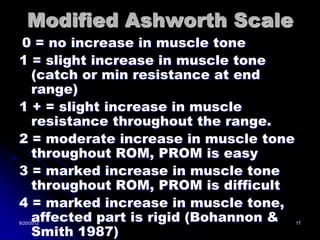
Modified Ashworth Scale
0 = no increase in muscle tone
1 = slight increase in muscle tone
  (catch or min resistance at end
  range)
1 + = slight increase in muscle
  resistance throughout the range.
2 = moderate increase in muscle tone
  throughout ROM, PROM is easy
3 = marked increase in muscle tone
  throughout ROM, PROM is difficult
4 = marked increase in muscle tone,
  affected part is rigid (Bohannon &
  Smith 1987)
8/20/2012                              17
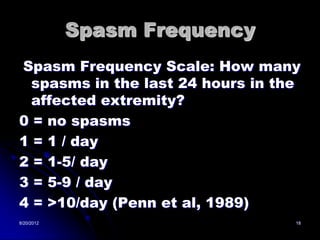
Spasm Frequency
Spasm Frequency Scale: How many
  spasms in the last 24 hours in the
  affected extremity?
0 = no spasms
1 = 1 / day
2 = 1-5/ day
3 = 5-9 / day
4 = >10/day (Penn et al, 1989)
8/20/2012                          18
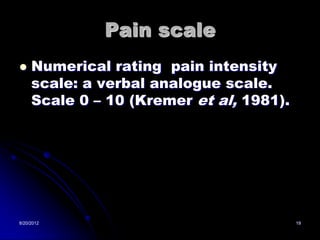
Pain scale
    Numerical rating pain intensity
     scale: a verbal analogue scale.
     Scale 0 – 10 (Kremer et al, 1981).


8/20/2012                                 19
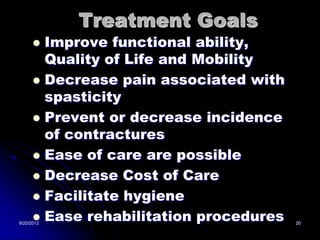
Treatment Goals
       Improve functional ability,
        Quality of Life and Mobility
       Decrease pain associated with
        spasticity
       Prevent or decrease incidence
        of contractures
       Ease of care are possible
       Decrease Cost of Care
       Facilitate hygiene
       Ease rehabilitation procedures
8/20/2012                                20
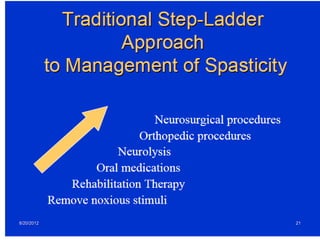
8/20/2012   21
Remove noxious stimuli
 Identify the ā€œtriggeringā€ stimulus
 Eliminate the factors that
  increase sensory input to the
  central nervous system


8/20/2012                              22
Rehabilitation therapy
    Positioning             EMG biofeedback
    Joint mobilization      Electrical
    Stretching               stimulation
    Strengthening           Orthotics
     Exercises               Splinting-
    Modalities:              static/dynamic
     Cryotherapy,             Casting:
     Hydrotherapy,            including serial
     Thermotherapy            casting
    Soft tissue
     manipulation
8/20/2012                                    23
Oral medications
 Lioresal: Baclofen
 Benzodiazepams: Diazepam
  (Valium)
 Dantrolene Sodium
 Tizanidine
 Gabapentin (Neurontin)


8/20/2012                      24
Neurolysis
Botulinum toxin Injections
Phenol Injections


8/20/2012                    25
Orthopedic approach
 Tenotomy
 Tendon lengthening
 Myotomy
 Tendon transfers


8/20/2012                         26
Neurosurgical approach
 Neurectomy
 Myelotomy/Cordectomy/
  Chordotomy
 Rhizotomy
 Selective Dorsal Rhizotomy
 Implantable dural electric
  stimulator
 Intrathecal Baclofen Pump

8/20/2012                            27
Conclusions
 While spasticity management can
  be difficult, it may also improve
  patient’s quality of life
 Spasticity is not necessarily the
  enemy, but is part of a pattern of
  abnormal motor control
 The choice of treatment depends
  on pattern of involvement

8/20/2012                              28
References
    Akosile CO, Fabunmi AA (2011).
     Pathophysiology, Functional Implications and
     Management of Spasticity in Stroke – A Review.
     AJPARS 3(1):6-12
    Ashworth B (1964). Preliminary trial of
     crisoprodol in multiple sclerosis. The
     practitioners 192:540-2
    Bohannon RW, Smith MB (1987). Interrater
     reliability of a modified Ashworth scale of muscle
     spasticity. PhysTher 67: 206-7.
8/20/2012                                             29
References cont
    Karadag-Saygi E, Cubukcu-Aydoseli K, Kablan
     N, Ofluoglu D (2010). The role of Kinesiotaping
     combined with Botulinum Toxin to reduce
     plantar flexors spasticity after stroke. Top Stroke
     Rehabil; 17(4):318–322

    Lundstromac E, Terentb A, Borgc J (2008).
     Prevalence of disabling spasticity 1 year after
     first-ever stroke. European Journal of Neurology
     15: 533–539
8/20/2012                                              30
References cont
  Urban PP, Wolf T, Uebele M, Marx JJ,
   Vogt T, Stoeter P, Bauermann T, Weibrich
   C, Vucurevic GD, Schneider A, Wissel J
   (2010). Occurence and Clinical Predictors
   of Spasticity after Ischemic Stroke. Stroke
   41:2016-2020
  Thompson AJ, Jarrett L, Lockley L,
   Marsden J, Stevenson VL (2012). Clinical
   management of spasticity. Available @
   www.jnnp.bmj.com Retrieved on August
   06 2012, Published by group.bmj.com
8/20/2012                                    31
Thank you
            Questions

                &
contributions
8/20/2012                32

Spasticity after stroke

  • 1.
    Spasticity After Stroke Adeagbo, Caleb A B.Physiotherapy (Lagos) Department of Physiotherapy, National Hospital, Abuja 8/20/2012 1
  • 2.
    Outline  Introduction  Definitions  Measurement  Types of Tools spasticity  Treatment  Pathophysiology  Conclusion  Other Types of  References Hypertonicity  Advantages of Spasticity 8/20/2012 2
  • 3.
    Introduction  Stroke isthe leading cause of morbidity and mortality (Lundstrom et al, 2008; Urban et al, 2012).  Spasticity is a common complication of stroke that lead to impaired gait characteristics in the upper and lower extremities (Karadag-Saygi et al, 2010). 8/20/2012 3
  • 4.
    Introduction cont  Optimum management of spasticity is dependent on an understanding of its underlying physiology, an awareness of its natural history, an appreciation of the impact on the patient and a comprehensive approach to minimizing that impact which is both multidisciplinary and consistent over time (Thompson et al, 2012). 8/20/2012 4
  • 5.
    Definitions  Stroke is an acute/sudden focal/global disturbance of the cerebral function with symptoms lasting for more than 24hours or sometimes leading to death with no other cause than vascular origin. 8/20/2012 5
  • 6.
    Definitions cont  Spasticity(meaning to draw or tug)  Spasticity is abnormal muscle tone recognized clinically as resistance to passive muscle stretch which increases with velocity of stretch. It is defined as 'a motor disorder characterized by velocity dependent increase in tonic stretch reflexes with exaggerated tendon jerks, resulting from hyperexcitability of the stretch reflex 8/20/2012 6
  • 7.
    Types of spasticity LEAD PIPE: presents as a uniform resistance to movement throughout the range of movement.  COGWHEEL: presents as an intermittent on/off resistance throughout the range of movement, making the movements jerky.  CLASP KNIFE: presents as increase in extensors of a joint when its passively flexed given way suddenly on exertion of further pressure. 8/20/2012 7
  • 8.
    Pathophysiology  The pathophysiologicbasis of spasticity is incompletely understood.  Spasticity is loss of inhibitory control over the gamma motor neuron  This inhibitory influence is in turn controlled by descending and peripheral inputs. 8/20/2012 8
  • 9.
    Pathophysiology contd  Lack of descending control over spinal cord interneuronal circuits results in a decrease in the effectiveness of spinal inhibitory circuits such as those mediating reciprocal, presynaptic, and recurrent inhibition. 8/20/2012 9
  • 10.
    Pathophysiology contd The changes in muscle tone probably result from  alterations in the balance of inputs from reticulospinal and other descending pathways to the motor and interneuronal circuits of the spinal cord  the absence of an intact corticospinal system. 8/20/2012 10
  • 11.
    Pathophysiology contd  Lossof descending tonic or phasic excitatory and inhibitory inputs to the spinal motor apparatus,  alterations in the segmental balance of excitatory and inhibitory control  denervation supersensitivity  neuronal sprouting 8/20/2012 11
  • 12.
    Other Types ofHypertonicity  RIGIDITY - Involuntary, bidirectional, non–velocity-dependent resistance to movement  CLONUS - Self-sustaining, oscillating movements secondary to hypertonicity  DYSTONIA - Involuntary, sustained contractions resulting in twisting, abnormal postures  ATHETOID - Involuntary, irregular, confluent writhing movements 8/20/2012 12
  • 13.
    Other Types of Hypertonicity contd  CHOREA - Involuntary, abrupt, rapid, irregular, and unsustained movements  BALLISMS - Involuntary flinging movements of the limbs or body  TREMOR - Involuntary, rhythmic, repetitive oscillations that are not self-sustaining 8/20/2012 13
  • 14.
    Advantages of Spasticity Maintenance of Muscle tone or Muscle Bulk  Tone Effect on Mobility  Tone effect on ADL's  Improved Circulation  Prevention of DVT  May assist with postural control 8/20/2012 14
  • 15.
    Measurement Tools  Ashworthscale  Modified Ashworth scale:  Spasm frequency  Reflex scale  Pain scale 8/20/2012 15
  • 16.
    Ashworth scale  0– no increase in tone  1 – slight increase in tone given a catch  2 – more marked increase in tone  3 – considerable increase in tone PM difficult  4 – limb rigid in flexion and extension (Ashworth scale, 1964) 8/20/2012 16
  • 17.
    Modified Ashworth Scale 0= no increase in muscle tone 1 = slight increase in muscle tone (catch or min resistance at end range) 1 + = slight increase in muscle resistance throughout the range. 2 = moderate increase in muscle tone throughout ROM, PROM is easy 3 = marked increase in muscle tone throughout ROM, PROM is difficult 4 = marked increase in muscle tone, affected part is rigid (Bohannon & Smith 1987) 8/20/2012 17
  • 18.
    Spasm Frequency Spasm FrequencyScale: How many spasms in the last 24 hours in the affected extremity? 0 = no spasms 1 = 1 / day 2 = 1-5/ day 3 = 5-9 / day 4 = >10/day (Penn et al, 1989) 8/20/2012 18
  • 19.
    Pain scale  Numerical rating pain intensity scale: a verbal analogue scale. Scale 0 – 10 (Kremer et al, 1981). 8/20/2012 19
  • 20.
    Treatment Goals  Improve functional ability, Quality of Life and Mobility  Decrease pain associated with spasticity  Prevent or decrease incidence of contractures  Ease of care are possible  Decrease Cost of Care  Facilitate hygiene  Ease rehabilitation procedures 8/20/2012 20
  • 21.
  • 22.
    Remove noxious stimuli Identify the ā€œtriggeringā€ stimulus  Eliminate the factors that increase sensory input to the central nervous system 8/20/2012 22
  • 23.
    Rehabilitation therapy  Positioning  EMG biofeedback  Joint mobilization  Electrical  Stretching stimulation  Strengthening  Orthotics Exercises  Splinting-  Modalities: static/dynamic Cryotherapy,  Casting: Hydrotherapy, including serial Thermotherapy casting  Soft tissue manipulation 8/20/2012 23
  • 24.
    Oral medications  Lioresal:Baclofen  Benzodiazepams: Diazepam (Valium)  Dantrolene Sodium  Tizanidine  Gabapentin (Neurontin) 8/20/2012 24
  • 25.
  • 26.
    Orthopedic approach  Tenotomy Tendon lengthening  Myotomy  Tendon transfers 8/20/2012 26
  • 27.
    Neurosurgical approach  Neurectomy Myelotomy/Cordectomy/ Chordotomy  Rhizotomy  Selective Dorsal Rhizotomy  Implantable dural electric stimulator  Intrathecal Baclofen Pump 8/20/2012 27
  • 28.
    Conclusions  While spasticitymanagement can be difficult, it may also improve patient’s quality of life  Spasticity is not necessarily the enemy, but is part of a pattern of abnormal motor control  The choice of treatment depends on pattern of involvement 8/20/2012 28
  • 29.
    References  Akosile CO, Fabunmi AA (2011). Pathophysiology, Functional Implications and Management of Spasticity in Stroke – A Review. AJPARS 3(1):6-12  Ashworth B (1964). Preliminary trial of crisoprodol in multiple sclerosis. The practitioners 192:540-2  Bohannon RW, Smith MB (1987). Interrater reliability of a modified Ashworth scale of muscle spasticity. PhysTher 67: 206-7. 8/20/2012 29
  • 30.
    References cont  Karadag-Saygi E, Cubukcu-Aydoseli K, Kablan N, Ofluoglu D (2010). The role of Kinesiotaping combined with Botulinum Toxin to reduce plantar flexors spasticity after stroke. Top Stroke Rehabil; 17(4):318–322  Lundstromac E, Terentb A, Borgc J (2008). Prevalence of disabling spasticity 1 year after first-ever stroke. European Journal of Neurology 15: 533–539 8/20/2012 30
  • 31.
    References cont Urban PP, Wolf T, Uebele M, Marx JJ, Vogt T, Stoeter P, Bauermann T, Weibrich C, Vucurevic GD, Schneider A, Wissel J (2010). Occurence and Clinical Predictors of Spasticity after Ischemic Stroke. Stroke 41:2016-2020  Thompson AJ, Jarrett L, Lockley L, Marsden J, Stevenson VL (2012). Clinical management of spasticity. Available @ www.jnnp.bmj.com Retrieved on August 06 2012, Published by group.bmj.com 8/20/2012 31
  • 32.
    Thank you Questions & contributions 8/20/2012 32