




Recognising features due to
neuromuscular impairments –
contracture and spasticity
Richard Baker
Professor of Clinical Gait Analysis
1
2
How can you visualise the
supplementary data on the graphs?
3
What is muscle “contracture”?
4
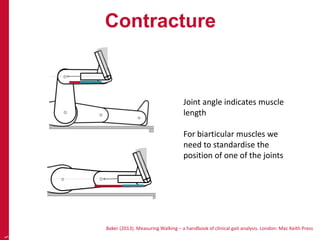
Contracture
5
Joint angle indicates muscle
length
For biarticular muscles we
need to standardise the
position of one of the joints
Baker (2013). Measuring Walking – a handbook of clinical gait analysis. London: Mac Keith Press
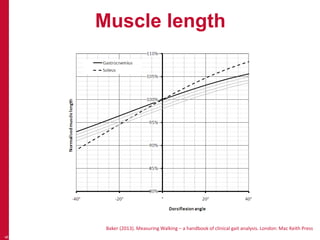
Muscle length
6
Baker (2013). Measuring Walking – a handbook of clinical gait analysis. London: Mac Keith Press
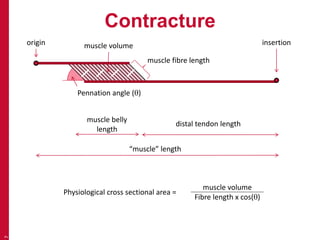
Contracture
7
“muscle” length
muscle belly
length
distal tendon length
origin insertion
muscle fibre length
Pennation angle (q)
muscle volume
Physiological cross sectional area =
muscle volume
Fibre length x cos(q)
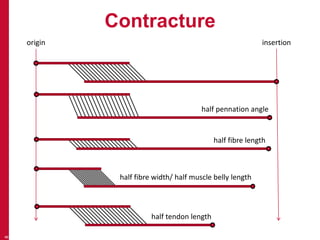
Contracture
8
origin insertion
half fibre length
half fibre width/ half muscle belly length
half tendon length
half pennation angle
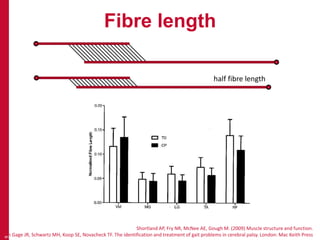
Fibre length
9
half fibre length
Shortland AP, Fry NR, McNee AE, Gough M. (2009) Muscle structure and function.
In Gage JR, Schwartz MH, Koop SE, Novacheck TF. The identification and treatment of gait problems in cerebral palsy. London: Mac Keith Press
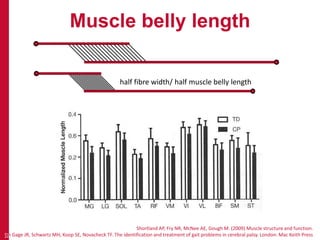
Muscle belly length
10
Shortland AP, Fry NR, McNee AE, Gough M. (2009) Muscle structure and function.
In Gage JR, Schwartz MH, Koop SE, Novacheck TF. The identification and treatment of gait problems in cerebral palsy. London: Mac Keith Press
half fibre width/ half muscle belly length
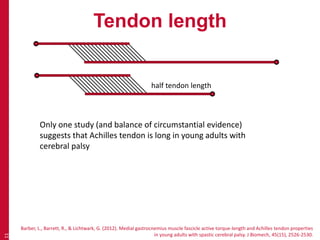
Tendon length
11
Barber, L., Barrett, R., & Lichtwark, G. (2012). Medial gastrocnemius muscle fascicle active torque-length and Achilles tendon properties
in young adults with spastic cerebral palsy. J Biomech, 45(15), 2526-2530.
half tendon length
Only one study (and balance of circumstantial evidence)
suggests that Achilles tendon is long in young adults with
cerebral palsy
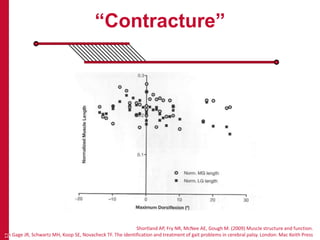
“Contracture”
12
Shortland AP, Fry NR, McNee AE, Gough M. (2009) Muscle structure and function.
In Gage JR, Schwartz MH, Koop SE, Novacheck TF. The identification and treatment of gait problems in cerebral palsy. London: Mac Keith Press
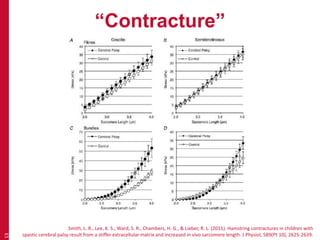
“Contracture”
13
Smith, L. R., Lee, K. S., Ward, S. R., Chambers, H. G., & Lieber, R. L. (2011). Hamstring contractures in children with
spastic cerebral palsy result from a stiffer extracellular matrix and increased in vivo sarcomere length. J Physiol, 589(Pt 10), 2625-2639.
Contracture
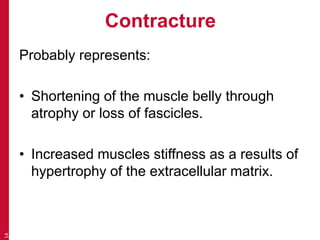
Probably represents:
• Shortening of the muscle belly through
atrophy or loss of fascicles.
• Increased muscles stiffness as a results of
hypertrophy of the extracellular matrix.
14
Recognising contracture from
the graphs
15
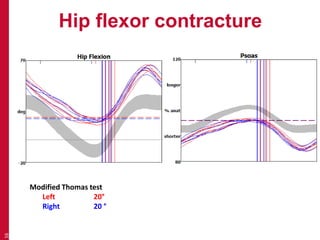
Hip flexor contracture
16
Modified Thomas test
Left 20°
Right 20 °
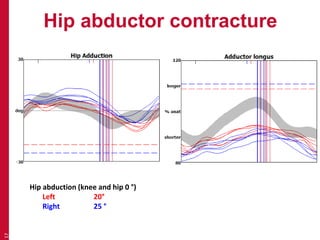
Hip abductor contracture
17
Hip abduction (knee and hip 0 °)
Left 20°
Right 25 °
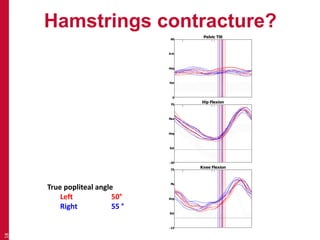
Hamstrings contracture?
18
True popliteal angle
Left 50°
Right 55 °
Pelvic Tilt60
0
Ant
Pst
deg
Hip Flexion70
-20
Flex
Ext
deg
Knee Flexion75
-15
Flx
Ext
deg
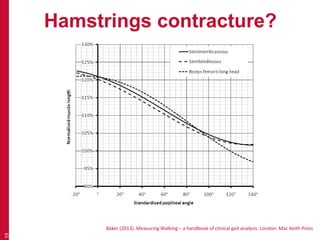
Hamstrings contracture?
19
Baker (2013). Measuring Walking – a handbook of clinical gait analysis. London: Mac Keith Press
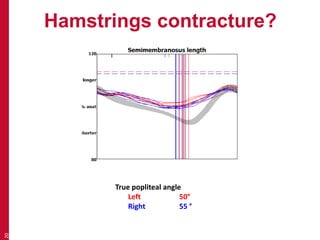
Hamstrings contracture?
20
True popliteal angle
Left 50°
Right 55 °
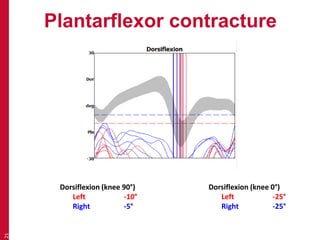
Plantarflexor contracture
21
Dorsiflexion (knee 90°)
Left -10°
Right -5°
Dorsiflexion (knee 0°)
Left -25°
Right -25°
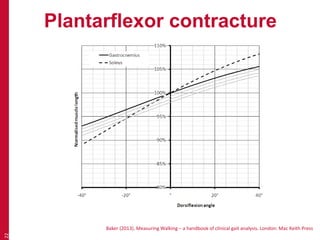
Plantarflexor contracture
22
Baker (2013). Measuring Walking – a handbook of clinical gait analysis. London: Mac Keith Press
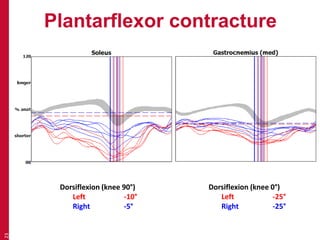
Plantarflexor contracture
23
Dorsiflexion (knee 90°)
Left -10°
Right -5°
Dorsiflexion (knee 0°)
Left -25°
Right -25°
What is “spasticity”?
24
Spasticity
25
Levine, 1952
A condition of paralysis or muscular
weakness associated with hyperreflexia, the
symptoms of which include increased
resistance to manipulation, exaggeration of
the deep reflexes, and clonus.
26
Levine, M. G., Knott, M., & Kabat, H. (1952). Relaxation of spasticity by electrical
stimulation of antagonist muscles. Arch Phys Med Rehabil, 33(11), 668-673.
Lance, 1980
“spasticity is a motor disorder characterized
by a velocity dependent increase in tonic
stretch reflexes (muscle tone) with
exaggerated tendon jerks, resulting from
hyper-excitability of the stretch reflexes, as
one component of the upper motor neuron
syndrome.”
27
Lance, J. (1980). Pathophysiology of spasticity and clinical experience with baclofen.
In R. Feldman, R. Young & W. Koella (Eds.), Spasticity: disordered motor control (485-
495). Chicago: Year book medical publishers.
Pandayan, 2005
“disordered sensori-motor control, resulting
from an upper motor neuron lesion,
presenting as intermittent or sustained
involuntary activation of muscle”
28
Pandyan, A. D., Gregoric, M., Barnes, M. P., Wood, D., Van Wijck, F., Burridge, J., . . .
Johnson, G. R. (2005). Spasticity: clinical perceptions, neurological realities and
meaningful measurement. [Review]. Disabil Rehabil, 27(1-2), 2-6.
Spasticity
• Not a property of the muscle.
• Property of the nervous system.
29
NIH Taskforce on Childhood
Motor Disorders
• Spasticity
• Tone
• Selective motor control
30
Sanger, T. D., Delgado, M. R., Gaebler-Spira, D., Hallett, M., & Mink, J. W. (2003).
Classification and definition of disorders causing hypertonia in childhood.
Pediatrics, 111(1), e89-97.
NIH Taskforce on Childhood
Motor Disorders
Spasticity
“resistance to externally imposed movement with
increasing speed of stretch and varies with the
direction of joint movement”
31
Sanger, T. D., Delgado, M. R., Gaebler-Spira, D., Hallett, M., & Mink, J. W. (2003).
Classification and definition of disorders causing hypertonia in childhood.
Pediatrics, 111(1), e89-97.
NIH Taskforce on Childhood
Motor Disorders
Tone
[resistance to] “passive stretch while the patient
is attempting to maintain a relaxed state of
muscle activity ”
32
Sanger, T. D., Delgado, M. R., Gaebler-Spira, D., Hallett, M., & Mink, J. W. (2003).
Classification and definition of disorders causing hypertonia in childhood.
Pediatrics, 111(1), e89-97.
NIH Taskforce on Childhood
Motor Disorders
Spasticity – response to fast stretch
Tone – response to slow stretch
33
Sanger, T. D., Delgado, M. R., Gaebler-Spira, D., Hallett, M., & Mink, J. W. (2003).
Classification and definition of disorders causing hypertonia in childhood.
Pediatrics, 111(1), e89-97.
NIH Taskforce on Childhood
Motor Disorders
Selective motor control
“the ability of the body to isolate the activation of
muscles in a selected pattern in response to
demands of a voluntary posture of movement”
34
Sanger, T. D., Chen, D., Delgado, M. R., Gaebler-Spira, D., Hallett, M., & Mink, J. W. (2006).
Definition and classification of negative motor signs in childhood.
Pediatrics, 118(5), 2159-2167
Measurement
35
Tone
Modified Ashworth Score (MAS):
• originally defined as measure of spasticity.
• joint moved through full range of
movement over a period of about one
second.
• too fast to measure tone – too slow to
measure spasticity
36
Bohannon, R. W., & Smith, M. B. (1987).
Interrater reliability of a modified ashworth scale of muscle spasticity.
Physical Therapy, 67(2), 206-207.
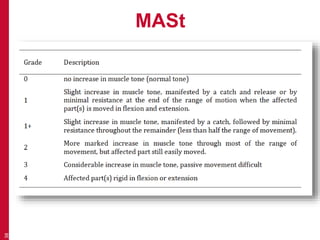
MAS for tone (MASt?)
• Perform stretch slowly so as not to elicit
spasticity.
• Use same scale as MAS.
37
MASt
38
Spasticity
Tardieu (1954)
• Complex
• Impractical
• In French!
39
Tardieu, G., Shentoub, S., & Delarue, R. (1954).
[Research on a technic for measurement of spasticity].
Rev Neurol (Paris), 91(2), 143-144.
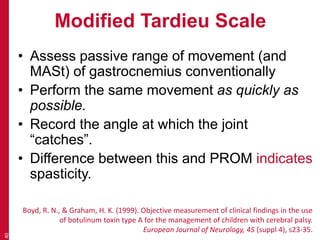
Modified Tardieu Scale
• Assess passive range of movement (and
MASt) of gastrocnemius conventionally
• Perform the same movement as quickly as
possible.
• Record the angle at which the joint
“catches”.
• Difference between this and PROM indicates
spasticity.
40
Boyd, R. N., & Graham, H. K. (1999). Objective measurement of clinical findings in the use
of botulinum toxin type A for the management of children with cerebral palsy.
European Journal of Neurology, 45 (suppl 4), s23-35.
MTS Notes
• We have defined spasticity as depending
on velocity which will only be indirectly
indicated by the angle of catch.
• Repeatability studies also suggest that the
measurement should only be taken as
indicative.
41
Selective motor control
Perform at time of MRC strength tests for
individual muscles.
2 muscle can be activated independently
to other muscles.
0 muscle can only be activated as part of
a patterned movement (often a flexor or
extensor synergy)
1 allows for an intermediate grading
42
Ounpuu?
Recognising spasticity from
the graphs
43
44

Recognising features (contracture and spasticity)

  • 1.
    Recognising features dueto neuromuscular impairments – contracture and spasticity Richard Baker Professor of Clinical Gait Analysis 1
  • 2.
  • 3.
    How can youvisualise the supplementary data on the graphs? 3
  • 4.
    What is muscle“contracture”? 4
  • 5.
    Contracture 5 Joint angle indicatesmuscle length For biarticular muscles we need to standardise the position of one of the joints Baker (2013). Measuring Walking – a handbook of clinical gait analysis. London: Mac Keith Press
  • 6.
    Muscle length 6 Baker (2013).Measuring Walking – a handbook of clinical gait analysis. London: Mac Keith Press
  • 7.
    Contracture 7 “muscle” length muscle belly length distaltendon length origin insertion muscle fibre length Pennation angle (q) muscle volume Physiological cross sectional area = muscle volume Fibre length x cos(q)
  • 8.
    Contracture 8 origin insertion half fibrelength half fibre width/ half muscle belly length half tendon length half pennation angle
  • 9.
    Fibre length 9 half fibrelength Shortland AP, Fry NR, McNee AE, Gough M. (2009) Muscle structure and function. In Gage JR, Schwartz MH, Koop SE, Novacheck TF. The identification and treatment of gait problems in cerebral palsy. London: Mac Keith Press
  • 10.
    Muscle belly length 10 ShortlandAP, Fry NR, McNee AE, Gough M. (2009) Muscle structure and function. In Gage JR, Schwartz MH, Koop SE, Novacheck TF. The identification and treatment of gait problems in cerebral palsy. London: Mac Keith Press half fibre width/ half muscle belly length
  • 11.
    Tendon length 11 Barber, L.,Barrett, R., & Lichtwark, G. (2012). Medial gastrocnemius muscle fascicle active torque-length and Achilles tendon properties in young adults with spastic cerebral palsy. J Biomech, 45(15), 2526-2530. half tendon length Only one study (and balance of circumstantial evidence) suggests that Achilles tendon is long in young adults with cerebral palsy
  • 12.
    “Contracture” 12 Shortland AP, FryNR, McNee AE, Gough M. (2009) Muscle structure and function. In Gage JR, Schwartz MH, Koop SE, Novacheck TF. The identification and treatment of gait problems in cerebral palsy. London: Mac Keith Press
  • 13.
    “Contracture” 13 Smith, L. R.,Lee, K. S., Ward, S. R., Chambers, H. G., & Lieber, R. L. (2011). Hamstring contractures in children with spastic cerebral palsy result from a stiffer extracellular matrix and increased in vivo sarcomere length. J Physiol, 589(Pt 10), 2625-2639.
  • 14.
    Contracture Probably represents: • Shorteningof the muscle belly through atrophy or loss of fascicles. • Increased muscles stiffness as a results of hypertrophy of the extracellular matrix. 14
  • 15.
  • 16.
    Hip flexor contracture 16 ModifiedThomas test Left 20° Right 20 °
  • 17.
    Hip abductor contracture 17 Hipabduction (knee and hip 0 °) Left 20° Right 25 °
  • 18.
    Hamstrings contracture? 18 True poplitealangle Left 50° Right 55 ° Pelvic Tilt60 0 Ant Pst deg Hip Flexion70 -20 Flex Ext deg Knee Flexion75 -15 Flx Ext deg
  • 19.
    Hamstrings contracture? 19 Baker (2013).Measuring Walking – a handbook of clinical gait analysis. London: Mac Keith Press
  • 20.
    Hamstrings contracture? 20 True poplitealangle Left 50° Right 55 °
  • 21.
    Plantarflexor contracture 21 Dorsiflexion (knee90°) Left -10° Right -5° Dorsiflexion (knee 0°) Left -25° Right -25°
  • 22.
    Plantarflexor contracture 22 Baker (2013).Measuring Walking – a handbook of clinical gait analysis. London: Mac Keith Press
  • 23.
    Plantarflexor contracture 23 Dorsiflexion (knee90°) Left -10° Right -5° Dorsiflexion (knee 0°) Left -25° Right -25°
  • 24.
  • 25.
  • 26.
    Levine, 1952 A conditionof paralysis or muscular weakness associated with hyperreflexia, the symptoms of which include increased resistance to manipulation, exaggeration of the deep reflexes, and clonus. 26 Levine, M. G., Knott, M., & Kabat, H. (1952). Relaxation of spasticity by electrical stimulation of antagonist muscles. Arch Phys Med Rehabil, 33(11), 668-673.
  • 27.
    Lance, 1980 “spasticity isa motor disorder characterized by a velocity dependent increase in tonic stretch reflexes (muscle tone) with exaggerated tendon jerks, resulting from hyper-excitability of the stretch reflexes, as one component of the upper motor neuron syndrome.” 27 Lance, J. (1980). Pathophysiology of spasticity and clinical experience with baclofen. In R. Feldman, R. Young & W. Koella (Eds.), Spasticity: disordered motor control (485- 495). Chicago: Year book medical publishers.
  • 28.
    Pandayan, 2005 “disordered sensori-motorcontrol, resulting from an upper motor neuron lesion, presenting as intermittent or sustained involuntary activation of muscle” 28 Pandyan, A. D., Gregoric, M., Barnes, M. P., Wood, D., Van Wijck, F., Burridge, J., . . . Johnson, G. R. (2005). Spasticity: clinical perceptions, neurological realities and meaningful measurement. [Review]. Disabil Rehabil, 27(1-2), 2-6.
  • 29.
    Spasticity • Not aproperty of the muscle. • Property of the nervous system. 29
  • 30.
    NIH Taskforce onChildhood Motor Disorders • Spasticity • Tone • Selective motor control 30 Sanger, T. D., Delgado, M. R., Gaebler-Spira, D., Hallett, M., & Mink, J. W. (2003). Classification and definition of disorders causing hypertonia in childhood. Pediatrics, 111(1), e89-97.
  • 31.
    NIH Taskforce onChildhood Motor Disorders Spasticity “resistance to externally imposed movement with increasing speed of stretch and varies with the direction of joint movement” 31 Sanger, T. D., Delgado, M. R., Gaebler-Spira, D., Hallett, M., & Mink, J. W. (2003). Classification and definition of disorders causing hypertonia in childhood. Pediatrics, 111(1), e89-97.
  • 32.
    NIH Taskforce onChildhood Motor Disorders Tone [resistance to] “passive stretch while the patient is attempting to maintain a relaxed state of muscle activity ” 32 Sanger, T. D., Delgado, M. R., Gaebler-Spira, D., Hallett, M., & Mink, J. W. (2003). Classification and definition of disorders causing hypertonia in childhood. Pediatrics, 111(1), e89-97.
  • 33.
    NIH Taskforce onChildhood Motor Disorders Spasticity – response to fast stretch Tone – response to slow stretch 33 Sanger, T. D., Delgado, M. R., Gaebler-Spira, D., Hallett, M., & Mink, J. W. (2003). Classification and definition of disorders causing hypertonia in childhood. Pediatrics, 111(1), e89-97.
  • 34.
    NIH Taskforce onChildhood Motor Disorders Selective motor control “the ability of the body to isolate the activation of muscles in a selected pattern in response to demands of a voluntary posture of movement” 34 Sanger, T. D., Chen, D., Delgado, M. R., Gaebler-Spira, D., Hallett, M., & Mink, J. W. (2006). Definition and classification of negative motor signs in childhood. Pediatrics, 118(5), 2159-2167
  • 35.
  • 36.
    Tone Modified Ashworth Score(MAS): • originally defined as measure of spasticity. • joint moved through full range of movement over a period of about one second. • too fast to measure tone – too slow to measure spasticity 36 Bohannon, R. W., & Smith, M. B. (1987). Interrater reliability of a modified ashworth scale of muscle spasticity. Physical Therapy, 67(2), 206-207.
  • 37.
    MAS for tone(MASt?) • Perform stretch slowly so as not to elicit spasticity. • Use same scale as MAS. 37
  • 38.
  • 39.
    Spasticity Tardieu (1954) • Complex •Impractical • In French! 39 Tardieu, G., Shentoub, S., & Delarue, R. (1954). [Research on a technic for measurement of spasticity]. Rev Neurol (Paris), 91(2), 143-144.
  • 40.
    Modified Tardieu Scale •Assess passive range of movement (and MASt) of gastrocnemius conventionally • Perform the same movement as quickly as possible. • Record the angle at which the joint “catches”. • Difference between this and PROM indicates spasticity. 40 Boyd, R. N., & Graham, H. K. (1999). Objective measurement of clinical findings in the use of botulinum toxin type A for the management of children with cerebral palsy. European Journal of Neurology, 45 (suppl 4), s23-35.
  • 41.
    MTS Notes • Wehave defined spasticity as depending on velocity which will only be indirectly indicated by the angle of catch. • Repeatability studies also suggest that the measurement should only be taken as indicative. 41
  • 42.
    Selective motor control Performat time of MRC strength tests for individual muscles. 2 muscle can be activated independently to other muscles. 0 muscle can only be activated as part of a patterned movement (often a flexor or extensor synergy) 1 allows for an intermediate grading 42 Ounpuu?
  • 43.
  • 44.