MANAGEMENT OF
SPASTICITY
DR. MANASI KULKARNI
MPT-NEUROPHYSIOTHERAPY
GUIDE: DR. SUVARNA GANVIR
D.V.V.P.F’s College of Physiotherapy, Ahmednagar
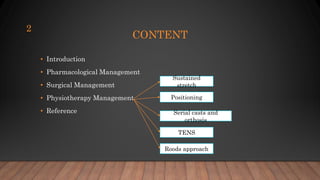
CONTENT
• Introduction
• Pharmacological Management
• Surgical Management
• Physiotherapy Management
• Reference
2
Sustained
stretch
Positioning
Serial casts and
orthosis
TENS
Roods approach
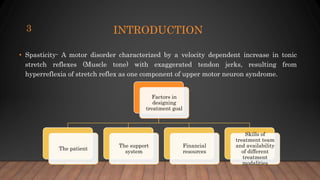
INTRODUCTION
• Spasticity- A motor disorder characterized by a velocity dependent increase in tonic
stretch reflexes (Muscle tone) with exaggerated tendon jerks, resulting from
hyperreflexia of stretch reflex as one component of upper motor neuron syndrome.
3
Factors in
designing
treatment goal
The patient
The support
system
Financial
resources
Skills of
treatment team
and availability
of different
treatment
modalities
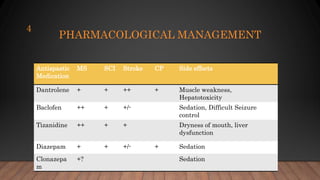
PHARMACOLOGICAL MANAGEMENT
Antispastic
Medication
MS SCI Stroke CP Side effects
Dantrolene + + ++ + Muscle weakness,
Hepatotoxicity
Baclofen ++ + +/- Sedation, Difficult Seizure
control
Tizanidine ++ + + Dryness of mouth, liver
dysfunction
Diazepam + + +/- + Sedation
Clonazepa
m
+? Sedation
4
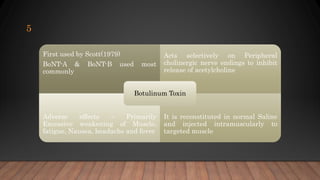
First used by Scott(1979)
BoNT-A & BoNT-B used most
commonly
Acts selectively on Peripheral
cholinergic nerve endings to inhibit
release of acetylcholine
Adverse effects – Primarily
Excessive weakening of Muscle,
fatigue, Nausea, headache and fever
It is reconstituted in normal Saline
and injected intramuscularly to
targeted muscle
Botulinum Toxin
5
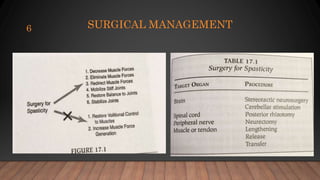
SURGICAL MANAGEMENT
6
7
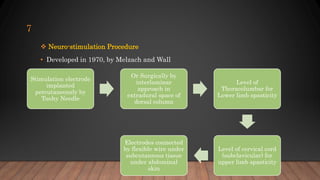
 Neuro-stimulation Procedure
• Developed in 1970, by Melzach and Wall
Stimulation electrode
implanted
percutaneously by
Tuohy Needle
Or Surgically by
interlaminar
approach in
extradural space of
dorsal column
Level of
Thoracolumbar for
Lower limb spasticity
Level of cervical cord
(subclavicular) for
upper limb spasticity
Electrodes connected
by flexible wire under
subcutaneous tissue
under abdominal
skin
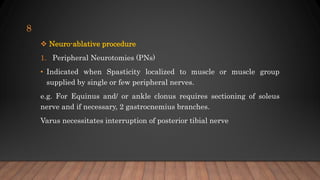
 Neuro-ablative procedure
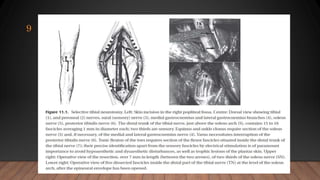
1. Peripheral Neurotomies (PNs)
• Indicated when Spasticity localized to muscle or muscle group
supplied by single or few peripheral nerves.
e.g. For Equinus and/ or ankle clonus requires sectioning of soleus
nerve and if necessary, 2 gastrocnemius branches.
Varus necessitates interruption of posterior tibial nerve
8
9
PHYSIOTHERAPY MANAGEMENT
1) Sustained Stretching
2) Positioning
3) Serial Casts
4) Use of Orthosis
5) Roods Approach
6) Strength training
10
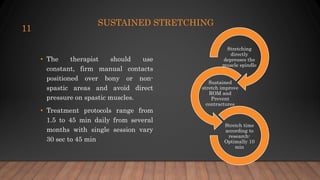
SUSTAINED STRETCHING
• The therapist should use
constant, firm manual contacts
positioned over bony or non-
spastic areas and avoid direct
pressure on spastic muscles.
• Treatment protocols range from
1.5 to 45 min daily from several
months with single session vary
30 sec to 45 min
11
Stretching
directly
depresses the
muscle spindle
Sustained
stretch improve
ROM and
Prevent
contractures
Stretch time
according to
research-
Optimally 10
min
12
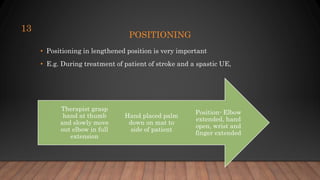
POSITIONING
• Positioning in lengthened position is very important
• E.g. During treatment of patient of stroke and a spastic UE,
13
Position- Elbow
extended, hand
open, wrist and
finger extended
Hand placed palm
down on mat to
side of patient
Therapist grasp
hand at thumb
and slowly move
out elbow in full
extension
14
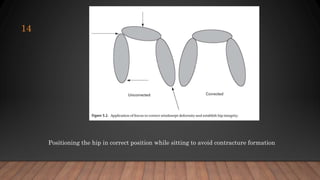
Positioning the hip in correct position while sitting to avoid contracture formation
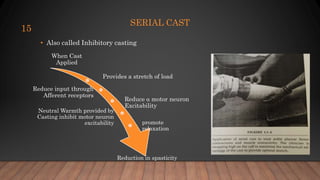
SERIAL CAST
• Also called Inhibitory casting
15
When Cast
Applied
Provides a stretch of load
Reduce input through
Afferent receptors
Reduce α motor neuron
Excitability
Neutral Warmth provided by
Casting inhibit motor neuron
excitability promote
relaxation
Reduction in spasticity
16 Wearing Schedule
Historically- 5-7 days change
A study by Pohl et al
suggested shorter interval of
1-4 days, equally effective
ROM gain in shorter period
and fewer complications
Complications
Burn due heat by cast or
secondary due to use of hot
water over cast
Development of
Compartment syndrome
Skin breakdown
DVT
Osteopenia and osteoporosis
with risk of pathologic
fracture with risk of prolong
use
USE OF ORTHOSIS
• Static splinting acts in similar way to the casts
• Dynamic splinting incorporate active, active assisted or passive
component into device.
• Lycra Garment- Rapid splinting and antispasticity effect.
- Gracies et al conducted a study on 16 stroke patients applying Lycra
for 3 hrs daily for 2 months showed significant decrease in spasticity
of wrist flexors.
17
18
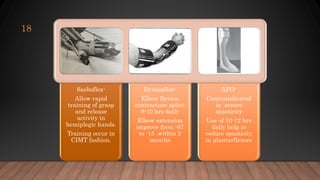
Saeboflex-
Allow rapid
training of grasp
and release
activity in
hemiplegic hands.
Training occur in
CIMT fashion.
Dynasplint-
Elbow flexion
contracture splint
8-10 hrs daily
Elbow extension
improve form -67
to -15 ,within 2
months
AFO-
Contraindicated
in severe
spasticity
Use of 10-12 hrs
daily help to
reduce spasticity
in plantarflexors
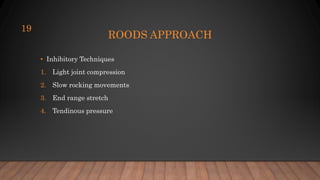
ROODS APPROACH
• Inhibitory Techniques
1. Light joint compression
2. Slow rocking movements
3. End range stretch
4. Tendinous pressure
19
STRENGTH TRAINING
• A review of15 RCTs that examined the effects of strength training in
persons with acute (2 weeks to 4.5 months) and in persons with chronic (2
to 8 years) poststroke concluded that strength training can improve
strength, improve activity, and does not increase spasticity.
• So it is suggested that strength training should not be excluded form the
rehabilitation program
20
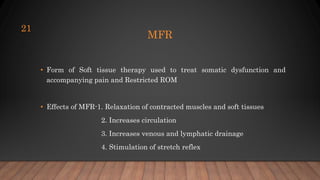
MFR
• Form of Soft tissue therapy used to treat somatic dysfunction and
accompanying pain and Restricted ROM
• Effects of MFR-1. Relaxation of contracted muscles and soft tissues
2. Increases circulation
3. Increases venous and lymphatic drainage
4. Stimulation of stretch reflex
21
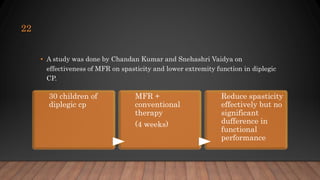
• A study was done by Chandan Kumar and Snehashri Vaidya on
effectiveness of MFR on spasticity and lower extremity function in diplegic
CP.
22
30 children of
diplegic cp
MFR +
conventional
therapy
(4 weeks)
Reduce spasticity
effectively but no
significant
dufference in
functional
performance
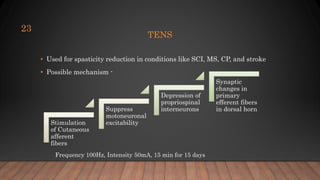
TENS
• Used for spasticity reduction in conditions like SCI, MS, CP, and stroke
• Possible mechanism -
23
Stimulation
of Cutaneous
afferent
fibers
Suppress
motoneuronal
excitability
Depression of
propriospinal
interneurons
Synaptic
changes in
primary
efferent fibers
in dorsal horn
Frequency 100Hz, Intensity 50mA, 15 min for 15 days
NMES
• Other electrical stimulation work first on the type I fibers on muscle spindle.
• Neuromuscular electrical stimulation was known to activate the Type II
fibers of muscle spindle due to which muscle contraction occur more
prominently. Antagonist activation by NMES will help to reduce spasticity in
Agonist muscle.
24
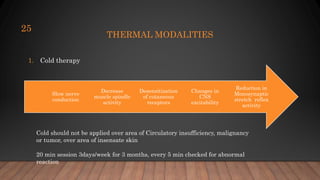
THERMAL MODALITIES
1. Cold therapy
25
Reduction in
Monosynaptic
stretch reflex
activity
Changes in
CNS
excitability
Desensitization
of cutaneous
receptors
Decrease
muscle spindle
activity
Slow nerve
conduction
Cold should not be applied over area of Circulatory insufficiency, malignancy
or tumor, over area of insensate skin
20 min session 3days/week for 3 months, every 5 min checked for abnormal
reaction
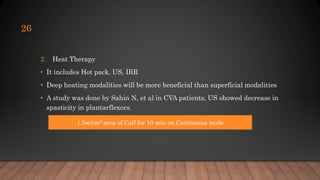
2. Heat Therapy
• It includes Hot pack, US, IRR
• Deep heating modalities will be more beneficial than superficial modalities
• A study was done by Sahin N, et al in CVA patients, US showed decrease in
spasticity in plantarflexors.
26
1.5w/cm2 area of Calf for 10 min on Contineous mode
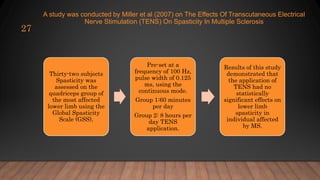
A study was conducted by Miller et al (2007) on The Effects Of Transcutaneous Electrical
Nerve Stimulation (TENS) On Spasticity In Multiple Sclerosis
27
Thirty-two subjects
Spasticity was
assessed on the
quadriceps group of
the most affected
lower limb using the
Global Spasticity
Scale (GSS),
Pre-set at a
frequency of 100 Hz,
pulse width of 0.125
ms, using the
continuous mode.
Group 1:60 minutes
per day
Group 2: 8 hours per
day TENS
application.
Results of this study
demonstrated that
the application of
TENS had no
statistically
significant effects on
lower limb
spasticity in
individual affected
by MS.
REFERENCES
1. Barnes M.P., Johnson G.R. Upper motor neuron syndrome and spasticity-clinical
management and neurophysiology. 2nd edition.
2. O’Sullivan S., Schmitz T.J., Fulk G.D. Physical Rehabilitation 6th edition
3. Brashear A., Elovic E. Spasticity diagnosis and management
4. Suvarna Ganvir, Shyam Ganvir. Manual Therapy Approaches in Neuro-physiotherapy
5. Hale, L, Fritz, V, and Goodman, M: Prolonged static muscle stretch reduces
spasticity—but for how long should it be held? J Physio. 1995;51(3)
6. Gehan M. et al Efficacy of cold therapy on spasticity and hand function in children
with CP. Journal of Advanced Research.2011
28
THANK YOU
29

Management of spasticity

  • 1.
    MANAGEMENT OF SPASTICITY DR. MANASIKULKARNI MPT-NEUROPHYSIOTHERAPY GUIDE: DR. SUVARNA GANVIR D.V.V.P.F’s College of Physiotherapy, Ahmednagar
  • 2.
    CONTENT • Introduction • PharmacologicalManagement • Surgical Management • Physiotherapy Management • Reference 2 Sustained stretch Positioning Serial casts and orthosis TENS Roods approach
  • 3.
    INTRODUCTION • Spasticity- Amotor disorder characterized by a velocity dependent increase in tonic stretch reflexes (Muscle tone) with exaggerated tendon jerks, resulting from hyperreflexia of stretch reflex as one component of upper motor neuron syndrome. 3 Factors in designing treatment goal The patient The support system Financial resources Skills of treatment team and availability of different treatment modalities
  • 4.
    PHARMACOLOGICAL MANAGEMENT Antispastic Medication MS SCIStroke CP Side effects Dantrolene + + ++ + Muscle weakness, Hepatotoxicity Baclofen ++ + +/- Sedation, Difficult Seizure control Tizanidine ++ + + Dryness of mouth, liver dysfunction Diazepam + + +/- + Sedation Clonazepa m +? Sedation 4
  • 5.
    First used byScott(1979) BoNT-A & BoNT-B used most commonly Acts selectively on Peripheral cholinergic nerve endings to inhibit release of acetylcholine Adverse effects – Primarily Excessive weakening of Muscle, fatigue, Nausea, headache and fever It is reconstituted in normal Saline and injected intramuscularly to targeted muscle Botulinum Toxin 5
  • 6.
  • 7.
    7  Neuro-stimulation Procedure •Developed in 1970, by Melzach and Wall Stimulation electrode implanted percutaneously by Tuohy Needle Or Surgically by interlaminar approach in extradural space of dorsal column Level of Thoracolumbar for Lower limb spasticity Level of cervical cord (subclavicular) for upper limb spasticity Electrodes connected by flexible wire under subcutaneous tissue under abdominal skin
  • 8.
     Neuro-ablative procedure 1.Peripheral Neurotomies (PNs) • Indicated when Spasticity localized to muscle or muscle group supplied by single or few peripheral nerves. e.g. For Equinus and/ or ankle clonus requires sectioning of soleus nerve and if necessary, 2 gastrocnemius branches. Varus necessitates interruption of posterior tibial nerve 8
  • 9.
  • 10.
    PHYSIOTHERAPY MANAGEMENT 1) SustainedStretching 2) Positioning 3) Serial Casts 4) Use of Orthosis 5) Roods Approach 6) Strength training 10
  • 11.
    SUSTAINED STRETCHING • Thetherapist should use constant, firm manual contacts positioned over bony or non- spastic areas and avoid direct pressure on spastic muscles. • Treatment protocols range from 1.5 to 45 min daily from several months with single session vary 30 sec to 45 min 11 Stretching directly depresses the muscle spindle Sustained stretch improve ROM and Prevent contractures Stretch time according to research- Optimally 10 min
  • 12.
  • 13.
    POSITIONING • Positioning inlengthened position is very important • E.g. During treatment of patient of stroke and a spastic UE, 13 Position- Elbow extended, hand open, wrist and finger extended Hand placed palm down on mat to side of patient Therapist grasp hand at thumb and slowly move out elbow in full extension
  • 14.
    14 Positioning the hipin correct position while sitting to avoid contracture formation
  • 15.
    SERIAL CAST • Alsocalled Inhibitory casting 15 When Cast Applied Provides a stretch of load Reduce input through Afferent receptors Reduce α motor neuron Excitability Neutral Warmth provided by Casting inhibit motor neuron excitability promote relaxation Reduction in spasticity
  • 16.
    16 Wearing Schedule Historically-5-7 days change A study by Pohl et al suggested shorter interval of 1-4 days, equally effective ROM gain in shorter period and fewer complications Complications Burn due heat by cast or secondary due to use of hot water over cast Development of Compartment syndrome Skin breakdown DVT Osteopenia and osteoporosis with risk of pathologic fracture with risk of prolong use
  • 17.
    USE OF ORTHOSIS •Static splinting acts in similar way to the casts • Dynamic splinting incorporate active, active assisted or passive component into device. • Lycra Garment- Rapid splinting and antispasticity effect. - Gracies et al conducted a study on 16 stroke patients applying Lycra for 3 hrs daily for 2 months showed significant decrease in spasticity of wrist flexors. 17
  • 18.
    18 Saeboflex- Allow rapid training ofgrasp and release activity in hemiplegic hands. Training occur in CIMT fashion. Dynasplint- Elbow flexion contracture splint 8-10 hrs daily Elbow extension improve form -67 to -15 ,within 2 months AFO- Contraindicated in severe spasticity Use of 10-12 hrs daily help to reduce spasticity in plantarflexors
  • 19.
    ROODS APPROACH • InhibitoryTechniques 1. Light joint compression 2. Slow rocking movements 3. End range stretch 4. Tendinous pressure 19
  • 20.
    STRENGTH TRAINING • Areview of15 RCTs that examined the effects of strength training in persons with acute (2 weeks to 4.5 months) and in persons with chronic (2 to 8 years) poststroke concluded that strength training can improve strength, improve activity, and does not increase spasticity. • So it is suggested that strength training should not be excluded form the rehabilitation program 20
  • 21.
    MFR • Form ofSoft tissue therapy used to treat somatic dysfunction and accompanying pain and Restricted ROM • Effects of MFR-1. Relaxation of contracted muscles and soft tissues 2. Increases circulation 3. Increases venous and lymphatic drainage 4. Stimulation of stretch reflex 21
  • 22.
    • A studywas done by Chandan Kumar and Snehashri Vaidya on effectiveness of MFR on spasticity and lower extremity function in diplegic CP. 22 30 children of diplegic cp MFR + conventional therapy (4 weeks) Reduce spasticity effectively but no significant dufference in functional performance
  • 23.
    TENS • Used forspasticity reduction in conditions like SCI, MS, CP, and stroke • Possible mechanism - 23 Stimulation of Cutaneous afferent fibers Suppress motoneuronal excitability Depression of propriospinal interneurons Synaptic changes in primary efferent fibers in dorsal horn Frequency 100Hz, Intensity 50mA, 15 min for 15 days
  • 24.
    NMES • Other electricalstimulation work first on the type I fibers on muscle spindle. • Neuromuscular electrical stimulation was known to activate the Type II fibers of muscle spindle due to which muscle contraction occur more prominently. Antagonist activation by NMES will help to reduce spasticity in Agonist muscle. 24
  • 25.
    THERMAL MODALITIES 1. Coldtherapy 25 Reduction in Monosynaptic stretch reflex activity Changes in CNS excitability Desensitization of cutaneous receptors Decrease muscle spindle activity Slow nerve conduction Cold should not be applied over area of Circulatory insufficiency, malignancy or tumor, over area of insensate skin 20 min session 3days/week for 3 months, every 5 min checked for abnormal reaction
  • 26.
    2. Heat Therapy •It includes Hot pack, US, IRR • Deep heating modalities will be more beneficial than superficial modalities • A study was done by Sahin N, et al in CVA patients, US showed decrease in spasticity in plantarflexors. 26 1.5w/cm2 area of Calf for 10 min on Contineous mode
  • 27.
    A study wasconducted by Miller et al (2007) on The Effects Of Transcutaneous Electrical Nerve Stimulation (TENS) On Spasticity In Multiple Sclerosis 27 Thirty-two subjects Spasticity was assessed on the quadriceps group of the most affected lower limb using the Global Spasticity Scale (GSS), Pre-set at a frequency of 100 Hz, pulse width of 0.125 ms, using the continuous mode. Group 1:60 minutes per day Group 2: 8 hours per day TENS application. Results of this study demonstrated that the application of TENS had no statistically significant effects on lower limb spasticity in individual affected by MS.
  • 28.
    REFERENCES 1. Barnes M.P.,Johnson G.R. Upper motor neuron syndrome and spasticity-clinical management and neurophysiology. 2nd edition. 2. O’Sullivan S., Schmitz T.J., Fulk G.D. Physical Rehabilitation 6th edition 3. Brashear A., Elovic E. Spasticity diagnosis and management 4. Suvarna Ganvir, Shyam Ganvir. Manual Therapy Approaches in Neuro-physiotherapy 5. Hale, L, Fritz, V, and Goodman, M: Prolonged static muscle stretch reduces spasticity—but for how long should it be held? J Physio. 1995;51(3) 6. Gehan M. et al Efficacy of cold therapy on spasticity and hand function in children with CP. Journal of Advanced Research.2011 28
  • 29.