 to express purpose
(answering the question WHY?)
 I’m saving up to buy a present for my sister.
 She’s going to the gym to lose weight.
INFINITIVE with to is used…
 after some adjectives
surprised, delighted, disappointed, easy,
happy, important, lucky, necessary, normal,
possible
 I was delighted to hear she finally got the job.
 It is normal to feel nervous before an exam.
 It is easy to find a parking spot at this time of the day.
INFINITIVE with to is used…
 after certain verbs
agree, afford, appear, arrange, ask, choose,
decide, deserve, expect, help, hesitate, hope,
learn, manage, need, offer, prepare,
pretend, promise, refuse, seem, would like,
want:
 He decided to stay for some more days.
 She refused to go to the new dentist.
 They deserve to win the competition.
INFINITIVE with TOO and
ENOUGH
 too + adjective + infinitive
She is too young to vote.
 Adjective + enough + infinitive
They are old enough to vote.
Use the INFINITIVE without TO…
(bare infinitive)
• After modal verbs
She may be clever but she is mot very friendly
• With some other verbs like make and let
Javier made Pablo cry
Let me know if you don’t understand
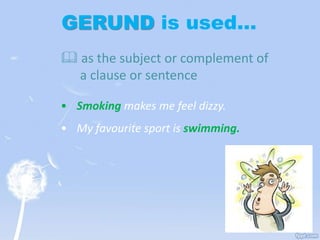
GERUND is used…
 as the subject or complement of
a clause or sentence
• Smoking makes me feel dizzy.
• My favourite sport is swimming.
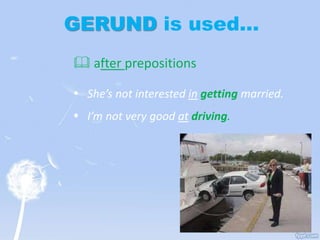
GERUND is used…
 after prepositions
 She’s not interested in getting married.
 I’m not very good at driving.
GERUND is used…
 verbs expressing likes and dislikes:
Like, love, adore, hate, detest,
dislike, enjoy, prefer
• and after certain verbs:
Admit, advise, suggest, finish,
imagine, involve, mind, stop,
be worth
GERUND is used…
• Be used to
• Get used to
• Can’t help
• Can’t stand
• Adapt to
• Feel like
• It’s no use
• Keep on
• Look forward to
…after these common expressions
Verbs followed by either the
gerund or the infinitive
 Like, love, hate, prefer are usually
followed by the gerund. However, the
infinitive is also possible.
I love to sunbathe/sunbathing
 Begin, start, continue, intend are
followed by the gerund or infinitve with
no change in meaning:
When I arrived it started to
rain/raining.
Verbs followed by either the
gerund or the infinitive with a
change of meaning:
forget
remember
regret
stop
Remember and forget
I still remember buying my first bike.
I’ll never forget meeting the Queen.
They look back at the past, at things
one did
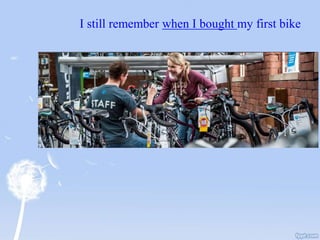
I still remember when I bought my first bike
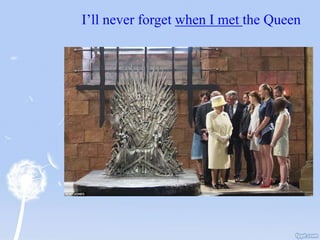
I’ll never forget when I met the Queen
You must remember to pick up Mrs
Lewis from the station.
Don’t forget to buy some milk.
They look forward in time, at things
one still has to do
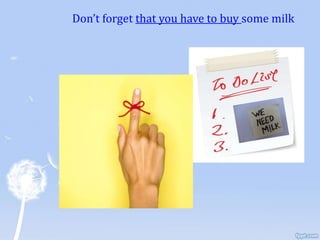
You must remember that you have to fetch Mrs
Lewis from the station.
Don’t forget that you have to buy some milk
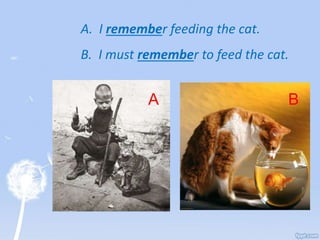
A. I remember feeding the cat.
B. I must remember to feed the cat.
A B
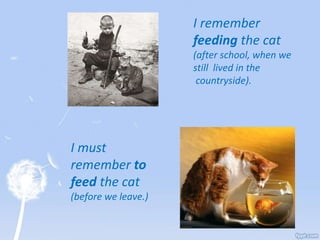
I remember
feeding the cat
(after school, when we
still lived in the
countryside).
I must
remember to
feed the cat
(before we leave.)
1. I’ll never forget seeing U2 in concert.
2. Don’t forget to phone me if you need any help.
 Which form is used “to recall a previous action”?
Which form is used “to remember what you have
to do”?
1. I’ll never forget seeing U2 in concert.
2. Don’t forget to phone me if you need any help.
 Which form is used “to recall a previous action”?
 the gerund
 Which form is used “to remember what you have
to do”?
 the infinitive
I regret leaving school at 14 – It was
a great mistake.
It looks back at the past, at something
you are sorry that you did
= I wish ....
...I hadn’t left school
• We regret to inform passengers that
the 14.50 train is one hour late.
It is used in announcements of bad
news
1. I regret seeing that film, it was so boring!
2. We regret to inform you that we are unable
to repair your car.
Which sentence means that “you are sorry for
what you are going to say?
Which sentence means “to be sorry for a previous
action”?
1. I regret seeing that film, it was so boring!
2. We regret to inform you that we are unable
to repair your car.
Which sentence means that “you are sorry for
what you are going to say?
 Number 2 = to infinitive
Which sentence means “to be sorry for a previous
action”?
 Number 1 = gerund
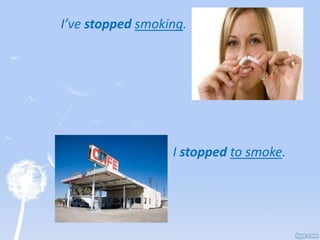
1. I’ve stopped smoking.
2. I stopped to smoke.
A B
I’ve stopped smoking.
I stopped to smoke.
Let’s practise!
• It's often hard to remember …………
vitamin pills. (TAKE)
Let’s practise!
• It's often hard to remember …………
vitamin pills. (TAKE)
• It's often hard to remember to take
vitamin pills.
Let’s practise!
• I’ll never forget …………..Halloween with
my grandparents when I was a child.
(CELEBRATE)
Let’s practise!
• I’ll never forget …………..Halloween with
my grandparents when I was a child.
(CELEBRATE)
• I’ll never forget celebrating Halloween
with my grandparents when I was a child.
Let’s practise!
• I have always regretted ………. up my
piano lessons.(GIVE)
Let’s practise!
• I have always regretted ………. up my
piano lessons.(GIVE)
• I have always regretted giving up my piano
lessons
Let’s practise!
• The management regrets ………. you that your contract
will not be renewed next month. (INFORM)
Let’s practise!
• The management regrets ……….you that your contract
will not be renewed next month. (INFORM)
• The management regrets to inform you that your contract
will not be renewed next month.
• He was accused of murdering / to murder
his boss
• He was accused of murdering his boss
The thieves managed escaping/ to
escape.
The thieves managed to escape.
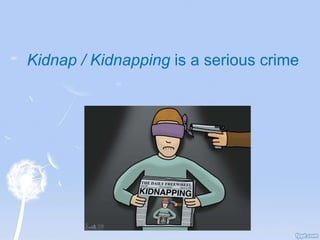
Kidnap / Kidnapping is a serious crime
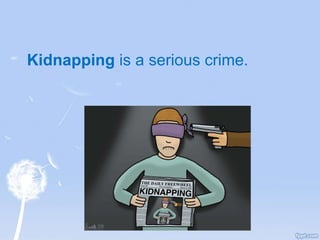
Kidnapping is a serious crime.
It’s difficult to learn / learning a
language.
It’s difficult to learn a language.
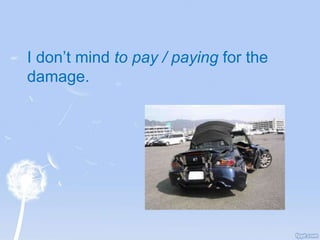
I don’t mind to pay / paying for the
damage.
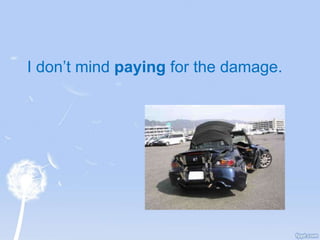
I don’t mind paying for the damage.
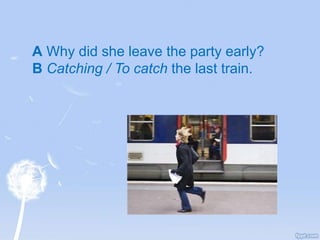
A Why did she leave the party early?
B Catching / To catch the last train.
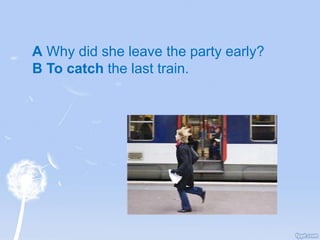
A Why did she leave the party early?
B To catch the last train.
Let’s work a bit further!
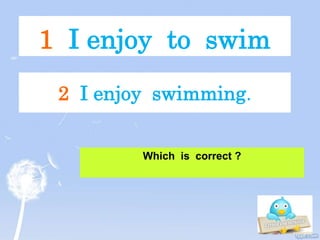
1 I enjoy to swim
Which is correct ?
2 I enjoy swimming.
1 I enjoy to swim
Which is correct ?
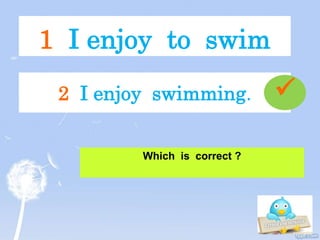
2 I enjoy swimming. 
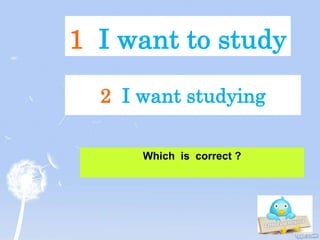
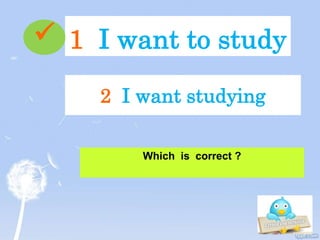
1 I want to study
Which is correct ?
2 I want studying
1 I want to study
Which is correct ?
2 I want studying

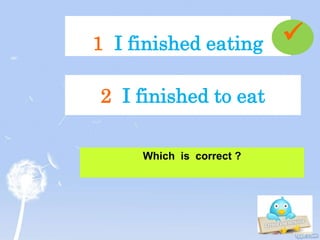
1 I finished eating
Which is correct ?
2 I finished to eat
1 I finished eating
Which is correct ?
2 I finished to eat

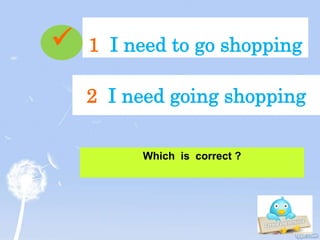
1 I need to go shopping
Which is correct ?
2 I need going shopping
1 I need to go shopping
Which is correct ?
2 I need going shopping

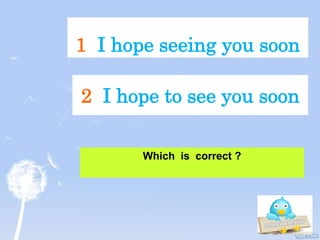
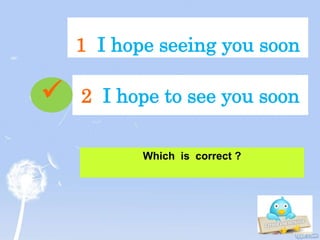
1 I hope seeing you soon
Which is correct ?
2 I hope to see you soon
1 I hope seeing you soon
Which is correct ?
2 I hope to see you soon
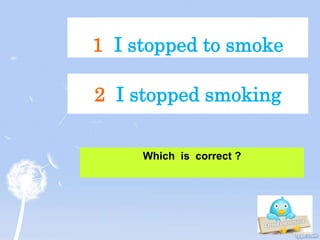
1 I stopped to smoke
Which is correct ?
2 I stopped smoking
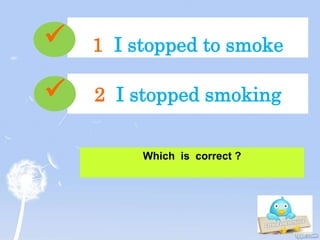
1 I stopped to smoke
Which is correct ?
2 I stopped smoking


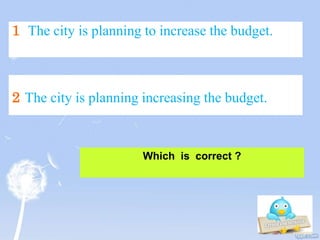
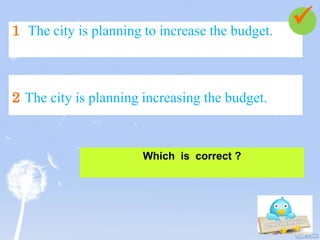
1 The city is planning to increase the budget.
Which is correct ?
2 The city is planning increasing the budget.
1 The city is planning to increase the budget.
Which is correct ?
2 The city is planning increasing the budget.

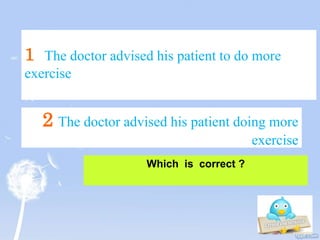
1 The doctor advised his patient to do more
exercise
Which is correct ?
2 The doctor advised his patient doing more
exercise
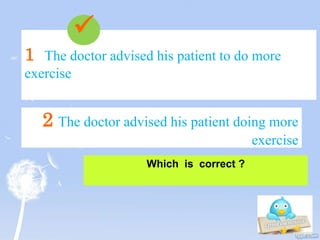
1 The doctor advised his patient to do more
exercise
Which is correct ?
2 The doctor advised his patient doing more
exercise

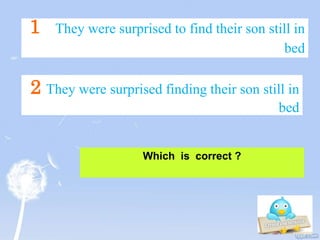
1 They were surprised to find their son still in
bed
Which is correct ?
2 They were surprised finding their son still in
bed
1 They were surprised to find their son still in
bed
Which is correct ?
2 They were surprised finding their son still in
bed

Which is correct ?
2 The teacher suggested to read books
regularly
1 The teacher suggested reading books
regularly
Which is correct ?
2 The teacher suggested to read books
regularly
1 The teacher suggested reading books
regularly

Which is correct ?
2 We are getting used to living in our new house
1 We are getting used to live in our new house
Which is correct ?
2 We are getting used to living in our new
house
1 We are getting used to live in our new house

You can find a list of verb
patterns on page 164 of your
book.
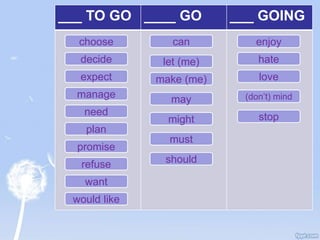
___ TO GO ____ GO ___ GOING
choose can
decide
enjoy
expect
hatelet (me)
lovemake (me)
manage may
might
(don’t) mind
must
need
plan
promise
refuse should
stop
want
would like
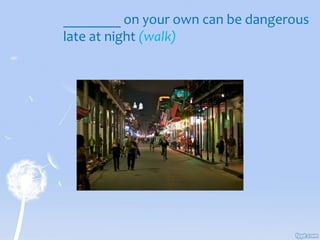
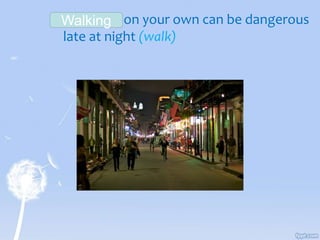
________ on your own can be dangerous
late at night (walk)
________ on your own can be dangerous
late at night (walk)
Walking
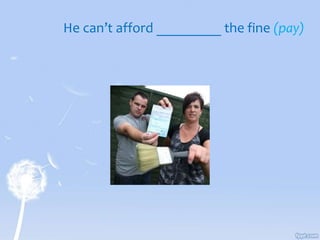
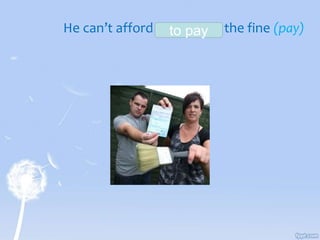
He can’t afford _________ the fine (pay)
He can’t afford _________ the fine (pay)to pay
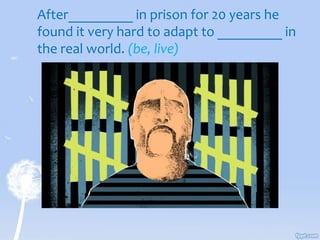
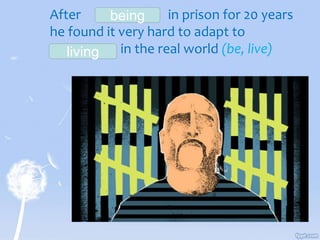
After_________ in prison for 20 years he
found it very hard to adapt to _________ in
the real world. (be, live)
After in prison for 20 years
he found it very hard to adapt to
_________ in the real world (be, live)
being
living
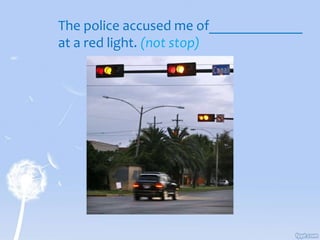
The police accused me of_____________
at a red light. (not stop)
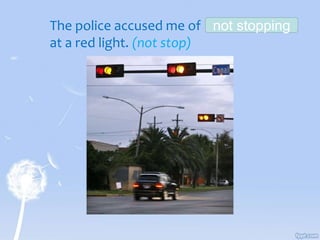
The police accused me of
at a red light. (not stop)
not stopping
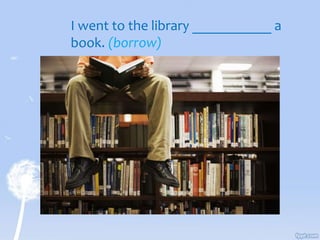
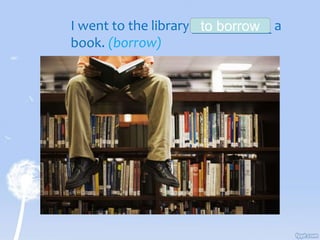
I went to the library ___________ a
book. (borrow)
I went to the library ___________ a
book. (borrow)
to borrow
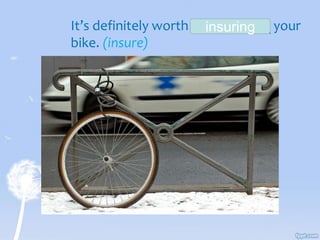
It’s definitely worth ___________ your
bike. (insure)
insuring
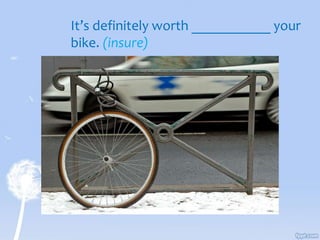
It’s definitely worth ___________ your
bike. (insure)
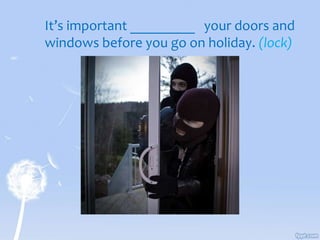
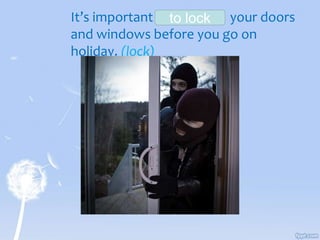
It’s important _________ your doors and
windows before you go on holiday. (lock)
It’s important _________ your doors
and windows before you go on
holiday. (lock)
to lock
Psychologists think that _________ violent videos
makes some children become interested in
____________ crimes. (watch, commit)
Psychologists think that _________ violent videos
makes some children become interested in
____________ crimes. (watch, commit)
watching
committing
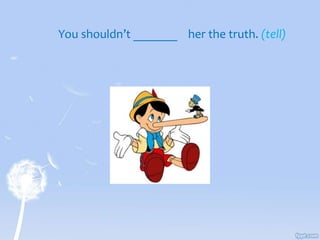
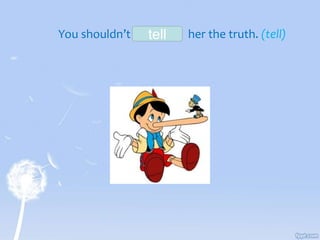
You shouldn’t _______ her the truth. (tell)
You shouldn’t _______ her the truth. (tell)tell
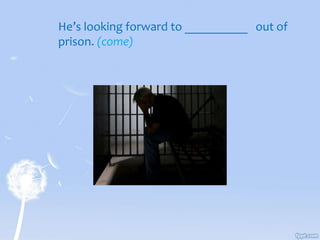
He’s looking forward to __________ out of
prison. (come)
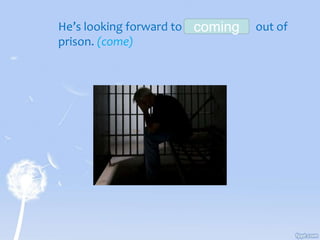
He’s looking forward to __________ out of
prison. (come)
coming
Gerunds and infinitives

Gerunds and infinitives

  • 2.
     to expresspurpose (answering the question WHY?)  I’m saving up to buy a present for my sister.  She’s going to the gym to lose weight.
  • 3.
    INFINITIVE with tois used…  after some adjectives surprised, delighted, disappointed, easy, happy, important, lucky, necessary, normal, possible  I was delighted to hear she finally got the job.  It is normal to feel nervous before an exam.  It is easy to find a parking spot at this time of the day.
  • 4.
    INFINITIVE with tois used…  after certain verbs agree, afford, appear, arrange, ask, choose, decide, deserve, expect, help, hesitate, hope, learn, manage, need, offer, prepare, pretend, promise, refuse, seem, would like, want:  He decided to stay for some more days.  She refused to go to the new dentist.  They deserve to win the competition.
  • 5.
    INFINITIVE with TOOand ENOUGH  too + adjective + infinitive She is too young to vote.  Adjective + enough + infinitive They are old enough to vote.
  • 6.
    Use the INFINITIVEwithout TO… (bare infinitive) • After modal verbs She may be clever but she is mot very friendly • With some other verbs like make and let Javier made Pablo cry Let me know if you don’t understand
  • 7.
    GERUND is used… as the subject or complement of a clause or sentence • Smoking makes me feel dizzy. • My favourite sport is swimming.
  • 8.
    GERUND is used… after prepositions  She’s not interested in getting married.  I’m not very good at driving.
  • 9.
    GERUND is used… verbs expressing likes and dislikes: Like, love, adore, hate, detest, dislike, enjoy, prefer • and after certain verbs: Admit, advise, suggest, finish, imagine, involve, mind, stop, be worth
  • 10.
    GERUND is used… •Be used to • Get used to • Can’t help • Can’t stand • Adapt to • Feel like • It’s no use • Keep on • Look forward to …after these common expressions
  • 11.
    Verbs followed byeither the gerund or the infinitive  Like, love, hate, prefer are usually followed by the gerund. However, the infinitive is also possible. I love to sunbathe/sunbathing  Begin, start, continue, intend are followed by the gerund or infinitve with no change in meaning: When I arrived it started to rain/raining.
  • 12.
    Verbs followed byeither the gerund or the infinitive with a change of meaning: forget remember regret stop
  • 13.
    Remember and forget Istill remember buying my first bike. I’ll never forget meeting the Queen. They look back at the past, at things one did
  • 14.
    I still rememberwhen I bought my first bike
  • 15.
    I’ll never forgetwhen I met the Queen
  • 16.
    You must rememberto pick up Mrs Lewis from the station. Don’t forget to buy some milk. They look forward in time, at things one still has to do
  • 17.
    You must rememberthat you have to fetch Mrs Lewis from the station.
  • 18.
    Don’t forget thatyou have to buy some milk
  • 19.
    A. I rememberfeeding the cat. B. I must remember to feed the cat. A B
  • 20.
    I remember feeding thecat (after school, when we still lived in the countryside). I must remember to feed the cat (before we leave.)
  • 21.
    1. I’ll neverforget seeing U2 in concert. 2. Don’t forget to phone me if you need any help.  Which form is used “to recall a previous action”? Which form is used “to remember what you have to do”?
  • 22.
    1. I’ll neverforget seeing U2 in concert. 2. Don’t forget to phone me if you need any help.  Which form is used “to recall a previous action”?  the gerund  Which form is used “to remember what you have to do”?  the infinitive
  • 23.
    I regret leavingschool at 14 – It was a great mistake. It looks back at the past, at something you are sorry that you did = I wish .... ...I hadn’t left school
  • 24.
    • We regretto inform passengers that the 14.50 train is one hour late. It is used in announcements of bad news
  • 25.
    1. I regretseeing that film, it was so boring! 2. We regret to inform you that we are unable to repair your car. Which sentence means that “you are sorry for what you are going to say? Which sentence means “to be sorry for a previous action”?
  • 26.
    1. I regretseeing that film, it was so boring! 2. We regret to inform you that we are unable to repair your car. Which sentence means that “you are sorry for what you are going to say?  Number 2 = to infinitive Which sentence means “to be sorry for a previous action”?  Number 1 = gerund
  • 27.
    1. I’ve stoppedsmoking. 2. I stopped to smoke. A B
  • 28.
    I’ve stopped smoking. Istopped to smoke.
  • 29.
    Let’s practise! • It'soften hard to remember ………… vitamin pills. (TAKE)
  • 30.
    Let’s practise! • It'soften hard to remember ………… vitamin pills. (TAKE) • It's often hard to remember to take vitamin pills.
  • 31.
    Let’s practise! • I’llnever forget …………..Halloween with my grandparents when I was a child. (CELEBRATE)
  • 32.
    Let’s practise! • I’llnever forget …………..Halloween with my grandparents when I was a child. (CELEBRATE) • I’ll never forget celebrating Halloween with my grandparents when I was a child.
  • 33.
    Let’s practise! • Ihave always regretted ………. up my piano lessons.(GIVE)
  • 34.
    Let’s practise! • Ihave always regretted ………. up my piano lessons.(GIVE) • I have always regretted giving up my piano lessons
  • 35.
    Let’s practise! • Themanagement regrets ………. you that your contract will not be renewed next month. (INFORM)
  • 36.
    Let’s practise! • Themanagement regrets ……….you that your contract will not be renewed next month. (INFORM) • The management regrets to inform you that your contract will not be renewed next month.
  • 37.
    • He wasaccused of murdering / to murder his boss
  • 38.
    • He wasaccused of murdering his boss
  • 39.
    The thieves managedescaping/ to escape.
  • 40.
  • 41.
    Kidnap / Kidnappingis a serious crime
  • 42.
    Kidnapping is aserious crime.
  • 43.
    It’s difficult tolearn / learning a language.
  • 44.
    It’s difficult tolearn a language.
  • 45.
    I don’t mindto pay / paying for the damage.
  • 46.
    I don’t mindpaying for the damage.
  • 47.
    A Why didshe leave the party early? B Catching / To catch the last train.
  • 48.
    A Why didshe leave the party early? B To catch the last train.
  • 49.
    Let’s work abit further!
  • 50.
    1 I enjoyto swim Which is correct ? 2 I enjoy swimming.
  • 51.
    1 I enjoyto swim Which is correct ? 2 I enjoy swimming. 
  • 52.
    1 I wantto study Which is correct ? 2 I want studying
  • 53.
    1 I wantto study Which is correct ? 2 I want studying 
  • 54.
    1 I finishedeating Which is correct ? 2 I finished to eat
  • 55.
    1 I finishedeating Which is correct ? 2 I finished to eat 
  • 56.
    1 I needto go shopping Which is correct ? 2 I need going shopping
  • 57.
    1 I needto go shopping Which is correct ? 2 I need going shopping 
  • 58.
    1 I hopeseeing you soon Which is correct ? 2 I hope to see you soon
  • 59.
    1 I hopeseeing you soon Which is correct ? 2 I hope to see you soon
  • 60.
    1 I stoppedto smoke Which is correct ? 2 I stopped smoking
  • 61.
    1 I stoppedto smoke Which is correct ? 2 I stopped smoking  
  • 62.
    1 The cityis planning to increase the budget. Which is correct ? 2 The city is planning increasing the budget.
  • 63.
    1 The cityis planning to increase the budget. Which is correct ? 2 The city is planning increasing the budget. 
  • 64.
    1 The doctoradvised his patient to do more exercise Which is correct ? 2 The doctor advised his patient doing more exercise
  • 65.
    1 The doctoradvised his patient to do more exercise Which is correct ? 2 The doctor advised his patient doing more exercise 
  • 66.
    1 They weresurprised to find their son still in bed Which is correct ? 2 They were surprised finding their son still in bed
  • 67.
    1 They weresurprised to find their son still in bed Which is correct ? 2 They were surprised finding their son still in bed 
  • 68.
    Which is correct? 2 The teacher suggested to read books regularly 1 The teacher suggested reading books regularly
  • 69.
    Which is correct? 2 The teacher suggested to read books regularly 1 The teacher suggested reading books regularly 
  • 70.
    Which is correct? 2 We are getting used to living in our new house 1 We are getting used to live in our new house
  • 71.
    Which is correct? 2 We are getting used to living in our new house 1 We are getting used to live in our new house 
  • 72.
    You can finda list of verb patterns on page 164 of your book.
  • 73.
    ___ TO GO____ GO ___ GOING choose can decide enjoy expect hatelet (me) lovemake (me) manage may might (don’t) mind must need plan promise refuse should stop want would like
  • 74.
    ________ on yourown can be dangerous late at night (walk)
  • 75.
    ________ on yourown can be dangerous late at night (walk) Walking
  • 76.
    He can’t afford_________ the fine (pay)
  • 77.
    He can’t afford_________ the fine (pay)to pay
  • 78.
    After_________ in prisonfor 20 years he found it very hard to adapt to _________ in the real world. (be, live)
  • 79.
    After in prisonfor 20 years he found it very hard to adapt to _________ in the real world (be, live) being living
  • 80.
    The police accusedme of_____________ at a red light. (not stop)
  • 81.
    The police accusedme of at a red light. (not stop) not stopping
  • 82.
    I went tothe library ___________ a book. (borrow)
  • 83.
    I went tothe library ___________ a book. (borrow) to borrow
  • 84.
    It’s definitely worth___________ your bike. (insure) insuring
  • 85.
    It’s definitely worth___________ your bike. (insure)
  • 86.
    It’s important _________your doors and windows before you go on holiday. (lock)
  • 87.
    It’s important _________your doors and windows before you go on holiday. (lock) to lock
  • 88.
    Psychologists think that_________ violent videos makes some children become interested in ____________ crimes. (watch, commit)
  • 89.
    Psychologists think that_________ violent videos makes some children become interested in ____________ crimes. (watch, commit) watching committing
  • 90.
    You shouldn’t _______her the truth. (tell)
  • 91.
    You shouldn’t _______her the truth. (tell)tell
  • 92.
    He’s looking forwardto __________ out of prison. (come)
  • 93.
    He’s looking forwardto __________ out of prison. (come) coming