GERUND AND
INFINITIVE
V+ing or To V ?
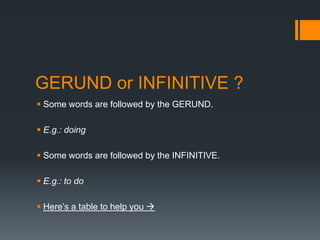
GERUND or INFINITIVE ?
 Some words are followed by the GERUND.
 E.g.: doing
 Some words are followed by the INFINITIVE.
 E.g.: to do
 Here’s a table to help you 
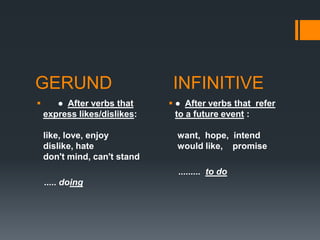
GERUND


INFINITIVE

● After verbs that
express likes/dislikes:

 ● After verbs that refer
to a future event :

like, love, enjoy
dislike, hate
don't mind, can't stand

want, hope, intend
would like, promise
......... to do

..... doing
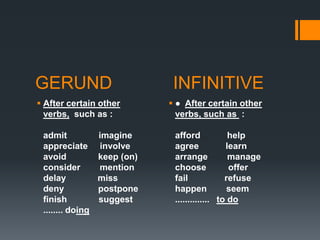
GERUND
 After certain other
verbs, such as :

admit
imagine
appreciate involve
avoid
keep (on)
consider
mention
delay
miss
deny
postpone
finish
suggest
........ doing

INFINITIVE
 ● After certain other
verbs, such as :

afford
help
agree
learn
arrange
manage
choose
offer
fail
refuse
happen
seem
.............. to do
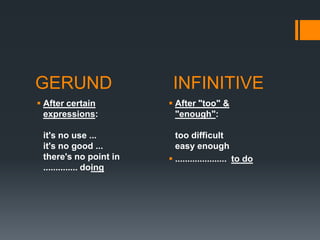
GERUND
 After certain
expressions:

it's no use ...
it's no good ...
there's no point in
.............. doing

INFINITIVE
 After "too" &
"enough":

too difficult
easy enough
 ..................... to do
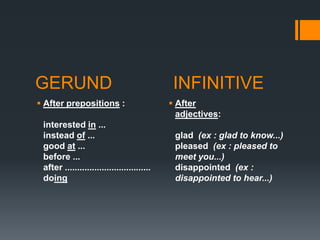
GERUND
 After prepositions :
interested in ...
instead of ...
good at ...
before ...
after ...................................
doing

INFINITIVE
 After
adjectives:

glad (ex : glad to know...)
pleased (ex : pleased to
meet you...)
disappointed (ex :
disappointed to hear...)
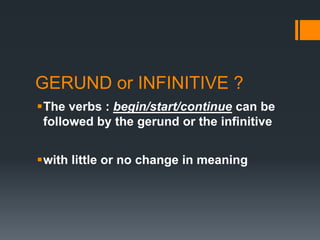
GERUND or INFINITIVE ?
The verbs : begin/start/continue can be
followed by the gerund or the infinitive
with little or no change in meaning
GERUND or INFINITIVE ?
The verbs : stop/try/remember can also
take both,
but the meaning changes
WHAT’S THE MEANING?
 STOP
 I’ve stopped watching cartoons.
 Meaning: Stop an activity
WHAT’S THE MEANING?
 STOP
 We stopped to go to the toilets at the petrol station.
 Meaning: Stop in order to
WHAT’S THE MEANING?
 TRY
 I ‘ve tried to understand his English, but I was unsuccessful.
 Meaning: Make an effort
WHAT’S THE MEANING?
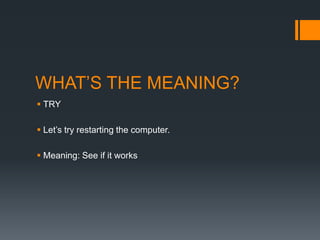
 TRY
 Let’s try restarting the computer.
 Meaning: See if it works
WHAT’S THE MEANING?
 REMEMBER
 Remember to bring your portfolio to the class tomorrow.
 Meaning: Don’t forget
WHAT’S THE MEANING?
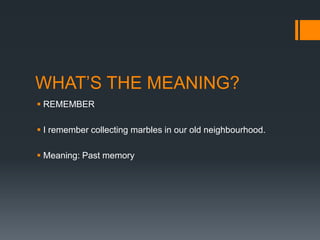
 REMEMBER
 I remember collecting marbles in our old neighbourhood.
 Meaning: Past memory
WHAT’S THE MEANING?
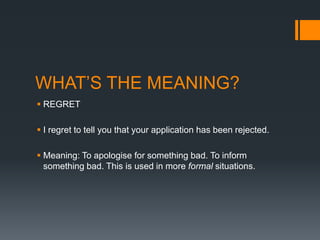
 REGRET
 I regret to tell you that your application has been rejected.
 Meaning: To apologise for something bad. To inform
something bad. This is used in more formal situations.
WHAT’S THE MEANING?
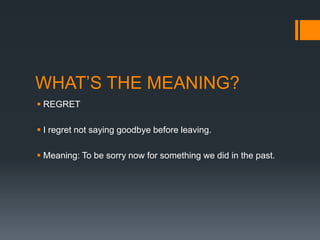
 REGRET
 I regret not saying goodbye before leaving.
 Meaning: To be sorry now for something we did in the past.
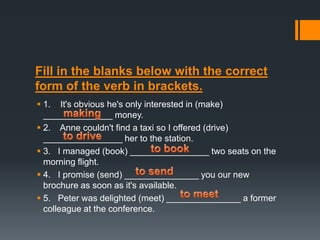
Fill in the blanks below with the correct
form of the verb in brackets.
 1. It's obvious he's only interested in (make)
______________ money.
 2. Anne couldn't find a taxi so I offered (drive)
________________ her to the station.
 3. I managed (book) ________________ two seats on the
morning flight.
 4. I promise (send) _______________ you our new
brochure as soon as it's available.
 5. Peter was delighted (meet) _______________ a former
colleague at the conference.
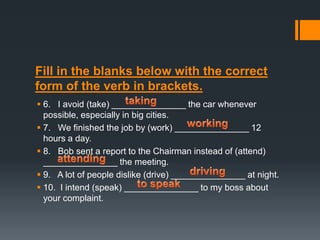
Fill in the blanks below with the correct
form of the verb in brackets.
 6. I avoid (take) _______________ the car whenever
possible, especially in big cities.
 7. We finished the job by (work) _______________ 12
hours a day.
 8. Bob sent a report to the Chairman instead of (attend)
_______________ the meeting.
 9. A lot of people dislike (drive) _______________ at night.
 10. I intend (speak) _______________ to my boss about
your complaint.

Gerund and Infinitive

  • 1.
  • 2.
    GERUND or INFINITIVE?  Some words are followed by the GERUND.  E.g.: doing  Some words are followed by the INFINITIVE.  E.g.: to do  Here’s a table to help you 
  • 3.
    GERUND  INFINITIVE ● After verbsthat express likes/dislikes:  ● After verbs that refer to a future event : like, love, enjoy dislike, hate don't mind, can't stand want, hope, intend would like, promise ......... to do ..... doing
  • 4.
    GERUND  After certainother verbs, such as : admit imagine appreciate involve avoid keep (on) consider mention delay miss deny postpone finish suggest ........ doing INFINITIVE  ● After certain other verbs, such as : afford help agree learn arrange manage choose offer fail refuse happen seem .............. to do
  • 5.
    GERUND  After certain expressions: it'sno use ... it's no good ... there's no point in .............. doing INFINITIVE  After "too" & "enough": too difficult easy enough  ..................... to do
  • 6.
    GERUND  After prepositions: interested in ... instead of ... good at ... before ... after ................................... doing INFINITIVE  After adjectives: glad (ex : glad to know...) pleased (ex : pleased to meet you...) disappointed (ex : disappointed to hear...)
  • 7.
    GERUND or INFINITIVE? The verbs : begin/start/continue can be followed by the gerund or the infinitive with little or no change in meaning
  • 8.
    GERUND or INFINITIVE? The verbs : stop/try/remember can also take both, but the meaning changes
  • 9.
    WHAT’S THE MEANING? STOP  I’ve stopped watching cartoons.  Meaning: Stop an activity
  • 10.
    WHAT’S THE MEANING? STOP  We stopped to go to the toilets at the petrol station.  Meaning: Stop in order to
  • 11.
    WHAT’S THE MEANING? TRY  I ‘ve tried to understand his English, but I was unsuccessful.  Meaning: Make an effort
  • 12.
    WHAT’S THE MEANING? TRY  Let’s try restarting the computer.  Meaning: See if it works
  • 13.
    WHAT’S THE MEANING? REMEMBER  Remember to bring your portfolio to the class tomorrow.  Meaning: Don’t forget
  • 14.
    WHAT’S THE MEANING? REMEMBER  I remember collecting marbles in our old neighbourhood.  Meaning: Past memory
  • 15.
    WHAT’S THE MEANING? REGRET  I regret to tell you that your application has been rejected.  Meaning: To apologise for something bad. To inform something bad. This is used in more formal situations.
  • 16.
    WHAT’S THE MEANING? REGRET  I regret not saying goodbye before leaving.  Meaning: To be sorry now for something we did in the past.
  • 17.
    Fill in theblanks below with the correct form of the verb in brackets.  1. It's obvious he's only interested in (make) ______________ money.  2. Anne couldn't find a taxi so I offered (drive) ________________ her to the station.  3. I managed (book) ________________ two seats on the morning flight.  4. I promise (send) _______________ you our new brochure as soon as it's available.  5. Peter was delighted (meet) _______________ a former colleague at the conference.
  • 18.
    Fill in theblanks below with the correct form of the verb in brackets.  6. I avoid (take) _______________ the car whenever possible, especially in big cities.  7. We finished the job by (work) _______________ 12 hours a day.  8. Bob sent a report to the Chairman instead of (attend) _______________ the meeting.  9. A lot of people dislike (drive) _______________ at night.  10. I intend (speak) _______________ to my boss about your complaint.