SIMPLE FUTURE The use of  “WILL”  and  “BE GOING TO” By: Miss Miryam Hdz.
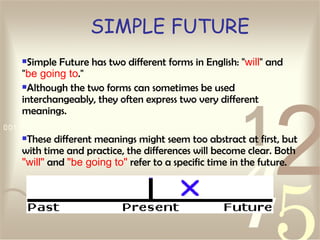
SIMPLE FUTURE Simple Future has two different forms in English: " will " and " be going to ."  Although the two forms can sometimes be used interchangeably, they often express two very different meanings.  These different meanings might seem too abstract at first, but with time and practice, the differences will become clear. Both  "will"  and  "be going to"  refer to a specific time in the future.
SIMPLE FUTURE FORM Will [will + verb] Examples: You  will help  him later.  Will  you  help  him later?  You  won’t help  him later.
SIMPLE FUTURE FORM Be Going To [am/is/are + going to + verb] Examples: You  are going to meet  Jane tonight.  Are  you  going to meet  Jane tonight?  You  are not going to meet  Jane tonight.
SIMPLE FUTURE USE 1  "Will"  to Express a Voluntary Action "Will" often suggests that a speaker  will do  something voluntarily.  A voluntary action is one the speaker offers to do for someone else. Often, we use  "will"  to respond to someone else's complaint or request for help.  We also use  "will"  when we request that someone help us or volunteer to do something for us. Similarly, we use  "won't"  when we refuse to voluntarily do something.
SIMPLE FUTURE Examples: I  will send  you the information when I get it.  I  will translate  the email, so Mr. Smith can read it.  Will  you  help  me move this heavy table?  Will  you  make  dinner?  I  will not do  your homework for you.  I  won't do  all the housework myself!  A: I'm really hungry. B: I 'll  make  some sandwiches.  A: I'm so tired. I'm about to fall asleep. B: I 'll   get  you some coffee.  A: The phone is ringing. B: I 'll   get  it.
SIMPLE FUTURE USE 2 "Will" to Express a Promise "Will"  is usually used in promises. Examples: I  will call  you when I arrive.  If I am elected President of the United States, I  will make  sure everyone has access to inexpensive health insurance.  I promise I  won’t tell  him about the surprise party.  Don't worry, I 'll be  careful.  I  won't tell  anyone your secret.
SIMPLE FUTURE "Be going to"  to Express a Plan "Be going to"  expresses that something is a plan. It expresses the idea that a person intends to do something in the future. It does not matter whether the plan is realistic or not.  Examples: He  is going to spend  his vacation in Hawaii.  She  is not going to spend  her vacation in Hawaii.  A: When  are  we  going to meet  each other tonight? B: We  are going to meet  at 6 PM.
SIMPLE FUTURE "Be going to"  to Express a Plan I 'm   going to be  an actor when I grow up.  Michelle  is going to begin  medical school next year.  They  are going to drive  all the way to Alaska.  Who  are  you  going to invite  to the party?  A: Who  is going to make  John's birthday cake? B: Sue  is going to make  John's birthday cake .
SIMPLE FUTURE " Will"  or  "Be Going to"  to Express a Prediction Both  "will"  and  "be going to"  can express the idea of a general prediction about the future. Predictions are guesses about what might happen in the future. In "prediction" sentences, the subject usually has little control over the future and therefore USES 1-3 do not apply. In the following examples, there is no difference in meaning.
SIMPLE FUTURE Examples: The year 2222  will be  a very interesting year.  The year 2222  is going to be  a very interesting year.  John Smith  will be  the next President.  John Smith  is going to be  the next President.  The movie "Zenith"  will win  several Academy Awards.  The movie "Zenith"  is going to win  several Academy Awards.
SIMPLE FUTURE ADVERB PLACEMENT The examples below show the placement for grammar adverbs such as: always, only, never, ever, still, just, etc. Examples: You  will  never  help  him.  Will  you  ever   help  him ?   You  are  never  going   to meet  Jane.  Are  you  ever  going   to meet  Jane ?
Will / Be Going To Using the words in parentheses, complete the text below with the appropriate tenses  . A: Why are you holding a piece of paper?  B: I (write)______________ a letter to my friends back home in Texas.  2. A: I'm about to fall asleep. I need to wake up!  B: I (get)____________ you a cup of coffee. That will wake you up.  3. A: I can't hear the television!  B: I (turn)_______________ it up so you can hear it.  4. We are so excited about our trip next month to France. We (visit) _______________ Paris, Nice and Grenoble. 5. Sarah (come)_____________ to the party. Oliver (be)____________ there as well.
Will / Be  Going To Using the words in parentheses, complete the text below with the appropriate tenses  6. Ted: It is so hot in here!  Sarah: I (turn)____________ the air-conditioning on.  7. I think he (be)______________ the next President of the United States.  8. After I graduate, I (attend)_____________ medical school and become a doctor. I have wanted to be a doctor all my life. 9. A: Excuse me, I need to talk to someone about our hotel room. I am afraid it is simply too small for four people.  B: That man at the service counter (help)_____________ you.  10. As soon as the weather clears up, we (walk)________________ down to the beach and go swimming.
Thanks for your attention Intermediate 1 Module 4 Reference: http://www.englishpage.com/verbpage/verbs18.htm

Simple Future

  • 1.
    SIMPLE FUTURE Theuse of “WILL” and “BE GOING TO” By: Miss Miryam Hdz.
  • 2.
    SIMPLE FUTURE SimpleFuture has two different forms in English: " will " and " be going to ." Although the two forms can sometimes be used interchangeably, they often express two very different meanings. These different meanings might seem too abstract at first, but with time and practice, the differences will become clear. Both "will" and "be going to" refer to a specific time in the future.
  • 3.
    SIMPLE FUTURE FORMWill [will + verb] Examples: You will help him later. Will you help him later? You won’t help him later.
  • 4.
    SIMPLE FUTURE FORMBe Going To [am/is/are + going to + verb] Examples: You are going to meet Jane tonight. Are you going to meet Jane tonight? You are not going to meet Jane tonight.
  • 5.
    SIMPLE FUTURE USE1 "Will" to Express a Voluntary Action "Will" often suggests that a speaker will do something voluntarily. A voluntary action is one the speaker offers to do for someone else. Often, we use "will" to respond to someone else's complaint or request for help. We also use "will" when we request that someone help us or volunteer to do something for us. Similarly, we use "won't" when we refuse to voluntarily do something.
  • 6.
    SIMPLE FUTURE Examples:I will send you the information when I get it. I will translate the email, so Mr. Smith can read it. Will you help me move this heavy table? Will you make dinner? I will not do your homework for you. I won't do all the housework myself! A: I'm really hungry. B: I 'll make some sandwiches. A: I'm so tired. I'm about to fall asleep. B: I 'll get you some coffee. A: The phone is ringing. B: I 'll get it.
  • 7.
    SIMPLE FUTURE USE2 "Will" to Express a Promise "Will" is usually used in promises. Examples: I will call you when I arrive. If I am elected President of the United States, I will make sure everyone has access to inexpensive health insurance. I promise I won’t tell him about the surprise party. Don't worry, I 'll be careful. I won't tell anyone your secret.
  • 8.
    SIMPLE FUTURE "Begoing to" to Express a Plan "Be going to" expresses that something is a plan. It expresses the idea that a person intends to do something in the future. It does not matter whether the plan is realistic or not. Examples: He is going to spend his vacation in Hawaii. She is not going to spend her vacation in Hawaii. A: When are we going to meet each other tonight? B: We are going to meet at 6 PM.
  • 9.
    SIMPLE FUTURE "Begoing to" to Express a Plan I 'm going to be an actor when I grow up. Michelle is going to begin medical school next year. They are going to drive all the way to Alaska. Who are you going to invite to the party? A: Who is going to make John's birthday cake? B: Sue is going to make John's birthday cake .
  • 10.
    SIMPLE FUTURE "Will" or "Be Going to" to Express a Prediction Both "will" and "be going to" can express the idea of a general prediction about the future. Predictions are guesses about what might happen in the future. In "prediction" sentences, the subject usually has little control over the future and therefore USES 1-3 do not apply. In the following examples, there is no difference in meaning.
  • 11.
    SIMPLE FUTURE Examples:The year 2222 will be a very interesting year. The year 2222 is going to be a very interesting year. John Smith will be the next President. John Smith is going to be the next President. The movie "Zenith" will win several Academy Awards. The movie "Zenith" is going to win several Academy Awards.
  • 12.
    SIMPLE FUTURE ADVERBPLACEMENT The examples below show the placement for grammar adverbs such as: always, only, never, ever, still, just, etc. Examples: You will never help him. Will you ever help him ? You are never going to meet Jane. Are you ever going to meet Jane ?
  • 13.
    Will / BeGoing To Using the words in parentheses, complete the text below with the appropriate tenses . A: Why are you holding a piece of paper? B: I (write)______________ a letter to my friends back home in Texas. 2. A: I'm about to fall asleep. I need to wake up! B: I (get)____________ you a cup of coffee. That will wake you up. 3. A: I can't hear the television! B: I (turn)_______________ it up so you can hear it. 4. We are so excited about our trip next month to France. We (visit) _______________ Paris, Nice and Grenoble. 5. Sarah (come)_____________ to the party. Oliver (be)____________ there as well.
  • 14.
    Will / Be Going To Using the words in parentheses, complete the text below with the appropriate tenses 6. Ted: It is so hot in here! Sarah: I (turn)____________ the air-conditioning on. 7. I think he (be)______________ the next President of the United States. 8. After I graduate, I (attend)_____________ medical school and become a doctor. I have wanted to be a doctor all my life. 9. A: Excuse me, I need to talk to someone about our hotel room. I am afraid it is simply too small for four people. B: That man at the service counter (help)_____________ you. 10. As soon as the weather clears up, we (walk)________________ down to the beach and go swimming.
  • 15.
    Thanks for yourattention Intermediate 1 Module 4 Reference: http://www.englishpage.com/verbpage/verbs18.htm