
4          Phrasal Verbs


The Things We Do


Focus on Grammar 3
Part II, Unit 10
By Ruth Luman, Gabriele Steiner, and BJ Wells
Copyright © 2006. Pearson Education, Inc. All rights reserved.
Phrasal Verbs

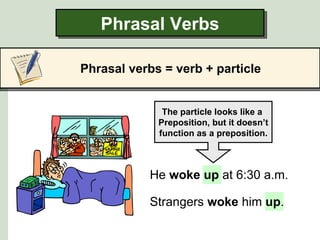
Phrasal verbs = verb + particle


              The particle looks like a
             Preposition, but it doesn’t
             function as a preposition.


           He woke up at 6:30 a.m.

           Strangers woke him up.
Particles

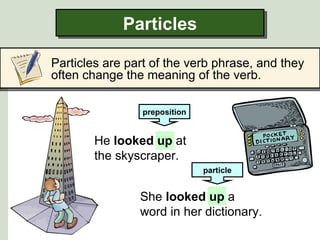
Particles are part of the verb phrase, and they
often change the meaning of the verb.

                preposition


        He looked up at
        the skyscraper.
                              particle


                She looked up a
                word in her dictionary.
Using Phrasal Verbs

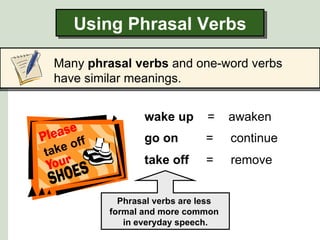
 Many phrasal verbs and one-word verbs
 have similar meanings.


                  wake up       =     awaken

     off
                  go on         =     continue
take
                  take off      =     remove


             Phrasal verbs are less
           formal and more common
              in everyday speech.
Transitive Phrasal Verbs
            1
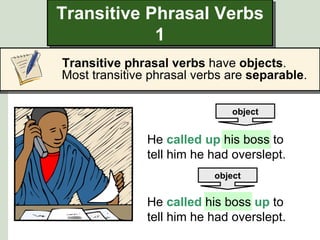
Transitive phrasal verbs have objects.
Most transitive phrasal verbs are separable.

                               object


               He called up his boss to
               tell him he had overslept.
                           object


               He called his boss up to
               tell him he had overslept.
Transitive Phrasal Verbs
             2
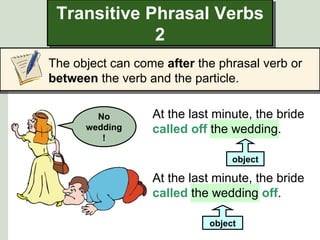
The object can come after the phrasal verb or
between the verb and the particle.

        No        At the last minute, the bride
      wedding     called off the wedding.
         !

                                 object

                  At the last minute, the bride
                  called the wedding off.

                            object
Be Careful!
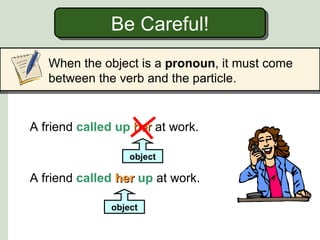
   When the object is a pronoun, it must come
   between the verb and the particle.


A friend called up her at work.

                  object

A friend called her up at work.

              object
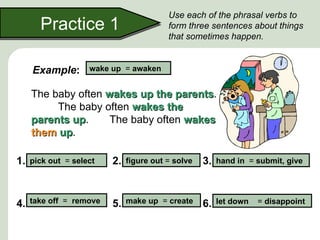
Use each of the phrasal verbs to
       Practice 1                        form three sentences about things
                                         that sometimes happen.


     Example:       wake up = awaken


     The baby often wakes up the parents.
                                  parents
          The baby often wakes the
     parents up.
             up      The baby often wakes
     them up.
          up

1.   pick out = select   2.   figure out = solve   3.   hand in = submit, give


4.   take off = remove   5.   make up = create     6.   let down   = disappoint
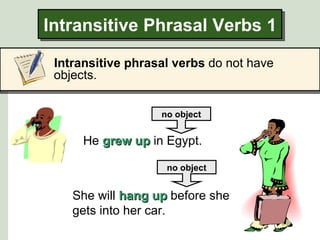
Intransitive Phrasal Verbs 1

 Intransitive phrasal verbs do not have
 objects.


                   no object


      He grew up in Egypt.

                    no object


    She will hang up before she
    gets into her car.
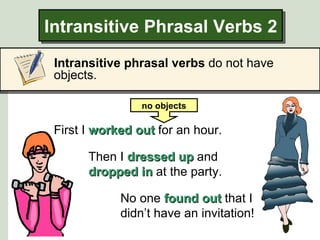
Intransitive Phrasal Verbs 2
 Intransitive phrasal verbs do not have
 objects.

                 no objects

 First I worked out for an hour.

       Then I dressed up and
       dropped in at the party.

             No one found out that I
             didn’t have an invitation!
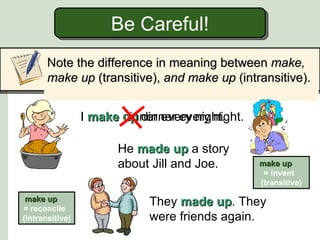
Be Careful!
       Note the difference in meaning between make,
       make up (transitive), and make up (intransitive).


                 I make up dinner every night.
                        dinner every night.

                       He made up a story
                       about Jill and Joe.       make up
                                                  = invent
                                                 (transitive)

 make up
= reconcile
                             They made up. They
                                         up
(intransitive)               were friends again.
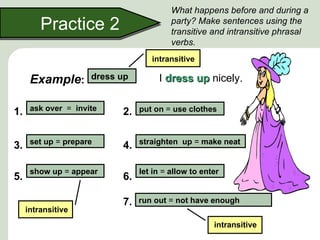
What happens before and during a
         Practice 2                      party? Make sentences using the
                                         transitive and intransitive phrasal
                                         verbs.
                                   intransitive

      Example:       dress up        I dress up nicely.

      ask over = invite         put on = use clothes
1.                         2.

      set up = prepare          straighten up = make neat
3.                         4.

      show up = appear          let in = allow to enter
5.                         6.

                           7.   run out = not have enough
     intransitive
                                                     intransitive
References

Copyright © 2006 Pearson Education
and its licensors. All rights reserved.

English Phrasal Verbs

  • 1.
    4 Phrasal Verbs The Things We Do Focus on Grammar 3 Part II, Unit 10 By Ruth Luman, Gabriele Steiner, and BJ Wells Copyright © 2006. Pearson Education, Inc. All rights reserved.
  • 2.
    Phrasal Verbs Phrasal verbs= verb + particle The particle looks like a Preposition, but it doesn’t function as a preposition. He woke up at 6:30 a.m. Strangers woke him up.
  • 3.
    Particles Particles are partof the verb phrase, and they often change the meaning of the verb. preposition He looked up at the skyscraper. particle She looked up a word in her dictionary.
  • 4.
    Using Phrasal Verbs Many phrasal verbs and one-word verbs have similar meanings. wake up = awaken off go on = continue take take off = remove Phrasal verbs are less formal and more common in everyday speech.
  • 5.
    Transitive Phrasal Verbs 1 Transitive phrasal verbs have objects. Most transitive phrasal verbs are separable. object He called up his boss to tell him he had overslept. object He called his boss up to tell him he had overslept.
  • 6.
    Transitive Phrasal Verbs 2 The object can come after the phrasal verb or between the verb and the particle. No At the last minute, the bride wedding called off the wedding. ! object At the last minute, the bride called the wedding off. object
  • 7.
    Be Careful! When the object is a pronoun, it must come between the verb and the particle. A friend called up her at work. object A friend called her up at work. object
  • 8.
    Use each ofthe phrasal verbs to Practice 1 form three sentences about things that sometimes happen. Example: wake up = awaken The baby often wakes up the parents. parents The baby often wakes the parents up. up The baby often wakes them up. up 1. pick out = select 2. figure out = solve 3. hand in = submit, give 4. take off = remove 5. make up = create 6. let down = disappoint
  • 9.
    Intransitive Phrasal Verbs1 Intransitive phrasal verbs do not have objects. no object He grew up in Egypt. no object She will hang up before she gets into her car.
  • 10.
    Intransitive Phrasal Verbs2 Intransitive phrasal verbs do not have objects. no objects First I worked out for an hour. Then I dressed up and dropped in at the party. No one found out that I didn’t have an invitation!
  • 11.
    Be Careful! Note the difference in meaning between make, make up (transitive), and make up (intransitive). I make up dinner every night. dinner every night. He made up a story about Jill and Joe. make up = invent (transitive) make up = reconcile They made up. They up (intransitive) were friends again.
  • 12.
    What happens beforeand during a Practice 2 party? Make sentences using the transitive and intransitive phrasal verbs. intransitive Example: dress up I dress up nicely. ask over = invite put on = use clothes 1. 2. set up = prepare straighten up = make neat 3. 4. show up = appear let in = allow to enter 5. 6. 7. run out = not have enough intransitive intransitive
  • 13.
    References Copyright © 2006Pearson Education and its licensors. All rights reserved.