PAST TENSES
B1
Past tenses 1. PAST SIMPLE
2. PAST CONTINUOUS
3. PAST PERFECT
4. PAST TENSES TOGETHER
Read the text
Taking a short cut
again, and try to
find examples of
these past tenses.
USES OF THE PAST
TENSES
Now you’ll find groups of uses that correspond to the past tenses.
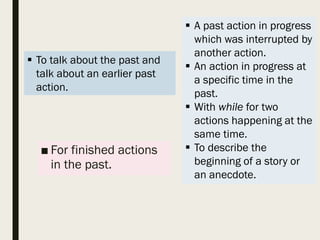
■ For finished actions
in the past.
 A past action in progress
which was interrupted by
another action.
 An action in progress at
a specific time in the
past.
 With while for two
actions happening at the
same time.
 To describe the
beginning of a story or
an anecdote.
 To talk about the past and
talk about an earlier past
action.
TIME EXPRESSIONS
What time expressions can we use for each of the
past tenses? Give examples!
Yesterday, then,
when, How long
ago...?, last
night/week/
month/year/
Friday/October,
etc.; three
days/weeks,
etc.;
ago, in 1999, etc.
While, when, as, all morning/evening/day/week, etc.
Before,
after,
already, just,
for, since,
till/until,
when,
by the time,
never, etc.
For,
Since,
How long,
Before,
Until,
etc.
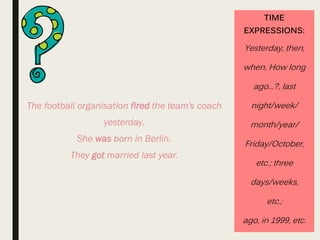
TIME
EXPRESSIONS:
Yesterday, then,
when, How long
ago...?, last
night/week/
month/year/
Friday/October,
etc.; three
days/weeks,
etc.;
ago, in 1999, etc.
The football organisation fired the team's coach
yesterday.
She was born in Berlin.
They got married last year.
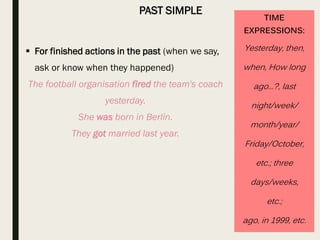
PAST SIMPLE
TIME
EXPRESSIONS:
Yesterday, then,
when, How long
ago...?, last
night/week/
month/year/
Friday/October,
etc.; three
days/weeks,
etc.;
ago, in 1999, etc.
 For finished actions in the past (when we say,
ask or know when they happened)
The football organisation fired the team's coach
yesterday.
She was born in Berlin.
They got married last year.
TIME EXPRESSIONS:
While, when, as, all morning/evening/day/week, etc.
We were watching the tennis match when the phone rang.
What were you doing at six o’clock last night?
PAST CONTINUOUS
TIME EXPRESSIONS:
While, when, as, all morning/evening/day/week, etc.
 To talk about an action in progress at a specific time in the past.
We were watching the tennis match when the phone rang.
What were you doing at six o’clock last night?
(was/were + verb -ing)
TIME EXPRESSIONS:
While, when, as, all morning/evening/day/week, etc.
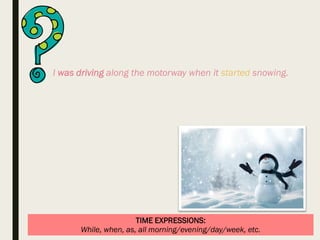
I was driving along the motorway when it started snowing.
PAST CONTINUOUS
TIME EXPRESSIONS:
While, when, as, all morning/evening/day/week, etc.
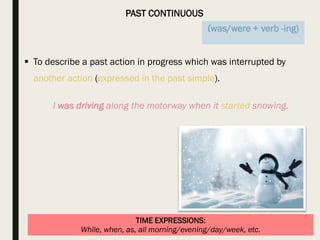
 To describe a past action in progress which was interrupted by
another action (expressed in the past simple).
I was driving along the motorway when it started snowing.
(was/were + verb -ing)
TIME EXPRESSIONS:
While, when, as, all morning/evening/day/week, etc.
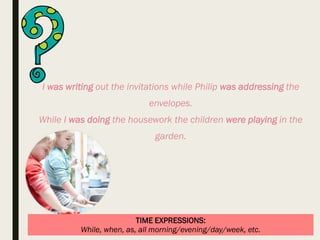
I was writing out the invitations while Philip was addressing the
envelopes.
While I was doing the housework the children were playing in the
garden.
PAST CONTINUOUS
TIME EXPRESSIONS:
While, when, as, all morning/evening/day/week, etc.
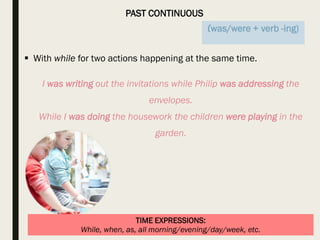
 With while for two actions happening at the same time.
I was writing out the invitations while Philip was addressing the
envelopes.
While I was doing the housework the children were playing in the
garden.
(was/were + verb -ing)
TIME EXPRESSIONS:
While, when, as, all morning/evening/day/week, etc.
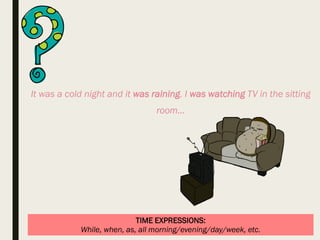
It was a cold night and it was raining. I was watching TV in the sitting
room…
PAST CONTINUOUS
TIME EXPRESSIONS:
While, when, as, all morning/evening/day/week, etc.
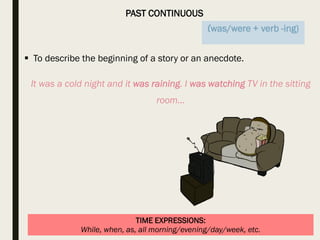
 To describe the beginning of a story or an anecdote.
It was a cold night and it was raining. I was watching TV in the sitting
room…
(was/were + verb -ing)
TIME
EXPRESSIONS:
Before,
after,
already, just,
for, since,
till/until, when,
by the time,
never, etc.
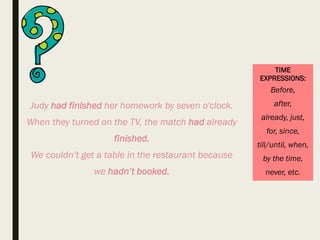
Judy had finished her homework by seven o'clock.
When they turned on the TV, the match had already
finished.
We couldn’t get a table in the restaurant because
we hadn’t booked.
PAST PERFECT
TIME
EXPRESSIONS:
Before,
after,
already, just,
for, since,
till/until, when,
by the time,
never, etc.
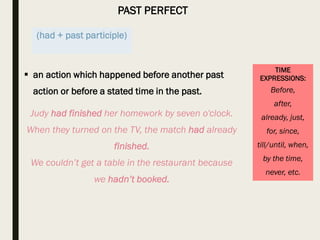
 an action which happened before another past
action or before a stated time in the past.
Judy had finished her homework by seven o'clock.
When they turned on the TV, the match had already
finished.
We couldn’t get a table in the restaurant because
we hadn’t booked.
(had + past participle)
PAST PERFECT
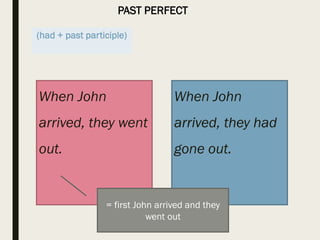
(had + past participle)
When John
arrived, they went
out.
When John
arrived, they had
gone out.
PAST PERFECT
(had + past participle)
When John
arrived, they went
out.
When John
arrived, they had
gone out.
= first John arrived and they
went out
PAST PERFECT
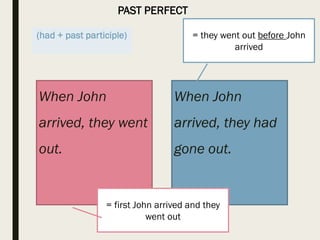
(had + past participle)
When John
arrived, they went
out.
When John
arrived, they had
gone out.
= first John arrived and they
went out
= they went out before John
arrived

Past tenses (simple, continuous, past perfect)

  • 1.
  • 2.
    Past tenses 1.PAST SIMPLE 2. PAST CONTINUOUS 3. PAST PERFECT 4. PAST TENSES TOGETHER Read the text Taking a short cut again, and try to find examples of these past tenses.
  • 3.
    USES OF THEPAST TENSES Now you’ll find groups of uses that correspond to the past tenses.
  • 4.
    ■ For finishedactions in the past.  A past action in progress which was interrupted by another action.  An action in progress at a specific time in the past.  With while for two actions happening at the same time.  To describe the beginning of a story or an anecdote.  To talk about the past and talk about an earlier past action.
  • 5.
    TIME EXPRESSIONS What timeexpressions can we use for each of the past tenses? Give examples!
  • 6.
    Yesterday, then, when, Howlong ago...?, last night/week/ month/year/ Friday/October, etc.; three days/weeks, etc.; ago, in 1999, etc. While, when, as, all morning/evening/day/week, etc. Before, after, already, just, for, since, till/until, when, by the time, never, etc. For, Since, How long, Before, Until, etc.
  • 7.
    TIME EXPRESSIONS: Yesterday, then, when, Howlong ago...?, last night/week/ month/year/ Friday/October, etc.; three days/weeks, etc.; ago, in 1999, etc. The football organisation fired the team's coach yesterday. She was born in Berlin. They got married last year.
  • 8.
    PAST SIMPLE TIME EXPRESSIONS: Yesterday, then, when,How long ago...?, last night/week/ month/year/ Friday/October, etc.; three days/weeks, etc.; ago, in 1999, etc.  For finished actions in the past (when we say, ask or know when they happened) The football organisation fired the team's coach yesterday. She was born in Berlin. They got married last year.
  • 9.
    TIME EXPRESSIONS: While, when,as, all morning/evening/day/week, etc. We were watching the tennis match when the phone rang. What were you doing at six o’clock last night?
  • 10.
    PAST CONTINUOUS TIME EXPRESSIONS: While,when, as, all morning/evening/day/week, etc.  To talk about an action in progress at a specific time in the past. We were watching the tennis match when the phone rang. What were you doing at six o’clock last night? (was/were + verb -ing)
  • 11.
    TIME EXPRESSIONS: While, when,as, all morning/evening/day/week, etc. I was driving along the motorway when it started snowing.
  • 12.
    PAST CONTINUOUS TIME EXPRESSIONS: While,when, as, all morning/evening/day/week, etc.  To describe a past action in progress which was interrupted by another action (expressed in the past simple). I was driving along the motorway when it started snowing. (was/were + verb -ing)
  • 13.
    TIME EXPRESSIONS: While, when,as, all morning/evening/day/week, etc. I was writing out the invitations while Philip was addressing the envelopes. While I was doing the housework the children were playing in the garden.
  • 14.
    PAST CONTINUOUS TIME EXPRESSIONS: While,when, as, all morning/evening/day/week, etc.  With while for two actions happening at the same time. I was writing out the invitations while Philip was addressing the envelopes. While I was doing the housework the children were playing in the garden. (was/were + verb -ing)
  • 15.
    TIME EXPRESSIONS: While, when,as, all morning/evening/day/week, etc. It was a cold night and it was raining. I was watching TV in the sitting room…
  • 16.
    PAST CONTINUOUS TIME EXPRESSIONS: While,when, as, all morning/evening/day/week, etc.  To describe the beginning of a story or an anecdote. It was a cold night and it was raining. I was watching TV in the sitting room… (was/were + verb -ing)
  • 17.
    TIME EXPRESSIONS: Before, after, already, just, for, since, till/until,when, by the time, never, etc. Judy had finished her homework by seven o'clock. When they turned on the TV, the match had already finished. We couldn’t get a table in the restaurant because we hadn’t booked.
  • 18.
    PAST PERFECT TIME EXPRESSIONS: Before, after, already, just, for,since, till/until, when, by the time, never, etc.  an action which happened before another past action or before a stated time in the past. Judy had finished her homework by seven o'clock. When they turned on the TV, the match had already finished. We couldn’t get a table in the restaurant because we hadn’t booked. (had + past participle)
  • 19.
    PAST PERFECT (had +past participle) When John arrived, they went out. When John arrived, they had gone out.
  • 20.
    PAST PERFECT (had +past participle) When John arrived, they went out. When John arrived, they had gone out. = first John arrived and they went out
  • 21.
    PAST PERFECT (had +past participle) When John arrived, they went out. When John arrived, they had gone out. = first John arrived and they went out = they went out before John arrived