Infinitives and Gerunds
C/ San Rafael, 25 46701-Gandia Tfno. 962 965 096    info@escolapiasgandia.es
                                                   www.escolapiasgandia.es                 COLEGIO ESCOLAPIAS
                                                                                                GANDIA


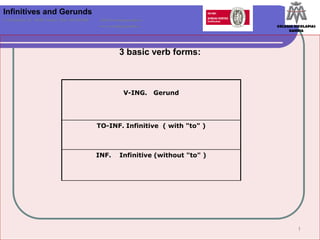
                                                              3 basic verb forms:


                                                                 V-ING.        Gerund


                                                   TO-INF. Infinitive ( with "to" )


                                                   INF.       Infinitive (without "to" )


                                                                                                    1
   USES OF THE GERUND: (V-ING)
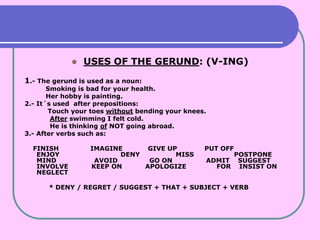
1.- The gerund is used as a noun:
       Smoking is bad for your health.
       Her hobby is painting.
2.- It´s used after prepositions:
       Touch your toes without bending your knees.
        After swimming I felt cold.
        He is thinking of NOT going abroad.
3.- After verbs such as:

  FINISH          IMAGINE      GIVE UP           PUT OFF
   ENJOY                 DENY         MISS                 POSTPONE
   MIND            AVOID       GO ON             ADMIT      SUGGEST
   INVOLVE        KEEP ON     APOLOGIZE            FOR      INSIST ON
   NEGLECT

      * DENY / REGRET / SUGGEST + THAT + SUBJECT + VERB
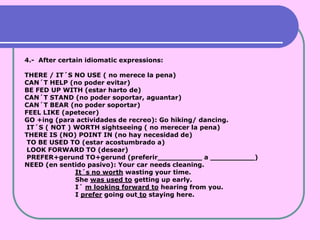
4.- After certain idiomatic expressions:

THERE / IT´S NO USE ( no merece la pena)
CAN´T HELP (no poder evitar)
BE FED UP WITH (estar harto de)
CAN´T STAND (no poder soportar, aguantar)
CAN´T BEAR (no poder soportar)
FEEL LIKE (apetecer)
GO +ing (para actividades de recreo): Go hiking/ dancing.
 IT´S ( NOT ) WORTH sightseeing ( no merecer la pena)
THERE IS (NO) POINT IN (no hay necesidad de)
 TO BE USED TO (estar acostumbrado a)
 LOOK FORWARD TO (desear)
 PREFER+gerund TO+gerund (preferir__________ a __________)
NEED (en sentido pasivo): Your car needs cleaning.
              It´s no worth wasting your time.
              She was used to getting up early.
              I´ m looking forward to hearing from you.
              I prefer going out to staying here.
USES OF TO-INFINITIVE
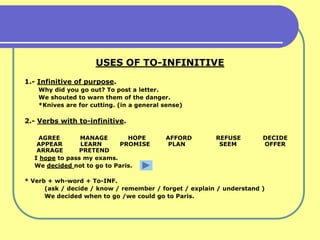
1.- Infinitive of purpose.
    Why did you go out? To post a letter.
    We shouted to warn them of the danger.
    *Knives are for cutting. (in a general sense)

2.- Verbs with to-infinitive.

   AGREE        MANAGE        HOPE         AFFORD       REFUSE        DECIDE
   APPEAR       LEARN      PROMISE          PLAN         SEEM         OFFER
   ARRAGE      PRETEND
  I hope to pass my exams.
  We decided not to go to Paris.

* Verb + wh-word + To-INF.
      (ask / decide / know / remember / forget / explain / understand )
      We decided when to go /we could go to Paris.
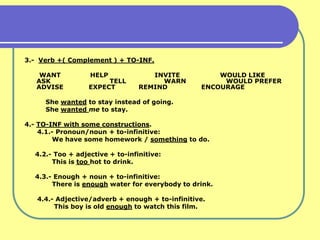
3.- Verb +( Complement ) + TO-INF.

    WANT          HELP              INVITE           WOULD LIKE
   ASK                 TELL           WARN            WOULD PREFER
   ADVISE         EXPECT         REMIND          ENCOURAGE

     She wanted to stay instead of going.
     She wanted me to stay.

4.- TO-INF with some constructions.
    4.1.- Pronoun/noun + to-infinitive:
        We have some homework / something to do.

  4.2.- Too + adjective + to-infinitive:
       This is too hot to drink.

  4.3.- Enough + noun + to-infinitive:
       There is enough water for everybody to drink.

   4.4.- Adjective/adverb + enough + to-infinitive.
        This boy is old enough to watch this film.
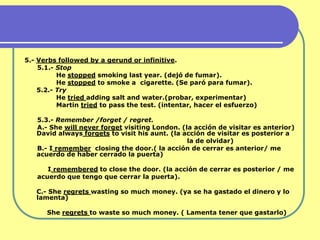
5.- Verbs followed by a gerund or infinitive.
    5.1.- Stop
          He stopped smoking last year. (dejó de fumar).
          He stopped to smoke a cigarette. (Se paró para fumar).
    5.2.- Try
          He tried adding salt and water.(probar, experimentar)
          Martin tried to pass the test. (intentar, hacer el esfuerzo)

   5.3.- Remember /forget / regret.
   A.- She will never forget visiting London. (la acción de visitar es anterior)
   David always forgets to visit his aunt. (la acción de visitar es posterior a
                                                la de olvidar)
   B.- I remember closing the door.( la acción de cerrar es anterior/ me
   acuerdo de haber cerrado la puerta)

      I remembered to close the door. (la acción de cerrar es posterior / me
   acuerdo que tengo que cerrar la puerta).

   C.- She regrets wasting so much money. (ya se ha gastado el dinero y lo
   lamenta)

      She regrets to waste so much money. ( Lamenta tener que gastarlo)
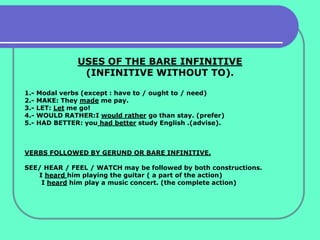
USES OF THE BARE INFINITIVE
                  (INFINITIVE WITHOUT TO).

1.-   Modal verbs (except : have to / ought to / need)
2.-   MAKE: They made me pay.
3.-   LET: Let me go!
4.-   WOULD RATHER:I would rather go than stay. (prefer)
5.-   HAD BETTER: you had better study English .(advise).


VERBS FOLLOWED BY GERUND OR BARE INFINITIVE.

SEE/ HEAR / FEEL / WATCH may be followed by both constructions.
   I heard him playing the guitar ( a part of the action)
    I heard him play a music concert. (the complete action)

Gerund Vs Infinitive

  • 1.
    Infinitives and Gerunds C/San Rafael, 25 46701-Gandia Tfno. 962 965 096 info@escolapiasgandia.es www.escolapiasgandia.es COLEGIO ESCOLAPIAS GANDIA 3 basic verb forms: V-ING. Gerund TO-INF. Infinitive ( with "to" ) INF. Infinitive (without "to" ) 1
  • 2.
    USES OF THE GERUND: (V-ING) 1.- The gerund is used as a noun: Smoking is bad for your health. Her hobby is painting. 2.- It´s used after prepositions: Touch your toes without bending your knees. After swimming I felt cold. He is thinking of NOT going abroad. 3.- After verbs such as: FINISH IMAGINE GIVE UP PUT OFF ENJOY DENY MISS POSTPONE MIND AVOID GO ON ADMIT SUGGEST INVOLVE KEEP ON APOLOGIZE FOR INSIST ON NEGLECT * DENY / REGRET / SUGGEST + THAT + SUBJECT + VERB
  • 3.
    4.- After certainidiomatic expressions: THERE / IT´S NO USE ( no merece la pena) CAN´T HELP (no poder evitar) BE FED UP WITH (estar harto de) CAN´T STAND (no poder soportar, aguantar) CAN´T BEAR (no poder soportar) FEEL LIKE (apetecer) GO +ing (para actividades de recreo): Go hiking/ dancing. IT´S ( NOT ) WORTH sightseeing ( no merecer la pena) THERE IS (NO) POINT IN (no hay necesidad de) TO BE USED TO (estar acostumbrado a) LOOK FORWARD TO (desear) PREFER+gerund TO+gerund (preferir__________ a __________) NEED (en sentido pasivo): Your car needs cleaning. It´s no worth wasting your time. She was used to getting up early. I´ m looking forward to hearing from you. I prefer going out to staying here.
  • 4.
    USES OF TO-INFINITIVE 1.-Infinitive of purpose. Why did you go out? To post a letter. We shouted to warn them of the danger. *Knives are for cutting. (in a general sense) 2.- Verbs with to-infinitive. AGREE MANAGE HOPE AFFORD REFUSE DECIDE APPEAR LEARN PROMISE PLAN SEEM OFFER ARRAGE PRETEND I hope to pass my exams. We decided not to go to Paris. * Verb + wh-word + To-INF. (ask / decide / know / remember / forget / explain / understand ) We decided when to go /we could go to Paris.
  • 5.
    3.- Verb +(Complement ) + TO-INF. WANT HELP INVITE WOULD LIKE ASK TELL WARN WOULD PREFER ADVISE EXPECT REMIND ENCOURAGE She wanted to stay instead of going. She wanted me to stay. 4.- TO-INF with some constructions. 4.1.- Pronoun/noun + to-infinitive: We have some homework / something to do. 4.2.- Too + adjective + to-infinitive: This is too hot to drink. 4.3.- Enough + noun + to-infinitive: There is enough water for everybody to drink. 4.4.- Adjective/adverb + enough + to-infinitive. This boy is old enough to watch this film.
  • 6.
    5.- Verbs followedby a gerund or infinitive. 5.1.- Stop He stopped smoking last year. (dejó de fumar). He stopped to smoke a cigarette. (Se paró para fumar). 5.2.- Try He tried adding salt and water.(probar, experimentar) Martin tried to pass the test. (intentar, hacer el esfuerzo) 5.3.- Remember /forget / regret. A.- She will never forget visiting London. (la acción de visitar es anterior) David always forgets to visit his aunt. (la acción de visitar es posterior a la de olvidar) B.- I remember closing the door.( la acción de cerrar es anterior/ me acuerdo de haber cerrado la puerta) I remembered to close the door. (la acción de cerrar es posterior / me acuerdo que tengo que cerrar la puerta). C.- She regrets wasting so much money. (ya se ha gastado el dinero y lo lamenta) She regrets to waste so much money. ( Lamenta tener que gastarlo)
  • 7.
    USES OF THEBARE INFINITIVE (INFINITIVE WITHOUT TO). 1.- Modal verbs (except : have to / ought to / need) 2.- MAKE: They made me pay. 3.- LET: Let me go! 4.- WOULD RATHER:I would rather go than stay. (prefer) 5.- HAD BETTER: you had better study English .(advise). VERBS FOLLOWED BY GERUND OR BARE INFINITIVE. SEE/ HEAR / FEEL / WATCH may be followed by both constructions. I heard him playing the guitar ( a part of the action) I heard him play a music concert. (the complete action)