Future
tenses
Talk for a minute about each of the
following:
– Your arrangements for this
evening.
– Your intentions for next year.
– Your predictions for the planet
for 2020.
Brainstorm
forms to
express the
future
will…
Future
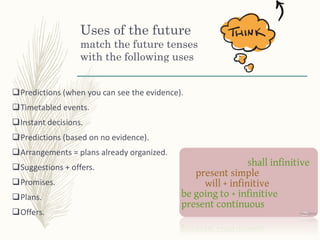
Uses of the future
match the future tenses
with the following uses
Predictions (when you can see the evidence).
Timetabled events.
Instant decisions.
Predictions (based on no evidence).
Arrangements = plans already organized.
Suggestions + offers.
Promises.
Plans.
Offers.
Future simple
 Spontaneous decisions
 Let’s go, I’ll buy you an ice-cream!
 Time clauses & Conditionals
 If I win the lottery, I’ll buy a boat
 Promises and offers
 I’ll help you with your luggage!
 Predictions which are not sure to happen
 Next year the school will move to a new building
 After “I think…”
 I think I’ll take a short nap. I’m so tired
Will + infinitive
shall
– When we offer to do something, and this takes
the form of a question, we use shall together
with I and we.
Shall I throw away this bread?
What I shall I do with my old phone?
Where shall we go for lunch today?
Future with “going to”
 Future plans
We are going to have a party as soon as we
move house.
Predictions based on an evidence
Look at those dark clouds. It’s going to rain.
be going to +
infinitive
Present continuous
– We use the present continuous when there is an
arrangement to do something – something has been
organized.
We’re having Liz and Nick for dinner tonight.
I’m meeting my bank manager tomorrow.
– There is sometimes very little difference between a plan,
and an arrangement, and we can often use either going to
or the present continuous.
to be + -ing
Talk about a plan you have…
– For this evening
– For the weekend
– For your next holiday
– To save money or spend less
– To improve your diet
– To learn something new
Make a prediction about…
– The environment
– Your favourite sports club
– The economy and unemployment
– An actor, singer, or group you like
– Your friends’ or family members’ career
– The characters in a TV series you watch
Responding to plans and
predictions
Plans
I’m going to..
Are you? So am I!
What a good idea! How nice!
Predictions
I don’t think…will / is going to…
I think so too.
I don’t think so either.
I hope so. I hope not
Future
Continuous
 to express an action in progress at a
certain time in the future.
In two weeks’ time, we will be enjoying our
Christmas celebrations
To ask about someone’s plans
Will you be seeing Laura this evening?
will be + -ing
Future Perfect
 to express an action that will be
complete in the future
In 4 weeks’ time we will have started a
new year
Will have + past
participle
How well can you
use these tenses?
I can’t believe that in June we _______
married for 20 years! (BE)
How well can you
use these tenses?
I can’t believe that in June we
_______ married for 20 years! (BE)
will have been
(action complete in the future)
We ___ back before six unless we
catch the earlier train (NOT BE)
We ___ back before six unless we
catch the earlier train (NOT BE)
won’t be
(1st conditional)
Oh no! Look at that traffic jam.
We __ !
(BE LATE)
Oh no! Look at that traffic jam.
We __ !
(BE LATE)
are going to be
(prediction based on an evidence)
What do you think we ____ this time
next year?
(DO)
What do you think we ____ this time
next year?
(DO)
will be doing
(action happening at a
specific point in the future)
I’ll tell you what the plans are
as soon as I _____ them.
(KNOW)
I’ll tell you what the plans are
as soon as I _____ them.
(KNOW)
know
(time clause)
By the end of this course you ___
1,000 words.
(LEARN)
By the end of this course you ___
1,000 words.
(LEARN)
will have learned/learnt
(action completed in the future)
I can’t meet you at 9:00.
I ____ my maths exam.
It starts at 8:30 (DO)
I can’t meet you at 9:00.
I ____ my maths exam.
It starts at 8:30 (DO)
will be doing
(action in progress
in the future)
__ you ___ anything interesting
this weekend?
(DO)
__ you ___ anything interesting
this weekend?
(DO)
Are you doing
(asking for future plans)
Will you be doing
(asking for plans which are sure to happen
if you know this person always goes somewhere at weekends)
If we don’t hurry, by the time we get
there the concert____.
(START)
If we don’t hurry, by the time we get
there the concert____.
(START)
will have started
(the action of “starting” will be complete)
Don’t forget we ____ dinner at your
sister’s this evening.
Don’t forget we ____ dinner at your
sister’s this evening.
(HAVE)
are having / are going to have
(future arrangements)
I ___ all my homework after dinner.
I promise! (DO)
I ___ all my homework after dinner.
I promise! (DO)
will do
You are sure to recognise me at the
station. I ____ a pink tie!
(WEAR)
You are sure to recognise me at the
station. I ____ a pink tie!
(WEAR)
will be wearing
(notice that we always use the verb “wear”
in the continuous form! …and we are referring
to a specific time in the future)
Don’t worry about your dog. I ____ it
while you are away
(LOOK AFTER)
Don’t worry about your dog. I ____ it
while you are away
(LOOK AFTER)
will look after
(offer or promise)
will be looking after
(action in progress in the future)
Don’t phone between 5 and 7.
I ____ the cup final.
(WATCH)
Don’t phone between 5 and 7.
I ____ the cup final.
(WATCH)
will be watching
(action in progress in the future)
am going to watch
(arranged plan)
Future tenses

Future tenses

  • 1.
  • 2.
    Talk for aminute about each of the following: – Your arrangements for this evening. – Your intentions for next year. – Your predictions for the planet for 2020.
  • 3.
  • 4.
  • 5.
    Uses of thefuture match the future tenses with the following uses Predictions (when you can see the evidence). Timetabled events. Instant decisions. Predictions (based on no evidence). Arrangements = plans already organized. Suggestions + offers. Promises. Plans. Offers.
  • 6.
    Future simple  Spontaneousdecisions  Let’s go, I’ll buy you an ice-cream!  Time clauses & Conditionals  If I win the lottery, I’ll buy a boat  Promises and offers  I’ll help you with your luggage!  Predictions which are not sure to happen  Next year the school will move to a new building  After “I think…”  I think I’ll take a short nap. I’m so tired Will + infinitive
  • 7.
    shall – When weoffer to do something, and this takes the form of a question, we use shall together with I and we. Shall I throw away this bread? What I shall I do with my old phone? Where shall we go for lunch today?
  • 8.
    Future with “goingto”  Future plans We are going to have a party as soon as we move house. Predictions based on an evidence Look at those dark clouds. It’s going to rain. be going to + infinitive
  • 9.
    Present continuous – Weuse the present continuous when there is an arrangement to do something – something has been organized. We’re having Liz and Nick for dinner tonight. I’m meeting my bank manager tomorrow. – There is sometimes very little difference between a plan, and an arrangement, and we can often use either going to or the present continuous. to be + -ing
  • 14.
    Talk about aplan you have… – For this evening – For the weekend – For your next holiday – To save money or spend less – To improve your diet – To learn something new Make a prediction about… – The environment – Your favourite sports club – The economy and unemployment – An actor, singer, or group you like – Your friends’ or family members’ career – The characters in a TV series you watch Responding to plans and predictions Plans I’m going to.. Are you? So am I! What a good idea! How nice! Predictions I don’t think…will / is going to… I think so too. I don’t think so either. I hope so. I hope not
  • 15.
    Future Continuous  to expressan action in progress at a certain time in the future. In two weeks’ time, we will be enjoying our Christmas celebrations To ask about someone’s plans Will you be seeing Laura this evening? will be + -ing
  • 16.
    Future Perfect  toexpress an action that will be complete in the future In 4 weeks’ time we will have started a new year Will have + past participle
  • 17.
    How well canyou use these tenses? I can’t believe that in June we _______ married for 20 years! (BE)
  • 18.
    How well canyou use these tenses? I can’t believe that in June we _______ married for 20 years! (BE) will have been (action complete in the future)
  • 19.
    We ___ backbefore six unless we catch the earlier train (NOT BE)
  • 20.
    We ___ backbefore six unless we catch the earlier train (NOT BE) won’t be (1st conditional)
  • 21.
    Oh no! Lookat that traffic jam. We __ ! (BE LATE)
  • 22.
    Oh no! Lookat that traffic jam. We __ ! (BE LATE) are going to be (prediction based on an evidence)
  • 23.
    What do youthink we ____ this time next year? (DO)
  • 24.
    What do youthink we ____ this time next year? (DO) will be doing (action happening at a specific point in the future)
  • 25.
    I’ll tell youwhat the plans are as soon as I _____ them. (KNOW)
  • 26.
    I’ll tell youwhat the plans are as soon as I _____ them. (KNOW) know (time clause)
  • 27.
    By the endof this course you ___ 1,000 words. (LEARN)
  • 28.
    By the endof this course you ___ 1,000 words. (LEARN) will have learned/learnt (action completed in the future)
  • 29.
    I can’t meetyou at 9:00. I ____ my maths exam. It starts at 8:30 (DO)
  • 30.
    I can’t meetyou at 9:00. I ____ my maths exam. It starts at 8:30 (DO) will be doing (action in progress in the future)
  • 31.
    __ you ___anything interesting this weekend? (DO)
  • 32.
    __ you ___anything interesting this weekend? (DO) Are you doing (asking for future plans) Will you be doing (asking for plans which are sure to happen if you know this person always goes somewhere at weekends)
  • 33.
    If we don’thurry, by the time we get there the concert____. (START)
  • 34.
    If we don’thurry, by the time we get there the concert____. (START) will have started (the action of “starting” will be complete)
  • 35.
    Don’t forget we____ dinner at your sister’s this evening.
  • 36.
    Don’t forget we____ dinner at your sister’s this evening. (HAVE) are having / are going to have (future arrangements)
  • 37.
    I ___ allmy homework after dinner. I promise! (DO)
  • 38.
    I ___ allmy homework after dinner. I promise! (DO) will do
  • 39.
    You are sureto recognise me at the station. I ____ a pink tie! (WEAR)
  • 40.
    You are sureto recognise me at the station. I ____ a pink tie! (WEAR) will be wearing (notice that we always use the verb “wear” in the continuous form! …and we are referring to a specific time in the future)
  • 41.
    Don’t worry aboutyour dog. I ____ it while you are away (LOOK AFTER)
  • 42.
    Don’t worry aboutyour dog. I ____ it while you are away (LOOK AFTER) will look after (offer or promise) will be looking after (action in progress in the future)
  • 43.
    Don’t phone between5 and 7. I ____ the cup final. (WATCH)
  • 44.
    Don’t phone between5 and 7. I ____ the cup final. (WATCH) will be watching (action in progress in the future) am going to watch (arranged plan)