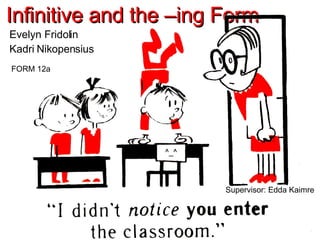
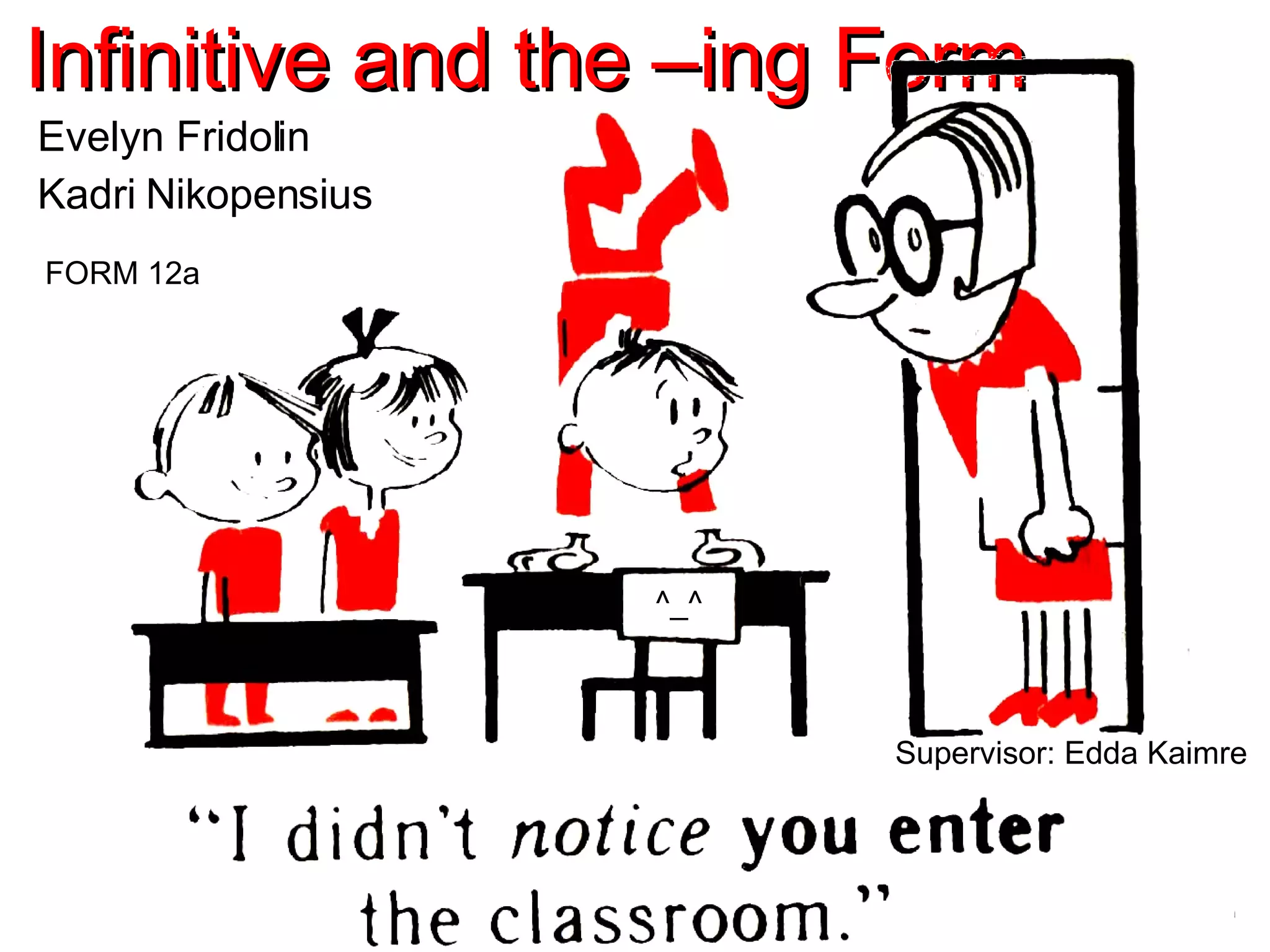
Infinitive and the –ing Form Evelyn Fridolin Kadri Nikopensius Supervisor: Edda Kaimre ^_^ FORM 12a
To - Infinitive To – infinitive is used To express purpose After certain verbs (agree, appear, decide, expect, hope, plan, promise, refuse) After adjectives which  Describe feelings/emotions (happy, glad) Express willingness Refer to a person’s character With the adjectives lucky and fortunate
Sam went to the bank  to get  some money. He  promised to help  us with the decorations. I was  annoyed to hear  that he had left. You were  clever not to believe  him.
To - Infinitive After certain nouns and pronouns such as something, somewhere, anyone, nothing After too/enough With it + be + adjective/noun To talk about an unexpected event which can be unpleasant, usually with only After; be + the first/second etc./next/last/best etc. After verbs and expressions such as ask, learn, find out, wonder, want to know, decide, explain, etc. When they are followed by question words.
We’ve got a lot of  homework to do . She is  too young to stay  out late. It is important to get  there on time. She came home  to find  her sister waiting for her. He  was the first to arrive. I don’t know  why he left .
The –ing Form The –ing form is used As anoun After certain verbs (admit, anticipate, appreciate, avoid, consider, continue, delay, deny, discuss, enjoy, escape, excuse, fancy, forgive imagine, involve, mention, mind, miss, postpone, practice, prevent, quit, recall, recollect, report, resent, resist, risk, save, stand, suggest, tolerate, understand etc.) After dislike, enjoy, hate, like, love, prefer to express general preference. 4. After expressions such as be busy, it’s no use,  it’s (no) good, it’s (not) worth, what’s the use of, can’t  help, there’s no point (in), can’t stand, have difficulty  (in), have trouble, have hard/difficult time etc.
Cycling  is a popular form of exercise. He  avoided answering  my question. She  likes painting . (But: She likes to paint) She  is busy writing  the wedding invitations.
The –ing Form After spend, waste, lose After prepositions After the preposition „to” with verbs and expressions such as look foward to, be used to, get round to, object to, in addition to, prefer etc. After the werbs hear, listen to, notice, see, watch feel + bare infinitive to describe a complate action, something that somebody saw, heard etc.
He  lost  £10 investing in unsuccessful companies. He was found guilty of  lying  in court. She  objects to working  on Saturdays. I  listened to  James  singing  a song.
References Jenny Dooley. Virginia Evans. “Grammarway” brains

Infinitive and the -ing Form

  • 1.
    Infinitive and the–ing Form Evelyn Fridolin Kadri Nikopensius Supervisor: Edda Kaimre ^_^ FORM 12a
  • 2.
    To - InfinitiveTo – infinitive is used To express purpose After certain verbs (agree, appear, decide, expect, hope, plan, promise, refuse) After adjectives which Describe feelings/emotions (happy, glad) Express willingness Refer to a person’s character With the adjectives lucky and fortunate
  • 3.
    Sam went tothe bank to get some money. He promised to help us with the decorations. I was annoyed to hear that he had left. You were clever not to believe him.
  • 4.
    To - InfinitiveAfter certain nouns and pronouns such as something, somewhere, anyone, nothing After too/enough With it + be + adjective/noun To talk about an unexpected event which can be unpleasant, usually with only After; be + the first/second etc./next/last/best etc. After verbs and expressions such as ask, learn, find out, wonder, want to know, decide, explain, etc. When they are followed by question words.
  • 5.
    We’ve got alot of homework to do . She is too young to stay out late. It is important to get there on time. She came home to find her sister waiting for her. He was the first to arrive. I don’t know why he left .
  • 6.
    The –ing FormThe –ing form is used As anoun After certain verbs (admit, anticipate, appreciate, avoid, consider, continue, delay, deny, discuss, enjoy, escape, excuse, fancy, forgive imagine, involve, mention, mind, miss, postpone, practice, prevent, quit, recall, recollect, report, resent, resist, risk, save, stand, suggest, tolerate, understand etc.) After dislike, enjoy, hate, like, love, prefer to express general preference. 4. After expressions such as be busy, it’s no use, it’s (no) good, it’s (not) worth, what’s the use of, can’t help, there’s no point (in), can’t stand, have difficulty (in), have trouble, have hard/difficult time etc.
  • 7.
    Cycling isa popular form of exercise. He avoided answering my question. She likes painting . (But: She likes to paint) She is busy writing the wedding invitations.
  • 8.
    The –ing FormAfter spend, waste, lose After prepositions After the preposition „to” with verbs and expressions such as look foward to, be used to, get round to, object to, in addition to, prefer etc. After the werbs hear, listen to, notice, see, watch feel + bare infinitive to describe a complate action, something that somebody saw, heard etc.
  • 9.
    He lost £10 investing in unsuccessful companies. He was found guilty of lying in court. She objects to working on Saturdays. I listened to James singing a song.
  • 10.
    References Jenny Dooley.Virginia Evans. “Grammarway” brains