Conditionals and wishes
Try to complete the following sentences
 We always have a great time if…
 Whenever Jay and Rose have a fight…
 As soon as I get home…
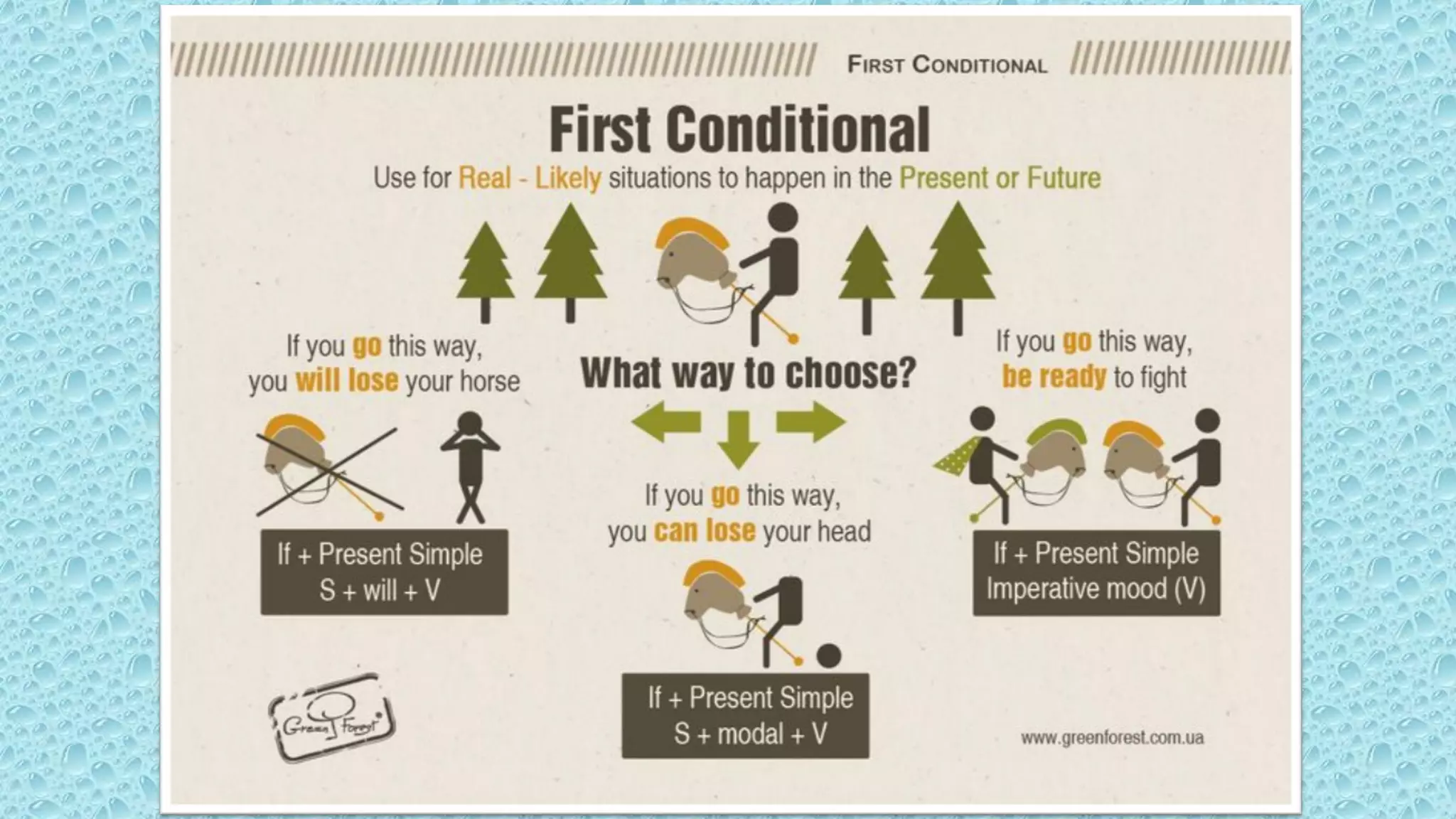
1st conditional
 To talk about possible present or future situations and their
result.
 Structure:
[CLAUSE 1] + [CLAUSE 2]
If / unless + Any present tense + Any future tense
modal verb
imperative mood
 If we pass the exam, our parents will let us go on vacation.
 I will have finished my work tomorrow, unless my children take up all my time.
 NOTICE that unless (if + not) adds a negative meaning, so the verb used in the same
clause is in the affirmative form.
Future time clauses
Which verb tense can you
identify after these time
expressions?
Future time clauses
Which verb tense can you
identify after these time
expressions?
That's right! The present form!
• Present simple
• Present continuous
• Present perfect
First conditional
Let’s brainstorm
superstitions. How do
you express them?
 Opening an umbrella indoors
If you open an umbrella indoors,
it will bring you bad luck.
 Breaking a mirror
 Breaking a mirror
If you break a mirror, you will
have you 7 years of bad luck.
 Finding a four leaf
clover
 Finding a four leaf
clover
When you find a four
leaf clover, you’ll
have good luck.
 Walking under a ladder
If you walk under a ladder,
something bad will happen to
you.
 Hand palm itching
 Hand palm itching
When your palm itches, you’ll
receive money.
First conditional
 Blowing out all the candles on
your birthday cake
First conditional
 Blowing out all the candles on
your birthday cake
If you blow out all the candles on
your birthday cake with one
breath, you will get what you
wanted.
Let’s keep going!
What can
you see
in this
picture?
In what
way would
it be
different
today?
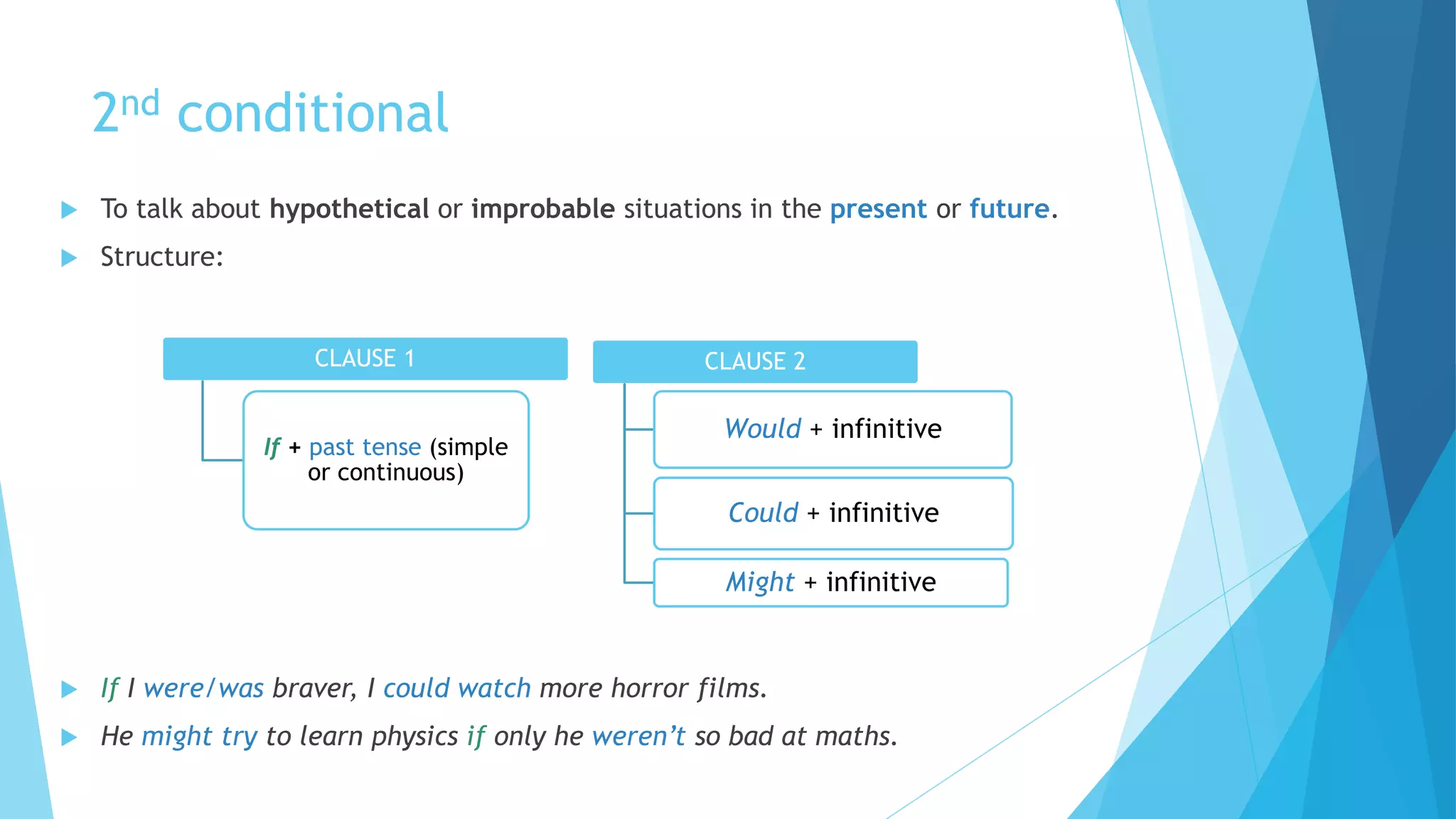
2nd conditional
 To talk about hypothetical or improbable situations in the present or future.
 Structure:
 If I were/was braver, I could watch more horror films.
 He might try to learn physics if only he weren’t so bad at maths.
CLAUSE 1
If + past tense (simple
or continuous)
CLAUSE 2
Would + infinitive
Could + infinitive
Might + infinitive
The Big Bang Theory and the second
conditional
Challenge: Talk for
1 minute!
How our lives
would be without…
Let’s identify the
structure
3rd conditional
 To talk about a hypothetical situation in the past.
 Structure:
 They could have stayed together, if they had been sincere to each other.
 If I had been saving money, now I wouldn’t have borrowed it from my parents.
CLAUSE 1
If + past perfect (simple or
continuous)
CLAUSE 2
Would have + past participle
Could have + past participle
Might have + past participle
Conditionals with inversion
 To make the second and third conditionals more formal, we can use
inversion putting the auxiliaries were and had at the beginning of the
sentence.
 If you were to join the committee, we’d be very pleased.
 Were you to join the committee, we would be very pleased.
 Note that the clause making the inversion is the if-clause, and if
disappears to make room for the auxiliary.
Conditionals with inversion
 Let’s look at another example, this time with the third conditional.
 If you had arrived on time, you would have understood the lecture.
 Had you arrived on time, you would have understood the lecture.
 Once more, the clause making the inversion is the if-clause, and if
disappears to make room for the auxiliary.
Mixed conditionals
3 & 2
 The most common combination is when we have a type 3 conditional in the
if-clause (if + past perfect) followed by a type 2 conditional (would +
infinitive) in the main clause.
 With this combination we are contrasting an imagined or real event in the
past with the present result of that:
• If he'd taken the medication as prescribed, he wouldn't still be lying
sick in bed.
• If she'd taken reasonable precautions, she wouldn't be pregnant now.
• If he hadn't run after the car thief and suffered a heart attack, he'd
probably be alive today.
When we talk about mixed
conditionals, we are referring
to conditional sentences that
combine two different types
of conditional patterns.
Mixed conditionals:
2 & 3
 The other possibility is when we have a type 2 conditional in the if-
clause (if + past simple) followed by a type 3 conditional (would've +
past participle) in the main clause.
 With this combination, we are describing ongoing circumstances in
relation to a previous past event. Consider these examples:
• If you weren't such a poor dancer, you would've got a job in the
chorus line in that musical.
• If you weren't so blind to his faults, you would've realised that
he was out to swindle you.
Replacing if
o Unless
o Even if
o As/So long as
o Supposing
o Whether … or
o Providing
o Provided that
o Whoever; wherever; whenever
o No matter who / when / where
There are different options to if
that can be used in its place. Try
some of these.
Rewrite the sentences with mistakes so
they are correct.
2. Suppose you would win the lottery, what would
you do?
Rewrite the sentences with mistakes so
they are correct.
2. Suppose you would win the lottery, what would
you do?
Suppose you won the lottery, what would you do?
Rewrite the sentences with mistakes so
they are correct.
• I’ve bought some food in case Marianne and John
came round for dinner.
Rewrite the sentences with mistakes so
they are correct.
• I’ve bought some food in case Marianne and John
came round for dinner.
I’ve bought some food in case Marianne and John
come round for dinner.
Rewrite the sentences with mistakes so
they are correct.
• If I had known you were coming to London, I
would pick you up at the airport.
Rewrite the sentences with mistakes so
they are correct.
• If I had known you were coming to London, I
would pick you up at the airport.
If I had known you were coming to London, I would
have picked you up at the airport.
Rewrite the sentences with mistakes so
they are correct.
• If I told you I love you, what would you have said?
Rewrite the sentences with mistakes so
they are correct.
• If I told you I love you, what would you have said?
If I told you I love you, what would you say?
Rewrite the sentences with mistakes so
they are correct.
• Unless Brian will instruct us otherwise, we will
close the shop at 7.
Rewrite the sentences with mistakes so
they are correct.
• Unless Brian will instruct us otherwise, we will
close the shop at 7.
Unless Brian instructs us otherwise, we will close
the shop at 7.
Rewrite the sentences with mistakes so
they are correct.
• Should he have rung, tell him I’ll meet him in the
library.
Rewrite the sentences with mistakes so
they are correct.
• Should he have rung, tell him I’ll meet him in the
library.
Should he ring, tell him I’ll meet him in the library.
Rewrite the sentences with mistakes so
they are correct.
• Had I known you’d been shopping, I would not go
myself.
Rewrite the sentences with mistakes so
they are correct.
• Had I known you’d been shopping, I would not go
myself.
Had I known you’d been shopping, I wouldn’t have
gone myself.
Rewrite the following using mixed
conditionals like in the example.
 Example:
I don’t have secretary, so I did all the typing myself.
If I had a secretary, I wouldn’t have done all the typing myself.
Rewrite the following using mixed
conditionals like in the example.
o He didn’t follow my advice; that’s why the work
isn’t finished yet.
Rewrite the following using mixed
conditionals like in the example.
o He didn’t follow my advice; that’s why the work
isn’t finished yet.
o If he’d followed my advice, the work would have
been finished by now.
Rewrite the following using mixed
conditionals like in the example.
o He can’t have been arguing with his boss all
morning; he looks far too relaxed!
Rewrite the following using mixed
conditionals like in the example.
o He can’t have been arguing with his boss all
morning; he looks far too relaxed!
o If he’d been arguing with his boss, he wouldn’t
look so relaxed.
Rewrite the following using mixed
conditionals like in the example.
o She doesn’t have the money, otherwise she would
have given me the loan.
Rewrite the following using mixed
conditionals like in the example.
o She doesn’t have the money, otherwise she would
have given me the loan.
o If she had the money, she would have given me
the loan.
Rewrite the following using mixed
conditionals like in the example.
o I realise I wasn’t very polite to the boss, but I’m
planning to leave this job anyway.
Rewrite the following using mixed
conditionals like in the example.
o I realise I wasn’t very polite to the boss, but I’m
planning to leave this job anyway.
o If I wasn’t planning to leave this job, I wouldn’t
have been rude to the boss.
Wishes
 To express a wish we can use wish and if only.
 If only has the same meaning as wish, only it is more emphatic/dramatic.
 With the subject pronoun I both forms were / was can be used in the if-
clause.
• http://prezi.com/vt0p_tsc39mj/?utm_campaign=share&ut
m_medium=copy&rc=ex0share
Wishing different present situations
• To say that we would like something to be different about a present
situation, we use the past simple or the past continuous.
I wish I was/were 10 years old (but I’m not).
If only I were travelling with you and not alone! It would be much
more fun.
Wishing different past situations
• To express regret about something which happened or didn’t happen in
the past, we use the past perfect.
I wish I had saved more money during my twenties (but I didn’t).
If only I hadn’t been so harsh to her! We could still be friends. (but I
was)
Wishing for change
• To express:
– a polite imperative,
– and a desire for a situation or person’s behaviour to change
we use the structure subject + would + bare infinitive.
I wish you would stop spreading rumours.
If only it would be sunny on my birthday, we could go swimming!
Human, if only you
would feed me, I
could go and take
a nap.
Regrets
• What do people
consider to be mistakes
of their youth?
Regrets
• Imagine the main character in the
clip is 70 today and looking back at
his teenage years.
Use if only and wish
Write a wish for each of the following sentences, like
in the example
• You want to buy a new car, but you haven’t got any
money.
Write a wish for each of the following sentences, like
in the example
• You want to buy a new car, but you haven’t got any
money.
• I wish I had enough money (to buy a new car).
Write a wish for each of the following sentences, like
in the example
• You didn’t follow your friend’s sensible advice.
Write a wish for each of the following sentences, like
in the example
• You didn’t follow your friend’s sensible advice.
• I wish I’d followed my friend’s advice.
Write a wish for each of the following sentences, like
in the example
• You lost your lecture notes.
Write a wish for each of the following sentences, like
in the example
• You lost your lecture notes.
• I wish I hadn’t lost my lecture notes.
Write a wish for each of the following sentences, like
in the example
• You want to ask a friend to help you, but he’s out of the
country.
Write a wish for each of the following sentences, like
in the example
• You want to ask a friend to help you, but he’s out of the
country.
• I wish my friend wasn’t out of the country.
Conditionals and wishes

Conditionals and wishes

  • 1.
  • 2.
    Try to completethe following sentences  We always have a great time if…  Whenever Jay and Rose have a fight…  As soon as I get home…
  • 4.
    1st conditional  Totalk about possible present or future situations and their result.  Structure: [CLAUSE 1] + [CLAUSE 2] If / unless + Any present tense + Any future tense modal verb imperative mood  If we pass the exam, our parents will let us go on vacation.  I will have finished my work tomorrow, unless my children take up all my time.  NOTICE that unless (if + not) adds a negative meaning, so the verb used in the same clause is in the affirmative form.
  • 6.
    Future time clauses Whichverb tense can you identify after these time expressions?
  • 7.
    Future time clauses Whichverb tense can you identify after these time expressions? That's right! The present form! • Present simple • Present continuous • Present perfect
  • 8.
  • 9.
     Opening anumbrella indoors
  • 10.
     Opening anumbrella indoors If you open an umbrella indoors, it will bring you bad luck.
  • 11.
  • 12.
     Breaking amirror If you break a mirror, you will have you 7 years of bad luck.
  • 13.
     Finding afour leaf clover
  • 14.
     Finding afour leaf clover When you find a four leaf clover, you’ll have good luck.
  • 15.
  • 16.
     Walking undera ladder If you walk under a ladder, something bad will happen to you.
  • 17.
  • 18.
     Hand palmitching When your palm itches, you’ll receive money.
  • 19.
    First conditional  Blowingout all the candles on your birthday cake
  • 20.
    First conditional  Blowingout all the candles on your birthday cake If you blow out all the candles on your birthday cake with one breath, you will get what you wanted.
  • 21.
  • 22.
    What can you see inthis picture?
  • 23.
    In what way would itbe different today?
  • 24.
    2nd conditional  Totalk about hypothetical or improbable situations in the present or future.  Structure:  If I were/was braver, I could watch more horror films.  He might try to learn physics if only he weren’t so bad at maths. CLAUSE 1 If + past tense (simple or continuous) CLAUSE 2 Would + infinitive Could + infinitive Might + infinitive
  • 25.
    The Big BangTheory and the second conditional
  • 26.
    Challenge: Talk for 1minute! How our lives would be without…
  • 27.
  • 28.
    3rd conditional  Totalk about a hypothetical situation in the past.  Structure:  They could have stayed together, if they had been sincere to each other.  If I had been saving money, now I wouldn’t have borrowed it from my parents. CLAUSE 1 If + past perfect (simple or continuous) CLAUSE 2 Would have + past participle Could have + past participle Might have + past participle
  • 30.
    Conditionals with inversion To make the second and third conditionals more formal, we can use inversion putting the auxiliaries were and had at the beginning of the sentence.  If you were to join the committee, we’d be very pleased.  Were you to join the committee, we would be very pleased.  Note that the clause making the inversion is the if-clause, and if disappears to make room for the auxiliary.
  • 31.
    Conditionals with inversion Let’s look at another example, this time with the third conditional.  If you had arrived on time, you would have understood the lecture.  Had you arrived on time, you would have understood the lecture.  Once more, the clause making the inversion is the if-clause, and if disappears to make room for the auxiliary.
  • 32.
    Mixed conditionals 3 &2  The most common combination is when we have a type 3 conditional in the if-clause (if + past perfect) followed by a type 2 conditional (would + infinitive) in the main clause.  With this combination we are contrasting an imagined or real event in the past with the present result of that: • If he'd taken the medication as prescribed, he wouldn't still be lying sick in bed. • If she'd taken reasonable precautions, she wouldn't be pregnant now. • If he hadn't run after the car thief and suffered a heart attack, he'd probably be alive today. When we talk about mixed conditionals, we are referring to conditional sentences that combine two different types of conditional patterns.
  • 33.
    Mixed conditionals: 2 &3  The other possibility is when we have a type 2 conditional in the if- clause (if + past simple) followed by a type 3 conditional (would've + past participle) in the main clause.  With this combination, we are describing ongoing circumstances in relation to a previous past event. Consider these examples: • If you weren't such a poor dancer, you would've got a job in the chorus line in that musical. • If you weren't so blind to his faults, you would've realised that he was out to swindle you.
  • 35.
    Replacing if o Unless oEven if o As/So long as o Supposing o Whether … or o Providing o Provided that o Whoever; wherever; whenever o No matter who / when / where There are different options to if that can be used in its place. Try some of these.
  • 37.
    Rewrite the sentenceswith mistakes so they are correct. 2. Suppose you would win the lottery, what would you do?
  • 38.
    Rewrite the sentenceswith mistakes so they are correct. 2. Suppose you would win the lottery, what would you do? Suppose you won the lottery, what would you do?
  • 39.
    Rewrite the sentenceswith mistakes so they are correct. • I’ve bought some food in case Marianne and John came round for dinner.
  • 40.
    Rewrite the sentenceswith mistakes so they are correct. • I’ve bought some food in case Marianne and John came round for dinner. I’ve bought some food in case Marianne and John come round for dinner.
  • 41.
    Rewrite the sentenceswith mistakes so they are correct. • If I had known you were coming to London, I would pick you up at the airport.
  • 42.
    Rewrite the sentenceswith mistakes so they are correct. • If I had known you were coming to London, I would pick you up at the airport. If I had known you were coming to London, I would have picked you up at the airport.
  • 43.
    Rewrite the sentenceswith mistakes so they are correct. • If I told you I love you, what would you have said?
  • 44.
    Rewrite the sentenceswith mistakes so they are correct. • If I told you I love you, what would you have said? If I told you I love you, what would you say?
  • 45.
    Rewrite the sentenceswith mistakes so they are correct. • Unless Brian will instruct us otherwise, we will close the shop at 7.
  • 46.
    Rewrite the sentenceswith mistakes so they are correct. • Unless Brian will instruct us otherwise, we will close the shop at 7. Unless Brian instructs us otherwise, we will close the shop at 7.
  • 47.
    Rewrite the sentenceswith mistakes so they are correct. • Should he have rung, tell him I’ll meet him in the library.
  • 48.
    Rewrite the sentenceswith mistakes so they are correct. • Should he have rung, tell him I’ll meet him in the library. Should he ring, tell him I’ll meet him in the library.
  • 49.
    Rewrite the sentenceswith mistakes so they are correct. • Had I known you’d been shopping, I would not go myself.
  • 50.
    Rewrite the sentenceswith mistakes so they are correct. • Had I known you’d been shopping, I would not go myself. Had I known you’d been shopping, I wouldn’t have gone myself.
  • 51.
    Rewrite the followingusing mixed conditionals like in the example.  Example: I don’t have secretary, so I did all the typing myself. If I had a secretary, I wouldn’t have done all the typing myself.
  • 52.
    Rewrite the followingusing mixed conditionals like in the example. o He didn’t follow my advice; that’s why the work isn’t finished yet.
  • 53.
    Rewrite the followingusing mixed conditionals like in the example. o He didn’t follow my advice; that’s why the work isn’t finished yet. o If he’d followed my advice, the work would have been finished by now.
  • 54.
    Rewrite the followingusing mixed conditionals like in the example. o He can’t have been arguing with his boss all morning; he looks far too relaxed!
  • 55.
    Rewrite the followingusing mixed conditionals like in the example. o He can’t have been arguing with his boss all morning; he looks far too relaxed! o If he’d been arguing with his boss, he wouldn’t look so relaxed.
  • 56.
    Rewrite the followingusing mixed conditionals like in the example. o She doesn’t have the money, otherwise she would have given me the loan.
  • 57.
    Rewrite the followingusing mixed conditionals like in the example. o She doesn’t have the money, otherwise she would have given me the loan. o If she had the money, she would have given me the loan.
  • 58.
    Rewrite the followingusing mixed conditionals like in the example. o I realise I wasn’t very polite to the boss, but I’m planning to leave this job anyway.
  • 59.
    Rewrite the followingusing mixed conditionals like in the example. o I realise I wasn’t very polite to the boss, but I’m planning to leave this job anyway. o If I wasn’t planning to leave this job, I wouldn’t have been rude to the boss.
  • 60.
    Wishes  To expressa wish we can use wish and if only.  If only has the same meaning as wish, only it is more emphatic/dramatic.  With the subject pronoun I both forms were / was can be used in the if- clause.
  • 61.
  • 62.
    Wishing different presentsituations • To say that we would like something to be different about a present situation, we use the past simple or the past continuous. I wish I was/were 10 years old (but I’m not). If only I were travelling with you and not alone! It would be much more fun.
  • 63.
    Wishing different pastsituations • To express regret about something which happened or didn’t happen in the past, we use the past perfect. I wish I had saved more money during my twenties (but I didn’t). If only I hadn’t been so harsh to her! We could still be friends. (but I was)
  • 64.
    Wishing for change •To express: – a polite imperative, – and a desire for a situation or person’s behaviour to change we use the structure subject + would + bare infinitive. I wish you would stop spreading rumours. If only it would be sunny on my birthday, we could go swimming! Human, if only you would feed me, I could go and take a nap.
  • 65.
    Regrets • What dopeople consider to be mistakes of their youth?
  • 66.
    Regrets • Imagine themain character in the clip is 70 today and looking back at his teenage years. Use if only and wish
  • 68.
    Write a wishfor each of the following sentences, like in the example • You want to buy a new car, but you haven’t got any money.
  • 69.
    Write a wishfor each of the following sentences, like in the example • You want to buy a new car, but you haven’t got any money. • I wish I had enough money (to buy a new car).
  • 70.
    Write a wishfor each of the following sentences, like in the example • You didn’t follow your friend’s sensible advice.
  • 71.
    Write a wishfor each of the following sentences, like in the example • You didn’t follow your friend’s sensible advice. • I wish I’d followed my friend’s advice.
  • 72.
    Write a wishfor each of the following sentences, like in the example • You lost your lecture notes.
  • 73.
    Write a wishfor each of the following sentences, like in the example • You lost your lecture notes. • I wish I hadn’t lost my lecture notes.
  • 74.
    Write a wishfor each of the following sentences, like in the example • You want to ask a friend to help you, but he’s out of the country.
  • 75.
    Write a wishfor each of the following sentences, like in the example • You want to ask a friend to help you, but he’s out of the country. • I wish my friend wasn’t out of the country.