EMBRYONIC DEVELOPMENT
AFTER FERTILIZATION
3 PROCESSES OCCURE IN AN
EMBRYO AFTER FERTILIZATION:
1) Cleavage
2) Gastrulation
3) Organogenesis
Cleavage
CLEAVAGE
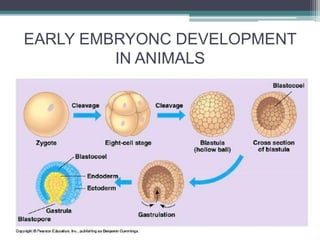
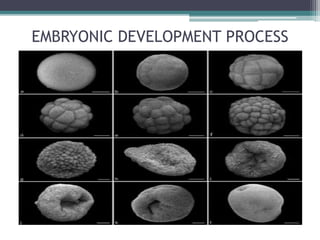
• The single celled zygote undergoes a period of
rapid cell division without growth to produce a
ball of cells.
• A hollow ball of cells are formed called a
blastula.
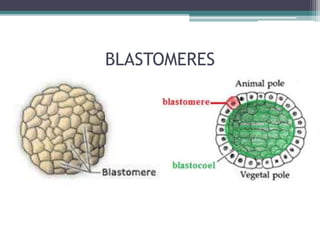
• The blastula consist of many smaller cells called
blastomeres.
• The blastula has a hollow part that is filled with
fluid and is called a blastocoel.
EARLY EMBRYONC DEVELOPMENT
IN ANIMALS
BLASTOMERES
TWO TYPES OF CLEAVAGE
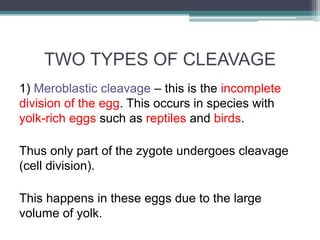
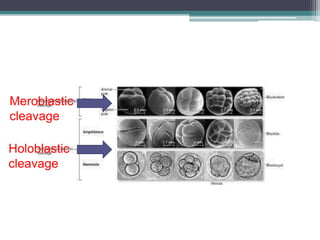
1) Meroblastic cleavage – this is the incomplete
division of the egg. This occurs in species with
yolk-rich eggs such as reptiles and birds.
Thus only part of the zygote undergoes cleavage
(cell division).
This happens in these eggs due to the large
volume of yolk.
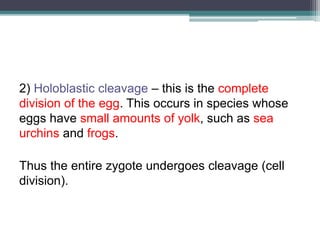
2) Holoblastic cleavage – this is the complete
division of the egg. This occurs in species whose
eggs have small amounts of yolk, such as sea
urchins and frogs.
Thus the entire zygote undergoes cleavage (cell
division).
Meroblastic
cleavage
Holoblastic
cleavage
GASTRULATION
GASTRULATION
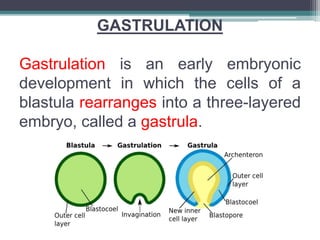
Gastrulation is an early embryonic
development in which the cells of a
blastula rearranges into a three-layered
embryo, called a gastrula.
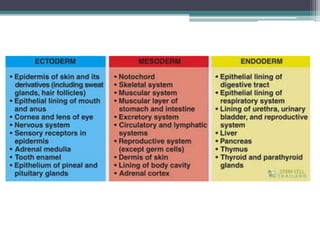
THREE EMBRYONIC GERM LAYERS
•Ectoderm
•Endoderm
•Mesoderm
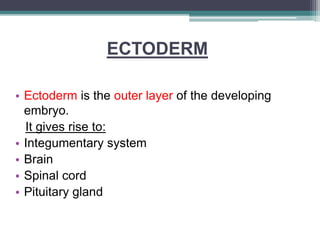
ECTODERM
• Ectoderm is the outer layer of the developing
embryo.
It gives rise to:
• Integumentary system
• Brain
• Spinal cord
• Pituitary gland
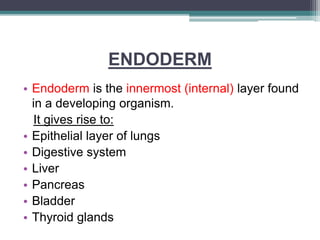
ENDODERM
• Endoderm is the innermost (internal) layer found
in a developing organism.
It gives rise to:
• Epithelial layer of lungs
• Digestive system
• Liver
• Pancreas
• Bladder
• Thyroid glands
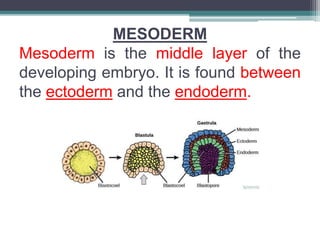
MESODERM
Mesoderm is the middle layer of the
developing embryo. It is found between
the ectoderm and the endoderm.
ORGANOGENESIS
ORGANOGENESIS
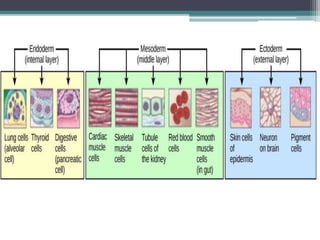
• Organogenesis is the process of the ectoderm,
endoderm and mesoderm developing into internal
organs of an organism.
• Endoderm: Form tissues within the lungs , thyroid
and pancreas.
• Mesoderm: Assists in the production of cardiac
muscle, skeletal muscles, smooth muscles , tissues
within kidneys and red bloody cells.
• Ectoderm: Makes tissues in the epidermis and
helps in the formation of neurons in the brain and
melanocyte.
ORGANOGENESIS CONTINUED….
• In every vertebrates the mesoderm forms the
notochord and the ectoderm forms the neural
plate.
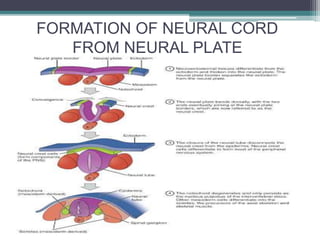
• The neural plate folds inwards and forms a
neural tube which will further go to form the
central nervous system which is the brain and
the spinal cord.
FORMATION OF NEURAL CORD
FROM NEURAL PLATE
EMBRYONIC DEVELOPMENT PROCESS

Embryonic development after fertilization

  • 1.
  • 2.
    3 PROCESSES OCCUREIN AN EMBRYO AFTER FERTILIZATION: 1) Cleavage 2) Gastrulation 3) Organogenesis
  • 3.
  • 4.
    CLEAVAGE • The singlecelled zygote undergoes a period of rapid cell division without growth to produce a ball of cells. • A hollow ball of cells are formed called a blastula. • The blastula consist of many smaller cells called blastomeres. • The blastula has a hollow part that is filled with fluid and is called a blastocoel.
  • 5.
  • 6.
  • 7.
    TWO TYPES OFCLEAVAGE 1) Meroblastic cleavage – this is the incomplete division of the egg. This occurs in species with yolk-rich eggs such as reptiles and birds. Thus only part of the zygote undergoes cleavage (cell division). This happens in these eggs due to the large volume of yolk.
  • 8.
    2) Holoblastic cleavage– this is the complete division of the egg. This occurs in species whose eggs have small amounts of yolk, such as sea urchins and frogs. Thus the entire zygote undergoes cleavage (cell division).
  • 9.
  • 10.
  • 11.
    GASTRULATION Gastrulation is anearly embryonic development in which the cells of a blastula rearranges into a three-layered embryo, called a gastrula.
  • 12.
    THREE EMBRYONIC GERMLAYERS •Ectoderm •Endoderm •Mesoderm
  • 13.
    ECTODERM • Ectoderm isthe outer layer of the developing embryo. It gives rise to: • Integumentary system • Brain • Spinal cord • Pituitary gland
  • 14.
    ENDODERM • Endoderm isthe innermost (internal) layer found in a developing organism. It gives rise to: • Epithelial layer of lungs • Digestive system • Liver • Pancreas • Bladder • Thyroid glands
  • 15.
    MESODERM Mesoderm is themiddle layer of the developing embryo. It is found between the ectoderm and the endoderm.
  • 17.
  • 18.
    ORGANOGENESIS • Organogenesis isthe process of the ectoderm, endoderm and mesoderm developing into internal organs of an organism. • Endoderm: Form tissues within the lungs , thyroid and pancreas. • Mesoderm: Assists in the production of cardiac muscle, skeletal muscles, smooth muscles , tissues within kidneys and red bloody cells. • Ectoderm: Makes tissues in the epidermis and helps in the formation of neurons in the brain and melanocyte.
  • 20.
    ORGANOGENESIS CONTINUED…. • Inevery vertebrates the mesoderm forms the notochord and the ectoderm forms the neural plate. • The neural plate folds inwards and forms a neural tube which will further go to form the central nervous system which is the brain and the spinal cord.
  • 21.
    FORMATION OF NEURALCORD FROM NEURAL PLATE
  • 22.