DHS 2 General Embryology Lecture 1 Original Lecture: Prof. Grant Townsend, University of Adelaide Dr. Sausan Al Kawas  University of Sharjah
Objectives To provide a general description of human embryological processes as follows: Germ cell formation & fertilization Prenatal development Induction, competence, and differentiation Formation of three-layerd embryo Formation of neural crest Formation of human tissues Folding of the embryo Copyright © 2006/07 The University of Sharjah slide
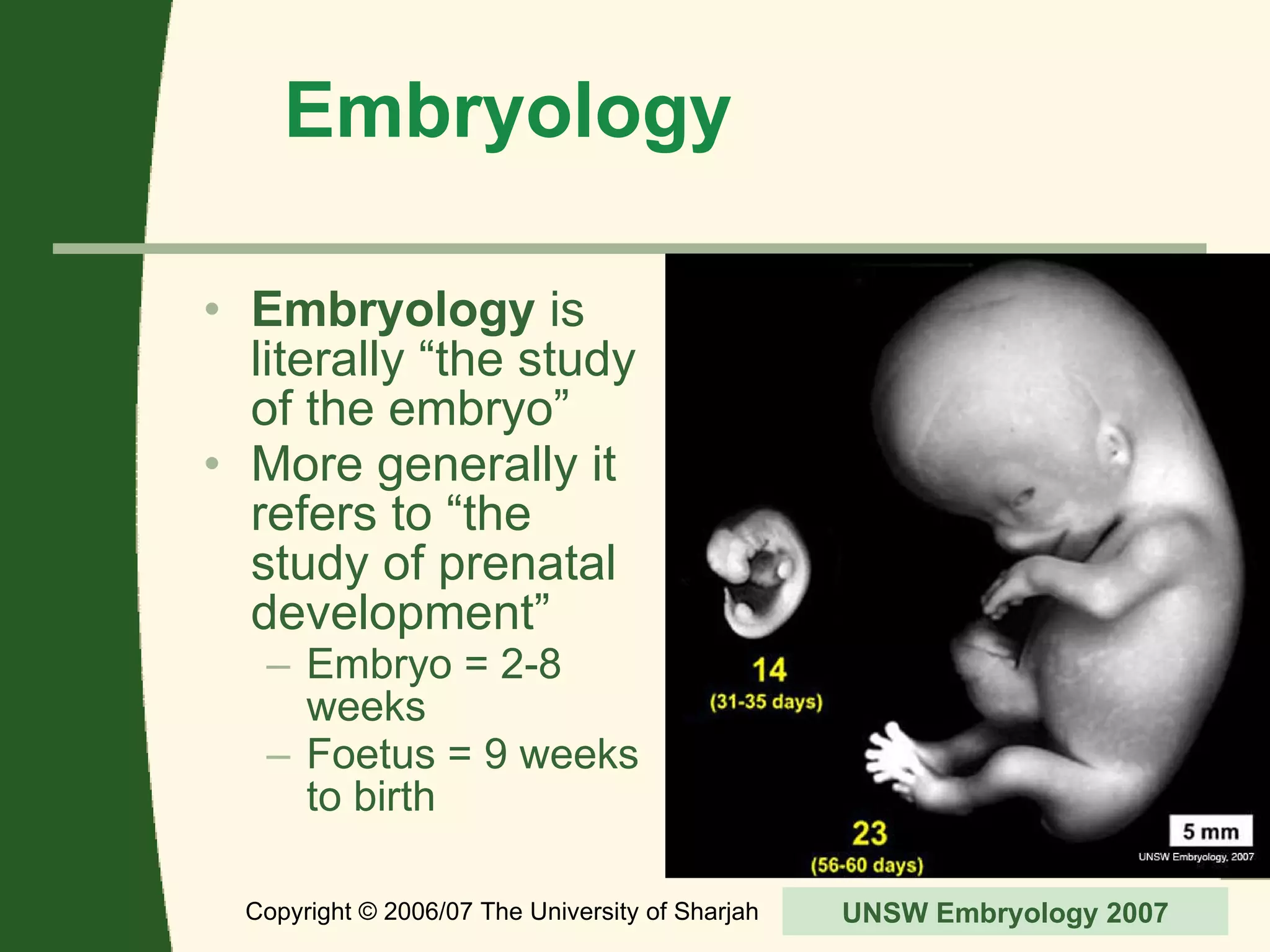
Embryology Embryology  is literally “the study of the embryo” More generally it refers to “the study of prenatal development” Embryo = 2-8 weeks Foetus = 9 weeks to birth Copyright © 2006/07 The University of Sharjah slide  UNSW Embryology 2007
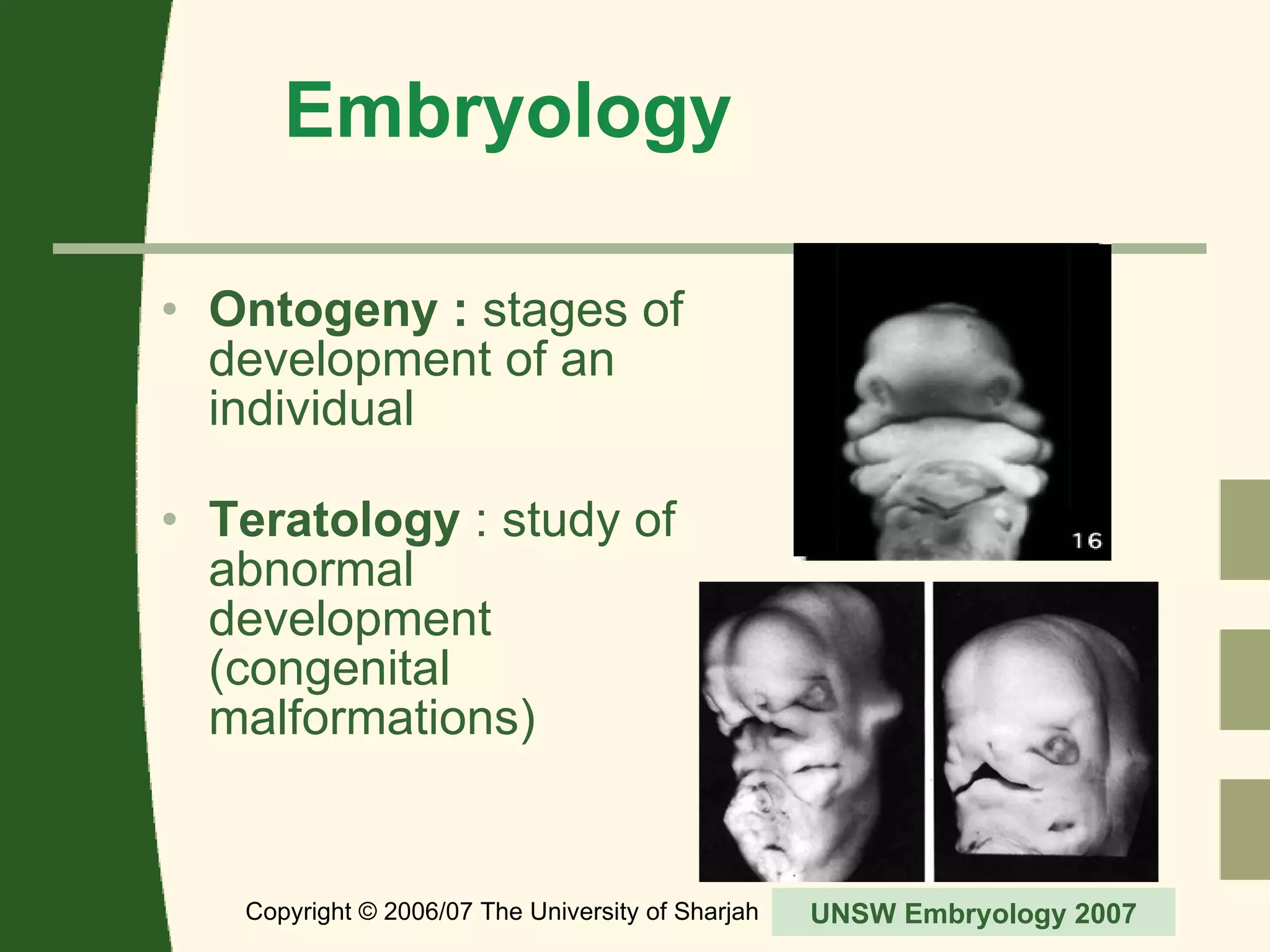
Embryology Ontogeny :  stages of development of an individual Teratology  : study of abnormal development (congenital malformations) Copyright © 2006/07 The University of Sharjah slide  UNSW Embryology 2007
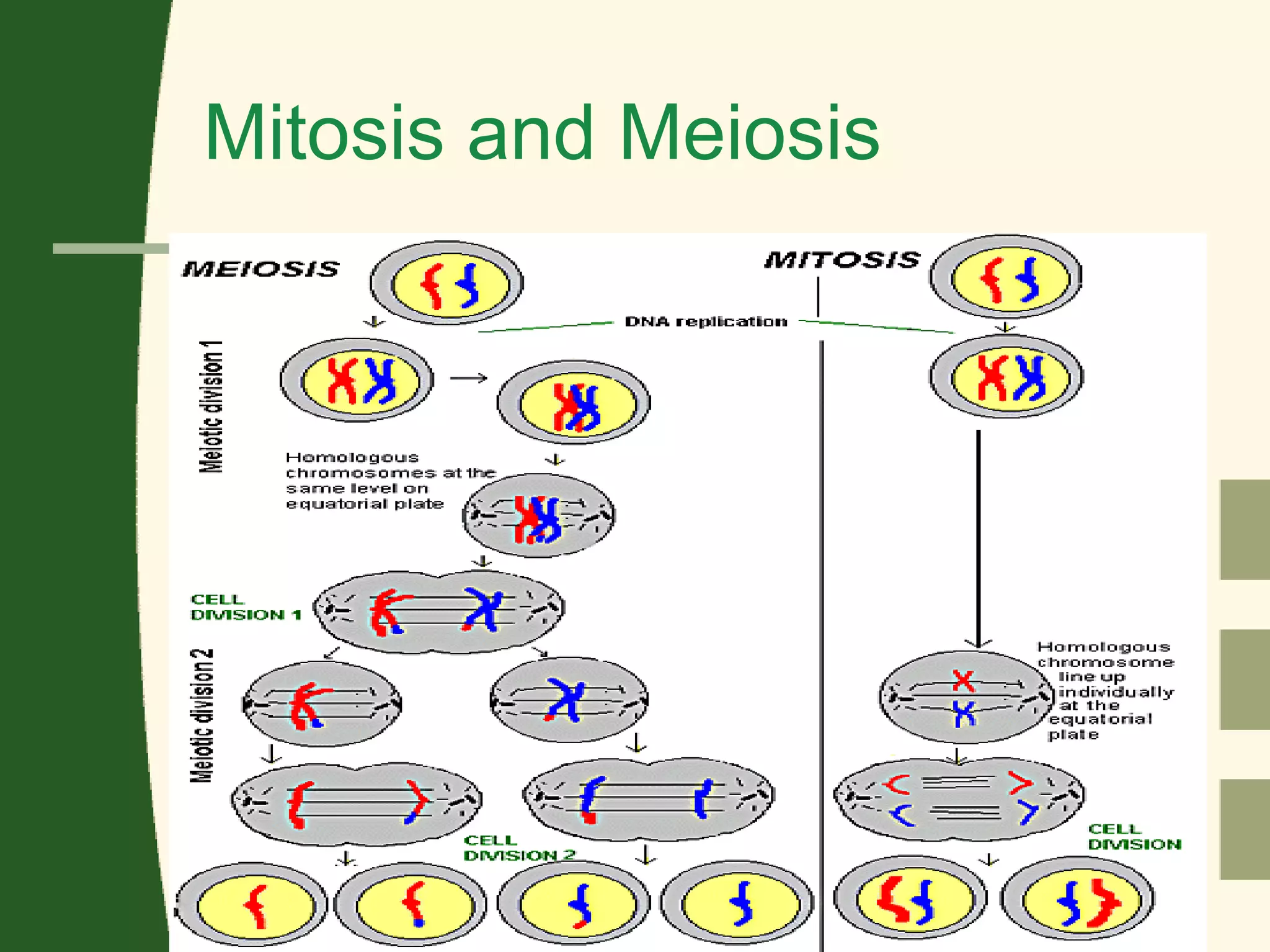
Mitosis and Meiosis Copyright © 2006/07 The University of Sharjah slide
Gametogenesis Gametogenesis is a process of formation and development of male(sperm) and female (ovum)gametes. During this process a reduction of the  the number of chromosomes takes place from diploid number (46) of primary  germ cells to the haploid number (23) in the mature germ cell. Copyright © 2006/07 The University of Sharjah slide
Gametogenesis It also involves the chromosomal and the cytoplasmic changes.  These alteration of the shape of the primary germ cells allow them to become ready for fertilization.  Copyright © 2006/07 The University of Sharjah slide
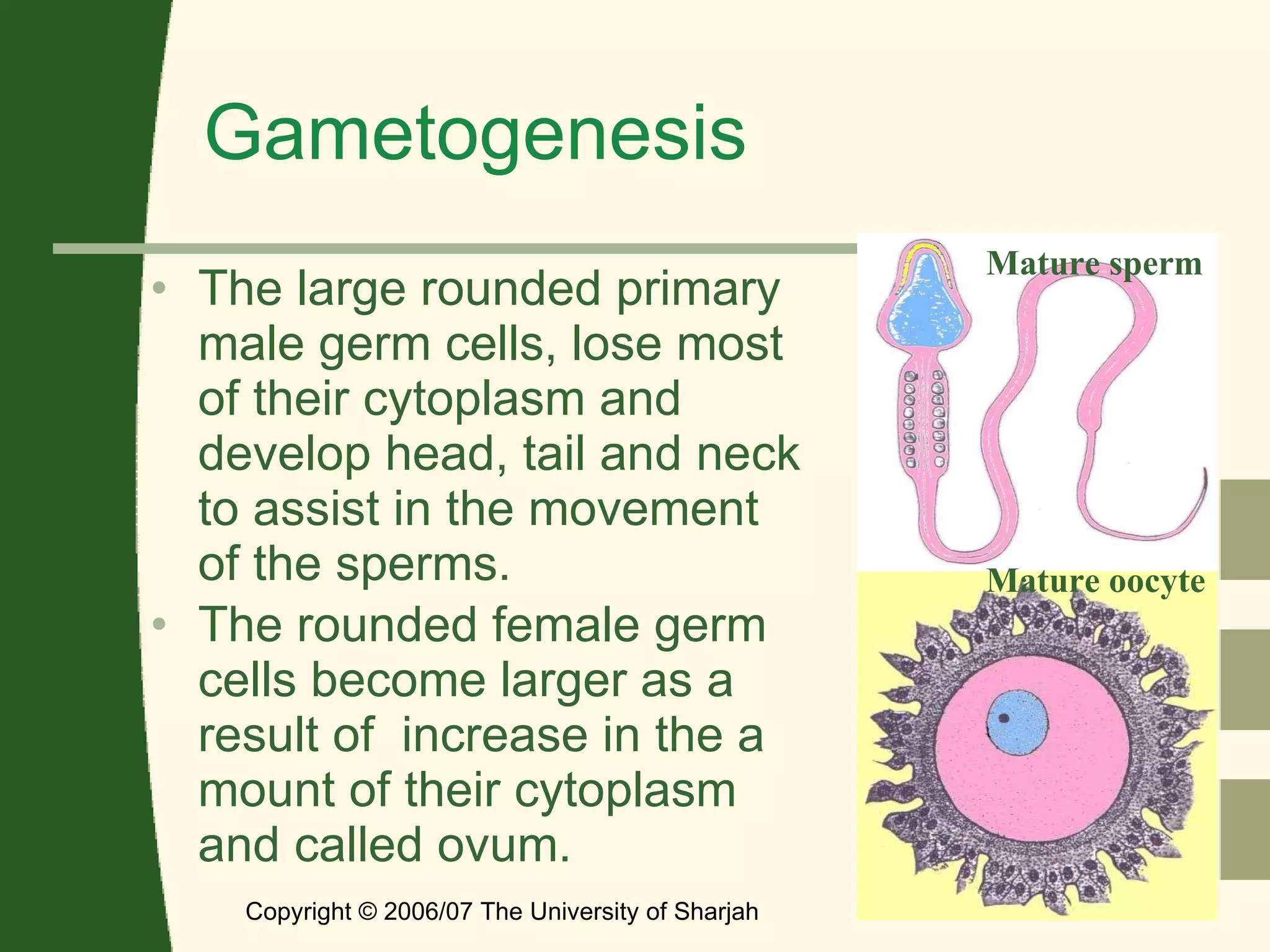
Gametogenesis The large rounded primary male germ cells, lose most of their cytoplasm and develop head, tail and neck to assist in the movement of the sperms. The rounded female germ cells become larger as a result of  increase in the a mount of their cytoplasm and called ovum. Copyright © 2006/07 The University of Sharjah slide  Mature sperm Mature oocyte
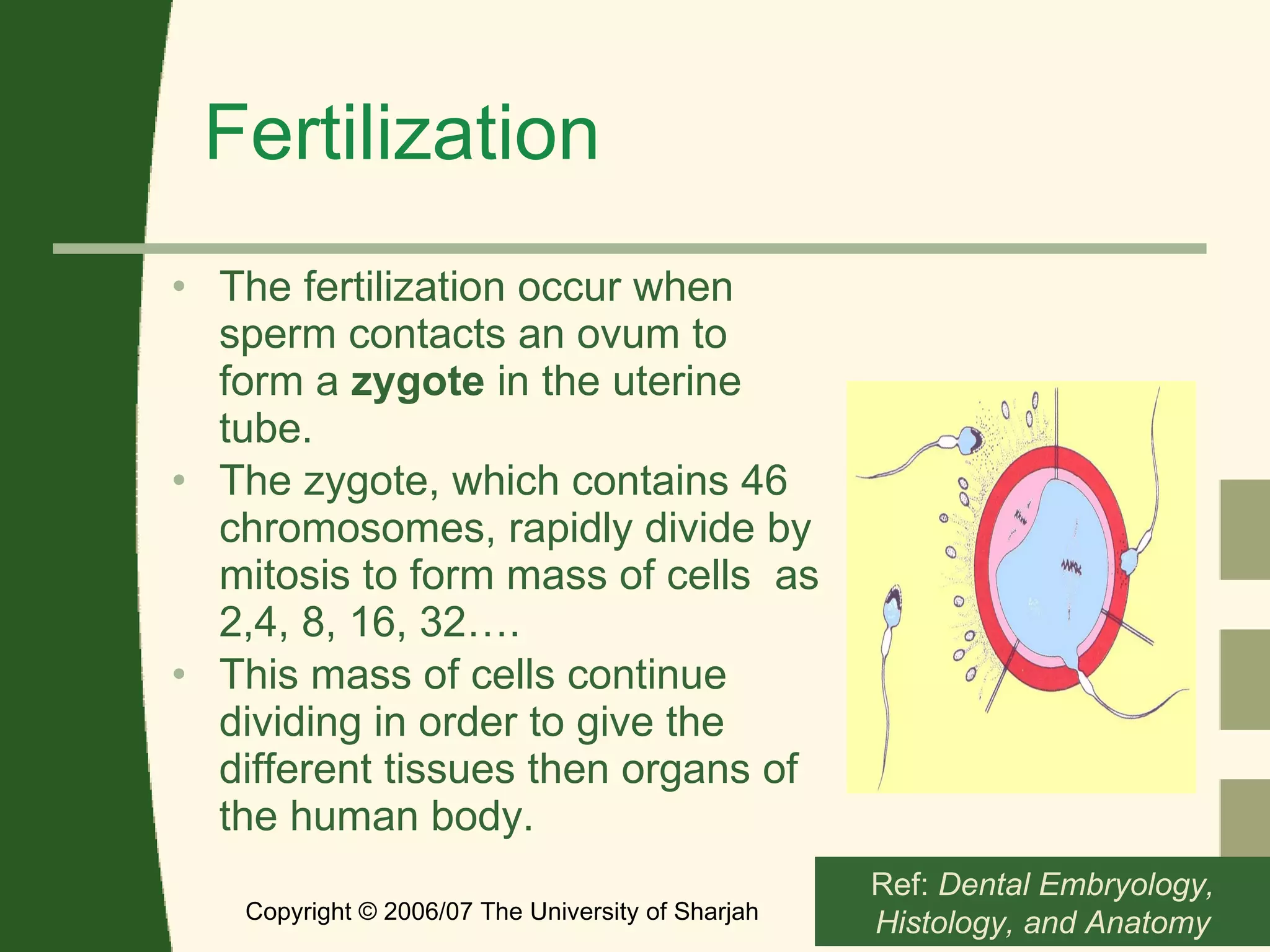
Fertilization The fertilization occur when sperm contacts an ovum to form a  zygote  in the uterine tube. The zygote, which contains 46 chromosomes, rapidly divide by mitosis to form mass of cells  as 2,4, 8, 16, 32….  This mass of cells continue dividing in order to give the different tissues then organs of the human body.  Copyright © 2006/07 The University of Sharjah slide  Ref:  Dental Embryology, Histology, and Anatomy
General Embryology Copyright © 2006/07 The University of Sharjah slide  These images reproduced from Dr. Di Marzo Mature Human Egg Fertilized Human Zygote 4 Cell Human Embryo UNSW Embryology 2010
General Embryology Fertilization Zygote Genotype, environment, phenotype Induction, competence, differentiation Formation of the three layered embryo Morula, blastocyst, bilaminar then trilaminar germ disc Ectoderm, endoderm, mesoderm Formation of neural crest cells Folding of the embryo Copyright © 2006/07 The University of Sharjah slide
Copyright © 2006/07 The University of Sharjah slide
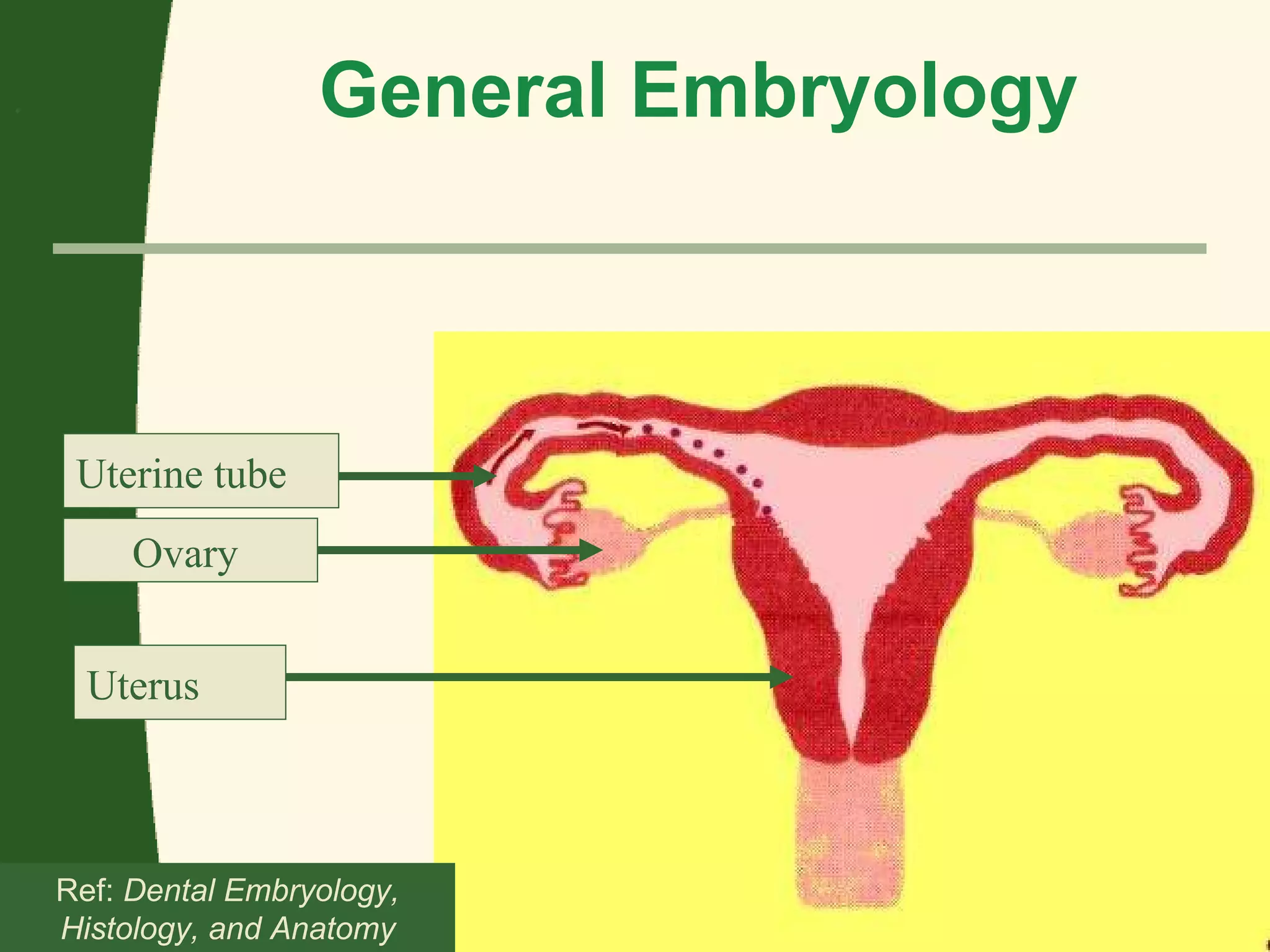
Copyright © 2006/07 The University of Sharjah slide  . General Embryology Ref:  Dental Embryology, Histology, and Anatomy Uterine tube Uterus  Ovary
Copyright © 2006/07 The University of Sharjah slide  General Embryology Ref:  Dental Embryology, Histology, and Anatomy Division of  the zygote  Zygote.  Formation of the morula Morula  Blastula
Structure of the blastocyt (blastula): Copyright © 2006/07 The University of Sharjah slide
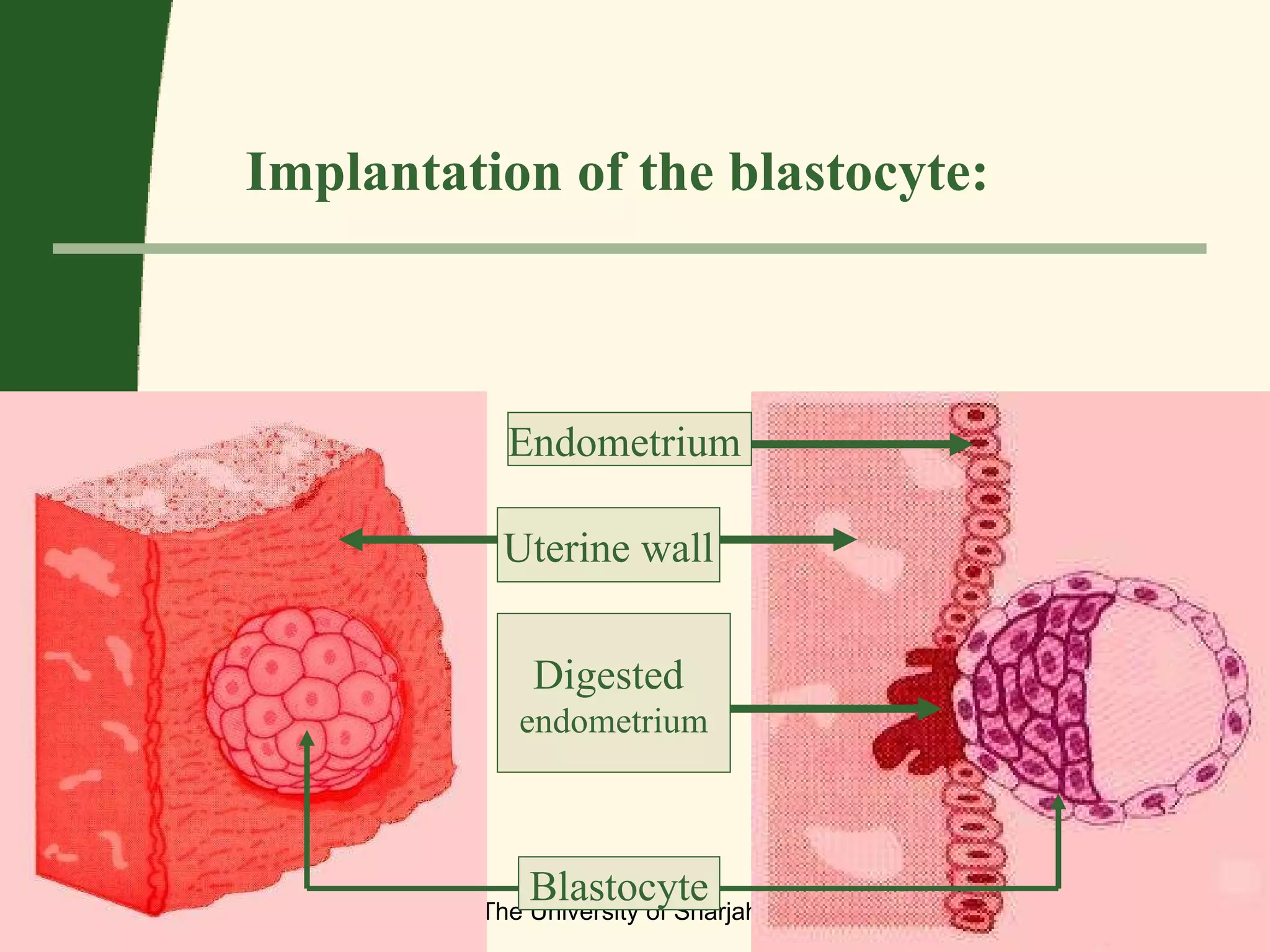
Copyright © 2006/07 The University of Sharjah slide  Implantation of the blastocyte: Uterine wall Endometrium  Digested  endometrium Blastocyte
Copyright © 2006/07 The University of Sharjah slide  Formation of embryonic layers: second week Ref:  Dental Embryology, Histology, and Anatomy Bilaminar embryonic disc  Secondary  Yolk sac Endometrium Hypoblast  amniotic cavity Epiblast
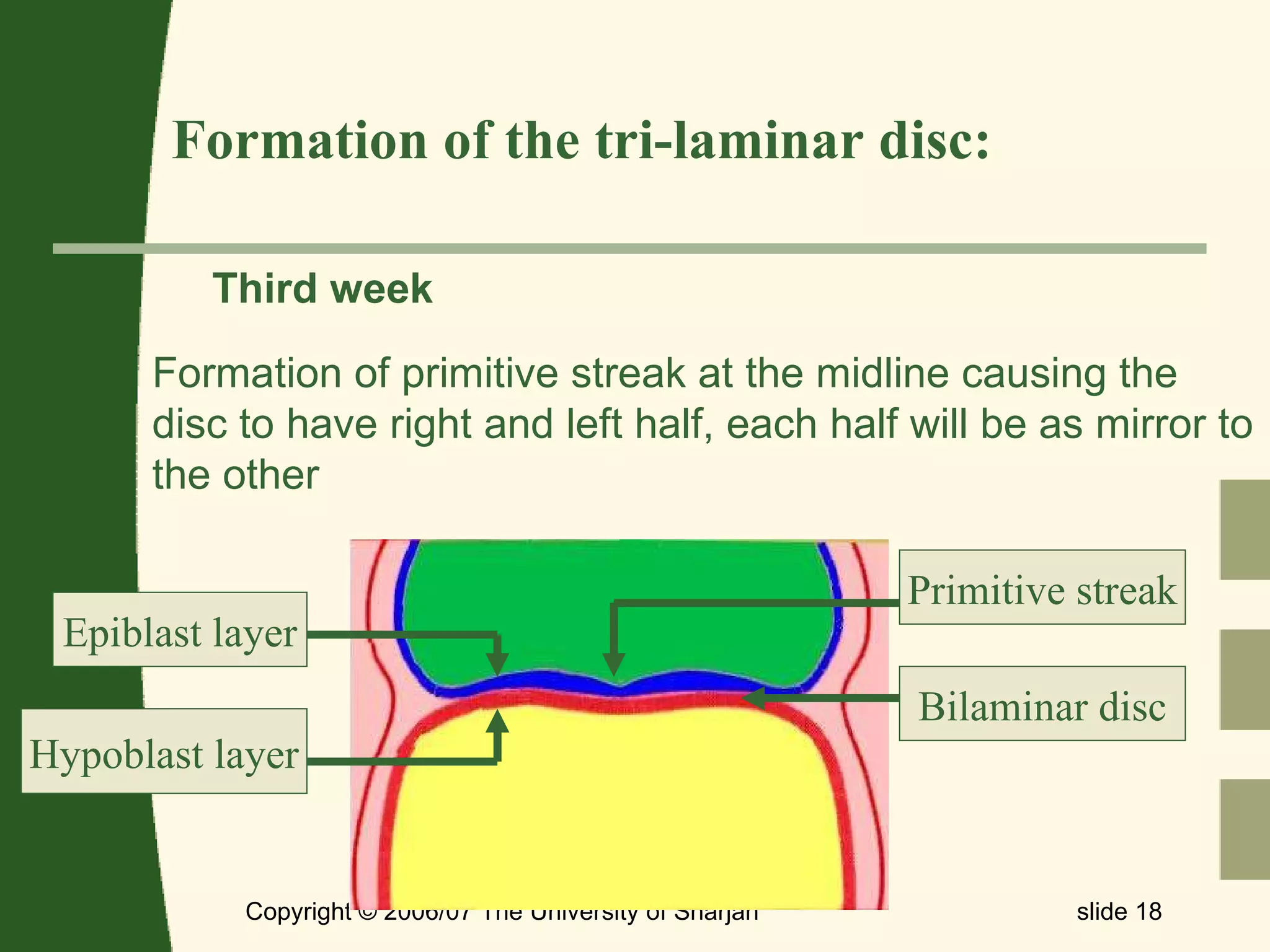
Copyright © 2006/07 The University of Sharjah slide  Formation of the tri-laminar disc:  Third week Formation of primitive streak at the midline causing the disc to have right and left half, each half will be as mirror to the other Primitive streak Bilaminar disc Epiblast layer Hypoblast layer
Copyright © 2006/07 The University of Sharjah slide  Formation of primitive streak  Formation of the tri-laminar disc:  UNSW Embryology 2007
Copyright © 2006/07 The University of Sharjah slide  Formation of the mesodermal layer:   Movement of some cells of epiblast toward hypoblast at the primitive streak forms a third embryonic layer called mesoderm.  Ectoderm  layer  Endoderm  layer  Mesoderm layer
Formation of Neural Crest Copyright © 2006/07 The University of Sharjah slide  The nervous system develops as a thickening within ectoderm giving the neural plate.
Formation of Neural Crest Neural plate : w ill fold to form neural groove Neural groove : fuses to form neural tube Neural tube :  Gives rise to brain and spinal cord Copyright © 2006/07 The University of Sharjah slide
Formation of Neural Crest Copyright © 2006/07 The University of Sharjah slide  UNSW Embryology 2007
Copyright © 2006/07 The University of Sharjah slide  Ref:  Human Anatomy & Physiology/ Marieb
Formation of Neural Crest Neural crest cells migrate throughout the body and give rise to: Cranial and sensory ganglia and nerves Sympathetic neurones Schwann cells Pigment cells Meninges Cartilage of branchial arches Most of the connective tissue of the face “ectomesenchyme” Copyright © 2006/07 The University of Sharjah slide  Ref:  Avery (2003)  Chapter 1992
Formation of Neural Crest Neural crest  is essential in development of the face, neck and oral tissues. All  tissues of a tooth and its supporting structures, except enamel, are derived from neural crest cells Copyright © 2006/07 The University of Sharjah slide  Ref:  Avery (2003)  Chapter 1992
Copyright © 2006/07 The University of Sharjah slide  The embryonic layers are distinct from each other and  give rise to specific tissues such as: Nervous system. Sensory epi.of eye , ear & nose. Epidermis, hair and nails. Mammary & cutaneous glands. Epi.of sinuses,oral & nasal cavities .  Intra-oral glands. Tooth enamel. Formation of the tissues: Ectoderm
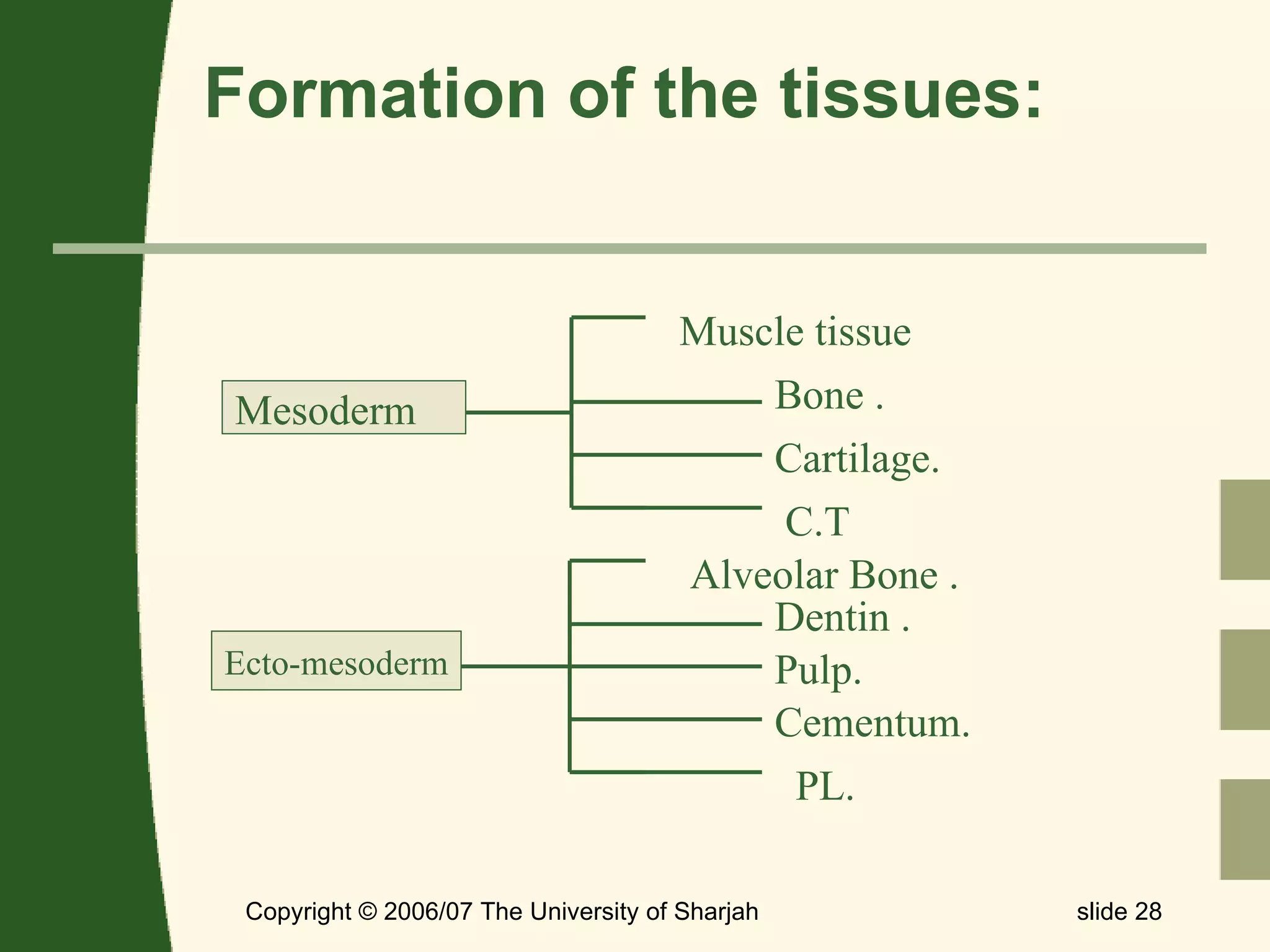
Formation of the tissues: Copyright © 2006/07 The University of Sharjah slide  Muscle tissue  C.T Bone . Cartilage. Pulp. Dentin . Cementum. PL.  Alveolar Bone . Mesoderm Ecto-mesoderm
Formation of the tissues: Copyright © 2006/07 The University of Sharjah slide  GI tract epithelium & associated glands. Ref:  Dental Embryology, Histology, and Anatomy Endoderm ECTODERM ENDODERM MESODERM
Folding of the embryo Folding in two planes: Along longitudinal axis to form the stomatodeum (primitive oral cavity) Copyright © 2006/07 The University of Sharjah slide  Ref:  Ten Cate (2003)  Chapter 2
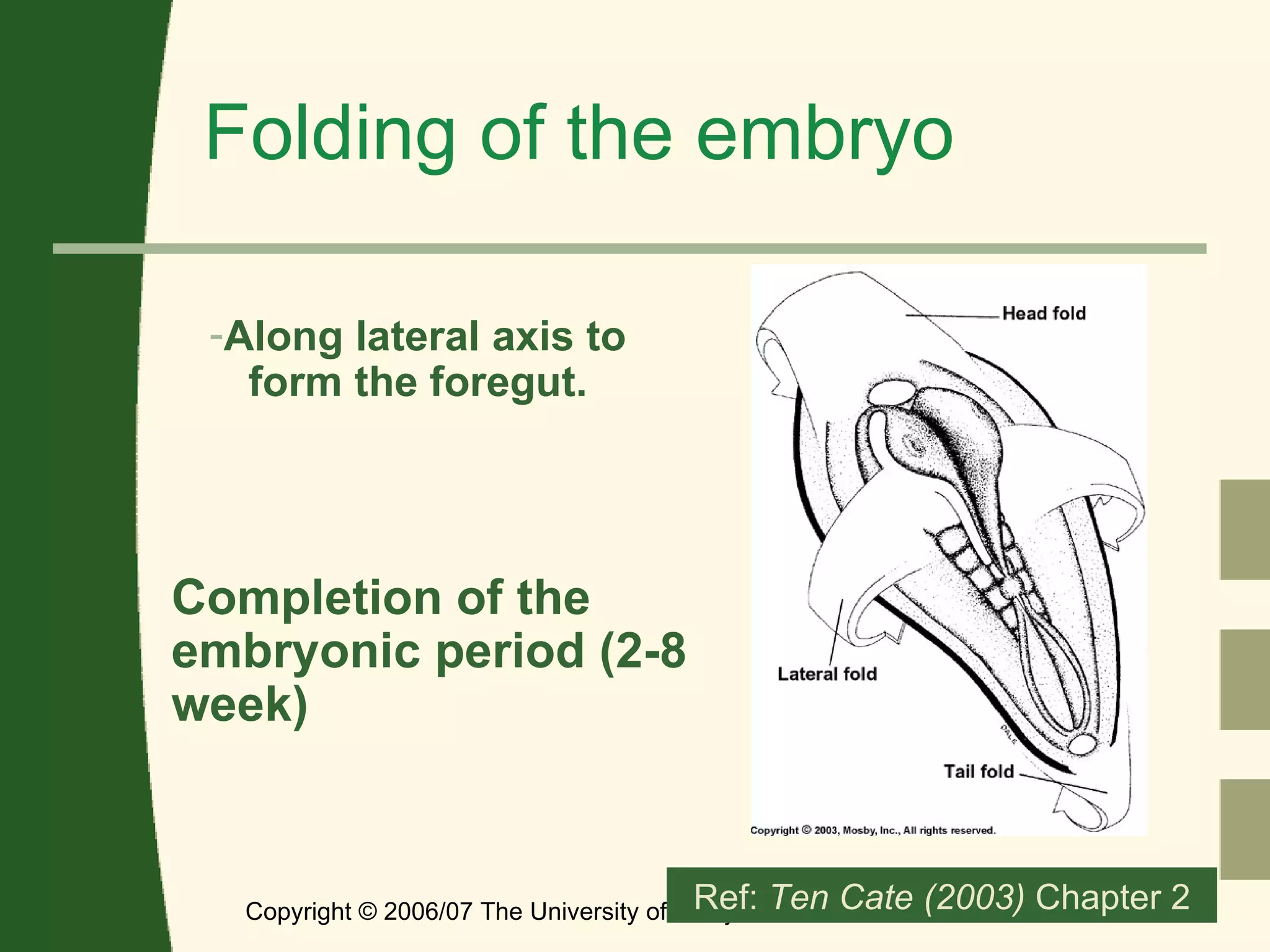
Folding of the embryo Copyright © 2006/07 The University of Sharjah slide  Ref:  Ten Cate (2003)  Chapter 2 Along lateral axis to form the foregut. Completion of the embryonic period (2-8 week)
Copyright © 2006/07 The University of Sharjah slide  Ten Cate (2003)  Chapter 2
Copyright © 2006/07 The University of Sharjah slide  Thank you

1 embryology

  • 1.
    DHS 2 GeneralEmbryology Lecture 1 Original Lecture: Prof. Grant Townsend, University of Adelaide Dr. Sausan Al Kawas University of Sharjah
  • 2.
    Objectives To providea general description of human embryological processes as follows: Germ cell formation & fertilization Prenatal development Induction, competence, and differentiation Formation of three-layerd embryo Formation of neural crest Formation of human tissues Folding of the embryo Copyright © 2006/07 The University of Sharjah slide
  • 3.
    Embryology Embryology is literally “the study of the embryo” More generally it refers to “the study of prenatal development” Embryo = 2-8 weeks Foetus = 9 weeks to birth Copyright © 2006/07 The University of Sharjah slide UNSW Embryology 2007
  • 4.
    Embryology Ontogeny : stages of development of an individual Teratology : study of abnormal development (congenital malformations) Copyright © 2006/07 The University of Sharjah slide UNSW Embryology 2007
  • 5.
    Mitosis and MeiosisCopyright © 2006/07 The University of Sharjah slide
  • 6.
    Gametogenesis Gametogenesis isa process of formation and development of male(sperm) and female (ovum)gametes. During this process a reduction of the the number of chromosomes takes place from diploid number (46) of primary germ cells to the haploid number (23) in the mature germ cell. Copyright © 2006/07 The University of Sharjah slide
  • 7.
    Gametogenesis It alsoinvolves the chromosomal and the cytoplasmic changes. These alteration of the shape of the primary germ cells allow them to become ready for fertilization. Copyright © 2006/07 The University of Sharjah slide
  • 8.
    Gametogenesis The largerounded primary male germ cells, lose most of their cytoplasm and develop head, tail and neck to assist in the movement of the sperms. The rounded female germ cells become larger as a result of increase in the a mount of their cytoplasm and called ovum. Copyright © 2006/07 The University of Sharjah slide Mature sperm Mature oocyte
  • 9.
    Fertilization The fertilizationoccur when sperm contacts an ovum to form a zygote in the uterine tube. The zygote, which contains 46 chromosomes, rapidly divide by mitosis to form mass of cells as 2,4, 8, 16, 32…. This mass of cells continue dividing in order to give the different tissues then organs of the human body. Copyright © 2006/07 The University of Sharjah slide Ref: Dental Embryology, Histology, and Anatomy
  • 10.
    General Embryology Copyright© 2006/07 The University of Sharjah slide These images reproduced from Dr. Di Marzo Mature Human Egg Fertilized Human Zygote 4 Cell Human Embryo UNSW Embryology 2010
  • 11.
    General Embryology FertilizationZygote Genotype, environment, phenotype Induction, competence, differentiation Formation of the three layered embryo Morula, blastocyst, bilaminar then trilaminar germ disc Ectoderm, endoderm, mesoderm Formation of neural crest cells Folding of the embryo Copyright © 2006/07 The University of Sharjah slide
  • 12.
    Copyright © 2006/07The University of Sharjah slide
  • 13.
    Copyright © 2006/07The University of Sharjah slide . General Embryology Ref: Dental Embryology, Histology, and Anatomy Uterine tube Uterus Ovary
  • 14.
    Copyright © 2006/07The University of Sharjah slide General Embryology Ref: Dental Embryology, Histology, and Anatomy Division of the zygote Zygote. Formation of the morula Morula Blastula
  • 15.
    Structure of theblastocyt (blastula): Copyright © 2006/07 The University of Sharjah slide
  • 16.
    Copyright © 2006/07The University of Sharjah slide Implantation of the blastocyte: Uterine wall Endometrium Digested endometrium Blastocyte
  • 17.
    Copyright © 2006/07The University of Sharjah slide Formation of embryonic layers: second week Ref: Dental Embryology, Histology, and Anatomy Bilaminar embryonic disc Secondary Yolk sac Endometrium Hypoblast amniotic cavity Epiblast
  • 18.
    Copyright © 2006/07The University of Sharjah slide Formation of the tri-laminar disc: Third week Formation of primitive streak at the midline causing the disc to have right and left half, each half will be as mirror to the other Primitive streak Bilaminar disc Epiblast layer Hypoblast layer
  • 19.
    Copyright © 2006/07The University of Sharjah slide Formation of primitive streak Formation of the tri-laminar disc: UNSW Embryology 2007
  • 20.
    Copyright © 2006/07The University of Sharjah slide Formation of the mesodermal layer: Movement of some cells of epiblast toward hypoblast at the primitive streak forms a third embryonic layer called mesoderm. Ectoderm layer Endoderm layer Mesoderm layer
  • 21.
    Formation of NeuralCrest Copyright © 2006/07 The University of Sharjah slide The nervous system develops as a thickening within ectoderm giving the neural plate.
  • 22.
    Formation of NeuralCrest Neural plate : w ill fold to form neural groove Neural groove : fuses to form neural tube Neural tube : Gives rise to brain and spinal cord Copyright © 2006/07 The University of Sharjah slide
  • 23.
    Formation of NeuralCrest Copyright © 2006/07 The University of Sharjah slide UNSW Embryology 2007
  • 24.
    Copyright © 2006/07The University of Sharjah slide Ref: Human Anatomy & Physiology/ Marieb
  • 25.
    Formation of NeuralCrest Neural crest cells migrate throughout the body and give rise to: Cranial and sensory ganglia and nerves Sympathetic neurones Schwann cells Pigment cells Meninges Cartilage of branchial arches Most of the connective tissue of the face “ectomesenchyme” Copyright © 2006/07 The University of Sharjah slide Ref: Avery (2003) Chapter 1992
  • 26.
    Formation of NeuralCrest Neural crest is essential in development of the face, neck and oral tissues. All tissues of a tooth and its supporting structures, except enamel, are derived from neural crest cells Copyright © 2006/07 The University of Sharjah slide Ref: Avery (2003) Chapter 1992
  • 27.
    Copyright © 2006/07The University of Sharjah slide The embryonic layers are distinct from each other and give rise to specific tissues such as: Nervous system. Sensory epi.of eye , ear & nose. Epidermis, hair and nails. Mammary & cutaneous glands. Epi.of sinuses,oral & nasal cavities . Intra-oral glands. Tooth enamel. Formation of the tissues: Ectoderm
  • 28.
    Formation of thetissues: Copyright © 2006/07 The University of Sharjah slide Muscle tissue C.T Bone . Cartilage. Pulp. Dentin . Cementum. PL. Alveolar Bone . Mesoderm Ecto-mesoderm
  • 29.
    Formation of thetissues: Copyright © 2006/07 The University of Sharjah slide GI tract epithelium & associated glands. Ref: Dental Embryology, Histology, and Anatomy Endoderm ECTODERM ENDODERM MESODERM
  • 30.
    Folding of theembryo Folding in two planes: Along longitudinal axis to form the stomatodeum (primitive oral cavity) Copyright © 2006/07 The University of Sharjah slide Ref: Ten Cate (2003) Chapter 2
  • 31.
    Folding of theembryo Copyright © 2006/07 The University of Sharjah slide Ref: Ten Cate (2003) Chapter 2 Along lateral axis to form the foregut. Completion of the embryonic period (2-8 week)
  • 32.
    Copyright © 2006/07The University of Sharjah slide Ten Cate (2003) Chapter 2
  • 33.
    Copyright © 2006/07The University of Sharjah slide Thank you

Editor's Notes

  • #22 In humans, the notochord forms in week 3, is eventually lost from vertebral regions and contributes to the nucleus pulposus of the intervertebral disc during the formation of the vertebral column.
  • #23 The central region of the ectoderm forms a columnar epithelium described as the neural plate. This epithelium will fold dorsally to form the neural groove , which then fuses to form an initially open at either end hollow neural tube . The neural tube forms the central nervous system (brain and spinal cord).