IMPLANTATION
M. Vharshini
M.Sc. 1st
year
Roll No.: 35
INTRODUCTION
Fertilization = Sperm + Ovum
Zygote
Cleavage formation
Compaction of morula
Blastocyst
Implantation
2
Implantation
Definition:
• Penetration of the blastocyst into the superficial (compact) layer of
the endometrium.
• The endometrium after implantation is called deciduas.
Time:
• Implantation occurs at the 6th
day after fertilization and is completed
about the 11th
day.
Site of implantation:
• Posterior wall of the uterine body in the functional layer of the
endometrium during the secretory phase of the cycle..
• Implantation in the lower segment leads to placenta praevia.
3
4
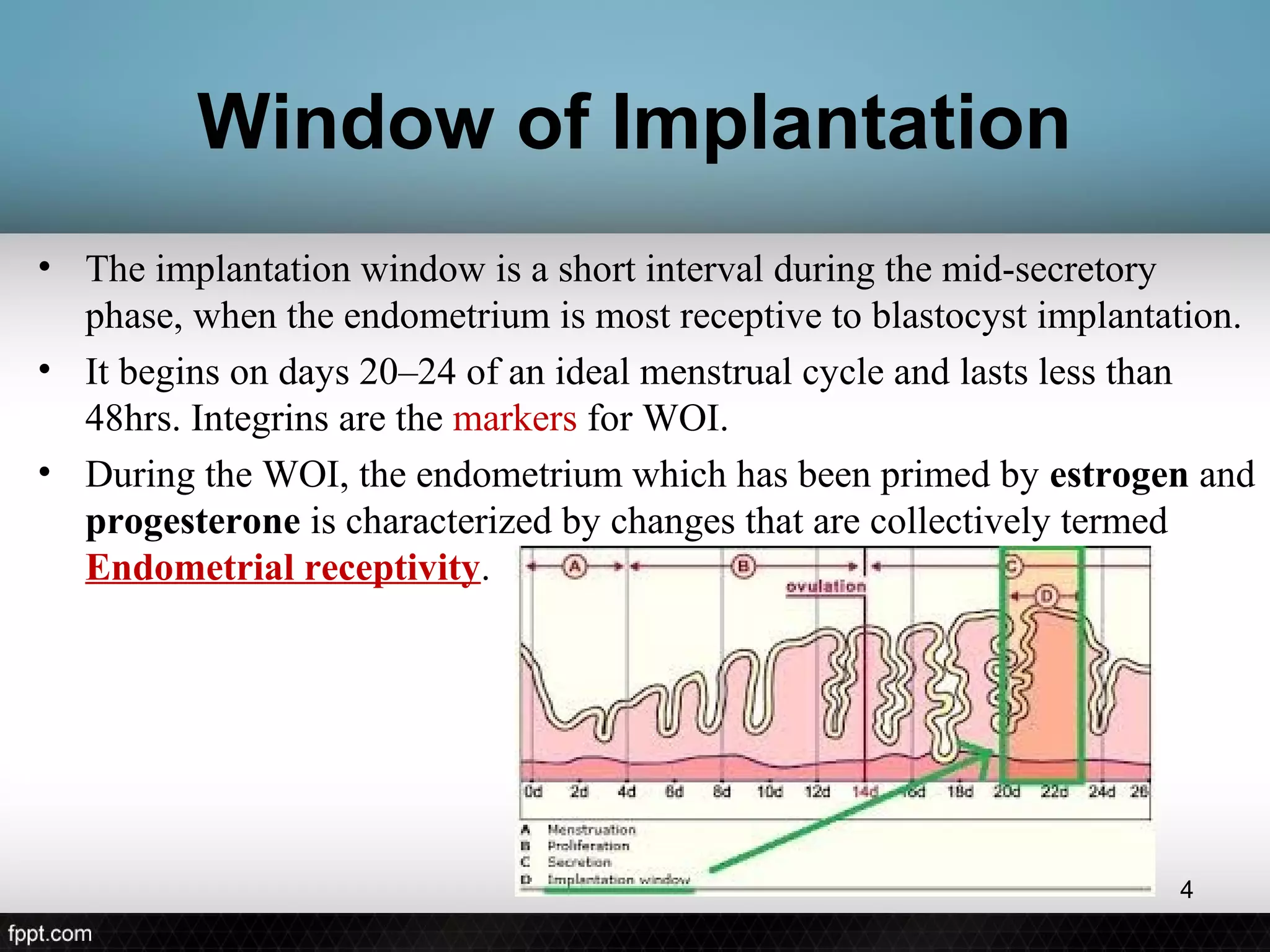
• The implantation window is a short interval during the mid-secretory
phase, when the endometrium is most receptive to blastocyst implantation.
• It begins on days 20–24 of an ideal menstrual cycle and lasts less than
48hrs. Integrins are the markers for WOI.
• During the WOI, the endometrium which has been primed by estrogen and
progesterone is characterized by changes that are collectively termed
Endometrial receptivity.
Window of Implantation
Pinopods
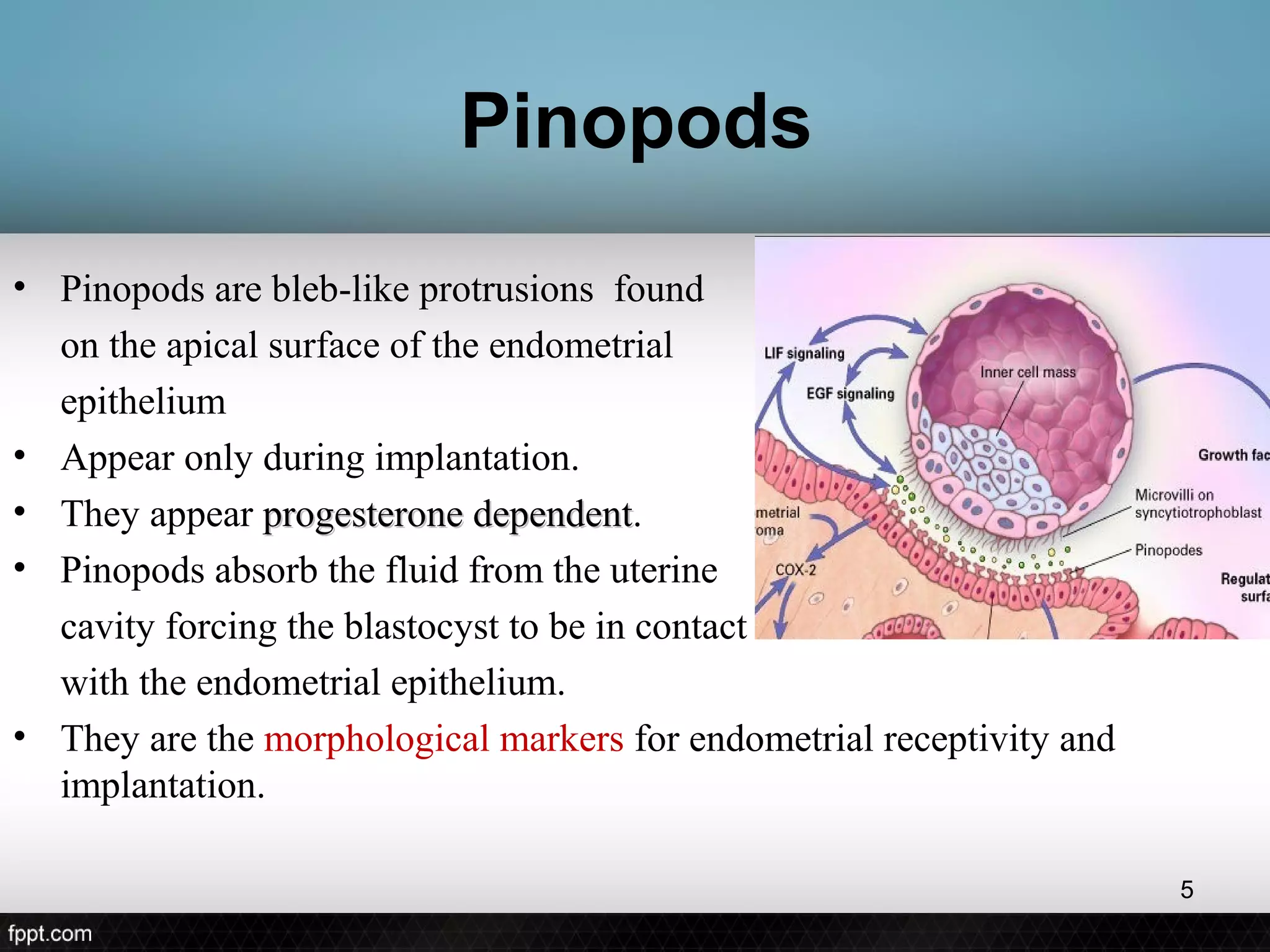
• Pinopods are bleb-like protrusions found
on the apical surface of the endometrial
epithelium
• Appear only during implantation.
• They appear progesterone dependentprogesterone dependent.
• Pinopods absorb the fluid from the uterine
cavity forcing the blastocyst to be in contact
with the endometrial epithelium.
• They are the morphological markers for endometrial receptivity and
implantation.
5
Decidualization
• Decidualization is a biological transformation by which the endometrial
stromal cells (fibroblast -like) differentiate into a highly specialized
secretory epithelioid cell type, termed decidual cellsdecidual cells.
• Decidualization occurs during the late secretory phase (D23-28) and is a
pre-requisite for successful blastocyst implantation.
• FUNCTIONS OF DECIDUAL CELLS:
• Controlled Trophoblast Invasion: Decidua forms a local micro environment to
promote trophoblast attachment & invasion as well as limit the extent of aggressive
invasion.
• Protection of Conceptus from Maternal Immune Rejection: Acts as a gate
keeper that controls immune tolerance during pregnancy by blocking T cells that
would otherwise attack the developing conceptus.
6
Stages of Implantation
7
HATCHING - blastocyst gets released
from zona pellucida
ADPLANTATION - blastocyst slowly "rolls"
on surface, aligns with the
ICM close to the epithelium.
APPOSITION - The very first, loose connection
between the blastocyst and the
endometrium.
ADHESION - The trophoblasts adhere by
penetrating the endometrium,
with protrusions of trophoblast cells.
INVASION - Invading into the uterine stroma
8
Invasion
9
• Blastocyst attaches to the endothermal epithelium, adjacent to
the embryonic pole.
• The trophoblast differentiates into two different cell masses:
– the outer syncytiotrophoblast (ST) ; multi-nucleated protoplasm
– the inner cytotrophoblast (CT)
• Finger-like processes of syncytiotrophoblast extend through
the endometrium and invade the endometrial connective
tissue.
• Day 7: Blastocyst gets implanted in the superficial compact
layer of endometrium & derives nourishment from it.
• Day 10: Blastocyst gradually embed deeper and the defect in
the endodermal epithelium is filled by closing plug which is
gradually repaired.
• Maternal blood filled lacunae appear in syncytiotrophoblast
establish primitive uteroplacental circulation.
Role of Mediators in
Implantation
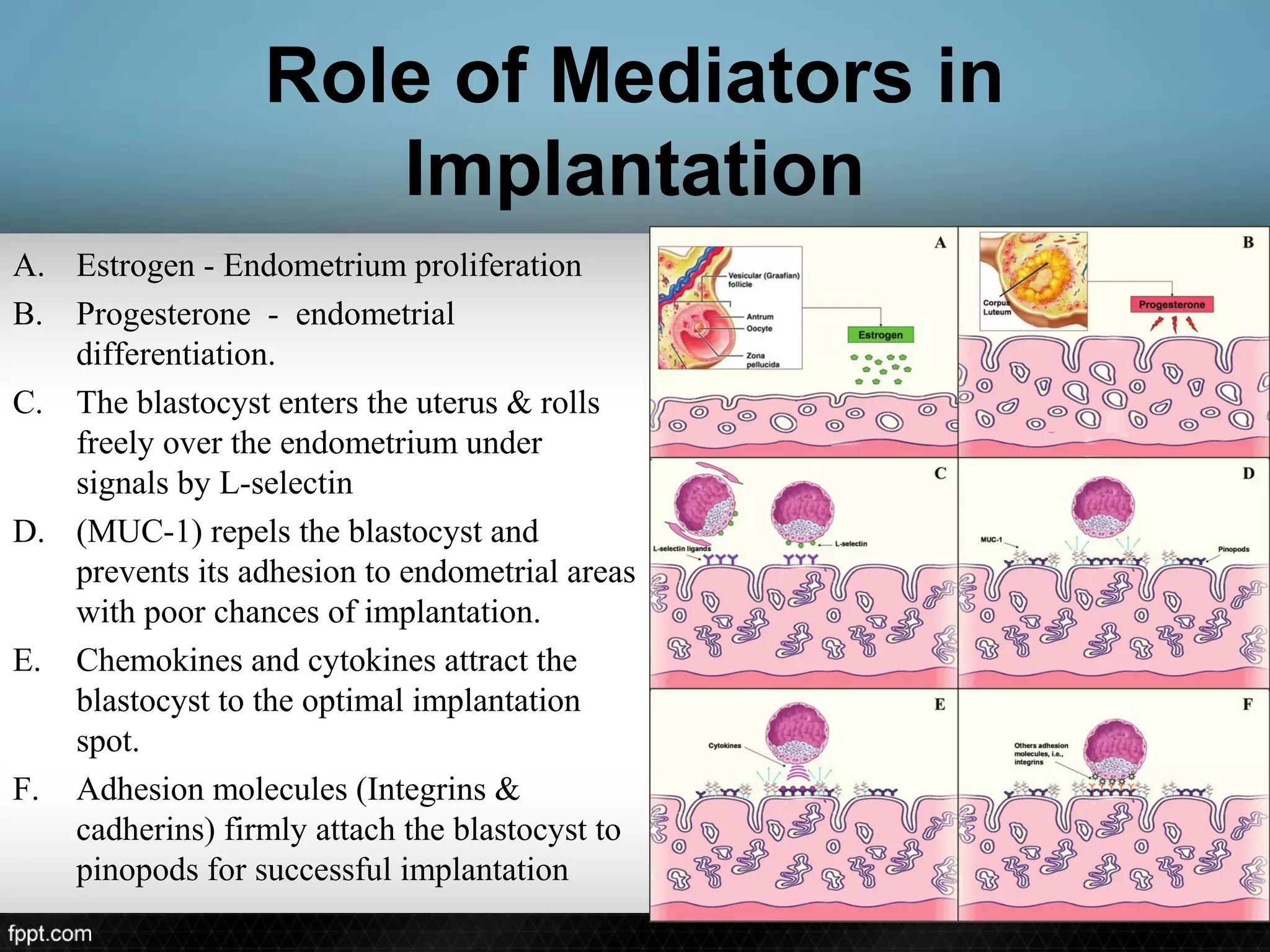
A. Estrogen - Endometrium proliferation
B. Progesterone - endometrial
differentiation.
C. The blastocyst enters the uterus & rolls
freely over the endometrium under
signals by L-selectin
D. (MUC-1) repels the blastocyst and
prevents its adhesion to endometrial areas
with poor chances of implantation.
E. Chemokines and cytokines attract the
blastocyst to the optimal implantation
spot.
F. Adhesion molecules (Integrins &
cadherins) firmly attach the blastocyst to
pinopods for successful implantation
10
Recurrent Implantation Failure
• Recurrent implantation failure (RIF) is a clinical entity which refers to repeated
failure of implantation.
• TYPES OF RECURRENT IMPLANTATION FAILURE:
11
Complication In Implantation
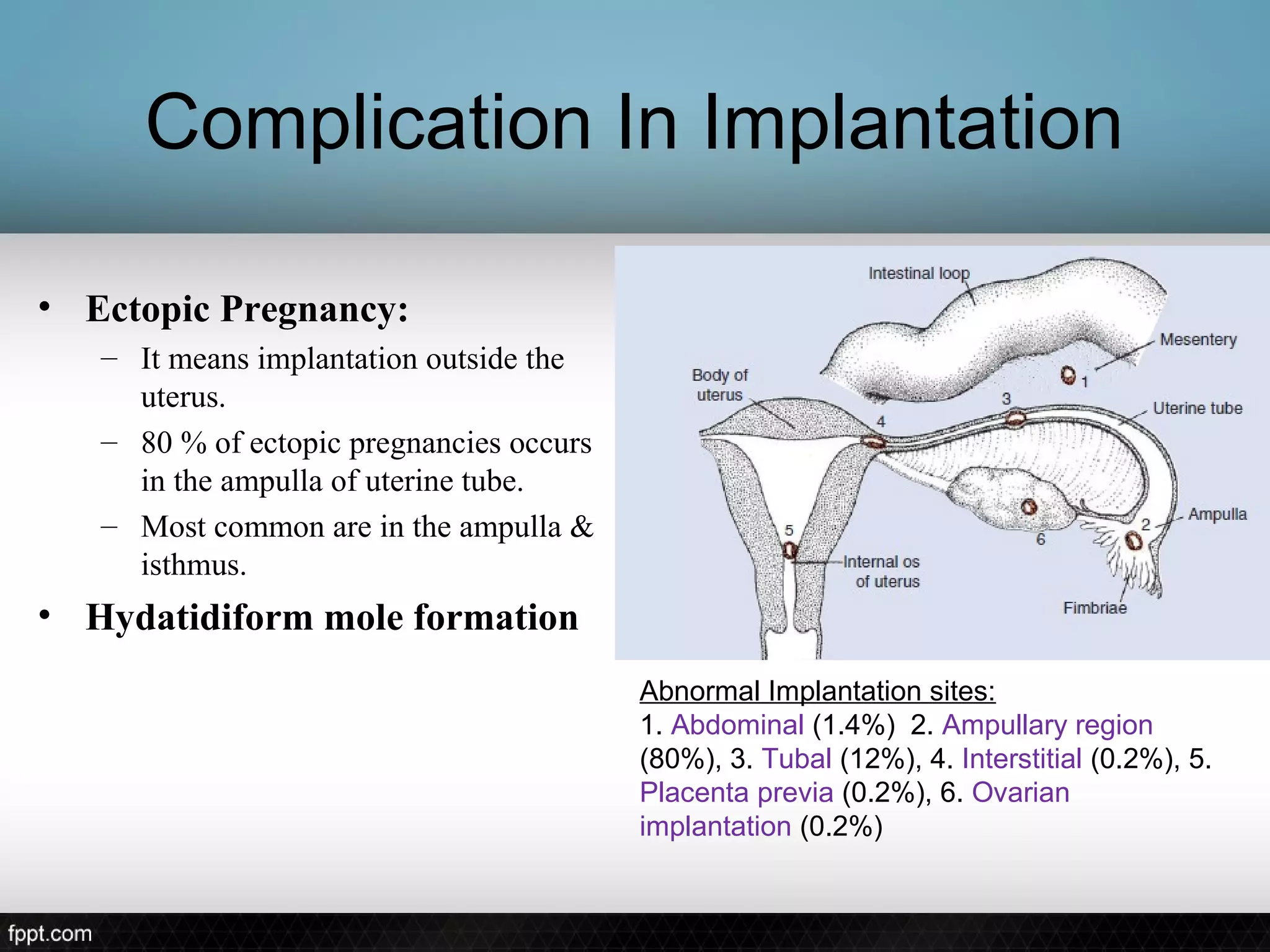
• Ectopic Pregnancy:
– It means implantation outside the
uterus.
– 80 % of ectopic pregnancies occurs
in the ampulla of uterine tube.
– Most common are in the ampulla &
isthmus.
• Hydatidiform mole formation
Abnormal Implantation sites:
1. Abdominal (1.4%) 2. Ampullary region
(80%), 3. Tubal (12%), 4. Interstitial (0.2%), 5.
Placenta previa (0.2%), 6. Ovarian
implantation (0.2%)
Complications in Pregnancy
• The invasion of cytotrophoblasts to the proper depth of the uterus is a major
factor in determining the outcome of pregnancy.
• Placenta accreta: Excessive invasion can lead to deficient development of the
decidua with abnormally firm attachment of the placenta directly onto the
myometrium.
• Placenta increta: Extension of the placenta into the myometrium
• Placenta percreta: Invasion through the myometrium to the uterine serosa and
even into adjacent organs.
• These disorders are associated with maternal illness and death, primarily due
to hemorrhage.
• Preeclampsia: Due to shallow invasion of cytotrophoblasts & more
endovscular invasion
13
References
BOOKS:
• Langman’s medical embryology,12th
edition.
• Textbook of clinical embryology by Kevin Coward & Dang Wells
ARTICLES:
• Hanna Achache & Ariel Revel; Endometrial receptivity markers, the
journey to successful embryo implantation. Human Reproduction
Update, Vol.12, No.6 pp. 731–746, 2006
• L. Aghajanova, A.E. Hamilton, et. al., Uterine receptivity to human
embryonic implantation: Histology, biomarkers, and transcriptomics.
Seminars in Cell & Developmental Biology 19 (2008) 204–211
14
THANK YOU
15

Implantation

  • 1.
  • 2.
    INTRODUCTION Fertilization = Sperm+ Ovum Zygote Cleavage formation Compaction of morula Blastocyst Implantation 2
  • 3.
    Implantation Definition: • Penetration ofthe blastocyst into the superficial (compact) layer of the endometrium. • The endometrium after implantation is called deciduas. Time: • Implantation occurs at the 6th day after fertilization and is completed about the 11th day. Site of implantation: • Posterior wall of the uterine body in the functional layer of the endometrium during the secretory phase of the cycle.. • Implantation in the lower segment leads to placenta praevia. 3
  • 4.
    4 • The implantationwindow is a short interval during the mid-secretory phase, when the endometrium is most receptive to blastocyst implantation. • It begins on days 20–24 of an ideal menstrual cycle and lasts less than 48hrs. Integrins are the markers for WOI. • During the WOI, the endometrium which has been primed by estrogen and progesterone is characterized by changes that are collectively termed Endometrial receptivity. Window of Implantation
  • 5.
    Pinopods • Pinopods arebleb-like protrusions found on the apical surface of the endometrial epithelium • Appear only during implantation. • They appear progesterone dependentprogesterone dependent. • Pinopods absorb the fluid from the uterine cavity forcing the blastocyst to be in contact with the endometrial epithelium. • They are the morphological markers for endometrial receptivity and implantation. 5
  • 6.
    Decidualization • Decidualization isa biological transformation by which the endometrial stromal cells (fibroblast -like) differentiate into a highly specialized secretory epithelioid cell type, termed decidual cellsdecidual cells. • Decidualization occurs during the late secretory phase (D23-28) and is a pre-requisite for successful blastocyst implantation. • FUNCTIONS OF DECIDUAL CELLS: • Controlled Trophoblast Invasion: Decidua forms a local micro environment to promote trophoblast attachment & invasion as well as limit the extent of aggressive invasion. • Protection of Conceptus from Maternal Immune Rejection: Acts as a gate keeper that controls immune tolerance during pregnancy by blocking T cells that would otherwise attack the developing conceptus. 6
  • 7.
    Stages of Implantation 7 HATCHING- blastocyst gets released from zona pellucida ADPLANTATION - blastocyst slowly "rolls" on surface, aligns with the ICM close to the epithelium. APPOSITION - The very first, loose connection between the blastocyst and the endometrium. ADHESION - The trophoblasts adhere by penetrating the endometrium, with protrusions of trophoblast cells. INVASION - Invading into the uterine stroma
  • 8.
  • 9.
    Invasion 9 • Blastocyst attachesto the endothermal epithelium, adjacent to the embryonic pole. • The trophoblast differentiates into two different cell masses: – the outer syncytiotrophoblast (ST) ; multi-nucleated protoplasm – the inner cytotrophoblast (CT) • Finger-like processes of syncytiotrophoblast extend through the endometrium and invade the endometrial connective tissue. • Day 7: Blastocyst gets implanted in the superficial compact layer of endometrium & derives nourishment from it. • Day 10: Blastocyst gradually embed deeper and the defect in the endodermal epithelium is filled by closing plug which is gradually repaired. • Maternal blood filled lacunae appear in syncytiotrophoblast establish primitive uteroplacental circulation.
  • 10.
    Role of Mediatorsin Implantation A. Estrogen - Endometrium proliferation B. Progesterone - endometrial differentiation. C. The blastocyst enters the uterus & rolls freely over the endometrium under signals by L-selectin D. (MUC-1) repels the blastocyst and prevents its adhesion to endometrial areas with poor chances of implantation. E. Chemokines and cytokines attract the blastocyst to the optimal implantation spot. F. Adhesion molecules (Integrins & cadherins) firmly attach the blastocyst to pinopods for successful implantation 10
  • 11.
    Recurrent Implantation Failure •Recurrent implantation failure (RIF) is a clinical entity which refers to repeated failure of implantation. • TYPES OF RECURRENT IMPLANTATION FAILURE: 11
  • 12.
    Complication In Implantation •Ectopic Pregnancy: – It means implantation outside the uterus. – 80 % of ectopic pregnancies occurs in the ampulla of uterine tube. – Most common are in the ampulla & isthmus. • Hydatidiform mole formation Abnormal Implantation sites: 1. Abdominal (1.4%) 2. Ampullary region (80%), 3. Tubal (12%), 4. Interstitial (0.2%), 5. Placenta previa (0.2%), 6. Ovarian implantation (0.2%)
  • 13.
    Complications in Pregnancy •The invasion of cytotrophoblasts to the proper depth of the uterus is a major factor in determining the outcome of pregnancy. • Placenta accreta: Excessive invasion can lead to deficient development of the decidua with abnormally firm attachment of the placenta directly onto the myometrium. • Placenta increta: Extension of the placenta into the myometrium • Placenta percreta: Invasion through the myometrium to the uterine serosa and even into adjacent organs. • These disorders are associated with maternal illness and death, primarily due to hemorrhage. • Preeclampsia: Due to shallow invasion of cytotrophoblasts & more endovscular invasion 13
  • 14.
    References BOOKS: • Langman’s medicalembryology,12th edition. • Textbook of clinical embryology by Kevin Coward & Dang Wells ARTICLES: • Hanna Achache & Ariel Revel; Endometrial receptivity markers, the journey to successful embryo implantation. Human Reproduction Update, Vol.12, No.6 pp. 731–746, 2006 • L. Aghajanova, A.E. Hamilton, et. al., Uterine receptivity to human embryonic implantation: Histology, biomarkers, and transcriptomics. Seminars in Cell & Developmental Biology 19 (2008) 204–211 14
  • 15.

Editor's Notes

  • #4 Implantation and the establishment of pregnancy are critical for human reproduction. Placenta praevia is when the placenta attaches inside the uterus but near or over the cervical opening.
  • #7 Process that closely resembles a mesenchymal–epithelial transition (MET), 3) when the uterus is primed for embryo attachment,