Copyright © 2010 Wolters Kluwer Health | Lippincott Williams & Wilkins
Lecture 1:
From Fertilization to
Gastrulation
Copyright © 2010 Wolters Kluwer Health | Lippincott Williams & Wilkins
Why Embryology?
• Birth defects are the leading cause of infant mortality.
• Birth defects are a major contributor to morbidity,
including physical and mental handicaps.
• All women of childbearing age are at risk of having an
infant with a birth defect. The incidence rate is 6/100
births.
• Each of you will have contact with women of
childbearing age; either as a friend, as a companion,
or as a patient. Or you are one yourself.
• MANY BIRTH DEFECTS CAN BE PREVENTED!
Copyright © 2010 Wolters Kluwer Health | Lippincott Williams & Wilkins
1st
Prenatal Visit: 8 Weeks
Copyright © 2010 Wolters Kluwer Health | Lippincott Williams & Wilkins
The First Week
Copyright © 2010 Wolters Kluwer Health | Lippincott Williams & Wilkins
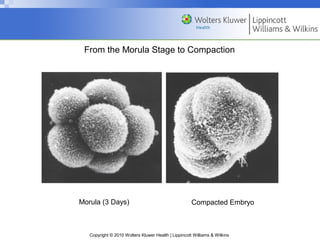
From the Morula Stage to Compaction
Morula (3 Days) Compacted Embryo
Copyright © 2010 Wolters Kluwer Health | Lippincott Williams & Wilkins
Formation of the Blastocyst and Implantation
Blastocyst (4-5 Days) Implanting Blastocyst (6 Days)
Syncytiotrophoblast
Cytotrophoblast
Copyright © 2010 Wolters Kluwer Health | Lippincott Williams & Wilkins
Hydatidiform Moles
• Formed from trophoblast
• Paternal genome (genomic imprinting)
• Secrete high levels of hCG
(syncytiotrophoblast)
• May become invasive (choriocarcinomas)
Copyright © 2010 Wolters Kluwer Health | Lippincott Williams & Wilkins
First Week of Development
Copyright © 2010 Wolters Kluwer Health | Lippincott Williams & Wilkins
Sites for Ectopic Pregnancies
Copyright © 2010 Wolters Kluwer Health | Lippincott Williams & Wilkins
Tubal Pregnancy
Copyright © 2010 Wolters Kluwer Health | Lippincott Williams & Wilkins
Ectopic Pregnancy in the Rectouterine (Douglas) Pouch
Copyright © 2010 Wolters Kluwer Health | Lippincott Williams & Wilkins
Assisted Reproductive
Technologies (ART)
Fertility treatments in which both the eggs and
sperm are handled in the laboratory (i.e., in vitro
fertilization and related procedures). Eggs and
sperm are placed in a culture medium; fertilized
eggs are placed in the uterus.
Copyright © 2010 Wolters Kluwer Health | Lippincott Williams & Wilkins
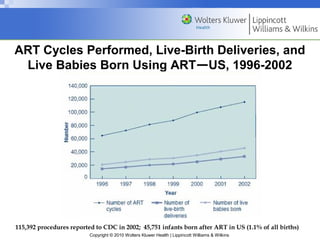
ART Cycles Performed, Live-Birth Deliveries, and
Live Babies Born Using ART—US, 1996-2002
115,392 procedures reported to CDC in 2002; 45,751 infants born after ART in US (1.1% of all births)
Copyright © 2010 Wolters Kluwer Health | Lippincott Williams & Wilkins
Adverse Outcomes Potentially
Associated with ART
• Embryo effects
• Spontaneous abortions
• Multiple births
• Adverse perinatal outcomes: low birth weight,
preterm delivery (even among singleton births)
• Birth defects
• Developmental disabilities
• Childhood malignancies
• Longer term outcomes?
• Effects on puberty/future fertility
• Effects on chronic disease risk
Copyright © 2010 Wolters Kluwer Health | Lippincott Williams & Wilkins
0
20
40
60
80
100
120
LBW VLBW Preterm
%adverseperinataloutcomes
Singletons Twins Triplets +
Percentage of Adverse Perinatal Outcomes
among ART Infants by Plurality -- US, 2002
Copyright © 2010 Wolters Kluwer Health | Lippincott Williams & Wilkins
Percent LBW among ART singletons (1996-1997)
compared to all singleton births to
non-teen mothers in US (1997)
Schieve et al., N Engl J Med 346:731-7, 2002
Copyright © 2010 Wolters Kluwer Health | Lippincott Williams & Wilkins
Large Meta-Analysis Study
30-40% Increased Risk of Birth
Defects from ART
From: Hansen et al., Human Reproduction, 20: 328, 2005
Copyright © 2010 Wolters Kluwer Health | Lippincott Williams & Wilkins
Implantation with Formation of Two Layers in the Embryoblast and the
Trophoblast
Implanting Blastocyst (6 Days) Implanted Embryo (7.5 Days)
Copyright © 2010 Wolters Kluwer Health | Lippincott Williams & Wilkins
Early Trophoblast (Placental) and Embryonic Development
9 Days
12 Days
13 Days
Yolk sac
cavity
Oropharyngeal
membrane
Copyright © 2010 Wolters Kluwer Health | Lippincott Williams & Wilkins
15 days15 Days
2nd Week = Week of Two’s
Cytotrophoblast: Syncytiotrophoblast &
Cytotrophoblast
Extraembryonic Mesoderm: Visceral (splanchnic) &
Parietal (somatic) Layers
Embryonic Disc: Epiblast & Hypoblast
(Parietal layer)
Extraembryonic
mesoderm
(Visceral layer)
Copyright © 2010 Wolters Kluwer Health | Lippincott Williams & Wilkins
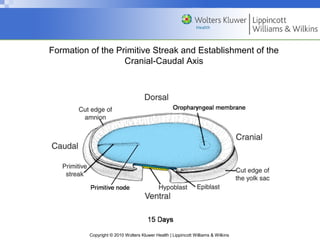
Formation of the Primitive Streak and Establishment of the
Cranial-Caudal Axis
Copyright © 2010 Wolters Kluwer Health | Lippincott Williams & Wilkins
BMPs: Hatched area = ventral mesoderm
(kidneys and body wall) and ectoderm
BMPs (goosecoid, brachyurea T) = dorsal
mesoderm (somites) and neural ectoderm
Anterior Visceral Endoderm (AVE) Induces the Cranial Region
Copyright © 2010 Wolters Kluwer Health | Lippincott Williams & Wilkins
Overexpression of Goosecoid in Frogs Causes Double-
Headed Tadpoles: Does It Cause This Defect in Humans?
Copyright © 2010 Wolters Kluwer Health | Lippincott Williams & Wilkins
Genetic Regulation of Laterality
Copyright © 2010 Wolters Kluwer Health | Lippincott Williams & Wilkins
Situs Inversus
Kartagener syndrome (20%)
Cilia malfunction with situs inversus
(bronchiectasis and sinusitis)
Laterality Sequences
Left or right sidedness
Asplenia (right)
Polysplenia (left)
Copyright © 2010 Wolters Kluwer Health | Lippincott Williams & Wilkins
Gastrulation: Formation of the 3 Germ Layers
14 Days 16 Days
Oropharyngeal membrane
Oropharyngeal
membrane
Copyright © 2010 Wolters Kluwer Health | Lippincott Williams & Wilkins
During Gastrulation, Epiblast Cells Move Toward the Primitive Streak,
Leave the Epiblast, and Create 2 New Layers
Oropharyngeal membrane
Copyright © 2010 Wolters Kluwer Health | Lippincott Williams & Wilkins
Formation of the Prechordal Plate and Notochord
Oropharyngeal membrane
Oropharyngeal
membrane
Copyright © 2010 Wolters Kluwer Health | Lippincott Williams & Wilkins
Formation of the Notochord
A
Cut lines for
C B
Oropharyngeal
membrane
Copyright © 2010 Wolters Kluwer Health | Lippincott Williams & Wilkins
The Three Germ Layers
Mesoderm
EndodermNotochord
(Part of the mesoderm)
Ectoderm
• Ectoderm: skin, CNS, PNS, eyes, internal
ear, neural crest cells (bones and connective
tissue of the face and part of the skull)
• Mesoderm: bones, connective tissue,
urogenital system, cardiovascular system
• Endoderm: gut and gut derivatives (liver,
pancreas, lungs, etc.)

From fertilization to gastrulation

  • 1.
    Copyright © 2010Wolters Kluwer Health | Lippincott Williams & Wilkins Lecture 1: From Fertilization to Gastrulation
  • 2.
    Copyright © 2010Wolters Kluwer Health | Lippincott Williams & Wilkins Why Embryology? • Birth defects are the leading cause of infant mortality. • Birth defects are a major contributor to morbidity, including physical and mental handicaps. • All women of childbearing age are at risk of having an infant with a birth defect. The incidence rate is 6/100 births. • Each of you will have contact with women of childbearing age; either as a friend, as a companion, or as a patient. Or you are one yourself. • MANY BIRTH DEFECTS CAN BE PREVENTED!
  • 3.
    Copyright © 2010Wolters Kluwer Health | Lippincott Williams & Wilkins 1st Prenatal Visit: 8 Weeks
  • 4.
    Copyright © 2010Wolters Kluwer Health | Lippincott Williams & Wilkins The First Week
  • 5.
    Copyright © 2010Wolters Kluwer Health | Lippincott Williams & Wilkins From the Morula Stage to Compaction Morula (3 Days) Compacted Embryo
  • 6.
    Copyright © 2010Wolters Kluwer Health | Lippincott Williams & Wilkins Formation of the Blastocyst and Implantation Blastocyst (4-5 Days) Implanting Blastocyst (6 Days) Syncytiotrophoblast Cytotrophoblast
  • 7.
    Copyright © 2010Wolters Kluwer Health | Lippincott Williams & Wilkins Hydatidiform Moles • Formed from trophoblast • Paternal genome (genomic imprinting) • Secrete high levels of hCG (syncytiotrophoblast) • May become invasive (choriocarcinomas)
  • 8.
    Copyright © 2010Wolters Kluwer Health | Lippincott Williams & Wilkins First Week of Development
  • 9.
    Copyright © 2010Wolters Kluwer Health | Lippincott Williams & Wilkins Sites for Ectopic Pregnancies
  • 10.
    Copyright © 2010Wolters Kluwer Health | Lippincott Williams & Wilkins Tubal Pregnancy
  • 11.
    Copyright © 2010Wolters Kluwer Health | Lippincott Williams & Wilkins Ectopic Pregnancy in the Rectouterine (Douglas) Pouch
  • 12.
    Copyright © 2010Wolters Kluwer Health | Lippincott Williams & Wilkins Assisted Reproductive Technologies (ART) Fertility treatments in which both the eggs and sperm are handled in the laboratory (i.e., in vitro fertilization and related procedures). Eggs and sperm are placed in a culture medium; fertilized eggs are placed in the uterus.
  • 13.
    Copyright © 2010Wolters Kluwer Health | Lippincott Williams & Wilkins ART Cycles Performed, Live-Birth Deliveries, and Live Babies Born Using ART—US, 1996-2002 115,392 procedures reported to CDC in 2002; 45,751 infants born after ART in US (1.1% of all births)
  • 14.
    Copyright © 2010Wolters Kluwer Health | Lippincott Williams & Wilkins Adverse Outcomes Potentially Associated with ART • Embryo effects • Spontaneous abortions • Multiple births • Adverse perinatal outcomes: low birth weight, preterm delivery (even among singleton births) • Birth defects • Developmental disabilities • Childhood malignancies • Longer term outcomes? • Effects on puberty/future fertility • Effects on chronic disease risk
  • 15.
    Copyright © 2010Wolters Kluwer Health | Lippincott Williams & Wilkins 0 20 40 60 80 100 120 LBW VLBW Preterm %adverseperinataloutcomes Singletons Twins Triplets + Percentage of Adverse Perinatal Outcomes among ART Infants by Plurality -- US, 2002
  • 16.
    Copyright © 2010Wolters Kluwer Health | Lippincott Williams & Wilkins Percent LBW among ART singletons (1996-1997) compared to all singleton births to non-teen mothers in US (1997) Schieve et al., N Engl J Med 346:731-7, 2002
  • 17.
    Copyright © 2010Wolters Kluwer Health | Lippincott Williams & Wilkins Large Meta-Analysis Study 30-40% Increased Risk of Birth Defects from ART From: Hansen et al., Human Reproduction, 20: 328, 2005
  • 18.
    Copyright © 2010Wolters Kluwer Health | Lippincott Williams & Wilkins Implantation with Formation of Two Layers in the Embryoblast and the Trophoblast Implanting Blastocyst (6 Days) Implanted Embryo (7.5 Days)
  • 19.
    Copyright © 2010Wolters Kluwer Health | Lippincott Williams & Wilkins Early Trophoblast (Placental) and Embryonic Development 9 Days 12 Days 13 Days Yolk sac cavity Oropharyngeal membrane
  • 20.
    Copyright © 2010Wolters Kluwer Health | Lippincott Williams & Wilkins 15 days15 Days 2nd Week = Week of Two’s Cytotrophoblast: Syncytiotrophoblast & Cytotrophoblast Extraembryonic Mesoderm: Visceral (splanchnic) & Parietal (somatic) Layers Embryonic Disc: Epiblast & Hypoblast (Parietal layer) Extraembryonic mesoderm (Visceral layer)
  • 21.
    Copyright © 2010Wolters Kluwer Health | Lippincott Williams & Wilkins Formation of the Primitive Streak and Establishment of the Cranial-Caudal Axis
  • 22.
    Copyright © 2010Wolters Kluwer Health | Lippincott Williams & Wilkins BMPs: Hatched area = ventral mesoderm (kidneys and body wall) and ectoderm BMPs (goosecoid, brachyurea T) = dorsal mesoderm (somites) and neural ectoderm Anterior Visceral Endoderm (AVE) Induces the Cranial Region
  • 23.
    Copyright © 2010Wolters Kluwer Health | Lippincott Williams & Wilkins Overexpression of Goosecoid in Frogs Causes Double- Headed Tadpoles: Does It Cause This Defect in Humans?
  • 24.
    Copyright © 2010Wolters Kluwer Health | Lippincott Williams & Wilkins Genetic Regulation of Laterality
  • 25.
    Copyright © 2010Wolters Kluwer Health | Lippincott Williams & Wilkins Situs Inversus Kartagener syndrome (20%) Cilia malfunction with situs inversus (bronchiectasis and sinusitis) Laterality Sequences Left or right sidedness Asplenia (right) Polysplenia (left)
  • 26.
    Copyright © 2010Wolters Kluwer Health | Lippincott Williams & Wilkins Gastrulation: Formation of the 3 Germ Layers 14 Days 16 Days Oropharyngeal membrane Oropharyngeal membrane
  • 27.
    Copyright © 2010Wolters Kluwer Health | Lippincott Williams & Wilkins During Gastrulation, Epiblast Cells Move Toward the Primitive Streak, Leave the Epiblast, and Create 2 New Layers Oropharyngeal membrane
  • 28.
    Copyright © 2010Wolters Kluwer Health | Lippincott Williams & Wilkins Formation of the Prechordal Plate and Notochord Oropharyngeal membrane Oropharyngeal membrane
  • 29.
    Copyright © 2010Wolters Kluwer Health | Lippincott Williams & Wilkins Formation of the Notochord A Cut lines for C B Oropharyngeal membrane
  • 30.
    Copyright © 2010Wolters Kluwer Health | Lippincott Williams & Wilkins The Three Germ Layers Mesoderm EndodermNotochord (Part of the mesoderm) Ectoderm • Ectoderm: skin, CNS, PNS, eyes, internal ear, neural crest cells (bones and connective tissue of the face and part of the skull) • Mesoderm: bones, connective tissue, urogenital system, cardiovascular system • Endoderm: gut and gut derivatives (liver, pancreas, lungs, etc.)

Editor's Notes

  • #13 So let’s start with a definition for ART – At CDC, we use the definition stipulated in the federal mandate (and really, the most commonly used medical definition). ART includes those treatments in which both eggs and sperm are retrieved and medically handled.
  • #14 115,392 procedures reported to CDC in 2002 45,751 infants born after ART in US (1.1% of all US births)
  • #15 This is a list of outcomes that are of concern; the actual empiric evidence is quite variable. Some have been fairly well studied, while for others, such effects on puberty, future fertility, and long-term chronic disease risk, there has been little to no study, but there is concern based on the data for more proximal outcomes. I’ve organized this list sequentially in terms of when an effect is observed, beginning with direct embryo effects such as fragmentation and cleavage rates and progressing to long-term child and adult outcomes. However, many of these effects may have similar origins and critical time periods for exposure.